|
Rolf Englund IntCom internetional
|
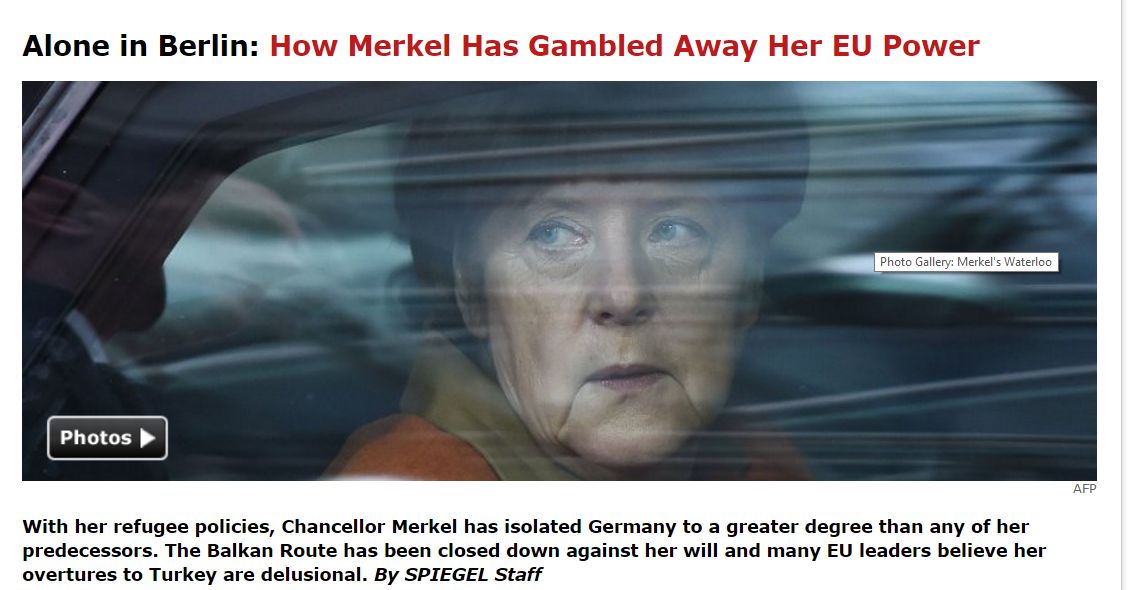
How the euro was saved
In the French seaside resort of Cannes
To the astonishment of almost everyone in the room, Angela Merkel began to cry.
the man sitting next to her, French President Nicolas Sarkozy, and the other across the table, US President Barack Obama
Peter Spiegel, Financial Times 11 May 2014
Europe’s Plan Z - The Grexit gamble
Part two of Peter Spiegel’s series from behind the scenes on how the euro was saved
"no single Plan Z document was ever compiled and no emails were exchanged between participants"
Financial Times 14 May 2014
‘If the euro falls, Europe falls’ - How the euro was saved - the third part
Angela Merkel was handed the piece of paper Barack Obama had just passed around.
“What is this?” the German chancellor asked. “I haven’t seen this before.”
A full-scale endorsement of a plan for the European Central Bank to protect eurozone countries when they came under attack from financial markets by automatically buying their bonds.
In retrospect, it marked the beginning of the final turning point in the crisis.
Peter Spiegel, Financial Times, 15 May 2014
Om man har en sedelpress går man inte i konkurs.
Det var varit det till synes självklara budskapet på denna blog ett antal gånger, första gången i november 2011.
Rolf Englund blog
The /German Constitutional/ court concludes that OMT violates the German constitution.
It accuses the ECB of making a power grab by extending its own mandate.
It says the scheme endangers the underpinnings of the eurozone rescue programmes.
Worse, it says OMT undermined deep principles of democracy.
Wolfgang Münchau, FT 9 February 2014
Tim Geithner recounts in his book Stress Test: Reflections on Financial Crises just how far the EU elites are willing to go to save the euro, even if it means toppling elected leaders and eviscerating Europe’s sovereign parliaments.
The former US Treasury Secretary says that EU officials approached him in the white heat of the EMU crisis in November 2011 with a plan to overthrow Silvio Berlusconi, Italy’s elected leader.
"They wanted us to refuse to back IMF loans to Italy as long as he refused to go," he writes.
Ambrose Evans-Pritchard, May 15th, 2014
Geithner told them this was unthinkable.
The US could not misuse the machinery of the IMF to settle political disputes in this way. "We can't have his blood on our hands".The revelations about EMU skulduggery are coming thick and fast. Tim Geithner recounts in his book Stress Test: Reflections on Financial Crises just how far the EU elites are willing to go to save the euro, even if it means toppling elected leaders and eviscerating Europe’s sovereign parliaments.
The former US Treasury Secretary says that EU officials approached him in the white heat of the EMU crisis in November 2011 with a plan to overthrow Silvio Berlusconi, Italy’s elected leader.
"They wanted us to refuse to back IMF loans to Italy as long as he refused to go," he writes.
Geithner told them this was unthinkable.
The US could not misuse the machinery of the IMF to settle political disputes in this way.
"We can't have his blood on our hands".
internetional.se/lehman911.htm#geitner
Don't blame Germany for the eurozone's travails, blame the euro itself
Germany didn’t set out to design an economic model that impoverishes much of the rest of Europe
Any attempt to set a single interest rate for 17 politically and fiscally sovereign nations is almost by definition doomed to failure.
Perpetual crisis is more or less guaranteed.
Jeremy Warner, Telegraph, 11 Nov 2013
Germany’s path to competitiveness: cutting the cost of labour.
Make no mistake; that has been the basis of the nation’s export success in the past dozen years;
and exports have been its sole consistent source of growth in that period.
But low wages are not the basis on which a rich nation should compete.
Adam Posen, president of the Peterson Institute for International Economics, FT 3 September 2013
Angela Merkel
After all, the German chancellor had grown up and reached adulthood in communist East Germany and
then risen to be not only the elected leader of a united Germany but Europe’s most respected politician.
She more than others understands that the price for unification in 1990 was
Germany’s acceptance of a common currency, a project unpopular with Germans
and agreed to only after assurances that the euro would be as strong as the revered dee mark.
MarketWatch July 11, 2014
SPIEGEL: How long can Brussels continue to impose austerity on countries like Spain and Greece,
a policy that the majority in those countries does not support?
Merkel: Bla, bla, bla
SPIEGEL: Once again, what makes you so confident that the countries in Southern Europe will subject themselves to your austerity mandate in the long run?
Merkel: Bla, bla, bla
SPIEGEL: Youth unemployment in Southern Europe is above 50 percent in some cases.
The austerity policies you have imposed are having disastrous consequences.
Der Spiegel 3 June 2013
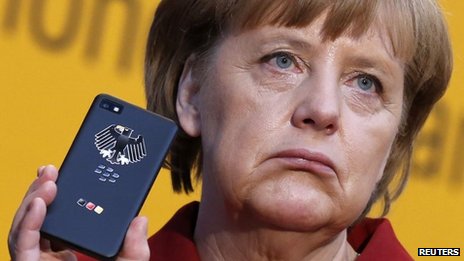
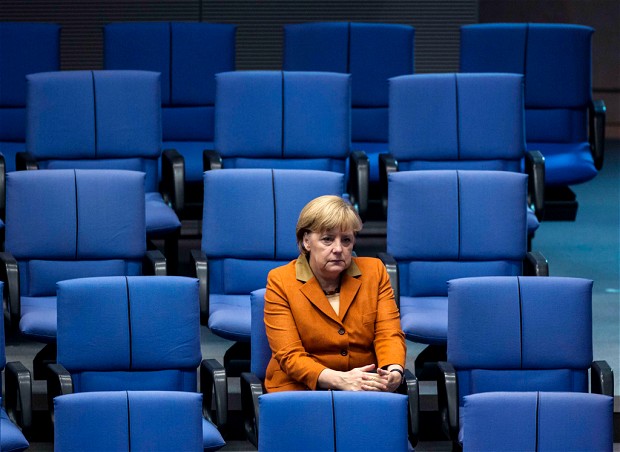
It is economic logic for the eurozone to break up. But since when has economic logic played a part in the EU? The political will has shown itself to be stronger than even I imagined.
Perhaps this attitude can best be summarised by a conversation I had with Angela Merkel, the German chancellor. I asked her if it would not be liberating for Greece to default and devalue its currency to get its economy back on track, as Iceland did?
Her reply was chilling.
“No,” Merkel said. “If Greece left the eurozone then other countries would want to leave
and that would be the end of our European dream.”
Nigel Farage, leader of the UK Independence Party, MEP, Financial Times 16 November 2012
What she meant was, whatever the suffering, the euro must survive at all costs.
Full text---
"You know, it's not over until the fat lady sings, as the saying goes," Ms Lagarde told reporters
when asked if she expected a deal to be forged at the meeting next week in Brussels.
Telegraph 16 November 2012
A crucial meeting of eurozone finance ministers next week will be key to getting Greece "back on its feet", IMF chief Christine Lagarde said, as she cut short her visit to Asia to attend the talks.
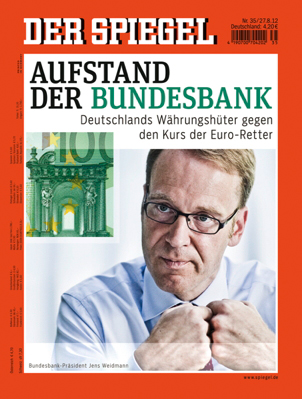
The president of the Bundesbank was once the mightiest central banker in Europe. No more.
In the council of the European Central Bank, Jens Weidmann is just one of 23.
He has only one vote – the same as Greece.
Josef Joffe, editor of Die Zeit and a fellow of the Hoover Institution at Stanford University, Financial Times 4 September 2012
This is the story of a historical bet gone badly wrong. After the fall of the Berlin Wall, chancellor Helmut Kohl offered the D-Mark to President François Mitterrand in exchange for French acceptance of German reunification.
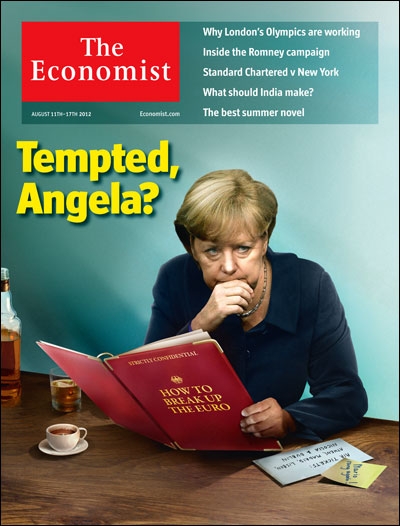
The Economist, The Merkel Memorandum och Plan B
Rolf Englund blog 10 augusti 2012
Germany's chancellor, Angela Merkel, who is among those forcefully pushing Greece to meet its ambitious savings targets,
said that her "heart bleeds" for the Greeks facing hardship as a consequence of swingeing cuts.(But)
Guardian, 17 September 2012
"I won't take part in pushing Greece out of the euro. That would have unforeseeable consequences," Merkel told students
during a discussion in Berlin's Neues Museum after she held a speech on the future of Europe - exactly 20 years after the day European Union leaders signed the Maastricht Treaty
Click here
Tyskarna gick in i EMU med en övervärderad kurs
Efter återföreningsbubblan som lämnade dem med en svag ekonomi i ett halvt decennium.
De arbetade långsamt tillbaka konkurrenskraften den hårda vägen, genom att pressa löner och driver upp produktiviteten.
Det är helt förståeligt att de nu tror att Club Med kan och bör göra samma sak.
De är helt fel, naturligtvis, eftersom Tyskland kunde sänka relativlöner under
a) en global boom, b) mot andra EMU-stater som inflaterade C) och med räntor som var låga även under de svåra åren.
Ingen av dessa faktorer gäller Italien eller Spanien nu.
Ambrose Evans-Pritchard, 2 December 2011
The Germans entered EMU at an overvalued rate
after the Reunification bubble, leaving them in semi-slump for half a decade.
They slowly clawed back competitiveness the hard way, by squeezing wages and driving up productivity.
It is entirely understandable that they now think Club Med can and should do the same.
They are profoundly wrong, of course, because Germany was able to lower relative wages during
a) a global boom, b) against other EMU states that were inflating c) and with benchmark borrowing cost that stayed low even during the dog days.
None of these factors apply to Italy or Spain now.
Ambrose Evans-Pritchard, December 2nd, 2011
Few have realised the most dangerous feature of Emu: it has locked Germany into a seriously uncompetitive real exchange rate
Martin Wolf, Financial Times, March 31, 1999
Wolodarski och Tysklands framgång med Ådalsmetoden
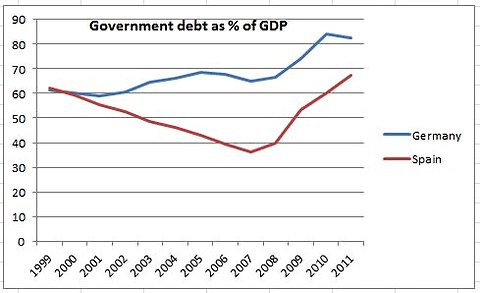
Merkel ändrar grundlagen för att lättare flytta makt till Bryssel
Rolf Englund blog 2011-11-14
Ms. Merkel,Madame Nein until she has persuaded her colleagues to amend the euro-zone treaty
to permit Brussels (spelled B-e-r-l-i-n) to control the tax, spending and fiscal policy of euro-zone members.
Work on that final piece of the still incomplete architecture of a united Europe will begin at the next euro-zone leaders' meeting on Dec. 9.
At that meeting, the shark that is the euro zone will resume its forward motion.
Unless, of course, many of the member nations prefer leaving the euro zone to becoming part of what they have taken to calling the Fourth Reich.
Irwin Stelzer, director of economic policy studies at the Hudson institute, Wall Street Journal 28/11 2011
The problem, as European leaders understand it, is that the European Council (composed of member-states) routinely blinked when it came to penalizing violators, including Germany and France.
Last week's deal supposedly makes the sanctions "automatic" by shifting enforcement authority to, of all places, the European Court of Justice.
The notion that justices in Luxembourg would levy and enforce financial sanctions on an already-bankrupt member-state is obviously absurd.
The actual enforcement mechanism remains what it is-the Germans' willingness to pay.
Put bluntly, credible enforcement means German puppet regimes in Rome, Athens, Madrid, and perhaps Paris.
Michael S. Greve, Timbros storastyster American Enterprise Institute, December 13, 2011
While there aren't going to be German tanks in Athens or anywhere else, the Brussels deal does illustrate the deeper, constitutional problem with heaping yet more authority on a government-over-governments.
We’re not occupiers, says Greek task force
Horst Reichenbach, who was appointed leader of the task force in September, acknowledged in an interview he had
underestimated how much his German nationality would inflame local sensitivities and complicate his mission.
Financial Times November 25, 2011
"The challenge of our generation is to finish what we started in Europe, and that is to bring about, step by step, a political union,"
Merkel told the party congress in the east German city of Leipzig, CNBC 14 Nov 2011
Making the European Monetary Union, by Harold James, Harvard University Press
It was an aspiration first formulated in 1970 in the so-called Werner plan
Review by Tony Barber, Financial Times December 16, 2012
It is sometimes said that the euro’s creation was the price demanded by Germany’s European allies for supporting German reunification during the collapse of eastern European and Soviet communism. Reunification supposedly filled Europe’s Lilliputian nations with such fright that they scrambled for a means to tie down the new German Gulliver. The single currency fitted the bill.
In his careful reconstruction of the political, financial and bureaucratic processes that led to the euro’s launch in 1999, Harold James demonstrates that the trail towards European monetary union was, in truth, blazed long before anyone dared even imagine the anti-communist revolutions of 1989-91.
It was an aspiration first formulated in 1970 in the so-called Werner plan, named after Pierre Werner, a prime minister of Luxembourg.
Om Maastrichts föregångare, den s k Werner-planen ur boken
"Vår framtid i Europa" (MUF, 1971) av Jan Brännström, Rolf Englund och Claes-Henric Siven
"The challenge of our generation is to finish what we started in Europe,
and that is to bring about, step by step, a political union,"
Merkel told the party congress in the east German city of Leipzig, CNBC 14 Nov 2011
Vi har glömt det nu – och då det begav sig försvann alltsammans i allmän segeryra och Europaretorik.
Men Mitterrand fick Helmut Kohl att ge upp den tyska D-marken i utbyte mot den europeiska euron.
Richard Swartz, Kolumn DN, 24 november 2012
Svårt var det inte: Kohl tillhör den kanske sista generation av tyska politiker som utan reservationer sätter likhetstecken mellan tyska och europeiska intressen.
Euron – “tekniskt” illa genomtänkt i vad som kallas ett icke optimalt valutaområde – skulle bli Europas nya instrument att hålla Tyskland i schack.
While Germans celebrated the collapse of the Berlin Wall, Helmut Kohl and Francois Mitterand were at war over the consequences of a united Germany.
Secret government documents obtained by Der Spiegel appear to show that Bonn was forced to sacrifice the Deutschmark for reunification.
Presseurope, 1 October 2010
With link to Der Spiegel
The Price of Unity Was the Deutsche Mark Sacrificed for Reunification?
09/30/2010
Newly revealed German government documents reveal that many in Helmut Kohl's Chancellery had deep doubts about a European common currency when it was introduced in 1998.
First and foremost, experts pointed to Italy as being the euro's weak link. The early shortcomings have yet to be corrected.
Der Spiegel, 8 May 2012
It was shortly before his departure to Brussels when the chancellor was overpowered by the sheer magnitude of the moment. Helmut Kohl said that the "weight of history" would become palpable on that weekend; the resolution to establish the monetary union, he said, was a reason for "joyful celebration."
Soon afterwards, on May 2, 1998, Kohl and his counterparts reached a momentous decision.
Eleven countries were to become part of the new European currency, including Germany, France, the Benelux countries -- and Italy.
The euro was not a German project. Quite the reverse.
German voters wanted to hold on to their currency.
It was pressed by those, led by France, who wanted to break the D-Mark zone.
The euro was the price Helmut Kohl paid to Mitterrand to win his blessing for reunification.
Philip Stephens, Financial Times 18 April 2013
"The 50 Days That Changed Europe" explains how the EU grew
from a six-nation trade alliance to a 27-country behemoth with its own currency.
in Strasbourg on Dec. 9, 1989, after the Berlin Wall fell,
Germany agreed to monetary union in order to get President Mitterand to agree to German reunification
WSJ 23 Sept 2011
Mrs. Siebelink tells of one summit in Strasbourg on Dec. 9, 1989, after the Berlin Wall fell, which turned out to be the day that Germany agreed to monetary union in order to get French President François Mitterand to agree to German reunification.
But the difficulty of understanding the EU is that so many of its important days are not about history.
They're just about the EU and meetings and the normal tick-tock of an institutional bureaucracy at work
The European election results showed euroscepticism rising across most of Europe.
But the really shocking factor for the euro elites should have been the strength of the vote for the Front National in France.
For the EU’s history – and its future – turns on France.
President Mitterrand exacted agreement to the euro as the price of France’s support for German reunification.
This only made sense if it was believed that the euro was in French interests and against Germany’s.
This is not quite how things have worked out
Roger Bootle, 1 June 2014
Ville Kohl ha euron, som Rolf Gustavsson påstår, eller blev han tvingad?
Rolf Englund blog 7 oktober 2012
Twenty years after the Maastricht Treaty, which was designed not just to integrate Europe
but to contain the might of a united Germany,
Berlin had effectively united Europe under its control, with Britain all but shut out.
New York Times, 9 December 2011
Valutaunionens rötter, kommunismens fall för 20 år sedan kom att bli eurons definitiva startskott
Den franske presidenten Mitterrand ställde då ett ultimatum:
för att acceptera ett tyskt enande var landet tvunget att ge upp sin D-mark och gå med på ett stärkt EU-samarbete.
Tyskland ville egentligen inte ha en gemensam valuta, men accepterade samarbetet på villkor att det inte fick drag av en traditionell valutaunion.
Peter Wolodarski, Signerat DN 21 augusti 2011
Förbundskansler Helmut Kohl gick med på förslaget – landsmännens skepsis till trots – och ett fördrag undertecknades senare i den holländska staden Maastricht.
när medlemmarna vid upprepade tillfällen tillåter sig att bryta mot reglerna, och två av syndarna är Tyskland och Frankrike, då förlorar valutasamarbetet ram och stadga. Och i en finanskris blir centralbankens passivitet och bristen på ekonomisk politik snabbt fatal.
Den europeiska krisen handlar inte längre om att ge stöd till mindre länder som Grekland, Portugal och Irland.
Den har övergått till vad som händer med stora ekonomier som Spanien, Italien och Frankrike om marknaderna inte lugnas.
Eurokrisen är på väg att omfatta en tredjedel av hela valutaunionen eller 130 procent av Tysklands ekonomi.
Inte konstigt att börsen har fallit kraftigt på sistone.
Om Italien får problem, då innebär det också att franska och tyska banker som har skulder i Italien får problem
Charles Wyplosz, en av Europas ledande makroekonomer, pekar i likhet med allt fler på Europeiska centralbanken.
Det som akut krävs för att lugna marknaden är att ECB – som har obegränsad tillgång till euro – garanterar att inget euroland ställer in betalningarna
Angela Merkel, som har sin bakgrund i DDR, blev tysk förbundskansler som en konsekvens av den tyska återföreningen. Det vore en ödets ironi och en historisk galenskap om hon lät euron krascha.
Angela Merkel föddes i Hamburg i dåvarande Västtyskland i en prästfamilj.
Hon kom med sin familj som barn till staden Templin i dåvarande Östtyskland, där hon växte upp.
Läs mer här
Charles Wyplosz, professor of economics at the Graduate Institute in Geneva, warned that he saw parallels with 1980s-era Japan,
where so-called zombie banks weighed down with bad investments tried to improve their financial standing by simply withholding new loans.
HOWARD SCHNEIDER The Washington Post 20 August 2011
Mr. Trichet may be remembered “as a charming and talented leader who failed to grasp the gravity of the crisis,”
said Charles Wyplosz, a professor of economics at the Graduate Institute in Geneva.
http://www.nytimes.com/2011/08/06/business/global/jean-claude-trichet-builder-of-the-euro-ends-his-career-on-a-bitter-note.html
Helmut Schlesinger, was president of the Bundesbank when sterling was forced out of the European Exchange Rate Mechanism in 1992.:
- And I would say that either we get the United States of Europe, that is an actual political union, and then that political union gets its own currency.
But then it is no monetary union any longer, but the currency of that new state.
Robert Peston, BBC Business editor, 17 May 2012
Förbundskansler Helmut Kohl gick med på förslaget – landsmännens skepsis till trots – och ett fördrag undertecknades senare i den holländska staden Maastricht.
Thatcher lade oförblommerat fram sin uppfattning för den man som hade makt att hindra den tyska återföreningen.
Gorbatjov svarade att Sovjetunionen var väl insatt i problemet, och hon kunde vara lugn.
Hans land ville lika lite som Storbritannien se ett enat Tyskland.
Det var värdefullt att de båda kände till varandras syn på denna ömtåliga fråga.
Till råga på allt lät François Mitterrand och fransmännen ledningen i Moskva förstå att de var inne på samma linje.
Timothy Garton Ash, DN
Mitterrand forderte Euro als Gegenleistung für die Einheit
Aus bisher geheim gehaltenen Protokollen geht nach SPIEGEL-Informationen hervor: Erst die Bereitschaft der Kohl-Bundesregierung, ihren Widerstand gegen die Einführung des Euro aufzugeben, ebnete den Weg zur Einheit.
Der Spiegel 25/9 2010
Der frühere Bundesbank-Präsident Karl-Otto Pöhl wurde noch deutlicher:
"Möglicherweise wäre die Europäische Währungsunion gar nicht zustande gekommen ohne deutsche Einheit."
Den tyske förbundskanslern Helmut Kohl tog denna oro på allvar och accepterade tanken på valutaunionen, som ett sätt att förankra det nya starka Tyskland i Europasamarbetet.
Resultatet blev Maastrichtfördraget.
Inför hotet om ett sönderfall kan man enas om åtgärder som vanligtvis ökar EU:s överstatliga karaktär.
Mats Hallgren, e24 21/12 2010
More Very important articles about EMU and the Financial Crisis
For those willing and able to examine our present situation with a reasonably open mind,
a comparison of the recent history of the Spanish and German economies can prove illuminating
As Wolfgang Munchau pointed out in the FT yesterday, Germany entered the eurozone at an uncompetitive exchange rate and embarked on a long period of (quite painful) wage moderation and deep structural reform.
A Fistful Of Euros, 31 August 2010 with many nice charts
Merkel’s Christian Democrats shellshocked after Bremen elections
A disaster for Angela Merkel’s CDU. Coming in third behind the Greens is traumatic for the Christian Democrats
Eurointelligence 24 May 2011
Frankfurter Allgemeine Zeitung and Süddeutsche Zeitung report on the soul searching within the CDU which comes to the depressing conclusion that it is no longer able to win majorities in an urban population.
Right now Europe may be embarking on a path that could tilt the union away from economic liberalism,
risking a split and, ultimately, even a British exit.
Mrs Merkel seems to be sleepwalking into this danger.
The Economist print 10/3 2011
Merkel följer folkets vilja
Kärnkraften har ingen framtid
Aftonbladet ledare, signerad Katrine Kielos, 2011-05-31
”Kärnkraften har ingen framtid... den är inte heller lämplig som en övergångsteknologi, tvärtom står den i vägen för nya och innovativa lösningar samt en framtidsorienterad omstrukturering av energiutbudet.” Citatet kommer varken från en trädkramande Greenpeace-aktivist, eller en miljöpartist med idéer om att framtidens välstånd ska växa på postindustriella träd.
Det är IG Metall, de tyska metallarbetarnas mäktiga fackförbund, som uttalar sig.
Natten till i går enades förbundskansler Angela Merkels regeringskoalition om att alla tyska kärnkraftverk ska stängas 2022. För Merkel var det ännu en politisk U-sväng
(”vår kansler är inte gjord av stål, hon är gjord av pudding”, som Der Spiegel nyligen skrev).
Förra veckan beslutade den schweiziska regeringen att fasa ut kärnkraften till 2034. Samtidigt har planerna för att bygga kärnkraftverk i Italien stoppats. Likaså i Thailand.
I Sverige sitter däremot en centerpartistisk miljöminister och beklagar den tyska avvecklingen.
Pakten löser inte eurons problem
Fredrik Reinfeldt vill inte uttala sig, och precis som statsministern påpekade: vad är det han ska uttala sig om?
Det finns inget papper och inga detaljer nerskrivna än. Men faktum kvarstår: Tysklands Angela Merkel och Frankrikes Nicolas Sarkozy föreslår en ”fransk-tysk konkurrenspakt” för eurozonen.
Allt ska vara bestämt om drygt en månad och nej, det finns inget papper.
Aftonbladet ledare, signerad Katrine Kielos, 12/2 2011
Någon verklig plan för hur man ska utjämna obalanserna inom EMU finns inte. Den underliggande politiska analysen handlar om att eftersom finanssektorn har orsakat krisen, så ska vanliga löntagare betala och förslaget går långt in och petar i nationella angelägenheter som kollektivavtal.
Skulle det genomföras är det naturligtvis ännu svårare att se ett euro-medlemskap för svensk del.
Katrine Kielos hos Aftonbladet
zc
Keep an eye on Austria, with an increasingly unstable banking system,
and the Netherlands, with slow growth and a massively over-indebted household sector.
Don’t assume that Germany can sail through this crash unscathed either. Its economy has been driven by exports to China, worth $100bn a year.
If China slows down dramatically, we may well find that the German economy is a lot weaker than we thought.
Matthew Lynn, Telegraph 24 Aug 2015
Unless Gordon Brown turned out to be right after all, and 'boom and bust' actually has been abolished, it was always going to come to a stop sometime. That’s how the market works
The eurozone was in a bad enough state already. But in a bear market, fresh cracks will emerge, just as they did in 2009 and 2010 in the wake of the last collapse.
When the French finance minister Mr Sapin arrived in Brussels at midday, he received a shock:
Wolfgang Schäuble, the German finance minister, was armed with a one-page paper advocating
a Greek “timeout from the eurozone” for “at least the next five years”
if Athens did not accept the bloc’s exacting conditions for a new bailout.
FT 17 July 2015
Weimar and Greece
Paul Krugman, 15 February 2015
Weimar, it’s never about the deflationary effects of the gold standard and austerity in 1930-32,
which is, you know, what brought you-know-who to power.
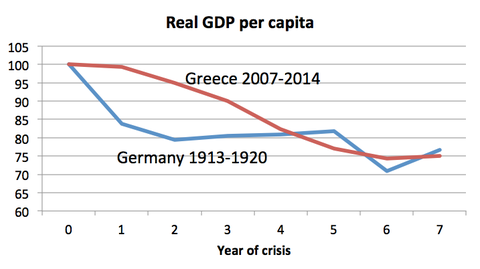
Är det tyskarna som är The Good Guys inom Euroland?
Rolf Englund 15 Februari 2015
Athanasios Orphanides, a former member of the ECB’s governing council, said it potentially broke EU rules.
“It is as if it’s accepted that the euro area’s modus operandi is to clear things with Germany,
and for the ECB to constrain its actions to what is best for Germany,” he told the Financial Times.
“This is inconsistent with and violates the [EU] treaty.”
FT 20 January 2015
The destruction of the Reichsmark’s value is an important historical lesson.
But missing from that narrative is the painful deflation that followed hyperinflation.
In 1923, at the height of the hyperinflation, 751,000 Germans were without work.
By 1932, as deflation began to bite, unemployment hit 5.6m.
Financial Times 18 January 2015
The European Court of Justice has declared
legal supremacy over the sovereign state of Germany, and therefore of Britain, France, Denmark and Poland as well.
If the Karlsruhe accepts this, the implication is that Germany will no longer be a fully self-governing sovereign state.
"This Union" - meaning the Union to which EU integrationists aspire
- is currently blocked by the German court, the last safeguard of our nation states against encroachment.
Ambrose Evans-Pritchard, 14 Jan 2015
What must change is the way in which nations are treated like wayward children.
People not just in the periphery, but in Italy and France, the euro’s second and third countries,
and the EU’s co-founders, are fed up with being dictated to.
It does not help when the orders themselves are wrong-headed,
as in the case of universally applied demand-destroying economic policies.
Financial Times editorial December 29, 2014
2015 must be the year when the eurozone’s most influential leaders lift their eyes from technocratic fixes to the wider horizons of politics.
That does not mean fiscal or political union.
If all the euro’s member states and, more importantly, their peoples,
were freely willing to take such a step, this newspaper would welcome it.
But the tolerance for further integration is at rock bottom.
This is due in part to the antagonising politics and contractionary policies with which the eurozone chose to confront the crisis.
It is also because of the overdone claim that “there is no alternative”.
The current path instead converges on a German model, not just in fiscal matters but more critically in the nature of structural reforms. Germany’s are credited with growth and employment, but they brought under-investment, precarious jobs and wage stagnation.
Top of pagePolicy makers remain wilfully blind to the reality that the debt problem is unresolved,
and that the eurozone’s outstanding public sector borrowings will never be repaid in full.
The West German economic miracle was launched from a clean balance sheet while the Allies remained heavily indebted.
John Plender, FT December 29, 2014
Some are born great, some achieve greatness, and some have greatness thrust upon ’em.
Germany did not seek the euro. On the contrary, it was a price others foolishly asked Germans to pay for unification.
German policy makers understood the political and economic implications of a currency union.
Those of almost all other would-be members did not.
Martin Wolf, FT December 9, 2014
The economic doctrines central to German conventional wisdom are those of a small open economy.
Debt restructuring must now be on the table, starting with Greece. Ireland, similarly, should be freed of the onerous burden of bailing out the foolish foreign creditors of its banks.
"The 50 Days That Changed Europe"
In Strasbourg on Dec. 9, 1989, after the Berlin Wall fell,
Germany agreed to monetary union in order to get President Mitterand to agree to German reunification
Wall Street Journal, 23 Sept 2011
“Be not afraid of greatness. Some are born great, some achieve greatness, and others have greatness thrust upon them.”
William Shakespeare, Twelfth Night
Germany’s policymakers deny the eurozone’s crisis-ridden countries a more active fiscal policy;
refuse to support a European investment agenda to generate demand and growth;
have declared a fiscal surplus, rather than faster potential growth, as their primary domestic goal;
and have begun turning against the European Central Bank (ECB) in the struggle against deflation and a credit crunch.
On all four counts, Germany is wrong.
Marcel Fratzscher, Project Syndicate 21 November 2014
Marcel Fratzscher, a former head of International Policy Analysis at the European Central Bank, is President of DIW Berlin, a research institute and think tank, and a professor of macroeconomics and finance at Humboldt University.
To be sure, Germany is justified in rejecting narrow-minded calls by France and Italy for unconditional fiscal expansion.
After all, fiscal stimulus can work only if it supports private investment and is accompanied by much more ambitious structural reforms – the kind of reforms that France and Italy are currently resisting.
The key to ending the European crisis is a stimulus plan that addresses deficiencies on both the supply and demand sides.
That is why Germany’s refusal to help find a way to finance the proposed European investment agenda – which, for a limited time, would fund productive private investment – is a mistake.
Equally problematic is Germany’s focus on maintaining a fiscal surplus.
The Germans have a name for their unique economic framework: ordoliberalism.
Wolfgang Münchau FT 16 November 2014
Mario Draghi's efforts to save EMU have hit the Berlin Wall
If the ECB tries to press ahead with QE, Germany's central bank chief will resign.
If it does not do so, the eurozone will remain stuck in a lowflation trap and Mario Draghi will resign
Ambrose Evans-Pritchard, 5 November 2014
Deep Divisions Emerge over ECB Quantitative Easing Plans
Some view /ECB/ bond purchases as unavoidable, as the euro zone could otherwise slide into dangerous deflation
Others warn against a violation of the ECB principle, which prohibits funding government debt by printing money.
Der Spiegel, 3 November 2014
Otmar Issing, ECB’s former chief economist, one of my Gurus,
apparantly does not understand that Germany no longer is an idependent state, regarding monetary policy.
Rolf Englund blog 24 October 2014
ECB should abolish its OMT program – which, according to Germany’s Constitutional Court, does not comply with EU treaty law anyway.
Furthermore, the ECB should reintroduce the requirement that TARGET2 debts be repaid with gold, as occurred in the US before 1975
The fiscal compact – formally the Treaty on Stability, Coordination, and Governance in the Economic and Monetary Union
French Prime Minister Manuel Valls and his Italian counterpart, Matteo Renzi, have declared – or at least insinuated –
that they will not comply with the fiscal compact to which all of the eurozone’s member countries agreed in 2012
Their stance highlights a fundamental flaw in the structure of the European Monetary Union
– one that Europe’s leaders must recognize and address before it is too late.
Hans-Werner Sinn, Project Syndicate 22 October 2014
German model is ruinous for Germany, and deadly for Europe
The Hartz IV reforms – so widely praised as the foundation of German competitiveness,
and now being foisted on southern Europe – did not raise productivity
Ambrose Evans-Pritchard 8 Oct 2014
The Hartz IV reforms – so widely praised as the foundation of German competitiveness, and now being foisted on southern Europe – did not raise productivity, the proper measure of labour reform.
Prof Fratzscher says the chief effect was to let companies compress wages through labour arbitrage. Real pay has fallen back to the levels of the late 1990s.
The legacy of Hartz IV is a lumpen-proletariat of 7.4m people on “mini-jobs”, part-time work that is tax-free up to €450. This flatters the jobless rate, but Germany has become a split society, more unequal than at any time in its modern history. A fifth of German children are raised in poverty.
Germany’s path to competitiveness: cutting the cost of labour.
Make no mistake; that has been the basis of the nation’s export success in the past dozen years;
and exports have been its sole consistent source of growth in that period.
But low wages are not the basis on which a rich nation should compete.
Adam Posen, president of the Peterson Institute for International Economics, FT 3 September 2013
Germany's Ukip threatens to paralyse eurozone rescue efforts
Alternative für Deutschland winning 12.6pc of the vote in Brandenburg and 10.6pc in Thuringia
Ambrose Evans-Pritchard (11,7k Twitterföljare), 23 September 2014
The new movement calls for an “orderly break-up” of monetary union, either by dividing the euro into smaller blocs or by returning to national currencies.
“Germany doesn’t need the euro, and the euro is hurting other countries. A return to the D-mark should not be a taboo,” it says.
Club Med states should recover viability through debt restructuring, rather than rely on taxpayer bail-outs that draw out the agony.
Unlike Ukip, the movement wants Germany to stay in a “strong EU”.
S&P said a forthcoming judgment by the European Court on the ECB’s backstop plan for Italy and Spain (OMT) might further constrain the EU rescue machinery. Germany’s top court has already ruled that the OMT “manifestly violates” EU treaties and is probably ultra vires, meaning that Bundesbank may not legally take part.
The political climate in the eurozone’s two core states is now extraordinary.
A D-Mark party is running at 10pc in the latest polls in Germany,
while the Front National’s Marine Le Pen is in the lead in France on 26 pc with calls for a return to the franc.
One more shock would test EMU cohesion to its limits.
Top of page with link also to German Constitutional Court
Europe’s banking union is set to face a challenge in Germany’s constitutional court,
a development that threatens to generate renewed uncertainty over one of the main responses to the eurozone’s financial crisis.
EU’s banking union is illegal under German law because it was created without the necessary treaty changes.
FT July 27, 2014
EU behöver inte en till tysk seger
Matteo Renzi, Italiens populäre socialdemokratiske premiärminister, har tagit över ordförandeklubban i EU
och utmanar Tyskland gällande åtstramningspolitiken.
Lycka till, säger kommentariatet, britterna förlorade nyss med 7-1.
Eller 26-2 för att använda de faktiska röstsiffrorna i rådet.
Men man ska nog inte räkna ut Matteo Renzi.
Katrine Kielos, Aftobladet 13 juli 2014
The argument between Italy and Germany asks a question at the heart of the currency’s future
Can an arrangement that will always fall well short of a textbook monetary union
be at once economically robust and politically sustainable?
Philip Stephens, FT 10 July 2014
David Cameron insisted on a show of hands, that leaders take responsibility for their decision.
The prime minister told them they would regret their decision and that they were taking
"an irreversible step, handing power to the European Parliament and away from the heads of government".
It was a sad day, he said.
But Angela Merkel defended the candidate she had been so lukewarm about just a few weeks ago.
She described him as a man who understood Europe and could balance the wishes of both the national governments and the European Parliament.
Later the German chancellor appeared to reach out to Britain.
She said that ever-closer union did not mean a one-speed Europe.
Gavin Hewitt, BBC 27 June 2014
David Cameron will hold crisis talks in Sweden on Monday with Angela Merkel in a further high-risk bid to persuade the German chancellor to drop support for the federalist Jean-Claude Juncker
Downing Street said that the prime minister, who will also be joined by the anti-Juncker prime ministers of Sweden and the Netherlands
to discuss the impasse, would be open to new names coming forward, and the idea of a woman taking the job
http://www.theguardian.com/world/2014/jun/07/david-cameron-new-bid-stop-jean-claude-juncker
Cameron, Reinfeldt, Merkel
Toppmöte på Harpsund om Juncker
Rolf Englund blog 8 juni 2014
The German economy Clouds ahead
Recent vigour hides underlying weaknesses in Europe’s leading economy
The Economist print edition June 7th 2014
I notice that the European Parliament’s president Martin Schulz (a socialist from the opposing bloc) is
calling for everybody to “accept the inevitable” and close ranks behind the Juncker juggernaut.
But he could hardly have chosen language more exasperating language,
since it is the presumption of inevitability that is most repugnant.
Ambrose Evans-Pritchard, June 6th, 2014
Schäuble explained that, as far as decisions over OMT bond purchases are concerned, the ECB ”cannot make these decisions because it has bound them to conditions that are beyond its control.”
Schäuble said that these conditions are decided by the European Stability Mechanism, the European governments’ bail-out program.
“ESM decisions are subject to a unanimous vote and we will not approve of such a program as announced by the ECB,” Schäuble explained
— buttressing a belief that, after a two-year interregnum, euro-area jitters may be about to restart.
David Marsh, MarketWatch, June 4, 2014
German wages fell 0.2pc in 2013. Germany too is in wage deflation.
Which raises the question: how on earth are France, Italy, Spain, Portugal, and Greece supposed to claw back lost labour competitiveness against Germany
by means of "internal devaluations" if German wages are falling?
Ambrose Evans-Pritchard, February 20th, 2014
Outright Monetary Infractions
The Court has now declared that it fully endorses the plaintiffs' arguments, and that the OMT program does indeed violate EU primary law.
Since its launch in 2012, the OMT program has allowed the ECB to buy, if necessary, unlimited amounts of troubled euro zone countries' government bonds,
provided the affected countries subscribe to the rules of Europe's rescue fund, the European Stability Mechanism.
Hans-Werner Sinn/Project Syndicate/CNBC, 10 Feb 2014
The /German Constitutional/ court concludes that OMT violates the German constitution.
It accuses the ECB of making a power grab by extending its own mandate.
It says the scheme endangers the underpinnings of the eurozone rescue programmes.
Worse, it says OMT undermined deep principles of democracy.
Wolfgang Münchau, FT 9 February 2014
In a speech setting out her priorities for the next parliamentary term, the German chancellor
Ms Merkel called for a “real economic union” in Europe through treaty change
saying that the current level of economic co-ordination in the eurozone is unsatisfactory.
The eurozone is currently in a state of “deceptive calm” in which the crisis is “under control, at best,” she said
Financial Times, 14 January 2014
“We want to emerge stronger from the crisis than we were at its outbreak,” Ms Merkel said.
Ms Merkel does not say “no” to eurozone bonds.
She says: “Not without treaty change.”
FT 2012
Martin Hellwig betonar att många problem återfinns i det tyska banksystemet.
"This is the most important book to have come out of the financial crisis", Martin Wolf
Martin Hellwig har skrivit boken ”The Bankers' New Clothes: What's Wrong with Banking and What to Do About It”.
Han anser att en äkta bankunion är en absolut nödvändighet om eurosamarbetet ska överleva.
SvD Näringsliv 26 december 2013
Quick: I say "German banks," and what's the first thing that comes to your mind?
Deutsche Bank? Big, German – must be stable and low-risk.
The fact that southern Europeans are opening accounts left and right in DB must mean that DB is lower-risk than the local wild guys.
Except that they have the largest derivatives portfolio, at $70 trillion
(but don't worry because it all nets out, sort of, and of course there is no counter-party risk!),
and they are the most highly leveraged bank in Europe (at 60:1 in the last tests – not a misprint)
John Mauldin, 16 december 2013
Without a truly integrated union and strong institutions to coordinate and enforce policy decisions,
the cries of “Berlin must do something” ring hollow.
Karl-Theodor zu Guttenberg, New York Times, 27 November 2013
A concern is that the monetary policy of the ECB is unsuitable for Germany and might even cause asset price bubbles.
This is surely true, just as the monetary policy pursued before 2007 was unsuitable for Ireland and Spain and did indeed drive asset price bubbles.
A central bank called upon to deliver a target rate of inflation in a union of diverse economies will destabilise nearly all the members at some time.
But that is what joining a currency union entails for all members, including even the largest.
Martin Wolf, FT, November 12, 2013
Why the eurozone will come apart sooner or later
The single currency has failed to become the harmonising force that it was supposed to be
Samuel Brittan, Financial Times, August 8, 2013
Don't blame Germany for the eurozone's travails, blame the euro itself
Germany didn’t set out to design an economic model that impoverishes much of the rest of Europe
Any attempt to set a single interest rate for 17 politically and fiscally sovereign nations is almost by definition doomed to failure.
Perpetual crisis is more or less guaranteed.
Jeremy Warner, Telegraph, 11 Nov 2013
I’ve found it impossible to ascertain who was originally responsible for the expression “one size fits all monetary policy”; Eddie George, former governor of the Bank of England, used it in the context of the single currency as far back as the late 1990s, though it possibly has a much longer pedigree.
In the early years of the euro, monetary policy was set loose to support a struggling Germany. From a German perspective, it should very probably have been looser still, but even as it stood, it was far too accommodative for much of the periphery, where it helped inflate unsustainable construction, banking and spending bubbles.
Germany didn’t set out to design an economic model that impoverishes much of the rest of Europe. Unfortunately, it did acquiesce in the euro, which prevents the natural market remedy of free-floating exchange rates and the application by nations of self-interested monetary policy.
The fault lies not with hard working Germans, but the folly of Europe’s policy elite.
The German finance ministry responded that its current account surplus was “no cause for concern, neither for Germany, nor for the eurozone, or the global economy”.
This reaction is as predictable as it is wrong.
The surplus, forecast by the IMF at $215bn this year (virtually the same as China’s) is indeed a big issue, above all for the future of the eurozone.
Martin Wolf, Financial Times, 5 Novermber 2013
I förhållande till ekonomins storlek så utklassar svensk bytesbalans faktiskt både Kinas och Tysklands,
vilket framgår av följande diagram eller nedanstående tabell.
Andreas Cervenka, SvD Näringsliv 16 november 2013
China, Germany Criticized by U.S. for Account Imbalances
Germany’s nominal current-account surplus was larger than that of China
Bloomberg, Oct 31, 2013
The Treasury targeted “countries with large and persistent surpluses” in the euro area, which “need to take action to boost domestic demand growth and shrink their surpluses.”
Germany has “maintained a large current-account surplus throughout the euro-area financial crisis, and in 2012, Germany’s nominal current-account surplus was larger than that of China,”
IMF Backs U.S. Treasury in Criticizing German Exports
"neglect of domestic demand has delayed ending the misery"
Bloomberg, Nov 1, 2013
The International Monetary Fund joined the U.S. Treasury Department in rebuking Germany’s trade surpluses, rebuffing the claim of Chancellor Angela Merkel’s government that booming exports are a sign of economic health.
As Germany bristled over a Treasury report critical of its current-account surpluses, the fund’s First Deputy Managing Director David Lipton urged Merkel’s government to reduce its export surplus to an “appropriate rate” to help its euro-area partners cut deficits.
The Treasury report berated Germany’s export focus during Europe’s debt crisis, saying its neglect of domestic demand has delayed ending the misery.
"The election had to take place before new policy initiatives could be rolled out."
This was always naïve. Mrs. Merkel is not about to pull a rabbit out of her hat.
Barry Eichengreen, 15 October 2013
Rather, she was always going to stay the course. Her temperament is perfectly attuned to that of her public.
She is content with the status quo, just as the German public is content.
It is not her way to accept, much less offer, radical changes in policy strategy.
The IMF has just told her that the growth of German GDP should accelerate further to 1.4% in 2014.
Southern Europe may be suffering, but who is to say that a little suffering is bad for the soul?
A little suffering may not be bad for the soul, but it is bad for stability.
There is still the possibility that high unemployment and continuing recession may result in a sudden vote of no confidence in the Greek or Italian government.
Portugal and Ireland may fail in their efforts to regain bond market access. A big bank failure in Italy or Spain might alarm investors.
Complacent Germans evidently believe that the status quo is tenable. In fact, any number of untoward events could upset the applecart. At that point, the crisis will be back with a vengeance.
And the biggest problem is yet to come
Italy that is unable to grow, incapable of reforming, and burdened with what increasingly looks like an unsustainable debt.
The parallels drawn by Mr Schäuble between Germany’s reforms in the 2000s
and the position of today’s vulnerable countries are absurd.
Martin Wolf, Financial Times, September 24, 2013
Wolfgang Schäuble, Germany’s finance minister, laid out the view on which Berlin’s current policy is based, with sobering clarity, in the Financial Times last week. The doomsayers, he argued were wrong. Instead, “the world should rejoice at the positive economic signals the eurozone is sending almost continuously these days”.
The latest unemployment rate is 12 per cent in Italy; 13.8 per cent in Ireland; 16.5 per cent in Portugal; 26.3 per cent in Spain; and 27.9 per cent in Greece.
Mr Schäuble accuses his critics of living in a “parallel universe”. I am happy to do so rather than live in his.
Ambrose Evans-Pritchard of The Telegraph has provided a colourful rejoinder. Kevin O’Rourke of Oxford and Alan Taylor of the University of California, Davis, offered a sober assessment, concluding that a break-up is not unthinkable.
One needs to understand why the parallels drawn by Mr Schäuble between Germany’s reforms in the 2000s and the position of today’s vulnerable countries are absurd.
Germany experienced a mild recession in 2003; today’s vulnerable countries are suffering depressions. Germany’s largest current account deficit was 1.7 per cent of GDP in 2000; those of today’s crisis-hit countries were far larger, with those of Greece, Portugal and Spain more than 10 per cent of GDP.
In the terrifying summer of 2012, the European Central Bank promised to do “whatever it takes” to save the euro. The ECB then announced its Outright Monetary Transaction programme of support for bonds of beleaguered sovereigns. This assuaged the markets’ alarm without any need (so far) to fire a shot in anger. This has given the eurozone time. But it has not solved the underlying problems.The new macroeconomic imbalances procedure avoids recognising the role of Germany’s shortage of domestic demand is most revealing.
The benchmark for concern over a current account surplus is 6 per cent of GDP, regardless of the size of the country.
Germany’s average turns out to be exactly 5.9 per cent.
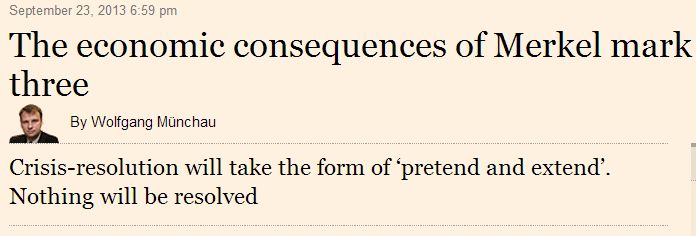
“pretend and extend”
You extend the maturity of the loans, reduce the interest rates and pretend your credit is still whole.
Wolfgang Münchau, Financial Times, September 24, 2013
It lacks transparency and it is undemocratic.
In the eurozone crisis, the logical limit would be to extend the maturity of the loans to infinite and reduce interest rates to zero. They will probably stay clear of this limit but the net present value of the loans will have to fall.
Crisis resolution through any form of debt forgiveness has no legal basis in the EU and is a political minefield.
So there will be a third Greek programme, a second Portuguese programme, and then fourth and third programmes respectively.
Everything will be revolved. Nothing will be resolved.
For me, the biggest achievement was the total and utter destruction of the FDP, her junior coalition partner. Or rather it was a case of assisted suicide.
While I disagree with almost all her economic policies, I cannot hide my admiration for her political ruthlessness.
Wolfgang Münchau, Financial Times, September 24, 2013
Germany’s path to competitiveness: cutting the cost of labour.
Make no mistake; that has been the basis of the nation’s export success in the past dozen years;
and exports have been its sole consistent source of growth in that period.
But low wages are not the basis on which a rich nation should compete.
Adam Posen, president of the Peterson Institute for International Economics, FT 3 September 2013
Since 2003 a falling unemployment rate has been the consequence of the creation of a large number of low-wage and part-time or flexitime jobs, without the benefits and protections afforded earlier postwar generations.
Germany now has the highest proportion of low-wage workers relative to the national median income in western Europe. Average wages increased by more than inflation and productivity growth in the past year for the first time after more than a decade of stagnation.
An American economist on the Bank of England’s monetary policy committee,
Mr. Posen is no academic scribbler or lonely blogger
New York Times 17 Sept 2011
Only?
Reverting to the D-mark is only backed by one-third of voters (32%)
46% said the euro shouldn’t be saved “at any cost”, while 42% said it should.
Open Europe and Open Europe Berlin, the first in a three-part series about Germans’ views on Europe,
ahead of the country’s federal elections on 22 September.
Open Europe, September 3, 2013
42% said they agree the euro is now threatening the European project – only marginally lower than those who say it does not (45%)
There was considerable support for the German Constitutional Court to rule the ECB’s bond-buying programme (OMT) illegal in its on-going court case.
By a margin of almost two to one (46% to 25%), Germans said the Court should rule against the OMT if the stability of the euro could be ensured in other ways.
Over a third (35%) said that the Court should rule against the OMT, even if that threatens the stability of the euro.
In a strong indication of how seriously Germans take the rule of law, almost half (48%) of those asked said upholding the law is more important than saving the euro (30% disagreed).
Germans love Merkel. Why? Because she asks little of them.
And because Merkel is practising a new style of power politics in Europe, which I have called Merkiavellism:
a combination of Machiavelli and Merkel.
Ulrich Beck, The Guardian, 2 September 2013
"Is it better to be loved or feared?" Machiavelli inquired in The Prince.
His answer was that "one ought to be both feared and loved, but as it is difficult for the two to go together, it is much safer to be feared than loved, if one of the two has to be wanting".
Merkiavelli is applying this principle in a new way. She is to be feared abroad, and loved at home – perhaps because she has taught other countries to fear. Brutal neoliberalism to the outside world, consensus with a social democratic tinge at home – that's the successful formula that has enabled Merkiavelli constantly to expand her own position of power and that of Germany as well.
There's a striking discrepancy concerning the positions of executive elites and political parties too. In most European countries there are strong Eurosceptic movements and parties giving the increasingly restless citizenry a voice.
PRINCE-programmet (program för att informera de europeiska medborgarna) ”kompletterar och förstärker kommissionens permanenta informationverksamhet för särskilda politikområden”.
- Detta är ett viktigt steg i utvecklingen av informationspolitiken för Europeiska unionens medborgare, skriver Kommissionens befullmäktigade i Sverige.
De motsträviga EU-medborgarna skall således med hjälp av sina egna skattepengar fås att förstå att EU och EMU är bra. Inte ens den berömde Machiavelli hade kunnat räkna ut det bättre.
Jag friskar upp mitt minne i Nationalencyklopedin och läser: Machiavelli, Niccolò, 1469-1527, italiensk statsman, historiker och filosof. Framför allt genom de kontroversiella läror M. förde fram i "Il principe" kan han sägas ha grundlagt den s.k. realpolitiska traditionen i västerländskt politiskt tänkande och samtidigt ha givit upphov till den dåliga klang som fortfarande vidlåder hans namn ("machiavellism", "machiavellisk").
M. framhöll bl.a. att en furste för att uppnå och hålla sig kvar vid makten ofta tvingas göra sig skyldig till handlingar som i det privata livet skulle betraktas som förkastliga - lögn, mord, svek, skoningslöshet.
Det viktigaste politiska målet var för M. skapandet av en italiensk enhetsstat under en stark furste.
År 1513 tillkom hans mest berömda verk, Il principe ("Fursten") eller - som den heter på engelska - The Prince.
Rolf Englund, Nya Wermlands-Tidningen 2001-04-04
I ett europeiskt perspektiv heter mardrömmen ”Alternativ för Tyskland” (AfD).
Om detta lilla parti skulle lyckas ta sig in i förbundsdagen så rubbas i grunden förutsättningarna för Tyskland som en betryggande pålitlig partner i Europa.
När nu ett tredje stödpaket till Grekland diskuteras offentligt får AfD understöd för sin agitation.
Fortfarande säger opinionsmätningarna att knappt 40 procent av väljarna är osäkra.
Rolf Gustavsson, SvD 1 september 2013.
Sannolikt är det för tidigt att räkna ut det nybildade eurokritiska partiet Alternativ för Tyskland.
DN besökte på måndagskvällen ett möte som borde vara en varningssignal för de etablerade partierna.
AfD präglas helt av talesmannen och nationalekonomen Bernd Lucke, professor vid universitetet i Hamburg och en debattör med pojkaktig utstrålning.
Han håller ett långt tal i på hotellet och gisslar det han konsekvent kallar gammelpartierna.
De cirka 400 åhörarna är helt i hans händer.
DN 27 augusti 2013
De etablerade partierna har än så länge försökt tiga ihjäl AfD i vetskap om att angrepp ger uppmärksamhet och eventuellt också nya anhängare.
Förbundskanslern Angela Merkel (CDU) har sagt att ”misslyckas euron så misslyckas Europa”. Bernd Lucke skakar på huvudet, han förstår inte vad Merkel menar, säger att det är ett av hennes många ogrundade påståenden.
– Hon har väldigt dåliga rådgivare i eurofrågan. Det som är vettigt består oavsett hur det går för euron, om det så är Schengen, frihandeln eller den fria arbetsmarknaden, tror han.
Angela Merkel: Greece should never have been allowed in the euro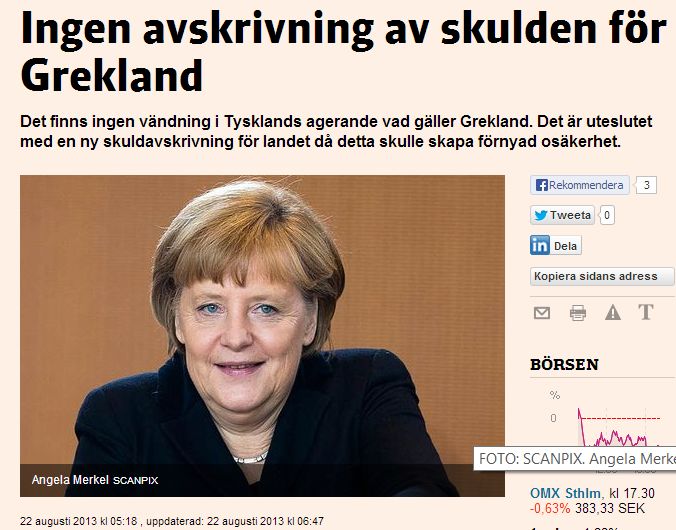
Ms Merkel’s finance minister, Wolfgang Schaeuble, admitted last month that Greece will need another bailout, raising fears among Germans that they will have to foot the bill.
On Sunday, the Chancellor refused to rule out another aid package but dismissed debt haircuts, which would hurt Germany as the country with the largest exposure to Greece.
“I am expressly warning against a haircut,” she said. “It could create a domino effect of uncertainty ... in the eurozone.”
Greece moved to the center of the German election campaign four weeks before election day,
as the SPD escalates its attacks over Merkel’s crisis response
With the European debt crisis in its fourth year, Merkel’s party allies have begun to address openly the prospect of a fresh Greek aid package.
Bloomberg, August 25, 2013
“Germany will have to pay for the stability of Europe and the euro zone,” Steinbrueck told ARD television in an interview yesterday in Berlin.
“I have the impression that this Greek package is connected with an assessment that crisis strategy up until now hasn’t lit a spark, but has rather failed.”
Merkel's Conservatives Split on Greek Aid
Schäuble, a senior member of the CDU, said that Athens would need more financial assistance
beyond the €230 billion it has already been promised to keep it solvent through the end of 2014.
Der Spiegel, 22 August 2013
Fotnot: 230 miljarder euro, i lån, är cirka 2,000 miljarder svenska kronor, för att Grekland skall klara sig till slutet av 2014.
Sedan skall pengarna återbetalas, någon gång, eller skrivas av.
Merkel's European Failure: Germany Dozes on a Volcano
Angela Merkel's government is forcing Southern Europe to undertake profound reforms
while at the same time denying its own responsibility for the consequences of its crisis policies.
Germany is risking a historic failure with its shortsighted wrangling.
Jürgen Habermas, Der Spiegel, August 09, 2013
Under the imploring headline "We Germans Don't Want a German Europe," German Finance Minister Wolfgang Schäuble recently denied in a newspaper essay published simultaneously in Great Britain, France, Poland, Italy and Spain that Germany seeks a political leadership role in the European Union.
Full text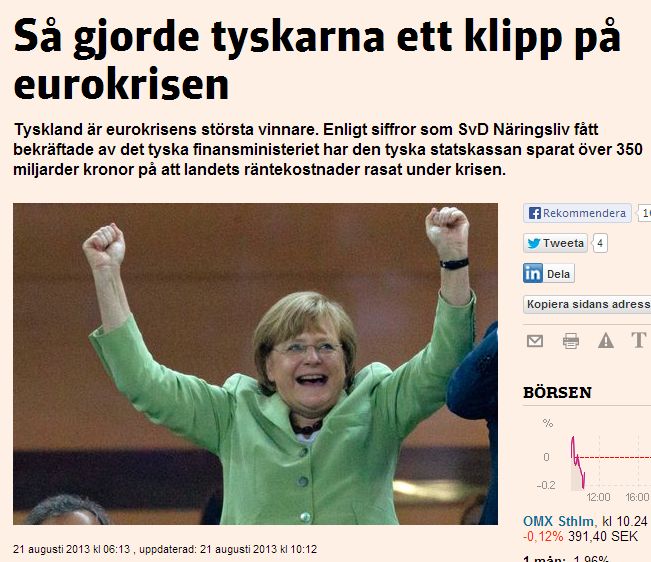
Tyskland är eurokrisens största vinnare.
Den tyska statskassan har sparat över 350 miljarder kronor på att landets räntekostnader rasat under krisen.
SvD Näringsliv, 21 augusti 2013
Germans are exposed to € 86 bn in European Financial Stability Facility loans
German Finance Ministry via tips Open Europe, August 2013
While the language of the IMF report is polite,
it masks a bitter dispute between the Fund and Germany over the nature of the EMU malaise,
and whether austerity and reform really have cleared the way for a viable recovery.
Ambrose, 6 Aug 2013
The IMF said Germany is barely above recession level, with growth of just 0.3pc this year followed by a Japan-style stagnation for the rest of decade with a peak growth rate of 1.3pc
The two have clashed at each stage of the crisis, with the Bundesbank deriding the IMF as the “Inflation Maximising Fund” under the control of Keynesians who have overstepped their “institutional and legal” authority.
The rebukes have infuriated the IMF Board members, especially those from Asia, Latin America, which think the Fund has been doing Germany’s work for it. They grumble that the IMF has been dragged into ill-designed rescue packages, and that the lion’s share of IMF resources have been used to prop up the currency experiment of rich countries well able to clean up their own messs.
Its envoy to the IMF refuted suggestions that Germany has misread the crisis, writing “I would like to emphasize that substantial progress has already been made”. He insisted that Germany must pursue “prudent policies” and act as an “anchor of regional stability” rather than try to kick-start growth with Keynesian stimulus.
He swatted aside demands by the Fund for a near halving of Germany’s current account surplus -- 7pc GDP last year -- saying the chronic imbalance is a result of complex market forces and the “high competitiveness of German enterprises”.
The IMF said Germany’s currency is undervalued by up to 10pc, roughly the same as China, but monetary union is jamming the correction mechanism with EMU.
The IMF’s latest report on Greece lays bares the country’s grotesque situation, and exposes the charade of EMU policy. It states that public debt will reach 176pc of GDP this year.
“The commitment of Greece’s European partners to provide debt relief as needed to keep debt on the programmed path remains, therefore, a critical part of the program,” said the Fund.
All EMU “solidarity” so far has been in the form of loans, adding further debt. There have been no grants or transfers. The moment that this starts to cost real money, we will enter a new phase of the EMU saga.
This cannot be countenanced before the German elections in September, and for the sake of appearances it cannot be carried out immediately afterwards either. That would be too cynical.
Ambrose Evans-Pritchard, August 1st, 2013
Considering issuing at least €6bn in hybrid equity capital such as convertible bonds
Deutsche Bank set to shrink to achieve leverage target
Deutsche Bank has one of the lowest leverage ratios of large banks globally
Financial Times, July 21, 2013
Elefanten i rummet är Frankrike – EU:s näst största ekonomi
Det tyska förbundsdagsvalet den 22 september lägger en död hand över europeisk krishantering under sommaren.
Thomas Gür, Kolumn SvD 20 juni 2013
De senaste 30 åren har Frankrike haft budgetunderskott nästan varje år.
I fjol var det 4,6 procent; högre än Italiens och i klass med Portugals.
Landets offentliga skuldsättning har gått från 56 procent av BNP år 2000 till vad som uppskattas bli nästan 95 procent i år.
Det tyska förbundsdagsvalet den 22 september lägger en död hand över europeisk krishantering under sommaren.
Tysklands Angela Merkel kan finna sig i rollen som den enda räddaren i nöden för Frankrike.
Kommer i så fall Tyskland och de tyska väljarna mäkta med att också ta sig an Grekland, Portugal, Spanien och Italien?
Thomas Gür är nejsägaren som ändrat
uppfattning och kommer att rösta för euron i
folkomröstningen.
MUF:s Blått, nr 1 2003
Fram till folkomröstningen om euron i september kommer Thomas Gür att arbeta som rådgivare till partiet i samband med kampanjarbetet för ett moderat ja.
- Jag tycker att euron är felaktigt uppbyggd,
och att en valutaunion skapar man
när den övriga integrationen
är färdig. EMU som system kan man vara kritisk till
"Elephant in the room" is an English metaphorical idiom for an obvious truth that is either being ignored or going unaddressed.
The idiomatic expression also applies to an obvious problem or risk no one wants to discuss.
It is based on the idea that an elephant in a room would be impossible to overlook;
thus, people in the room who pretend the elephant is not there have chosen to avoid dealing with the looming big issue.
http://en.wikipedia.org/wiki/Elephant_in_the_room
Tomas Lundin
Klart står också att det tyska förbundsdagsvalet den 22 september lägger en död hand över hela krispolitiken.
Alla vet att Portugal sannolikt kommer att behöva ett nytt stödpaket, precis som Grekland. Men det får man inte ens viska om så länge Angela Merkel är på valturné och möter väljare som ser rött bara ordet Sydeuropa nämns.
Allt detta är naturligtvis makulatur när valet i Tyskland är över, oavsett vem som vinner.
Då finns det ingen anledning längre att blunda för det oundvikliga.
http://www.svd.se/naringsliv/nyheter/varlden/eurokrisen-tar-fart-igen_8350976.svd
Germany is preparing for a national election in which – much like in last year’s French presidential election – the European crisis is to play no part, or at least only a minor one.
Both government and opposition believe that it would be better to tell the people the truth concerning
the most vital question of the day only after the election (and in measured doses).
Such an outcome would make a mockery of democracy.
Joschka Fischer, Project Syndicate, April 30, 2013
During the current calendar year, Greece's mountain of debt will grow by around €330 billion
The only thing left that can help Greece pull itself out of the crisis is a debt haircut by public creditors.
Whether one wants to call that step a haircut, debt forgiveness or a state bankruptcy is of secondary importance
Der Spiegel, July 18, 2013
Is Germany Repeating American Errors at Bretton Woods?
Today, Germany is trying to resuscitate /återuppväcka/ the periphery of the crisis-stricken euro area
in much the same way, and it is worth looking back at the formation of Bretton Woods for clues as to how this will play out.
Germany will soon have to choose: a Marshall Plan for the south, or an economic and political breakdown of the euro zone.
Bloomberg, July 16, 2013
Why Austerity Still Isn't Working in Greece
Representatives of Greek business are now convinced that the country cannot survive without yet another debt haircut.
The subject is politically sensitive, especially in Germany, because this time a debt haircut would also affect public creditors,
which already hold 80 percent of Greek sovereign debt.
In other words, a large share of German assistance loans would be irretrievably lost.
Der Spiegel, July 9, 2013
Indeed, German Finance Minister Wolfgang Schäuble ruled out such a possibility just last week.
Greece is expecting a second debt haircut from its European creditors following the German election,
the country's economy minister said on Tuesday. First, though, Athens must prove that it has done enough
to receive the next tranche of badly needed bailout money.
Der Spiegel, June 2, 2013
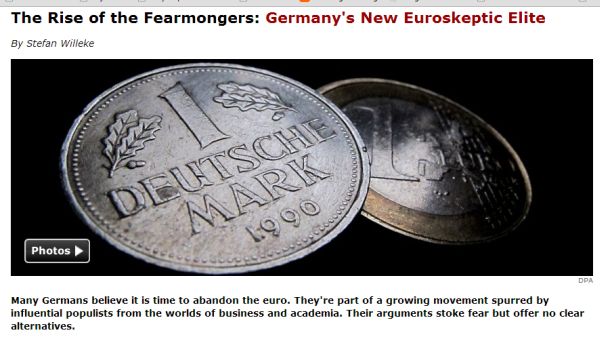
Many Germans believe it is time to abandon the euro.
They're part of a growing movement spurred by influential populists from the worlds of business and academia.
Their arguments stoke fear but offer no clear alternatives.
Der Spiegel, June 19, 2013
SPIEGEL: How long can Brussels continue to impose austerity on countries like Spain and Greece,
a policy that the majority in those countries does not support?
Merkel: Democratically elected governments are our partners in all of these countries. My Greek, Spanish and Portuguese counterparts are all democratically authorized to pursue their courageous and arduous course of reforms. In politics, we are repeatedly forced to make decisions that are not popular at first. Take, for example, the retirement age of 67, which we've already addressed. It still has little support in the polls, even if it remains unavoidable.
SPIEGEL: Once again, what makes you so confident that the countries in Southern Europe will subject themselves to your austerity mandate in the long run?
Merkel: Many people in these countries know that years of undesirable developments led to these problems, and that this is why something has to change. At the same time, I know all too well that the necessary reforms demand a great deal of them. Many often justifiably raise the question of fairness, and whether too much is being asked of ordinary working people while the more affluent seem to be getting off lightly. In many countries, for example, labor laws for young people have been made very flexible, which means that when a company runs into difficulties, they are the first ones to lose their jobs. There is also a fierce debate over fairness when it comes to older workers, although in their case we cannot forget the reasons for the difficulties.
SPIEGEL: Youth unemployment in Southern Europe is above 50 percent in some cases. The austerity policies you have imposed are having disastrous consequences.
Full text at Der Spiegel 3 June 2013
The EU's bailout of Cyprus has elicited unusually frank and vehement criticism from the finance experts grouped in the IMF's Executive Board.
Although no names were mentioned, the criticism was directed at all European politicians involved in the bailout,
from Merkel and Schäuble to Hollande, Barroso and Olli Rehn.
The criticism applies in particular to the Eurogroup president, Dutch politician Jeroen Dijsselbloem, who has even recommended the Cyprus bailout as a model for future bailout programs.
Der Spiegel, 3 June 2013
Germany’s largest banks were €14bn short of the capital needed to meet incoming Basel III banking rules
The banks, which include the two largest by assets – Deutsche Bank and Commerzbank – managed to cut
their collective capital shortfall from €32bn in the second half of 2012,
as lenders responded to pressure from investors to improve their balance sheets ahead of the introduction of the Basel III rule book by 2019.
Financial Times 28 May 2013
A new way of thinking has recently taken hold in the German capital
Wolfgang Schäuble sounded almost like a new convert extolling the wonders of heaven as he raved about his latest conclusions on the subject of saving the euro.
"We need more investment, and we need more programs," the German finance minister announced
The man who had persistently maintained his image as an austerity commissioner is suddenly a champion of growth.
Der Spiegel, 27 May 2013
Does George Soros know something we don’t about the S&P 500?
Soros Fund Management increased a bear-call bet on the S&P 500 in a huge way.
The fund lifted a put position — a bet the market will go lower — to its biggest size yet,
making a 605% leap over the previous quarter.
MarketWatch 15 August 2014
For the past 25 years or so the financial authorities and institutions they regulate have been guided by market fundamentalism:
All the innovations – risk management, trading techniques, the alphabet soup of derivatives and synthetic financial instruments – were based on that belief.
The innovations remained unregulated because authorities believe markets are self-correcting.
George Soros FT 2/4 2008
Soros om att dom inte förstod att det var ett stort steg att avskaffa den egna sedelpressen Rolf Englund blog 2012-09-10
Soros versus Sinn:
The German Question
Project Syndicate May 6, 2013
George Soros:
The causes of the crisis cannot be properly understood without recognizing the euro’s fatal flaw:
By creating an independent central bank, member countries have become indebted in a currency that they do not control.
At first, both the authorities and market participants treated all government bonds as if they were riskless, creating a perverse incentive for banks to load up on the weaker bonds.
When the Greek crisis raised the specter of default, financial markets reacted with a vengeance, relegating all heavily indebted eurozone members to the status of a Third World country over-extended in a foreign currency.
Subsequently, the heavily indebted member countries were treated as if they were solely responsible for their misfortunes, and the structural defect of the euro remained uncorrected.
Once this is understood, the solution practically suggests itself.
It can be summed up in one word: Eurobonds.
Hans-Werner Sinn:
Soros is playing with fire. Crunch time is fast approaching.
Cyprus is almost out of the euro,
Moreover, the Greeks and Spaniards are unlikely to be able to bear the strain of economic austerity much longer, with youth unemployment inching toward 60%. France, too, has competitiveness problems, and is unable to meet its commitments under the European Union’s Fiscal Compact. Portugal needs a new rescue program, and Slovenia could soon be asking for a rescue as well.
Many investors echo Soros. They want to cut and run – to unload their toxic paper onto intergovernmental rescuers
If Soros were right, and Germany had to choose between Eurobonds and the euro, many Germans would surely prefer to leave the euro. The new German political party would attract much more support, and sentiment might shift. The euro itself would be finished;
after all, its primary task was to break the Bundesbank’s dominance in monetary policy.
But Soros is wrong. For starters, there is no legal basis for his demand. Article 125 of the Treaty on the Functioning of the European Union expressly forbids the mutualization of debt.
Worst of all, Soros does not recognize the real nature of the eurozone’s problems. The ongoing financial crisis is merely a symptom of the monetary union’s underlying malady: its southern members’ loss of competitiveness.
Soros argumenterar för att Tyskland antingen måste acceptera euroobligationer – eller lämna valutaunionen.
Soros tankar om euron får stor uppmärksamhet i hela Europa.
Det säger något om hur desperat jakten på lösningar är och hur få svar på krisen de politiska ledarna verkar ha.
Åtstramningarna har blivit en ond cirkel av sjunkande tillväxt och stigande arbetslöshet
och den bankunion som sades vara räddningen är halvfärdig och skjuts på framtiden.
Annika Ström Melin, signerat, DN 23 april 2013
Grundfelet med euron enligt Soros var att
medlemsländerna skuldsattes i en valuta som de inte kunde kontrollera.
Det gjorde nationella konkurser möjliga.
Danne Nordling om George Soros artikel i DN:s kulturdel 21/4 (ej onl)
Wolfgang Schäuble warns
EU bank rescue agency needs treaty changes
"EU democratic legitimacy could be improved upon"
"EU powers defined by its treaties. To take them lightly ...is to tamper with the rule of law"
Financial Times May 12, 2013
“The EU does not have coercive means to enforce decisions. Its historical roots are young. Its democratic legitimacy could be improved upon,” Mr Schäuble writes.
“What it has are responsibilities and powers defined by its treaties. To take them lightly, as is sometimes suggested, is to tamper with the rule of law.”
In the past decade, public and private debt levels have rocketed. This debt will have to come down.
And for our banks to fulfil their role as financiers of the economy, they will have to deleverage.
The European Commission will soon put forward a proposal for a resolution mechanism. We will assess it with an open mind.
Yet while today’s EU treaties provide adequate foundation for the new supervisor and for a single resolution mechanism,
they do not suffice to anchor beyond doubt a new and strong central resolution authority.
We should not make promises we cannot keep. The overly optimistic predictions about a single supervisor starting work as early as January 2013 cost the EU credibility.
This would be a timber-framed, not a steel-framed, banking union. But it would serve its purpose and
buy time for the creation of a legal base for our long-term goal:
a truly European and supranational banking union, with strong, central authorities, and potentially covering the entire single market.
The writer is German finance minister
Ms Merkel does not say “no” to eurozone bonds.
She says: “Not without treaty change.”
The German constitutional court in Karlsruhe would never allow Germany’s sovereign guarantee
to be given to its eurozone partners without them submitting to effective and centrally budgeted discipline.
Financial Times 31 May 2012
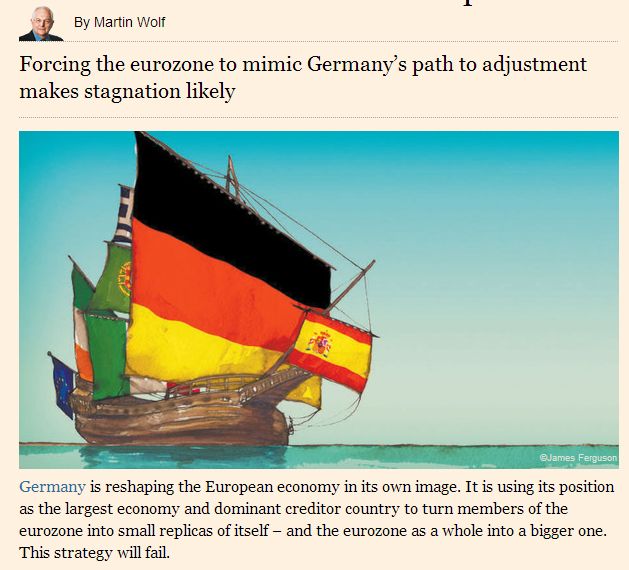
The mistaken consensus swiftly emerged, notably in Berlin, that this was a fiscal crisis.
But that was to confuse symptoms with causes, except in the case of Greece.
"this analysis of “imbalances” close to indefensible"
Martin Wolf, Financial Times May 7, 2013
Unfortunately, the eurozone’s healthier countries also hew tightly to the stability mantra.
So they, too, tightened fiscal positions.
Meanwhile, consumer price inflation is falling below the ECB’s 2 per cent target. Last week’s cut of a quarter of a percentage point in the intervention rate will make next to no difference.
A big adverse shock risks turning low inflation into deflation. That would aggravate the pressure on countries in crisis.
Even if deflation is avoided, the hope that they will grow their way out of their difficulties, via eurozone demand and internal rebalancing, is a fantasy, in the current macroeconomic context.
If one wants to understand how far the folly goes, one must study the European Commission’s work on macroeconomic imbalances. Its features are revealing.
Thus, it takes a current account deficit of 4 per cent of GDP as a sign of imbalance.
Yet, for surpluses, the criterion is 6 per cent. Is it an accident that this happens to be Germany’s?
Above all, no account is taken of a country’s size in assessing its contribution to imbalances.
In this way, Germany’s role is brushed out.
Yet its surplus savings create huge difficulties when interest rates are close to zero.
"Antingen bestämmer man sig för att gå den tyska vägen eller så kommer kontinenten att förvandlas till ett permanent krisområde av massarbetslöshet, nedlagda industrier och hopplöshet"
Eurokrisen har gått in på sitt fjärde år och ingen ljusning finns i sikte.
Den inslagna vägen fungerar inte. Frågan är bara vad det är som görs fel och hur alternativen ser ut.
För vänstern och Dagens Nyheters ledarsida är saken enkel.
Det är åtstramningspolitiken som är ensam bov i dramat och om
bara Tyskland slutade snåla skulle krisen hävas och Europa andas morgonluft igen.
Anna Dahlberg, Expressen 28 april 2013
When Konrad Adenauer and Charles de Gaulle met in 1962 in Reims cathedral for a mass of reconciliation,
de Gaulle’s chair was taller than Adenauer’s. That was fine with the Germans,
who accepted that the French should lead politically even if the Germans led economically.
Yet German understanding is being tested as never before.
“Publicly, I’m never worried about France; I trust,” says one official wryly, before expounding how trusting is now hard.
The Economist print, 4 May 2013
For Europe any reasonable endgame will require a large transfer from Germany to the periphery.
The sooner this implicit transfer becomes explicit,
the sooner Europe will be able to find its way towards a stable growth path.
Kenneth Rogoff and Carmen Reinhart, Financial Times May 1, 2013
Unlikely
Everyone is now looking ahead to the German election in September,
with the idea being that with election season gone and perhaps with a Conservative/Social Democrat "grand coalition" at the helm,
Germany will flinch and drop the whole austerity thing.
Mats Persson, Director of Open Europe, Telegraph April 30th, 2013
Unlikely. We might see some easing of targets and toned down rhetoric, but no fundamental shift.
The German consensus on austerity runs incredibly deep.
The Franco-German axis that has driven EU affairs ever since Schuman and Adenauer in the early 1950s is collapsing before our eyes.
This was inevitable. Their interests have become incompatible under monetary union.
The currency that was supposed to bind them is turning them into enemies, as this newspaper long warned.
Ambrose Evans-Pritchard, Daily Telegraph, April 30th, 2013
Highly Recommended
En oro för en allt större tysk dominans inom EU
sprider sig genom medlemsländerna på kontinenten.
Nu har den politiska tänkaren Jürgen Habermas gått ut med en varning, skriver brittiska The Guardian
SvD Näringsliv 29 april 2013
Habermas anser att EU håller på att förvandlas till en ”överstatlig demokrati” och att det inte råder någon koppling mellan vad som behöver göras inom den ekonomiska politiken och vad som är genomförbart. Vad som än händer menar Habermas att det är en farlig utveckling att tumma på demokratin inom unionen.
He said the EU elite's response to the crisis had been to construct a "technocracy without democratic roots",
trapping Europe in a dilemma of legitimacy and accountability,
between "the economic policies required to preserve the euro and,
on the other, the political steps to closer integration.
The steps that are necessary are unpopular and meet with spontaneous popular resistance".
Prominent German economist Hans-Werner Sinn:
“It is worth defending the euro” while advocating “temporary exits of weak countries”
Open Europe Newsletter 29 April 2013
Angela Merkel already used the term Schicksalsgemeinschaft,
a semi-mystical German concept of unity which broadly equates to the American idea of “manifest destiny”.
So, will Angela Merkel, once safely re-elected as German Chancellor,
be prepared to provide the leadership necessary to save monetary union?
Jeremy Warner, Telegraph 25 Apr 2013
Wolfgang Schauble
Germany’s economics minister Philipp Rosler saying that it would be absolute danger
if member states departed from the course of budgetary consolidation.
In passing, Schauble also hit out at Jose Manual Barroso,
saying the eurozone problems had nothing to do with strict budget rules.
"Somebody should tell Barroso that."
Eurointelligence 26 April 2013
Nu trillar polletten ner
German Chancellor Angela Merkel:
"The ECB has the difficult task of setting an interest rate that meets the needs of all countries," she said.
"This means on the one hand the lowest possible interest rates for EU crisis countries so that they have access to the urgently needed liquidity.
On the other hand, Germany would need a higher interest rate because savings are currently losing value,"
Expatica.com 25 april 2013
Rolf: En hastig sökning hittar t ex detta från 2003, då det var Tyskland som behövde en lägre ränta:
The one-size-fits-all monetary policy needed in a currency area of twelve countries
is inflicting particular damage on Germany, the biggest economy in Europe.
The Economist, June 9, 2003
Se även:
Den europeiska mardrömmen
Tyskland är inte Sverige i kvadrat. Tysklands problem är långt värre än så. Arbetslösheten överstiger 10 procent, tillväxten är närmast obefintlig,
budgeten går med underskott, banksystemet skakar, risken för deflation är överhängande och landets industri befinner sig i en svår kostnadskris.
Den tyska utvecklingen är en europeisk mardröm, vars slut vi ännu inte sett skymten av.
Peter Wolodarski DN 27/4 2003
German Foreign Minister Guido Westerwelle maintained Germany's position, warning against a move away from austerity.
"We are convinced that if we give up on the policies of budgetary consolidation,
if we fall back into the old policies of racking up debts, then we will cement mass unemployment for many years in Europe,"
Growth cannot be purchased with new debts, he added, saying that
"growth and consolidation policies are two sides of the same coin."
Der Spiegel, 23 April 2013
German power does not flow from the euro. German weight and geography vexed the continent even before the principalities of the Holy Roman Empire were soldered together by Otto von Bismarck.
Unification, and then reunification, turned the German question – how to balance a nation too big for its neighbourhood – into the abiding dilemma of European geopolitics.
Philip Stephens, Financial Times 18 April 2013
Power carries responsibilities. The criticism of Germany that sticks is about the self-righteous assumption that all will be well only when feckless Greeks, Spanish, Italians and the rest behave like Germans.
Ms Merkel must accept, if only after this year’s election, that adjustment has to be symmetrical.
For others to cut their deficits, Germany must shed some of its surplus.
Den svenska utrikespolitikens eviga fråga. Skall vi följa Tyskland eller skall vi följa England.
Rolf Englund blog 9 december 2011
Rome, Habsburg and the European Union
The euro was not a German project. Quite the reverse.
German voters wanted to hold on to their currency.
It was pressed by those, led by France, who wanted to break the D-Mark zone.
The euro was the price Helmut Kohl paid to Mitterrand to win his blessing for reunification.
Philip Stephens, Financial Times 18 April 2013
Germany laid down a big barrier on the fast track to European banking union,
insisting a revision of EU treaties is necessary to create a single authority to wind up banks,
even if it took several years to accomplish.
Financial Times, April 14, 2013
Germany is not to blame for unpopular reforms;
these are necessary for economic survival in a single currency that eliminates the options of independent monetary policy and currency devaluation.
The critics are more on target over Germany’s excessive insistence on austerity.
The Economist print 13 April 2013
"Growth-friendly process of consolidation"
Schäuble: “We need to stop this debate which says you have to choose between austerity and growth,”
The two-day effort by the United States Treasury secretary, Jacob J. Lew,
to persuade Europe to consider shifting its focus from budget balance to growth highlighted a deep trans-Atlantic policy gulf
New York Times, 9 April 2013
“It’s déjà vu all over again.” The European game goes like this:
Angela Merkel draws lines in the sand; then she vacates them, breaks a few treaties,
and lets the European Central Bank take over,
though Mario Draghi, its president, is demonstratively dragging his heels.
Josef Joffe, editor of Die Zeit, Financial Times 21 March 2013
De slutna rummens beslutsfattande är ansiktslöst
”Det som hänt visar att EU befinner sig i ett slags undantagstillstånd. Ingenting är längre heligt.
Då kan vad som helst hända”,
säger professor Sverker Gustavsson när jag ringer honom för att tala om den pågående krisen.
Annika Ström Melin, Signerat DN 22 mars 2013
The president of the Bundesbank was once the mightiest central banker in Europe. No more.
In the council of the European Central Bank, Jens Weidmann is just one of 23.
He has only one vote – the same as Greece.
Josef Joffe, editor of Die Zeit, Financial Times 4 September 2012
Jens Weidmann, president of the Bundesbank
and a member of the ECB's governing council,
Only politics, not the ECB, can solve the euro zone crisis
"We should quickly revert to our core business, which is monetary policy,"
CNBC 12 Mar 2013
Former Central Bank Head Karl Otto Pöhl:
Bailout Plan Is All About 'Rescuing Banks and Rich Greeks'
Der Spiegel May 18, 2010
Eurozone sovereigns will emphatically not be bailed out by their fellow governments following solemn announcements.
Instead, they’ll be bailed out by “exceptional liquidity assistance” (ELA),
which means the sovereigns’ own banks will write cheques to their local banks against the security of national bonds.
Totally different, you see.
Instead of money created by the ECB, this is money created by the ESCB, or European system of central banks.
John Dizard, Financial Times March 8, 2013
By now it has become ever more clear that euro area policy is to make sure absolutely nothing happens
until after the German elections in September 2013.
John Dizard, Financial Times 16 December 2012
naked capitalism: Is the Eurozone Nearing a Make or Break Point?
One of my colleagues studied in Germany, has extensive, high level political and economic contacts there, and reads the press daily.
He is not prone to overstatement or overreaction and also has a propensity to makes Delphic remarks.
He said the Eurozone is over. In pretty much those words, a simple sentence, no caveats or conditionals.
I nearly fell out of my chair.
naked capitalism, 5 March 2013
A new party led by economists, jurists, and Christian Democrat rebels will kick off this week,
calling for the break-up of monetary union before it can do any more damage.
"An end to this euro," is the first line on the webpage of Alternative für Deutschland (AfD).
"The introduction of the euro has proved to be a fatal mistake, that threatens the welfare of us all.
The old parties are used up. They stubbornly refuse to admit their mistakes."
Ambrose, 10 March 2013
They propose German withdrawl from EMU and return to the D-Mark, or a breakaway currency with the Dutch, Austrians, Finns, and like-minded nations.
The French are not among them. The borders run along the ancient line of cleavage dividing Latins from Germanic tribes.
The plans draw on work by Hans-Olaf Henkel, former head of Germany's industry federation (BDI) and a chastened europhile
-- the "worst error of my professional life", he told me.
Chancellor Angela Merkel suddenly has a "UKIP problem" on the her right flank.
Should she sign off on a bail-out out for Cyprus -- safeguarding the "dirty funds of Russian oligarchs", as the AfD puts it -- she will be raked by heavy fire.
That will test her solidarity mantra, and she can turn on a Pfennig. She ditched her nuclear energy policy days after surveying the post-Fukushima polls.
It all started in early 2010, when Ms Merkel suggested Greece leave the eurozone.
After Nicolas Sarkozy threatened her with ending the special French-German relationship, she gave in and helped to bail out Greece.
That turned out to be a bailout of French banks.
Before the crisis, Germans were the most admired Europeans in Greece, today, they are the most hated.
Hans-Olaf Henkel, former head of the Federation of German Industries, Financial Times, 17 July 2012
Den förre ordföranden Hans Olaf Henkel i det tyska industriförbundet, motsvarigheten till Svenskt Näringsliv, föreslår i en artikel i Financial Times
att Tyskland, Österrike, Finland och Nederländerna ska lämna eurosamarbetet och forma ett helt nytt valutasamarbete.
Henkel, som tidigare var en av eurons ivrigaste försvarare, har under den intensiva skuldkrisen ändrat uppfattning om det krisdrabbade valutasamarbetet.
Han skriver att hans tidigare stöd till euron är hans karriärs största misstag.
Ekot 30 augusti 2011
One in four Germans would be set to vote in September's federal election for a party that wants to quit the euro,
according to an opinion poll published on Monday that highlights German unease over the costs of the euro zone crisis.
Reuters, 11 March 2013
Germany's mainstream parties remain solidly pro-euro despite grumbling over costly bailouts of Greece and others.
A German taboo on nationalism, rooted in atonement for the crimes of the Nazi era, has helped to muffle eurosceptic voices.
Anti-euro political parties in Europe in recent years have so far tended to be either well to the right of center or,
as evidenced by the recent vote in Italy, anything but staid.
But in Germany, change may be afoot. A new party is forming this spring.
And its founders are a collection of some of the country's top economists and academics.
Der Spiegel 8 March 2013
"Democracy is eroding," reads a statement on its website (German only).
"The will of the people regarding (decisions relating to the euro) is never queried and is not represented in parliament.
The government is depriving voters of a voice through disinformation, is pressuring constitutional organs, like parliament and the Constitutional Court,
and is making far-reaching decisions in committees that have no democratic legitimacy."
Germany has a new anti-euro party
Die Welt has the details of a new anti-euro party that has established itself ahead of the September elections.
This group includes a number of economists and legal scholars who are quite well known in Germany.
They also include a former CEO of Thyssen, and the ubiquitous Hans-Olaf Henkel.
Eurointelligence 4 March 2013
The party will formally be established April 13 with three political priorities:
first, Germany shall no longer be liable for anybody else’s debt;
second, every member state should be able to leave the eurozone;
third, any transfer of sovereignty has to be subject to a referendum.
The article quotes one of the founders - a former journalist of Frankfurter Allgemeine – as saying that is not just anti-euro, it was more importantly a party supports the spirit of Germany’s Basic Law, which they see violated as a result of the government’s euro policies.
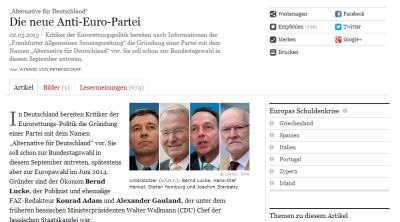
The turmoil produced by the Italian elections has directed attention back to where it should have been all along – to the politics of the eurozone crisis.
It is possible that southern Europe will give the Germans until the autumn to come around to a new approach.
But toleration for austerity is unlikely to last much beyond then.
Europe may be approaching a stark choice: giving up the euro; or keeping it and seeing the political crisis spin out of control.
Mark Mazower, professor of history at Columbia university, Financial Times 28 February 2013
The German government is now resigned to accepting an aid package for Cyprus without a default,
From the story it becomes clear that they have not got a clue how to do this.
The pressure is increased because the danger in Cyprus is not an imminent collapse of the state,
but a collapse of the banks, which are running out of funding.
Eurointelligence 22 February 2013
German President Joachim Gauck
First and foremost, he said, Europe needed to develop a common identity.
"European identity is not about excluding those who are different"
When it comes to the European Union, many in Germany and around the 27-member club think first and foremost of mind-numbing bureaucracy in Brussels and the never-ending crisis facing the Continent's common currency.
Citizens feel powerless, helpless and oftentimes ignored.
German President Joachim Gauck, Der Spiegel 22 February
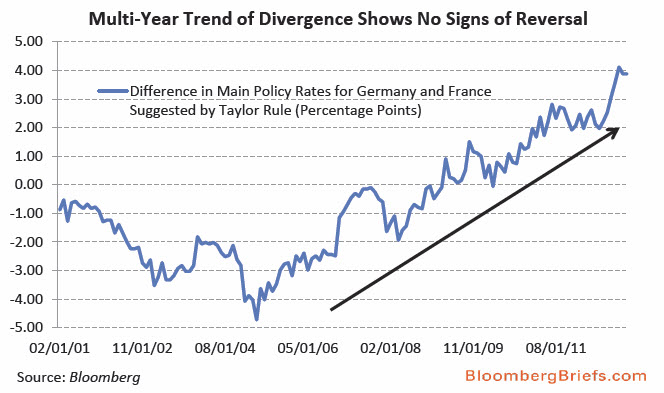
Franco-German Divide Nears Record High
We ask - rhetorically once again -
how can they expect to hold this together with a single monetary policy.
Tyler Durden 22 February 2013
Silvio Berlusconi said Merkel’s East German roots had made her too rigid and too austerity-minded.
Berlusconi says Merkel is an "intelligent bureaucrat" tied to the notion of a centralized economy.
He disagrees with the notion that the fiscal compact was designed to shore up the common currency.
He said the Fiscal Compact imposes a shoe size 42 for men and 40 for women.
This is why he says he wants to renegotiate the entire Compact if elected.
Eurointelligence 19 February 2013
Sverige och hela Norden borde stärka banden till Tyskland
Att stärka de tyska banden handlar också om realpolitik. I takt med Tysklands allt starkare politiska och ekonomiska ställning i Europa kan Sverige ha nytta av den långa historia som faktiskt knyter samman våra länder.
Fram till andra världskriget var tyska helt dominerande som främmande språk i Sverige. Att det sedan hamnade i vanrykte och trängdes bort av engelskan är inte svårt att förstå, men det är trots allt nästan sjuttio år sedan kriget tog slut
Annika Ström Melin, DN Signerat 18 februari 2013
Gloomsters buried the euro too soon
The turning point came when Chancellor Angela Merkel concluded that
a eurozone collapse would risk the break-up of the EU.
Philip Stephens, FT January 31, 2013
It is worth exploring where the pessimists went wrong. The obvious mistake was to underestimate the political will of European leaders to keep the show on the road.
For many in Britain, as we heard the other day from Prime Minister David Cameron, the EU is about the single market. For the rest it is a political project – the guarantor of Franco-German reconciliation, of freedom in the former dictatorships of left and right, and of a European voice in a world where power is fast heading east.
The turning point came when Chancellor Angela Merkel concluded that a eurozone collapse would risk the break-up of the EU.
Germany would lose the strategic framework for its security and prosperity. It is striking how the national discourse changed within a matter of months, The conversation has shifted from “feckless” Greeks to the euro’s vital role in guarding German interests.
Ms Merkel decided during the late summer that it was too risky to allow Greece to leave. At about the same time, she sided with the European Central Bank against the Bundesbank.
Mario Draghi, ECB president, got the go-ahead to guarantee the bonds of peripheral states.
Once the ECB had positioned itself as lender of first resort, the markets were left stranded on the wrong side of an unwinnable fight.
IMF managing director Christine Lagarde said that Europe needed a plan for growth - short and long term.
It wasn't enough, she said, paraphrasing Chancellor Angela Merkel, to say
"we have solved all of our economic problems, now we just have to wait seven years to see the effects".
Stephanie Flanders, BBC Economics editor, 27 January 2013
Draghi calls Schäuble a lawyer
At last week’s Ecofin, Schauble said, what he had reported before, that in his view, Cyprus was not systemically relevant
(which means that Germany could not legally participate in an ESM programme, as systemic relevance is a legal pre-condition under the German ESM law).
Draghi also warned that a default of Cyprus would also impede Ireland’s and Portugal’s return to the market
Eurointelligence 28 January 2013
The ECB's Mario Draghi has taken the risk of a sovereign default in Spain and Italy off the table, but he has not restored these countries to economic viability within a D-Mark currency bloc, and nor can he.
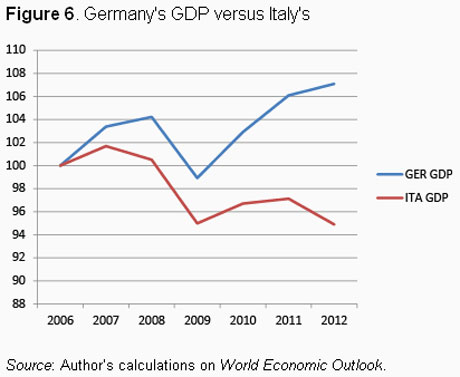
Take a moment to read Eurozone crisis: it ain't over yet by Professor Paulo Manasse from Bologna University, posted on VOX EU.
Ambrose Evans-Pritchard, January 23rd, 2013
This week, France and Germany celebrate the 50th anniversary of the Elysée treaty, the document that laid the foundation for their close co-operation on building an integrated European Union
The French and German parliaments will meet in a joint session in the Berlin Reichstag on Tuesday, and the two governments will meet in the office of Angela Merkel, German chancellor
Financial Times, 20 January 2013
One picture sums it up: Helmut Kohl and François Mitterrand holding hands in the Douaumont cemetery in 1984, beside the first world war battlefield of Verdun, where nearly 800,000 French and German soldiers died in pointless slaughter fighting for a few square miles of mud in 1916.
Why the Euro Zone Crisis is Over…Until September
On Sunday, Merkel's conservative coalition lost regional elections in Lower Saxony, one of the country's most populous states.
Merkel's Christian Democratic Union (CDU) has now lost its majority in the upper house of the German parliament, the Bundesrat, which could make it harder for Merkel to introduce policies in the federal parliament without compromising with opposition parties, Newton told CNBC.
CNBC 21 Jan 2013
Ambrose Evans-Pritchard (AEP) increasingly faces the risk of running out of hyperbolic war-analogies sooner than the euro collapses.
For months he has been numbing his readership with references to the Second World War or the First World War, or to ‘1930s-style policies’
so that not even the most casual reader on his way to the sports pages can be left in any doubt as to how bad this whole thing in Europe is,
and how bad it will get, and importantly, who is responsible.
Detlev Schlichter, 11 December 2012
Cyprus Bailout Could Fail in German Parliament
Der Spiegel 9 January 2013
SPD is considering blocking a Cyprus deal on the grounds that it won’t support tax dumping and money laundering
The article also quotes a German CSU MEP, who demanded a guarantee that the money goes to help the citizens of Cyprus, and not the oligarchs of Russia
Eurointelligence 9 January 2013
German government is furious about van Rompuy’s three-stage strategy
Frankfuter Allgemeine reports that Berlin is furious about the van Rompuy report towards economic union.
The German government says these proposals go too far.
Eurointelligence 7 December 2012
Acropolis Adieu med Mireille Mathieu och Angela Merkel
Rolf Englund blog 6 december 2012
Angela Merkel öppnar nu för första gången för möjligheten att gå med på
en grekisk skuldavskrivning som också kommer drabba europeiska skattebetalare.
Ekot 2 december 2012
Merkel säger att ”om Grekland får ordning på sina intäkter utan att ta upp nya skulder, då får vi se hur det ser ut och utvärdera läget."
Det är dock enligt Merkel inte aktuellt förrän 2014 eller 2015, det vill säga långt efter nästa års tyska förbundsdagsval.
En ny grekisk skuldavskrivning, som bland annat Internationella Valutafonden kräver, kommer kosta tyska och europeiska skattebetalare flera tiotals miljarder euro. Den förra skuldavskrivningen drabbade privata fordringsägare, en ny skulle även belasta eurostaternas budgetar.
Och på senare tid har, som Ekot rapporterat om, flera tyska politiker börjat signalera det i Tyskland känsliga budskapet att målet att rädda Grekland kvar i eurozonen kan bli dyrt.
Anledningen är att det senaste Greklandsbeslutet inom eurozonen, som ska förse Grekland med cirka 44 miljarder euro i nya nödlån, nu för första gången kostar tyska skattebetalare reda pengar, ungefär motsvarande fem miljarder kronor. Det är alltså inte längre bara frågan om att låna ut pengar eller gå i borgen för krediter.
IMF wants Greece's creditors to forgive a portion of the country's debt,
a move which could cost Germany up to 17.5 billion euros.
It is partly for that reason that euro-zone finance ministers are in favor of extending by two years
the deadline for Greece to reduce its debt load to 120 percent of GDP from 2020 to 2022.
Der Spiegel, 14 November 2012
The IMF believes that the only way Greece can reduce its sovereign debt to the target level of 120 percent of gross domestic product in the next decade is by way of another partial default.
This time, however, it wouldn't just be private creditors who would lose out as they did in the debt haircut carried out this spring.
A second such cut of Greek debt would force international creditors, Germany included, to write down a portion of the billions they have loaned Athens. A 50 percent default would result in Germany losing €17.5 billion of the €35 billion it has loaned Athens thus far.
With general elections approaching next year, Chancellor Angela Merkel is adamantly opposed to such a move.
A visibly angered Mrs Lagarde, the managing director of the IMF, shook her head and rolled her eyes
at the announcement /by Jean-Claude Juncker, president of the Eurogroup/ that breaches the Washington-based fund’s condition that Greek debt must become sustainable by 2020.
As Thomas Mayer of Deutsche Bank argues in a new book, this cannot be tenable.
Germans are already unhappy with the ECB’s monetary policy, even though inflation remains dormant.
But if its governance structure prevents Germany heading off banking crises that Germans must nonetheless pay for, unhappiness will turn into fury.
Consider the anger of Americans and Britons about bailouts for plutocratic bankers.
Now imagine their feelings if the bankers were foreign.
Sebastian Mallaby, Financial Time, November 13, 2012
Europe's Unfinished Currency: The Political Economics of the Euro
Even if the economic fit isn’t perfect, currency unions can be held together by fiscal transfers from the richer to the poorer regions.
This is what happens in the United Kingdom, where Wales and Scotland are the recipients of English largesse.
Germany has had its own recent experience with a transfer union. Since the country’s reunification in 1990 large sums have flowed from the other Bundeslander towards east Germany.
Edward Chancellor, Financial Times, 4 November 2012
Chancellor Angela Merkel of Germany,
who was raised under Communism, saw ideology’s destructive effects firsthand
Alison Smale, New York Times, October 29, 2012
Over the last 13 years, German workers' average real incomes have fallen by 4 pc
Germany has supplied BMWs to southern Europe and they have given it IOUs in return.
Will those IOUs ever be honoured? That is the problem with trying to grow through unbalanced trade.
In the end, your trade partners need something to pay you with.
Roger Bootle, Telegraph 7 October 2012
From the formation of the euro in 1999 to now, German unit labour costs have hardly risen.
Since costs have continued rising briskly elsewhere, Germany has gained competitiveness enormously. The result is now a surplus of exports over imports of about 6pc of GDP. It is this surplus – and the associated income and jobs – that defenders of the status quo say would be threatened without the euro.
During the euro's existence Germany´s average growth rate has been only 1.4pc, below the UK's – and below Spain's and Ireland's.
The explanation is clear. Whereas consumer spending has grown by about 30pc in America and the UK, in Germany it has grown by only 10pc.
The reason is that over the last 13 years, German workers' average real incomes have fallen by 4pc. The very success in keeping costs down has also kept pay down.
If, one way or another, the link between Germany and the southern euro member countries is broken, a return to the days of the deutschemark.
By reducing the domestic price of exports and imports, a stronger currency would transfer income from producers to consumers.
The result would be increased consumption.
If Germany left the euro, not only would the peripheral countries be better off, but so also would Germany.
RE: Simsalabim
Snipers, Commandos to Welcome Merkel in Greece
CNBC, 8 October 2012
Ville Kohl ha euron, som Rolf Gustavsson påstår, eller blev han tvingad?
Rolf Englund blog 7 oktober 2012
Welcome back to the eurozone crisis
Germany will not after all allow Spain to dump the risk of its banks on to the ESM
Wolfgang Münchau, Financial Times 30 September 2012
Grekland, Tyskland och IMF vid avgrundens rand
Rolf Engund blog 30 september 2012
09/11/2012 George Soros' Plan to Save the Euro
Germany has the potential to either save the European Union and the euro or destroy both
- so it must either lead or exit the common currency zone.
Der Spiegel 11 September 2012
Soros:
I admire Chancellor Merkel for her leadership qualities, but she is leading Europe in the wrong direction.
Der Spiegel, 13 February 2012
Mr Draghi’s magic bullet has badly wounded something even more important – democracy in Europe. Certainly, for anyone with a sense of history, the sight of the German representative on the ECB being isolated and outvoted should be chilling.
Since 1945, the central idea of the European project was never again to leave a powerful and aggrieved Germany isolated at the centre of Europe.
Gideon Rachman, Financial Times, September 10, 2012
At Jackson Hole, Mr Weidmann refused to comment on these reports, which presumably means they must be true.
If he did resign, it would be the third such German walk out over ECB bond buying
after Jurgen Stark, who resigned late last year, and before him, Axel Weber, who was equally unable to contain his contempt for the practice.
It's plainly intolerable that perfectly solvent Italian households and businesses should be forced to pay much higher real rates of interest than their German counterparts. Such discrimination only hardwires national differences in competitiveness into the euro area.
It follows that Mr Draghi must urgently apply monetary stimulus in the form of bond buying to the parts of the eurozone economy that need it.
To hell with Mr Weidmann's objections. What's Germany going to do if Mr Weidmann is defied? Leave the euro? Come to think of it…
Daily Telegraph 31 August 2012
Bankunion är på väg
"a big step towards more European integration – a genuine transfer of sovereignty
and a significant strengthening of European institutions"
Wolfgang Schäuble, Financial Times, August 30, 2012
Quite why gold bugs think that the Gold Standard prevents asset bubbles and excess debt is beyond me. The 1920s saw US debt levels surge to around 300pc to 350pc of GDP.
It is very similar to what occurred in our own Noughties up to 2008.
As Paul Krugman says, Europe has replicated the worst features of interwar Gold with monetary union.
Ambrose Evans-Pritchard, August 29th, 2012
This credit creation happened under the post-WWI Gold Standard. The massive build-up in Germany’s external debt in the late 1920s – so like the Spanish build-up under the D-mark Standard (ie euro) in our own era – was directly caused by the perverse mechanisms of the interwar gold system.
France and the US (both undervalued on 1920s gold) had to flood the deficit countries with loans to offset their trade surpluses. When they cut off those loans – as Germany has cut off loans to Spain today – the result was violent economic contraction in Germany.
Anybody who has read Barry Eichengreen’s "Golden Fetters" knows what happened thereafter. The Gold Standard transmitted the monetary crunch by the US Federal Reserve to the rest of the world.
As Paul Krugman says, Europe has replicated the worst features of interwar Gold with monetary union. EMU is a D-mark peg instead of a dollar peg. No matter. The mechanism of debt-deflation torture for entire societies is much the same.
I Berlin blev Jens Weidmann snabbt Angela Merkels viktigaste rådgivare i ekonomiska frågor. En smidig, pragmatisk och beslutsstark tjänsteman utan partipolitisk koppling som höll i trådarna bakom kulisserna.
I sin nya roll som Bundesbankchef – och medlem i Europeiska Centralbankens råd – överraskar han med att öppet brännmärka ECB:s stödköp av statspapper i det krisdrabbade Sydeuropa.
SvD Näringsliv, Tomas Lundin, 1 september 2012
The Bundesbank against the World
German Central Bank Opposes Euro Strategy
Der Spiegel, August 27, 2012
The European Central Bank plans to resume buying the bonds of crisis-hit countries on a large scale.
Jens Weidmann, head of the German central bank, is firmly opposed to the idea, arguing that it will lead to inflation and lessen pressure on governments to carry out reforms.
But he is becoming increasingly isolated within the ECB and in the political world.
In one corner, we have Jens Weidmann, the head of Germany's Bundesbank, who warned in Der Spiegel on Sunday that "central bank financing can become addictive like a drug." Earlier this month, ECB President Mario Draghi cited Mr. Weidmann as one of the chief critics of a new round of ECB bond buying.
In the other corner stands Jörg Asmussen, a member of the ECB's executive board. On Monday Mr. Asmussen made the opposite case in a speech in Hamburg, arguing that high government bond yields in Spain and Italy were preventing the bank's monetary policy from filtering down to businesses and consumers in those countries.
Frankfurt vs. Frankfurt
Wall Street Journal, August 23, 2012
Perhaps Merkel wants to grant Greece additional help until she's survived Germany's 2013 elections.
It is no accident that the troika consisting of the European Commission (EC), the European Central Bank (ECB) and the International Monetary Fund (IMF) will not ready a decisive report until September.
Eurozone countries won't let Greece go broke. At least not this time.
the latest act in the Greek tragedy is set to last until at least mid-September.
That is also when the German Constitutional Court is expected to give a temporary ruling on ESM
Bernd Riegert, Deutsche Welle, August 25, 2012
Merkel kör Ja-kampanjen i repris: "Euron har givit oss fred och välstånd"
The German Chancellor launched a bold marketing campaign with the slogan: “I want Europe.”
“Europe is not just a matter of the intellect – Europe is and remains above all a matter of the heart,” Merkel said in a three minute video clip that launched a nation-wide campaign backed by German companies and celebrities.
Louise Armitstead, Telegraph Chief Business Correspondent, 23 Aug 2012, via Rolf Englund blog
Germany Considers Holding EU Referendum
Der Spiegel 10 August 2012
Att många EU-medlemmar behöver reformera sina ekonomier är lätt att instämma i. Men idén om att krisländerna borde ”följa Tysklands exempel” förtiger en tung faktor bakom den tyska framgången.
Ty vad som huvudsakligen förbättrade konkurrenskraften i början av 2000talet, var att kostnadsökningarna i resten av euroområdet var mycket snabbare. Det tyska blev för varje år relativt sett billigare. Europeiska centralbanken bidrog till denna utveckling genom att hålla räntan låg, vilket under dessa år passade den tyska ekonomin men knappast resten av euroområdet.
Ändå fortsatte processen i nästan ett decennium, och varningsflagg restes sällan.
Därmed förtiger man en avgörande del i den tyska framgångssagan, och man förutsätter att krisländerna ska vidta åtgärder som man själv aldrig behövde genomföra.
En sådan krispolitik bör kallas för vad den är: enkelriktad, orealistisk och orättfärdig.
DN-ledare 4 augusti 2012
Wolodarski"no reasonable justification whatsoever for these subsidies for the banks"
The problem will only get worse and that's why I think, in the long-term, the euro will not be sustainable
I have received a 140-page document from a member of the German parliament - he had been given it himself just today,
yet he is supposed to vote based on this material.
Stefan Homburg, professor at Leibnitz University and director of Institute for Public Finance, Deutsche Welle 19 July 2012
Gigantic sums are being handled here in a completely hasty and irresponsible manner, and there is no reasonable justification whatsoever for these subsidies for the banks.
I think most scientists and experts agree that there will only be two solutions in the end. The one coherent solution is abandoning the currency union, but maintaining the EU. That means that every country would have its own currency again, just like we did up until ten years ago. The other coherent solution would be a European federal state in Brussels which would create taxation laws, social legislation and other important financial legislation. That kind of federal state with a uniform legislation could work. Just how democratic it would be is a different question.
Antingen skapar euro-länderna ett Europas Förenta Staterna eller så spricker valutaunionen på sikt
Niklas Johansson Krönika Veckans Affärer nr 43, 2002, ja 2002
It all started in early 2010, when Ms Merkel suggested Greece leave the eurozone.
After Nicolas Sarkozy threatened her with ending the special French-German relationship, she gave in and helped to bail out Greece.
That turned out to be a bailout of French banks.
Before the crisis, Germans were the most admired Europeans in Greece, today, they are the most hated.
Hans-Olaf Henkel, former head of the Federation of German Industries, Financial Times, 17 July 2012
Two hundred economists protested in an open letter to German citizens. Even the German constitutional court believes that enough is enough. In an unprecedented move, the judges publicly asked Germany’s president to withhold his signature under the ESM.
Should the court rule that further shifts of power to Brussels are subject to a referendum or should Finland opt to leave the euro, Ms Merkel might face her second “Fukushima”. Remember that after the tsunami hit Japan, it took Ms Merkel just a few days to abandon her energy policy and announce a departure from nuclear energy altogether.
Den förre ordföranden Hans Olaf Henkel i det tyska industriförbundet, motsvarigheten till Svenskt Näringsliv, föreslår i en artikel i Financial Times
att Tyskland, Österrike, Finland och Nederländerna ska lämna eurosamarbetet och forma ett helt nytt valutasamarbete.
Henkel, som tidigare var en av eurons ivrigaste försvarare, har under den intensiva skuldkrisen ändrat uppfattning om det krisdrabbade valutasamarbetet.
Han skriver att hans tidigare stöd till euron är hans karriärs största misstag.
Ekot 30 augusti 2011
In the early 2000s, Germany was struggling to adhere to euro-zone criteria aimed at ensuring common currency stability.
Instead of introducing austerity, however, Chancellor Gerhard Schröder simply launched an effort to change the rules.
New documents show just how key his role was in weakening the Stability Pact.
Der Spiegel, 16 July 2012
Europe is in more danger than at any time since the 1930s.
I believe that the dominant form of political organisation over the next decade will be nationalism.
We are one charismatic leader away from a complete re-ordering of the continent.
Thomas Pascoe, Telegeraph July 13th, 2012
The problem with reparations, halted under the Nazi Party in 1933, was not that the Germans were unable to pay a debt which amounted to 83pct of GDP in 1923: on the contrary, they were (I recommend AJP Taylor’s Origins of the Second World War on this point).
Instead, it was that neither Germany nor pre-Anschluss Austria recognised the "war guilt" clause in the Treaty of Versailles which justified such payments.
Not only did the debtors believe the debts unjust, so did the creditors. Sophisticated opinion in Britain, shared by Cabinet ministers and Keynes, held that the peace terms were unduly harsh on the Germans and would cause unnecessary deprivation. This combination of stubbornness and sympathy ensured that when debts eventually went unpaid, no nation intervened to support the existing financial system.
172 German professors can’t be wrong
OR PERHAPS they can.
The most remarkable thing, says one FAZ reader, is that “so many economists could agree on a single text :-) – incredible.”
The Economist, July 6th 2012
Angela Merkel vs. 160 Angry German Economists
Why is Angela Merkel so reluctant to do what it takes to save the euro?
The economists include the president of the influential Ifo Institute for Economic Research Hans-Werner Sinn
Marc Champion, Bloomberg July 5, 2012
Her tactics remind me of the “coronation theory” of the 1980s:
the Bundesbank used to say that monetary union was acceptable but only after full political union was completed.
It was another way of saying never.
The real victor in Brussels was Merkel
Someone will have to explain to me how we can have no change to Germany’s overall liabilities, nor of ECB policies,
and yet Italy and Spain can now be safe when they were not safe a week ago.
Wolfgang Munchau, Financial Times July 1, 2012
Merkel has led the euro zone one more step along the path toward a pooling of debt, an IOU-nion
This is not the first time that Merkel has surrendered what had been repeatedly heralded as Germany's final line in the sand.
Every step of the campaign to rescue the euro over the last two years has gone from being a taboo to a done-deal that triggers massive public outrage.
Indeed, one could even go further and say that the entire history of European integration has been a series of broken taboos
Der Spiegel, 29 June 2012
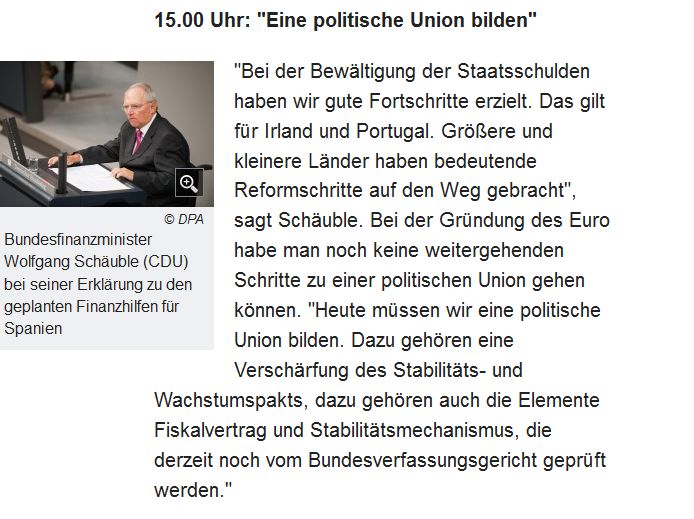
"Heute müssen wir eine politische Union bilden.
Dazu gehören eine Verschärfung des Stabilitäts- und Wachstumspakts,
dazu gehören auch die Elemente Fiskalvertrag und Stabilitätsmechanismus,
die derzeit noch vom Bundesverfassungsgericht geprüft werden."
Finanzminister Schäuble, Bundestag, Welt Online 19 July 2012
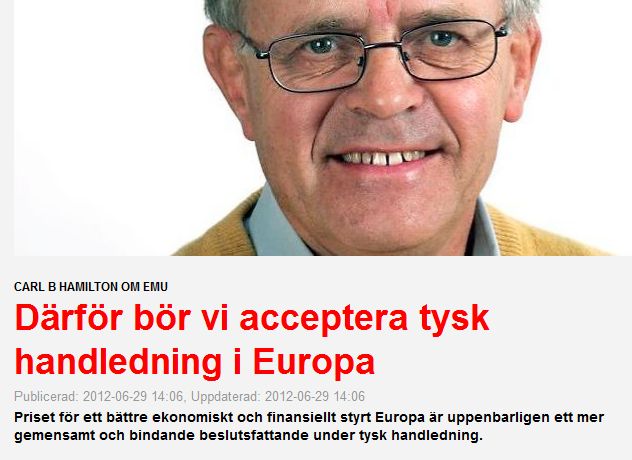
Priset för ett bättre ekonomiskt och finansiellt styrt Europa är
uppenbarligen ett mer gemensamt och bindande beslutsfattande under tysk handledning
Carl B Hamilton, Newsmill 29 juni 2012
Ever since the World Cup in 2006, collective national euphoria during major soccer championships has been part of German life.
That's also true with Euro 2012. Some see the beginnings of a disturbing nationalism.
Deutsche Welle 24 June 2012
German flags draped from windows, people ardently belting out the national anthem with one hand laid over their hearts: not long ago, images like these would have been unthinkable in Germany. And many still say that in light of the country's past, it's not appropriate to feel and display national pride.
Kommentar av Rolf Englund
Tyskarna är som andra folk. Dom vill inte bli en provins i ett nytt Romar-rike dom heller
The most important thing is that we create a fiscal union, one in which the nation states give up their jurisdiction in terms of fiscal policy.
If we had always said we would only take steps toward integration if they would immediately work 100 percent, we would never have advanced by so much as a meter.
That's why we wanted to introduce the euro first and then quickly make the decisions needed for a political union
SPIEGEL: It almost sounds as if you had longed for the crisis so that you could finally correct the birth defects of the euro.
Schäuble: Well, it isn't quite that bad. But the more people see what's at stake, the more they are willing to draw the right consequences.
SPIEGEL Interview with Finance Minister Schäuble, 25 June 2012
Att EU går framåt betyder att politisk makt flyttas från medlemsländerna till Bryssel och detta kan inte genomföras på demokratisk väg. Folken (obs pluralen) är nämligen helt emot detta.
Men om man ställer till rejäla kriser, så kan varje nationell maktelit skrämma sitt folk till underkastelse.
EU-kommissionens tidigare ordförande, virrpannan Romano Prodi, var så omedveten att han skrev en kolumn i självaste Financial Times (20 maj 2010), där han lugnt konstaterade att han och alla de andra som drev fram europrojektet naturligtvis visste att det skulle leda till en svår kris förr eller senare.
Jag citerar: ”When the euro was born everyone knew that sooner or later a crisis would occur. It was inevitable that, for such a bold and unprecedented project, in some countries (even the most virtuous ones), mistakes would be made and unforeseeable events occur.”
State of The Union
De svenska fackföreningarna och väljarna är inte sämre, snarare bättre, än motsvarigheterna i länder som Tyskland, Frankrike, Spanien, Italien och Grekland.
Det betyder att det inte bara för Sverige, utan för alla länder, är en dum idé att vara med i euron.
Om det är så dumt, varför har då så många europeiska politiker valt att införa euron?
Svaret är att det har de gjort av andra skäl än ekonomiska.
Vad är det som har en flagga, en nationaldag, en nationalsång, en militärstyrka, ett parlament och en högsta domstol.
En stat, naturligtvis. Vad är det mer en stat har? Jo, en valuta.
Det är därför europas ledande politiker har infört euron. För att vara med om att rita om Europas karta, skapa ett nytt imperium, i Habsburgs efterföljd,
som kan utmana USA, som vänstern hatar och högern föraktar.
Rolf Englund 20 januari 2003
The small number of intelligent officials and the economic elite understand what is at stake, but are willing to take the risk of an accident.
The preservation of the euro is not their primary objective.
When Otmar Issing, the former chief economist of the European Central Bank, categorically rejects any form of debt mutualisation,
as he did in a recent newspaper article, he omits to mention what would happen if the government were to follow his advice.
The eurozone would break up.
Wolfgang Munchau, Financial Times 24 June 2012
"The 50 Days That Changed Europe" explains how the EU grew from a six-nation trade alliance to a 27-country behemoth with its own currency.
in Strasbourg on Dec. 9, 1989, after the Berlin Wall fell,
Germany agreed to monetary union in order to get President Mitterand to agree to German reunification
WSJ 23 Sept 2011
Kommentar av Rolf Englund:
Tänk om det är så att Tysklands motsträvighet att rädda euron beror på att
Frankrike tvingade Tyskland att gå med på euron för att få återförenas?
Hemska tanke!
Peter Wolodarski, Dagens Nyheter 24 juni 2012:
I förra veckan hörde jag en av Tyskland främsta publicister, Die Zeits chefredaktör Josef Joffe, tala om den europeiska skuldkrisen på Johnsonstiftelsens intressanta Engelsbergsseminarium.
Under sina 15 minuter i talarstolen använde han begreppet ”Club Med” ungefär 15–20 gånger för att avhandla eurokrisens underskottsländer.
I några korta meningar förvandlades krisen från ett problem som Europa gemensamt orsakat, till en smet som några semesterarrangörer vid Medelhavet vispat samman
Jag blev inte på det klara med hur Joffe vill att depressionen ska bekämpas, annat än att de lata sydeuropéerna bör ta sig i kragen och börja arbeta.
Dock fruktade den tyske chefredaktören, som jag ofta läst med stor behållning, att Angela Merkel inte kommer att stå pall för trycket utan snart öppnar plånboken för att rädda de slösaktiga i söder.
Inte ett ord om de lättsinniga tyska bankernas centrala roll i att krisen uppstod och fördjupades. Inte ett ord om att EMU-projektet berövat södra Europa avgörande möjligheter att själva parera nedgången, vilket ställer krav på samarbetets överskottsländer att lugna marknaderna och underlätta återhämtningen.
Något enhetligt Club Med existerar ju inte. Grekland är ett specialfall, Italien har sina problem efter Berlusconiåren, Portugal är Portugal och när finansoron bröt ut var statsskulden i Spanien och Irland – tro det eller ej – väsentligt lägre än i Tyskland.
Det som förenar dessa stater är inte främst något kulturellt särdrag, även om korruptionen är mer utbredd i söder än i norr.
Den gemensamma nämnaren är i stället att samtliga drabbats hårt av eurons tillkortakommanden
Peter Wolodarski, Dagens Nyheter 24 juni 2012
German president suspends ESM on orders from Constitutional Court
After an intervention of the Constitutional Court, the German president Joachim Gauck will not sign the new law Bundestag passed to implement the ESM
and the fiscal pact for the time being, Frankfurter Allgemeine Zeitung reports.
Eurointelligence Daily Briefing 22.06.2012
The mood in the chancellor’s ultra-modern offices, opposite the reconstructed Reichstag,
is a mix of scorn, gloom and outrage at being misunderstood by the world.
Charlemagne, The Economist print, June 16th 2012
Angela Merkel balked at committing to direct sovereign debt purchases through the euro-area bailout fund,
pushing back on calls by the bloc’s leaders who support the measure as a way to ease the crisis
Such a move, while legally possible, “is not up for debate” at present, Merkel said yesterday in Berlin.
French President Francois Hollande championed the idea of using the European Stability Mechanism to purchase indebted countries’ bonds
Just returned from the Group of 20 summit in Los Cabos, Mexico, Merkel said: “I haven’t heard about such things.”
Bloomberg, 21 June 2012
With the EU’s politicians unable or unwilling to act, everything depends on the European Central Bank and its chief, Mario Draghi.
The EU’s political leadership understands that a Spanish default would be a cataclysm -- including for Germany
The ECB has to step up. It wasn’t easy for the Fed to enlarge its role in this way, and it will be even harder for the ECB, which operates under tighter legal restraints.
There’s no alternative. We will know one way or the other within days. EU leaders have a summit meeting scheduled at the end of the month
Clive Crook, Bloomberg, June 20, 2012
During the G20 meeting, Merkel -- together with Hollande, Spanish Prime Minister Mariano Rajoy and Italian Prime Minister Mario Monti --
were on the hot seat, forced to explain to the rest of the world exactly how they planned to finally bring Europe's enormous debt problems under control.
And they had to promise to do even more to save the euro than they have already.
"We support the intention to consider concrete steps towards a more integrated financial architecture, encompassing banking supervision, resolution and recapitalization, and deposit insurance," the summit's final statement reads.
Der Spiegel 20 June 2012
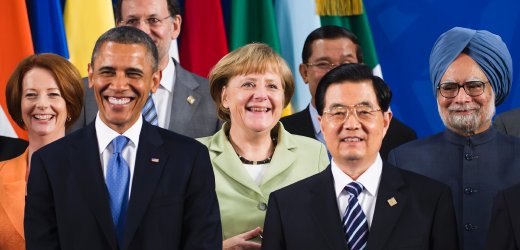
G20 sources suggested that Angela Merkel was preparing to
allow eurozone institutions to begin buying bonds issued by member state's governments.
The purpose of the intervention would be to bring down sovereign bond yields of weaker eurozone states
The Independent 20 June 2012
However, a German government spokesman insisted last night that there had been "no change" in Berlin's position on the use of the funds of the eurozone bailout funds.
The announcement of these new measures could come at a meeting of the eurozone powers that will be hosted by the Italian Prime Minister, Mario Monti, in Rome on Friday. Those attending will include Ms Merkel and François Hollande, the new French President.
European leaders are poised to announce a £600 billion /cirka 6.600 miljarder kronor/ deal to bail out Spain and Italy
Telegraph 20 June 2012
RE: Det låter föga sannolikt, tycker jag. Eller så är dom skrämda från vettet.
In their closing statement, the eurozone countries promised to take whatever measures necessary to maintain the stability and integrity of the region and to keep financial markets functioning.
Robert Shapiro, a former US undersecretary for commerce, said it was market pressure that would lead to a change of tack in Europe - particularly when it comes to German Chancellor Angela Merkel.
Shapiro, who served under former US President Bill Clinton and is currently an advisor to Obama, said the
G20 summit was successful because the chancellor altered her position.
Deutsche Welle, 20 June 2012
"For the first time, she agreed, begrudgingly, that the eurozone's money could be used to balance Spanish and Italian accounts," he told DW.
For her part, Merkel said the message to take away from Los Cabos was that the eurozone nations gave their political support to the shared currency. She said discussions took place concerning a "European institution that would embody the supervision of banks" and "more measures for growth, the adoption of guidelines for shared standards for deposit guarantees and bank reorganization."
Fredrik Reinfeldt i riksdagens partiledardebatt 13 juni 2012
Ett stort steg som pekar på fördjupning och överföring av suveränitet från nationalstaterna till den europeiska nivån.
Med kort varsel kommer det nu att avkrävas svar av Sverige som nation och av riksdagens partier om hur vi ska förhålla oss till mycket av det här.
Klicka här
The marriage may have been foolish. But a divorce would be terrifying. It is against this background that we must assess the views of the dominant partner: Germany.
According to a translation I have received from the German embassy, Angela Merkel, Germany’s cautious chancellor, told the Bundestag last week that she wishes to say to “all those who...are intent on persuading Germany that we need eurobonds, stability funds, a European deposit guarantee scheme, many more billions and much more: yes, Germany is strong”.
Moreover: “We’re convinced that Europe is our destiny and our future... But we’re also aware that Germany’s strength isn’t infinite.”
Furthermore: “Quite apart from the fact that these seemingly simple proposals...are unfeasible in constitutional terms, they are completely counterproductive. They would make mediocrity the yardstick for Europe. We would thus be forced to abandon our goal of maintaining prosperity in the face of international competition.”
Martin Wolf, via CNBC 20 June 2012
To all this she added: “The fiscal compact is a first step towards combining greater unity with greater control at the European level. And it’s going to be vital that national powers only be relinquished when it is clear that this will involve independent supervision of the European institutions.
In sum, she made three crucial points: first, Germany is not about to stump up more money; second, everybody in the euro zone must become like Germany; third, when and only when strong rules and credible controls exist at the European level might Germany accept any further losses of national sovereignty.
In an apparent reference to the proposed euro bonds,
Merkel said that seemingly simple "collectivization ideas" are actually
"unconstitutional and completely counterproductive."
Der Spiegel 14 June 2012
The real source of uncertainty about the euro’s future is the failure of Germany and its European partners to commit themselves to the level of integration needed to hold the single currency together.
Systemic reforms will be needed, including some mutualisation of debts and a move towards a banking union, with euro-wide oversight and responsibility for banks
The Ecoonomist print 16 June 2012
It's hard to know whether to laugh or cry. Every week, seemingly, brings some new miracle cure, some further quack remedy, produced as if from the back of a lorry, which promises finally to fix the eurozone debt crisis once and for all.
A little while back, it was eurobonds, then it was European Central Bank intervention in sovereign bond markets,
followed by project bonds, use of European bail-out funds for direct recapitalisation of struggling periphery banks, and so on.
It's desperate stuff.
Jeremy Warner, Telegraph 13 June 2012
The favoured fix du jour is that of rapid progression to a fully-fledged banking union, or federal banking system – a plan which the European Commission seems to think it could have up and running by the beginning of next year.
This one lasted even less time than the others before being shot down in flames by the big wigs of Berlin and Frankfurt.
At the heart of the disaster is the reluctance of Europe’s self-deluding elite to admit that
the single currency was launched on a false premise and shored up by deceit.
Jeff Randall, Daily Telgraph 25 June 2012
The false premise was, as /Krugman/ pointed out recently, “the arrogance of European officials, mostly from richer countries, who convinced themselves that they could make a single currency work without a single government”.
The deceit, highlighted by Harvard historian Niall Ferguson in the first of his Reith lectures last week, continues to be a “fraudulent” system of national accounting
Confounded by events and discredited by outcomes, those who urged us to believe that political firepower would abolish financial gravity inside the eurozone are now tormented by their own hubris. Yet rather than confess to intellectual shortcomings, they thrash about for scapegoats.
The problem is not those benefiting from the system but the system itself.
In a league table of financial fantasies, the euro is right up there with Tulipomania and the South Sea Bubble.
The dream of a United States of Europe has turned into a nightmare, but confronting reality is too terrifying for them to contemplate.
In the absence of voter approval for irreversible fiscal union and a perpetual conveyor belt of taxpayer funding from Stuttgart to Salonika,
how does the euro survive?
For if Greece goes, what about Spain?
Felet är att eurozonens ledare inte vill inse att allt var fel från början.
De vill inte inse att tanken, att ha en gemsam valuta för Tyskland och Grekland, Finland och Cypern, var och är en felaktig tanke.
Allt var fel från början, precis som kommunismen. Om bara inte Stalin hade kommit... Om bara inte Grekland hade misskött sin ekonomi..
Rolf Englund 21 oktober 2011
Se även Englunds lag: Har man sagt A, måste man säga B och har man sagt B är det svårt att säga att A var fel.
Europe needs a fiscal and banking union if it is to survive
“the worst crisis” since the European Union’s creation,
Spanish Prime Minister Mariano Rajoy said in an open letter to leaders on Wednesday.
Rajoy added that the European Council’s next meeting on June 28-29 provides an “urgent” opportunity to outline these plans
CNBC 13 Jun 2012
National governments need to surrender sovereignty to the European center, Merkel says, so that democratic accountability is restored and proper standards of governance can be maintained.
Meaning what? Perhaps she imagines that this new political union would put Germany in command.
Assuming non-Germans would be allowed to vote, Germany would be less in command than now.
Clive Crook, Bloomberg June 13, 2012
The German government has begun opening the door to shared debts for the first time in a profound change of policy,
agreeing to explore proposals for a €2.3 trillion (£1.9 trillion) stabilization fund in order to stop the eurozone’s crisis escalating out of control.
Ambrose Evans-Pritchard, 13 June 2012
Ms Merkel rejected the Redemption Pact last November as “totally impossible”, even though it was drafted by Germany’s Council of Economic Experts or Five Wise Men and is widely-viewed as the only viable route out of the current impasse.
Jose Manuel Barroso, the European Commission’s chief, warned that Europe faces a “social emergency” . Countries sticking to reforms are engulfed by forces beyond their control.
“We must recognise that we have a systemic problem. I am not sure the urgency of this is fully understood in all the capitals,” he said in a thinly veiled attack on Berlin.
Otmar Issing warns against a further mutualisation of debt and risks
“Germany would do the right thing to stick to the treaty and as the others to do the same.
A Germany that would drown in debt because it takes liabilities as a result of an ill-conceived sense of solidarity
will provoke the rage of its citizens and alienate them even further from the European idea as is unfortunately already the case now.”
Frankfurter Allgemeine Zeitung via Eurointelligence 12 June 2012
The demands being made of the German government spring from a sincere desire to avoid a rerun of the 1930s,
when economic disaster provoked political catastrophe.
However, while these demands may make economic sense, they are politically unrealistic and dangerous.
They are textbook solutions that fail the real-world test.
Worse, if enacted, they would risk provoking the very political radicalisation they are ultimately meant to prevent.
Gideon Rachman, Financial Times 11 June 2012
Once you take a big step towards the mutualisation of debt across Europe, you are forced towards much deeper political union.
It is not just the much-discussed need for a European “minister of finance”, with the power to override national governments. To avoid bitter disputes over fairness, you would also need to harmonise European social-security systems.
The Merkel government is not ruling out eurozone bonds or EU deposit insurance for ever.
It is arguing that any such moves can come only as part of a bigger project – the formation of a political union.
A recent Pew opinion poll showed strong majorities across Europe against ceding national sovereignty over budgetary matters to a central authority.
Barroso pushes EU banking union
All 27 EU countries should submit their big banks to a single cross-border supervisor as part of a banking union to be enacted as soon as next year
Financial Times, 11 June 2012
The European Union, the world’s biggest economic area, could plunge into a spiral of bank busts, defaults and depression
— a financial calamity to dwarf the mayhem unleashed by the bankruptcy of Lehman Brothers in 2008.
The Econoomist print 9 June 2012
A Sneak Peek at Tomorrow's Europe - the abyss is no longer very far away
Politics is a strange business, and one of its premier oddities is that monumental changes are rarely heralded by great speeches.
Chancellor Angela Merkel in recent weeks has revealed just such a change in tone.
"More than anything, we need a political union,"
Der Spiegel, 11 June 2012
Higly recommended
The chancellor is not a master of the apocalypse in the vein of Green Party patriarch Joschka Fischer, who pronounced earlier this month that "the European house is in flames."
That is hardly Merkel-esque locution, but she is fully aware that the abyss is no longer very far away.
It would be the beginning of the United States of Europe.
As such, the four European architects are aiming at establishing a new European consensus.
Germany would have to take on additional risks within the euro zone. In return, southern Europeans would have to grant Brussels control over their national budgets -- according to German principles.
It would be an experiment with uncertain results.
It could, in the end, be the savior of the common European currency -- or it could mean the implosion of Europe.
Such a plan could very well calm international financial markets. But it could also be that Europeans wouldn't accept it.
Still, it might be the last chance to prevent a collapse of the euro.
Om man klickar sig fram via ledarsidans blogg och klickar på Sanna Rayman, en av mina favoriter på SvDs ledarredakton,
hittar man ett opus med rubriken "Merkel och moralismen"
Rolf Englund 11 juni 2012
Att det europeiska samarbetet går genom en besvärlig fas just nu är tveklöst.
Inte med bästa vilja i världen går det att hävda att vi har en livaktig Europadebatt i Sverige.
Vi har anledning att följa den nya tyska debatten, där det på sina håll finns tankar om ett samarbete betydligt tätare än dagens.
Carl Bildt, SvD Brännpumkt 7 september 2012
Treaty change
The last big rewrite took the best part of a decade: the constitutional treaty was rejected by French and Dutch voters in 2005,
and its successor, the Lisbon treaty, had to be put to the Irish twice before passing.
Today, even assuming that Europe’s debtors and creditors can agree, any revision could invite disaster.
Much of the euro zone is in a deep and prolonged recession,
and Eurosceptic parties of many stripes are on the rise in both north and south.
Charlemagne, The Economist print Apr 27th 2013
A common safety net is another essential element.
This would involve common deposit insurance and common backstop.
The other union Europe needs to contemplate is fiscal union.
That will surely take time, and further discussion by members to choose the precise end point.
David Lipton, First Deputy Managing Director IMF, April 25, 2013
Barroso: We must complete the unfinished business of economic and monetary union (EMU)
Common and more integrated supervision is the first step towards a banking union.
Moreover, it is the start of something much bigger.
Project Syndicate, 29 augusti 2012
Bankunion är på väg
"a big step towards more European integration – a genuine transfer of sovereignty
and a significant strengthening of European institutions"
Wolfgang Schäuble, Financial Times, August 30, 2012
Under a mandate from the EU heads of states and governments, the European Commission will shortly unveil proposals for the creation of a Europe-wide supervisory system for banks.
This new supervisor is widely expected to be housed at the European Central Bank.
Setting up such a system will be no simple undertaking and doing so within a reasonable timeframe will require not just hard work but also courage, for it implies a big step towards more European integration – a genuine transfer of sovereignty and a significant strengthening of European institutions.
The centrepiece of the rule book – the translation of the Basel III capital requirements for banks into European law, also known as CRD IV – is still being negotiated between the member states and the European parliament.
Officials cautioned that the legislation was still being drafted and would not be formally unveiled by Mr Barroso until his state of the union address on September 12.
To become law, it must be approved by all 27 EU heads of government;
commission officials hope they will agree at an EU summit before the end of the year.
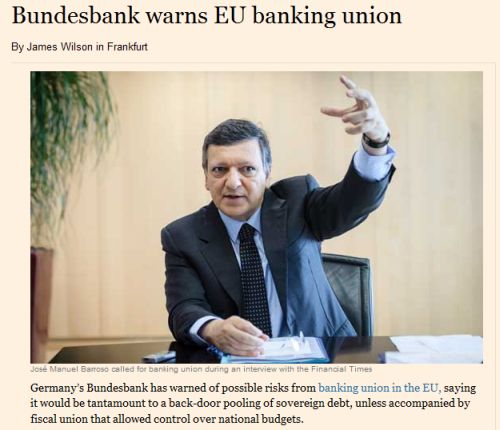
Sabine Lautenschläger, vice-president of the Bundesbank, said banking union could only work in tandem with fiscal union –
meaning some common cross-border binding rules on how countries could set budgets.
Ms Lautenschläger also cast doubt on how quickly any banking union could be implemented,
saying “comprehensive EU treaty changes” would be needed.
Ms Merkel does not say “no” to eurozone bonds. She says: “Not without treaty change.”
The German constitutional court in Karlsruhe would never allow Germany’s sovereign guarantee to be given to its eurozone partners
without them submitting to effective and centrally budgeted discipline.
Financial Times 31 May 2012
"I am sure the euro will oblige us to introduce a new set of economic policy instruments.
It is politically impossible to propose that now. But some day there will be a crisis and new instruments will be created."
Romano Prodi, EU Commission President, Financial Times, 4 December 2001
Det finns dock starkare krafter som talar för att EMU-länderna trots allt lär ge upp makten till Bryssel.
Etablissemanget vill det. Nästan alla etablerade partipolitiker kommer framstå som åsnor om EMU havererar.
Marknaden vill det. - Lobbyisterna vill det.
Under hotet att bli ett nästa Grekland kommer medborgarna låta ett nytt EU-fördrag kuppas igenom.
Peter Benson, SvD Näringsliv 21 juli 2012
German government is furious about van Rompuy’s three-stage strategy
Frankfuter Allgemeine reports that Berlin is furious about the van Rompuy report towards economic union.
The German government says these proposals go too far.
Eurointelligence 7 December 2012
In particular, the government is appalled by the idea of a “three stage process”. Berlin is happy to talk about everything in general and vague terms, but refuses point blank to be drawn in on any commitments beyond 2014 (we wonder why). The government is also angry that van Rompuy has taken over many elements of the proposals from the European Commission last week. The article says that a firm commitment towards these goals would trigger a dynamic that might be difficult to get under control. Berlin does not want to address the issues, including treaty change, until 2014.
The three stages outlined by the proposal are the completion of the existing legislation in 2012 and 2013, including on banking union and Basel III. The second stage is a common bank resolution administration and a common resolution fund – but the article said a common deposit insurance has been dropped. A third stage includes changes to the European Treaties, with the setup of a common fiscal capacity.
A masterplan for “completion of economic and monetary union” has been set out in a confidential document to be discussed by EU leaders at a Brussels summit next week.
In the nine-page paper, seen by The Daily Telegraph, Herman Van Rompuy, the president of the European Council – the monthly summits of EU leaders –
charts a series of steps from ongoing financial reforms to overall political union for the eurozone.
Daily Telegraph 5 December 2012
“The general objective will be to aim for a progressive pooling of economic sovereignty at the European level,” the paper states.
Västblocket
Merkel Pushes for Convention to Draft New EU Treaty
Germany is pushing for a new treaty governing the construction of the European Union, and it is calling for a convention to draft the pact to be convened before the end of the year.
The treaty would pave the way for deeper European integration and would create a new legal foundation for the bloc.
Der Spiegel 27 augusti 2012
Chancellor Angela Merkel's European Union policy adviser, Nikolaus Meyer-Landrut, has expressed this desire in discussions with high-level EU officials in Brussels, SPIEGEL has learned.
A date for the beginning of the convention is expected to be fixed at an EU summit in December.
When Merkel previously brought up the subject during a December EU summit meeting, many people reacted with indignation. Initially, the other EU countries were unwilling to go along with the calls from Merkel and then-French President Nicolas Sarkozy for automatic sanctions for repeat offenders of budget rules.
In the end, the Germans and French found a common position, saying they would push forward with a new EU treaty -- either with the entire bloc or with the 17 members of the euro zone if other countries were unwilling to go along with it.
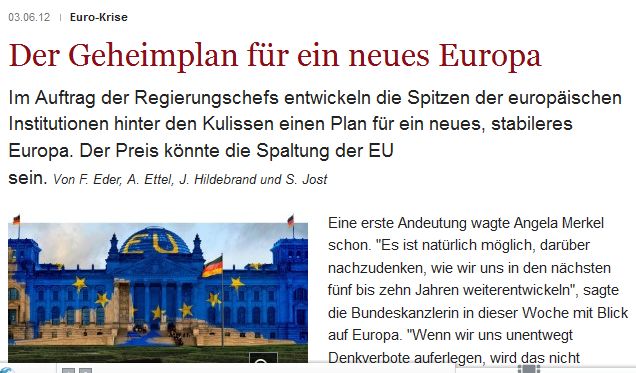
"A secret plan to save Europe": That's how the German newspaper Welt am Sonntag described it this weekend.
According to the paper, Van Rompuy, Manuel Barroso,Juncker and Draghi were all working behind the scenes on a master plan.
But it turns out the grand plan is not all that secret. At the last European summit on May 23, the four were explicitly given the task of finding a permanent solution to the crisis by the end of this month.
Deutsche Welle June 6 2012
Merkel was probably responding to a comment from ECB head Mario Draghi last week. He said that the crisis had exposed the inadequacy of the financial and economic framework set up for the monetary union before it was launched in 1999.
"That configuration that we had with us by and large for ten years which was considered sustainable, I should add, in a perhaps myopic way, has been shown to be unsustainable unless further steps are taken," Draghi said in response to questions in the European Parliament.
Only gradually did it become clear how dramatic this statement was:
the man in charge of the European Central Bank no longer believes in the future of the euro in its current form
Full text Die Welt 3 Juni 2012
EUs grundlag - The Constitution
Om ett fördjupat EU-bygge blir tillräckligt bra
bör Sverige allvarligt överväga att delta och inte reflexmässigt följa Storbritannien ut i en oviss kyla.
Men först måste partierna inför valet till Europaparlamentet nästa år förklara vad de vill i EU-frågan.
Allt annat är ett svek mot demokratin, skriver "ledande svenska EU-debattörer".
Anders Wijkman, Karl-Erik Olsson, Rolf Gustavsson, Ulf Dahlsten och Kristina Persson, DN Debatt 2 mars 2013
EU summit delays crucial eurozone moves
An EU summit once touted as a gathering to set the future course of the eurozone has instead put off all major decisions on closer fiscal and economic integration
until June, casting a blow to efforts by the presidents of the EU’s major institutions to jump start the effort early next year.
Financial Times December 14, 2012
A Game of Euro Chicken
Playing Until the Germans Lose Their Nerve
It's well-known that French President François Mitterrand made his approval of German reunification contingent on German Chancellor Helmut Kohl's acceptance of the common currency.
The next stage in the crisis will be blatant blackmail. With their refusal to accept money from the bailout fund to recapitalize their banks, the Spanish are not far from causing the entire system to explode.
Jan Fleischhauer, Der Spiegel 8 June 2012
For Germany, being part of the European Union has always included an element of blackmail. France has been playing this card from the beginning, but now the Spanish and the Greeks have mastered the game. They're banking on Berlin losing its nerve.
Indeed, only political simpletons assume that when people in Madrid, Rome or Paris talk about Europe, they really mean the European Union.
Jan Fleischhauer is the author of "Der Schwarze Kanal," or "The Black Channel," SPIEGEL ONLINE's weekly conservative political column. Black is a reference to the political color of Chancellor Angela Merkel's political party, the center-right Christian Democratic Union.
"The 50 Days That Changed Europe" explains how the EU grew from a six-nation trade alliance to a 27-country behemoth with its own currency.
in Strasbourg on Dec. 9, 1989, after the Berlin Wall fell,
Germany agreed to monetary union in order to get President Mitterand to agree to German reunification
WSJ 23 Sept 2011
Berlin säger nej till en gemensam europeisk upplåning via euroobligationer. Nej till en större krisfond. Nej till en europeisk bankakut. Nej till att ECB lånar pengar direkt till stater. Nej till högre inflation för att snabbare få bort skulder. Nej till färre nedskärningar och mer stimulanser för att få fart på tillväxten, inte minst i Tyskland.
Man kan resa relevanta invändningar mot vart och ett av dessa förslag. Men man kan inte avfärda samtliga utan att det får konsekvenser.
Tyskland, som är Europas största långivare, verkar fortfarande tro att de senaste årens krismedicin – snabba åtstramningar – ska vinna tillbaka marknadens förtroende för de krisande eurostaterna och därigenom återställa lugnet.
Men ingenting tyder på att den tyska medicinen fungerar.
Europa har slagit in på en kamikazekurs som ser ut att leda mot att euron bryts sönder.
/Spanien/ riskerar att dras ned i en negativ spiral som kan knäcka banksystemet, orsaka en statsbankrutt
och leda till att Spanien lämnar den europeiska valutaunionen.
Peter Wolodarski, Dagens Nyheter 3 juni 2012
Is the euro entering the end game?
World Bank head Robert Zoellick argued that it is almost time to "break the glass" on the emergency alarm.
Such sentiments about the dangers currently facing the European common currency are hardly new.
But this week, concern at the highest levels appears to be slowly morphing into panic.
Der Spiegel 1 June 2012
Italian Prime Minister Mario Monti also got into the act on Thursday by
demanding that the euro backstop fund, the European Stability Mechanism (ESM),
be allowed to provide fresh capital directly to struggling European banks,
a move that Germany has strictly opposed thus far.
Der Spiegel 1 June 2012
Ms Merkel does not say “no” to eurozone bonds. She says: “Not without treaty change.”
The German constitutional court in Karlsruhe would never allow Germany’s sovereign guarantee to be given to its eurozone partners
without them submitting to effective and centrally budgeted discipline.
Financial Times 31 May 2012
The German constitutional court
If Spain, Ireland, Greece, Portugal and maybe Italy, broke free (with a combined GDP to rival Germany).
They would enjoy an immediate 30pc cost advantage thanks to devaluation, which would jump start growth
Germany would probably be forced to adopt its own stimulus measures to boost consumer spending at home
A smaller German surplus and more inflation would result, but that's no disaster, even for Germans.
Damian Reece, Telegraph 31 May 2012
ECB
There isn’t much that Germany has in common with Greece but in one regard the two countries are actually quite similar
– both say they want the euro but neither is prepared to do the things necessary to keep it.
Jeremy Warner, 30 May 2012
The crisis in the eurozone is the result of France’s persistent pursuit of the “European project,”
the goal of political unification that began after World War II when two leading French politicians,
Jean Monnet and Robert Schuman, proposed the creation of a United States of Europe.
Germany resisted the euro, arguing that full political union should come first. Since there was no chance that the other countries would accept political union, Germany’s position seemed like a technical maneuver to prevent the establishment of the single currency.
Germany was reluctant to give up the Deutsche Mark, a symbol of its economic power and commitment to price stability.
Germany eventually agreed to the creation of the euro only when French President François Mitterrand made it a condition of France’s support for German reunification.
Martin Feldstein, 27 May 2012, with many links
Why it is impossible - The Name Is Bond. Eurobond.
German central bank chief Jens Weidmann:
“The pooling of debt is just one side of a coin where federalism is the other.
Governments who are in favour (of eurobonds) fail to point this out,”
Sapa-AFP 26 maj 2012
Greek leftist Alexis Tsipras delivers 'message of friendship' to Germans
Leader of Syriza insists Greece is not seeking to blackmail Germany during his charm offensive in Berlin
Guardian 22 May 2012
New York Times om Ms. Merkel:
By this point, there should be no debate: Austerity has been a failure
New York Times, editorial, 24 May 2012
The German Chancellor
“It’s just about not spending more than you collect.
It’s astonishing that this simple fact leads to such debates,”
Speaking yesterday the British Chancellor, George Osborne, said:
“Eurozone countries needs to stand behind their currency
or face up to prospect of a Greece exit with all the risks that that could involve.”
Telegraph 22 May 2012
CDU parliaament group leader; "Sarrazin is wrong again. The euro is a success story and will remain so."
A new book 'Europe Doesn't Need the Euro.'
by Thilo Sarrazin, a firebrand author and former board member of the German central bank.
Der Spiegel, 22 maj 2012
Thilo Sarrazin, the former board member of Germany's central bank who caused outrage two years ago with a bestseller criticizing the impact of Muslim immigrants on German society, presented a new book on Tuesday that could strike a similar chord with Germans: "Europe Doesn't Need the Euro."
In his latest work, the combative politician, a maverick member of the opposition center-left Social Democratic Party, controversially argues that Germany is being pressured to bail out the euro zone because it perpetrated the Holocaust.
Sarrazin writes that supporters of euro bonds in Germany "are driven by that very German reflex, that we can only finally atone for the Holocaust and World War II when we have put all our interests and money into European hands," according to excerpts published in German media ahead of the book launch.
Carsten Schneider, a budget policy spokesman for the SPD, said:
"Sarrazin is once again trying out the usual provocation. His criticism of the euro is nationalist and reactionary."
Volker Kauder, the parliamentary group leader of Chancellor Angela Merkel's Christian Democrats, said:
"Sarrazin is wrong again. The euro is a success story and will remain so."
He concludes that Europe can only get out of its mess if it rapidly moves towards political union, which he opposes,
or that the union should be transformed into a looser formation that allows troubled member states to quit so that they can regain competitiveness through currency devaluation.
Sarrazin, a former finance minister for the city-state of Berlin, quit his position at the Bundesbank in 2010 after reaching a settlement with the central bank, which had tried to fire him for damaging its reputation with his repeated provocative comments about immigrants.
He has since embarked on a lucrative career as an author. Sarrazin sold over 1.3 million copies of "Germany Abolishes Itself."
Europa leds av ett tankefel
Merkantilismen har ersatt kapitalismen och orsakat dagens kris
Om alla länder ska ha exportöverskott finns det inga som kan importera detta överskott.
Den merkantila principen och analogin med ett vanligt hushåll är fel
Danne Nordlling 20 maj 2012
Enda chansen att rädda euron är en fullfjädrad politisk union.
I ett första steg bör Tyskland och Frankrike bli ett land.
Kenneth Rogoff, Harvard, tidigare chefekonom på IMF, i SVT:s Agenda.
via SvD Näringsliv 21 maj 2012
Schaeuble Seeks Crisis Resolution With Moscovici
“We’re all very pleased that France wants to offer new initiatives with its newly elected president,”
“The German government is ready to talk about anything,” Schaeuble said,
though he ruled out measures that would raise debt.
Bloomberg 21 May 2012
The euro has lost 3.5 percent against the U.S. dollar this month and almost $4 trillion has been wiped from equity markets amid concerns over Greece.
The German government says a Greek euro exit would be expensive, but could be handled
“Two years ago this would have been like jumping off the 10th floor and the outcome would have been deadly”, the paper quotes an unnamed government source.
“Now it would be like jumping off the 2nd floor – a couple of broken bones, but not deadly.”
Rainer Brüderle, the FDP’s chief whip in Bundestag, told Handelsblatt
Eurointelligence Daily Briefing, 18 maj 2012
If Greece goes:
An exit is likely to shatter faith in the eurozone’s integrity for ever
Martin Wolf, Financial Times, May 17, 2012 7:10 pm
Om att äta kakan, ha den kvar, eller sälja den på kredit till Grekland
Rolf Englund 17 maj 2012
After Greek voters rejected austerity in last week's election Europe has been searching for a Plan B
It's time to admit that the EU/IMF rescue plan has failed.
Greece's best hopes now lie in a return to the drachma.
Der Spiegel, Staff, 14 maj 2012
At the Chancellery in Berlin, the television images from Athens now remind Merkel's advisers
of conditions in the ill-fated Weimar Republic of 1919-1933.
Der Spiegel, Staff, 14 maj 2012
Ett stort land som Tyskland kan bidra mer till efterfrågan i den europeiska ekonomin
genom att de närmaste åren tillåta större budgetunderskott och löneökningar.
Därmed gör man det lättare för andra att växa sig ur krisen och förbättra sin konkurrenskraft.
Peter Wolodarski, DN 13 maj 2012
“Growth through structural reform is important and necessary,’’ Merkel said.
“Growth through debt would throw us back to the beginning of the crisis.”
Financial Times, 10 May 2012
The Bundesbank, the most hawkish of central banks, has signalled it would accept higher inflation in Germany
as part of an economic rebalancing in the eurozone that would boost the international competitiveness of countries worst-hit by the region’s debt crisis.
Financial Times, 9 May 2012
A future German inflation rate above the eurozone average could be part of a natural adjustment process as crisis-hit countries pulled themselves out of recession, the Bundesbank argued in evidence to German parliamentarians submitted on Wednesday.
Surprise, Bundesbank tycker högre inflation är OK
Rof Englund 10 maj 2012
Euro Will Have to Be Devalued to Save EU
Devaluing a currency enables debtor nations to meet their obligations more easily, but European nations cannot act unilaterally in monetary policy.
Wharton finance professor Jeremy Siegel, CNBC 9 May 2012
One obvious solution to helping the troubled nations is a devaluation of the euro,
something the ECB has resisted due primarily to pressure from Germany and nations that don't have the same debt issues.
Devaluing a currency enables debtor nations to meet their obligations more easily, but European nations cannot act unilaterally in monetary policy.
"Greece leaving the euro zone — I think they would love to leave if they could figure out how.
The ECB, in an attempt to save the union, will lower the euro."
A quite shocking example, even to us, has been a commentary in this morning’s Welt in which the author argues that
the SPD’s repositioning on the fiscal pact – falling in line with Francois Hollande – was bordering on treason (“Vaterlandsverat”).
Eurointelligence, 9 May 2012
Den tyske finansministern Wolfgang Schäuble tycker att det är i sin ordning om lönerna i Tyskland stiger mer än i alla andra EU-länder.
Europaportalen 8 maj 2012
Kritiker menar att låga tyska löner gör att landet har en stor fördel gentemot andra EU-länder och att köpkraften ligger på en konstlat låg nivå. Den tyske kristdemokratiske finansministern Wolfgang Schäuble välkomnar nu att lönerna för tyska arbetare stiger.
SURRENDER of all German forces to General Dwight D. Eisenhower, Rheims. May 7, 1945
Rolf Englund 7 maj 2012
'Berlin Is Running Out of Allies in Euro Crisis'
Budget discipline is out of fashion in Europe.
Chancellor Angela Merkel is looking increasingly lonely in her fight
to save the euro through painful austerity measures
Der Spiegel 24 april 2012
First Greece’s Papandreou, then Italy’s Berlusconi, followed by Spain’s Zapatero, and now France’s Nicolas Sarkozy
Ever since the euro crisis erupted two years ago, no major European politician has been re-elected
So long as Germany and France were united behind that deal, it was rock-solid. That is the way the EU works. What the Franco-German axis demands, it gets.
But Hollande has pledged himself to tearing it up.
MarketWatch 25 April 2012
Funding of banks that are not financially sound or against inadequate collateral would shift substantial risks between national taxpayers.
Such implicit transfers are therefore beyond the mandate of the eurozone’s central banks.
not a legalistic obsession: it is key to the acceptance of monetary union by Europe’s citizens
President of the Deutsche Bundesbank, Jens Weidmann, FT May 7, 2012
Rescuing banks using taxpayers’ money is something that can only be decided by national parliaments.
Abiding by the rules of stability-oriented monetary policy, many of which are enshrined in the EU treaty, is not a legalistic obsession:
it is key to the acceptance of monetary union by Europe’s citizens.
Ignoring such constraints is not a pragmatic solution but would instead mean being carelessly oblivious to the corrosive effect such violations have on confidence in our single currency.
Bundesbank’s Jens Weidmann is no longer his master’s voice.
Almost a year into his new job as the head of Germany’s Bundesbank, Weidmann, 44,
has matured from Chancellor Angela Merkel’s discreet right-hand man at global economic meetings
into one of the few European policy makers warning that governments are failing to do what’s needed to rescue the euro.
Bloomberg Apr 23, 2012
Things have not gone Weidmann’s way as the debt crisis presented the ECB with challenges few foresaw.
He was outvoted on Aug. 4 when soaring yields in Italy and Spain prompted the ECB to resume and expand its bond-purchase program, a decision that prompted chief economist Juergen Stark, a former Bundesbank vice president, to quit.
Who is running Germany? A remakable article by a remarkable journalist
Is the Federal Chancellor in charge of the country’s foreign policy and strategic destiny, answering to the Bundestag?
Or is the Bundesbank answering to what it believes to be a higher master – the German constitution and the Basic Law – invoking the rulings of the Verfassungsgericht
Ambrose Evans-Pritchard, April 19th, 2012
The fiscal compact – formally the Treaty on Stability, Coordination, and Governance in the Economic and Monetary Union
French Prime Minister Manuel Valls and his Italian counterpart, Matteo Renzi, have declared – or at least insinuated –
that they will not comply with the fiscal compact to which all of the eurozone’s member countries agreed in 2012
Their stance highlights a fundamental flaw in the structure of the European Monetary Union
– one that Europe’s leaders must recognize and address before it is too late.
Hans-Werner Sinn, Project Syndicate 22 October 2014
Italy’s Downward Spiral
Italy’s new prime minister, Matteo Renzi, wants to stimulate growth. But what he really intends to do is accumulate even more debt.
True, debt spurs demand; but this type of demand is artificial and short-lived.
Sustainable growth can be achieved only if Italy’s economy regains its competitiveness,
and within the eurozone there is only one way to accomplish this: by reducing the prices of its goods relative to those of its eurozone competitors.
What Italy managed in the past by devaluing the lira must now be emulated through so-called real depreciation.
Hans-Werner Sinn, Project Syndicate 21 August 2014
Merkel has a duty to stop Draghi’s illegal fiscal meddling
The ECB is overstepping its mandate with anti-deflationary measures
Hans-Werner Sinn, FT September 29, 2014
Why Draghi was wrong to cut interest rates
Deflation in parts of a currency union is not the same as deflation of a union as a whole
Hans-Werner Sinn, Financial Times, November 13, 2013
Prominent German economist Hans-Werner Sinn:
“It is worth defending the euro” while advocating “temporary exits of weak countries”
Open Europe Newsletter 29 April 2013
In an interview with the Frankfurter Allgemeinen Sonntagszeitung, prominent German economist Hans-Werner Sinn, President of the Ifo Institute for Economic Research, says “it is worth defending the euro” while advocating “temporary exits of weak countries”.
On the new German anti-euro party ‘Alternative für Deutschland’ (AfD), Sinn says they are “acknowledged economists who know what they’re talking about” but added that he is less pessimistic about the future of euro than the AfD.
You can watch an interview Hans-Werner Sinn gave to Open Europe earlier this month.
Interview with the Frankfurter Allgemeinen Sonntagszeitung
Spain and Italy
At some point the Greeks will say: we cannot continue with the euro and instead we will reintroduce the drachma
Greece can become competitive again. First, the tourists will return.
The, the Greeks will stop importing more agricultural products from France than they export.
That will give a boost to the domestic economy. Third, the capital that was pulled out of the country will return.
Hans-Werner Sinn, president of the Ifo research institute, Deutsche Welle 17 June 2012
Under no circumstances whatsoever could the eurozone members span a protective umbrella over Europe's big countries, like it has for the small ones.
Altogether, Greece has received 460 billion euros so far. That cannot be repeated proportionately for the big countries.
We are fast approaching a tight spot where things are getting very difficult.
When the failure of Lehman Brothers at the end of 2008 led to a collapse in demand for /Germany’s/ goods
– and the economy contracted faster than most other industrialised countries – workers were not sacked on a grand scale as in the US.
Encouraged by subsidies for Kurzarbeit, or short-time working, companies instead hoarded labour.
As a result, domestic demand remained stable, allowing a quick rebound. “The difference today compared with 2009 is that industry has learnt to cope with short, deep crises,” says Mr von Fritsch. “Such crisis experience creates a calmer mood.”
Almost a decade ago Hans-Werner Sinn, president of Munich’s Ifo economic institute and one of the country’s best-known economists, wrote a book entitled Can Germany Be Saved?
What helped was that other countries inflated away from Germany. That has contributed greatly to Germany’s success.
Financial Times, 19 April 2012
De nya nödlånen på 130 miljarder euro som eurozonens finansministrar i dag väntas besluta om kommer inte att hjälpa Grekland överhuvudtaget.
Istället kommer pengarna bara att hjälpa de internationella banker som har fordringar på Grekland och förvärra situationen för landet ytterligare
Hans-Werner Sinn, chef för det inflytelserika ekonomiska Institutet Ifo i München, skräder inte orden i en intervju i tidskriften Der Spiegel.
Ekot, 20 februari 2012
The most likely outcome... German inflation will rise
The dominant German view is that the crisis reflects fiscal indiscipline.
Others insist (rightly) that the core problem was excessive lending, divergent competitiveness and external imbalances.
Martin Wolf, Financial Times 17 April 2012
Columbi ägg?
If Germany were the one to leave, the euro would be the currency that fell in value, relative to Germany’s new national currency and also to the dollar.
The weaker European countries would get to keep the euro but still get the devaluation they need, which would reduce their labor costs far less painfully than through wage cuts.
Michael Sivy, TIME 12 April 2012
It would then be up to Germany to decide whether to leave, perhaps with Austria, the Netherlands and Finland.
The German people should be made aware that the results would include a soaring exchange rate, a massive decline in the profitability of Germany’s exports,
a huge financial shock and a sharp fall in gross domestic product.
Martin Wolf, Financial Times 13 September 13, 2011
EU Fiscal Pact May Breach German Constitution
Germany's opposition Left Party says the fiscal pact agreed by 25 of the EU's 27 members may breach the constitution
because -- the party argues -- it can never be rescinded (rescind: to annul or repeal)
Der Spiegel, Thomas Darnstädt 2 April 2012
If the purpose of monetary union is to tie down a "European Germany" with silken cords, the Kohl-Mitterrand legacy has gone horribly wrong.
Germany's glistening new capital on the Spree - capped by Sir Norman Foster's Reichstag dome - is the throbbing heart of a reborn First Reich, a secular and democratic variant of the Imperium Romanum Sacrum or Hohenstaufen Empire.
Ambrose Evans-Pritchard, 1 April 2012
This hegemony is as deeply troubling to the Germans themselves as it is to the rest of Europe. They too have been swept along by an EMU process that they do not fully understand, and that has left them with a string of awful choices.
"This is not what we aspired to," said a senior official. "The German political class has no aspiration to be number one. It is not our reflex to stick out and lead policy. We have done extremely well by not being in the forefront."
Yet, for all the rhetoric, little has changed. The austerity strategy imposed by Berlin on Europe's `Arc of Depression' - against the better judgement of the European Commission, the OECD, International Monetary Fund, and informed economic opinion across the globe - has not been modified in the slightest even though economic contraction has proved deeper than expected in every single victim country.
Mr Schäuble talks of reducing debt in a "growth-friendly manner" but that is exactly what he forbids. He has embraced to the Puritan doctrine of "expansionary fiscal contraction" taught in German universities - but almost nowhere else in the world - which in its extreme form posits that a return to fiscal probity brings its own reward, even without the cushion of devaluation and monetary stimulus.
Germany went through its own austerity in the early part of the last decade while others were living high on the hog, and the memory understandably rankles. But as ex-Chancellor Gerhard Schroder says to deaf ears, he had to break the EU stability pact with deficits above 3pc of GDP at that time in order to cushion the pain of deep labour reform. Fiscal slippage was politically necessary, even in Germany.
Full text of excellent article
Rome, Habsburg and the European Union
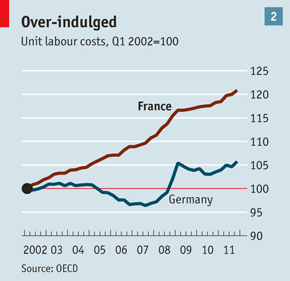
The Economist print 31 March 2012
As a result of the Constitutional Court ruling the powers of Bundestag in the context of euro rescue decisions with financial implications were further enhanced yesterday, Süddeutsche Zeitung writes.
All decisions with financial implications will have to be approved by the German parliament as a whole.
Earlier, the parliament itself had voted a law that delegated a great amount of decision power to a special committee that was empowered to decide on the Bundestag’s behalf in the name of speed, efficiency and discretion.
But the Karlsruhe court declared this to be unconstitutional and contrary to its intention to further re-enforce the democratic control of the government’s European policy decisions.
Eurointelligence 28 March 2012
The head of OECD has said that the eurozone needs to double its bailout fund to 1 trillion euros
But German Chancellor Angela Merkel said that she would favour only a temporary increase to 700bn euros
BBC 27 March 2012
A total merger of the EFSF and the ESM would raise Germany’s risk temporarily to about €400bn.
I find it hard to see how the German parliament would simply accept a near-doubling of the risk,
after having been told time and again that this would not be necessary.
And even this would not satisfy the rest of the world, since this is only a temporary increase.
Wolfgang Münchau, FT 25 March 2012
Some economists warn that the German central bank faces hidden liabilities of 500 billion euros
in the form of unsettled claims within the European payments settlement system,
and could lose that sum if the euro zone breaks apart.
Der Spiegel 26 March 2012
Jag kan i själva verket tycka att Tyskland leder saneringen av Europas ekonomi just genom att agera bromskloss.
Merkels lite buttra motsträvighet fyller en viktig funktion som motvikt mot röster och stater
som bara vill brassa på med stödåtgärder utan att bekymra sig över myntets baksida.
SvD-ledare Claes Arvidsson 24 mars 2012
"Ljuger euro-politikerna?"
I en kolumn i DN idag 14/3-12 (ej onl) menar professor Barry Eichengreen, Berkley, att eurokrisen till stor del beror på bristande förtroende.
Ett exempel på förtroendeminskande politik är Angela Merkels agerande när hon säger "en sak ena dagen och raka motsatsen nästa"
Danne Nordling 14 mars 2012
There are growing divisions among ECB leadership about how to handle the euro crisis,
not to mention between the ECB and the Bundesbank, Germany's central bank.
While ECB head Mario Draghi is pleased with his recent decision to flood the markets with cheap money,
Bundesbank President Jens Weidmann warns of the dangers.
Der Spiegel, 6 March 2012
Europakten kräver tysk grundlagsändring
German Chancellor Angela Merkel faces an unexpected challenge
the new treaty will require a two-thirds majority in both houses of parliament
CNBC 3 mars
Sélestat have emerged as a focal point of the French presidential campaign.
This ancient town in the center of Alsace boasts the extraordinary Humanist Library, dating from the 15th century.
But less proudly, Sélestat also has an unemployment rate of about 8 percent, much higher than towns just across the border in Germany.
Emmendingen, a German town of 27,000 that is only slightly larger than Sélestat and barely 20 miles away, has an unemployment rate of under 3 percent.
Among those under 25 years of age, the unemployment rate in Sélestat is 23 percent; in Emmendingen, it is 7 percent.
New York Times, 3 March 2012
Target 2
One of the more intriguing recent developments of the eurozone crisis is the shock expressed by
Germany’s economic establishment that the eurozone is, in fact, a monetary union.
Wolfgang Münchau, FT 4 March 2012
Det var en trött, disträ och håglös förbundskansler som stakade sig igenom regeringsförklaringen.
Som om hon inte riktigt trodde på vad hon sade när hon påstod att en stabilitetsunion höll på att bildas i Europa.
Rolf Gustavssonm, SvD 3 mars 2012
Den tyska författningsdomstolen
förklarade att den panel på nio ledamöter som skulle fungera som kontrollorgan för den tyska krispolitiken
"till stora delar" är grundlagsvidrig
DN/TT 28 februari 2012
G20-länderna kommer inte att skjuta till mer pengar förrän eurozonen själv gjort mer
Euroländerna håller på att bygga upp en ny räddningsfond som ska innehålla 500 miljarder euro.
Det är alldeles för lite, hävdar länderna utanför Europa, brandväggen måste byggas högre
Ekot 27 februari 2012
- Den stora risken var att Grekland skulle utlösa en kris i italienska, franska och tyska banker.
Nu finns i praktiken en EU-garanti för de utestående grekiska statsobligationerna.
Anders Borg, TT, SvD papper 22 februari 2012
Germany Isolated over Resistance to Expanding Euro Bailout
Der Spiegel, 23 februari 2012
Germany's ruling parties are to introduce a resolution in parliament blocking any further boost to the EU’s bail-out machinery,
vastly complicating Greece’s rescue package and risking a major clash with the International Monetary Fund.
Ambrose Evans-Pritchard, and Louise Armitstead 23 Feb 2012
Greece must default if it wants democracy
These demands fail Immanuel Kant’s “categorical imperative”
Nor could they be adopted in Germany – they would be unconstitutional
Wolfgang Munchau, Financial Times 19 February 2012
Grekland, Carl Rudbeck, Melodifestivalen, Brüning, Ann-Charlotte Marteus och Don't mention the war
Rolf Englund blog 19 februari 2012
What keeps the United States' monetary union strong is not our common language nor the uniformity of economic conditions across member states,
but rather our meaningful fiscal union transfers across states as part of the federal U.S. budget
If the European Monetary Union is to survive, Germany will have to dramatically increase its transfers to the periphery countries.
Ted Temzelides, professor of economics at Rice University, February 17, 2012
Den tyske presidenten Christian Wulff
avgår, liksom tidigare Horst Köhler
Rolf Englnd blog 17 Febr 2012
While questions on Greece’s remaining in the euro “have their justification,”
Merkel warned that a failure of the 17-member euro might endanger the Europe Union and the global economy.
Bloomberg 27/2 2012
“I think those risks are incalculable, and therefore indefensible,” Merkel told lawmakers in the lower house of parliament, or Bundestag, in Berlin today. As chancellor, “I should and have to take risks, but I cannot embark on adventures. My oath forbids that.”
Merkel’s coalition has a 20-seat majority in the 620-seat Bundestag and the bill is also backed by opposition Social Democratic and Greens lawmakers who together have 222 seats.
The euro has been a major experiment. A (current) total of 17 countries with many things in common -- but also many differences, such as their economies, politics, histories and ways of life -- have embraced a common currency.
Contrary to the expectations of many (including myself), these differences have not grown smaller over the years.
Unfortunately, there is no reason to expect that such increased harmonization might occur in the foreseeable future.
Wolfgang Kaden, Der Spiegel 2 March 2012
It's been over 20 years since then-German Chancellor and former history scholar Helmut Kohl stood before the Bundestag, Germany's parliament, and uttered the remarkable line:
"Recent history … has taught us that the notion one can maintain an economic and currency union over the long term without a political union is absurd."
Today, we know that a political union marked by a centralized European government is nothing but an illusory dream. Indeed, there won't be a United States of Europe comparable to that across Atlantic any time soon -- if ever.
- The euro was a noble experiment, but it has failed.
Robert Barro i Wall Street Journal
Artikelns rubrik var "All Systems Reverse!"
Jfr "Kunde vi rulla tillbaka Sovjetunionen skall vi väl kunna rulla tillbaka Europeiska Unionen"
"The way to European unity is irreversible," Mr. Kohl declared to a special session of Parliament
Germany must decide what the European Union is for
Chancellor Helmut Kohl asserted to a special session of Parliament that accords signed by European leaders in Maastricht
would ultimately lead the Continent to political union
Clive Crook, Bloomberg 16 February 2012
He continued: “The member states of the European Community are now bound in such a way that it is impossible for them to split apart and fall back into the concept of the nation-state, with all of its consequences. That means that we have achieved a key goal of German policy toward Europe.”
Kohl Calls the Path to European Unity Irreversible, New York Times 14 December, 1991
Chancellor Helmut Kohl asserted today that accords signed by European leaders this week would ultimately lead the Continent to political union."The way to European unity is irreversible," Mr. Kohl declared to a special session of Parliament.
Maybe, just maybe, the claim that Europeans were bound so closely together that the nation-state was history helped financial markets to believe the EU would not let countries of the euro zone default on their debts.
As long as this was believed - whatever the clauses in the debt contracts might say - Greece and others could borrow very cheaply, and they did.
Eurokrisen, fisksoppan och elitens olidliga dumhet
Rolf Englund blog 28 november 2011
Det kan visserligen hända att en gemensam valuta skulle tvinga fram den anpassning som krävs för att den ska fungera:
en samordnad finanspolitik, flexibla arbetsmarknader, och överföringar av människor och resurser mellan länderna.
Men tänk om det inte fungerar.
Gunnar Wetterberg, Samhällspolitisk chef på SACO
DN Debatt 1995-07-18
According to the leading front page story of Süddeutsche Zeitung there are deep divergences between Wolfgang Schäuble and Angela Merkel on what strategy to adopt for Greece.
The chancellor agrees with Schäuble’s diagnosis that Greece is hopeless but she fears a default will lead to contagion for Italy and Spain
with the potential to blow up EMU
Eurointelligence 17 February 2012
So Merkel insists on sticking to the current strategy. The paper explains that the dispute makes coherent discussions with Germany difficult because the finance ministry and the chancellor’s office are negotiating with contradictory messages in Brussels. According to Süddeutsche, Finland and Austria are supporting Schäuble’s default strategy while the Netherlands internally even plead for a more radical solution that would result in Greece’s euro exit. Also Luxemburg’s Luc Frieden toys with an exit of the country from EMU.
“EU is now saying to the Greek people: ‘Unless you vote for the right parties, we will not give you the rest of the money and you will go bankrupt,'”
When Nigel Farage asked German Chancellor Angela Merkel why the country cannot be allowed to leave the euro,
default on its obligations and restore the economy, he received a “very telling response:”
“She said: ‘We cannot let Greece go, because if it does leave, there will be other countries that will want to leave too, and that will mean the end of the European project.’”
MEP Nigel Farage, RT 16 February 2012
Schäuble suggested delaying Greek elections
Eurointelligence 16 February 2012
Voluntary
Why might Germany prefer a defaulted Greece to a rescued Greece?
The trouble with the PSI is that it may set off a wave of similar demands from deeply indebted countries.
If Greece can have its outstanding debt reduced, why shouldn’t other countries also get this treatment?
John Carney, Senior Editor, CNBC.com 14 Feb 2012
A more polite form of German-bashing by Lagarde, Geithner and Cameron
I if the eurozone is to survive – and the world economy is to avoid disaster –
Germany has to do much more, and pay much more, to keep the single currency afloat
They make demands for financial commitments that would risk economic and political disaster back in Germany.
Gideon Rachman, FT 13/2 2012
Germany was in the forefront of the countries pushing for the creation of the euro.
/in Strasbourg on Dec. 9, 1989, after the Berlin Wall fell, Germany agreed to monetary union in order to get President Mitterand to agree to German reunification/
And yet it is increasingly apparent that creating a single currency, without a single nation behind it, is at the root of the current crisis.
Twice in the past year I have found myself sitting next to different senior German officials at a dinner who have proceeded to tell me that the whole single currency was a terrible mistake.
Full text of excellent article
*
The long shadow of the 1930s
Could things go bad again?
I mean really bad – Great Depression bad, world war bad?
The kind of cataclysmic event my generation has learned to think belongs only in the history books.
Gideon Rachman, Financial Times, November 28, 2011
Han är bildad, Ambrose; Grekland, Tyskland och the London Debt Agreement of 1953
Rolf Englund blog 13/2 2012
The extraordinary decision by Angela Merkel to campaign for Sarkozy in the April-May presidential elections
where he is trailing in the polls against the Socialist candidate Francois Hollande) has been criticized in much of the German press
David Marsh, MarketWatch 13 February 2012
The center-right daily Süddeutsche Zeitung pointed to a “dangerous impression that the German government’s policy is to provoke a Socialist defeat.” Left-leaning magazine Der Spiegel wrote that Merkel risks reawakening “old resentments about a powerful Germany” and pointed to the likelihood that France could split between “a pro-German right and an anti-German left.”
Merkel’s self-confidence is such that she perhaps has simply disregarded the risks of backing a campaigner who looks likely to lose.
Born Angela Kasner, she is the oldest daughter of a rural Protestant pastor for whom education was more important than piousness.
She was still a university student when she married Ulrich Merkel. The marriage did not last long, but she kept the name.
She was a "studied" GDR citizen: not too opportunistic, not too unruly
Merkel was not an opposition figure in the former communist East Germany.
Deutsdhe Welle 8 March 2012
In school, young Angela was watched closely by her teachers, as were all children who came from religious families. Being careful in dealing with others would certainly have been one of the lessons she learned early on.
She excelled in mathematics and Russian and completed her degree in physics in Leipzig as one of the best in her class. She was still a university student when she married Ulrich Merkel. The marriage did not last long, but she kept the name.
There were repeated encounters with the East German monitoring and surveillance system. At her first job interview, her future employer already knew that Merkel had bought new blue jeans and that she listened to Western radio broadcasts. As much as she can get worked up about these and other Stasi experiences, it never really hurt her. She was a "studied" GDR citizen: not too opportunistic, not too unruly.
She has proven that she can lead – but many in her party are still asking in which direction she plans to take the CDU.
Chancellor Angela Merkel of Germany,
who was raised under Communism, saw ideology’s destructive effects firsthand
Alison Smale, New York Times, October 29, 2012
Moldova On a blazing afternoon, as the euro crisis was surging back from summer vacation, Chancellor Angela Merkel of Germany descended on this impoverished sliver of a nation in her continuing quest to expand the European family.
Folk costumes, children proffering roses and an honor guard figured in a welcome that evoked faded Communist pomp and still more distant Hapsburg glory.
In a land that the chancellor acknowledged had once suffered “the dictatorship of Nazi Germany,” the scene unfurled before a mighty Airbus with “Luftwaffe” emblazoned on its tail.
Evelyn Roll, a journalist who early on spotted Ms. Merkel’s political potential and has spent many hours with her, writing a 2001 biography, credits Ms. Merkel’s scientific mind for much of her unlikely success: in a conservative country, a childless Lutheran divorcee raised in the East became the first female chancellor in 2005 as leader of a party run largely by traditional family men from Roman Catholic strongholds of West Germany.
German President Joachim Gauck
First and foremost, he said, Europe needed to develop a common identity.
"European identity is not about excluding those who are different"
When it comes to the European Union, many in Germany and around the 27-member club think first and foremost of
mind-numbing bureaucracy in Brussels and the never-ending crisis facing the Continent's common currency.
Citizens feel powerless, helpless and oftentimes ignored.
German President Joachim Gauck, Der Spiegel 22 February
Such were the sentiments that German President Joachim Gauck acknowledged right at the beginning of his highly anticipated keynote address on Europe
It was the first major speech of his 11-month-old presidency, and it comes at a time when euro-skepticism is widespread - most notably in Britain, but also in Germany and across the EU.
Gauck, though, quickly moved on from the laundry list of complaints that are often directed at Brussels and from the fears felt by those countries in crisis.
In the rest of the speech, he delivered an eloquent and passionate defense of the European idea.
"We can travel from the Neman (River) to the Atlantic and from Finland to Sicily without at any point having to dig out a passport," he said.
(RE: Nästan Von Biscaya bis zum Ural)
"We can use one and the same currency across much of Europe, and we buy Spanish shoes and Czech cars without paying extra customs charges…. In a very positive way, more Europe has become part of our everyday lives."
Gauck, who, like Chancellor Angela Merkel, spent his formative years in the former East Germany, was quick to call for "more Europe" when he was first sworn in last March, following the ignominious resignation of his predecessor, Christian Wulff.
But Friday marked the first time he provided greater insight into his vision of Europe.
First and foremost, he said, Europe needed to develop a common identity.
"It is still hard to pinpoint what it is that makes us European, what it means to have a European identity," he said,
before attempting to provide a solution to the riddle.
"Europe does have a source of identity: an essentially timeless canon of values which unites us at two different levels, both in our profession of respect for them and in the action we take to uphold them."
"European identity is not about excluding those who are different," he said.
"Rather, European identity grows out of our deepening cooperation and the conviction of those who say we want to be part of this community because we share common values.
More Europe means making diversity more genuinely part of our lives and allowing it to unite us."
Gauck received a standing ovation at the end of his speech. And then he quickly left the stage.
Kommentar av Rolf Englund:
Ich verstehe nicht.
Europa och Folken
En Europeisk nation eller nationernas Europa?
I dag brukar den europeiska identiteten ofta något högtravande sägas ha sin bas i det antika arvet:
den fria tanken, individualismen, humaniteten och demokratin med sina vaggor i Athen och Rom.
Mot detta kan invändas att varken Grekland eller romarriket kan betecknas som europeiska civilisationer.
Båda var medelhavskulturer med betydande centra i Mindre Asien, Afrika och Främre Orienten.
När Alexander den store gav sig ut för att erövra den tidens civiliserade värld, Egypten, Persien och Indien,
hade han ingen tanke på att han gjorde detta för den europeiska sakens skull.
Ingmar Karlsson, Wahlström och Widstrand, 1996
Silvio Berlusconi said Merkel’s East German roots had made her too rigid and too austerity-minded.
Berlusconi says Merkel is an "intelligent bureaucrat" tied to the notion of a centralized economy.
He disagrees with the notion that the fiscal compact was designed to shore up the common currency.
He said the Fiscal Compact imposes a shoe size 42 for men and 40 for women.
This is why he says he wants to renegotiate the entire Compact if elected.
Eurointelligence 19 February 2013
Angela Merkel is often depicted by the Western media as a boring,
mousey and indecisive physicist obsessed by rules and the Euro ideal.
In fact, she is none of these things.
Her unusual and at times murky past suggests that she is driven by the ideal of technocratic power,
has no firm belief in anything, and is ruthlessly disloyal when it suits her.
Her role in the former East Germany has been cleaned up by those around her.
The Slog, 30 January 2012
The Slog puts some flesh on the real character behind the Chancellor’s image
Angela Merkel’s father Horst Kasner died last September aged 85. Some secrets surrounding this enigmatic man have died with him, but quite a few things are a matter of public record. Born in 1926, he served on the Russian front during World Ward II and, at the age of 19 in 1943, was taken prisoner.
How long he remained in Russian hands – and when he got back to Germany – is not recorded. But somewhere along the way, he became a clergyman, and married a Polish woman, Herlind Jentzsch, in 1952. She gave birth to Angela in 1954, and then three weeks later Kasner did what almost no other German had ever done: he moved from West Germany to the DDR. By choice, he became an Osti.
Thanks to Professor Pelotard for the link
Merkel 3.0: Stasis You Can Believe In, Der Spiegel
Chancellor Angela Merkel of Germany,
who was raised under Communism, saw ideology’s destructive effects firsthand
Alison Smale, New York Times, October 29, 2012
German unemployment has fallen to a post-Reunification low of 5.5 pc
France’s jobless rate has crept up to a post-EMU high of 9.9 pc
The half-century habits of Franco-German condominium die hard.
It is a painful process for French elites to admit that monetary union is asphyxiating /stryper, kväver/ their economy
and must inevitably trap France in mercantilist subordination to Germany
Ambrose Evans-Pritchard, 5 Feb 2012
Fiscal discipline is not the cure.
This attempt to vindicate the catastrophic austerity of Heinrich Brüning, German chancellor in 1930-1932, is horrifying.
Martin Wolf Financial Times 31 January, 2012
EU på väg upprepa Tysklands misstag
Har inte åtminstone tyskarna hört talas om Brüning?
Rolf Englund blog 2011-12-10
Merkels eget svar på vad som behöver göras är
mer samordning mellan Europas länder, mer samordnade skatter och mer samordnad arbetsrätt.
Arbetskraften är ännu inte tillräckligt rörlig mellan Europas länder
– Jag föreställer mig att Europakommissionen blir mer av en regering i framtiden,
sade Tysklands förbundskansler Angela Merkel, Ekot 25 januari kl 20:55</p>
Merkels uncompromising message – matched by many other German participants in Davos – has caused some dismay among other delegates
Financial Times 25 January 2012
Some had hoped that Berlin, particularly with its economic strength, would be more open to greater financing of the necessary adjustment process in the eurozone or to that role being played by the European Central Bank.
Speaking on the fringes of the forum, George Soros, the financier, blamed Germany for many of the eurozone’s woes.
“The austerity that Germany wants to impose will push Europe into a deflationary spiral,” he told journalists.
“The fact that an unsustainable target is being imposed creates a very dangerous political dynamic.
Instead of pulling countries together, it will drive them to mutual recrimination.”
Financial Times 25 January 2012
Det som Tyskland fruktar, dvs. en kraftig förlust av konkurrenskraft mot södra euroområdet, är nödvändig för att komma ur eurokrisen.
Detta är inte en olycklig biprodukt utan själva syftet med den nu förda politiken,
som ju går ut på att sänka offentliga utgifter och höja skatter så att skyhög arbetslöshet och företagskonkurser tvingar fram fallande löner
Det är det man menar med uttrycket ”interndevalvering”
Nils Lundgren, 22:e januari 2012
The financial markets have calmed for the moment, but the next wave of turbulence may be just around the corner.
Germany is under pressure from all sides to provide more funds to rescue the common currency,
but Chancellor Angela Merkel would prefer not to pay any more.
Der Spiegel, 20 January 2012
The central bank, based in Frankfurt, used typically understated and technical language to describe its actions,
but it appears to have done what its leadership said throughout 2011 that it would not do:
namely, flood the financial markets with euros
New York Times, 20 January 2012
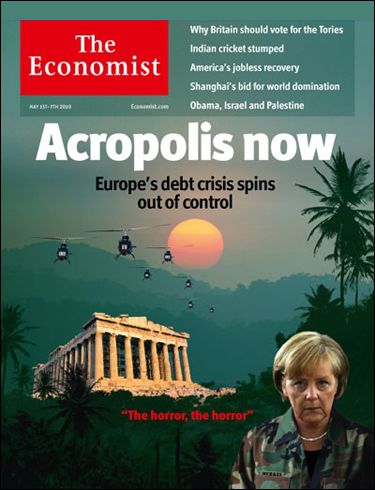
The German chancellor remains a believer.
This weekend she said that Greece could rebuild its economy despite austerity.
She accepts that spending cuts alone won't work, but she believes that structural reforms have to be forcefully implemented although they take time.
Gavin Hewitt, BBC Europe editor, 16 January 2012
The European Union must recognize Italy's efforts in fighting the sovereign debt crisis
or risk the third-largest euro zone economy falling into the hands of anti-EU populists
Italian Prime Minister Mario Monti, CNBC 11 Jan 2012
Monti, who took office less than two months ago at the head of a technocrat government, told the German daily Die Welt that he was asking Italians for big sacrifices.
"I cannot be successful with my policies if the policies of the EU do not change. If that doesn't happen, Italy — which has always been a pro-European country — could flee into the hands of populists."
Monti called the breaches of the Maastricht Treaty limits on deficit ceilings by France and Germany,
soon after the launch of the single currency, the "worst mistake in the EU in the past ten years".
Germany has long insisted that austerity be the primary strategy used in confronting the ongoing euro-zone debt crisis.
Italy has now joined France in demanding a more nuanced approach.
Italian prime minister seems to have lost his enthusiasm for austerity.
He has begun pursuing a different direction -- one diametrically opposed to that which German Chancellor Angela Merkel would like to see.
Der Spiegel, 11 January 2012
Sometimes, it doesn't take long for the most perfect of plans to go awry. Mario Monti, professor of economics and a former European commissioner, was heavily supported by Berlin when Italy was searching for a successor to Silvio Berlusconi as prime minister. Monti was to introduce far-reaching austerity measures in the heavily indebted country -- measures seen as vital to prevent Italy from dragging the entire euro zone down with it.
Monti, initially, did what was expected of him. He immediately passed a savings package worth €30 billion ($38 billion). And Berlin figured that more was on the way.
Now, though, the Italian prime minister seems to have lost his enthusiasm for austerity. He has begun pursuing a different direction -- one diametrically opposed to that which German Chancellor Angela Merkel would like to see. And on Wednesday, the two are set to meet in Berlin to talk about their differences.
Workers of Europe unite, you've only euro chains to lose
Comrades across Europe, come over to the eurosceptic side.
Ambrose Evans-Pritchard, 18 December 2011
The fact that we can occupy the posts of neither the president or chief economist only
shows even more clearly that Germany is being pushed to the margins of the ECB.
It has been regularly voted down in important decisions since May 2010.
All of the nice talk about how the ECB would function based on the Bundesbank model,
and how Germany would play a special role as the largest country,
have proven to be hollow words.
Hans-Werner Sinn, Der Spiegel, 9 January 2012
Många tyskar fattiga trots stark tillväxt
var sjunde tysk under fattigdomsgränsen
Ekot, 22december 2011
Enligt en rapport som presenterades i går och som undersökt de senaste fem åren, lever nästan var sjunde tysk under fattigdomsgränsen.
DPW-studien blir nu ett inlägg i debatten om huruvida priset för den tyska tillväxten och de senaste årens stora exportframgångar är att man har skapat en stor låglönesektor med de nya regler för arbetslöshets- och socialunderstöd som infördes i mitten av 2000-talet av den då rödgröna regeringen.
Wolodarski och Tysklands framgång med Ådalsmetoden
Rolf Englund blog 4 december 2011
Horst Reichenbach
The Greek press has dubbed him the "German Premier" - one of the friendlier terms used.
Der Spiegel, 21 december 2011
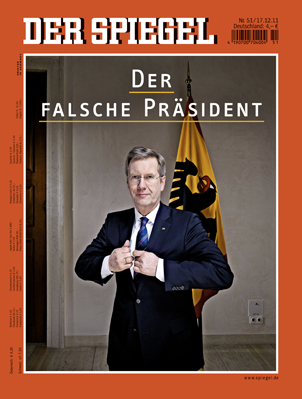
Reichenbach, tall, slim and always dressed in a dark suit, is friendly but not jovial in his dealings with the Greeks. He is not one for exuberant gestures. He is a civil servant, not a politician.
Reichenbach's job is a balancing act. He has to intervene to provide foreign expertise, and yet he is supposed to stay out of political matters.
"It just happens to be the approach I have to take," says Reichenbach. The Greek press has dubbed him the "German Premier" -- one of the friendlier terms used.
Reichenbach admits that he underestimated how difficult being German would make his work.
Full textHorst Reichenbach
We’re not occupiers, says Greek task force
Rolf Englund blog 2011-11-26
De människor som mobbade EU till att anta en gemensam valuta,
de människor som mobbade både Europa och USA till åtstramning är inte teknokrater.
De är istället djupt opraktiska romantiker.
Så varför drev dessa "teknokrater" på så hårt för euron, och bortsåg från många varningar från ekonomer?
Delvis var det drömmen om ett enat Europa, som kontinenten elit fann så lockande att de viftade undan praktiska invändningar.
Paul Krugman, New York Times, 20 November, 2011
Plans show Germany will meet its debt brake goal
- which foresees a cut in the structural deficit to no more than 0.35 percent of gross domestic product -
two years earlier than previously expected in 2014 and balance the budget in 2016.
CNBC 21 March 2012
A constitutional and economic monstrosity
They propose to tighten the screws on fiscal deviants.
It may feel good. But it will not work.
Martin Wolf, Financial Times, December 13, 2011
The idea is to write fiscal discipline into national constitutions
But such a compact will not safeguard the euro against future booms and busts.
The Economist print, Dec 17th 2011
Merkel's Teutonic summit enshrines Hooverism in EU treaty law
Angela Merkel’s summit has sealed a 1930s outcome for Europe,
further entrenching Germany’s misguided and contractionary policies
without offering any viable way out of the crisis at hand.
Ambrose Evans-Pritchard, 11 Dec 2011
You could call it Hooverism written into EU treaty law, though that traduces Hoover.
The harsher truth is that it replicates the "500 deflation decrees" of Pierre Laval, later shot by a Free French firing squad.
Europe will now have its austerity union, a revamped Stability Pact. Budgets will be vetted "ex ante". Structural deficits will be capped at 0.5pc of GDP. Sinners will be punished automatically once they break the 3pc limit, and submit to suzerainty. Commissars will tell them how to treat trade unions, what to tax, and what to spend.
It is not remotely a fiscal union. There will be no joint debt issuance, no EU treasury, no shared budgets, and no fiscal transfers to regions in trouble. "The agreement hard-wires pro-cyclical fiscal austerity into the institutional framework of the eurozone, with no quid quo pro to move gradually to debt mutualisation." said Simon Tilford from the Centre for European Reform.
Orwellian Currency Area
Kevin O’Rourke has a very good point:
what European leaders are describing as “fiscal union” is very nearly the opposite
Paul Krugman, December 10, 2011
Rather than creating an inter-regional insurance mechanism involving counter-cyclical transfers,
the version on offer would constitutionalize pro-cyclical adjustment in recession-hit countries,
with no countervailing measures to boost demand elsewhere in the eurozone.
Describing this as a “fiscal union,” as some have done, constitutes a near-Orwellian abuse of language.
Kevin O’Rourke is Professor of Economic History at the University of Oxford, and a fellow of All Souls College.
A Summit to the Death
Kevin O'Rourke, 9 December 2011
Once again, Europe’s national leaders showed themselves to be in denial about what underlies the eurozone’s economic, banking, and sovereign-debt crises, and thus hopelessly unable to resolve them.
A second, related lesson is that it is difficult to cut nominal wages, and that they are certainly not flexible enough to eliminate unemployment.
That is true even in a country as flexible, small, and open as Ireland, where unemployment increased last month to 14.5%, emigration notwithstanding, and where tax revenues in November ran 1.6% below target as a result.
If the nineteenth-century “internal devaluation” strategy to promote growth by cutting domestic wages and prices is proving so difficult in Ireland, how does the EU expect it to work across the entire eurozone periphery?
The world nowadays looks very much like the theoretical world that economists have traditionally used to examine the costs and benefits of monetary unions. The eurozone members’ loss of ability to devalue their exchange rates is a major cost.
Governments’ efforts to promote wage cuts, or to engineer them by driving their countries into recession, cannot substitute for exchange-rate devaluation.
Placing the entire burden of adjustment on deficit countries is a recipe for disaster.
Greklands interndevalvering och Ådalshändelserna
Rolf Englund blog 2011-11-08
Is Germany’s fiscal straitjacket an example for others?
Germany’s constitutional Schuldenbremse of 2009 is likely to be the model for the 15 euro-zone countries
Under its provisions, the federal government must cut its structural deficit
(ie, adjusted for the business cycle) to 0.35% of GDP by 2016
The Economist print Dec 10th 2011
The German measure has broad popular support. But it also has its critics.
Some economists object in principle, and warn of disaster if Europe follows suit.
A bigger group is in favour but sees room for improvement.
EU på väg upprepa Tysklands misstag
Rolf Englund blog 10 december 2011
"We have started a new phase in European integration," Angela Merkel told the Bundestag
Few people outside Germany cared much when the quiet and unassuming chancellor
stood to address members in the cold and clinical surroundings of the German parliament on 2 December.
But her words were keenly awaited by the German political elite.
Indeed, the speech may eventually be seen as one of the defining speeches in the recent history of the European Union.
In it, Mrs Merkel outlined the German vision of the future of Europe.
Kabir Chibber, Business reporter, BBC News, 8 December 2011
The Growth and Stability Pact was introduced when the euro was agreed in 1992. It limits budget deficits to no more than 3% of a country's total economy.
And following the recession in the early 2000s, who was it that quickly violated the pact? Germany and France.
In her speech, Mrs Merkel said that "the European Central Bank has a different task from that of the Fed or the Bank of England".
By this, she means that the ECB (and the Bundesbank) differ from the Federal Reserve and the Bank of England in that they are not mandated to be the lenders of last resort - so they don't have to lend when the markets fail.
And so Mrs Merkel concluded her speech with: "The future of the euro is inseparable from European unity."
In reality, Europe is on the path toward becoming a federal country
The European idea as we know it is in the process of dissolving into thin air.
The monumental postwar project of a peacefully unified continent where all member states hold hands in friendship collapsed overnight.
Roland Nelles, seit März 2011 Mitglied der Chefredaktion, Der Spiegel, 9 Dezember 2011
On the one side is the common currency union, which is following the Franco-German desire to grow together as a way to finally get the euro crisis under control.
On the other side is the United Kingdom, standing petulantly alone, no longer wanting to play.
The euro crisis has exposed a kind of creative momentum that is in the process of creating something new. A new Europe. It is an entity which Chancellor Angela Merkel calls a "fiscal union."
But in reality, Europe is on the path toward becoming a federal country.
Germany and France would lead, as became clear on Thursday night in Brussels.
In the long hours of a bitter Brussels night Europe changed.
A major step was taken towards closer integration. It was not as a result of popular demand by Europe's people.
It came about because Europe's leaders believed their project had "never been in such danger".
Gavin Hewitt, BBC Europe editor, 9 December 2011
Germany and France are seeking a separate agreement among the 17 euro-zone members.
That, though, may be illegal say many.
"Many" = The legal services experts of the European Commission,
the European Central Bank and the European Council
Der Spiegel, 9 december 2011
Tyskland förbereder för att ta över Commerzbank
Ekot 5 december 2011
Flera aktörer varnar för att bankernas likviditet är hotad.
Beware the Merkozy recipe
The euro crisis cannot be solved by yet another one-sided solution
The Economist print Dec 10th 2011
The core of the solution has to be the link between good behaviour and joint liability.
Otherwise this will be just another much-ballyhooed summit that fails to save the euro.
European stocks are up today, and I have no idea why. I’m with Felix Salmon — this looks like a disastrous meeting.
More austerity, more posing of the crisis, wrongly, as being all about fiscal deficits; no mechanism for ECB funding.
Paul Krugman, December 9, 2011
Somehow southern Europe is supposed to deflate its way to prosperity, while everyone runs a trade surplus, presumably against that potentially habitable planet we’ve discovered 600 light-years away.
Merkozy failed to save the eurozone
Two heads, it is said, are better than one.
In the case of Angela Merkel and Nicolas Sarkozy that was not the case.
Martin Wolf, Financial Times, 6 December 2011
If the most powerful country in the eurozone refuses to recognise the nature of the crisis, the eurozone has no chance of either remedying it or preventing a recurrence.
Yes, the ECB might paper over the cracks. In the short run, such intervention is even indispensable, since time is needed for external adjustments.
Ultimately, however, external adjustment is crucial. That is far more important than fiscal austerity.
Once the role of external adjustment is recognised, the core issue becomes not fiscal austerity but needed shifts in competitiveness.
Europa lider av en förtroendekris som har sin grund i höga och växande statsskulder.
Leif Johansson och Jacob Wallenberg, DN Debatt, 9 december 2011
– Grekland var ett undantag, sa Merkel på den gemensamma presskonferensen i Paris.
– Viktigt är investerare förstår att det är tryggt att investera i Europa.
Både Merkel och Sarkozy tog öppet avstånd från gemensamma europeiska statsobligationer, så kallade eurobonds,
och framhöll Europeiska Centralbankens oberoende.
SvD Näringsliv, 5 december 2011
– Vi uttrycker vårt förtroende för ECB, förklarade Sarkozy som tidigare gått i bräschen för att ECB ska kunna köpa upp statspapper från krisdrabbade euroländer men i går sa att han inte tänkte kommentera dess agerande, varken positivt eller negativt.
No fiscal union, no Eurobonds, no ECB as lender of last resort – yet.
Just the usual blather and a revamped Stability Pact (Fiskalunion).
Private investors will not have to face further haircuts after Greece (if you believe anything they say on this subject) but that was already the case.
Ambrose Evans-Pritchard, December 5th, 2011
Merkel seems to have backed off on demands that budget breaches will be justiciable before the European Court, so the Treaty chatter is mostly Quatsch, bêtises, and eyewash.
This Merkel climb-down makes it less likely that she will give in on real rescue measures, so why the market exuberance in Italy? Beats me.
None of Mrs Merkel’s proposals - whether enshrined in EU treaties or not - offer any meaningful solution to the crisis at hand.
They continue to ignore the cancer in the EMU system: the corrosive 30pc currency misalignment between North and South,
and the German-Dutch trade surplus.
Ambrose Evans-Pritchard, 4 Dec 2011
Her plan clings to the Wagnerian myth that Club Med fiscal extravagance is the cause of all the trouble, though Spain had a budget surplus of 2pc of GDP five years ago and never broke the Stability Pact - unlike Germany - and Italy has long had a primary surplus.
Please stop defaming Germany out there in the blogosphere.
The Germans gave up the D-Mark reluctantly under French and Italian pressure, as the price for acquiescence in Reunification.
They entered EMU at an overvalued rate after the Reunification bubble, leaving them in semi-slump for half a decade.
They slowly clawed back competitiveness the hard way, by squeezing wages and driving up productivity.
Ambrose Evans-Pritchard, December 2nd, 2011
En lysande artikel
It is entirely understandable that they now think Club Med can and should do the same.
(They are profoundly wrong, of course, because Germany was able to lower relative wages during a) a global boom, b) against other EMU states that were inflating c) and with benchmark borrowing cost that stayed low even during the dog days. None of these factors apply to Italy or Spain now. But this is hard to explain this to the man or woman on the Berlin tram.)
As the wise professors warned at the time, EMU would lead ineluctably to full fiscal union because an orphan currency would not endure without an EU Treasury and government to back it up, but it would a fiscal union accountable to nobody, because no European democracy exists, or can exist.
It would lead to debt pooling and shared budgets.
It would lead – fatally – to loss of the Bundestag’s sovereign powers to tax and spend.
The core functions of parliament would slip away to EU mandarins.
RE: Hear, Hear!
'Germany As Isolated on Euro as US Was On Iraq'
Market participants and EU politicians are starting to sound more apocalyptic in their warnings about the euro crisis
as yet another make-or-break summit, on Dec. 8 and 9, draws near.
Meanwhile the pressure on Germany to drop its opposition to euro bonds or a massive intervention in bond markets by the European Central Bank is intensifying by the day
.
Der Spiegel, 29 November 2011
Polish Foreign Minister Radoslaw Sikorski resorted to dramatic rhetoric on Monday evening when he appealed to Germany to avert the collapse of the euro zone.
RE: Tyskland kan dock räkna på stöd från Reinfeldt
- Germany is the only country in Europe that can act to save
the eurozone and the wider European Union from “a crisis of apocalyptic proportions”
The Polish foreign minister, Financial Times, November 28, 2011
There is clearly no hope of Germany stumping up any more bail-out cash without tighter controls on the “Club Med” countries’ purse strings. Such controls may be put in place.
Tighter controls on the “Club Med” countries’ purse strings
But that’s not “fiscal union”.
The only way a single currency can work in the long term is by pooling a large share of total tax revenues and having intra-regional fiscal transfers, as in the US. Yet that will never happen in Western Europe.
Liam Halligan, DT 26 Nov 2011
Anything less, though, a souped-up Stability and Growth Pact for instance, would be too weak to succeed. When it comes to the crunch, spending rules set at the European level will always be broken by politicians answerable to their own domestic electorates.
The notion that “fiscal union” of some kind is workable, and that Germany wants it, has gained ground because that is the only way certain financial analysts can keep predicting that “Merkel will print” and the end-of-year market rally will come.
The euro is a macro-economic weapon of mass destruction - it simply must be defused.
Should Germany sanction the European Central Bank to guarantee the sovereign debts of all ?
These are the questions that the cheer-leaders of “fiscal union” need to answer.
Liam Halligan, DT, 19 Nov 2011
We’re not occupiers, says Greek task force
Horst Reichenbach, who was appointed leader of the task force in September, acknowledged in an interview he had
underestimated how much his German nationality would inflame local sensitivities and complicate his mission.
Financial Times November 25, 2011
Death of a currency as
Eurogeddon approaches
It's time to think what hitherto markets have regarded as unthinkable – that the euro really is on its last legs.
The defining moment was the fiasco over Wednesday's bund auction, reinforced on Thursday by the spectacle of German sovereign bond yields rising above those of the UK.
Up until the past few days, it has remained just about possible to go along with the idea that ultimately Germany would bow to pressure and do whatever might be required to save the single currency.
In recent days, it has become plain as a pike staff that the lady's not for turning.
Jeremy Warner, DT 24 Nov 2011
'A Complete Disaster'
Germany has been considered a safe haven of financial stability amid the ongoing euro crisis - but that may be changing.
Growing mistrust from investors seems apparent after what has been described as a "disastrous" government bond auction on Wednesday.
Der Spiegel, 23 November 2011
Yields on 10-year French bonds jumped 0.13 percent to reach 3.6 percent. In turn, the interest rates for the offering are just below this year's high of 3.8 percent. In Belgium, 10-year bond yields rose to 5.16 percent -- the highest rate since 2002.
German bond auction 'disaster' rocks markets, DT
German finance minister Wolfgang Schauble – the most dangerous man in the world
– is imposing a reactionary policy of synchronized tightening on the whole eurozone
through the EU institutions, invoking a doctrine of “expansionary fiscal contractions”
that has no record of success without offsetting monetary and exchange stimulus.
Ambrose Evans-Pritchard, DT, 20 Nov 2011
Wolfgang Schauble har i alla fall stöd av Johnny Munkhammar:
Forskare har pekat på att länder som beslutsamt minskar de offentliga utgifterna faktiskt kan få god tillväxt.
Johnny Munkhammar, riksdagsledamot (M), SvD 20 november 2011
Berlin doesn’t know what to do.
Should Germany sanction the European Central Bank to guarantee the sovereign debts of all ?
The world’s financial markets are watching and waiting, convinced that Merkel will eventually relent.
Liam Halligan, DT, 19 Nov 2011
Minns ni Ja-sidans prat om att EMU skulle ge lägre ränta?
Nu lånar Sverige billigare än Tyskland
Rolf Englund blog 2011-11-16
Asked why EU leaders were still holding the Sunday meeting, the German official said:
“That’s a good question. Sarkozy wants one.”
Financial Times 21 October 2011
The postponement is due to a combination of two factors: Nicolas Sarkozy’s diplomacy, and
the German Bundestag’s insistence that it needs to give a mandate to the chancellor ahead of the summit.
Eurointelligence 21 October 2011
The Bundestag made it clear to Angela Merkel that it insists on seeing the draft proposals for the EFSF guidelines in German this Thursday
if it is to give the chancellor a mandate for negotiations at the summit on Sunday, Frankfurter Allgemeine Zeitung reports.
Eurointelligence 20 October 2011
The parliament intends to discuss the guidelines at a special session of its budget committee today but there have been no drafts so far.
According to the new law about the co-decision of the Bundestag on European matters
(a result of the Constitutional Court’s ruling ordering a systematic implication of Bundestag on all EU matters with budgetary relevance),
the government has to seek a mandate from parliaments in order to have the legitimate right to decide on behalf of Germany during summits.
FDP parliamentary leader Rainer Brüderle said the EU drafts had to be presented to the Bundestag at midnight today.
In other countries, editorialists have often been critical of the "Occupy Wall Street" movement, but op-ed pages in Germany on Monday reserve their censure
for the banks for bringing on the crisis and also the political failures that allowed the situation to spiral out of control in recent years.
Der Spiegel 17 October 2011
The center left Süddeutsche Zeitung writes:
"Ultimately, the protests are an expression of bitter disappointment. During the 2008 financial crisis, when states pumped enormous sums of money into banks, many people believed they were witnessing a reformation of capitalism.
That was and remains an illusion. The major banks continued to gamble with the same means and methods that led to the financial crisis.
They were able to continue with their game because none of the strict new rules announced by global leaders were ever put into force.
Financial capitalism hasn't become more humane, and turbo capitalism is still going strong."
The conservative Frankfurter Allgemeine Zeitung writes:
"Politicians, who are currently preparing for the G-20 summit in Cannes, France ignore the global protests at their peril.
The movement will create additional pressure for a more comprehensive regulation of banks and disciplining of the financial markets.
But although the banks shouldn't have any illusions about how unpopular they are, the politicians' own share of responsibility should not be omitted.
The explosion in debt happened because they made promises to voters that couldn't be financed."
Fitch on Thursday evening placed several financial institutions on its watch list, suggesting that they might be downgraded.
Among them was German market leader Deutsche Bank, long considered a model of financial health, despite the global crisis.
Der Spiegel 14 oktober 2011
Angela Merkel, the German chancellor, and France’s President Nicolas Sarkozy spelt out their determination to defend the stability of the euro
as they met for a bilateral summit in Berlin, but refused to spell out any further details of their plans.
FT 9 October 2011
I dag träffas Tysklands förbundskansler Angela Merkel och Frankrikes president Nicolas Sarkozy i Berlin för att diskutera skuldkrisen i Europa.
Inför mötet har det rapporterats om oenighet mellan Eurozonens två viktigaste länder till exempel om hur europeiska storbanker ska räddas
Ekot med bra bild 9 oktober 2011
IMF beräknar bankernas behov av friska buffertar till 200 miljarder euro
Tyskland vill i första hand låta bankerna själva försöka skaffa kapital från sina ägare. Fungerar det inte får de nationella regeringarna gripa in.
Frankrike att EFSF ska sköta ruljangsen; möjligen beroende på att franska banker hårt utsatta i Sydeuropa.
DN-ledare 9 oktober 2011
En möjlig källa är euroländernas räddningsfond EFSF; när alla parlament har sagt ja ska den ha 440 miljarder till förfogande och tillåtas pumpa in pengar i krisbanker. Då blir det å andra sidan inte mycket kvar till vacklande stater i söder.
Populister som ylar om att bankerna borde stå sitt kast har inte funderat över hur ett Europa skulle se ut där finansmarknaden har gått under.
DN borde kunna skilja på bankerna och deras aktieägare
Rolf Englund blog 9 oktober 2011
The Ticking Euro Bomb
The architects of the euro and their successors have lost the Maastricht Treaty bet.
They have jeopardized an agreement made by 12 countries in the hope that the markets wouldn't notice how fragile their shiny new currency really is.
Der Spiegel Staff, 7 October 2011
En lysans artikel - Highly recommended
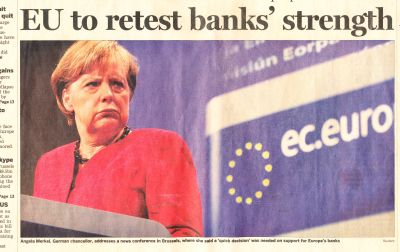
FT 6 October 2011
Plan to Recapitalize Banks Remains Thin on Details
WSJ 7 October 2011
Bailouts or Bankruptcies?
Europe Begins Working on Plan B for the Euro
Der Spiegel 7 October 2011
Writing in Handelsblatt, Frank Walter Steinmeier, the SPD parliamentary leader, said that the Bundestag’s approval of the EFSF will solve nothing.
The politicians will not get ahead of the crisis, unless they adopted a clear long-term strategy of where they are headed.
He is proposing a 10-year road map towards a political and fiscal union to accompany that current crisis management – similar to the Delors plan of the 1990s.
Eurointelligence 4 October 2011
Eurozone crisis: Democracy in the balance
Scant regard is given to the will of the people
They want Germany's economic strength to be deployed behind Europe's debts.
Gavin Hewitt, BBC Europe editor, 3 October 2011
The Frankfurter Allgemeine Zeitung said the vote gave "no carte blanche for a rescue orgy". Bild weighed in with "this time it has to be enough".
But, led by US President Barack Obama and his Treasury Secretary Tim Geithner, there is international clamour for more action. Europe has to speak with a single voice and take decisive action.
The British Chancellor, George Osborne, has said that the logic of monetary union leads directly to fiscal union.
All of this pressure is aimed at Germany. What do these siren voices want? They want Germany's economic strength to be deployed behind Europe's debts.
Scant regard is given to the will of the people. Every indicator suggests the German people do not want it.
Indeed, a weekend poll indicates that 50% of the German people want the Deutsche mark back.
That is why Chancellor Merkel has said that there will be no "debt union". It is one of her red lines.
“Up until here and no further”
Bavarian Prime Minister defines limits to Germany’s readiness to help the eurozone
Horst Seehofer, who is also chairman of Angela Merkel’s sister party CSU, argues that today’s vote
for the enhanced EFSF to €211bn must be the limit of what Germany is asked to do.
Eurointelligence 29 sept 2011
“If there is a threat of a downgrade for Germany’s creditworthiness then there must be an end to this”
Markets are convinced that Europe is preparing to massively increase the reach of the euro backstop fund known as the EFSF.
But politicians have been just as quick to deny it. What is going on?
Der Spiegel 28 Sept 2011
"en ny bankliknande monsterstruktur som med hjälp av belåning ska kunna låna ut bortåt 18500 miljarder kronor
ECB har bland stödköpt statspapper i krisländer för 1500 miljarder kronor
och lånat ut ytterligare 3700 miljarder till problemtyngda banker mot säkerhet i samma skakiga obligationer.
Som förlustreserv har ECB ett kapital som motsvarar fyra kronor per utlånad hundralapp
Andreas Cervenka, SvD Näringsliv, 3 Oktober 2011
As it stands, the single currency has become a doomsday machine, driving Europe and the rest of the world ever closer to financial collapse.
There is a “grand plan” for saving the euro circulating within the G20,
involving a bigger bail-out fund, the recapitalisation of Europe’s banks and a Greek default on realistic terms.
Wolfgang Schäuble, Angela Merkel’s finance minister, dismissed it out of hand.
In the markets, there is a widespread assumption that Schäuble doesn’t really mean it
Jeremy Warner, DT 28 Sept 2011
In the markets, there is a widespread assumption that Schäuble doesn’t really mean it – that when push comes to shove, and today’s vote in the German parliament on last summer’s rescue package is safely out of the way, he’ll do whatever is necessary.
But if he does, he’ll almost certainly lose his job, and very likely pull Germany’s coalition government down with him.
A financial crisis will have been transformed into a political one, and the democratic deficit at the heart of the European project will have reached new bounds.
Writing in Süddeutsche Zeitung, Claus Hulverscheidt underlines that the next step to enhance the eurozone’s defence lines are well under way.
“Leading politicians of the G20 have admitted for a long time that discussions for such a leverage are ongoing”, he writes.
But Wolfgang Schäuble played on words at the recent IMF meeting in Washington and creates the impression in interviews and in his interventions in the Bundestag that this is not case.
“It is as often: Schäuble did not lie, neither in Washington nor in the Bundestag nor in Deutschlandfunk (the radio station that interviewed him yesterday). But he has not told the truth either.”
Eurointelligence 30 Sept 2011
The vote “is no carte blanche for a rescue orgy”, Frankfurter Allgemeine Zeitung’s political editor Berthold Kohler warns in a front page editorial. „The parliament insists even more on its rights. The sovereign only has a limited understanding for the circumstance that there should be a different set of rules for overly indebted states or overambitious but undercapitalized banks than for righteous people who build their houses.” Kohler also warns that the estrangement of the Europeans from Europe will not decrease if we continue to violate what the peoples of Europe consider to be right.”
In a second front page editorial economics editor Holger Steltzner says: “Finance minister Schäuble said in the Bundestag that the German guarantee framework was limited to €211bn, and the yet to be negotiated guidelines for the crisis funds needed the assent of the parliamentarians. We have to take Schäuble by his word, otherwise the Funds will use leverage, insurance elements and repackaged default probabilities until nobody knows anymore who bears how much risk.”
The dangerous subversion of Germany's democracy
Markets appear to be acting on the firm belief that Germany’s finance minister Wolfgang Schäuble is lying to lawmakers
Ambrose Evans-Pritchard, September 28th, 2011
Very Important Article
Optimism over Europe’s "grand plan" to shore up EMU was widely said to be the cause of yesterday’s torrid rally on global markets
This is interesting, since Germany’s finance minister Wolfgang Schäuble has given an iron-clad assurance to the Bundestag that no such plan exists and that Germany will not support any attempt to "leverage" the EU’s €440bn bail-out plan to €2 trillion, or any other sum.
"I don’t understand how anyone in the European Commission can have such a stupid idea. The result would be to endanger the AAA sovereign debt ratings of other member states. It makes no sense."
All of this was out in the open and widely reported. Markets appear to be acting on the firm belief that he is lying to lawmakers, that there is indeed a secret plan, that it will be implemented once the inconvenience of the Bundestag’s vote on the EFSF tomorrow is safely out of the way, and that German democracy is being cynically subverted.
Andreas Vosskuhle, head of the constitutional court or Verfassungsgericht, specifically warned this week that Germany is entering treacherous waters.
He said that the improvisation of far-reaching policies to shore up EMU had become "dangerous", and warned against schemes to circumvent the rule of law with backroom deals.
"Germany has a great affinity for the rule of law. People expect the political class to obey the rules."
Constitutional court or Verfassungsgericht
Frau Merkel, it really is a euro crisis
Angela Merkel told German industry today that we are not facing "a euro crisis, but a debt crisis."
She is wrong. Total levels of private and sovereign debt in the eurozone
are lower than in the UK, the US, and far lower than in Japan.
Ambrose Evans-Pritchard, September 27th, 2011
The reason this crisis keeps grinding ever deeper is because the euro itself is a machine for perpetual destruction. The currency is fundamentally warped and misaligned.
It spans a 30pc gap in competitiveness between North and South. Intra-EMU current account deficits have become vast, chronic, and corrosive. Monetary Union is inherently poisonous.
The countries in trouble no longer have the policy tools — interest rates, QE, liquidity, and exchange rates — to lift themselves out of debt-deflation.
Konstruktionen kring euron har inte varit fel
Jan Björklund, Birgitta Ohlsson, Carl B Hamilton
och Olle Schmidt
Det finns egentligen inte någon Eurokris.
Tvärtom tvingar euron fram reformer som sedan länge varit nödvändiga, vilket alltid har varit ett av de starkaste argumenten för en gemensam valuta.
Stefan Fölster
Euroanhängarna uppträder fortfarande som om de tror att krisen handlar om Grekland.
De vill inte inse att tanken, att ha en gemsam valuta för Tyskland och Grekland, Finland och Cypern, var och är en felaktig tanke.
Rolf Englund blog
The German government on Tuesday firmly rejected the idea that the European Financial Stability Facility would be expanded
beyond what the 17 euro-zone governments agreed upon in July,
warning that an expansion would jeopardize the triple-A credit ratings of some contributing countries.
WSJ 27 Sept 2011
Changes to the bailout facility "should look exactly as the plan set out on July 21,"
said Steffen Seibert, a spokesman for German Chancellor Angela Merkel, adding that the German government doesn't approve of further changes.
The new Bundesbank president, Jens Weidmann, used to be one of Merkel's closest advisers.
Now, he is one of her staunchest critics over the euro rescue.
He is strictly opposed to the European Central Bank's policy of buying up bonds from debt-stricken countries
-- and is winning a growing number of allies for his cause.
By SPIEGEL Staff, 26 sept 2011
His views were shared by his predecessor, Axel Weber, and the ECB's former chief economist, Jürgen Stark, both of whom stepped down from their positions because it was getting lonelier and lonelier on their side of the battle.
(Bundesbank president Jens) Weidmann tells Bundestags budget committee the extended EFSF is a horrible idea
"would lead to the worst of all worlds between inter-governmentalism and a fiscal union"
Eurointelligence 20 sept 2011
“Those decisions are another step towards a common liability and to less discipline via the capital markets without any means of control or influence over the national fiscal policies”, he warned the deputies yesterday.
Weidmann was especially critical of the proposal backed by Merkel that the EFSF should be able to buy government bonds of crisis countries so that the ECB can be relieved of that task.
Weidmann said it was entirely unclear what conditions would be attached to this buying programme and how it could be in line with the constitutional court’s requirement that this kind of help can only be granted as an “ultima ratio” to guarantee the stability of the euro.
In a remarkable speech Bundesbank president Jens Weidmann yesterday launched a debate in Germany on the eurozone’s future evolution
Financial Times Deutschland reports. He urged the government to quickly decide on whether it wanted to continue existing arrangements
or “big leap” towards a fiscal union /which/ would require a change of the German constitution and would be the result of a “long and difficult path”
Eurointelligence 14 September 2011
Merkel would like to show a united front in the European debt crisis, but
dissent by Philipp Rösler, who is also vice chancellor, has called her whole government into question.
Der Spiegel, 15 sept 2011
Letting Greece go bankrupt is a touchy subject in Berlin. The idea of not saving Greece is popular among ordinary Germans, who are skeptical about sending more German public money to Athens,
but unmentionable in government circles, because of worries that loose talk could cause turmoil on the financial markets.
RE: Vanligt folk har lurats att tro att pengarna går till lata greker, när de i själva verket gå till bankerna, vars ledningar fått stora bonusar när de givit lånen.
Top of pageMerkel government under threat over euro dispute
Süddeutsche Zeitung and Frankfurter Allgemeine Zeitung both report that the German government could fall over the crisis.
It seems certain now that FDP MP Frank Schäffler will succeed to get an internal party referendum.
That effectively makes it impossible for FDP deputies to vote in favour of the ESM later this year.
Eurointelligence 5 Sept 2011
Meanwhile transport minister Peter Ramsauer of the CSU said a Greek default would not be the “end of the world”. He said he was against the ESM as well because it violated “the foundations the parliament’s budgetary sovereignty”, as he laid out in an article in Frankfurter Allgemeine Zeitung.
Will German indecision on the euro drag the whole world down?
Torn between two constituencies – a policy elite that remains wedded to discredited ideas of European solidarity,
and the great mass of the German people who do not see why they should be required to subsidise ill-disciplined fellow travellers
– Germany has become paralysed.
Jeremy Warner, DT, 14 Sep 2011
Trapped by their history, the country’s leaders seem incapable of facing up to the choices that need to be made to bring the chaos of today’s related sovereign debt and banking crises to any kind of meaningful resolution.
In its indecision, Germany threatens not just the future prosperity of Europe, including its own, but as is clear from the growing alarm of American and Chinese policymakers, that of the world economy as a whole.
Just as Germany yearns for the return of the deutschemark, peripheral nations look back longingly on the sometimes violent currency swings of pre-euro days as if it were a golden age.
However unsettling the exchange rate turbulence of those times was, at least national governments were still in control of their own destiny.
Now they’ve lost even the blessing of low and stable interest rates.
In a remarkable speech Bundesbank president Jens Weidmann yesterday launched a debate in Germany on the eurozone’s future evolution
Financial Times Deutschland reports. He urged the government to quickly decide on whether it wanted to continue existing arrangements
or “big leap” towards a fiscal union /which/ would require a change of the German constitution and would be the result of a “long and difficult path”
Eurointelligence 14 September 2011
“From my point of view a decision has to be taken within a short time”, he insisted.
He said a fiscal union where national parliaments no longer have the last word on the budgets and European authority intervenes is a possibility, would require a change of the German constitution and would be the result of a “long and difficult path”.
But Weidmann insisted that both options can be “in principle economically sustainable”.
Die Krise als Herausforderung für die Währungsunion
Dr. Jens Weidmann
Präsident der Deutschen Bundesbank
Köln, 13. September 2011
The “middle way” of increasingly pooling responsibilities but retaining national responsibilities for fiscal policies
“threatens to collapse under its own inconsistency”.
Eurozone central banks were already carrying considerable risks on their balance sheets.
“I believe strongly that from now on these should be reduced again and in no way expanded,” he said in a speech in Cologne
ECB har belastat sig med "betydande risker" genom obligationsköpen i marknaden och dessa bör minskas. Det uppgav den tyska ECB-ledamoten Jens Weidmann på tisdagskvällen, enligt Reuters.
Sept 13 (Reuters) - The European Central Bank has burdened itself with "considerable risks" and these should be unwound,
Bundesbank President Jens Weidmann said on Tuesday, in a thinly veiled attack on the ECB's bond-buy plan.
Click
Challenges for monetary policy in EMU
Professor Axel A Weber, now former, President of the Deutsche Bundesbank, 13 April 2011
Last week’s ruling of the German constitutional court.
It categorically rules out any policy option beyond what has been agreed so far.
I cannot see how it can be consistent with the survival of the eurozone, given the policies of member states and the ECB
Wolfgang Munchau, FT 11 Septemner 2011
Germany and Greece flirt with mutual assured destruction
Let us be clear, the chief reason why Greece cannot meet its deficit targets is
because the EU has imposed the most violent fiscal deflation ever inflicted on a modern developed economy
- 16pc of GDP of net tightening in three years - without offsetting monetary stimulus, debt relief, or devaluation.
Ambrose Evans-Pritchard, 11 September 2011
Interestingly, for all the anti-Keynesian rhetoric of the German government
in 2008/9, as a share of GDP, Germany launched the largest Keynesian expansion of any G7 country.
Roger Bootle, 11 Sepember 2011
In the summer of 1990, the deutschmark was declared the official currency of the German Democratic Republic,
as communist East Germany was known. Three months later, the five East German states joined the Federal Republic of Germany.
All at once, the newly enlarged "deutschmark zone" had what economists and politicians want for the euro zone today:
a common economic and financial policy, largely uniform fiscal and social systems and an extensive redistribution of income among the regions.
Der Spiegel 6 september 2011
The agreements were an "expression of solidarity among the Germans," then-Chancellor Helmut Kohl said approvingly.
He famously promised that there would soon be "blossoming landscapes" in the east. His promise proved to be wishful thinking.
Since then, more than €1.4 trillion ($1.98 trillion) in financial assistance and transfers have flowed from the former states of West Germany to the former East Germany.
But Kohl's blossoming landscapes have yet to materialize.
Valutaunionens rötter, kommunismens fall för 20 år sedan kom att bli eurons definitiva startskott
Den franske presidenten Mitterrand ställde då ett ultimatum:
för att acceptera ett tyskt enande var landet tvunget att ge upp sin D-mark och gå med på ett stärkt EU-samarbete.
Tyskland ville egentligen inte ha en gemensam valuta, men accepterade samarbetet på villkor att det inte fick drag av en traditionell valutaunion.
Peter Wolodarski, Signerat DN 21 augusti 2011
The worst of the euro crisis is yet to come
The most disturbing aspect about the eurozone right now is that
every crisis resolution strategy depends on a moderately strong economic recovery.
Wolfgang Münchau, FT September 4, 2011
Euroland måste nu antingen bli en riktig federation, överstatligt och med Tyskland i spetsen, det land som vann kriget genom att förlora det.
Eller Euroland faller itu vilket vore detsamma som en renationalisering. Inget av alternativen är särskilt trevligt.
Richard Swartz, Kolumn DN 3 september 2011
Den förre ordföranden Hans Olaf Henkel i det tyska industriförbundet, motsvarigheten till Svenskt Näringsliv, föreslår i en artikel i Financial Times
att Tyskland, Österrike, Finland och Nederländerna ska lämna eurosamarbetet och forma ett helt nytt valutasamarbete.
Henkel, som tidigare var en av eurons ivrigaste försvarare, har under den intensiva skuldkrisen ändrat uppfattning om det krisdrabbade valutasamarbetet.
Han skriver att hans tidigare stöd till euron är hans karriärs största misstag.
Ekot 30 augusti 2011
Having been an early supporter of the euro, I now consider my engagement to be the biggest professional mistake I ever made.
Hans-Olaf Henkel, Financial Times, 29 August 2011
The writer is former head of the Federation of German Industries (BDI) and has joined about 50 other business leaders in a legal challenge at Germany’s Constitutional Court against the Greece rescue package
Germany’s Constitutional Court
German Chancellor Angela Merkel faces growing resistance within her ruling coalition over expanding the powers of the euro zone's bailout fund,
At issue is securing German parliamentary approval for a deal Ms. Merkel brokered with other European leaders in July
Part of the agreement involves vesting the bailout fund with powers that were previously the prerogative of national parliaments.
Conservative opponents of the deal worry it will open the door to relinquishing more sovereignty to the European Union.
Wall Street Journal, 30 August 2011
Mrs Merkel has cancelled a high-profile trip to Russia on September 7,
the crucial day when the package goes to the Bundestag and the country's constitutional court rules on the legality of the EU's bail-out machinery.
Ambrose Evans-Pritchard, 28 August 2011
If the court rules that the €440bn rescue fund (EFSF) breaches Treaty law or undermines German fiscal sovereignty, it risks setting off an instant brushfire across monetary union.
The seething discontent in Germany over Europe's debt crisis has spread to all the key institutions of the state. "Hysteria is sweeping Germany " said Klaus Regling, the EFSF's director.
German Constitutional CourtGerman President Christian Wulff questioned the legality of the European Central Bank's bond-buying program
highlighting the strength of opposition in Germany to the controversial plan.
CNBC 24 Aug 2011
Bundesbank questions legality of EU bail-outs
Germany's Bundesbank has issued a blistering critique of EU bail-out policies,
warning that the eurozone is drifting towards a debt union without "democratic legitimacy" or treaty backing.
Ambrose Evans-Pritchard, 22 August 2011
Good news and bad for German Chancellor Angela Merkel:
Three-quarters of Germans disapprove of her efforts to solve the problems plaguing the euro
But at least the French trust her more than their own president, Nicolas Sarkozy
Der Spiegel 19 August 2011
I tisdags framträdde Merkel tillsammans med Frankrikes president Nicolas Sarkozy. Avsikten var att lugna oroliga medborgare. Här ska tas krafttag, bildas en ekonomisk regering för euroområdet. På sikt ska skattepolitiken samordnas och så ska man införa en transaktionsskatt på finansiella affärer, Tobinskatt som det kallades på den tid Attacrörelsen var aktiv.
Är detta att ta medborgarna på allvar? Tvärtom. Det är ett bevis för att ledarna för Europas två största länder anser att deras landsmän är debila.
Expressen-ledare 18 augusti 2011
How to save the euro – kick out Germany
Best of all for France, the French bureaucratic elite would again become unquestioned leaders of the European federal project.
Anatole Kaletsky, The Times 17 August 2011
The first fundamental flaw of the euro project — the contradiction between a single currency and a multiplicity of divergent national fiscal policies — may still eventually be resolved in favour of the federal solution.
This was always the intention of the euro’s ultimate founding fathers, François Mitterrand and Helmut Kohl.
Now Europe must face the second flaw — that German and French conceptions of a federal Europe are mutually incompatible.
Not only do the two nations have very different theories of government centralisation and devolution, much more crudely their visions of a federal Europe are fundamentally incompatible in terms of simple power politics.
The really fundamental issue that must now be resolved if the euro is to continue is not whether a federal Europe is necessary, but whether the nascent federation will be run by Germany or France.
Germany could be politely asked to leave. Or the decision could be triggered by a political revolt or court decision within Germany if the other euro members override its objections and force the ECB to buy vast amounts of Italian and Spanish debt.
Best of all for France, the French bureaucratic elite would again become unquestioned leaders of the European federal project.
Germany’s exporters and banks, meanwhile, would suffer the mother of deflationary shocks — so much so that Germany might come crawling back with its tail between its legs, begging for permission to rejoin a monetary union ruled by France.
Top of pageShe /Mrs Merkel/ is already finding it hard to persuade her coalition partners to support in parliament
the deal she struck in July to expand the EFSF’s powers and let it buy up government debt.
She is mindful that the Bundesbank is vociferously against a big ECB programme to buy government bonds (the ECB has already spent €100 billion).
And she fears that her country’s constitutional court may rule all euro zone bail-outs to be illegal
The Economist print 20 August 2011
A year ago it was said that the euro zone could take care of two or three small countries but that Spain was too big to fail. Today, with Italy and even France looming into the picture, the very survival of the euro is coming into question.
A break-up of the euro may not be unthinkable, but it would certainly be damaging, painful and very expensive.
her country’s constitutional court
Europe's economy slides towards disaster
The EU leaders’ rhetoric in Paris makes it clear that they are not facing up to the existential crisis.
Jeremy Warner, Daily Telegraph 17 Aug 2011
Rather than attempting to stave off a double-dip recession by loosening monetary policy – and fiscal policy, too, among those member states that can still afford it – Europe has gone careening off in the opposite direction.
Interest rates have been raised, and member states have been forced into self-defeating austerity programmes which, by destroying growth, have made underlying debt dynamics even worse.
It is hard to imagine a more perversely inappropriate set of policies.
The truth is that a project meant to tame Germany and integrate her into the heart of Europe has backfired spectacularly.
Far from making economies converge, it has succeeded only in driving them ever further apart
Att Merkel och Sarkozy lägger förslag som i bästa fall är ineffektiva och i värsta fall direkt dubiösa är bara en del av Europas problem.
En annan del är att dessa ledare – men långt ifrån bara de – skjuter in sig så ensidigt på makroekonomin.
Svenska Dagbladet, ledare 18 augusti 2011
President Sarkozy said:
"Eurobonds can be imagined one day but at the end of the European integration process, not at the beginning."
BBC 17 August 2011
Chancellor Merkel was far more cautious. Key members of her coalition have made it clear their outright opposition to eurobonds.
The coalition could even break up over the issue. Deutsche Bank has called eurobonds "poison pills".
A new deutsche mark
Something terrible may happen,
but it's so terrible we can't even imagine what the consequences might be
Exactly how bad would things get if a significant number of the euro zone's members had to withdraw from the bloc and write off a significant portion of their debts?
Paul Hannon, Wall Street Journal 16 August 2011
Frankfurter Allgemeine’s Holger Stelzner,
its economics editor and probably the most influential conservative economic commentator in Germany,
writes the ECB has turned into a political agency, and it has turned into EBB – a European Bad Bank
Eurointelligence 16 august 2011
Angela Merkel face a revolt among supporters over the deal they agreed last month with their 16 eurozone partners
Financial Times August 9, 2011
Merkel is determined to resist pressure from her partners, and from the European Commission, for any further measures – such as increasing the size of the €440bn European Financial Stability Facility, or introducing eurozone bonds – for fear of losing her parliamentary majority.
Italian Finance Minister compared Germany and its small-minded Chancellor to a first-class passenger on the Titanic.
When the ship hits the iceberg, everybody goes down together
Rolf Englund blog 20 juli 2011
Ingen kurs för euron
Merkels regering vet inte vad den vill.
Gräl, misstag och opportunism präglar bilden.
DN ledarsidan signerat Gunnar Jonsson 20 juli 2011
Eurokrisen passar Merkel sällsynt illa. Hon är bäst på att vänta, trötta ut, tiga och dra i långbänk. Så har rivalerna besegrats, men finansmarknaderna har inte tid med sådant.
Återföreningen kostade enorma belopp, men i mitten av 2000-talet lades grunden för dagens ekonomiska lyft.
Industrin och facket samarbetade för att höja produktiviteten, och lönerna hölls tillbaka.
En regering ledd av socialdemokratiska SPD genomförde samtidigt reformer på arbetsmarknaden och stramade åt den svällande a-kassan.
Till brittiska Economist säger Merkel att hon får olika råd från alla håll, och att hon inte kan experimentera när åsikterna är så splittrade. Vad hon själv vill är som vanligt oklart.
De väldiga tyska överskotten är också en del av balansproblemen i Europa, men det vill Berlin inte gärna kännas vid.
20 juli-attentatet kallas det mest kända attentatet mot Adolf Hitler.
Det genomfördes den 20 juli 1944
"When the Holy Roman Emperor, Henry VI (1190-1197), demanded money and men for his projected crusade,
Alexios III (of Byzantium) humiliatingly complied by introducing a nex tax, the infamous Alamanikon or "German tax".
A History of Greece, Nicholas Doumanis
The euro zone's strategy for dealing with its members' fiscal problems is in tatters,
and it is far from certain that its leaders will be willing and able to come up with a more successful alternative when they meet Thursday.
If they don't, the currency area won't survive
Wall Street Journal 19 July 2011
So what went wrong? Essentially, from being a series of national crises, the fiscal problems facing some of its members became a crisis of the currency area around about October last year, with the German government's public call for private-sector participation in the resolution of any future crises.
It may have been well intentioned, but it was most certainly naive. Not for the first time, euro-zone policy makers demonstrated their lack of understanding of how financial markets work.
Having assumed that no euro-zone government would ever be allowed to default on its debts, investors quickly concluded that a default would be the only way continued support for weak members could be justified to German tax payers.
They became extremely averse to holding bonds issued by governments that might in the future need help, tipping both Ireland and Portugal over the edge.
In short, it seems unlikely euro-zone leaders will have any answer to the contagion problem.
This means Spain and Italy will lose access to bond market funding, increasing the risk that what started off as a series of fiscal problems affecting a rather small part of the euro-zone economy will end up destroying the entire currency area.
Read more hereDer Euro steht vor der ultimativen Zerreißprobe.
Falls sich die 17 Regierungschefs der Euroländer am Freitag treffen, geht es nur um eine Frage:
Überlebt unsere Einheitswährung?
Die ehrliche Antwort ist: Wir haben eigentlich keine Alternative!
Bildzeitung 12 Juli 2011
German banks have launched a stinging attack on the imminent publication of highly detailed information about their holdings,
claiming these could worsen the sovereign debt crisis
The European Banking Association plans on Friday to release detailed debt holdings data for 91 of the European Union’s largest banks including 13 from Germany as part of its much anticipated stress tests.
Financial Times 11 July 2011
Germany must now be willing either to buy or guarantee Spanish and Italian debt,
and in doing so to cross the Rubicon to fiscal and political union,
or accept that EMU must break up with calamitous consequences for German foreign policy.
Ambrose Evans-Pritchard, 10 July 2011
Democratization Can't Save Europe
Democracy needs the kinds of conditions that do not exist in Europe today.
The Need for a Centralization of Power
Herfried Münkler, Der Spiegel 8 juli 2011
East Germany Was and Is Greece
More than 20 years later, the former East Germany is still an economic backwater, with unemployment rates double what they are in the west of the country.
WSJ blog July 7, 2011
European government officials are worried about a region struggling to recover from an economic shock that caused unemployment to soar. The region wants to become a more competitive manufacturer, but it uses the same currency as world-beating German exporters clustered around the Rhine and in Bavaria. So devaluing its currency to regain competitiveness is out of the question.
This could be a description of Greece, Portugal, Ireland or Spain in 2011. But it’s also a description of East Germany in the years after reunification. It’s a parallel that should worry euro-zone policymakers.
EU policymakers are trying to bring export-sector jobs to Greece through a painful austerity plan. That, unfortunately, will require a significant drop in wages, which can rise quickly but often take years and years to fall to levels needed to arouse a dormant export sector.
In East Germany, emigration was part of the answer. EU officials often preach the virtues of labor-market mobility, but are they really hoping to see large-scale emigration from Greece to other parts of the euro zone?
Full text----
Ur huvudpunkter i Nils Lundgrens föredragning i Helsingfors inför riksdagens utrikesutskott och inför Europakommitténs seminarium den 21 september 1994
Ingen kan idag säga när Europa har fått en sådan geografisk rörlighet, en så stor federal budget och en sådan nominell löneflexibilitet att en gemensam valuta kan fungera från Sicilien till Nordkap.
Medan vi väntar på den dagen, bör vi dock ställa oss frågan, om vi vill underminera nationernas möjligheter till överlevnad som nationer i sådan omfattning, som krävs, när vinsten av en gemensam valuta enligt de studier som gjorts är så utomordentligt blygsam?
Ty en nation överlever knappast i längden som nation, om den inte kan erbjuda de egna medborgarna en inhemsk differentierad arbetsmarknad med det moderna samhällets alla kvalificerade arbetsuppgifter.
Läs mer härWithin just five years, the Greeks want to cut spending by the equivalent of 17 percent of their total GDP in 2010.
Similar Measures Would Crush German Economy
Applying this to Germany would amount to a savings goal of €425 billion -
a gigantic sum that would mean the complete collapse of the German economy
Der Spiegel, 1 July 2011
"Removing that much money from the economy in such a short period of time would kill everything off," said Gustav Horn, head of the Macroeconomic Policy Institute (IMK).
The Germans would also have to exert enormous efforts to achieve the equivalent of the €50 billion in revenues that Greece is aiming to get from privatizating state assets -- despite having seven times the population and correspondingly larger state-run companies.
Specter of Years of Stagnating Wages Haunts the Globe
Median male real US earnings have not risen since 1975
Average real Japanese household incomes after taxation fell in the decade to mid-2000s
And those in Germany have been falling in the past 10 years.
Chris Giles, Financial Times, 28 Jun 2011, via CNBC
"The euro is a very good thing and it's important that we keep it," he said.
"It's good for the consumer and good for business." "The euro is fine. It's not in crisis."
Joe Kaeser, chief financial officer of German industrial company Siemens AG
MarketWatcj 21 June 2011
A bondholder contribution was “always meant to be voluntary,” Merkel told a German Parliament committee today in Berlin.
She said no solution is possible without the support of the ECB, which warned that a compulsory role risked triggering Greek default and contagion.
Bloomberg 22 June, 2011
"A voluntary participation was always what was under discussion," Merkel said, to murmurs of objection from opposition lawmakers she was briefing at a parliamentary committee hearing. "I've always said that. Merkel said only Finland and the Netherlands originally supported such a proposal and that bringing France on board, when she met French President Nicolas Sarkozy in Berlin last week, was a major accomplishment. "Even the voluntary program had very little support in Europe," Merkel said. Merkel said that discussions with banks and other entities holding Greek bonds are underway, and that finance ministers will agree to the outline of a new package that will include private-bondholder participation July 3. That will clear the way for the Bundestag, the lower house of parliament, to approve a future Greek aid package later that week, Merkel said.
http://online.wsj.com/article/BT-CO-20110622-703828.html
Time for Plan B
How the Euro Became Europe's Greatest Threat
The currency union chains together economies that are simply incompatible.
SPIEGEL Staff 20 June 2011
Very Important Article
The German constitutional court has almost no other choice than to rule that EU law was violated.
After all it was Christine Lagarde who told the Wall Street Journal recently.
“We have violated all rules of law because we agreed that we really wanted to save the eurozone.”
Eurointelligence 24 May 2011
These days, merely saying that the European idea transformed a war-torn continent into an island of freedom and stability would seem rather quaint to most.
Now the issue is whether Europe can even be prevented from becoming a transfer union
In many countries, Europe is no longer seen as a historic stroke of luck. Instead, we ask ourselves how we can protect our countries from African refugees and - depending on our various perspectives - from supposedly greedy southern countries or the overbearing Germans.
Ralf Neukirch, Der Siegel 12/5 2011
European banks had $188 billion at risk from the government debt of Greece, Ireland, Portugal and Spain
at the end of 2010, according to a report this week from the Bank for International Settlements.
European lenders held $52.3 billion in Greek sovereign debt, with German banks owning the biggest share
Bloomberg 7 juni 2011
ECB President Jean-Claude Trichet yesterday gave his first signal endorsing measures to encourage investors to buy new Greek bonds to replace maturing securities.
While Trichet said he’s against imposing losses on creditors, he indicated he’d approve of financial institutions maintaining their level of outstanding credit.
“That is not a default,” he said at an event in Montreal late yesterday.
“That is something the ECB would consider appropriate.”
Jean-Claude Trichet is apoplectic at the loose talk of debt restructuring.
The ECB’s president fully appreciates the real risks of contagion from a Greek debt restructuring to the rest of the periphery.
He also knows that all too much of the cumulative $1,000bn in sovereign debt of Greece, Ireland, and Portugal sits on the French and German banks’ balance sheets.
Desmond Lachmann, Financial Times May 30 2011
Frankfurter Allgemeine;
Deutsche Banken bangen mit Griechenland
The irony of all this is that Germany would take the biggest hit if there was the private sector participation that Angela Merkel and Wolfgang Schäuble are always asking for.
Eurointelligence 7 June 2011
German banks have become the most exposed financial institutions in terms of government bonds from the crisis ridden euro periphery, according to news reports in Frankfurter Allgemeine Zeitung and Financial Times Deutschland on the latest statistics from the Bank of International Settlement (BIS).
With holdings in the magnitude of $62bn (BIS statistics are in dollars) the German banks bypassed the French financial institutions which $58bn worth of government bonds from Greece, Ireland, Portugal and Spain.
The German lead is particularly pronounced in Greece with German banks holding bonds over almost $23bn. This does not even take into account the €7.4bn held by FMS Wertmanagement which took over all the bad loans that were previously in the books of Hypo Real Estate (HRE).
The irony of all this is that Germany would take the biggest hit if there was the private sector participation that Angela Merkel and Wolfgang Schäuble are always asking for.
Delstaterna, eller förbundsländer som de heter i Tyskland, har en hög grad av självständighet. När det gäller att driva in skatter är de visserligen bakbundna av federala regler.
Däremot har det varit fritt fram att låna pengar. Det har de också gjort i enorm skala det senaste decenniet.
Flera av de tyska delstaterna är lika stora låntagare som några av Europas länder.
Ännu mer bekymmersamt för Angela Merkel är de tyska bankerna.
Andreas Cervenka, SvD Näringsliv 5 juni 2011
Angela Merkel har föreslagit att EU inför ett nytt system med ett slags ”skuldbroms” som förhindrar slösaktiga länder att låna mer pengar även om det kniper. Förebilden är det system som Tyskland självt satt upp för sina egna delstater och som ska utrota alla underskott fram till 2020.
Bara en floskelavtrubbad EU-byråkrat kan kalla en blyväst för en livboj och förvänta sig att bli trodd.
Politikernas räddning av krisande euroländer ser i själva verket ut att vara en enkelbiljett till den undergång de påstår sig vilja undvika
Andreas Cervenka, SvD Näringsliv 1 april 2011
Grekland har ingen chans att klara sig undan en omstrukturering av sina skulder.
Då är lika bra att använda pengarna till att rädda de tyska bankerna som är engagerade i Grekland med 40 miljarder euro, anser
Frank Schäffler, FDP, medlem i parlamentets finansutskott
Tomas Lundin, SvD Näringsliv 13 maj 2011
According to a study by PriceWaterhauseCoopers, the total volume of bad debt
in five EU countries – Germany, UK, Italy, Spain and Ireland rose 14% to € 688 bn in 2010.
The largest chunk came from the German banks, whose estimated bad debts rose 7% at € 225 bn /SEK 2 025 miljarder/
Eurointelligence 14/4 2011
A day after Portugal formally requested aid from the European Union to help ease ongoing debt problems,
Madrid on Friday insisted that it was "out of the question" that Spain would be next.
German commentators aren't so sure, and say that it's time for European leaders to reveal the true extent of the problems.
Der Spiegel 8/4 2011
The center-left Süddeutsche Zeitung writes:
Portugal has stagnated for the last 10 years, and it is now facing yet another lost decade. By 2020, there will be an entire generation of young adults who have experienced nothing but one crisis after another.
The financial daily Handelsblatt writes:
First and foremost, euro-zone countries must bring themselves to reveal the true losses their banks have experienced as a result of the euro crisis and the losses that could still be pending. Indeed, the new round of stress tests would be a perfect way to shed light on such questions. But euro-zone decision makers lack the courage. Once again, the stress tests are not testing which banks would be hit hardest in the case of a state bankruptcy in the euro zone.
One has to assume that political interests are the reason rather than economic logic."
A group of 50 economists and lawyers are apply for a court injunction at the Karlsruhe constitutional court against the rescue program for Portugal
Eurointelligence 12/4 2011
They’re bust. Admit it.
Greece, Ireland and Portugal should restructure their debts now
Angela Merkel called the euro-zone summit on March 24th-25th a “big step forward” in solving the region’s debt crisis.
Something between a fudge and a failure would be more accurate.
The Economist print March 31st 2011
German president and SPD chief attack bankers
Like his predecessor Horst Köhler, who had called the financial markets “a monster”, German President Christian Wulff attacked the bankers by accusing them of being highly paid inhabitants of a parallel world.
Eurointelligence 1/4 2011
The most important hole in the plans for economic co-ordination is the unwillingness to recognise the link between the external surpluses of core countries and the financial fragility in the periphery.
The focus remains overwhelmingly on fiscal indiscipline, which was not the cause of the crises in Ireland or Spain.
An additional question is whether those in trouble can regain competitiveness without making their euro-denominated debt yet more unmanageable.
Martin Wolf, FT March 29, 2011
The biggest failing in the plan for a permanent European stability mechanism is that its resources – a total of €500bn – would be insufficient to manage liquidity crises in larger countries.
Moreover, as my colleague Wolfgang Münchau has also noted, even this depends on resources from countries that may themselves need to be rescued.
Second, it is unclear whether the countries now in difficulty will be able to escape from their crises at manageable political cost. They have barely begun what is surely going to prove a long and painful process of adjustment.
It would be helpful – and honest – for the German government and the governments of other creditor countries to tell their people that they are rescuing their own savings in the guise of rescuing peripheral countries. The alternative is to write off loans and recapitalise their banks directly. To admit this would be to admit their policies have been at fault. That would surely be helpful.
A fascinating speech by Lorenzo Bini Smaghi, a member of the executive board of the European Central Bank, makes the point. “Europe”, notes Mr Bini Smaghi, “is evolving, growing, continuing on its path of integration. This is not happening, however, according to some pre-defined, agreed plan, but rather in response to the challenges it faces, which in some cases are likely to endanger the very existence of the Union.”
The current crisis is such a challenge.
Euro breakup revisited
I would take Germany’s limited liability as given, both for reasons of domestic politics and constitutional law.
It is inconceivable that the German constitutional court would accept an unlimited burden sharing.
And even a change of government in 2013 would not fundamentally Germany’s position.
If any politicians tried to raise Germany’s burden, the country would revolt.
Wolfgang Münchau 24.03.2011
Jean-Claude Trichet is upping his war against the European Council when he decried yesterday’s Ecofin agreement as poor and insufficient.
Eurointelligence 16/3 2011
While Olli Rehn welcomed the “historic reform”, Trichet once again criticised their lack of ambition. He called them an insufficient lesson from the crisis, according to El Pais. The Hungarian presidency also acknowledged that yesterday’s compromise implied a less stringent stability pact than the one proposed by the European Commission.
The article notes that sanctions will only be applied after preventative measures have been tried first, and failed.
The real problem at present is that a debt overhang in GIP(S) has created financial market instability.
In this sense Chancellor Merkel has been right to observe that we have a ‘debt crisis’ not a ‘euro crisis’.
But the appropriate corollary should be that we should fix the debt crisis, not add another layer of policy coordination.
Daniel Gros, director of the Centre for European Policy Studies, Eurointelligence 10.03.2011
In a damning editorial for Frankfurter Allgemeine Zeitung Werner Mussler is highly pessimistic about the Euro governance reforms the summit will decide.
The advantages of political integration that defenders of the new Euro rules like to point out will turn into the opposite because protests against painful reforms in Greece and protests in Germany against the Euro will produce the opposite of more integration.
Eurointelligence 24/3 2011
The only advantage of the agreement is that it terminates a period where breaking the Euro rules was the rule. But the downsides outweigh by far this tiny advantage:
The monetary union now is a transfer union with the German budget as the basis. There will be no limits to these transfers. The advantages of political integration that defenders of the new Euro rules like to point out will turn into the opposite because protests against painful reforms in Greece and protests in Germany against the Euro will produce the opposite of more integration.
The tougher rules of the new stability and growth pact will not work according to Mussler because it is the governments that remain in charge of enforcing them.
Furthermore, a resolution of the other major European crisis, the banking crisis, is not in sight. So there is no reason at all, the correspondent writes, to believe that summits decisions will lead to a sustainable solution for the current crisis in and of the Euro area.
Permanent Euro Fix
Germany to Contribute 22 Billion Euros to New Fund
Finance ministers agreed on Monday to furnish the new permanent bailout fund with 80 billion euros, with the ability to call on 620 billion euros more should the need arise.
The deal paves the way for agreement at an EU summit later this week.
Der Spiegel 22/3 2011
German Finance Minister Wolfgang Schäuble stressed on Monday that the EU will continue to attach strict conditions to bailouts in the future, requiring countries to impose rigorous austerity programs in return for help.
Markus Ferber, a member of the European Parliament for the Christian Social Union, the Bavarian sister party of the CDU, said that provision may breach European Union treaties which stipulate that member states must not assume each other's liabilities. "The possibility of the ESM to buy government bonds in the primary market is a classic assumption of liabilities that is ruled out by the European treaties," said Ferber.
Portuguese opposition parties have refused to back austerity measures drafted to help the country avoid a bail-out
The political crisis in Lisbon threatens to dominate a European Union summit on Thursday, at which leaders hope to finalise “a grand bargain” to resolve the eurozone debt crisis.
FT March 22 2011
The European stability mechanism, which will be the permanent crisis mechanism from 2013
The agreement reached on March 11 not only appeared comprehensive, it also came as a surprise.
Unfortunately, when you look more closely, as I did last week, it begins to look smaller. By the end of the week, it had crumbled.
Wolfgang Münchau, FT March 20 2011
It is important to understand a couple of technical aspects of the financial rescue mechanisms agreed on Saturday.
The current one – the European financial stability facility (EFSF) – will run out in 2013. It gives credits to countries in trouble, and may soon buy their bonds on the primary markets. These rank pari passu – on the same terms – with everybody else’s investments. That means, should the country default, everybody gets hit equally. If, say Greece, were to default today, Germany and France would have to make good on their credit guarantees to the EFSF. It would be a political disaster.
German conservatives would cry “transfer union” and drag Ms Merkel to the German constitutional court. The creditor nations would therefore not allow a default until 2013.
In 2013, a new mechanism will replace the EFSF. It is called the European stability mechanism (ESM).
The crucial difference between the two is that its credits will be senior to those of private investors.
To come up with such an idea requires a good deal of ignorance of how financial markets work.
Unfortunately, financial illiteracy is, and always has been, a hallmark of much of European economic policy.
Wolfgang Münchau, FT March 13, 2011
In his FTD column, Wolfgang Münchau argues that Germany cannot have it both ways:
saying no to an increase in the EFSF’s remit, and saying No to government capital injections into the domestic banking sector.
If Germany decides against bailout that prepare the grounds for a default of Greece, Portugal and Ireland,
which would have significant consequences for the German banking system.
Eurointelligence 9/3 2011
His preference would be for a process managed by the EFSF, which would include a combination of default, bailout, and reform.
European Central Bank Wants to Unload PIIGS Bonds
During the crisis, the European Central Bank began buying up bonds from debt-ridden countries like Greece.
Now the bank wants to transfer responsibility for those securities to the EU's euro rescue fund.
Meanwhile, the parliamentary group of German Chancellor Angela Merkel's conservatives have issued a resolution opposing such bond purchases.
Der Spiegel 4/3 2011
Sources with direct knowledge of the developments have told SPIEGEL that the central bank, in internal discussions, is pressuring governments of the 17 euro-zone countries to transfer the bonds purchased to the European Union's euro rescue fund, the European Financial Stability Facility (EFSF).
Merkel's conservative Christian Democratic Union (CDU) party's group in parliament is strictly opposed to the purchase of state bonds through the EFSF, but SPIEGEL has learned from sources that neither Merkel nor Schäuble feels bound in their vote in Brussels to the parliamentary group's position.
The chancellor and finance minister are opposed to the direct purchase of bonds by the EFSF, but they are not opposed to troubled countries taking loans from the rescue fund in order to buy back their own bonds from the market.
FDP finance expert Hermann Otto Solms has said he is also "strictly opposed to allowing the rescue fund to provide loans to indebted nations to buy back their state bonds." He said it was questionable whether such actions could be reconciled with Germany's constitution.
"What is being proposed here is nothing other than a transfer union through the back door," Solms claimed.
Merkel är fiffig med inte demokratisk
Rolf Englund blog 7/3 2011
Germany, Finland and the Netherlands are blocking proposals to increase the scope of the EFSF to include bond purchases, or to fund any effective bond bond repurchase programmes.
The article says the development was a setback for the ECB, which had hoped that the EFSF could buy part of the ECB’s own peripheral bond portfolio, which it amassed as part of its securities market programme.
The article says that Germany was ready to increase the package from a nominal to a real €440bn (but what’s is the point of that without bond purchases?).
Eurointelligence 07.03.2011
The differences between (Eurons räddningspaket) EFSF and a CDO
Last week, the political developments in Germany shifted dramatically in the wrong direction.
The Bundesbank, the parliament, the small business community and influential academics have all come out openly against an extension of the various support mechanisms.
German society as a whole is in open revolt against the eurozone.
The only reason to accept such a loss of sovereignty would be the prize of an ever closer economic union.
Wolfgang Münchau, FT, February 27 2011
Academics and businesses are joining Bundestag and Bundestag in protests against proposed extension of the eurozone’s financial umbrella;
Eurointelligence 25/2 2011
Very important article
It looks this week as though the spirit of revolution has hit Germany,
where first the Bundestag and the Bundesbank, and now the country’s academic establishment and business community
are in open revolt against Angela Merkel’s policy to bolster the European rescue mechanism.
This is a very serious situation in our view, on the verge of getting out of control.
The conservative establishment is in open rebellion against a weak government about to face a string of electoral defeats.
German business associations are also coming out in protest against an increase in the rescue umbrella.
189 German economists are calling for an immediate default procedure of insolvent states, including Sinn, von Hagen, Neumann, Burda and Wieland;
Holger Stelzer of Frankfurter Allegemeine says the ECB is now a bad bank;
Paul Taylor of Reuters says there is a “reality gap” between Germany and the rest of the eurozone;
Germany’s Bild launched an openly racist attack against Mario Draghi;
bookmakers though still have Draghi as the odds-on favourite to succeed Jean-Claude Trichet;
Papandreou tells Bild that Greece will not sell its islands;
Portugal plans another bond buy-back;
Mark Schieritz debunks a statement by Hans Werner Sinn that the Bundesbank’s net eurosystem surplus constitutes a threat;
Sinn also claims that Germany’s president Horst Köhler resigned in protest against the government’s handling of the euro crisis;
The government, the Bundestag, and the Bundesbank all have their own, and conflicting, views on how the crisis should be resolved.
To add to the confusion, the three parliamentary groups in the Bundestag yesterday made a recommendation to the Bundestag
– a proposal that will be formally voted on - that Merkel must not agree anything without asking the parliament first,
something FT Deutschland reports she was “not entirely happy” about.
In addition, as Reuters reports, the parliamentary parties are dead set against any bond buyback to be organised by the ESM.
A draft contained the following excerpt: "Parliament expects that jointly financed or guaranteed purchase programmes of government debt would be
ruled out for reasons of constitutional and European law, and on economic grounds."
Eurointelligence 22/2 2011
Divisions in eurozone over ECB bond-buying
One of the ECB’s most senior figures said the bank should not be used to fund national debts and that if it was forced to, it would mean the end of the single currency.
Jonathan Russell, Daily Telegraph, 17 Dec 2011
Executive board member Juergen Stark, who announced his surprise resignation from the ECB earlier this year, said disagreements over the central bank’s bond-buying programme was behind his decision.
In an interview with German weekly WirtschaftsWoche to be published on Tuesday, Mr Stark said he did not agree with the way the euro crisis has been handled. He particularly criticised the use of monetary measures, or the wholesale purchase of sovereign bonds by the bank, to contain the crisis.
The statement is in contrast to what the Bank said in September to explain his surprise resignation, which was put down to “personal reasons”.
European Central Bank chief economist Juergen Stark has resigned
One of four members of the ECB who voted against buying the bonds of indebted eurozone nations.
BBC 9 September 2011
in recent weeks, the ECB has bought more than 35bn euros (£30bn) in bonds, significantly reducing Italian and Spanish spreads over benchmark German Bunds, on top of the 76bn euros in Greek, Irish and Portuguese bonds it has bought since May 2010.
It is unbelievable how far /Axel Weber/ stands outside the emerging policy consensus in European capitals.
His message is that everybody should do their own thing. The cornerstones of the monetary union are subsidiarity, responsibility of individual member countries, and the no-bailout rule.
In other words, this is a monetary union only.
Eurointelligence 22/2 2011
The Bundesbank also yesterday launched a further broadside against bond purchases in its monthly report.
The Bundesbank said it opposed giving the EFSF or the ESM powers to buy government bonds in the secondary market.
The current crisis has challenged the founding principles of EMU
Some proposals would result in a weakening of the responsibility of financial market participants and member states,
diminished incentives for sound fiscal policies,
and again a shifting of risks to the taxpayers of other member states.
Axel Weber, outgoing president of Germany’s Bundesbank, FT 21/2 2011
Axel Weber, Germany’s departing Bundesbank president, has put his country on a collision course with its eurozone partners
by opposing a central part of proposals for resolving future sovereign debt crises.
FT 21/2 2011
Angela Merkel’s Christian Democrats have just suffered the worst defeat since World War Two in the Hamburg elections.
Their vote share collapsed from 43pc to 21pc
Ambrose Evans-Pritchard, February 21st, 2011
Merkel will lose another three seats in the Bundesrat, reducing her to a lame-duck Chancellor.
This greatly complicate chances of an EU deal next month to sort out the rescue fund
We must watch Germany closely, and not just the eight judges of the Verfassungsgericht in Karlsrühe – that den of incurable Teutonism and closet eurosceptics.
As Jörg Kramer from Commerzbank said this morning, the ECB’s 1pc rate (and limitless support for EU banks) is “much too expansionary for a fast-growing Germany”.
For those of us who lived through the ERM crisis of 1992 and followed German events closely at that time, all this has a familiar ring.
It was not just recession in the UK, Italy, Spain, and parts of Scandinavia that caused the fixed exchange system to blow up, it was the deadly cocktail of slumps and banking troubles in these countries combining with German overheating. The mix triggered the final crisis.
Like today, Germany was at a different stage of the cycle from others in 1992.
Hamburg, the city-state of Merkel’s birth
Chancellor Angela Merkel’s party suffered its worst defeat since World War II in Germany’s richest state,
losing control of Hamburg in the first of seven state elections this year
Bloomberg Feb 21, 2011
The result in Hamburg, the city-state of Merkel’s birth, underscores the challenge she faces trying to balance public opposition to bailouts for debt-wracked states against pressure from investors and fellow euro countries to lead the way in stemming the debt contagion. She faces three more state ballots next month on either side of a March 24-25 European Union summit called to form a comprehensive plan for the crisis.
Angela Merkel föddes i Hamburg i dåvarande Västtyskland i en prästfamilj.
Hon kom med sin familj som barn till staden Templin i dåvarande Östtyskland, där hon växte upp.
All that has occurred so far is that Irish and Greek taxpayers have taken on fresh debt so that creditors do not crystallise losses.
It remains a disguised rescue for North European banks and insurers.
There can no longer be any doubt that Germany has lost control of the ECB, that the implicit contract under which the German people agreed to give up the D-Mark has been breached.
The eight judges of the Verfassungsgericht ruled on the Maastricht Treaty in 1993 that EMU failure to ensure monetary stability in Germany would violate the Grundgesetz
and either force Germany to change its constitution (very hard) or leave the euro.
Ambrose Evans-Pritchard 20 Feb 2011
Wolfgang Münchau har nu begått ytterligare ett mästerstycke i Financial Times
While the rest of us are debating how to solve Europe’s banking crisis,
and become exasperated by the lack of progress, Ms Merkel is solving a crisis in a parallel universe.
Rolf Englund blog 21/2 2011
German acceptance of a higher lending ceiling for the EFSF, on condition that every member of the eurozone becomes, economically, like Germany.
To that effect, her policy advisers drafted a six-point programme of economic torture instruments.
It triggered a revolt in the European Council at a meeting 10 days ago.
We have been presented with the same data over and again:
since 1999 when the euro was introduced, unit labor costs have risen by 25% to 30% relative to Germany in Greece, Spain, Portugal and Italy.
This is impressive, but well short of a proof. First, is 1999 a good base to make comparisons?
We know that Germany mistakenly converted deutschemarks into euros at an inflated value, thereby knocking off its competitiveness.
Wage moderation was needed and impressively achieved over the first decade of the euro.
Charles Wyplosz, Eurointelligence 17.02.2011
Bundesbank president Axel Weber said a lack of political acceptance in the eurozone for his hawkish monetary views
had driven his abrupt decision not to run for European Central Bank presidency.
CNBC, 14 Feb 2011
The central banker sent shockwaves through Europe and angered the German government last week when it emerged he would step aside as Bundesbank president and drop out of the race to succeed Jean-Claude Trichet as head of the ECB.
Eurointelligence:
Frankfurter Allgemeine has a furious editorial about Weber’s decision to quit race – furious because they always supported him on the substantive issue of ECB bond purchases. The editorial argues that Weber was fleeing from responsibility, that he damaged Angela Merkel, and that the purpose of his action is merely to secure a well-paying job in the private sector.
Eurointelligence:
Wolfgang Münchau argues in his FT column the case for Mario Draghi. (Notice: early this morning the link on the FT’s home page was broken. We will reprint the article on the Eurointelligence website at noon.) He writes the next president of the ECB requires a broad and unusual mix of qualities: an understanding of monetary and financial economics, knowledge of the financial system, diplomatic skills, and political acumen. Jean-Claude Trichet combines most of these, and so does Mario Draghi. What is astonishing about the other candidates currently in discussion is that they do not fall short one of these categories, but on all of them. On any objective grounds, this is no contest at all.
Axel Weber, the president of Germany's Bundesbank and leading candidate as the next head of the European Central Bank, will step down
It casts a spotlight on Angela Merkel´s problems with the chancellor's EU policies and threatens to further erode her authority in Brussels.
Der Spiegel 11/2 2011
Journalists apparently knew about Weber's plans before Merkel did, even though he was her desired candidate to lead the critical European Union institution
Sarkozy in Davos
'Mrs. Merkel and I Will Never, Never Allow the Euro To Fail'
Der Spiegel 27/1 2011
Merkel Rules Out Return to Deutsche Mark
Der Spiegel 19/1 2011
In an interview to be published in Germany's weekly Stern magazine on Thursday, Merkel also rejected the idea of splitting the euro zone into north and south zones, reaffirming Germany's commitment to an economically united Europe.
He says the party’s secretary’s threat to quit the coalition if Merkel agrees to an extension of the EFSF is bordering on the insane – considering that an extremely conservative deal on this issue is currently being worked out. He writes that the party was insular and had no notion of the global and European interconnectedness of German economy.
*
FDP / FDP-Fraktion | Finanzen
Maßnahmen zur Stabilisierung des Euros
Let us assume for the sake of argument that Europe succeeds in containing the immediate EMU debt crisis, with help from Asia, and that Germany’s fractious coalition actually agrees to a bail-out fund big enough to make any difference.
What does this achieve, other than allowing banks to buy time by offloading liabilities onto European and Chinese taxpayers?
Ambrose Evans-Pritchard, 16 Jan 2011
That is to say, Germany must be prepared to do for Southern European what it has already done for its own kin in East Germany, but on six times the scale.
Ambrose Evans-Pritchard, 16 Jan 2011
The European Commission has just announced an agreement whereby English will be the official language of the European Union rather than German, which was the other possibility.
As part of the negotiations, the British Government conceded that English spelling had some room for improvement and has accepted a 5- year phase-in plan that would become known as "Euro-English".
In the first year, "s" will replace the soft "c".
Sertainly, this will make the sivil servants jump with joy.
The hard "c" will be dropped in favour of "k".
This should klear up konfusion, and keyboards kan have one less letter.
There will be growing publik enthusiasm in the sekond year when the troublesome "ph" will be replaced with "f".
This will make words like fotograf 20% shorter.
In the 3rd year, publik akseptanse of the new spelling kan be expekted to reach the stage where more komplikated changes are possible.
Governments will enkourage the removal of double letters which have always ben a deterent to akurate speling.
Also, al wil agre that the horibl mes of the silent "e" in the languag is disgrasful and it should go away.
By the 4th yer people wil be reseptiv to steps such as replasing "th" with "z" and "w" with "v".
During ze fifz yer, ze unesesary "o" kan be dropd from vords kontaining "ou" and after ziz fifz yer, ve vil hav a reil sensi bl riten styl.
Zer vil be no mor trubl or difikultis and evrivun vil find it ezi tu understand ech oza.
Ze drem of a united urop vil finali kum tru.
Und efter ze fifz yer, ve vil al be speking German like zey vunted in ze forst plas.
Eurons framtid högst osäker
Angela Merkel: ”Det viktigaste är att vi tror på euron
och inte låter oss irriteras av marknaderna”
Toma Lundin e24 2010-12-30
En tidig visionär som Tysklands nuvarande finansminister Wolfgang Schäuble talade redan 1994 om ett ”Kärneuropa”.
I dag säger Schäuble: ”Om tio år kommer vi att ha strukturer som i stor utsträckning motsvarar vad man skulle kunna kalla en politisk union”.
I en politisk union skulle skatter koordineras och budgetpolitik övervakas och samordnas.
Men det skulle också krävas transfereringar till struktursvaga delar av unionen – och här är frågan om tyska, franska eller nederländska skattebetalare är beredda att ställa upp.
Räkna med ”more of the same”: som bit för bit – två steg framåt, ett steg bakåt – skapar förutsättningar för ett mer samordnat och kanske också mer federalt Europa
Joschka Fischer om en ny allians mellan Paris och Berlin
Den irländska krisen har kommit mig att för första gången undra om euron – och därmed EU – kan gå i stöpet.
Trenden går i riktning mot ett ”tyskt Europa”, som aldrig kommer att fungera.
Joschka Fischer, Kolumn DN 28/12 2010
Att Tyskland av hänsyn till sina egna nationella intressen måste undvika allt som isolerar det inom Europa och att man därför måste skapa ett ”europeiskt Tyskland”, och inte ett ”tyskt Europa”, är inte aktuellt längre.
Om euron försvann – och därmed EU och dess gemensamma marknad – blev det den största alleuropeiska katastrofen sedan 1945.
En äkta stabilitet i eurozonen förutsätter makroekonomisk enhetlighet, som i sin tur kräver att en väl fungerande ekonomisk union integreras politiskt.
Successivt införda ekonomiska och sociala åtgärder (till exempel pensionsålder), nya balansinstrument (euroobligationer som betalningsinstrument) och en effektiv stabilitetsmekanism behövs alla för att den gemensamma valutan ska leva vidare.
Några ändringar i fördraget ska vi nog inte tänka oss just nu.
Schengenavtalet erbjuder ett alternativ i form av arrangemang mellan separata stater.
Att gränskontrollen avskaffades var ingalunda en obetydlig detalj och ändå kom den till efter avtal mellan staterna. Varför inte också en ekonomisk union?
Vad eurozonen nu behöver är inte ett nytt Maastricht utan ett slags Schmidt–Giscard 2.
Merkel får delge tyskarna den obehagliga sanningen att priset för euron ofrånkomligen är en betalningsunion och en ekonomisk union,
Sarkozy får klargöra för fransmännen vad en äkta stabilitetsunion och ekonomisk union kostar.
Den politiska risken för båda blir stor, men alternativet, att euron försvinner, är oacceptabelt för dem.
Finanskrisen för länge sedan har blivit en politisk kris som hotar EU:s själva existens
Doubts are growing as to whether the euro has a future
Europe needs a far-reaching debt restructuring mechanism - but strangely,
politicians have shown a preference for issuing yet more mountains of debt.
The euro has never been popular with Germans.
But now that they might have to atone for the financial sins of other EU countries,
the number of euroskeptics has been swelling dramatically.
Der Spiegel 7/12 2010
Back in 2007, Ireland’s net public debt was just 12 per cent of gross domestic product.
This compares with 50 per cent in Germany and 80 per cent in Greece.
Martin Wolf, FT November 23 2010
This is the most important eurozone news today, much more important, and alarming, than anything that happens in Ireland.
The OECD forecasts that Germany’s current account surplus will rise back to 7% of GDP by 2012.
This means that the forces that driving the eurozone apart, are gathering speed again.
Eurointelligence 19/11 2010
Former German Chancellor Helmut Schmidt has accused his country's current leaders of failing to grasp modern international finance.
He also said the EU lacked leaders capable of crisis management.
BBC 7/12 2010
Luxembourg Prime Minister Jean-Claude Juncker was an exception, he suggested, but his country was "too small".
Mr Schmidt further accused Germany's central bank of being "reactionary".
As chancellor in 1979, the former Social Democrat leader was an architect of the European Monetary System, which linked EU currencies and was a key step on the path to the euro.
Now approaching his 92nd birthday, he is one of Germany's most respected elder statesmen, his status as one of Germany's most popular chancellors since the war underpinned by opinion polls.
On the occasion of his 90th birthday, Helmut Schmidt was thanked by Valéry Giscard d’Estaing for his contribution to European monetary stability. Schmidt’s impressive leadership had led to
the “biggest success story of the past decade”, said Giscard: “the introduction of the euro”.
The Institute for German Studies
The Bank for International Settlements,
not exactly the world’s most controversial institution,
said the debate about investor bail-ins triggered by the Franco-German agreement at Deauville
was an important factor in the intensification of the euro zone sovereign debt crisis
Eurointelligence 13/12 2010
If Germany and its hard-money allies genuinely wish to save the euro – which is open to doubt –
they should stop posturing, face up to the grim imperative of a Transferunion, and
desist immediately from imposing their ruinous and reactionary policies of debt deflation on southern Europe and Ireland.
Ambrose Evans-Pritchard, 19 Dec 2010
IMF warned of "adverse fiscal and financial feedback loops" in Ireland, in its latest report.
"A prolonged period of deep recession could weaken loan repayment capacity of households and businesses and increase bank losses beyond current projections, leading the economy into a negative spiral. Wage and price deflation – coupled with contraction in activity – could have a powerful negative effect on debt dynamics," it said.
"There are significant risks that could affect Ireland's capacity to repay the Fund," it said.
Indeed, so why is the IMF board giving a green light to this obscurantism?
Währungskrise
Der Euro ist in Gefahr - und Europas Spitzenpolitiker verkennen die historische Dimension der Bedrohung.
Jetzt braucht es eine Revolution: Alle EU-Staaten müssen Steuern, Renten und Löhne koordinieren.
Sonst wird es gerade Deutschland schlecht ergehen.
Der Spiegel, 15/12 2010, von Sven Böll, Jahrgang 1975, Seit März 2010 stellvertretender Ressortleiter Wirtschaft.
Früher konnten sich diese Staaten Wohlstand erkaufen, indem sie ihre Währungen abwerteten. Weil die Euro-Mitgliedschaft dies unmöglich macht, müssen sie heute auto-aggressive Sparmaßnahmen beschließen. Ohne zu wissen, ob die Genesung so gelingt.
Gelingen kann dies nur, wenn die Mitglieder der Euro-Zone ihre Wirtschafts-, Finanz- und Sozialpolitik koordinieren.
Ein erster Schritt wäre es, die Unternehmen-, Einkommen- und Mehrwertsteuer zu harmonisieren.
Die Steuerpolitik darf aber nur der Anfang sein. Langfristig muss es auch eine europäische Sozialpolitik geben.
Europas derzeitige Krise muss als Auslöser für eine Entwicklung zu einer echten politischen und wirtschaftlichen Union begriffen werden.
Översättning från tyska till svenska via Google:
Valutakris
Euron är i fara - och Europas ledare inte inser den historiska dimensionen av hotet.
Nu behöver en revolution: Alla EU-länder måste samordna skatt, pensioner och löner.
Annars kommer det att gå illa just Tyskland.
Der Spiegel 15/12 2010, av Sven Böll, född 1975, sedan mars 2010, biträdande chef för nationalekonomi.
Tidigare kunde dessa stater köpa välstånd genom att devalvera sina valutor. Eftersom euron medlemskap detta omöjligt, måste de besluta nu auto-aggressiva kostnadsnedskärningar. Utan att veta om återhämtningen lyckas sön
Detta kan bara lyckas om medlemmarna i den samordnande euroområdet ekonomiska, finansiella och sociala politiken.
Ett första steg skulle vara att harmonisera bolaget, inkomstskatt och moms.
Den skattepolitik kan bara vara början. På lång sikt måste det finnas en europeisk socialpolitik.
Europas nuvarande krisen måste förstås som en utlösande faktor för en utveckling mot en verklig politisk och ekonomisk union.
Länkar via Rolf Englund blogThe clock is now showing one minute to midnight. Greece is probably beyond saving.
The early signs of bank runs in Spain and other peripheral economies suggest the virus of contagion is taking hold even before Athens makes up its mind in a second general election.
Policy makers have less time than they thought only a few days ago.
Philip Stephens, Financial Times 17 maj 2012
Angela Merkel already used the term Schicksalsgemeinschaft,
a semi-mystical German concept of unity which broadly equates to the American idea of “manifest destiny”.
So, will Angela Merkel, once safely re-elected as German Chancellor,
be prepared to provide the leadership necessary to save monetary union?
Jeremy Warner, Telegraph 25 Apr 2013
Why is it that central bank money-printing on the unprecedented and global scale practised in recent years has had so little traction? A large part of the answer lies in Europe’s failure to confront the design flaws at the heart of its experiment in monetary union.
The whole process of post-boom economic adjustment is made very much more difficult by the euro, which acts as a virtually insurmountable barrier to the relative price movements necessary to resolve the debt stand-off.
With European leaders collectively unprepared to accept either break-up of the single currency or the type of transfer union that would make it viable, it is hard to know where the solutions might lie.
At the highest levels of German policy-making, it is understood that either the design flaws must be eliminated or the euro will disintegrate.
So, will Angela Merkel, once safely re-elected as German Chancellor, be prepared to provide the leadership necessary to save monetary union?
To go significantly further would require treaty change, referendums throughout the eurozone, and even a change in the German constitution, which forbids debt mutualisation. This is a much bigger ask than anything done to date, a huge debate she would have to win with a sceptical German public and beyond.
It would also require a trade-off which most other members of the eurozone don’t want to make – political union, with adequate democratic accountability, checks, balances and constraints, in return for some form of fiscal union.
The German preference is for the political union to precede the joint liability.
Are the Germans destined to save the euro?
It is an article of faith in Berlin that the single currency must survive, whatever the cost.
Somewhat unfortunately, given the expression’s usage by the Third Reich, she has referred to the single currency as “Schicksalsgemeinschaft”,
or a community of fate, a historic task that Germans must carry out whatever the costs.
Jeremy Warner, Telegraph 17 May 2012
The idea that Germany will throw its hands in the air in disgust at recent developments, and give up on the whole thing, is almost certainly misguided.
It’s curious, to put it mildly, that a country as fastidious as Germany should have committed itself to an economic experiment as dysfunctional as European Monetary Union.
But as Angela Merkel has said, the euro is more than just a currency.
"Der Euro ist unser gemeinsames Schicksal, und Europa ist unsere gemeinsame Zukunft"
Förbundskansler Merkels ord kommenteras
Rolf Englund blog 16/12 2010
“The euro is our common fate, and Europe is our common future,” sade Förbundskansler Merkel,enligt Financial Times.
Översättningen från engelska till tyska gjord av Google låter så här:
"Der Euro ist unser gemeinsames Schicksal, und Europa ist unsere gemeinsame Zukunft"
Det låter väl inte riktigt trevligt?
I become nervous when Angela Merkel says the future of the euro and that of the EU are inextricably linked.
What worries me is that, on the evidence so far, Berlin does not have the political will to rescue the single currency.
Philip Stephens, FT December 2 2010
2011 will see the first member of the European single currency starting to talk seriously about
leaving the euro zone.
That country will be Germany.
Guy Johnson, CNBC "European Closing Bell" Anchor 29 Nov 2010
The survival of the Euro is no longer up for debate.
If 2010 has proved anything, it is that the productivity divide between core and periphery is too great to be spanned by a single currency.
The only real question is how does the breakdown happen and which countries Berlin is prepared to take with it.
Every country in the region has the bulk of its debt in euros. Consequently, for many nations there will need to be a debt restructuring. This will not be a pleasant experience for debtors or creditors, though many are increasingly aware that it is on the horizon.
Once this episode is over, almost everybody will be much happier.
The only problem that lies in the way of this rational outcome is that much of Europe is currently burdened by a political elite that can't admit that it was wrong.
There seems to be no desire among these politicians to recognize that that single currency was a mistake for many nations and that it is time to find an exit strategy.
The people or Europe need better leadership and they need it now.
German banks are among the biggest holders of eurozone sovereign debt
– with €46.5bn of bonds from the governments of Greece, Ireland, Portugal and Spain combined,
according to the most recent data from the Bundesbank
The banks have another €91bn of exposure to those countries’ banking sectors
James Wilson and Gerrit Wiesmann, FT, April 5, 2011
As the financial crisis spread in 2008, Germany offered up to €500bn ($710bn) in liquidity guarantees and capital to its teetering institutions.
German banks – thanks to their cross-border exposure – a big obstacle to cleaning up the eurozone’s financial and fiscal crisis.
€7,600bn of German banking assets are supported by less than €350bn of equity and reserves, according to DIW, a Berlin think-tank.
Frankfurter Allgemeine said German banks have the highest credit risks in Ireland.
The exposure of German banks was €113bn,
while the largest exposure to Ireland in terms of the bank’s host country’s GDP came from Belgium.
Eurointelligence 20/12 2010
Auch deutsche Banken haben sich mit Milliardensummen in Irland engagiert.
Wo die Risiken liegen und wie viel Geld die einzelnen Institute im Feuer haben.
Handelsblatt 18/11 2010
The conservative Die Welt writes:
"The unthinkable has happened. The euro, the common currency and pride of the Europeans, is suspiciously close to the abyss."
"Europe is in the deepest crisis since its foundation.
The community began as a project for peace and reconciliation. Its credo was: The whole is more important than the individual country.
Little remains of that sentiment. The EU of today is like a club of 27 egotists, that are somehow connected through technocratic procedures and the competition for the biggest slice of the European wealth cake.
Europe is exhausted. It lacks strength, ideas, a common purpose and an indentity."
Cit by Der Spiegel 17/11 2010
---
The center-right Frankfurter Allgemeine Zeitung writes:
"The euro, which was supposed to make European integration 'irreversible' could become its undertaker.
Euro under siege after Portugal hits panic button
'If the euro fails, then Europe fails,'
warned the German Chancellor Angela Merkel last night
DT Tuesday 16 November 2010 with nice pic
Europe stumbles blindly towards its 1931 moment
Unless the ECB takes fast and dramatic action, it risks destroying the currency it is paid to manage,
and allowing a political catastrophe to unfold in Europe.
Ambrose Evans-Pritchard 14 Nov 2010
Europas stabilitet är inte längre given
Om boken Peer Steinbrück, tidigare Tysklands finansminister, Unterm Strich
Rolf Gustavsson, SvD 6 november 2010
Angela Merkel consigns Ireland, Portugal and Spain to their fate
Germany has had enough. Any eurozone state that spends its way into a debt crisis
or cannot adapt to a monetary union set for Northern rhythms will face “orderly” bankruptcy.
Ambrose Evans-Pritchard 31 Oct 2010
European Financial Stability Facility (Greklands räddningspaket)
Germany’s constitutional court has left Ms Merkel little leeway.
Without a treaty change, the EFSF must run out in 2013
Wolfgang Münchau, FT October 31 2010
Without mentioning Greece directly, Ms. Merkel said
"we simply mustn't permit the uncontrolled default of a country."
Ms. Merkel compared the situation to the collapse of Lehman Brothers.
The repetition of "such a thing absolutely needs to be avoided," she warned.
Wall Street Journal 11 June 2011
Euro disintegration was never a great risk.
The real danger was and remains a collapse of Europe’s financial system
and the slump this would trigger. A sovereign default could easily have repercussions exceeding even those of the Lehman bankruptcy two years ago.
The fact that the aid to Greece was a surreptitious /Obtained, done, or made by clandestine or stealthy means/ rescue of German banks was an important, if unmentioned, reason for Berlin’s willingness to play along.
Financial Times editorial October 12 2010
Some German economists have a different view. My friend, Hans-Werner Sinn, president of the Ifo Institute for Economic Research, in Munich, provides an alternative story in a paper on the crisis. His starting point is with finance. Integration of the eurozone capital market and the mistaken view that risk had disappeared in the periphery drove convergence in interest rates.
Prof Sinn argues, rightly, that rescue packages must include “haircuts” for creditors. Indeed, he notes that the Greek rescue was more an attempt to hide the losses of banks, particularly French banks, than to save Greece. The principle that sovereigns never default is unacceptable. But I would add that reforms must not focus on fiscal discipline alone, but at least as much on mitigating the wild private sector boom-bust cycles.
Thilo Sarrazin
European countries cannot have it both ways on immigration
Which European politician said in July that his country was “suffering from 50 years of lax immigration rules that have led to a failure of integration”?
Tony Barber, FT September 3 2010
The improvement in Germany’s economic growth is driven not by productivity gains but by real devaluation.
The intra-eurozone imbalances will not only persist, but probably increase.
This will make the economic adjustment for Spain, Portugal or Greece even more difficult than it already is.
Those persistent imbalances, much more than the build-up of debt, are my deep cause of concern about the long-term health of the eurozone.
Wolfgang Münchau, FT August 29 2010
Domedagen II
“If HRE is the only German bank that fails, that completely discredits the tests – not just for Germany but for the whole of Europe”.
Rolf Englund blog 2010-07-21
Theo Waigel, German finance minister in the 1990s:
"In '92 and '93 we had big crises," he says.
The "euro crisis" is no more than media hysteria and political ineptitude.
BBC 19 July 2010
/ineptitude; Synonym incompetence, unsuitability/
Waigel has aged well. His trademark eyebrows are just as black and bushy as they were in his heyday when he crafted the Stability and Growth Pact and Maastricht criteria that were supposed to ensure eurozone countries kept their budgets under control.
This, he concedes, was not strong enough. "I was very disappointed with my successors," he says. The Social Democrat-Green coalition government broke the pact and avoided sanctions - setting a precedent for others to follow.
"[My son] said to me: 'Is it true you are the father of the euro?'" says Mr Waigel. "I said: 'That's what they say'. 'Well,' he answered, 'I don't want to be its brother!'"
One Size Fits One
"a lot of the issue can be captured by one picture"
Paul Krugman July 12, 2010
Reading these commentaries by Edward Chancellor and Wolfgang Munchau, it occurred to me that a lot of the issue can be captured by one picture.
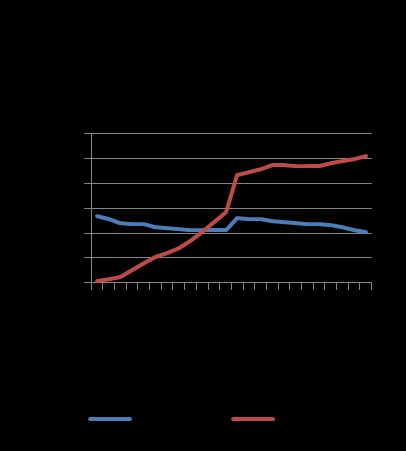
Here’s the total number of unemployed, in thousands, in Germany and Spain:
The gap between Spain and Germany
These two countries share a single currency and inhabit the same monetary union.
Spain would benefit from a looser monetary and fiscal policy.
Germany would not.
Gavin Hewitt, the BBC's Europe editor, 9 July 2010
It was 20 years ago that then-Chancellor Helmut Kohl made a lonely decision.
a monetary union for the two Germanys
Instead of one to one, the exchange rate should have been one to three or one to four, to reflect the economic reality
German Interior Minister Thomas de Maizière, Der Spiegel 1st July 2010
The Berlin Wall had come down, and thousands of East German citizens were moving to the West every week. Kohl offered Hans Modrow, the interim communist leader of East Germany at the time, a monetary union for the two Germanys.
Experts were annoyed by the proposal, and Karl Otto Pöhl, the then-head of West Germany's central bank, the Bundesbank, warned against it. But Kohl had his way. Money transporters began rolling eastward overnight. The West German deutsche mark was named East Germany's currency on July 1, 1990.
Politically speaking, the monetary union was a success. The people were delighted, because they no longer had to travel to the west to get deutsche marks. But the move had a devastating effect on the economy. Overnight, all pensions, wages and savings of up to 6,000 East German marks were exchanged on a one-to-one basis. This was beneficial for East German citizens but not for businesses, many of which went under when they suddenly found themselves having to compete with the highly modern West German economy.
"Although there was no reasonable political alternative to the fixed exchange rate, it was a bad move economically," says de Maizière. "Instead of one to one, the exchange rate should have been one to three or one to four, to reflect the economic reality, but this would have had the devastating political consequence of further migration."Kommentar av Rolf Englund:
Som man brukade säga från myndighetshåll i det gamla sog. DDR: "Eine Mark ist Eine Mark".
Germany reiterates its insistence on an EU sovereign insolvency law
There is still no final agreement on the EFSF, as this is still blocked by the Slovakians. But the fund will go ahead one way or the other.
Eurointelligence 13.07.2010
Wolfgang Schauble said the issue remains firmly on the agenda of Herman van Rompuy’s task force, but, as Frankfurter Allgemeine reports, there is no support for the setup of a “Berlin Club”, akin to the Paris Club, as all these changes would almost certainly require a change in the European Treaties, for which there is no appetite.
You can read more about this crazy Berlin Club proposal in Der Spiegel – hat tip Naked Capitalism, which correctly calls it a trial balloon for domestic consumption.
The new Slovak government remains opposed to a rescue package for Greece, Prime Minister Iveta Radicova said Monday, after a meeting with European Union Council President Herman van Rompuy.
Wall Street Journal 13 July, 2010
The snag with Germany’s idea (insolvency rules)is that it goes too far
It is hard to see how such a plan could be imposed, let alone enforced. It would place the debtor nation in a position of colonial submission.
If ever agreed to, this would be politically explosive.
FT editorial July 13 2010
New rules are needed to underpin the eurozone in the post-crisis world. The stability and growth pact has failed. To avoid moral hazard, these rules must admit the possibility of sovereign default.
Any orderly restructuring would involve creditors taking haircuts. So would a disorderly default. However, it would strengthen market discipline if creditors knew both that they would face haircuts and how those might be negotiated. The Germans are right to push these ideas. A colonial-style workout, by contrast, would lack credibility. When sovereigns default, what is needed is a conference table not a torture chamber.
Germany is now actively (and very secretly) pushing for a plan outlining a set of insolvency rules,
which would require that private investors bear a portion of the rescue burden, and much more importantly,
would see at least a partial give up in state sovereignty
Tyler Durden, Zerohedge, 12/7 2010
A new insolvency trustee (the "Berlin Club", which we fail to see at least for now, how it differs from the Paris Club) would take implicit control over and override a default nation's treasury, in essence pushing the bankrupt country into a form of Feudal vassal state-cum-reparations subservience.
Welcome to financial warfare in the post-globalization period.
The big news out of Europe this morning, and the reason for the drag on the euro is an article in Der Spiegel, "Merkel's rules for bankruptcy"
Logiken i det hela rör sig i federativ riktning... Sch! säger Kohl åt mig när jag tar upp det
Göran Persson
Will taxpayers will have to bail out their banks, when we have the results on 23 July of stress tests?
Only a few weeks ago there was an initial billion dollar bailout of European banks.
You may have missed it, because it wasn't called a bank rescue programme.
BBC's business editor Robert Peston, 16 July 2010
It was a financial support package for Greece worth 110bn euros - and 750bn euros of credit for other eurozone governments that may face difficulty keeping up the payments on their debts.
On the face of it therefore this was aid for eurozone states.
What is troubling, however, is that the creditors of Europe's big banks fear that the billion dollar rescue package wasn't enough
Only a closer union can save the eurozone
I am aware that, at a time of rising nationalism and regionalism throughout the EU, there is no consensus for such sweeping reforms
Wolfgang Münchau, FT, June 27 2010 19:52
At some point the markets will realise that large parts of the German and French banking systems are insolvent, and that they are going to stay insolvent.
You might think that Europe’s policy elites cannot be so stupid as to commit themselves to stress tests without a resolution strategy up their sleeves. But I am afraid they probably are. Europe’s political leaders and their economic advisers are, for the most part, financially illiterate.
In 1998, four renegade German professors tried to stop the introduction of the euro with a legal challenge in Germany's highest court.
Now, 12 years later, they are fighting against a German bailout for Greece - and this time around, people are listening to them.
Der Spiegel online 30 june 2010
Är Sverige med i motståndsrörelsen?
Ett tysk-franskt förslag mötte motstånd på EU-toppmötet. Det blockerades, av England, Tjeckien och Sverige
Rolf Englund blog 18/6 2010
Tyskland, G20, Grekland EU/SPV
Rolf Englund blog 2010-06-08
EU leaders will tomorrow meet in Brussels for a crucial summit.
A briefing outlining recent developments and moves towards what French President Nicolas Sarkozy has labelled an economic government for the EU
Open Europe 16 June 2010
...
Merkel, Sarkozy Paper Over Differences Before EU Summit
a vague call for an "economic government"
Spielgel Online 15/6 2010
"We're not afraid of transparency," said the Spanish Banking Association (AEB), saying the full truth would put an end to rumours battering Spain's instutitions. El Pais reported that the government backs the initiative, putting it on a collision course with Germany which insists on secrecy.
Ambrose Evans-Pritchard, 15 Jun 2010
Till och med i fredags hade ECB köpt obligationer från eurozonens krisländer för totalt 35 miljarder euro (340 miljarder kronor) på tre veckor.
ECB:s stödköp syftar till att få bort flaskhalsar på kreditmarknaden, som uppstått då obligationerna inte längre går att omsätta på andrahandsmarknaden.
DI/TT 31/5 2010
ECB Buying Up Greek Bonds
German Central Bankers Suspect French Conspiracy
gives French banks the perfect opportunity to get rid of their Greek assets
Der Spiegel 31 May 2010
Axel Weber, the Bundesbank president, remained stone-faced as he acknowledged the latest figures, which indicated that by the end of last week the European Central Bank (ECB) had already spent close to €40 billion ($50 billion) on buying up government bonds from Spain, Portugal, Ireland and, in particular, Greece.
The ECB already has about €25 billion of Greece's mountain of debt on its books, and it is adding another €2 billion a day, on average. The Bundesbank, which has a 27 percent stake in the ECB, is responsible for €7 billion of the ECB's Greek government bonds.
Many Bundesbank members are wondering why the ECB is buying Greek bonds in the first place, particularly on this scale, now that the euro-zone countries' €110 billion bailout package for Greece has been approved, and the first tranche of the funds has already been disbursed.
Top of pageThe €750bn financial rescue package
The German constitutional court has still to rule on the package. "natural disasters or exceptional occurrences beyond its control"
Wolfgang Münchau May 30 2010
The fixed-exchange mechanism had gone horribly wrong
The tragedy of the interwar years in Germany was that the Social Democrats - then the world’s foremost socialist party - became fatally tainted by acquiescing in /accepting/ Bruning’s deflation torture from 1930 to 1932.
They did so, of course, because they dared not confront the orthodoxies of the Gold Standard.
The result in Germany was the Reichstag election of July 1932 when the Communists and Nazis won over the half the seats.
Ambrose Evans-Pritchard 23 May 2010
Just 319 out of the 622 members of the Bundestag backed Germany’s €148bn contribution,
underlining Berlin’s unease about helping Greece and setting up an emergency fund for other nations.
Another 195 abstained and 73 voted against.
Financial Times May 21 2010
It was an uncomfortably close call for Mrs. Merkel.
The bill passed by a margin of just seven votes, with half a dozen members of her conservative coalition voting against it.
The left-wing opposition parties refused to support the deal, either abstaining or voting against it.
New York Times May 21 2010
Det tyska beslutet fattades med stor brådska och utan det breda parlamentariska stöd som regeringen hoppats på.
– Ni har ingen linje och inget mål. Ni vet inte vad ni vill med landet eller Europa.
Det omdömet fällde de tyska socialdemokraternas ledare Sigmar Gabriel om Angela Merkels regering i förbundsdagsdebatten i dag.
För Tysklands del omfattar dagens beslut ungefär lika mycket som en halv årsbudget för landet, eller omräknat i kronor 1 500 miljarder.
Ekot 21 maj 2010
By announcing a ban on the activities of short-sellers she /Angela Merkel/ is hoping her decoy will avert German attention from the small print of Berlin's support for Greece, which talks of developing processes for "an orderly state insolvency". This sounds ominously like a softening-up process for a form of default.
Jeff Randall, Daily Telegraph 20 May 2010
Gnisslet mellan Tyskland och övriga euroländer ger underlag för spekulationer om att tyskarna skulle vara på väg att tröttna på euron och i stället söka sig tillbaka mot gamla D-marken.
Förmodligen rör det sig om helt ogrundade gissningar, men de öppnar ändå för ett dystert scenario där valutaunionen spricker och Europa hotas av ekonomiskt kaos.
Johan Schück, DN 2010-05-21
The euro is in danger, German Chancellor Angela Merkel
said in a speech to parliament
CNBC 19 May 2010
Germans are amazed at global reaction to their fiscal proposals
FT Deutschland had an interesting culture shock article in which it quotes several economists as saying that
Germany’s debt rule, if applied to the whole of the eurozone, is much more likely to result in investor panic than solve the problem.
Eurointelligence 20 may 2010
Frankrikes president Nicolas Sarkozy hotade med att dra Frankrike ur eurosamarbetet
om inte Tyskland gick med på det räddningspaket som ska hjälpa Grekland ur krisen.
Det uppger den spanska tidningen El País enligt DN 14 maj 2010
There can be no more pretence that monetary union respects the premise
on which it was sold to European citizens, Germans in particular.
Financial Times editorial May 10 2010 20:41
The two German members of the ECB's council voted against the move
The European Central Bank risks irreparable damage to its reputation by agreeing to the mass purchases of southern European bonds in defiance of the German Bundesbank and apparently under orders from EU leaders.
Ambrose Evans-Pritchard 11 May 2010
How can a loan guarantee solve a problem of excessive indebtedness?
The funny thing is that the Germans, Ms Merkel probably included, really believed in the “no bail-out” clause.
They were shocked by events. They failed to see that Article 125 of the Lisbon treaty is the kind of law that is irrelevant until needed, at which point it becomes impossible to apply.
Wolfgang Münchau May 10 2010
Ms Merkel’s staff had impressed on her that any attempt to support Greece with loans at below market interest rates would draw the ire of the German constitutional court. That, too, turned out to be a misjudgment. We know that the court is sceptical about further European integration and made its views clear last year in its ruling on the Lisbon treaty. But Germany’s constitutional justices are not reckless. They duly and almost instantaneously dismissed a frivolous case against the Greek aid package, brought by four Europhobic professors.
German Chancellor Angela Merkel accused the financial industry of playing dirty. "First the banks failed, forcing states to carry out rescue operations. They plunged the global economy over the precipice and we had to launch recovery packages, which increased our debts, and now they are speculating against these debts. That is very treacherous," she said. "Governments must regain supremacy. It is a fight against the markets and I am determined to win this fight".
Ambrose Evans-Pritchard, 6 May 2010
Mrs Merkel made a moving plea to the Bundestag to support the €110bn (£93bn) rescue for Greece.
"Nothing less than the future of Europe is at stake. The happy tale of German history since World War Two and our emergence as a free, united, and strong country cannot be separated from the European Union.
We owe decades of peace and prosperity to the understanding of our neighbours," she said.
Daily Telegraph 6/5 2010
"Europe today is looking to Germany. As the strongest economy in Europe, Germany has a special responsibility and it takes this responsibility to heart.
"Immediate help is needed to ensure the financial stability of the eurozone. This must be done to avoid a chain-reaction to the European and international financial system, and contagion to other eurozone states. There is no alternative."
Rolf Englund: Det finns ingen anledning till oro, således
OBS Ironi. Eller om det är sarkasm?
To Angela Merkel and Germany’s political class, the state elections in North-Rhine Westphalia are infinitely more important than the future of the eurozone.
The opinion polls seem to support this attitude. Greek aid is unbelievably unpopular, with 86 per cent opposed according to a poll published last Sunday.
Come to think of it, there are not many issues in a democracy on which 86 per cent of the people agree on.
Wolfgang Münchau, Eurointelligence 29/4 2010
While it is one thing to criticise a political process as being too slow or otherwise inadequate, Mrs Merkel’s response to this crisis has been irresponsible. While the Greek crisis was caused by irresponsible Greek policy, it was turned into a wider political and economic crisis by her procrastination. The promises of two consecutive European Councils have proved hollow. The financial markets now consider EU leaders, and Mrs Merkel in particular, as liars.
After Wednesday’s scare, and the downgrade of Spain, Merkel went from complacency straight into panic.
But even now it is not clear whether the Bundestag is going to vote in favour of the aid – which is going to be much, much large than previously reported, about $120bn for three year, without restructuring.
Den 9 maj är det val i Tysklands största delstat Nordrhein-Westfalen med 18 miljoner invånare.
Händelsevis har eurozonens ledare nu bestämt datum för ett toppmöte om Grekland till dagen efter valet.
Gunnar Jonsson Signerat DN 2010-04-29
– Den stora risken i ett krisscenario är att bankerna i Tyskland och Frankrike får en rejäl smäll och att vi får en ny vända av finanskris,
säger Handelsbankens chefekonom Jan Häggström.
Ekot 28/4 2010
The writer is senior adviser to Soditic-CBIP LLP, chairman of SCCO International and author of The Euro – The Politics of the New Global Currency
When Josef Joffe, then foreign editor of the German daily Süddeutsche Zeitung, wrote a 4,000-word essay in December 1997 attacking the planned formation of the European single currency, he published it first in English, in the New York Review of Books.
“Never in the history of democracy have so few debated so little about so momentous a transformation in the lives of men and women,” noted Mr Joffe.
As if to confirm his point, the article appeared in an abridged German translation in the Süddeutsche Zeitung more than a month later, unobtrusively buried in a weekend supplement.
The episode illustrates past barriers to plain speaking about economic and monetary union (Emu). Many ordinary Germans always feared the euro would be less stable than the D-Mark. Yet, reflecting postwar belief that German interests ineluctably overlapped with Europe’s, there was little discussion of the risks. This went beyond Germany. One senior Dutch central banker, now retired, says most European governments – including his own – agreed the Maastricht treaty 20 years ago without understanding what they had signed into law.
Wilhelm Hankel, Wilhelm Nölling, Karl Albrecht Schachtschneider and Joachim Starbatty, four German professors who launched an unsuccessful anti-euro lawsuit at the constitutional court in 1998, are preparing fresh legal action. Their claims of infringements to the Emu rules, in particular over the “no bail-out clause” preventing joint payment of weaker states’ debts, have a much greater chance of success this time.
Under existing law Greece cannot be pushed out. In fact Greece cannot leave the eurozone voluntarily, without having to leave the EU as well.
In any case, it is smarter for Greece to default inside the eurozone than outside.
So what happens if the Bundestag blocks the aid? Greece will simply default, and this will put several German and French banks that hold large chunks of Greek sovereign and private debt at risk.
Wolfgang Münchau, FT April 25 2010
Perhaps the most significant legacy of this crisis is the emergence of a Germany that asserts its own national interest above being "good Europeans"; the role it has played in the past.
Gavin Hewitt, the BBC's Europe editor, 24 April 2010
In a revealing article in the New York Times, John Kornblum, a former US ambassador to Germany, says that "Europe in the institutional sense has become increasingly unpopular" in Germany.
"German courts have begun to define German European issues in the context of the German constitution rather than on the basis of EU law," he writes. He goes on to say that "the growing gap between Germany's aspirations and the perceived needs of other members of the EU is beginning to burden both sides. Most Europeans are simply not ready to live up to German standards".
77 milarder kronor
It has been estimated that Germany will have to contribute over eight billion Euros to the relief effort.
For Merkel, whose coalition government is facing an important regional election in the state of North Rhine-Westphalia on May 9, that steep bill is becoming reality sooner than she would have liked.
Spiegel Online 23/4 2010
German tax payers are reluctant to support their debt-strapped neighbors, and she and her coalition partners hoped to keep the awkward bailout issue as quiet as possible during the run-up to the election. But that plan has been crushed by the urgency of the Greek predicament.
The voices that matter are those of German Chancellor Angela Merkel, the Bundesbank, the finance committee of the Bundestag, and ultimately the Verfassungsgericht, or German constitutional court.
Ambrose Evans-Pritchard April 12th, 2010
Christopher Steegmans, spokesman for Chancellor Angela Merkel, decided that the best defense would be to go on the offensive.
In a press conference held in Berlin on Monday, he declared that the state of the European Union's decision on whether to help Greece was "unchanged"
Der Spiegel 12/4 2010
"Tyskland vek sig för trycket - vi ska inte lura oss själva att sådana lån är något annat än subventioner", sa Frank Schaeffler, biträdande finanstalesman för regeringskoalitionspartiet FDP.
DI/Direkt 2010-04-12
Germany's Bundesbank has fired a warning shot at Chancellor Angela Merkel, attacking the joint EU-IMF rescue plan for Greece as
a threat to economic stability and probably illegal.
Leaked extracts from an internal report appeared in the Frankfurter Rundschau
Ambrose Evans-Pritchard, 8 Apr 2010
Christopher Steegmans, spokesman for Chancellor Angela Merkel, decided that the best defense would be to go on the offensive.
In a press conference held in Berlin on Monday, he declared that the state of the European Union's decision on whether to help Greece was "unchanged"
Der Spiegel 12/4 2010
But something about his hasty and unprompted justification elicited the feeling that something just wasn't right. Hadn't something happened?
If worst comes to worst, Germany actually will have to contribute the lion's share of the EU's rescue package for Greece. KfW, the government-owned development bank, would have to transfer €8.4 billion into Athens' accounts, and those funds would be backed by the federal government.
"Tyskland vek sig för trycket - vi ska inte lura oss själva att sådana lån är något annat än subventioner", sa Frank Schaeffler, biträdande finanstalesman för regeringskoalitionspartiet FDP.
DI/Direkt 2010-04-12
"Lånen skulle skada euron, hjälpa Grekland endast temporärt. Vi skulle vara ute på mycket tunn is, legalt och ekonomiskt", fortsatte han.
"Eurogruppens beslut öppnar dörren för spridningseffekter. Det är en invitation till spekulanter att tjäna storkovan på andra euroländers obligationer och en bailout-spiral", sa Hans Michelbach, biträdande finanstalesman för CSU-partiet.
Germany's Bundesbank has fired a warning shot at Chancellor Angela Merkel, attacking the joint EU-IMF rescue plan for Greece as
a threat to economic stability and probably illegal.
Leaked extracts from an internal report appeared in the Frankfurter Rundschau
Ambrose Evans-Pritchard, 8 Apr 2010
The Bundesbank document offers a withering critique of the deal agreed by EU leaders two weeks ago, saying the plan had been cobbled together without consulting central banks and will lead to monetisation of debt. "It brings problems in respect to stability policy that should not be underestimated."
The joint rescue between the IMF and the EU would turn the Bundesbank into a "money-printing machine" for the purchase of Greek bonds, according to Rundschau. This would breach the EU's 'no-bail clause'.
Barclays Capital said any rescue would have to be at least €40bn-€45bn to restore confidence and provide Greece the funding it needs to buy time for reform.
SPIEGEL ONLINE: And in Athens in the meantime, they are burning the flags of Europe.
Weidenfeld: Clearly that is not a good thing.
But in this you can also see the meaningful role that Europe now plays.
Germany should boost domestic demand and wages to ease the lopsided euro-region trade flows
that restrict growth in economies from Greece to Portugal, Bank of England policy maker Adam Posen said.
Bloomberg March 25 2010
Leaders of the 16-nation euro region met in Brussels to debate the contingency plan for a mix of IMF and bilateral loans as the ECB’s president, Jean-Claude Trichet, said Europe has to resolve the crisis on its own.
“If the IMF or any other authority exercises any responsibility instead of the eurogroup, instead of the governments, this would clearly be very, very bad,” Trichet said on France’s Public Senat television.
Trichet’s criticism put the independent central bank on a collision course with European political leaders as the bloc struggled to prevent an escalation of Greece’s debt crisis that has sent the euro to its lowest against the dollar in 10 months.
The accord masks a bitter struggle between Germany and a French-led bloc over the future shape of Europe.
For all the rhetoric, Berlin has refused to cross the Rubicon towards an EU fiscal union, shattering long-held assumptions about the inevitable march of the EU project.
By bringing in the IMF, it ensures that each sovereign state remains responsible for its own debts.
Ambrose Evans-Pritchard 25 March 2010
The monetary union is neither a political nor a fiscal union.
The stability pact calls for each country to cope with its own budget problems.
Neglecting this principle would be dangerous for the acceptance of the European monetary union, especially in Germany.
Thomas Mayer, chief economist for Deutsche Bank, Spiegel Online 25/3 2010
Thomas Mayer has been chief economist for Deutsche Bank since the beginning of 2010. Before joining Germany's largest financial institution, Mayer worked for the International Monetary Fund in Washington and for investment bank Goldman Sachs.
SPIEGEL ONLINE: Do you worry about the currency?
Mayer: Of course. We should never steer towards a transfer union, whereby large countries give permanent financial support to less strong countries. The acceptance of the euro would rapidly dwindle among the general population. In the medium term, this could break down the monetary union. The German taxpayer is not prepared to permanently pay out for other countries living beyond their means.
Full textThomas Mayer, economist at Deutsche Bank, said the latest Greek austerity measures could cause the economy to shrink by 4 per cent this year, making the government’s task even more formidable.
“The adjustment remains a Herculean task, and the costs of the adjustment in terms of lost output could be larger than policymakers currently anticipate,” Mr Mayer said.
FT March 15 2010
– Som tysk kansler bär jag ett stort ansvar. Tyska folket litade på att de skulle få en stabil euro när de gav upp d-marken.
Det förtroendet får inte svikas, sa Angela Merkel inför de tyska parlamentarikerna.
Ekot 25 mars 2010
Hon upprepade den tyska linjen att Grekland bara i yttersta nödfall ska få bistånd utifrån. Och i så fall inte från EU direkt, eller från euroländerna gemensamt. Grekerna bör söka stöd hos Internationella valutafonden IMF, anser den tyska regeringen.
Därutöver kan enskilda länder i eurozonen ge bilateral hjälp till Grekland. Och om alla euroländer då ställer upp så kommer också Tyskland att göra det. Men, upprepade Angela Merkel i förbundsdagen, bara i yttersta nödfall. Och där är Grekland inte ännu.
Opinion polls suggest Angel Merkel’s coalition will lose control of the German Senate in regional elections on May 9.
No wonder she wants to fire a populist shot at voters. But in refusing to underwrite a few billion euros of Greek debt the Chancellor is playing with fire.
Simon Hobbs, CNBC 23 Mar 2010
For 60 years her predecessors spent vast amounts of money and energy driving European integration. At each stage their purpose was clear: solidarity.
11 years ago Germany finally persuaded 5 neighbours to join it in constructing the Euro; each abandoned their national currencies and pooled monetary policy in Frankfurt. Two years later Greece joined them. And yes – Athens lied to get in. We suspected so at the time. But no one blew the whistle.
GAME, SET AND MATCH FOR MERKEL – GREECE WILL HAVE TO GO TO THE IMF
Germany has laid down three conditions for an agreement: an immediately pending catastrophe, involvement of the IMF, and treaty changes to harden the stability pact (or rather a commitment to accept those changes).
Eurointelligence 24/3 2010
Hans-Werner Sinn, head of Germany’s IFO Institute, said the US would have to purge its debt excesses the hard way.
“The bitter truth is that there is no way out of this with monetary and fiscal policy.
They will just have to see their living standards go down.”
Dr Roubini said the US growth rate was likely to fall below 1pc in the second half of the year
Niall Ferguson said the US has exhausted fiscal stimulus, The fiscal crisis seems to be out of control.
Ambrose Evans-Pritchard,05 Sep 2010
Hans Werner Sinn, chef för det ansedda IFO-institutet
Euro bonds would destroy the euro zone.
In 1995, shortly before the exchange rates for the euro were fixed,
the interest rates on Italian and Spanish debt were on average about 5 percentage points above Germany's.
Der Spiegel 23 Augusti 2011
If all countries -- regardless of their creditworthiness -- were to pay the same interest rate, the last impediments to excessive state indebtedness would fall away.
Hans Werner Sinn, chef för det ansedda IFO-institutet.
I helgen aktualiserade den ansedda ekonomen alternativet att Grekland lämnar eurozonen.
Alternativet, att Grekland försöker bli mer konkurrenskraftigt inom eurozonen, riskerar att leda till inbördeskrig.
Ekot 10 maj 2011
Då skulle landet kunna devalvera och på så sätt få tillbaka sin konkurrenskraft. Men ett sådant scenario skulle också rasera bankväsendet eftersom grekerna skulle storma bankerna och ut sina besparingar.
Alternativet, att Grekland försöker bli mer konkurrenskraftigt inom eurozonen, riskerar att leda till inbördeskrig.
Hans-Werner Sinn's remarks are apparently listened to as closely as are the Federal Reserve Chairman's remarks in the US. He said:
The Greek drama will have a 'frightful' ('schreklich') ending no matter which course of action is taken.
The objective is to avoid having a Greek default trigger another banking crisis across the EU.
John Mauldin 22/3 2010
There are three bad alternatives. He recommends #3 (effectively, default):
A Franco-German bailout.
IMF loans. Dr. Sinn believes that this would accelerate the Greek economic contraction with a dramatic deflation
Exit the Euro zone, revive the Drachma, re-denominate the sovereign bonds in Drachma, let the Drachma collapse
The report - whose authors include Hans-Werner Sinn, president of Germany's Ifo institute, and John Flemming, former executive director of the Bank of England - will help to keep alive the debate over whether the monetary rules set for the eurozone are acting as a straitjacket on its economy.
Financial Times; Feb 18, 2002
Olivier Blanchard, the IMF’s chief economist called for several bold innovations.
Central banks should raise their inflation targets—perhaps to 4% from the standard 2% or so.
The Economist print Feb 18th 2010
The beginning of the end of Europe’s economic and monetary union as we know it.
This is the true historical significance of Ms Merkel’s decision.
Wolfgang Münchau, FT March 21 2010 19:35
The FT has commissioned an opinion poll from Harris, according to which a majority Germans oppose aid to Greece, want Greece to leave the euro area,
and believe that Germany would be better off with the D-Mark.
Eurointelligence 22/3 2010
Full text hos Eurointelligence
Kommentar av någon
När tyskarna blir tillfrågade om man tror att man skulle haft det bättre utanför euron svara 39% ja - och endast 30% svarar nej! Visserligen ett stort antal osäkra men om man endast betraktar de säkra så skulle ett valresultat få ungefär samma utfall som vår euro-omröstning.
Lustigt nog har jag inte sett en enda tidning skriva om detta. (sarkasm)
Germany with an expected current account surplus of $187bn this year, should spend more.
If Germany does not, it will force its less competitive eurozone partners to stagnate and deflate.
So the world faces a choice: either the serial exporters can choose to consume more and rebalance the world economy through growth.
Or – as Mr Schäuble would prefer – they can sit on their hands, allow demand to crumble and rebalance the world economy through stagnation.
There is only one sane answer.
--
Tyskland ska spara 771 miljarder
DI 2010-06-07
---
German Government Agrees on Historic Austerity Program
Right or wrong – whether this plunges the whole world into a deflationary abyss from which there is no escape or if, somehow, this has the desired effect of restoring financial stability over time –
it’s nice to see that there are at least a few elected officials in the world who question the idea of simply piling on more debt to cure the world’s economic ills.
Tim Iacono 7 Jun 2010
"economically absurd", "economically erroneous and politically dangerous", "a scandal", "insane"
Europe’s monetary union is in a deep crisis.
In the context of Greece’s debt concerns and emerging problems in other countries, huge current account imbalances have been identified as a major threat.
But since the adoption of a single currency, devaluation is no longer available to correct an unsustainable current account deficit.
Otmar Issing, FT March 18 2010
The Future of the Euro
Moment of Truth for Europe's Common Currency
Part 2: Is Europe Laying the Foundation for a Common EU Economic Government?
Der Spiegel Online 19/3 2010
China and Germany unite to impose global deflation
Germany is in a supposedly irrevocable currency union with some of its principal customers. It now wants them to deflate their way to prosperity in a world of chronically weak aggregate demand.
I am beginning to wonder whether the open global economy is going to survive this crisis.
The eurozone may also be in some danger.
Martin Wolf, FT March 16 2010
Greece, the euro, and the Battle of Jutland
A Gefechtskehrtwendunga 180-degree turn that saves you
Mr Juncker, the Commission’s Jose Barroso, and their allies, have been trying to exploit the crisis to advance the EU Project, pushing the boat stealthily across the Rubicon towards fiscal federalism and a de facto debt union.
Ambrose Evans-Pritchard 18/3 2010
This is a extraordinary story.
Here was the European Council making a political declaration that they would be ready to stand by Greece,
and now Germany wants Greece to turn to the IMF for aid.
Eurointelligence 18/3 2010
Bloomberg spoke to Michael Meister, the CDU’s influential finance spokesman, who has been a lead sceptic on a bailout all along, as saying:
“We have to think about who has the instruments to push for Greece to restore its capital-markets access... Nobody apart from the IMF has these instruments.”
He adding that attempting a Greek rescue without the IMF “would be a very daring experiment.”
This report from NRC Handelsblatt tells the extraordinary story of how it happened:
Sarkozy and Berlusconi worked out the deal with Trichet, and then told Merkel that they would go ahead by themselves.
Also, Merkel had insisted on a 6% interest rate. We quote the relevant of the story in full:
Eurointelligence 13/4 2010
Peter Boone and Simon Johnson say Portugal is next
11/4 2010
The voices that matter are those of German Chancellor Angela Merkel, the Bundesbank, the finance committee of the Bundestag, and ultimately the Verfassungsgericht, or German constitutional court.
Ambrose Evans-Pritchard April 12th, 2010
The Latin and Anglo-Saxon media have underplayed or ignored altogether the importance of a challenge at the Verfassungsgericht. So have market analysts. There seems to be a collective failure to understand that certain things cannot be “fixed” by the usual methods of EU alchemy.
I recommend reading the court’s thunderous ruling on the Lisbon Treaty in June 2009, a cannon shot warning to Brussels and the EU elites that it will no longer be pushed around. It states that the EU is “an association of sovereign national states (Staatenverbund)” and that states are “Masters of the Treaties” and not the other way round.
The EU’s fundamental order is “subject to the disposal of the Member States alone and in which the peoples of their Member States, i.e. the citizens of the states, remain the subjects of democratic legitimisation.”
It constructs a line of defence against infringements of German sovereignty, stating that certain fields “must forever remain under German control.”
Varför frågar ingen Birgitta Ohlsson om Grekland och EMU?
Rolf Englund blog 12/4 2010
Does nobody read German any more?
As of today, German finance minister Wolfgang Schauble has not yet agreed to anything beyond a last resort rescue “if insolvency were imminent” and if there were to be a threat to the “financial stability of the euro area as a whole”.
Ambrose Evans-Pritchard March 16th, 2010
Very Important Article
Does nobody read German any more? Nearly all the reports on Europe’s bail-out for Greece appear to be coming from Paris, or Madrid, or sources within the Brussels apparatus determined to seize on the EMU crisis to advance the “Project”, this time by leaps and bounds towards fiscal federalism.
This cannot possibly be done without German backing, so it is academic what these people think or want. As of today, German finance minister Wolfgang Schauble has not yet agreed to anything beyond a last resort rescue “if insolvency were imminent” and if there were to be a threat to the “financial stability of the euro area as a whole”. That raises the bar very high.
He cannot go further because any bail-out for Greece would breach the EU’s no-bail-out-clause, and would therefore violate the German Grundgesetz, or constitutional law.
I can only conclude that the persistent refusal to treat this as a genuine problem is because these pundits do not read German newspapers. They can read French and hack Spanish or Italian, and normally that is enough in EU affairs, but sometimes it is not, and this occasion is one of them.
I happen to think that the German/EU policy of enforcing a ferocious fiscal squeeze on half Europe is demented and destructive. This Hooveresque strategy will tip these countries into a debt spiral, along the lines described by Irving Fisher in Debt Deflation Causes of Great Depressions (Economica, 1933).
It will prove self-defeating, starting with Greece, which will see its public debt galloping up to 135pc of GDP this year. The policy will rebound against German exporters and Germany’s under-capitalized banks, ultimately dragging the entire eurozone into a deflationary swamp.
I can think of no better way to destroy everything good that the EU has done in half a century.
David Owen from Jefferies Fixed Income said there is no instance in modern history when a state has managed to pull off a fiscal squeeze equal to 4pc of GDP in the midst of a recession, as Greece is being told to do. (Though Latvia may qualify).
The immediate political issue is that whatever Berlin wants to do over Greece, its hands are tied by the Verfassungsgericht, or constitutional court. This is the same court that issued a thundering ruling on the Lisbon Treaty last year, reminding EU Putchists that sovereign states are “Masters of the Treaties” and not the other way round, and that national parliaments are the only legitimate fora of democracy.
In my view, the House of Lords should strike down any EU law that breaches our constitutional tradition
(Magna Carta, Bill of Rights, etc) and damn the torpedoes.
God bless the Germans.
Ambrose Evans-Pritchard March 16th, 2010
Very Important Article
Ambrose kommenterar en kommentar till sin artikel:
reply exbrat,
The German Verfassungsgericht is like the US Supreme Court. Its task is to ensure that all laws comply with the German constitution. If they do not, it strikes them down — and reserves the right to do this to EU laws. Ergo, it does not accept the primacy of EU law over German constitutional law (only over ordinary German law — though Germans may correct me on this if I am wrong).
You can amend the German constitution but that is very hard. Two thirds majority, etc.
The British system makes it harder to make a stand on this, but we can do so. In my view, the House of Lords should strike down any EU law that breaches our constitutional tradition (Magna Carta, Bill of Rights, etc) and damn the torpedoes.
It should certainly stamp all over the abominable Charter with its clause allowing the EU to override all rights in “the general interest of the Union”. That is an outright Fascist clause, and I am very surprised it got through the Verfassungsgericht (it may not, if there is a court case challenging this).
We don’t dare do what the German courts do. That is entirely political, and our own fault. Germany’s top court is now the only defender of British sovereignty against EU Putschists.
God bless the Germans.
In a landmark judgment in 1993, the constitutional court ruled that, once it came into force, monetary union had continuously to satisfy the full conditions of the “stabilisation treaty”
concluded when the single currency was agreed.
If it did not, the court ruled, Germany would be obliged to leave.
The four professors who took the German government to the German constitutional court in 1998 over Germany’s entry into the euro. Wilhelm Hankel, Wilhelm Nölling, Karl Albrecht Schachtschneider and Joachim Starbatty, FT, March 25 2010
Årets val gäller bl.a. ett vilande grundlagsförslag med ändringar av 10.2 och 10.5 i regeringsformen (RF).
Inga löften om att kassera det vilande grundlagsförslaget, inga röster från oss väljare!
Varför rösta, när det gör detsamma om våra lagar stiftas i Stockholm eller i Bryssel!
Margit Gennser i Barometern 2002-08-03
We need an agreement that as an ultima ratio it's possible to exclude a country from the euro zone if again and again it doesn't fulfill the requirements,"
Ms. Merkel said in an address to Germany's lower house of parliament.
WSJ March 17, 2010
If life in the eurozone becomes intolerable, exit will become the default resolution mechanism.
And when you include the legal possibility of an exit, the whole political and economic dynamic changes,
and the threat of an exit might turn into a self-fulfilling prophecy.
This does not apply only to Greece, but to a number of countries that have lost competitiveness to Germany.
Wolfgang Münchau, FT March 14 2010
“Should a eurozone member ultimately find itself unable to consolidate its budgets or restore its competitiveness, this country should, as a last resort, exit the monetary union while being able to remain a member of the EU.”
Wolfgang Schäuble, German finance minister, FT March 11 2010 19:15
Greece, Ireland, Portugal and Spain will cut the demand
So, unless as-yet-unspotted foreign cavalry ride to Europe’s rescue by buying up the continent’s products, aggregate demand will fall.
Less competitive Eurozone countries will be forced to deflate and shrink their economies to match Europe’s diminished and diminishing circumstances.
FT Editorial March 15 2010
Germans like to believe that they made a huge sacrifice in giving up their beloved D-mark ten years ago, but
they have in truth benefited more than anyone else from the euro.
Almost half of Germany’s exports go to other euro-area countries that can no longer resort to devaluation to counter German competitiveness.
The Economist print March 11th 2010
Too few women are in full-time work, partly because child-care support is lacking. The country’s demographic prospects are dire.
A special report on Germany
The Economist print March 11th 2010
Ever since the federal republic was founded, Germany has had two over-riding strategic objectives: sound money and European integration. These were the twin imperatives learned from the calamities of the early 20th century.
The euro embodies these aims. Now they conflict with each other.
Martin Wolf FT March 9 2010
Germany can be Germany – an economy with fiscal discipline, feeble domestic demand and a huge export surplus – only because others are not. Its current economic model violates the universalisability principle of Germany’s greatest philosopher, Immanuel Kant.
RE: Som varje mamma brukar säga: Hur skulle det se ut om alla gjorde så där?
Establishing the EMF would require a new treaty
We must note an even greater difficulty. The notion that the big threat is fiscal indiscipline is false.
Now Germany insists that every country should eliminate its excess fiscal deficit as quickly as possible.
But that can only happen if current account balances improve or private balances deteriorate.
The most likely outcome of such fiscal retrenchment would be a slump in countries with large external and fiscal deficits. Given the lack of competitiveness of such external deficit countries and the weakness of demand elsewhere in the eurozone, such slumps might become very long-lasting.
The question is whether populations would put up with this. If not, political crises will emerge, with inherently uncertain consequences.
Germany is in a trap of its own devising. It wants its neighbours to be as like itself as possible. They cannot be, because its deficient domestic demand cannot be universalised.
"Nu behövs ett statsmannalikt ledarskap... Europas ledare, först och främst Tyskland och Frankrike"
Ska vi rycka ut för de sydeuropeiska länderna
eller ge upp och låta euron dö?
Den frågan klargör vad hela krisen handlar om: det europeiska projektets framtid.
Joschka Fischer, kolumn DN 10/3 2010
SORRY, NO EMF – CAN’T BE DONE
Der Chefvolkswirt der Europäischen Zentralbank (EZB), Jürgen Stark
wrote in Handelsblatt that an EMF violated the existing treaties
Eurointelligence 9.03.2010
So here they make the biggest governance proposal in the history of the euro, and it looks like they messed it up. A treaty change is needed to implement Schauble’s proposal, as Merkel now admits and the French also think it is not realistic.
Der Chefvolkswirt der Europäischen Zentralbank (EZB), Jürgen Stark wrote in Handelsblatt that an EMF violated the existing treaties and would undermine the public’s trust in the euro. What was needed was a stricter application of the budget rules. The ECB said Mr Stark’s views did not represent those of the ECB, but were personal.
Merkel about EMF
A full-scale negotiation of the EU’s 27 member states would be needed to set up a European Monetary Fund, which would be able to bail out eurozone members subject to strict budgetary conditions.
“Without treaty change we cannot found such a fund,” Ms Merkel told foreign correspondents in Berlin on Monday.
FT March 8 2010
German constitutional law imposes such tight constraints that any dilution of the no bail-out clause in the Maastricht treaty or the price stability target of the ECB might trigger a forced German exit.
The most one can hope for during the next 10 years is improved voluntary co-ordination in the European Council.
Germany has unilaterally prescribed itself a deficit-to-GDP ceiling of 0.35 per cent from 2016.
Wolfgang Münchau March 7 2010
Grekland
One banker said the situation was surreal.
"How can they call the Germans incompetent Nazis and still expect a bail-out?"
Ambrose Evans-Pritchard, 24 Feb 2010
Grekland, EMU, Tyskland och Freden
Rolf Englund blog 23/2 2010
Participating states established a common central bank but refused to surrender the right to tax their citizens to a common authority. This principle was enshrined in the Maastricht treaty and has since been rigorously interpreted by the German constitutional court. The euro was a unique and unusual construction whose viability is now being tested.
George Soros FT February 21 2010
De som sade nej för att de är emot ökad överstatlighet blir än mer övertygade om att de har rätt.
Den svenska euro-debatten kommer att polariseras.
Klas Eklund February 14th, 2010
Det är sant att EMU som helhet inte är ett “optimalt valutaområde”. Skillnaderna mellan olika regioner är stora. Och arbetsmarknaden i unionen är inte tillräckligt internationaliserad och flexibel, ej heller är finanspolitiken tillräckligt samordnad för att kunna motbalansera då penningpolitiken kommer rejält ur synk för något land som utvecklas annorlunda än kärnländerna.
Men det här är ett problem som framför allt rör länder som Spanien och Irland. De har växt snabbt, med våldsamt byggande och ibland hög inflation. ECB:s ränta var under boom-åren för låg för deras behov.
Eftersom de hade hög inflation var realräntan faktiskt lägre där än i kärnländerna, vilket ytterligare blåste på uppgång och fastighetsbubbla.
Krisen ska lösas genom fastare samordning, först vad gäller stödet till Grekland, därefter finanspolitiken för unionen som helhet.
Den gemensamma penningpolitiken förutsätter ett mycket starkare samarbete också rörande finanspolitiken.
Logiken i det hela rör sig i federativ riktning... Sch! säger Kohl åt mig när jag tar upp det.
Göran Persson
Är Du federalist, Peter Wolodarski?
Rolf Englund blog 18/2 2010
Är Du federalist, Klas Eklund?
Less than a year before the euro became the currency of 11 European countries in January 1999, a declaration signed by 155 German-speaking economists called for an “orderly”— ie, long — delay.
The prospective euro members, they said, had not yet reduced their debt and deficits to suit a workable monetary union;
some were using “creative accounting” to get there, and a casual attitude towards deficits would undermine confidence in the euro’s stability.
The Economist print Feb 18th 2010
Now the prediction is coming true, says Wim Kösters, of the Ruhr University in Bochum and one of the original signatories. Greece, which joined the euro two years after its inception, has concealed the dodgy state of its finances. Now it is under attack from speculators. A default could spread panic to other deficit-plagued economies, including those of Spain and Portugal, with scary consequences for Europe’s already shaky banking system. But if Greece’s partners bail it out, defying the euro’s founding treaty, the currency will suffer. Either way, the euro is in trouble.
It is no secret that the German government and business establishment were also dubious about what they saw as a French-led project. What decided the matter for Helmut Kohl, the then German chancellor, was his belief in a federal Europe. He originally hoped that monetary union would be coupled with a political union. But, when he realised that was not to be, he still hoped that the monetary union would itself lead to a political one.
Samuel Brittan, FT February 18 2010
The worst that could happen now is a leap into the imaginary world of soft options.
That would be the end of the eurozone.
Wolfgang Münchau February 14 2010
Last year’s German constitutional court ruling on the Lisbon treaty added further impediments to effective eurozone economic governance. The court stated unambiguously that macroeconomic policy must remain the competence of the member states.
Chancellor Angela Merkel is constrained by the 1993 Maastricht treaty ruling of the German constitutional court stipulated that stability is an unalienable basis for Germany’s participation in a monetary union. Should this principle be violated, the legal basis for Germany’s participation would no longer be valid. Article 125 of the Lisbon treaty – the infamous “No Bail-out Clause” – is legally an important aspect of the overall stability of the system. And some people will no doubt argue that a Greek bail-out would violate article 125.
A fiscal union is not going to happen. Nor will the EU embark on yet another treaty change.
Germany should be encouraged – within the limits set by the constitution – to raise domestic demand. Last year’s constitutional balanced budget amendment was unhelpful in this respect.
The Frankfurter Allgemeine summed up German feelings when it asked why taxpayers should bail out a country that thinks it an outrage to raise the retirement age to 63.
"Should Germans have to work in the future until 69 instead of 67 so that Greeks can enjoy early retirement?"
Ambrose Evans-Pritchard GMT 14 Feb 2010
Frankfurter Allgemeine Zeitung oozed indignation.
“Germany is meant to take responsibility for Greek debts – that’s not how the idea of the euro was sold to the Germans,”
the conservative newspaper noted in reference to the single currency’s founding treaty, which banned bail-outs.
Financial Times February 11 2010
The newspaper noted that Greece’s eurozone partners had in the past neither the will nor the instruments to force Athens to reform its finances. “How do they hope to have any success once they have lent money to Greece?” Its editorial warned that if the eurozone changed from “a currency union to a debtors’ zone”, its citizens would “pay a heavy price in the form of a devaluation of their currency and their pensions”.
French banks hold €80bn of Greek debts, twice the exposure of German banks, though Greek debt is merely the tip of the iceberg.
Total exposure to Club O'Med is $853bn for France (30pc of its GDP), and $707bn for Germany (19pc of GDP)
Ambrose Evans-Pritchard, 10/2 2010
German exposure to the region amounts to €43bn in Greece, €47bn in Portugal, €193bn in Ireland, and €240bn in Spain,
according to the Bank for International Settlements.
German lenders are already vulnerable, with the world's lowest risk-adjusted capital ratios bar Japan.
Ambrose Evans-Pritchard, 10/2 2010
Should Germany bail out Club Med or leave the euro altogether?
Germany faces a terrible dilemma. Either Europe's paymaster agrees to underwrite a Greek bail-out and drops its vehement opposition to a de facto EU economic government, treasury, and debt union, or the euro will start to unravel,
and with it Germany's strategic investment in the post-war order.
Ambrose Evans-Pritchard, 31 Jan 2010
Germany is happily placed in the current EMU system. By compressing wages for a decade it has stolen a march on EMU. Critics unfairly call this a beggar-thy-neighbour policy. It is simply the way Lutheran society operates, in deep contrast to the way Latin society operates – a cultural clash that should have given pause for thought before Europe's elites launched headlong into their adventure.
The matter will in the end be decided by democracy. German citizens were given a pledge by their leaders in the 1990s that loss of the D-Mark would not lead to monetary disorder, or leave them liable for Club Med debt. That is the sacred contract of EMU.
"Politically," said Bundesbank chief Axel Weber, "it's not possible to tell voters that they are bailing out another country so that it can avoid painful austerity measures that they themselves have gone through. Such aid, whether conditional, or – even worse – unconditional, is counterproductive."
Athens has promised to slash the budget deficit by 10pc of GDP over three years, though the country is sliding deeper into slump, faces 20pc unemployment by the year's end, has a tottering banking system, and has already lost control of its streets before spending cuts have even begun.
The Papandreou government has craftily invited the European Commission to set up a vice-regal inspectorate in Athens, to become the focus of popular fury.
Spain's troubles are less immediate, but it lost as much competitiveness during the early EMU boom, that debt trap of negative real interest rates. External corporate debt is dangerously high. The budget deficit was 11.3pc of GDP last year. Madrid has drawn up €50bn of cuts to sweeten the markets, even though unemployment is already 19pc. The jobless typically receive 50pc to 60pc of former earnings for around 18 months, then the axe falls. The social distress hits with a lag. How much more tightening can Spain endure before Catalan, Basque, and Galician seperatism rocks the Spanish state?
Fiscal austerity in these circumstances without monetary and exchange stimulus to offer a lifeline is incoherent. These policies must fail because they are based on EU wishful thinking that high-debt nations can regain competitiveness within EMU against a zero-inflation Germany. Such a strategy will drive them into a debt-deflation spiral.
Jag tror ingen egentligen har tänkt igenom det här ordentligt. Ja, de som är federalister har gjort det, och de har gjort det lätt för sig, naturligtvis. De vill ha ett Europas förenta stater med direktvalt organ och alltihop, det är enkelt.
Men vi är inte federalister i Sverige, vi är för en europeisk union som vi vill skall bli större, men vi vill inte ha en federation.
Göran Persson
It was inevitable, I think, that Czech President Vaclav Klaus would take his last stand against the European Union’s Lisbon treaty on the Sudeten German issue.
Tony Barber, FT's Brussels bureau chief, 12/10 2009
Last week's ruling by the German Constitutional Court, coupled with demands by one conservative party for changes to the constitution,
may not only jeopardize Berlin's schedule for the ratification of the Lisbon Treaty.
The Karlsruhe ruling also threatens future steps toward European integration.
SPIEGEL Staff 6/7 2009
Anders Borgs plan för balans i EU-ekonomin
Mats Hallgren, Svde24 2009-07-07
Germany’s constitutional court ruled that the Lisbon treaty was consistent with German law.
This means Germany will be able ratify the treaty before the end of the year.
But... If you read the entire 147-page ruling, you realise that
the court has given a damning verdict on future European integration.
For example, it declared a hypothetical fiscal policy co-ordination or the establishment of a single European Union military command as unconstitutional.
Wolfgang Münchau, FT July 12 2009
Rolf Gustavsson:
Precis som när Maastrichtfördraget behandlades i författningsdomstolen (1992) sätter Tysklands högsta jurister gränser på en lång rad områden för hur långt den europeiska integrationen ska kunna gå utan att hota det demokratiska styrelseskicket.
Domstolen slår fast att EU inte är en ”statsanalog” organisation och att
EU-parlamentet inte representerar ett europeiskt statsfolk.
EU förblir ett förbund mellan självständiga demokratiska stater och EU-parlamentet företräder folken i dessa stater.
Men för att den fortsatta integrationen inte ska skena iväg utom kontroll för de demokratiska instanserna krävs att de ges förstärkta kontrollmöjligheter.
Utan förbättrad parlamentarisk kontroll riskerar demokratin att urholkas, anser domarna i Karlsruhe.
SvD 30 juni 2009, 23.30
It could be that future generations of German politicians find ingenious ways around the balanced budget law.
Or that they find a two-thirds majority to overturn it.
Or that Mr Sarkozy or his successors follow Germany into a future of austerity.
But as long as one of those three events fails to happen, Germany may discover that unilateral fiscal rigour in a monetary union could prove extremely costly.
For the sustainability of the euro, you surely do not want to get into a position where a large member state has a rational economic reason to quit.
So if Germany and France really do what they both promise,
you may as well start the egg timer.
Wolfgang Münchau, Financial Times June 28 2009
"The [free-market] liberalism without rules failed
"We refuse a bureaucratic Europe that mechanically applies the rules ...
We want a European Union that listens to the citizens, innovates, revitalises."
Such a Union would "favour the emergence of strong European enterprises" and
would "protect the European industry."
Angela Merkel and president Nicolas Sarkozy,
31 May 2009 Journal du Dimanche and Die Welt am Sonntag
After the US, the country with the biggest banking problem is probably Germany.
a bank can apply to set up its own bad bank
It buys the structured securities from the bank at 90 per cent of book value, guaranteed by the government
Wolfgang Münchau, Financial Times May 17 2009
Under the draft legislation put forward by the German government last week, a bank can apply to set up its own bad bank.
A bad bank is not really a bank at all. It is a special purpose vehicle, similar to those off-balance sheet vehicles that triggered this crisis in the first place.
It buys the structured securities from the bank at 90 per cent of book value – the price at which the securities are currently valued on the balance sheet.
In return, the SPV issues new debt securities to the bank, guaranteed by the government.
Germany’s government is finalising “bad bank” plans to deal with toxic financial assets
as part of efforts to restore confidence to the banking system that also include a
takeover offer launched this week for Hypo Real Estate, the stricken property lender.
Financial Times April 10 2009
The next government in Germany should start to cut spending by 2011 at the latest
to help achieve a balanced budget, European Union finance ministers said at a meeting in Brussels today.
Bloomberg March 10 2009
Ex-Bundesbank chief Karl Otto Pohl has just said that Ireland and Greece
are in danger of defaulting on their sovereign debts and/or may be forced out of the Euro
Ambrose Evans-Pritchard Daily Telegraph Feb 26, 2009
"I think there are countries considering the possibility. It would be very expensive," he said.
"The exchange rate would go down, 50 or 60% and then interest rates would go sky high
because the markets would lose all confidence."
Professor Pohl said Germany's political class is afraid their country will ultimately have to pay for the EMU mess.
His view is that the burden should be shifted to the IMF (ie. the US, Canada, Japan, Britain).
Thanks a lot Karl Otto. You broke it, you fix it.
For those who may not be aware of his Sky interview by my colleague Jeff Randall.
Will Germany deliver on the Faustian bargain that created monetary union?
The German finance ministry is drafting rescue plans to prevent
default on the edges of the eurozone
leading to a full-blown collapse of Europe's monetary system.
Ambrose Evans-Pritchard, Daily Telegraph 23 Feb 2009
From a European perspective, there is an acute danger of an extreme exchange-rate overshoot,
which on top of the fall in global demand for European export goods could have devastating effects on exporters, much worse than anything we have seen so far.
Unlike 10 years ago, there is not much scope for wage cuts this time, so this crisis will hit profits.
Wolfgang Münchau, Financial Times, December 21 2008
Germany's constitutional court has been handed a second complaint over the EU's Lisbon Treaty
with the potential to delay the country's final ratification of the document for several months.
The complaint is being brought by... former MEP Franz Ludwig Graf Stauffenberg
EU Observer 27/1 2009
German conservative MP Peter Gauweiler repeated his intention to bring the treaty before the country's constitutional court.
"What Brussels is supposed to get in powers is not compatible with our democratic principles,"
He said his reason for bringing the case is the constitutional court's loss of power to the European court. The constitutional court has until now kept an eye on the inalienable rights of German citizens given to them by Germany's constitution (Grundgesetz), he noted.
EU Observer 25/4 2008
Det är dock inte tillfredsställande att grundlagen ger ett så vagt och otydligt besked om förutsättningarna för Sveriges medlemskap i EU. Som lagrådet påpekade i sitt yttrande över det konstitutionella fördraget ”synes det ... väl kunna hävdas att principerna för statsskicket påverkas enligt det nya fördraget”.
SIEPS remissvar på Lissabon 2008
Läs mer här
EU treaty ratification may be delayed in Germany
The text then needs to be signed off by the country's president, Horst Kohler.
If Mr Gauweiler, a centre-right politician from CSU put a case before the he country's constitutional court...
EU Observer 20/2 2008
According to a report in German daily Die Welt, politicians from the Left Party as well as Peter Gauweiler, a centre-right politician from one of governing parties -the CSU - are examining the text of the EU treaty to see if they can bring a case before the country's constitutional court.
Their move could mean that the final formal step of ratification is delayed. German MPs are widely expected to approve the treaty when it comes before parliament in May.
However, the text then needs to be signed off by the country's president, Horst Kohler.
If Mr Gauweiler has put a case before the court, Mr Kohler will then have to decide whether to go ahead and sign off the treaty anyway or wait for the court to make its case.
There has already been a precedent for this. In June 2005, Mr Kohler refused to sign off the German law approving the original EU constitution. In addition to France and the Netherlands having rejected the document, Mr Gauweiler had also brought a case against the EU constitution before Germany's constitutional court.
At the time, the constitutional judge in charge of the issue, Siegfried Bross, advised Mr Kohler to wait until the court's decision before signing off the EU document, notes Die Welt.
Mr Gauweiler had complained that the EU constitution took too much power away from the country's national parliament, arguing that the document overstepped the boundaries that the German constitution provides for the integration of state institutions in the EU.
Mr Kohler, who hopes to be re-elected as president in May 2009, now finds himself in an awkward position.
Formally, it is possible to sign off the treaty even if the court is examining it, but such a move is politically difficult, especially if the constitutional court were to eventually decide against the legality of the EU document.
Questions are being raised in Germany about the new treaty,
following Germany’s failure to ratify the constitution.
An appeal lodged with the federal constitutional court obtaining an injunction from the court
preventing the federal president from signing the instrument of ratification
Frankfurter Allgemeine Zeitung/Freeeurope.info
In a long and carefully ambiguous interview with the Frankfurter Allgemeine Zeitung,
the President of the federal constitutional court, Hans-Jürgen Papier,
has said that “the EU is not a state” and that “it should not become one.”
Professor Paul de Grauwe
"Without further steps towards political union, the eurozone has little chance of survival"
Ambrose Evans-Pritchard, Daily Telegraph 16/7 2007
There is no doubt that containment of Germany
– usually politely put as the banishment of war from Europe –
has been fundamental to the development of the EU.
Gideon Rachman, Financial Times July 17 2007
The Common Agricultural Policy – still the EU’s most expensive policy – was, in effect, a form of disguised war reparations.
The euro – the biggest single act of economic and political integration yet – was largely a reaction to German reunification. France’s President François Mitterrand was initially panicked. So Chancellor Helmut Kohl of Germany persuaded him that a single currency would bind Germany irrevocably into a united Europe.
In 2000 it was they who played the role now assigned to the Poles – resisting the idea that Germany’s larger population should entitle it to greater voting power. The French insisted that the founding bargain of the EU – rooted in the war – was that France and Germany should always be equal.
It is certainly true that Germany has faced its own past with an honesty lacking in many other European countries. I remember the astonishment of German colleagues a couple of years ago, when they discovered that the building in Rome in which the ill-fated EU constitution was being negotiated still had heroic friezes of Mussolini carved into the walls.
More than 15 years after reunification, most Europeans seem comfortable with the new Germany. They fear a weak German economy more than a strong one, and they accept that the welcoming face that the Germans presented during last year’s football World Cup is the country’s real face, not just a mask. The EU really has moved on from the days when the containment of Germany was its central objective.
The only country where the external adjustment has taken place has been Germany:
but even in this case the adjustment was very slow and took more than a decade:
the shock of German unification and the ensuing loss of competitiveness of Germany took more of a decade to be unraveled
via a painful process of corporate restructuring and significant wage moderation.
Nouriel Roubini, New York University and RGE Monitor, 28/6 2007
Almost a new economic miracle
It became conventional to say that Germany was prevented by the European monetary union from having a needed devaluation.
But Germany has had a real devaluation.
It has been one of the very few countries apart from Japan to experience an actual fall in unit labour costs in manufacturing.
Samuel Brittan, FT April 13 2007
Unemployment, which peaked in 2005 at 10 per cent of the labour force is now down to 7.7 per cent on standardised international definitions.
What is so fascinating about the change is that it owes comparatively little to official policy. The government is using some of the extra VAT revenues to reduce social charges. But most of the turnround seems to reflect spontaneous behaviour by both business and labour. German businesses had to contend with both the rise in the euro and the “one size fits all” policies of the European Central Bank.
While the nominal trade-weighted exchange rate for the euro has risen by more than 20 per cent since the beginning of 2000, the real effective German rate has fallen by nearly 10 per cent.
None of this vindicates the “one size fits all” policy of the monetary union; nor does it suggest that the UK should throw away the inestimable advantage of a floating exchange rate to join the euro.
Milton Friedman once put the case for a floating exchange rate by comparing it with daylight saving time, which spared us the need to get up an hour earlier to take advantage of the extra sunlight.
Comment by Rolf Englund:
Economic miracle?
Or is it just NAIRU working?
High unemployment gives low inflation? But the cost is much higher to do it that way than by
letting the currency adjust.
Unemployment at 7.7 per cent, isn't it a bit to high for being in a miracle economy country?
In Sweden we call that Utanförskap....
NAIRU
An overwhelming majority of citizens in the big eurozone countries believe the euro has damaged their national economies, highlighting the popular scepticism that still surrounds Europe’s eight-year-old monetary union.
Almost two-thirds of Germans say they preferred their former currency, the D-Mark.
Financial Times 29/1 2007
The reason that markets haven’t jumped yet is that the last great inflation and correction happened
in the late 1970s and early 1980s, just long enough ago that most adults in the financial markets don’t remember it
Amity Shlaes, Bloomberg 15 March 2012
Amity Shlaes is senior fellow in economic history at the Council on Foreign Relations
All appeared calm in 1972, too, before inflation jumped to 11 percent by 1974, and stayed high for the rest of the decade, diminishing the quality of life for whole cohorts.
They paid the higher interest rates needed to reduce the inflation, and got a house with one less bedroom. Or no pool.
Stephen Roach:
"Many of today's investors were still in diapers (blöjor)during the great stagflation of the 1970s.
Those who weren't will never forget the darkest period in modern financial market history."
Next Bubble Is Forming: U.S. Government Bonds
Farewell to the Mark
Amity Shlaes, member of The Wall Street Journal's editorial
board.
Wall Street Journal, December 31, 1998
The Forgotten Man: A New History of the Great Depression, by Amity Shlaes.
This new book is the finest history of the Great Depression ever written.
Steven F. Hayward, National Review, July 30, 2007
Germany's parliamentary democracy is under threat from the European Union
which is slowly taking away all the national parliament's powers
Roman Herzog, the country's ex-president, has said in Welt am Sonntag.
EU Observer 15/1 2007
Det är fel att bortse från den positiva utvecklingen med stigande sysselsättning på den tyska arbetsmarknaden.
- Detta kan ha olika orsaker, inte minst de konjunkturella, och behöver inte bero på just att a-kassan sänktes.
säger Johnny Munkhammar, programansvarig på Timbro.
I Tyskland sänktes ersättningen i a-kassan drastiskt förra året.
Ett av målen med reformen var att få arbetslösa att acceptera jobb med låga löner.
Men effekterna på arbetsmarknaden har uteblivit, enligt forskare.
Kristian Åström, Ekot 25/10 2006
Det var för snart två år sedan som ersättningsnivån sänktes. Reformen, som heter Hartz fyra, drevs igenom av den tidigare kanslern Gerhard Schröder. Den fick också en stor betydelse i hans eget fall.
Den arbetsmarknadsreform som den förra regeringen Schröder genomförde (Hartz IV) och som var avsedd att spara och få fler att arbeta mer har visat sig lika verkningslös som kostsam.
Barbro Hedvall, DNs ledarsida, 22/6 2006
De tyska offentliga finanserna är i ett tillstånd som "trotsar all beskrivning" enligt förbundskanslern själv. Och detta också om man räknar med effekten av den treprocentiga höjningen av momsen som var ett vallöfte från CDU, förbundskanslerns parti.
Den arbetsmarknadsreform som den förra regeringen Schröder genomförde och som var avsedd att spara och få fler att arbeta mer har visat sig lika verkningslös som kostsam. Hartz IV, som denna reform kallas, har drivit upp utgifterna för social- och arbetslöshetsunderstöd till svindlande nivåer, bland annat därför att den tvärtemot avsikten inte uppmuntrar människor att ta alla slags arbeten. Arbetslösheten har förblivit hög och alltför många tyskar stannat kvar i bidragsberoende. Något måste göras åt Hartz IV, det medger förbundskanslern.
Se även:
Last week, Germany’s grand coalition claimed it had effectively solved the pension problem after deciding to increase the retirement age from 65 to 67.
The German government has therefore solved the pension problem by turning it into a deflation problem.
Wolfgang Munchau, Financial Times 13/3 2006
Angela Merkel kan tyckas grå i sin framtoning, men hon har skakat liv i Tyskland. Framtidstron har återvänt.
Tysklands ekonomiska stagnation med rekordhög arbetslöshet och budgetunderskott som bryter mot EU:s regelverk har två viktiga förklaringar.
SvD-ledare 28/3 2006
Tysklands ekonomiska stagnation med rekordhög arbetslöshet och budgetunderskott som bryter mot EU:s regelverk har två viktiga förklaringar.
Å ena sidan är arbetskraftskostnaderna för höga, och, å andra sidan, gäller detsamma för välfärdsstaten.
En gång kunde kostnaderna bäras, men världen (globaliseringen), EU (östutvidgningen, euron och inre marknaden) och Tyskland (återföreningen) har förändrats.
Merkel gick till val på reformer och detta är också grunden för hennes vision av Tyskland - och Europa. Hittills har det dock mest varit prat, men läget blir snart skarpt. Närmast gäller det sjukvården som blöder. Det handlar om att minska underskotten för staten och sänka arbetskraftskostnaderna för arbetsgivarna.
Det hävdas ibland att medier förstorar enskilda personers betydelse i politiken.
Men i fallet Angela Merkel är det svårt att överdriva den roll som hon redan spelat som tysk förbundskansler.
Arbetslösheten på 12 procent måste sjunka och välståndet växa.
DN-ledare 12/3 2006
Tyskland har med ekonomen Hans-Werner Sinns ord drabbats av fem chocker. Först den tilltagande globaliseringen som slagit ut tusentals traditionella industrijobb. Sedan EU-integrationen som bidragit till att minska landets skalfördelar gentemot små länder. Och så eurons ankomst som innebar att andra länder plötsligt fick lika låga räntor som Tyskland.
Förbundskansler Merkel har än så länge inte presenterat någon lösning på landets ekonomiska kris. Men hon har tagit några betydelsefulla steg. Pensionsåldern har höjts till 67 år. Det förs diskussioner om sjukvårdsreformer samt förändringar av skattesystemet och energipolitiken.
Nästan alla ekonomer underskattar effekterna av globaliseringen, hävdade professorerna Mats Persson och Marian Radetzki i måndagens DN. Deras budskap till kollegerna var tydligt: i stället för att intressera sig för sjukskrivningar, a-kassor och styrräntor borde de oroa sig för vad som händer i den globala ekonomin.
DN-ledare 14/1 2006
Germany wants to bind Russia to EU
EU Observer 1/9 2006
"The goal must be to make the political, economic and cultural ties between the EU and Russia – its anchor in a wider Europe – irreversible", says a foreign ministry paper seen by German daily Handelsblatt.
"A complete European peace regime and the resolution of important security and political problems from the Balkans to the Middle East can only be attained with Russia and not without it," the paper says.
Germany’s export strength also makes it export-dependent and vulnerable to a downturn in global demand.
Any distress in the US will transmit to the rest of the world economy via the financial markets.
Direct trade has long ceased to be the main transmission mechanism of transatlantic shocks, at least for the UK and the eurozone.
Wolfgang Munchau, FT March 4 2007
I have heard some economists argue that Germany would be in a better position than France to withstand any global shocks, given Germany’s recent improvements in competitiveness. I disagree. Germany’s economic strategy is far more dependent on a friendly global economic macroeconomic and financial environment – precisely the kind of environment that was called into question last week. France may be suffering from a deteriorating export performance, but at least France still manages to generate a decent rate of domestic demand.
The Morgan Stanley calculation is, in fact, not even a worst-case scenario. For that you would need to add a big rise in the trade-weighted exchange rate of the euro.
So how real are these alarmist scenarios? Last week, we saw a taste of how quickly the markets’ euphoria can turn. While Alan Greenspan, former chairman of the Federal Reserve, did not forecast a recession, the mere fact that he used the word is remarkable. As I predicted in my New Year outlook on the global economy, there is a non-trivial, though incalculable risk of a recession in the US and a fairly significant probability of a hard landing.
Full textThe world confronts the risk of a US recession next year,
brought on by a collapse in house prices.
Europe will not escape the impact of dollar depreciation
Wolfgang Munchau, FT 4/12 2006
The countries worst affected would be the Netherlands, Denmark, Sweden, Norway, the UK and Switzerland. Interestingly none of these countries, save for the Netherlands, is a eurozone member.
A recession would almost certainly lead to a fall in the US current account deficit, and possibly a further significant decline in the dollar’s real exchange rate.
Philip Lane from Trinity College in Dublin and Gian Maria Milesi-Ferretti from the International Monetary Fund looked at three scenarios: a soft landing scenario, a disruptive scenario and one in which the world’s policymakers would do all the right things at the right time – the “triumph-of-hope-over-experience” scenario.
Scenarios one and three are both benign and improbable. It is scenario two we should worry about.
Dollar - Houseprices - Top of page
Ms Merkel’s star has tumbled over the past week as the government’s reform agenda has come unstuck.
Only seven months ago she enjoyed the highest popularity ratings ever recorded by a postwar chancellor.
Today it looks as if the grand coalition of Social Democrats and Christian Democrats is failing to deliver change.
Wolfgang Munchau, Financial Times 9/7 2006
Der Spiegel, the influential German news magazine, last week asked whether she might end up as a less successful chancellor than Gerhard Schröder, her not very successful predecessor.
The compromise Ms Merkel tried to sell to the German public last week failed the main test – to break the link between health costs and wages. Nor did it include market-based mechanisms that would put a lid on overall spending on healthcare. Its main element was an increase in user charges. What Ms Merkel calls reforms in reality amount to little more than a hike in insurance rates. The main structural change is a new layer of bureaucracy to shuffle money between patients and the various health insurance companies.
Last week, the critics finally came out from their hiding places. Rarely have German political commentators used such vituperative prose as they did last week. The style of debate is getting rougher even within the grand coalition itself. Its leaders spent the last few days openly trading insults, accusing each other of a breach of trust. After seven months, this is the first genuine coalition bust-up.
Germany’s national economic strategy consists of two planks, budgetary consolidation and a beggar-thy-neighbour real devaluation inside the eurozone as Germany improves its competitiveness through wage moderation.
One could make a case for budgetary consolidation during a cyclical upswing, but a systemic policy of real devaluation is destructive from the perspective of the eurozone as a whole.
Wolfgang Münchau, Financial Times 15/5 2006
Last week, Germany’s grand coalition claimed it had effectively solved the pension problem after deciding to increase the retirement age from 65 to 67.
The German government has therefore solved the pension problem by turning it into a deflation problem.
Wolfgang Munchau, Financial Times 13/3 2006
In fact, welfare reforms may have caused the recent rise in protectionism. As reforms, they have been successful. They plugged financial gaps in the social security system and cut down welfare abuses. But they were unbalanced. They affected the social system but not the wider economy.
In a book published in Germany last week - Das Ende der Sozialen Marktwirtschaft, Hanser-Verlag, 2006 - I argued that the German government should have focused on reforms of the corporatist system, the so-called social market economy, rather than on social reforms.
The Hartz IV reforms, introduced by the previous government, dramatically reduced welfare entitlement. Unemployed single people, for example, now receive no more than a paltry €345 ($409) a month.
Welfare and pension reform, in particular, has had an undesirable macroeconomic effect.
A senior economic adviser to the German government told me he expected real wage deflation to continue for many years to come, even as the economy recovered.
The fall in pensions is even more dramatic than the fall in wages. Ten years ago, the German government projected that average pensions would reach €1,510 this year. Today’s average pension is only €1,184, about 22 per cent lower than forecast. What we are witnessing is a deflationary spiral in full swing, with both wages and pensions in real decline. The German government has therefore solved the pension problem by turning it into a deflation problem.
The causes of Germany’s fundamental economic weakness are still there.
There are several conventional explanations, none of which is fully convincing.
The consensus among central bankers is that failure to reform labour markets has depressed the trend growth rate, which may now be as little as 1 per cent a year.
Switzerland has been a model of a deregulated, low-tax economy. Yet its average growth rate since 1991 has been 1.1 per cent.
Wolfgang Munchau, Financial Times, January 16 2006
The consensus among central bankers is that failure to reform labour markets has depressed the trend growth rate, which may now be as little as 1 per cent a year. The flaw in this theory is that other countries, such as the Netherlands and Switzerland, have tried to reform their labour markets yet are performing even worse than Germany. Switzerland has been a model of a deregulated, low-tax economy. Yet its average growth rate since 1991 has been 1.1 per cent. If labour market reforms were the answer, the partial reforms of the previous German government should have improved growth by now. They have not.
An alternative reason is the macroeconomic policy regime.
Neither theory can explain, for example, Germany’s export puzzle. How can it be that the country is the world’s second largest exporter and yet is unable to generate domestic economic growth?
It is true that the wages of German production workers may not be internationally competitive. But the solution cannot be to cut their wages until they become competitive. What is needed is more economic flexibility, to give displaced industrial workers an opportunity to seek alternative high-wage specialisations. This would also be the best long-term response to a fall in the dollar.
Few have realised the most dangerous feature of EMU:
it has locked Germany into a seriously uncompetitive real exchange rate
Martin Wolf, Financial Times, March 31, 1999
Gerhard Schroeder's Sellout
It's one thing for a legislator to resign his job, leave his committee chairmanship and go to work for a company over whose industry he once had jurisdiction. It's quite another thing when the chancellor of Germany - one of the world's largest economies - leaves his job and goes to work for a company controlled by the Russian government
the chief executive of the pipeline consortium is none other than a former East German secret police officer who was friendly with Vladimir Putin, the Russian president, back when Mr. Putin was a KGB agent in East Germany.
Washington Post editorial, December 13, 2005
IT'S THE SORT of behavior we have - sadly - come to expect from some in Congress. But when Gerhard Schroeder, the former German chancellor, announced last week that he was going to work for Gazprom, the Russian energy behemoth, he catapulted himself into a different league. It's one thing for a legislator to resign his job, leave his committee chairmanship and go to work for a company over whose industry he once had jurisdiction. It's quite another thing when the chancellor of Germany -- one of the world's largest economies -- leaves his job and goes to work for a company controlled by the Russian government that is helping to build a Baltic Sea gas pipeline that he championed while in office. To make the decision even more unpalatable, it turns out that the chief executive of the pipeline consortium is none other than a former East German secret police officer who was friendly with Vladimir Putin, the Russian president, back when Mr. Putin was a KGB agent in East Germany.
The pipeline has cost Germany diplomatically by infuriating its Central European and Baltic neighbors. They point out that the Russian government chose to use the sea route rather than run a new pipeline alongside one that already exists on land, despite the far greater expense. The only possible reason for doing so was political: The Baltic Sea pipeline could allow Russia, a country that has made political use of its energy resources, to cut off gas to Central Europe and the Baltic states while still delivering gas to Germany.
Tysklands problem är låg ekonomisk tillväxt, hög arbetslöshet, svag konsumtion och ett för stort budgetunderskott.
Huvudmålet är att minska budgetunderskottet utan hänsyn till följderna för den ekonomiska aktiviteten - vad som brukar kallas dumsnålhet
DN, huvudledare 16/11 2005
Tysklands problem är låg ekonomisk tillväxt, hög arbetslöshet, svag konsumtion och ett för stort budgetunderskott. Samt en allmänt nedslagen stämning och ängslan inför framtiden. Det ska nu botas med högre skatter, både på inkomster och konsumtion. Borta är de skattesänkningar kristdemokraterna ville ha under valrörelsen, borta är också förslagen om att flytta löneförhandlingarna till företagen. Provanställningsperioden förlängs visserligen från sex till tjugofyra månader men möjligheterna begränsas att visstidsanställa.
Huvudmålet är att minska budgetunderskottet utan hänsyn till följderna för den ekonomiska aktiviteten. Den stora koalitionen kommer nära vad som brukar kallas dumsnålhet.
Risken är därför stor att Tyskland kommer att fortsätta i samma tillstånd som hittills, och det är inte så dåligt för den majoritet som har jobb. Men hos alla de miljoner som inte kommer in på arbetsmarknaden och hos alla dem som blir av med sina jobb till andra mer dynamiska länder kommer besvikelsen att växa. Och för Europa som helhet betyder ett problemtyngt Tyskland ännu en tid av svaghet.
Kommentar av Rolf Englund:
Man undrar när DN, och många andra, skall erkänna den svenska
dumsnålheten 1992 ff ?
A method to the dollar madness
So what's going on? Currencies are supposed to tumble in price when trade deficits climb this high.
The dollar's up because the euro is down
Jim Jubak, CNBC 15/11 2005
The parties seem to be deliberately over-ambitious
in their deficit goals and it is hard to understand why
Dirk Schumacher, economist at Goldman Sachs, Financial Times, 12/11 2005
Germany is set to breach the EU's budget rules for the fifth year in a row in 2006 as growth remains sluggish, the government's so-called "Five Wise Men" said in their latest forecast
Deutsche Welle 9/11 2005
As the incoming government under chancellor-to-be Angela Merkel tries to put together a program of reforms to get the German economy back on its feet, the Wise Men warned Berlin not to seek to plug the gaping holes in Germany's public purse by raising the sales tax, as is highly likely.
The European Central Bank is about to raise its interest rate for the first time in two and a half years. Does this move make any sense?
The ECB must not let an obsessive worry over what appear to be non-existent inflationary dangers kill off a fragile recovery.
That would be worse than a crime. It would be a blunder.
Martin Wolf, Financial Times, November 30 2005
Critic: Those whom the gods wish to destroy, they first make mad! At the very first signs of life in the eurozone, the ECB raises interest rates
Conservative: This is a typically hysterical reaction to the mildest of policy changes. All the ECB intends is to make an exceptionally accommodative monetary policy a little less so. Real short-term interest rates have been zero or negative for most of the last two years and the growth of money and credit has now reached 8.5 per cent.
The ECB believes that structural policies are chiefly to blame for the eurozone’s economic weakness.
The pre-announced interest rate rise that the European Central Bank is due to agree this Thursday must rank as one of the most bizarre monetary policy decisions of recent times
While the ECB does not pursue strict monetary targets, it has a monetarist tradition.
Wolfgang Munchau, Financial Times 28/11 2005
The real problem with the ECB is the mindset that has led to this decision. This mindset is also reflected in the Maastricht treaty, which establishes the central bank’s operating rules. It mandates that the ECB focus exclusively on price stability at the expense of other policy goals
The now defunct European constitution would have provided a golden opportunity for ECB reform. But EU leaders ducked the issue for fear of provoking a crisis of confidence in the euro. It is still not too late to propose ECB reform as part of the next treaty revision. For as long as EU leaders maintain the status quo, they have the central bank they deserve.
The ECB consensus holds that monetary policy has no “real” effects – those that affect growth and employment – and that monetary policy should therefore focus on price stability.
In the wide range of economic opinion, this is an extreme view.
So what institutional changes would it take to force the ECB to change its policy? Three specific, but moderate, amendments to the Maastricht treaty would do the trick.
Wolfgang Munchau is an associate editor of the Financial Times.
Mats Svegfors 1994:
Visst beror dagens problem i ekonomin i någon mån på missgrepp i slutet av 80-talet och början av 90-talet.
Men i grunden har Sverige inte hamnat i en stabiliseringspolitisk kris. Underskottet i statsbudgeten beror djupare sett på att vi försöker överbrygga en konjunkturnedgång när det i själva verket handlar om en grundläggande strukturell förändring.
Klicka här
Germany’s incoming “grand coalition” of Christian Democrats and Social Democrats is about to commit the biggest economic policy error since unification – the attempt to pursue budget consolidation at the expense of all other economic policy goals. In doing so, it risks turning a five-year-long stagnation into a full-scale depression.
It would be more accurate, perhaps, to compare her /Ms Merkel/ to Heinrich Brüning, a Christian conservative who was German chancellor from 1930 to 1932.
Wolfgang Munchau, Financial Times, 7/11 2005
Wolfgang Munchau is an associate editor of the Financial Times
The CDU and SPD have discovered a financing gap of between €35bn and €70bn which they plan to consolidate at once in 2006.
What does the new German government hope to accomplish with this policy? Part of the answer lies in the ideological zealotry of some Christian Democrats who believe that deficits are sinful. The other part is economic incompetence. The quality of economic policy advice at the level of the central government must rank among the worst in all developed nations. The few economists at the finance ministry are vastly outnumbered by lawyers. The legal case for deficit reduction – in terms of compliance with the European and domestic fiscal rules – is much stronger than the economic case.
One could conceivably justify a deficit-cutting strategy in combination with structural reforms that generate some short-term economic growth – such as deregulation of the services sector or financial markets, reduction in the transaction costs for house purchases, or an attempt to inject more competition into the market for housing finance. But the present state of coalition negotiations suggests this is not going to happen either. Ms Merkel may have campaigned on an agenda of reforms. But her “grand coalition” government will undertake far fewer reforms than the coalition of Gerhard Schröder, the outgoing chancellor.
Ms Merkel has often been compared to Baroness Thatcher, the former British prime minister. It would be more accurate, perhaps, to compare her to Heinrich Brüning, a Christian conservative who was German chancellor from 1930 to 1932. Mr Brüning was infamous for his insistence on balancing the budget every year, even though the country had already entered a depression. This coincided with the pursuit by the Reichsbank, the former German central bank, of a deflationary monetary policy.
Heinrich Brüning - Göran Persson - Carl Bildt
Part of what makes German politics so hard to read is the absence of an element present in virtually all western democracies: a body of publicly debated, right-of-centre doctrine.
It is easy to point to Mr Stoiber’s mix of Catholic social values and corporatism but harder to say whether his departure shifts Ms Merkel’s government “right” or “left”, or alters nothing. German politicians do not talk that way.
Udo di Fabio has written an American-style book. The Culture of Freedom (Die Kultur der Freiheit, C.H.Beck)
Christopher Caldwell, Financial Times, November 5 2005
Now he has written an American-style book. The Culture of Freedom (Die Kultur der Freiheit, C.H.Beck) chides Germans – and westerners in general – for embracing a specious idea of personal freedom that has actually made them less free. He seeks to rally them to a “new bourgeois age”. The book can be compared to Charles Murray’s Losing Ground (1984) or Allan Bloom’s The Closing of the American Mind (1987), which violated a set of social-democratic taboos and helped win over a politically disorientated middle class to conservatism and the Republican party.
EU political elites have no idea how to deal with globalisation and the EU’s institutions are not the place to tackle it.
The consensus in France is that globalisation is a threat against which one needs protection.
The Germans, supply-siders to the core, treat globalisation as a pure competitiveness problem. Their answer is wage cutting.
For the European Commission, globalisation is a good opportunity to launch wasteful programmes. The latest is the “shock-absorber” fund.
Wolfgang Münchau, Financial Times, 31/10 2005
The leaders of Germany's government-in-waiting agreed on Monday night to make spending cuts worth at least €35bn by 2007 in order to bring the budget deficit back in line with the European Union's fiscal rules
Financial Times 25/10 2005
Georg Milbradt, state premier of the eastern state of Saxony and a CDU finance expert, said on Monday that the necessary cuts would be painful. He told Financial Times Deutschland: “It's an illusion to believe that one could resolve Germany's budgetary problems without affecting the incomes of ordinary people. There are no easy solutions any more.”
Angela Merkel, the CDU's chancellor designate, has acknowledged that pensions would be frozen next year for the third successive year, and that cuts of at least €10bn to unemployment benefits for long-term unemployed were necessary.
Ms Merkel's comments came as she also sought to limit the damage of a debate within her own party over reasons why the CDU performed relatively poorly in last month's election.
Sir, Wolfgang Munchau could not be more right to argue that the current debate about European social models has got things the wrong way round (FT 9/11 2005)
It is time to set aside the tired debate pitting Europe against the nation state. Forced to choose between the two, voters in France, the Netherlands and elsewhere will not hesitate to opt for the national alternative.
The solution is not to push forward with “Europe”, but to explain to the voters that they do not need to choose. Put another way, if Europe is to recapture the popular imagination (and popular support), we need to make practical suggestions for how European integration can continue to rescue the nation state well into the 21st century.
At Chatham House we have been running a project on “Rethinking European Economic Governance” for almost a year now.
The Royal Institute of International Affairs (RIIA), also known as Chatham House
Erik Jones, Resident Associate Professor of European Studies—based at Bologna Center
These days, it is difficult to find a European think-tank that does not advocate adoption of the Scandinavian social model.
But the notion that the social model in small, consensual, wealthy and ethnically homogenous northern European countries such as Sweden and Denmark should serve as a model for large economies with huge wealth and income differences and mass immigration such as Germany or Italy is surely bordering on insanity.
Wolfgang Munchau, Financial Times 24/10 2005
Yet this is precisely the debate that European Union leaders will be having when they meet for their special summit at Hampton Court near London on Thursday. Instead of focusing on reforms of the social model, they should look at reforms of the EU’s economic system. The latter refers to the regulation of markets and macroeconomic governance. The former relates to risk insurance and social transfer systems. In the European debate, we
The right answer is therefore to liberalise markets, while retaining welfare and insurance systems. Instead, Europeans have been doing the opposite. We have scaled down our welfare systems without opening up our markets.
After 10 years of economic reforms, the Germans decided they had had enough.
The German electorate has launched a new era in European economic policy – a post-reform era.
The reforms by Schröder made life tougher but did not inject any new dynamism into the economy.
Wolfgang Munchau, Financial Times, October 10 2005
To outsiders, this sounds like a surprising statement. Germany does not feel like a reformed economy. Children leave school at 1pm. Mothers generally do not work. The shops close at 8pm. Most people work 35 hours a week. Trade unions and employers’ associations have a de facto monopoly over the wage level. Most companies cannot dismiss their workers. Trade unions hold 50 per cent of the votes in the supervisory boards. The list goes on and on.
His Hartz-IV welfare reforms extended means-testing and reduced overall entitlements. But they came at the wrong time – in the middle of an economic downturn – and most importantly, they were not accompanied by supporting reforms in other areas – for example, a liberalisation in services. They created plenty of uncertainty but no new jobs.
Among European policy elites, it has been virtually impossible even to contemplate the possibility that reforms might fail in the end. The worst possible scenario people had been imagining was for these reforms to be delayed.
The truth is that Europe has mismanaged the process of economic reform by making false promises and failing to explain what reforms should accomplish, by what time and through what channels.
Före 1970 hade Sverige låga skatter, 65 procents ersättning i a-kassa och sjukförsäkring samt flera karensdagar vid sjukdom - och reallönerna ökade i raketfart. Under 1970- och 1980-talet rusade skatter och ersättningar i väg - och reallönerna låg still.
Kom tillbaka, Carl Bildt, Bengt Westerberg och Bo Lundgren. Allt är förlåtet.
Niklas Ekdal, signerat DN 10/10
Kronkursförsvaret
Capitalism Vs. Democracy
The recent German and Japanese elections deserve more attention than they've received because they illustrate the uneasy relationship between capitalism and democracy.
Capitalism thrives on change - it inspires new technologies, products and profit opportunities.
Democracy resists change - it creates powerful constituencies with a stake in the status quo.
Robert J. Samuelson, Washington Post, September 28, 2005
In a study, political scientist Stephen Silvia of American University writes: "The [government's] share of the German economy has become too large, crowding out more productive economic activity. The cost of employing people -- in particular, non-wage costs -- has become too high. Government regulations . . . dampen competition." Schroeder made some changes. He cut lavish unemployment benefits (which made joblessness attractive). Merkel proposed easing restrictions against firing workers (which, perversely, deter companies from hiring new workers) and also wanted to relax nationwide collective bargaining (which makes wages rigid).
The weak Japanese and German economies partly explain the lopsided nature of world economic growth, which is overly dependent on constantly expanding U.S. trade deficits.
From 2000 to 2004, virtually all of Germany's meager economic expansion stemmed from increased exports; Japan's performance was also one-sided. Many economists regard this pattern as unstable, risking a global recession.
I am a bit more cautious than most about projecting a massive boom if Germany implements efficiency enhancing reforms.
The link between reform and growth is not obvious in the short-run. The dislocations associated with efficiency enhancing reforms (efficiency enhancing reform is economese for making it easier to fire people among other things ... ) can dampen consumer spending, as workers worry that they may lose their job and start to save more.
I do think Germany needs to do more to prepare for a world where the US no longer supports global demand growth, and to make sure the German government's future commitments are commensurate with its resources.
Brad Setser blog 15/9 2005
Long-term efficiency improvements do not always translate into higher consumer spending in the short-run. One potential explanation for why consumer demand has been so weak in Germany (see the OECD data) is the fact that Germany has started to reform. Unit labor costs in Germany are falling. That may be part of the reason why German household savings rose from 9.7% to 10.7% between 2000 and 2003.
German grand coalition plan in turmoil
Efforts to build Germany's grand coalition government descended into chaos on Tuesday as Edmund Stoiber, Bavarian premier, said he was no longer willing to join the cabinet of Angela Merkel, the chancellor-in-waiting.
Financial Times, 2/11 2005
Mr Stoiber's surprise decision not to become economics and technology minister means that Germany's unprecedented political crisis has now spread to the conservative parties following the unexpected resignation earlier this week of Franz Müntefering, leader of the Social Democrats, over an internal party power struggle.
Mr Stoiber was also annoyed that his proposals for a “super economics ministry”, encompassing aspects of the economics, technology and finance portfolios, had been watered down by Ms Merkel, analysts said. There are now fears in the CDU that Mr Stoiber, who failed in the 2002 election to become chancellor and has strained relations with Ms Merkel, will attack the coalition from his Bavarian power base.
SPD and CDU leaders said they still aimed to conclude a coalition agreement by their self-imposed deadline of November 12, but would continue negotiating if this target was not met. If they fail to reach an agreement, then both parties could try to form alliances with other, smaller parties. Fresh elections would be called if no coalition is formed.
No one wanted publicly to contemplate the prospect of more political uncertainty for Europe's largest economy, let alone the prospect of fresh elections if the current disarray leads to deadlock. But the prospects that Merkel, who hopes to be elected chancellor by Parliament on Nov. 22, could serve out a four-year term as Germany's first woman leader appeared diminished.
Nevertheless, she appeared on television Tuesday night and told the country: "I am fully committed to making a grand coalition possible. We will work to make a success of it."
In the first setback for Merkel, Franz Müntefering, the designated vice chancellor and labor minister, resigned suddenly on Monday as leader of the Social Democrats after a rebellion by a younger generation of politicians in the party.
With Müntefering no longer having the authority to push through a coalition agreement on the left and Stoiber no longer involved in the talks, Merkel is in an even weaker position to have a coalition accord accepted by either the conservatives or the Social Democrats.
International Herald Tribune 1/11 2005
Brandenburg Premier Matthias Platzeck has said he had won enough support to lead the Social Democratic (SPD) party
Platzeck will be the SPD's first leader from eastern Germany
Press Review: Bizarre Spectacle of German Politics
Deutsche Welle 2/11 2005
Brandenburg Premier Matthias Platzeck has said he had won enough support to lead the Social Democratic (SPD) party, ending a crisis after party chief Franz Müntefering said he would step down. Platzeck, 51, said he would take over as party president after meeting with a rival for the post, Kurt Beck, the premier of Rhineland-Palatinate. Beck said he was supporting Platzeck, who in turn said he had received the backing of all of the party's regional groups. Platzeck said he would combine the party leadership with his functions as state permier in the eastern German state of Brandenburg. As he governs with a grand coalition of SPD and CDU in his state, he is also well prepared to take part in grand coalition talks on the national level.
Den politiska krisen i Tyskland har förvärrats efter att socialdemokraternas ordförande Franz Müntefering oväntat hoppat av.
Sex veckor efter nyvalet har Tyskand fortfarande ingen ny regering och de pågående förhandlingarna om en storkoalition riskerar att spricka.
Ekot 1/11 2005
35 miljarder euro ska sparas och det är det största sparpaketet i tysk efterkrigstid. Båda partierna ska godkänna regeringsplanen om två veckor och därefter ska Angela Merkel tillträda som kansler. Så är det tänkt.
Gero Neugebauer, a professor of political sociology at Berlin's Free University, does not believe the current uproar over the SPD leadership and Stoiber's return to Munich necessarily means the end of the grand coalition, despite the shaken confidence of the parties involved. "Both parties have a long-term interest in making it work for now," he said. "Both need to build a stable government and look toward to the 2009 elections."
But he added: "The chances of that coalition being stable are now not as good."
Deutsche Welle
Germany
All the political parties, and their leaders, are now engaged in tortuous manoeuvring over possible coalitions that smacks more of Weimar than of the Federal Republic
The Economist editorial 22/9 2005
Comment by Rolf Englund:
Weimar was not so bad, until The Great Depression, the latest
research shows
Det tyska valet kan som de franska och holländska nejen till EU-författningen ses som utslag av den förtroendeklyfta mellan väljare och politiker som blivit allt mer uppenbar i Europa.
DN-ledare 22/9 2005
Den kanaliseras lätt till EU-projektet men gäller något mer: Medborgarna misstror framtiden och politikerna misströstar om sin förmåga att övertyga dem om att de har en lösning för denna framtid.
VOTERS OF GERMANY, I salute you! On Sunday you delivered a fair, constructive and intelligent verdict on your political class.
The fact that all respectable commentators in the German and European establishment agreed in declaring this election to have been an utter disaster — “the worst of all possible outcomes” is the cliché of the hour — merely confirms the democracy’s main premise:
the collective wisdom of the people is usually wiser than the conventional wisdom of a self-regarding elite.
Anatole Kaletsky, The Times, September 22, 2005
The German election was a triumph of democracy in the same way as the referendums in France and the Netherlands. Just like those referendums, it has created a political stalemate, neutered diplomacy and paralysed the economic reform process. But political paralysis was exactly what German voters wanted — and quite rightly so.
Germans were right to vote for political paralysis for the same reason that the French and the Dutch were right to immobilise Europe: because German politicians were all, without exception, determined to push their country in the wrong direction, and if you are moving in the wrong direction towards the edge of a precipice, immobility is a better option than dynamism
If these were the policies that could pull a country out of recession, then Herbert Hoover would be remembered as the greatest US President of the 20th century and Montagu Norman would be more celebrated as an economist than Maynard Keynes.
The new German government’s deflationary macroeconomic policies will sabotage potentially favourable results of supply-side reforms.
The need for mutual support between pro-competitive supply-side reforms and expansionary macroeconomic policies should be obvious to anyone with an understanding of Keynesian economics.
It has been amply demonstrated in practice — positively by the success of the US and UK economies since the mid-1980s and negatively by the consistent forecasting failures of the pre-Keynesian economic flat-earthers of the European Central Bank
Anatole Kaletsky, The Times, September 19, 2005
Angela Merkel
Why a science degree and a handbag are not enough for the new Iron Lady
Anatole Kaletsky, The Times, September 8, 2005
The reasons for scepticism about Germany are twofold. The first is that Germany’s electoral system is still very biased against a strong Thatcher-style government.
Frau Merkel’s reform programme, for all its fine rhetoric about competition and incentives, is economically misconceived. In fact, if Frau Merkel really implements her election promises, the German economy will probably slide into an even deeper morass.
This is because the austerity measures in her initial reform plans — higher consumer taxes, smaller government deficits, cutbacks in pensions and job security — would initially exacerbate unemployment and weaken economic growth... If Frau Merkel sticks to these masochistic priorities, not only will she push Germany into deeper recession: she could well set back pro-market reform across Europe for another decade.
To German devotees of Thatcherism this may seem an outrageous accusation; the Iron Lady, after all, pushed Britain into deep recession in 1979 and still emerged triumphant. What such masochistic neo-Thatcherites forget is that Britain in 1979 needed austerity because it had to stop economic overheating and inflation; Germany today has exactly the opposite problem.
In sum, Angela Merkel may seem to have a great deal in common with Margaret Thatcher, given her science degree, her bluntness and her hand-bag. But such superficial similarities may deceive. Thatcher did not, in general, demand pointless sacrifices and pick fights that she was bound to lose.
|
V |
H |
|
|
The formation of a Grand Coalition will put an enormous strain on a party system that is already fragmented, by encouraging more radical small parties to formulate ever more outrageous alternatives to existing policies. |
Machtübernahme and all that |
|
|
For Angela Merkel, the leader of Germany’s Christian Democrats, the grip on power is slowly slipping away. |
Angela Merkel’s failure to land a decisive victory in the German elections has sent shockwaves around the European Union and left supporters of economic reform in despair. |
|
|
Det största nederlaget led ändå kristdemokraterna, som gjorde sitt sämsta val sedan 50-talet. |
När jobben står på spel är det ohållbart att centrala kollektivavtal ska kunna hindra lokala uppgörelser om längre arbetstider och lägre löner. En uppluckring av det starka anställningsskyddet skulle öka rörligheten och antalet nya jobb. |
|
|
V |
H |
|
|
The disappointing result suggests that Ms Merkel may not have been the right candidate for the CDU, because she is so atypical of a party with deep catholic, social and western elements. |
H |
|
|
Tyskland har hittills sluppit högerpopulismen. Landets mycket civiliserade politiska kultur har varit stark. Men även den tyska valmanskåren är föränderlig och inget är givet. |
Massarbetslöshet, ekonomisk stagnation och offentliga underskott till trots misslyckades CDU och liberala FDP att samla en majoritet bakom sig. Tyskarna önskade sig förändringar men svek förändringsbenägna politiker. Ett dystert resultat för hela Europa. |
|
|
Tyska arbetare måste bli billigare och tyska konsumenter få det litet dyrare. Så ser Angela Merkels program ut i stark förenkling. |
Många tyskar inser dock, glädjande nog, att förändringar behövs. Annars skulle kristdemokraterna, som vill gå ännu längre än SPD i fråga om reformer, knappast ha fått mer än var tredje röst. |
|
|
Euron är inte problemet för Tyskland, tvärtemot vad många tror. Europeiska centralbankens styrränta på 2 procent är inte högre än den räntenivå som gamla Bundesbank skulle ha hållit |
For 34 years she worked in the same factory, but she lost her job in December 2002. |
|
|
The lavish welfare state, financed from levies on wages, has raised average labour costs in the manufacturing sector to €27.60 ($33.70, £18.60) an hour, making German workers some of the most expensive to employ on the planet – Americans cost €18.76, Poles €3.29. |
Few have realised the most dangerous feature of EMU: it has locked Germany into a seriously uncompetitive real exchange rate |
|
|
Angela Merkel, who was brought up in East Germany, is an uncharismatic campaigner who appears thoroughly uncomfortable at being called a German Margaret Thatcher. |
Det är ganska enkelt. Loket i den europeiska ekonomin behöver nytt bränsle för att åter kunna få upp farten och det ställer krav på förändringar av den tyska sociala modellen... |
|
|
On Friday a senior CDU politician admitted for the first that the public might not support the tough economic reforms likely under a CDU-FDP alliance. |
If Chancellor Gerhard Schröder is ousted from office in just over a week, it will largely be because he failed to address Germany's joblessness - currently stuck at an alltime postwar high |
|
|
Wolfgang Schauble, foreign affairs adviser in opposition leader Angela Merkel's pre-election team |
Ken Clarke’s dismissal of the euro as a “failure” is like a cardinal telling us that God doesn’t really exist. |
|
|
The federal government will borrow €22 billion ($27 billion) next year, pushing the overall budget deficit well above 3% of GDP, the ceiling supposedly set by the euro-area's stability pact. Public debt will hit €1.5 trillion by the end of 2005, or 68% of GDP. If nothing is done, some projections have debt rising to an Italian-style 111% by 2050. Adding implicit debt, such as pension liabilities, pushes the ratio to three times as high. |
It is economic performance – not the European Union budget or any proposed constitution – that will determine the fate of the “European Project”. |
|
|
It is extraordinary to consider, for example, that the German people never had the opportunity to express their views in a referendum as to whether they ought to abandon one of the most successful post-war monetary regimes in favour of an untried and untested currency. Even if one makes allowances for Germany’s traditional post-war phobia of being perceived as “bad Europeans”, it is almost certain that most would have voted to retain the D-mark, had they been given the opportunity to express themselves in a proper democratic forum. |
Bild, a leading German tabloid, showed overwhelming hostility in Germany to the constitution. |
|
|
Gerhard Schröder; Det är under hans tid vid makten som den mödosamma omprövningen av en förkalkad välfärdsstat till sist ändå har inletts. |
Visst är det lustigt att moderaterna i Sverige går till val på det som
väljarna i Tyskland just med kraft har avvisat. |
|
|
UPI press agency |
De omstridda så kallade Harzreformerna innebär bland annat en sänkning av ersättningsnivåerna för många arbetslösa och hårdare krav på att ta de jobb som erbjuds. |
|
|
In North Rhine-Westphalia, as in the rest of the country, the No. 1 issue is unemployment. Of the country's five million jobless, more than one million live in North Rhine-Westphalia. In Gelsenkirchen, a city in the Ruhr Valley, Germany's industrial heartland, the jobless rate is a whopping 25%, double the national average. "My most important job is to give people hope, to make sure depression doesn't take over," said Mayor Frank Baranowski just before the elections. "It might take another 15 to 20 years before things are back to normal here, but at least people know that their children will have a better life." |
Given the results of yesterday's elections, it's clear that voters - furious about recent cuts to unemployment benefits - don't have that kind of patience. |
|
|
The most ignominious defeat of Gerhard Schröder's political career may be at hand. |
German Chancellor Gerhard Schroeder plans to seek early elections following his party's devastating loss of a key powerbase |
|
|
The ruling coalition of Gerhard Schröder faces a crucial test in North Rhine-Westphalia this Sunday. |
Tysklands största delstat Nordrhein-Westfalen |
|
|
Enligt tidningen Süddeutsche Zeitung ska EU-författningen föras upp i den tyska Författningsdomstolen |
Det tyska folket har egentligen inte frånhänt sig några befogenheter, argumenterade domstolen. Dessa är bara utlånade. Unionen är ett provisorium. Därigenom kränks inte den tyska demokratin. |
|
|
The proposal for a new European Union services directive, issued when Frits Bolkestein was single market commissioner, is under attack from all sides. |
H |
|
|
The new constitution, with its nonsense about a "social union", makes the wrong choices. |
As Germany becomes part of a bigger labour market with hugely divergent welfare standards, it will become a magnet for immigrants. |
|
|
When Gerhard Schröder was first elected German Chancellor in 1998, 3.8 million Germans were out of work. |
Without the Stability Pact there would have been no support in Germany for the new currency. |
|
|
Det finns ingen trovärdig vändpunkt i sikte. I dag står cirka 5,2 miljoner tyskar utan arbete. |
Gloom about Europe's economic outlook intensified markedly on Thursday after a plunge in economic confidence across the continent and further rises in French and German unemployment. |
|
|
Germany would be able to cite the costs of its reunification as an excuse for breaking the European Union’s stability and growth pact. |
Germany does U-turn on competition in services
Germany has joined France in asking the European Commission to rethink ambitious plans to open the services sector to cross-border competition. |
|
|
Five million Germans out of work |
Fem miljoner tyskar utan jobb |
|
|
German unemployment rose for the 11th consecutive month in December - making the year's average jobless total the highest since reunification.
The seasonally adjusted jobless total rose a higher than expected 17,000 to 4.483 million, the Bundesbank said.
|
Hans Eichel, finance minister, criticised the Bundesbank for refusing to help ease government financial problems by selling gold reserves. |
|
|
– Det multikulturella samhället är dömt att misslyckas. |
Tack gode Allah för Europeiska Unionen |
|
|
Germany's unemployment rate rose in November to the highest since December 1998 as business confidence fell to its lowest in more than a year |
Others countered that - at least as far as the European Union is concerned - English should not necessarily be given the status of the bloc's foremost language. |
|
|
One Euro, One Way out of Unemployment? |
Continental Europe, and more specifically, Germany, would have to
find enough of an autonomous momentum to achieve a higher relative growth path. For this scenario to
materialise, a modicum of stability in oil prices and exchange rates is required, which would allow a
traditionally weakly resilient euro area to start catching up with the fast growing economies of the OECD.
|
|
|
Euron spricker när dollarn faller |
How long will the euro survive? The author shows that the answer depends principally on Germany. |
|
|
Business confidence in Germany, Europe's largest economy, has fallen to its lowest level in more than a year, over concerns at a strengthening euro. |
German economy grew just 0.1% in the three months to September, slower than expected.
The figure is the lowest since the outright contraction in the second quarter of 2003. |
|
|
The number of unemployed in Germay rose to 4.457 million. |
German Foreign Minister Joschka Fischer has said Turkish entry to the European Union would be as important for Europe as the D-Day invasion 60 years ago. |
|
|
German Chancellor Gerhard Schröder's hard-won labour market reforms could weaken his country's generous but underfunded social security system and fail to reduce unemployment, Germany's six leading economic institutes said |
External relations commissioner-designate Benita Ferrero-Waldner has put forward the case for a EU role on the UN’s Security Council. |
|
|
The German Christian Democrat Party appears to be suffering an internal split over the Turkish issue. The leader of Germany's centre-right opposition party, Angela Merkel, earlier this month wrote to other centre-right leaders in the EU in a bid to block Turkey's full membership of the EU, offering instead a "privileged partnership". Chairman of the German Parliament’s foreign affairs committee Volker Rühe has however criticised the party’s leader Angela Merkel of being out of step with the majority in Europe. |
For the first time since 1989, Germans are questioning the old assumption that East would eventually meld into West. Instead it is becoming apparent that the two sides have begun to diverge economically, politically and culturally. | |
|
I mötet mellan Stasi och den västtyska välfärdsstaten förenades det sämsta av två världar |
EMU bäddar för bråk |
|
|
Hans Tson Söderström: Tur att vi har vår flytande krona |
Germany's mainstream political parties were sharply rebuffed on Sunday when voters in two regional elections in formerly communist East Germany handed extremists their best results in years |
|
|
|
Schroeder said Monday he "would have wished for a better result |
|
|
|
|
|
|
Commission's quarterly economic report |
|
|
|
Can the world trust Germany, and can Germans trust themselves? |
It has never been clear whether the intention of the
stability pact was to secure fiscal sustainability, to run an optimal fiscal
policy for the eurozone as a whole or - as I always suspected - to dissuade
some countries from joining the euro Wolfgang Munchau Financial Times 24/5 2004 |
< |
|
"The [European] project has broken down: no-one today can
give a satisfactory answer to the question of why Europe [exists] and where it
is going" |
The finance ministers of Britain, France and Germany are
joining forces to call for reinterpretation of the eurozone's stability and
growth pact |
|
|
Stora euro-länder som Tyskland och Frankrike, men
även nya medlemmar som Polen och Tjeckien, riskerar att få extremt
stora problem med sina offentliga finanser. |
Europe's traditions deserve a debate that identifies distinctive
European values and defines the nature of the great political experiment in
which the states of Europe are engaged. A document that raises the spirit.
|
|
|
Den 13 juni är det val till Europaparlamentet. Den centrala
frågan inför detta val borde vara hur mycket makt vi är beredda
att överlåta till EU. |
||
|
With present policies and public finance structures, Germany
is on course for insolvency |
||
|
Stora euro-länder som
Tyskland och Frankrike, men även nya medlemmar som Polen och Tjeckien,
riskerar att få extremt stora problem med sina offentliga finanser.
Kreditvärderingsföretaget Standard & Poor’s har gjort framtidsberäkningar för 25 industriländer, däribland Sverige.Politikerna komemr med tiden att tvingas till en rad impopulära beslut, tror Marianne Flink, chef för Standard & Poor’s i Sverige: Trots den här varningen ser Standard & Poor’s ingen katastrof inom synhåll de närmaste 10-15 åren. Det är först därefter som de offentliga finanserna står inför ett hotande haveri. Men som vanligt är många faktorer inblandade, till exempel att förmånerna i välfärdssystemen är oförändrat stora, att skatterna inte höjs, att ålderspyramiden och tillväxten fortsätter utvecklas ungefär som i dag. Men i så fall kommer mycket att gå över styr. Inte minst i stora euro-länder som Tyskland och Frankrike. Men även nya medlemmar som Polen och Tjeckien, riskerar att få extremt stora problem med sina offentliga finanser. Växande problemen tornar upp sig, inte bara i Europa utan även i USA, Japan och i en asiatisk tigerekonomi som Sydkorea. Vid en jämförelse kommer några länder att klara bättre. Dit hör bland andra Sverige och Storbritannien, som ser ut att klara de nuvarande kraven i EU:s stabilitetspakt. |
German Chancellor Gerhard Schröder and his
conservative opponent Edmund Stoiber have blasted new EU member states for
policies of tax-dumping and unfair tax competition. |
|
|
"Vi befinner oss i en dämpad uppgångsfas, utan
någon bredare bas. |
Why Germany's economy is failing to fly |
|
|
Delstatsvalet i Hamburg på söndagen är
det första av 14 val i Tyskland i år och supervalåret inleddes
med en stor förlust för socialdemokraterna. |
Europe is doing much worse than the United States
economically, right? Not if you subtract Germany. Without Germany's
figures, The Economist magazine has computed, Europe's economic performance
would look as good as America's. |
|
|
Turkiets förhållande till EU blir en
valfråga i den kommande valrörelsen inför valet till
Europaparlamentet |
Gerhard Schröder, German chancellor, is expected to
provide strong backing for Turkey's bid to join the European Union |
|
|
Germany used to be one of Europe's richest nations. In
the late 1980s its GDP per head was 20% higher than the average of the European
Union. But estimates by The Economist suggest that Germany's GDP per head fell
1% below the EU average last year |
||
|
The Commission says the economic forecasts produced by
Chancellor Gerhard Schröder's government are unrealistic, and that Germany
will breach the European Union's stability pact for a fourth successive year in
2005. |
||
|
Det kan hända att de här tre gamla galtarna ska
böka på egen hand ett tag, sa den svenske statsministern Göran
Persson apropå det europeiska stormaktsmöte som i dag inleds i
Berlin. |
If there has been one element of consistency in the career of Gerhard Schröder, the German chancellor, it has been his determination and ability to occupy positions of power. So to find Mr Schröder giving up his other big job - the chairmanship of Germany's Social Democratic Party - speaks volumes for the mess in which he finds himself, and adds hugely to the uncertainties surrounding economic reform in Germany. Mr Schröder's ability to come from behind and secure
his objectives should never be underestimated. But he risks being in office and
not in power until the 2006 national election. The resulting reform hiatus
would be a terrible outcome for Germany, Europe and the world. |
|
|
German Chancellor Gerhard Schroeder
has announced his resignation as chairman of his party Germany's Social Democrats suffered several setbacks in state elections last year. They have also hit an all-time low of about 25% in opinion polls, and lost tens of thousands of members. |
||
|
The German economy has "turned the corner" and is set to grow by up to 2 per cent this year despite concerns over the strong euro, according to a government report. Wolfgang Clement, economy and labour minister, said that this year's economic recovery would outstrip the 1.5 per cent average growth figure recorded in the 1990s, in a sign of the early fruits from Chancellor Gerhard Schröder's structural reforms. Mr Clement predicted average unemployment would fall this
year by 100,000 to 4.28m, with the monthly total falling below the symbolically
important figure of 4m in "late summer". |
||
|
I Frankrike lever stundom föreställningen kvar
att landets stormaktsstatus skall garanteras genom ett europeiskt samarbete.
|
MEPs would get a basic salary of /SEK 83.000/ €9,053
($11,400) a month ( |
|
|
Tysklands var den ivrigaste förespråkaren
för stabilitetspakten. |
||
|
Euroländernas finansministrar nådde tidigt
på tisdagsmorgonen en kompromiss som kan avvärja den hotande krisen
kring Tysklands och Frankrikes budgetunderskott. |
German plan could be end of stability pact |
|
|
Ulrike Guerot, |
||
|
|
About 100,000 people have marched
through Berlin protesting against the German Government's far-reaching reforms
to the welfare system. |
|
|
The Franco-German monster |
||
|
Carl Tham talar: Tyskland - ett land i kris?
|
The governing coalition in Germany has
proposed freezing the level of retirement pensions in 2004 as a part of its
economic reform package. Mr Schroeder admitted that the freeze effectively
amounted to a cut in real benefits received by pensioners. |
|
|
Ser ni inte dramat på kontinenten? |
Germany signalled its determination on Monday to press
ahead with building a two-speed Europe, in the face of Sweden's resounding
decision not to join the euro. |
|
|
Tyskland som svarat för nästan en tredjedel av BNP i eurozonen väntas även nästa år bryta mot stabilitets- och tillväxtpakten med ett rekordstort budgetunderskott på 4,3 procent av bruttonationalprodukten. Varningen kommer från konjunkturinstitutet DIW i Berlin som i går gjorde en dramatisk revidering av sin juliprognos på 3,6 procent och nu förutsäger ett underskott på 80 miljarder euro i år och 87 miljarder euro nästa år. - Sker inget mirakel har Tyskland inte en chans att klara 3-procentgränsen i stabilitetspakten, säger till SvD Näringsliv nationalekonomen Dieter Vesper som är ansvarig för DIW-prognosen. Vesper dömer ut statsminister Göran Perssons angrepp på Tyskland och Frankrike. Persson kritiserade i tisdagens Financial Times att de stora länderna i EU försummat att spara och genomföra reformer. - Vad gäller dagsläget är kritiken
irrelevant. Ingen i Europa är betjänt av att Tyskland sparar
ihjäl sig bara för att uppfylla budgetkriterierna, säger Vesper.
DIW anser att länder som Sverige i stället gynnas av att Tyskland
sänker skatterna och försöker få fart på
efterfrågan, precis som resten av Europa profiterade av den tyska
återföreningsboomen i början på 90-talet. Nästa
års skattesänkning är en av huvudorsakerna till att
statsfinanserna fortsätter att dräneras. Andra faktorer är den
höga arbetslösheten som har fått utgifterna för
socialbidrag och A-kassa att explodera. DIW är det första stora
forskningsinstitutet i Tyskland som nu officiellt gör tummen ner för
finansminister Eichels löfte att sänka budgetunderskottet till mindre
än 3 procent nästa år. Men även resten av instituten
förbereder nya prognoser med dystra siffror. |
Hans Eichel, German finance
minister: Germany might breach the stability pact by more than expected
|
|
|
I stället för att kraftfullt förklara
varför han anser att det är avgörande för Sverige att vara
med i euro-projektet ägnar han sig åt att diskutera ett eventuellt
haveri av stabilitetspakten. Perssons resonemang om stabilitetspaktens problem är i sak inte fel. Tyska ekonomin står mitt i en av sina värsta kriser, liksom den franska. Om detta resonerar Persson insiktsfullt. Han borde ha fortsatt med att förklara varför pakten, om än reformerad, trots allt behövs. |
||
|
Ett av nejsidans favoritnummer
är att Tysklands ekonomiska kris beror på euron |
||
|
Han poängterar att de ekonomiska svårigheter
som Tyskland idag har inte har att göra med det europeiska ekonomiska
samarbetet. - Det är nationella problem som kan lösas inom
Tyskland med politiska beslut. |
Bankgesellschaft and several other German banks engulfed
in bad loans and creating a financial headache just as horrible as the 1980s
bubble in Japan |
|
|
Utvecklingen i Tyskland är bara ett ovanligt tydligt
exempel på det reformbehovet. |
Germany is on course to breach the
European Union's budget deficit rules again next year unless it does more
to cut spending, the Bundesbank warned yesterday. |
|
|
The European Commission has warned Germany radical
restrictions |
||
|
Recession gripped Germany, Italy and the Netherlands
|
||
|
German bank fears |
||
|
Parallels between the American boom of the second half of
the 1990s and the present European recession. |
||
|
"Jeg var måske lidt naiv" |
Italy has officially entered
recession |
|
|
Det finns starka ekonomiska
skäl för att ha en buffert i statsfinanserna om man ska gå med
i EMU |
Germany's seasonally unadjusted unemployment rate rose to 10.4% in July, up from 10.2% in June. That means an extra 94,500 people were out of work in July,
bringing the total to 4.35 million. |
|
|
Tyskland lånar till skattesänkningar |
||
|
Lundgren-falangen lutar sig gärna mot den teori som
utvecklades av Robert Mundell - Nobelpristagare i ekonomi - om optimala
valutaområden. Kort innebär den att om länder inte har samma
struktur så är det svårt bedriva en gemensam ekonomisk
politik. Euromotståndarna brukar åberopa Tysklands
återförening som exempel på sådana strukturproblem.
Det vittnar om okunnighet om Tysklands historia att insinuera att en expansiv
valutapolitik skulle ha tillgripits för att åtgärda dessa
problem. Sällan har en teori blivit så missbrukad som Mundells!
|
Germans are from Mars, Italians are from Venus |
|
|
Tänk om Tyskland, för säg två
år sedan, hade kunnat sänka sin ränta kraftigt. Det hade
naturligtvis haft positiva effekter för investeringar, produktion och
sysselsättning. Att förneka det är att förneka alla
kända ekonomiska samband. |
Germany gets its way on immigration
policy |
|
|
Tysklands inträde i EMU 1999 skapade naturligtvis
inte svårigheterna men förvärrade dem. |
German unemployment has fallen for the fourth month in a row, down to 4.26 million - or 10.2% of the workforce - from 4.34 million in May, but well below the peak of more than 4.7 million at the beginning of this year. The overall number of Germans in work also fell, an indication that prolonged economic gloom has persuaded many to quit the workforce Much of the decrease in unemployment, meanwhile, can be accounted for by adjustments to the way the figures are calculated. |
|
|
Det är nonsens att Tysklands
ekonomiska problem beror på euron. De beror istället på
återföreningen. Det sade Tysklands utrikesminister Joschka Fischer på tisdagen vid ett socialdemokratiskt ekonomiskt seminarium under Almedalsveckan. Han ville också tona ned Tysklands federalistiska ambitioner för Europa och sade att federalism enligt tysk tradition snarare innebär decentralisering än centralisering. "From Confederacy to Federation - Thoughts on the finality of European integration" , Speech by Joschka Fischer at the Humboldt University in Berlin, 12 May 2000 |
"We know them, the German people. They
always want to be the best in the class and inhabit our beaches in the summer,
punch-drunk with arrogant self-confidence." With his country’s leader still embroiled in controversy, the Italian under-secretary of State for Industry, Stefano Stefani has attacked the German people in another extraordinary outburst from a member of the Italian government. In a letter addressed to his party members, the Lega Nord party member writes: "We know them, the German people. They always want to be the best in the class and inhabit our beaches in the summer, punch-drunk with arrogant self-confidence." |
|
|
Chancellor Gerhard Schroeder insisted
that Germany could afford the stimulus of income-tax cuts without having to
raise other taxes, because the economy would grow fast enough to offset lost
revenue. |
||
|
I regel kommer troligen den svenska konjunkturen att vara
väl synkroniserad med de andra EU-ländernas, men i vissa lägen
kan det uppkomma stora avvikelser som kan ge allvarliga stabiliseringspolitiska
problem (som i Sverige i början av 1990-talet eller i Tyskland i dag) |
“There's a clear sense that France and Germany are
moving side by side on economic co-ordination,” says a French official. If
so, no need to worry too much about penalties for breaching the stability
pact. |
|
|
Haken är finansieringen. Det har
talats vagt om besparingar och privatiseringar, ja till och med om ökad
skuldsättning, men Tyskland har redan brutit mot reglerna i EU:s
stabilitetspakt två gånger så nu krävs att man drar ner
på de offentliga utgifterna. Allt annat är ohållbart.
|
"We will surely vote as expected, that is - not in favour", says Bavarian prime minister and CSU leader, Edmund Stoiber, in the German newspaper, Spiegel Online. "If the proposed tax cuts will not result in a serious
increase of the budget deficit, the step is in general a good thing,"
comments the President of the Bundesbank, Ernst Welteke in the Financial Times
Deutschland.
Background |
|
|
Underskotten i den tyska budgeten
innebär ett hot för EU:s stabilitetspakts existens. Det sade Wolfgang
Wiegard, ordförande i förbundskansler Gerhard Schröders
råd av ekonomiska rådgivare, vise män, i en intervju med
Tagesspiegel på måndagen, enligt Bloomberg News. |
||
|
Enligt Padoa-Schioppa, som är ledamot i
Europeiska centralbankens direktion, är det inte märkvärdigare
att ECB sätter samma ränta för hela euroområdet än
att tyska Bundesbank tidigare gjorde det för hela Tyskland, med deras
stora regionala skillnader. |
||
|
Fromlet tillstår inga samband mellan Tysklands
negativa utveckling och euron och det gör inte heller Anders B Borg i sitt
genmäle. |
||
|
En del menar att EMU-medlemskapet
förvärrar Tysklands situation i och med att det främsta vapnet
mot deflation är styrräntan. Dagens räntenivå på 2
procent är anpassat till EMU-snittet och inte specifikt för den tyska
situationen. Men det är ett pris som Tysklands nationella
centralbankschef, Ernst Welteke på Deutsche Bundesbank, är villig
att betala. |
A meeting is starting at an 18th
Century chateau near Berlin on Saturday that could further threaten the
credibility of the European Union stability pact. |
|
|
The German life insurance sector has
suffered its first company collapse in 50 years. |
||
|
The perils of political Europe |
||
|
När jag har följt debatten har jag ibland
uppmärksammat argument som inte alltid har bekräftats av ekonomisk
forskning. |
While the CDU party seems prepared to
endorse the draft, Bavarian prime minister and CSU leader, Edmund Stoiber said
he would not be ready to ratify the paper in the German Bundestag as it stands,
according to German media reports. |
|
|
Föga vettigt att hänvisa till den kraftigt
försvagade dollarn som ett argument mot
EMU. |
A contemptible deal |
|
|
EMU är i gungning |
A half-serious proposition
|
|
|
Robert Goebbels |
Germany has been called everything
from the sick man of Europe to the sleeping giant of the European Union. But in
a little-noticed consequence of Europe's constitutional convention, Berlin has
emerged as perhaps the biggest winner in the Union's internal power struggle.
|
|
|
Tyskland hade inte haft bättre sits med egen valuta
|
Fears that Germany may be heading for
the damaging combination of deflation and recession that has plagued Japan for
more than a decade were fuelled earlier this week by the International
Monetary Fund said Germany faced a "considerable" risk of mild deflation over
the coming year and warned that the deep-seated economic woes of Europe's
biggest economy could quickly spill over into the rest of the eurozone.
|
|
|
Inför folkomröstningen om euron
hävdar många att Tyskland utgör ett varnande exempel. Exakt
på vad är dock oklart. För egen del ser jag inte de tyska
problemen som skäl att säga nej till euron. Mer intressant är
vad som har skett i vårt östra grannland Finland. |
Unless monetary policy is loosened, such a level of
competitiveness /in Germany/ could take a decade to attain. |
|
|
EMU-blocket hade nolltillväxt första kvartalet
i år, rapporterade Eurostat nyligen. Och utsikterna framöver ser
minst sagt bleka ut, inte minst för Europas största enskilda ekonomi,
Tyskland. Vad EMU-ländernas exportföretag - och för den delen
hela ekonomierna - minst av allt behöver är en "revalverad" euro.
|
Most economists do not currently see
deflation as an imminent threat to the eurozone. |
|
|
"Sture Eskilsson tar upp Tyskland, och säger att
landet drabbats hårt på grund av påfrestningar skapade av
EMU. Det är ju totalt fel." |
Inflation in the developed world is at
its lowest in almost half a century. This should be a moment of triumph for
inflation-busting central banks. Yet instead, many economists are fretting that
they have succeeded too well. Prices have been falling in Japan since 1995; in
America and Germany the risk of deflation is greater than at any time since the
1930s. |
|
|
Krig har alltid vinnare och
förlorare. Saddam Hussein - död eller på flykt - är
naturligtvis Irakkonfliktens stora förlorare. Men också Tyskland har
förlorat mycket, inklusive de många amerikanska trupper som enligt
uppgift ska flytta till baser i andra länder. |
It´s tough when prices rise.
But falling prices can be even worse. Deflation brought down Weimar Germany,
it´s crushing Japan, and it could be coming to you soon |
|
|
Den tilltänkte moderatledaren Fredrik Reinfeldt
illbakavisade bestämt nejsidans argument att Tysklands pressade ekonomi
skulle vara en följd av EMU-inträdet |
If the dollar contiunes to decline-
something that should be expected given
the unustainable US current
account deficit of 5 per cent of gross domestic product - the probability
of exported disinflation from the US to Europe looms large. Deflation in
Germany is becoming more likely every month |
|
|
Inför folkomröstningen om euron
hävdar många att Tyskland utgör ett varnande exempel. Exakt
på vad är dock oklart. För egen del ser jag inte de tyska
problemen som skäl att säga nej till euron - däremot som en
varning om vad som sker om arbetsmarknaden är för stel och
kostnaderna för höga. |
Even though Germany, the biggest economy in the euro zone, is suffering from a crisis of historic magnitude and is close to deflation, the European Central Bank has refused to cut interest rates. It must give equal weight to other members like Ireland, where inflation is close to five per cent. Furthermore, the Stability and Growth Pact, which
underpins the euro, restricts government borrowing and the German chancellor,
Gerhard Schröder, is actually having to raise taxes even though growth is
stalling. No wonder the latest poll shows support for his Social Democrat/Green
coalition has fallen to only 27 per cent. |
|
|
Krisen i den tyska ekonomin är redan djup. Men om
ett år, när EU utvidgas österut, kan den förvärras
avsevärt. Den tyska utvecklingen är en bomb som väntar på
att brisera. |
||
|
Förstamajtalet dränktes i burop. Partiet
är i uppror. Opinionssiffrorna katastrofala. Den tyske
förbundskanslern Gerhard Schröder kämpar för sin politiska
överlevnad. På den extra partidagen den 1 juni ska reformprogrammet
Agenda 2010 lotsas förbi fackliga protester och angrepp från den
socialdemokratiska vänstern. |
||
|
Tyskland befinner sig i en svår kostnadskris. Vad
som krävs är radikala strukturgrepp |
||
|
Tysklands ekonomiska problem är relevanta inför
den svenska folkomröstningen om EMU. Tysklands kris kan bli Sveriges. Hur
avser svenska politiker att hantera ekonomiska kriser om Sverige röstar
ja? |
Retail sales in Germany fell back
sharply in March, below even the most pessimistic forecasts. In real, or
inflation-adjusted terms, sales dropped by 3% in March compared with February,
and lost 4% on the year. |
|
|
PM Nilsson: Antiamerikanismens antisemitiska
rötter |
||
|
Den europeiska mardrömmen |
The gulf between Gerhard Schröder, the German chancellor, and his party critics deepened on Friday after leftwingers and trade unionists attacked sweeping plans to change the state pensions system. The recommendations that the pension age be raised and early retirement penalised, unveiled unexpectedly on Thursday by a government commission, have heightened the tension between the chancellor and leftwing opponents in his Social Democratic party in the crucial period before meetings on Mr Schröder's previously announced labour market and welfare reforms. |
|
|
Att stå upp mot världens enda supermakt har
på kort tid blivit en tysk specialitet, i klass med produktionen av
bilar, bratwurst och surkål. |
||
|
Det är uppenbart att Tysklands mer än tio
år gamla ekonomiska problem inte beror på den fyraåriga
euron |
||
|
I valen 1932 fick Hitler 37 procent av rösterna och
blev landets största parti. Bruning avgick, och inom ett år satt den
tidigare obetydlige korpralen från Böhmen som ny tysk rikskansler.
Historikerna har inte varit nådiga i sin dom över den ekonomiska
politik som förde Europa till krigets rand. Men dagens EMU påminner
inte så lite om guldmyntfoten. |
Britain must avoid Germany's mistake |
|
|
Mini-summit on April 29. The leaders of Belgium, France,
Germany and Luxembourg will discuss the creation of a European defence union.
|
||
|
Alongside the shooting war in Iraq, another, less
sensational conflict has broken out. This is a struggle for influence between
Europe and the United States. |
||
|
Germany is of particular concern: as IMF points out, 2003 will be the third consecutive year that Europe’s largest economy has grown at a rate of less than 1%. There is not much sign of any improvement, either. Although—unlike some economists—the IMF
forecasters do not believe there is much risk of global deflation, they do
think that of all the industrial countries, Germany remains most vulnerable to
falling prices after Japan. Japan, of course, is now almost a global economic
pariah. |
||
|
What is the single factor uniting
Europe's worst performing economies? The answer is: they all use the euro,
while those countries still using their own currencies are doing rather well,
according to the European Commission's spring forecasts published on
Tuesday |
||
|
Assar Lindbeck: |
European shares crash |
|
|
"När tyskarna väl klarat att följa
stabilitetspakten, kommer ingen annan att tillåtas bryta den." |
Germanys leading pensions association warns that
statutory contributions will have to increase sharply to cover a looming gap
caused by feeble growth in Europe's biggest economy. |
|
|
Strong euro hits VW profits wiped almost 1bn euros off
the firm's stock market value |
||
|
Det är inte, som Rune Andersson tycks anse, den
rörliga kronkursen som skänkt oss svenskar de senaste årens
ekonomiska stabilitet. Att hänvisa till den tyska ekonomin som argument
mot euron är missvisande. |
German unemployment has risen to
11.3%, its highest level during the government of Chancellor Gerhard
Schroeder |
|
|
Tysklands kris är vår |
A different view of euro-sclerosis |
|
|
Euron ökar riskerna för egna
företagare |
Germany's stagnation is beyond its control |
|
|
"Med en gemensam ränta för
hela EMU-området kan tydligen inte ens Tyskland få en
välanpassad ränta” (pdf) |
The European Central Bank on Monday sought to allay fears
of a banking crisis in Germany |
|
|
Kommer Frankrike och Tyskland att överta rollen som
avskräckande exempel i världsekonomin från Japan? |
HVB Group, Germany's second largest bank, has posted its
first ever annual loss. The bank was hit hard by the dire state of the German
economy. The loss at Europe's largest lender was mainly due to due to
spiralling bad debts and a sharp drop in income. |
|
|
"den fege och opportunistiske tysken
Schröder" |
Well over half the Bundestag's Social Democrats are
trade-union members or officials. |
|
|
Tyskland är det uppenbara exemplet |
||
|
- Jag blir medlem /i Medborgare mot EMU/ av
omtanke om EU. EMU kan skapa starka spänningar mellan länderna. Det
kan bli en bomb som briserar. |
German retail sales fell last year for
the first time since 1997, |
|
|
Jag var kort sagt i Berlin |
German Chancellor Gerhard
Schroeder's Social Democrats have suffered crushing defeats in two state
elections |
|
|
Europa nej-sidans bästa argument |
Tysk ekonomi blir bättre |
|
|
Ingen räddning i sikte för Tyskland |
The German European Commissioner Günter Verheugen
and his French colleague Pascal Lamy have called for a Franco-German
federation. |
|
|
I Tyskland fungerar oljan som totalförklaring till
allt som rör USA:s utrikespolitik |
Germany's economic growth slowed to 0.2%
last year, its lowest annual rate since the recession in 1993. |
|
|
"Euron har förvärrat de tyska
problemen" |
Germany must take action on its
looming budget deficit by 21 May or face punishment, the European Commission
has warned |
|
|
Margit Gennser tycks underskatta ECB:s
kompetens och oberoende när hon påstår att ECB kommer att
anpassa penningpolitiken till de tyska behoven. |
Germany’s economic outlook continues to deteriorate,
along with that for the rest of the euro area. The government now faces the
prospect of a strike by millions of public-sector worker |
|
|
Fransmännen började oroa sig för att de
proamerikanska och frihandelsvänliga britterna skulle bestämma
dagordningen. Man kan nästan höra hur ropen ekade mellan Berlins
väggar: |
67.8% of Germans saying they are dissatisfied or outright
unhappy with the euro |
|
|
Tyskland kan vara ett varnade exempel för
EMU-debatten Går det dåligt för Tyskland, kan viljan att
gå med i deras klubb ta stryk |
Gerhard Major |
|
|
Peter Wolodarski om Tyskland |
Stricken giant holds back Europe's
economy |
|
|
Det ekonomisk-psykologiska tvärstoppet i den tyska
ekonomin under de senaste månaderna pekar på ett större
problem som förr eller senare riskerar att hemsöka alla våra
ekonomier. |
Germany must go shopping |
|
|
"Tyskland kommer att bli en av nej-sidans
trumfkort" |
Unemploment is high, bankruptcies are rife,
banks are teetering and taxes are going up. How did the German economy get this
bad? |
|
|
Tyskland är på
väg in i en djup politisk kris. I detta läge pågår jakten
på syndabockar. Euron, och stabilitetspakten är självklara
kandidater. |
"If France does well by cutting taxes and pursuing a
laxer fiscal policy than the one demanded by the Commission and the ECB, other
countries will surely follow" |
|
|
Tysklands dilemma blir smärtsamt
tydligt |
To be sure, Mr Chirac won a victory of sorts in Brussels.
He cajoled a weak German chancellor, lacking a clear vision of the future of
Europe, into accepting a deal that will hurt, not help Germany. Yet the
president was acting from a position of weakness rather than strength. To
equate the farm deal either with renewed French leadership in Europe or with a
rebirth of the Franco-German axis is to misunderstand how much Europe has
changed. |
|
|
Strukturella reformer räddar Tyskland
|
||
|
Michael Treschow: |
Germany's Economic Ills |
|
|
Tysklands kris talar för euron |
A trap of Berlin's own invention |
|
|
EMU bäddar för bråk |
Germany sits on the brink of deflation |
|
|
Sverige bör vänta med EMU! Se
på situationen i Tyskland där man även efter mer än tio
år ännu inte lyckats integrera de forna östtyska delstarerna,
vare sig ekonomiskt eller politiskt. |
EU's recovery may have been washed away |
|
|
"Röde Danny" (Cohn-Bendit) vill att Europa blir
USA:s motpol |
The price of a falling dollar |
|
|
Germany´s
pensions bill is calculated to be 4.600 miljarder dollar |
||
|
The battle for Germany |
||
|
The Economist: Everyone knows that Europe has a high rate of unemployment on average. Few realise that more than half of the 15 EU member countries have unemployment rates lower than America's; these include Britain, the Netherlands and Sweden. |
||
With present policies and public
finance structures, Germany is on course for insolvency
Financial
Times editorial 18/5 2004
There are fundamentally two reasons for the perilous state of public finances. Neither is fixable in the short term. The first is the public finance system itself. The proportion of discretionary spending in relation to total public sector spending has fallen persistently, thanks to off-budget programmes including those to finance unification. Mr Eichel has too little room to manoeuvre to deliver budgets that comply with the eurozone's stability and growth pact. The country is set to breach the deficit ceiling of 3 per cent of gross domestic product in 2005 for the fourth year running.
The second - and probably more important - reason is the persistent fall in economic growth rates.
Germany's council of economic advisers estimates the potential annual economic growth rate at about 1.5 per cent. Some estimates put it at 1 per cent. Behind the decline in potential growth are rising real interest rates as a result of economic and monetary union and falling productivity growth in some sectors.
An average of about 2 per cent is needed if the public sector and the country's welfare systems are to be sustainable in the long run. Low potential growth rates and the future obligations of German's unfunded pension systems have dramatic consequences for the public finances.
After last year's controversial welfare reforms Mr Schröder has made a more activist industrial policy to create national industrial champions his economic policy priority. He also wants to change the stability pact to legitimise Germany's deficits. Neither will change the fact that, with present policies and public finance structures, Germany is on course for insolvency.
Germany's bestselling book is “Das
Methusalem-Komplott” (The Methuselah conspiracy), an anti-ageism
tirade
The Economist 13/5 2004
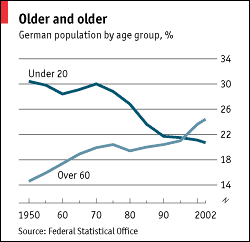
After half a century of obscurity, population issues are resurfacing in headlines, bestseller lists and talk shows. When in April the Berlin Institute for World Population and Global Development, a think-tank, issued a study saying which regions will suffer from a shrinking population, it was amazed by the media interest. And Germany's bestselling book is “Das Methusalem-Komplott” (The Methuselah conspiracy), an anti-ageism tirade by Frank Schirrmacher, a co-publisher of the Frankfurter Allgemeine Zeitung newspaper.
Both publications paint a bleak picture. Some regions are in a death spiral of sorts, says Reiner Klingholz, one of the authors of the study—and others may share that fate in years to come: their population is imploding, not just because of a lack of babies but because young, qualified people are moving away, making many regions even less attractive for job-creating investments. Mr Schirrmacher fears a clash of the generations and wants a cultural revolution to rethink what it means to be old.
If Germany has suppressed its demographic problems for so long, it is mainly because of its Nazi past. Population policy sounded like racial policy. Even today, the country has only four university chairs in demography. There are many reasons Germans are waking up now, says Elisabeth Niejahr, author of a forthcoming book entitled “Altenrepublik” (Republic of the Old): the financial woes of public pension funds and the health-care system; unification (most imploding regions are in the east); and the fact that Germany's baby-boomers (like the 44-year-old Mr Schirrmacher) are beginning to be elderly.
The German government is pushing for the
German language to be accepted as an official European Union tongue
Deutsche
Welle 7/4 2004
With the European Union set to expand by a further 10 nations at the beginning of May, Germany's leaders see an opportunity to spread the word that German is a spoken language worthy of the second spot behind English as the EU's lingua franca. The federal government is preparing to make a very strong case for German to be one of the European "super-tongues" with an impressive array of statistics and the support of committed linguists to shore up the bid for recognition at EU level. I
n a resolution last Thursday, the Bundestag or the lower house of parliament called on the government to push for German as a third principal EU language. A similar resolution was passed in the Bundesrat or upper house last month.
Expansion brings more Germans speakers to the EU German is the world's 12th most widely spoken language and the most prevalent in Europe after Russian, with some 100 million native speakers. When the EU expands to 25 states in May, the new members will bring many more German-speaking citizens into the fold. In the ten accession countries joining the EU on May 1, German is spoken by twice as many people as French.
Why Germany's economy is failing to fly
Wolfgang
Munchau Financial Times 1/4 2004
While unfavourable demography, inflexible wage settlement systems and a generous welfare state may explain the gradual fall in potential output over the previous decades, they cannot explain the unexpected, sharp and persistent decline in economic growth since 2001.
As a British observer remarked last month at the annual Königswinter conference on Anglo-German relations: "There is a tendency in Germany not to question unification, economic and monetary union and the stability and growth pact as possible causes for economic problems. They are all treated as taboos." Few domestic commentators have dared suggest that the euro or unification might have exacerbated economic difficulties. In parliamentary debates about economic policy there are few references to interest rates or exchange rates, as opposed to laws on dismissal and shop opening hours.
But there is evidence that both unification and the euro had notable effects. Economic and monetary union's main impact has come through an increase in real interest rates, though not - as is often argued - through the entry exchange rate and the stability and growth pact.
The theory of an overvalued entry exchange rate does not appear consistent with Germany's current account surpluses against the rest of the EU and the world, or with the continuous fall over the past decade in real exchange rates - the nominal rates adjusted by expected inflation - against other EU countries.
There is likewise little evidence that the stability and growth pact, which set out strict enforcement procedures to restrain fiscal spending in the eurozone, had much of an impact. The government could not have run a significantly looser fiscal policy during this period, given the constraints imposed by the stability requirements in Germany's constitution, with its variant of the so-called "golden rule" that restricts government borrowing to financing investment.
EMU bäddar för bråk
Stefan de Vylder
Göteborgs-Posten 2002-10-22
RE: En lysande artikel
Few have realised the most dangerous feature of Emu: it has locked
Germany into a seriously uncompetitive real exchange rate
Martin Wolf, Financial
Times, March 31, 1999
Ageing populations 'will create crippling
debt'
continental European countries - including Germany, France,
Portugal, Greece, Poland and the Czech Republic - would see their public debt
grow to more than 200 per cent of gross domestic product by 2050
Financial
Times 1/4 2004
Richard Jackson, senior fellow in charge of the demography project at the Center for Strategic and International Studies, a US think tank, says future pension promises pose a risk to political stability. "If you assume countries do not cut benefits, you are looking at fiscal Armageddon."
He noted that the report might understate the size of future deficits because the calculations use statistics that understate consensus of forecasts for improvements in life expectancy and overstate future fertility rates.
"In a scenario which is about as optimistic as you can get, that still leaves fiscal meltdown in just about every country in 25 years," Mr Jackson said.
"Vi befinner oss i en dämpad
uppgångsfas, utan någon bredare bas.
Återhämtningen bärs av en dynamisk utländsk
efterfrågan...den inhemska efterfrågan har ännu inte
börjat öka och det gäller särskilt den privata
konsumtionen" som skadas av arbetslösheten.
Han sade också att
räntenivåerna är "låga" och "frikostiga".
"Penningpolitiken står inte i vägen för en snabbare
tillväxt"
tyske centralbankschefen och ECB-rådsledamoten Ernst
Welteke, DN/Direkt 24/3 2004
German industrial output fell in January
after a slight surge in December,
raising fresh doubts over the
strength of the recovery now under way in the eurozone's largest economy.
Financial Times 9/3 2004
The economics ministry said preliminary data released on Tuesday showed that output had fallen a seasonally adjusted 0.1 per cent. The drop surprised economists who had expected a 0.5 per cent increase.
Economists say the strong euro, which gained 20 per cent against the dollar last year, may have started to weigh on export demand. Domestic demand remains weak because of high unemployment and uncertainties brought by Berlin efforts to reform pension and benefit systems.
Hamburg is not Germany. But
the
rout of the Social Democratic Party in Sunday's elections in the city state
amounts to a grievous blow for Gerhard Schröder
With just over 30 per
cent of the vote, the chancellor's party recorded its worst ever result in a
state where it governed for about 50 years after the second world
war
Financial Times editorial, 2/3 2004
The Christian Democrat party, in opposition nationally since 1998 and ruling in Hamburg from 2001 until December in a bizarre coalition that included a maverick rightwing party, emerged with 47 per cent of the votes. It is true that local factors played a part in the SPD's Hamburg debacle. In Ole von Beust, the incumbent governing mayor, the CDU had an attractive candidate with a high personal following, not least among traditional SPD voters. Despite his administration's uninspiring record, Mr von Beust profited most from the collapse of his former coalition partner: the Schill party, formed by Ronald Schill, a former judge.
Blue collar voters and pensioners who deserted the SPD for the law-and-order populist in 2001 returned to the mainstream by voting for the CDU.
Delstatsvalet i Hamburg på
söndagen är det första av 14 val i Tyskland i år och
supervalåret inleddes med en stor förlust för
socialdemokraterna.
Ekot 1/3 2004
Samtidigt vann kristdemokraterna en historik seger och i Tyskland talas idag om en ny politisk stjärna. Kristdemokraterna fick egen majoritet Lyckliga kristdemokrater höjer ölglaset och njuter segerns sötma. Tyskland har fått en ny politisk superstar. Han heter Ole von Beust, 48 år och är kristdemokrat och borgmästare i Hamburg.
Ole von Beust är inget politisk fyrverkeri och när hans egen far förra året avslöjade i en tidningsintervju att hans son är homosexuell, befarade en del att det var slutet på Ole von Beusts politiska karriär. Men i valet i Hamburg har ett nytt storstadsanpassat CDU tonat fram i en kampanj helt fokuserad på Beust.
Europe is doing much worse than the United
States economically, right? Not if you subtract Germany.
Without
Germany's figures, The Economist magazine has computed, Europe's economic
performance would look as good as America's. That gives some sense of how bad
things are in Europe's biggest national economy
International Herald Tribune
6/3 2004
Germany is in the grip of a profound malaise. The economy contracted by 0.1 percent last year, and is headed for growth of only 1.5 percent this year. Unemployment stands at 10.3 percent. Consumers and investors lack confidence. The reasons are no mystery: a lavish welfare system that the state can no longer afford, and high labor costs that send business elsewhere.
The chancellor plans to make a major speech to the nation on March 25. It's a good opportunity for him to try to persuade his countrymen of the immediate and urgent need for a thorough overhaul of the entire economic apparatus, including the antiquated system of centralized wage-bargaining, the Byzantine tax system and the bloated budget. A bold wave of reform would give Germans the sense that they had not lost the capacity for hard work, innovation and sacrifice that created the postwar miracle.
Germany used to be one of Europe's
richest nations. In the late 1980s its GDP per head was 20% higher than the
average of the European Union. But estimates by The Economist suggest that
Germany's GDP per head fell 1% below the EU average last year
(measured
at purchasing-power parity, to take account of differences in prices).
The
Economist 19/2 2004
Very Important Article
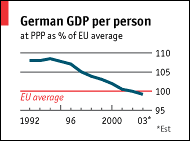
Only four of the EU'S 15 members now have a lower income per head. The entry of new members into the EU on May 1st will help to spare Germany's blushes, because these countries' lower incomes will once again push Germany up above a new European average. Nevertheless Germany's relative economic decline has been alarming by any measure. And it looks as if it will continue.
Some of Germany's poor record can be attributed to the reunification of East and West Germany in 1990. At the stroke of a pen this produced a country with average incomes 13% lower than the former West Germany's. Yet this still left income per person for a united Germany 9% higher than the EU average.
Since then Germany has been the EU's slowest-growing economy, with an average annual growth rate of only 1.4%—roughly the same as that achieved by feeble Japan over the same period.
Over the past decade GDP per head in the rest of the EU grew by an average of 2.3%—even faster than America's 2.1% average growth.
And though it is true that European labour markets are in general less flexible than America's, Europe outside of Germany has been creating just as many jobs as America. Over the past decade, employment has risen by an average of only 0.2% a year in Germany, against a rate of 1.3% a year in the rest of the EU, exactly the same pace of increase as in America.
Apologists argue that Germany has not done so badly given the heavy cost of reunification. But this glosses over deeper problems that existed well before reunification. Germany not only has high wage costs, high taxes and an over-generous welfare state, in common with many other continental European economies, it must also cope with the hangover from years of over-investment due to a subsidised cost of capital, thanks to the big role played by state-owned banks.
Few have realised the most
dangerous feature of Emu:
it has locked Germany into a seriously
uncompetitive real exchange rate
Martin Wolf, Financial Times
EMU
bäddar för bråk
Stefan de Vylder Göteborgs-Posten
2002-10-22
RE: En lysande artikel
Det är lågkonjunktur i
EU. Den allra sämsta utvecklingen hittar vi i Tyskland, som befinner sig i
en djup ekonomisk svacka med låg eller obefintlig tillväxt av allt
utom arbetslöshet.
The Commission says the economic forecasts
produced by Chancellor Gerhard Schröder's government are unrealistic, and
that Germany will breach the European Union's stability pact for a fourth
successive year in 2005.
Financial
Times 18/2 2004
Last November Germany and France rebuffed Mr Solbes when they
forced the suspension of the rules of the stability pact to avoid being fined
for repeated breaches of the 3 per cent deficit ceiling. The Commission is now
challenging that decision in the European Court of Justice, and its verdict on
Germany's budgetary outlook is unlikely to calm tensions. It argued that
Berlin's forecasts are over-optimistic in a number of areas.
The Commission
forecasts German economic growth of 1.8 per cent in 2005, compared with
Berlin's claim of 2.5 per cent;
It says the German deficit will be 3.9 per
cent in 2004 and 3.4 per cent in 2005; the German forecasts are 3.25 and 2.5
per cent respectively;
And it argues that Germany has claimed for the last
six years that it is about to cut spending as percentage of GDP, but the
promises never materialise.
Det kan hända att de här tre gamla
galtarna ska böka på egen hand ett tag, sa den svenske
statsministern Göran Persson apropå det europeiska
stormaktsmöte som i dag inleds i Berlin.
I mindre grisiga
sammanhang lystrar mötesdeltagarna till namnen Gerhard Schröder,
kansler i Tyskland, Jacques Chirac, president i Frankrike och Tony Blair,
premiärminister i Storbritannien.
PM Nilsson, Expressen 18/2 2004
En återkommande tolkning är att stormakterna inför utvidgningen den första maj vill visa resten av Europa vem som egentligen bestämmer. Trilskande polacker och spanjorer ska inte tro att de är lika stora på jorden som de är i orden. Den gamla fransk-tyska motorn i väst-EU ska kompletteras med en extra brittisk cylinder för att orka dra vidare när unionen består av 25 medlemmar. Eller som Tysklands utrikesminister Fischer uttryckte det i en av sina många historiska jämförelser: "Precis som Bismarcks rike från 1871 är den fransk-tyska duon för liten för europeisk hegemoni och för stor för den europeiska maktbalansen". Om detta är bakgrunden är mötets innebörd inte så dramatiskt. Det fransk-tyska 50-åriga samarbetet präglades av att de nationella intressena underordnades det gemensammas bästa, och att få in outsidern Storbritannien i den inre kretsen kan bara vara bra.
Men en mer oroande tolkning görs av tyskarna själva. Denna unionens mest exemplariske mönsterelev, som hittills ansett att Tyskland måste europeiseras i stället för att försöka förtyska Europa och att kompromissen alltid är den bästa lösningen, har börjat tappa entusiasmen och pliktkänslan inför EU, skriver till exempel Die Zeits Bryssel-korrespondent. Efterkrigstidens hukande är slut, Helmut Kohls outgrundligt djupa plånbok som löste upp varje låsning är borta, liksom lojaliteten mot de gemensamma normerna i stabilitetspakten.
Och om Tyskland blir som alla andra länder, det vill säga sätter de nationella intressena före de gemensamma, ändrar unionen snabbt karaktär. Det unika försöket att samla européerna under ett tak byts mot det traditionella europeiska stormaktsspelet med växlande allianser, rivalitet och ökade spänningar när makterna ska balanseras och Tyskland hållas i schack. Till en början kommer det kanske att heta att mellanstatligheten vann över federationsivrarna, men egentligen är det inget annat än det europeiska mycket farliga normaltillståndet. För ett litet och skyddslöst land som Sverige vore en sådan utveckling katastrofal och det är en gåta att vår statsledning är så lättsinnig att den endast kan klämma ur sig ett dåligt lagårdsskämt.
Ulrike Guerot,
chief of the
European Union section of a government-subsidized policy research
institute,
the German Council on Foreign Relations:
Germany must not
fall further into a French trap
International Herald Tribune
4/11 2003
Considering that the source was the chief of the European Union section of a government-subsidized policy research institute, the admonition was fairly extraordinary: Germany must not fall further into a French trap that was turning the Schröder government away from the country's real interests and potential for leadership in Europe.
It wasn't just that the idea of EU pioneer groups under French control setting the pace for Europe have no chance of success, wrote Ulrike Guerot of the Research Institute of the German Council on Foreign Relations. The concept was dangerous for Germany, she said, because it harmed its traditional relationships with the United States and Britain and would alienate the new EU and NATO member countries of eastern and central Europe.
The remarks are the leading edge of what looks like a backlash against the Schröder government's over-embrace of France in the wake of the Iraq war and the EU's coming enlargement to 25 members. The backlash's central target, condemned in commentary in two major newspapers over the past week, was that Germany was lending itself to a remake of the French-generated policy that already during the Iraq war led to falling afoul of the United States - and perhaps more importantly creating opponents of the new democracies of Europe.
German Council on Foreign Relations
The Franco-German monster
The
Economist 2003-10-23
It has struggled back to life, but to what end? Rather like Frankenstein's monster, the Franco-German relationship has a habit of appearing dead for long periods, only to spring to life and start crashing around once more. Early last year, many commentators pronounced the monster dormant, if not definitively deceased. The German chancellor, Gerhard Schröder, and the French president, Jacques Chirac, were known to get on badly. The two countries fell out spectacularly at a summit in Nice in late 2000. Germany was said to be increasingly irritated by French intransigence over agricultural reform. And the French were fretful that a unified Germany was looking east, and no longer had eyes for Marianne.
Then, in October 2002, the Franco-German relationship miraculously revived. Mr Schröder and Mr Chirac settled their differences over agriculture and the budget. Just as significant as the fact of agreement was how it was reached—at a bilateral meeting just before an EU summit in Brussels, with the deal simply presented to other European leaders. And since that dramatic moment, the relationship has gone from strength to strength.
In January the two countries held high-profile celebrations of the 40th anniversary of the 1963 Elysée treaty that marked Franco-German reconciliation. At the convention on Europe's future they presented joint constitutional proposals. The two governments have held joint cabinet meetings and set up countless combined official groups. They stood shoulder-to-shoulder against the American-led drive to wage war on Saddam Hussein. In March, they put forward joint plans (with Belgium and Luxembourg) to set up a European defence headquarters separate from NATO.
The renewed closeness was epitomised at the most recent EU summit by Mr Schröder's invitation to Mr Chirac to stand in for him on the final day. Journalists amused themselves at the closing press conference by asking the French president questions in German, a language he does not speak.
Behind the hilarity, France and Germany are making two serious points. First, they will continue to have a closer relationship with each other than with any other EU countries. And second, the Franco-German motor will continue to drive the process of European integration.
Ett av nejsidans favoritnummer är
att Tysklands ekonomiska kris beror på euron
Sydsvenskan ledare
26/8 2003
Onekligen är Tyskland idag inne i en djup ekonomisk kris. Arbetslösheten ligger på över 10 procent, tillväxten är så låg att den knappast märks, industrins kostnadsläge är alldeles för högt.
I allt väsentligt är dock den tyska krisen självförvållad. Tysklands ekonomiska elände har sin grund i återföreningen för snart tretton år sedan. Då övertog Västtyskland det planekonomiska konkursbo DDR lämnat efter sig. Östtyskarna fick byta sina mark mot D-mark till kursen 1:1.
Möjligen var denna generösa växlingskurs politiskt nödvändig. Ekonomiskt var den ett misstag. När återföreningens tioårsjubileum firades hösten 2000 hade ofattbara 1 500 miljarder D-mark, 7 000-8 000 miljarder kronor, plöjts ned i återuppbyggnaden av det forna Östtyskland. Subventionerna motsvarade en tredjedel av bruttonationalprodukten i landets östra del. Trots att en femtedel av den tyska befolkningen bodde i öst svarade denna del bara för en tiondel av Tysklands produktion. Alla räknade då med att öststödet skulle vara nödvändigt i åtminstone ytterligare ett decennium. En annan viktig förklaring till att Tyskland förlorat sin ekonomiska särställning är att övriga länder inför övergången till euron sanerade sina ekonomier med Tyskland som riktmärke. Det var ett krav från tysk sida för att överge D-marken och ge sig in i en monetär union att de andra medlemsstaterna fick bukt med inflationen och ordning på sina offentliga finanser så att räntan kunde sjunka till låg, tysk nivå.
Men medan de andra blivande euroländerna stärkte sina ekonomier låg Tyskland stilla. Den smärtsamma ekonomiska omställning som många europeiska stater genomgick under 1990-talet återstår för tysk del.
Man kan som Svenska Dagbladets rutinerade Brysselkorrespondent Rolf Gustavsson gjorde i söndags ställa frågan "om Europas ledande politiker de senaste 30 åren varit naiva dumskallar eller ondskefulla fiender till demokratins ideal" när de skapat EU och den gemensamma valutan, eller om det är Per Gahrton, Sören Wibe och de andra på nejsidan som misstar sig.
Germany may have Europe’s largest and most robust economy, but...
An auction for WestLB, a publicly owned institution in Düsseldorf that was once Germany’s third-largest lender, has attracted just two bidders
The New York Times 17 Feb 2011
The woes of WestLB, which has received $11 billion in taxpayer support since 2009, are symptomatic of a larger problem in the German economy.
Many of its biggest banks are still on government life support after making bad lending bets during the bubble years.
And with their access to cheap capital long gone, their prospects of becoming profitable again are dubious.
An internal memo at the time showed that BaFin feared write-offs might top €800bn (£688bn), twice the reserves of Germany's financial institutions.
German lenders have the lowest risk-weighted capital ratios in the world after Japan. They were slow to rebuild safety cushions after the sub-prime crisis, and now face a second set of losses on Club Med holdings
Reporting rules have let Landesbanken delay write-downs, turning them into Europe's "zombie" banks.
German regulators have taken supervisory board roles at at least 10 of the country's top banks, reawakening fears about the health of a sector that last year was hit by record risk provisions and equity losses.
In a move virtually unparalleled in other western markets, BaFin, the chief financial regulator, is understood to be making regular appearances at the supervisory board meetings of all three of Germany's big listed banks - Deutsche, Commerzbank and HVB - as well as Dresdner Bank, part of insurance group Allianz.
It is also attending all the meetings of certain high-risk institutions, such as WestLB, the public-sector bank that since May has been the subject of a BaFin probe over lax risk management. Also under scrutiny are several other regional public-sector Landesbanks, including Bankgesellschaft Berlin (BGB), Bayerische Landesbank and NordLB, as well as the co-operative sector's umbrella organisation, DZ Bank, and several small private banks.
Helmut Bauer, director of banking regulation at BaFin, refused to comment on individual banks, but said: "Our presence on a supervisory board is part of good proactive regulation. It is in no way a signal that anything is going wrong."
Parallels between the American boom of
the second half of the 1990s and the present European recession.
In both
cases, policymakers decided that the economic conditions they observed were
driven by structural factors.
Paul de Grauwe, Financial Times, August
7 2003
The writer is professor of economics at the University of Leuven
There are intriguing parallels between the American boom of the second half of the 1990s and the present European recession. In both cases, policymakers decided that the economic conditions they observed were driven by structural factors.
In the US, the Federal Reserve attributed the great boom to a productivity miracle. In the eyes of the Fed, and of many others, the great economic expansion was driven by the new dynamics of the information technology revolution promising permanently higher growth rates. Acting on this diagnosis, the Fed felt unconstrained in providing ample liquidity.
It has now become obvious that this diagnosis was wrong. The US economy was experiencing a classic bubble led by the exaggerated expectations of believers in fairy tales. By providing all the extra liquidity, the Fed was fuelling the bubble, until it burst.
Surprisingly, something similar is happening in the eurozone, although the economic conditions are the opposite of those in the US in the 1990s. European policymakers, in particular the European Central Bank, have blamed the eurozone recession on structural factors. Labour market rigidities, above all, are seen as the root causes of the slowdown.
Acting on this diagnosis, policymakers have taken a wait-and-see attitude. The ECB has been slow in stimulating the economy and has blamed the eurozone politicians for doing nothing to liberalise labour markets and modernise welfare systems.
The eurozone governments have started to believe that nothing can be done to increase aggregate demand, and in any case their hands are tied by the stability pact, the European Union's public deficit limits.
The structural rigidities diagnosis of the downturn in the eurozone since 2000 is wrong. It is difficult to see how rigidities - a permanent feature of continental European economies for the past 30 years - can suddenly produce a drop in growth rates from more than 3 per cent in 1998-2000 to close to zero now. And why did the same rigidities not prevent a European economic boom in the second half of the 1990s?
It would be foolish to deny that there are market rigidities in Europe. Some welfare systems create disincentives to work and incentives to early retirement. Many countries place constraints on hiring and firing, while high taxation of labour and population ageing are widespread. But while they reduce the long-term growth potential of the eurozone, such rigidities barely affect business cycle conditions.
Economic growth in Europe has been known to move up and down, and will continue to do so irrespective of rigidities in labour, product and capital markets. By diagnosing the economic downturn as structural in origin, ECB officials and some governments have escaped their responsibility for stabilising the economy.
In the US in the late 1990s and in the eurozone today, policymakers made the wrong diagnosis and applied the wrong policies.
There is a second parallel between late 1990s America and the eurozone today. The US boom was driven by excessive optimism about economic prospects, which led American consumers and investors to embark on a spending spree.
The eurozone recession is driven by excessive pessimism about the future of Europe. Pessimism leads consumers and investors to postpone spending on goods and services, and it becomes a self-fulfilling prophecy.
As it turned out, the US was not the miracle economy that policymakers and analysts believed it to be. In contrast, there is as yet no such consensus that the pessimism that pervades the eurozone is excessive. There is still a widely held view that Europe is sick and that its economic future is bleak. But the gloom is vastly exaggerated.
Productivity growth, when correctly measured, has been much the same in Europe and in the US over the last 10 years. The main difference is that European workers like to work fewer hours than their US counterparts.
Several countries have embarked on reform programmes, even if progress is gradual. And unlike the US, the eurozone is not saddled with a consumer debt overhang, a long-term imbalance that will be painful to correct.
There is a third parallel between booming America and gloomy Europe. This has to do with the talk that was once heard in Washington and is now common in Frankfurt, home of the ECB. During the late 1990s, Alan Greenspan, the Fed chairman, openly defended the idea that America was living through a productivity miracle. As a result, he convinced many doubters that the boom was not just some temporary demand upsurge, but was caused by structural changes in the American economy. It is likely that this gave a strong impetus to the bubble and allowed it to last longer than it would have without the exuberant talk.
Something similar has happened in Europe since the start of the economic slowdown. The lectures we hear from Frankfurt routinely stress the need for structural reform as a condition for getting out of the recession.
Structural reforms, however, are very difficult to implement in democratic societies. They imply changes in the distribution of income and in economic security, and are resisted by those who are called upon to become more flexible.
The implementation of these reforms will take many years. If they are a pre-condition for escaping from recession, there is no end in sight.
Thus, paradoxically, the endless criticism of structural rigidities emanating from Frankfurt serves to prolong the pessimism and therefore the weakness of demand. Europe is stuck in a sluggish state.
Much as the Fed helped to fuel the great American boom of the late 1990s, the ECB is helping to sustain the recession by spreading the word that nothing can be done about it for the foreseeable future.
Pessimism is contagious. Fortunately, people become tired of it. That is why even modest signs of economic recovery can revive "animal spirits". That is also why Policymakers can make a difference by providing even a small monetary or fiscal stimulus. Despite their reluctance to assume their responsibilities, there is no doubt that the economic upturn will become a reality in Europe as it has done so often in the past. Pessimism then will fade away, making place for a more sober diagnosis of Europe's economic problems.
ECB is a law
unto itself FT 98-11-12
Paul de Grauwe says the
European Central Bank is accountable to no one, which compromises its chance to
be truly independent. Do the conditions exist for the successful independence
of the European Central Bank? The answer is no, for the following reasons.
Bankgesellschaft and several other German
banks engulfed in bad loans and creating a financial headache just as horrible
as the 1980s bubble in Japan
Gillian Tett, Financial Times 16/8 2003
Gillian Tett is a Lex columnist and former FT Tokyo bureau
chief.
Her book on Shinsei bank, "Saving the Sun", is published by
HarperBusiness next month.
For the past 13 years, Japan has suffered from economic stagnation, spiralling national debt, falling prices, declining industrial competitiveness and a series of banking collapses. In Germany, economic crisis became evident morel recently after it mishandled reunification by converting the former East German currency into D-Marks at a level that made East Germany utterly uncompetitive.
In the German capital, a financial tale has been unfolding which distils in a particularly potent form the problems lurking in Germany that so resemble those in Japan. And at the heart of it is Berlin's premier financial institution, Bankgesellschaft.
One powerful German fund manager described it during the bank's shareholder meeting two years ago as "the biggest banking scandal in German history". The bank emerged in its present form in 1994, when the Berlin government decided, in the mood of optimism and ambition that followed Germany's reunification, to merge some local, state-owned savings banks, mortgage lenders and commercial banks into a single entity.
the Berlin government was in the middle of an orgy of spending to celebrate reunification, as well as the impending resumption in 2000 of the city's role as the national capital. In particular, construction projects were exploding across Berlin and the rest of East Germany. Bankgesellschaft, along with the other German banks, provided the funding. The bank quickly became one of the 10 largest in Germany, dominating corporate lending in the Berlin region and accounting for a startling 60 per cent of the retail banking market in Berlin, with some €200 billion in assets.
by the time Berlin was restored as the capital, the property bubble had burst, leaving Bankgesellschaft and several other German banks engulfed in bad loans and creating a financial headache just as horrible as the 1980s bubble in Japan. "It is common knowledge that it is very hard for any outsider to tell what is happening at a German bank from its balance sheet, because the accounting is so opaque. In that sense Germany is rather like Japan," says Robert Stenram, former head of the Tokyo office of the Swedish group, Swedbank.
The situation at Bankgesellschaft was doubly murky because senior bank figures were also prominent Berlin politicians.
In 2001 German regulators belatedly inspected the bank, deemed it insolvent and forced it to declare a €1.65 billion loss, a record in the sector. Panic-stricken, Berlin's politicians decided they could not bear to see the bank collapse. They pumped in €2 billion more capital, taking state ownership from 57 per cent to 81 per cent, and promised to underwrite future losses on some €20 billion of particularly dubious loans in the bank portfolio.
Thus far, it all seemed like a leaf from the Tokyo book: whenever a crisis has emerged at a Japanese bank in recent years, the first instinct of Tokyo policymakers has been to paper over the cracks by propping up the system with money.
Bankgesellschaft was only the tip of an iceberg of problems for Berlin. The city is plagued with an extraordinarily expensive state infrastructure, a legacy of heavy cold war subsidies, and the transformation of two cities into one after unification. It has three state operas, two zoos, five orchestras, 170 museums, 150,000 government employees and a host of lavish benefits that Germans take for granted. Combined with the wild construction spending of the 1990s and a stagnant economy, this has created a debt that amounted to €38 billion when Sarrazin took office, or some €14,000 for every resident, a figure that looks positively Japanese.
The finance senator prefers another metaphor. "Our fiscal situation is worse than Argentina," he says glumly, as he sits in his hot, stuffy office in the Berlin senate. (There is no air conditioning, an aide explains, because of costcutting.) "In fact, on a per capita basis, our debt is twice as bad as Argentina, which is very alarming."
In the past 18 months, the city's debt has risen from €38 billion to almost €50 billion. Brussels is still insisting that Berlin must privatise Bankgesellschaft. The senate has promised to sell the bank by 2006 and expects to get considerably more than Flowers wanted to pay. It bases this on the belief that Berlin will enjoy an economic recovery and Bankgesellschaft will implement a wildly successful restructuring plan. If this does not happen, however, the government faces a full-scale banking crisis. It could then incur the wrath of Brussels by attempting another bailout, or end up selling the bank for a song after all.
The next, and potentially most crucial, chapter of the Bankgesellschaft saga, like that of German reform, is waiting to be written. And until that occurs, Europe's largest economy cannot state with any confidence that it has truly avoided he "Japanese disease".
Tyskland lånar till
skattesänkningar
- Förutsatt att våra kalkyler
håller kommer vi uppfylla kraven i stabilitets- och tillväxtpakten,
sade Schröder
SvD Näringsliv 17/7 2003
Förbundskansler Gerhard Schröder försäkrade i
går att Tyskland strävade efter att finansiera nästa års
skattesänkning utan att bryta mot stabilitets- och tillväxtpakten
för tredje året i rad.
- Förutsatt att våra kalkyler
håller kommer vi uppfylla kraven i stabilitets- och tillväxtpakten,
sade Schröder på en presskonferens i Berlin tillsammans med
finansminister Hans Eichel.
Uttalandet kom bara dagen efter en het strid bland eurozonens finansministrar om president Jacques Chiracs förslag att temporärt mjuka upp budgetkraven i EMU.
Det tyska skattepaketet som bland annat sänker marginalskatten med drygt 10 procentenheter till 42 procent kostar 7,5 miljarder euro nästa år, knappt 70 miljarder kronor.
Sänkningen skulle egentligen ha trätt i kraft 2005 men har tidigarelagts. Nästan två tredjedelar av beloppet, knappt fem miljarder euro, ska finansieras med hjälp av nya statliga krediter. Två miljarder euro ska dras in genom privatiseringar och ytterligare en miljard genom att avskaffa subventioner till både hushållen och näringslivet.
Till de statsägda företag som Tyskland avser att privatisera hör Deutsche Telekom och Deutsche Post, Europas störste telekombolag respektive största post- och fraktbolag. Aktierna kommer troligen att "parkeras" hos den statsägda banken KfW i väntan på bättre börstider.
Schröder sade i går att han räknade med att skattesänkningen skulle skapa högre tillväxt i Tyskland. Europas största ekonomi är nu inne på det tredje krisåret och väntas enligt Internationella valutafondens senaste prognos stagnera i år.
Schröder framhöll att Europa inte bara behöver
spara utan också få igång konjunkturen.
- Pakten kallas
ju faktiskt stabilitets- och tillväxtpakten, påpekade han.
Även Frankrike signalerade i går att regeringen
strävade efter att uppfylla kraven i stabilitets- och tillväxtpakten.
Men precis som Schröder, som knöt det tyska löftet till att
regeringens tillväxtprognos skulle uppfyllas, hade även den franska
regeringen ett kryphål.
- Målsättningen är att
respektera stabilitets- och tillväxtpaktens intention samtidigt som vi
måste ta hänsyn till den fortsatt svåra ekonomiska
situationen, sade regeringens talesman Jean-Francois Cope efter onsdagens
regeringssammanträde.
Chirac storms the stability pact
The Economist 16/7
2003
Frances President Jacques Chirac has angered other EU countries by proposing a relaxation of the euro areas rules on budget deficits. He also faces opposition from Jean-Claude Trichet, the Frenchman who, at Mr Chiracs insistence, will soon be running the European Central Bank
France bust the euro area’s limit on budget deficits last year, it is on course to bust it again this year and, unless the government makes big spending cuts, it will probably do so for a third time next year.
Under the European Union’s “stability and growth pact”, countries which have adopted the euro (currently 12 of the 15 EU members) must keep their budget deficits to less than 3% of GDP or face the possibility of heavy fines.
But on Monday July 14th, as France celebrated Bastille Day and the EU’s finance ministers gathered in Brussels for a two-day summit, President Jacques Chirac angered many of them by calling for the pact to be relaxed temporarily, to boost Europe’s sluggish economic performance.
The ministers agreed to reject Mr Chirac’s call for more “flexibility” in interpreting the pact: the Dutch finance minister, Gerrit Zalm, said France had already been given enough leeway; now it ought to start obeying the rules.
The storming of the Bastille had been a better idea than Mr Chirac’s storming of the stability pact, he quipped. Austria’s finance minister, Karl-Heinz Grasser, complained that reopening the debate on the budget limit was damaging the euro block’s credibility, and said that France should be fined if it breached the limit again next year.
Krig har alltid vinnare och
förlorare. Saddam Hussein - död eller på flykt - är
naturligtvis Irakkonfliktens stora förlorare. Men också Tyskland har
förlorat mycket, inklusive de många amerikanska trupper som enligt
uppgift ska flytta till baser i andra länder.
Trots planerna på
att skapa en europeisk armé tillsammans med Frankrike, Belgien och
Luxemburg är Tyskland mindre relevant i världspolitiken nu än
före Irakkriget.
Michael Mertes Översättning:
Peter Wolodarski
Michael Mertes var tidigare utrikespolitisk rådgivare till
Helmut Kohl
DN
12/5 2003
Att reparera den skadan blir inte lätt. Varje del av Tysklands internationella ställning har försvagats. Landet kan inte längre spela rollen som transatlantisk medlare mellan Frankrike och Amerika. Det kan glömma USA:s stöd i kampanjen för en permanent plats i FN:s säkerhetsråd. Och i stället för att forma en tredje väg för Europas vänster tillsammans med Storbritanniens Tony Blair behöver förbundskansler Gerhard Schröder stöd av Blair i diskussionerna med George W Bush - som känner sig personligen bedragen av Schröder i upptakten till kriget. I det postkommunistiska östra Europa uppfattas inte längre Tyskland som en pålitlig försvarare av regionens intressen. Multilaterala organisationer, som fungerat som hörnpelare i Tysklands utrikespolitik i nästan ett halvt sekel, är försvagade. Och europeiska unionens förhoppningar om en gemensam utrikes- och säkerhetspolitik har kommit på skam.
Förstamajtalet dränktes i burop.
Partiet är i uppror. Opinionssiffrorna katastrofala. Den tyske
förbundskanslern Gerhard Schröder kämpar för sin politiska
överlevnad. På den extra partidagen den 1 juni ska reformprogrammet
Agenda 2010 lotsas förbi fackliga protester och angrepp från den
socialdemokratiska vänstern.
Aftonbladet
ledare 4/5 2003
Gerhard Schröder och den franske presidenten Jacques Chirac slätar över de tidigare motsättningarna med USA. Nu gäller det att se framåt, säger de. Försvarssamarbetet handlar om att stärka ”den europeiska pelaren i Nato”, inte om en motvikt till Pentagon. Ändå är slutsatserna från tisdagens toppmöte långtgående. Tyskland, Frankrike, Belgien och Luxemburg enades om nya steg mot en europeisk försvarsunion. EU:s framtidskonvent har redan tagit fram förslag i samma riktning.
Gerhard Schröder sa ja till ett nytt militärt högkvarter, som kan leda EU-insatser när inte USA och Nato vill vara med. En radikal kursändring från Tysklands tidigare lojalitet med USA, och ett hårt slag mot britterna, som vill knyta EU:s militära förmåga nära till Nato. Det tysk-franska samarbetet väger fortfarande tyngst inom EU, trots Blairs övertalningsförsök.
Den svenska regeringen har goda skäl att kritisera planerna på en försvarsunion. Nya allianser för kollektivt försvar är inte lösningen på dagens säkerhetspolitiska hot.
A shot of inflation would be good for
Europe
By Hans-Werner Sinn
Financial Times May 20 2003 20:05
Highly recommended
The writer is professor of economics and public finance and president of the Ifo Institute for Economic Research
This month's long-awaited revision of the European Central Bank's inflation target was a disappointment. Although the ECB paid lip-service to greater tolerance of inflation, nothing has really changed. The ceiling for eurozone inflation will remain at 2 per cent. This is bad news for eurozone countries, because they need a dose of inflation to get moving again.
Controlling the average inflation rate alone makes no sense as long as the span in national eurozone inflation rates, which averaged 2.7 per cent over the first four years of the euro, remains as large as it is. This divergence has systemic causes that are likely to persist for the foreseeable future.
Although member countries already have very similar prices for traded goods, great differences prevail in prices for non-traded goods such as services, rents, building materials and catering. This is because of different wage levels, which in turn reflect differences in development. In the course of the economic convergence that will take place over the next two decades, wages as well as prices for non-traded goods and services will converge in all eurozone countries.
This adjustment in relative prices is a natural and desirable process that the ECB's monetary policy should tolerate, especially as it is advanced by the euro. The euro led to a convergence of interest rates in Europe and has lowered the real cost of capital in soft-currency countries that previously had to pay high risk premiums with their interest rates. For this reason the euro is stimulating investment in these countries, supporting real growth, boosting wages and increasing the rate at which prices are converging.
If the ECB tries to curb this transitional inflation with a restrictive monetary policy based on an ambitious inflation target, it will adversely affect the more developed countries, which will be forced towards too low a rate of inflation. Since nominal wages and prices in the core eurozone economies tend to be resistant to decline, some inflation is always advisable because it facilitates real wage and price cuts in weak sectors. If inflation is too low, real wages and prices in these sectors will remain too high, triggering bankruptcies and job losses.
The German and French economies are the main victims, because they have high wages and high prices for non-traded goods. Moreover, both countries have lost the interest rate advantage they enjoyed when they had their own currencies. Aggravating this is the possibility that the euro may have been introduced too early, before the D-Mark and the French franc were able fully to realign after the 1992 currency crisis.
The real wage restraint necessary for restoring competitiveness in Germany and France could be more easily accomplished if the ECB had a higher inflation ceiling. This would enable Germany and France to become more competitive by just waiting for inflation in other countries where price levels are currently too low. With separate currencies, they could induce the same effect with an open devaluation. Unless monetary policy is loosened, such a level of competitiveness could take a decade to attain.
It is sometimes argued that the ECB should not consider country-specific inflation rates because the US Federal Reserve looks only at the US average. That argument is not convincing. First, unlike the dollar, the euro is young. Currently, Europe is undergoing a real convergence process with huge differences in inflation rates; this problem has long since been overcome in the US. Second, unlike Europe, the US has no extended social welfare net that prevents nominal wages from falling.
European states offer unemployment benefits that depend on previous wages and welfare payments that are defined in nominal terms. These high replacement incomes keep a floor under nominal wages. Even if unions are willing to accept - or are unable to prevent - real wage cuts, real wages cannot fall unless there is inflation. Yes, political reforms that cut unemployment and welfare benefits are also a possibility but such reforms are very tricky.
For this reason the ECB should set an inflation ceiling of 2.5 per cent until eurozone convergence is concluded, at the same time ensuring that no country falls to very low inflation levels, say, below 1.5 per cent. It should pay particular attention to the inflation floor, because deflation or low inflation in single countries would pose great dangers to the stability of the European economy.
Stefan de Vylder var den första i världen som
upptäckte att EMU har ett inbyggt ofrånkomligt fel som gör att
länder med lågkonjunktur får högre realränta, medan
länder med överhettning får lägre realränta.
http://www.nejtillemu.com/devylder.htm#baddar
Peter Wolodarski är den ledarskribent som bäst av alla
har insett de faror som hotar Tyskland
http://www.nejtillemu.com/wolodarski.htm#bomb
I den artikeln refererar Peter också till just Hans-Werner Sinn
Inför
folkomröstningen om euron hävdar många att Tyskland utgör
ett varnande exempel. Exakt på vad är dock oklart. För egen del
ser jag inte de tyska problemen som skäl att säga nej till euron -
däremot som en varning om vad som sker om arbetsmarknaden är för
stel och kostnaderna för höga.
Klas Eklund, kolumn SvD 7/5
2003
Risken att Sverige skulle gå en tysk utveckling till mötes är liten.
Mer intressant är vad som har skett i vårt östra grannland Finland.
Det är märkligt att den svenska debatten i så hög grad fokuseras på Tyskland, när vi har ett grannland, Finland, vars struktur är mycket mer likartad den svenska och där de ekonomiska utmaningarna i så hög grad påminner om våra. Men det kanske beror på att de finska erfarenheterna av euron är så tydligt positiva - och det är väl inte tillräckligt pikant för att vara intressant …
Tysklands ekonomiska problem är
relevanta inför den svenska folkomröstningen om EMU. Tysklands kris
kan bli Sveriges. Hur avser svenska politiker att hantera ekonomiska kriser om
Sverige röstar ja?
Per Lundborg, professor Göteborgs
universitet
Fackföreningsrörelsens institut för ekonomisk
forskning (FIEF) SvD Brännpunkt 29/4 2003
Tysk ekonomi är i kris. Arbetslösheten är över tio procent och tillväxten sedan länge under EU:s genomsnitt. Det samlade produktionsvärdet (bruttonationalprodukten, BNP) per person, ett mått på levnadsstandarden, ligger nu nära EU:s genomsnitt och under senare år har Tyskland passerats av Storbritannien, Finland, Nederländerna, Irland och Österrike.
De offentliga finanserna är i oordning och förra året var underskottet 3,6 procent av BNP och statsskulden nästan 62 procent av BNP.
Tysklands kris är relevant för den svenska EMU-debatten. Krisen är inte orsakad av EMU, men krisen belyser de problem som kan uppkomma med gemensam valuta.
EMU-medlemskapet försvårar lösningen av de ekonomiska problemen och i avsaknad av nationell penningpolitik framtvingas ineffektiva arbetsmarknadsreformer och inrikespolitiska problem.
Den tyska återföreningen blev ett ekonomiskt misslyckande. Vid enandet tillät regeringen 1990 att den östtyska marken växlades in till kursen en D-mark. I ett slag steg lönekostnaden i öst från cirka sju procent av lönekostnaden i väst till cirka 30 procent. Vidare skulle lönerna i östra Tyskland fasas in med lönerna i västra Tyskland under bara fem år.
Men produktivitetsökningen i öst motsvarade inte på långt när lönekostnadsökningarna. Uppsvinget i öst uteblev. De uppkomna lönenivåerna gjorde att ekonomin i östra Tyskland inte var konkurrenskraftig.
Arbetslösheten är i dag 17 procent i öst trots många förtidspensioneringar och många i åtgärder. Västra Tyskland förmår inte heller suga upp arbetslösa från öst. Den offentliga resursöverföringen till öst har sedan återföreningen uppgått till svindlande siffror, cirka 8 000 miljarder kronor. Återföreningens regionala och strukturella problem orsakade gigantiska budgetunderskott.
Kommentar av Rolf Englund:
Östtyskland och Västtyskland bildade ett mini-EMU.
Bättre förutsättningar för ett optimalt
valutaområde kan man inte tänka sig.
Ett folk, ett språk.
Men Tysklands problem är inte bara strukturella. Efterfrågan på varor och tjänster är alltför låg. Arbetslösheten är hög även i västra Tyskland och inflationen är mycket låg, 1,3 procent. Den Europeiska centralbanken (ECB) anpassar räntan, inte till Tysklands, utan till hela euroområdets inflation som är cirka 2,3 procent.
ECB:s styrränta blir därmed för hög i Tyskland vilket håller tillbaka efterfrågan. En räntesänkning skulle höja den låga inflationen till en rimlig nivå, men samtidigt driva upp inflationen i andra EMU-länder där den redan är hög och euroområdets samlade inflation skulle bli oacceptabelt hög.
Det hävdas ofta att räntan anpassas till de stora EMU-länderna, men inte ens ett stort land som Tyskland får nödvändig draghjälp av ECB.
Hade Tyskland stått utanför EMU hade Bundesbank anpassat styrräntan till tyska förhållanden och ekonomin hade stimulerats.
Vid utanförskap hade värdet på D-marken fallit och Tysklands internationella konkurrenskraft hade förbättrats genom justering av de felaktiga priserna på varor och arbetskraft gentemot sina handelspartners.
En annan möjlighet är finanspolitiska åtgärder, d v s ekonomisk stimulans genom t ex skattesänkningar eller sänkta arbetsgivaravgifter, generellt eller regionalt. Men de stora underskotten omöjliggör sådana åtgärder. Ökade statliga underskott skulle göra att Tyskland drog på sig dryga böter.
Genom EMU-medlemskapet gav man upp räntevapnet och finanspolitiken är blockerad av underskotten. Då återstår enligt många bara en sak:
arbetsmarknaden måste avregleras så att lönerna kan chocksänkas till paritet med produktiviteten. Oppositionen har baxat in Schröder på denna väg: trygghetslagarna uppluckras, arbetslöshetsersättningen begränsas och kollektivavtalen inskränks för att pressa lönerna.
Det finns alltid skäl att granska effekterna av arbetsmarknadens institutioner och det är rimligt att man justerar t ex arbetslöshetsersättningens längd till normal europeisk nivå. Samtidigt är det orealistiskt att reformerna skulle påverka sysselsättningen på något avgörande sätt och inom rimlig tid.
Då önskade effekter uteblir framtvingas ytterligare neddragningar och hårdare sociala konfrontationer. Oppositionen och dess ekonomer har redan i dag ett batteri av mer långtgående förslag syftande till att möjliggöra lönesänkningarna.
De institutioner som präglar den tyska arbetsmarknaden är representativa för många europeiska länder och har existerat länge och i såväl goda som dåliga tider. Inget talar för att arbetsmarknadsreformer är effektiva medel för att komma ur kriser.
Reformerna av den tyska arbetsmarknaden är framtvingade bl a av EMU-medlemskapet, som utesluter växelkursanpassning och en för landet anpassad ränta.
Tysklands situation är ingalunda unik då Frankrike och Italien också kämpar mot hög arbetslöshet under stora budgetunderskott.
Ingen ska tro att inte svensk ekonomi kan hamna i samma situation. Detta stämmer till eftertanke inför Sveriges EMU-omröstning.
Principfrågan är hur den ekonomiska politiken vid kriser ska bedrivas under medlemskap. Många partier är emot ökat sparande (EMU-skatt) för att klara kriser under EMU.
För att interna devalveringar, d v s finansierade sänkningar av arbetsgivaravgifterna, ska fungera måste enligt utredningar finanspolitiken reformeras. Men även detta motsätter sig politikerna.
I avsaknad av nationell penningpolitik återstår, liksom i Tyskland, bara krav på avreglering av arbetsmarknaden vilket inte på ett effektivt sätt skulle minska arbetslösheten.
Det är rimligt att politikerna före omröstningen klargör hur ekonomiska kriser ska hanteras under EMU, utan "EMU-skatt" och finanspolitiska reformer.
Assar Lindbeck vill ha buffert finansierad med EMU-skatt
Germanys leading pensions association warns
that statutory contributions will have to increase sharply to cover a looming
gap caused by feeble growth in Europe's biggest economy.
Financial
Times 11/3 2003
The VDR association of statutory pension funds, an advisory body that influences government policy, will say increasing contributions to the state-run pay-as-you-go pension system from 19.5 to 19.9 per cent of gross wages may be unavoidable given the weak economy and high unemployment. The warning comes as a bruising blow to Gerhardt Schröder, the German chancellor, who will deliver a keynote parliamentary speech on Friday aimed at reducing the non-wage labour costs borne by employers.
European shares crash
BBC,
Wednesday, 12 March, 2003, 17:33 GMT
European shares have tumbled again, with London shares closing at their lowest level since May 1995. Paris stocks plummeted to levels a little over one third what they were at their September 2000 peak.
And Germany is now in the grips of a market downturn worse than it suffered in the Great Depression, calculations at investment bank Merrill Lynch have revealed.
"There's one word for it - carnage. It's horrible," said Richard Wright, at brokerage GNI in London. "Nobody has any confidence. Nobody wants to buy anything.
"And if they do buy anything they're wrong within about 10 minutes. It's fairly gloomy."
More about the stock
market
at Rolf Englund Internetional Communications website
"Nu har det vänt" - Ha
is i magen"
Strong euro hits VW profits
wiped almost 1bn euros off the firm's stock market value
BBC 11/3 2003
"Given present exchange rates ... and in the event that the market situation in Western Europe and the US does not improve, we will not be able to match the 2002 operating profit," chief executive Bernd Pischetsrieder said. The warning initially sent VW shares down 10% to their lowest level since December 1996, and wiped almost 1bn euros off the firm's stock market value.
Deutsche Telekom, Germany's dominant telephone company, has reported Europe's biggest ever annual corporate loss. For 2002 the company posted a net loss of 24.6bn euros (£16.9bn; $27.1bn) BBC 10/3 2003
The European Central Bank on Monday
sought to allay fears of a banking crisis in Germany
Financial Times 25/2
2003
The European Central Bank on Monday sought to allay fears of a banking crisis in Germany amid reports that the government and senior bankers had discussed emergency measures to bail out the financial system. In a hurriedly called press conference to launch an ECB report on banking stability in the European Union, Edgar Meister, who heads the ECB's banking supervision committee, dismissed talk of a Berlin-backed bank rescue plan. Mr Meister, who also sits on the board of the Bundesbank, said he was confident Germany's beleaguered banks could "resolve their specific weaknesses on their own" without needing taxpayers' money.
|
När det gäller EMU-debatten finns det ett argument
som jag har synnerligen svårt för. Inte för att det skulle vara
särskilt besvärligt att bemöta. Heller inte för att det
skulle vara intellektuellt tungt eller värst sannolikt. Nej, min antipati
beror på att det röjer en inställning till omvärlden som
jag tycker genuint illa om.
Argumentet går
ut på att Sverige inte ska gå med i EMU eftersom "EMU kommer att
spricka". |
Kommer Frankrike och Tyskland att
överta rollen som
avskräckande exempel i världsekonomin
från Japan?
SvD-ledare 18/2 2003
Medan Japan, USA och Sydostasien småningom reser sig, kommer det kontinentala Europa att ligga kvar i recession. Skulle EU dessutom börja rucka på stabilitetspakten kan det äventyra återhämtningen. Japan är ett avskräckande exempel på vad som kan hända om ett land sätter alltför stor tillit till finanspolitiska stimulanser.
Kommer Frankrike och Tyskland att överta rollen som avskräckande exempel i världsekonomin från Japan? Förutsättningarna finns och det är ett scenario som inger oro inför framtiden.
Tyskland är det uppenbara exemplet
Lars Calmfors, Affärsvärlden 12/2 2003
Tyskland har jämfört med andra länder ett mycket högt kostnadsläge och har också i högre utsträckning än andra EMU-länder tappat marknadsandelar på världsmarknaden. Utan devalvering måste Tyskland återvinna konkurrenskraften genom att ha lägre kostnadsökningar än omvärlden.
- Om kostnadsläget skulle behöva sänkas med tio procent och man har en halv procentenhets lägre kostnadsökningar per år skulle det alltså ta femton, tjugo år, säger Lars Calmfors.
Rolf Englund Medborgare mot
EMU
Affärsvärlden internet, kommentarer till
ovanstående.2003-02-13 07:05
Tyskland visar EMU:s risker Tyskland
är nu en daglig påminnelse om hur det kan gå - och regelbundet
kommer att gå - för länder som är med i EMU och
råkar i svårigheter. Ett land råkar alltid i
svårigheter, av och till och av olika skäl. Tysklands problem beror
inte enbart på Euron och EMU, men euron och EMU gör det svårt
för Tyskland att ta sig ur sina problem. Undrar hur Calmfors har
räknat när han kommer fram till ett Ja till EMU, av politiska
skäl, fastän hans utredning, världens största i sitt slag,
kommit fram till att EMU ekonomiskt vore en nackdel för Sverige.
Häromveckan besökte jag
huvudstaden i ett land som av USA:s regering numera nämns i samma andetag
som Libyen och Kuba. Det är också huvudstaden i ett land som USA:s
regering numera anser tillhöra det gamla Europa, till skillnad från
exempelvis Albanien eller Rumänien som numera anses tillhöra det nya
Europa. Det är också huvudstaden i ett land som till nyligen
betraktades som USA:s mest trogna allierade i Europa eftersom det mer än
något annat land i Europa har USA att tacka för sin nuvarande
existens. Jag var kort sagt i Berlin
Göran
Rosenberg 13/2 2003
Ingen räddning i sikte för
Tyskland
SvD-ledare 10/2 003
Tysklands situation är en del av en kontinentaleuropeisk kris som i grunden måste hänföras till brist på reformvilja. Den skattesänkningsvåg som tidigare sköljde över Europa har förbytts i skattehöjningar och budgetunderskott.
Det är symptomatiskt att diskussionen i EU mest handlar om hur man ska kunna etablera minimiskattenivåer, nu senast på energi. Och inte har skattehöjningar gjort Schröder mer populär. Hälften av de tillfrågade i en färsk opinionsundersökning tvivlar på hans förmåga att hantera ekonomin.
Ett ljus i mörkret är att Tyskland, Frankrike och Storbritannien har börjat samarbeta för att göra den europeiska arbetsmarknaden mer flexibel. Det rimliga vore att Frankrike och Tyskland satte sig på skolbänken och tog intryck av de reformer som har gjort Storbritannien till Europas ekonomiska centrum. Ja, inte bara Tyskland och Frankrike, utan även Sverige och resten av Europa.
In Frankfurt, the Dax index of leading shares had tumbled
nearly 4% to a fresh five-year low of 3,180.
BBC 2002-09-17
The Dax's latest slump means that it has now lost 42% of its value since March, making it the worst-performing stock index in Europe.
The combined market value of the blue chip firms listed on the Dax has fallen by a total of 318 billion euros ($309bn)- equivalent to the annual economic output of Poland - over the same period.
06/25
08:28 European Economies:
German Business Confidence Falls
(Update1) By Christian Baumgaertel Frankfurt, June 25 (Bloomberg) --
German business confidence unexpectedly fell in June, a survey of 7,000
companies showed, as Europe's largest economy struggles to recover from
recession. The Ifo economic research institute's index of western German
business confidence declined to 91.3 from 91.6 in May. Retailers and
construction companies led the decline.
Straining the pact
FT, May
15 2002 19:38
From Berlin, Brussels and other European capitals, the message going to the French government this week could scarcely have been louder or clearer.
Alarmed that President Jacques Chirac's budget proposals risk tearing apart the eurozone's rules for fiscal discipline, some of Europe's most influential policymakers are asking France to think again. "The French government cannot expect us to lift a finger to help soften the stability and growth pact," says Hans Eichel, Germany's finance minister, referring to the agreement that obliges eurozone governments to balance their budgets over the medium term.
Germany
goes for the big clean-up
FT, May 6 2002 20:36
It was not the sort
of thing you would expect a German govern ment minister to say. At the height
of a recent scandal in Germany over bribes paid by industry bosses to local
politicians, Werner Muller, economics minister, was reduced to assuring the
public that Germany had "not completely become a corrupt banana republic".
In a country with a love of rules and a law-abiding approach to life, the meaning behind the minister's words was not lost: corruption was a growing problem that could damage Germany's global standing. The latest scandal, involving huge bribes paid by waste disposal companies to Social Democratic politicians in Cologne, western Germany, was only the latest in a series to make headlines.
Major
strike hits Germany
BBC 6 May, 2002
Thousands of German workers have
downed their tools in the country's first large-scale strike in seven years.
The strike is going ahead despite warnings from business leaders and
politicians that it could hit the country's still-feeble economic recovery.
"What we're doing is not war. It's a strike for economic progress," said the
leader of the IG Metall engineering union in the south-western state of
Baden-Wuerttemberg, Berthold Huber
Särskilt yttrande
av ledamoten Nils Lundgren
Erfarenheterna från den västtyska
valutaunionen 1948-1991 pekar inte heller på att sådana
förändringar drivs fram på marknaden. Under denna period
präglades de södra delarna (Bayern och Baden-Württemberg ofta av
tendenser till överhettning medan Schleswig-Holstein och Niedersachsen
drogs med hög arbetslöshet.
Tillbaka till globaliseringen
(buffertfonder, guldmyntfoten , Lars Jonung)
DN-ledare 2002-03-07
Sverige måste välja: antingen bli en bra EMU-medlem som
Irland, eller följa den stela tyska ekonomin i
spåren.
Schröder calls for Europe
to set tax rates
The Times 2002-02-22
Europe's stability pact
The Economist
Feb 14th 2002
Kedjan var töjbar
(stabilitetspakten/Tyskland)
Barbro Hedvall
DN 2002-02-13
När Schröder
schnapsar är det rätt
Ledare i Finanstidningen 2002-02-13
Tyska regeringen EMU-förlamad
Leif Widén
2002-02-07
Helmuth Schmidt
Om
utvidgningen går för snabbt kan det komma en backlash
The European Commission has voted to issue
Germany and Portugal
with warnings over their swelling budget deficits.
What does this mean and what are the likely consequences?
BBC
News Online explains
A conservative tide is sweeping Europe
ANATOLE KALETSKY
The Times, JANUARY 17 2002
Germany risks EU warning over budget deficit
EU Observer 2002-01-23
Commissioners speak of
Franco-German confederation
EU Observer 2002-01-22
The CDU’s choice
Financial Times
editorial, 2002-01-08 20:04
"Peace in Our Time"
"the process of European
integration now irreversible"
Chancellor Helmut Kohl
BBC 2001-12-17
German conservatives call for EU
constitution
EU Observer 2001-11-27
CSU Chairman EDMUND
STOIBER:
"EU speak with one voice in foreign affairs"
France and Germany
back EU constitution
BBC, 23 November, 2001, 16:53 GMT
Little relief in sight for the German
economy
Wolfgang Munchau
Financial Times, November 4 2001
Pessimism worsens among German firms
BBC, 21 November, 2001, 12:57 GMT
Jobs woe for German economy
BBC, 16
October, 2001
Eichel puts case for changes to EU stability
pact
Financial Times, August 16 2001
Germans Prove Highly Resistant To the Unified
Currency's Charms
THE WALL STREET JOURNAL 2001-08-14
Tysklands kris är
vår
Exportutsikterna försämras ytterligare av de senaste
månadernas stärkta euro
Dagens Industri, ledare 28/2 2003
Tyskland är farligt nära en recession.
Kanslerns hårdnackade motstånd mot Irakkriget kan också straffa sig. Flera försvarsföretag har redan rapporterat att det har blivit svårare att sälja till USA. Om amerikanerna dessutom får för sig att bojkotta varor från Tyskland skulle det slå hårt mot tysk export. Sportbilstillverkaren Porsche har sin största marknad i USA, ja faktiskt i delstaten Kalifornien. Även Daimler Chrysler, BMW och Volkswagen är starkt beroende av USA.
Exportutsikterna försämras ytterligare av de senaste månadernas stärkta euro.
De tyska trygghetslagarna är också mer stelbenta än de svenska, vilket gör det svårt för företag i kris att skära ned. Få vågar anställa och arbetslösheten stiger. Många svenska företagsledare vittnar om att det är enklare i Sverige.
Krisen har redan börjat smitta av sig på bankerna. De senaste tre åren har staten tagit över nödlidande lån på över 260 miljarder kronor. Nu pågår också diskussioner om att starta en bankakut för de största bankerna. Redan vid starten skulle den tvingas ta över ytterligare krislån på minst 80 miljarder kronor.
Att budgetunderskottet ligger farligt nära EMU-gränsen, 3 procent av BNP, ökar inte direkt regeringens förhandlingsutrymme.
De tyska problemen angår Sverige i allra högsta grad. Tyskland är Sveriges största handelspartner. En tiondel av Sveriges export går dit. Dessutom sätter Tyskland takten för hela eurozonen och Europa. Om motorn fortsätter gå på tomgång hamnar hela Europa på efterkälken.
Att skylla EMU-medlemskapet för
Tysklands aktuella problem är missriktat
Lars Gunnar Aspman SEB
website 2003-02-26
Strukturproblem har starkt bidragit till att nuvarande konjunkturnedgång blivit djupare i Tyskland än i flertalet andra europeiska länder. Dessutom är stabiliseringspolitiken i hög grad låst av EMU-medlemskapet.
ECB sätter räntan på basis av inflationsutsikterna i Euroland som helhet, inte efter tyska förhållanden, och Stabilitetspaktens krav på max 3 procents budgetunderskott tvingar nu Tyskland att strama år finanspolitiken i en konjunktursvacka.
Men att skylla EMU-medlemskapet för Tysklands aktuella problem är missriktat, eftersom dessa främst är strukturella, och därmed borde angripas med reformer av arbetsmarknad, skattesystem och transfereringar.
Den politiska viljan att ta viktiga reformsteg förefaller dock skral, och till detta kommer allt mer högljudda protester från fackföreningarna. Mest sannolikt är därför att Tyskland förblir på efterkälken i Europa ytterligare några år
Se även SEBs chefsekonom Klas Eklund
Germany's stagnation is beyond its
control
By David Mackie and Silvia Pepino
The writers are,
respectively, chief economist for Western Europe
and eurozone economist at
JP Morgan
Financial Times 27/2 2003
Structural rigidities are widely blamed for Germany's economic stagnation. But although it suffers from a number of structural problems, notably in the labour market, these do not explain the contraction that started in the fourth quarter of last year.
Market rigidities explain why Germany has a very low potential growth rate: the latest Organisation for Economic co-operation and Development estimate is 1.5 per cent. But recessions come about owing to a lack of demand.
Although a common interest rate applies to the whole of the eurozone, this does not mean that the monetary stance in each country is the same. The best way to compare monetary stances is to look at Taylor rules. These were originally developed by John Taylor - now undersecretary for international affairs at the US Treasury - to indicate how a central bank should set policy rates given the extent to which actual inflation has diverged from the central bank's target, and the degree of spare capacity in the economy.
Applied to individual countries in the eurozone, Taylor rules show what level of policy rates would be appropriate if each country still had an independent central bank looking at growth, spare capacity and inflation.
There are three clear messages. First, before 1999, monetary policy in Germany (and for the region as a whole) was set on the basis of macroeconomic conditions in Germany. The gap between policy rates set by the Bundesbank and those implied by the German Taylor rule was very small. For France, Italy and Spain, interest rates were higher than their respective macroeconomic conditions required, in order to keep exchange rates stable.
Second, since the launch of the single currency, the monetary stance set by the European Central Bank has been too tight for Germany but too loose in Italy and Spain. The gap between ECB rates and the Taylor rule for France has been very small. And third, the divergence in monetary stances has increased. Since 1999, the ECB's policy rate has on average been almost 1 percentage point too high for Germany. But by the fourth quarter of last year, the ECB's policy rate was almost 2 percentage points too high.
The implications are dramatic. If the Bundesbank were setting rates purely on the basis of conditions in Germany - as it did before 1999 - they would be close to 1 per cent, rather than the ECB's current 2.75 per cent. Similarly, the Bank of Spain would have raised rates close to 7 per cent. Inappropriate monetary stances are pushing growth rates apart.
The only ray of hope is the possibility of a powerful upswing in global growth that is not offset by further appreciation of the euro. This seems unlikely. The outlook for Germany is grim indeed.
The Taylor
Rule
The Federal Reserve Bank of St. Louis
A different view of euro-sclerosis
The main arguments against the UK's joining the euro
relate to the positive advantages of a floating exchange rate; and it is on
this that UK euro-opponents should concentrate.
By Samuel
Brittan, Financial Times, February 28 2003
According to the conventional wisdom, Europe has been growing more slowly than the US for 20 years as a result of structural "rigidities". European Union leaders have themselves signed up to reform declarations, starting with one at Lisbon in 2000. Doubt is cast on this diagnosis in a recent paper, What's Wrong with Europe's Economy?, by Adair Turner
What's Wrong
with Europe's Economy?, by Adair Turner
http://cep.lse.ac.uk/queens/Adair_Turner_Transcript.pdf
The facts are not as they are often made to appear. In the period 1980-2001, real growth per annum was indeed nearly half as fast again in the US as in the eurozone countries. But if you look at growth per head of population, nearly all the difference disappears; and the US lead represents mostly population growth.
Turner puts under the microscope the difference between US and French gross domestic product per capita, which put the US some 40 per cent ahead in 1999. There was virtually no difference between output per hour in the two countries. The differences were due to two factors. American workers put in nearly 20 per cent more hours than French ones and the employment ratio was 15 per cent higher in the US.
The conclusion Turner draws is that ideally Germany ought to receive a reduction in labour costs via a lower exchange rate - the opposite of what has happened recently when the euro has risen against the dollar. But because it is in the eurozone, devaluation is not open to Germany.
One final point. Defective European labour markets are not a valid reason for Britain not to join the euro. The more rigid and sclerotic European products or labour markets turn out to be, the greater the opportunity for British companies to make a killing.
The main arguments against the UK's joining the euro relate to the positive advantages of a floating exchange rate; and it is on this that UK euro-opponents should concentrate.
Europa nej-sidans bästa
argument
Niklas Johansson
Veckans Affärer 2003-02-10
Europas länder kommer alltid att styras av politiker som är lojala mot EMU-projektet. Som följer stabilitetspakten slaviskt. Och som aldrig kommer att plocka populistiska poänger genom att kritisera den europeiska centralbankens, ECB:s, räntepolitik.
Tror ni på ovanstående påståenden? De är sällan uttalade i EMU-debatten, däremot underförstådda. Av dem som med säkerhet hävdar att EMU främjar politisk integration, stabilitet och fred på vår kontinent. Som om vägen från EMU ledde tillbaka till gyttjan, taggtråden och kulspruteelden vid Somme och Verdun.
Därför kommer den svenska nej-sidan att utnyttja minsta tecken på ekonomisk och politisk oro bland EMU-länderna. Problem som uppstår därför att ECB:s ränta och eurons valutakurs inte kan passa alla länder samtidigt.
Samtidigt kommer ja-sidan att tona ned dessa intressekonflikter.
Vi har Tyskland förstås, en intressant spelpjäs för nej-sidan. Landet plågas av låg, nära obefintlig, tillväxt och ett budgetunderskott över stabilitetspaktens gräns på 3 procent av BNP, vilket tvingar fram skattehöjningar och utgiftsminskningar som förvärrar lågkonjunkturen.
Samtidigt som varken ECB:s ränta eller eurokursen är tillräckligt expansiva för tyska förhållanden. Tvärtom får Tyskland den högsta realräntan (nominell ränta minus inflation) inom EMU, på grund av landets låga inflation. På liknande sätt får överhettade länder som Irland och Spanien den lägsta realräntan.
Även Frankrike lovar att bli en intressant tillgång för nej-sidan. Risken finns att budgetunderskottet kryper över 3 procent i år, men landets borgerliga regering trotsar ändå kraven från övriga länders finansministrar om att minska det strukturella budgetunderskottet med 0,5 procent av BNP i år.
Den minnesgode vet också att länder med statsskulder över 60 procent av BNP beviljades undantag från konvergenskriterierna vid inträdet till EMU, under förutsättning att utvecklingen gick åt rätt håll. Men Italien, med den allra tyngsta skuldbördan, dras fortfarande med ett stort budgetunderskott.
Vad ska då ja-sidan mobilisera?
Storbritannien är en dark horse. Före den 7 juni ska Tony Blairs regering ta ställning till om fem testkriterier för brittiskt EMU-medlemskap är uppfyllda (vilket främst handlar om hur den brittiska ekonomin skulle påverkas).
Ett positivt besked i juni skulle hjälpa den svenska ja-kampanjen. Det motsatta vore å andra sidan till stor skada.
Sammantaget tycks den europeiska utvecklingen spela nej-sidan i händerna. Det har uppstått sprickor i EMU-fasaden, den gemensamma räntan och valutakursen orsakar spänningar mellan länder som rör sig i olika takt.
Ändå har vi bara sett början. På sikt kan den tyska situationen, och andra liknande, i grunden skaka det etablissemang som fört in sina länder i EMU. När arbetslösheten stiger medan valutakurs, penning- och finanspolitik är låsta av EMU och stabilitetspakten får populister på både höger- och vänsterkanten ett präktigt frislag. Ett sådant scenario ville inte finansminister Bosse Ringholm ens diskutera när VA intervjuade honom om EMU. Det var alltför hypotetiskt. Och långsökt.
När EMU-motståndarna för ut den tyska spelpjäsen på brädet får han kasta sina skygglappar.
Tyskland - Europas sjuke man
DN-ledare
4/2 2003
Svenskarna må vara Europas mest sjukskrivna folk men tyskarnas ekonomi och välfärdssystem är det sjukaste. Deras politiska doktorer är inte heller de mest beslutsamma. Genom sin blotta storlek sprider dessutom Tyskland sin sjuka till övriga Europa.
Vi svenskar känner igen det mesta. Vi känner också igen botemedlen - rörligare arbetsmarknad, större konkurrens, försämrade förmåner, budgetsanering - allt för att nå tillväxt igen. Men inte nog med det - vi minns också varifrån de kritiska råden kom och vilka som hade en annan verklighetstolkning, vilka som ville reformera och vilka som inte ville. Samt vilka som faktiskt gjorde det.
Tysk ekonomi blir bättre
"if
everything goes well and we do not have a war in Iraq"
Financial Times 30/1
2003
Whichever way you look at it, the mood in Germany these days is pretty grim. The most optimistic estimates for growth of gross domestic product expect no more than 1 per cent in 2003. Unemployment is expected to hit an average of 4.2m, or one in 10 of the working population. In east Germany it is nearer one in five. Domestic demand is feeble. The retail trade has just reported the sharpest drop in turnover in postwar history, down 3.5 per cent in 2002 on the previous year, at €365bn ($395bn). The government is putting a brave face on it. Wolfgang Clement, economy minister, is still banking on an export-led recovery in the second half of the year - "if everything goes well and we do not have a war in Iraq".
Tyskland kan vara ett varnade exempel
för EMU-debatten.
Går det dåligt för Tyskland, kan
viljan att gå med i deras klubb ta stryk
Klas Eklund, ekot, 8/1
2003
-Tyskland är Europas största ekonomi och Sveriges största handelspartner, säger Klas Eklund, chefsekonom på SEB.
Tyskland kan också vara ett varnade exempel för den ekonomiska debatten i Sverige och för EMU-debatten. Går det dåligt för Tyskland, kan viljan att gå med i deras klubb ta stryk, tror Klas Eklund.
Det går minst sagt dåligt för Tyskland. Landet som tidigare var Europas ekonomiska lok har blivit Europas släpankare. Förra året var tillväxten i princip noll. Arbetslösheten är uppe på nästan tio procent, i det gamla Östtyskland ända uppemot 20 procent. Bättre tider dröjer Någon snabb förbättring är inte att vänta, enligt Klas Eklund.
– Om världsekonomin vänder uppåt under andra halvåret i år, som många hoppas, kommer tysk export att få mer draghjälp, enligt Klas Eklund. Problemet är att det inte finns några tecken på återhämtning i den tyska inhemska ekonomin och problemen består i flera år framåt.
Peter Wolodarski om Tyskland
"Arbetsmarknaden är för stel, välfärdssystemen
för generösa,
skatterna för höga och reglerna som styr
företagen för många"
DN 7/1 2003
Nästan alla är överens om vad som är fel; senast levererade OECD det kärva budskapet i sin årliga rapport. Arbetsmarknaden är för stel, välfärdssystemen för generösa, skatterna för höga och reglerna som styr företagen för många. Tanken var god: tyskarna ville minimera risker och skapa trygghet men fick i stället ett näringsliv som - i likhet med det svenska - saknar dynamik. Över fyra miljoner är arbetslösa och det går forfarande inte att köpa ett paket mjölk på söndagarna. Det är betecknande.
Betecknande är också hur de forna framgångarna -precis som i Sverige - födde tron på att samhällets maskin aldrig mer behövde oljas. Tyskarna hade sitt Wirtschaftswunder efter kriget, vi hade hundra år av fantastisk ekonomisk utveckling fram till 1970. Och varken här eller där har politikerna på allvar velat ta konsekvenserna av den stagnation som följt.
Det ekonomisk-psykologiska
tvärstoppet i den tyska ekonomin under de senaste månaderna pekar
på ett större problem som förr eller senare riskerar att
hemsöka alla våra ekonomier.
Carl Bildts veckobrev 7 januari
2003
Det successiva skapandet av en europeisk gemensam inre marknad i förening med den omfattande liberaliseringen av världshandeln och den pågående teknologiska revolutionen har skapat en utbudsrevolution som dramatiskt ökar kraven på konkurrenskraft och omvandling i de olika ekonomierna. Förr kunde strukturer skyddas och döljas bakom mer eller mindre betydande hinder vid de gamla gränserna, men när nu dessa successivt rivs förändras situationen dramatiskt, och kraven på omvandling och förnyelse av ekonomierna måste ställas väsentligt mycket högre än vad som tidigare var fallet. Det globala liberala systemskifte som tog sin början på 1980-talet, och accelererade kraftigt under 1990-talet, ställer nu allt större och större krav.
Och det är här Tyskland har snubblat. Stela strukturer från banker till fackföreningar har bromsat omvandlingen.
Under de närmaste åren tror jag att Tyskland kommer att vara Europas intressantaste land. När man nu så tydligt kört i väggen, finns inget alternativ till en mer eller mindre radikal reformpolitik. För ett decennium sedan var det åtskilliga som tittade på Sverige och det liberala systemskifte som vi inledde här och såg det som en möjlig modell för Europa. Hur Tyskland kommer att hantera sin situation under de kommande åren kommer att bli av allra största betydelse.
Peter Wolodarski om
Tyskland
"Arbetsmarknaden är för stel,
välfärdssystemen för generösa,
skatterna för
höga och reglerna som styr företagen för många"
DN 7/1 2003
Kommentar RE:
Man har hört det förut, att det
skulle vara strukturellt, se t ex kronnkursförsvararen Mats Svegfors
94-09-10 i SvD
- Visst beror dagens problem i ekonomin i någon
mån på missgrepp i slutet av 80-talet och början av 90-talet.
Men i grunden har Sverige inte hamnat i en stabiliseringspolitisk kris.
Underskottet i statsbudgeten
beror djupare sett på att vi försöker överbrygga en
konjunkturnedgång när det i själva verket handlar om en
grundläggande strukturell förändring.
Germany’s economic outlook continues
to deteriorate,
along with that for the rest of the euro area.
The
government now faces the prospect of a strike
by millions of public-sector
worker
The Economist 2/1 2003
Export prospects appear to have weakened, partly in response to the rise in the value of the euro, which has made German products less competitive on world markets.
The chancellor has warned of the need for reform—in his message, he talked about the need for fundamental change—but after more than four years in power, his newly re-elected government has shown little appetite for pushing through unpopular policies. Ironically, the government’s dithering has itself delivered unpopularity on an almost unprecedented scale. Within weeks of the start of his government’s new term, Mr Schröder had seen his popularity fall further and faster than any other chancellor in modern times.
The constraints of the euro area’s stability and growth pact mean that the government is having to tighten its belt instead of loosen it. Tax cuts planned for this month have been put on hold for at least a year, to enable the government to cope with the extra spending arising from last summer’s floods and to meet the its stability-pact targets. These have already been eased to give Germany, France and Italy more time to meet the pact’s exacting requirements.
The creation of the euro has seen Germany squeezed from both ends. Room for manoeuvre in fiscal policy is limited because of the stability pact. Monetary policy is now entirely a matter for the European Central Bank (ECB), which largely resisted interest-rate cuts during 2002. When a rate cut did come, in December, German banks were quick to make clear that they would not be passing on the benefits of cheaper money to the rest of the economy: they are, they say, too tightly squeezed themselves to afford it. This blockage in the monetary-policy transmission mechanism will slow the impact of the ECB’s loosening.
Mr Schröder also has his work cut out to convince Germans that the bloated welfare system has to be tackled. Germany’s pension and unemployment benefits are among the most generous in the world and there has been fierce popular resistance to change. Union leaders and even some senior Social Democrats remain opposed to cuts in benefit provisions and to the introduction of more private-sector competition into health-care provision.
Recession gripped Germany, Italy and the
Netherlands
The weakest numbers of all came from the
Netherlands
"It's worse than Germany now,"
International Herald Tribune
15/8 2003
The weakest numbers of all came from the Netherlands, where output plunged by 0.5 percent between April and June as consumers pulled back on spending. It was the third straight quarter of economic contraction. Analysts warned that the Dutch economy, one of the few Continental success stories of the 1990's, has now inherited Germany's role as the sick man of Europe.
"It's worse than Germany now," said Annemarieke Christian, an analyst at Morgan Stanley, "and it will continue to lag for some time."
"It's pretty awful," said Audrey Childe-Freeman, an economist at CIBC World Markets in London. "We're still in an environment where the euro zone economy has basically come to a halt."
The German economy, long the European laggard, entered a shallow recession for the second time in as many years, the government reported Thursday.
The weakness spread to Italy - heavily dependent on Germany as an export market - which also slipped into recession in the second quarter, the first in a decade.
The weakest numbers of all came from the Netherlands, where output plunged by 0.5 percent between April and June as consumers pulled back on spending. It was the third straight quarter of economic contraction. Analysts warned that the Dutch economy, one of the few Continental success stories of the 1990's, has now inherited Germany's role as the sick man of Europe.
"It's worse than Germany now," said Annemarieke Christian, an analyst at Morgan Stanley, "and it will continue to lag for some time."
Most countries in the euro zone are suffering from weak overseas demand for their goods, which have been priced out of some markets by a rise in the value of the euro. The region's gross domestic product was unchanged in the three months to June compared with the first quarter, when it expanded 0.1 percent.
The EU's European statistics office on Thursday reported that the euro region grew by 0.1 percent in the second quarter, unchanged from the first-quarter growth pace.
France, the second-largest economy in the euro zone, does not report on its second-quarter performance until next week. But the government has steadily reduced its growth forecasts this year, citing the effects of an unfavorable exchange rate.
Unlike Germany, which is opening the fiscal spending taps in an effort to get out of recession, the Netherlands is actually curbing spending as the government aims to keep its budget deficit within the 3 percent limit allowed under European monetary union.
Germany, along with France, is expected to breach that cap.
The Netherlands, meanwhile, is cutting government outlays, as the government tries to stay within the euro guidelines on public spending.
The Netherlands was one of the first countries in Continental Europe to overhaul its labor markets. That helped it to cut unemployment sharply in the 1990's and to steadily record economic growth rates of more than 3 percent late in the decade. But that success also drove up labor costs, and now the economy is suffering some of the consequences. Belatedly, companies are cutting payrolls and consumer spending is sliding.
"Tyskland kommer att bli en av nej-sidans
trumfkort"
Viktor Munkhammar, DI finanskrönika
23/12 2002
Nej-anhängarna i EMU-debatten har vind i seglen just nu. Opinionen går deras väg och ett antal tunga borgerliga debattörer har klivit på nej-tåget. Dessutom är en intern strid inom socialdemokratin om de så kallade buffertfonderna under uppsegling. LO kräver att de införs men det tycks hart när omöjligt att konstruera ett upplägg som inte skrämmer bort potentiella ja-röster.
Men frågan är om inte Tyskland kommer att bli nej-sidans allra bästa vän i EMU-debatten. EMU-områdets största ekonomi, EU:s skattkista och Europas symbol för effektiv ekonomi parat med socialt ansvarstagande är en miserabel syn för tillfället.
Tyskland är ett perfekt skräckexempel för att visa hur illa det kan gå i EMU.
I debatten sägs ibland att Tyskland kopplade D-marken till euron till en alldeles för stark kurs. Den tyska konkurrenskraften skulle därmed ha skadats för lång tid framöver.
Att döma av exportstatistiken håller inte argumentet. Enligt Svenskt Näringsliv har den tyska exporten ökat snabbare än såväl övriga EMU-länders som Sveriges sedan euron infördes 1999.
Ett tyngre argument för att EMU-medlemskapet skadar Tysklands ekonomi är Tillväxt- och stabilitetspaktens krav på högst 3 procents underskott i de offentliga finanserna. Pakten tvingar landet att föra en galen finanspolitik.
Även för den som inte är lagd åt det keynesianska hållet och vill att staten ska bedriva en aktiv stabiliseringspolitik för att motverka konjunktursvängningar, ligger det något i resonemaget: Tillväxt- och stabilitetspakten tycks vara mer en stabilitets- än en tillväxtpakt.
Ett annat tungt argument är att den tyska ekonomin stryps av en för hög realränta, det vill säga den nominella räntan minus inflationen. Inflationen i Tyskland är den lägsta i hela EU, 1,0 procent. Men eftersom prisökningstakten i EMU-zonen som helhet ligger och har legat en bit över Europeiska centralbankens tuffa inflationsmål på högst 2 procent, har det varit snålt med räntesänkningar.
EMU bäddar för bråk Stefan de Vylder
SEB:s chefsekonom Klas Eklund skriver i en kolumn på SvD:s ledarsida att en halv procentenhets lägre ränta hit eller dit inte har så stor betydelse.
Tyskland är på
väg in i en djup politisk kris
Klas Eklund, kolumn på SvD
ledarsida 17/12 2002
Men om det i stället handlade om 1-2 procentenheter skulle saken komma i ett annat ljus, vilket Mats Lind på fondkommissionärsfirman Öhman påpekar i ett marknadsbrev.
Sammantaget finns ändå visst fog för att hävda att EMU-medlemskapet har varit negativt för den tyska ekonomin. Åtminstone har det lagt sten på börda. Hur tung stenen är i relation till den av EMU oberoende bördan kan diskuteras länge. Men i en upphetsad och känslomässig valkampanj finns litet eller inget utrymme för sådana nyanser. Tyskland kommer därför att bli en av nej-sidans trumfkort.
Few have realised the
most dangerous feature of Emu:
it has locked Germany into a seriously
uncompetitive real exchange rate
Martin Wolf, Financial Times
67.8% of Germans saying they are
dissatisfied
or outright unhappy with the euro
EU Observer 20/12
2002
As the single currency approaches its first anniversary, around two thirds of Germans surveyed say they are unhappy with it, making the EU's largest economy the most sceptical in the eurozone. A European Commission poll found that many Germans blame the replacement of the Deutschmark for a rise in prices and the current economic slowdown.
Economic analysts and the European Commission deny the claim that the euro changeover led to major price hikes, arguing that actual overall price inflation was no more than 0.2%. But the 67.8% of Germans saying they are dissatisfied or outright unhappy with the euro, shows a marked contrast with nearly 80 per cent of Belgians and Finns who declare themselves pleased with the single currency, reports the Financial Times.
Gerhard Major
Financial Times
editorial
November 20 2002
Highly recommended article
For decades, Germany has exported economic and political ideas; its postwar social market economy was widely admired and copied. That remains largely unchanged. But the current economic crisis is so entrenched and so intractable that Germany is now importing the postwar "British disease" and the language to match.
Derived from Shakespeare's Richard III, the "winter of discontent" described a low point in Britain's industrial relations, when the strikes of late 1978 and early 1979 left rubbish piling up in the streets. Germany's stagnant economy, rising taxes and antagonism to change have prompted some to reach for the bard in translation. Winter der Unzufriedenheit captures the public's dramatic loss of support for Gerhard Schröder's new government. Britain was forcibly ejected from Europe's exchange rate mechanism on "Black Wednesday" in September 1992. With its budget deficit rising alarmingly, the European Commission decided to launch its excessive deficit procedure against Germany on schwarzer Mittwoch, last Wednesday.
The parallels do not end there. Governments rarely suffer mid-term unpopularity in their first year. The popularity of John Major's 1992-97 Conservative party slumped, never to recover, after the ERM disaster within five months of the election. Mr Schröder's ratings have similarly collapsed - but within weeks. The electorate does not believe that he had no knowledge of the problems to come in September's election campaign. Nor should it.
Recovery from here would test any politician's skills. For Mr Schröder, it will be even harder. He has to fight against his reputation for zigzagging on policy, his tiny parliamentary majority, opposition control of the legislature's upper house and rampant vested interests in society.
Mr Schröder could follow the path of Mr Major and muddle on for the next four years. Past form would suggest he will. It may work: the US economy may start firing again; perhaps German consumers will fill the shops with Christmas cheer; perhaps opposition to the Hartz proposals on the labour market and the new Rürup commission on welfare will melt away. Perhaps pigs will fly. This was the tactic of John Major and it failed - miserably.
Alternatively, Mr Schröder could start by telling Germany that the country may be wealthy but its prospects are bleak. SPD ministers would stop blaming differential inflation rates in the eurozone, as Hans Eichel, the finance minister, did yesterday. Instead, they would tell the public that low wage increases, lower employment costs and less generous unemployment benefits are needed to regain competitiveness and economic growth.
So far, there is no sign that Mr Schröder's government will take the bold steps necessary. His government deserves the same fate as that of the Conservatives after Mr Major. For its own survival, the SPD must avoid such an outcome; and the Greens should question their role in a government destined for disaster.
Stricken giant holds back
Europe's economy
By Brian Groom, Financial Times, November 15 2002
This ought to be Germany's hour. Twelve years after the fall of the Berlin Wall, the country that has been the chief proponent and potential beneficiary of enlargement will shortly be at the centre of a 25-member European Union - its biggest country with 82m people, generating a fifth of its gross domestic product. It could be immensely powerful.
It is seen as a stricken giant, the sick man of Europe, that has lost its way as a wealth-generator and has yet to work out how to articulate its international role. The "German problem", which recurred for the best part of two centuries, is back - but this time, unusually, the German problem has economic weakness at its heart.
In these circumstances, a degree of schadenfreude might be expected in other capitals. For years Germany had been thrust down their throats as the model of economic virtue. The mighty Deutschmark ruled and Bundesbank presidents regularly lectured others on fiscal and monetary probity.
The situation is too serious, however, for others to take much pleasure. With Japan's recovery faltering, and German weakness holding back the European economy, the US looks like being left again as the world's main source of growth - and there are doubts about the sustainability of its performance.
For the past 50 years, German leaders have sublimated national instincts to the broader EU good - not least in exchanging the D-Mark for the euro, which was far from popular with many Germans.
Germany is in a bind. It cannot escape by devaluing its currency now it is in the euro, which many believe it entered at too high a rate. And externally the euro is more likely to rise against the dollar and yen than to fall.
Interest rates set by the European Central Bank are too high for Germany. The stability pact and Germany's own structural deficit (irrespective of the economic cycle) cramp its room for fiscal expansion. It is in a vicious circle in which low employment leads to higher welfare claims and eventually heftier payroll taxes, creating still more unemployment.
Structural reform is the only long-term answer, but in the short term it would cause pain that neither government nor the public appears willing to contemplate. Germany remains a wealthy, comfortable society. The danger is that, like Japan, it would prefer to muddle through than take tough policy decisions.
Germany must go shopping
the eurozone monetary policy works very differently from in the Anglo
bloc
By John Plender, Financial Times, November 14 2002
The world is overdependent on the English-speaking countries, especially the US, as a source of demand in the global economy. No one expects Japan to do much for global demand for quite some time. Continental Europe ought to be in a position to save the world from recession or deflation if the Anglophone bloc prematurely unwinds imbalances that have caused private sector debt to soar and current account deficits to widen. But we all know that is unlikely to happen.
The obvious cyclical remedy for the ills of Europe's slower-growing economies is a cut in the European Central Bank's short-term interest rate. The structural medicine favoured by most liberal economists in investment banks is the deregulation of rigid labour markets.
Yet in Germany, where the threat of deflation is greatest, the long maturity of debt, especially in the housing market, means monetary policy imparts less stimulus than in the US or UK. Comparable strictures apply in France and Italy. And loosening labour markets might be counterproductive in a downturn. Employers facing a credit crunch and a profits squeeze would be more inclined to fire than to hire, worsening the demand problem.
The reality is that in the eurozone monetary policy works very differently from in the Anglo bloc, a point that is reflected in contrasting structures of savings and debt. In 2001, according to the Organisation for Economic Co-operation and Development's Economic Outlook, household savings as a percentage of disposable income in Germany were 10.2 per cent; in France 15.8 per cent; and in Italy 10.9 per cent. The figures for the US and the UK were 1.6 per cent and 5.6 per cent.
The same contrast is apparent in these countries' household liabilities. The Bundesbank calculates that, after adjusting for transatlantic differences in the statistical treatment of sole proprietorships and partnerships, household liabilities as a percentage of national output amounted to 108 per cent in the US, 80 per cent in the UK, 74 per cent in Germany, 46 per cent in France and 30 per cent in Italy.
The high saving, low borrowing ethos makes for stability. Yet this stability is not much help when an economy is threatened with deflation. And in Germany and Italy, demographic pressure will worsen the threat by shrinking the working age population
Unemploment is high,
bankruptcies are rife, banks are teetering and taxes are going up.
How did
the German economy get this bad?
Time 2002-10-03
Long regarded as the locomotive of European industry, Germany has recently been behaving more like the caboose. If the Germans can't turn their economy around soon, it risks going the way of Japan, which has suffered a decade-long slide into high unemployment and deflation. Since Germany's industry is closely tied to exports within the euro zone, the faltering economy threatens recovery in other E.U. states like France and Italy. "Deflation is coming into the system and that's what happened in Japan," says Gustav Horn, an economist with the German Institute of Economic Research. "I'm afraid this could start in Germany too next year."
The main dax index of stocks has declined from a high of 8065 in March, 2000 to around 3170 today — a fall of 60%, higher than losses in the U.S. or British markets.
A study by the European Union issued in May says that the growth rate in Germany averaged just 1.6% between 1995 and 2001, a full percentage point behind its euro-zone partners.
"If France does well by cutting taxes
and pursuing a laxer fiscal policy than the one demanded by the Commission and
the ECB, other countries will surely follow"
Anatole Kaletsky, The
Times, October 10, 2002
Almost all economists and many politicians now accept an apparently outlandish view expressed on this page many times since the mid-1990s: that, as a result of its own mishandling of unification and the euro project, Germany has become the sick man of Europe. What is still controversial is whether the whole Continent is condemned to follow Germany’s long-term decline, or whether a new source of economic dynamism and political leadership
If France does well by cutting taxes and pursuing a laxer fiscal policy than the one demanded by the Commission and the ECB, other countries will surely follow. As this happens, the commission and the ECB will be forced to adjust to the new economic reality by changing their own rules and operating procedures.
Let me return, then, to the key issue — whether France would improve its economic performance by defying the Stability Pact and following a more expansionary economic policy. The answer is unequivocally yes. In an environment where interest rates are set by the ECB at far too high a level for the health of the European economy, fiscal policy is the only answer for a nation that wants to cut unemployment and restore economic growth.
Germany's Economic Ills
Martin
Feldstein
Essays in Honor of Horst Siebert, forthcoming
I will start this essay by looking at the short-run problems of recession and of the loss of monetary policy independence as a result of the European Economic and Monetary Union.
In writing this I certainly do not mean to be critical of the ECB. Its responsibility is to the EMU countries as a whole and on that basis the interest rate decline may have been appropriate. My point is rather that Germany would have benefitted from a more rapid reduction of rates.
Within the United States, however, individuals respond to state or regional declines in demand by moving to other regions and by reducing wages relative to those of other regions, thereby increasing the attractiveness of producing in the region and reducing the prices of the products of the region relative to prices elsewhere in the country. While such migration and wage responses are in principle available in Germany, the reality is that migration to other countries is severely limited by differences in language and wages are much less responsive than they are in the United States.
Even with such a more active fiscal policy, the effect of the EMU is likely to mean greater cyclical fluctuations in unemployment and higher average levels of unemployment than would have been possible with national monetary policy and a national currency.
EMU and International Conflict
FOREIGN AFFAIRS NOVEMBER/DECEMBER 1997
More american economists about EMU
Germany sits on the brink of
deflation
Financial Times, September 17 2002 20:05
The US may suffer a decade of lost growth, just as Japan did during the 1990s, they argue. But when looking for a country most likely to be sucked into a deflationary trap, people should focus on Germany, not the US.
Both Japan and Germany have lost control over real short-term interest rates. For Japan, this is because nominal short rates have reached the lower limit of zero and inflation is stuck in negative territory. For Germany, the European Central Bank has to set interest rates to achieve price stability across all eurozone countries. Though the cause is different, the effect is the same: interest rates are too high for both Germany and Japan. One method for determining the right level for interest rates - the so-called Taylor rule - would imply that interest rates in Germany should be as much as 3 percentage points lower than in the rest of the eurozone and below the ECB's current refinancing rate. For Japan, the same method would suggest that official interest rates should be significantly below zero.
Both Germany and Japan also suffer from high real effective exchange rates. Japan's persistently high current account surplus prevents a meaningful decline in the yen's exchange rate. Meanwhile, Germany's exchange rate has been irrevocably fixed against its main trading partners within the eurozone, giving it limited scope to achieve a depreciation. So, with too-high official interest rates and still strong exchange rates, the two countries suffer from inappropriately tight monetary conditions.
Both countries are also unable aggressively to stimulate the economy via a loosening of the fiscal stance. Japan cannot afford to do so because the size of the deficit is already high. In the face of zero nominal growth and an already high debt to GDP ratio, Japan is under pressure to reduce its deficit.
Germany's flexibility is cramped by the eurozone's growth and stability pact, which requires Germany to prevent its high fiscal deficit from rising further.
Few have realised the
most dangerous feature of Emu:
it has locked Germany into a seriously
uncompetitive real exchange rate
Martin Wolf, Financial Times
The German malaise: a 'barricaded
society'
International Herald Tribune
2002-09-10
While the economy is a central issue in national elections Sept. 22, the performance rankings suggest that Germany's most specific problems - one of the European Union's lowest rates of economic growth, high debt and deficit, and a bottom rung in the EU for unemployment - are ultimately difficult to solve because they have their roots in a society that is uncomfortable with and resistant to change.
The key performance figures are these: In the 2002 World Competitiveness ratings, compiled by the Lausanne-based Institute for International Management Development, Germany ranked 47th out of 49 major countries when it came to flexibility and adaptability. It placed 15th in overall competitiveness, but in terms of the business community's trust in any German government's capacity to adapt to economic developments, it was 46th.
EU's recovery may have been washed away
Anatole Kaletsky
The Times, August 29, 2002
Highly recommended
Back in the spring, when Westminster, the media, and the markets were all consumed by one of their outbursts of euro fever, and speculation was rife about a referendum as early as this autumn, I made a small bet with Philip Gould, the Prime Minister's pollster. The euro, I maintained, would prove even less attractive to British voters after they returned from their summer holidays than it was before. As a result, Tony Blair would face certain defeat in a referendum and would have to abandon the entire euro project at least until the next Parliament.
The disdain for the euro among British travellers this summer has now been so well-documented that I can hardly add anything beyond "I told you so". Indeed, the whole issue of euro membership is so utterly dead that it is scarcely worth discussing any longer.
The first e-mail I opened when I returned from my holidays was a disinvitation to a major conference on the hoary old question of whether Britain should join the euro. The event had been cancelled for lack of interest. "We have not been able to recruit enough participants," admitted the distinguished quango which was to run the retreat. "This is a most surprising outcome and has never happened to us before in the history of our organisation."
To me, the lack of interest was not at all surprising. Even the Foreign Office has given up on the euro, to judge by Jack Straw's shift of focus to constitutional issues in his recent speaking tour. And Tony Blair has a new outlet for his vanity: Iraq. (I suspect that Iraq will prove as frustrating as the euro for Mr Blair; after a Republican defeat in November's congressional elections "regime change" in Iraq will join the euro referendum among the great non-events of the decade. But that is another story for another day.)
In any case, the reason for believing that Britain will stay out of the euro is the same as it has been since 1997. As long as British voters are asked in a referendum whether they want to give up their economic self-government, they will say no.
But while Britain has been saved from the euro, at least for the time being, by the operation of democracy and the good sense of voters, the rest of Europe is looking less and less fortunate on both counts. Europe is bouncing along the bottom of a deep economic slump and can no longer hope to export its way out of trouble by selling luxury goods to a super-charged American economy.
Meanwhile, Germany, which is now perennially Europe's weakest, as well as its largest, economy, is being sucked into a deflationary whirlpool similar to the one that drowned the postwar economic miracle in Japan.
Yet there seems to be little hope that either democracy or good sense will come to the rescue. To understand this grim diagnosis, we must focus on Germany, whose dysfunctions and blunders have been primarily responsible for Europe's economic woes since the late 1980s.
That the German economy is going from bad to worse was shown yesterday by the third fall in three months in the closely watched IFO economic situation index. Germany's economic growth is projected at around 0.5 per cent in each of the next two years by the most "optimistic" forecasters and nobody expects any reduction in unemployment in the foreseeable future.
This is not surprising to anyone with an understanding of economics or history.
When Germany entered the euro it made the same mistakes as Britain did when it rejoined the gold standard in 1925 and re-pegged the pound to the dollar after 1945.
Like Britain in the 1920s or the 1950s/1960s, Germany has locked itself into a fixed exchange rate with labour costs that are unsustainably high.
Few have realised the
most dangerous feature of Emu:
it has locked Germany into a seriously
uncompetitive real exchange rate
Martin Wolf, Financial Times
Krugman: WHY GERMANY KANT KOMPETE
In another disturbing analogy with Britain in the 1960s, the German political system has ceded enormous power over wage-setting and economic policy generally to trade unions whose main concern is to preserve the privileges of the very workers who are most overpaid.
Germany has topped this farrago of blunders by imposing on the whole euro system an ultra-monetarist macroeconomic framework designed to prevent any possible escape from the predicament in which it has trapped itself.
It was Germany that encouraged the European Central Bank (ECB) to impose an absurdly low inflation ceiling on the entire eurozone. This has prevented German competitiveness from being restored - as it often was in the 1970s and 1980s - via wage inflation in France, Italy and other eurozone countries.
The ECB's German-inspired anti-inflationary fanaticism has also resulted in a euro-wide interest rate which is substantially higher than the rate of growth of German national income. This means in effect that savers are guaranteed a better return from lending money to the ECB than businessmen can expect to generate from risky investments in German industry and commerce.
This sort of monetary perversity, which favours rentiers over entrepreneurs and encourages excess saving instead of consumption and investment, is justifiable only during periods of high inflation. It is, however, sadly familiar to anyone who has studied the interwar depressions or remembers the monetary madness of the early 1990s that pushed Japan into its current spiral.
To make matters even worse, Germany blocked off the one remaining escape hatch that might have been open to it, even with the euro, by insisting upon the ludicrously misnamed "stability and growth pact".
This pact has prevented euro members from offsetting overly tight monetary policies with Keynesian remedies such as higher public spending or tax reductions.
Given that Germany cannot cut interest rates or devalue its currency, the only means it has left to stimulate economic growth and reduce unemployment is to reduce taxes, raise public spending and allow its budget deficit to increase.
Such a Keynesian expansion would be even easier to justify after the devastation of the summer floods. But taking another leaf out of Japan's pre-Keynesian textbook of the 1990s, the German Finance Ministry is now contemplating exactly the opposite course.
It is, instead, calculating how much it should raise taxes to "compensate for" the budgetary shortfalls caused by the economy's disappointing rate of economic growth.
Yet despite all these perversities, there was cause for moderate optimism about Europe's economic prospects - at least until this month.
First, the political swing to the Right across Europe seemed to presage a victory for the Conservatives in Germany too. This raised the possibility of major changes to the ruinous economic policies of Gerhard Schröder, especially in the fields of taxation and employment.
In the past week, however, the gap between Edmund Stoiber's conservatives and Herr Schröder's Social Democrats has narrowed almost to vanishing point. This does not mean that the Left will win, since the liberals will almost certainly favour a Centre-Right coalition, but it does mean that Herr Stoiber will be even more mealy-mouthed in his economic promises - especially with regard to tax cuts and European issues - than he was before.
Secondly, the strong public reaction in recent elections against mass unemployment created the hope that Europe's governments would rebuild the macroeconomic framework of the euro project. The present ultra-monetarist rules of the eurozone effectively ban expansionary Keynesian policies to reduce unemployment. Yet precisely such policies were demanded by Europe's voters. The implication seemed to be that the Maastricht treaty would be reopened, the "stability pact" would be rewritten, and the ECB would surely be reformed.
The reaction in Germany to the flood disasters makes these hopes seem increasingly forlorn. Instead of attacking the pre-Keynesian economic illiteracy of Herr Schröder's plan for a tax increase to pay for the flood damage, the conservatives and liberals are simply avoiding the issue.
Instead of demanding lower interest rates and direct political control of the ECB's targets, they ramble nostalgically about the Bundesbank. Instead of proposing an alliance with France and Italy to dismantle the stability pact, they waffle about the need for the euro to be as strong as the old mark.
Europe will need some much more decisive economic leadership if it is to avert long-term stagnation and quite possibly a Japanese-style crisis. Nobody in Germany seems fit to provide it.
Euron spricker
när dollarn faller
Rolf Englund i EU-krönika i Nya
Wermlands-Tidningen 2001-01-08
The battle for Germany
Financial
Times editorial, 2002-04-08
To understand Edmund Stoiber's appeal to Germany's voters, travel to the rolling hills of southern Bavaria. In countless small towns and villages, businesses from chemicals to computers have risen alongside traditional agriculture to create one of the most successful economies in Europe.
From its roots as a poor agricultural state after the war, Bavaria has been transformed into virtually the richest region in Germany. Unemployment, at 5.5 per cent, is the second lowest in Germany and only a sliver above the 5.4 per cent of neighbouring Baden-Wurttemberg.
It is on his reputation for economic competence that Mr Stoiber is largely basing his campaign to unseat Gerhard Schröder in September's federal elections. In speech after speech, the Bavarian premier has contrasted his state's prosperity with the rising unemployment and faltering growth of many other parts of Germany - an underperformance he blames on the social democratic chancellor. For both men, economic issues will be crucial in a close election fight.
Germany risks EU warning over budget
deficit
EU Observer 2002-01-23
The European Commission is considering the possibility of reprimanding Chancellor Gerhard Schroeder’s government over the country's budget deficit, official sources said on Tuesday to the Frankfurter Allgemeine Zeitung.
German finance minister Hans Eichel said that he saw no reason for any reprimand because the deficit remained below 3 per cent of GDP.
Under the Stability and Growth Pact criteria that apply in the eurozone, a country's deficit should not exceed 3 per cent of GDP.
Tysk höst
Monica Hedlund,
Veckans Affärer nr 50/2001
Nu saktar också Europas ekonomiska lokomotiv Tyskland in. Med ungefär en fjärdedel av EU:s BNP vilar ansvaret tungt på Tyskland att dra upp EU-länderna ur konjunktursvackan. Statistiken är allt annat än uppmuntrande. I oktober var arbetslösheten hela 9 procent, industriproduktionen föll med 2 procent i september och orderingången till tillverkningsindustrin sjönk dubbelt så mycket. Under tredje kvartalet i år var BNP-tillväxten negativ.
"Peace in Our Time"
"the process of
European integration now irreversible"
Chancellor Helmut Kohl
BBC
2001-12-17
An opinion poll on Sunday found that only one in three Germans thought the euro would benefit them, confirming that many are still deeply ambiguous about the currency.
Brushing aside such doubts, the former Chancellor Helmut Kohl - one of the architects of the euro - said the process of European integration was now irreversible. In a newspaper interview, he hailed the euro as a precondition for peace and freedom in the 21st Century... the process of European integration was now irreversible.
The CDU’s choice
Financial Times
editorial, 2002-01-08 20:04
The Christian Democratic Union used to be the natural party of government in Germany. From Konrad Adenauer to Helmut Kohl, the CDU’s ascendancy was virtually unchallenged. But today the party is struggling to find a suitable candidate to challenge Gerhard Schroder, the Social Democrat chancellor, in this year’s federal elections.
The choice is between Angela Merkel, CDU party leader, and Edmond Stoiber, prime minister of Bavaria and head of the conservative Christian Social Union. Both have declared their willingness to run as the CDU/CSU chancellor-candidate but Ms Merkel is under some pressure to stand aside. In the interests of her party, she should do so.
Ms Merkel enjoyed a promising start as leader. Her folksy east German manner went down well after the traumatic departure of Mr Kohl owing to afinancing scandal. But she has failed to offer a credible alternative to Mr Schroder. She has rarely had a grip on her fractious party. Her big idea - the “new social market” - is small beer.
Mr Stoiber is made of sterner stuff. He is unchallenged in Bavaria. His home state, with its low unemployment and high-technology prowess, is a showcase for the rest of Germany. His call for a clearer definition of powers between Brussels, the nation states and the regions has made him one of the most influential voices on Europe in Germany.
A Stoiber candidacy would nevertheless be an uncomfortable prospect for some Germans - and other Europeans. Bavarian politicians are social conservatives who do not travel easily north of Nuremberg. Franz Josef Strauss discovered this in 1980 when he suffered a humiliating defeat from Helmut Schmidt, another SPD chancellor. Mr Stoiber, who hails from a Catholic state, may find his appeal limited in predominantly Protestant east Germany.
On Europe, Mr Stoiber’s reputation is hard-line. He opposes the steady accumulation of power in Brussels. On occasions, he is unashamedly populist. He is a fierce critic of the European Commission’s competition and state aid policies. A Chancellor Stoiber, alongside a rightwing Silvio Berlusconi government in Rome, would give the EU a different complexion.
Yet Mr Stoiber is not a free-market Eurosceptic. His views on Europe are closer to Tony Blair’s than to those of the British Conservative party. On the economy, his instinct has generally been more provincial protectionist than pro-competition. Thus, while he is less in thrall to the trades unions than Mr Schroder, his radicalism has its limits.
The chancellor remains the favourite in this year’s election but the economic slowdown has shortened the odds. A Stoiber candidacy guarantees a serious contest. That can only be in Germany’s interest.
German conservatives call for EU
constitution
EU Observer 2001-11-27
CSU Chairman EDMUND STOIBER:
"EU
speak with one voice in foreign affairs"
Germany's Christian Democrat opposition parties on Monday called for a European constitution and far reaching reforms of the EU's system, showing consensus between German political parties on EU reforms, three weeks ahead of the Laeken EU summit, which will focus on the future of Europe.
The proposals, presented by the CDU and its Bavarian sister party CSU, also include a plan for a distribution of competences between EU and the member states.
The paper, called "proposal for a European constitutional Treaty", calls for more powers for the European Union in the security and defence policy and in the area of asylum, and urges powers for the regions in the current EU regional policy managing the aid for less developed regions.
Vorschläge von CDU und CSU
für einen Europäischen Verfassungsvertrag (pdf)
A conservative tide is
sweeping Europe
ANATOLE KALETSKY
The Times, JANUARY 17 2002
Last weekend, Germany’s conservative parties united around an impressive new leader, Edmund Stoiber, to challenge the red-green coalition Government in September’s general election. This morning, the first poll to be published since the announcement gives Stoiber’s conservatives their first significant lead over Gerhard Schröder’s Social Democrats since 1999.
A few days earlier, Silvio Berlusconi, imprinted his Italian Government with the stamp of his nationalist conservatism by sacking Renato Ruggiero, the centrist Brussels civil servant whom the Italian political establishment had imposed as Foreign Minister.
Within the next few weeks, Jacques Chirac, the leader of the French Right, will launch what is likely to be a successful bid for re-election as President on a platform of tax cuts and national sovereignty.
If they win decisively in May, Chirac’s right-wing supporters will probably acquire enough political momentum to beat the Socialists in the legislative elections and reunite the legislative and executive arms of the Government under conservative control.
Surveying this scene and thinking ahead to the most tempestuous year for European politics since the fall of the Berlin Wall, I cannot resist rephrasing Marx and Engels at the start of the Communist Manifesto:
“A spectre is haunting Europe, the spectre of conservatism. All the powers of Europe have entered into a holy alliance to exorcise this spectre: the Commission and the unions; Schröder and Jospin; German environmentalists and French énarque spies. Let the chattering classes tremble at a conservative revolution. The conservatives have nothing to lose but their seats, they have a world to win.”
Pessimism worsens among German firms
BBC, 21 November, 2001, 12:57 GMT
Hopes of a rapid recovery for the German economy have been dashed with news that industrial confidence has fallen to an eight-year low. The well-regarded monthly Ifo survey of business confidence eased to an index level of 84.7 last month, from 85.0 in September. The drop, while small, had been little expected by economists following a particularly notable decline in optimism in September.
Eastern Germany's economy and voters
The
Economist 2002-03-14
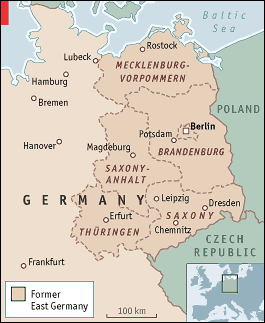
Its economy soared at an average 8% a year in the first half of the 1990s; since 1997 it has grown at less than half the western rate, and last year it moved into recession, shrinking by 0.5%. Wages are still a quarter below those in the west, yet unemployment has climbed to almost 18%, higher than when Mr Schröder came to power and over twice the western rate. Productivity, having doubled in the early years, has been stuck at two-thirds of the western level since 1997.
The east has already had some euro750 billion ($675 billion) in net transfers of public funds over the past decade. Much has been achieved—not enough, but far more than most easterners care to recognise. And, despite grumbles from states like Bavaria, the federal government recently pushed through a new euro156 billion “solidarity pact” to improve infrastructure in the east in the 15 years after 2005, when the current pact ends. Yet money alone cannot solve all the east's ills.
Another, perhaps more intractable, problem for the east has been the exodus of many of its brightest and best. Even before formal reunification, some 800,000 easterners flooded west over the newly opened borders in search of a better life. Since 1991, a further 1m have left, tempted by better job opportunities and higher wages in the west. Most are young, dynamic and well trained. Some have since returned, but they tend to be the old or the less successful. This is one reason for the continuing wide discrepancy in productivity between east and west.
Little relief in sight for the German
economy
Wolfgang Munchau
Financial Times, November 4 2001
Why is the German economy so weak? The US, Japan and the eurozone have all been experiencing a significant fall in economic growth in the past few weeks. Yet Germany, which makes up a third of the eurozones economy, seems to suffer more than the average eurozone country. Are there specific factors that need to be tackled by Germany alone and, if so, will the government deal with them?
Gerhard Schröder, German chancellor, has so far refused to acknowledge publicly that the country is on the brink of recession and has declined to enact US-style programmes of tax cuts or spending increases. Yet the economic downturn carries great risks for him, with a general election set for next September.
There are two cyclical scenarios to explain what is likely to happen to the economy. Under the first, Germany is going through a normal cyclical downturn, maybe a recession, which will be followed by a noticeable recovery in the second quarter of next year. This scenario would probably cause only limited political damage to the government.
Scenario two assumes a more prolonged recession in the US, delaying recoveries elsewhere. This is an alarming scenario for the German economy and for Mr Schröder. German fiscal policy is relatively, but not excessively, loose. European interest rates are relatively, but not excessively, low. The euros exchange rate is stable. If US growth is sluggish or negative in the first half of next year, the German economy will be in a recession - or close to one - for most of next year.
During the last election campaign, Mr Schröder said he wanted his tenure in office to be judged primarily on reducing unemployment. He pledged to cut the number of jobless from the then prevailing level of 4m. He even said he did not deserve to be re-elected if he failed to meet his goal. The statement sounded courageous but he now looks in danger of breaking his promise.
According to a survey by the German Chambers of Industry and Commerce, a third of all companies in Germany are planning job losses this winter.
There is no doubt that Mr Schröder will act to stimulate the economy. The question is when he will act and what he will do. The government believes it may be wiser to move when the public mood hits rock bottom. With more bad news on the economy expected in the next few months, the best time for action might be December or January, when headcount unemployment is expected to peak.
There would also be political risks. Germany and other European countries are eager to stick to the stability and growth pact, which aims to restrain government deficits. This is not a time to undermine confidence in economic and monetary union, when the introduction of euro banknotes and coins is only a few weeks away. Furthermore, Mr Schröder knows that his core Social Democratic voters are not among those most likely to benefit from income tax cuts.
With monetary policy in the hands of the European Central Bank, and fiscal policy constrained by the stability and growth pact, the German chancellor has a few policy options left. He could bring forward public sector investment programmes and boost spending on Germanys chronically underfunded police and army. The government has already pledged DM3bn ($1.37bn) on internal and external security following the September 11 attacks in the US. But there is scope for even greater public spending in these areas - and that is supported by large sections of the German public.
Mr Schröder can expect little relief from the US and the world economy, from the cautious monetary policy of the ECB, and from the German consumer. Waiting for the recession to end is simply too risky. Mr Schroder may be a player but he is certainly not a gambler.
Jobs woe for German economy
BBC, 16
October, 2001
Munich's Oktoberfest - held traditionally, albeit confusingly in September - was a more dismal affair than usual this year.
Beer consumption, that key indicator of economic sentiment, was down by an unprecedented 20%.
Germany's economy was already stuttering dangerously ahead of the 11 September attacks on the US.
Now, with the country's top companies announcing a swathe of job losses, the mood is grimmer than it has been for years.
Eichel puts case for changes to EU
stability pact
Financial Times, August 16 2001
19:05GMT
Hans Eichel, German finance minister, has held out the prospect of changes in the European Union’s stability pact, which enforces fiscal discipline in the eurozone.
Mr Eichel, answering press questions in Riga, Latvia, on Thursday said it could be useful to focus more on spending targets rather than following rigid annual deficit reduction. His comments reflect a broader debate in the eurozone as EU governments grapple with an economic slowdown that is reducing tax revenues.
Germany was the original achitect of the stability pact - conceived partly as a means of persuading the German public that countries such as Italy with poor records of fiscal discipline would be kept in check if they became members of the single currency.
Slower-than-expected growth is making it more difficult for some governments to stick to this year’s deficit-reduction targets. It is also calling into question the 1993 Maastricht treaty’s plan for a steady movement toward balanced budgets in the medium term.
Mr Eichel made clear he remained committed to budget discipline. But he said the treaty was agreed when most governments were running heavy budget deficits.
It might be more useful to follow spending targets. “You can plan spending in a budget, but you cannot plan your income. The decisive thing for me is that we pursue [budget] consolidation steadfastly, independently of whether or not there is more or less income one year due to economic developments.”
Mr Eichel later clarified his remarks. “To dispel any doubt, I want to say clearly that I support fully the stability and growth pact, its instruments and all the responsibilities that arise out of it and which we signed up to. This Germany suppports fully.”
Belgium, which holds the presidency of the EU, said there was already a consensus within the EU over a more flexible approach to the pact. An adviser to Didier Reynders, finance minister, said: “If tax receipts are lower than expected in nominal terms a higher deficit could be accepted.”
The position was agreed by finance ministers in June. At their Gothenburg summit later that month, EU leaders implied that an economic downturn - and a consequent revenue shortfall - should be taken into account when assessing the pact.
Mr Eichel said a quick reform of the pact was unlikely. “I am for keeping the deficit targets in the first instance for pedagogical reasons, knowing we do not decide this on our own.”
Germans Prove Highly Resistant To the
Unified Currency's Charms
THE WALL STREET JOURNAL 2001-08-14
SCHWERIN, Germany -- In the cobblestone marketplace of this eastern German city, a small tent decorated with information on the euro squats in the sweltering midday heat, deserted by all but one young man. Perspiring in a yellow-cardboard euro costume, he waits for someone to whom he can hand a flyer.
Finally, a visitor wanders in: Horst Endler, a retired chemical
worker.
"If they had asked us, I would have said no to the euro," he says,
blithely ignoring the man in the euro suit. "They are cheating us with the
euro."
So go Germany's efforts to popularize the currency that in five months will kick the mark -- the beloved mark -- out of people's pockets. The home of Europe's biggest economy turns out also to be home to its toughest audience: The Berlin government says it spends more per capita on marketing the common currency than France, Italy and Spain, but with less success. Eight months into the campaign, most Germans still reject the euro. And Theo Waigel, the former finance minister who helped create it, continues to get regular death threats.
Perhaps that accounts for the marketing campaign's somber -- even defeatist -- tone. While France sells the euro with a happy little girl, and Spain trots out bubbly Ernie, the Sesame Street character, Germany's most prominent images are black-and-white photos of elder statesmen and no-nonsense news anchors stating the dreary inevitable, such as "The euro, our future."
The mark, one of history's most successful currencies, symbolized Germany's postwar rebirth. It was created in 1948 -- before West Germany itself, before the country won its fist Olympic gold and before its triumph at the 1954 World Cup. For a people that in 35 years had lost two World Wars and twice had their savings hyperinflated out of existence, the mark's strength became an obsession, and an object of national pride.
"The hard mark has become part of our national identity," says Ulrich Wickert, a German news anchor who is part of the euro campaign. "It is a symbol of regained respect in the world, and people feel that this is what they're losing now."
Given this mourning for the mark, the campaign's creators have faint hope of making the euro a hit. Publicis Groupe, the ad agency behind the promotion campaign, says it's seeking only to calm, not to convert.
"We are not trying to make the Germans love the euro, but to accept it," says chief executive Maurice Levy.
http://interactive.wsj.com/articles/SB997736081777083905.htm
Germans 'unhappy over euro'
BBC, 16
July 2001
54% of Germans were unhappy to be giving up deutschmarks for euros.
If you look at a survey carried out in 1999, it was then estimated that 60% of people in Germany supported the euro. That has changed. Part of the reasoning is probably Germany's move towards recession - a move which has coincided with the adoption of the euro.
Do Economic
Captains Hear the Storm Warnings?
David Ignatius International Herald
Tribune Monday, July 16, 2001
A
troubled city (Berlin)
Financial Time, May 30 2001
From lawyers to
Lufthansa pilots, the list of wealthy west Germans who have lost money
investing in Berlin property since 1990 is about as long as the wall that once
divided the city.
It is not surprising that the same misjudgments - founded
on post-reunification euphoria that led to wildly inflated expectations of
income streams and property prices - should have extended to Bankgesellschaft
Berlin.
The bank is the city's biggest financial institution and Germany's
10th biggest bank, majority-owned by the city state.
Tyskland skissar på kraftigt
förändrat EU
Rolf Gustavsson i SvD 2001-05-02
Schroeder Plan Seeks More
Unified Europe
Radical Changes in EU Constitution Would Create
a Strong Parliament
International Herald Tribune, April 30, 2001
German proposal for EU
Government
BBC website, 29 April, 2001
Gloom hits German businesses
BBC, Monday, 23 April, 2001
Schröder in call for EU
constitution
Financial Times 2001-01-20
The newsmagazine Stern published
five photographs Thursday of Foreign Minister Joschka Fischer assaulting a
police officer during his days as a militant in the 1970s in Frankfurt.
Internetional Herald Tribune 2001-01-05
German Economic Indicators (pdf)
The last days of King Kohl
Mitten im
Leben, Wolfgang Schäuble, Bertelsmann, E21.47
The implosion of
Germany's centre-right Christian Democrat Union is one of the most dramatic
political events of the past decade. Seemingly invincible under Helmut Kohl,
the CDU-led coalition held power for 16 years in Europe's largest country.
Then, in a matter of months, the party fell apart in the wake of an illicit
financing scandal which is still buried in mystery.
Wolfgang Schauble, the
long-time crown prince to King Kohl, is well-placed to write the definitive
account of what went wrong. The former leader of the CDU has produced a book
which is part political testament and part authentic thriller. By the end, the
reader is left gasping at the speed of the party's descent into chaos.
Otmar Issing: Two
speeches, one by Joschka Fischer, the German foreign minister, the second by
Jacques Chirac, the French president, have revived an old debate:
what
should be the future shape of Europe? "Old wine in new bottles," some sceptics
say. But I believe we really do need a new debate.
Buch: Europa neu denken - Warum und wie weiter Einigung? Hans Arnold
Neue Vorwürfe in der
CDU-Affäre:
Einem Zeitungsbericht zufolge hat die hessische CDU
doch Schwarzgeld von ihren Schweizer Konten an die Bundespartei
überwiesen.
War der Landesverband einer von Kohls anonymen Spendern?
Ein Sprechers Kohls dementierte gegenüber SPIEGEL ONLINE die Meldung.
German president demands a European constitution
Bundespräsident Johannes Rau hat sich für die Schaffung einer europäischen Verfassung ausgesprochen
Germany to press for referendums From
FT, September 6 2000
Germany's governing coalition parties are to
campaign for a change in the constitution to allow greater use of referendums
on important political decisions.
Speech by Joschka Fischer at the Humboldt University in Berlin, 12 May 2000
Tyska MBL-planer pressar eurokursen
Tyskar och fransmän kohandlar om IMF och ECB mot USA
Speech by Joschka Fischer at the Humboldt University in Berlin, 12 May 2000
Few have realised the
most dangerous feature of Emu: it has locked Germany into a seriously
uncompetitive real exchange rate
Martin Wolf, Financial
Times
The next federal election is due in September 2002
and the contest will probably be fought between Mr Schröder and the other
heavyweight of German politics, Edmund Stoiber, the conservative Bavarian prime
minister
. Under normal circumstances, Schröder versus Stoiber would be
no contest. No Bavarian has ever succeeded in becoming chancellor. Franz-Josef
Strauss tried against Helmut Schmidt in 1980, and failed resoundingly. Bavaria
is too conservative, and too staunchly Roman Catholic, to inspire voters from
other more Protestant and secular parts of the country.
This time, however,
might just be different. The economy is weakening and unemployment is rising.
The Green party, Mr Schröder's coalition partner, has lost some of its
support.
Of all the conservative leaders in Germany, Mr Stoiber is the
least compromising and most outspoken. He is also a Eurosceptic, at least by
German standards. But that is not the real threat to Mr Schröder.
The
key to Mr Stoiber's political attraction is that his home state of Bavaria is
consistently outperforming the rest of the German economy. It has almost no
unemployment, an excellent education system, the lowest crime rates in the
country and the highest concentration of high-technology industries. Indeed, if
Bavaria were an independent state, it would be one of the most successful
economies in the world.
By contrast, Mr Schröder's economic record is
mixed. Lower Saxony, where he was premier until 1998, is one of the less
well-off west German states. At the national level, growth has long lagged
behind those of most EU countries since the mid-1990s.
Euroland’s prospect - Daily Telegraph 2000-04-28
Germans shaken by euro slump - From The Times 2000-05-01
German advisers losing faith in the euro - Daily Telegraph 2000-04-25
German industry calls for moderate pace in EU eastwards expansion, 25 April 2000
Helge Berger
Center for Economic Studies University of Munich
German
economics professors call for delay of EMU
-
Prof. Dr. Manfred J. M.
Neumann, Direktor Institut für Internationale Wirtschaftspolitik der
Universität Bonn
Stoiber: Fischers Grundsatzrede zur Europapolitik hinterlässt mehr Fragen als Antworten
CDU: Zehn gute Gründe für die Euro-Währung
The American Institute
for Contemporary German Studies (AICGS)
is a center for nonpartisan ,
advanced research, study, and discussion of the Federal Republic of Germany --
its politics, economy, culture and society.
The Institute is affiliated
with The Johns Hopkins University
German academics criticise 'weak' euro Electronic Telegraph, 25 March 1999
Euroland’s prospect
Daily Telegraph 2000-04-28
Imagine what it must be to be residents of euroland. How would we feel about the decline of the euro?
Yesterday the European Central Bank increased interest rates by a quarter of one per cent, but, instead of rallying, the euro fell even further. The currency has now dropped by more than a fifth against the dollar. The German mark (which now exists only in name) is at a 14-year low against the pound. If we were residents of, say, France or Belgium, would this cause us to worry?
We would certainly be hearing reassuring words from our politicians. There is a lot of talk on the Continent about the difference between the ”internal” and the ”external” economies. It is suggested that the internal economy is not affected by changes in the external value of the euro. To British ears, such reasoning takes us back to Harold Wilson’s notorious ministerial broadcast in November 1967, after the pound had been devalued by a comparatively modest 14 per cent. ”It does not mean, of course,” he said, ”that the pound here in Britain, in your pocket or purse or in your bank, has been devalued.” Is that message any more reliable now than it was 33 years ago?
For the present, there are no signs of resurgent prices. But on the other hand, monetary control appears loose. The fall in the currency itself indicates this. In addition, money supply in euroland has been rising at more than six per cent – above the reference level of 4.5 per cent. Credit growth is rising even faster, at about 10 per cent. These figures suggest a genuine risk of higher inflation down the line.
Eurolanders might also reasonably be concerned about the causes of the present weakness. Foreigners - and locals, too are reluctant to invest in euroland. Most of the member countries are seen as having low underlying growth, taxes that are too high and administrative burdens that are too heavy. Gradually, faith in the currency itself is ebbing away.
Nobody has ever known the euro to do anything but fall and the European Central Bank is untested. It has never raised interest rates aggressively. Is it capable of doing so? Has it got the guts and the independence? Eurolanders cannot know for sure.
There is a slight risk that the currency might go into freefall. What would happen? Would the ECB at last raise interest rates with conviction? Or not? If it did, how would countries still suffering from high unemployment react? Might a populist politician arise somewhere, arguing that the unemployed were suffering because of the membership of the euro?
Could there be talk of deserting it? For the time being, eurolanders are not suffering. But they might reasonably be a little concerned. It is like the phoney war - a time of uneasiness.
Germans shaken by euro slump
From
The Times 2000-05-01
GERMANY'S growing nervousness about the relentless slide of the euro bubbled to the surface yesterday with demands for an urgent European summit to discuss the ailing common currency.
"The German Government should make the euro the dominant theme at the European summit in Porto in June," Roland Koch, the Christian Democratic prime minister of Hesse, said.
Jürgen Rüttgers, another leading Christian Democrat, who aims to be prime minister of North Rhine Westphalia in elections this month, said: "I do not think this can wait until June." An emergency summit should be held before the scheduled session in Portugal, he said.
The Government is trying to avoid any sign of panic and emphasises that the weak euro is doing wonders for German car exports to the United States. But the fear of imported inflation and a more general anxiety about a permanent loss of confidence in the euro is now evident at every level in the German political class.
Hans Reckers, a banker, appealed yesterday to delay the entry of Greece into the euro club. "With the present period of weakness of the euro, and bearing in mind the long-term stability of the euro, it will be a bad signal to take in new candidates who do not unambiguously conform to the Maastricht criteria for European monetary union," he said.
German politicians have taken up the call to keep Greece out of EMU for the time being.
An opinion poll showed that four out of five Germans have minimal, or no confidence in the euro.
The euro fell last week to $0.91 (57 pence).
For Germans the price of a glass of Coca-Cola in Britain has gone up since last October from DM4.70 to DM5.25 and a glass of beer from DM3.90 to DM4.40. That makes Britain one of the most expensive destinations for German tourists.