Frankrike France
France
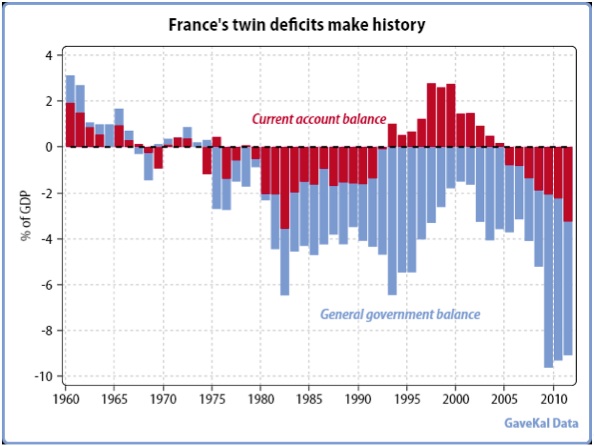
The effect of austerity has been to erode the tax base, leaving the budget deficit stuck at over 4pc of GDP.
France has gained remarkably little from fiscal tightening equal to 5pc of GDP over the last three years.
Undeterred, it is now pushing through extra cuts of €50bn by 2017 under the new premier Manuel Valls,
dubbed the “economic Clemenceau” for his willingness to endure casualties stoically
Ambrose Evans-Pritchard, 3 July 2014
As the situation worsened in early 1918, Clemenceau continued to support the policy of total war – "We present ourselves before you
with the single thought of total war" – and the policy of "la guerre jusqu'au bout" (war until the end). Clemenceau
Japanese-style lost decade. But at least Japan maintained near full employment.
The eurozone faces a far worse prospect: a lost generation.
The political consequences of this scenario are the subject of an important book published in France by
François Heisbourg, chairman of the International Institute for Strategic Studies and the Geneva Centre for Security.
In La Fin du Rêve Européen, he says the situation has become so intractable that the only way to save the EU is to abandon the euro.
Wolfgang Münchau, FT, November 3, 2013
I once proposed the opposite course of action – to recognise that the eurozone is now the true kernel of European integration – and to continue from there, changing the treaties with a view to turning the EU into an organisation fit to manage a complex monetary union.
Such a political union would need to include a framework for the resolution of existing debt, joint liability instruments for future debt,
a banking union firmly anchored at the central political level, and additional fiscal transfers as well.
Federalism - "ever closer union" - The United States of Europe
An astonishing new book by François Heisbourg
– La Fin du Rêve Européen (The end of the European dream) –
argues that the "euro cancer" must be cut out to save the rest of the EU Project before it is too late.
Ambrose Evans-Pritchard, October 21st, 2013
"The dream has given way to nightmare. We must face the reality that the EU itself is now threatened by the euro. The current efforts to save it are endangering the Union yet further," he writes
A product of the Quai d'Orsay, he is an ardent European federalist and long-time champion of EMU, and currently chairman of the very blue-chip International Institute for Strategic Studies (IISS).
Once the Quai d'Orsay set starts to break the taboo, we must be nearing a political inflection point.
---
The official rationale may have been prudent monetary policy. But coming on the eve of the anniversary of the treaty that cemented postwar reconciliation between France and Germany,
last week’s announcement of the Bundesbank’srepatriation of its gold from the Banque de France was a poignant symbol of the fraying of the relationship between the two powers at the heart of the EU.
François Heisbourg, Financial Times, January 20, 2013
I Malmö levererade Persson, våren 2011, som vanligt utan manus, precisa formuleringar som hade kunnat gå rakt till trycket.
Men framför allt sade han något som ytterst få ens knystade om vid denna tid.
När Persson kom in på Europas skuldkris svepte han förbi Grekland, Portugal, Irland, Spanien och Italien och underströk sedan att
problemen där är ingenting jämfört med vad som väntar ifall Frankrike börjar vackla.
Per T Ohlsson, Sydsvenskan 2 december 2012
Some French officials are blaming The Economist for Moody's decision to take away the French government's top AAA credit rating.
For them, it's all part of the Anglo-American conspiracy against French exceptionalism that has been going on since at least the 1960s.
It's no accident, Parisians might add, conspiratorially, that Fitch is the only one of the three major ratings agencies that has yet to strip France of its triple A; it's the only one that is not American-owned. (As it happens, it's French.)
Stephanie Flanders, BBC Economics editor, 20 november 2012
The way the French see it, Britain and America can't stand the fact that France has taken a different approach to the global market economy - one with more egalite and fraternite, and less worship of the free market gods. They let out their frustration by suggesting that France is the "ticking time bomb at the heart of Europe".
The time-bomb at the heart of Europe
Why France could become the biggest danger to Europe’s single currency
The Economist print Nov 17th 2012
Nu finns i praktiken en EU-garanti för de utestående grekiska statsobligationerna.
Anders Borg, TT, SvD papper 22 februari 2012
- To Be, Or Not To
Be A Country - that is the question
Sir Oliver Wright, GCMG, DCVO, DSC,
April 2001 .... more
Alliance pour la Souveraineté de la France
France's European policy (Franska UD på engelska!)
President Chirac in english
The Guardian om
Chiracs tal om EUs framtid (juni 2000)
http://www.premier-ministre.gouv.fr/en
UDF:s presidentkandidat Francois Bayrou på franska
Philippe de Villiers is a French rebel with a cause. He breaks a general taboo among respectable politicians in France.
He says boldly that "the Europe of Brussels is an anti-democratic dictatorship".
http://www.nejtillemu.com/villiers.htm
Donald Trump, Marine Le Pen, Nigel Farage
The economic losers are in revolt against the elites
Martin Wolf January 26, 2016
Losers have votes, too. That is what democracy means — and rightly so. If they feel sufficiently cheated and humiliated, they will vote for Donald Trump, a candidate for the Republican party’s presidential nomination in the US, Marine Le Pen of the National Front in France or Nigel Farage of the UK Independence party.
The projects of the rightwing elite have long been low marginal tax rates, liberal immigration, globalisation, curbs on costly “entitlement programmes”, deregulated labour markets and maximisation of shareholder value.
The projects of the leftwing elite have been liberal immigration (again), multiculturalism, secularism, diversity, choice on abortion, and racial and gender equality.
Libertarians embrace the causes of the elites of both sides; that is why they are a tiny minority.
The odds of France leaving the Eurozone, or Frexit, have just gone from a tail risk to plausible
thanks to the boost the Hedbo shootings have given to the leader of France’s far right party, the National Front, and its leader, Marine Le Pen.
Opinion polls indicate that that she would win the first round of a presidential ballot were elections held now.
NakedCapitalism Yves Smith January 9, 2015
Pamflett skriven av Joschka Fischer: Scheitert Europa? (Misslyckas Europa?).
Det europeiska samarbetet är på väg mot fiasko. EU-projektet har aldrig varit så hotat som i dag.
Finanskrisen aktualiserade de alltjämt olösta existentiella frågorna om EU:s mål och medel.
Det traditionellt tongivande samarbetet mellan Tyskland och Frankrike blockeras av att båda vägrar diskutera framtiden.
Rolf Gustavsson, SvD 23 november 2014
Joschka Fischer är helt klar över att Frankrikes djupa ekonomiska och sociala problem i hög grad är självförvållade,
men i dagens kritiska läge tjänar det ingenting till att fortsätta moralisera över det.
Tyska eftergifter för att hjälpa Frankrike ur krisen blir både kostsamma och inrikespolitiskt impopulära.
Men Frankrike intar en avgörande nyckelposition i klyftan mellan nord och syd i EU.
Om Frankrike bara fortsätter att glida in i den sydeuropeiska kretsen av krisländer så spricker EU.
Då spricker det som bildar EU:s kärna, eurogruppen med den gemensamma valutan.
Manuel Valls, the French prime minister, declared
“We are a great nation" -France is a sovereign country.”
FT October 20, 2014
France bows to EU pressure on budget deficit
FT 27 October 2014
ECB should abolish its OMT program – which, according to Germany’s Constitutional Court, does not comply with EU treaty law anyway.
Furthermore, the ECB should reintroduce the requirement that TARGET2 debts be repaid with gold, as occurred in the US before 1975
The fiscal compact – formally the Treaty on Stability, Coordination, and Governance in the Economic and Monetary Union
French Prime Minister Manuel Valls and his Italian counterpart, Matteo Renzi, have declared – or at least insinuated –
that they will not comply with the fiscal compact to which all of the eurozone’s member countries agreed in 2012
Their stance highlights a fundamental flaw in the structure of the European Monetary Union
– one that Europe’s leaders must recognize and address before it is too late.
Hans-Werner Sinn, Project Syndicate 22 October 2014
If you want an indication of the collective mood in France at the moment,
try this for a best-selling book title: Le Suicide français, by Éric Zemmour.
Its 530 pages are a relentless polemic against what Zemmour calls the destruction of the nation
by a “vast subversive project” imposed via feminism, globalisation, immigration and the “monstrous Brussels bureaucracy”.
Hugh Carnegy, FT October 21, 2014
His book has been outselling the latest work by Patrick Modiano, proud French winner of this year’s Nobel literature prize.
There are estimates that Le Suicide français will sell north of 300,000 copies, more than three times the pre-prize average sales of Modiano’s books.
The popularity of the Zemmour book has sent a deeper shudder through a French establishment long used to decliniste books bemoaning the state of the nation and surveys showing the French are less optimistic about their future than Iraqis.
Borders and budgets risks provoking political crises
that could plausibly culminate in the break-up of the euro, or even the EU.
Gideon Rachman, FT October 20, 2014
I winced when I heard that. It was one of those statements that actually sounds less convincing the more defiantly it is uttered.
For the fact is that France is not a sovereign country when it comes to budgetary matters – and nor are the other 17 countries that have adopted the European single currency.
In the next few days that truth could become brutally apparent.
France is not alone in struggling with the constraints on its national sovereignty imposed by Europe.
Britain too is wrestling with the fact that, under European law, it cannot prevent unlimited immigration from the rest of the EU.
Control of borders and budgets are two of the most traditional powers of the nation.
The extent to which France and Britain are chafing against European erosion of their sovereignty, on these issues, risks provoking political crises that could plausibly culminate in the break-up of the euro, or even the EU.
Secular stagnation
Eurozone policy makers face three choices.
First, they can transform the eurozone into a political union, and do whatever it takes:
a eurobond, a small fiscal union, transfer mechanisms and a banking union worthy of its name.
Second, they can accept secular stagnation.
The final choice is a break-up of the eurozone.
Wolfgang Münchau, FT October 19, 2014
Yesterday, president François Hollande had to ask his prime minister, Manuel Valls, to form a new government
after senior ministers publicly criticised his economic strategy - Mr Hollande’s “absurd” austerity policies
Telegraph 25 August 2014
Arnaud Montebourg, the outspoken economy minister was protesting at Mr Hollande’s “absurd” austerity policies,
which he claimed were bringing about “the most destructive crisis in Europe since 1929”.
Just to ramp up the jingoistic rhetoric, Mr Montebourg reminded his countrymen that France was free and
“shouldn’t be aligning itself with the obsessions of the German right”.
"some malfunctions occurred and mistakes were made"
U.S. poised to impose record fine /nearly $9 billion/ on BNP Paribas
French bank expected to plead guilty to sanctions breaches
MarketWatch 30 June 2014
The European election results showed euroscepticism rising across most of Europe.
But the really shocking factor for the euro elites should have been the strength of the vote for the Front National in France.
For the EU’s history – and its future – turns on France.
Roger Bootle, 1 June 2014
The EU was first imagined and constructed by two Frenchmen, Jean Monnet and Robert Schuman,
whose priorities were to end the age-old enmity between France and Germany and prevent another European war.
The essential idea was to tie Germany into some European political entity.
President Mitterrand exacted agreement to the euro as the price of France’s support for German reunification.
This only made sense if it was believed that the euro was in French interests and against Germany’s.
This is not quite how things have worked out
In Strasbourg on Dec. 9, 1989, after the Berlin Wall fell,
Germany agreed to monetary union in order to get President Mitterand to agree to German reunification
WSJ 23 Sept 2011
The results in France are infinitely the more important
– and not just because Ms Le Pen’s smile does not disguise the FN’s fascist and anti-semitic roots.
France, by contrast, is an essential pillar.
Without France, the euro and the entire European project would collapse in on themselves.
Philip Stephens FT May 29, 2014
I Malmö levererade Persson, våren 2011, som vanligt utan manus, precisa formuleringar som hade kunnat gå rakt till trycket.
Men framför allt sade han något som ytterst få ens knystade om vid denna tid.
När Persson kom in på Europas skuldkris svepte han förbi Grekland, Portugal, Irland, Spanien och Italien och underströk sedan att
problemen där är ingenting jämfört med vad som väntar ifall Frankrike börjar vackla.
Per T Ohlsson, Sydsvenskan 2 december 2012
Polls: 23%, against 21% for the centre-right UMP, med socialisterna på tredje plats
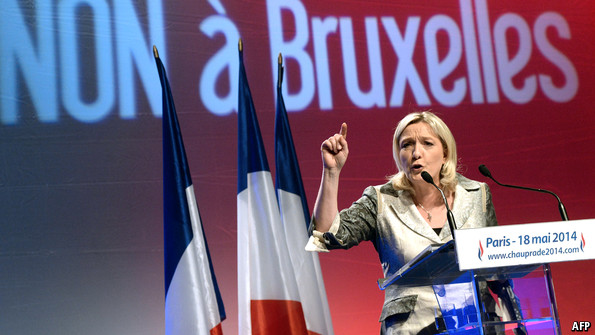
The biggest fallout from the European elections will come from the success of Marine Le Pen’s National Front.
The Economist print, daterad 24 May 2014
She is capitalising on rising Euroscepticism, with promises to take France out of the euro and Schengen, explode the pro-European consensus and end diktats from Brussels.
Nicolas Sarkozy, the former president, has also called for powers to be returned from Brussels to national governments.
If Ms Le Pen comes first, however much that has been forecast, it will be a huge shock.
The mystery is why a French Socialist president with a parliamentary majority should so passively submit to policies that are sapping the lifeblood of the French economy and destroying his presidency.
Francois Hollande won the presidency two years ago on a growth ticket, vowing to lead an EMU-wide reflation drive that would lift Europe out of slump.
He promised to veto the EU Fiscal Compact.
Ambrose Evans-Pritchard, 21 May 2014
By a horrible twist of fate, Europe's political Left has become the enforcer of reactionary economic policies. The great socialist parties of the post-war era have been trapped by the corrosive dynamics of monetary union, apologists for mass unemployment and a 1930s deflationary regime that subtly favour the interests of elites.
France is the new cauldron /kittel/ of Eurosceptic revolution
Britain is marginal to the great debate on Europe.
France is the linchpin, fast becoming a cauldron of Eurosceptic/Poujadist views on the Right,
anti-EMU reflationary Keynesian views on the Left, mixed with soul-searching over the wisdom of monetary union across the French establishment.
Ambrose Evans-Pritchard, April 15th, 2014
1153 Comments Comment on this article
Han Som Bestämde, evigt förknippad med 1990-talets sanering av statsfinanserna, väcker fortfarande känslor.
Men även kritikerna torde hålla med om att han behärskar två saker: Ekonomi – och att tala.
I Malmö levererade Persson, våren 2011, som vanligt utan manus, precisa formuleringar som hade kunnat gå rakt till trycket.
Men framför allt sade han något som ytterst få ens knystade om vid denna tid.
När Persson kom in på Europas skuldkris svepte han förbi Grekland, Portugal, Irland, Spanien och Italien och underströk sedan att
problemen där är ingenting jämfört med vad som väntar ifall Frankrike börjar vackla.
Per T Ohlsson, Sydsvenskan 2 december 2012
France jobless rate at a record 3.32 millions
– about 11 per cent of the workforce.
FT, February 26, 2014
German wages fell 0.2pc in 2013. Germany too is in wage deflation.
Which raises the question: how on earth are France, Italy, Spain, Portugal, and Greece supposed to claw back lost labour competitiveness against Germany
by means of "internal devaluations" if German wages are falling?
Ambrose Evans-Pritchard, February 20th, 2014
If you want to understand the financial crisis and the subsequent recession, Say’s Law is of no help whatsoever.
Mr Hollande’s embrace of this defunct economist has three important consequences.
If France goes to the trouble of aligning with Germany on German terms, expect no mercy for others.
The message of righteousness will be broadcast in stereophonic quality.
Wolfgang Münchau, Financial Times, January 19, 2014
Do not romanticise his U-turn two years into his term and compare it with François Mitterrand’s similarly-timed adoption of the “franc fort” policy in 1983. The purpose of the Mitterrand’s decision was to allow France to coexist in a semi-fixed exchange rate regime with West Germany.
It was a political choice of macroeconomic adjustment, not one of supply-side voodoo and ideological convergence.
The third significance lies in the fact that the new consensus spans the entire mainstream political spectrum. If you live on the European continent and if you have a problem with Say’s Law, the only political parties that cater to you are the extreme left or the extreme right.
What it also tells us is that the policy debate within the eurozone is largely concluded. Those who favoured a new governance framework, which once included the French, have lost.
France’s 'AA' Hollande pays price for kowtowing to EMU deflation madness
Let me be clear. The quarrel is not with the German nation, but with the 1930s policies being enforced on Europe by Angela Merkel and German political establishment.
(Have they all forgotten – or never learned – that it was the Bruning deflation of 1930-1932 that destroyed Weimar?)
Ambrose Evans-Pritchard, November 8th, 2013
An astonishing new book by François Heisbourg – La Fin du Rêve Européen (The end of the European dream) –
argues that the "euro cancer" must be cut out to save the rest of the EU Project before it is too late.
Ambrose Evans-Pritchard, October 21st, 2013
EU har ett demokratiskt underskott som inte självklart balanseras av en bankunion.
”Eliten” är ofta en tacksam måltavla.
Att stå upp mot populisterna är nödvändigt. Men Europavänner måste också anstränga sig för att visa att EU-projektet är till för medborgarna.
DN-ledare, Gunnar Jonsson, 17 oktober 2013
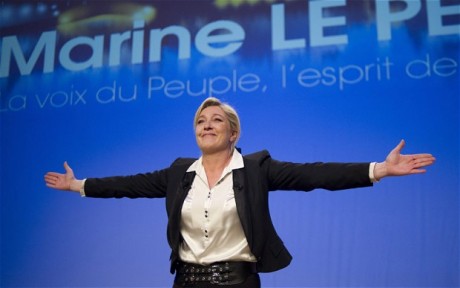
We have a minor earthquake in France.
A party committed to withdrawal from the euro, the restoration of French franc, and the complete destruction of monetary union has just defeated the establishment in the Brignoles run-off election.
Ambrose Evans-Pritchard, October 14th, 2013
We will start with a remarkable example of both hubris and economic ignorance published earlier this year in Le Monde.
Under the headline "No: France Is Not Bankrupt," Bruno Moschetto, a professor of economics at the University of Paris I and HEC, made the following case.
No, France is not bankrupt .... The claim is untrue economically and financially. France is not and will not bankrupt because it would then be in a state of insolvency.
Professor, saying a country is not bankrupt because it would then be insolvent is kind of like saying your daughter cannot be pregnant because she would then have a baby.
John Mauldin, August 23, 2013
A state cannot be bankrupt, in its own currency, to foreigners and residents, since the latter would be invited to meet its debt by an immediate increase in taxation.
In abstract, the state is its citizens, and the citizens are the guarantors of obligations of the state. In the final analysis, "The state is us." To be in a state of suspension of payments, a state would have to be indebted in a foreign currency, unable to deal with foreign currency liabilities in that currency….
Ultimately our leaders have all the financial and political means, through the levying of taxes, to be facing our deadlines in euros. And besides, our lenders regularly renew their confidence, and rates have never been lower.
Four things leap to mind as I read this.
First, Professor, saying a country is not bankrupt because it would then be insolvent is kind of like saying your daughter cannot be pregnant because she would then have a baby.
Just because something is unthinkable doesn't mean it can't happen.
Second, contrary to your apparent understanding and the understanding of your partners in the Eurozone, especially Germany,
France does not have its own currency. The Greeks, Portuguese, Italians, and Spanish have all found out that they cannot print their own currencies, no matter how much they wish they could.
You are all bound up in a misguided economic experiment called the euro.
For all intents and purposes you are in fact indebted in a foreign currency.
On your current path you will soon have to go to Germany and the rest of Europe asking for a special dispensation simply because you are France.
If this development weren't so potentially tragic, with horrific economic implications for the entire world, it would be especially amusing theater.
Fourth and finally, you clearly haven't done your homework on economic crises.
The fact that your interest rates are low and that your loans routinely get rolled over simply says that you have not yet come to your own Bang! moment.
Every country that falls into crisis is able to get financing at low rates right up until the moment it can't.
Om man har en sedelpress går man inte i konkurs.
Det var varit det till synes självklara budskapet på denna blog ett antal gånger, första gången i november 2011.
Läs mer här
Elefanten i rummet är Frankrike – EU:s näst största ekonomi
Det tyska förbundsdagsvalet den 22 september lägger en död hand över europeisk krishantering under sommaren.
Thomas Gür, Kolumn SvD 20 juni 2013
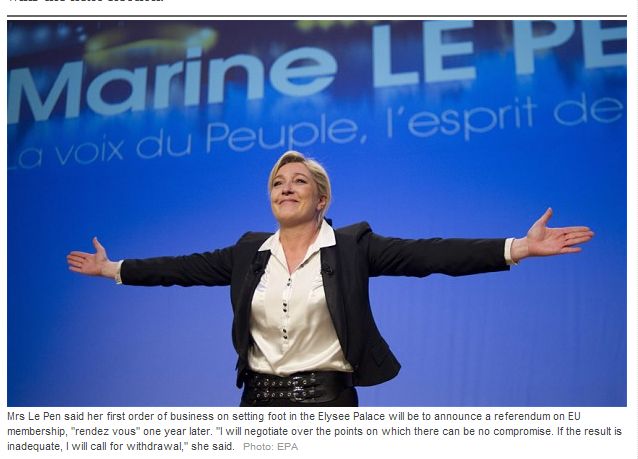
Marine Le Pen
Brimming with confidence after her party secured 46pc of the vote in a by-election earthquake a week ago.
Her candidate trounced the ruling Socialists in their own bastion of Villeneuve-sur-Lot.
"The euro ceases to exist the moment that France leaves, and that is our incredible strength.
What are they going to do, send in tanks?"
Ambrose, June 30, 2013
For the first time, the Front National is running level with the two governing parties of post-War France, Socialists and Gaullistes.
All are near 21pc in national polls, though the Front alone has the wind in its sails.
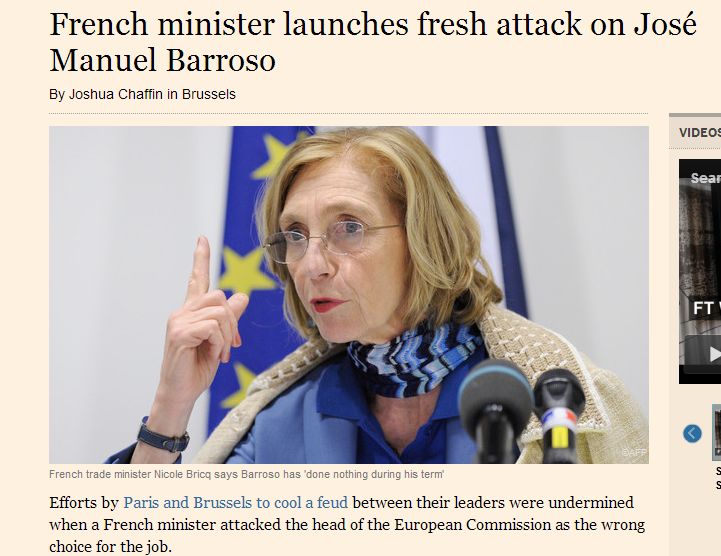
Nicole Bricq, France’s trade minister, said in a television interview that José Manuel Barroso had “done nothing during his term”.
Ms Bricq also suggested that Mr Barroso’s reappointment in 2009 had been a mistake, saying:
“I believe that the choice taken... four years ago was not necessarily good.”
Financial Times, June 28, 2013
Coming after efforts at a two-day EU summit in Brussels by both Mr Barroso and François Hollande, the French president, to play down any personal tensions between them, the comments caused a behind the scenes scramble to gauge whether Ms Bricq’s outburst was an intentional continuation of the anti-Barroso campaign or a misfire by an out-of-sync minister.
- Centralbankerna kan inte ensamma dra Europa ur krisen,
finanspolitiken måste nu ta ett större ansvar.
Anders Borg, DN Debatt 29 maj 2013
Europe's leaders, rather belatedly, are recognising that youth unemployment threatens the entire European project.
At a conference in Paris on Tuesday, organised by the Berggruen Institute on Governance, fear and warnings flowed from every speech.
Gavin Hewitt, BBC Europe editor, 28 May 2013
Jacques Attali, a French economist and former adviser to the late president Francois Mitterrand, warned of a Europe in danger of "falling asleep", of young people being excluded from a changing world.
It was a theme echoed by the French President, Francois Hollande, who spoke of a Europe wracked by doubt, wondering whether Europe has any meaning at all. He spoke about hatred and anger, with citizens turning their backs on the European project. The very idea of Europe, he said, was being challenged.
“We must act urgently – 6m youngsters are out of work in Europe?...
close to 14m are without work, study or an apprenticeship,” Mr Hollande said at a conference in Paris
Wolfgang Schäuble, the German finance minister, warned of “catastrophe” and said
“we will lose the battle for European unity” if jobs were not found for Europe’s youngsters.
Financial Times 28 May 2013
France, Spain and Slovenia are set to be criticised in a major commission report on Wednesday
as countries that have failed to cut public debt and to implement structural reforms
European Union studies on “macroeconomic imbalances” have been given new teeth this year
under eurozone “governance” legislation
Telegraph, 25 May 2013
In a major shift away from austerity, the commission will give France an extra two years to cut debt.
It will be conditional on the understanding that President Hollande agrees to reforms
that his last two predecessors, presidents Chirac and Sarkozy, failed to implement in the face of popular revolt.
“We’re witnessing the end of the dogma of austerity” as the only tool to fight the euro debt crisis,
Moscovici said today on Europe 1 radio.
“We’ve been pleading for a growth policy for a year. Austerity on its own impedes growth.”
When Konrad Adenauer and Charles de Gaulle met in 1962 in Reims cathedral for a mass of reconciliation,
de Gaulle’s chair was taller than Adenauer’s. That was fine with the Germans,
who accepted that the French should lead politically even if the Germans led economically.
Yet German understanding is being tested as never before.
“Publicly, I’m never worried about France; I trust,” says one official wryly, before expounding how trusting is now hard.
The Economist print, 4 May 2013
The Franco-German axis that has driven EU affairs ever since Schuman and Adenauer in the early 1950s is collapsing before our eyes.
This was inevitable. Their interests have become incompatible under monetary union.
The currency that was supposed to bind them is turning them into enemies, as this newspaper long warned.
Ambrose Evans-Pritchard, Daily Telegraph, April 30th, 2013
Highly Recommended
Rehn: The French government has begun structural reforms, but the economic outlook has also simultaneously and unexpectedly worsened. France must now persuade the European Commission and its European partners that it will get its public finances in order in medium-term.
SPIEGEL: What use is it, then, if Europe obliges itself to ever greater budgetary discipline, but in reality is constantly making concessions?
Rehn: I don't make any trade-offs when it comes to the Stability Pact rules. The reformed pact places an emphasis on making public finances sustainable in the medium-term. In the short term, certain divergence can be accepted under the condition that a country is implementing reforms.
So we are relying on partnerships, but we are also prepared to initiate sanctions instruments if necessary.
Olli Rehn, Der Spiegel 4 March 2013
Frankrike blir först ut med att bryta mot Bryssels nya tuffa budgetregler
– bara två månader efter att de infördes.
Det är en katastrof för krishanteringen och för EU:s trovärdighet.
Therese Larsson, SvD 24 februari 2013
Det var ingen rolig rubrik som mötte Le Figaros läsare i förra veckan. ”Bienvenue au Club Med” stod det på förstasidan, en ordlek som inte bara anspelar på den klassiska researrangörens extravaganta semesterorter, utan snarare på att fransmännen nu sällat sig till Medelhavsländernas klubb av krisekonomier.
Frankrike har enligt artikeln lämnat ”de dygdiga länderna i norr” för att istället ”spendera pengar man inte har”.
Den så kallade finanspakten infördes vid årsskiftet och var tänkt att återupprätta förtroendet för Europas krishantering. Alla EU-länder förutom Storbritannien och Tjeckien lovade dyrt och heligt att sanera sina finanser och att inte ha ett större budgetunderskott än 3 procent av BNP. I Frankrikes fall redan 2013. Annars väntar böter.
Det kommer François Hollande inte att klara.
Should Olli Rehn, the commission’s vice-president, coerce governments in France and other countries into further adjustment
to ensure they meet their 2013 deficit targets?
Or should he give them more time?
It is a difficult balancing act.
Jean Pisani-Ferry, Financial Times 21 February 21 2013
The case for being tough rests on an argument about credibility. In 2003, France and Germany built a coalition to rebut the commission’s recommendations on deficits and put the stability and growth pact “in abeyance”.
Over the past decade, France has been a serial breaker of the rules outlined in the pact. Today, the situation is worse.
The 0.8 per cent growth forecast underpinning the French 2013 budget was already questionable on the day it was announced.
A soft stance vis-à-vis Paris would certainly lead many in Europe and beyond to question the credibility of the new fiscal framework. If Brussels is not able to discipline France, then will anyone take it seriously?
On the other hand, the case for being flexible rests on an economic and on a political argument. Immediate fiscal adjustment in countries that have kept access to capital markets is not what Europe needs.
Monti called the breaches of the Maastricht Treaty limits on deficit ceilings by France and Germany,
soon after the launch of the single currency,
the "worst mistake in the EU in the past ten years".
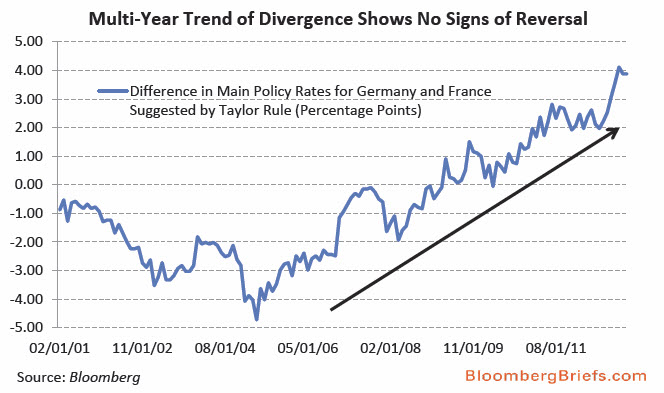
Franco-German Divide Nears Record High
We ask - rhetorically once again -
how can they expect to hold this together with a single monetary policy.
Tyler Durden 22 February 2013
Once the French get into a full-scale crisis, it’s over.
Lars Seier Christensen, co-chief executive officer of Danish bank Saxo Bank A/S,
said the euro’s recent rally is illusory and the shared currency is set to fail
because the continent hasn’t supported it with a fiscal union.
Bloomberg 18 February 2013
French President François Hollande has called for more budgetary, social and tax integration, leading to a "eurozone government" during a debate with MEPs.
Addressing the European Parliament on 5 February 2013, he said Europe was more than just "a market, a currency and a set of treaties".
During the debate, the leader of the Liberal group, Belgian MEP Guy Verhofstadt said Mr Hollande's ambitions for EU integration needed to go even further.
"Europe has no future unless we become a true federation - even an empire, in a good sense," he stated.
BBC, 5 February 2013
Germany Dismisses Hollande’s Call to Steer Euro’s Rate
German government spokesman didn’t rule out a discussion over the French president’s warning about a rising euro.
“Exchange-rate policy isn’t an appropriate instrument to boost competitiveness;
it relies on short-term stimulus through targeted depreciation,”
Bloomberg Feb 6, 2013
Hollande: ”Euroområdet behöver en valutapolitik”
– Vi kan inte låta euron fluktuera som marknaderna känner för, sade han.
SvD Näringsliv, 5 februari 2013
Det sade Frankrikes president Francois Hollande inför Europaparlamentet i Strasbourg på tisdagen, rapporterar Bloomberg News.
– Europa... lämnar euron sårbar för irrationella rörelser i endera riktningen. En valutaunion måste ha en växelkurspolitik eller så utelämnas den i slutändan till en växelkurs som inte är förenlig med det verkliga tillståndet i ekonomin, fortsatte han.
Han sade också att krisen i euroområdet inte är över och att alla läxor inte har lärts från eurokrisen
French President Francois Hollande called for government leaders to steer the euro’s exchange rate, becoming the most powerful European official to warn that the rising currency may deepen the recession. Hollande broke with Germany’s hands-off policy on exchange rates and set up a potential clash with the European Central Bank by saying the euro area has to use the currency as an export-promoting tool just like the U.S. and China.He said he was not calling for the European Central Bank to set an exchange rate target, but he demanded “an indispensable reform of [the] international monetary system”.
He added: “If not we are insisting on countries making efforts to be competitive which are destroyed by the rising value of the euro.”
The pace of the euro’s rise in recent weeks has alarmed some policy makers and European companies.
Financial Times 5 February 2013
Why do countries such as China and the US manipulate their exchange rate?
The answer is simple. Because they can.
And why do other countries shout about “currency wars” and complain bitterly about the manipulation?
Because they cannot.
John Authers, FT, February 1, 2013
This week, France and Germany celebrate the 50th anniversary of the Elysée treaty, the document that laid the foundation for their close co-operation on building an integrated European Union
The French and German parliaments will meet in a joint session in the Berlin Reichstag on Tuesday, and the two governments will meet in the office of Angela Merkel, German chancellor
Financial Times, 20 January 2013
Frankrike – eurozonens näst största ekonomi – är det största hotet mot euron.
Landet plågas av en dramatisk försämring av den egna konkurrenskraften och man gör inget för att stoppa utvecklingen,
skriver tidningen Fortune, enligt SvD Näringsliv 11 januari 2013
Han Som Bestämde, evigt förknippad med 1990-talets sanering av statsfinanserna, väcker fortfarande känslor.
Men även kritikerna torde hålla med om att han behärskar två saker: Ekonomi – och att tala.
I Malmö levererade Persson, våren 2011, som vanligt utan manus, precisa formuleringar som hade kunnat gå rakt till trycket.
Men framför allt sade han något som ytterst få ens knystade om vid denna tid.
När Persson kom in på Europas skuldkris svepte han förbi Grekland, Portugal, Irland, Spanien och Italien och underströk sedan att
problemen där är ingenting jämfört med vad som väntar ifall Frankrike börjar vackla.
Per T Ohlsson, Sydsvenskan 2 december 2012
Risken för att det går dithän är överhängande, menade Persson, och pekade på Frankrikes kroniska budgetunderskott, svaga konkurrenskraft, skakiga banker och överbelastade pensionssystem.
Det var utomordentligt klarsynt.
Göran Persson var aldrig någon entusiast, men drev under sin tid som statsminister en lojal EU-politik.
Perssons utdragna tvivel rörande euron var olyckligt för Sverige, men byggde på kunskap och insikt om bristerna i valutanionens konstruktion.
DN-ledare 10 september 2011
Varning för den galliske tuppen
Efter kommunismens fall 1989 togs steg inte bara för att utvidga det existerande och överlag väl fungerande EG till gamla kommunistländer. Det hela omvandlades också till en politisk union.
Och då det hos vissa politiker (bland andra den av inrikessocialistiska motgångar pinade Mitterrand!) inte sattes någon realistisk ände på visionen om ”ett enat Europa” lämnades fältet fritt för de kohorter av Brysselbyråkrater som på franskt manér, med tysk nit och italiensk effektivitet blev ansvariga för att implementera den.
Anders Edwardsson, NWT, 2012-06-19
Det är målsättningen om ett ständigt fastare förbund
- "ever closer union" -
som är själva grundbultsfelet med EU.
Rolf Englund Barometerns website 7/6 2005
France and the euro
The time-bomb at the heart of Europe
Why France could become the biggest danger to Europe’s single currency
The Economist print Nov 17th 2012
President François Mitterrand argued for the single currency because he hoped to bolster French influence in an EU that would otherwise fall under the sway of a unified Germany. France has gained from the euro: it is borrowing at record low rates and has avoided the troubles of the Mediterranean. Yet even before May, when François Hollande became the country’s first Socialist president since Mitterrand, France had ceded leadership in the euro crisis to Germany. And now its economy looks increasingly vulnerable as well.
As our special report in this issue explains, France still has many strengths, but its weaknesses have been laid bare by the euro crisis.
For years it has been losing competitiveness to Germany and the trend has accelerated as the Germans have cut costs and pushed through big reforms. Without the option of currency devaluation, France has resorted to public spending and debt.
Even as other EU countries have curbed the reach of the state, it has grown in France to consume almost 57% of GDP, the highest share in the euro zone.
Because of the failure to balance a single budget since 1981, public debt has risen from 22% of GDP then to over 90% now.
S&P downgrades France’s biggest bank
Financial Times October 25, 2012
The vicious circle linking the outlook for banks with their economies continued on Thursday night
after S&P cited increased economic risks as the main reason for downgrading BNP Paribas
and changed the outlook to negative for 10 other French banks, including Societe Generale and Credit Agricole.
“The economic risks under which French banks operate have increased in our view, leaving them moderately more exposed to the potential of a more protracted recession in the eurozone,” S&P said in a statement.
Nouriel Roubini, Dr Doom, kommenterar Frankrike som han anser har stora problem.
Han anser att utsikterna, trots besked om åtstramningar, är mörka.
SvD Näringsliv 28 september 2012
The French government has been forced to rescue a distressed domestic mortgage lender, Basel III
Financial Times, 2 September 2012
It said it would seek approval from the European Commission for its bailout of Crédit Immobilier de France, which follows the €90bn joint rescue with the Belgian and Luxembourg governments of the collapsed lender Dexia, which is still under negotiation with Brussels.
Pierre Moscovici, finance minister, said in a statement late on Saturday night that the government had agreed a request from CIF to grant it a guarantee to enable it to “meet all its commitments” after its access to wholesale market funding dried up.
Mr Moscovici added that tough new requirements under the Basel III capital requirements for banks had also played a role in CIF’s inability to stand on its own two feet.
When EU regulators ran stress-tests on European banks in July,
Dexia, the Franco-Belgian lender, not only passed the exercise, it emerged as one of the safest banks in Europe.
FT October 5, 2011
The crisis in the eurozone is the result of France’s persistent pursuit of the “European project,”
the goal of political unification that began after World War II when two leading French politicians,
Jean Monnet and Robert Schuman, proposed the creation of a United States of Europe.
Martin Feldstein, 27 May 2012, with many links
An obscure book, L’heure des choix, pour une économie politique
Francois Hollande wrote it in 1991 with fellow-author Pierre Moscovici
A single currency could only work if there was, beforehand,
a transfer of wealth from northern to southern Europe…in the region of 12.5 procent
The Slog, 22 May 2012
Footnote: Co-author Pierre Moscovici is now….Minister of Finance in the Hollande administration.
He is reported to be in emergency talks with Wolfgang Schäuble ‘to ensure Greece stays in the eurozone’.
Enda chansen att rädda euron är en fullfjädrad politisk union.
I ett första steg bör Tyskland och Frankrike bli ett land.
Kenneth Rogoff, Harvard, tidigare chefekonom på IMF, i SVT:s Agenda.
via SvD Näringsliv 21 maj 2012
The Commission forecasts that France too will miss its target of reducing the deficit to 3pc by next year
without further cuts or tax increases. For a new president committed to fighting the present austerity medicine,
If France is given a dispensation from the new fiscal pact, why should anyone else take it seriously?
Jeremy Warner, Telegraph 11 May 2012
Beyond downgrade jitters, or fears of contagion from $710bn of French bank exposure to Italy, Spain, Greece, Ireland, and Portugal (IMF data).
A gut feeling in global markets that France is sliding into deep trouble,
clinging to a ruinously expensive social model in a Teutonic monetary union and a Chinese trading world.
Ambrose Evans-Pritchard, 6 May 2012
French economists say the moment of danger will come later this summer - whoever is elected - as the full force of Europe’s contraction crisis hits France.
Nicolas Sarkozy’s defeat makes him the first incumbent in more than 30 years to fail to win re-election,
and the ninth European leader to be booted out since the region’s debt crisis began.
Bloomberg, May 7, 2012
First Greece’s Papandreou, then Italy’s Berlusconi, followed by Spain’s Zapatero, and now France’s Nicolas Sarkozy
Ever since the euro crisis erupted two years ago, no major European politician has been re-elected
So long as Germany and France were united behind that deal, it was rock-solid. That is the way the EU works. What the Franco-German axis demands, it gets.
But Hollande has pledged himself to tearing it up.
MarketWatch 25 April 2012
Lars Calmfors i Hässleholm:
Ännu återstår att se om EU har de verktydg som behövs för att ta sig ur krisen.
– Än så länge ger Frankrike stödlån även om de har högre statsskuld än Spanien.
Anders Selnes, europaportalen, 19 april 2012
Tidigare än Tysklands Angela Merkel insåg också Sarkozy hur allvarlig eurokrisen var. Han har drivit på för gemensamma lösningar, även om de utformats för att passa franska intressen.
Nicolas Sarkozy är Europavän, men tilltagande och oroande EU-kritik har präglat presidentens tal inför valet på söndag. Hans angrepp på Schengensamarbetet, tirader om minskad invandring och krav på hårdare kontroll av unionens gränser följer ett illavarslande mönster som etablerades i Grenoble sommaren 2010.
Den gången höll presidenten ett riktigt obehagligt tal. Han dömde ut 50 års invandringspolitik, kopplade kriminalitet till den fria rörligheten och gav order om att romer från östra Europa omedelbart skulle slängas ut ur Frankrike. Det var en öppen flört med Nationella frontens väljare på högerkanten, och den har han återupptagit under valrörelsen. Häromdagen vände sig Nicolas Sarkozy direkt till Marine Le Pens sympatisörer och vädjade om deras stöd.
Annika Ström Melin, DN 20 april 2012
The Greek election, which we now know will happen on 6 May, will revive questions about whether Greece can stick with its new programme - or, indeed, the euro.
But the election in France on the same day could prove more consequential.
Why? Because a victory for Francois Hollande in France would re-open the entire debate about austerity and growth, right at the heart of Europe.
The very phrase, President Hollande, could also (whisper it softly) cause investors to wonder whether France - the country with by far the highest government spending as a share of GDP in the eurozone - deserved to be borrowing at less than 3%.
Stephanie Flanders, BBC Economics editor, 11 April 2012While French banks are not the problem that Spanish banks are, they are far larger relative to the size of their home country.
And French banks have very large exposure to European peripheral debt. A default by Spain would push them (and a lot of other European banks) over the edge.
John Mauldin, 13 May 2012
Top of page - News - Start page
Should France Be Added to the 'PIIGS'?
Hollande’s biggest task could be avoiding the fate of the euro zone’s ailing peripheral states
— the so-called ‘PIIGS’ - Portugal, Italy, Ireland, Greece and Spain
Patrick Allen, CNBC EMEA Head of News, 16 May 2012
“France is not self-financing, but instead relies on capital inflows from abroad.
Furthermore, the twin deficits (government deficit and current account) are in each case higher than the average for the euro land,”
said Jan Poser, chief economist at Sarasin in a research note after Hollande’s inauguration.
Bank Sarasin – Sustainable Swiss Private Banking since 1841
Top of page - News - Start page
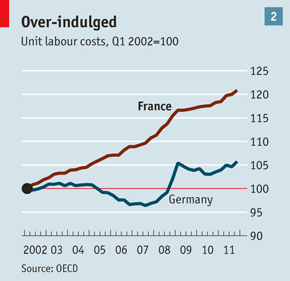
France has not balanced its books since 1974. Public debt stands at 90% of GDP and rising. Public spending, at 56% of GDP — more even than in Sweden.
The banks are undercapitalised. Unemployment is higher than at any time since the late 1990s and has not fallen below 7% in nearly 30 years, creating chronic joblessness in the crime-ridden banlieues that ring France’s big cities.
Exports are stagnating. France now has the euro zone’s largest current-account deficit in nominal terms.
A sluggish and unreformed France might even find itself at the centre of the next euro crisis.
The Economist print 31 March 2012
Sélestat have emerged as a focal point of the French presidential campaign.
This ancient town in the center of Alsace boasts the extraordinary Humanist Library, dating from the 15th century.
But less proudly, Sélestat also has an unemployment rate of about 8 percent, much higher than towns just across the border in Germany.
Emmendingen, a German town of 27,000 that is only slightly larger than Sélestat and barely 20 miles away, has an unemployment rate of under 3 percent.
Among those under 25 years of age, the unemployment rate in Sélestat is 23 percent; in Emmendingen, it is 7 percent.
New York Times, 3 March 2012
- Den stora risken var att Grekland skulle utlösa en kris i italienska, franska och tyska banker.
Nu finns i praktiken en EU-garanti för de utestående grekiska statsobligationerna.
Anders Borg, TT, SvD papper 22 februari 2012
The extraordinary decision by Angela Merkel to campaign for Sarkozy in the April-May presidential elections
where he is trailing in the polls against the Socialist candidate Francois Hollande) has been criticized in much of the German press
David Marsh, MarketWatch 13 February 2012
French Trade Gap Record $91 Billion in 2011
With a presidential election less than three months away,
the deficit has become a political issue as a symbol of France’s decline
Bloomberg 7 February 2012
France has suffered a trade deficit every year since 2002.
The first round of the presidential election will take place on April 22, followed by a second and decisive round on May 6.
German unemployment has fallen to a post-Reunification low of 5.5 pc
France’s jobless rate has crept up to a post-EMU high of 9.9 pc
The half-century habits of Franco-German condominium die hard.
It is a painful process for French elites to admit that monetary union is asphyxiating /stryper, kväver/ their economy
and must inevitably trap France in mercantilist subordination to Germany
Ambrose Evans-Pritchard, 5 Feb 2012
The Carolingian union is all that anybody in French public life can really remember. It worked marvellously for two generations, levering French power on the global stage, and the euro was of course their own creation, intended to tie down a reunited Germany with “silken cords”.
How can they now face the awful truth that this elegant strategy has blown up in their faces, enthroning Germany as undisputed hegemon?
Yet they can hardly ignore the evidence. While German unemployment has fallen to a post-Reunification low of 5.5pc, France’s jobless rate has crept up to a post-EMU high of 9.9pc and is certain to rise further as recession bites again.
While both countries had the same sorts of export surplus in the early 1990s, they have diverged massively since the D-Mark and franc were fixed in perpetuity. Germany has a current account surplus of 5pc of GDP: France has a deficit of 2.7pc, anathema for Colbertistes.
French unemployment at 12-year high
Rose by 29,900 in November to reach 2.85 million, up 5.2 per cent on the year
French job market is deteriorating ahead of the April-May presidential election.
FT, December 26, 2011
According to ILO-compliant data from the INSEE national statistics office issued on December 1, the unemployment rate in mainland France rose in the third quarter to 9.3 per cent from 9.1 per cent in the previous three months.
Om man har en sedelpress går man inte i konkurs, forts.
French central bank governor Christian Noyer has lashed out against credit rating agencies
for threatening to axe the country’s AAA status,
claiming if any nation should be downgraded it’s the UK.
Damian Reece, Daily Telegraph, 15 Dec 2011
High quality global journalism requires investment. Please share this article with others using the link below, do not cut & paste the article. See our Ts&Cs and Copyright Policy for more detail. Email ftsales.support@ft.com to buy additional rights.
Jean-Claude Piris was one of the most powerful men in Brussels,
a top EU lawyer who almost singlehandedly authored the series of international treaties that took a loosely affiliated community of 12
to a quasi-political union of 27, complete with its own currency.
So when Mr Piris retired last year and published a book arguing the EU had grown too large too quickly, it set off a firestorm among the euorocracy
Financial Times 15 May 2012
Mr Piris’ theory that the EU should develop a “hard core” among a smaller, more integrated group of eurozone countries could soon be put to the test.
If Greece were to exit the euro, Mr Piris believes, other member states would be forced to integrate their economies and fiscal institutions even more closely
to fend off the inevitable attack from panicky markets.
Jean-Claude Piris var ofta en som höll i pennan när EU:s grundfördrag skulle revideras.
När han nu som fri pensionär på distans betraktar tillståndet i EU grips han av förtvivlan, vrede och besvikelse
Samarbetet riskerar att förlora sin legitimitet.
Rolf Gustavsson, SvD 19 februari 2012
Jean-Claude Piris en av Bryssels mest svårfångade personligheter. Utåt diskret tillbakadragen som det anstår en hög jurist, inåt en självmedveten maktspelare som hade sina fingrar i alla pajerna de senaste 20 år
Jean-Claude Piris var ofta en som höll i pennan när EU:s grundfördrag skulle revideras. Ibland hörde jag att han i skrivbordslådan hade färdiga utkast till nästa fördrag redan innan förhandlingarna börjat.
Den minnesgode erinrar sig för övrigt att Fredrik Reinfeldts största bestående bedrift som ordförande i EU var att få detta så hett efterlängtade Lissabonfördrag på plats hösten 2009.
När nu Jean-Claude Piris som fri pensionär på distans betraktar tillståndet i EU grips han av förtvivlan, vrede och besvikelse, om än uttryckt i återhållen fackprosa.
Jean-Claude Piris: The Future of Europe (Cambridge University Press).
Här underkänner han Lissabonfördraget som helt otillräckligt och varnar för att EU i sin nuvarande form riskerar att helt gå i baklås.
Samarbetet riskerar att förlora sin legitimitet.
Skulden lägger han i första hand på det högsta politiska ledarskap, som han tjänat i all år.
Nej till EU-federation
Ett av de avgörande argumenten för mig mot en federal utveckling är att
jag tror inte att det kommer att gå att skapa ett europeiskt parlamentet
som kommer att upplevas som legitimt som lagstiftare av folkflertalet i Europa
säger Göran Persson i DN 19/1 2003, ett halvår före folkomröstningen om EMU
Top of page - News - Start page
President Sarkozy galopperade in på sin gamla käpphäst: ett nytt mellanstatligt avtal utanför EU.
Så återuppväcktes en gaullistisk dröm om ett mellanstatligt organiserat Europa,
ett fäderneländernas Europa fjärran från de fosterlandslösa eurokraterna.
Rolf Gustavsson, SvD 17 december 2011
I Merkels och Sarkozys senaste europlan finns också skatten på finansiella transaktioner.
Den är visserligen en usel idé, som fiaskot för den svenska valpskatten på 80-talet visade, men för dem är poängen att markera mot marknaden.
En sådan skatt skulle framför allt riktas mot London, som dominerar den europeiska finanssektorn.
Och det är mot den bakgrunden skilsmässan på toppmötet mellan Storbritannien och kontinenten måste ses.
Signerat Gunnar Jonsson, DN 10 december 2011
In the long hours of a bitter Brussels night Europe changed.
A major step was taken towards closer integration. It was not as a result of popular demand by Europe's people.
It came about because Europe's leaders believed their project had "never been in such danger".
Gavin Hewitt, BBC Europe editor, 9 December 2011
A Franco-German plan aimed at solving the euro-debt crisis by a partial loss of sovereignty and deeper fiscal integration
sparked bellicose anti-German comments from French opposition politicians.
Leaders of far-left and far-right groups, and representatives of mainstream parties, accused Paris of bending to German diktats
Wall Street Journal, 3 december 2011
"In order to weaken the president, the Socialists take the risk of resurrecting the old demons of Germanophobia," Foreign Minister Alain Juppé said in a statement.
Överallt sprids känslan av att undergången närmar sig.
”Överlever euron julen?” undrade tidningen Le Journal du Dimanche i en jätterubrik på förstasidan i söndags.
Annika Ström Melin på Parisbesök, signerat DN 30 november 2011
Samtidigt presenteras ny statistik om arbetslösheten som stiger till nya dystra rekord och tv visar bilder på köer utanför nyöppnade soppkök. Aldrig förr har jag sett så många tiggare på gatorna i Paris.
Annika Ström Melin på Parisbesök
Rolf Englund blog 30 november 2011
Sarkozy:
You cannot make a single currency without economic convergence and economic integration. It's impossible.
But on the contrary, one cannot plead for federalism and at the same time for the enlargement of Europe. It's impossible. There's a contradiction.
We are 27. We will obviously have to open up to the Balkans. We will be 32, 33 or 34.
I imagine that nobody thinks that federalism — total integration — is possible at 33, 34, 35 countries.
Charlemagne, The Economist Nov 10th 2011
Nicolas Sarkozy gatecrashed Jean-Claude Trichet’s farewell party in Frankfurt
and put France’s demand back on the table to give the EFSF a banking licence so that it could refinance itself via the ECB,
Financial Times Deutschland writes.
Eurointelligence 20 October 2011
After the official celebration, there was an improvised mini summit with Angela Merkel, Jean-Claude Trichet, Mario Draghi, Herman Van Rompuy and José Manuel Barroso attending.
Before Sarkozy’s surprise visit, Francois Baroin said that France remained convinced that the “banking licence for the EFSF would certainly be the best solution”. After two and half hours, all the participants left without statements.
German government sources expressed surprise at Sarkozy’s decision to go back on a subject they thought they had buried, as it was unacceptable to both Germany and the ECB.
Europe Deeply Divided Ahead of Make-or-Break Summit
French President Nicolas Sarkozy fears that downgrading these countries' bonds would lead to the collapse of his banking system.
Der SPIEGEL Staff, 17 October 2011
Under their plan, banks would be called upon to voluntarily increase their share of the financing of Greek debt. If this does not lead to a debt haircut of at least 50 haircut, the banks would be compelled to participate in the plan.
But it is highly unlikely that the banks will do this voluntarily. The French are particularly resistant to a larger haircut, because a handful of them have lent large sums of money to shaky economies like Greece, Spain and Italy. French President Nicolas Sarkozy fears that downgrading these countries' bonds would lead to the collapse of his banking system.
The head of Deutsche Bank is raging against politicians, Berlin is raging against Paris and the north is raging against the south. The world is expecting decisive results at this weekend's EU summit on emergency measures to shore up the euro, but the Europeans remain split.
The monetary union's 17 finance ministers will meet in Brussels this Friday, their counterparts from the remaining European Union countries will join them on Saturday and, finally, on Sunday the EU heads of state and government will arrive to give their blessing to the bailout package.
The most important meetings were scheduled for the weekend so that the decisions can be taken when financial markets are closed. Everyone is afraid of how the ominous markets will react.
IMF beräknar bankernas behov av friska buffertar till 200 miljarder euro
Tyskland vill i första hand låta bankerna själva försöka skaffa kapital från sina ägare. Fungerar det inte får de nationella regeringarna gripa in.
Frankrike att EFSF ska sköta ruljangsen; möjligen beroende på att franska banker hårt utsatta i Sydeuropa.
DN-ledare 9 oktober 2011
"The total debt of the three big U.S. banks (Bank of America, JP Morgan and Citigroup) is $5.86 trillion, or 39% of GDP,
while the debts of BNP, Crédit Agricole and Société Générale come to €4.7 trillion, or 250% of French GDP."
Nicolas Lecaussin, Institute for Economic and Fiscal Research (IREF), WSJ 13 September 2011
Lagarde vs. Lagarde on Stimulus
IMF Chief Lagarde over the weekend bluntly criticized European governments for doing too little to boost economic growth.
Wall Street Journal, August 30, 2011
Christine Lagarde, the tall, silver-haired, impeccably-dressed woman who now heads the International Monetary Fund, bears a strong resemblance to a former French finance minister also named Christine Lagarde. But listening to their positions on fiscal stimulus, you could be forgiven for doubting whether they are in fact the same person.
IMF Chief Lagarde over the weekend bluntly criticized European governments for doing too little to boost economic growth. She even took the strongly Keynesian position that a strategy to improve Europe’s sovereign finances could involve more short-term fiscal stimulus: “It does not necessarily mean drastic upfront belt-tightening—if countries address long-term fiscal risks like rising pension costs or healthcare spending, they will have more space in the short run to support growth and jobs.”
Top of pageCconcern at the approach taken by BNP Paribas and CNP Assurances
In a private letter sent to the European Securities and Markets Authority, the European Union’s market regulator,
the International Accounting Standards Board, the body that sets their accounting rules,
criticised the inconsistent way in which banks and insurers have been writing down the value of their Greek sovereign debt.
Financial Times, 29 August 2011
Good news and bad for German Chancellor Angela Merkel:
Three-quarters of Germans disapprove of her efforts to solve the problems plaguing the euro
But at least the French trust her more than their own president, Nicolas Sarkozy
Der Spiegel 19 August 2011
I tisdags framträdde Merkel tillsammans med Frankrikes president Nicolas Sarkozy. Avsikten var att lugna oroliga medborgare. Här ska tas krafttag, bildas en ekonomisk regering för euroområdet. På sikt ska skattepolitiken samordnas och så ska man införa en transaktionsskatt på finansiella affärer, Tobinskatt som det kallades på den tid Attacrörelsen var aktiv.
Är detta att ta medborgarna på allvar? Tvärtom. Det är ett bevis för att ledarna för Europas två största länder anser att deras landsmän är debila.
Expressen-ledare 18 augusti 2011
How to save the euro – kick out Germany
Best of all for France, the French bureaucratic elite would again become unquestioned leaders of the European federal project.
Anatole Kaletsky, The Times 17 August 2011
President Sarkozy said:
"Eurobonds can be imagined one day but at the end of the European integration process, not at the beginning."
BBC 17 August 2011
On Wednesday Mr Sarkozy summoned members of his government back from holiday for an emergency meeting
In a statement after the two hour meeting in the Elysee Palace in Paris, Mr Sarkozy said France’s pledge to reduce the budget deficit from last year’s 7.1 per cent to 3 per cent by 2013
“will be kept whatever the evolution of the economic situation”.
Financial Times 10 August 2011
Today the French government is working overtime to make sure that a Sarkozy loyalist, the leader of his economic team — Finance Minister Christine Lagarde — becomes the next managing director.
Why do France and other euro-zone countries now care so much about who runs the I.M.F.?
Simon Johnson, the former chief economist at the IMF, New York Times June 2, 2011
Just a few years ago, euro-zone countries were at the forefront of those saying that the International Monetary Fund had lost its relevance and should be downsized. French authorities regarded the I.M.F. as so marginal that President Nicolas Sarkozy was happy to put forward the name of a potential rival, Dominique Strauss-Kahn, as a candidate for its managing director, in fall 2007.
Simon Johnson, the former chief economist at the International Monetary Fund, is the co-author of “13 Bankers.”
The German constitutional court has almost no other choice than to rule that EU law was violated.
After all it was Christine Lagarde who told the Wall Street Journal recently.
“We have violated all rules of law because we agreed that we really wanted to save the eurozone.”
Eurointelligence 24 May 2011
If Spain has no strategy, France has had something worse: a bad one.
President Nicolas Sarkozy has saddled Europe with a worse than useless outfit called the Union for the Mediterranean.
Its founding co-president, alongside Sarkozy himself, was none other than Hosni Mubarak.
This 43-country waffle shop has an array of cumbersome, dysfunctional committees and projects, wholly unfit for purpose.
Now that we do need a union for the Mediterranean, we should really start by abolishing the Union for the Mediterranean.
Timothy Garton Ash, The Guardian, 17 February 2011
Sarkozy in Davos
'Mrs. Merkel and I Will Never, Never Allow the Euro To Fail'
Der Spiegel 27/1 2011
The new French revolution
Youths as young as 15 are turning France into a battleground in a violent protest over pensions.
Are they becoming unstoppable?
The Times 24 October 2010
Some 200 demonstrators blocked France's Marseille-Provence airport for more than three hours
Thursday as strikes and protests continued across the country
CNN 21/10 2010 with nice video
Sarkozy warning as French strikes hit power supply
BBC 20 October 2010, with nice video
In the Paris suburb of Nanterre, youths smashed shop windows and threw stones while in Lyon there were skirmishes between rioters and police.
Mr Hortefeux, on a visit to Lyon, condemned the violence, saying it was "unacceptable" that more than 60 police officers had been injured.
Transport workers continued their protests and the national rail operator, the SNCF, said one in three high-speed TGV trains had been cancelled
The French government has authorised the use of a special intervention force to deal with protesters blocking fuel depots
BBC 20/10 2010 with nice vidoe
French interior minister Brice Hortefeux authorised use of the paramilitary police to break blockades at fuel depots. He said he respected the right to protest, but that did not include the right to block workers or to commit pillage or violence.
The BBC's Christian Fraser said this force was the equivalent of a Swat team whose normal duties include hostage rescue.
...
Är det rätt av facket att göra upporor?
Rolf Englund blog 2010-10-20
“We must act urgently – 6m youngsters are out of work in Europe?...
close to 14m are without work, study or an apprenticeship,” Mr Hollande said at a conference in Paris
Wolfgang Schäuble, the German finance minister, warned of “catastrophe” and said
“we will lose the battle for European unity” if jobs were not found for Europe’s youngsters.
Financial Times 28 May 2013
His call came as the European Commission said the jobless rate among under-25s across the EU stood at 23.5 per cent in March,
with the rate reaching 24 per cent in the 17-member eurozone, up 1.5 percentage points compared with the year before.
The rate has climbed to more than 59 per cent in Greece and more than 55 per cent in Spain.
Hollande was speaking as France and Germany stepped up efforts to show they were working to tackle the problem, seen as a key element in flagging support for EU institutions and the continent’s political leadership.
Radical left is right about Europe’s debt
The tragedy of today’s eurozone is the sense of resignation with which the establishment parties of the centre-left and the centre-right
are allowing Europe to drift into the economic equivalent of a nuclear winter.
You may not consider yourself a supporter of the radical left.
But if you lived in the eurozone and supported those policies, that would be your only choice.
Wolfgang Münchau, FT November 23, 2014
Of the radical parties that have emerged recently, the one to watch is Podemos /in Spain/.
Podemos’ goal was not to leave the eurozone – but that equally the party would not insist on membership at all costs.
The aim is the economic wellbeing of the country.
The establishment fears that this agenda will turn the country into a European version of Venezuela.
But there is nothing controversial about the statement that if debt is unsustainable it needs to be restructured.
European governments keep playing the “extend and pretend” game.
The tragedy of today’s eurozone is the sense of resignation with which the establishment parties of the centre-left and the centre-right are
allowing Europe to drift into the economic equivalent of a nuclear winter.
Peter Wolodarski @pwolodarski
Wolfgang Münchau har nog rätt om detta
The euro is in greater peril today than at the height of the crisis
Insurrectional electorates more likely to vote for a new generation of leaders
Wolfgang Münchau, FT November 9, 2014
If there is one thing European policy makers agree on, it is that the survival of the euro is no longer in doubt.
I would challenge that consensus.
As so often in life, the true threat may not come from where you expect – the bond markets. The main protagonists today are not international investors,
but insurrectional electorates more likely to vote for a new generation of leaders and more willing to support regional independence movements.
Both Ms Le Pen and Mr Grillo want their countries to leave the eurozone.
In Greece, Alexis Tsipras and his Syriza party lead the polls. So does Podemos in Spain, with its formidable young leader Pablo Iglesias
Today the eurozone has no mechanism to defend itself against a drawn-out depression.
Unlike two years ago, we now have a clearer idea about the long-term policy response.
Austerity is here to stay. Fiscal policy will continue to contract as member states fulfil their obligations under new European fiscal rules
Unworkable and unreformable, the euro surely cannot survive another serious downturn
The euro in its present form will die not of the financial traumas that first threatened its existence, but of popular anger
Jeremy Warner, Telegraph 18 August 2015
Defiant France ignores the abyss
There is the argument in government ministries and the smoke-free conference rooms of Brussels,
as politicians and bureaucrats attempt to define new continent-wide rules to ensure Europe
does not slip back into a new and debilitating debt crisis.
But the future of the European economy and its single currency is more likely to be decided on the streets.
Gideon Rachman, FT October 18 2010
The French people still do not seem to realise the potential gravity of their situation. Their government’s proposal to raise the retirement age from 60 to 62 is an extremely mild reform – certainly compared with the cuts in wages, pensions and services that are being forced through in other debt-stricken European countries such as Greece, Spain, Ireland and even Britain. And yet France’s proposed reforms have brought millions of demonstrators on to the streets.
It may need a genuine fiscal crisis finally to persuade the French that, as Margaret Thatcher once put it: “There is no alternative.”
This parrot has ceased to be
Unlike Japan, which has a homogenous, stoic society, the euro area cannot hang together through years of economic sclerosis and falling prices.
As debt burdens soar from Italy to Greece, investors will take fright, populist politicians will gain ground,
and — sooner rather than later — the euro will collapse.
The Economist print, editorial, October 25th 2014
Secular stagnation
Eurozone policy makers face three choices.
First, they can transform the eurozone into a political union, and do whatever it takes:
a eurobond, a small fiscal union, transfer mechanisms and a banking union worthy of its name.
Second, they can accept secular stagnation.
The final choice is a break-up of the eurozone.
Wolfgang Münchau, FT October 19, 2014
French strikes force petrol stations to shut
BBC 18 October 2010, with nice video
Strike action against the government's reform plans is being ramped up, with lorry drivers starting the week by staging a go-slow on motorways around several major cities including Paris, Lille and Lyon.
"The government is in control," Industry Minister Christian Estrosi told French radio on Monday.
"There will be no blockade for companies, no blockade for transport and no blockade for road users."
Mitterrand forderte Euro als Gegenleistung für die Einheit
Aus bisher geheim gehaltenen Protokollen geht nach SPIEGEL-Informationen hervor: Erst die Bereitschaft der Kohl-Bundesregierung, ihren Widerstand gegen die Einführung des Euro aufzugeben, ebnete den Weg zur Einheit.
Der Spiegel 25/9 2010
Jacques Chirac to stand trial
Could face a ten-year prison sentence and 150,000-euro fine if found guilty.
Daily Telegraph 21 Sept 2010
Mr Chirac faces charges of abuse of public funds while he was mayor of Paris. It is alleged that he paid 21 allies for doing non-existent jobs
France's junior minister for EU affairs has said to the European Commission:
"This is not how you speak to a major power like France, which is the mother of human rights."
"A plane ticket to one's country of origin in the European Union is not a death train, and is not the gas chamber,"
EU Observer 15/9 2010
Following stinging comments on Roma expulsions by EU justice commissioner Viviane Reding. Focusing in on the commissioner's remark on Tuesday that "this is a situation I had thought Europe would not have to witness again after the Second World War," that Ms Reding's "unseemly" remarks in effect compare France to the Nazi regime.
Sarkozy förklarade med ödesmättat tonfall:
Vi lever med konsekvenserna av femtio års invandring. Det har slutat med ett stort misslyckande när det gäller integrationen. Varför säger vi ingenting om detta? Är vi rädda?
Talet hölls i Grenoble den 30 juli och finns på Elyséepalatsets hemsida
Annika Ström Melin DN 8/9 2010
Only a closer union can save the eurozone
I am aware that, at a time of rising nationalism and regionalism throughout the EU, there is no consensus for such sweeping reforms
Wolfgang Münchau, FT, June 27 2010 19:52
At some point the markets will realise that large parts of the German and French banking systems are insolvent, and that they are going to stay insolvent.
You might think that Europe’s policy elites cannot be so stupid as to commit themselves to stress tests without a resolution strategy up their sleeves. But I am afraid they probably are. Europe’s political leaders and their economic advisers are, for the most part, financially illiterate.
EU leaders will tomorrow meet in Brussels for a crucial summit.
A briefing outlining recent developments and moves towards what French President Nicolas Sarkozy has labelled an economic government for the EU
Open Europe 16 June 2010
...
Merkel, Sarkozy Paper Over Differences Before EU Summit
a vague call for an "economic government"
Spielgel Online 15/6 2010
VD för det franska försäkringsbolaget AXA, Henri de Castries, sa på tisdagen att det inte finns några skäl att oroa sig för de europiska staternas solvens.
Vidare uppgav han att AXA inte var i en position där de måste sälja tillgångar på grund av tryck från marknaden.
AXA sjönk 3,8 procent.
DI 1 juni 2010
ECB Buying Up Greek Bonds
German Central Bankers Suspect French Conspiracy
gives French banks the perfect opportunity to get rid of their Greek assets
Der Spiegel 31 May 2010
Som sig bör av en man av värld läser Pagrotsky Financial Times och han citerade varnande en artikel ur dagens nummer:
- The eurozone’s €440bn debt guarantee scheme is tantamount to the adoption of a Nato-style mutual defence clause and marks an “unprecedented” change to the bloc’s treaties, according to France’s Europe minister.
In an interview with the Financial Times, Pierre Lellouche laid bare the French government’s conviction that the emergency stabilisation scheme agreed earlier this month amounted to a fundamental revision of the European Union’s rules and a leap towards an economic government for the bloc.
“The €440bn mechanism is nothing less than the importation of Nato’s Article 5 mutual defence clause applied to the eurozone. When one member is under attack the others are obliged to come to its defence.”
Read more here:
SNS, Pagrotsky och Greklands återhämtning
Rolf Englund blog 2010-05-28
Frankrikes president Nicolas Sarkozy hotade med att dra Frankrike ur eurosamarbetet
om inte Tyskland gick med på det räddningspaket som ska hjälpa Grekland ur krisen.
Det uppger den spanska tidningen El País enligt DN 14 maj 2010
Euro remains on the right side of history
At stake in this struggle, ultimately, is the ideology of the omnipotent nation-state.
Tommaso Padoa-Schioppa, FT May 13 2010
Well, did he say it or didn’t he?
It would be extraordinary, if true - for two reasons. First, if France were to leave the euro area, European monetary union would have no reason to continue. It would collapse. And that would be like dropping a financial nuclear bomb on Europe. Secondly, it is inconceivable that France would consider it to be in its national interests to take such a drastic step.
May 17, 2010 by Tony Barber
Den franska storbanken BNP Paribas har en exponering mot grekiska statsobligationer på 5 miljarder euro (49 miljarder kronor).
E24 6/5 2010
- Alla scenarion om en spridning av den grekiska krisen till Spanien och Portugal saknar verklighetsförankring, sade BNP Paribas-chefen Baudouin Prot.
BNP Paribas-chefen ville dock inte avslöja bankens exponering mot andra sydeuropeiska länder.
– Den stora risken i ett krisscenario är att bankerna i Tyskland och Frankrike får en rejäl smäll och att vi får en ny vända av finanskris,
säger Handelsbankens chefekonom Jan Häggström.
Ekot 28/4 2010
French Finance Minister Christine Lagarde said no such plan would emerge if Greece doesn't default on its debt.
"There is no such thing as a bailout plan which would have been approved, agreed or otherwise, because there is no need for such a thing,"
WSJ MARCH 13, 2010
Brussels is enforcing an EU-version of Pierre Laval's deflation decrees in 1935, the policy that tipped France's Third Republic over the edge.
EU elites must have been chastened by the outpouring of anti-German feeling in the Greek parliament last week.
Ambrose Evans-Pritchard 21 Feb 2010
French banks hold €80bn of Greek debts, twice the exposure of German banks, though Greek debt is merely the tip of the iceberg.
Total exposure to Club O'Med is $853bn for France (30pc of its GDP), and $707bn for Germany (19pc of GDP)
Ambrose Evans-Pritchard, 10/2 2010
"The euro at $1.50 is a disaster for the European economy and industry,"
said Henri Guaino, right-hand man of President Nicolas Sarkozy.
French finance minister Christine Lagarde said it was intolerable that Europe
should "pay the price" for a dysfunctional link between the US and China.
Ambrose Evans-Pritchard, 20 Oct 2009
Anders Borgs plan för balans i EU-ekonomin
Mats Hallgren, Svde24 2009-07-07
It could be that future generations of German politicians find ingenious ways around the balanced budget law.
Or that they find a two-thirds majority to overturn it.
Or that Mr Sarkozy or his successors follow Germany into a future of austerity.
But as long as one of those three events fails to happen, Germany may discover that unilateral fiscal rigour in a monetary union could prove extremely costly.
For the sustainability of the euro, you surely do not want to get into a position where a large member state has a rational economic reason to quit.
So if Germany and France really do what they both promise,
you may as well start the egg timer.
Wolfgang Münchau, Financial Times June 28 2009
"The [free-market] liberalism without rules failed
"We refuse a bureaucratic Europe that mechanically applies the rules ...
We want a European Union that listens to the citizens, innovates, revitalises."
Such a Union would "favour the emergence of strong European enterprises" and
would "protect the European industry."
Angela Merkel and president Nicolas Sarkozy,
31 May 2009 Journal du Dimanche and Die Welt am Sonntag
President Nicolas Sarkozy is drawing up plans to boost the political accountability of the European Central Bank
Mr Sarkozy wants the ECB to publish regular minutes of the meetings of its interest rate-setting governing council, a controversial proposal likely to be seen by the bank as a direct assault on its independence because of the pressure it would place on the national representatives who sit on the body.
Financial Times, July 20 2008
“Some things are easier to legalize than to legitimate.”
--Nicolas de Chamfort (1741-1794)
On February 4, the French Parliament voted in the bill modifying title XV of the French Constitution in Versailles, and three days later, on February 7, the Treaty of Lisbon was formally ratified.
How did we go from the voters’ refusals to the adoption of the text by Parliament in 2008?
Online Journal June 5, 2008
The Lisbon Treaty, which provides for the reform of the EU’s institutions, was drawn up to replace the draft European constitution, which was first rejected on May 29, 2005, by 55 percent of French voters and then on June 1, 2005, by 61 percent of Dutch voters.
Måndagen 4 februari röstade franska folkvalda i ett gemensamt möte med senaten och nationalförsamlingen igenom en fransk grundlagsändring som möjliggjorde att de både församlingarna den 7 februari godkände Lissabonfördraget. Den nödvändiga grundlagsändringen för att kunna göra maktöverlåtelsen kunde ske genom att 193 folkvalda ur den s.k.”vänstern” antingen avstod från att rösta eller röstade ja till en förändring [1]
Den förrådda folkomröstningen 2005
Frankrike godkände nya EU-fördraget
Skillnaderna mot det ursprungliga förslaget är i mångt och mycket symboliska, som att delarna om en EU-hymn och flagga har tagits bort.
Omröstningen skedde i skuggan av den franske presidenten Nicolas Sarkozys bröllop och föranledde inte några större diskussioner.
DN, reporter Marianne Björklund, 4/2 2008
Referendums on the new European Union Treaty were "dangerous"
and would be lost in France, Britain and other countries, Nicolas Sarkozy has admitted.
Daily Telegraph 2007-11-14
President Sarkozy urged the US to maintain a strong dollar policy,
warning that “monetary disorder risked turning into economic war”.
FT November 7 2007
“The yuan is already a problem for everybody. The dollar should not remain simply a problem for others. If we are not careful, monetary disorder risks descending into economic war, of which we would all be victims.”
The dollar, said John Connolly, treasury secretary to Richard Nixon, "is our currency, but your problem".
Gerhard Schröder, Germany's chancellor, knows what he meant
Martin Wolf, Financial Times 1/3 2004
"Some thougths about the future of the euro"
The real threat to the cohesion of the monetary union is not Italy, or even a post-property-crash Spain.
The real issue is the political gulf between France and Germany.
Susanne Mundschenk and Wolfgang Münchau, Eurointelligence 18/10 2007
"Europe must progressively affirm itself as a first-rank player for peace and security,
in co-operation with the United Nations, the Atlantic Alliance and the African Union",
"France is not strong without Europe, just as Europe is not strong without France".
Mr Sarkozy said in the first foreign policy speech of his presidency on Monday 27 August 200.
EU Observer
Professor Paul de Grauwe
"Without further steps towards political union, the eurozone has little chance of survival"
Ambrose Evans-Pritchard, Daily Telegraph 16/7 2007
Mr Sarkozy may run into "unexpected problems" according to the EPC paper.
Before it can ratify the reform treaty, Paris will first have to make changes to its own national constitution
EU Observer 27/7 2007
Mr Sarkozy's calls for a “European economic government”
A second headache is the reopening of old debates about how sovereign states should align their economies and merge currencies, but at the same time remain democratically accountable to voters.
The Economist 12/7 2007
As far as the Eurocrats can make out, economic government means giving elected national politicians the last word over broad swathes of EU economic policy,
including the exchange rate and budget discipline, while not actually scrapping such totems
as the independence of the European Central Bank (ECB).
A French history of the single currency* credits François Mitterrand with the first public call for “an economic government for Europe”, in an October 1990 speech to a Franco-German summit in Paris. In a rhetorical flourish that Mr Sarkozy might envy, Mr Mitterrand called Europe's planned single currency and central bank mere instruments that lacked a soul.
A second headache is the reopening of old debates about how sovereign states should align their economies and merge currencies, but at the same time remain democratically accountable to voters.
The truth is that big countries do not have to obey the same rules, and Mr Sarkozy will probably get away with missing the original 2010 target for eliminating his budget deficit. This is not so shocking: the pact was reformed to allow flexibility to countries undertaking structural reforms.
Full textGermany needs to formulate a response to Sarkozy or the only proposal on the table will be
Sarkozy’s anti-stability, anti-competition, pro-currency-intervention proposals.
Wolfgang Münchau, Eurointelligence 12/7 2007
It was a remarkable performance by Nicolas Sarkozy when he visited the Eurogroup in Brussels. He managed to avoid a confrontation, and to defuse some of the criticisms launched against him by Peer Steinbruck, the German finance minister.
Jean-Claude Juncker now appears to side with Sarkozy. Until not too long ago, it looked as though Sarkozy was isolated in Europe. Now it is very clear that the Germans are isolated in their rejection of any form of economic policy co-ordination beyond the stability and growth pact.
This show us how fast politics can change.
I have argued in my recent Financial Times Deutschland column that Germany needs to formulate a response to Sarkozy. Or better, that Germany makes its own proposal to improve economic policy co-ordination in the euro area. If not, the only proposal on the table will be Sarkozy’s anti-stability, anti-competition, pro-currency-intervention proposals.
President Nicolas Sarkozy
"How can you continue to export if the euro is the only currency in the world
that is overvalued compared to the dollar, the yen and the yuan?
Daily Telegraph 7/6 2007
Mr Sarkozy seeks a stronger “political Europe”:
a permanent EU presidency, a foreign minister, “reinforced co-operation” between smaller groups of member states, and more majority voting - QMV.
Financial Times editorial 28/5 2007
The new French president likes to provoke, but he should choose his enemies with care. On trade protection, and Turkey, he may antagonise the British. He can live with that. If he challenges the powers of the European Central Bank, he will have to face the wrath of Berlin.
Mr Sarkozy seeks a stronger “political Europe”: a permanent EU presidency to replace the present six-monthly rotation, a foreign minister, “reinforced co-operation” between smaller groups of member states on policies that all 27 cannot agree, and more majority voting – especially in the area of immigration. He is neatly in the centre ground between the maximalists who want the full constitution – such as Italy’s Romano Prodi – and the minimalists, doubtless including any future British government under Gordon Brown.
Mr Sarkozy already presents himself as a “good European”. Yet he is not a natural man of consensus. On other issues, he remains ominously Gaullist: he wants Europe to provide more “protection” against the effects of globalisation, condemns “naivety” in EU negotiations on the Doha round, and wants more “economic governance” to counterbalance the powers of the European Central Bank. He is adamant that Turkey should not join the EU.
A voting share of 53 per cent sounds impressive. But a closer analysis of the French presidential election throws up a perplexing result. According to Ipsos*, the polling organisation, 18-59 year olds – those who work and pay most of the taxes – overwhelmingly voted for Ségolène Royal, the defeated Socialist candidate
Mr Sarkozy is now the president of France as a result of an extraordinary degree of homogenous political preferences by pensioners. Mr Sarkozy won an unbelievable
68 per cent among those over 70,
and 61 per cent among the 60-69 year olds.
Wolfgang Munchau,Financial Times May 21 2007
Tom Peters, the management guru, has made another interesting observation in his blog. While Mr Sarkozy was campaigning on a “back-to-work” ticket, he owed his election victory to people who are no longer in work. Mr Peters says by sending the young back to work, the “six-zero plussers can get their hands on the loot they need to spend their remaining winters in Nice”.
Ms Merkel and Mr Sarkozy are both exceptional and talented politicians. But I do not buy the argument that they are representatives of a new age of centre-right European politics. I think it is far more likely that they will turn out to be transitional figures in brave defiance of a tectonic shift to the left in their countries.
Although it is widely known that our Social Security and Medicare Programs are threatened by these demographic trends, there are many who believe that they have accumulated sufficient private wealth to fund their retirement.
But this may not be so. The same crisis that strikes the public pension programs can overwhelm private pensions as well. Since there will not be enough workers earning income, there will not be enough savings generated to purchase the assets the retirees must sell to finance their retirement.
Jeremy Siegel, Wall Street Journal, September 20, 2006
European finance ministers
The incoming French president was warned there was no enthusiasm for his election calls for the ECB’s mandate to be amended to focus it on creating jobs and growth as well as fighting inflation.
Financial Times 9/5 2007
Alain Lamassoure, tipped to be the new Europe minister in the Sarkozy government, said Paris will agree to stick "as much as possible to the original text."
"we will play the European hymn or fly the flag whether it is mentioned in the new treaty or not."
He added that the same applies to the exact title of the future EU's foreign affairs minister. "As long as his status and powers are preserved we're fine with [a title change]."
EU Observer 9/10 2007
Mr Sarkozy wants a pared down treaty that can be approved by national parliaments only, while Ms Royal and Mr Bayrou - who also favours a slimmer treaty - both want a referendum.
EU Observer 10/4 2007
France's elections will also have profound implications for Europe and its attempts to revive talks on internal institutional reform, with the topic until very recently being taboo at political level since the EU constitution was rejected by French voters in May 2005.
Another referendum in France would likely force other countries hoping to avoid a popular poll on the issue - notably the UK - into having one.
The French created the European Union, so it would be appropriate if they destroyed it.
Of course, Mr Sarkozy and Ms Royal would reject any suggestion that they are eurosceptics. Both argue that they want a “better Europe” or a “different Europe”.
Gideon Rachman, Financial Times, April 10 2007
Listen to the arguments made by the leading candidates in the French presidential election – Nicolas Sarkozy and Ségolène Royal – and it sounds as if they are intent on taking a sledgehammer to the “Common European home”, built by their compatriots Jean Monnet, Robert Schuman and Jacques Delors.
The visions of Europe that they are dangling before French voters are likely to be unacceptable to the rest of the EU. So the French presidential election is setting the stage for confrontation between France and its European partners in Brussels, followed by rampant euroscepticism at home.
In Paris 10 days ago, I heard Mr Sarkozy give a speech to a group of young entrepreneurs that directly attacked the euro. He blamed the single currency for undermining French competitiveness, for raising prices and for hobbling French growth. Mr Sarkozy’s proposed solution is not to leave the single currency, but to set up an “economic government” for the EU. This seems to be a code for scrapping the independence of the European Central Bank. But any such idea is likely to be unacceptable to Germany, where central bank independence is a quasi-religious concept.
Ségolène Royal’s faltering presidential campaign was dealt a further blow on Monday as François Hollande,
the leader of her Socialist party and father of her children,
admitted he was worried she would be knocked out in the first round of France’s election next month.
Financial Times 13/3 2007
The latest poll, published yesterday by Le Figaro, gave Mr Sarkozy 27 per cent, against 25.5 per cent for Ms Royal and 23 per cent for Mr Bayrou. Mr Le Pen was fourth with 12 per cent.
An overwhelming majority of citizens in the big eurozone countries believe the euro has damaged their national economies, highlighting the popular scepticism that still surrounds Europe’s eight-year-old monetary union.
Almost two-thirds of Germans say they preferred their former currency, the D-Mark.
Financial Times 29/1 2007
Even Ségolène Royal and Nicolas Sarkozy are attempting to divert the blame for France's ills on to others by taking cheap shots at the European Commission and the European Central Bank.
Financial Times editorial 29/12 2006
But even the leading contenders from the two mainstream parties - Ségolène Royal from the opposition Socialist party and Nicolas Sarkozy from the ruling UMP party - are demanding a complete break with the past. They too are seeking to dissociate themselves from a system with which they have both been intimately linked - in different ministerial jobs and elected positions - for the past quarter of a century. They are also attempting to divert the blame for France's ills on to others by taking cheap shots at the European Commission and the European Central Bank.
On key issues, moreover, such as Turkey's accession to the EU, she (Ségolène Royal) has declared that "her opinion is that of the French people" - whatever that may be. Such opportunism may help win her short-term popularity but it is an abdication of her responsibility for leadership.
Ségolène Royal, socialist candidate for the presidential elections:
It's not for Mr Trichet to dictate the future of our economies: it's a matter for our leaders chosen by the people.
Daily Telegraph 27/12 2006
France's prime minister Dominique de Villepin:
"Let us equip ourselves with a real exchange-rate strategy which integrates the objectives of growth, protection of our industry and, of course, employment. It is a major subject which we should address at European level."
Wall Street Journal 15/11 2006
In a landmark speech mapping out his vision for Europe, Mr Sarkozy called on European leaders to agree a "mini-treaty" that would salvage the urgently required institutional reforms laid out in the original draft constitution.
Such a mini-treaty, the French interior minister stressed, would require only parliamentary ratification, but no referendum.
Financial Times 9/9 2006
One Country - One President
In Mr Sarkozy's vision, the commission president would himself be elected by the European Parliament - which would provide him with a democratic mandate.
EU Observer 9/9 2006
"Oron för ett ”Europas förenta stater” är obefogad"
Trots att Sverige är medlem sedan mer än tio år anser inte de politiska partierna att detta är viktiga frågor.
SOM-institutet vid Göteborgs universitet: lika många svenskar är för ett medlemskap som emot. En fjärdedel kan inte ta ställning.
Sydsvenskan ledare 27/5 2006
Officiell fransk kritik mot EMU
Rådet för Ekonomisk Analys (CAE) har släppts en rapport som kritiserar EMU och menar att den monetära unionen är i kris. Författarna
menar att EMU misslyckats med att leverera det som dess påhejare utlovat. Istället är resultaten mer eller mindre motsatta.
Sebastian Weil, Fritt Europa 13/4 2006
For the first time, an official French report has criticised the Euro. The latest report of the Council for Economic Analysis (CAE) given to the French government on 23 March, “Economic policy and Growth in Europe,” written by Philippe Aghion, Élie Cohen and Jean Pisani-Ferry, draws up a really tough assessment on the single currency and the actions of the Euro zone.
The Brussels Journal 13/4 2006
Few things can fill the Anglo soul with such warm happiness as the sight of the French getting hysterical in public. Parisian riots are of a marvellously win-win proposition.
The dishonest, arrogant, self-interested, lazy baggage handlers, ticket collectors, air-traffic controllers, protected peasants and nihilistic, drivel-ranting students all get doused, bashed and gassed while the repellent attack dogs of the state, the CRS, get cobblestoned and bricked.
As an added pleasure there is the humiliation of the government.
AA Gill, The Sunday Times 9/4 2006
There is a deep British pleasure in watching the Frogs riot in Paris but perhaps, and it’s only a small perhaps, but perhaps they’re right. Maybe the cravenly entitled students and the lazy, fat, nose-thumbing unions are more right than wrong. All market societies work on a balance between employer and employee, between what one can get away with and the other will put up with. It’s a pendulum that swings hither and thither; perhaps now it’s too much in the favour of business. The whole first world is having China and India held up as a dreadful competitive warning.
Factor-price equalization - Faktorprisutjämning
The prime minister is portrayed in the media as an idealistic political leader who tried to do the right thing, but failed.
In the same vein, the young protesters on the streets of Paris look as though they stand in the way of France’s transition to the 21st century.
As far as I know there exists no reputable academic foundation for Mr de Villepin’s specific proposal – a work contract that removes employment protection for the young, while leaving it fully in place for the old
Wolfgang Munchau, Financial Times 27/3 2006
French youth unemployment is among the highest in the western world. It has oscillated between 20 and 30 per cent since the mid-1980s and is now at the lower end of this band, but with no signs of a futher decline. Tito Boeri of Bocconi University in Milan and Pietro Garibaldi at the University of Turin argue* that Mr de Villepin’s CPE accentuates the intergenerational conflict between labour market insiders and outsiders. They conclude that for as long as this conflict persists, there will be no genuine labour market reform.
France
The unemployment rate for 15-24-year-olds is almost 22%, one of the highest in Europe.
The Economist 16/3 2006
has acute problems getting its young people into work. Mass access to the school-leaving exam and to universities has not been matched by more jobs for the young. Fewer than 30% of French 15-24-year-olds are in employment, way below the OECD average and half the rate in Britain. And many of those with jobs are on short-term contracts that often last no more than a couple of months; they find it hard to move into steadier work.
Moreover, the new contract was devised partly in response to last autumn's rioting in France's troubled suburbs. Indeed it is not meant primarily for students, many of whom will not even graduate before they reach 25, at all—but rather for those who leave school with no qualifications and face unemployment rates as high as 40-50%. For them, even two years under the new job contracts would offer work experience that might lead on to something better than a life on the dole.
If President Chirac and his ministers had any sense they would stop philosophising about the ideals of the French Revolution and would focus instead on the practical policies required to accelerate the economy’s growth rate
In doing this, they could hardly do better than recall the policies that pulled Britain out of the terrible recession of 1979-81.
Anatole Kaletsky, The Times, 10/11 2005
Between late 1980 and 1984, interest rates in Britain were slashed from 17 per cent to 8.5 per cent. As a result of these dramatic rate cuts, the value of sterling halved from $2.40 in early 1981 to just $1.05, giving what was left of Britain’s manufacturing industry an enormous boost.
The monetary stimulus from these rare cuts and devaluation was what triggered the recovery of the British economy — far more than Mrs Thatcher’s labour and trade union reforms. Significantly, only one of the great supply-side reforms for which Mrs Thatcher is now remembered was implemented before the economic recovery of 1982-84. This was the sale of council houses and financial deregulation that helped to produce the house price boom of 1982-85.
The labour reforms and privatisations that came later were absolutely necessary to consolidate the recovery of the early 1980s and to prevent it developing into an inflationary spiral; but it was the monetary easing, devaluation and housing boom that got the economy moving.
Vi måste nu arbeta tillsammans med länderna söder om Sahara och med Nordafrika för att komma fram till en samordnad modell baserad på delat ansvar.
Utvecklingsprojekt måste få de medel som behövs för att de ska lyckas, till exempel genom innovativ finansiering på Europanivån.
Jacques Chirac, DN Debatt 26/10 2005
It is difficult to argue with a 56 per cent vote on a high turnout of 70 per cent. And if there is any comfort to be drawn from this seismic event, it is that
the French No vote may force the EU political class to pay attention at last to the views of electors and abandon the top-down elitism on which the European project has moved forward.
Financial Times 31/5 2005
It is difficult to recall anything positive about Jacques Chirac's 10 years in office. Mr Chirac occupies the Elysée palace thanks to a freak landslide victory in 2002 when the French left was forced to support him to keep out Jean-Marie Le Pen, the Front National leader. The French president's support was borrowed, not earned, and on Sunday many voters gleefully called in their loans.
Mr Chirac should now accept the consequences of the lost referendum and resign. He is a busted flush.
The departure of such a discredited and unsuccessful politician would give France - and by extension the EU - the chance of a new start.
President Jacques Chirac tog under torsdagskvällens tal på sig rollen som pedagog och
ställde frågor till sig själv som han därefter svarade på med ett ja.
Ja, konstitutionen kommer att göra Frankrike mer inflytelserikt inom EU....
SvT 27/5 2005
Ja, konstitutionen är ett vapen mot utflyttningen av franska företag och ja, konstitutionen kommer att bättre skydda européerna mot såväl terrorism som epidemier och miljöproblem, enligt Chirac.
1. "The constitution is a noble document designed to help today's enlarged EU march on more efficiently towards an “ever closer union”, one that can be strong in the face of the United States
No would be the right answer in next week's French and Dutch referendums
and a good one for Europe
2. "The treaty is just a technical matter that will make little real difference and is too boring for voters to worry their pretty heads about."
The Economist print edition May 26th 2005
France's referendum has not yet been held but the inquests have already begun about why the Yes campaign has floundered.
Although France's three biggest political parties, the mainstream media, the business establishment, and much of the cultural elite have been in favour of the constitution, the No camp has remained firmly ahead
"The referendum campaign has exposed the deep divisions between the elite and the rest of society, between the beneficiaries of globalisation and its victims, between Paris and the provinces, and between those who favour further European integration and those who are afraid of it."
FT 27/5 2005
Even though the political parties supporting the constitution have had more airtime on national radio and television to explain their views, the No campaign has been able to sway the public debate by effective grassroots mobilisation and paradoxically the innovative use of one of the tools of globalisation, the internet.
Dozens of websites and blogs have been created by the No campaigners to spread their criticisms of the constitution and the political elite. “The No has won the internet battle,” Mr Reynié says. “They have created a counter-culture, a parallel system to the official media. It is an insurrection against the professional journalists.”
Hur kunde Nej-sidan vinna i den svenska EMU-omröstningen?
För information via internet, vänd Dig med förtroende till
IntCom, Internetional Communications, som handhar bl a denna site.
Se även:
EU har alltför länge varit ett projekt för en liten politisk elit, säger Margot Wallström.
Vårens uppblossande motstånd mot EU:s nya grundlag har skördat sitt första offer:
Margot Wallströms förslag till hur unionen ska få ut sitt budskap till medborgarna.
DN 27/5 2005
"People are waking up and realizing that the French are probably going to vote no ...
said Hugh Walsh, a currency trader in New York
"How do you have a united currency and monetary policy without having a united political front?"
(Bloomberg)May 26 2005
If the French and the Dutch reject the EU Constitution on Sunday and Wednesday, they should re-run the referendums, the current president of the EU, Jean-Claude Juncker, has said.
EU Observer 26/5 2005
"If at the end of the ratification process, we do not manage to solve the problems, the countries that would have said No, would have to ask themselves the question again", Mr Juncker said in an interview with Belgian daily Le Soir.
Why has an apparently persistent opposition to the European constitution emerged in France, a country so often at the forefront of European construction?
How France turned against Europe
The writer, author of Les 101 Mots de la Democratie Francaise(Odile Jacob),
is professor of government at the Institut d'Etudes Politiques, Paris
Raphael Hadas-Lebel FT May 23 2005
The theory of a punishment vote is flawed, given that the main opposition, the Socialist party, backs the constitution.
It may be that the No vote is a wholesale rejection of the political class that has pushed forward the European project and is now losing its credibility. But it is more than a simple change of mood towards politics: it has to do with the entire concept of Europe.
Medan allas blickar varit riktade mot Frankrike har Nederländerna, som röstar tre dagar senare, i skymundan seglat upp som den verkliga rysaren.
Där visar de senaste opinionsundersökningarna på en överväldigande majoritet för nejsidan.
Mellan 53 och 63 procent av de tillfrågade svarar att de kommer att rösta emot konstitutionen.
Jasidan får stöd av bara 27 till 37 procent.
DN reporter Sigrid Böe 24/5 2005
Top
If the No vote wins in France
will they have to start again fron "Ground Zero"?
CNBC 23/5 2005
The No camp counters feverishly that the constitution is really about a conspiratorial supra-national organisation rewriting the past to entrench its power. Not so different to the Da Vinci code.
Not since the Dreyfus affair a century ago, when the country was torn apart over whether a Jewish army officer sold secrets to the Germans, has an issue been so divisive, some opine. Parents have turned against children, husbands against wives.
The Yes campaigners have tried to mop the electorate's fevered brow, saying the constitution will help Europe avoid war, spread international happiness and even aid the fight against cancer.
Observer Financial Times 23/5 2005
Few books have proved as popular as The Da Vinci Code by Dan Brown. But there are some surprise contenders in Paris, where much of its action takes place: five of the top 10 best-selling non-fiction books are about Europe's constitutional treaty.
The Yes campaigners fear that if they acknowledge Plan B's existence they will only encourage voters to ask what's in it. The No camp claims that whatever it contains must be better than Plan A.
According to the latest opinion poll published on Sunday, the No camp commands 52 per cent support in France.
French and Dutch to reject EU treaty, polls say
Mr Schröder plans to attend a socialist Yes rally in Toulouse on Thursday night, his third intervention in the French debate in a month.
Financial Times 23/5 2005
The No camp may have received a further boost yesterday after the election setback of Gerhard Schröder.
Dutch opinion polls show resistance to the treaty hardening. On Friday a poll by TNS NIPO, for RTL television news, had the No campaign with 54 per cent and Yes at 27 per cent. The same day a poll by Interview NSS for Nova television gave No 63 per cent and Yes 37 per cent.
Till vardags brukar Frankrike vara enkelt att förstå sig på. Presidenten bestämmer, parlamentet godkänner och regeringen verkställer.
Det franska folket är inget lydigt kollektiv som stillsamt låter sig styras av maktens krav på disciplin.
I folkdjupet lever rebellisk individualism och misstro mot makten.
Rolf Gustavsson SvD 22/5 2005
Oavsett den fråga som ställs i folkomröstningen lyder det spontana svaret inte "ja" eller "nej" utan "skit" (merde!). Och det riktar sig i dag i första hand mot den franske presidenten, Jacques Chirac.
I september 1992 befann sig Francois Mitterrand i samma dramatiska beråd som Chirac i dag. Då gällde folkomröstningen formellt sett Maastricht-fördraget men i realiteten även Mitterrands ställning. På frågan om han tänkte avgå vid en nej-seger svarade Mitterrand att det argumentet att rösta nej tänkte han inte bjuda på.
Då som nu eskalerade överdrifterna. Nej-sidans profiler jämförde Bryssel med Moskva och påstod att en gemensam valuta skulle leda till ett gemensamt språk i Europa - engelska. Franska språket skulle vara utrotningshotat.
Mitterrand var inte sämre. Han förklarade i sin slutplädering i tv att ett ja till Maastricht skulle skydda Frankrike mot aids, terrorism och japanska bilar.
RE: Visst är det konstigt att det bara är Ja-sägarna som förstår och besvarar folkomröstningsfrågan utan ovidkommande hänsyn....
De tre ledarna betonade också att det inte finns någon "Plan B" om fransmännen säger nej.
- Man måste verkligen vara okunnig om hur EU fungerar eller verkligen vilja lura fransmännen, när man kommer med sådana påståenden, sade Chirac.
(RE: Jfr "EU-kommissionens respekterade förre ordförande Jacques Delors sade att "sanningen bjuder oss att säga att det kan finnas en plan B" vid ett franskt nej.")
DN/TT 20/5 2005
- Europatanken föddes här i Frankrike. Det är Frankrikes ansvar att inte svika oss andra européer vad gäller konstitutionen.
Det sade den tyske kanslern Gerhard Schröder när han på torsdagen träffade Frankrikes president Jacques Chirac och den polske presidenten Aleksander Kwasniewski i franska Nancy.
- Vi behöver ett ja för att skapa ett starkt och solidariskt Europa, sade Kwasniewski och konstaterade att ett franskt nej till konstitutionen skulle bli mycket svårt att förklara för de polska väljarna.
De tre ledarna betonade också att det inte finns någon "Plan B" om fransmännen säger nej.
- Man måste verkligen vara okunnig om hur EU fungerar eller verkligen vilja lura fransmännen, när man kommer med sådana påståenden, sade Chirac.
Nu pågår till och med en debatt om debatten.
Det började med ett upprop från ett stort antal tv-journalister, som menade att medierna tagit ställning för ja-sidan och helt oförblommerat för kampanj för ett ja till EU-konstitutionen. Mätningar har också visat att ja-sidan fått betydligt större utrymme i tv än nej-sidan. Uppropet har på två veckor samlat omkring 14.000 underskrifter.
Kallsvetten börjar på nytt lacka i EU-huvudstädernas regeringskanslier
EU-kommissionens respekterade förre ordförande Jacques Delors sade att "sanningen bjuder oss att säga att det kan finnas en plan B" vid ett franskt nej.
Dystert nog för jasidan visar också Ipsos undersökning att fransmännen är mer negativa till grundlagsförslaget ju bättre de anser att de känner till det.
DN 19/5 2005
En anledning till att nejkampanjen åter vinner terräng tycks vara att allt fler väljare övertygas om att en nejröst inte får negativa konsekvenser utan tvärtom kan leda till en ny förhandling med ett bättre utfall.
EU-kommissionens respekterade förre ordförande Jacques Delors sade att "sanningen bjuder oss att säga att det kan finnas en plan B" vid ett franskt nej, även om det skulle skapa stora problem.
Free elections sure can be a drag.
Whatever the outcome, let no one say that French voters won't be making an informed choice
Wall Street Journal editorial May 18, 2005
Three opinion polls yesterday put the nons in the driver's seat less than two weeks before France's referendum on the EU Constitution. After the ouis retook the poll lead earlier in May, the latest shift in momentum will turn the pro-constitution French and European establishment back into Cassandras, proclaiming that a rejection would mean the end of the EU as we know it.
How silly. To their great credit, the French people are giving these elites a useful refresher course in democracy. For the last two months, the people have immersed themselves in the often tedious minutiae of Europe. Local town hall meetings on the constitution are packed. Prime-time television chat shows are awash with talk about particular directives or the mission of Europe. Newspapers and magazines fill column after column with EU news.
The debate may not always be pretty but at least it's taking place.
The best-seller list alone should make any Europhile weep with joy. Seven of the top 20 nonfiction titles are on the constitution. The 475-page treaty itself, in four parts, 36 protocols and two annexes, was the top seller in the L'Express-RTL ranking for five consecutive weeks. Commuters on the Paris subway can be spotted reading this ungainly document. Two of the four nonpartisan guides to the treaty are among the top five best sellers, ahead of Bob Dylan's autobiography. Further down are two anticonstitution tomes from Attac, the antiglobalization group. As a category, only Dan Brown of "Da Vinci Code" fame seems to outsell Euro-fare these days.
Thanks to the referendum, this EU member state is belatedly digesting "Europe." Too many other EU politicians lacked the courage of President Jacques Chirac (no typo here) and opted for a rubber stamp in their parliaments. What a lost opportunity to narrow the EU's democracy deficit, especially since the constitution is sold as a landmark event in EU history.
Of course, Mr. Chirac, the opposition Socialists and all the mainstream media are aghast that the French public won't, like Pavlov's dog, vote "yes" on command. Free elections sure can be a drag.
Whatever the outcome, though, let no one say that French voters won't be making an informed choice come May 29.
If the French do indeed shoot down the constitution even some leading /US/ administration officials are likely to cheer.
It would seriously undermine prospects for EU enlargement to include key American friends such as Turkey and Ukraine.
Philip Gordon Financial times 17/5 2005
The writer, a senior fellow at the Brookings Institution, is author of Allies at War: America, Europe and the Crisis Over Iraq (McGraw Hill)
Notwithstanding some neoconservative fantasies in the US, in no way would the constitution undermine the Nato alliance or oblige US allies such as Britain and Poland to follow France and Germany on issues like Iraq.
If the French say No, it is an illusion to think they will simply be asked to vote again later, as the Danes and Irish did after voters rejected previous EU treaties.
The result of a French No would be the sort of disunity and political paralysis that makes the current EU such an awkward partner for other countries to deal with. With French politics thrown into disarray and Mr Chirac discredited, big initiatives would be put on hold until the next French presidential election in 2007.
The No campaign has regained the lead, as voters ignore warnings about the damage that would be caused by rejection of Europe's constitutional treaty.
The latest opinion polls show that an increasing proportion of respondents say France could renegotiate a better treaty after a No vote.
According to a poll conducted on May 14 by Ipsos, that view is now shared by 61 per cent, up nine points on the week before.
Financial Times 18/5 2005
The - possibly fatal - conceit was to dress up necessary reforms of EU institutions in the guise of a constitution,
with a status comparable to that of the document defining the United States of America.
A No will be a No to the constitution, not to Europe.
John Kay: A French No would be best,
Financial Times 10/5 2005
Den franska folkomröstningdebatten förs numera på nätet, läser jag i franska tidningar. Särskilt nejsidan, som kanske med rätta anser sig styvmoderligt behandlad av etablerade medier, för fram sitt budskap i cyberrymde
Sedan några dagar tillbaka bloggar EU-parlamentsveteranen Jean-Louis Bourlanges loss på Le Mondes hemsida i en dubbelblogg med grundlagskritikern Dominique Rousseau.
DN reporter Ingrid Hedström 7/5 2005
Den politiska veckotidningen Le Nouvel Observateur, som är för de förslag till ny grundlag för EU som de franska väljarna ska rösta om 29 maj, klagar i en ledarartikel över att nejkampanjen inte får tillräckligt utrymme för sina argument i radio, tv och stora tidningar.
- Ju mindre utrymme de får, desto mer övertygande blir de, varnar Le Nouvel Observateur.
Jasidan har så småningom upptäckt att det kanske inte räcker med välmodulerade tv-framträdanden på bästa sändningstid för att övertyga de yngre delarna av en misstrogen väljarkår, som på nätet vant sig vid skarpa argument med högre känslotryck.
http://referendum.blog.lemonde.fr/referendum/
En opinionsundersökning som publicerades i Paris Matchs nätupplaga visar en exakt jämvikt. 50-50, mellan lägren.
Jacques Chirac: Den här konstitutionen vänder ryggen åt dem som försvarar tesen om Europa som endast en inre marknad. Den förenar kravet på en stor marknad och kravet på en social harmonisering, sade Chirac i talet och försäkrade dessutom att konstitutionen är "huvudsakligen franskinspirerad".
DN/TT 5/5 2005
Mätningen gjordes av opinionsinstitutet Ifop på tisdagen och onsdagen. På onsdagen höll president Jacques Chirac ett tv-sänt tal till fransmännen om vikten av konstitutionen.
- Säger vi nej blir vi inte bara kvar i det förflutna, vi försvagar också Frankrike märkbart. Den här konstitutionen vänder ryggen åt dem som försvarar tesen om Europa som endast en inre marknad. Den förenar kravet på en stor marknad och kravet på en social harmonisering, sade Chirac i talet och försäkrade dessutom att konstitutionen är "huvudsakligen franskinspirerad".
Dutch political leaders have scrambled into action on behalf of the Yes campaign for the European constitution,
but polls indicate they may be too late to save the outcome of the June 1 referendum.
An internet poll, undertaken over the weekend, of 7,500 respondents by IPP,
the independent Dutch centre for political participation, shows 58 per cent would vote No to 42 per cent Yes.
Financial Times 25/4 2005
In another weekend poll for Dutch television, Maurice de Hond found the No vote leading the Yes camp 52 per cent to 48 per cent. It predicted a 32 per cent turnout.However, a poll by Interview-NSS, also for Dutch television, found Yes with 64 per cent to No's 36 per cent.The government's own survey has Yes ahead, but with its lead slipping. Of those certain or likely to vote, the Yes vote fell from 44 per cent in March to 39 per cent in April, while No climbed from 23 per cent to 26 per cent. One third are undecide
Bland de grupper som tidigare varit postiva till EU-samarbetet, vilket ofta många unga människor varit,
och även franska intellektuella, har det skett en opinionsförändring
Det är nu accepterat, till och med lite "inne" att vara emot konstitutionen
Margot Wallström i Europa-Posten (organ för Europeiska kommissionens representation i Sverige) nr 4/2005
Jämför med Pernilla Ström
Det är fasligt vad det koketteras inom vissa näringslivskretsar om EMU nu för tiden.
Det har nästan blivit trend att säga att man är emot
Pernilla Ström DN 27/1 2003
The French No to the treaty signalled by the opinion polls would upend everything.
Some European leaders are already insisting that the ratification process would have to proceed in other EU states.
In reality, French rejection would kill the treaty.
Philip Stephens Financial Times 2005
As far as I can tell, no one in Paris believes that Jacques Chirac would be willing to present it to the electorate again before the next presidential election in two years' time. How then could other governments proceed to ratify a treaty that the French president had declared to be dead? This is not a British problem. Forget Mr Blair here, and ask if Poland, the Czech Republic, Ireland and Denmark could secure the backing of their voters for the treaty.
It was the British prime minister's surprise decision last year to call a referendum that forced the French president to do likewise. This, according to the French version of events, after Mr Blair had privately pleaded with Mr Chirac over many months to rejects calls in France for a plebiscite. To make matters worse, the prime minister did not even bother to tell the president when he changed his mind and announced the British vote. Little wonder Anglo-French relations have since been less than cordiale.
Top
The latest poll suggests that more than 60% of French adults would vote against
The results of the poll for the Metro newspaper, conducted by MarketTools on 20 April, suggest an increase in the No vote, up from 58% in a poll for L'Express released on Thursday (BBC)
Three weeks ago, the political leadership of the European Union had no Plan B if the French vote No in their referendum on the EU constitutional treaty on May 29. This is no longer the case.
As the prospects of a French No have grown, at least two such plans have developed.
Wolfgang Munchau, Financial Times April 24 2005 20:12
Knut Ståhlbergs mästerliga biografi över Charles de Gaulle
Frankrikes politiska skala löper i dag från högerpopulism till kommunism.
Men det som i så många andra länder är marknadsvänlig höger saknas.
Per Dahl, Barometern 22/4 2005
Carl Bildt:
Practically all of my French friends are now telling me that it looks as if the referendum on May 29 is going to result in France saying "non" to the constitutional treaty of the European Union.
Carl Bildt blog 18/4 2005
Financial Times editorial:
The meeting between 83 young voters and the 72-year-old Mr Chirac exposed a wide gulf between ruler and ruled.
Young and old talked past each other. The 18- to 30-year-olds were preoccupied with national issues, such as jobs and public services, while Mr Chirac's arguments focused on Europe's role as a power in a multi-polar world.
When the organisation was conceived, it was possible to accept its top-down, elitist nature as one of several trade-offs to assist the noble goals of banishing war and shoring up the western side of a continent divided by the Iron Curtain. Fifty years on, today's European citizens feel none of the geopolitical imperatives of the founding fathers.
16/4 2005
DN, Ingrid Hedström
"Röde Dany", ledaren för den franska majrevolten 1968, står på barrikaderna igen.
Den här gången har han tagit på sig en verklig utmaning - att övertyga alltmer skeptiska franska väljare att rösta ja till EU:s nya grundlag.
- Vi har en mycket djup kris mellan allt fler människor och de styrande. Det finns ett avståndstagande från eliten, den politiska eliten, kultur-eliten och även medieeliten, inklusive mig själv. Vi kan inte knyta an till en massa människor därför att de inte längre har förtroende för oss.
15/4 2005
- Den här grundlagen är början på ett konstitutionellt Europa med värden att försvara och politiska strukturer. Jag tycker att vi med den tar steget bort från ett enbart marknadsinriktat Europa. Därför försvarar jag den.
Det säger Daniel Cohn-Bendit i en intervju med DN inför den franska folkomröstningen den 29 maj.
Den som röstar nej till konstitutionen för att ge nyliberalismen en snyting skjuter sig själv i foten, anser Cohn-Bendit, eftersom en stor del av de nya inslagen i förslaget "handlar om att komma förbi den renodlat marknadsinriktade definitionen av Europa".
- Och jag säger att om vi vill ha ett Europa som kan ta ansvar i världen, också gentemot amerikanerna och deras unilaterala sätt att handskas med världen, då måste vi stärka Europa politiskt och det gör konstitutionen.
- Vi har en mycket djup kris mellan allt fler människor och de styrande. Det finns ett avståndstagande från eliten, den politiska eliten, kultur-eliten och även medieeliten, inklusive mig själv. Vi kan inte knyta an till en massa människor därför att de inte längre har förtroende för oss.- Vi har en mycket djup kris mellan allt fler människor och de styrande. Det finns ett avståndstagande från eliten, den politiska eliten, kultur-eliten och även medieeliten, inklusive mig själv. Vi kan inte knyta an till en massa människor därför att de inte längre har förtroende för oss.
Daniel Cohn-Bendit är fortfarande vår fiende
So what if the Irish did vote No?
In an interview with Le Monde, MEP Daniel Cohn-Bendit said
that an Irish No vote will put the question about the functioning of Europe back on the table of the French presidency and with it the question of veto rights. He argued a No vote should have consequences:
If a country votes No, it should leave the European Union.
Eurointelligence 9/6 2008
DN, Ingrid Hedström
Den nya EU-grundlagen behövs, förklarade Chirac, för att bemöta globaliseringens effekter
15/4 2005
- Globaliseringen, som oroar det franska folket, och som drivs av en ultraliberal strömning, gynnar de starkaste.
EU-grundlagen behövs också för att Europa ska kunna hävda sig i en värld som alltmer domineras av stormakter som USA men också de uppåtstigande bjässarna Kina och Indien, fortsatte Chirac:
- Mot dessa makter kan vi inte kämpa ensamma, så starkt är inte Frankrike. Europa måste vara starkt och organiserat för att kunna gå emot den utvecklingen.
USA, EU och anti-amerikanismen
Anatole Kaletsky:
Why I say oui to a French no
While the British election could conceivably change our government for the rest of the decade or, more likely, force Tony Blair into retirement a few years ahead of plan, the French referendum could transform the political and economic prospects for the whole of Europe, including Britain, for an entire generation.
The Times 14/4 2005
What, then, is the real issue before the voters of France? A few days ago I heard this question beautifully answered for a British audience by Charles Gave, a prominent French economist who also happens to be my business partner: “Why will the French vote “no”? Because this referendum gives them the chance of a lifetime to vote simultaneously against the two politicians they have hated most for the past 30 years: Chirac and Giscard. To understand what the average Frenchman thinks of these two defunct septuagenarians claiming to speak for the nation, imagine how people in Britain would feel if they turned on the TV news and found Harold Wilson still arguing with Ted Heath.”
The alternatives offered to the people of France are not between the idealistic European multiculturalism of the 21st century and the xenophobic nationalism of the 19th. Rather they face a choice between two approaches: on one hand the liberal ideology of free markets and small governments that seems to be sweeping the world after its relaunch in Britain and America in the 1980s.
The alternative is the 1970s belief that a centralised, protectionist and bureaucratically managed state could gradually be extended to the whole of Europe, preserving and enhancing the traditions of Gaullism in its glory days, when Chirac and Giscard were rising to power.
Why would the failure of the EU constitution advance liberalisation? First because it would be a wake-up call for the politicians and officials who have so mismanaged the European economy since the mid-1990s that France, Germany and Italy, which used to be among the world’s most prosperous and technologically advanced countries, have not just fallen behind America, Japan and Britain but now see their jobs and leading industries threatened with extinction by South Korea, Taiwan and even China.
A “no” vote would be such a shock to Europe’s governing elites that the European Central Bank may well recognise that the only alternative to lower interest rates and a weaker euro will be the complete collapse of the single-currency project.
Journalist associations from three large rival TV channels (France 2, France 3 and M6) have denounced, amongst other things, the lack of political analysts on the programme.
They deplore a "confusion of genres between information and show programmes"
The programme, called "Referendum: live from the Elysee", is to be aired in prime time 20h50.
The young people present on the set will be between 18 to 25 years old,
EU Observer 11/4 2005
Three topics will be discussed: the referendum on the EU Constitution, the perspectives for France in Europe, and Europe's place in the world.
Whereas TF1 is praising "a direct dialogue, a spontaneous and free exchange", some Journalist associations are said to be shocked by the "stage-managed information", to be presented, according to Le Figaro.
Journalist associations from three large rival TV channels (France 2, France 3 and M6), comprising some 600 people, have denounced, amongst other things, the lack of political analysts on the programme.
They deplore a "confusion of genres between information and show programmes", which, they say, is becoming "the rule as far as political debate is concerned".
The programme, called "Referendum: live from the Elysee", is to be aired in prime time (20h50) and hosted by TF1's most widely-known journalist, Patrick Poivre d'Arvor. The young people present on the set will be between 18 to 25 years old.
Financial Times:
EU officials have begun discussing contingency plans for containing any crisis,
with a scheduled June summit seen as the focus for attempts to chart a fresh way forward.
Jean-Claude Juncker, the veteran prime minister of Luxembourg and holder of the rotating EU presidency, is said by officials to be on standby to co-ordinate the EU's response if France or the Netherlands votes No.
14/4 2005
One senior EU official said: “We may want to issue a political statement quickly to try to limit the damage. Then we would try to pick up the pieces at the EU summit on June 16-17.”
He said there were no formal contingency plans in place, and there were still hopes that both France and the Netherlands would endorse the treaty.
Prime Minister Jean-Pierre Raffarin:
The French Europe
"[The EU Constitution] embodies the French vision of Europe. A 'yes' vote will reinforce the French model in Europe, a 'no' vote will weaken it."
29 and 30 March 2005
If France approves the EU constitution, French Yes campaigners will have provided British Eurosceptics with plenty of ammunition for the UK's poll next year.
Britain's Vote No campaign has kindly rounded up some choice quotes from French ministers:
Barbro Hedvall, DNs ledarsida
Folket synes vara på väg att säga ett rungande nej den 29 maj.
Presidenten är impopulär. Hans regering med Jean-Pierre Raffarin är impopulär. Den ekonomiska politiken som leder till högre arbetslöshet, ökande konkurrens och utflyttning av jobb är impopulär. Det nya utvidgade Europa är impopulärt, för att inte tala om tanken på Turkiet som EU-medlem.
12/4 2005
Expressen ledare:
Konstitutionen kommer nu med all sannolikhet
att skjutas i sank redan den 29 maj då Frankrike håller folkomröstning.
Ett Nice-fördrag som inte passar för 25 medlemmar, en havererad stabilitetspakt som inte fungerar som ankare för euron och med en allt skröpligare ekonomi som inte klarar att skapa nya jobb när de gamla försvinner till Kina.
11/4 2005
Euron är främst ett politiskt projekt, ett nödvändigt steg mot Europas Förenta Stater.
Om det bara handlade om ekonomi finns det fördelar med euron, men också nackdelar. Jag menar att fördelarna uppväger, men det är ganska jämt.
De politiska fördelarna med att vara med i eurokretsen är däremot huvudskälet för att vara med.
OLLE WÄSTBERGS NYHETSBREV 17 JUNI 2010
Att Euron är en problematisk valuta har sagts från början. Länderna som ingår har olika förutsättningar att parera ”asymmetriska chocker”, d v s stora utifrån kommande problem som drabbar ett land. Ett gemensamt valutaområde kräver både penning- och finanspolitik, och euroområdet har bara penningpolitik, d v s endast en riksbank och inget finansdepartement.
Euro remains on the right side of history
At stake in this struggle, ultimately, is the ideology of the omnipotent nation-state.
Tommaso Padoa-Schioppa, FT May 13 2010
The writer is president of Notre Europe and chairman for Europe of Promontory Financial Group. He is a former Italian finance minister and a former member of the ECB’s executive board
Over many months, a mighty army has advanced on the citadel of the European currency with the cry: “It will never work!” The army was quick and single-minded, the citadel slow and divided. The besiegers were thousands, steeled by convictions all the more fervent for their extreme simplicity.
Their reasoning was as follows: the euro area is not a political union and can never become one, because Europeans have no appetite for it and nation-states will not relinquish power. The citadel, therefore, is doomed to capitulate and its stubborn resistance merely serves to create profit opportunities for astute traders.
Equally strong and simple was the credo of the defenders, who countered: “It can work!” For years, Europe’s heads of government and central bankers had preached that a currency without a state is a smart invention that can last forever
Enemies as they are, the two camps share the same prime article of faith: that the nation-state is and will continue to be the absolute sovereign within its borders. Both believe that international relations will continue to be based on the twin postulates of internal homogeneity and external independence, a model invented by the Treaty of Westphalia of 1648.
What they did not understand was that, in our era, the dynamics of history consist precisely of the search – largely unguided, often painful but inexorable – for an optimal distribution of power along the scale of ever-wider human aggregations, which are tied by common interests more than by tribal identity.
In this battle, the citadel emerged as the winner because it finally set aside hesitation, prejudice and division. But in a deeper sense it lost, too. It was mistaken in its belief that the euro and full national sovereignty are compatible. The attackers saw the incompatibility, but were mistaken in their belief that it was the euro, rather than the Westphalian dogma, that would emerge most damaged.
The army is formidable but it bets on the wrong cause: a return to the old world of flexible exchange rates, where each country deludes itself that it can be insulated from its neighbours and tries to foster growth through competitive devaluations, reneging on debts when it sees fit.
At stake in this struggle, ultimately, is the ideology of the omnipotent nation-state.
Annika Ström Melin, vårt lands mest kunniga journalist i detta ämne, ställer EMU-frågan på sin spets.
Rolf Englund blog 18/2 2010
EMU förutsätter en federal stat
Margit Gennser på Brännpunkt i Svd 1999-02-10
Utan Europas förenta stater kommer EMU att spränga EU
Staffan Ahlberg Dagens Industri 24/5 2003
Socialismen var en utopistisk och deterministisk ideologi.
Den är nu död men har ersatts av vad man skulle kunna kalla EU-topismen
Rolf Englund för radions OBS 8/5 2005 (refuserat)
Federalisterna, Jugoslavien, Annika Ström Melin och Göran Persson
Rolf Englund blog 2010-05-14
Euron spricker när dollarn faller
Rolf Englund 8/1 2001
It is almost impossible to overstate the importance of the French referendum on the European constitution for the future of the European Union.
For the first time since the creation of the euro in 1999, we might be discussing what the European Central Bank and euro advocates have most dreaded: how long the euro might survive.
The euro can be still justified for as long as progress towards political union continues
Wolfgang Munchau Financial Times 11/4 2005
Without the prospect of eventual political union on the basis of some constitutional treaty, a single currency was always difficult to justify, and it might turn out to be even more difficult to sustain. I never thought it was possible to defend the euro purely on economic grounds. At best, the euro might have proved economically neutral for most, and beneficial for some. In reality, the eurozone probably falls somewhat short of this ideal scenario.
But what if eventual political union suddenly seemed less likely than political fragmentation? Without the goal of some form of political union, could we still expect Germany or the Netherlands, for example, to be committed forever to a currency area whose monetary policies might not suit the economic conditions of their particular economies? Without the politics, the euro is not nearly as attractive.
This does not mean that the eurozone will face imminent collapse after a French No vote. It might survive several decades in the twilight of faltering European integration. But its life expectancy may soon be regarded as finite.
This is in spite of the fact that this is a poor constitution from an economic point of view.
Politiker i Nederländerna ser med oro på att nej-sidan leder i valkampanjen inför folkomröstningen om EU-konstitutionen i Frankrike.
Holländarna ska rösta tre dagar efter Frankrike och nu kampanjar de för ett ja.
Kerstin Brostrand, Ekot 7/4 2005
I slutet av maj ska Frankrike folkomrösta om EU:s nya författning och EU:s ledare väntar med oro på resultatet.Flera opinionsundersökningar har visat att nej-sidan leder med en knapp majoritet och det kastar också en skugga över folkomröstningen om författningen i Holland i början av juni.
Den holländska regeringen startade en ny kampanj för EU:s nya författning på tisdagen för att försöka förhindra att den negativa stämningen bland de franska väljarna sprider sig till Nederländerna. I helsidesannonser i de holländska morgontidningarna uppmanades väljarna att delta i folkomröstningen den 1 juni och till dess lära sig mer om författningen genom att läsa gratistidningen om konstitutionen som ska publiceras i tabloidformat nästa vecka.
Men det kanske inte alls blir någon holländsk folkomröstning.Om fransmännen röstar nej den 29 maj så överväger den holländska regeringen och ja-kampanjen att ställa in alltihop och hålla vallokalerna stängda.Ytterligare ett nej till EU:s författning i Holland, tre dagar efter ett fransk avvisande skulle vara det närmaste man kan komma en katastrof för EU.
Top
The proposal for a new European Union services directive, issued when Frits Bolkestein was single market commissioner, is under attack from all sides.
Dubbed the "Frankenstein directive", it has been billed "unacceptable" by Jacques Chirac,
All this excitement is difficult to understand.
By Daniel Gros, director of the Centre for European Policy Studies
Financial Times 6/4 2005
A narrow majority of voters is inclined to reject Mr Giscard's beloved constitution threatening to bring the European project juddering to a halt.
Financial Times 5/4 2005
Mr Giscard said it would be impossible to renegotiate such a document, especially as it had already been ratified by several countries. "We would have a crisis," he concluded.
The possibility of just such a crisis crystallising in France has significantly increased in recent weeks, according to a batch of opinion polls. These have all shown that a narrow majority of voters is inclined to reject Mr Giscard's beloved constitution in a national referendum on May 29, threatening to bring the European project juddering to a halt.
When President Jacques Chirac announced on July 14 last year that he was to hold a referendum to approve the constitution, pro-European sentiment was strong. An electoral triumph would reinforce Mr Chirac's political authority, giving him the perfect platform to launch a bid for a third presidential term in 2007 if he so desired. But events have since conspired against him. The opinion polls show that the French electorate has grown increasingly unhappy with his government, insecure about the country's economic future and worried about the way the EU has been developing.
The second great difficulty bedevilling the Yes campaign is that their opponents are proving an elusive and effective enemy, refusing to be drawn into a battle on the government's chosen ground.
On the left, Laurent Fabius, the former prime minister and deputy leader of the Socialist party, has been the most articulate critic of the constitution.
Some elements of the Gaullist right are also campaigning against the constitution, arguing against both Turkey's entry and any further loss of sovereignty to Brussels. Charles Pasqua, the Gaullist senator and former interior minister who opposed the Maastricht treaty of 1992 that paved the way for the euro, last weekend pitched in for the No campaign. "Federal, ultra-liberal, Atlanticist - such is the Europe in which we have been living since Maastricht and such is the Europe that is being celebrated in this constitution," he said, accusing Mr Chirac's UMP of abandoning its Gaullist heritage.
The Yes camp is also teeming with political sub-plots. Mr Sarkozy's voters have been whispering to the press that a No vote would kill off any chances of Mr Chirac's running for a third term, leaving the field free for their man to emerge as the natural leader of the right. Le Canard Enchainé, the investigative newspaper, has even reported that the Elysée Palace had grown so suspicious of Mr Sarkozy that it ordered his telephones to be bugged.
France’s Yes campaigners on Europe like to draw comfort from their victory in the referendum in 1992, when they persuaded voters to adopt the euro. But it would be rash to draw too much reassurance: the result in 1992 was close and both the context and the content of the two campaigns are very different.
Sylvie Goulard, a professor at Sciences Po, Paris’s political sciences school, argues there are three main differences between the situation in 1992 and 2005 - all to the detriment of the current Yes campaign.
First, the opposition to the euro was conducted mainly on a rarefied level, with opponents of the single currency focusing on economics.
Second, Mr Chirac is not Mitterrand.
Third, the European context is very different. In 1992, the Soviet Union had just imploded and democracy was flourishing in eastern Europe. France was clearly the politically dominant force in the EU with Jacques Delors, a French former Socialist minister, in charge of the Commission.
I believe the odds still favour ratification. But since the last five opinion polls before the weekend put the No vote ahead, it is perfectly legitimate to ask what would happen if the French voted this way.
One would have thought Europe's political leaders had a contingency plan to deal with this kind of emergency. But, at least to my knowledge, no such plan exists. As one senior European Union official put it recently, the consequences of a French No vote were "too awful to contemplate". As a result, few EU officials have contemplated them.
Wolfgang Munchau Financial Times 4/4 2005
Compared with a French Non, the consequences of a British No are almost trivial. In a much noted pamphlet, Charles Grantfrom the Centre for European Reform in London set out in great detail how a British No would trigger the formation of a coreEurope based around France and Germany.* This would leave the UK politically isolated. An EU without the UK is imaginable. An EU without France is not.
The French No campaign opposes the EU constitution for precisely the opposite reason to that of Britain's eurosceptics. The French are fervent pro-Europeans, who believe that the EU is becoming too "Anglo-Saxon".
If a French No were simply regarded as a vote of no-confidence in the EU in general, and in President Jacques Chirac in particular, the consequences would be even worse. There would be a political crisis in French domestic politics.
The crisis would quickly engulf the whole EU. An immediate consequence of a No vote in any of these scenarios would be the indefinite postponement of enlargement talks with Turkey and Croatia. One of the rationales for the constitution was to prepare the EU for enlargement by reducing the threshold for a qualified majority. Turkey could then look forward to another 40 years of waiting in the EU's antechamber.
This leaves us with two rather unpalatable options: a coreEurope in which the EU would remain little more than the shell of a single market; or an empty shell without a core. It is no wonder that some people find a French No vote "too awful to contemplate".
An Ifop poll published Sunday 3/4 said 55 per cent would vote No.
Eric Chaney, chief European economist at Morgan Stanley, who has compiled a forecasting model using the latest polling data and basic probability analysis, calculates that the likelihood of the constitution being approved by all EU members has dropped from 34 per cent in early March to less than 20 per cent today.
Financial Times 4/4 2005
Recent opinion polls have highlighted an increasing possibility of French voters overturning the European constitution in a referendum on May 29, once an unthinkable prospect. An Ifop poll for the Journal du Dimanche newspaper published on Sunday said 55 per cent would vote No.
“Polls for most elections are not very reliable. But for a very simple question, Yes or No, they are very reliable,” he said. “If the French vote were tomorrow it would be almost surely No.”
Debatten inför den franska folkomröstningen börjar
få nästan spöklikt många likheter med debatten inför den
svenska EMU-omröstningen.
I Sverige var det bilden av Ericsson-chefen Carl-Henrik Svanberg
kindpussande socialdemokratiska utrikesministern och kronprinsessan
Anna Lindh.
Ingrid Hedström, DN 2/4 2005
Precis som i Sverige ökar nejsidan långsamt och obevekligt sin andel av valmanskåren.
Och precis som i Sverige finns den kontroversilla Bilden - fotot som får vänstersinnade jaförespråkare att rysa av obehag, men som ger meningar nickningar från dem som i jakampanjen ser en eliternas sammansvärning mot folket.
I Sverige var det bilden av Ericsson-chefen Carl-Henrik Svanberg kindpussande socialdemokratiska utrikesministern och kronprinsessan Anna Lindh.
I Frankrike är det bilden av s-ledaren Francois Hollande sida vid sida med högerns hopp, UMP-ledaren och tidigare ministern Nicolas Sarkozy, på omslaget till Paris Match.
De båda partiledarna ser onekligen ut som tvillingar på bilden. De bär likadana mörkblå kostymer, likadana ljusblå skjortor och slipsar i exakt samma mellanblå nyans. Likada leenden dessutom.
För frustrerade franska väljare blir det lätt ett bevis för att Hollande och Sarkozy har samma svar, eller brist på svar, på deras oroliga frågor om arbetslöshet, företagsutflyttningar och sociala problem.
Låt oss tänka det otänkbara.
Klockan åtta på kvällen den 29 maj kommer nyheten. Franska folket säger nej till EU:s konstitutionella fördrag.
Budskapet blir att ratifikationen av fördraget fortsätter i övriga EU som om ingenting hänt. Som om Frankrike vore ett försumbart lilleputtland som Danmark eller Irland.
Chirac är en omåttligt glupsk principlös maktpolitiker som bara är gaullist när det passar honom.
Rolf Gustavsson SvD 3/4 2005
När EU:s politiker lyfter huvudet ur sanden flyr de in i formaljuridiken. Vi kan fortsätta att leva med det gällande Nicefördraget. Och det går ju ett litet tag till. Fram till 2007 då Bulgarien och Rumänien blir EU-medlemmar. Därefter blir Nicefördraget obrukbart.
Det var Jacques Chirac som förhandlade för Frankrike, som undertecknade det konstitutionella fördraget, som den 14 juli i fjol utlovade en folkomröstning, som formulerade frågeställningen och som bestämde valdagen. Kort sagt, Chirac är ja-sidans främste företrädare. Vid en ja-seger är Chirac vinnaren, vid en nej-seger är han förloraren.
Gloom about Europe's economic outlook intensified markedly on Thursday after a plunge in economic confidence across the continent and further rises in French and German unemployment.
“France is struggling with the cost of reforms that went in the wrong direction the 35-hour week, for instance,” said Klaus Eklund, economist at SEB Bank in Stockholm and adviser to José Manuel Barroso, the European Commission president.
Financial Times 1/4 2005
In forecasts in line with those to be published by the Commission next week, Euroframe expected eurozone growth of just 1.5 per cent this year, after 1.8 per cent in 2004.
The French and German governments, meanwhile, face increasing political pressures caused by high unemployment. Patrick Devedjian, French industry minister, described as “very bad” figures showing the country's jobless rate at a five-year high of 10.1 per cent in February.
German unemployment, nevertheless, rose in March by a seasonally adjusted 92,000 to almost 5m, or 12 per cent of the workforce
I undersökningen som publicerades igår i Le Figaro uppger 54 procent att de säkert röstar nej
i omröstningen den 29 maj.
Rolf Gustavsson SvD 30/3 2005
Sedan länge har Chirac hårda motståndare som kommer från hans egen politiska familj. Där finns några mycket aktiva euro-dissidenter som framför allt vill bekämpa Bryssel och försvara Frankrikes suveränitet. Till dessa ”suveränister” hör gamla framträdande ministrar som Charles Pasqua och Philippe Seguin.
Nicolas Sarkozy, ledaren för presidentens eget parti (UMP), liksom François Bayrou, ledaren för det lilla center-högerpartiet UDF, tillhör dem som motsätter sig Turkiets EU-ambitioner, medan Chirac säger ja till Turkiet.
Den verkliga mardrömmen för Chirac vore att den allt intensivare kampanjen utvecklas till en förtroendeomröstning om presidenten och hans impopulära regering. För tre år sedan röstade vänstern för Jacques Chirac i presidentvalet eftersom alternativet var Jean-Marie Le Pen. Chirac behöver åter detta stöd men i dag talar många inom vänstern om behovet av en ”hälsosam kris” i EU och i Frankrike.
Something structural is going on as well: the rise of a new Euroscepticism.
Valéry Giscard d'Estaing, a former president who chaired the convention that first drafted the constitution, has talked of an “open crisis” if France says no.
Jacques Delors, former president of the European Commission, has talked of a “cataclysm”.
The Economist 23/3 2005
Unemployment is over 10%. Growth is still sluggish. Rents are rising. Hundreds of thousands of protesters have taken to the streets. Yet the government lacks any serious plan to revive the economy or increase jobs. Moreover, a whiff of sleaze hangs in the air, after the resignation of Hervé Gaymard as finance minister over a housing scandal, not to mention the opening this week of a corruption trial that fingers colleagues of Mr Chirac when he was mayor of Paris.
The inclusion of Turkey is seen as yet another symbol of the transformation of the EU into a loose confederation, lacking political ambition, and far removed from the founding French idea.
It is this notion of the “wrong sort of Europe” that mobilises the no campaigners. Laurent Fabius, the Socialist Party's number two, supported Maastricht, and still calls himself “fundamentally pro-European”. But now he fears that “Europe will become just a free-trade zone”. Better to return to the Nice treaty, and start again.
French Euroscepticism is thus the polar opposite of the British variety: it is not anti-Europe but rather anti-liberal Europe.
Ett ja - och president Chirac kommer att fortsätta att spela i första divisionen tillsammans med den tyske förbundskanslern.
Ett nej - och EU hamnar i en stor kris.
DN-ledare 27/3 2005
När Frankrike haft sin folkomröstning om konstitutionen kan Barroso och hans medarbetare återkomma med ett omarbetat förslag som fortfarande ställer till stora problem för löntagare och konsumenter.
Aftonbladet ledare 24/3 2005
Mr Chirac said he had chosen to have a referendum on the Constitution out of respect for French citizens and traditions.
According to him, all choices must be respected, including abstention, if they are well considered.
EU Observer 23/3 2005
To ratify a treaty in France, the President can choose between a referendum and a vote by the Parliament. However, the country has a strong tradition of holding referendums."A referendum as such is a democratic approach", Mr Chirac said.
"I am convinced that this Treaty (the Constitution) is a step forward in terms of economic, social and foreign policy", he said adding that France has "nothing to lose and everything to win" with the document.
He will address the French on the referendum "when the time comes".The French president also said he was happy with the agreement reached on the controversial services directive.
Frankrike ansåg sig ha stoppat det kritiserade förslaget om handel med tjänster. EU-kommissionen menade sig ha fått klartecken för samma förslag.
Och EU-ordföranden, Jean-Claude Juncker, slog fast att ingenting förändrats.
DN 24/3 2005
- Att säga att vi gjort något dramatiskt är helt enkelt inte sant! Det vi gjort är att låta EU:s lagstiftningsarbete fortsätta, med förbehållet att det inte får leda till social dumpning, sade Juncker efter mötet.
- Ingen krävde att tjänstedirektivet skulle dras tillbaka. Tvärtom ansåg alla att vi behöver öppna marknaden för fri handel med tjänster, underströk kommissionens ordförande, José Manuel Barroso.
- Dra tillbaka och dra tillbaka - vad betyder det? svarade den franske presidenten Jacques Chirac undvikande, när han pressades på besked om han verkligen stoppat förslaget.
- De allra flesta länder har någon typ av bekymmer med tjänstedirektivet, samtidigt som alla inser att vi behöver ett sådant, annars hamnar de här frågorna i domstol, säger Sveriges statsminister Göran Persson.
The concessions they won yesterday on services were more apparent than real. For the summiteers urged that the draft plan do what it already largely does: exempt public services, and avoid creating "social dumping" or a downward spiral in pay and standards. For the same reason, the summit did not - contrary to the impression given by Mr Chirac and Mr Schröder - order the Commission to rewrite its draft.
Perhaps this will help Mr Chirac with his now very dicey referendum on the EU constitution on May 29, and Mr Schröder with the difficult election that his Social Democrats face a week earlier in their heartland of North Rhine Westphalia.
Financial Times editorial 24/3
Risken för bakslag i den franska folkomröstningen överskuggar allt mer arbetet i EU.
Som det ser ut i dag kommer franska folket om två månader att säga nej till förslaget till EU-konstitutionen.
Rolf Gustavsson SvD 23/3 2005
Om så sker inträffar en omskakande politisk katastrof både för president Jacques Chirac och för EU-samarbetet i sin helhet. Den stora frågan på toppmötet, som avslutas i dag, handlar därför om - och i så fall hur - övriga EU på något sätt kan hjälpa Chirac att vinna omröstningen den 29 maj.
nne i detta reformpaket ligger emellertid ett förslag till liberaliserad tjänstemarknad som väcker mycket starka känslor runt om i Europa. Jacques Chirac och Gerhard Schröder har i mycket aggressiva ordalag förkastat förslaget. Det antogs enhälligt för drygt ett år sedan av Romano Prodis kommission på initiativ av den holländske kommissionären Frits Bolkestein. Den nu hårt trängda nya Barroso-kommissionen har hamnat i dilemmat att den måste hitta en kompromiss som avdramatiserar förslaget utan att för den skull offra de strategiska ambitionerna att skapa en gemensam europeisk tjänstemarknad.
The survey for Le Figaro showed that 52 percent of people who said they were certain to vote would vote no in the referendum
The "no" vote has risen from 40 percent to 52 percent since the last IPSOS poll in early March.
EU Observer 21/3 2005
This appeared to confirm a turnaround in French public opinion that was suggested by a poll on Friday, which also showed the no camp forging ahead.Opposition to the new EU charter has grown significantly in a very short space of time, the survey also indicated.
Näringskommissionär Günter Verheugen säger i Financial Times att tjänstedirektivet tas som gisslan i debatten - och att kommissionen skall hjälpa Chirac. Risken är annars att det blir non i maj:
enligt en opinionsmätning i Le Parisien igår tänker 51 procent rösta nej.
Sydsvenskan 19/3 2005
Euroskepticismen är inte längre bara en brittisk paradgren. Den breder ut sig i unionens hjärtland.
Frankrike och Tyskland struntar i stabilitetspakten och betraktar det nya tjänstedirektivet som en inbjudan till "social dumping".
Kommissionens ordförande José Manuel Barroso hävdar att franska politiker underblåser eurofobin inför folkomröstningen om konstitutionen den 29 maj. Frankrikes president Jacques Chirac kallar EU:s tjänstedirektiv "oacceptabelt". Näringskommissionär Günter Verheugen säger i Financial Times att tjänstedirektivet tas som gisslan i debatten - och att kommissionen skall hjälpa Chirac. Risken är annars att det blir non i maj: enligt en opinionsmätning i Le Parisien igår tänker 51 procent rösta nej.
Mr Chirac is these days one of the most left-wing of Europe's leaders.
His variety of continental conservatism belongs to a social Gaullist tradition, which—like Christian Democracy—often defines itself precisely against liberalism.
The Economist 18/3 2005
His recent proposal to create an “international solidarity levy” on international financial transactions or airline-ticket sales, so as to finance African development and the fight against AIDS
The French president has no rivals as global spokesman on anti-Americanism, a doctrine that usually belongs to the left in Europe but in France has a long history on the Gaullist right as well.
To this, he has added his own blend of anti-globalisation, globe-trotting with the likes of Brazil's President Luiz Inácio Lula da Silva, a former trade-union leader, and dispatching representatives to the World Social Forum.
Moreover, with his Arabist foreign policy in the Middle East, and his defiant hostility to the war in Iraq, he seems to have a soft-left world outlook that would fit well on any university campus.
On economic matters, this is certainly no market-liberalising, right-wing government. In May, Mr Chirac will celebrate ten years in office. It is hard to detect what mark his decade has left.
Mr Chirac has contined to resist EU efforts to liberalise the energy market. He is now blocking the services directive, which he said this week was “unacceptable” and should be “picked apart”. He has even reactivated an interventionist industrial policy.
His variety of continental conservatism belongs to a social Gaullist tradition, which—like Christian Democracy—often defines itself precisely against liberalism. Under this doctrine, the language of “social cohesion” and “solidarity” belongs to the right as much as to the left. In other words, Mr Chirac has not been liberalising simply because, as one adviser says, “he does not believe in untempered liberalism”.
Visit Paris and the mood of apprehension among the French political classes is unmistakeable. In a little over two months, France will vote on whether to ratify the European Union's constitutional treaty. Few seem certain the answer will be Yes.
Mr Chirac has set May 29 as the date for the treaty referendum.
Philip Stephens Financial Times 18/3 2005
Mr Chirac has set May 29 as the date for the treaty referendum. The opinion poll headlines - showing 60 per cent in favour - suggest he should win it comfortably. The politicians are less sure. Opinion has been moving towards the No camp. When pollsters question only those who profess themselves certain to vote, the gap narrows sharply to only 53 per cent in favour.
Behind the nervousness lurks fear of a deeper crisis of identity. France is no longer sure of its place in the world. Much has changed since Maastricht. Little of it is of comfort to France. As a founder member of the club, France has never questioned the rationale for Europe. Beyond the immediate aim of reconciliation with Germany, the European Union has been the essential locus for the advancement of France's national interest.
There is also the ever-present danger that the voters will choose to answer a different question, treating the referendum as a chance to lodge a protest against the government. All this evokes ominous echoes of the Maastricht treaty, ratified by the slimmest of majorities in 1991. Then, as now, the Yes side started well ahead.
Among the organised left - the trade unions and activists who last week put a million demonstrators on the streets to protest against the government's economic policies - opinion is said to be running 70 to 30 per cent for the No camp.
Det franska politiska etablissemanget vill, trots riskerna och trots erfarenheterna av den ytterst knappa ja-segern om Maastrichtavtalet 1992, förankra EU:s traktat i folkomröstning.
De stora svenska partierna vågar inte pröva författningsfrågan ens i den kommande valrörelsen.
Aftonbladadet ledare 7/3 2005
Jacques Chirac faces a testing vote on the EU constitution in the early summer
The vote will take place “before the summer”, he declared in his televised new year's address. This probably means early June.
The Economist 6/1 2005
Since EU leaders agreed in December to begin membership negotiations with Turkey, the French political row over the possibility of ever admitting this big, poor and Muslim country has resumed. Mr Chirac has long been an advocate of admitting Turkey, mainly for strategic reasons. But even with Michel Barnier, his foreign minister, and Dominique de Villepin, his interior minister, in agreement, he is still in the minority. His prime minister, Jean-Pierre Raffarin, is against. So is Nicolas Sarkozy, the new head of his UMP party, along with most UMP members of parliament, and a majority of the French public, according to the polls. Mindful of this hostility, even Mr Chirac has begun to talk more cautiously about when Turkey might be ready.
Mr Chirac is now trying to sterilise the referendum on the constitution by removing any traces of the Turkish question. He has already promised a separate referendum on Turkish entry—when it is imminent, in 10-15 years' time. This week, his cabinet approved a change to the constitution that will oblige France to hold a referendum on any future expansion of the EU.
Med ett rungande "ja" gav de franska socialisterna, PS, sitt stöd till EU:s nya grundlag, vid sin interna omröstning på onsdagskvällen.
DN 2/12 2004
Med mer än 55 procent av medlemmarna bakom sig ställer sig därmed Frankrikes största oppositionsparti på samma sida som president Jacques Chirac och regeringen i kampen för ett ja i folkomröstningen nästa år.
- Tvärt emot EU-skeptikernas skräckpropaganda innebär den nya grundlagen verkliga demokratiska framsteg, framför allt på det sociala området, sade Martin Schulz, ledare för den socialdemokratiska gruppen i EU-parlamentet.
Britter och svenskar har ett viktigt gemensamt Europaintresse,
att bevara ett mer löst organiserat, utåtriktat Europa än det mer integrerade Europa Tysklands utrikesminister Joschka Fischer förespråkar
Vernon Bogdanor, statsvetarprofessor Oxford DN Debatt 28/11 2004
On Wednesday, the Socialist party, which forms the chief opposition to the government, will vote on whether the party should campaign for or against the constitutional treaty in the national referendum that Jacques Chirac, the president of France, has called for next year. The result could have momentous consequences for the Socialist party, for France, and for Europe.
Financial Times 26/11 2004
Charles de Gaulle, the former French president and one of the chief architects of postwar France, was clear about the role Europe should play in his country's designs. He argued that Europe should act as a lever for France, multiplying the nation's influence in the world and creating an alternative power centre to the US. For several decades, the economic and political incarnation of Europe largely fulfilled that function. The Franco-German alliance proved the driving force behind the creation of the institutions that form today's European Union. France's national influence, in economic, social and trade policy, has undoubtedly been magnified as a result.
But France is, perhaps belatedly, waking up to the realisation that the Europe it helped create is changing fast and that Paris is losing its once dominant grip over the EU. Partly, this is the result of simple arithmetic. In a Union of 25 member states, France's influence is inevitably weaker. Partly, it is the result of Germany becoming more assertive in pursuing national interests following the country's unification.
Laurent Fabius, the party's deputy leader and former prime minister, and other prominent Socialists have been campaigning vigorously against it. Mr Fabius argues that France's vision of Europe has been betrayed. Instead of deepening the ties between its member states and developing Europe's social dimension, the EU has developed à l'anglaise and become too liberal, diffuse and spineless. "A Yes is a renunciation, albeit involuntarily, of the good intentions and the grand idea of a European power. A No creates the possibility of a rebound," he argues in his campaign book, A Certain Idea of Europe.
Dominique Strauss-Kahn, one of the French Socialist Party's most senior figures, has warned of the possible "breakdown of Europe" if his party's members reject the European Union's constitutional treaty in an internal vote next week.
Financial Times 26/11 2004
The No campaign in the Socialist Party has been spearheaded by Laurent Fabius, the former prime minister, who has argued that Europe is becoming too economically liberal.
But Mr Strauss-Kahn rejected this argument, saying the constitutional treaty also set objectives for full employment, anti-discrimination, and social welfare. Mr Strauss-Kahn also weighed into the debate over Turkey saying the country had a "calling" to join the EU.
"If the European Union hopes to play its part, it should take responsibility for the whole of the zone from which its culture and civilisation originated: the north of Europe as well as the Mediterranean. I cannot see it lasting in setting up a sort of barrier in the Strait of Gibraltar and in the Bosphorus," he said. His comments came a day after Valéry Giscard d'Estaing, the former French president, called for the EU to limit links with Turkey to a "privileged partnership".
Mr Chirac and Mr Sarkozy embody two quite different and competing ideas about the future of France. Mr Chirac is a neo-Gaullist conservative who believes that French power should be projected through a strong Europe, built on the Franco-German axis and forming a counterbalance to the United States.
The Economist Survey 25/11 2004
IN THE summer of 1975, at a party congress in Nice, an energetic and ambitious young French centre-right prime minister introduced to the packed auditorium an equally energetic and ambitious centre-right party youth member. The 20-year-old student had travelled on the overnight train, and had written his first political speech on a single sheet of paper. The prime minister warned him to speak for no more than five minutes. Defiant, intoxicated by the applause, he went on for 20. The prime minister was Jacques Chirac. The young hack was Nicolas Sarkozy.
On November 28th, at a stage show outside Paris, Mr Sarkozy will be declared the overwhelming winner of an election to head the Union for a Popular Movement (UMP), the ruling party and the descendant of the one Mr Chirac launched a year after the Nice congress. Mr Sarkozy succeeds Alain Juppé, Mr Chirac's preferred heir, who in January was found guilty—pending appeal—of political corruption. The man Mr Chirac most distrusts is about to get his hands on the party the president created.
Fransk revolution mot EU-fördraget
Montebourg och hans radikala fraktion inom franska socialistpartiet är revoltörerna. De bekämpar intensivt fördraget. Oväntat nog stöds de av Laurent Fabius, en gång i tiden upphöjd till premiärminister av François Mitterrand.
De 120 000 medlemmarna ska om en månad rösta ja eller nej till EU-traktaten. Ett nej innebär med stor säkerhet att författningen dör
Olle Svenning, Aftonbladet 2/10 2004
France should hold a referendum on whether to allow Turkey into the EU, according to French finance minister Nicolas Sarkozy.
The German Christian Democrat Party appears to be suffering an internal split over the Turkish issue. The leader of Germany's centre-right opposition party, Angela Merkel, earlier this month wrote to other centre-right leaders in the EU in a bid to block Turkey's full membership of the EU, offering instead a "privileged partnership". Chairman of the German Parliament’s foreign affairs committee Volker Rühe has however criticised the party’s leader Angela Merkel of being out of step with the majority in Europe.
France searches for its place in a wider Union
International Herald Tribune 27/9 2004
A chief architect of so many of Europe's big innovations, from the single market to the euro, Paris these days is having trouble winning sympathy for its initiatives. Add to that recent discordant outbursts with European partners over issues ranging from Iraq to industrial policy, and France is looking increasingly isolated. . Nicolas Bavarez, who shook the intellectual establishment last year with his book "France in Free Fall," says the situation has worsened in the past 12 months.
Is France really in terminal decline?
BBC 10/11 2003
Former Prime Minister Laurent Fabius is drifting towards a firm rejection of the Constitution
In a France 2 interview last Thursday (9 September), Mr Fabius placed conditions upon his support for the text, saying it was insufficient to create a "social Europe". He called for tax harmonisation across the EU, an increase of EU spending on education and research and a renaming of the Stability and Growth Pact to "Stability and Employment Pact"
EU Observer 14/9 2004
However, Mr Fabius appears to have since hardened his position, drifting towards a clear "no". In a much quoted comment over the weekend, he said, "I find nothing in this text that would allow for a change of policy in the field of jobs and fight against the moving of jobs abroad ... my natural inclination ... is therefore to vote no".
And the leading lights of the Socialist party appear to be aligning themselves behind the two men. Acccording to Le Nouvel Observateur, 25 leading Socialists have pronounced for a "yes", including Pervenche Bérès (leading French MEP and Chair of the European Parliament's Economics Committee) and former Foreign Minister Hubert Védrine. The "no" corner includes one MEP (André Laignel) and several members of the Socialist national bureau.
Another leading Socialist, former Presidential candidate Lionel Jospin, has yet to pronounce either way. Some 40 percent of the Socialist Party's membership is estimated to be opposed to the Constitution.
När folket får
bestämma
Nästa år röstar fransmännen om EU:s
nya konstitution
Mats Wiklund Signerat DNs ledarsida 19/7 2004
Redan i dag står det klart att, förutom Frankrike, låter Danmark, Irland, Luxemburg, Portugal, Spanien och Storbritannien väljarna ta ställning. I Belgien, Nederländerna, Polen och Tjeckien talar mycket för en folkomröstning.
Även om politikerna gör sitt bästa för att engagera väljarna och undviker allt vad von oben-attityd heter kan de inte komma ifrån själva sakfrågan: konstitutionen.
Erfarenheterna av folkomröstningar visar att väljarnas känslospröt snabbt registrerar intellektuell ohederlighet och falsk retorik. När nu allt fler av Europas ledare lägger sina öden i folkets händer innebär det ett stort chanstagande. Vi har en lång resa framför oss men i dag framstår ett, kanske flera, nej som den troligaste utgången.
Philippe de Villiers is a French rebel with a cause. He breaks
a general taboo among respectable politicians in France. He says boldly that
"the Europe of Brussels is an anti-democratic dictatorship".
In the
last European elections Mr de Villiers' political party, the Movement for
France, won more votes than any other centre-right party, including the one led
by President Jacques Chirac.
BBC 30/3
2004
European Press Review: Beginning of the End for Jacques
Chirac
European editorialists comment on the blow dealt French
President Jacques Chirac during the past weekend's elections and the attempts
to revive enthusiasm for the EU draft constitution.
Deutsche
Welle 29/3 2004
The Libération in Paris agrees that French voters obviously want a political change. President Jacques Chirac needs to respond to that demand through his actions and in whom he chooses to help him govern. Whatever choices he makes, though, the paper thinks this could be the beginning of the end of the Chirac era.
Jacques Delors: Asked if he puts the chances of the effective
collapse of the EU as high as 50%, he replies simply:
“Yes.”
The Economist 12/2
2004
Mr Delors's anxiety also reflects a peculiarly French worry about enlarging the Union from its present membership of 15 countries to 25 in May, with more coming. The French elite has become used to dominating the Union, never more so than in the heyday of Mr Delors, and it is clearly anxious that enlargement could spell an end to this happy arrangement. The elite's anxieties have transmitted themselves to the general public; opinion polls show stronger hostility to EU enlargement in France than in any of the other 14 member countries.
Given current birth rates, it is not
impossible that in 25 years France will have a Muslim majority.
Barbara
Amiel, Daily Telegraph 26/1 2004
France is facing the problem that dare not speak its name. Though French law prohibits the census from any reference to ethnic background or religion, many demographers estimate that as much as 20-30 per cent of the population under 25 is now Muslim.
The streets, the traditional haunt of younger people, now belong to Muslim youths. In France, the phrase "les jeunes" is a politically correct way of referring to young Muslims. Given current birth rates, it is not impossible that in 25 years France will have a Muslim majority.
The consequences are dynamic: is it possible that secular France might become an Islamic state? The situation is not dissimilar elsewhere in the EU. Europeans may at some young point in the 21st century have to decide whether they wish to retain the diluted but traditional Judaeo-Christian culture of their minority or have it replaced by the Islamic culture of the majority.
UK was right not to join flawed euro, admits Jacques Delors
In a remarkably frank interview with The Times, the one-time bogeyman of
Eurosceptics also predicted that Britain would stay out for years
The Times 17/1 2004
Europe can trust in France's support
For France, Europe is first and foremost a state of mind, a community
of souls whose aim, since the Enlightenment, has been the quest for happiness
and justice.
Jean-Pierre Raffarin, Financial Times January 14 2004
The
writer is prime minister of France
At the last European Union summit in Brussels, we failed to agree on the constitutional treaty. But we have not lost hope of giving the EU's 450m citizens a constitutional pact.
For France, Europe is first and foremost a state of mind, a community of souls whose aim, since the Enlightenment, has been the quest for happiness and justice.
Europe has put people at the heart of its political project and achieved the goal of peace.
For France, a wider Europe has always implied a deeper Europe. We know from experience the hurdles on the way to better European governance - the temptation to take the federalist route, the potential drift towards bureaucracy, the marathon haggling at summits. But I have not forgotten the successes: the monetary system with Valéry Giscard d'Estaing, European democracy with Simone Veil and the single market with Jacques Delors. I am not saying that the French have built Europe, but Europe has always attracted French talent.
The genuinely substantive German-French relationship can act as a beacon for those wishing to strengthen co-operation: with the UK in defence, with Poland in promoting the "Weimar Triangle", and with the eurogroup in finding a better way to link stability and growth within the pact.
We must also improve the stability pact, which is still too insensitive to economic cycles. We need to place budgetary discipline in a more ambitious economic context. I am keen to see a remodelled pact that takes greater account of reforms that are improving the long-term viability of our public finances. I want it to reflect spending that prepares for the future, especially research funding.
I am also calling on those with the authority to speak for Europe to point out the damage wrought by the instability of the dollar and euro exchange rates. This instability is good for no one. Together, we must find ways of securing parities that are more compatible with economic reality.
Europe's responsibility is to serve Europeans - hence France's support for the ITER fusion project, for sustainable growth, for the fight against deindustrialisation, and for trans-European communication networks.
Responsibility towards the world means building new Euro-American relations, based on a dialogue between equals and on common ambitions for the world.
It also means developing a human vision of globalisation, making cultural diversity, democracy, development aid and the fight against epidemics EU priorities.
Europe must also play a greater role in protecting our planet through the proposed World Environment Organisation, which builds on the Kyoto Protocol.
I Frankrike lever stundom
föreställningen kvar att landets stormaktsstatus skall garanteras
genom ett europeiskt samarbete.
Att värna den fransk-tyska axeln
framför allt annat tycks vara förbundskansler Gerhard Schröders
överordnade mål.
Smålandsposten 15/12 2003
Tyskland som länge var den aktiva motorn i samarbetet utgör i dag en passiviserande broms. Men det fransk-tyska samarbetet tycks också gynnas av tämligen osannolik personligt vänskap. Socialdemokraten Schröder och högerpresidenten Chirac verkar trivas lika bra tillsammans som företrädarna Kohl och Mitterand. Den brittiske premiärministern Tony Blair inbjuds då och då till gemensamma frukostar. Men axeln mellan Berlin och Paris utvecklas inte till någon triangel där också London inkluderas.
Euroländernas finansministrar nådde tidigt på
tisdagsmorgonen en kompromiss som kan avvärja den hotande krisen kring
Tysklands och Frankrikes budgetunderskott.
- Kommissionen beklagar djupt
uppgörelsen, som vi anser strider mot EU-fördraget och
stabilitetspakten, sade Solbes.
DN
25/11 2003
Sedan franske finansministern Francis Mer lovat att komma med
nya åtgärder har straffproceduren
ställts i
vänteläge till nästa möte med Eurogruppen och
Ekofinrådet den 24 och 25 november.
SvD Näringsliv 5/11 2003
Ulrike Guerot,
chief of the European Union section of
a government-subsidized policy research institute,
the German Council on
Foreign Relations:
Germany must not fall further into a French
trap
International Herald Tribune 4/11
2003
France has avoided sanctions over its breach of eurozone
budgetary constraints
BBC 4/11
2003
Jacques Chirac ended two days of intense but fruitless talks
with France's main political leaders yesterday still facing one of the most
painful dilemmas of his long political career: whether or not to call a
referendum to ratify Europe's new constitution.
Alain Juppé, the
former conservative prime minister who now heads the UMP, said yesterday:
"I think it would be best, for a text of this importance, for the people to
be allowed to express their view."
The Guardian
2003-10-30
The French president is not opposed to a national vote on the issue, and has said he will not make his mind up until a final text is agreed. But he knows that holding a referendum on Europe could prove his biggest blunder since the disastrous early dissolution of parliament in 1997. The political class in France is deeply and unhappily split over the European constitution drawn up by the former French president Valéry Giscard d'Estaing and now being debated in Brussels.
The Franco-German monster
The Economist 2003-10-23
France on Tuesday reacted defiantly to a European Commission
compromise proposal that would allow the rogue nation of the eurozone's public
finances to escape an automatic fine for its breach of EU budget rules.
Financial Times, October 21 2003
As expected, Brussels conceded France an extra year - until 2005 - to bring its budget deficit below the 3 per cent of GDP ceiling set by the EU's stability and growth pact. But its demand that France curb its deficit in 2004 by an additional 0.4 per cent brought a frosty response from the French finance ministry. It said the government would not "call into question the global balance of the 2004 budget by introducing €6bn ($7bn, £4.2bn) of supplementary measures, which would be destabilising".
France misses deficit deadline
The
EU executive is expected to draw up detailed budget recommendations for France
- the toughest sanction ever attempted against a country
BBC 3/10 2003
France is on a collision course with the European Union over its refusal to comply with budget rules governing the 12 nation eurozone. The country had until midnight on Friday to tell its EU partners how it intended to curb its ballooning deficit if it wants to avoid the threat of hefty fines. But as the deadline passed, France showed little sign of complying with the EU's demands.
The EC made clear this week that the budget recently unveiled by France did not comply with EU demands that its deficit come in below 3% of Gross Domestic Product (GDP). The EU executive is expected to draw up detailed budget recommendations for France - the toughest sanction ever attempted against a country - in an effort to safeguard the euro.
French President Jacques Chirac told the conference that, while
not perfect, the draft should be accepted fairly much as it is.
"To contest
this or that element of the compromise would inevitably open a Pandora's box
and could lead to the failure of the intergovernmental conference," he said.
BBC, with good links, as usual, 4/10
2003
An increasingly prickly relationship
between France and the European Commission has begun to produce an
uncomfortable sensation:
is French Euroscepticism on the rise?
The
Economist 2/10 2003
Time was, Europe served as a useful device for French politicians. It enabled them to impose unpopular reforms—privatisation, energy liberalisation, cuts to farm subsidies—in the name of a popular, greater European, good. But an increasingly prickly relationship between France and the European Commission has begun to produce an uncomfortable sensation: is French Euroscepticism on the rise?
The immediate cause of the spat with the commission turns on the government's budget deficit for 2004. In the budget unveiled last week by Francis Mer, the finance minister, France plans in 2004 to exceed the 3% limit imposed by the European Union's stability pact for the third year running, this time reaching 3.6%. Despite scolding, France says it will not make further changes to bring the deficit into line by October 3rd, as requested by European finance ministers. They must then decide whether to start the procedure for punishing France, which could end in a fine.
The irritation in Brussels is palpable: the French understanding of rules, goes a widespread feeling, is that they apply to everybody else.
President Vaclav Klaus of the Czech Republic has already
chilled the mood by refusing to attend today's ceremonial launch, and slamming
the draft text as a blueprint for a European super-state.
"This is crossing
the Rubicon after which there will be no more sovereign states in Europe with
fully fledged governments and parliaments which represent legitimate interests
of their citizens," he said.
"Basic matters will be decided by a remote
federal government in Brussels, and Czech citizens will be only a tiny particle
whose voice and influence will be almost zero."
Ambrose Evans-Pritchard, Daily Telegraph 4/10
2003
Ser ni inte dramat på kontinenten?
Vilka slutatser
drar näringslivet av det som händer i Tyskland och Frankrike?
Varför måste man bejaka ett deltagande som inte känns bra,
när nya vittnesmål om bristerna dyker upp varje dag?
Bengt Karlöf, konsult, författare och
småföretagare Dagens Industri 2003-09-06
France has admitted that its budget deficit this year will be
4% of gross domestic product - a level way above Brussels rules on fiscal
discipline.
BBC 1/9 2003
The French jobless rate had risen to 9.6%
last month, from June's figure of 9.5%.
The number of people classified
as unemployed under International Labour Organisation measurements increased to
2,615,000.
BBC
29/8 2003
Frankrike skapar svängrum på
andras bekostnad
Mitt i den svenska EMU-kampanjens slutskede kommer nya
rapporter om spänningar inom eurozonen.
Frankrike bryter mot
stabilitetspakten
Fredrik Braconier, SvD Näringsliv 29/8 2003
Redan tycker vissa länder att EMU-kostymen är för trång. Uppluckrade villkor försvagar dock valutan och vältrar över bördor på andra. Mitt i den svenska EMU-kampanjens slutskede kommer nya rapporter om spänningar inom eurozonen. Frankrike bryter mot stabilitetspakten genom att tillåta för stora budgetunderskott under en period på minst 3-4 år. Tyskland följer i spåren. Frankrike, Tyskland och flera andra euroländer har ekonomiska problem. Tillväxten är låg, ja rentav negativ. Arbetslösheten växer. Ohållbara pensionssystem är en bomb men reformer möter protester.
Man kan förstås diskutera om de existerande reglerna med mått för budgetunderskott och statsskuld är de mest relevanta. Vissa anser att till exempel tak för offentliga utgifter är lika viktigt. Någon typ av regler måste dock finnas. Hade Frankrike och Tyskland haft kvar francs eller mark skulle de egna valutorna utsatts för tryck. Stora och kontinuerliga budgetunderskott som skapar mer pengar riskerar att försvaga valutan. Räntehöjningar blir då ett sätt att betala marknaden för högre valutarisk. Nu ingår Frankrike och Tyskland i eurozonen. Hela zonen har samma valuta och centralbanksränta. Valuta- och räntekostymen skall passa alla. När Frankrike vill töja ut sin kostymärm genom upprepade budgetunderskott skapar man svängrum på andras bekostnad. Alternativet är att alla EMU-länder gör på samma sätt.
Romano Prodi, European Commission president, will back a tough
line against France and any other member that continue to flout the eurozone's
budget deficit rules
Financial Times 28/8
2003
France is set to become the first
country of the eurozone to admit it will breach the rules of the stability and
growth pact, by exceeding budget limits in three consecutive years.
Financial Times 26/8 2003
Jean-Pierre Raffarin, the French prime minister, will on Wednesday tell Romano Prodi, president of the European Commission, that France's budget deficit for this year is worse than expected. Internal government estimates, to be made public next month, indicate that it will also exceed eurozone limits in 2004.
France is set to become the first country of the eurozone to admit it will breach the rules of the stability and growth pact, by exceeding budget limits in three consecutive years.
Mr Raffarin will on Wednesday explain how France's deficit will hit at least 3.7 per cent of gross domestic product in 2003, a notch above the latest estimate of 3.6 per cent announced in June. Government sources now fear a deficit of as much as 3.9 per cent. France's own projections for 2004 will be published on September 24 in the 2004 draft budget.
France risks a penalty, under which it may have to pledge a €4bn deposit. According to the Maastricht Treaty, a country has one year to come back within the 3 per cent limit after it has breached the ceiling.
Germany is also widely expected to face sanctions for the same reasons, but the government of Gerard Schröder, German chancellor, is not expected to reveal its latest budget estimates before November. In his meeting with Mr Prodi, Mr Raffarin will plead for an easing of the stability pact rules, which he accuses of throttling the eurozone's growth in a difficult economic environment.
Nu får den Hitlervänliga
Vichyregimen i Frankrike fungera som ett argument mot svensk
övergång till euron.
Det är den brittiske ekonomen Bernard
Connolly, inbjuden av Medborgare mot EMU, som står för den drastiska
liknelsen.
Johan Schück, DN 26/8 2003
Bernard Connolly blev känd som EU-tjänstemannen som skrev boken "The Rotten Heart of Europe" för att protestera mot planerna på EMU, med påföljd att han avskedades. Detta inträffade 1995-96 och väckte stort uppseende. Nu har Bernard Connolly, som i dag är chefsstrateg vid AIG Trading Group i London, gjort sitt inträde i den svenska eurodebatten.
På ett seminarium anordnat av det borgerliga nätverket Medborgare mot EMU gick han till våldsam attack mot EU-kommissionens förre ordförande Jacques Delors, som anklagades för att ha dragit upp planerna på euron i syfte att avskaffa demokratin.
- Han sade själv att avsikten var att skapa en politisk och militär superstat. Meningen med EMU var att låta makten gå över till byråkrater och experter, som inte kan utmanas eller granskas, hävdade Bernard Connolly.
Ett sådant system finns det, enligt honom, mäktiga intressen som önskar. Det gäller även i Sverige där man i många borgerliga kretsar resonerar på ett uppgivet sätt, liknande tongångarna i Frankrike på 1930-talet:
- Låt andra fatta besluten åt oss, säger man. I Frankrike ledde det till att man lät Tyskland bestämma. Samma franska inställning levde sedan kvar under 1950-, 60- och 70-talen, framhöll Connolly.
Vid Medborgare mot EMU:s seminarium talade även Sean Gabb, forskare vid University of North London. Han betonade att det är helt osannolikt med en brittisk övergång till euron. Det beror inte enbart på att en bred folkmajoritet är emot och att beslutet ska föregås av folkomröstning:
- Stämningen mot euron skulle finnas kvar, även efter ett eventuellt beslut att gå över till euron. Många människor skulle inte acceptera det, utan försöka motverka förändringen genom civil olydnad. Det ligger inte i politikernas intresse att få så mycket bråk, förklarade Sean Gabb hotfullt.
Margit Gennser, ordförande i Medborgare mot EMU och tidigare moderat riksdagsledamot, uttrycker sig avvaktande om vad Connollly och Gabb sagt:
- Det är viktigt att lära av historien, men man kan dra olika slutsatser. Lars Tobisson i moderaterna tillhörde dem som tyckte att trycket att förändra Sverige måste komma utifrån. Men om etablissemanget drar i väg för långt från väljarna kan det uppstå revolutionära stämningar där fattade beslut inte åtföljs, sade hon.
Frankrikes BNP sjönk under andra
kvartalet
Tyskland och Italien befinner sig redan i en recession.
SvD Näringsliv 2003-08-21
EU:s statistiska centralbyrå, Eurostat, kommer sannolikt att tvingas att rapportera ett BNP-minus för EU-blocket under perioden april-juni i år. Det blir följden av att Frankrike - EU:s tredje största ekonomi efter Tyskland och Storbritannien - noterat ett oväntat svagt andra kvartal.
Beskedet från den franska statistikmyndigheten Insee bidrog till att ytterligare fördystra bilden av det ekonomiska läget inom EMU-blocket. Både Tyskland och Italien har nyligen rapporterat minustillväxt för såväl första som andra kvartalet i år. Enligt de tumregler som brukar användas befinner sig därmed de båda länderna i en recession.
Och nu har det alltså också vänt neråt i Frankrike, som tidigare haft en bättre ekonomisk tillväxt än de andra stora EMU-länderna ända sedan 1997. I fjol noterade exempelvis Frankrike en BNP-ökning på 1,2 procent mot 0,2 procent i Tyskland och 0,4 procent i Italien.
Den kraftiga förstärkningen av euron - som gått upp med 16 procent gentemot dollarn under det senaste året - har slagit hårt mot den franska exporten och därmed mot hela ekonomin. Det har bidragit till att läget på arbetsmarknaden försämrats ytterligare. I juni nådde den öppna arbetslösheten 9,5 procent.
Konjunkturfallet kommer också att leda till ännu större bekymmer för den franska regeringen som just nu försöker pussla ihop en budget som skall klara EMU:s stabilitetskrav med ett budgetunderskott som uppgår till högst 3 procent av BNP.
Recession gripped Germany, Italy and the Netherlands
The
weakest numbers of all came from the Netherlands
"It's worse than
Germany now,"
International Herald
Tribune 15/8 2003
"Jeg var måske lidt naiv"
Chirac og Schröder
spiller hasard med Europas økonomiske union - og dermed med professor
Niels Thygesens livsværk.
Berlingske Tidende 26/7 2003
The stability pact needs to be "modernised and whipped into
shape"
EU Trade Commissioner Pascal Lamy
EU Observer 25/7 2003
French President Jacques Chirac has reopened the debate on the
EU's Stability and Growth Pact
EU
Observer 14/7 203
“There's a clear sense that France and Germany are moving
side by side on economic co-ordination,” says a French official. If so, no
need to worry too much about penalties for breaching the stability pact.
“Since last week, a clear Franco-German strategy has emerged: to pursue
structural reforms and cut deficits only after, when growth resumes,” says
Jacques Delpla of Barclays Capital in Paris. “This entails each voting no
to fines against the other.”
The
Economist 3/7 2003
Göran Persson är Frankrikes man
Ulf Nilson, Metro 2003-06-17
EMU är i gungning
Antingen tvingar EMU-problemen EU
att snabbt bli en centraliserad superstat eller så spricker EMU
Margit Gennser, SvD Brännpunkt 16/6 2003
Margit Gennser är
ordförande i Medborgare mot EMU och var riksdagsledamot (m) 1982-2002
klicka
här
A contemptible deal
Germany would help France water
down the farm reform in return for French support in opposing proposals it
dislikes in the takeover directive
Financial
Times editorial, June 13 2003
Mini-summit on April 29. The leaders of Belgium, France,
Germany and Luxembourg will discuss the creation of a European defence union.
Charles Grant and Ulrike Guerot
Financil Times 17/4 2003
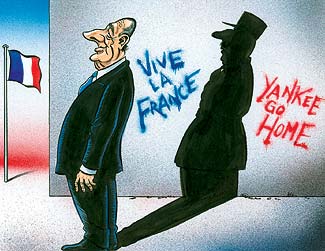
The pro-Chirac L'Express magazine, for example, commented recently that though one could certainly criticise the way America and Britain had chosen to go to war, and though George Bush's “messianic imperialism” was “disturbing”, it was also true that “the anti-Americanism gaining ground in Europe and encouraging—across the world—our diplomacy of pacifism will have serious consequences: we have assumed the responsibility of breaking the unity of the democratic world and of relying on allies who share little of our values. In short, we have deliberately chosen to split our natural base and to cosy up to countries that do not belong to it. Why?”
Good question.
The
Economist 27/3 2003
This /Iraq/ war shows the need to construct a united Europe
and
rapidly create a European defence force. This war demonstrates the
urgent need for
Europe to advance political union, to become a federal
Europe, both more
democratic and integrated.
Laurent Fabius,
formerly prime minister of France
Financial Times 26/3 2003
Edith Cresson has become the first former Commissioner to be
charged with corruption.
Ms Cresson, who is also a former French prime
minister, has been charged by the Belgian authorities with counterfeiting
benefiting from professional contracts.
EU
Observer 25/3 2003
Den europeiska
upplösningen griper omkring sig.
Senast är det Frankrike som
säger nej till det europeiska
monetära samarbetets krav på
budgetdisciplin.
DN-ledare 27/2 2003
Defiant France rules out austerity
package
Financial Times, February 25 2003
Jacques Chirac, has strongly criticised EU Agriculture
Commissioner, Franz Fischler, for his "obstinacy"
over the reform of the Common Agriculture Policy
EU Observer 24/2
2003
Det enade Europa
President Jacques Chiracs förolämpande ordval -
"ouppfostrade" - om de kandidatländer som uttalade sin solidaritet med
USA, är inte någon stundens förlöpning av en irriterad
politiker utan faktiskt ett utslag av en fransk hållning.
Frankrike
fruktade Tysklands enande men lät sig lugnas med euron.
DN-ledare 20/2 2003
France's economic ties
to Iraq
BBC 13 February, 2003
Fransk
politik är billigt effektsökeri
Ulf Nilson Metro 2003-02-12
Chirac sees a united Europe as a
necessary counterweight to the American hegemon.
The Economist 30/1
2003
Storm clouds are gathering over
Paris
France receiving a warning that it must fix its budget deficit by
2006
or face the consequances.
BBC 22/1
2003
Fransmännen började oroa sig för att de
proamerikanska och frihandelsvänliga britterna skulle bestämma
dagordningen. Man kan nästan höra hur ropen ekade mellan Berlins
väggar: Achtung, Engländer!
Sydsvenskan 22/1 2003
The German European Commissioner Günter Verheugen and his
French colleague Pascal Lamy have called for
a Franco-German federation.
EU Observer 21/1 2003
France has raised its budget deficit forecast
for 2002 to 2.8% of gross domestic product (GDP), one day after the European
Commission issued the country with an "early warning" over its existing
deficit.
BBC
20/11 2002
Why France disdains America
John Vinocur International Herald Tribune
2002-10-09
France faces rebuke over budget
deficit
Financial Times, October 9 2002
France defiant over budget
deficit cuts
France on Monday night defied its partners in the
eurozone, and refused to start cutting its budget deficit in 2003, in breach of
its commitments under the European Union's growth and stability pact.
"Röde Danny" (Cohn-Bendit)
vill att Europa blir USA:s motpol
SvD utrikes 2002-08-04
Den europeiska
upplösningen griper omkring sig.
Senast är det Frankrike som
säger nej till det europeiska
monetära samarbetets krav på
budgetdisciplin.
DN-ledare 27/2 2003
Inte större underskott än tre procent av BNP, bruttonationalprodukten, får det bli. Blir underskottet större måste medlemsstaten göra något åt det. Sådan är överenskommelsen. Flera medlemsstater klarar inte att hålla treprocentgränsen och har också fått varningar för detta samt fått lova att göra något åt saken.
Värst har det blivit för Portugal, som både fått anmärkning från EU-kommissionen och EU-kollegerna och satt i gång ett åtstramningsprogram. Det senare svider hårt i ett av EU:s fattigare länder. Också det forna ekonomiska loket Tyskland har misslyckats, varnats och utfäst sig att göra något för att hålla sig till de överenskomna reglerna.
Så icke Frankrike alltså.
- Att strama åt budgeten i det här läget är fel, det gör vi bara inte, lyder budskapet från den franske regeringschefen Jean-Pierre Raffarin. Sannolikt kommer därför det franska budgetunderskottet också i år att överskrida 3 procent. Därmed utmanar han EMU-reglerna.
Och det må vara. Premiärminister Raffarin har förvisso rätt när han pekar på att en åtstramning i form av höjda skatter, minskade utgifter, magrare bidrag på kort sikt inte skulle göra gott i det ekonomiska stillastående som nu råder.
RE: Det låter som s.k. "förlegad Keynesianism"
Men det är en sak att reglerna inte är de bästa och att de därför kan behöva ändras, en annan att förklara att man inte tänker följa dem.
| EU's Prodi Calls Deficit
Reduction Accord `Stupid' Paris, Oct. 17 (Bloomberg) |
EMU-beslutet
större än EU-beslutet Göran Persson i Europa-Posten nr 7/2002 - Jag vet hur viktig stabilitetspakten är för mig som anhängare av en nationell finanspolitik men en europeisk penningpolitik. Det som ska förena eld och vatten där är stabilitetspakten. Om den ska börja vattnas ur - då måste vi ju prata om det. |
Why France disdains America
John Vinocur International Herald Tribune
2002-10-09
Two new books by French authors, one at the top of the best-seller list, the other described as a work of exceptional scholarship, are confronting the French with the proposition that their anti-Americanism is a self-inflicted national illness.
For one of the authors, the anti-Americanism of the French is a willful delusion, an attempt by a dominant political and intellectual caste to mask its own failures and insignificance.
For the other, French anti-Americanism is a centuries-old tradition - a layered accumulation of condescension and fear, vastly more significant than the French gift of a Statue of Liberty to the United States or the assistance of a Marquis de Lafayette - and a rare terrain in French national life where conflicting political and intellectual forces can find common ground.
Both books distinguish French anti-Americanism from normal criticism of the United States as pushing criticism beyond the rational to a level of virulence where it essentially defines French problems and inadequacies while undermining France's capacity to make its way in the world.
For a study that insists on what the author calls a profoundly French malaise inherent in French anti-Americanism - an essentially contrarian concept here - Philippe Roger's book, "L'Ennemi americain," has been received with exceptional praise. Le Monde described it as "a chef d'oeuvre of semantic history" and Le Nouvel Observateur said it was a "masterly" analysis of a French tradition that reflects a combination of stupidity, ignorance, and paranoia.
Jean-Francois Revel's "L'Obsession anti-americaine" has been rewarded with the number 1 place on the nonfiction best-seller list. The writer, the single right-of-center pillar of French intellectual life known outside the country, argues that anti-Americanism in Europe and particularly in France is so reflexive, even when the United States is right, that it has resulted in the Americans' no longer paying any attention to criticism even when it is reasonable.
Straining the pact
FT, May 15 2002
19:38
From Berlin, Brussels and other European capitals, the message going to the French government this week could scarcely have been louder or clearer.
I EU kan ingen
höra dig skrika (Le Pen)
Johan Hakelius, kolumn i Aftonbladet
2002-05-07
Explaining Le Pen's success
Apr 25th 2002 From The
Economist
French political leaders have rallied behind Jacques Chirac to make sure he trounces Jean-Marie Le Pen, the extreme right-winger who stunned France by winning a place in the presidential run-off next month. Mr Le Pen's success has sent an earthquake through European politics
FRANCE is still struggling to understand the implications of Jean-Marie Le Pen's unexpected success in winning a place in the second round of the country's presidential elections. The long-time gadfly of the extreme right has no doubt about the meaning of his success on Sunday April 21st. He describes himself as “the candidate of the French people against the candidate of the system. We are witnessing the toppling of a decadent, corrupt and ossified political system.” Many of his opponents might agree with him, at least about that.
Framgången för Jean-Marie Le Pen i det franska presidentvalet har ställt det mesta på huvudet. Förfärade och förundrade frågar sig människor i och utanför Frankrike vad det var som hände.
I ett slag har Frankrikes politiska framtoning blivit en annan. Underströmmen av missnöje med utvecklingen mot en öppnare värld, hårdare konkurrens och rörliga folkströmmar har förenats med liknöjdheten. När uppfattningen att min röst inget betyder förenas med inställningen att de etablerade politikerna är av samma skrot och korn och mest ute efter att hunsa och skinna den vanlige väljaren, bildas en vådlig förening. Det är den som skickat fram Jean-Marie Le Pen till en förstaplansroll.
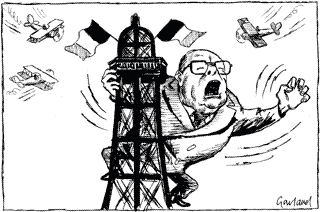
Monster from France's past bids for a bankrupt republic Daily Telegraph
Le
Pen, product of the EU Daily Telgraph editorial, 23/04/2002)
In a
sense, they are right. The old bruiser's election is indeed a challenge to the
European project; but not quite in the way that the Euro-leaders intend. For
the truth is that M Le Pen, like other anti-establishment demagogues around
Europe, is a product of the EU system. Supporters of European integration often
claim that it discourages extremism. To the extent that it prevents radical
parties from either wing from implementing their manifestoes, this is true. But
there is a down-side. As more powers are transferred to Brussels, voters begin
to sense that they are losing control of their futures. Sick of the ideological
consensus of their governing parties, despairing of being listened to, they are
driven to support politicians opposed to the entire system.
Far rightist
wooed voters with anti-immigrant line
International Herald Tribune
2002-04-22
Despite critics' charges that his name is a byword for bigotry and bullying, Jean-Marie Le Pen, a 73-year-old former paratrooper, has led his National Front party from virtually nowhere - 0.74 percent of the vote in 1974 - to a stunning success Sunday with appeals to voters' fears about crime and immigration.
Although the National Front split into two rival movements four years ago, Le Pen won public support with his tough talk about law and order, violence, immigration and the expansion of Islam in France.
EU tycks glömma Europas historia
Per Ahlmark
Kolumn i DN 2002-03-21
A conservative tide is sweeping Europe
ANATOLE KALETSKY
The Times, JANUARY 17
2002
Commissioners speak of Franco-German
confederation
EU Observer 2002-01-22
France's Europe
Financial Times
editorial January 22 2002
Giscard demands large salary
for EU work
EU Observer 2002-01-21
Chirac hit by
sleaze claim
A NEW scandal threatened to tarnish President Chirac
yesterday after the disclosure of claims that his former Government had paid a
ransom for French hostages in Lebanon and that senior Gaullists had pocketed
some of the cash.
The Times JANUARY 05 2002
France and Germany
back EU constitution
BBC, 23 November, 2001, 16:53 GMT
Giscard d’Estaing favour a
EU with federal powers
EU Observer 2001-10-12
Commissioners speak of Franco-German
confederation
EU Observer 2002-01-22
European commissioners Günter Verheugen and Pascal Lamy on Monday debated the idea of a Franco-German confederation, as a core of deeper European integration. Speaking at the Goethe Institute on the Franco-German relations and the future of Europe, the two commissioners discussed the principles of a Franco-German confederation, with a common army, common embassies in third countries, and a common seat at the United Nations Organisation as core elements.
The French and German commissioners, both socialists, also pointed out how important it was for the health of the EU that the Franco-German relationship delivers. "The Franco-German couple is the matrix for compromise in the European Union, the forerunner for important compromises. And this is not because they tend to agree on many issues: on the contrary, they have many divergent interests, but they have the political good will to reach compromise," commissioner Lamy said.
France's Europe
Financial Times
editorial January 22 2002
France is not the only country that is confused about the European Union of the future. But its loss of conviction matters more than most. For 40 years France has shaped the Union. Think of the Commission bureaucracy, the common agricultural policy or monetary union. Over the past decade French dominance has been diluted by EU enlargement and challenged by a Germany keen to assert itself.
Having long believed in a Europe built in France's image, the French no longer recognise the Union when they see it. That is the uncharacteristically blunt message from Pascal Lamy, the EU's trade commissioner, and Jean Pisani- Ferry, an economic adviser to the prime minister. In a refreshing report, they call for a radical reassessment of national interests.
France is not only fighting losing battles. Maintaining the cultural exception, preserving the CAP and maintaining at all costs the parity of influence with Germany are yesterday's wars. The French stance is overwhelmingly defensive. The French in general, and the left in particular, are uncomfortable with the liberal direction of European economic policy even though it has greatly benefited France.
The prospect of enlargement only deepens the sense of angst. It will accelerate the demise of the CAP, bring in pro-American states that are still enthusiastic for free markets, and further dilute French influence. The Paris elite has begun to question the consensus in favour of reuniting the continent.
There are legitimate concerns about organised crime, corruption and the ability of the new members to survive in the single market. Above all, there is the need to adapt the EU's institutions so that they do not seize up. But blocking enlargement would create an unthinkable political crisis that could wipe out the achievements of the last 40 years.
France is in danger of replacing Britain as Europe's most awkward member. It must not sulk on the sidelines. It must generate a positive agenda. Its influence depends on the strength of its ideas and not on its ability to hatch a deal with Germany.
There is a good chance that this year's elections will return a president and prime minister of the same political hue. The rivalries of cohabitation have distorted France's EU policy. If a united French government can articulate a coherent idea of Europe, France can regain the initiative.
Monday's report marks the first signs of new thinking in Paris in a long time. If the ideas are reflected in the forthcoming election campaign, they will help bring France out of its present cul de sac.
July 12th 2001 From The Economist print edition
France in
an Age of Globalization. By Hubert Védrine. Brookings Institution Press;
144 pages; $16.95 and £12.50
THE late Enoch Powell, a learned and provocative English Tory, liked to say that British foreign policy now consisted in finding out what the United States was going to want of Britain, and doing it in advance. It has often seemed as if the opposite were true of France. Charles de Gaulle, France’s leader from 1958-69, took pride in exasperating American presidents, starting with Franklin Roosevelt. French politicians since have continued the local tradition of twitching Uncle Sam’s beard.
The favour is returned. When in June last year Hubert Védrine, the French foreign minister, declined to join more than 100 other nations in an American-inspired declaration of support for democracy, the New York Times headlined its report, “At democracy’s picnic, Paris supplies ants”. Mr Védrine had already gained a certain notoriety in the United States by describing it in 1998 as the world’s only “hyperpower”, a term which sounds more pejorative in English than in French and which offended some Americans.
France’s official sleaze
July
14th 2001 The Economist
So why have the clouds gathered this year over Mr Chirac’s parade? Why are some politicians on the right, ostensibly his allies, muttering that he will lose to Lionel Jospin, the Socialist prime minister? Why do a few even muse that Mr Chirac may not put himself on the ballot paper?
The answer is that he faces an ever-rising tide of scandal. Over the past year Mr Chirac’s name has been linked to illegal kickbacks on public-works contracts, the illicit financing of political parties, phoney jobs for party members and, in a burst of headlines last month, the use of taxpayers’ cash—literally, since airline tickets and hotel bills were paid for with bank-notes—to buy foreign trips for himself and his family.
This week France’s now-relentless investigating judges began questioning former aides to the president, including his influential daughter, Claude, about the jaunts abroad. Next week they will, it is said, grill his wife. All that prevents the president himself being interrogated, even if only as a witness, is a lawyers’ stalemate. The president’s men invoke the constitution to say a president in office is above such things. The Paris prosecutor last week begged to disagree, but was this week contradicted by his superior on the Paris appeals court.
The Times,
JUNE 6 2001
LIONEL JOSPIN was forced to admit yesterday that he had
joined a small secretive Trotskyist movement in the 1960s. The Socialist French
Prime Minister had previously denied claims that he had been a member of the
International Communist Organisation.
His admission to the National
Assembly is particularly embarrassing as it lends credence to claims that he
initially joined the Socialist Party as part of a Trotskyist plot to infiltrate
political institutions.
Shades of
Trotsky
Wall Street Journal, 2001-06-06
Täcknamn Michel
SvD-ledare 2001-06-12
Han menade egentligen inget allvarligt, det bara blev så. Frankrikes premiärminister Lionel Jospin har avslöjats som f d trotskist. Saken har väckt stor uppmärksamhet eftersom Jospin har ljugit om sitt förflutna. Men vad kan man annat vänta av uppburna socialister? Kamrater på vänsterkanten hävdar nu att det var en ungdomssynd, och "vem har inte varit kommunist i sin ungdom"? Tja, de flesta har inte varit kommunist i sin ungdom, och ännu färre har ljugit om det, särskilt bland premiärministrar.
Man förstår dock varför. Jospins
medlemskap i en hårdför trotskistsekt var nämligen ingen
ungdomssynd, utan varade under täcknamnet Michel ända till 1987,
då han hade avancerat till en hög post inom socialistpartiet.
Infiltration är en trotskistisk arbetsmetod, som uppenbarligen fungerar
för tillträde även till de högsta av maktens boningar. Det
har aldrig varit rätt att vara trotskist, vare sig 1917 eller 1987.
Hade Jospin varit högerpolitiker och avslöjats med motsvarande
extremistbakgrund skulle hans karriär ha varit slut. Men han är
vänster.
Även
Klas Eklund var
Trotskyist,
"trottare", som han numera, som chefsekonom på SEB,
leende säger.
Då brukar direktörerna skrocka.
Trotsky var inte snäll bara för att han blev mördad av Stalin.
Frankrikes Jospin
visar vägen, trots allt
Ledaren, Aftonbladet 010602
Med sitt EU-tal markerade den franske premiärministern att han står för en sorts blandform mellan federalism och nationernas Europa. Egentligen vore federalism den enklaste vägen till ett mer demokratiskt Europa. Med en klart definierad överstatlig struktur skulle vi slippa dagens dunkla förhandlingsspel och byråkratvälde, där väljarna inte har någon möjlighet att utkräva ansvar för EU:s samlade politik utan bara för den egna regeringens agerande. Men det politiska stödet för en sådan lösning räcker inte till. Tyskland står isolerat. Det blir en blandform även i fortsättningen. Då har Lionel Jospins modell en fördel i det att den hakar fast byråkratin och ekonomin i de politiska strukturerna, ökar ansvarigheten och tillåter EU att ägna sig åt frågor som berör människor i deras vardag. Därmed skulle Jospins modell på litet sikt även kunna bidra till ett mer folkligt förankrat och demokratiskt Europa.
French
lesson: Harmony on integration and taxes means disharmony ahead
The Times, Leading article 2001-05-29
Thus, while M Jospin
unsurprisingly rejects last month’s proposal by his German fellow
Socialist, Chancellor Gerhard Schröder, to abolish the executive role of
the Council of Ministers and turn it into a European version of the German
Bundesrat, he supports the idea of an elected President of the European
Commission. And he has no problems with “a gradual controlled
process” of “transferring powers to the Union level”. Again,
while insisting that inter-governmental co-operation is
“indispensable”, he has his own agenda for dictating policies from
Brussels, beginning with “economic government of the eurozone” —
the emphasis is M Jospin’s — which would “act to stop any
behaviour detrimental to the general European interest”.
Frankrike spjärnar emot
DN-ledare 29/5 2001
Denna EU-skeptiska opinion finns i Frankrike både till
höger och inom den vänster som är Lionel Jospins väljare.
Det var också detta traditionella vänsterskeptiska perspektiv som
präglade premiärministerns tankar om "framtiden för ett utvidgat
Europa". Lionel Jospin hade mer att säga om den europeiska livsstilen
än om de europeiska institutionerna. Ingen tvekan om vart spetsen var
riktad: mot den amerikanska kulturimperialismen och mot en globalisering som
hotar traditionella franska, förlåt europeiska, värden.
Lösningen blir mer av gemensamma sociala regler för att skydda
européerna, "Europa kan inte vara bara en frihandelszon".
French
Leader's Blueprint Sets Out a Socialist Europe
International Herald
Tribune, May 29, 2001
Prime Minister Lionel Jospin of France proposed a
wide arc of left-wing social ambitions for Europe's future on Monday, with
perspectives that swept from harmonized working conditions and universal access
to schooling abroad to a so-called economic government that would serve as a
political watchman over the independent European Central Bank. . In a speech
that was as much an expression of Socialist election campaign liturgy as a
design for the future structure of the European Union, Mr. Jospin paired the
left-wing vision of a treaty on common social standards and state-controlled
consolidation of public services with much narrower proposals for institutional
change in the EU.
Through its left-wing character, Mr. Jospin's blueprint
seemed less than a real plan for the EU because it excluded the instincts of
vast numbers of European moderates, centrists and rightists.
Ideas
confirm worst fears of sceptics
Daily Telegraph 2001-05-29
By
Ambrose Evans-Pritchard in Brussels
LIONEL JOSPIN has confirmed the
worst fears of British Eurosceptics, calling for a full-scale "economic
government" along socialist lines to buttress the euro and a single criminal
justice system.
On the economic front, Mr Jospin said the creation of the
euro had left unfinished business in EU affairs. "In order to rebalance the
European edifice, we now need an economic government. The co-ordination of
economic policy must be greatly increased," he said. One of its tasks would be
to "stamp out behaviour detrimental to the general European interest". In a
direct attack on Britain, M Jospin said it was necessary to combat "fiscal
dumping", the term used on the Continent to describe the low-tax forms of
capitalism in Anglo-Saxon countries.
An
election about Europe
Daily Telegraph 2001-05-29
TONY BLAIR
apparently pleaded with the French Prime Minister, Lionel Jospin, not to make
his speech yesterday. Now we know why. M Jospin spelt out the
Euro-integrationist agenda in pitiless detail: an operational EU police force;
a common criminal justice system; uniform asylum and immigration policies; a
European foreign policy conducted by an EU diplomatic corps; full economic
union, including a mechanism for fiscal transfers. If even a quarter of M
Jospin's agenda were implemented, the EU would cease to be an association of
states, and instead become a state in its own right.
Lionel Jospin's vision for the EU
Financial Times
editorial, May 29 2001
Of course, this was the speech of a French socialist and it was directed in significant part at his domestic audience. Mr Jospin was setting out his stall for next year's presidential elections in France, presenting himself as both a committed European and a patriotic Frenchman. Like all his fellow European leaders, Mr Jospin's first focus is on his home constituency.
That explains much of what he would like to see among the functions of a future EU, including the vague idea of a European social treaty, a European industrial policy and a desire to curb what he calls "unfair tax competition". He also wants an "economic government of the euro-zone", with closer co-ordination of economic policies.
These are long-standing French ideas that have not hitherto won much support from other member states. They do not seem likely to do so now, even if they stir up an anxious debate in the overheated atmosphere of the UK election campaign.
More important is Mr Jospin's strong support for the idea of a "federation of nation states" as the future model for the EU, deliberately preserving the ambiguity inherent in its present structure.
It is a constructive ambiguity. The French premier wants to have both integrated European institutions and sovereign nation states - an idea he shares with Tony Blair, his British counterpart, Joschka Fischer, the German foreign minister, and Jacques Chirac, his own president.
The European Council (of heads of government) and the Council of Ministers remain at the heart of his constitutional vision. But he does want a stronger democratic role for the European parliament. He suggests that the majority group after elections should appoint the president of the European Commission. The Council would in turn have the power to dissolve the parliament, imposing a restraint on any frivolous abuse of parliamentary authority.
All these ideas, and others such as the need for a European constitution and a second parliamentary chamber, must be debated long and hard between now and 2004 - the deadline for the next EU reform. Any changes will inevitably be a compromise and must be approved unanimously. The essential thing is that the EU should become more accountable, more democratic and more effective, even after its membership doubles with enlargement. It is an ambitious agenda.
Jospin
rejects federal EU plan
BBC 2001-05-28
Mr Jospin said
a proposal by Chancellor Gerhard Schroeder, under
which the EU Council of Ministers, would be turned into a chamber of the
European Parliament was unacceptable. "France, like other European nations,
could not accept such a statute nor such a concept of what a federation is," he
said in a speech to the Foreign Press Club in Paris.
Mr Jospin called for
Europe to create an "economic government" with a fund to help euro zone
economies in trouble.
I dag kapitalism? (Lepage)
Ur Timbro Idag
5-00
För tjugo år sedan, 1980, publicerade Timbro boken I
morgon kapitalism av den franske samhällsdebattören Henri Lepage. Den
blev bokstavligen utgångspunkten för vads om kom att kallas den
nyliberala rörelsen, genom att introducera begreppet nyliberalism i den
svenska debatten.
Charlemagne
Jacques Chirac, not what he was
The Economist Dec 21st 2000
Go back a few days, to the evening of December 14th, and imagine
you are a political spin-doctor in the court of President Jacques Chirac. Your
man is about to face the television cameras, and you are understandably
nervous. For he is besieged by tales of corruption, queried even by fellow
conservatives, dogged by whispers that at 68 he is not as robust as he seems.
A dreadful thought is in your mind: a bad performance—a drop too many
of sweat, a verbal gaffe, a sudden shiftiness in the eyes—could strip away
the presidential aura and mark the beginning of the end. In other words, with a
presidential election looming in the spring of 2002, Mr Chirac may start to
look like a loser against Lionel Jospin, the Socialist prime minister with whom
the electorate has condemned him to “cohabit” since the general
election of 1997. Indeed, might Mr Chirac even bow out beforehand?
Enlargement presents a chance to put right
all that is wrong with the EU
By
Hubert Vedrine, French foreign minister.
Tyskar och fransmän kohandlar om IMF och ECB mot USA
Eurocrats are from Mars, Cosmocrats from Venus - By Dominique Moisi
French Magistrates to Place ECB's Trichet Under Investigation
New Books from France
Reviewed by John Laughland
John Laughland is European
Director of the European Foundation.
Dakar is on the West African
coast and on the outbreak of the Second World War was used as a base by the
French Navy. After
the fall of France in the summer of 1940 the British government decided that
French ships would not be used by the German Navy.
On 23rd September
1940 the Royal Navy began bombarding Dakar.
Losses were suffered by both
sides and on 25th September Winston Churchill
ordered the abandonment of
the operation.
http://perso.wanadoo.fr/dakar.1940/forces-1.htm
http://www.watersideweb.co.uk/Barham/dakar.htm
http://aerostories.free.fr/dossiers/AA/vichy/page10.html
The plan
was based on the hope that local French forces in Dakar would rally to de
Gaulle as soon as they saw the combined British and Free French fleet draw
near.
Instead they stayed loyal to the regime of Vichy France which Petain
had now
established in the unoccupied zone of France.
Fransk-Tyskt samarbete på
1940-talet
Franco-German Cooperation in the 1940's

