Irland
Debunking myths:
Why austerity and structural reforms have had little to do with Ireland’s economic recovery
Aidan Regan, European Politics and Policy/LSE, 2 February 2016
The Irish recovery has nothing to do with austerity induced cost competitiveness and everything to do with a State-led enterprise policy to attract foreign direct investment (FDI) from the United States.
The European Commission argues that the Irish recovery is an outcome of the government’s successful implementation of their structural adjustment programme
The problem with this old fashioned concept of competitiveness is that the firms driving Ireland’s export-led recovery are in high-wage price inelastic sectors (biotech, pharmaceuticals, finance, business and computer services). What this means is that their products are less sensitive to movements in international prices.
Top of page
The Economist 16 February 215
Traumatised by the way Lehman Brothers’ collapse almost brought down the financial system,
the European authorities concluded back then that every bank was systemically significant and none could be allowed to fail.
This led to the egregious /Outrageously bad; shocking/ mistake of making Irish taxpayers bail out German, French and UK investors
in private Irish banks
FT Editorial August 4, 2014

It is slow moving variables — long term unemployment, gradual shifts in public opinion, and so on — that pose the greatest threat to the Euro’s survival.
If the far right does as well as people now seem to think it will in the European elections,
this will presumably be presented in the media as a “shock” to the system,
but has it not been obvious since 2010 at the latest that something like this was likely, given Eurozone macroeconomic policies?
And has it not been obvious for years that actually existing EMU is harming the broader European project?
Kevin O Rourke, The Irish Economy, 25 February 2014
Europe’s political leaders should remember what Ernest Hemingway said about bankruptcy.
“How did you go bankrupt?"
Two ways. Gradually, then suddenly.”
"The Troika has done more damage to Ireland than Britain ever did in 800 years," said David Begg, head of the Irish Confederation of Trade Unions.
Mr Begg said the image of Ireland as the poster-child of EU recovery was a myth culitivated by EU creditors whose only interest is to recoup their money.
"At least the IMF officials are willing to admit they have been wrong but the EU officials are total ideologues."
"It is like being in an awful World War One conflict where the generals have expended a million lives to gain one yard of ground, yet nothing will change their mind in face of all the evidence."
Ambrose 28 Feb 2013
The outburst comes a day after Irish unions reached a provisional deal with the government for a further round of public sector pay cuts averaging 5.5pc, rising to 10pc for higher earners such as doctors. This follows 14pc pay cuts already in force.
Irish Finance minister Michael Noonan played down concerns about the slide in sterling against the euro, saying the Irish economy is now strong enough to withstand the exchange rate shock even though Britain accounts for a fifth of the country's exports.
"We don't see a problem for sterling at present levels. We have cut costs right through the economy with an internal devaluation of 15pc or 16pc and we are now highly competitive."
Ireland shows the way with its debt deal
Rescheduling of promissory notes is monetary financing in all but name
Wolfgang Münchau, FT February 10, 2013
Everybody seemed to be talking about monetary financing of debt last week – the ultimate taboo in monetary policy. And hidden behind a veil of unbelievable complexity, the eurozone may have done just that.
Various European central bankers rushed to proclaim that the agreed rescheduling of Ireland’s so-called promissory notes would not set a precedent for sovereign debt laundering.
In legal terms, the agreement is probably watertight. It may be a borderline issue, but who cares?
In economic terms, the situation is much clearer. This is monetary financing in all but name – and a jolly good thing it is too.
The interest rates will be lower, but this is not the real issue,
as the Irish economist Karl Whelan explained in what must be the best paper ever written on ELA and promissory notes.
Dublin hails ‘historic’ debt restructure
FT 7 February 7 2013
Draghi calls Schäuble a lawyer
At last week’s Ecofin, Schauble said, what he had reported before, that in his view, Cyprus was not systemically relevant
(which means that Germany could not legally participate in an ESM programme, as systemic relevance is a legal pre-condition under the German ESM law).
Draghi also warned that a default of Cyprus would also impede Ireland’s and Portugal’s return to the market
Eurointelligence 28 January 2013
EU:s finanspakt: Irland röstar men har inget val
Gunnar Jonsson, signerat, DN 31 maj 2012
RE: En lysande artikel
Opinionsundersökarna spår en klar seger för jasidan, men inte beror det på entusiasm. Medborgarna avskyr den rådande svångremspolitiken. Samtidigt är de rädda för att alternativet är utestängning från både Europas inre kretsar och de internationella kreditmarknaderna.
På 90-talet spann den keltiska tigern av belåtenhet. En avreglerad ekonomi med låg bolagsskatt lockade till sig multinationella företag och spred välstånd vida omkring.
Dess värre var euroräntan för låg för det överhettade Irland. Lönerna drog i väg.
Och mellan 1997 och 2007 fyrdubblades fastighetspriserna.
Den internationella finanskrisen spräckte bubblan, och efter Lehmankraschen 2008 kollapsade Irlands banker.
Farorna borde ha varit synliga i kristallkulan, även om alla som vanligt är klokast i efterhand.
Men nu begicks det avgörande misstaget: regeringen bestämde sig för att rädda bankerna genom en totalgaranti för alla deras kreditgivare.
Den kapsejsande finans- och fastighetssektorn välte rakt ned i skattebetalarnas knä
Paralleller finns med Spanien.
Före krisen var de offentliga finanserna i ordning, men allt rasade när staten skulle ta hand om det privata skuldberget. 2010 var Irlands budgetunderskott svindlande 32 procent.
Den sämsta banklösning Spanien kan låna är Irlands.
Paul Krugman, New York Times, 22 May 2011
men tänk om de goda tiderna beror på bostadsbubblan, som på Irland
Rolf Englund blog 23 november 2011
That was the fateful day on which the then Irish government extended its infamous guarantee to the banks, and thereby saddled the Irish taxpayer with liability for years of excessive, corrupt and injudicious lending.
Jeremy Warner, Daily Telegraph March 31st, 2011
to the tune of €440bn – some 250 per cent of Irish gross domestic product.
Everything that has happened in Ireland since then, especially its daily recurring banking crisis,
has been a consequence of that fateful decision.
FT Lex February 22 2011
The government’s humiliation is a historic moment for Ireland. For the first time, allegiances dating back to the civil war of the 1920s have been overshadowed by a newer trauma.
The wreckage from the banking crisis is stained with red ink, not with blood; it will nonetheless permanently change Irish society.
Financial Times editorial February 28 2011
Common monetary policy is the case in point. No correcting mechanism was put in place to take account of the fact that measures decided in Frankfurt could at times be too hot or too cold for the smaller economies.
So, what a country such as Ireland requires is clever and flexible use of fiscal policy to offset common monetary policy.
Yet the proposed fiscal compact will do the opposite. It will tie both policymaking hands behind our backs.
The popular delusion that the fiscal compact is a cure for our economic problems is a fantasy that needs demolishing.
Michael O’Sullivan, Financial Times 29 March 2012
Look and learn from across the Irish Sea
A generation ago it would have seemed ridiculous to go to Ireland for economics lessons. Not any more
George Osborne, nowadays Chancellor of the Exchequer, The Times February 23, 2006
Irland växte snabbt under 90-talet. Med euron tillkom en låg ränta som blåste upp en jättelik fastighetsbubbla.
Politiker, bankdirektörer och näringslivstoppar blundade och höll varandra om ryggen.
Även banker i andra euroländer lånade glatt till allt och alla.
Bubblan sprack slutligen 2008, och regeringen fick för sig att utfärda en totalgaranti för bankernas långivare.
När bankerna rasade gick botten ur statskassan.
Gunnar Jonsson, Signerat DN:s ledarsida 24/2 2011
Det är sant att Anders Borg har prioriterat ordning och reda i den offentliga ekonomin. Men det har han inte varit ensam om.
Samma sak kan även sägas om finansministrarna i Irland och Spanien, länder som till alldeles nyligen fick ett gott betyg för sin ekonomiska skötsel och hade föga gemensamt med exempelvis Grekland.
Peter Wolodarski, DN 20/2 2011
zc
men tänk om de goda tiderna beror på bostadsbubblan, som på Irland
Rolf Englund blog 23 november 2011
Mario Draghi said in a reply letter to Fianna Fail that "
considerable progress" has been made in mending Ireland's banks but more needs to be done to ensure the stability of the country's financial system, the Wall Street Journal reports. There is still a “very large stock” of non-performing loans, bank restructuring is yet to be completed and viability of the banking sector has to be ensured.
Moody's Investors Service said Friday that the "sheer scale" of the impaired loans on the books of Irish banks may lead the ECB to insist in the coming euro-area stress tests that Irish lenders set aside more loan-loss provisions than the Irish central bank has required so far.
Eurointelligence 25 March 2014
Den keltiska tigern väckte en gång beundran.
Men den låga räntan i valutaunionen ledde till överhettning, lönerna rusade, politiker och bankirer blev fartblinda.
Lehmankraschen spräckte den väldiga fastighetsbubblan och sänkte Irlands banker.
Här begicks ett grovt misstag när regeringen utfärdade en totalgaranti för alla deras kreditgivare.
DN-ledare signerad Gunnar Jonsson, 16 november 2013
Skattebetalarna tog smällen, och så ville EU-kommissionen och centralbanken ECB ha det på den tiden.
Nästa gång står aktieägare och obligationsinnehavare först i kön.
Sammanlagt har Irland fått 67,5 miljarder euro i nödlån. Sedan 2008 har dessutom skattehöjningar och nedskärningar värda 28 miljarder genomförts.
Åtstramningarna har varit brutala. Nästa år väntas dock tillväxt nära 2 procent. Konkurrenskraften är god och fastighetspriserna har vänt uppåt ur djupet.
Euroländerna grälar vidare om bankunionen.
Tyskland vill inte betala för någon kollektivisering av andras problem och håller fast vid att räddningsfonden ESM bara ska ge stöd till länder, inte direkt till banker.
Eurokrisen är inte över
DN-ledare signerad Gunnar Jonsson, 16 november 2013
Exemplet Irland visar faran. När en bankkrasch knäcker en liten statskassa sprider sig verkningarna, vad tyskarna än önskar.
Kvar på akuten finns dessutom Portugal och Cypern, samt givetvis Grekland vars räddning ingen kan garantera.
Eurokrisen är inte över.
The number of Irish homeowners not making their mortgage payments increased again in the first half of the year,
highlighting how Dublin faces significant challenges as it prepares to exit its international bailout programme later this year.
Stubbornly high unemployment and declining wages have prompted the arrears crisis.
A 50 per cent fall in Irish house prices since 2007 exacerbated the problem by
leaving hundreds of thousands of Irish borrowers trapped in negative equity.
Financial Times, August 23, 2013
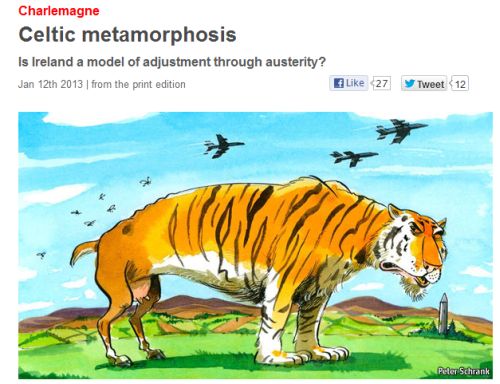
Ireland has a good claim to being a model of adjustment through austerity and structural reform.
Yet success is far from assured
Charlemagne, The Economist print 12 January 2013
After suffering a catastrophic banking and property bust, it has met its deficit-cutting targets. It has recovered much of its export competitiveness. Multinational firms that use Ireland as a low-tax base are investing keenly once more. The Irish economy has been growing, albeit slowly, in contrast with the shrinking in the troubled periphery of the euro zone. And Ireland is regaining market confidence, this week selling €2.5 billion ($3.3 billion) worth of bonds at a lower interest rate than its bail-out loans.
Yet success is far from assured. The Irish economy is a strange hybrid: the front legs of its export sector may have recovered tigerlike strength, but the hind legs of the domestic economy are more akin to those of a sickly Mediterranean goat.
Both parts are vulnerable. As a big exporter Ireland is exposed both to recession in the rest of Europe and to a global slowdown. At home the burden of its collapsed banking sector is a heavy drag on the economy
(Ireland’s public debt shot up from 25% of GDP in 2007 to about 120% this year, and the budget deficit is still 8% of GDP).
Merkel has cast doubt on one of the main benefits of eurozone banking union only hours after the bloc’s leaders agreed to a slightly clearer time table for the creation of a single bank supervisor.
Ms Merkel said that bad assets held by Spanish and Irish banks will not be cleaned up by the eurozone’s new €500bn rescue fund, adding that it should only be used to shore up teetering financial institutions in the future.
Financial Times 19 October 2012
The debate over whether the U.S.’s largest banks are too big is heating up.
Since the 2008 financial crisis, the perception has taken hold among some analysts and economists that certain U.S. institutions are too big to fail, meaning they would have to be bailed out to protect the financial system in the event of another calamity.
The continued downward spiral in Europe raises a similar question: Are some banks too big to save, meaning their collapse could dramatically worsen the euro crisis
(as happened in Ireland in the fall of 2008 and is happening now in Spain and Greece)?
Simon Johnson, who served as chief economist at the IMF in 2007 and 2008, Bloomberg 3 September 2012
Måste Spanien upprepa Irlands misstag?
I Irland fick oron till följd att regeringen införde en bankgaranti.
När Irlands banker fick problem med hotande bankrusning fanns ingen "lender of last resort".
Hur kunde eurons konstruktörer glömma att förse valutaunionen med en fungerande centralbank
Danne Nordling 2 juni 2012
The fiscal treaty will not solve Europe’s crisis
The Spanish and Irish crises stem from too much cross-border private sector borrowing and lending
Today’s large fiscal deficits are a result of, not the cause of, Ireland’s and Spain’s crises.
David McWilliams, Financial Times 28 May 2012
Economists And Post-Crisis Policy (Also Ireland)
Henry Farrell and John Quiggin have posted their fascinating paper on the rise and
temporary, I think) fall of Keynesian economics in the aftermath of the financial crisis
Paul Krugman, March 11, 2012
Why do I think it’s temporary? Because the austerians have gone from disaster to disaster.
Just for fun, look at Alan Reynolds proclaiming the triumph of austerity in Ireland in the summer of 2010, and Tyler Cowen doing it again last fall.
Irish EU treaty vote threatens chaos
Ireland has shocked Europe with plans for a referendum on the EU's fiscal treaty,
a move that risks an unprecedented fragmentation of the eurozone and a major clash with Germany.
"It gives the Irish people the opportunity to reaffirm Ireland's commitment to membership of the euro,"
/the PM/ told ashen-faced members of the Dail.
Ambrose Evans-Pritchard, 28 February 2012
The Irish voted "No" to both the Nice and Lisbon treaties before being made to vote again. Dublin has ruled out a second vote this time.
Mrs Merkel's coalition base is in revolt over demands from Brussels and the International Monetary Fund for a boost in the EU rescue machinery (ESM) to €750bn (£635bn), the unspoken condition imposed by the rest of the world for unlocking global aid.
The new requests would push the German share of the funding to well over €300bn, breaching a €211bn ceiling set by the Bundestag in September.
Ireland will continue to receive loans under its €67bn package from the EU-ECB-IMF "Troika" even if it votes "No" but would be in serious trouble if it needed a second package later. The fiscal compact forbids to use of the ESM bail-out fund for non-signatories.
Ireland is getting a choice - which is more than other eurozone states
Democracy continues to interfere with the European Union's best laid plans.
It's bad enough that Greek elections could be held in April to allow voters there the chance
to express a view on new rules and regulations being imposed on them
Damian Reece, 28 Feb 2012
Citizens of Ireland will be asked to vote on Europe's fiscal treaty, which imposes new rules on their government's ability to control its own tax and spending, among other things.
The loss of sovereignty this implies is unpopular there, to say the least.
Irland ska hålla en folkomröstning om den nya europakten om budgetdisciplin
Det var definitivt inte vad Tysklands förbundskansler Angela Merkel ville höra
Irländarna kan mycket väl tänkas rösta nej igen.
Då får de väl, som traditionen och Tyskland bjuder, helt enkelt rösta om.
DN-ledare, signerad Gunnar Jonsson, 29 februari 2012
Den gröna ön hamnade på obestånd när finanskrisen spräckte bankbubblan, men Irland är inte emot budgetbalansering som sådan. Grundlagen påbjuder dock folkomröstning när makt ska flyttas till EU.
Både 2001 och 2008 sa irländarna nej till EU-fördrag, för att sedan ändra sig.
Ireland will hold a referendum on the eurozone fiscal treaty,
plunging Europe into months of uncertainty and potentially
placing a question mark over Ireland’s future membership of the euro
Financial Times, 28 February 2012
Under the Irish constitution, the Irish people have to vote to ratify any significant transfer of sovereignty to Europe. Dublin has held referendums on every significant EU treaty since 1987 when Raymond Crotty, an economics professor, won a landmark legal challenge against the state, forcing a plebiscite on the Single European Act.
Det välskötta Irland klarar krisen,
men kostnaden för euroäventyret är gigantisk
Nils Lundgren 15 februari 2012
Euron störtade Irland i kris därför att den privata sektorn, framför allt bygg- och fastighetsbranschen, lånade allt vad tygen höll till de låga räntor som ECB måste hålla för att det passade den jättelika tyska ekonomin.
Eftersom Irland inte kunde föra en egen penningpolitik anpassad för att klara den framväxande lånebubblan, slutade det hela med en enorm bankkrasch, när det stod klart att lånen inte kunde betalas tillbaka.
Banksystemet fick räddas av de irländska skattebetalarna till en kostnad som bara under året 2010 kostade 30 procent av BNP.
Fiscal irresponsibility; Greece, but nobody else.
Italy ran deficits in the years before the crisis, but they were only slightly larger than Germany’s
(Italy’s large debt is a legacy from irresponsible policies many years ago).
Portugal’s deficits were significantly smaller, while Spain and Ireland actually ran surpluses
Paul Krugman, New York Times, February 26, 2012
Recent events have given us a dramatic demonstration of
the reality of nominal wage stickiness.
Despite crushing unemployment, wages in Ireland and Latvia have come down only slightly
— but Iceland, by letting its currency devalue, achieved a quick 30 percent fall in wages relative to the euro zone.
Paul Krugman. December 24, 2011

Interndevalvering via Ådalsmetoden
No. The Irish Economy Is Not Recovering
via Brad deLong, 15 December
Ett år efter Irland fick sitt räddningspaket är läget fortfarande mycket mörkt.
Konsumtionen faller, investeringarna likaså, och folket är förbannade för att
nästa års budget mejlats runt i Tyskland innan det irländska parlamentet fått se den.
Enligt ekonomer kan ytterligare nödlån från EU behövas.
SvD nyhetsplats 29 november 2011
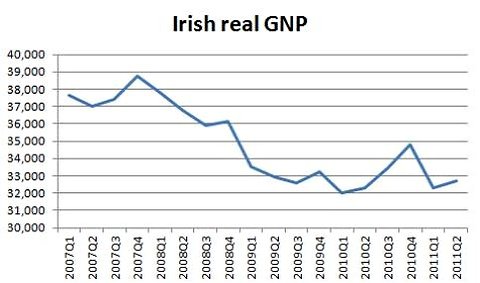
Real income, which bottomed out 18.4% below the previous peak, is now only 15.7% below that peak …
Paul Krugman, NYT 30 Sept 2011
I really wonder about the state of economics education.
Paul Krugman on Ireland
New Yourk Times 23 Sept 2011
The European Union’s Maastricht treaty was designed to deal only with imbalances in the public sector; but excesses in the banking sector have been far worse.
George Soros, FT August 14, 2011
The euro’s introduction led to housing booms in countries such as Spain and Ireland.
Eurozone banks became among the world’s most over-leveraged, and they remain in need of protection from counterparty risks.
Moody’s cuts Ireland to junk
The more politicians talk about private-sector participation for Greece,
the greater the risk of a downgrade for Ireland and Portugal.
Eurointelligence 13 July 2011
Sverige, Irland och deras Tiger-ekonomier och bostadsbubblor
Rolf Englund blog 11 juli 2011
The Irish finance minister, Michael Noonan, said that 30 September, 2008, will go down in history as the blackest day in Ireland since the Civil War.
That was the fateful day on which the then Irish government extended its infamous guarantee to the banks, and thereby saddled the Irish taxpayer with liability for years of excessive, corrupt and injudicious lending.
Jeremy Warner, Daily Telegraph March 31st, 2011
Irish negotiators were hoping to be able to announce with the recapitalisation that this ECB funding had been converted into some kind of medium term facility to allow the banks time to deleverage or find alternative deposits.
But there’s been unexplained silence on this front so far. The ECB seems to be struggling to agree mutually acceptable terms.
Euroländerna har enats om en plan för statlig bankgaranti
Veckans Affärer 2008-10-12
FI positiv till förslag om statlig bankgaranti
FI pekar dock på risken att explicita eller implicita statliga garantier kan ge upphov till icke önskvärda beteenden hos bankerna.
Pressmeddelande 2008-10-27
Alla banker har lämnat det statliga garantiprogrammet, meddelar Riksgälden.
Vid halvårsskiftet uppgick de utestående garantierna till 196 miljarder kronor. Vid årsskiftet var motsvarande siffra 271 miljarder kronor.
Som allra mest uppgick garantierna till 354 miljarder kronor.
Swedbank har tecknat nära 90 procent av garantierna
SvD Näringsliv/TT 10 augusti 2010
I find it unforgivable that the last Irish government guaranteed bank debt so insouciantly and that the rest of the European Union has supported this decision.
For a sovereign to destroy its own credit, to save creditors of its banks, is plainly wrong.
It does not make it better, but worse, that it is doing so largely to protect financial systems in other countries.
Martin Wolf, FT March 8 2011
Italy turmoil shows banking ‘doom loop’ still a powerful force
FT 5 June 2018
Måste Spanien upprepa Irlands misstag?
I Irland fick oron till följd att regeringen införde en bankgaranti.
När Irlands banker fick problem med hotande bankrusning fanns ingen "lender of last resort".
Hur kunde eurons konstruktörer glömma att förse valutaunionen med en fungerande centralbank
Danne Nordling 2 juni 2012
RE; Förra gången Sverige införde statlig bankgaranti
Enligt vår uppfattning stod det finansiella systemet i Sverige inför en kollaps den 24 september 1992.
Utländska långivare hade tappat förtroendet för det svenska banksystemet.
Bedömningen var att utan ett omfattande statligt ingripande hade vi stått inför en finansiell härdsmälta av aldrig tidigare skådat slag. Utan åtgärder kunde även i slutändan statens upplåning komma att påverkas.
Nationens hela finansiella funktionsförmåga stod på spel.
Stefan Ingves och Göran Lind, Ekonomisk Debatt nr 1/1998
Jag var statsminister under dessa år och fast övertygad om fördelarna med en hårdvalutapolitik. Det hade delvis att göra med de tidigare decenniernas erfarenhet av devalveringspolitik, men var
delvis en konsekvens av att jag strävade efter att Sverige skulle gå in i det europeiska samarbetets kärna, också den ekonomiska och monetära unionen, och därmed vara med i den gemensamma europeiska valutan från dess första dag.
Försvaret av kronan handlade om den viktiga kombinationen av ekonomisk politik och Europapolitik.
Carl Bildts veckobrev v1/2002
The banks are being forced to shrink to a size that poses less risk to the Irish economy.
They've been instructed to reduce the net loans on their balance sheets by 71bn euros by the end of 2013
- an amount equivalent to around half the value of the Irish economy.
Robert Peston, the BBC's business editor, 31 March 2011
And this process, known as deleveraging, is expected to generate another £11bn (12bn euros) of losses for the quartet of Irish banks, as certain loans and assets are bound to be sold or unwound for less than their face value.
Could the Irish banking system, where a single nationalised bank, Anglo Irish, has just announced losses of £16bn (18bn euros), equivalent to well over a third of all revenues received by the Irish government, be any more bust (and thanks to the journalist Fintan O'Toole for that comparator)?
Irish banks need extra 24bn euros to survive
Until now, losses in the Irish banking system have stemmed from the collapse of a speculative bubble in the commercial property sector, where billions were borrowed from the banks to fund hotels and shopping malls.
However, the latest stress tests focused instead on an emerging meltdown in the residential sector.
BBC 31/3 2011
The total total amount poured into the Irish banks since the financial crisis is close to 70bn euros.
That is equivalent to almost half of the Irish economy's annual output, or about 17,000 euros per Irish citizen - a burden that the government sees as unacceptable.
Full textThe unbelievable truth about Ireland and its banks
Total quantity of state investment a breathtaking 75bn euros - 45% of GDP
Robert Peston, the BBC's business editor, 30 March 2011
Regulators at the Irish central bank have conducted a review of how much extra capital - as a buffer against future losses - is required by Bank of Ireland, Allied Irish Bank, EBS and Irish Life and Permanent.
Unless something unexpected happens in the next 24 hours, the total amount of additional capital that will need to be injected into these banks will be a bit less than 35bn euros - including 8bn euros that was supposed to be injected into them at the end of February, but was postponed because of Ireland's political turmoil.
That would take the total quantity of state investment in Ireland banks to a breathtaking 75bn euros (actually a tiny bit more than that).
That is an almost unbelievably large number. When I think about it, I have a small panic attack - because it represents 45% of Ireland's GDP and 55% of its GNP.
The European Central Bank turned a blind eye to "irresponsible lending" by German, French, British and Belgian banks,
the European Union's former ambassador to the United States, John Bruton has said.
EUobserver 8/3 2011
In a damning speech at the London School of Economics on Monday (7 March) evening, Mr Bruton, also a former Irish prime minister of the same conservative political stripe as the current leader-elect, Enda Kenny, has accused Frankfurt of failing to use its powers to rein in speculative bubbles in countries such as Ireland and Spain.
"From 2000 on, British, German, Belgian, French banks, and banks of other EU countries lent irresponsibly to the Irish banks in the hope that they too could profit from the then obtaining Irish construction bubble," he said. "They were supervised by their home central banks, and by the ECB ... who seemingly raised no objection to this lending."
Moody’s cut the ratings of Irish banks to junk status
The downgrade means the unguaranteed unsecured senior bonds at Ireland’s six banks are now rated as non-investment grade, or junk.
FT, February 11 2011
Spain’s success is of acute relevance to the rest of the eurozone
Spain is where Ireland was a couple of years ago
Mohamed El-Erian, FT February 3 2011
Anyone familiar with the Byzantine complexities of European policymaking would not have been surprised to learn that
the latest round of EU bank stress testing is going to be – well, about as testing as the last one,
which famously found both Allied Irish Banks and Bank of Ireland to be perfectly solvent.
Jeremy Warner Daily Telegraph 9 March 2011
"Irish domestic banks currently depend almost entirely on the (European Central Bank) to refinance expiring market debt,"
Total debts of the six Irish banks approach USD 375 billion, more than 170 percent of Ireland's gross domestic product.
S&P senior analyst Frank Gill, CNBC, 2 Feb 2011
“Amazing” that the Irish government has “socialized” the banks
— some $80 billion in senior and subordinated debt — and made it the financial responsibility of Irish taxpayers, who didn’t create it.
Michael Lewis, author of "Liar’s Poker," "The Big Short" and "The Blind Side,"
CNBC 1 Feb 2011
The IMF’s Article IV report on Ireland published in September 2007 begins:
“Economic performance remains very strong, supported by SOUND policies. Given the Irish economy’s strong fundamentals and the authorities’ commitment to sound policies, Directors expected economic growth to remain robust over the medium term.”
The IMF said Ireland was in fiscal SURPLUS of 3pc of GDP and total public debt had fallen to just 12pc.
Ambrose Evans-Pritchard January 21st, 2011
Ireland had almost entirely eliminated its public debt.
Mr Barroso’s own staff signed off happily on Ireland’s accounts in their Stability Update report December 2007, discerning risks but agreeing that the country was “operating responsible fiscal policy”.
For Mr Barroso to talk now about Ireland’s ” fiscally irresponsible situation” is to rewrite history.
Irland
net outward migration to be 100,000 over the two-year period from April 2010 to April 2012.
CNBC 20/1 2011
An unprecedented financial crisis has forced Irish people, particularly young graduates, to once again seek opportunities overseas, echoing previous generations of departures and making emigration a hot topic in an upcoming parliamentary election.
The Economic andSocial Research Institute (ESRI) has estimated net outward migration to be 100,000 over the two-year period from April 2010 to April 2012.
The rate of departure is the highest in recent memory and overshadows even the 1980s, a decade scarred by emigration, when the net outflow peaked at 44,000 in 1989.
*
Ingen kan idag säga när Europa har fått en sådan geografisk rörlighet, en så stor federal budget och en sådan nominell löneflexibilitet att en gemensam valuta kan fungera från Sicilien till Nordkap.
Medan vi väntar på den dagen, bör vi dock ställa oss frågan, om vi vill underminera nationernas möjligheter till överlevnad som nationer i sådan omfattning, som krävs, när vinsten av en gemensam valuta enligt de studier som gjorts är så utomordentligt blygsam?
Ty en nation överlever knappast i längden som nation, om den inte kan erbjuda de egna medborgarna en inhemsk differentierad arbetsmarknad med det moderna samhällets alla kvalificerade arbetsuppgifter.
En egen valuta kan vara ett nödvändigt, ehuru naturligtvis inte tillräckligt, villkor för nationens möjligheter som nation under många årtionden framåt. Påståendet kan inte bevisas, men inte heller motbevisas och vi bör tänka efter vilka risker vi är beredda att ta.
Nils Lundgren 1994
Joschka Fischer om en ny allians mellan Paris och Berlin
Den irländska krisen har kommit mig att för första gången undra om euron – och därmed EU – kan gå i stöpet.
Trenden går i riktning mot ett ”tyskt Europa”, som aldrig kommer att fungera.
Joschka Fischer, Kolumn DN 28/12 2010
If Germany and its hard-money allies genuinely wish to save the euro – which is open to doubt –
they should stop posturing, face up to the grim imperative of a Transferunion, and
desist immediately from imposing their ruinous and reactionary policies of debt deflation on southern Europe and Ireland.
Ambrose Evans-Pritchard, 19 Dec 2010
Look and learn from across the Irish Sea
A generation ago it would have seemed ridiculous to go to Ireland for economics lessons. Not any more
A generation ago, the very idea that a British politician would go to Ireland to see how to run an economy would have been laughable. The Irish Republic was seen as Britain’s poor and troubled country cousin, a rural backwater on the edge of Europe.
Today things are different. Ireland stands as a shining example of the art of the possible in long-term economic policymaking, and that is why I am in Dublin: to listen and to learn.
George Osborne, Chancellor of the Exchequer, The Times February 23, 2006
Ireland: An extreme version of the British disease
Robert Peston, BBC 22 November 2010
ECB Expresses `Serious Concerns' About Irish Proposals to Stabilize Banks
Bloomberg 20/12 2010
Ireland
Severe Budget cutbacks will see drop in living standards
Middle-income workers, families and social welfare recipients will bear the brunt of a €6 billion fiscal adjustmeny
Irish Times, December 7, 2010
The budget documents are now online.
The server is clearly busy but I just downloaded all the documents.
Karl Whelan, December 7th, 2010
The EU Is Pushing Ireland to the Brink of Ruin
To make sure that the state does not drown in its debts,
the annual rate of growth has to be significantly higher than the interest due on the national debt,
If the Irish economy does not grow by 8-10 percent, then the country will end in a debt-deflationary spiral.
And even the most optimistic government projections are just below 4 percent.
Der Spiegel 8/12 2010
And the austerity measures will achieve little if Ireland does not get a handle on the problems with its banking sector. It is still the country's Achilles' heel.
Ever since the Irish government's fatal decision to provide a blanket guarantee for all debts and deposits at the banks, the fate of the state has been linked to that to the financial institutions.
And those toxic debts left over from the real estate boom are still lurking in their accounts.
Irlands nedskärningar motsvarar 110 miljarder kronor
Rolf Englund blog 7/12 2010
In the spring of 2010, fiscal austerity became fashionable.
I use the term advisedly: the sudden consensus among Very Serious People that everyone must balance budgets now now now wasn’t based on any kind of careful analysis.
It was more like a fad, something everyone professed to believe because that was what the in-crowd was saying.
Paul Krugman, NYT October 21, 2010
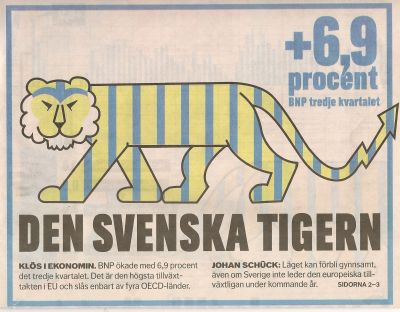
Sverige bekräftar nu sin plats bland tigerekonomierna.
Under fjärde kvartalet 2010 växte Sveriges bruttonationalprodukt (BNP) med 7,3 procent och tillväxten för hela fjolåret blev 5,5 procent, den högsta siffran sedan 1970.
e24 2011-03-01
Ireland Central Bank governor Patrick Honohan warned repeatedly that the credit bubble was out of control and would end badly
Ambrose Evans-Pritchard 19 Nov 2010
It pains me to say this. I’m probably the most pro-euro economist on my side of the Atlantic.
I’m also a believer in the larger European project.
But given this abject failure of European and German leadership, I am going to have to rethink my position.
Barry Eichengreen
The markets attention shifted from the immediate funding problems to the underlying solvency issues.
Ireland’s interest rates under the EFSF will average 5.8%, and investors realised that this rate is too high to be sustainable.
As the country’s nominal growth is almost certain to lie well below that number for many years to come, Ireland’s debt will be on an explosive trajectory.
The markets have come to recognise that Ireland is insolvent. This morning, the yields on 10 years were close to 9.5% - which entails a high default probability.
Eurointelligence 30/11 2010
Here's what we Eurosceptics were saying about Ireland and the euro in 1998
Daniel Hannan November 21st, 2010
If the ECB determined monetary policy to suit the majority of participants, it would give “the peripheral states a double-dose of what they don’t need: low interest rates”. The consequence would be an unsustainable credit boom in some of those states and, in due course, a commensurately painful crash. The UK, we cautioned, should pay particular attention to what happened in Ireland: The UK and Ireland would be especially badly affected by monetary union with the Continent.
It would be nice if the BBC stopped trotting these characters /EMU-suportes/ out as if they were disinterested experts, while presenting those of us who opposed the euro as Right-wing eccentrics.
We don’t want an apology, those of us who got the call right: we just want to be listened to next time.
Daniel Hannan November 21st, 2010
Daniel Hannan is a writer and journalist, and has been Conservative MEP for South East England since 1999. He speaks French and Spanish and loves Europe, but believes that the European Union is making its constituent nations poorer, less democratic and less free.
Det var inte folket som besegrade eliten.
Det var den slutna ekonomins särintresse som besegrade den öppnas
Lars Jonung kolumn DNs ledarsida 10/9 2004
Nejsidan fann sitt starkaste stöd hos låginkomsttagare, anställda i stat och kommun, lågutbildade, LO-medlemmar, kvinnor och på landsbygden.
Ja-väljarna fanns främst bland höginkomsttagare, privatanställda, högutbildade, egenföretagare, Saco-medlemmar, män och i städerna.
Det finns jätterisker att det inte fungerar.
Att Irland kommer att misslyckas att få till sin ekonomi i alla fall – att de kommer att gå i statsbankrutt
och vara tvungna att be om att få sina skulder nedskrivna.
Om det händer har privata skulder i banker och finansbolag flyttas över till skattebetalarna.
Ekots Staffan Sonning 22/11 2010
Cui bono? The banks, of course.
I Sverige har bostadspriserna rusat i höjden med hela 116 procent på tio år.
Det är lika mycket som i Spanien och betydligt mer än på krisdrabbade Irland
där priserna stigit med 34 procent sedan år 2000, enligt SEB.
Expressen 24/11 2010
Back in 2007, Ireland’s net public debt was just 12 per cent of gross domestic product.
This compares with 50 per cent in Germany and 80 per cent in Greece.
Martin Wolf, FT November 23 2010
Spain, too, had net public debt in 2007 at just 27 per cent of GDP.
If the fiscal rules had been applied as ruthlessly as German policymakers say they now want (though their predecessors resisted their application to themselves in the early 2000s), they would have affected France and Germany more than twice as often as Ireland or Spain between inception of the eurozone and the current wave of crises.
It was not the public but the private sector that went haywire in Ireland and in Spain. In the low interest rate environment caused principally by chronically weak demand in core European countries – Germany’s real domestic demand was a mere 5 per cent higher in 2008 than in 1999 – asset prices and credit exploded in several peripheral countries, particularly Ireland.
The public-sector rescue of Ireland's banks is predicated on the idea that the banks' creditors will be reassured
by a lifting in their capital resources from 8% of assets to 12%.
Robert Peston BBC 29 November 2010
The fact is that a 12% "core tier 1 capital" ratio - while it may be a multiple of the protection that was in place for banks three years ago - will be seen as still too low by some investors and many international regulators
Ireland: An extreme version of the British disease
Robert Peston, BBC 22 November 2010
1) Banks that became too big and too dependent on overseas borrowing
2) Banks that lent far too much to commercial and residential property, fuelling an unsustainable boom that has gone pop
*
Irland gick in i den finansiella och ekonomiska krisen utan underskott och med närmast exemplariskt skötta statsfinanser.
Kanske är vi i Sverige blinda för att vi befinner oss i en irländsk/spansk situation med lånefest och, än så länge, stigande bostadspriser.
Rolf Englund blog 21/11 2010
The Irish bailout is not, after all, what one normally thinks of as a bailout
— it’s not like the Texas S&L bailout, where national taxpayers assumed the losses of failed Texas banks.
It’s simply an agreement to lend Ireland funds at more or less safe market rates.
We can also see why the bailout isn’t likely to succeed. The basic situation is that given the cost of rescuing Ireland’s banks
and the damage harsh austerity is inflicting on Ireland’s economy,
investors are understandably skeptical that the Irish government will actually be able to meet its commitments.
Paul Krugman New York Times November 23, 2010
De som försöker skuldbelägga Europeiska centralbankens låga ränta för den ohållbara låneexpansionen har en poäng.
Skeptiker till euron vädrar morgonluft och upprepar sin gamla kritik mot den gemensamma valutan:
– Vad var det vi sa, säger de. Euron passade inte för Greklands behov och den passar inte heller för Irlands.
Vad som krävs är en nationell räntepolitik och nationella valutor, som går att devalvera.
Peter Wolodarski, DN Signerat 21/11 2010
---
Peter Wolodarski försvarar EMU om Irland och Grekland
Rolf Englund blog 2010-11-21
Var det den gemensamma valutan som ligger bakom Irlands problem.
Skulle krisen ha dämpats om den irländska riksbanken hade kunnat höja räntan för att kyla av den keltiska tigern? Har landet drabbats av en så kallad asymmetrisk chock?
Ja, svarade Lars Calmfors. Han anser att Irland är ett tydligt exempel på att den gemensamma räntenivån i hela euroområdet kan skapa problem för enskilda länder.
Annika Ström Melin, DN Signerat 18/11 2010
Till skillnad från till exempel Grekland gick nämligen Irland in i den finansiella och ekonomiska krisen utan underskott och med närmast exemplariskt skötta statsfinanser.
Irland skulle, enligt Lars Calmfors, ha behövt en högre ränta – eller en stramare finanspolitik. Därför anser han att den irländska krisen visar att begreppet asymmetrisk chock inte är en teoretisk konstruktion, utan en högst praktisk verklighet.
Harry Flam höll inte med.
Poängen i den här artikeln är inte att döma vem av professorerna som har rätt. Men hur man än definierar en asymmetrisk chock finns ett politiskt ansvar för krisen som kan och bör utkrävas. Det räcker med att tänka på Storbritannien för att inse att det är för enkelt att skylla på euron.
Full textThe eurozone is pressing ahead with the same approach it has followed ever since the collapse of Lehmans
When in doubt, sign another blank cheque to private creditors, and try not to think about the money, or the moral hazard.
Stephanie Flanders, the BBC's economics editor, 22 November 2010
At the start of this year (Thinking the Unthinkable), I considered whether what the world needs now is not just a mechanism to allow banks to fail in the future, but to allow sovereign governments to fail as well. Chancellor Merkel may be right to want to find one, but right now the eurozone looks weaker, not stronger, for her efforts. We don't have a reasonable way to talk about restructuring any senior debt at all.
The two largest creditors to Ireland are /banks in/ the UK and Germany,
with loans outstanding of $149bn and $139bn respectively
An Irish bank default would affect the German and British banking systems directly, and require significant domestic bank bail-outs.
Wolfgang Münchau, FT November 21 2010
Cui bono? The banks, of course.
It was an old-fashioned property bubble
Ireland Central Bank governor Patrick Honohan warned repeatedly that the credit bubble was out of control and would end badly
Ambrose Evans-Pritchard 19 Nov 2010
Highly recommended
Dr Honohan was the towering prophet who foresaw the Celtic Calamity. A former official at both the World Bank and the IMF, he warned repeatedly from his perch at Trinity College Dublin that the credit bubble was out of control and would end badly.
His paper written for the World Bank in early 2009 entitled What Went Wrong In Ireland? recounts a catalogue of errors by Fianna Fail over the years and the pitfalls of euro membership, and is perhaps the best primer as to why the country is now under de facto tutelage of the EU and the IMF.
"It was an old-fashioned property bubble. Lengthy success lulled policy makers into a false sense of security. Captured by hubris, they neglected to ensure the basics, allowing a rogue bank's [Anglo Irish] reckless expansionism," he wrote.
Officials disclosed that the Irish central bank had extended €20bn ($27bn) of exceptional liquidity to the banks in September and October
– over and above the €130bn they had been lent by the European Central Bank,
which itself was one-quarter of all ECB lending to eurozone banks.
Financial Times November 19 2010
Bond markets sensed this extra aid meant one or two Irish banks might be close to using up all the assets they could put up to tap ECB liquidity.
It is not an exaggeration to say that there would not be a banking system in Ireland - and therefore not an economy in any conventional sense
- if it weren't for the generosity of the European Central Bank in providing loans to Irish banks
that the markets won't provide.
Robert Peston, the BBC's business editor, 15/11 2010
Until the country joined the European exchange rate mechanism in 1979, the Irish pound was virtually identical with the UK pound.
Samuel Brittan 18/11 2010
It was more than a fixed exchange rate. If you went on holiday to Ireland from England you did not have to convert any money. UK currency was generally acceptable even in the most fervently Republican areas. This did not always work completely the other way round. London cab drivers were not overenthusiastic about accepting Irish “punts”, but they ran no real risk in doing so. At a different level, some Irish banks operated indifferently across the island, as if the border with the North did not exist. And while some UK citizens liked and others disliked the many Irish residents in the country, there was no real feeling that they were foreigners. (I have always been struck by the parallel with Germany and Austria, a comparison disliked by my Austrian friends).
The breakaway from sterling in 1979 and later reflected as much political as economic factors. If the UK and the EU were at a parting of the ways, the natural instinct of Irish leaders was to go with continental Europe, even though it had some dubious economic consequences. There were times when Ireland had to go along with relatively low euro interest rates even when the Irish central bank made it quite clear that, given a free hand, it would have raised rates in the Republic. While the problems of other peripheral countries have reflected failure to align their costs and competitiveness with the euro heartlands, the Irish recession and debt are much more the after-effects of a financial binge, as in the case of the UK but on a magnified scale. The two economies hang together more than it is fashionable to admit.
The Good Friday agreements and subsequent progress may not have finally “solved” the problem of Northern Ireland, but the political atmosphere is much better than it has been for several decades; and in any splintering of the eurozone there should be fewer political obstacles to Ireland adopting sterling again, if that were in the country’s economic interests.
The conundrum is that the best course for Ireland would be to exit the euro zone,
depreciate its currency and restructure its bank debt.
Yves Smith, writes the blog Naked Capitalism, New York Times November 17, 2010
But euro zone leaders are just as afraid of a fracturing of the euro zone and imposing losses on still-weak banks as they are of voter wrath.
The only certainty is the evolving Irish crisis will prove to be interesting, and not in a good way.
The Irish government has issued guarantees to its banking system worth approximately 176 percent of Irish gross domestic product.
Irish banks, increasingly shut out of private markets, have grown ever more reliant on liquidity provided by the ECB.
Jacob F. Kirkegaard, research fellow at the Peterson Institute for International Economics,
New York Times November 17, 2010
Eventually, the central bank will turn off the tap, and the Irish government will have to accept the bailout to avoid domestic economic catastrophe.
Ireland borrowed and spent itself into a financial crisis.
Irish banks borrowed abroad and re-lent the money to Irish home buyers on the expectation that home prices would continue to climb.
When the real estate market collapsed, borrowers crashed, the banks came tumbling after, and so did the rest of the economy.
Sound familiar?
Jeffry A. Frieden, a professor of government at Harvard, author of Global Capitalism: Its Fall and Rise in the Twentieth Century."
New York Times November 17, 2010
Ireland
What is the fundamental problem that needs to be fixed?
And second, how can that problem be fixed?
Robert Peston, the BBC's business editor 18 November 2010
To state the obvious, and as I've been banging on about for days, it is the perceived weakness of Ireland's bloated, lossmaking banks that is the fundamental problem.
Is it the case that these hobbled banks would be able to borrow from commercial lenders again, and would become less dependent on the European Central Bank for funds, if all that happened was that a few more tens of billions of euros was injected into them as new capital, as additional protection against losses?
Or would investors and banks still be wary of lending to these banks, if they felt that the entity standing behind the banks - the Irish state - remained a credit of dubious worth?
Then there is the legendary good humoured fatalism of the Irish
“When you put your card in a cash machine these days and it says ‘Insufficient Funds’,
you can never be sure if it means you or the bank.”
Anatole Kaletsky
Auch deutsche Banken haben sich mit Milliardensummen in Irland engagiert.
Wo die Risiken liegen und wie viel Geld die einzelnen Institute im Feuer haben.
Handelsblatt 18/11 2010
SEK 796 miljarder
Dublin hopes to dress up any bail-out as aid for banks rather than the state,
but the distinction became meaningless when Ireland guaranteed its banks in September 2008.
Ambrose Evans-Pritchard, 18 Nov 2010 with nice pic
"The two are inextricably merged: it's an omelette that is impossible to unscramble," said Professor Brian Lucey from Trinity College Dublin.
He estimates the total cost of rescuing Anglo Irish and absorbing toxic debt through the 'bad bank' NAMA at €85bn.
€85bn x 9,37 = SEK 796 miljarder
Germany wants to bail out Ireland more than the Irish want to be bailed out.
The Irish financial problem, in contrast to the Greek one, is not caused by excessive government borrowing
but by the enormous losses suffered by the country’s private banks, which owe tens of billions of euros more
to their foreign creditors than they can expect to recoup from their dud property loans.
Anatole Kaletsky The Times November 17 2010
But banks in the eurozone can borrow unlimited funds from the European Central Bank and indefinitely avert failure.
This behaviour horrifies the Germans, who see that the ECB has been transformed from a bastion of monetary orthodoxy into a rehab clinic for bust banks
Cui bono? The banks, of course.
"Irland behöver EU:s lugnande tigerbalsam"
Läs här om Tigerbalsam
Krisen /för Irland/ bottnar i att boomen i alltför hög grad var lånedriven med banker som använde glädjekalkyler.
Däri ligger också den politiska skulden: man borde ha kylt ned marknaden.
SvD-ledare 18/11 2010
Att sätta stopp för oron för statsbankrutt handlar inte heller bara om Irland utan om rädsla för smitta till Portugal, Spanien och Italien
Trots sedvanligt larm och stoj har EU hanterat finanskrisens hyggligt.
Ju snabbare Irland nu sväljer den beska medicinen, desto lättare blir det att stilla marknadsoron
DN och SvD drar inga slutsatser av Irland och EMU
Rolf Englund blog 18/11 2010
När den amerikanska bostadsmarknaden dök sprack också den irländska fastighetsbubblan.
Bankerna kapsejsade under trycket av svajiga krediter och bostadsköpare som inte kunde betala sina lån.
Staten håller nu ett svårt sjukt finanssystem under armarna.
DN-ledare 18/11 2010
Självklart måste Irland fortsätta kampen mot sina budgethål. Hittills har landet gjort mer än de flesta, men det har inte räckt.
Otack är världens lön, kan säkert många irländare känna. Här har de under snart två års tid genomlevt brutala offentliga nedskärningar och lönesänkningar. Ändå straffar marknaden Irland med allt högre räntor på statspapper och en ny fas av finanskrisen.
Marknaderna fick skrämselhicka när förbundskansler Angela Merkel lovade att tvinga privata investerare att ta en del av förlusterna om ett euroland ställer in betalningarna.
DN och SvD drar inga slutsatser av Irland och EMU
Rolf Englund blog 18/11 2010
Europe heads back into the storm
Ireland’s basic problem is that it now has to choose between its own sovereign solvency and the solvency of its banks.
Other European countries – in and out of the eurozone – may soon face the same choice.
In such a world, keeping banks afloat with public capital risks sinking the sovereign
– and with it, the whole banking system.
Financial Times editorial November 17 2010
Supply side rabbits
How do you try to convince markets that an economy is going to grow even in the face of serious budget cuts, at a time of already high unemployment?
You produce some supply side structural reforms from a hat, et voila!
Kevin O’Rourke 16/11
This is how the IMF envisages getting growth in Greece, for example, and it is now being suggested that structural reforms will be a means of getting growth in Ireland as well:
I am a little confused by this. After all, it just a couple of months since Morgan Stanley provided a completely contrary reason for being bullish about Ireland:
Clearly, Ireland is facing major challenges in the quarters and years ahead. But, if there is one economy in the euro area that could meet such challenges, it is probably the Irish economy, in our view. Mind you, these strong preconditions are not a guarantee that Ireland will be able to overcome the challenges that lie ahead easily. But we believe that Ireland is fundamentally different from the other peripheral countries in that it is a fully deregulated, fully liberalised market economy. Hence, it should be able to adjust to the new environment and work its way out of the current situation more quickly.
The reason for my confusion is that if we are indeed fully deregulated and fully liberalised, it is hard to see where the Irish supply side rabbits are going to come from.
It is not an exaggeration to say that there would not be a banking system in Ireland - and therefore not an economy in any conventional sense
- if it weren't for the generosity of the European Central Bank in providing loans to Irish banks
that the markets won't provide.
Robert Peston, the BBC's business editor, 15/11 2010
The latest published figures, which almost certainly understate the true picture, show that the European Central Bank had lent 83bn euros to Ireland's domestic banks by the end of September and it had lent 130bn euros to all Irish credit institutions at the end of October.
Or to put it another way, ECB loans to Irish financial institutions were more-or-less equivalent to the current annual value of Ireland's Gross National Product.
To repeat, without the financial support of the ECB, Ireland would be bust right now.
Löpsedelstext från Dublin: 48 Hours to Save The Euro
Irland avvisar spekulationer om EU-stöd
Ekot 15/11 2010, med fin bild
I morgon och på onsdag möts EU:s finansministrar i Bryssel och då står Irland på agendan. Många håller det inte för otroligt att den irländske finansministern Brian Lenihan då ändå kommer att begära någon form av ekonomiskt stöd från EU.
Coca-Cola last week issued $4.5bn of three-year bonds on a rock-bottom coupon of 0.75 per cent.
Compare Coca-Cola with poor old Ireland whose three-year government bonds are now yielding 8.8 per cent.
Something is wrong.
Tony Jackson, FT November 14 2010
The Republic of Ireland is in preliminary talks with EU officials for financial support, the BBC has learned.
It is now no longer a matter of whether but when the Irish government formally
approaches the European Financial Stability Fund (EFSF) for a bailout
BBC 13 November 2010
The provisional estimate for EFSF loans is believed to lie between 60 bn and 80 bn euros, USD 82-110 bn.
The European Financial Stability Fund (EFSF) and The Permanent Crisis Resolution Mechanism (PCRM)
Rolf Englund blog 2010-11-12
"One of the most catastrophic political decision taken in post-war Europe"
The collapse of Lehman Brothers was without a doubt the single most symbolic moment of the financial crisis.
But for Europe it was on Tuesday, 30 September 2008, when the Irish prime minister gave a blanket guarantee for the entire banking sector.
Wolfgang Münchau, Eurointelligence 7/10 2010
The European Central Bank intervened to stabilise the Irish bond markets on Friday
after a report by a leading UK bank triggered investor fears that the country might turn to the international community for a multibillion-euro bail-out.
FT September 17 2010
The renewed bout of jitters sparked a half a percentage point jump in two-year Irish bond yields and pushed 10-year yields and the cost of insuring the country’s debt against default to record highs.
Ireland has shown what happens when you grasp the fiscal nettle, slashing public wages by 13pc –
to applause from EU elites – without offsetting monetary and exchange stimulus.
Ambrose Evans-Pritchard, 19 Sep 2010
Irish bonds have spiked even higher to a post-EMU record 6.38pc.
Two years into its purge, Ireland has a budget deficit near 20pc of GDP.
It is 12pc if you strip out the bank rescues, but the reason why the bad debts of Anglo Irish keep spiralling upwards is that
the economy keeps spiralling downwards. House prices have fallen 35pc. Nominal GDP has contracted 19pc.
It seems doubtful that the Celtic Tiger will ever roar again.
How did Ireland lurch into crisis once more
when most other European countries seem to have got to grips with their banking woes?
Sunday Times 3 oktober 2010
The problems began when Allied engaged in a destructive head-on battle for business with Anglo Irish Bank, its local rival. From 2003 to 2007, Allied lending to the Irish property and construction sector exploded from €6.7 billion to €30 billion. Right at the frothing peak of the market, from 2005 on, the bank doubled its exposure to the sector.
Ireland will take a majority stake in its second-largest bank, Allied Irish Bank
The bail-out costs will lift the fiscal deficit from the planned 11.75 per cent of gross domestic product in 2010 to 32 per cent.
This compares with the Maastricht treaty guidelines of 3 per cent.
FT, September 30 2010
Fintan O'Toole in the Irish Times:
"The choice is now stark: do we go on being "good Europeans" at the cost of destroying our own society or do we become "bad Europeans", lose the trust of our European partners, but save ourselves?"
Ambrose Evans-Pritchard, 08 Sep 2010
"There comes a point of existential crisis when even the meekest of countries has to put its vital national interests (first). We are at that point now," he said, deeming it the job of the ECB to shore up Anglo Irish if it thinks default poses systemic risk.
Fintan O'Toole in the Irish Times
This story is also not at all the way it’s being told. Yes, Ireland had fiscal austerity — but it also benefited from a devaluation and an inflationary boom in the UK.
Oh, and Irish interest rates fell sharply, which was possible because they were very high to begin with
So yes, you can boost your economy with fiscal austerity, as long as you also devalue your currency and sharply reduce interest rates.
Paul Krugman June 15, 2010
Our own single currency saw the exit of the Republic of Ireland in 1979 when the Irish pound free-floated against sterling.
It made sense for Ireland to express its nationhood with its own currency. The first impact was a modest devaluation against sterling, which helped to fuel Ireland’s great economic growth of the late 20th century.
Its surrender of its currency when it first entered the euro helped, as it gave Ireland lower interest rates that pumped up the credit bubble. Now it is a hindrance because it leaves Ireland less competitive.
John Redwood, The Times May 27 2010
Is the crisis coming back?
After the downgrading of Ireland by S&P, Irish sovereign bond spreads rose from 318bp to 344bp to level higher than before May, and even Greece spreads are now back at close to 10%, the level before the agreement on the EFSF. This means that the European rescue package have failed to calm down the market stress that triggered on those package in the first place.
There was further bad news from the US, where existing home sales declined by a record amount for July, giving rise to expectations of another decline in US house prices.
As ever, Calculated Risk has the best coverage of this.
The Wall Street Journal says in a comment that even a downturn to annualised growth rates of under 2% will feel like a recession.
In a 2% economy, there won’t be any job creation, or wage increases.
Eurointelligence 25/8 2010
The Irish Republic has had its credit rating downgraded
Thinks that the Irish government will spend 90bn euros helping the banks
10bn euros higher than previous estimates.
BBC 25/8 2010
The premium Ireland has to pay over Germany has risen to 3 percentage points
– the highest since March.
Ireland’s budget deficit, at 14 per cent of gross domestic product, is the biggest in the eurozone.
FT 17 August 2010
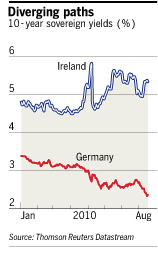
Ireland’s central bank governor, Patrick Honohan, added from Beijing that governments needed to convince investors that they would deliver on commitments to cut budget deficits. Ireland’s budget deficit, at 14 per cent of gross domestic product, is the biggest in the eurozone.
Concerns about Ireland rose last week after it unveiled a bigger-than-expected capital injection for nationalised lender Anglo Irish Bank.
Spreads on Irish 10-year bonds reached 297 basis points over German Bunds on Wednesday
amid reports the European Central Bank (ECB) is intervening to shore up Irish debt,
a reversal of the bank’s plans to withdraw emergency support.
The euro fell almost three cents against the dollar from $1.32 to $1.29.
Ambrose Evans-Pritchard, 11 Aug 2010
The latest jitters stem from the escalating costs of Ireland’s rescue of Anglo Irish Bank (AIB). The European Commission revealed this week that it had approved government support worth €24.3bn (£20bn) for the bank, significantly higher than estimates by Dublin earlier this spring.
The Irish Independent picked up these incredible comments from the Bundesbank in its monthly bulletin
in which it criticised Ireland, Spain, Portugal and Greece for running "persistently high" current-account deficits over the past decade,
which the Bundesbank says is a "source of danger" for the single-currency region.
Eurointelligence 20.07.2010
“Ireland's economic policies pose a danger to the eurozone as a whole and we should take measures to improve the economy ourselves rather than look to others to change”
(Interestingly, the Bundesbank does not think that persistent current account surpluses, which are the logical counterpart of current account deficits, constitute a “source of danger”. This suggests to us that the people who write these report are economically illiterate.)
Moody’s downgrades Ireland rating
Irish 10-year bond yields, which have an inverse relationship with prices, rose 8 basis points to 5.51 per cent, the highest level since the end of June.
FT July 19 2010
Reflections on a changed land
An Irish landscape of boom and bust
A Fortune writer tours the land of his ancestors for clues to the country's sudden fall from charmed to challenged.
photo gallery Fortune
Lars Calmfors, professor, DN Debatt 15/1 2010
Man kan försöka beräkna hur mycket den gemensamma ränta som ECB sätter för hela euroområdet skiljer sig från den ränta som skulle vara önskvärd för det enskilda eurolandet utifrån dess konjunktursituation.
European Economic Advisory Group har gjort sådana kalkyler /som/ tyder på att skillnaderna i konjunkturläge mellan länderna i dag är större än någon gång tidigare sedan EMU-starten.
Några euroländer har drabbats mycket mer av den pågående krisen än andra. Det gäller främst Irland, Spanien och Grekland.
De djupa nedgångarna i dessa länder beror dessutom i hög grad på att den gemensamma penningpolitiken inte tillräckligt motverkade de tidigare överhettningarna där med snabb kredittillväxt, fastighetsbubblor och kraftigare prisökningar än i omvärlden.
De mest aktiva EMU-förespråkarna har närmast velat förlöjliga argumentet om asymmetriska störningar. Men argumentet måste uppenbarligen även fortsättningsvis tas på största allvar.
Läs mer här
Varför ska Sverige gå med i EMU?
Framför allt Grekland, Irland och Spanien har under senare år haft kraftiga överhettningar som inte har dämpats tillräckligt av den gemensamma penningpolitiken.
Dessa överhettningar har bidragit till att de pågående konjunkturnedgångarna i dessa länder har blivit särskilt djupa.
Lars Calmfors Sieps JULI Nr 6-2009
Ireland will begin operating a new “bad bank” to house
€81bn in bad property loans left over from the financial crisis
and set out new capital requirements that are expected to see the further nationalisation of its banking sector.
FT, March 29 2010
The two biggest Irish banks, Allied Irish and Bank of Ireland tumbled Monday
Analysts expect the government to direct them to raise new capital to absorb
massive losses on bubble-era loans to real estate developers.
CNN March 29, 2010
Greece, Ireland, Portugal and Spain will cut the demand
So, unless as-yet-unspotted foreign cavalry ride to Europe’s rescue by buying up the continent’s products, aggregate demand will fall.
Less competitive Eurozone countries will be forced to deflate and shrink their economies to match Europe’s diminished and diminishing circumstances.
FT Editorial March 15 2010
People forget that one of the oldest currency unions in history, that between the UK and Ireland, was brought to an abrupt end when Ireland abandoned sterling – first for the European exchange rate mechanism and then for the euro.
Samuel Brittan, FT February 18 2010
With all the talk about debt crises last weeek, it is easy to forget that there is a real economic crisis afflicting Europe as well.
The fact that little Ireland is having to cut expenditure and raise taxes at a time like this will further worsen our own economic problems, but is of no broader consequence.
How many Irish people have even noticed what is happening in Latvia?
Kevin O’Rourke, The Irish Economy 14/2 2010
But if the entire periphery found itself having to fight market panic by cutting in an excessive fashion, simultaneously, that could be very dangerous — especially if Spain, or, God forbid, Italy, became involved as well.
Poland's Solidarity-era icon Lech Walesa will be in Ireland on Thursday and Friday to campaign for a "yes" vote to the EU's Lisbon Treaty ahead of the October 2 referendum, his office said.
Walesa, the shipyard electrician turned head of Poland's epic anti-communist Solidarity trade union, Nobel Peace Prize winner and former Polish president will be followed by European Commission president Jose Manuel Barroso who is planning a trip to Ireland on September 19.
Expatica 16/9 2009
Libertas leader rejoins battle against EU treaty
Irish millionaire and anti-Lisbon Treaty campaigner Declan Ganley has made a late and unexpected return to battle in the country's second referendum on the EU pact.
EU Observer 14/9 2009
Mr Ganley, the founder of Libertas - a eurosceptic political party which was hammered in the June EU elections - at a press conference in Dublin on Sunday (13 September) announced the revival of his anti-treaty operation, but this time on a much smaller scale.
Mr Ganley gave an extended interview to the Wall Street Journal, arguing that the very decision of European leaders to force a second referendum is reason enough to vote No again.
"Why, when the French voted No, the Dutch voted no and the Irish voted no, are we still being force-fed the same formula?" he said.
He also complained about Article 48 in the Lisbon Treaty, which according to Mr Ganley, allows EU leaders in future "with just intergovernmental agreement, with no need of going back to the citizens anywhere, [to] make any change to this constitutional document, adding any new powers, without having to revisit an electorate anywhere."
State of the Union - The Irish people had a vote on the Lisbon Treaty. They voted no.
"The Irish people had a vote on the Lisbon Treaty. They voted no.
A higher percentage of the electorate voted no than voted for Barack Obama in the United States of America.
No one’s suggesting he should run for re-election next month"
Declan Ganley, Irish Times, September 11, 2009
State of The Union
Vad är det som har en flagga, en nationaldag, en nationalsång, en militärstyrka, ett parlament och en högsta domstol.
En stat, naturligtvis. Vad är det mer en stat har? Jo, en valuta.
Det är därför europas ledande politiker har infört euron.
För att vara med om att rita om Europas karta, skapa ett nytt imperium, i Habsburgs efterföljd, som kan utmana USA, som vänstern hatar och högern föraktar.
Rolf Englund Internet 20/1 2003
Varför ska Sverige gå med i EMU?
Framför allt Grekland, Irland och Spanien har under senare år haft kraftiga överhettningar som inte har dämpats tillräckligt av den gemensamma penningpolitiken.
Dessa överhettningar har bidragit till att de pågående konjunkturnedgångarna i dessa länder har blivit särskilt djupa.
Lars Calmfors Sieps JULI Nr 6-2009
Påbörja konsolideringen 2010
Kommissionen har tagit första steget mot att starta budgetprocedurer mot Frankrike, Spanien, Grekland och Irland för att ha brutit mot stabilitetspaktens 3-procentsgräns.
Inga tidsgränser har ännu satts för när länderna måste sänka underskotten under 3 procent av BNP.
Det beslutet väntas fattas vid det informella ekofinmötet i Prag den 3-4 april.
Frankrike har villkorat korrigeringen av sitt underskott till den ekonomiska utvecklingen.
The Europe of Freedom and Democracy Group – the new eurosceptic party formerly known as the Independence-Democracy Group - announced its party name and political programme. The new party of 30 MEPs also intends to campaign against the Lisbon Treaty in the second Irish referendum likely to be held this October, with the party's co-president, Nigel Farage of UKIP, laying down a strong marker at the party's first meeting in the European parliament. EU Observer 1/7 2009
Mr Farage said Irish voters had already rejected the Lisbon Treaty in a referendum last June,
just as French and Dutch voters rejected the similar Constitutional Treaty in 2005,
but politicians were not willing to listen to their responses.
The wording below of the proposed Lisbon “guarantee” in Section A of today’s European Council decision or agreement, even if it were given binding European Treaty status by opening and adding a Protocol to the Lisbon Treaty, which is not intended - is about as useful as a gate in the middle of a field!
It purports to restrict the effects of the Lisbon Treaty on the Irish Constitution in ONLY ONE SMALL AREA - “the area of Freedom, Security and Justice“,
which is only one of 13 areas of shared competences in the EU, i.e. shared between the Union and its Member States.
The National Platform - For a Europe of Independent Democratic Co-Operating Nation States, june 2009
EU leaders have agreed a deal they hope will secure the Lisbon Treaty
a "Yes" vote in a second Irish referendum.
BBC 19/6 2009
Ireland won legally-binding assurances that Lisbon would not affect Irish policies on military neutrality, taxes and abortion, diplomats said.
French President Nicolas Sarkozy said leaders had agreed to Irish demands that the guarantees would be given the status of a treaty "protocol".
"legally binding decisions which clarify but do not change the treaty text"
The summit conclusions spell out that other EU member states do not need to ratify the treaty again on foot of the guarantees given to Ireland.
Irish Times June 20, 2009
That assurance was especially important for British prime minister Gordon Brown, facing a Conservative opposition hostile to the treaty.
The conclusions say explicitly that these are legally binding decisions which clarify but do not change the treaty text. This further confirms that the ratifications already made by other member states stand. The one substantive change since last year’s referendum, that each member state will retain a European commissioner, will be made on foot of a political not a textual decision – but only if the treaty is ratified here and elsewhere.
Despite the many political changes since the last referendum, including the definite shift in public opinion in its favour, its ratification cannot be taken for granted. A strong campaign based on civil society as well as political parties is needed to pass it, backed by determined efforts to inform voters on its real contents and a fair media debate concentrating on different points of view rather than distorted facts.
Ireland is ECB's sacrifical lamb to satisfy German inflation demands
Put bluntly, Ireland is being forced to roll back the welfare state and tighten fiscal policy
in the midst of a savage economic contraction
in order to uphold the deflation orthodoxies of Europe's monetary union.
Ambrose Evans-Pritchard, Daily Telegraph 12 Apr 2009
If Ireland still controlled the levers of economic policy, it would have slashed interest rates to near zero to prevent a property collapse from destroying the banking system.
The Irish central bank would be a founder member of the "money printing" club, leading the way towards quantitative easing a l'outrance.
Mr Lenihan hopes to shield banks from the calamitous consequences by creating a buffer agency. It will soak up €80bn to €90bn in toxic debt – or 50pc of GDP.
He borrowed the plan from Sweden's bank rescues in the early 1990s, but overlooks the key point
– it was not the bail-out that saved Sweden's financial system,
the country recovered only by ditching its exchange peg and regaining its freedom of action.
Depression buffs will note the parallel with Britain's infamous budget in September 1931, when Phillip Snowden cut the dole and child allowance to uphold the deflation orthodoxies of the Gold Standard – though in that case the flinty Pennine rather liked hair-shirts for their own sake.
Though few had any inkling at the time, Snowden's austerity drive would soon push British society over the edge. It set off a mutiny – a Royal Navy mutiny at Invergordon over pay cuts, in turn triggering a run on sterling. The pound was forced off Gold within days. Irish deliverance from EMU will not be so easy.
Ireland was betrayed by the European Central Bank, which opened the monetary floodgates early this decade to nurse Germany through a slump, holding rates at 2pc until late 2005, despite flagrant breach of the ECB's own M3 money targets.
Fast-growing Ireland and the Club Med over-heaters were sacrificed to help Germany.
Construction reached 21pc of GDP – a world record? – compared with 11pc in the US at the peak.
The success of the Irish government’s plans to set up a “bad bank” rests on details that have not yet been finalised.
The loans have a nominal value of €80bn-€90bn – about half of Ireland’s annual economic output.
Financial Times April 8 2009
Irlands ekonomi står inför en djup svacka.
Priserna faller, arbetslösheten är på väg upp över 14 procent och
budgetunderskottet har vuxit till nästan 13 procent av landets BNP, enligt landets centralbank.
Skär ned och försök undvik skattehöjningar. Det är centralbankens rekommendation inför krisbudgeten
DN 2009-04-03
Krisen slår inte minst mot bostadsbyggandet, som väntas rasa med två tredjedelar i år.
The Bank of England may have averted a catastrophe.
If ever there was a time when this country needed its own monetary authorities this is the moment.
Those nations with fossilised or timid central banks clinging to outdated ideologies are not so lucky.
Even less lucky are those such as Spain and Ireland that have surrendered policy to a body that is deaf to their pleas and constitutionally obliged to ignore the welfare of their particular societies.
They face crucifixion.
Ambrose Evans-Pritchard, Daily Telegraph, 08 Mar 2009
According to a cruel joke making the rounds these days,
the difference between Iceland and Ireland is one letter and six months.
Speculation that the euro zone's breakup is imminent
Wall Street Journal 23/1 2009
Lissabonfördragets slutgiltiga öde avgörs i Irland i höst
Rolf Gustavsson SvD 27/2 2009
Den irländska regeringen som i dessa dagar är mer impopulär än någonsin följer en handlingsplan som i stora drag är känd. För att på nytt kunna vända sig till folket måste den visa att förutsättningarna förändrats sedan nej-segern vid den förra omröstningen.
Vid EU-toppmötet före jul fick den gehör för principen att EU ger Irland några förtydligande förbehåll som förväntas minska motståndet mot fördraget.
Exakt hur den juridiska formeln för dessa förbehåll ska utformas prövar nu expertisen i Dublin och Bryssel.
Vid EU-toppmötet i juni förväntas de kunna presenteras och backas upp av EU-ländernas stats- och regeringschefer.
I vilken mån de är tillräckliga för att vända opinionen i Irland återstår att se.
I Tyskland hänger det slutliga godkännandet av fördraget på författningsdomstolen i Karlsruhe.
Där prövas under våren om fördraget skulle vara oförenligt med Tysklands grundlag
och beskedet från Karlsruhe väntas i maj eller juni.
Germany's constitutional court has been handed a second complaint over the EU's Lisbon Treaty
with the potential to delay the country's final ratification of the document for several months.
The complaint is being brought by... former MEP Franz Ludwig Graf Stauffenberg
EU Observer 27/1 2009
The referendum is a device viewed with suspicion by those who believe in representative government.
Yet first the French and Dutch, and now the Irish, have used the referendum to defend representative government.
Larry Siedentop, Financial Times July 1 2008
Very Important Article
Irländska staten skyddar alla banklån
DI/Direkt 2008-09-30 08:13
Irlands regering har beslutat att införa en bankgaranti som ska skydda all bankinlåning, säkerställda obligationer, och primära (senior) skuldebrev för bankerna Allied Irish Bank, Bank of Ireland, Anglo Irish Bank, Irish Life and Permanent, Irish Nationwide Building Society och Eduational Building Society.
Ireland was once dubbed the Celtic tiger economy and a model for the accession states of the European Union. However, with its construction and property markets stalling, last week it became the first country among the 15 members of the euro single currency to declare it was officially in recession.
With money markets frozen, Irish banks are seen as particularly dependent on interbank funding to finance loan expansion, which is seen as a vulnerability.
FT September 29 2008
Ireland’s banks suffered their biggest one-day fall in share price for two decades on Monday as fears swept the Dublin market about their ability to withstand the downturn in the Irish economy amid the global financial turmoil.
Brian Lenihan, finance minister, has already brought forward the December budget by seven weeks to address the crisis.
In an attempt to prevent a run on the banks, the minister raised the deposit insurance scheme from €20,000 to €100,000. This is the highest level in the EU.
Ireland leads euroland into recession as property crashes
Ireland has become the first country in the eurozone to slide into recession as the torrid housing boom of recent years turns into a deep slump.
Construction was 21pc of GDP at the peak last year, which is even worse than Spain (18pc) and far worse than America (11pc) at the height of the bubble,
Ambrose Evans-Pritchard Daily Telegraph 25 Sep 2008
"Italy will definitely be next, and probably Germany," said Julian Callow, Europe economist at Barclays Capital.
"Ireland is suffering from a massive reliance on real estate. Construction was 21pc of GDP at the peak last year, which is even worse than Spain (18pc) and far worse than America (11pc) at the height of the bubble," he said.
House prices have fallen for eighteen months in a row, according to the tsb/ESRI index. Average values are now down 13pc from their peak of €311,000, and show no sign of stabilizing.
Den stigande räntan drabbar inte svenskarna lika hårt som i många andra länder i Europa.
Den svenska ekonomin är betydligt bättre än i övriga EU, vilket gör det möjligt att kombinera räntehöjningen med en expansiv finanspolitik med bland annat sänkta skatter.
Lars Calmfors, Ekonomiekot 4 juli 2008
Spain, Ireland `Thrown to the Wolves'
July 4 2008 (Bloomberg)
I can think of only two reasons, why the loss of Lisbon should excite such anger and determination.
First, it doesn’t matter what the treaty does. It is just unacceptable for one small country to thwart the will of the political leaderships of the big countries.
The second reason could be that the treaty is crucial because it is the next stage in the drive for political union, which began with the Single European Act and continued with Maastricht and the creation of the Euro. Lisbon, in itself, is a disappointingly small step towards political union.
But - if it is stopped - the whole process is stopped. And that is unacceptable.
Gideon Rachman, Financial Times June 24, 2008
The Irish No campaign won by 862,415 votes to 752,451. Turnout was 53.1%.
Irish PM Brian Cowen said he respected the vote but it had caused a "difficult situation" that had "no quick fix"
"The government accepts and respects the verdict of the Irish people."
BBC 13/6 2008
Ett övertygande nej från Irland som sänder chockvågor över Europa.
DN 13/6 2008
The Independent (Ireland) about the Lisbon Treaty
Ireland should vote no to EU treaty
As the only EU country to hold a referendum on the Lisbon Treaty, Ireland today carries the can for the cowardly evasions of its partners.
Daily Telegraph 12/6 2008
Six years ago, work began on a constitution designed, in a bitter irony, to bring the union closer to the people. When that was rejected by French and Dutch voters in 2005, the EU, in time-honoured fashion, refused to take no for an answer and drew up an amending treaty in which the substance of the constitution was preserved but the need for further referenda minimised.
Ett irländskt nej skulle stoppa detta ”mini-fördrag” som tillkom som en nödlösning efter nederlagen för EU-konstitutionen i Frankrike och Nederländerna 2005.
Både politiskt och tekniskt skulle ett irländskt nej innebära ett mycket dramatiskt bakslag för EU-samarbetet.
Rolf Gustavsson SvD 11/6 2008
Ett nej på Irland i morgon skulle tyda på att den förtroendekris som första gången blottades 1992 fortfarande skulle bestå, trots alla ansträngningar att övervinna den, bland annat med Margot Wallströms ”Plan D” (demokrati, dialog och debatt).
Nej-sidan växer på Irland
SvD 10 juni 2008
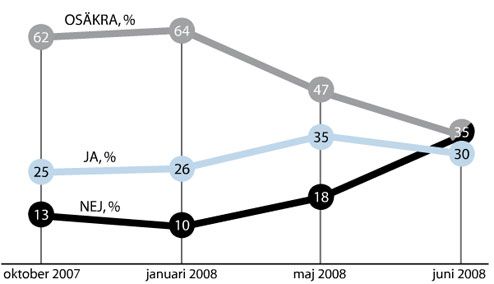
“June 12 is a great opportunity to hand Europe back to the half a billion people it belongs to.
We have to send a firm message to Europe’s leaders and send them back to the drawing board,” Mr Ganley, the businessman who leads Libertas, told reporters.
Financial Times 11/6 2008
Other EU governments are praying for a Yes vote in Ireland, the only member state putting the treaty to a referendum, because a No would represent a second demoralising blow after the failure of the EU’s constitutional treaty in 2005.
Ireland is in a unique and historic position as the only country required to ratify Lisbon with a democratic vote.
Ireland has a duty to vote no on June 12. Then the EU must work to address the democratic deficit which lies at the heart of its problems.
And then all the EU citizens must have their say.
Gary Byrnes, Dublin, The Guardian, June 11 2008
Irish voters were warned on Monday that the rest of the European Union would look at them with “gigantic incomprehension” if they rejected the bloc’s Lisbon reform treaty in Thursday’s referendum.
FT June 9 2008
Bernard Kouchner, France’s foreign minister, said Ireland had benefited more than other member states from EU largesse since it joined the bloc in 1973.
Government spending has fallen hard into the red, the global credit crunch has hammered a long-soaring property market, and unemployment is on the rise.
The Tiger attracted 200,000 eastern European immigrants who poured into Ireland when the bloc nearly doubled in size in 2004 – and now there are complaints that there aren't enough jobs to go around.
Unlike most European Union members, Ireland promoted an open-door policy for EU job-seekers.
Today, one out of every six jobs is held by a foreigner, including 90 per cent of the past year's newly created jobs, a government report found this month. EU critics claim the Lisbon treaty will accelerate the import of lower-salaried workers and export of jobs eastward.
http://news.scotsman.com/latestnews/Will-Irish-39ayes39-be-smiling.4167306.jp
Irlands folkomröstning och mp:s utträdeskrav
Per Gahrton (mp) 2008-06-08
Som vanligt har utsikterna till en nej-seger skapat panik från EU-entusiasterna och fått de s k journalister som egentligen alltid har varit propagandister att kasta masken, inte minst i DN. När Marianne Björklund upphetsat slår larm om den hotande nej-segern meddelar hon också att ja-sidan ju har stöd av ”samtliga Irlands stora partier”, medan nej-sidan består av en ”brokig samling” från vänster till höger (DN 7 juni). Men representerar inte också ja-sidan – precis som i Sverige, Danmark och många andra EU-länder – partier från vänster till höger som i de vanliga valen är varandras huvudmotståndare? Är inte sådana oheliga koalitioner också ganska brokiga – t ex den svenska ja-sidan från socialdemokrater till kristdemokrater?
As Irish landmarks go, there are few more symbolic than the GPO building on O'Connell Street in Dublin - the scene of the Easter Rising in 1916.
On Saturday, anti-treaty campaign groups gathered outside and unfurled a banner, which read:
"People died for our freedom. Don't give it away. Vote No."
http://news.bbc.co.uk/2/hi/europe/7442710.stm
Daniel Cohn-Bendit är fortfarande vår fiende
So what if the Irish did vote No?
In an interview with Le Monde, MEP Daniel Cohn-Bendit said
that an Irish No vote will put the question about the functioning of Europe back on the table of the French presidency and with it the question of veto rights. He argued a No vote should have consequences:
If a country votes No, it should leave the European Union.
Eurointelligence 9/6 2008
"Röde Dany", ledaren för den franska majrevolten 1968, står på barrikaderna igen.
Den här gången har han tagit på sig en verklig utmaning - att övertyga alltmer skeptiska franska väljare att rösta ja till EU:s nya grundlag.
- Vi har en mycket djup kris mellan allt fler människor och de styrande. Det finns ett avståndstagande från eliten, den politiska eliten, kultur-eliten och även medieeliten, inklusive mig själv. Vi kan inte knyta an till en massa människor därför att de inte längre har förtroende för oss.
DN 15/4 2005
Irland ska rösta om Lissabonfördraget den 12 juni.
Fördraget är ett stort steg
mot Europas förenta stater.
Ett nej vore välkommet eftersom detta är en sämre
kopia av det tidigare förkastade konstitutionsförslaget.
Vi Europavänner är inte
nöjda med lite ökad insyn från våra nationella parlament. Detta är centralism
om än i demokratiska former
Carl-Johan Westholm Dagens Industri 7 juni 2008
There was speculation in Westminster that the Prime Minister could be persuaded to use a "no" vote in the Republic to drop the EU treaty Bill that is currently before Parliament – allowing him to appear as if he is listening to voters while avoiding additional political pressure.
The Bill to ratify the treaty in Britain was approved in a vote of MPs in March, but it faces a more difficult passage through the House of Lords.
Peers will next vote on the treaty on Wednesday and a final vote – giving the go-ahead for ratification by the UK – will take place on 18 June, the day before an EU summit where leaders will attempt to push ahead with the treaty's key changes.
The Independent 8 June 2008
There always is a "Plan B" and the "colleagues" are not going to let a little thing like a "No" vote from a marginal country on the periphery of the Union derail their plans.
EU Referendum June 06, 2008
Wanted: plan C
Editorial The Guardian, June 7 2008
Majoritet mot EU-fördrag i Irland
Motståndarna mot EU-fördraget är för första gången fler än anhängarna i Irland där en folkomröstning hålls nästa vecka
DN/TT 2008-06-06
Ireland May Reject New EU Treaty, Irish Times Poll Indicates
The new European Union treaty may be defeated in a referendum in Ireland next week
June 6 (Bloomberg)
Opinion poll shows huge rise in anti-Lisbon sentiment
Independent Friday June 06 2008
Latest Irish poll shows EU treaty heading for defeat
EU Observer
Europa håller andan inför EU-omröstning
Rolf Gustavsson SvD 31 maj 2008
Folk skall ta ställning till fördraget på dess egna meriter, hoppas biskoparna.
Liknande förhoppningar hyser uppenbarligen EU-minister Cecilia Malmström som i torsdags i rent profana ordalag sände fördraget på remiss till Lagrådet. Hon förespråkar en svensk ratifikation eftersom fördraget gör EU öppnare och effektivare samt möjliggör en fortsatt utvidgning av medlemskretsen.
Däremot blir jag djupt betänksam när jag hör uppmaningar till allmänheten att noga studera fördragstexten. Texten är nämligen närmast oläslig för den som inte har långvarig träning i finstilta rättsakter. Den sluga idén 1992 att skicka ut Maastricht-fördraget till de danska hushållen kom från Nej-sidans Jens-Peter Bonde och så gick det som det gick. Danmark har fortfarande inte repat sig från sviterna av Nejsidans seger i juni 1992.
Ett eventuellt irländskt nej till Lissabonfördraget skapar en ny kris för EU:s ledare.
I Sverige skulle anti-EU-krafterna stärkas.
På spel står det med möda ompaketerade fördraget, i stort sett detsamma som förkastades 2005.
DN huvudledare 19/5 2008
För att Lissabonfördraget ska träda i kraft måste det godkännas av samtliga EU:s 27 medlemsstater. Hittills har 13 länder givit grönt ljus. Endast ett land - Irland - ska folkomrösta om fördraget.
Erfarenheterna från omröstningen om Nicefördraget 2001, då jasidan länge ledde stort men ändå förlorade, gör att ingen jaseger kan tas ut på förhand.
Alla folkomröstningar tenderar att bli jämna ju närmare valdagen kommer.
Sverige kan bli bland de sista länderna som godkänner Lissabonfördraget. Först senare i höst ska riksdagen ta ställning.
För ett par veckor sedan röstades miljöpartiets och vänsterpartiets krav på en svensk folkomröstning om fördraget ned.
Folkomröstningar bör i det längsta undvikas.
Det gäller i synnerhet i komplicerade frågor som nya EU-fördrag.
Nyligen polisanmälde sverigedemokraternas ungdomsförbund statsminister Fredrik Reinfeldt för högförräderi - på grund av att han undertecknat Lissabonfördraget. Sverigedemokraterna hoppas på ett genombrott i valet till Europaparlamentet våren 2009. Nej till turkiskt medlemskap blir en av paradfrågorna.
Folkomröstningar är måhända inte den optimala formen för beslut i komplexa frågor.
Det är angeläget att vi får en tidsplan, inför nästa mandatperiod, för en EMU-anslutning och så småningom för ett införande av euron.
Det tror jag skulle öka framtidstron bland för små- och medelstora företag.
Marie Weibull Kornias (m), Europaportalen 2008-05-12
Carl Bildt: Vi har inte tillräckligt mandat
/för att i riksdagen fatta beslut utan folkomröstning om EUs grundlag/
Carl Bildt hos Göran Rosenberg i TV4 2/12 2003
En folkomröstning kan vi vara utan
DN-ledare 2000-09-30
BBC: Irish referendum
The Irish Republic is the only European Union member state to have a public vote
Four high-profile voices in the debate
Click on the links below to read what they have to say.
12 May 2008
Click on the link to read what they have to say.
One of the non-party-political groups that opposes the Lisbon treaty is a free-market ginger group known as Libertas.
It kicked off its "no" campaign at the start of this month with giant posters of Tony Blair's former spin doctor and the slogan underneath: "Say no to Mandelson's Europe".
Click
Fler affärsmän som kampanjar mot EU just nu är mångmiljonären
Declan Ganley på Irland som startat en nej-rörelse mot det nya EU-fördraget inför folkormöstningen på Irland den 12 juni.
Europanytt 15/05/2008
The risk that the Irish will vote No to the Lisbon treaty
on June 12th is rising
The Economist print May 8th 2008
In Brussels the mood is equally stern. It is common to hear that a No vote in a small country cannot be permitted to interfere with the smooth running of the EU. In February the European Parliament voted down a (symbolic) amendment undertaking to “respect the outcome” of the Irish referendum.
The Irish, it is said, should remember what happened when they said No to the Nice treaty in 2001: they were simply invited to vote again. The second time round, they said Yes, thanks to a higher turnout, more energetic campaigning by a chastened government, and a protocol stating that Irish neutrality was unaffected by plans for EU defence.
A veteran pro-EU campaigner in Dublin predicts that a No to Lisbon would end the same way.
“A second vote is doable, we could always magic up a protocol,” he suggests.
Quotable Quotes:
“the proposals we dare not present directly” (short list)
The National Platform EU Research & Information Centre
Few Irishmen are better equipped than Pat Cox to make the case for Ireland's role in Europe.
But even the usually loquacious former president of the European parliament appeared to find it hard going this week persuading an audience of young solicitors why they should vote Yes in next month's critical referendum on the Lisbon reform treaty.
Financial Times May 3 2008
The collapse of the housing bubble in the United States is mutating into a global phenomenon,
with real estate prices swooning from the Irish countryside and the Spanish coast to Baltic seaports
New York Times 14/4 2008
In Ireland, Spain, Britain and elsewhere, housing markets that soared over the last decade are falling back to earth. Property analysts predict that some countries, like this one /Ireland), will face an even more wrenching adjustment than that of the United States, including the possibility that the downturn could become a wholesale collapse.
For countries like Ireland, where prices were even more inflated than in the United States, it has been a painful education
Emma Linnane, a 31-year-old university administrator.She bought a cozy, one-bedroom apartment in the Dublin suburbs with her fiancé, Paul Colgan, in May 2006, at the peak of the market.
They paid $575,000 — at least $100,000 more than it would fetch today.
De fyra största svenska bankerna har idag mer än hälften av sina sammanlagda tillgångar i utlandet,
framför allt i övriga Norden, men även i Tyskland, Polen och de baltiska länderna.
Nästan lika stor andel av deras sammanlagda rörelseresultat härstammar från utlandet.
Riksbankschef Stefan Ingves, Nationalekonomiska föreningen, 2008-03-13
Though many observers are rightly concerned about Spain, it may be Ireland that becomes the next serious test of EMU’s one-size-fits-all monetary policy.
Alan Ahearne, Eurointelligence 6/4 2008
Iin the process leading to EMU real interest rates sharply fell in countries such as Spain, Portugal, Ireland and the Netherlands.
This reduction in real interest rates led to an economic boom and overheating that – in the countries above – took also the form of a housing boom with excessive investment in real estate and sharply rising home prices.
The ensuing economic bust in the Netherlands and Portugal was particularly painful.
Nouriel Roubini, New York University and RGE Monitor, 28/6 2007
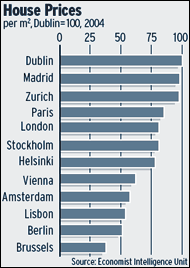
"The Irish are heavily dependent on exports of tech-goods to the US, so they're hit hard by the rising euro,"
said Bernard Connolly, chief strategist at Banque AIG.
Daily Telegraph 25/4 2007
The ECB has raised rates seven times to 3.75pc already, with vastly different effects on a 13-nation currency union. While the German bloc prospers, the 'Club Med' stragglers are at the tail-end of a property boom. Reverting to their old habits, they have lost competitiveness.
The Irish Tiger has been a star performer over the past decade but EMU membership has distorted the economy and caused a property bubble. Personal debt per capita has reached 190pc of GDP, the highest in the developed world. Bank lending grew at 30pc last year. House prices have risen at 16pc a year for the past decade.
Ireland may soon face the sort of problems encountered by Britain during the ERM crisis the 1992, when the fixed exchange rate system forced the UK to raise rates during an accelerating downturn. The big difference is that Ireland will have no way out.
There are two phases in an asset price bubble that repeat themselves with clockwork regularity.
In Ireland, the GDP share of construction and housing is 20.7 per cent.
Wolfgang Munchau, FT
Do current account deficits matter inside a monetary union?
he impact of low interest rates was greatest not where demand was weakest, but where conditions for a property boom were best: notably, in Ireland and Spain
Martin Wolf, FT 28/3 2007
The booms in Spanish and Irish real estate make the US real estate boom look timid
Charles Gottlieb of the Center for European policy studies, Nov 21, 2006
Ireland today is the richest country in the European Union after Luxembourg.
Thomas L. Friedman, The New York Times, 29/6 2005
Yes, the country that for hundreds of years was best known for emigration, tragic poets, famines, civil wars and leprechauns today has a per capita G.D.P. higher than that of Germany, France and Britain.
It tells you a lot about Europe today: all the innovation is happening on the periphery by those countries embracing globalization in their own ways - Ireland, Britain, Scandinavia and Eastern Europe - while those following the French-German social model are suffering high unemployment and low growth.
Irlands rekordhöga tillväxt är ett minne
blott
BNP växte bara med 0,5 procent i årstakt under
första kvartalet i år
Dagens Industri,
Gunnar Örn, 7/8 2003
IMF warns house prices may have risen too
high
Irish
Times 7/8 2003
There is a significant risk that house prices are overvalued, leaving the property market vulnerable if unemployment rises sharply, the International Monetary Fund (IMF) has warned. The boom in credit could have helped to push house prices to unsustainable levels, it says, leaving purchasers exposed and posing risks for banks and building societies which have lent them money.
In its latest assessment of the Irish economy, the IMF forecasts a pick-up in growth next year, but warns that declining competitiveness could hinder the economy.
Att döma av de irländska erfarenheterna spelar det
alltså ingen roll om Sverige röstar ja eller nej till EMU i
september. Handeln med euroländerna lär varken bli större eller
mindre för det.
Gunnar Örn, DI 7/4
2003
Irish urged to support enlargement after No vote
The European Union is set to ask the Irish parliament (Dáil) for a declaration backing enlargement if Ireland rejects the Nice Treaty for a second time, reports the Irish Times.
In this way EU officials are hoping to get around the fact that enlargement will proceed anyway despite the fact that the Irish would have voted against a treaty which facilitates it. However, they admit, according to the Irish Times, that such a declaration would not remove all the obstacles that will envitably follow in the path of a second rejection of Nice.
Irish citizens are due to go to the polls next Saturday, October 19.... more
The Irish should be nasty to Nice
By
Quentin Peel, Financial Times, October 1 2002 20:01
Irish referendum Saturday, October 19
The Irish prime minister, Bertie Ahern, this afternoon announced
that he has set the date for the second referendum on the Nice Treaty. It will
take place on Saturday, October 19.
Mr Ahern said that it would be a
disaster for both Ireland and the applicant countries if it were to be
rejected.
Ireland's once so successful "Celtic Tiger"
economy has been hit by negative economic developments recently, which might
undermine the government at a very critical time, analysts in Dublin fear just
around a month ahead of the planned second referendum on the Nice Treaty.
Without the approval of the Irish, the Nice Treaty will not be passed in
the whole of the EU....
more
Dublin to present referendum bill next week
Föredrag av Johan Norberg vid Näringslivets Fonds årsmöte den 27 augusti 2002.
The fate of the European Union’s expansion to 25 nations is in Ireland’s hands, Denmark’s Prime Minister has said. Anders Fogh Rasmussen, who takes over the EU presidency next Monday said another Irish ‘‘no’’ to the Nice Treaty which makes enlargement possible would throw the whole project into doubt. Speaking late last night in Copenhagen he said it would be a ‘‘political disaster’’.
Another
"No" expected in Ireland
EU Observer 2002-08-21
What to do if the Irish say No
By Kirsty
Hughes, Financial Times, August 5 2002 21:06
Ratifying Nice treaty poses big challenge
(Ireland)
Financial Times, May 19 2002 21:17
Tillbaka till globaliseringen
(buffertfonder, guldmyntfoten , Lars Jonung)
DN-ledare 2002-03-07
Sverige måste välja: antingen bli en bra EMU-medlem som Irland,
eller följa den stela tyska ekonomin i
spåren.
TO THE PRIME MINISTER OF SWEDEN
We, the undersigned representatives of Irish organisations opposed to the Treaty of Nice which are currently taking part in Irelands National Forum on Europe in Dublin, appeal to you to ensure that the Swedish Government does not proceed with ratification of this Treaty in view of the Irish peoples refusal to ratify it in their referendum last June.
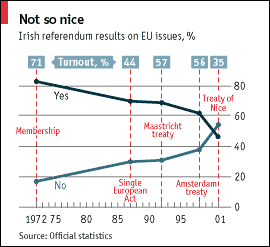
Folkomröstning om Nice i Irland
Ulven i EU:s fårakläder
avslöjas (Irland)
Björn von der Esch i SvD 2001-06-13
The Gothenburg summit of the European Union on June 15th
The
Economist 2001-06-13
was meant to mark the progress made towards
bringing as many as 12 new members into the EU. But an Irish referendum
rejecting the treaty which provides the basis for the EU's enlargement has been
a setback, sowing dismay and confusion
IF IRISH voters were concerned about their loss of influence in an expanding European Union, they must be rather gratified by the splash they made in their vote last Thursday. On a low turnout, of 35% of the electorate, 54% of voters—a mere 530,000 people—have managed to throw a serious spanner in the EU’s works: the only country to require a referendum to ratify the Treaty of Nice voted to reject it.
”Nej betyder nej även
från Irland”
Margit Gennser i Sydsvenskan 12 juni 2001
Måndagen den 11 juni i riksdagen, i anförande nr 51, sade Bo Lundgren (m):
Utfallet av den irländska folkomröstningen om Nicefördraget är mycket oroande. Den är en följd av lågt valdeltagande och en obehaglig kampanj av nationalister och vänstergrupper. Det är en kampanj för slutenhet och nationell egoism. Detta leder till att Europadebatten måste förnyas – där är vårt ansvar gemensamt – och ta sin utgångspunkt i de grundläggande värden; frihet, demokrati och fred som är grunden för den europeiska unionen. Det är dags att ta strid med de grupper som bekämpar öppenhet och fri handel.
Irisk skugga över Göteborg
Borås Tidning 2001-06-10
Johan Andersson Sundeen
Nej-sidans seger på
Irland
Rolf Gustavsson i SvD 2001-06-08
The Irish should be nasty to Nice
By Quentin Peel, Financial Times, October 1 2002 20:01
A dreadful thought is gradually dawning in the corridors of power of the European Union. In rather less than three weeks' time the voters of Ireland may well decide for a second time not to ratify the Treaty of Nice in their forthcoming national referendum.
At this moment nothing is certain. But the latest opinion poll published by the Irish Times shows a narrower margin of support than there was only days before the last referendum in 2001. That one was lost by 54 to 46 per cent.
If the Irish vote No to Nice they could hold hostage the entire enlargement process of the EU, intended to admit 10 new member states from eastern and southern Europe by 2004. The Nice treaty is the crucial enabling document setting out the new decision-making rules for an enlarged EU. It has to be ratified by all 15 member states for a new voting system to come into effect.
It is ironic that it should be a referendum in Ireland, a country that is normally extremely positive in its attitudes to the EU, that calls so much into question. The country has benefited financially more than any other member state, with the possible exception of Luxembourg. It looks ungrateful to say No now.
The trouble is, it is a lousy treaty that deserves to be rejected. The EU will become more clumsy, more opaque and more unintelligible to ordinary people once it comes into effect. What is needed is a simpler system - a straightforward double majority of member states and their populations. But that was not acceptable to France, because it would have given Germany a bigger influence. At Nice, Britain and Spain backed Jacques Chirac, the French president who was in the chair.
In fact, it would not be a disaster at all for the EU if Ireland voted No on October 19. It would be a very good thing. If it delayed enlargement for a few months, that would be a small price to pay for democracy. It might force the member states to pay a little more attention to their voters and scrap a bad treaty once and for all.
Another "No" expected in Ireland
EU Observer 2002-08-21
The most likely outcome of the second Irish referendum on the Treaty of Nice, according to the Economist Intelligence Unit, is another "No" vote."
A general election in the country four months ago have not brought much change, but although the result may be closer than initially anticipated, the most likely outcome is still another 'No', the EIU predicts.
Ireland's government and others across Europe were aghast in June 2001 when, on a turnout of just one third, Irish voters narrowly rejected the treaty, the Unit reports. The acrimoniously negotiated Nice treaty, which requires ratification by each of the 15 existing member states before entering into force, was framed to prepare the Union for a raft of new members.
The most recent opinion poll, taken in May, showed that support for Nice had sunk to a record low.
What to do if the Irish say No
By Kirsty
Hughes, Financial Times, August 5 2002 21:06
This autumn, European Union enlargement will at last enter its endgame, when 10 countries are due to complete negotiations for membership. Last-minute cliff-hangers on the budget and agriculture before a deal is clinched are inevitable and have been long foreseen. And while there is still no deal on Cyprus, the Helsinki Summit three years ago cleared the way to admit a divided island if necessary.
But the most serious obstacle, not anticipated in the many years of enlargement preparation, is the Irish referendum. Having rejected the Nice treaty in a referendum in June last year, Irish voters are to be asked - probably in October - to think again. The treaty, which details the institutional arrangements for an enlarged EU, has to be ratified by all 15 EU states to become binding.
Politicians in Ireland and from across the EU are scrambling to present a united front, insisting that a second "No" will stall enlargement, creating a political crisis. Upping the ante, they insist there is no plan B. Nice, they say, is vital for enlargement. Bertie Ahern, Ireland's prime minister, has appealed to voters not to tell the 10 candidate countries to "go to hell". Anders Rasmussen, the Danish prime minister, declared on taking over the EU presidency in July that "a new 'No' [would] jeopardise the whole enlargement process".
The European Commission has said it has no contingency plan. Irish voters are not convinced. They are well disposed towards enlargement but dubious about Nice. A recent opinion poll showed 60 per cent in favour of enlargement and only 17 per cent against, above the EU average.
But on the forthcoming referendum, opinion looks split evenly between Yes, No and Don't know. Treaty supporters are hoping a stronger Yes campaign will lift voter turnout from its low of a third last summer and reverse the 54:46 per cent rejection of the first referendum.
Ratifying Nice treaty poses big challenge
(Ireland)
Financial Times, May 19 2002 21:17
Nice was one four-letter word noticeable by its absence from the Irish general election campaign. But the need to ratify the European Union treaty on enlarging to the east before the end of the year is arguably the biggest single challenge facing the new government.
Last June, much to the surprise of Ireland's European partners, the Irish, long seen as one of the most pro-European electorates, rejected the treaty in a referendum.
On a turnout of just 34 per cent, Ireland voted No by a margin of 53.9 per cent to 46.1 per cent.
According to an eve of election poll in the Irish Times, voters are for the first time evenly split on whether they support the treaty. Some 32 per cent said they would vote for the treaty, down eight points on a previous poll in January, while the number of those prepared to vote against rose three points to 32 per cent.
The new government is expected to secure a declaration from its EU partners at the Seville summit in June reassuring the No camp that Ireland's neutrality is not jeopardised by participation in the European rapid reaction force.
But the Economist Intelligence Unit in a report in April concluded the Irish were "more likely than not" to reject the treaty a second time, which it said would "convulse the EU, raise serious doubts about its enlargement and precipitate one of the most serious crises in Ireland's foreign relations in the state's 80 year history".
Dan O'Brien, author of the report, says the political class, all of whom favour enlargement and support the treaty, believes the challenge is "simply to fill the information gap".
Svenska regeringen
erkänner att lagligheten i riksdagens ratificering av Nice-fördraget
kan ifrågasättas
Ur Prop. 2001/02:72 Ändringar i
regeringsformen samarbetet i EU m.m. Sid 31 ff
JOINT STATEMENT ON THE IRISH
REFERENDUM BY
GÖRAN PERSSON, PRESIDENT OF THE EUROPEAN COUNCIL AND
PRIME MINISTER OF SWEDEN
AND ROMANO PRODI, PRESIDENT OF THE EUROPEAN
COMMISSION
We are very disappointed at the result of the referendum in Ireland. Nonetheless we fully respect the outcome of this democratic process.
We know that the Irish Government and the Irish people are committed to the enlargement process. We trust that the Irish Government will make every effort to secure ratification within the agreed time frame.
The Presidency and the Commission are ready to contribute in every possible way to help the Irish Government find a way forward, taking into account the differing concerns reflected by this result, without changing the substance of the Nice treaty.
Meanwhile, of course, the work of the Union must continue and the Member States and the Commission will pursue the enlargement negotiations with undiminished vigour and determination, in line with our firm commitment given to the applicant countries.
The objective of an enlarged Europe must be realised. We must now find the most appropriate way to pursue the goals decided upon at Nice. Our will to secure the accession of new members must be clearly demonstrated.
The Presidency and the Commission are in the process of consulting the Irish Government and all other Member States in order to assess all the aspects of the outcome of the referendum. The meeting of the General Affairs Council on Monday 11 June will provide the first opportunity to discuss this matter.
This situation undoubtedly underlines the need for greater efforts from all of us to explain Europe to our citizens and to involve them more thoroughly in the debate about the Union, its role and its future direction.
Naughty or Nice?
The Wall Street Journal Europe, June 11,
2001
What do you call it when just under a million voters of a European island nation dash the aspirations of a continent of some 450 million souls?
To some, it is democracy in action. To others, the ungrateful greed of one the EU's most subsidized nations.
Still others are sure it is the reflexive close-mindedness of a traditionally inward-looking people. A fourth camp maintains that the embarrassment doled out to the Eurocrats by the Irish was payback for the slap on the wrist Ireland received in February for daring to continue its tax-cutting ways.
In all likelihood it is a little bit of all of them, with some extra ingredients such as concerns about Ireland's neutrality and a reaction to leftist warnings of a future "corporate" Europe -- whatever that means.
But we do know that the Irish do not have a history of euroskepticism comparable to Britain's. As an island nation on the edge of Europe, the threats of a flood of cheap East European workers probably did not loom as large in Irish concerns as it does in border countries such as Germany and Austria.
We also know that although Ireland has fed handsomely at the EU farm and regional subsidy trough, its sizable budget surpluses and rising living standard will soon make EU aid a thing of the past, irrespective of any crowding out that might occur when the EU takes on new subsidy burdens through expansion eastward. Indeed, the possibility of the loss of regional aid did not loom large in the campaign rhetoric or posters of the No campaign, which was spearheaded by a motley crew of hard-core leftists, pacifists and Irish nationalists.
Though many may think that the low turnout allowed fringe groups to carry the day, that's not quite the whole story, either. Of the 41 constituencies reporting results, 39 of them voted against the treaty, the only exceptions being Dublin Southwest and Dun Laoghaire, Dublin's port city.
This broad opposition came despite support for the treaty from all of Ireland's mainstream parties, both in the government and in opposition.
We last saw this kind of popular revolt against the opinions of the ruling class in Denmark, which last year defied its professional politicians by voting against joining the euro.
Should Tony Blair ever call his long-awaited referendum on British membership in the euro, all polls indicate that, Labour's overwhelming popularity notwithstanding, the pound would win and the euro would lose, despite the government's support for joining.
The lesson we draw from these periodic bouts of discontent with "Europe" is not that voters are predominately euroskeptic or are more concerned about protecting what they have than about making way for the future. We take it, rather, as yet another warning that the people of Europe still cherish their democratic prerogatives, and do not take it kindly when they feel that they've been neglected or trampled.
In Ireland, the most obvious candidate for a catalyst for last week's vote was the European Commission's February decision to reprimand Ireland for its fiscal policy, in spite of Ireland's low debt and budget surpluses. Nice was fundamentally a technical treaty, and as Deputy Prime Minister Mary Harney, who writes nearby, acknowledged in a recent interview, it is hard to sell a treaty without a clear message behind it.
But it was not hard for the average Irishman to understand that his government wanted to cut taxes, and technocrats in Europe tried to stop it.
Given this undercurrent of concern for national sovereignty, it would be a grave mistake, as Ms. Harney indicates in her piece alongside, for the EU to blithely ignore the Irish vote or treat at as a nonevent in the process of ratification.
It would make a mockery of the ratification process if the question were simply resubmitted to the Irish voters until they came back with the "right" answer.
For the Commission to issue, as it did, a statement saying "We trust the Irish government will make every effort to secure ratification within the agreed timeframe" only exacerbates the situation.
Like it or not, the Irish have spoken.
The Commission and the Irish government are well-advised to listen carefully to what they have said, and go forward from there. This may mean tinkering with the treaty to address Irish concerns; if this is not possible, a new treaty may need to be written.
All that said, however, it remains true that the vote last week may be more representative of the views of the Irish left than of the electorate as a whole. At some point, the government may have to go back to the voters and remind them that those who support a positive vision for Europe would do well to bestir themselves to vote and make their wishes known.
An upset for Europe
Quentin Peel, Financial Times, June
11, 2001
Last week, the republic of Ireland was regarded in the rest of the European Union as one of the most positive and enthusiastic supporters of the EU and all its works.
That was before Thursday's Irish referendum on the treaty of Nice. The reforms, intended to provide the legal basis for enlargement of the Union to include 12 new members from eastern and southern Europe, were rejected by Irish voters.
This weekend the entire political establishment in Dublin was involved in a damage limitation exercise to indicate that, in spite of voting "no" to the treaty, one of the smallest member states would not disrupt the biggest political project on the European agenda.
The vote is an acute embarrassment for the Irish government and for all the EU leaders, coming just days before their first meeting with George W. Bush, the US president. Instead of presenting enlargement as a fait accompli, they will be demonstrating what a difficult and divisive political process it is, throughout Europe.
The Celtic tiger owes a lot to Brussels' investment in infrastructure, education and training for its extraordinary economic performance over the past decade. Perhaps most important, Ireland has managed to redefine its national identity through membership of the EU and overcome its obsession with its former colonial ruler in neighbouring Britain.
As a result, the republic has consistently topped the polls for trusting the EU and all its institutions. Yet Irish voters have now refused to incorporate the Nice treaty into the Irish constitution, by almost 54 per cent to 46 per cent. They are in effect blocking its required ratification by all member states.
The vote, on a turnout of barely 30 per cent, stunned the Irish political establishment and caused consternation in the rest of the EU and dismay in eastern Europe.
This week's summit in the Swedish port of Gothenburg was supposed to celebrate the steady progress towards the next phase of enlargement and even fix a firm date for its conclusion. Goran Persson, the Swedish prime minister, and Romano Prodi, president of the European Commission, were at pains to insist on Friday that nothing would delay the process.
But the Irish referendum has undoubtedly thrown up a roadblock that will now have to be removed, quite apart from stoking up resistance in other member states.
Whatever the motivation, the vote means that for the second time in less than a year, a motley group of activists from the left and right has upset the pro-European plans of their own political establishment and voted against the plans drawn up by the 15 EU governments.
Last September in Denmark, a country with a long tradition of Euroscepticism, the decision simply meant not joining the single currency. Ireland's decision on the Nice treaty is comparable, rather, with the Danish rejection of the Maastricht treaty in 1992, for both agreements are constitutional documents requiring ratification of all member states to come into effect.
The low turnout across Ireland, even more pronounced in traditionally pro-EU rural areas than in the newly prosperous cities, was undoubtedly crucial in the victory of the No campaign.
This brought together Sinn Fein, the nationalist republican movement, the environmentalist and pacifist Green party, other supporters of Irish neutrality, the far left, and assorted traditional nationalists.
They were opposed by the entire political centre: Fianna Fail and the Progressive Democrats from the government and Fine Gael and the Labour party from the opposition.
The No campaign adopted the simple and sweeping slogan that a vote for Nice meant "You will lose power, money and freedom". The countryside was plastered with posters to that effect, while the Yes campaigners were virtually invisible.
The problem for the Yes side was that the Nice treaty was unintelligible for most voters. A week before the referendum, more than 50 per cent said they did not understand it, or know even vaguely what it was about.
The treaty introduces a complex triple-majority system of voting in an enlarged EU. Once in force, any decision taken must be supported by a simple majority of member states, by 62 per cent of their combined population and by a "qualified majority" of the members.
The last is based on an arbitrary table of voting weights, making some allowance for the difference in size between Germany at one end and Luxembourg at the other. It is horribly complicated, the result of four days and nights of haggling between big and small members at the EU summit in Nice last December.
In addition, the treaty introduces more majority voting and sets a ceiling on the size of the European Commission of one member per country, up to 27. It also provides a minimal legal framework to set up a European "rapid reaction" defence force, in which members can participate as their national parliaments decide.
Fears for traditional Irish neutrality were one important factor fuelling the No vote. In trying to reverse it, the Irish government will probably seek reassurances on that score from its EU partners. They could be attached to the treaty.
The rest of the doubts are more difficult to answer, for they go to the heart of the EU process of simultaneous deepening and widening. They concern fears about a loss of identity in an ever larger union and a fear of the cost of enlargement in a country that has always been a big net beneficiary.
At Gothenburg, Spain is determined to get a declaration promising some protection from a massive switch of funds to poorer eastern Europe.
That is one fundamental issue that has emerged in recent weeks, as the enlargement negotiations have finally got to the most difficult issues, including free movement of labour and capital, agriculture and distribution of the structural funds.
The problem is that difficult issues such as agricultural reform have all been postponed. Funding of enlargement has been fixed for the near term - up to 2006 and possibly as far as 2013 with a bit of budgetary dexterity. There is no clarity on who will pay to help eastern Europe catch up in the medium term.
It is those sorts of questions, along with the perception that an enlarged EU is becoming increasingly complex and ever more distant as well as more arbitrary and less democratic, that seem to be fuelling revolts as in Ireland and Denmark. Both countries are positive about enlargement in principle but clearly hesitant about the consequences.
The lesson of the Irish referendum is that far more effort will have to be made to engage ordinary people in the European process if they are to be persuaded to accept an enlarged and more complex EU.
Not Nice
Financial Times editorial, June 11, 2001
The voters of Ireland have rejected the treaty of Nice - the package of institutional reforms intended to clear the way for enlargement of the European Union - in a referendum. That is not merely humiliating for the Irish government, which campaigned for a "yes" vote. It should also come as a salutary shock to all the other 14 EU member states.
The fact that less than a third of the Irish electorate bothered to vote was in no small part a reflection of the complexity and apparent irrelevance of what they were being asked to decide on. The Nice treaty is a sorry compromise, the result of the worst sort of inter-governmental horse-trading. It seeks to introduce a very complicated voting structure for the enlarged EU and a clumsy compromise on the future size of the European Commission. No ordinary voter can be expected to understand it, let alone be enthusiastic about it.
Those in favour argue that the treaty is essential to clear the way for the emerging democracies of central and eastern Europe to join the EU. That failed to persuade a majority of Irish voters. Like many others in the EU, they remain unconvinced of the benefits of enlargement and fearful of the costs.
Political leaders across the Union have failed to make the case for this historic step. They have prevaricated while enthusiasm has evaporated. If it is going to happen, as it must, a far more energetic case must be made for it in countries such as Britain, France, Germany and Spain, as well as in Ireland.
The Nice treaty is about core constitutional arrangements in the EU. It has to be ratified by all 15 member states, although Ireland is the only one that felt the need to hold a referendum. But Irish objections were many and varied and they will not be easy to answer.
Some voted "no" because they fear that Irish neutrality will be compromised by the proposals for a European peacekeeping force.
Others believe Irish sovereignty is threatened and fear becoming irrelevant in a larger EU dominated by the big member states. Undoubtedly some want Ireland to have all the benefits of EU membership and none of the costs.
Mere assurances, or minor treaty amendments, will not satisfy them. Renegotiating the Nice treaty is not an option any EU leader will want to follow but it should not be excluded. The present treaty is a poor compromise and could well be improved.
But that must not be an excuse for delay, which would destabilise the accession candidates and risk a further decline in popular support in the existing member states.
Irland
Ur Di 2001-06-11
Nicefördraget som beslutades i december måste godkännas i alla medlemsländer innan det kan träda ikraft. Så om inte irländarna kan förmås att hålla en ny folkomröstning om ett ändrat fördrag, så hotas hela utvidgningen. Det förnekas av den ansvarige EU-kommissionären, Günter Verheuegn. Han hävdar att processen fortsätter som tidigare och att de första nya länderna ska tas in så de kan vara med och rösta i nästa val till EU-parlamentet i juni 2004.
"Så länge Nicefördraget inte trätt i kraft, så kan EU bara släppa in fem nya medlemsländer", säger en EU-tjänsteman. "Därför finns det nu två möjligheter." "Det ena är att regeringscheferna antar en deklaration vid toppmötet i Göteborg eller senare om att utvidgningen kan äga rum ändå. Den andra möjligheten är att de ändrar Nicefördraget och att Irland håller en ny folkomröstning om detta fördrag." 22 omröstningar om EU
Irland har hållit 22 folkomröstningar om EU sedan landet blev medlem. Tidigare har EU-stödet på Irland varit massivt, eftersom landets snabba ekonomiska utveckling gjorts möjlig genom generösa EU-bidrag. Men i går handlade det om stödet för en utvidgning och då visade irländarna att de inte vill ha in fler länder som ska konkurrera om EUs pengar.
Av de 2,9 miljoner röstberättigade irländarna var det bara 30 procent eller 870.000 som röstade, vilket är det i särklass lägsta valdeltagandet hittills. Det är enligt Irlands premiärminister Bertie Ahern en viktig orsak till att det blev ett nej.
Entusiasmen för utvidgningen är låg även i övriga EU-länder, bortsett från de nordiska, men Irlands nej kommer ändå som en chock. Utvidgningen ses som EUs viktigaste fråga av politikerna, men det är bara en tredjedel av EUs befolkning som stöder projektet.
Ireland's
anti-Euro activists hope for surprise 'No' vote
By Ambrose
Evans-Pritchard, Daily Telegraph 2001-06-07
IRISH Eurosceptics say they are
confident they can pull off a surprise victory in today's referendum on the
Nice Treaty as the Republic's voters grow alarmed about the superpower
ambitions of the European Union.
Eliten smyger
undan debatten
DN-ledare 2001-06-07
LITE I SKYMUNDAN
pågår ett drama som kan kasta in EU i en konstitutionell kris och
försena utvidgningsprocessen. I dag folkomröstar de alltmer
EU-skeptiska irländarna om Nicefördraget. Vad som såg ut att
vara en formsak har plötsligt blivit en betydligt mer osäker
affär.
Curbing
Unemployment in Europe:
Are There Lessons from Ireland and the Netherlands?
Federal Reserve Bank of New York
Current Issues in Economics and
Finance
May 2001 Volume 7, Number 5
Ireland
In an unprecedented breakthrough on the Irish Nice Treaty campaign, the three
major Sunday newspapers in Ireland all carried opinion, analysis and articles
critical of the Nice Treaty and condemned the Irish government's treatment of
the opposition campaign.
Furthermore, the normally cautious Sunday Business
Post - the business, politics and economics paper - carried an editorial on
Sunday which strongly suggests that people vote no to Nice. “For the first
time we're thinking of voting 'no' - unless we can get real answers to serious
questions between now and polling day,” the leading article said.
Ireland's
love affair with Europe starts to unravel
Daily Telegraph
2001-05-04
Talk in Brussels is beginning to turn to the poll on June 7. Not
the British election, but Ireland's referendum on the Nice Treaty. The Irish
are alone in the EU in being offered a direct say. If they vote "no", the
entire deal will need to be renegotiated - a prospect that, after the
ill-tempered scrapping that accompanied the last summit, fills Eurocrats with
horror.
Picking on the
wrong target (Ireland)
Martin Wolf i Financial Times, February 14,
2001
Bo Lundgren på moderat.se
2001-02-13
Det
är allvarligt att Göran Persson nu utesluter att Sverige inför
euron före 2005. Medborgarna går därmed i flera år
miste om lägre priser till följd av bättre konkurrens och
lägre räntor till följd av mindre osäkerhet. Man skulle
kunna genomföra en folkomröstning redan i höst
eller nästa vår.
EMU:s rätta
ansikte
Huvudledare av Håkan Larsson i Östersunds-Posten
14/2 2001
Britain and Ireland refuse to
obey Brussels on spending
Daily Telegraph 2001-02-13
EU frågar och svarar själv om Stabilitetspakten
Svensk Handel om EU-kommissionens kritik av Irland: Konkurrens bättre än skatteharmonisering
Irish finance minister rejects EU
reprimand
Financial Times, Last Updated: February 12 2001 16:47GMT
Tiny Ireland Becomes Test Case For Enforcement of
EU Rules
Wall Street Journal 2001-02-12
Men det regnar ju i Frankfurt
Gunnar
Örn i Dagens Industri 2001-01-29
Irland
avgör EU:s utvidgning
Folkomröstningen på torsdag i
Irland om EU:s Nicefördrag kan bli en vändpunkt för unionen. Om
nejsidan vinner i detta tidigare så EU-positiva land innebär det
problem för Irlands ställning i unionen och för hela
frågan om EU:s utvidgning.
Nyhetsartikel DN 2001-06-05
Pressmeddelande
2001-01-29
Svensk Handel om EU-kommissionens kritik av Irland:
Konkurrens bättre än skatteharmonisering
- Irlands ekonomiska framgång med en tillväxt på 10 procent under förra året förtjänar beröm och inte kritik. EU-kommissionens varning i förra veckan till emu-landet Irland har väckt berättigat uppseende. Det säger Carl-Johan Westholm, Svensk Handels VD, med anledning av den rapport om Irland som Svensk Handel presenterar idag.
- Irland har ett överskott i statsbudgeten på nära 5 procent av BNP, en arbetslöshet under 5 procent, stor invandring - 3 000 svenskar arbetar idag i Dublin - och en statsskuld på bara 39 procent av BNP. Irland är ett föredöme, menar Westholm.
I Svensk Handels rapport, som är skriven av Håkan Gergils, framgår att Irlands ekonomi har utvecklats i raketfart, med en ökning av BNP på 9-10 procent årligen sedan 1993. 1999 var landets BNP per invånare 26 procent större än Västeuropas i genomsnitt.
- Irlands vice regeringschef Mary Harney har besvarat EU-kommissionens kritik med att Irland förtjänar applåder, inte reprimander. Det verkar som om EU-kommissionen inte gillar att ett medlemsland sänker skatterna mer än andra. Men konkurrens om den bästa arbetskraften genom låga skatter är ett framgångsrecept för hela Europa. Dessutom fungerar ekonomin effektivare, om inte höga skatter stör det frivilliga samarbetet mellan människorna, säger Carl-Johan Westholm.
http://www.svenskhandel.se/templates/artikel.asp?AID=213
Irlands rekordhöga tillväxt
är ett minne blott
BNP växte bara med 0,5 procent i
årstakt under första kvartalet i år
Dagens Industri,
Gunnar Örn, 7/8 2003
"Den keltiska tigerns tid är förbi", konstaterar OECD i sin senaste analys av öns ekonomi.
Läget är egentligen ännu värre än vad BNP-siffrorna visar. En mycket stor del av Irlands produktion sker i dotterbolag till utländska jättekoncerner, främst amerikanska läkemedels- och datajättar som Pfizer och Microsoft.
Räknar man bort de vinster, som de utlandsägda bolagen plockar hem från ön, visar det sig att irländarna haft nolltillväxt i två års tid: Irlands BNI (bruttonationalinkomsten) har inte vuxit alls sedan början av 2001.
BNI är BNP justerad för "faktorinkomster" (räntor, vinster och löner) som betalas från och till utlandet. På Irland anses BNI vara ett bättre mått på den ekonomiska aktiviteten på ön.
Brendan Walsh, ekonomiprofessor vid University College i Dublin, har tidigare varnat för att de amerikanska data- och läkemedelsjättarnas skatteplanering blåst upp Irlands BNP-siffror. Irland har Europas lägsta bolagsskatt. Stora internationella bolag har därför ett starkt intresse av att lägga en så stor del som möjligt av sina vinster där.
De stora utländska investeringarna på ön har emellertid drivits av annat också, som att Irland har en ung och välutbildad engelsktalande befolkning.
Irish finance minister rejects EU
reprimand
Financial Times, Last Updated: February 12 2001 16:47GMT
Charlie McCreevy, Ireland’s finance minister, on Monday rejected an unprecedented reprimand from European Union finance ministers criticising Ireland’s tax-cutting 2001 budget.
Ireland, as expected, found itself isolated by other EU states which voted to back a proposal by the European Commission to tell Ireland to end the inconsistency between its expansionary 2001 budget and the EU’s broad economic policy guidelines.
According to a statement issued by the EU finance ministers, ”the Irish budget for 2001 is expansionary and pro-cyclical and therefore inconsistent with the European Union’s 2000 broad guidelines of the economic policies.”
It added: ”To remove the inconsistency with the broad guidelines engendered by the budget plans for 2001, the Irish government should take countervailing budgetary measures during the current fiscal year.”
According to a statement made by McCreevy to the Ecofin meeting: ”I have no problem with advice to Ireland setting out the council’s view of the appropriate policy mix for the future. This can take the form of an opinion, as is the normal course. It is very difficult for me, in the light of the comparative performance of the Irish economy, to see that any recommendation is warranted.”
Mr McCreevy defended the Irish government’s economic record, arguing that the country had managed to combine prudent economic policy during a period of rapid economic growth and entry to the euro-zone.
”The commission methodology overstates the extent of fiscal loosening substantially, due to once-off factors,” said McCreevy. ”We are running very large budget surpluses and setting aside substantial sums to fund future pensions while at the same time our public expenditure levels per capita are significantly below that of other EU countries.”
Tiny Ireland Becomes Test Case For
Enforcement of EU Rules
Wall Street Journal 2001-02-12
In a drama in miniature of the problems of euro-zone economic policy, European Union finance ministers meet Monday to decide on a proposal to reprimand tiny Ireland for failing to follow the EU's anti-inflation policies.
The meeting is mostly theater. Whatever the other EU countries decide at the meeting in Brussels, no one is expecting Ireland to change its expansionary fiscal policies, which, critics say, are fueling an inflationary bubble. Anyway, Ireland is too small to have any impact on the euro zone as a whole.
But in the political battle over whether a single currency implies a single economic policy, the dispute is being seen as a precedent for forcing the euro-zone governments to follow a common line and fine-tune their collective fiscal and tax policies.
Fans of European integration, including European Central Bank President Wim Duisenberg, want the meeting Monday to make the point by giving the wayward Irish a strong slap on the wrist. "We must be able to discipline even the best students in the class," says Romano Prodi, president of the European Commission, which formally submitted the proposal to reprimand Ireland.
No Policy Change Planned
Perhaps. But the effect of a reprimand could also be counterproductive. Critics worry that Ireland is being singled out only because it is easier to push around than larger, more powerful countries. And in using Ireland as a test case, some argue that the EU has simply got its sums wrong. Ireland's high growth rates and open economy should make it a model for the EU, not a subject of criticism, they say. "There will be no change in the budget and no change in economic policy," says Irish Finance Minister Charlie McCreevy.
At the heart of the dispute is the uncertainty surrounding the treaties that created the euro zone. Although they established a European Central Bank and a one-size-fits-all monetary policy, the EU still has only the most basic rules for fiscal or tax policy.
The EU treaties do set certain requirements on fiscal policy that are backed up by the threat of fines -- for example, a limit on budget deficits of 3% of gross domestic product. But because all EU countries have met these criteria, all that remains is a vague and bureaucratic system of peer pressure.
Under this process, Ireland pledged last year to try to bring down its inflation rate, which in 2000 ran at 5.6%, more than twice the EU average of 2.3%. Acknowledging that this was an aberration from the overall euro-zone goal of price stability, Ireland signed on to an EU policy paper that called on it to slow the economy and cut inflation.
But in its budget for 2001, an election year, Ireland passed a slew of tax cuts and spending measures totaling 2 billion pounds ($2.35 billion or 2.54 billion). The government contends that, even with this package of tax cuts, it will be able to turn in a budget surplus and slash state debt. Moreover, it argues that the cuts in direct taxes will generate a one-time reduction in inflation.
The Irish government also dismisses the contention that its loose fiscal policy lies behind its high inflation. Rather, external factors, namely the weak euro and high oil prices, are to blame, the government contends. "Budget policy in a small, open country does not drive inflation as it would in a large, self-contained economy," said a government aide of Mary Harney, Ireland's deputy prime minister.
The latest increase in spending would add just 0.31 percentage point to inflation after three years, according to studies cited by Ms. Harney. She has called for the European Commission to conduct a formal review of small, open economies within Euroland, which she says would be useful as the EU and eventually the euro area expand eastward to include such economies.
Irish Inflation Falls
Mr. McCreevy's expected case Monday that Ireland's inflation is under control given its 10% growth in 2000 will be helped by the latest figures published Friday.
Year-to-year consumer-price inflation in Ireland slowed to 5.2% in January from 5.9% in December. And on a harmonized basis, the measurement used by the EU, it fell to 3.9% in January from 4.6% in December -- which is below the Dutch figure and about one percentage point higher than the expected EU-wide figure for January.
Monday's EU meeting will likely agree with the commission, however, that Ireland's fiscal loosening is "pro-cyclical" and "expansionary." What happens next is unclear. Ireland has already said it has no plans to rewrite its budget, and the EU has little else it can do.
Economists say the strength of the EU reprimand may give a clue to whether the EU will try to push harder against other countries with dubious fiscal policy. "The Irish question is really a Trojan horse for the debate on France and Italy," says Patrick Mange, chief economist for Merrill Lynch in Paris.
For instance, France did little last year to reduce its budget deficit, despite higher-than-expected growth. The French budget for 2001 predicts a 1% shortfall, little improved from 1.2% in 2000. The commission issued an opinion that this was not "fully consistent" with EU economic policy. But with elections next year, the French government is unlikely to change policy, and unlike Ireland it has plenty of weight in the EU political structure.
All of this will fuel arguments over whether the EU should impinge on national economic sovereignty. For its part, Ireland feels unfairly picked on. Though support for the EU and the euro remain high in the country, the Irish media speculate that the real reason for the reprimand is that Ireland's low tax rates have led to a flood of direct investment from the U.S. and elsewhere, to the detriment of other European countries. In 1998, for example, Ireland attracted $751 million (810.9 million euros) in direct investment from the U.S., more than did the rest of Europe combined.
A German government official, who asked not to be named, said the action on Ireland amounts to "a signal." He added, "It connects to the euro question in the end and what extent we are able to watch over economic and financial policy when we're sitting in the same boat."
But most market economists doubt that this political debate will affect the euro soon. With most EU governments now at or near balanced budgets, they argue that the effect of fiscal policy on the euro is limited. And markets have in any case already accepted that EU economic policy will remain fragmented. "Markets have been very much aware for some time of the limits of having a unified monetary policy without a unified fiscal system," says Julian Callow, senior economist for Credit Suisse First Boston (Europe).
Men det regnar ju i Frankfurt
Gunnar Örn i Dagens Industri 2001-01-29
Irland blir ett testfall på hur ett litet land klarar EMU-anpassningen i ett läge där landets konjunktur hamnat helt ur fas med de stora medlemsländernas. Hittills ser det inte direkt lovande ut. Sedan Irland gick med i EMU har inflationen i landet stigit till den högsta nivån på 15 år.
Den överhettade irländska ekonomin skulle må bra av en penningpolitisk avkylning i form av högre räntor, men det är numera praktiskt omöjligt. Från januari 1999 sätts den irländska räntan inte i Dublin utan i Frankfurt. Europeiska centralbankens styrränta är gemensam för alla medlemsländer i valutaunionen.
När ECBs chefer bestämmer styrräntan måste de titta på det ekonomiska läget i "Euroland" som helhet. De kan inte ta någon särskild hänsyn till den lilla irländska ekonomin, som bara svarar för 3 procent av hela eurozonens BNP. Irland har därför fått dras med en penningpolitik som är mer anpassad för tyska och franska förhållanden än för irländska.
Och i takt med att ECB försökt värma upp den underkylda kontinentaleuropeiska ekonomin, har temperaturen stigit i den redan överhettade irländska. För Irland finns det förstås alternativa metoder. Kan man inte använda räntevapnet för att hålla inflationen nere, går det ändå att kyla av ekonomin med hjälp av finanspolitiken, det vill säga med höjda skatter och/eller sänkta statsutgifter.
Regeringen i Dublin, med finansminister Charlie McGreevy i spetsen, har emellertid inte gjort några ansatser i den riktningen. Tvärtom. I sin senaste budget föreslår den sänkta skatter och höjda statsutgifter.
McGreevys expansiva budget har fått EU-kommissionen i Bryssel att reagera. I förra veckan fick Irland en direkt varning: "Den budgetpolitik irländska regeringen lagt för de närmaste två åren med ökade offentliga utgifter och skattesänkningar bidrar till ökad privatkonsumtion i en redan överhettad ekonomi och bidrar till att spä på en redan hög inflation. En sådan politik strider mot EUs ekonomiska riktlinjer, vilka Irland bröt mot redan förra året." Ärendet går nu vidare till EUs finansministerråd, Ekofin.
Vid mötet den 12 februari får Ekofins ordförande - för närvarande Sveriges finansminister Bosse Ringholm - den delikata uppgiften att läxa upp sin irländske kollega och kräva en stramare finanspolitik. Men varken kommissionen eller ministerrådet kan tvinga den irländska regeringen att riva upp sin budget. Den kan bara utöva vad som på engelska brukar kallas "peer pressure", eller moraliskt tryck.
Regeringen i Dublin visar heller inga tecken på att vilja lyda Bryssel: "Mitt svar är att den politik Irland fört ligger bakom den ekonomiska succén", sa Charlie McGreevy i en första kommentar till kommissionens varning. "När andra länder i Europa når samma framgångar kanske jag tar större intryck", tillade han. McGreevys vägran beror inte bara på nationell självbelåtenhet.
Den expansiva budgeten hänger starkt ihop med Irlands tradition av så kallad förhandlad inkomstpolitik: Fackföreningarna får skattesänkningar i utbyte mot låga löneökningar. Att riva upp budgeten vore detsamma som att riva upp det stora "samhällskontrakt" som gett republiken tio år av välstånd och arbetsfred. Dessutom är det allmänt känt hur svårt folkvalda politiker har att strama åt i goda tider.
Varför ska de behöva höja skatterna/ skära ned utgifterna när budgeten redan visar stora överskott? På så sätt påminner Irland om Sverige i mitten av 1980-talet. Dåvarande Riksbankschefen Bengt Dennis kunde heller inte använda räntevapnet för att kyla av den överhettade ekonomin, eftersom penningpolitiken var låst av den fasta växelkursen. Och finansministern Kjell-Olof Feldt lyckades aldrig övertyga vare sig väljarna eller partimedlemmarna om behovet av finanspolitiska åtstramningar.
Lösningen kan vara att underkasta sig någon form av yttre disciplin, till exempel de ekonomiska riktlinjerna från EU-kommissionen, men att döma av det irländska exemplet verkar det inte vara någon framkomlig väg. Dublindemokrati och Brysselbyråkrati går inte ihop. Då uppstår den vidare frågan om en monetär union i längden kan fungera utan en politisk dito.
Klarar euroländerna en hårt centralstyrd ränte- och valutapolitik när varje land envisas med att bedriva sin egen, självständiga finans- och budgetpolitik? Om inte, hur ska en överstatlig finanspolitik se ut? Irland är ett testfall. Den nya svenska EMU-utredningen har anledning att titta extra noga på utvecklingen där innan den råder Sverige att gå med.
Ireland's inflation is not yet a
conclusive argument against 'one size fits all' monetary policy
Samuel
Brittan, Financial Times, October 26, 2000
The experience of Ireland will provide hard evidence on the economic case for Britain's adopting the euro.
The Irish economy is, in many ways, more like the British economy than that of continental Europe. A large proportion of its trade is with the UK. Its business cycle is more in line with the US and British than the continental one. In addition, its financial institutions are closer to the Anglo-American than to the Rhineland model.
It does, however, have a labour market subject to a corporatist-type incomes policy with the New Labourish title of the Programme for Prosperity and Fairness (PPF).
The eurosceptics are not waiting for further evidence before proclaiming that Ireland already provides a case against the euro. Irish inflation, at 6 per cent, is more than twice that of the euro-zone. But instead of being able to raise interest rates, the Irish Central Bank has had to accept relatively low rates designed for a European area that is growing more slowly and has had a good deal of slack.
At this point, however, one needs to be careful. The difficulty of peripheral regions in living with a centrally determined monetary policy is not confined to the euro-zone. Eddie George, governor of the Bank of England, has to wear protective clothing when he visits the north of England, where he is attacked for maintaining a monetary policy more suited to the booming south-east.
If there is a boom in Oregon, that state still has to accept a Federal Reserve policy designed to fit the whole of the US. Indeed, it is tempting to argue that the inflation rate in a monetary union is the rate at which that currency loses purchasing power over the whole zone. There cannot be a Scottish or a Texan rate of inflation different from that for the UK or the US.
What harm, then, can rising prices do in a euro region such as Ireland? If Ireland still had an independent currency, that currency would ultimately depreciate. The danger would be of an inflationary spiral in which the exchange rate and the internal value of money followed each other downwards. One benefit of monetary union is that this spiral cannot develop. For the crucial stage - an exchange rate depreciation that validates domestic inflation - is cut off at source.
The fundamental role of prices in a market economy is to convey information - eg, a rising price of oil indicates supply shortage. A drawback of inflation is that the information that should be conveyed by changes in relative prices is lost when the measuring rod - that is, money - itself depreciates at a fluctuating rate.
It helps to look at the US. Is an increase in prices in Oregon a sign of an inflationary disease or is it a relative price change of a fundamentally healthy kind, which attracts capital to Oregon and provides a slight competitive advantage to the rest of the US?
Some economists argue that Ireland is in a particular bind because it has no political scope for tightening fiscal policy, for under the PPF the government has promised further tax cuts in return for pay restraint. Enthusiasts for fiscal fine-tuning are often enthusiasts for incomes policies as well; and here the two enthusiasms get in each other's way. But that is hardly the fault of the euro.
In fact, members of existing federations, such as the US states or the German Lander, do not use variations in their budgets as a deliberate measure for smoothing the business cycle. They survive without the fiscal weapon.
Ireland's problems are those of prosperity.
The commonly cited 10 per cent growth rate is misleading, as international companies use transfer prices to take their profits in Ireland, which has a low rate of corporation tax. But, even at 6 or 8 per cent, the growth rate is the highest in Europe.
Ireland was a backward economy until a decade or two ago. But once international investors became convinced that the protectionist and inflationary policies of the De Valera regime had been jettisoned and there would be a stable business environment, investment flowed in to take advantage of the low labour costs.
A previously backward country can, of course, achieve a higher rate of productivity growth than its neighbours because it is catching up with best practice elsewhere. But the labour market is not divided into rigid segments. Wages that reflect productivity growth in the traded sector influence wages and prices in sheltered domestic sectors, where the opportunity for productivity growth is less.
Thus a country such as Ireland can have an "inflation rate" higher than its main trading partners without becoming uncompetitive.
Why worry then? An argument against benign neglect is that in a rapidly growing and overheated economy, credit will soar and demand be stimulated by far more than can be justified by differential productivity gains. If profits are squeezed in the export sector, Ireland could indeed become uncompetitive within the euro-zone. But to say this assumes that exporters, many of them large multinationals, would be so foolish as to grant pay and price increases that they know cannot be sustained under a regime where devaluation is no longer an option.
To the extent that overshooting of pay and prices nevertheless develops in the traded sector, the British eurosceptics would have won a point. To the extent that it does not do so, euro supporters will have the advantage.
We are left, then, with the problem of what to do about price increases in the Irish domestic sector. Whether we choose to call them inflationary or not, the symptoms are familiar: rapidly rising land and house prices in Dublin; waiting lists and labour shortages developing. A good many bogus cures are in circulation, most of them no more advanced than those of the Roman emperor Diocletian, who tried to control prices by edict.
Until recently the main safety valve against inflationary overheating was the influx of returning Irish workers - thus tackling inflation by increasing supply to meet the rise in demand.
But this safety valve may no longer be sufficient, unless Ireland adopts the fully liberal course of opening its borders to immigrants of any description, unskilled as well as skilled. And even a liberal could query the overspill costs of adding further to congestion and land hunger.
There is an unfashionable and unpopular formula, which is to let let economic forces have their sway. The normal way in which a boom was curbed under the gold standard was that as labour shortages developed, wages rose at the expense of profits and the incentive to invest declined, bringing with it an economic slowdown and an end to inflation. If the Irish pay accord prevents this from happening, it may have outlived its usefulness.
European Economies: Euro-Zone Consumer Prices Rose 0.2% in July
Brussels, Aug. 18 (Bloomberg) -- Consumer prices in the 11 countries that share the euro rose for a 10th month in July, reinforcing investors’ expectations that the European Central Bank will increase interest rates to ward off inflation.
Prices rose 0.2 percent from June, leaving the annual rate unchanged at a four-year high of 2.4 percent, the European Union’s statistics office said. The inflation rate breached the ECB’s 2 percent ceiling for a second straight month.
Manufacturers have seen raw material costs rise following a more than doubling in oil prices since the start of last year and the euro’s 22 percent drop against the dollar, which pushed up import costs. With the region’s economy growing at the fastest pace in a decade, some companies are finding it easier to pass higher costs along to their customers.
Ireland’s inflation rate, at 5.9 percent, was the fastest in the region, followed by Luxembourg at 4.7 percent and Spain at 3.7 percent. Germany, France and Austria had the slowest rates, at 2 percent. The variation underscores the difficulty of the ECB’s task in setting a common interest rate for 11 countries.
Irish luck
Financial Times, leader, 11-Aug-2000
All good things must come to an end. Ireland has enjoyed several years of rapid economic growth, spurred by productivity gains and a flood of investment. But as the International Monetary Fund warned yesterday, the strains are now starting to show.
Irelandsticks out awkwardly from its fellow members of the European single currency. Output growth over the past six years has averaged 8 per cent. At more than 5 per cent, inflation is well above the European average.
Behind these statistics lies a more complex story. Ireland has been in a period of transition, from a low-wage, low-productivity country to a high-technology economy. As productivity has caught up with European levels, so wages and prices have drifted upwards. This is a benign process in a single currency zone where members initially have different price and wage levels.
Unit labour costs in the manufacturing sector have actually tumbled. Ireland remains a competitive place to do business, as the continuing rise in foreign direct investment shows.
But with Irish gross national product now 90 per cent of the EU average, the period of catch-up is almost over. Ideally, Ireland might come to a soft landing. As wages and inflation rise, profit expectations should fall, investment growth should decline, and output growth ease.
The concern that the IMF raises, though, is whether the momentum in the economy is so great that instead of a gradual slowdown, it may overheat. And this, inevitably, would be followed by a painful correction.
Monetary policy in Ireland is clearly too loose. Consumer credit expanded by nearly 25 per cent in the year to May, stimulating a rapid rise in asset prices. House prices have gone up by more than 50 per cent in two years, raising fears of a crash.
And the very policy that has been credited with keeping Ireland's economy from overheating - the wage pact between the government and the unions - may yet prove to be the country's Achilles heel. Years of subdued wage growth have left people feeling that they deserve a bigger share of the pie. Wage settlements are already breaking through the agreed barriers, and the conditions are present for an acceleration in pay demands.
The government's side of the bargain is also causing trouble. The quid pro quo for moderate wage growth has been tax cuts - which, as the IMF pointedly says, are exactly the opposite of what the Irish economy needs.
The Irish need to steer towards a soft landing, without the rudder of interest rates. They will need a tighter fiscal policy, sensible supply side measures - and a a good deal of luck.
IMF warns Ireland on economy: Fund urges government to tighten
fiscal policy and resist further tax reductions
Financial Times ;
11-Aug-2000
In an otherwise bullish assessment of Ireland's "spectacular" economic performance, the IMF in its annual country report, warned of the "more pronounced" signs of overheating, compared with a year ago.
Inflation is running at 5.5 per cent, the highest for 15 years and more than twice the euro-zone average.
The IMF report described Ireland as "at the cutting edge of the debate" over the risks faced by the fast-growing countries at the fringe of the euro-zone. It said until now the impact of higher inflation had been "outweighed" by strong productivity growth and the weakness of the euro.
But it warned that "rising wage and price pressures could set the stage for a difficult adjustment later if the euro were to appreciate substantially".
Despite the euro's current weakness, most analysts believe a substantial appreciation is long overdue. With exchange and interest rate policy surrendered by joining the euro, Ireland relies on fiscal policy to fine tune demand.
The Fund said that while "moderate tax cuts under the national wage agreement should be respected, pressures for larger tax reductions should be resisted because such reductions would add to, rather than ease, the risks of overheating in the near term".
It also said that while the government was committed to major infrastructure spending to overcome supply bottlenecks, there would have to be "tight control over growth in other public spending".
Dermot O'Brien, chief economist with NCB stockbrokers, said the IMF was putting undue stress on wages and prices as determinants of competitiveness.
He said Ireland's export performance was driven by the multinational sector for whom the issue of wages was far less important than the availability of skills and the low corporate tax regime.
The IMF report said: "Overheating within a monetary union need not be resolved in a dramatic fashion", but warned that "if asset prices rise to unsustainable levels, a subsequent collapse might provoke significant problems for the banking sector that feed back into declines in output". ECB hints at rate rise,
