Alla valutaunioner i historien har antingen
lett till en stat eller spruckit.
Varför skulle EMU vara så
annorlunda?
Anders Lindberg, Hässelby, SvD Synpunkt
14/8 2003
|
This is old version - New version is here
Juncker: Greece is and will irreversibly remain a member of the euro area
BBC, August 14, 2015 I hate to say it, but I fear that we are in for a new round of euro zone troubles. Continued very low level of inflation expectations in the euro zone. As a consequence, nominal GDP growth also remains very weak across the euro zone. Germany even gave up its fabled deutschmark, a totem of hard-earned postwar affluence, Germany should leave the euro zone in order to save the union, Germany should leave the euro zone in order to save the union, Bara en person. Angela Merkel. Mervyn King: the eurozone is doomed The eurozone is doomed to fail and will lurch from crisis to crisis unless it is broken up, according to the former governor of the Bank of England. In his new book, Lord King claims that steps towards fiscal union will not quell tensions in the 19-nation bloc and could even tear it apart. He warns of a looming “economic [and] political crisis” triggered by endless bail-outs, austerity demands and pressure from the “elites in Europe” and the US to create “a transfer union” to solve the eurozone’s woes The rout in European financial markets last week was a watershed event. Donald Tusk, the president of the European council, David Cameron scrapped a debate at the European parliament on Tuesday and scheduled a meeting with Jean-Claude Juncker, president of the European commission, amid fears that a proposed settlement geared to keeping the UK in the EU could unravel because of growing European objections to the concessions promised to Britain. Europe’s leaders find solutions that are temporary, barely satisfactory and designed chiefly
Whether it concerns terrorism, immigration, homegrown political extremism, the eurozone’s unity, unemployment, lacklustre economic growth or even Europe’s military defences,
Like Cavafy’s imaginary state, or like the Holy Roman Empire, which lasted for 1,000 years before Napoleon put it out of its misery in 1806,
The EU did not collapse suddenly like the Roman empire. Early 2005 may be considered the apogee of what was then called the European project. The previous spring, 10 states of central and eastern Europe joined the EU, making it the largest commonwealth of liberal democracies in European history. That union was proposing a constitutional treaty, popularly known as a “European constitution”. A single currency, the euro, appeared to be working well — and for many Europeans there was a sense of all-round optimism.
“The next decade, however, proved these to be grandiose illusions. A series of crises left European leaders reeling, starting with the rejection of the European constitution in referendums in France and the Netherlands, and continuing with a decade-long crisis of the eurozone, Russian annexation of parts of Ukraine, Islamist terror attacks, a British referendum on leaving the EU, millions of refugees fleeing the Middle East and Africa, as well as the growth of eurosceptic, anti-system and xenophobic parties across the continent. “Unfortunately, the European leaders who gathered for one of their innumerable summits in Brussels in December 2015 failed to acknowledge the depth of the union’s existential crisis, let alone to find answers that effectively addressed the growing disillusionment of their peoples The EU did not collapse suddenly like the Roman empire, with barbarian hordes occupying the bureaucratic palaces of Brussels. Its decline was more like that of the Holy Roman Empire. Rome, Habsburg and the European Union Unworkable and unreformable, the euro surely cannot survive another serious downturn I vastly overestimated the risk of /Euro/ breakup, because I got the political economy wrong I’m sorry to say that I completely missed the important of liquidity and cash shortages in driving bond prices in the euro area. If Europe cannot bend it will break That failure to be flexible about change is dangerous. A Europe that cannot bend is much more likely to break. There will be no serious adjustments of policy, since it will just be too hard to agree what to do.
“The decision to use the single currency to drive the European project forward was a risky one, Mr Fischer quoted EU founding father Jean Monnet in arguing that the history of Europe would be “forged in crises”. “All that has been done so far makes it very likely that EMU — the Economic and Monetary Union — will survive this crisis,” Mr Fischer said. Policy makers in Italy, Portugal and Spain say their economies and financial systems are strong enough to survive a Greek departure from the eurozone, On the other hand, a Grexit that was carefully managed and led to economic recovery in Greece, albeit after five to 10 years, A Greek departure from the eurozone would still be "negative", Accidental exit from the eurozone is quite likely — not because Greece or its partners want it A country is most likely to leave the euro if its government cannot meet its obligations, its banks close their doors, its economy is depressed and its politics are turbulent. Greece might soon be in this state. A chaotic exit may then occur. It is vital to avoid such a “Greccident”. Moreover, exit — particularly if unassisted — could cause grave economic and geopolitical consequences. Greece might plunge into an economic abyss. Abandoned by Europe, it might turn towards unfriendly powers. This would be a strategic disaster. Finally, Greece has already suffered the pains of austerity. From now on, things should get better, provided policy improves. To save the euro, let Greece go But, if so, this will not be the final act. The unfolding drama has exposed the fundamental weakness of imposing a common currency on such disparate societies Top of page Fundamental misalignments that have made life so unbearable for many Europeans. Germany had a surplus of 7.5 per cent of its economic output last year. Sustaining the Unsustainable Eurozone But this process has not occurred, and, as the interminable Greek crisis has shown, the eurozone remains rife with structural weaknesses and extremely vulnerable to internal shocks. This is clearly not sustainable. Despite efforts to promote fiscal-policy coordination, eurozone members’ budgets still fall under the purview of separate national authorities, and northern Europeans continue to oppose transfers from more to less prosperous countries beyond the very limited allowance of the European Union’s regional funds. Moreover, labor mobility is severely constrained by linguistic and cultural barriers, as well as administrative bottlenecks. And “ever-closer” political union has ceased to attract public support – if it ever did – and is thus not feasible today. It is a sign of low expectations in the handling of the Greek debt crisis
In theory the euro is forever. That is what all the law associated with it says. Whether Berlin likes it or not, the moment Greece leaves, those who control the world's huge pools of liquidity or cash Berlin, Paris and the rest simply cannot be confident the euro will be for all time if Greece is either bundled out the exit door or chooses to walk through it. "ever closer union" - The United States of Europe The banks in Greece will not open on Monday, I guess The euro is engaged in two dances of death. The risks of mutual misreading between Merkel and the markets on this are potentially catastrophic. ECB; expansion of so-called Emergency Liquidity Assistance by about 5 billion euros to Greece on Thursday The real risk for the eurozone is that Greek default and euro departure go relatively well The spectre of Greece's exit from the single currency - or "Grexit" - once again. Snap elections in Greece open the way for an anti-austerity government
Eurozone’s weakest link is the voters Secular stagnation
The second and third choices are not mutually exclusive. As the political union is firmly off the table, this leaves us with a choice between depression and failure – or both in succession. Financial markets have woken up to the possibility of a eurozone-wide economic depression with very low inflation over the next 10 to 20 years.
Secular stagnation – the idea that a chronic shortfall of investment might produce a long period of weak demand – also has disturbing implications for financial investors.
Eurozone policy makers face three choices. First, they can transform the eurozone into a political union, and do whatever it takes: a eurobond, a small fiscal union, transfer mechanisms and a banking union worthy of its name. Second, they can accept secular stagnation. The final choice is a break-up of the eurozone. The second and third choices are not mutually exclusive. As the political union is firmly off the table, this leaves us with a choice between depression and failure – or both in succession. Defiant France ignores the abyss Borders and budgets risks provoking political crises How the euro was saved Unbalanced and unsustainable – if something cannot go on forever, then it will stop /RE: If something cannot go on for ever it will stop. The Public Interest - nr 97 Fall 1989/ and http://en.wikiquote.org/wiki/Herbert_Stein/ Eurointelligence puff:
If something cannot go on for ever it will stop.
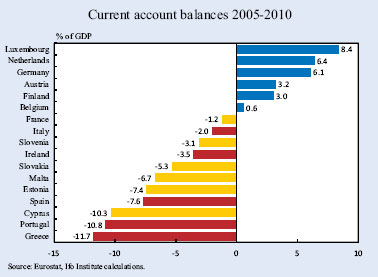
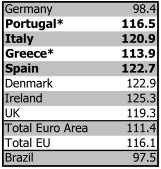
Since the euro was inaugurated in 1999, German unit labour costs have risen by less than a cumulative 13 per cent. During this time, Greek, Spanish and Portuguese labour costs have risen by 20 to 30 per cent, and Italian ones by even more. It is hardly surprising that Germany has a current account surplus of 6 per cent of gross domestic product The economic theory – such as there was – behind the creation of the euro was that the single currency itself, and the supposed impossibility of devaluation by members, would act as a harmonising force. But this has not happened and present relationships have become unsustainable. Herbert Stein, an economist active in Washington towards the end of the last century, said that if a policy or situation was unsustainable, it would not be sustained. But he did not indicate how long it would take for such situations to unravel. /RE: If something cannot go on for ever it will stop. The Public Interest - nr 97 Fall 1989/ and http://en.wikiquote.org/wiki/Herbert_Stein/ Meanwhile, it is in the interests of the eurocrats to make the problems seem as complicated as possible so that only a small number of so-called financial experts can even discuss them; and we have had one financial package after another and one guarantee after another to keep the structure going. But loans and guarantees do not make the unsustainable sustainable. There is only a limited number of ways that the situation could develop. First, “austerity” in the peripheral countries could succeed.
/Interndevalvering (Ådals-metoden)/ Second, the peripherals could continue to stagnate. Unemployment is now 22 per cent in Greece, 24 per cent in Spain, 18 per cent in Portugal, 15 per cent in Ireland and 10 per cent in Italy. The third option is unlikely, but included for completeness. Germany and other northern euro members could pursue more “expansionary” (read inflationary) policies, thus reducing the agony of the south. Alternatively it could continue to subsidise the peripherals indefinitely. The fourth option is for one or more of the peripherals to leave the eurozone. If I had to bet (which I don’t), my money would be on number 4. But I would not bet at all on when it will occur. The Holy Roman Empire was founded by Charlemagne in 800 and lasted until it was dissolved by Napoleon in 1806. The timescale of euro disintegration is anyone’s guess. More by Samuel Brittan at Financial Times More by Samuel Brittan at IntCom and nejtillemu.com Rome, Habsburg and the European Union This month marks the fourth anniversary of the May 2010 financial rescue of Greece. Ireland, Portugal, Spain, and Greece have made considerable progress in lowering their unit labor costs to 1999 levels relative to Germany.
Italy and France, meanwhile, have made considerably less progress on improving their international competitiveness. Europe’s banking crisis is unresolved. Loans to finance fixed investment continue to fall. Remarkably, the European Banking Authority’s latest stress test for the eurozone’s banks does not contemplate the possibility of deflation in its adverse scenario. Europe’s much vaunted banking union harmonizes deposit-insurance coverage but does not provide a common deposit-insurance fund. The associated resolution fund will possess only € 55 billion of its own capital, whereas European bank liabilities are on the order of € 1 trillion. The longer the crisis in the Eurozone drags on,
In Latin America it took nine years for growth to recover sustainably to the levels prevailing prior to the crisis in 1982.
East Asia’s crisis, in contrast, took the form of a v-shaped recession and recovery, with growth falling sharply in 1998, the year following the onset of the crisis, but recovering equally sharply in 1999 to levels nearly as high as before the crisis.
Thanks Eurointelligence and Brad Delong for the link. Rolf Englund, Den Stora bankkraschen, Timbro, 1983 Internationella valutafondens roll i krishantering: fallet Asien
http://www.internetional.se/evas299.htm#asien Since the European debt crisis broke out in 2009,
Kommentar av Rolf Englund:
Förhoppningsvis går det att hitta hållbara vägar ur dagens djupa europeiska kris, men det blir inte lätt. Det vi beskådar är inte eurons kris. In the US, bank assets were close to 80 per cent of gross domestic product. The ECB is saying that it will seek to eliminate the threat of a break-up, except when this threat is most real,
Kommer Europa låta Bryssel ta över den ekonomiska makten eller läggs EMU-projektet ner? Resonerar man kring vad som är ”långsiktigt hållbart” så landar man lätt i slutsatsen att eurons dagar är räknade. "Lätt som en plätt" What is needed is a solution that is both politically feasible and economically workable Unsustainable and Disintegration Euron kollapsar i Spanien Martin Wolf: Would he conclude that the European currency union was a mistake? A Greek exit from the euro area has the potential to be RE: The Ultimate Article about EMU and the Eurocrisis Why the euro is doomed to fall apart: The bottom line, as brilliantly explained in the European Economic Advisory Group's latest annual report,
is that it is a balance of payments crisis, pure and simple, which the eurozone lacks the adjustment mechanisms to deal with Jeremy Warner, Daily Telegraph, March 16th, 2012 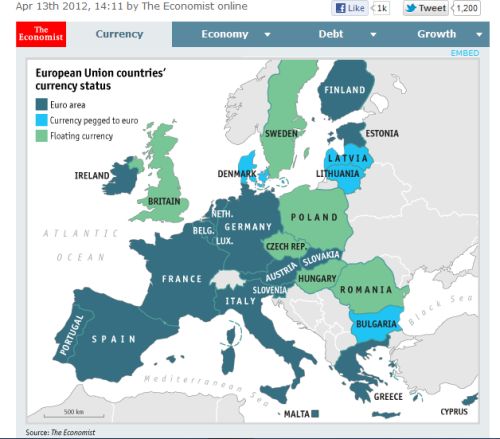 With Spain now front and center, the essential wrongness of the whole European policy focus becomes totally apparent.
Spain did not get into this crisis by being fiscally irresponsible; here’s a little comparison: 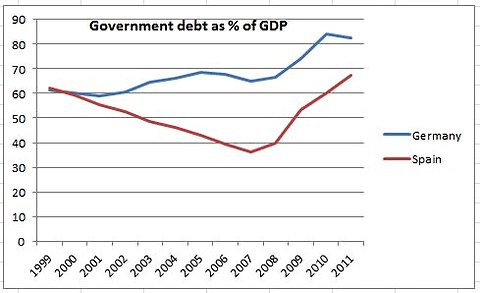 Paul Krugman, 7 March 2012 Events on the Continent have come to feel much like the drift into war.
There is a feeling of powerless inevitability about it. Jeremy Warner, 1 Dec 2011 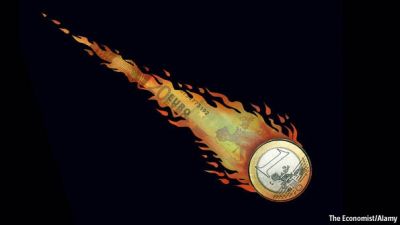 Is this really the end?
Unless Germany and the ECB move quickly, the single currency’s collapse is looming The Economist print Nov 26th 2011 The greatest threat to the euro is that Greece will make a success of default and devaluation. The Ticking Euro Bomb
The architects of the euro and their successors have lost the Maastricht Treaty bet. They have jeopardized an agreement made by 12 countries in the hope that the markets wouldn't notice how fragile their shiny new currency really is. Der Spiegel Staff, 7 October 2011 En lysans artikel - Highly recommended a defining moment for Europe
I make no apologies for repeatedly taxing the reader with commentary on the future of the single currency, for its crisis is without doubt the most important European story of the decade. We are fast approaching a defining moment. Jeremy Warner, Daily Telegraph 9 Dec 2010 What EU leaders once ruled out — a default by a euro-zone nation — has firmly entered the sphere of the possible 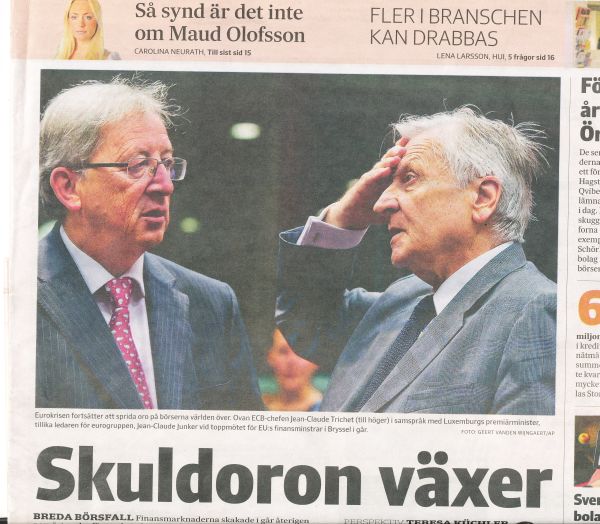 Eurogruppens ledare Jean-Claude Junker och Jean-Claude Trichet, chef för den Europeiska Centralbanken ECB SvD Näringsliv 13 juli 2011 Euron är "världens mest stabila valuta".
Eurogruppens ordförande Jean-Claude Juncker i en tidningsintervju på fredagen, rapporterar Bloomberg News. DI 2011-01-03 Were the Eurosceptics right?
Gavin Hewitt, BBC Europe editor, 22 June 2011 Greece’s austerity plan looks doomed to fail.
It does too little to prevent the epic folly of Greece’s railways and other ruinous schemes. It will screw down too hard on ordinary Greeks, with new taxes, spending cuts and a rushed privatisation scheme. And it will almost certainly condemn Greece to recession, strife and an eventual debt default. The Economist print June 30th 2011 “Events in Greece have brought the euro area to a crossroads:
the future character of European monetary union will be determined by the way in which this situation is handled.” Jens Weidmann, Bundesbank president and European Central Bank governing council member, Hamburg, 20 May, 2011 Financial Times, Ralph Atkins, May 24 2011 22:35 It’s now clear that Greece, Ireland and Portugal can’t and won’t repay their debts in full, although Spain might manage to tough it out
Paul Krugman, New York Times, 22 May 2011 The eurozone's crisis in BBC graphics:
Click here En omstrukturering kan innehålla olika typer av förändringar av villkoren i ett lån, men vanligtvis innebär det en nedskrivning av skuldernas värde.
Tekniskt sett är en omstrukturering lika med en betalningsinställelse. Hittills har den officiella linjen från ledande EU-politiker och beslutsfattare varit att en omstrukturering inte är aktuell, även om de flesta räknar med att det bakom kulisserna dras upp planer på hur en sådan skulle se ut Viktor Munkhammar DI 14/4 2011 Rolf Englund: Ett annat ord är Statsbankrutt. raising the spectre of the "effective end of the euro area,"
The Economist Intelligence Unit has warned, 4 Apr 2011   Hoppet är ute för EMU - Euron kollapsar i Spanien
Rolf Englund blog 31/5 2010 Euron spricker när dollarn faller
Rolf Englund NWT 8/1 2001 'If the euro fails, then Europe fails,'
warned the German Chancellor Angela Merkel last night DT Tuesday 16 November 2010 with nice pic "Risken är att EU plötsligt ger upp andan"
Europeiska unionen är döende, skrev Charles Kupchan i en tankeväckande krönika i söndagens Washington Post. Det finns tyvärr en del som tyder på att han har rätt. Annika Ström Melin, Kolumn DN 1 september 2010 The futile attempt to save the eurozone
Samuel Brittan, FT November 4 2010 Otmar Issing, the former chief economist of the European Central Bank and the German Bundesbank,
is a genial number-cruncher who believes in the overall benefits of European integration has turned virulently pessimistic over the European single currency. In a marked change from his relative sanguinity during his eight years at the ECB, he terms member countries’ unreliability on economic policies “a basic design flaw of monetary union.” David Marsh, Market Watch, Jan. 10, 2011 Highly recommended Euro's Collapse Is Not 'Unthinkable': Warren Buffett
CNBC, 24 March 2011 Det finns egentligen inte någon Eurokris. Stefan Fölster menar att en nedskrivning av Greklands skulder är oundviklig.
– Det är egentligen inte en Greklandskris utan en bankkris Stefan Fölster intervjuad i Sv D Näringsliv 28 juni 2011 The eurozone is now subject to a generalised and full-blown run on its bond market, Italian spreads reached a horrendous 5.3% this morning, Spanish spreads are moving towards 5%, and French spreads, at 1.916%, are no longer at a level that this consistent with an AAA rating. Belgium’s spread has hit 3.2% this morning, and is now at a level of Italy and Spain a couple of months ago. Even Austria is now under attack, with spreads of 1.8% yesterday. It was a day when global equity market plunged, amid fears that the eurozone crisis could throw the world economy into recession. Origins of the Euro Crisis Kash Mansori has an excellent post about the origins of the euro crisis. He documents the fact — which the Germans cannot bring themselves to acknowledge — that fiscal irresponsibility had very little to do with it. Somewhere in the years just before the crisis I was at a meeting in Barcelona where Olivier Blanchard tried to tell the Spaniards how dangerous the situation was getting; Olivier Blanchard, the IMF’s chief economist called for several bold innovations. The euro is engaged in two dances of death. On the one hand, in an incredible reversal of practice during the global financial crisis—when central banks were at pains to conceal which institutions were receiving their emergency assistance for fear of compounding the adverse signals and therefore the crisis—
On the other hand, Syriza would like nothing better now than to see the yields on Spanish, Portuguese, or Italian sovereign debt relative to Germany jump, signalling broader market disquiet— that Grexit may be imminent and that the rump eurozone would be badly destabilized by it—so forcing ECB retreat. So Syriza, in league with Podemos in Spain and prevailing anti-euro Italian political forces, is openly threatening to blow up its own exchange rate regime, the euro, in order to make it work. The army of euro-philes and euroapologists including the IMF, casting themselves as what Krugman labels “Very Serious People” (VSPs), defended it as the best possible monetary-craft for Europe. The risks of mutual misreading between Merkel and the markets on this are potentially catastrophic. "After twenty years of service, I am ashamed to have had any association with the Fund at all," Some eurozone policy makers seem to be confident that a Greek exit from the euro, hard or soft, The euro is still vulnerable, and Greece is not the only problem Pamflett skriven av Joschka Fischer: Scheitert Europa? (Misslyckas Europa?). The euro is in greater peril today than at the height of the crisis
America’s experience in the 1960s should have warned the eurozone’s creators that tying national monetary authorities’ hands might not be such a good idea.
That would not be the case if the eurozone operated according to Robert Mundell’s vision of an optimal currency area, with labor and capital adjustments replacing exchange-rate adjustment, and shocks being homogeneous (rather than asymmetric). Moreover, Germany’s experience with reunification suggests that political union is integral to such a union’s success. The eurozone’s performance has not met any of these criteria. This parrot has ceased to be 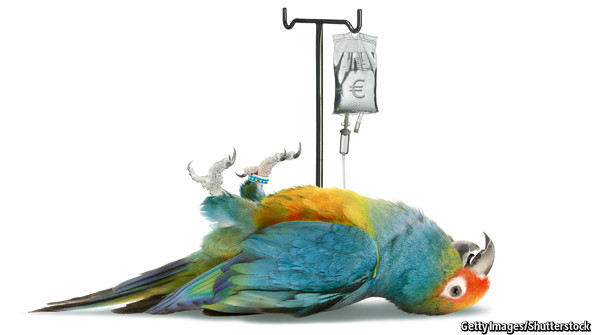
Youtube: This parrot is dead The future of the European economy and its single currency is more likely to be decided on the streets. Borders and budgets risks provoking political crises Remember Europe?
But the recent sell-off in global stock markets seems to have revived repressed memories. Today, with the eurozone economy still flatlining five years after its crisis erupted,
Some two or three years ago, the European Central Bank (ECB) would have been seen as revolutionary and courageous, Ilargi: Europe Is Crumbling Into Collapse Yves here. The word “collapse” may seem overwrought when applied to Europe, but cold-blooded, clear eyed colleagues who have good connections and have spent a bit of time there recently say things that are broadly similar to Ilargi’s take. Despite the conventional wisdom that the cost of a Eurozone breakup is catastrophically and thus will never take place, that confidence may prove to be the currency union’s undoing. Ideological rigidity about austerity is leading to policies that are crushing large swathes of the population. And Europe, unlike the US, had enough of a tradition of popular revolt that that uprisings, either on the street or in the ballot box, are real possibilities, as the sudden rise of the anti-EU right shows. Draghi’s recent speech at the annual gathering of central bankers in Jackson Hole has excited great interest, Italy's Renzi must bring back the lira to end depression The argument between Italy and Germany asks a question at the heart of the currency’s future Italy, with the same eye on domestic politics, worries about political credibility. This rests on a resumption of growth. Germany may be right to argue that a stable debt and deficit framework is a prerequisite for growth, but if markets conclude the remedy is killing the patient, then the whole system would lose credibility. Ferdinando Giugliano?
As La Guardia and Peet argue, the eurozone’s politicians made
Rolf Gustavsson i SvD 29 juni The Euro Crisis and Its Aftermath http://www.amazon.com/Euro-Crisis-Its-Aftermath-ebook http://www.project-syndicate.org/columnist/jean-pisani-ferry Jean Pisani-Ferry was the first Director of Bruegel from 2005-2013.
http://www.bruegel.org/about/person/view/27213-jean-pisani-ferry/ Jean Pisani-Ferry at Financial Times
We were asked: “What probability do you attach to Greece leaving the eurozone by the end of the year?” The consequences of abandoning the euro are highly uncertain, and few European leaders are willing to go there. Many explanations have been proffered. Yes, the French and the British were protesting their ineffective establishment parties.
Plus ca change, plus c'est la meme chose: The results in France are infinitely the more important
I Malmö levererade Persson, våren 2011, som vanligt utan manus, precisa formuleringar som hade kunnat gå rakt till trycket.
The EU authorities are now in a near hopeless situation. The two dominant parties of the post-Franco order in Spain saw their share of the vote drop to 49pc from 80pc last time,
Europe's "Fiscal Compact" has set in motion a doomsday machine, Full text of Ambrose Evans-Pritchard 28 May 2014 
European Spring:
As these books all argue, the crisis was always about more than whether financial markets would buy government debt.
The Euro Crisis and its Aftermath. By Jean Pisani-Ferry. To eliminate the monetary independence of 17 sovereign countries and create a major new world currency is a pretty big undertaking. Ett intressant inlägg kommer från tankesmedjan Bruegel i Bryssel. This month marks the fourth anniversary of the May 2010 financial rescue of Greece. Complacent policy makers and investors imagine the crisis is over.
Europe’s Plan Z - The Grexit gamble Peter Spiegel reveals how a secret strategy was developed to contain the firestorm from a Greek exit. June 15 2012 was the Friday before a parliamentary election – the second national vote in as many months – and the country appeared to be edging towards panic.
Unbeknown to almost the entire Greek political establishment, however, a small group of EU and International Monetary Fund officials had been working clandestinely for months preparing for a collapse of Greece’s banks. Plan Z was never used. Several senior officials said they were stunned Ms Merkel and Mr Sarkozy had aired the idea that the eurozone could be left voluntarily, something that had previously been vigorously denied. According to one participant, no single Plan Z document was ever compiled and no emails were exchanged between participants about their work.
How the euro was saved 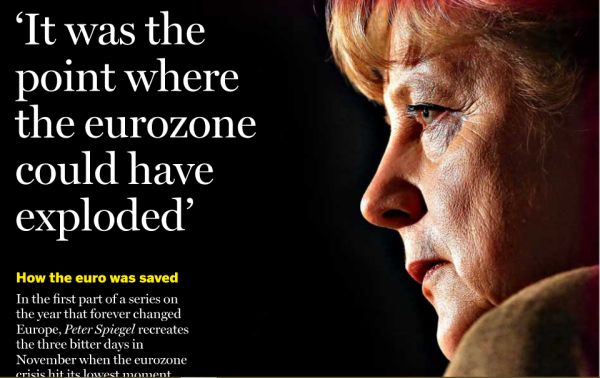
“Das ist nicht fair.” That is not fair, the German chancellor said angrily, tears welling in her eyes. A cornered Ms Merkel threw the French and American criticism back in their faces. If Mr Sarkozy or Mr Obama did not like the way her government ran, they had only themselves to blame. After all, it was their allied militaries that had “imposed” the German constitution on a defeated wartime foe six decades earlier. Greece was imploding politically; Italy, a country too big to bail out, appeared just days away from being cut off from global financial markets; and Ms Merkel, try as Mr Sarkozy and Mr Obama might, could not be convinced to increase German contributions to the eurozone’s “firewall” – the “big bazooka” or “wall of money” they believed had to grow dramatically to fend off attacks by panicking bond traders. And yet less than a year after that November 2011 night, the existential crisis for Europe’s single currency would, for all intents and purposes, be over. Strict budget rules were made inviolable; banking oversight was stripped from national authorities; and the printing presses of the European Central Bank would become the lender of last resort for failing eurozone sovereigns. Europeiska centralbankens (ECB) högste chef Mario Draghi Om man har en sedelpress går man inte i konkurs. President Obama was in France for a meeting of the G20. Euro stability more important than Greece, says Angela Merkel
Charlemagne If markets once seemed ready to push the weakest countries out of the euro, now it is voters who may pull their escape cord. Support for the European project, always fragile, will keep falling if it fails to deliver greater prosperity.
It is slow moving variables — long term unemployment, gradual shifts in public opinion, and so on — that pose the greatest threat to the Euro’s survival.
Europe’s political leaders should remember what Ernest Hemingway said about bankruptcy.
German wages fell 0.2pc in 2013. Germany too is in wage deflation.
Whatever happened to the eurozone crisis? The Anglo-Saxon jeremiads have been proved wrong. It needs to be said at the outset that Europe is still enjoying the "Draghi effect": To politicians and officials the key question hanging over the euro was its survival. For the moment that question has been laid to rest. But to the public there is perhaps a more important question - does the single currency deliver prosperity or stagnation? Marknaderna skiter i hur det går för Spanien, Grekland, Italien och andra krisländer
Do you think that the euro will fail? Euron har redan kollapsat
I går kväll, efter att ha uppdaterat sidan om "När och hur spricker EMU?" stod sanningen helt plötsligt klar för mig. Strong Governments, Weak Banks
FORES presenterar en antologi där några av Sveriges kunnigaste ekonomer beskriver bakgrunden till krisen
Lars Calmfors: "Överlever euron?" Bokpresentation 14/11, Youtube, Highly Recommended Greece, Spain and Portugal need to devalue in real terms by about 30 per cent
A concern is that the monetary policy of the ECB is unsuitable for Germany and might even cause asset price bubbles. Europe Breakup Forces Mount as Union Relevance Fades Sieps uppdrag är att på ett självständigt och allsidigt sätt belysa aktuella europapolitiska frågor. SIEPS remissvar på Lissabon Sieps var en gång en förhållandevis aktad organisation med viss akademisk prägel. Debt loads rise faster than nominal GDP - The "denominator effect" So says Simon Tilford from the Centre for European Reform. Tentative signs of life after six quarters of contraction are deemed a vindication of shock therapy, even as the underlying crisis gets worse in almost every key respect.
Far from being on the mend, the economic crisis across the South is deepening. Real interest rates are increasing from already high levels," he said. 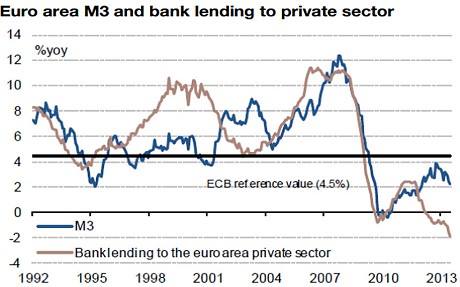
Europe has not recovered. It has begun to stabilise, but only just, amid mass unemployment, with debt trajectories still spiralling out of control in Italy, Portugal, Spain and once again in Greece. Hur kan man undvika att inse att 25 procents arbetslöshet är en katastrof för land och folk?
Hollande Bids Adieu to EU Vacation Culture as Crisis Lingers The euro zone crisis could be largely over by the end of the year
"We are now only at a very small risk of the break up of the currency. "Except in Italy, where we have to ask in a post-Monti [environment] what happens next, the political risks to the euro have receded," Det vi beskådar är inte eurons kris. Once the French get into a full-scale crisis, it’s over. “Another possible fallout is getting rid of some of the countries that are being ruined by being in the euro, notably the southern European economies,” Christensen said. “It’s the political world that has been extremely supportive of the euro, not for economic reasons but for political reasons,” said Christensen, a long-time critic of the single currency and who now lives in Switzerland. Gloomsters buried the euro too soon
"Intellectuals" Why the Euro Zone Crisis is Over…Until September
On Sunday, Merkel's conservative coalition lost regional elections in Lower Saxony, one of the country's most populous states.
So far, Merkel's euro zone policy decisions have only been constrained by public opinion and Germany's constitutional court, I ett alltmer instabilt lapptäcke av IMF-åtgärder, europeiska länder utan egna sedelpressar och tecken på riktig depression
Martin Wolf och Rolf Englund om att den som har en sedelpress går inte i konkurs. The real risk for the global economy is in Europe. If the ECB imposes further austerity conditions (as it seems to be demanding of Greece and Spain) in exchange for financing, the cure will only worsen the patient’s condition. Likewise, common European banking supervision will not suffice to prevent the continuing exodus of funds from the afflicted countries. That requires an adequate common deposit-insurance scheme, which the northern European countries have said is not in the cards anytime soon. While European leaders have repeatedly done what previously seemed unthinkable, their responses have been out of synch with markets. They have consistently underestimated their austerity programs’ adverse effects and overestimated the benefits of their institutional adjustments. Will the dam break in 2007?
The EMU disaster is not at root a public debt crisis, and never was.
Whether you think this matters depends on whether you think the democracies of southern Europe will tolerate slow grinding depression – with no light at the end of the tunnel – for year after year. The denouement is hard to predict in such situations. Political upheavals are famously non-linear. But the situation in Spain is remarkable, with the added nitroglycerine of a ruling party determined to exploit the crisis to take power back from the regions, and Catalonia determined to resist with all means at its disposal. Data from Tinsa released today shows that Spanish house prices fell 11.3pc last year, and are now down 33.3pc from the peak in 2007. Eurozone governments’ determination to stop the liquidity crisis The ECB’s support cannot help in the solvency case because the central bank is not allowed, by its own legal definition, to write off or participate in a restructuring of any debt it holds. Germany was now ready to accept a two-year extension of the Greek programme, but there would be no new money, leaving Greece itself to fund the gap – something that is simply not going to happen. The refusal to let the European Stability Mechanism fund Spanish banks directly falls into the same category. Debt that has arisen in Spain will remain debt of the Spanish state as ultimate guarantor. Full textIn 2010, US banks had assets of €8.6tn. But those of the EU’s were €42.9tn. In the US, bank assets were close to 80 per cent of gross domestic product. Half of the world’s 30 biggest banks are headquartered in the EU. If the EU makes a mess of banking, it can explode the world economy. In brief, while individual US banks may be “too big to fail”, the EU has a banking sector that is not only too big to fail, but too big to save. Full textThe ECB action will not prevent countries like Spain from having a pretty terrible few years.
The ECB is saying that it will seek to eliminate the threat of a break-up, except when this threat is most real,
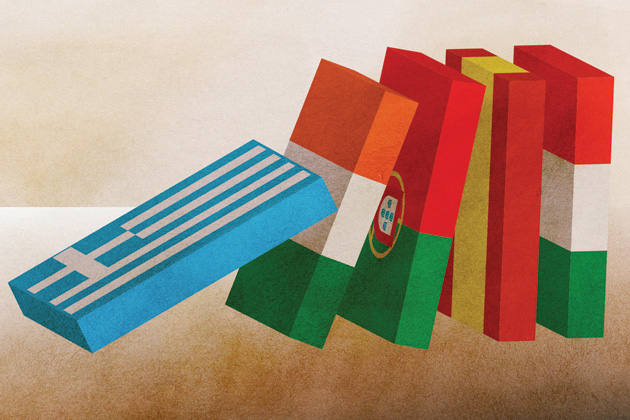
Spain and Italy are at the heart of the story, which could yet end with a breakup of the euro zone. The bottom line: If a bailout of Spanish sovereign debt costs €300 billion, then the Europeans may lack the funds needed to rescue Italy. Det som händer i Europa är stort, mycket svårt att greppa, och åtgärderna som föreslås är stundtals radikala. German, French or other savers may hold bank accounts, pensions, insurance policies. Investors’ panic does the opposite. They cannot repatriate capital that has been invested or consumed, but their attempt to do so has meant an abrupt halt of new funding. The periphery’s need to reduce current account deficits equally abruptly is the main cause of the recessions. By refusing to extend new financing, investors are ruining their chance of recouping their own investments. The way the eurozone’s imbalances are being unwound is poisoning what solidarity the monetary union used to possess. It is not sufficiently appreciated that these imbalances were driven by private investors. Welcome to Martin E. Sandbu's website. Euro Zone as We Know It Has Two Years Left If EMU Exists In 5 Years Fiskal Union Man bör fråga sig hur det kommer sig att vi i Sverige överför stora belopp inom vårt land mellan olika regioner ”Det handlar alltså inte om en gigantisk överstatlig finanspolitisk union”, det ser bara ut så. Debattartikeln är en bra sammanfattning av den inte mycket mer detaljerade tiosidiga rapporten, Breaking the Deadlock: A Path out of the Crises, varpå artikeln baseras. Mecenaten bakom rapporten är Institute for New Economic Thinking (INET); ett ungt institut grundat av George Soros 2009, en inte fullt lika ung legend inom valutaspekulation och välgörenhet. Liksom i juli 1914 vandrar Europa lealöst mot en katastrof av ofattbara proportioner INET, Council on the Eurozone Crisis Krisen i eurozonen kan fortfarande lösas, men för det fordras att Europas ledare förmår separera två problem: Detta är huvudpunkterna i det förslag för hur krisen ska lösas som i dag presenteras av en grupp av 16 europeiska nationalekonomer från de flesta av EU:s stora medlemsländer, inklusive fyra framstående tyska ekonomer av olika politisk färg. Utgångspunkten är att en lösning inte bara måste vara hållbar ekonomiskt men också politiskt möjlig att genomföra. Alla som var med om att skriva under Maastricht-avtalet som lade grunden till euron har ett ansvar. Alla måste vara med och dela på de kostnader som uppstått till följd av eurons brister och för det massiva krisprogram som fordras för att få tillbaka tillväxten i alla medlemsländer. En insättarförsäkring skulle som i Sverige kunna baseras på en gemensam fond uppbyggd genom avgifter på bankerna, men den skulle också fordra någon form av delat betalningsansvar, exempelvis via ECB, om kostnaderna för en kris skulle överstiga fondens resurser. En bankunion ger också hopp om en förnyad demokratisk legitimitet för det europeiska projektet. Medborgarna i den Europeiska unionen har med växande skepsis sett hur makt överförts till europeiska institutioner utan att åtföljas av motsvarande politiskt ansvar. Men de har också med tilltagande indignation följt hur bankerna och deras ledningar kommit mer eller mindre oskadda ut ur krisen samtidigt som skattebetalarna fått bära kostnaderna för deras misstag. För att eurosystemet skall fungera på lång sikt måste den europeiska centralbanken ECB ta ett ökat ansvar, inte bara för en bankunion, men också fungera som ”lender of last resort”. En viktig del i dess ökade ansvar vore att ge den nya ekonomiska stabilitetsfonden ESM en banklicens så att den kan låna från ECB. Allt detta kan ske utan att i grunden ändra ECB:s statuter. Det behövs med andra ord inte någon gigantisk överstatlig finanspolitisk union. Eurokrisen, fisksoppan och elitens olidliga dumhet Med en gemensam real ränta måste man ha en gemensam central myndighet/regering och stora transfereringar mellan valutaområdets olika delar The Institute For New Economic Thinking Så heter en ny rapport från The Institute For New Economic Thinking där 17 ledande internationella ekonomer utvärderar den ekonomiska krisen i Europa och ger tips på hur unionens politiker ska ta sig ur knipan. Deras grundtes är att Europa aningslöst rör sig mot en såväl ekonomisk som humanitär katastrof där ”en dominobricka efter den andra” den senaste tiden har fallit in i krisen. Senast ut: Spanien, som enligt experterna bara är dagar ifrån en allvarlig likviditetskris. För att angripa problemet vid roten anser ekonomerna att unionens länder bör lägga alla skulder som överstiger 60 av landets BNP, allt enligt Maastrichtavtalet, i en gemensam pott med Tysklands kreditvärdighet som garant. Europe is “sleepwalking towards disaster” “This dramatic situation is the result of a eurozone system which, as currently constructed, is thoroughly broken. The cause is a systemic failure. It is the responsibility of all European nations that were parties to its flawed design, construction and implementation to contribute to a solution. Absent this collective response, the euro will disintegrate,” they added in a co-signed report for the Institute for New Economic Thinking. Institute for New Economic Thinking They claimed the system could be stabilised immediately by creating a lender of last resort to back-stop the bond markets, either by mobilising the ECB or by giving the eurozone bail-out fund (ESM) a banking licence to borrow from the ECB. The lack of any light at the end of the tunnel is leading to a populist backlash in both the debtor and creditor states. The only question is whether the North or the South succumb to revulsion first. Had Greece still had its drachma the shortcomings of the country's financial accounts would have been much clearer for all to see much earlier Rubrik: The Wisdom of the Currency Crowd Extraordinary Popular Delusions and the Madness of Crowds IMF: IMF Executive Board Concludes Article IV Consultation on Euro Area Policies Själv röstade jag ”ja” till att Sverige skulle gå med i valutaunionen vid folkomröstningen 2003 Kommentar av Rolf Englund: Kommer Europa låta Bryssel ta över den ekonomiska makten eller läggs EMU-projektet ner? Resonerar man kring vad som är ”långsiktigt hållbart” så landar man lätt i slutsatsen att eurons dagar är räknade. Grekland lämnar sannolikt EMU. Men istället för att leda till att euron havererar så lär Greklands djupa kris bli ett tacksamt slagträ när EMU-lobbyn ska skrämma opinionen till att acceptera Bryssels nya maktfunktioner. ECB President Mario Draghi Nils Lundgren 2011: "I am sure the euro will oblige us to introduce a new set of economic policy instruments. "Lätt som en plätt" Artikeln om eurokrisens scenarier visar hur arbetskraftskostnaden per tillverkad enhet har förändrats sedan euron infördes. I Tyskland har kostnaden ökat noll procent medan tillverkning i Italien och Spanien nu är ungefär en tredjedel dyrare. Valutakursen för euron balanserar dock mitt emellan dessa båda ytterligheter vilket innebär att tysk export får turbofart av en svag valuta samtidigt som det omvända gäller för Italien och Spanien. Med den breda penseln kan man måla upp två huvudscenarier för framtiden. Eurokrisens scenarier: Jesper Stage och Magnus Henrekson Jesper Stage, professor i nationalekonomi vid Mittuniversitetet i Sundsvall, tycker att euroområdets makthavare borde fokusera på att få fart på ekonomin igen. – Inflationsmålet inom euroområdet borde höjas till åtminstone tre procent eller kanske mer. Med den inflationsnivå som gäller nu bygger man in massarbetslöshet i krisländerna under lång tid framöver, säger Stage. Jesper Stage är en av många ekonomer som skrivit under manifestet för ekonomisk sans som nobelpristagaren i ekonomi Paul Krugman skapat på Internet. Det beskriver i dramatiska ordalag hur misstagen från krisen på 1930-talet nu håller på att upprepas. Krugman tillhör den keynesianska skolan som förespråkar en aktiv finanspolitik. Men andra svenska ekonomer tycker att Stages och Krugmans syn på hur krisen ska lösas är naiv. Tillväxtreformer och uteblivna besparingar är kostsamma på kort sikt och kräver att Tyskland och andra stabila länder öppnar den stora plånboken. Det är inte rimligt, menar bland andra professor Magnus Henrekson som är VD på Institutet för Näringslivsforskning. – Med stor sannolikhet kommer man inte få tillbaks de här pengarna och det ska politikerna ta ansvar för gentemot sina nationella väljare. Som det ser ut i dag är väljarna inte intresserade av det utan kommer rösta bort en politiker som fattar ett sådant beslut. Magnus Henrekson, professor nationalekonomi SvD Näringsliv 27 juli 2011 Magnus Henrekson, VD på Institutet för Näringslivsforskning. Varför går det bra för Sverige? : om sambanden mellan offentlig sektor, ekonomisk frihet och ekonomisk utveckilng av Andreas Bergh, Magnus Henrekson Överlever EMU utan fiskal union? The dream of the unification of Europe goes back at least to the 15th century The so-called "rescue" packages for the troubled economies of Europe have involved insistence on draconian cuts in public services and living standards. The hardship and inequality of the process have frayed tempers in austerity-hit countries and generated resistance – and partial non-compliance – which in turn have irritated the leaders of countries offering the "rescue". The very thing that the pioneers of European unity wanted to eliminate, namely disaffection among European nations, has been fomented by these deeply divisive policies (now reflected in such rhetoric as "lazy Greeks" or "domineering Germans," depending on where you live). On the economic side, too, the policies have been seriously counterproductive, with falling incomes, high unemployment and disappearing services, without the expected curative effect of deficit reduction. So what has gone wrong? Two issues need to be separated out:
The problems we are seeing in Europe today are mainly the result of policy mistakes: Members of the Financial Policy Committee (FPC), the Bank of England’s risk regulator, The record of the interim Financial Policy Committee reveals members thought Det finns två huvudvägar för att rädda Europas ekonomi från en katastrofal utveckling - om man nu vill det. Om vi börjar i slutändan måste dels Grekland och dels Spanien och Italien förhindras från att bli så bankrutta att de måste lämna euron. För att motverka den ökande risken för en statsbankrutt måste Greklands tillväxt bli positiv istället för negativ. Den konventionella teorin säger att om ett antal år kommer åtstramningsåtgärderna att leda till att företagen börjar investera och expandera igen. Draghi also poured cold water on a third option Nouriel Roubini, once known as "Dr. Doom" for bearish views predicting the 2008 financial crash, The US is a federal nation state, not a federation of nations like the EU. The writer is author of ‘Land of Promise: An Economic History of the United States’ and a co-founder of the New America Foundation Hamilton probably would have scoffed at the idea that federal institutions devised to unite Massachusetts, Virginia and New York could unite Germany, Greece and Poland. In 1802 he wrote: “The safety of a republic depends essentially on the energy of a common national sentiment; on a uniformity of principles and habits; on the exemption of the citizens from foreign bias, and prejudices; and on that love of country which almost invariably be found to be closely connected with birth, education and family.” The respected economist and Telegraph columnist Roger Bootle summarises Not only must any agreement fit the needs of these three leaders. Hanteringen av Spaniens och Italiens statsfinansiella problem är förmodligen avgörande för EU:s framtid. What is needed is a solution that is both politically feasible and economically workable "Det finns ingen anledning till oro" Europa saknar de verktyg som är nödvändiga i en allvarlig kris: He said the eurozone crisis can have one of three outcomes. Number is two is not going to happen, so we are left with the bifurcation we have forecasting for a long time. Either they agree a full backstop – which can logically only come from the ECB, and which in turn requires a political union – or the eurozone collapses. Berlusconi says Italy should quit eurozone unless Merkel changes course Just in time for the G-20 Summit, On Monday morning EU Commission President José Manuel Barroso lost it when a Canadian reporter in shorts wanted to know why the North Americans should be responsible for the problems of rich Europeans. "We are not coming here to receive lessons in terms of democracy or in terms of how to handle the economy," Barroso fumed. "By the way, this crisis was not originated in Europe. This crisis originated in North America and much of our financial sector was contaminated by, how can I put it, unorthodox practices from some sectors of the financial market." Eurozone crisis explained Under no circumstances whatsoever could the eurozone members span a protective umbrella over Europe's big countries, like it has for the small ones.
World leaders must draw up a “concerted global action plan” to deal with the eurozone crisis at next week’s G20 summit In an article for news agency Reuters Mr Brown urged leaders to follow the example set at the 2009 London G20 summit, after the last credit crisis, when an international bail-out was agreed. Ivan Krastev, head of the Centre for Liberal Strategies, a Bulgarian think-tank, Paradoxically, the belief that the Union cannot disintegrate, backed by the economists and shared by Europe's political class, is one of the risks of disintegration. The Soviet collapse is the most powerful demonstration that the disintegration of the EU need not be the result of a victory of anti-EU forces over pro-EU forces. Apokalyps nu? Apocalypse Now..Ride Of The Valkyries The Euro’s 11th Hour Frustrated, European leaders have descended into the five stages of grief: denial, anger, bargaining, depression and — by some — acceptance that the euro could fall apart At the heart of the European quandary is the conundrum that ideas that are economically sensible are not politically feasible, while ideas that are politically possible make little economic sense. Since 2000, wages of German workers have increased barely more than efficiency has grown. Meanwhile, Greece’s unit labor cost (the average cost of labor per unit of output) has increased by roughly 40 percent. Greece is merely the most disobedient of a passel of problem children; by this all-important measure, the other 15 members are mostly sprinkled closer to Greece than to Germany. The stronger countries must also accept the need for fiscal transfers — subsidies to poorer euro zone members — just as states like New York pay far more in federal taxes than they get back in services and transfer payments. The euro zone may find another piecemeal solution and escape the hangman for now, but unless it attacks its more fundamental problems, it is doomed to a cascading series of crises that will ultimately destroy the common currency. Steven Rattner, a contributing opinion writer, is a longtime Wall Street executive and a former counselor to the Treasury secretary. Jag tycker att euron långsiktigt är bra en idé.Den bygger ett gemenskaptänkande vilket är viktigt i Europa givet vår historiska belastning och bakgrund Men den blev inte som det var tänkt. Fredrik Reinfeldt, Ekot Lördagsintervju 9 maj 2012 Europe’s economic outlook and market conditions remain “daunting,” European governments need to take “courageous moves towards fiscal and financial union” to break the link between sovereign risk and bank risk, he said. “Without the design and implementation of appropriate governance arrangements, monetary union is difficult to sustain,” Visco said. "I am sure the euro will oblige us to introduce a new set of economic policy instruments. 
The equity market seems to be thinking it. The bond market certainly is. If Spain, Ireland, Greece, Portugal and maybe Italy, broke free (with a combined GDP to rival Germany). In brief, the eurozone is now on a journey towards break-up Euro Crisis: Europas politiker har slagit in på en ekonomisk kurs som ser ut att leda mot sammanbrott. It probably is about time to judge the euro zone as a failed idea, Euron kollapsar i Spanien Bear Stearns, Lehman Brothers and Grexit calls into question Europe’s hapless politicians, having asserted that exit from the single currency was impossible, RE: The Ultimate Article about EMU and the Eurocrisis I had written repeatedly that the eurozone was a flawed construction that was likely to collapse. If that was the case, I was asked, would it not be better to break the whole thing up now? At this point, I heard myself becoming shifty and evasive – “The trouble,” I replied, “is that I keep being told that a break-up would cause a catastrophe. Until I can tell you convincingly why that’s untrue, I can’t responsibly advocate it.” But prevarication is no longer good enough. In the coming months, Europe may be forced to decide. It is true that the transition from here to there will be painful and dangerous. My colleague Martin Wolf laid out an updated version of the full horror scenario in Friday’s FT – involving a breakdown of law and order in Greece, and financial collapse across Europe. How could anyone responsibly run that risk? The answer is that the alternatives to eurozone break-up are inherently implausible and deeply unattractive. Without the option of devaluing their currencies, uncompetitive economies are left with “internal devaluation” – otherwise known as wage cuts and mass unemployment. It is true that countries such as Greece badly need economic reforms. But these reforms – conducted within the straitjacket of monetary union with Germany – are causing political and economic turmoil. In theory, the eurozone might rectify this error by moving to a real political union. Even if EU politicians were able to overcome such objections and create a real federal union, this giant new entity would essentially hollow out the powers of national democracies. Sacrificing national self-rule on the altar of the euro is inherently objectionable – and would invite a nationalist backlash across Europe. Suddenly, it has become easy to see how the euro A Greek exit from the euro area has the potential to be This is the first major revolt by any electorate against the eurozone’s austerity policies, Furthermore, Greece is just the tip of the iceberg. The swing against austerity by voters in the eurozone is manifesting itself in many different places. Until the end of last year, austerity economics had a surprising amount of political support inside the eurozone, and not just in core countries like Germany. ECB has apparently now said that it won't directly lend to some Greek banks that it judges to be technically "insolvent". David Cameron, Britain’s prime minister, will on Thursday warn that the single European currency could unravel Om att äta kakan, ha den kvar, eller sälja den på kredit till Grekland Should France Be Added to the 'PIIGS'? The euro currency is a malady that condemns at least a generation of Greeks, Italians, Spaniards, Portuguese and Irish to the economic infirmary. The economists and politicians who created the system still proclaim it can survive. Peter Boone is a non-resident senior fellow at the Peterson Institute for International Economics, a visiting senior fellow at the London School of Economics and an adviser at Salute Capital Management.
Today, there are about 8.5 trillion euros ($11 trillion) of sovereign bonds outstanding in the euro area, and more than $180 trillion in derivatives linked to interest rates These interest-rate derivatives -- known as swaps -- are held by large leveraged financial institutions (banks, hedge funds), or by pension and insurance companies with large, long-term liabilities. If interest rates rise, bond prices fall, and derivative contracts change in value (good news for people who have hedged into fixed interest rates and a potential disaster for those exposed to rising interest rates). Is there any hope for the euro dream? One potential way forward would be to create a European- level fiscal union that assumes all national debt, much like what Alexander Hamilton did as first U.S. secretary of the Treasury. That isn’t going to happen in modern Europe. Who could even ask them to do so? Bör alla avgå? Hur skall eurons Ja-sägare hanera sin besvikelse After Greek voters rejected austerity in last week's election Europe has been searching for a Plan B At the Chancellery in Berlin, the television images from Athens now remind Merkel's advisers of conditions in the ill-fated Weimar Republic of 1919-1933. Back then, the Germans perceived the Treaty of Versailles as a supposed "disgrace." Now, the Greeks feel the same way about the austerity measures imposed by Brussels. And, as in the 1920s in Germany, the situation in Greece today benefits fringe parties on both the left and the right. Expelled from the eurozone, Greece might prove more dangerous to the system than it ever was inside it The writer is a senior fellow at the Peterson Institute for International Economics and author of ‘Eclipse: Living in the Shadow of China’s Economic Dominance’ A substantially depreciated exchange rate would set in motion a process of adjustment that would soon reorientate the economy and put it on a path of sustainable growth. What is the evidence? Just look at what happened to the countries that defaulted and devalued during the financial crises of the 1990s. Suppose that by mid-2013 Greece’s economy is recovering, while the rest of the eurozone remains in recession. The effect on austerity-addled Spain, Portugal and even Italy would be powerful. Voters there would not fail to notice the improving condition of their hitherto scorned Greek neighbour. The ongoing Greek tragedy could yet turn out not too badly for the Greeks. But tragedy it might well be for the eurozone and perhaps for the European project. If the eurozone gives way on /Greece/, what chance would there be of painful austerity being continued, The big danger for the rest of the eurozone is not that Greece makes a complete horlicks of monetary independence The big danger for the rest of the eurozone The game would be up. Bank deposits would flee from these countries and end up with German banks which, through the Bundesbank, would recycle them to beleaguered banks in the periphery. In the process, Germany and the other northern countries could end up taking on the risk of the whole banking system of peripheral Europe. "Eurodämmerung" Eurodämmerung Some of us have been talking it over, and here’s what we think the end game looks like: 4b. End of the euro. Krugman alltför optimistisk om tidsplanen för Eurodämmerung De människor som mobbade EU till att anta en gemensam valuta, Regeringen bör utlysa nyval The political turmoil in the Netherlands has sent a disastrous message that could thwart Merkel's master plan to save the single currency.
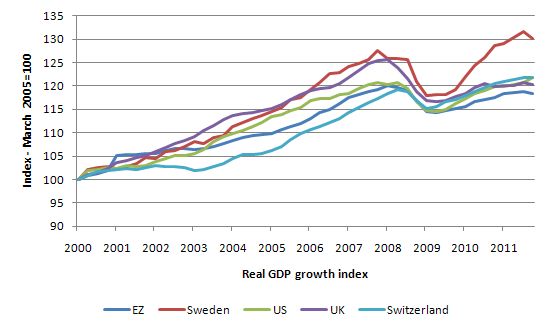
Europe’s Economic Suicide Spain’s fiscal problems are a consequence of its depression, not its cause. The most likely outcome... German inflation will rise The political elites of member states and much of their population continue to believe in the postwar agenda, if not as passionately as before. The most likely outcome... German inflation will rise and its external surpluses fall. Adjustment will occur Om man har en sedelpress går man inte i konkurs When the euro was being created, the economics profession split into three groups Their performance cannot be judged after five or 15 years. It’s understandable that people who felt a strong prejudice for or against the euro’s existence should feel the itch to make a point when things turn their way, but the point is bound to be misleading, and intentionally so. The reality, however, is that changes in the broad flow of history, which the euro certainly was, require a much longer view. There is no provision in any European Treaty for a country to leave the eurozone. Minns ni folkomröstningen om EMU 2003, Martin Sandbu, the economics leader writer for the Financial Times, vad har han att säga? Han fortsätter: The Irish left the sterling zone. The Balts escaped from the rouble. The Czechs and Slovaks left each other. The founders of the euro thought they were forging a rival to the American dollar. Common sense suggests that leaders should think about how to manage a break-up. Some may be doing so. But having described a split as bringing economic Armageddon, leaders dare not be seen planning for it. Greker, spanjorer, italienare och andra försöker nu ta sig ur det brinnande eurohuset. Detssvärre saknas förberedda nödutgångar. Euro Was Flawed at Birth and Should Break Apart Now Since the launch of the euro in January 1999, Germany and the Netherlands have experienced a growth slowdown and loss of wealth for their citizens that would not have happened had they never joined the euro. We know this to be true, because we can compare the progress of these two Northern European economies with that of Sweden and Switzerland, which kept their freely floating currencies in 1999 and continued to grow as before.
Charles Dumas writes: No wonder the Germans and Dutch are angry. But their anger should be directed at the governments that took them into the euro, not at the hapless citizens of Mediterranean Europe, who now are also suffering the effects of the common currency. Sweden and Switzerland didn’t have to make any such sacrifice of ordinary people’s prosperity, while at the same time they enjoyed stronger employment as well as budget and current-account balances. That leads to only one conclusion: The euro was a mistake from the outset. It should be abandoned in unison and soon. Källa: Bill Mitchell – billy blog Full text by Carles Dumas at Bloomberg Nouriel Roubini: markets are “schizophrenic” they cannot decide whether to reward or punish countries such as Hary Flam vill ha lönesänkningar i krisländerna U.S. Treasury Secretary Timothy Geithner warned heavily indebted countries not to resort to draconian measures to fix their budgets, "Economic growth is likely to be weak for some time. The path of fiscal consolidation should be gradual with a multiyear phase-in of reforms," Geithner said in remarks prepared for delivery to the House Financial Services Committee on Tuesday. "If every time economic growth disappoints, governments are forced to cut spending or raise taxes immediately to make up for the impact of weaker growth on deficits, this would risk a self-reinforcing negative spiral of growth-killing austerity," he said. Istället för att satsa oss ur kristider innebär arbetslinjen att vi arbetar oss ur de besvärliga perioderna. Metoden att genom åtstramningar få budgetbalans kan tyckas vara vad som behövs för de försumliga PIIG:s-länderna. Men oavsett hur illa vi tycker om dessa länders frivola leverne är det inte för att vi känner att det är moraliskt riktigt att sätta strypkoppel på dem som ska avgöra vad som är en riktig ekonomisk politik. Vi måste tänka på konsekvenserna av en åtstramning i en stor del av Europa. Det scenario som jag /Danne/ skrev om 2/9 2011 Euron har redan kollapsat Eurozone members, stumbling from one crisis to the next, Faced with execution today or execution tomorrow, most people would choose the latter option. Who knows what might happen in between – an amnesty might be declared, the executioner might die. Hope springs eternal. This way of thinking has come to instruct European attitudes to the euro. Everyone now accepts that the euro hasn't worked out as hoped, but they would rather have it all breakup at some point in the future than face the immediate pain of having it breakup now. It seems unlikely, but you never know, in the meantime things might sort themselves out. We've just had write-downs on Greek sovereign debt of more than €100bn, and we can be pretty certain there's a lot more of that to come, both from Greece and the rest of the eurozone periphery. Yet perhaps oddly, Germans haven't really noticed it. It all looks like fantasy money which doesn't really affect them. Meanwhile, the periphery seems to believe the consequences of leaving will be worse than the price paid in never ending austerity of staying in. And all think the dream of European solidarity and unity still something worth fighting for. It’s hard to see how getting European banks to buy bonds from potentially insolvent countries Det vi ser är inte primärt en statsskuldskris utan en eurokris som har lett till en statsskuldskris. Detta ledde till att staten i Grekland, Portugal och Italien lånade upp pengar och finansierade en på sikt ohållbar efterfrågenivå som medförde stigande inflation i priser och löner och därmed obönhörligt sjunkande konkurrenskraft. I Spanien och Irland var det istället den privata sektorn som lånade för mycket, när räntorna blev så låga. Effekterna blev desamma. Priser och löner steg snabbare och den internationella konkurrenskraften försämrades kraftigt. Däremot blev det inte några budgetunderskott och växande statsskulder under processen. De problemen exploderade först när staten måste gå in och rädda banker samtidigt som efterfrågan säckade ihop och därmed skatteintäkterna samtidigt som utgifterna steg för arbetslöshetsersättning och andra krisåtgärder. Det vi ser är således inte primärt en statsskuldskris utan en eurokris som har lett till en statsskuldskris. Valutaunionen var ett mycket riskfyllt projekt som inte borde ha genomförts under detta historiska skede. Den hemska sanningen om John Hassler, Göran Persson och kronkursförsvaret Forskarna kommer att ha till uppgift att förklara hur det kom sig att så många i det ledande skiktet i Europas länder kom att vara för Kuriosa Danne Nordling 12 mars om EEAG, SNS och Spanien ”Situationen i euroområdet har fått utvecklas till en sådan djup kris att inga enkla lösningar längre finns att tillgå”, När euron infördes närmade sig obligationsräntorna i eurozonen varandra. På ekonomspråk heter det konvergens. – Initialt var det bra men utvecklingen gick för långt och riskerna på både mikro- och makronivå undervärderades, sade John Hassler när han presenterade rapporten. Utvecklingen ledde till snabbt ökande löner och priser i de fattigare länderna. Det betydde att dessa länders exportvaror blev dyrare och de tappade konkurrenskraft.
Förre finansministern Erik Åsbrink (S) var också en av kommentatorerna. Han varnade för alltför massiva interventioner i krisländerna. Krisländerna måste ta ner prisnivån i landet så att varor och tjänster blir konkurrenskraftiga. Och därmed få i gång en tillväxt. John Hassler, EMU, heder, sanning och rätt EEAG och John Hasslers pudel. Hassler sade bland annat att det var viktigt när man skulle genomföra åtstramningar och strukturreformer i krisländerna att man hade en story som folket köpte, liksom vid den svenska statsskuldkrisen i början på 1990-talet.
Hassler hade i slutet av sitt anförande en liten, liten pudel där han sade att problem hade blivit större och delvis annorlunda (TARGET) än vad han hade förutsett. zct Italy’s debts to European Central Bank near €500bn Italian banks have pulled assets out of the central bank March 2018, the Italian central bank owed partners — the Bundesbank, above all — a further €443bn in the “Target 2” system. Today, debtor and creditor positions inside the European System of Central Banks surpass their scale during the crisis of 2012. Martin Wolf chief economics commentator Financial Times 22 May 2018 The Bundesbank’s Target2 credits to the ECB system - mostly to Italy and Spain - are €927bn and rising. Italy's insurgents enrage Germany and risk ECB payment freeze Professor Clemens Fuest, head of Germany’s influential IFO Institute warned that the ECB would have to cut off Target2 credits to the Bank of Italy Target2, the euro’s real-time gross settlement system, has emerged as the eurozone’s mechanism for financing the emergence of widening structural balance-of-payments gaps, For Greece, Italy, Portugal, and Spain, public-sector debt must now also include the central bank’s sharply rising debts. Furthermore, the ECB should reintroduce the requirement that TARGET2 debts be repaid with gold, as occurred in the US before 1975 The fiscal compact – formally the Treaty on Stability, Coordination, and Governance in the Economic and Monetary Union Some economists warn that the German central bank faces hidden liabilities of 500 billion euros According to SPIEGEL, the German government has said it sees no such risks. But a Greek euro exit could still cost the German central bank billions. We first need to understand the root causes of the crisis. If you mis-diagnose the problem, you are highly likely to prescribe the wrong medicine, which is precisely what is occurring
European Economic Advisory Group's latest annual report Before the advent of the euro, such imbalances would be corrected through the natural market mechanism of free floating exchange rates. Actually what's been happening is the exact opposite of what should occur. In terms of their competitiveness, or prices, relative to one another, the surplus countries have been devaluing since the euro came into existence, while the deficit countries have been appreciating. /RE: Den som först i världen kom på denna lika allvarliga som ofrånkomliga effekt var, osannolikt nog, Stefan de Vylder, som skrev i Göteborgs-Posten 2002-10-22 / Or as the EEAG Report puts it, "the economies adopting the
euro locked themselves into a system with no feasible
adjustment mechanism. German savers are continuing to finance the deficits, in part through the bailout mechanisms which have been put in place, but also through the good offices of the European Central Bank. It works like this. ... German banks are suddenly flush with cash... Some of this money is on lent to the German economy, /the rest/ gets deposited with the Bundesbank. Quite obviously, this is an unsustainable model. It is simply not viable indefinitely to finance a customer who cannot pay his way. But generally you don't find that out until you demand the money back. (ECB) issuing over €1 trillion in short-term loans The Hundred-Billion-Euro Bomb Target 2 The EEAG Report on the European Economy 2012 Target 2 of the ECB vs. In the US similar imbalances have arisen since September 2008. Since the beginning of the Fed’s liquidity operations, the New York Fed has accumulated a large positive ISA account, while the Richmond and San Francisco Fed have accumulated a negative ISA account. They are not eliminated either. But how can this be? Why was ISA not settled in April 2011? Repeated rounds of self-defeating austerity have become the order of the day. Still others see the crisis as one of confidence, which can be addressed by setting up a rescue fund large enough to convince markets that they cannot undo the euro – a “big bazooka”. This, too, is just wishful thinking. The real cause, as long argued by Sir Mervyn King, Governor of the Bank of England, and now accepted by most leading economists, is a simple, old-fashioned balance of payments crisis. 172 German professors can’t be wrong A letter from 172 German-speaking economists published by the daily Frankfurter Allgemeine Zeitung (FAZ) lambasts the steps taken towards a banking union by euro-zone leaders at a summit last week in Brussels It has unleashed a counterblast from government heavyweights and their economic advisers, leaving the public even more confused.The 172 professors have certainly broken new ground. The most remarkable thing, says one FAZ reader, is that “so many economists could agree on a single text :-) – incredible.” Angela Merkel vs. 160 Angry German Economists
The crucial step is to agree on the nature of the /euro/ illness. Indeed, the balance of payments may matter more in the eurozone than among economies not bound together in a currency union. Hans-Werner Sinn of CESifo, in Munich, has done much to explain, in his words, that “the European Monetary Union is experiencing a serious internal balance of payments crisis that is similar, in important ways, to the crisis of the Bretton Woods System, in the years prior to its demise.” A special issue of the CESifo Forum, published in January 2012, is dedicated to this theme. Can one have balance of payments crises in a currency union? The Hundred-Billion-Euro Bomb Target 2 The Bundesbank is getting nervous about a counterparty risk if the euro were to collapse suddenly. So, the two “Target 2” professors deserve credit for explaining the detailed mechanisms of how a monetary union functions in the presence of a broken banking sector. However, it is hard to understand why everybody feigns surprise at the fact that current account imbalances can be financed indefinitely in a monetary union. (ECB) issuing over €1 trillion in short-term loans Frankfurter Allgemeine has the scoop of the day. This is a hugely significantly development, considering also that the Bundesbank has until recently denied the significance of Germany’s €500bn Target 2 imbalances. Source: Eurointelligence Hans Werner Sinn, the man who raised the Target 2 debate, writes in Frankfurter Allgemeine about how to fix the Target 2 imbalances. He said Europe’s south-west is now financing its persistent current account deficits through the money presses, as central banks now provide unlimited liquidity to the banking sector. That money, thus created, flows to Germany, where ends up at the Bundesbank as a claim against the eurosystem. He compares the Target 2 balances to equivalent balances in the US, which are much lower, which he says is due to different rules under which the system there operates. He proposes to create covered bonds – securities on property and other assets – created by the eurosystem to redeem the Target 2 imbalances. Source: Eurointelligence Capital flight "A Primer on the Euro Breakup: Default, Exit and Devaluation as the Optimal Solution." Tepper reminds us that "during the past century sixty-nine countries have exited currency areas with little downward economic volatility." He makes the case that "The mechanics of currency breakups are complicated but feasible, and historical examples provide a roadmap for exit." The real problem in Europe, he says, is that "EU peripheral countries face severe, unsustainable imbalances in real effective exchange rates and external debt levels that are higher than in most previous emerging market crises." The way through? "Orderly defaults and debt rescheduling coupled with devaluations are inevitable and even desirable. Exiting from the euro and devaluation would accelerate insolvencies, but would provide a powerful policy tool via flexible exchange rates. The European periphery could then grow again quickly with deleveraged balance sheets and more competitive exchange rates, much like many emerging markets after recent defaults and devaluations (Asia 1997, Russia 1998, and Argentina 2002)." The greatest threat to the euro is that Greece will make a success of default and devaluation. According to last week's plan, by 2020 the ratio of Greek national debt to GDP will be down to 120.5 procent. /RE: Man brukar säga att ekonomer använder decimaler i sina prognoser för att visa att dom har humor./ Since the beginning of 2008, Greek real GDP has fallen by more than 17pc. On my forecasts, by the end of next year, the total fall will be more like 25pc. Unsurprisingly, employment has also fallen sharply, by about 500,000, in a total workforce of about 5 million. The unemployment rate is now more than 20pc. So what's the escape route? Greece suffers from both heavy indebtedness and a lack of competitiveness. Attempts to cut back on the debt by austerity alone will deliver misery alone. Only measured austerity combined with economic growth offers a way out. But while Greece is so uncompetitive it is difficult to see where growth will come from. The solution offered by Germany and its allies is that austerity will lead to an internal devaluation, i.e. deflation, which would enable Greece gradually to regain competitiveness. Yet this proposed solution is a complete non-starter. If austerity succeeds in delivering deflation, then the growth of nominal GDP will be depressed; most likely it will turn negative. In that case, the burden of debt will increase. The only way out of this mess is a combination of default and devaluation, which can accomplish in a flash what it would take many years or even decades of deflation to achieve. Why can't the European political class that got us into this unholy mess see this? In my view, the greatest threat to the euro is that Greece will make a success of default and devaluation. Something like it has happened several times before, notably with Argentina in 2002, when it defaulted and devalued. The country went from an appalling financial crisis to growing by 11pc in the space of 18 months. Leaders of the euro area’s wealthier nations are increasingly raising a provocative question: The improvement, though, is largely cosmetic. The ECB has brought down bond yields by offering banks a no-brainer trade: Buy European government bonds yielding more than 5 percent with money borrowed from the central bank at a rate of 1 percent. The resulting demand from banks has buoyed bond prices and helped Spain and Italy issue more new debt. It also leaves financial institutions -- and the ECB itself -- more exposed to losses in the event of sovereign defaults or renewed market turmoil. Either way, the trend reflects just how fragile the euro area has become. If investors and regular account holders already see a difference between a euro deposited in Italy and a euro deposited in Germany, there’s a real danger that Greece’s withdrawal from the common currency would trigger bank runs and freeze government-debt markets. A spectre is haunting Europe: disorderly default Why Greece and Portugal ought to go bankrupt Two years ago, most European policymakers still believed that Greece would pull through. They lacked experience in managing financial crises. They did not even consult with policymakers in other parts of the world who had dealt with crises in previous decades. Armed with ignorance and arrogance, they ended up repeating everyone else’s mistakes. They thought they were clever when they came up with the idea of an expansionary fiscal contraction. And they thought that a voluntary private sector involvement (PSI) could really help. In some northern European capitals, policymakers are beginning to understand that the Greek programme has been an unmitigated failure. European Doubts Growing over Greece Debt Strategy Europe is now paying the price for the inability of its leaders -- together with the International Monetary Fund (IMF) and its managing director Christine Lagarde -- have still not been able to agree on effective therapy for improving Greece's economic health. They share the belief that, given the unforeseeable consequences, a Greek exit from the euro zone should be avoided at all costs. But it remains unclear how the highly indebted country can be nursed back to health within the currency union. The agreement means that private creditors will have to write down between 70 and 75 percent of their claims. In exchange, they will receive new bonds with longer maturity periods and significantly lower yields. The new bonds will be guaranteed by the euro backstop fund, which provides added incentive for creditors to participate in the swap. On Friday, German commentators argue that it is time for EU politicians to face the truth about the situation The Financial Times Deutschland writes: The conservative Die Welt writes: Merkel: I Won't Take Part In Pushing Greece Out Of Euro Mr Cameron, The Prime Minister, said he believed the ''most likely outcome'' was that the euro would hold together, despite the current debt crisis. "You can't have a single currency with those fundamental competitiveness divides unless you have massive transfers of wealth from one part of Europe to another." Calmfors pekar på Eurokrisens huvudproblem,kostnadsläget The Budapest government saw borrowing costs soar and the currency plunge as traders bet that international authorities may abandon Hungary, Workers of Europe unite, you've only euro chains to lose Almost 97pc of the European Union’s population is now governed by conservative or Right-leaning coalitions, or EU-imposed mandarins. All that is left to social democrats is Austria (8.4m), Denmark (5.5m), and Slovenia (2.1m). The whole machinery of the European Union (EU) system is under the control of the Right, with variants of Rhenish corporatism in the Council, and pre-modern Hayekians at the European Central Bank (ECB). Whether you regard this Hegelian ascendancy as good or bad, it certainly has profound consequences. For just as former Prime Minister Margaret Thatcher protested at Bruges that “we have not successfully rolled back the frontiers of the state in Britain, only to see them reimposed at a European level”, the Left might equally protest that they have not fought the long, hard struggle for worker rights in their own democracies to see social welfare rolled back by Brussels and Frankfurt. The 26 states that went along with this Merkel plan have given up the right to pursue counter-cyclical Keynesian stimulus, and have agreed to do so in perpetuity since it is almost impossible to repeal EU “Acquis”. Personally, I am not a Keynesian – nor are many Daily Telegraph readers – but this strikes me as a mad commitment to make. For the Left it is surely an unmitigated disaster. They cannot pursue their economic agenda ever again. Yet there is another parallel of equal resonance: the election of the Front Populaire in France with Communist support in May 1936, the cathartic rejection of deflation policy. Whether or not Leon Blum privately wanted to leave the Gold Standard – that inter-war replica of Europe’s unemployment union – the logic of his policies forced the outcome. Orthodoxy was overthrown. The question for today’s Left is whether it is in their interests to keep apologising for an EU monetary regime that has pushed the jobless rate for youth to 49pc in Spain, 45pc in Greece, 30pc in Portugal and Ireland, 29pc in Italy and 24pc in France – yet 8.9pc in undervalued Germany – and that offers no credible way out of the slump for the Southern half. A constitutional and economic monstrosity What is the Commission going to do if they still fail to comply? Take them over? The answer, we now know, is: yes. This is a constitutional monstrosity. Still more important, as professor Kevin O’Rourke of Oxford university argues on Project Syndicate, is that it is also an economic monstrosity. Europe's common currency actually has two gigantic problems. First, the immediate problem. The euro was an audacious venture that put the cart before many horses. The fundamental problem is that the euro zone is not a country. Initially 11, and now 17, sovereign nations signed up for a currency union without first homogenizing their budget policies, their tax systems, their bank regulations or much else. Normally, a weak economy has three ways to fight back. It can loosen monetary policy, it can loosen fiscal policy, or it can let its currency depreciate. (If the currency is floating, the market will do this automatically.) But membership in the euro zone forecloses two of these escape hatches, leaving only fiscal policy. And once a member country stretches its borrowing capacity to the limit—as Greece did—that route is closed, too. Then what happens? One answer is playing out now as a Greek tragedy: You have a depression. And if neither monetary stimulus, fiscal stimulus, nor currency depreciation is possible, when does this depression end? In the latest summit agreement, reached last Friday, all 17 euro-zone countries, plus several others, pledged to pursue fiscal discipline—with tighter enforcement than previously. But that agreement is more about forestalling future crises than curing the present one. The debt and banking crisis hogs all the attention because of its immediacy, plus the high drama of all those summit meetings. But the other, slower-acting problem — lopsided competitiveness within the euro zone — is far more intractable. To see why, remember the two fundamental determinants of exchange rates: (1) productivity in different countries—so, other things equal, faster productivity growth should lead to a rising exchange rate; and Thus, for a currency union to succeed, its member nations need to register approximately equal productivity growth and approximately equal wage and price inflation. The eurozone deal will fail Last year, Germany ran a balance of payments current account surplus of 5.7 per cent of gross domestic product, even bigger than China’s, which stood at 5.2 per cent of GDP. These surpluses need to be recycled somewhere else in the world. A current account surplus, after all, represents no more than an excess of domestic savings over domestic investment. A country running a current account surplus must, by definition, be acquiring foreign assets. Yet, in doing so, it may add to cross-border economic problems. Kommentar av Rolf Englund: It would be Europe’s worst nightmare: after weeks of rumors, Nils Lundgren: Europakten räddar inte Italien från bankrutt Är Merkel onykter eller har översättaren inte begripit vad hon sade? Trots att den frågande journalisten bjöd på att inte ta upp Italien, som är det mest akut utsatta landet, ville Merkel inte ens låtsas att hon hade en synpunkt på det kortsiktiga problemet med Portugal mfl. Traders are asking a more mundane question: Two decades to the day after the Maastricht Treaty was concluded, the EU's tectonic plates have slipped Confronted by the financial crisis, the euro zone is having to integrate more deeply, with a consequent loss of national sovereignty to the EU (or some other central co-ordinating body); Britain, which had secured a formal opt-out from the euro, has decided to let them go their way. Whether the agreement does anything to stabilise the euro is moot. The agreement is heavily tilted towards budget discipline and austerity. It does little to generate money in the short term to arrest the run on sovereigns, nor does it provide a longer-term perspective of jointly-issued bonds. Much will depend on how the European Central Bank responds in the coming days and weeks. Of the nine other EU countries outside the euro, Hungary, the Czech Republic and Sweden Content of Merkozy proposal Automatic sanctions. In case of non-compliance with the deficit rule, countries are subject to automatic sanctions, which will require a majority of 85% to overturn.
How to Forge a Common European Identity
Events on the Continent have come to feel much like the drift into war. Crisis summits come and go with no resolution in sight, but there's always the next one to set the world to rights, though we all know that in truth it won't. Markets and politicians cling to the belief that in the end, the single currency won't be allowed to fail. The economic and financial consequences are thought too awful to allow for such an outcome. Yet as long as the eurozone's creditor nations continue to adopt their "can pay, but won't pay" approach to the crisis, it is hard to see how it can end in any other way. Europe is already back in the midst of a credit crunch, with its banks largely frozen out of wholesale funding; eurozone banks have become so risk averse that they prefer to lodge their excess liquidity with the European Central Bank than lend to each other. Across the Continent, banks are shrinking their credit. The long shadow of the 1930s This time they may save the euro Germany huddles in the shadow of its experience during the 1930s and has been paralysed by an obsession with moral hazard. On the other side of the debate, the governments under siege from the bond markets know that at some point fiscal austerity becomes a self-defeating strategy. Comment by Rolf Englund Bank of England Governor Sir Mervyn King Some bankers argue that tighter capital requirement rules mean lower lending, as banks are forced to hang on to assets as a contingency, rather than pass it on to borrowers. Top of pageCentral bank deal should remind eurozone leaders of looming disaster Eurozone money supply has been contracting recently in an eerie echo of the events contributing to the 1930s Depression One possibility would be to guarantee financing of rollover of public debts and fiscal deficits ... though even this might be insufficient to arrest the contagion The world has reached a new and potentially even more devastating stage of the financial crisis that emerged in the advanced countries in the summer of 2007. 1000 miljarder euro är väl mycket pengar? For Europe, a Lehman Moment Europe in 2011 differs from the U.S in 2008. The American union was solid in 2008, the survival of its currency unquestioned. Europe more closely resembles the U.S. in 1777-89 under the Articles of Confederation, the flawed compromise between centralization and decentralization that gave way to the Constitution and a stronger federal government. Already, European banks—having trouble borrowing in dollars, facing higher capital standards, holding government bonds that may not be worth their value on the books—are dumping assets and pulling back from emerging markets. The fiscal solution THERE is a new note from Arnaud Mares of Morgan Stanley about what he calls Europe's "Hamiltonian moment" after the point when Alexander Hamilton committed the US federal government to assume the debts of the individual states. The voters, What if they reject fiscal control in a referendum? History suggests they will be asked to keep voting until they give the "right" answer with complete financial meltdown for those who get it wrong. Alexander Hamilton (January 11, 1755 or 1757[1] – July 12, 1804) was a Founding Father, soldier, economist, political philosopher, one of America's first constitutional lawyers and the first United States Secretary of the Treasury. The euro zone's 17 finance ministers converged on EU headquarters Tuesday in a desperate bid to save their currency The ministers were discussing ideas that only weeks ago would have been taboo: 
Investors need to prepare for three possible outcomes to the European debt crisis, 'Germany As Isolated on Euro as US Was On Iraq' One striking feature of the euro crisis is how fast the unthinkable has become mainstream. Last week, the U.K. Financial Services Authority publicly advised banks to draw up contingency plans. - Germany is the only country in Europe that can act to save The extraordinary appeal by Radoslaw Sikorski, delivered in the shadow of the Brandenburg Gate in the German capital, came as the Organisation for Economic Co-operation and Development called on European leaders to provide “credible and large enough firepower” to halt the sell-off in the eurozone sovereign debt market, or risk a severe recession. Sikorski is married to American journalist and historian Anne Applebaum. Euro Zone on the Brink - A Continent Stares into the Abyss Investors have lost confidence in the euro-zone countries and in their ability to rescue the common currency. Not even the recent changes of government in Italy, Greece and Spain have been enough to persuade them otherwise. There is a growing sense of fear, both in the financial markets and in government offices. Even serious bankers who exude confidence in public admit privately that the monetary union could soon fall apart. 
The long shadow of the 1930s Since the collapse of Lehman Brothers in 2008, we have discovered that things can definitely get worse. The question is how much worse? The risk of a grave economic crisis in Europe is severe. "Men EMU är i alla fall bra för freden" The eurozone has 10 days at most. I have yet to be convinced that the European Council is capable of reaching such a substantive agreement given its past record. Of course, it will agree on something and sell it as a comprehensive package. It always does. Breaking up is hard to do The people who bullied Europe into adopting a common currency, And the things they demand on behalf of their romantic visions are often cruel, involving huge sacrifices from ordinary workers and families. To save the world economy we must topple these dangerous romantics from their pedestals. The truth is that Europe’s march toward a common currency was, from the beginning, a dubious project on any objective economic analysis. Let me single out in particular the European Central Bank (E.C.B.), which is supposed to be the ultimate technocratic institution, and which has been especially notable for taking refuge in fantasy as things go wrong. Last year, for example, the bank affirmed its belief in the confidence fairy — that is, the claim that budget cuts in a depressed economy will actually promote expansion, by raising business and consumer confidence. Strange to say, that hasn’t happened anywhere. So am I against technocrats? Not at all. I like technocrats — technocrats are friends of mine. And we need technical expertise to deal with our economic woes.
Italian bond yields rise above 8% With the replacement of Zapatero's Socialist party by Rajoy's conservative Popular Party, The assured election of Mr. Rajoy's PP could not bring the rate Spain had to pay for 10-year money last week below an unsustainable 7%. Nor does anyone believe that Lucas Papademos, the economist who now heads the Greek government, can do anything other than preside over a default, orderly if possible, disorderly if necessary. The EFSF pop gun has not been converted into the "big bazooka" needed to back up the more than €I trillion Spain and Italy will have to borrow in the next three years. Eurojättar varnar för total valutakollaps 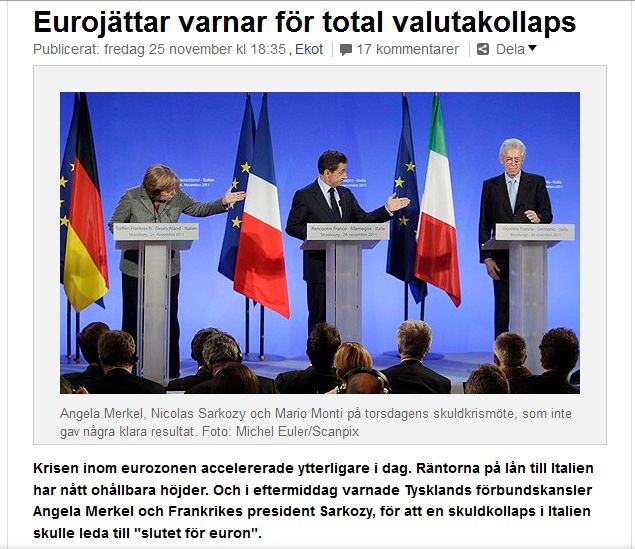
Krisen inom eurozonen accelererade ytterligare i dag. Räntorna på lån till Italien har nått ohållbara höjder. Och i eftermiddag varnade Tysklands förbundskansler Angela Merkel och Frankrikes president Sarkozy, för att en skuldkollaps i Italien skulle leda till "slutet för euron". Ekot 25/11 2011 
Death of a currency as The defining moment was the fiasco over Wednesday's bund auction, reinforced on Thursday by the spectacle of German sovereign bond yields rising above those of the UK. Up until the past few days, it has remained just about possible to go along with the idea that ultimately Germany would bow to pressure and do whatever might be required to save the single currency. In recent days, it has become plain as a pike staff that the lady's not for turning. Suddenly, no-one wants to hold euro denominated assets of any variety, and that includes what had previously been thought the eurozone safe haven of German bunds. Armageddon at Parthenon?
Is this really the end? The latest example is Spain. Despite a sweeping election victory on November 20th for the People’s Party, committed to reform and austerity, the country’s borrowing costs have surged again. The panic engulfing Europe’s banks is no less alarming. Their access to wholesale funding markets has dried up, and the interbank market is increasingly stressed, as banks refuse to lend to each other.Firms are pulling deposits from peripheral countries’ banks. This backdoor run is forcing banks to sell assets and squeeze lending; Germany, still fretful about turning a currency union into a transfer union in which it forever supports the weaker members, has dismissed the idea.
The crisis in the euro area is turning into a panic and dragging the zone into recession. The intensifying financial pressure raises the chances of a disorderly default by a government, a run of retail deposits on banks short of cash, or a revolt against austerity that would mark the start of the break-up of the euro zone. Consider the three ingredients for recession: a credit crunch, tighter fiscal policy and a dearth of confidence. In aggregate, European banks’ loans exceed their deposits, so they rely on wholesale funds — short-term bills, longer-term bonds or loans from other banks — to bridge the gap. But investors are becoming warier of lending to banks that have euro-zone bonds on their books and that can no longer rely on the backing of governments with borrowing troubles of their own. Long-term bond issues have become scarce and American money-market funds, hitherto buyers of short-term bank bills, are running scared. Have a nice day and read full text here Markets and the euro 'end game' (Reuters) - Riot police shielded Greece's national parliament Sunday as demonstrators gathered to protest against austerity measures on the eve of talks in Brussels on a 130-billion-euro ($171 billion) bailout The euro is a macro-economic weapon of mass destruction - it simply must be defused. Berlin doesn’t know what to do. The world’s financial markets, the British and American governments, and practically every non-German eurozone politician, are united. They’re watching and waiting, convinced that Merkel will eventually relent. The job of any central bank, the ECB included, is to act as “lender of the last resort” to commercial banks in its jurisdiction that are solvent, but in need of temporary liquidity. Are all these countries, their electorates supplicant, their future politicians content, really going to subscribe to and live under, for decades to come, a system based on Berlin telling them how much they can borrow and spend? How long before new, more extreme politicians come to the fore, pandering to base human prejudice? How long before a system that’s supposed to promote free trade and European co-operation ended up, instead, promoting protectionism, hatred and conflict? These are the questions that the cheer-leaders of “fiscal union” need to answer. “Fiscal union” advocates will also need, when the time comes, to send out the eurozone riot-police. How much louder do the alarm bells need to ring before time is called on this absurd monetary experiment? Varför är Sverige en fiskal union? Conspiracies, Coups and Currencies Stability would be achieved at the expense of democracy: the rituals of parliaments and elections would endure, but the real decision-making power would pass permanently to the forces represented by the so-called “Frankfurt Group” — an ad hoc inner circle consisting of Germany’s Angela Merkel, France’s Nicolas Sarkozy and a cluster of bankers and E.U. functionaries, which has been spearheaded European crisis management since October. One could argue that the Greeks and Italians — and the Spanish and the Irish and everyone else — should have known what they were signing up for when they joined the euro in the first place But the fact is that the project of European union has never enjoyed deep popular support. Its advocates were always adept at re-running referendums until the vote came out their way, or designing treaties that bypassed the voting public entirely. The longer the financial crisis in Europe drags on, the greater the risk of a European economic collapse The financial crisis in Europe has resulted from the attempt to impose a single money on such disparate economies as Germany and Greece. So far the approach to Europe’s debt crisis has been to have richer countries—essentially Germany—lend more to Greece so it can continue to service its debt. However, the condition for such aid has been sharp fiscal retrenchment in Greece, which has caused the economy to collapse and created the riots being seen in news media. Better to recognize that Greece is insolvent, write down its debt, and contain the crisis there than to keep supplying Greece with the funds to service an ever-increasing level of debt. While not a pleasant outcome, such decisive steps could help to keep Greece’s debt crisis from spreading even further — to Portugal, Spain, and Italy — and thereby threatening to precipitate a European economic collapse. The gathering storm in Italy has a growing number of policy makers calling on the ECB Yet few believe the ECB would let the common currency collapse to defend that principle. Of course, even a panic can be rational. But the German Chancellor is not supposed to think the existence of the euro is in question. In fact, it is at the heart of her approach to the crisis - politically and economically - that the single currency must not only come out of this in one piece, but come out of it stronger, with the all members committed to behaving more like Germany.
And he /Sir Mervyn King, Bank of England chief/ has never thought the ECB should or could be the saviour of the euro, by buying vast quantities of Italian - or Spanish - government debt. Why? Because, as I have explained on too many occasions, To ask the ECB to step in, in these circumstances, is basically to ask it to take risks onto its balance sheet, Suitably designed, the ECB's balance sheet could perhaps be a temporary bridge to a full-blown fiscal union. Finito? Markets are abandoning the periphery, including Italy, which is the world's eighth largest economy and third largest bond market. This is triggering margin calls and leading banks to pull credit from the European market. This, in turn, is damaging the European economy, which is already being squeezed by the austerity programmes adopted in every large euro-zone economy. A weakening economy will damage revenues, undermining efforts at fiscal consolidation, further driving away investors and potentially triggering more austerity. The cycle will continue until something breaks. Eventually, one economy or another will face a true bank run and severe capital flight and will be forced to adopt capital controls. At that point, it will effectively be out of the euro area. What happens next isn't clear, but it's unlikely to be pretty. Det finns ingen lösning, bra eller dålig, på eurokrisen The euro is not an end in itself. The single currency is just an instrument, aimed at promoting economic prosperity and political harmony across Europe. For reasons of pride, fear, ideology and personal survival, The euro has helped both to create and sustain the crisis in Europe. First, it caused interest rates to plunge in southern Europe, encouraging countries such as Italy and Greece to go on a borrowing binge. Now the single currency rules out the options that postwar Italy and others traditionally used to cope with high levels of debt: inflation and devaluation of the currency. Neither policy was cost free, but they provided an alternative to the “internal devaluation” (otherwise known as wage cuts and mass unemployment) that is currently being urged on Italy, Greece and much of southern Europe. Det finns ingen lösning, bra eller dålig, på eurokrisen Euro crisis reaches the Rubicon "would make the collapse of Lehman Brothers seem like a small problem" “An uncontrolled insolvency of Greece and an end of the euro would unleash a tsunami that would make the collapse of Lehman Brothers seem like a small problem.” Eurodämmerung The question I’m trying to answer right now is how the final act will be played. At this point I’d guess soaring rates on Italian debt leading to a gigantic bank run, both because of solvency fears about Italian banks given a default and because of fear that Italy will end up leaving the euro. This then leads to emergency bank closing, and once that happens, a decision to drop the euro and install the new lira. Next stop, France. Götterdämmerung Götterdämmerung är tyska för Ragnarök (ordagrant "Gudaskymning"). Ragnarök ("Gudarnas sista öde" refererar inom nordisk mytologi till en serie händelser, inklusive en avgörande strid, som förutspås leda till jordens undergång. Bundestag went along with /Merkel/ – with an important caveat. Before the summit, German Chancellor Angela Merkel went before her parliament and, in an impassioned speech, basically declared that unless the parliament approved the expansion and leverage of the EFSF the European Union would collapse, along with the decades-long peace that has prevailed. And the Bundestag went along with her – with an important caveat. They made their approval conditional on the European Central Bank continuing to comply with Article 123 of the Treaty of Lisbon, which says that the ECB cannot print money (or words to that effect). The Germans are obsessed with an independent ECB that will maintain the value of the euro – something to do with Weimar being embedded in their collective psyche. Contrast this "obsession" with Martin Wolf leading the chorus for incoming ECB president Mario Draghi (an Italian) to ignore the Germans. Here are some choice paragraphs from his recent piece: Be Honest – The European Debt Deal Was Really A Greek Debt Default But investors are not stupid. Greece was allowed to default. If Italy or Spain or Portugal gets into serious trouble it is likely that they will be allowed to default too. Investors like to feel safe. They want to feel as though their investments are secure. This Greek debt deal is a huge red flag which signals to global financial markets that there is no longer safety in European bonds. Top of page
A key reason why the eurozone is under challenge is that markets have become conscious of a fundamental weaknesses in its design. Even if leaders do enough to avoid a financial meltdown, A UK businessman is offering The prize is described as the second biggest cash prize to be awarded to an academic economist after the Nobel Prize. Europe Deeply Divided Ahead of Make-or-Break Summit Pumping cash into a problem and imposing austerity – as is happening in Greece – is not the answer. By fixing their exchange rates within the eurozone, its 17 members have denied themselves "the natural safety valve, which can limit the extent of imbalances in demand across countries", said Sir Mervyn. Anyway, far more urgent is how we deal with the crisis of confidence in some banks and sovereigns. Here the Bank of England Governor had a clear message for the eurozone. Four years into the crisis, said Sir Mervyn, it was "surely time to accept that the underlying problem is one of solvency, not liquidity". BNP Paribas SA and Commerzbank AG (CBK) are unloading sovereign bonds at a loss, Banks are selling debt of southern European nations as investors punish companies with large holdings and regulators demand higher reserves to shoulder possible losses. The European Banking Authority is requiring lenders to boost capital by 106 billion euros after marking their government debt to market values. The trend may undermine European leaders’ efforts to lower borrowing costs for countries such as Greece and Italy while generating larger writedowns and capital shortfalls. If losing half the face value of a bond does not amount to a default, what does? If it judges that a “credit event” has taken place, then payouts will be triggered on credit-default swaps (CDSs), insurance contracts against default on government bonds. This is something that the governments and the ECB had been determined to avoid, fearing it would lead to financial catastrophe, rather as the bankruptcy of Lehman Brothers did in 2008. “You don’t have to be paranoid to be terrified,” says a senior figure involved in the deliberations. Sadly, this latest deal promises to be no more enduring. At best, it will buy time before the next round of panic. At worst, it may push the euro zone into catastrophe. A euroozone built on one-sided deflationary adjustment will fail. Efforts to bring the crisis under control have failed, so far. True, the eurozone’s leadership has disposed of George Papandreou’s disruptive desire for democratic legitimacy. But financial stress is entrenched in Italy and Spain The crisis will be over if and only if weaker countries regain competitiveness. At present, their structural external deficits are too large to be financed voluntarily. A euroozone built on one-sided deflationary adjustment will fail. That seems certain. If the leaders of the eurozone insist on that policy, they will have to accept the result. PJ Anders Linder, politisk chefredaktör på SvD, m fl,, borde kunna medge att det var bra att det blev Nej till EMU i folkomröstningen The eurozone sovereigns lack a true lender of last resort. The fundamental challenge is not financing, but adjustment. Inside the eurozone, adjustment of imbalances remains essential. But it is also vastly difficult, because the exchange rate has gone. Flera franska bankaktier faller tungt på tisdagen, Frankrike kan få bidra med ytterligare pengar till andra europeiska länder eller sitt eget banksystem, som skulle innebära "betydande" nya förpliktelser i balansräkningen. ... Big snag. Professor Ansgar Belke, from Berlin's DIW Institute, said any leveraging of the EFSF would be "poisonous" for France’s AAA rating and would set off an uncontrollable chain of events. "It counteracts all efforts made so far to stabilize the eurozone debt crisis, which are premised on the AAA rating of a sufficiently large number of strong economies. We will find out soon enough what EU leaders actually intend to do – rather than what the European Commission would like them to do. Something slightly odd is going on. All of which is to say that anyone who believes that we may be approaching the end of the eurozone's wobbles and agonies is guaranteed to be disappointed, and quite soon. The lead negotiator for private holders of Greek debt has said that A group led by France and the European Central Bank has insisted that any new “haircut” must be voluntary, since forced writedowns would constitute a full-scale Greek default, triggering insurance policies, known as credit default swaps, and potentially reigniting investor panic. Voluntary? As Sir John Major wrote this morning in the FT, this does not solve EMU’s fundamental problem, It is therefore unlikely to succeed. It means that Italy, Spain, Portugal, et al must close the gap with Germany by austerity alone, risking a Fisherite debt deflation spiral. As I have written many times, this is a destructive and intellectually incoherent policy, akin to the 1930s Gold Standard Sir John Major wrote this morning in the FT Hindsight is often graceless. But it is a fact that sterling did not enter the euro because we foresaw flaws in its structure. We believed monetary union without fiscal union was risky; that convergence of the powerful northern economies with southern Europe was unlikely (especially once Germany had absorbed her Eastern Länder). I had a political objection as well: that entry into the euro, and the abolition of sterling, would remove key policy options from the British government. That is why, at Maastricht, I opted out of the euro. It was not easy. The opt-out was only obtained by threatening to veto the treaty. Germany is pushing behind the scenes for a "hard" default in Greece Although Greece's 10-year bonds are trading at a 60pc discount on the open market, European banks do not have to write down losses so long as there is no formal default and the debt is held in their long-term loan book. The danger arises if banks are forced to "crystallize" the damage before raising their capital buffers. Said Gary Jenkins from Evolution Securities: Pulling the plug on Greece risks bringing a much bigger crisis to a head all too quickly. The euro zone's decision to impose losses on holders of Greek government bonds has been an unmitigated disaster, The Ticking Euro Bomb The nations of the euro zone are in debt to the tune of €8 trillion, while banks hold European government bonds at a face value of €1 trillion on their books. The central banks of Greece, Italy, Portugal and Spain owe Germany's Bundesbank €348 billion. The ECB has purchased €150 billion in government bonds, and the banks, fearing loan defaults, would rather park up to €150 billion with the ECB than lend money. For a monetary union to function, the economies of its member states cannot drift too far apart, because it lacks the usual balancing mechanism, the exchange rate. Normally a country depreciates its currency when its economy falters. This makes its goods cheaper on the world market, allowing it to increase exports and thereby reduce its deficits. But this doesn't work in a monetary union. If one country doesn't manage its economy effectively, the common currency acts as a manacle (fotboja). Rogoff saiys the euro project is at a crossroads. The European partners must either enter into a forced marriage, a shotgun marriage, or the union will break apart sooner or later. In the end, only two possibilities will remain: a transfer union, in which the strong countries pay for the weak; or a smaller monetary union, a core Europe of sorts, that would consist of only relatively comparable economies. A transfer and liability union requires new political institutions, and individual countries would have to confer a significant portion of their powers on Brussels. The second path, a firewall would have to be erected between the countries that are in fact insolvent and others that have only a short-term liquidity problem. Then the banks would have to be provided with government funds, so that the financial system does not collapse when banks are forced to write off some of the government bonds on their balance sheets. Europe’s crisis is all about the north-south split Kommentar av Rolf Englund: "I am sure the euro will oblige us to introduce a new set of economic policy instruments. It is politically impossible to propose that now. But some day there will be a crisis and new instruments will be created." Romano Prodi, EU Commission President. Financial Times, 4 December 2001 http://www.liebreich.com/LDC/HTML/Europe/08-Euro.html We are now in the stage of the crisis where people get truly desperate. Most economic historians and international economists I know believe a monetary union would fail unless it develops into a fiscal union. What Really Caused the Eurozone Crisis? (Part 1) First, Wolfgang Schäuble, Germany’s finance minister, from his recent piece in the Financial Times: Next, here's an excerpt from a statement recently made by Greece's Deputy Prime Minister and Minister of Finance, Evangelos Venizelos:
These two statements capture the essence of two radically different views about the origins of the EZ debt crisis. Which one is right? Rather than large current account deficits being the result of fiscal mismanagement or excessive consumption, the current account deficits were the necessary and unavoidable counterpart to the surge in capital flows from the EZ core. Rather than above-average inflation rates and deteriorating competitiveness being signs of labor market inefficiencies or lax fiscal policies in the peripheral countries, appreciating real exchange rates were inevitable as the mechanism by which those current account deficits were effected. Konstruktionen kring euron har inte varit fel There was progress towards a eurozone rescue deal during the IMF's annual meeting in Washington, according to those present. War Game Amid a growing air of desperation, world financial leaders said they are scrambling to douse
"The threat of cascading default, bank runs, and catastrophic risk must be taken off the table, as otherwise it will undermine all other efforts, both within Europe and globally," U.S. Treasury Secretary Timothy Geithner said in a speech before the IMF. The U.S. Treasury is pushing Europe to respond to the crisis with a "shock-and-awe" strategy. Washington believes a major increase in the effective size the euro zone bailout fund would finally put market fears to rest. People's Bank of China Gov. Zhou Xiaochuan urged a prompt resolution to the euro-area debt crisis through "forceful and credible" measures. "The negative feedback loop between public-sector and private financial institutions' vulnerabilities weighs heavily on market confidence and limits the effectiveness of macroeconomic policies," he said.
The Treaty on European Union, known as the Treaty of Maastricht, was signed in the Netherlands city of Maastricht on February 7, 1992, A default by Greece, or its departure from the eurozone, also carries contagion risk. That means investors will worry about other nations in trouble Allt var fel från början, precis som kommunismen. Det är målsättningen om ett ständigt fastare förbund The euro, as we know, is a curious edifice (A building, especially one of imposing appearance or size), built without exits. The zone's endless travails have long ceased to be either a little local difficulty or the object of a bit of schadenfreude on the part of the world's Treasuries. They've become a source of grave systemic risk at a time when the world really doesn't need another one. The central theme of "Ozymandias" is the inevitable complete decline of all leaders, and of the empires they build, however mighty in their own time. There is no provision in any European Treaty for a country to leave the eurozone. The commentaries that puzzle me are those that say in one breath that the eurozone cannot survive Snillen spekulerar What comes next is the explosion of the European project. America will survive this because America is a state. The riots of Athens will become those of Milan, Madrid and Marseilles. Parties of the fringe will gain greater sway. Border checkpoints will return. Currencies will be resurrected, then devalued. Remarkably, the European authorities that drove Ms Lagarde’s selection just three months ago have rejected important components of her analysis Failure would be yet another example of what Churchill called “want of foresight, unwillingness to act when action would be simple and effective, lack of clear thinking, confusion of counsel until the emergency comes, until self- preservation strikes its jarring gong – these are features which constitute the endless repetition of history”. We are moving away from what I consider the only effective solution to the crisis. "We must now face the difficult task of moving forward towards a single economy, a single political entity... "I am sure the euro will oblige us to introduce a new set of economic policy instruments. As Europe's leaders seemingly dance on the edge of disaster, European officials ended a two-day financial summit Saturday with no new concrete plans On Saturday, the officials discussed but failed to agree on a proposal to tax financial transactions. Greece is likely to run out of cash by mid-October if it does not receive billions of euros of bailout money, potentially setting off a financial contagion that could hop from bank to bank and country to country. The euro – a cross-border project supported by the political elite and by businesses But they tolerated it as long as it appeared to work, just as the growth of global investment banking was regarded as irrelevant to most people’s day-to-day lives. Why is Spain — along with Italy in so much trouble? The run is on their governments rather than, or more accurately as well as, their financial institutions. Investors, for whatever reason, fear that a country will default on its debt. This makes them unwilling to buy the country’s bonds, or at least not unless offered a very high interest rate. And the fact that the country must roll its debt over at high interest rates worsens its fiscal prospects, making default more likely, so that the crisis of confidence becomes a self-fulfilling prophecy. And as it does, it becomes a banking crisis as well, since a country’s banks are normally heavily invested in government debt. Now, a country with its own currency, like Britain, can short-circuit this process: if necessary, the Bank of England can step in to buy government debt with newly created money. What Mr. Trichet and his colleagues should be doing right now is buying up Spanish and Italian debt — that is, doing what these countries would be doing for themselves if they still had their own currencies But the E.C.B. immediately found itself under severe pressure from the moralizers, who hate the idea of letting countries off the hook for their alleged fiscal sins. And the perception that the moralizers will block any further rescue actions has set off a renewed market panic. Elementärt, min käre Watson. Men det fordras en Krugman eller en Nils Lundgren, för att förklara det. Att de kan förklara det så bra beror på att de förstår det så bra, inte på att de skulle vara bättre pedagoger än vi vanliga dödliga.So grave, so menacing, so unstoppable has the euro crisis become that even rescue talk only fuels ever-rising panic. Few people, least of all this newspaper, want either vast intervention in financial markets Greece, which is unambiguously insolvent, ought to have a hard but orderly write-down. The ECB must declare that it stands behind all solvent countries’ sovereign debts and that it is ready to use unlimited resources to ward off market panic. That is consistent with the ECB’s goal to ensure price and financial stability for the euro zone as a whole. Third, it needs to shift the euro zone’s macroeconomic policy from its obsession with budget-cutting towards an agenda for growth. And finally, it must start the process of designing a new system to stop such a mess ever being created again.
The Economist: This is not what they were promised when the euro was set up. Treasury Secretary Timothy F. Geithner made an unusual appearance at a meeting of euro zone finance ministries. Mr. Geithner had been invited to offer some advice on fixing Europe’s sovereign debt and banking problems. European leaders, who have been slow to react to the root causes of the problem, emerged from the meeting dismissive of Mr. Geithner’s ideas and, in some cases, even of the idea that the United States was in a position to give out such pointers. New York Times 16 Sept 2011 U.S. Treasury Secretary Timothy Geithner told EU finance ministers on Friday they should European banks are “grossly under-capitalized” Will the eurozone break up? Just nu är Italien och Spanien viktigast. Jag skulle bli förvånad om alla de länder som i dag har euron som valuta kommer att ha det om tio år. Rumpnissen bleknar När förhandlingarna mellan 27 politiska ledare runt bordet sätter i gång på allvar är det styrkan som avgör. I teorin har varje land en röst och rätt att lägga in sitt veto, men i praktiken är det de stora länderna som har mest att säga till om. Under EU-nämndens möte i riksdagen på onsdagen framkom att Frankrike och Tyskland ska presentera ett färdigt och mer detaljerat förslag till fördragsändringar på torsdagens toppmöte. Inte ens EU:s president hade tydligen fått läsa det förrän sent på onsdagseftermiddagen. Då skickades det fransk-tyska utkastet i ett brev (på franska) till Herman Van Rompuy, Fredrik Reinfeldt och de andra stats- och regeringscheferna i unionen. "Vi måste ha en åsikt på EU-nämnden på onsdag” Vänsterpartiet säger ”blankt nej” till det fransk-tyska förslaget, meddelade Jonas Sjöstedt i en intervju med di.se tidigare på tisdagen. Han anser att förslaget är djupt odemokratiskt. Marie Granlund säger att Socialdemokraterna ännu inte tagit ställning till förslaget och vill inte uttala sig om innehållet i Merkels och Sarkozys utkast. ”Det går inte bara att följa det här via nyheterna. Man måste ju veta vad det verkligen innebär. Man måste vara seriös när det handlar om fördragsförändringar”, säger hon. Att rädda euron är i fokus, men för att klara det krävs en fördragsändring. Angela Merkel understryker att Tyskland och Frankrike som starka länder inom zonen har ett särskilt ansvar för att se till att krisen inte fördjupas utan blir löst. Ms Merkel’s scepticism also stems from bitter experience. Wolodarski och eurons hot mot demokrati och välstånd Lösningen, det bästa möjliga utfallet, innebär alltså en inflationsspiral i hela eurozonen, samt att Sydeuropa i realiteten blir koloniserat. Pratar man med näringsliv och eurokrater tycker de att den lösningen är helt okej: "det finns inte tid för politiska spel", som EU-ordföranden Barroso sade. Hur illa ställt är det egentligen? Euron står inför ett sammanbrott – Eurosamarbetet kommer inte att hålla som vi känner det idag. Antingen går man snabbt mot gemensam finanspolitik och därmed gemensam statsbildning, eller så är det är bara en fråga om när och hur EMU bryts upp, inte om, säger Royal Bank of Scotlands chefekonom Pär Magnusson. Motsättningarna inom eurozonen talar snarare för att det är något av de rika länderna som kommer att välja att lämna. Den politiska opinionen på hemmaplan kommer sannolikt bli övermäktig. T Tyskland ligger faktiskt nära till hands att bli det första landet att bryta sig loss. Valutaunionen var inget man egentligen önskade utan kan ses som en eftergift för att Västtyskland skulle få förenas med Östtyskland. Överallt sprids känslan av att undergången närmar sig. Eurokrisen, fisksoppan och elitens olidliga dumhet Socialism och EMU - två misslyckade fullskaleexperiment 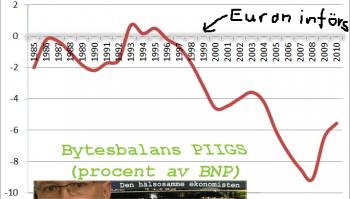
The ongoing discussions of economic policy and principles since the Great Recession Maybe the idea is that the burst bubble reduces demand, and hence leads to lower production. Eurozone Problems De människor som mobbade EU till att anta en gemensam valuta, Översättning av Google och Rolf Englund De saker som de kräver för sina romantiska visioner är ofta grymma, med stora uppoffringar från vanliga arbetare och familjer. För att rädda världsekonomin måste vi störta dessa farliga romantiker från sina piedestaler. Sanningen är att Europas marsch mot en gemensam valuta var från början ett tvivelaktigt projekt enligt varje objektiv ekonomisk analys. Låt mig peka ut särskilt Europeiska centralbanken (ECB), som är tänkt att vara den ultimata teknokratisk institution, och som har varit särskilt anmärkningsvärd för att ta sin tillflykt till fantasier medan saker går fel. Förra året till exempel, bekräftade banken sin övertygelse om "the confidence fairy" - det vill säga tron att budgetnedskärningar i en deprimerad ekonomi faktiskt kommer att främja en exåansion genom att öka företagens och konsumenternas förtroende. Konstigt att säga, har det inte hänt någonstans. Så är jag mot teknokrater? Inte alls. Jag gillar teknokrater - teknokrater är vänner till mig. Och vi behöver teknisk kompetens för att hantera våra ekonomiska problem. Men vår diskurs snedvrids av ideologer och önsketänkande tänkare - tråkiga, grymma romantiker - som låtsas vara teknokrater. Hela Europa riskerar att få nobben när marknaderna öppnar i kväll i Asien. Slutet för den nuvarande valutaunionen. Inte det mest sannolika, men ändå inget orealistiskt perspektiv. Inget kan rädda Grekland Eurojättar varnar för total valutakollaps Banker förbereder sig för eurokollaps Greker tömmer sina bankkonton Kontanter, guldmynt och placeringar utomlands lockar mer än pengar på banken. Från att ha tömts på upp till 2 miljarder euro, cirka 18 miljarder kronor, per månad den senaste tiden har uttagen från de grekiska bankerna accelererat. Eurodämmerung Götterdämmerung är tyska för Ragnarök (ordagrant "Gudaskymning"). Ragnarök ("Gudarnas sista öde" refererar inom nordisk mytologi till en serie händelser, inklusive en avgörande strid, som förutspås leda till jordens undergång. 106 miljarder euro Europas största banker tvingas att öka kapitaltäckningen, ett mått på risknivån, från 4 till 9 procent. De har fram till sommaren på sig. Totalsumman 106 miljarder euro för rekapitalisering av bankerna reser ändå frågetecken. Nästan hälften är redan täckt av olika länders räddningspaket. EU:s stresstester har tidigare konsekvent underskattat bankernas brister, och IMF tror att det behövs 200 miljarder. Hur det mycket större Italien ska botas är nästa mysterium. Toppmötets svajigaste resultat gäller dock räddningsfonden EFSF, som ska skydda övriga skuldstater från grekisk smitta. Angela Merkels och Nicolas Sarkozys modell, som Jacques Delors kallar Merkozy, Till varje pris? Är de till och med beredda att offra gemenskapen i EU för att rädda valutan euron? Rubriken på Philippe Ricards analys i Le Monde var illavarslande, om än försett med ett frågetecken: Europeiska Unionen är död – leve eurozonen? ... Mercosur is an economic and political agreement among Argentina, Brazil, Paraguay and Uruguay. Founded in 1991 by the Treaty of Asunción Det finns ingen lösning, bra eller dålig, på eurokrisen Det är obegripligt hur EU kunde blunda för att hela Europa inte är som Tyskland. War Game: Nu börjar eurokrisen bli riktigt spännande Spara detta citat för framtida bruk För att lugna marknaden och för ha verktyg att hindra krisen från att spåra ur totalt arbetar Europas ledare på ett sätt att Kommentar av Rolf Englund: Euro-krisen IMF-chefen varnar för kollaps ett anförande som publicerats på IMF:s webplats SOU 2002:16, Stabiliseringspolitik i valutaunionen, slutbetänkande samt underlagsrapporter Vilken väg tar euron? Scenario 6: Status Quo – allt fortsätter som vanligt Ett annat, inte helt omöjligt, scenario är att allt fortsätter som hittills. Politikerna fortsätter att hitta ad-hoc lösningar jagade av marknaden. Grekland kämpar på, BNP fortsätter att rasa, arbetslösheten att stiga och landet tvingas till en lång och plågsam interndevalvering med social oro som följd. Det minst dåliga scenariot är att krisländerna i södra Europa intensifierar sina budgetsaneringar Det andra huvudscenariot är att ett växande väljarmotstånd mot ytterligare stödinsatser i Tyskland och på andra håll leder till ett abrupt slut för dessa. Långivarna gör då stora kapitalförluster på sina innehav av statspapper från dessa länder. Charles Gave beskriver situationen i Grekland som ett ”lågintensivt inbördeskrig”.
”För att rädda Europa måste vi döda euron”, säger analysräven Charles Gave Konstruktionen kring euron har inte varit fel Den gemensamma valutan ska räddas genom exit för de stater som gör euron sjuk. I den bästa av världar kan detta ske under ordnande former. George Soros has warned Europe's debt crisis risks triggering another Great Depression unless euro zone leaders adopt a series of radical policy measures, including the creation of a common treasury. Does the Euro Have a Future? By joining the euro, Greece and other peripheral nations lost much more than control over interest and exchange rates. A self-feeding spiral of economic destruction has established itself. As a result, they are being progressively forced into default, a fate hitherto reserved only for developing and third world nations. Mrs Merkel told the RBB radio station: After Stark "Through stupidity, romanticism and goodness knows what, the experts — chancellors and economists — supported the idea of a currency "I was one of the main spokesmen against the euro eleven years ago and said then it would not survive He added that history had shown that currencies without governments fail. * Alla valutaunioner i historien har antingen lett till en stat eller spruckit. * - To Be, Or Not To Be A Country - that is the question “Perhaps future historians will consider Maastricht a decisive step towards the emergence of a stable, European-wide power. Yet there is another, darker possibility ... The effort to bind states together may lead, instead, to a huge increase in frictions among them. If so, the event would meet the classical definition of tragedy: hubris (arrogance), ate (folly); nemesis (destruction).” I wrote the above in the Financial Times almost 20 years ago. My fears are coming true. The only way to save the eurozone from collapse The cause of the panic attack was the European Council’s decision on October 26 to renegotiate the private sector participation of Greek sovereign debt holders. The introduction of a Eurobond will require a broader and deeper economic government that extends well beyond the notion of a fiscal union. But it might not happen. The crisis is moving too fast. We may well find that the Germans, the Dutch and the Finns are not ready for this. Europe is now leveraging for a catastrophe The way eurozone leaders have been handling the crisis ultimately vindicates the German constitutional court’s conservatism in its definition of what constitutes a functioning democracy. Unless there is a dramatic and simultaneous shift in the politics of Italy, Germany and the European Central Bank, The author is president of Eurointelligence, and an associate editor of the Financial Times. * Konstruktionen kring euron har inte varit fel Den gemensamma valutan ska räddas genom exit för de stater som gör euron sjuk. I den bästa av världar kan detta ske under ordnande former. The greatest fear is that one of the Continent’s major banks may fail, setting off a financial panic like the one sparked by Lehman’s bankruptcy in September 2008. “This crisis has the potential to be a lot worse than Lehman Brothers,” said George Soros, Gunnar Hökmarks generande förslag om eurokrisen The worst of the euro crisis is yet to come There is no provision in any European Treaty for a country to leave the eurozone. But everywhere you hear the same refrain: how do you break up a monetary union? And if it cannot be broken up then surely it must hold together. But in fact you cannot legislate for changing economic conditions or changes in peoples' attitudes. For an exit from the euro by a single member country, or the split of the euro into two or more parts, not to be extremely messy, you need planning and careful forethought, requiring discussion and the exploration of possibilities. Yet, to avoid precipitating a banking collapse, never mind other sorts of economic dislocation, you need absolute secrecy and surprise. After all, if people thought that such a change was coming they would try to withdraw money from vulnerable countries' banks and this could prompt a banking collapse and a serious economic crisis. * Nu brådskar det att avveckla euron under ordnade former. Rome, Habsburg and the European Union Europe will not slide back into recession, and the euro remains "strong and resilient" Låt Grekland lämna euron Nu brådskar det att avveckla euron under ordnade former. Even a joint bond might not save the euro The eurozone bond is not something you can introduce in an emergency meeting at midnight tomorrow. We are near to the end of the eurozone in its present form. The latest news from Greece is troubling. Its banks are so short of cash they have to borrow on an emergency basis from the European Central Bank, even though tens of billions of euros of special assistance has already been directed to its economy. No one can predict the exact form or scale of the coming eurozone turmoil. However, the public debate in Germany about the cost of eurozone bail-outs suggests that a fundamental reappraisal of the single currency is under way. We must be ready for a full-scale break-up of the monetary union. Today's European leaders can't do anything about the original sin: There are no cheap ways to speed the healing of housing. There's a lively debate about the merits of cutting government spending immediately, Johan Norberg varnar 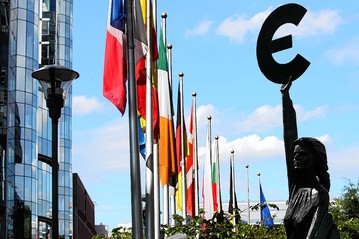
Kunde vi rulla tillbaka Sovjetunionen skall vi väl kunna rulla tillbaka Europeiska Unionen
Klicka här If the region's banks remain under pressure, however, the countries at the euro zone's core, in particular Germany and France, In the normally quiet month of August we have seen these difficulties escalate so rapidly that little now stands between Europe and a decade of low growth, high unemployment, industrial decline and popular discontent, the nearest modern economic parallel for which is the 1930s. Readers have asked for a quick verdict on the Merkel-Sarkozy deal. It was a vacuous restatement of clauses that already exist in the Lisbon Treaty, or an attempt to pass off retreads such as the Tobin Tax and harmonization of the corporate tax base as if they were new. More fiscal austerity for laggards, without even the Marshall Plan we had on July 21. It is all a step backwards into the black hole. The ECB can hold the line for now by purchasing €20bn of Spanish and Italian bonds each week. But once the ECB nears €150bn or so, the markets will brace for the next crisis. Italy alone has to raise or roll-over €68bn by the end of September. You can be sure that a great number of investors will take advantage of ECB intervention between now and then to lighten their holdings, and switch the risk to eurozone taxpayers. The ECB may have to buy at least €100bn of Italian bonds alone by late September to cap the 10-year yield at 5pc. French economist Jacques Delpla, who co-authored a paper proposing how eurobonds could work, See also: Trichet The leaders of Germany and France can agree to fiscal fusion and an EMU debt union, This implies the emasculation of Europe's historic nation states. They can tear up the mandate of European Central Bank and order Frankfurt to go nuclear with €2 trillion of `unsterilized' bond purchases until the M3 money supply in Italy, Spain, Portugal, Ireland, and Greece stops contracting Or they can try to muddle through with their usual mix of half-measures and bluster. This will lead to a rapid disintegration of monetary union and a banking collapse. It risks a repeat of 1931 if executed badly, as it most likely would be. What Italy has is a growth problem, rooted in currency misalignment. Having lost over 40pc in unit labour cost competitiveness against Germany since EMU, it is trapped in slump. Per capital income has contracted for a decade. So why is Europe forcing Italy to tighten drastically and run an even bigger primary surplus within two years, and doing so just as the world flirts with a double-dip downturn? The path of least resistance for Angela Merkel and Nicolas Sarkozy on Tuesday is surely to force the ECB to change course, by treaty power if necessary. Den nya beskyllningen mot Tea party-rörelsen är att den förstår samhällsekonomi i termer av hushållsekonomi. The Franco-German plan is fundamentally flawed because it does nothing to address If German Chancellor Angela Merkel and French President Nicolas Sarkozy get their wa y— and they almost always do — the 17 nations that use the euro will more closely coordinate their economic policies, and in particular their budgets. This is a long overdue effort to mirror and complement the common monetary policy that has been in place since the launch of the euro in 1999. A new deutsche mark Germany, Europe's strongest economy. In the wake of a break-up, it would be like Switzerland on steroids A new deutsche mark, or a northern euro with France, the Netherlands, Belgium, Luxembourg, Austria and Finland attached—would appreciate very sharply against the now many more currencies circulating in Europe, and indeed any other currency. Which might make the Swiss happy. Assuming the northern euro was the choice, would France, the Netherlands or anywhere else be able to endure a super-strong currency? The risks of what Sir Mervyn King, the Governor of the Bank of England, on Wednesday referred to as At his Inflation Report press conference yesterday, Sir Mervyn said: It will be years before the world economy cures itself of the debt overhang. Deprived of the remedy of currency correction, and with no corresponding mechanisms to address the imbalances, creditor and debtor nations are ripping each other apart. Detta är skälen till att jag betraktar euron och EMU som ett felkonstruerat system. Slithering to the wrong kind of union Om EMU:s föregångare, den s k Werner-planen Det förutsätter en ändring av Romfördraget vilket givetvis förutsätter enighet mellan medlemsländerna. Det är knappast troligt att rapportens slutmål kommer att kunna realiseras. Allt för många sakliga skäl talar mot de föreslagna åtgärderna ... Kravet på för evigt fixerade paritetskurser är inte realistiskt ... En låsning av valutakurserna innebär att prissystemet inte fullständigt kan fylla sin uppgift som koordinationsinstrument." Läs mer här Here is the statement by eurozone leaders. http://www.consilium.europa.eu/ The agreement included new aid for Greece that embraced bondholders, The risk is that the package will follow the pattern of previous agreements and eventually disappoint markets. “The European Financial Stability Facility has gone from being a single-barreled gun to a Gatling gun, but with the same amount of ammo,” Willem Buiter, chief economist at Citigroup Inc. told Bloomberg Television Reaktionen auf Griechenland-Paket One step back from the abyss The moment of no return, in any currency crisis, doesn't come when governments run out of options. It comes when governments run out of options that are politically possible - or credible. Think of the UK's own ERM crisis /1992/: the game was up when Norman Lamont raised interest rates to 15%to defend the currency peg, in the middle of the recession. Everyone knew that wouldn't wash. nejtillemu.com/normanlamontThere is no word, yet, on whether the EFSF is going to get any bigger. It's a bit feeble to announce a major new tool for confronting market contagion, without saying explicitly that you are giving it more money as well. Oklart var pengarna till Grekland ska tas ifrån As the German economist, Christian Schultze, told me for my television bulletin on Thursday, Gemany is not ready for collective European bonds - or any big leap towards a full fledged Federal union. If that is really what saving the Euro requires, as George Osborne and Ed Balls have both suggested, then "the euro has a big problem" You would think that Mr Osborne might have more sympathy for the Germans' reluctance to sanction a massive transfer of power from sovereign governments to the centre; a transfer which, by all accounts, would be expressly against the wishes of most of their citizens. So what's the EFSF then? Banks will reduce Greece’s debt by 13.5 billion euros by exchanging bonds and “potentially much more” through a buyback program still to be outlined by governments, said the Institute of International Finance, a Washington-based group representing banks. Investors will have the option to exchange existing Greek debt into four instruments. Three will be fully collateralized by AAA-rated zero-coupon securities and have a 30-year maturity, and the fourth will be for 15 years and partially collateralized by funds held in an escrow account. Crisis managers are aiming for a 90 percent participation rate from Greek bondholders More at BloombergBanks across Europe are braced to take as much as 17 billion euro ($24.5 billion) of Up until now, most banks have not written down the value of the bulk of their Greek sovereign bonds. Bonds can be held in two buckets on banks’ balance sheets: trading books, which routinely mark the value of bonds to market, only hold a fraction of banks’ sovereign bond investments; the balance is in so-called banking books, which are routinely held to maturity and are therefore not traditionally marked to market, ignoring plunges in bond values as a result. The current risk weightings for sovereign bonds under the Basel II framework for the standardised approach - used by many smaller banks - give a zero risk weighting to instruments with a AAA to a AA- credit rating. At the moment, 31 nations are rated in this bracket by Standard & Poor's, including Ireland and Spain. Italy has a A+ and Portugal carries a A- credit rating, which under the Basel rules attracts a 20% risk weighting Imposing capital requirements is easy, but what is capital and what are real risk assets? "Det gäller bara Grekland", Mycket fiffigt, Eurozone agrees new Greek bailout – Det är klart att när det har varit så mycket osäkerhet och så mycket problem i euroområdet så It appears that the eurozone is forcing Greece into a selective default. This would be a default, the first by a western industrialised country in a generation. How do the credit ratings agencies decide whether a Greek restructuring plan constitutes a default? 1937! So demand will be depressed in both crisis and non-crisis economies; STATEMENT BY THE HEADS OF STATE OR GOVERNMENT OF THE EURO AREA AND EU INSTITUTIONS Preliminärt utkast från torsdagens EU-toppmöte som Reuters tagit del av. Greklands lån från EFSF att förlängas till åtminstone 15 år, från dagens 7,5 år. While Merkel and Sarkozy were all smiles for the photographers when they met in Berlin last night the French president told his confidents what he really thinks of the German chancellor. But Sarkozy also hit out at Jean-Claude Trichet’s refusal to accept any Greek government bonds should the summit solution lead to a selective default or a default. “Trichet’s strategy is Belgian roulette”, he said according to Le canard enchainé. Eurointelligence 21 July 2011 The accord between the two most powerful states in the euro zone Germany and France reach Greek accord No immediate details were available but Steffen Seibert, a spokesman for Angela Merkel, the German chancellor, said “a common German-French position” had been agreed. Merkel and Sarkozy “listened” to the views of Trichet, the statement said Time is running out for salvaging Greece and, beyond it, Europe’s shared currency, the euro. If Europe’s leaders fail to extricate Greece from its current unsustainable debt-servicing obligations — by lowering interest rates and lengthening maturities at a minimum — the market reaction, for all of Europe, may be unforgiving, and uncontainable as investors conclude that no European sovereign debt is safe from possible default. Chancellor Angela Merkel of Germany says bank creditors must first agree to a partial write-down of their loans to Greece. That would certainly be fair. But there’s no time for that fight right now France’s president, Nicolas Sarkozy, has argued for swapping some of the Greek debt held by French banks for longer maturities. That offers some relief to the French banks but none to Greece, and rating agencies would likely label it partial default. No solution is possible unless Chancellor Merkel steps back from her unrealistic insistence that Greece’s bank creditors first bear some of the cost of any debt restructuring. Euroledarna rådvilla som nakna kejsare With Italian and Spanish debt yields ever higher, Thursday’s emergency summit offers perhaps the last chance to address it. In an added sign of mounting anxiety ahead of a European Union summit meeting on Thursday, Ingen bankskatt inom EU It looks like Jean-Claude Trichet and the financial markets have scared the European negotiators, But a bank tax, or bank levy, is not going to be easy to implement. For a start, as the FT reminds us in its main story this morning, this cannot be implemented eurozone-wide. This has to be done country-per-country. Germany’s experience with a bank levy, introduced last year, is not encouraging. The FT quotes a crisis as saying that the plan is unworkable, as it would require all eurozone countries to pass new tax legislation, while it would be impossible to target taxes on specific banks holding Greek bonds. ... Ny EU-skatt fel lösning på grekiskt slöseri I morgon samlas Europas finansministrar till krismöte om Grekland. På agendan finns ett förslag om att införa en EU-skatt på banker. Sverige måste tydligt klargöra att detta är helt otänkbart Karl Sigfrid arbetade under folkomröstningen om EMU på Medborgare mot EMU. French President Nicolas Sarkozy was to meet Merkel on Wednesday in Berlin "They agreed that dealing effectively with this crisis is important for sustaining the economic recovery in Europe as well as for the global economy," the White House said in a statement. Stephanie Flanders, BBC Economics editor: European officials are considering a tax on financial institutions In addition to a bank tax, “Option Three” could also include a voluntary rollover of Greek debt. The other two proposals are likely to involve some form of default, the document said. A meeting of euro zone leaders on Thursday will not be the final step in the resolution of Greece's debt crisis Either a deal is at hand and the town’s leading journalists don’t know about it – or we’re still a long way off with just 48 hours to go. The euro zone's strategy for dealing with its members' fiscal problems is in tatters, So what went wrong? Essentially, from being a series of national crises, the fiscal problems facing some of its members became a crisis of the currency area around about October last year, with the German government's public call for private-sector participation in the resolution of any future crises. It may have been well intentioned, but it was most certainly naive. Not for the first time, euro-zone policy makers demonstrated their lack of understanding of how financial markets work. Having assumed that no euro-zone government would ever be allowed to default on its debts, investors quickly concluded that a default would be the only way continued support for weak members could be justified to German tax payers. They became extremely averse to holding bonds issued by governments that might in the future need help, tipping both Ireland and Portugal over the edge. In short, it seems unlikely euro-zone leaders will have any answer to the contagion problem. This means Spain and Italy will lose access to bond market funding, increasing the risk that what started off as a series of fiscal problems affecting a rather small part of the euro-zone economy will end up destroying the entire currency area. Read more hereThis could even involve a country taking a sabbatical from the eurozone Peripherals implementing courageous austerity measures have been losing the support of citizens who feel, rightly, that their sacrifices have done little to improve prospects for their country. For too long, Europe has pretended that the crisis in its periphery was liquidity-driven rather than solvency-induced. Officials dismissed the need for debt restructuring, preferring a bail-out for Greece, Ireland and Portugal that piled new debt on top of an already unsustainable burden. Europe could opt for greater fiscal union, first de facto and then de jure. Individual countries would sacrifice a significant amount of national sovereignty and fiscal policy discretion. If this is politically impossible to implement, and I suspect it may be, Europe should opt for a restructuring of the debt of the weak peripherals, recapitalising the ECB... At some stage, this could even involve a country taking a sabbatical from the eurozone – but not the EU - in order to regain the policy flexibility needed to restore competitiveness. ... Det är kostnadsläget, stupid. It will help if Angela Merkel and Jean-Claude Trichet end their increasingly pointless squabble over private sector involvement in a Greek debt relief package. The risks to the European banking system, with its intricate patterns of multibillion-euro, cross-national loans and investments, are correspondingly high. ... Trichet: ... For Schäuble, the euro crisis is an opportunity to finally realize his plan for a political union. "Europe is like a bicycle. If you stop it, it will fall over," he said in a keynote speech in Paris in December, quoting the great European Jacques Delors. Schäuble never believed that a common currency could work without political cooperation. He has been pushing Merkel in this direction behind the scenes, but she has been hesitating and dithering. Göran Persson: Vi går mot en europeisk federation /Men varje 5-åring vet ju att det är mycket lätt att få stopp på cykeln utan att ramla. Officials in Germany's Finance Ministry are analyzing several models for paring down Greece's debt burden to a more tolerable size.
This would involve relieving the country of roughly €70 billion (SEK 648 milljarrder) in debt. "We are searching through our entire arsenal for a fundamental solution to the problem," said one official close to Finance Minister Wolfgang Schäuble. Five years ago, I was among those who argued that the probability of a collapse of the eurozone was close to zero. Europe’s political leadership has been, and still is, committing a category error in its approach. A modest proposal Only one option can be orderly. Germany and its satellite economies must withdraw from EMU, leaving the Greco-Latin bloc with the residual euro and the institutions of monetary union. Let us call the legacy group the "Latin Union" in memory of its 19th Century forebear. Once the dust had settled, it would become clear that Italy, Spain, Ireland, and perhaps Portugal had regained enough competitiveness to hope to grow their way out of debt traps. The alternative is to impose austerity and debt deflation without offsetting relief – à la grecque – on a string a countries until their polities shatter, and capital flight sets off disorderly EMU exit by the weaker states, with a concomitant chain of defaults reaching Italy, the world's third biggest debtor. As the bond jitters of the last two weeks have shown, we are already uncomfortably close to this. How to save the eurozone “The governments have been warned, in no uncertain terms and using all possible means. I have said so publicly. Trichet reiterated that the ECB will not accept as collateral bonds from a nation that defaults. Trichet said the euro is not in danger and remains “a highly credible currency.” He reiterated that the ECB will not accept as collateral bonds from a nation that defaults. “If a country defaults, we can no longer accept as normal eligible collateral defaulted bonds issued by the government of that country,” Trichet said. “Because, in the eyes of the Governing Council, this would impair our ability to be an anchor of confidence and stability.”Trichet said in an interview with the Financial Times Deutschland, according to a transcript released by the Frankfurt-based ECB. As German Chancellor Angela Merkel flirts with solutions to the Greek crisis that rating companies say would amount to a default, Trichet says leaders can’t repeat the mistakes made by U.S. officials when they let Lehman Brothers Holdings Inc. fail. Eurogruppens ledare Jean-Claude Junker och Jean-Claude Trichet, chef för den Europeiska Centralbanken ECB Soon the euro zone may well have to expand the EFSF and allow it to issue jointly guaranteed “Eurobonds”. What EU leaders once ruled out — a default by a euro-zone nation — has firmly entered the sphere of the possible The eurozone might be on the verge of a fiscal cum financial crisis that destroys not just the solvency of important countries In Europe, politicians are dealing with the legacy of a utopian project which requires a degree of solidarity that their peoples do not feel. Europas ledare möts och pratar, men någon ordning på eurokrisen får de inte. Efter månader av villrådighet verkar eurozonens finansministrar ha fått klart för sig att Greklands skuldberg måste trimmas, men är inte överens om hur. Italien är eurozonens tredje största ekonomi, men delar defekter med andra Medelhavsländer. Tillväxt och produktivitet har sackat efter EU-snittet sedan euron infördes. Den offentliga sektorn är överviktig, de sociala förmånerna frikostiga. Skattesmitning och svartjobb är specialiteter. Some of Europe's biggest banks are taking steps to shore up their defenses should the debt crisis spiral out of control and one or more countries leave the euro zone Wall Street Journal 13 July 2011 Some banks recently have been reining in some cross-border lending to companies in countries like Spain and Italy, bank officials say. Others are parking more money with the European Central Bank, according to ECB data. Banks also are increasing their use of credit-default swaps as protection against their holdings of sovereign debt from shaky countries. The moves reflect mounting concern that Europe's political leaders lack the will to adequately address the Continent's problems. The worries have shifted from concerns that Greece may default on its debts to a more dramatic scenario where Greece or another country departs the currency bloc. Friday emergency summit meeting Herman Van Rompuy began making arrangements to summon European leaders to Brussels on Friday for an emergency summit meeting. Several diplomats cautioned that Mr Van Rompuy’s calls were hasty, and that it remained unclear whether an emerging consensus could be translated into a binding legal agreement on such short notice. For the record Very funny, Do Read! "Ministers discussed the main parameters of a new multi-annual adjustment program for Greece, which will build on strong commitments to fiscal consolidation, ambitious growth-enhancing structural reforms and a substantial privatization of state assets." "en viss default" Europas ledare är för första gången beredda att acceptera en viss default av grekiska statspapper. Det skulle innebära att privata finansiärer förlorar pengar på lånen till Grekland. Trichet says leaders can’t repeat the mistakes made by U.S. officials when they let Lehman Brothers Holdings Inc. fail.“No credit event, no selective default, no default,” he said Once again Europe's debt crisis has metastasized, and once again the financial authorities face systemic contagion unless they take immediate and dramatic action. What it will take is a belated recognition by Germany that this crisis is not a morality tale contrasting virtuous, thrifty Teutons, with feckless Greco-Latins and Guinness-befuddled Celts, but rather a North-South structural crisis caused by the inherent workings of monetary union. The implications of this are profound. Germany must now be willing either to buy or guarantee Spanish and Italian debt, Large matters, beyond the intellectual vision of Germany's current leaders. The cost of insuring Italian debt rose sharply after the country’s trusted Finance Minister became linked to a corruption scandal Despite the brave efforts of their governments and people, It is quite understandable that eurozone governments and the European Central Bank are not hurrying to make the necessary adjustments. The ECB’s worst nightmare The ECB is now financing around 20 per cent of the balance sheets of Greek and Portuguese banks, and has a total exposure to the troubled economies in excess of 400 bn euro. The capital and reserves of the European System of Central Banks is only 81 bn euro, so recapitalisation of the central banks could easily become necessary. As if that were not enough of a problem, there are signs of a further, and even less controllable, problem emerging. Ordinary bank depositors in Greece and Ireland are beginning to shift their money out of the retail banks. As the UK government found in the case of Northern Rock, the appearance of queues outside banks is one of the worst nightmares which a central bank can face. It has not happened in Europe – yet. --- One Sunday in October 2008, Alistair Darling flew back from Washington to find Britain on the brink of banking meltdown. The chancellor was told by his Treasury officials that unless a rescue plan was announced by the time the City opened for business the following morning, there was no guarantee that cashpoints would work and that cheques would be honoured. The possibility of global financial implosion concentrated minds wonderfully; bailout plans were announced that ensured disaster was averted. --- A run on a bank occurs when a large number of depositors, fearing that their bank will be unable to repay their deposits in full and on time, simultaneously try to withdraw their funds immediately. Nationalisation of Northern Rock, Wikipedia Bank Runs, by George G. Kaufman Nice pics of bank runs, Google Eventually, governments pursuing ever more austerity In their seminal study of sovereign defaults, "This Time Is Different," U.S. academics Carmen Reinhart and Kenneth Rogoff showed that the most usual way for governments to escape crippling debt is to renege. Bond market yields suggest investors are almost certain of Greek and Portuguese defaults over the next couple of years. Keynesian economists have long argued that the ECB's focus on inflation is wrong-headed and ultimately self-defeating. In part, that's because in seeking to pursue monetary policy to suit Germany and other core economies it is condemning the periphery to debt deflation. Apart from their debt burdens, the fundamental problem with these economies is that they're not competitive relative to Germany. To regain competitiveness, they need the cost of German labor and other inputs to rise faster than their own. "This Time Is Different"Greece, Ireland and Portugal The Greek rescue and the European financial stability facility were meant to tide countries over until private lenders recovered from a temporary panic.
Yields on the sovereign obligations of Greece, Ireland and Portugal remain near record highs. But it does mean that markets do not believe them. In this sense, the rescues are failing. Nice, sort of, chart of Youth Unemployment Moment of truth for the eurozone The biggest question in any debt crisis is whether a credible path back to solvency can be found. For Greece, this now seems very unlikely. The same is true, to a lesser extent, for Ireland and Portugal. This raises three further questions. First, how big is any required restructuring? Second, who should bear the cost? Finally, is restructuring enough? If the answer to the last question is No, then one has to ask whether the currency union will last in its current form. At some point, the present value of the cost of debt must be drastically lowered. This does not have to happen today. But it has to happen soon enough to give people hope. In its absence, failure is not just likely. It is close to a certainty. The EU authorities are attempting to muzzle free opinion, threatening Fitch, Moody’s, and S&P with vague retribution Currency unions switch exchange risk into default risk. States with their own sovereign currency and debt in their own currency can let the exchange rate take the strain when they get into trouble, as the US and the UK have done. Foreign investors lose money on the exchange rate. This not the case at all for EMU laggards. They cannot devalue or inflate away debt. The stress shows up in the bond markets instead. The more relevant comparison in this respect is between the Euroland’s Club Med states and California. My gripe against the agencies is not that they are downgrading all these semi-bankrupt states today, but that they totally failed to signal the inherent dangers of EMU a long time ago when the crucial investment decisions were being made. They too were swept up by euro euphoria. They too failed to understand the inherent structure of monetary union, or to spot obvious warning signs as the drama unfolded and the North-South divide became ever-more apparent. They handed out AAAs like confetti. Trichet says leaders can’t repeat the mistakes made by U.S. officials when they let Lehman Brothers Holdings Inc. fail.
The ECB’s worst nightmare Jan Kees de Jager, the Dutch finance minister Mr Trichet hardened the ECB’s line on defaults during his press conference. He said one should not presume that private sector involvement was normal. Of course, a default rating would not affect Greece’ access to capital markets right now, but as we have seen in the last few days, fear of a default spreads like wildfire. Möte på torsdag mellan Frankrikes nye finansminister Francois Baroin och hans tyske kollega Wolfgang Schäuble Greece, Portugal and Ireland Wolfgang Schäuble, German finance minister, said a rethink was needed Just as eurozone governments and banks appeared to be coalescing around a French-led plan for a piecemeal rollover into new 30-year bonds, Wolfgang Schäuble, German finance minister, said a rethink was needed as talks about “a quantifiable private-sector contribution... had produced no result”. Wednesday’s meeting debated tweaks to that plan – extending the rollover target percentage and cutting the coupon potentially to below 6 per cent. But participants said little headway was made. “There was a lot of confusion, it was very chaotic,” said one. “A lot of people spent a lot of time just stating their opinion.” S&P and Moody’s S&P said in a statement: "It is our view that each of the two financing options described in the (French banks') proposal would likely amount to a default under our criteria." Moody’s issued a terse note saying that it was not party to any ongoing discussions. Moody’s will only comment on a scheme, once it has been decided. Ewald Nowotny, the Austrian central bank governor, made an interesting comment, according to Reuters, saying that the ECB had been in discussions with the rating agencies, and found that attitudes had hardened. He said he was struck by the fact that the agencies were tougher now than they were in respect of the Latin American Brady bonds. (But this French banking association proposal is not a Brady bond. It is a rollover plan, with an element of collateralisation.) "Default", kallas det bland kreditvärderare, när en låntagare saknar betalningsförmåga. Skulle Grekland brännmärkas med "default" av S & P eller Fitch kan den grekiska skuldkrisen förvärras snabbt. Bland annat kan Europeiska centralbanken (ECB) i ett sådant läge sluta ta emot grekiska obligationer som säkerhet för lån. S&P said this morning a French plan to allow Greece to voluntarily change the terms on some of its debts when they come up for repayment would, "likely amount to a default under our criteria". French banks, which hold some of the biggest exposures to Greek government debt, want to allow the country to extend the maturity of its bonds, which S&P said could be defined as a "selective default". The default threat came as Greece was told yesterday by the chairman of the Eurogroup of finance ministers that it must privatise assets on a scale similar to the sell-off of East German companies at the fall of the Berlin Wall to rebuild its finances. The Greek rollover pact is like a toxic CDO This isn't just a mortgage or housing crisis. The alleged case of a successful internal devaluation — that of Latvia Paradoxically, the early interest rate convergence became damaging as it allowed a severe lack of fiscal discipline in some countries (such as Greece and Portugal) and the build-up of asset bubbles in others (such as Spain and Ireland). Moreover the lack of market discipline delayed the necessary structural reforms and led to divergences in wage growth relative to productivity growth, and thus a rise in unit labor costs in the periphery and a loss of competitiveness that led to economic divergence between the PIIGS and the core. And the straightjacket of common monetary and currency policy exacerbated the real growth divergence at a time when structural and fiscal policies diverged. Any successful monetary union has eventually been associated with political and fiscal union. Political union in the EZ and EU has stalled and a backlash against anonymous Brussels bureaucrats imposing their views on nation states is brewing. A fiscal union would require that a significant amount of federal/central revenues be mobilized for the provision of EU/EZ-wide public goods, but there is no mechanism or will to provide the EU with enough power to create a semi-federal system of taxation, transfers and spending. The alleged case of a successful internal devaluation — that of Latvia —is not relevant here: Entering the crisis, its public debt was 9% of GDP, not the 100%- plus of Greece; losses from depression and deflation were taken by foreign banks dominating its banking system; and accepting a draconian 20% fall in output was politically feasible as Latvia did not want to fall into the arms of the Russian bear again. German Banks ask for state guarantees as a condition for private sector involvement The bosses of the lobby groups for private and public banks (BdB and VÖB) asked for “certain assurances” adding that “waiting on purely voluntary help without conditions will not lead to success”. The request would render Wolfgang Schäuble’s request of public sector involvement (PSI) absurd because in the end it would be the taxpayer who shoulders the burden. Recent public commitments stating the EU would ensure Greece remains solvent through next year were thought to be enough to secure the backing of the IMF IMF's statutes stipulate that the organization can only lend a country money if it is certain that the state will be able to meet its payment obligations for the next 12 months. Time for Plan B Part 1: How the Euro Became Europe's Greatest Threat If the current situation continues, the monetary union will invariably turn into a transfer union, a path the inventors of the euro were determined to prevent. There is no emergency exit, and there are no rules to follow in an emergency -- only the hope that everything will turn out well in the end. This is why the crises of a few euro countries are a crisis for the euro, as well as a crisis for the European Union, its governments and its institutions. The fact that the countries funding the bailouts are lacking democratic legitimization is now becoming the greatest impediment to joint crisis management The euro, created with the aim of permanently uniting Europe, has become the greatest threat to the continent's future. A collapse of the monetary union would set Europe back by decades, dealing it a blow from which it might never recover Part 2: The Euro Is a Fair-Weather Construct USA:s president och alla vi andra borde inte bekymra oss om Liran och Drachman Germany's chancellor wants "a substantial contribution" from private creditors who are due to be repaid some €64 billion by 2014. If those creditors baulk but are nevertheless coerced into rolling over their loans, enter the credit agencies and the ECB, for both of whom a forced rollover is, dare we say it, a default. Irwin Stelzer, director of economic policy studies at the Hudson Institute, WSJ 20 June 2011 Why spend seven hours behind closed doors, only to decide to wait and see? Why spend seven hours behind closed doors, only to decide to wait and see? As a result of the discussion, he said, the euro group had “cleared the way for a solution”. Threats are only worth making if those making the threats could actually carry them out Eurozone finance ministers' overnight decision to withhold payment of 12bn euros of emergency loans to Greece, pending agreement by the Greek parliament on austerity measures and privatisations, would be rational and credible on the basis that Greece has more to lose from a disorderly Greek default than the eurozone itself. WarGames: Chicken-Race mellan Berlin och Frankfurt Luxembourg Prime Minister Jean-Claude Juncker, the head of the eurozone group of finance ministers said "lack of discipline in countries such as Greece and Portugal was matched only by the build-up of asset bubbles in others like Spain and Ireland" Paradoxically the halo effect of early interest rate convergence allowed a greater divergence in fiscal policies. A reckless lack of discipline in countries such as Greece and Portugal was matched only by the build-up of asset bubbles in others like Spain and Ireland. The bail-out strategy that rescued Europe’s peripheral economies is proving insufficient. which wants the maturities on Greek bonds to be extended, and the ECB, which resists any debt restructuring. The hope is still that Europe’s leaders will come up with a face-saving compromise at their summit on June 23rd-24th. Inherently, there are two conflicting economic tensions in the rescue packages. Though the ministers will doubtless go on talking, it is increasingly hard to see a safe way out of this crisis. Andes Borg å ena och å den andra sidan om eurokrisen Svenska Dagbladet åter i EMU-debatten! European finance ministers will hold an emergency meeting on Tuesday in an effort to narrow differences over a €172bn ($247bn) rescue package for Greece. The bail-out deal is at risk of being derailed by a growing dispute between Berlin and the European Central Bank over the role of private bondholders. Eurokrisen är alltså över? Fel. IMF's statutes stipulate that the organization can only lend a country money if it is certain that the state will be able to meet its payment obligations for the next 12 months. Today the French government is working overtime to make sure that a Sarkozy loyalist, the leader of his economic team — Finance Minister Christine Lagarde — becomes the next managing director. The global fallout of a eurozone collapse The writer is professor of economics at Harvard University and co-author with Carmen Reinhart of This Time is Different A s many commentators have rightly observed, the euro experiment is at a crossroads. Either the eurozone will deepen into a fiscal union, or the weak members will be forced to break off. The 1980s and 1990s taught us /Kronkursförsvaret 1992/ that for countries with open capital markets, fixed exchange rates are a mirage that cannot be indefinitely sustained. If the euro goes the way of the Argentine currency peg, the noughts and tens – the first decades of the 21st century – will be viewed as teaching the same lesson about more radical currency marriages.
The sovereign debt crises that Europe is experiencing today are a typical aftershock of a deep financial crisis. Unfortunately, as currently construed, the euro is looking very much like a system that amplifies shocks rather than absorbs them. European leaders’ plans to achieve effective devaluation through major wage adjustment seem far-fetched. The real question is whether common currency is sustainable politically. My guess is that if the current slow patch in global growth does not quickly subside, we will not have to wait long for an answer. The European Cental Bank's bailout package is just a $1 trillion fig leaf covering the problem and Om euron kollapsar Det krävs förändringar i EU:s fördrag och därmed också nya uppslitande folkomröstningar. En annan, kanske troligare, möjlighet är att Grekland lämnar det eurosamarbete man bluffade sig in i och att valutaunionen som fortsätter med sexton medlemmar. Det skulle förmodligen stärka den europeiska valutan, men också smärta den europeiska banksektorn då Grekland skulle skriva av sina lån. Politikerna lär inte ge upp europrojektet än på ett tag. Nästa steg ser ut att bli att kraven på Grekland höjs ännu ett snäpp och att mer pengar lånas ut. --- What happens when Greece defaults. Here are a few things: Co-Founder Of Reaganomics, Paul Craig Roberts: After the creation of the euro in 1999, European nations that had previously been considered risky, The answer to that question is now, of course, painfully apparent. Greece’s government, finding itself able to borrow at rates only slightly higher than those facing Germany, took on far too much debt. The governments of Ireland and Spain didn’t (Portugal is somewhere in between) — but their banks did, and when the bubble burst, taxpayers found themselves on the hook for bank debts. The problem was made worse by the fact that the 1999-2007 boom left prices and costs in the debtor nations far out of line with those of their neighbors. What to do? European leaders offered emergency loans to nations in crisis, but only in exchange for promises to impose savage austerity programs, mainly consisting of huge spending cuts. Objections that these programs would be self-defeating — not only would they impose large direct pain, but they also would, by worsening the economic slump, reduce revenues — were waved away. Austerity would actually be expansionary, it was claimed, because it would improve confidence. But the confidence fairy hasn’t shown up. Europe’s troubled debtor nations are, as we should have expected, suffering further economic decline thanks to those austerity programs, and confidence is plunging instead of rising. It’s now clear that Greece, Ireland and Portugal can’t and won’t repay their debts in full, although Spain might manage to tough it out. Greece, Ireland, Portugal, Spain “Events in Greece have brought the euro area to a crossroads: Jean-Claude Trichet, ECB president – with less than six months before his eight-year term expires – has refused to discuss any debt restructuring for the nation, storming out of a meeting of eurozone finance ministers in Luxembourg this month when it was raised. His colleagues, including Mr Weidmann of the Bundesbank, have raised the stakes. They warn that if politicians take even a modest step towards a restructuring, the ECB will cut Greek banks off from its lifesaving liquidity supply, triggering a financial collapse that would push the country’s economy into the abyss. It is the central bank equivalent of nuclear deterrence: defy us and we will blow up the world Concluding remarks at the Banque de France / Deutsche Bundesbank Spring Conference on “Fiscal and Monetary Policy Challenges in the Short and Long Run” Bundesbank President och Grekland – “the central bank equivalent of nuclear deterrence: defy us and we will blow up the world” Kaos väntar om Grekland faller Simon Johnson, tidigare chefsekonom vid IMF och numera forskare vid Bostonuniversitetet MIT, varnar för ett ”Lehman moment”, en global finansiell hjärtinfarkt i stil med oktober 2008, om det blir aktuellt med en nedsättning eller tidsomläggning av Greklands skuldbetalningar, rapporterar Bloomberg. The Spanish people have finally found their voice. For over a week they have been occupying squares across the country to protest at unemployment. For 16- to 24-year-olds, 43% are without work. The endgame for Europe is approaching — and much faster than anyone expected This was designed to relieve the Greek Government’s debt burden, which the EU has belatedly accepted as unsupportable — and to ensure that private investors bear some of the consequent loss. So far, so good. What the EU politicians did not seem to realise was that a plan to wipe out half the value of Greek government bonds might be seen as a warning to bondholders of other indebted EU countries. There is only one real alternative to a break-up of the euro. This is to reinforce the single currency with an EU fiscal policy, administered by an EU finance ministry and backed by rapid progress towards a federal political union. The creation of so-called E-bonds, jointly guaranteed by all European governments, to replace half or more of existing national debts. The total cost to taxpayers in Germany and other creditor countries of supporting Greece, Ireland and Portugal will be much higher than seemed likely last year Last year it was possible for EU taxpayers to share the burden of the bailouts with private investors who had foolishly lent money to the Greek Government and the bust Irish banks. Now many of these investors have been repaid in full The confusing debate about “reprofiling” or soft restructuring pays testimony to the sheer incompetence of eurozone’s finance ministers, The ECB, which has bought about €45bn /SEK 404 miljarder/ of Greek bonds over the past year, The European Central Bank has criticised proposals for a possible restructuring of Greek sovereign debts, laying bare a behind-the-scenes row between ECB technocrats and European Union politicians over Greece’s debt crisis. Om Grekland ställer in betalningarna, alternativt skriver ned värdet på sina utestående lån, Interest rate cuts work their way through to the real economy by a number of transmission channels. The eurozone, as designed, has failed. The underlying economics of the /Euro/crises are clear The domestic counterparts of these external deficits could be huge fiscal deficits (as in Greece), huge private financial deficits (as in Ireland and Spain) or a combination of the two (as in Portugal). Indeed, we now know that the distinction between private deficits and debt and public deficits and debt is far less absolute than the fiscal priesthood understands: private debt becomes public debt and private deficits become public deficits very swiftly. In a crisis, huge external deficits also result in “sudden stops” in the inflow of external finance and so the need for official support, to finance the ongoing fiscal and current account deficits and capital flight. The problem with the strategy of imposing the burden on taxpayers in borrowing countries is that it is unlikely to work. The eurozone’s journey to defaults Läget i Grekland blir allt allvarligare. Ekonomin skenar och missnöjet bland människor växer. “I was told to say there was no meeting... We had certain necessities to consider” Skrattar bäst som skrattar först om Grekland Europe is running a giant Ponzi scheme In May 1931, a Viennese bank named Credit-Anstalt failed. The scariest thing about the Credit-Anstalt default is that it occurred in a small, peripheral country, just as today's worst problems are concentrated so far in Greece, Ireland, and Portugal, which combined make up just 5 percent of the 27-nation European Union's gross domestic product. "Austria is a tiny, tiny little place, and you wouldn't imagine it could set off a chain of domino reactions. But it did. I do see exactly that potential now," says James. There's a modern analogy in Greek banks' unwise loans in Bulgaria, Romania, and Serbia. For all Germany’s fear of becoming locked into permanent support for the Irish and others, Pushing the Irish and Greeks into official EFSF-style bailouts thus worsens their finances and makes default more likely. After the Latin American debt crisis in the 1980s, US regulators lied about the health of American banks until they were in a position to take a voluntary haircut on their bad loans. Jean Monnet, the French economist and public official who is regarded as one of the architects of European unity, once famously stated that "Europe will be forged in crises and will be the sum of the solutions adopted for those crises." Gone is the politically expedient "no bailout" clause of the euphoric early period of the monetary union. Greek, Portuguese Bonds Slump as Schaeuble Proposes Restructure RE: "Tsunamani sinks all the boats" Many European banks need bigger capital cushions to restore market confidence and help reduce the risk of another financial crisis, A day after Portugal formally requested aid from the European Union to help ease ongoing debt problems, ECB and The Taylor Rule - a difference of 9 per cent The Taylor Rule, devised by Stanford University economist John B. Taylor, is a measure of where rates should be set given inflation and growth projections. Bara en floskelavtrubbad EU-byråkrat kan kalla en blyväst för en livboj och förvänta sig att bli trodd. Istället för sanering har länder med skuldproblem försetts med nya kreditkort, i form av nödlån från EU och IMF, för att kunna betala sina räkningar. Matematikintresserade ekonomer påpekade redan ifjol att idén inte var allt för briljant. För ett land ska kunna banta sin statsskuld krävs att den ekonomiska tillväxten är minst lika hög som räntan på lånen. I djup lågkonjunktur tvingar det fram så masochistiska besparingar att ekonomin riskerar att krympa ytterligare. Fallande BNP och stigande räntor gör att landet riskerar att hamna i en hopplös skuldfälla. The risk is roughly one in seven that Europe's ongoing debt crisis will push member nations to abandon the shared currency, The pressure on politicians from voters at home to leave the shared currency could then become "irresistible", resulting in either stragglers like Portugal or Ireland or a robust economy such as Germany deciding to leave, before other members follow suit. "This scenario posits that sooner or later, the cement that has held European countries together for decades cracks and the progression towards ever-closer union comes to a spectacular halt," State of the union: Can the eurozone survive its debt crisis? State of The Union They’re bust. Admit it. The leaders fell short on almost every task they set themselves. They agreed on a “permanent” rescue mechanism to be introduced in 2013, but couldn’t fund it properly, because Mrs Merkel refused to put up money her finance minister had pledged. The Brussels gathering did little to help Greece, Ireland and Portugal, the zone’s most troubled economies. At the EU’s insistence, the peripherals’ priority is to slash their budget deficits regardless of the consequences on growth. The total exposure of foreign banks to the struggling quartet of The BIS, the central bank of central banks, said in its quarterly report that Germany had $569bn of exposure to the quartet, France $380bn, and the UK $431bn. Three numbers stand out: 12.4, 9.8 and 7.8 That they remain so high — compared with just 3.24 percent on German bonds — shows that investors remain unconvinced that Europe’s haphazard strategy for bailing out troubled, highly indebted countries has succeeded a year after it began. Kommentar av Rolf Englund: EU bailar inte ut någon, EU lånar ut Vad säger Annika Ström Melin, som borde veta bättre? The divisiveness pact Euro-zone leaders have pursued two objectives: first, rescue those on the brink of collapse, such as Greece and Ireland, with temporary loans (not grants); and second, try to impose Germanic rigour to prevent future crises. None of this has convinced the markets. It is still fair to ask if the pact is aiming at the right problems. One cause of market turmoil is fear of contagion because of the fragility of Europe’s banks. But Germany is cagey about new stress tests and reluctant to recapitalise its institutions. This blocks any sensible debate about restructuring Greek and Irish debt in the near term even though, confusingly, Germany insists that bondholders must in future bear more of the burden. Comment by Rolf Englund "Europakten är bra för Sverige" The flawed economics of the Competitiveness Pact: The macroeconomic imbalances of the GIP(S) (Greece, Ireland, Portugal and Spain) were caused by domestic demand booms, in turn driven or simply abetted by capital flows. The countries with the strongest increases in housing investment and consumption were also those with the highest measured loss of competiveness. A restoration of competitiveness in Southern Europe needs ultimately a macroeconomic cure: a contraction in demand leading to adjustment in wages. This ‘market based’ adjustment pattern needs time, but it works. It worked also for Germany between 1995 and 2005. It is difficult to see how regular meetings of the Heads of State and Governments could somehow override the wage setting process in labour markets. The basic assumptions of Competitiveness Pact are thus flawed. The real problem at present is that a debt overhang in GIP(S) has created financial market instability. In this sense Chancellor Merkel has been right to observe that we have a ‘debt crisis’ not a ‘euro crisis’. But the appropriate corollary should be that we should fix the debt crisis, not add another layer of policy coordination. http://www.ceps.eu/The Finnish problem Peter Spiegel in the FT has a good article about the Finnish problem. Finland is blocking the increase in the EFSF’s effective lending capacity because of the April 17 elections. Her party, the centre party, has fallen to third place in a recent poll, as the eurosceptic True Fins is surging ahead, capitalising on the public’s opposition to increasing Finland’s liability in the eurozone rescue mechanism. Riksdagens finansutskott beslutade i dag att Sverige inte ska gå med i den så kallade europakten, Folkpartiet däremot driver på för att Sverige ska gå med i europakten så snart som möjligt. Jean-Claude Trichet is upping his war against the European Council when he decried yesterday’s Ecofin agreement as poor and insufficient. "The fundamental problem is in the banking system
"I think this whole thing is a Ponzi scheme in which governments that are already in deep red ink are trying to generate more red ink," "The fundamental problem is in the banking system, and Europeans - now for how many years, four since this began? - have been in denial about the problem of insolvent banks and this, it seems to me, kicks the problem down the road and puts off the day of reckoning," Ferguson added. The European stability mechanism, which will be the permanent crisis mechanism from 2013 These days no European summit is complete without a new deal to solve the eurozone debt crisis. It is always interesting to see how long it takes for the markets to lose faith in the latest solution. Sometimes the fix lasts for months, sometimes for weeks, sometimes just for days. The deal reached to strengthen the bloc’s €440bn rescue fund will be overshadowed by the horrors in Libya and Japan. That is because the fundamental European problem is now not economic – it is political. Euroscepticism is rising across the European Union, both in countries that have received bail-outs and in the countries that have funded them. Right now Europe may be embarking on a path that could tilt the union away from economic liberalism, For all her sound instincts and skills as a politician, she appears to have no vision for the EU. She has been woefully slow to get to grips with the euro zone’s troubles, largely because German voters do not want to bail out weak countries such as Greece, Ireland and potentially Portugal. And, in her efforts to assure her countrymen that she is imposing Teutonic discipline on the profligate peripherals, she is allowing the euro zone’s role in forming the EU’s economic policies to be greatly enlarged. Experience shows that formal votes and veto rights in EU summits do not offer complete protection. The EU is a club, not a parliament. When proposals get to a summit, they have momentum: you can fight one or two, but not the whole lot. Nobel Prize-winning economist Joseph Stiglitz said the European Union may face a “lost half-decade” similar to that experienced by Japan “In Japan -- where they tried to balance the budget too early -- in 1997 and 1998, Japan went in for another lost half- decade,” Will the dam break in 2007? More by Joseph Stiglitz at IntCom Why the eurozone will survive An interesting new report: “Europe will work”, published by Nomura Global Economics under the direction of John Llewellyn and Peter Westaway makes the case. The eurozone is the product of a process of European integration that began in the aftermath of the second world war. Even for today’s leaders, this remains an existential project The consequences of even a partial break- up of the eurozone are unknowable and frightening. Only in extreme circumstances would European leaders contemplate this step. This does not mean that some form of break-up is inconceivable: Germany would exit if the body politic concluded that membership was incompatible with monetary stability; peripheral countries would also exit if they concluded that membership was incompatible with prosperity. Neither is close to that decision, as yet. The convergence of perceived risks stimulated accelerated convergence of incomes. In the euphoria of the time, incautious lenders lent borrowers the rope with which the latter could hang themselves, be they irresponsible governments (as in Greece) or foolish private entities (as in Ireland and Spain). The result was huge indebtedness. 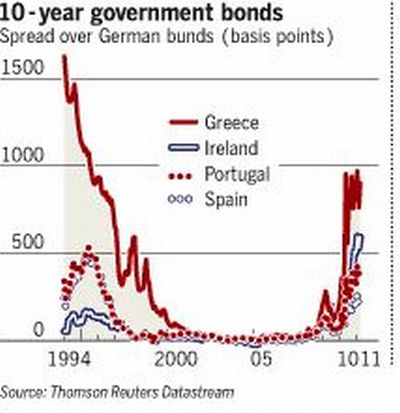 500 punkter är fem procent, naturligtvis 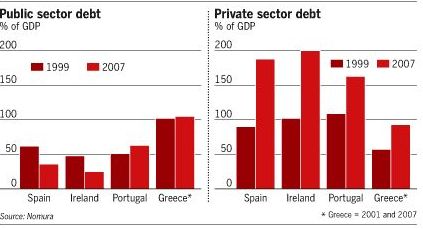 When private lenders tighten the noose, notionally private debt tends to turn into public debt, as governments try to rescue imploding financial systems and sustain activity in collapsing economies. Even countries with sound public finances, such as Ireland and Spain, find themselves in such difficulties. As the Nomura report notes, the manageability of public debt depends on just three things: It is in the nature of crises that they make all three of these far worse. I find it unforgivable that the last Irish government guaranteed bank debt so insouciantly
Euro breakup revisited Egentligen strider det mot EU:s grundlag att låta EMU-länderna gå i borgen för varandras skulder, It is twelve years since the launch of EMU. Ambrose Evans-Pritchard 7 March 2011 For the benefit of our readers, we thought we’d post a copy of the Barroso-Van Rompuy plan’s four-page outline, Eurokrisen är inte över Om det brakar kommer det inte längre att räcka med att låtsas att det är ett likviditets- och budgetdisciplinsproblem, som Euroföreträdarna har gjort så här långt. Det kommer att vara uppenbart att det handlar solvensproblem, det vill säga att det finns stora förluster i systemet som någon måste betala. Full text"I dag försöker finansministrarna till varje pris hindra en omstrukturering av statsskulderna, Use of marginal lending facility spikes to €15bn Take-up of the ECB’s marginal lending facility – an overnight emergency facility with an interest rate of currently at 1.75% - has suddenly spiked to €15bn in the previous night. A normal take-up rate is below €1bn, so this increase could signal that a bank is in serious funding trouble. It could also mean that it was a mistake – a bank accidentally tapping the facility, something that has happened before. The statistic alone is not sufficient proof of another banking crisis, but money market traders have learned to be sceptical. The key moment to watch is today’s release of the MLF. First, low interest rates, especially in real terms, which resulted from the single monetary policy, and encouraged risk-taking behaviour; The expectation of higher levels of income led to excessive consumption and investment compared with the supply capacity of the economy. As a result, cost and price increases in the non-tradable sector exceeded productivity gains. [3] Higher inflation differentials in the catching-up countries could partly be attributed to Balassa-Samuelson effects [4]. However, the divergences in nominal developments were further fuelled by four pro-cyclical factors: First, low interest rates, especially in real terms, which resulted from the single monetary policy, and encouraged risk-taking behaviour; Second, fiscal policies assessed on the basis of nominal variables (deficit as a percentage of GDP) turned out to be pro-cyclical and contributed to excessive domestic demand growth and the accumulation of external imbalances; Third, supervisory policies in many countries did not counteract excessive risk-taking and the related excessive credit growth, which fuelled a housing boom and/or an overheating process; Fourth, financial markets and rating agencies failed to differentiate sufficiently between euro area countries with different risks, contributing to the significant compression of risk premia in the sovereign debt securities markets. Ten-year government bonds were almost equally priced across all euro area countries between 2001 and 2007, while economic fundamentals continued to be very different. Let me now expand briefly on some of these points. We have been presented with the same data over and again: Why Angela Merkel's Competitiveness Pact is a bad idea, and what else she should do We have been presented with the same data over and again: Rädda euron första punkten på finansministrarnas lista För att komplicera de redan spretiga diskussionerna något mer så har Nicolas Sarkozy och Angela Merkel presenterat ett eget förslag om EU:s konkurrenskraft. For months, financial markets and policymakers from Wall Street to Frankfurt have been begging European leaders to do something – anything – Of all the short-term measures that once appeared likely, only two have achieved any semblance of consensus: strengthening the bail-out fund’s financial firepower – ensuring that €440bn is really €440bn – and an extension in loan maturities for Greece. Dangers lurk in Franco-German plans for a more tightly integrated euro zone On the face of it, the pact is about bolstering the economic bit of Europe’s economic and monetary union (see Charlemagne). But the pact does little to resolve the euro’s current sovereign-debt crisis. The pact also includes ideas that are not just unhelpful, but also damaging. One is to impose constitutional amendments to enforce balanced budgets, which are too rigid in a system without a big federal budget. This should also worry EU countries outside the euro, including Britain, Poland and Sweden. Sarkozy in Davos James Bond Never say never again It is hard to estimate the exact amount it will cost to recapitalise the European banking sector. I have heard a credible estimate of €100bn-€200bn. This is the biggest push of German political hegemony in my lifetime. It is the price the German chancellor commands for her acceptance of an increase in the lending ceiling of the EFSF. The key issue in Europe now is not the merits of the single currency but the parlous state of its banking system. Too much was lent too cheaply to American subprime borrowers and Spanish property developers, Icelandic and Irish banks, Dubai and Greece. Among the biggest lenders were European banks. At heart, the “euro crisis” is a wrestling match over who will ultimately bear these bank losses. Roubini says it is absurd to focus on 2013 Europe is now facing what Edwin Truman of the Peterson Institute for International Economics calls Let us assume for the sake of argument that Europe succeeds in containing the immediate EMU debt crisis, with help from Asia, and that Germany’s fractious coalition actually agrees to a bail-out fund big enough to make any difference. The 30pc gap in labour competitiveness that has built up between Germany and Club Med since the eurozone currencies were locked together in perpetuity will remain. Greece, Portugal, Spain, and Ireland will stay trapped in structural depression through this year, and well into next, rotating from a liquidity crisis to a chronic political and social crisis that exposes the inability of elected governments to counter 1930s job wastage. Unemployment is 28pc in Andalucia, and 30pc in Cadiz. Chancellor Angela Merkel can choose to save monetary union, first by doubling the size of the EU bail-out fund and halve the interest rate charged so that the debt-stricken states can recover; and then by acquiescing in fiscal federalism and a pooling of debts -- what McKinsey’s chief in Germany calls a "spiral into a Transferunion" – entailing a regime of subsidies for years to come. That is to say, Germany must be prepared to do for Southern European what it has already done for its own kin in East Germany, but on six times the scale. Or she can pull the plug, by quietly signalling to the Verfassungsgericht that Berlin would not be too angry if the eight judges declared the EU’s rescue machinery to be unconstitutional, ending EMU as we know it. The dam breaks in Portugal The EU strategy is simply unworkable. It relies on hope and a prayer, and the misguided belief that the North-South imbalances are “self-correcting” to pinch from Wolfgang’s excellent column once again. All we can do is stand back and watch in pain as the Euro-Hegelians ruin one country after another. At the December summit, the European Union missed a historic chance to get on top of this crisis. The most glaring manifestation of this lack of leadership is the EU policy consensus What makes this crisis self-sustaining is the presence of two interacting components: Vad finns det egentligen för ekonomiska argument för att EU eller EMU ska låna ut pengar till de medlemsländer som inte har ordning på sina statsfinanser? Vad skulle hända om vi inte ställde upp, utan i värsta fall lät exempelvis Grekland göra en ensidig nedskrivning av sina skulder med kanske tjugo eller trettio procent? *
So do not be fooled by anybody who says that the central bank should cut interest rates for the benefit of innocent citizens Greece has become the world's riskiest borrower in the fourth quarter of 2010, surpassing Venezuela, Irish 10-year yields have been climbing to 9%, Greek 10-year yields to over 12%, Euron är "världens mest stabila valuta". Jean-Claude Juncker dismissed concerns about the future of the euro, calling it The foreign owner of a Greek, Irish or Portuguese bond, for example, faces two specific dangers You can make a useful distinction between risks that are positive, but too small to bother about, and those that are small, but non-trivial. Three years ago I would have described the risk of a eurozone break-up as trivial. Now I still think it is small, but non-trivial. Risk awareness is something that shifts suddenly. For a long time you may see no risk; when you do, it is time to seek insurance. For the first 10 years of the eurozone, investors considered the risks trivial and sought no insurance whatsoever. They treated the bonds of eurozone member states almost identically. But once this changed, sovereign bond yields began to diverge rapidly. What we saw last year was not a speculative attack on the euro, as continental European politicians would have us believe, but a perfectly normal response to a change in risk perception Europe preview of 2011 The unthinkable is being thought in chanceries, cabinets, treasuries and central banks across Europe as the year begins after market doubts over the ability of euro zone governments to pay back their debts resulted in two countries, Ireland and Greece, going into receivership in 2010. Despite the gloom, 2011 will begin with Estonia, an economically challenged East European state, joining the euro. It will be the single currency’s 17th member and a triumph of optimism over pessimism - or reality, as many will see it. Joschka Fischer om en ny allians mellan Paris och Berlin The euro’s struggles could become more pronounced in coming months as traders increasingly use the beleaguered currency to fund so-called “carry trades.” The crisis was caused – except in Greece – by large and persistent intra-eurozone private sector imbalances between the centre and the periphery, If Germany and its hard-money allies genuinely wish to save the euro – which is open to doubt – Mechanics of a European capital flight It’s a nine-page note oozing with detail about how — precisely — capital flight amongst eurozone members impacts the eurosystem. Most economic historians and international economists I know believe a monetary union would fail unless it develops into a fiscal union. a defining moment for Europe "Un-European" though it might be – that's what Luxembourg's prime minister, Jean-Claude Juncker, called it – Germany is not about to yield on the "no bail-out" clause. This is the bit of the Stability and Growth Pact that forbids fiscal transfers between members of Europe's monetary union. It is hard enough to get west Germans to subsidise east Germans, or Englishmen to support the Scots. If you couldn't contain Germany, you might at least be able to give it common cause with the rest of Europe by integrating it. For a while, this seemed to work. Monetary union was the quid pro quo for allowing a re-united Germany, a way of further binding Germany's national interest into that of the rest of Europe. Does Europe press on down the road of ever closer union, which means debt sharing and fiscal homogenisation, or do nations retreat back into the pursuit of narrow self-interest? Full textFormer British Prime Minister Gordon Brown has said he Nils-Eric Sandberg och sökandet efter EMU:s Holy Grail Rolf Englund blog 9/12 2010 Euro-Krise Doubts are growing as to whether the euro has a future Konstruktionen av den fond som sattes upp efter Greklandskrisen i våras har en inneboende svaghet. One of the hallmarks of the unfolding financial crisis is that even “experts” quickly concede that How do you balance the moral hazards of propping up the banks, with the practical hazards of letting them default? Desmond Lachman, now a research fellow with the American Enterprise Institute: Next year could bring a crisis that will likely end with weaker countries streaming for the euro zone's exits.
Once you're in a fixed exchange rate system and you allow internal and external imbalances to start building, it's impossible to fix without a massive recession. But a deep recession undermines the political will to make the needed changes, and it erodes the tax base, which means the government ends up collecting less money even with taxes going up. You said last month at a conference that there's no way this will go on for three years. Now you're saying 12 to 18 months. But why not next Tuesday, say? Oh, there will be a fight. The stakes are so high. *
Why Greece will have to leave the eurozoneDesmond Lachman, FT January 11 2010 Any bank requires a continuous flow of funds and the question ceases to be whether it is solvent and becomes simply whether it will be able to refinance maturing debt at an acceptable price. Sir John Gieve is senior adviser to GLG Partners, part of Man Group, and a former deputy governor of the Bank of England It only needs a small level of risk to make it sensible to steer clear. So now it is Portugal and Spain issuing the denials while Italy, Belgium and even France try to dismiss any threat as absurd. Although for the present, banks and sovereigns can turn to the European Central Bank for funding, the ECB is wary of being drawn into providing fiscal transfers through the back door (by buying sovereign and bank debt which will in time be written down). How Close Did Europe Come to Lehman-Style Crisis? When the European Central Bank's nearly $1 trillion package was announced on the following Monday, banks were able to raise 12-month funds again, Browne said.  Time for Plan B This newspaper does not advocate the first rich-country sovereign defaults in half a century lightly. But the logic for taking action sooner rather than later is powerful. The only plausible long-term alternative to debt restructuring—permanent fiscal transfer from Europe’s richer core (read Germany)—seems to be a political non-starter. The burden on the countries that have been rescued is enormous. The Irish will toil for years to service rescue loans that, at Europe’s insistence, pay off the bondholders of its defunct banks. At some point it will become politically impossible to demand more austerity to pay off foreigners. The financial storm has reopened the debate on the euro’s flawed design In between the two is just prayer and improvisation. The EU will try to make its fixes hold long enough for the storms to subside. But all know that if the jet engine and the biplane came apart, the result would be a horrible, fiery crash. Hur många euro går det på en tulpanlök? Rätt svar är: minst en. Det finns en lång rad finansiella kriser genom historien: tulpanlökarna i Holland (1630-talet), brittiska South Sea Company och franska La compagnie du Mississippi (1720-talet), kanal- och järnvägsbyggande samt nya banker och finansinstitut (1800-talet), amerikanska aktier (1929), havererade europeiska banker med österrikiska Credit Anstalt i spetsen (1931). Bland de mer närliggande finns amerikanska Savings & Loans-krisen, Japankraschen och den skandinaviska finanskrisen (slutet av 80- och början av 90-talet), samt Asien-, Ryssland- och Internetbubblan (före och efter millennieskiftet). Med införandet av euron ”konvergerade” riskpremierna på alla euroländernas upplåning mot den ”riskfria” tyska räntan. Att lånen var emitterade i denna gemensamma valuta gav uppenbarligen omvärlden och i synnerhet de som köpte statsobligationerna en övertygande känsla av att länder och marknader som Grekland, Spanien, Portugal och deras historiska betalningsbekymmer var just bara historia. Det gällde även Irland, Estland, Lettland och Litauen som knöt sina valutor till euron för att i framtiden gå med i valutaunionen. Det gav samma övertygande känsla till dem som lånade ut pengar till grekiska, irländska och spanska banker. Tulipmania in the Netherlands in the 1630s Det osannolika och omöjliga med en uppdelning eller ett sönderfall av euron i en ny monetär flora, Visserligen låtsas eller hoppas det breda och okoordinerade ledargarnityret inom den europeiska centralbanken, ECB, eurozonen och EU att krisen inom de så kallade PIIGS-länderna i grunden bara är en likviditetskris, som uppstått på grund av en neurotisk, alternativt spekulationsdriven, kapitalmarknad. For sceptics the question has always been how robust a currency union among diverse economies with less than unlimited mutual solidarity can be. Can Europe save the euro? -- a disaster that could pull the global economy into the double-dip recession that was so feared earlier this year. And it could potentially undermine the euro. On Monday, Wall Street traders watched in horror as the euro plunged beneath its 200-day moving average for the first time since January You probably realize by now that this debt-deflation death spiral merely shifts the risk of losses from bank investors to taxpayers The blame doesn't rest solely with spendthrift politicians in Greece or spendthrift bankers in Ireland. Anthony Mirhaydari is the founder and publisher of the Edge, a new investment advisory newsletter. Previously, he was a senior research analyst with Markman Capital Insight, an advisory and money management firm, and a business consulting analyst with Moss Adams focusing on the financial-services industry. He studied finance at the University of Washington's Foster School of Business, graduating magna cum laude. Mirhaydari lives in the Seattle area with his wife and two children. 2011 will see the first member of the European single currency starting to talk seriously about Under a floating exchange rate, some of the pressure would be relieved by a rising exchange rate in the boom and a falling rate in the bust. What about the spectre of “debt deflation”? European finance ministers have in effect announced that the risks of lending to financially stretched eurozone countries would increase in two and a half year's time In practice this means that the eurozone has set itself a deadline of two and a half years to persuade investors that its finances are in order. If it fails to do so, a whole host of weaker eurozone states could find they are confronted with punitive borrowing terms or even a strike by lenders. Endgame The markets attention shifted from the immediate funding problems to the underlying solvency issues. Despite an €85 billion bail-out for Ireland, the euro zone’s debt crisis is getting worse. “The speculation on international financial markets can’t be explained rationally at all,” declared Wolfgang Schäuble, Germany’s finance minister. But it can, and there are three reasons why. Breaking up the euro is not unthinkable, just very costly. Deep down lurks the sullen suspicion that this is a drama that the euro zone may be condemned to relive time and again. So why not get out now? However much countries may now regret joining the euro, leaving it does not make sense. But the fact that it ought to survive does not mean that it will. And unless Europe’s leaders move further and faster, it might not. Europe’s leaders have been slow and timid in response to market pressures. Only belatedly have they recognised that some countries are not just in need of bridging loans to tide them over, but may be unable to repay their debts. That means that some pain will have to be inflicted on bondholders. I become nervous when Angela Merkel says the future of the euro and that of the EU are inextricably linked. Europe is edging towards the unthinkable Let me assure you that my proposal stands no chance of success. Fear is spreading in Europe. How many countries are going to need bailouts But what scares those who deal with euro policy the most is the situation in Spain. The €750 billion program set up by the European Union and the International Monetary Fund for dealing with the euro crisis may be enough to cover Greece, Ireland and Portugal without problems, but there could be problems if a bailout is needed for Spain, which is Europe's fourth-largest economy. 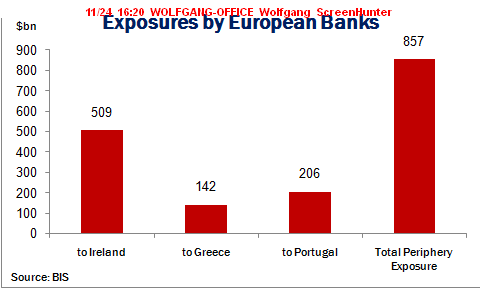 Allra störst exponering har det svenska banksystemet mot Estland och de baltiska grannländerna. Jan Häggström, chefekonom på Handelsbanken, varnar för att den baltiska finanskrisen kan förvärras igen om Estland inför euron som planerat, nästa år. How to solve the financial crisis? The euro crisis Probably one of the best pieces of analytical commentary we have yet read on the eurozone situation Credit default swaps (CDS) measuring risk on German, French and Dutch bonds have surged over recent days, "Germany cannot keep paying for bail-outs without going bankrupt itself," said Professor Wilhelm Hankel, of Frankfurt University. "This is frightening people. You cannot find a bank safe deposit box in Germany because every single one has already been taken and stuffed with gold and silver. It is like an underground Switzerland within our borders. People have terrible memories of 1948 and 1923 when they lost their savings." While Germany's public and private debt is not extreme, it is very high for a country on the cusp of an acute ageing crisis. Adjusted for demographics, Germany is already one of the most indebted nations in the world. Europe's fate may be decided soon by the German constitutional court as it rules on a clutch of cases challenging the legality of the Greek bail-out, the EFSF machinery, and ECB bond purchases. Eurozone borrowing costs hit record “The moment you have even a flicker of a doubt about default risk, it becomes rational to reduce positions in a larger country like Spain purely on grounds of diversification,” he said. Some traders warned that contagion could even spread to the core eurozone debt markets of France and the Netherlands. Martin Wolf refers me /Clive Crook/ to this new paper by Paul De Grauwe, Comment by Rolf Englund The road to self-destruction of the eurozone In the end the ERM collapsed. When governments solemnly declare that in times of payment difficulties they will devalue the government bonds, that’s what a haircut means, it will introduce a speculative dynamics in the eurozone similar to the one that destroyed the ERM. * Lord Lamont was UK chancellor of the exchequer 1990-93 and is co-chairman of the Bruges Group RE: They say that he was singing in the bath the morning after UK left ERM. The Irish bailout is not, after all, what one normally thinks of as a bailout "There is zero danger" Det allmänna stödet för EU förblev intakt, även om stödet för euron störtdök, utropar Sieps som en regeringens Bagdad Bob Leaving the euro: how would it work? EU:s "Bagdad Bob" EMU är inget experiment. EMU är ett vågspel. Den irländska krisen är långt ifrån över och läget för euron är "exceptionellt allvarligt", Om Spanien får akuta problem att hantera sina statsfinanser. "Can the Euro Still Be Saved?" Euro-zone governments have spent months trying to end the crisis facing their common currency, but the danger has not been averted. On the contrary, the crisis meetings have returned and billions in emergency funds are needed once again. And there is still no end in sight to the crisis. The plans, and the horror stories about Irish banks, caused a stir in the financial markets, pushing up risk premiums for the government bonds of all the ailing countries. "Merkel and Sarkozy apparently didn't think about the second act," comments Luxembourg Foreign Minister Jean Asselborn. The yields on Irish government bonds rose as high as 8.6 percent at times -- 6.2 percentage points higher than the rate Germany pays to borrow money. This prompted Irish Prime Minister Brian Cowen to angrily note that Merkel's actions were "not helpful." The German plan to automatically force bondholders to pay up when financial aid packages are approved "might seem attractive from a theoretical point of view," says ECB executive board member Lorenzo Bini Smaghi, but it would "in practice destabilize markets and have severe effects on economies in the euro area." The conservative Die Welt writes: The center-right Frankfurter Allgemeine Zeitung writes: This is the most important eurozone news today, much more important, and alarming, than anything that happens in Ireland. When the euro was launched, it was a big bet that sharing the same currency would make a group of very different economies converge, and so allow the European Central Bank to operate a single monetary policy for all of them. The economies are just too different to allow a single central bank to manage all of them. The euro has turned into a bankruptcy machine. Once the markets have finished with Ireland, they will simply move on to Portugal and Spain, and after that to Italy and France. Matthew Lynn is a Bloomberg News columnist and the author of “Bust,” a forthcoming book on the Greek debt crisis. Mr Van Rompuy said he was "very confident" the problems could be overcome. But he added: Europe heads back into the storm Ireland’s basic problem is that it now has to choose between its own sovereign solvency and the solvency of its banks. Other European countries – in and out of the eurozone – may soon face the same choice. In such a world, keeping banks afloat with public capital risks sinking the sovereign – and with it, the whole banking system. Financial Times editorial November 17 2010 The banks find it increasingly hard to fund themselves anywhere else than the European Central Bank’s liquidity facilities. The exposure of banks /in Greece, Portugal, and Ireland/ is around $1.5 trillion Let's assume, which is reasonable, that a meaningful portion of that $1.5 trillion can never be repaid What would be a disaster would be a disorderly, piecemeal process of public and private sector defaults Robert Peston, the BBC's business editor, 16/11 2010 (£930bn) in total, twice the value of the aggregated economies of Greece, Portugal and Ireland, or three-quarters of Britain's GDP. Let's assume, which is reasonable, that a meaningful portion of that $1.5 trillion can never be repaid, because some part of the collateral backing those loans has been lost forever (property prices, for example, simply won't recover fast enough) and the earning capacity of the Greek, Portuguese and Irish economies isn't enough to meet the difference. Even so, the potential loss on that $1.5 trillion exposure for banks would be manageable (if painful) so long as there is an orderly process of establishing what can be repaid - and then reconstructing the quantum and payment schedule of the debts on that basis. What would be a disaster - and this is reflected in the emotional comments of Mr van Rompuy and of Portugal's finance minister, Fernando Teixeira dos Santos - would be a disorderly, piecemeal process of public and private sector defaults, especially since that would be bound to undermine the financial credibility of other much bigger eurozone economies, such as Spain and Italy. Euro under siege after Portugal hits panic button Portugal became the latest European nation to suggest it was on the brink of seeking help from Brussels after Ireland confirmed it had begun preliminary talks over its debt problems. Greece also disclosed yesterday that its economic problems are even worse than previously thought. Last night, the German Chancellor Angela Merkel raised the spectre of the euro collapsing as she warned: “If the euro fails, then Europe fails.” ... EU:s president och Tysklands förbundskansler pratar strunt ... It is not an exaggeration to say that there would not be a banking system in Ireland - and therefore not an economy in any conventional sense
for the generosity of the European Central Bank in providing loans to Irish banks that the markets won't provide. Europas stabilitet är inte längre given Om boken Peer Steinbrück, tidigare Tysklands finansminister, Unterm Strich Rolf Gustavsson, SvD 6 november 2010 Han hävdar att vi inte vill inse vad vi egentligen vet, för då skulle vi förstå att vi begår självbedrägeri och gör dumheter. Insikten borde framtvinga omprövningar av våra övertygelser, men sådana kan leda oss ut på krävande och slingriga vägar som vi helst vill undvika. Då är det bekvämare att välja den föråldrade visshetens raka och utslätade väg, även om den leder vilse. Omprövningar är ansträngande och därför ägnar vi oss hellre åt verklighetsflykt. Ingenting garanterar att vi i Europa om tio år har kvar vårt hyggliga välstånd. Djupgående ekonomiska, sociala och demografiska förskjutningar skakar grundvalarna i vårt välfärdsbygge. De processerna påskyndas av den ekonomiska och finansiella krisen, som långt ifrån är över. Alla hoppas på ekonomisk tillväxt som en mirakelmedicin, men ingen vet varifrån den skall komma. Därför varnar Steinbrück uttryckligen för den stora nästan oemotståndliga frestelsen att släppa loss litet mer inflation för att ta ner de väldiga statsskulderna. På sikt hotar en ny världsomspännande inflationsvåg, skriver han. So why are the possibility of sovereign default, persistent imbalances and lack of a fiscal union incompatible? You can have a system in which two of the three are present, for example by allowing default and large imbalances. But then you would require a fiscal union that acts as a systemic shock absorber. That is the case in the US, where a common fiscal superstructure makes intra-state divergences sustainable. However, without a single state, in the presence of imbalances and of default, it is hard to see how an economically integrated single currency area could survive a severe crisis. Imbalances produce large cross-country financial flows. In the absence of central financial regulation, these flows lead to distortions in the financial sector that end up as a liability of governments. In the absence of a common fiscal shock absorber, and without the possibility of devaluation, countries can find themselves in a situation from which they cannot escape without outside help. That may be happening in Ireland now. In a monetary union with dispersed debt ownership, such crises are also highly contagious. The futile attempt to save the eurozone The fundamental instability of the present eurozone has been exhaustively analysed by the economist Christopher Smallwood in a Capital Economics paper. (“Why the euro needs to break up”). I have linked to it via Stumbleupon My name there is medborgarenglund, if that may be of any help I am learning how to be perfectly legal Angela Merkel consigns Ireland, Portugal and Spain to their fate Debt relief will be enforced, either by interest holidays or haircuts on the value of the bonds. Investors will pay the price for failing to grasp the mechanical and obvious point that currency unions do not eliminate risk: they switch it from exchange risk to default risk. What were investors thinking when they bought Greek 10-year bonds at 26 basis points over Bunds in 2007, below the spread between British Columbia and Quebec? A treaty change will be rammed through under Article 48 of the Lisbon Treaty, a trick that circumvents the need for full ratification. Eurosceptics can feel vindicated in warning that this “escalator” clause would soon be exploited for unchecked treaty-creep. One might argue that bondholders should have been punished for their errors long ago. The stench of moral hazard has been sickening, on both sides of the Atlantic. An orderly bankruptcy along lines routinely engineered by the International Monetary Fund is exactly what Greece needs. It makes no sense to push Greece further into a debt compound spiral by raising public debt from 115pc of GDP at the outset of the “rescue” to 150pc at the end of the ordeal. If you strip out the humbug, the Greek package allows banks and funds to shift roughly €150bn of liabilities onto EU governments, or the European Central Bank, or the IMF. Greek citizens are being subjected to the full pain of austerity under false pretences, without being offered the cure of debt relief. It is in reality a bail-out for investors. Calmfors: EMU klarar inte ytterligare en kris Euroområdets ekonomier skulle klara av att hantera en ny kris inom kort under förutsättning att den inte blir för stor. Euro disintegration was never a great risk. ECB loans to banks down to 514 billion euros (USD 716 billion), Political upheaval rocks eurozone debt markets As members of the eurozone, Portugal, Ireland, Greece cannot devalue or resort to monetary stimulus offset fiscal tightening. They must each pursue a policy of "internal devaluation", meaning deflation within the currency bloc to regain lost competitiveness. This is risky for economies with total debt levels above 300pc of GDP, as is the case in Ireland and Portugal. Ireland’s nominal GDP has already contracted by over 20pc of GDP, yet the debt burden has not diminished. Europe is the region in the world most at risk of losing a currency war. Without strong growth, it simply cannot work. The euro: Using a chart that illustrated how financial markets were driving interest rates on the bonds of weaker eurozone governments to unsustainably high levels, Mr Trichet announced that the crisis was no longer limited to Greece. One participant recalls: “Trichet said: ‘This isn’t only a problem for one country. It’s several countries. It’s Europe. It’s global. It’s a situation that is deteriorating with extreme rapidity and intensity.’” Part 1 of our series on the spring’s sovereign-debt crisis. The euro zone's near death had stakes for people around the world. A wave of government defaults on Europe's periphery could have triggered a new crisis in the international banking system, with even worse consequences for the global economy than the failure of Lehman. Europe eventually did establish a rescue fund in May. By then the price of calm had soared, requiring a pledge of €750 billion. It defused the panic but hasn't snuffed out the crisis: Unsustainable borrowing still poses huge challenges, especially in Greece and Ireland. The task force met in the shadows of the EU's many councils and summits in Brussels, Luxembourg and other capitals, often gathering at 6 a.m. or huddling over sandwiches late at night. Participants kept colleagues in their own governments in the dark, for fear leaks would trigger rampant speculation in financial markets. Ms. Merkel put her foot down, insisting that only the IMF had the necessary experience. Mr. Sarkozy, recognizing that Germany's financial muscle was essential for any bailout, reluctantly gave way.
------- Part 2 of our series on the spring’s sovereign-debt crisis. At 3:45 p.m., Mr. Schäuble's deputy, Jörg Asmussen—a civil servant without the authority to sign off on €500 billion—told the other finance ministers Mr. Schäuble wasn't coming back. The ministers looked "horrified," according to one participant, knowing that without Germany's financial muscle, the meeting would come to nothing. Christine Lagarde, France's cool-headed 54-year-old finance minister, feared Europe was heading for failure Den ekonomiska politiken i EU måste utvecklas och det kan bara ske gradvis. Det finns gott om bekymmer inom EU. Arbetslösheten ökar inte längre, men är i snitt 10 procent i hela euroområdet. Nya siffror från Irland visar att landets tillväxt föll kraftigt under årets andra kvartal. I Spanien fortsätter tillväxten att vara negativ. Inte heller Frankrike har fått riktig fart. Professor Lars Calmfors, ordförande för Finanspolitiska rådet, har nyligen publicerat en läsvärd rapport, ”Fiscal policy coordination in Europe”. Kommentar av Rolf Englund:
Ur Rolf Englund, Rosornas Krig, Timbro, 1984 Det är målsättningen om ett ständigt fastare förbund Robert Schuman och Jean Monnet Open Europe’s Chairman Lord Leach When asked about the future of monetary union, Lord Leach said, Lord Leach of Fairford is a Director of Jardine Matheson Holdings. Dr. Irwin Stelzer, senior fellow and director Hudson Institute The extra yield that investors demand to hold 10-year Irish bonds over German bunds today exceeded 400 basis points for the first time
Portugal is also being punished by investors, with the spread on its bonds also touching a record today. En form av ohelig allians, där problemtyngda stater garanterar problemtyngda banker, I början av sommaren riktades starkt fokus mot ett omfattande lånebehov i Spanien, och finansmarknaderna reagerade då positivt på varje fulltecknad emission, oavsett hur hög räntan blev. A eurozone banking crisis left unresolved If you assume a post-reform Greece will miraculously turn into a Aegean tiger, or that Ireland will generate another housing price bubble, the present rate of indebtedness will be no big deal. It all rests on your assumptions about growth. In the summer, it looked as though the strategy might work, as the economic data came in better than expected. We know from economic history that countries enter into longish phases of stagnation after a financial crisis. The safe assumption to make for Ireland – and Greece – is that there will not be much nominal growth in the next five years. If you make that assumption, you realise Greece will almost certainly not be in a position to repay its debts. Joachim Fels, chief global economist at Morgan Stanley, said strains had reached a point where "one or several governments" may soon have to tap soon the rescue mechanism. Investors are bracing for a flood of fresh bond issuance, while concern is mounting that austerity measures in Ireland, Greece, and Spain have left these countries trapped in a downward spiral. It is worrying that European policymakers have not created a mechanism for dealing with an insolvent state in the European Monetary Union. 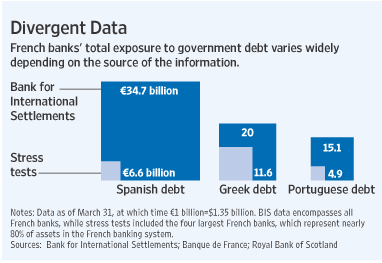
Markets are starting to panic about the eurozone periphery Belgian’s deputy prime minister, Laurette Onkelinx, who is close to Mr Di Rupo, is quoted as saying: While the Europeans are celebrating the end of the financial crisis, something strange is happening in the bond markets. Last Friday, the spreads were 3.4 per cent for Ireland, 9.4 per cent for Greece, 3.4 per cent for Portugal, and 1.7 per cent for Spain. The yield on 10-year German bonds is currently ridiculously low, about 2.3 per cent. The financial markets somehow regard Germany as a paragon of virtue, stability and sound financial management, and are happy to demand virtually no return on 10-year investments. If the bond markets were ever returned to normal, and if the spreads were to persist, peripheral Europe would find itself subject to an intolerable market interest rate burden. We can either dig our head in the sand or prepare for the inevitable – that one day a eurozone state will either default, or, more likely, be forced to restructure its debt. It is important not merely to accept the principle, but also to make the institutional preparations for an orderly default of a eurozone member. It is going to happen. The intra-eurozone imbalances will not only persist, but probably increase. The improvement in Germany’s economic growth is driven not by productivity gains but by real devaluation. The European economy is at risk of sliding back into a recession as governments cut spending to reduce their budget deficits. As Raghuram Rajan of the University of Chicago Booth School of Business and former chief economist of the International Monetary Fund notes in a thought-provoking new book, the underlying “fault lines” are still with us. The new Slovak government remains opposed to a rescue package for Greece, Prime Minister Iveta Radicova said Monday, after a meeting with European Union Council President Herman van Rompuy. "The position of our minister of finance and also my personal and our political party [position] is as it was before, that we really do not agree," Ms. Radicova said when asked about her view of the Slovak contribution to aid for Greece. Slovakia stalls €440bn bail-out fund At about €4.4bn, Slovakia's contribution to the fund is relatively small. But the centre-right parties that won its June 12 election and are forming a government campaigned on a platform of no bail-outs. 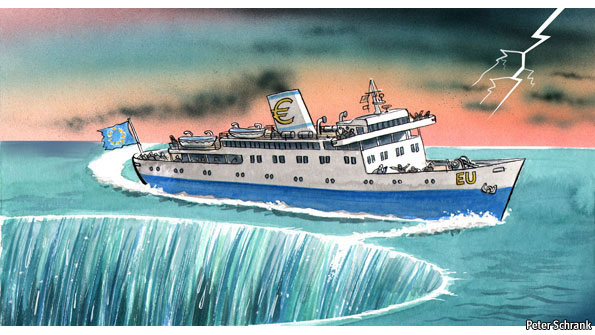 Staring into the abyss As the euro-zone crisis spooks governments, opinions are diverging dramatically about what the union is for Jean-Claude Juncker, prime minister of Luxembourg, said memorably in 2007: “We all know what to do, but we don’t know how to get re-elected once we have done it.” The Economist print July 8th 2010
Europa befinner sig i den värsta situationen sedan andra världskriget,
kanske till och med sedan första världskriget. Det säger chefen för den Europeiska centralbanken Jean-Claude Trichet Ekot 16 maj 2010 ECB-chefen Jean-Claude Trichet gör sitt uttalande i en intervju i det kommande numret av den tyska tidskriften Der Spiegel. ... Jean-Claude Trichet tells us the world faced a second Lehman crash in the days and hours before EU leaders launched their €720bn defence fund.
If the European Central Bank’s president is correct, we are in trouble. The EU-IMF package is already unravelling. What will the West do for its next trick? Ambrose Evans-Pritchard 16 May 2010 --- The president of Germany's central bank, the Bundesbank, Axel Weber, his Dutch counterpart and the ECB's chief economist, Jürgen Stark, voted against this move. Seldom is there so much dissent within the highest decision-making body for the euro. For some of us writing at the time of the Eurozone's formation just over a decade ago, the current crisis has been all too predictable. Other currency unions, we pointed out, had been tried in history and always fallen apart. Andrew Alexander, Daily Mail 12th February 2010 "Risken är att EU plötsligt ger upp andan" Europeiska unionen är döende, skrev Charles Kupchan i en tankeväckande krönika i söndagens Washington Post. Nationalismens återkomst kommer att leda till EU:s fall, förklarade han. Det är ingen plötslig eller dramatisk död, utan ett utdraget försvinnande, hävdade Kupchan och fortsatte: Snart kommer vi att vända oss mot andra sidan Atlanten och inse att den europeiska integrationen, som vi under de senaste femtio åren tagit för given, är borta. Det finns tyvärr en del som tyder på att han har rätt. Viljan att hålla ihop Europa har blivit svagare, både bland ledande politiker och medborgare. Den senaste Eurobarometern visar vad som har hänt. I undersökningen, som genomfördes i somras, svarar bara 49 procent att medlemskapet är ”något bra”. Under ytan pågår också en annan utveckling, som inte syns lika väl. Europeiska unionen flämtar, och behöver hjälp för att kunna börja andas igen. Utan politisk vilja att fortsätta samarbetet kan det gå fort. Risken är att EU plötsligt ger upp andan. Medlemsstaternas uppslitande arvsskifte skulle inte bli en trevlig tillställning. Charles Kupchan i Washington Post Only a closer union can save the eurozone At some point the markets will realise that large parts of the German and French banking systems are insolvent, and that they are going to stay insolvent. Beyond this restructuring, the eurozone will need to commit itself to a full-blown fiscal union and proper political institutions that give binding macroeconomic instructions to member states for budgetary policy, financial policy and structural policies. The public and private sector imbalances are so immense that they are not self-correcting. There is no point in beating about the bush and issuing polite calls for the creation of independent fiscal councils or other paraphernalia. This is not the time for a debate on second-order reforms. I am aware that, at a time of rising nationalism and regionalism throughout the EU, there is no consensus for such sweeping reforms. But that is the choice the EU’s citizens and their political leaders will have to make – a choice between reverting to dysfunctional and, as it transpires, insolvent nation states, or jumping to a political and economic union. "ever closer union"Det är målsättningen om ett ständigt fastare förbund - "ever closer union" - som är själva grundbultsfelet med EU. EMU:s Ja-sägare förorsakar Världsdepression Contrary to general belief, Germany’s eurosceptic professors have not abandoned their legal efforts to block the EU rescues for European banks exposed to Greek debt, Hungary's IMF revolt augurs ill for Greece The country /Hungary/ cannot easily devalue to claw its way out of its debt-trap Forex lending represents around 91 per cent of the total in Latvia, 87 per cent in Estonia and 72 per cent in Lithuania and over 50 per cent in Hungary, Romania and Bulgaria
a senior official at the European Bank for Reconstruction and Development Satsa på en hästkur av samma kraft som Lettland! The rebellion against the 1930s fiscal and monetary policies of the Euro-complex is gathering pace. Far from holding the eurozone together, it will cause weaker countries to be catapulted out of EMU. John Makin is one of my Gurus It is fitting that on September 15 Japan, the world's only major economy battling actual deflation, initiated what has come to be a global round of quantitative easing. John Makin is one of my Gurus "Can countries inside a fixed exchange-rate system like the euro grow and tighten budget policy at the same time? Pimco also gave warning that the bond vigilantes have lost faith in the policy and are trying to liquidate their holdings of peripheral EMU faster than the European Central Bank (ECB) can buy the debt, causing a relentless rise in yields, and a vicious circle. The Folly of Currency Pegs Notwithstanding the highly touted Greek rescue package Greece will probably default on its debt sometime within the next year John H. Makin (May 2010) The current flap over the sustainability of Greece's membership in the European Economic and Monetary Union (EMU) is reminiscent, in many ways, of the events leading up to the collapse of the Bretton Woods system--another ultimately untenable currency regime--which was put into place after World War II and terminated by the break of the dollar's link to gold after August 1971. For example, Greece should not share a currency with Germany (or have a currency pegged to Germany's) as it has done by joining the EMU, unless it is willing to adopt what are essentially German monetary policies as expressed by the ECB. The only way to avoid this and maintain a shared currency would be for Greek labor to move freely to Germany as pressure for currency depreciation rises, just as California labor can move to Colorado or any other U.S. state under the same circumstances. Notwithstanding the highly touted Greek rescue package of €45 billion unveiled on April 12 by European governments in conjunction with the IMF, Greece will probably default on its debt sometime within the next year, just as Argentina defaulted on its debt in December 2001 after a decade-long peg to the dollar that suffered from the same flaw as Greek membership in the EMU. The United States and Argentina were not part of an optimal currency area for much of the same reason that Greece and Germany are not. More by Makin Rolf Englund blog 2009-03-11 EMU - en snabbkurs Comment by Rolf Englund: "I was opposed to the euro, I think it was a great mistake to have monetary integration," Markets, and to great extent economic policy, are "held hostage" by forces that are "to a great extent moved by herd behavior" and policy makers will have to take that into account when addressing the issue, he added. "Complete break-up would have effects that dwarf the post Lehman Brothers collapse," ING analysts wrote in a market research. As Amartya Sen, the Nobel-laureate, pointed out in the Financial Times ("The diverse ancestry of democracy", June 12 2005), democracy is "government by discussion". Elections are only part of that discussion. A discussion that absorbs an elite of politicians, bureaucrats, intellectuals and interests does occur at the European level. Its house newspaper is the FT. But there is no European-wide discussion that includes the public at large. Nor could there be in an EU with 460m people and 25 countries divided by history, culture, values and, above all, language. SPIEGEL: Despite all of these efforts, the central problems with the euro remain. Strong economies belong to the same currency union as weak ones like Greece. Is the euro not doomed to failure? The creation of the euro resulted in the disappearance of intra-area exchange rate risk and an expectation of fiscal and macroeconomic convergence among the euro member countries. In the US, stress test forced weaker institutions to raise capital and turned round sentiment The case against the euro What prompted this thought was my reading of an in-depth analysis of the crisis in the eurozone. It has been put together by the Carnegie Endowment for International Peace. It is called Paradigm Lost - the Euro in Crisis. It features a series of reports by economists such as Uri Dadush, Sergei Aleksashenko, Vera Eidelman and Paola Subacchi. The focus of the report is the so-called PIIGS - Portugal, Ireland, Italy, Greece and Spain In Greece, Ireland and Spain credit increased by an average of 155%, but in countries like Germany and the Netherlands, the core, it increased by only 27%. That is one of the key conclusions of the paper. Since adopting the euro Greece, Ireland, Italy, Portugal and Spain have become increasingly uncompetitive. That and the slowdown in productivity is the heart of the crisis in the eurozone, rather than debt. Paradigm Lost - the Euro in Crisis The eurozone’s tragic small-country mindset Mr Van Rompuy, like the majority of EU leaders, hails from a small country – in his case, Belgium. When small-country politicians talk about economics, they naturally talk within the framework of a small open economy. One of the most important characteristics of a small open economy is that its own actions have little impact on the rest of the world. Governments now implement austerity packages without any consideration of the effect on other countries. Austerity started in Greece, spread to Portugal, Spain, Italy and Germany. The rush to austerity creates a formidable dilemma for France. The strategic alternative is either to accept it or risk a break with Germany, thus reversing more than 25 years of Franco-German monetary and fiscal convergence. It is a deeply serious choice. The prevailing view in Brussels and Frankfurt is that the growth problem is 100 per cent structural. So far, so good. But here is my question: what is your “plan B”? - Visst beror dagens problem i ekonomin i någon mån på missgrepp i slutet av 80-talet och början av 90-talet. I en ovanligt öppenhjärtig intervju i måndagens Financial Times förklarade EU:s president Herman Van Rompuy att euroområdet var ”på gränsen till ett sammanbrott” i våras. En rimligare förklaring till krisen är de enskilda medlemsländernas bristande budgetkontroll När EU:s stats- och regeringschefer samlas för att ha förtroliga samtal om Europas politiska vägval skrivs inte ens protokoll. Herman Van Rompuy leder den minst öppna av EU:s institutioner. Genom intervjuer öppnar han dörren på glänt, men priset för den förändrade maktbalansen i EU är ökat hemlighetsmakeri. Annika Ström Melin, president Van Rompuy och EMU --- I Grekland beror problemen på underskotten. I Spanien och på Irland på vilda lånepartyn som blev värre av euron. Det går inte att analysera krisen som ”om alla bara hållit ordning och följt reglerna skulle allt vara bra”. Folkpartiet bryr sig inte om ekonomiska argument. “What went wrong wasn’t what happened this year. What went wrong was what happened in the first 11 years of the euro’s history. In some ways we were victims of our success. “The euro became a strong currency with very small interest rate spreads [on government bonds]. It was like some kind of sleeping pill, some kind of drug. We weren’t aware of the underlying problems.” Herman Van Rompuy, president of the European Union, FT June 13 2010 In an interview with the Financial Times, Mr Van Rompuy said that the 16-nation bloc had been on the edge of a breakdown last month that could have caused a world crisis. But European leaders now understood that the way forward was to implement politically unpopular but necessary economic reforms, such as opening up labour markets and raising the retirement age, he said. Herman Van Rompuy, non-combatant German and French officials tend not to mention that it was lending by their domestic banks and investors that helped Greece, Spain and others to live so long beyond their means.  The biggest economies in the eurozone are rallying round the big support package agreed in early May, because they think a default by a European government could be bad for everyone. But it's also because they know it would be particularly bad for the French and German banks who are sitting on a large amount of Greek and other sovereign debt. It was the banks and other financial institutions (e.g. pension funds, insurance companies) that facilitated the boom at the periphery of the eurozone by lending huge sums to Spain, Greece, Ireland and Portugal under virtually the same conditions as those applicable to Germany and the Netherlands. In doing so they failed to charge a realistic risk margin. One of the consequences was that European leaders were lulled into a false sense of security. After all, if the financial markets didn’t envisage any problems, why would Europe’s leaders – themselves mere mortals – be troubled? Surely the markets are always right? Heleen Mees, Eurointelligence 10 June 2010 Globalisation has brought instability to the global economy. Banks and other financial institutions have played a key role in this respect by taking massive risks without pricing them properly. They must not be allowed to emerge from the carnage unscathed. CDS prices are over 721bp for Greek five-year bonds, Portugal 345bp, Ireland 260bp, Spain 247bp, and Italy 234bp. The reasons for the return of mistrust are doubts about the package itself, doubts about the future governance of the eurozone, the cacophony of European governments, the persistent criticisms of Axel Weber. Germany insists that the SPV does not borrow at average eurozone market rates, but at the market rates of the recipient country (which would rendered the whole project ad absurdum). In its financial stability review, the European Central Bank predicted €195bn in bank writedowns in 2010 and 2011, and warns of dangerous financial contagion as a direct result of the sovereign debt crisis. El Pais spoke of a "perverse spiral" in its editorial. Parkinsons lag och ECBs nya skyskrapa, forts. The single currency was created by eurocrats, foisted upon its people and bound to end in tears. An ABC of financial shocks and fiscal aftershocks “But they bailed out Greece,” said the boy. “So why all the turbulence?” The big point is that investors are not altogether stupid: they know these are temporary patches; they know Greek indebtedness is going to worsen; they know that other countries in peripheral Europe will find it hard to grow out of their plight Martin Wolf, May 28 2010 Highly recommended The eurozone’s crisis has blown sky-high the idea that developed countries are 100 per cent safe. The possibility of a break-up of the eurozone.
Then there is the question of whether Greece will – or should – default. Such an event would dwarf any sovereign default since 1983. The two most significant – Russia in 1998 and Argentina in 2001 – amounted to a combined $155bn in defaulted debt, according to Barclays Capital. Greece’s outstanding debt is some $350bn. A default would be massively painful but it remains a viable option for Athens. The euro, in its current form, is finished. By announcing a ban on the activities of short-sellers she /Angela Merkel/ is hoping her decoy will avert German attention from the small print of Berlin's support for Greece, which talks of developing processes for "an orderly state insolvency". This sounds ominously like a softening-up process for a form of default. Merkel and Cameron disagree on EU treaty change UK Prime Minister David Cameron on Friday (21 May) rejected the the idea of a new EU treaty change to accommodate German chancellor Angela Merkel's vision of stronger economic co-ordination in the EU. "There is no question of agreeing to a treaty that transfers powers from Westminster to Brussels. Britain is obviously not in the eurozone and is not going to be joining, so it wouldn't agree to any treaty that drew us further into the euro area," Mr Cameron said on Friday (21 May) during a joint press conference with Ms Merkel in Berlin. Gnisslet mellan Tyskland och övriga euroländer ger underlag för spekulationer om att tyskarna skulle vara på väg att tröttna på euron och i stället söka sig tillbaka mot gamla D-marken. Här finns historiska spår som förskräcker, från 1930-talets konkurrensdevalveringar som fördjupade depressionen och banade väg för ännu större katastrofer. Ingen vill ta ansvaret för att något liknande ska hända. Det är ett avgörande skäl till att Tyskland och de andra euroländerna kan väntas ta sig samman och söka lösningar som räddar valutaunionen. Det räcker inte att återupprätta EU:s stabilitets- och tillväxtpakt. Om man vill verka förebyggande, så behövs även kontroll över euroländernas ekonomiska utveckling i stort. Annars går det inte att förhindra fastighetsbubblor såsom i Irland och Spanien eller väldiga underskott mot omvärlden såsom i dag i Portugal. Might the eurozone break up? Until recently I would have answered:
absolutely no. Is that still true? I do not know. It was no accident that the eurozone created a special purpose vehicle to manage this bail-out. The credit team at Credit Suisse pursued this question to the bitter end. Before the start of monetary union in 1999, EU countries borrowed at different interest rates, the spreads reflecting expectations about future exchange rate realignments and default probabilities. With the arrival of the euro, spreads almost disappeared. Just as subprime CDOs enjoyed triple A ratings because of the way they were constructed, the entire eurozone enjoyed a triple A rating on the back of Germany’s. This produced a massive credit boom in Spain and Portugal, and those credits were recycled through the eurozone banking system. Bankers in Düsseldorf, Munich and Paris bought those Spanish mortgage obligations and Greek sovereign bonds, proudly adding them to their fine collections of subprime CDOs. The eurozone came extremely close to a breakdown 10 days ago. While fiscal profligacy was the root cause of the problems in Greece, it is not the root cause of the problems in Portugal and Spain - a defunct labour market and massive indebtedness of the private sector. What makes the economic problem in the Iberian peninsula so difficult is the simultaneous need to reduce debt and improve competitiveness. Spain cannot maintain a large price differential with Germany forever. If you add fiscal retrenchment into this toxic debt-deflation mix, the result is bound to be a self-sustaining depression, especially in the absence of structural reforms. What is completely missing in Brussels – and even more so in Berlin – is an understanding of the urgency of the situation. So when the European Union’s programme of credit guarantees ends in three years, the same combination of factors that led to the most recent crisis will still be present. I thought it was ironic that a special purpose vehicle had been chosen to save the eurozone, given our most recent experience with those toxic structures. --- How can a loan guarantee solve a problem of excessive indebtedness?
IMFs dödsdom över Grekland och EU:s räddningspaket
Rolf Englund blog 2010-05-12 Inte vår bästa stund
Den europeiska situationen nu är inte alldeles bekväm. Den grekiska krisens drama går från den ena akten till den andra. Carl Bildt, blog, 25 april 2010 Finanskrisens härjningar. Kronans svängningar. Greklands ekonomiska kaos.
Plötsligt har euron blivit het inför valet. Sydsvenskan har talat med alla de fyra borgerliga partiledarna. De är djupt oeniga i fråga om folkomröstning. Fredrik Reinfeldt anger två villkor för att han ska lova en folkomröstning. Sydsvenskan 3 april 2010 Varje dag kan vi nu via medierna se hur konflikterna och problemen med EMU tydliggörs. Den mycket prekära utveckling som vi idag ser i Grekland, Portugal, Italien och Irland visar på den hämsko som EMU utgör när dessa kristyngda ekonomier ska försöka hitta en väg ut ur krisen. Förmågan att ta sig ur finanskrisens efterdyningar blir onödigt långdragen och låg. Att inte fullt ut ha möjlighet att bedriva en egen ekonomisk politik skapar ett hårt tryck på statsbudgeten och bäddar för de missnöjesyttringar som vi ser rada upp sig i land efter land. Historien borde förskräcka. Den här sortens förkeynesiansk deflationspolitik provades under 1920- och 1930-talen och var antagligen den främsta enskilda orsaken till depressionen. Ekonomierna tog sig inte ur moraset förrän dåtidens dårskap - guldmyntfoten - kastades på historiens gravhög. Och är det egentligen inte också där EMU hör hemma? Frankrikes president Nicolas Sarkozy hotade med att dra Frankrike ur eurosamarbetet a better move would have been to arrange for Greece and Portugal to leave the European Union , Kenneth Rogoff, professor of economics and public policy at Harvard, told CNBC Friday 14/5 2010 “It was nuts to let Greece and Portugal in (to the EU) as quickly as they did,” he added. “They just looked the other way and decided to let them in. Greece had high inflation, default risks. Portugal had an IMF program early as 1984." Greece - Portugal”Centralbanker dumpar euron” The End of the Beginning for the Euro First off, there is the self-contented hubris. Next consider the immediate causes of the calamity. European politicians such as Swedish Finance Minister Anders Borglambast financial markets for "wolfpack behavior." Speculation is a factor, but you cannot blame the coal mine disaster on the canary. Countries should get their act together and follow the German example Mr. De Vos is a professor at Ghent University and the general director of the Itinera Institute, a Brussels-based non-partisan policy institute.He is the author, most recently, of "After the Meltdown: The Future of Capitalism and Globalization in the Age of the Twin Crises," (ShoehornBooks.com, 2010). The euro was supposed to lubricate faster economic growth by eliminating the cost and confusion of constantly converting between national currencies. More important, it would promote political unity. With a common currency, people would feel "European." What we're seeing in Greece is the death spiral of the welfare state. A single currency could no more subsume national identities than drinking Coke could make people American. If other euro countries (Portugal, Spain, Italy) suffer Greece's fate -- lose market confidence and can't borrow at plausible rates -- there would be a wider crisis. The End of the Euro It was far from clear that the 11 countries that initially joined up constituted an "optimal currency area." A single monetary policy would likely amplify, rather than diminish, the fundamental differentials between highly productive Germany and the less efficient periphery. But the worst defect in the design of the EMU, we argued, was that it was uniting Europe's currencies but leaving its fiscal policies completely uncoordinated. There were, to be sure, "convergence criteria," which specified that a country could join only if its deficit was less than 3 percent of gross domestic product and its public debt was less than 60 percent. But even when these were turned into a permanent set of fiscal rules in the Stability and Growth Pact, there was no obvious way they could be enforced. A confidential Bank of England paper circulated in 1998 speculated about what would happen if a country—referred to only as "Country I"—ran much larger deficits than were allowed. The result, the bank warned, would be a colossal mess. Why? Because the new European Central Bank (ECB) was prohibited from bailing out a country with such an excess deficit by lending money directly to the government. For nearly nine years after Greece became the 12th EMU member on Jan. 1, 2001, the Cassandras appeared to have gotten it wrong. The euro was a triumphant success... Between 1999 and 2003, international banks issued more bonds priced in euros than in dollars. The countries that had stayed out began to wonder if they'd missed not just the bus but a luxury coach. Then, in October 2009 This Greek tragedy has several more acts to come. The first will be a Greek default. It's simply not credible that the government will be able to deliver such severe fiscal tightening at a time of deep recession. The next act will be even more dramatic... the contagion effect Even more alarming is the exposure of other EU banks to Greek debt, which totals $193 billion, When the euro was launched back in January 1999, it was worth less than $1.20, and for most of its first three years it was down below parity with the dollar. So its recent slide from close to $1.60 before the global financial crisis to $1.27 last week is far from unprecedented. But the way this crisis is unfolding, further declines seem likely. It will surely be at least a year before investors wake up to the fact that the fiscal predicament of the United States is actually worse than that of the euro zone. The difference is, of course, that the United States has a federal system, while the euro zone does not. In America, Texas automatically bails out Michigan via the redistribution of income and corporation tax receipts. What the Greek crisis has belatedly revealed is that such fiscal centralization is the necessary corollary of a monetary union. Europe now faces a much bigger decision than whether to bail out Greece. The real choice is between becoming a fully fledged United States of Europe, or remaining little more than a modern-day Holy Roman Empire, a gimcrack hodgepodge of "variable geometry" that will sooner or later fall apart. The euro is in danger, German Chancellor Angela Merkel "Every one of us here can feel that the current crisis of the euro is the greatest challenge that Europe has faced for decades, since the signing of the Treaty of Rome," she said. "This challenge is existential. And we have to rise to it. "I'll boil it down to its core: Mrs Merkel made a moving plea to the Bundestag to support the €110bn (£93bn) rescue for Greece.
"Nothing less than the future of Europe is at stake. The happy tale of German history since World War Two and our emergence as a free, united, and strong country cannot be separated from the European Union. We owe decades of peace and prosperity to the understanding of our neighbours," she said. Daily Telegraph 6/5 2010 People worry that if Greece is Bear Stearns, Portugal is Lehman and Spain AIG,"
BNP Paribas said during the past week, a phrase that gained much circulation. Reuters 7/5 2010 Paul Krugman: "Grekland kommer att lämna euron" ”Euron är en domedagsmaskin”, menar Junilistans före detta ordförande Nils Lundgren, – Grekland är det mest eklatanta exemplet på hur det kan gå. Jag menar att det här är ett extremt tydligt bevis för att vi som var skeptiska inför omröstningen hade rätt, säger Nils Lundgren. Folkpartiets Carl Hamilton menar dock att krisen i Grekland inte beror på eurosamarbetet som sådant, utan på Greklands oförmåga att följa gemensamma regler.
– I slutändan tror jag att krisen kommer att leda till att det blir nödvändigt med en större samordning av finanspolitiken. Det kanske tar ett par år, men det kommer att leda till en överstatlighet på finansområdet, säger folkpartiets Carl Hamilton. Nils Lundgren, vars Junilistan länge motsatt sig en ökad överstatlighet, ser en liknande utveckling och är kritisk. – En viktig del av det vi ser nu är att man inte kan ha en självständig finanspolitik och en gemensam penningpolitik. Det är ingen ny lärdom, utan något vi lärt ut till studenter sedan 60-talet. Why should money be poured into Greece to "save the euro"? Besides the moral hazard effects of the intervention, it makes little sense to prolong a monetary regime which is actually one of the reasons why these Eurozone countries are in trouble. Gilles Saint-Paul, VoxEU.org, 5 May 2010 The Eurozone was formed and it was largely accepted as an irreversible fact. The sceptics refrained from questioning its soundness as an institution for fear of being perceived as unrealistic or extreme. Mentioning that a member country might leave the monetary union some day was considered a political non-starter, so that pragmatic economists who insisted on making a difference in the policy arena did not see the point in ruining their credibility by making such suggestions. The reason why the Eurozone does not work is not asymmetric shocks but asymmetric trends. Take the example of Spain. It has enjoyed strong growth after its accession to the Eurozone, but this growth was not sustainable. It was mainly driven by a construction boom, itself the outcome of a housing bubble. As construction is not a traded good, the result has been a massive trade deficit, which reached 9% of GDP. As the boom heated the economy (relative to its equilibrium level which involves a rather high level of unemployment), Spain has experienced consistently greater inflation than the average of the Eurozone. This inflation has in turn deteriorated its competitiveness, which has further added to its trade deficit, while making it quite painful to reallocate resources to the export sector now that the construction industry is gone. Greece has experienced similar inflation differentials and its competitiveness is even more crippled than Spain's. The “c” word: Contagion Since € 110bn - $ 143bn - many policymakers thought – or prayed – it would be big enough to smother the market fear. Instead, the fear seems to be worsening. The price of bonds issued by Portugal and Spain slumped on Wednesday amid rumours that those countries might soon be forced to tap the IMF for aid too. Tales also circulated that some Greek, Spanish and Portuguese banks are being shut out of the interbank markets due to concerns about counterparty risk. Even normally sanguine officials could be heard uttering the “c” word: contagion. Greek crisis exposes default lines running through the eurozone Initially, it was thought that the eurozone would not be subject to such market brutality /as in 1992/ because, in complete contrast to the ERM, once countries have joined the euro, there is no exchange rate against which speculators can take out positions. Roger Bootle, Daily Telegraph 2 May 2010 On the morning of September 16 1992, the UK was in the Exchange Rate Mechanism (ERM); by the evening it was out. No politician decided this – it just happened. Initially, it was thought that the eurozone would not be subject to such market brutality because, in complete contrast to the ERM, once countries have joined the euro, there is no exchange rate against which speculators can take out positions. As we now know all too clearly, there is still a means through which pressure can be exerted – namely the bond markets. But at first it was not thought that the bond market could stage anything as spectacular as the events of September 1992. There was a subliminal belief that, whatever the treaties might say, if a eurozone member ever got into trouble, somehow or other the rest of the eurozone would bail it out. Anyway, this was well before the collapse of Lehman Brothers. Greece is now the risk, just as happened with Lehmans. But, Greece, trapped inside the sluggish eurozone, these would condemn her to years, and perhaps decades, of depression and deflation. Full textAcropolis now The eurozone’s economic governance governments continue to elude the fact that the sovereign debt crisis results from the crisis of the European banking industry... The choice must ultimately be between discarding the euro or taking the plunge into a federal structure This is definitely not the kind of argument today’s wobbly cast of political leaders are prepared to put to the public. Thomas Klau is a senior policy fellow with the European Council on Foreign Relations. Is a European banking crisis next? Från ECB till EBC Bryssel, Belgien och fullskaleexperimentet EMU Proud nations such as France, Germany, Britain or Spain would not surrender their identities; but they would pursue their interests collectively. Maddening as it could often be, “Europe” would always be around. That is what I used to think. Philip Stephens, FT April 29 2010 Europe no longer carries the stamp of inevitability. Quite suddenly, it has become almost as easy to foresee a future in which the Union fractures. The risk is not so much of a great rupture – though if Greece defaults the immediate shocks will be profound – but of the atrophy that flows from the absence of political leadership. Full text of interesting article Det är målsättningen om ett ständigt fastare förbund - "ever closer union" - som är själva grundbultsfelet med EU. – Den stora risken i ett krisscenario är att bankerna i Tyskland och Frankrike får en rejäl smäll och att vi får en ny vända av finanskris, So do not be fooled by anybody who says that the central bank should cut interest rates for the benefit of innocent citizens This is going to be the most important week in the 11-year history of Europe’s monetary union. Germany Friday will be remembered as the day the euro needed rescuing. The last few months have been a long, agonising drama. It is the financial markets that have been in the driving seat. The politicians, the eurozone countries, the European Central Bank, the European Union have all played catch-up, scrambling to put together a rescue plan. Now Europe is faced with what is potentially the biggest ever bail-out of a country. Poland should not rush to sign up to the euro Because Poland’s currency is not bound by the Exchange Rate Mechanism II, we have been able to adjust the value of the zloty in line with domestic requirements. Between 2008 and 2009, Poland’s real effective exchange rate, allowing for differences in unit labour costs, fell by nearly 20 per cent – a significant factor behind the narrowing of the current account deficit. During this process, we brought about a significant catch-up in GDP per capita, now at 60 per cent of the EU average compared with 49 per cent in 2004 when Poland joined the EU. The necessary structural reforms will, over the longer term, improve Poland’s ability to meet euro entry criteria. But we must temper the wish to adopt the euro with necessary prudence. We should not tie ourselves to timetables that may prove counterproductive. Solid economic growth and sensible policies on debt and deficits are possible both within and outside the eurozone. The Glory of Poland “Katyn is the place of death of the Polish intelligentsia,” Michnik, now the soul of Poland’s successful Gazeta Wyborcza newspaper, said when I reached him by phone. “This is a terrible national tragedy. But in my sadness I am optimistic because Putin’s strong and wise declaration has opened a new phase in Polish-Russian relations, and because we Poles are showing we can be responsible and stable.” Michnik was referring to Prime Minister Vladimir Putin’s words after he decided last week to join, for the first time, Polish officials commemorating the anniversary of the murder at Katyn of thousands of Polish officers by the Soviet Union at the start of World War II. Putin, while defending the Russian people, denounced the “cynical lies” that had hidden the truth of Katyn, said “there is no justification for these crimes” of a “totalitarian regime” and declared, “We should meet each other halfway, realizing that it is impossible to live only in the past.” Katyn Mr. Van Rompuy and many investors fear a sovereign default would start a chain reaction of panic and failures, perhaps breaking up the euro zone. Roubini: The stringent cost-cutting measures that the EU and the International Monetary Fund are imposing on countries such as Greece and Ireland are, in principle, the right way to get a handle on their debt. In the interests of Europe as a whole, Germany should do all it can to bolster growth -- at home and in Europe. Germany should, therefore, postpone its austerity strategy. The Portugal page has moved here This remains for some time EMU bollar Gris med Europa Portugal ger upp, ber om krislån Det finansiella läget för Portugal är nu så pressat att landet inte klarar sig utan den typ av stödpaket som Irland och Grekland fick av EU och IMF i fjol. Mr Socrates did not say how much aid Portugal would ask for. Portugal will follow Greece and Ireland to failure The Portugal page has moved here One has to wonder how much deeper the economic recessions in Greece, Ireland, and Portugal will have to become for the IMF and the EU to recognize that the countries in the periphery suffer from solvency rather than liquidity problems, that are not amenable to correction by fiscal retrenchment alone in a fixed exchange rate system. The risk is that, before they do, the electorates in Greece, Ireland, and Portugal will revolt against seemingly endless economic hardship to which they are being subjected for the sake of keeping them current on their debt obligations to foreign financial institutions. The writer is resident fellow at the American Enterprise Institute More by Desmond Lachman at nejtillemu.com Standard & Poor’s downgrading of Portugal’s sovereign debt made clear that the primary cause This is what the European Council said after its meeting last weekend: "If, on the basis of a sustainability analysis, it is concluded that a macro-economic programme cannot realistically restore the public debt to a sustainable path, the beneficiary Member State will be required to engage in active negotiations in good faith with its creditors to secure their direct involvement in restoring debt sustainability." So that’s it. Greece, Portugal and Ireland are all heading for a big debt restructuring, which means that private investors are going to have to bear the costs of a considerable part of the fiscal adjustment. It’s what bond markets have been saying for more than a year now, and of course it is what the political left has been demanding too. The Portugal page has moved here The total exposure of foreign banks to the struggling quartet of Portuguese debt yields soared to new records. The 10y bond hit 7.9% Though unconfirmed, only substantial liquidity support from the European Central Bank is keeping the financial systems and, indirectly, the governments of peripheral states such as Ireland, Portugal and Greece alive, For some time, Portugal's government has been borrowing from its banks by selling them bonds, which in turn have been swapping the bonds for cash from the ECB (see my earlier notes on this).
The Portugal page has moved here William White, chairman of the Organization for Economic Cooperation and Development's Economic and Development Review Committee, William White, until recently economic adviser to the Bank for International Settlements To cover Portugal’s deficit and bond repayments for three years, Portugal PM Socrates' resignation overshadows EU summit Pressure on Portugal's economy intensified on Thursday as the interest rate on the country's 10-year bonds climbed to a new high of 7.91%. Abril en Portugal - Julio Iglesias Skuldkrisen i EMU är av allt att döma på väg in i ännu en kritisk fas. Upptakten till helgens EU-toppmöte kunde ha varit bättre. Tanken var att helgens EU-toppmöte skulle innebära ett slut på den improviserade brandsläckning som hittills präglat EMU:s hantering av skuldkrisen. I stället skulle eurozonen börja blicka framåt och ta itu med grundläggande problem som bristande konkurrenskraft. Tyvärr verkar det som att det blir brandsläckning igen. Men med tanke på hur lågt förväntningarna har sjunkit finns potential för positiva överraskningar. Ekot om samma Portugals regeringskris The opposition parties appeared to be responding to the public mood in Portugal, which had turned against the belt-tightening. The government's efforts to sort out the country's finances with tax increases and cuts in welfare spending had led to a wave of strikes. Tens of thousands of people recently held protests against precarious working conditions, unemployment and the austerity measures. Portugal väntas i april be om ett stödpaket från EU och IMF, rapporterar Reuters med hänvisning till källor i eurozonen. * ECB intervened in the markets on Friday to prevent Portugal’s borrowing costs spiralling to “danger levels”
Portugal I fredags meddelade visserligen att premiärminister Sócrates att budgetunderskottet gått ner till 7,3 procent. Men han undvek noga att berätta att regeringen plundrat halvstatliga telebolaget Portugal Telecoms pensionskassa för att klara sina utfästelser gentemot EU. Portugal planerar i år att låna upp 18-20 miljarder euro med nya obligationslån "Om den auktionen går dåligt ökar risken rejält för att Portugal inom kort måste följa Irland och söka hjälp", skriver SEB i ett marknadsbrev. Yep, Portugal’s 10-year debt is yielding more than 7 per cent Irish 10-year yields have been climbing to 9%, Greek 10-year yields to over 12%, Portugal is the next example of a country to demonstrate that austerity in the middle of a financial crisis is a sure recipe for disaster. Portugal’s minority government is to unveil a tough austerity budget on Friday The 2011 budget proposals are designed to reassure financial markets that Portugal, one of the eurozone economies most vulnerable to a sovereign debt crisis, will meet its ambitious deficit-reduction targets. But a political crisis sparked by the budget vote would destroy the positive impact on Portugal’s borrowing costs of planned austerity measures, including a 5 per cent cut in public sector pay and a pension freeze. Portugal Portugal was a net foreign creditor in the mid-1990s. EMU has turned it into a net foreign debtor to the tune of 109pc of GDP. That is what happens when you cut interest rates suddenly from 16pc to 3pc. Be that as it may, the comments struck a nerve. Yields on 10-year Portuguese debt surged to 6.15pc, back to May crisis levels when the EU faced its "Lehman moment" and launched a €750bn (£625bn) rescue blitz. The brutal truth is that Portugal lost competitiveness on a grand scale on joining EMU and has never been able to get it back. The European Cental Bank's bailout package is just a $1 trillion fig leaf covering the problem and Help Portugal Help Greece As of a few minutes ago, the yield on a two-year Portuguese bond stood at 5.66% and the yield on a 10-year at 6.13%. Both yields are up substantially from yesterday. It now seems clear that Portugal’s cost of borrowing the €2 billion it is putting toward the Greek bailout now exceeds the interest rate Greece will pay. (We earlier detailed the rate calculations; three-year Euribor is 1.73% today, so the bailout rate is 4.73%, plus a 0.5% service charge in the first year.) But European Commission officials say a special clause in the bailout deal prevents any country from taking a loss on its Grecian lending. So the other 14 countries will cede a small bit of their profit to Portugal. Some back-of-the-envelope math: If we assume Portugal’s cost of borrowing for three years is around 5.75%, it will need a subsidy of about 0.5% in the first year and 1% annually thereafter, or €50 million over three years on its €2 billion loan. The real fun begins if Spain’s cost of borrowing rises above the pooled loan rate. It has to lend €9.8 billion to Greece. A country such as Portugal with total debt of 300pc of GDP, a current account deficit of 11.2pc, and a budget deficit of 9.4pc should not think it has the luxury to trim spending at a leisurely pace. We are in the Maastricht madhouse, a currency union without a treasury, ruled by the "no bail-out" clause of Article 125 of the EU Treaties. Europe is at last paying the price for fudging the true implications of EMU 19 years ago in that Medieval city on the Maas, gambling that it would one day be able to lead Germany by the nose into a debt union. Portugal's economy Portugal is doing better than Greece. So why are markets fretting over Lisbon’s debt burden (yields on two-year bonds have risen to 4.8%)? And why have such figures as Simon Johnson, a former IMF chief economist, and Nouriel Roubini, a New York economics professor once labelled Dr Doom, said that a Greek-style crisis could infect Portugal? One answer is that Portugal’s biggest problem is not primarily fiscal. It concerns growth—or the lack of it. Real GDP growth over the decade since Portugal joined the euro has been the slowest in the zone, despite a boom in Spain, its main trading partner. 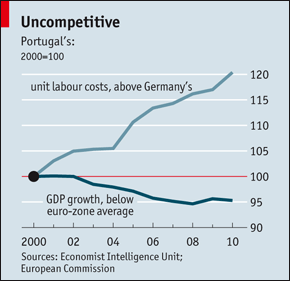
Low growth reflects a disastrous loss of competitiveness since the country joined the euro. Portugal has lost export-market share to emerging economies (including those of eastern Europe) that churn out similar low-value products. The Importance of Being Earnest EMU - en snabbkurs Värstascenariot för euron Southern Europe's problem is essentially a competitiveness problem, and not a fiscal one, and if many states have been having growing difficulty with their negative fiscal balances, this is a symptom of the problem, and not its cause. Even in the worst of cases - countries like Greece and Portugal - the rising recourse to fiscal outlays has been a response to lack of "healthy" growth, and the root cause of this continuing difficulty in generating real growth has been the underlying lack of competitiveness, and the inability to export your way out of trouble once the burden of debt starts to rise, so simply pruning the fiscal side isn't going to cure the problem, and by now that simple point should be obvious, I would have thought. Edward Hugh, Spain Economy Watch March 24, 2010 To some extent I cannot help feeling that a congenital inability to take bite-the-bullet type decisions is resulting in an ongoing process of passing the buck ever onwards and upwards. The latest exemple here is the issue of IMF involvement in the Greek adjustment process Well, one of the reasons lying behind all the reluctance we are currently seeing may not be the issue of the German constitution, or even the question of changes to the Lisbon Treaty, or any of the major issues of principal which arise and would require lengthy and onerous debate. Maybe the question is a much more simple one: perhaps Europe's leaders are simply worried that if they make a cheap loan to Greece, then Spain, Portugal, Ireland, Italy, Austria, Slovenia and Slovakia may all soon argue they also need one. I spent the best part of last week trying to figure out the mechanics of the eurozone’s €440bn bail-out fund. Once it raises the funds, the EFSF will not be able to lend on all of the €1bn, but only the portion backed by the collateral of those countries that themselves have a triple A rating. edifice: An elaborate conceptual structure: observations that provided the foundation for the edifice of evolutionary theory. collateralised debt obligation I am aware of the commitment of Europe’s elite to the success of the European project. The IMF should impose default on Greece to end the charade The euro’s big fat failed wedding Nästa krishärd Bulgarien som knutit sin valuta mot euron och därför ser ut att drabbas av samma problem som euroländerna kring Medelhavet. ekonomism.us 24/3 2010 EU ger klartecken för Bulgarien och Rumänien En viktig slutsats är emellertid att valutaunionen har skapat en mycket stor del av de ekonomiska balansproblem som framför allt de sydeuropeiska länderna står inför. The beginning of the end of Europe’s economic and monetary union as we know it. In a column several weeks ago I put forward three conditions necessary for the eurozone to survive in the long run: a crisis resolution mechanism, a procedure to deal with internal imbalances, and a common banking supervisor. Since then, things have been moving in the wrong direction on all three counts. For a start, we have come from a situation in which the “no bail-out” clause of the Maastricht treaty, having been almost universally disbelieved for 10 years, is suddenly 100 per cent credible. The minute the IMF marches into Greece, all ambiguity will end. The Greek crisis and the future of the Eurozone The structural problem in the Eurozone is created by the fact that the monetary union is not embedded in a political union. Paul De Grauwe Eurointelligence 11.03.2010 As is well-known, the ECB relies on ratings produced by American rating agencies to determine eligibility of government bonds as collateral. Prior to the financial crisis the minimal rating needed to be eligible was A- (or equivalent). In order to support the banking system during the banking crisis, the ECB temporarily lowered this to BBB+. At the end of 2009, however, the ECB announced that it would return to the pre-crisis minimal rating from the start of 2011 on. As the Greek sovereign debt had been lowered to BBB+, this created a big problem for financial institutions holding Greek government bonds, which now face the prospect that their holdings of Greek government bonds may become extremely illiquid. No wonder many dumped Greek government bonds, precipitating the crisis. The choice the Eurozone authorities face today is between two evils. The second evil arises from the contagious effects of letting Greece default on the banking system and macroeconomic policies in the Eurozone The legal skeptics argue that the no-bail out clause in the Treaty forbids the member states of the union to provide financial assistance to another member state. But this is a misreading of the Treaty. The no-bail-out clause only says that the European Union shall not be liable for the debt of governments, i.e. the governments of the Union cannot be forced to bail-out a member state (see Article 103, section 1). But this does not exclude that the governments of the EU freely decide to provide financial assistance to one of the member states. In fact this is explicitly laid down in Article 100, section 2. Thus euro zone governments have the legal capacity to bail out other governments. Here is the text: “Where a Member State is in difficulties or is seriously threatened with severe difficulties caused by natural disasters or exceptional occurrences beyond its control, the Council, acting by a qualified majority on a proposal from the Commission, may grant, under certain conditions, Community financial assistance to the Member State concerned”. ECB should discontinue its policy of outsourcing country risk analysis to American rating agencies. The latter have a dismal record. What’s to be done: the long term The structural problem in the Eurozone is created by the fact that the monetary union is not embedded in a political union. This imbalance leads to a dynamics of creeping divergencies between member states and no mechanism to correct or to alleviate it This structural problem has to be fixed before we are hit by the next crisis. There is today in the Eurozone no willingness to move forward into a more intense political union. One is led to the conclusion that the inability to create a more intense political union in the eurozone will continue to make the latter a fragile construction, prone to crises and great turbulence each time such a crisis must be resolved. Chancellor Angela Merkel has halted at the Rubicon. The fundamental problem with the euro project was overambition. The writer is chairman of Syngenta and former chief executive of Barclays I had always supposed that the euro would hold together because the misery of unravelling it seemed likely to exceed the pain of soldiering on. But when both partners in a marriage seriously question the arrangement, divorce is only a matter of time. This is a marriage with 16 partners and domestic violence is hotting up. Chancellor Angela Merkel has halted at the Rubicon. “Should a eurozone member ultimately find itself unable to consolidate its budgets or restore its competitiveness, this country should, as a last resort, exit the monetary union while being able to remain a member of the EU.”
Wolfgang Schäuble, German finance minister, FT March 11 2010 19:15 Olli Rehn /European Commissioner for Economic and Financial Affairs/ is quoted with the dramatic statement that a failure of Greece is a failure of the EU. Greece threatens more than the euro The Future of the Euro The disastrous budget situation in Greece has highlighted the common currency's weaknesses in recent weeks and similar situations in Spain, Ireland, Italy or Portugal could aggravate the situation even further. "economically absurd", "economically erroneous and politically dangerous", "a scandal", "insane" Across Europe, from profligate Greece to newly strait-laced Ireland, countries are promising deep, painful cuts in public spending even as they face the likelihood of a new recession. We need an agreement that as an ultima ratio it's possible to exclude a country from the euro zone if again and again it doesn't fulfill the requirements," Ms. Merkel's spokesman, Ulrich Wilhelm, said Wednesday that securing approval for the new rule would take "a few years"—a vast understatement, said Simon Tilford, chief economist at the Center for European Reform, a London think tank, considering the history of the Lisbon treaty. Ms. Merkel said the country's heavy reliance on exports is a plus, not a minus. "Germany will not forfeit its export strength," Ms. Merkel said. Her affirmation of the exports that drive Europe's largest economy made her the latest German official to hit back against French Finance Minister Christine Lagarde, who said the strategy creates unsustainable imbalances in the euro zone. Ms. Lagarde, speaking on French radio Wednesday, said that Germany should lower taxes to boost domestic consumption. Full textChina and Germany unite to impose global deflation They've got only a garlic press
For many years, I and others thought that when times got tough, it would be virtually impossible for the European currency to hold together. If life in the eurozone becomes intolerable, exit will become the default resolution mechanism. I had previously assumed that Germany had a national interest in preserving the eurozone, as its exporters benefit more than anyone else from a stable exchange rate. Ergo, I thought, Germany – despite the rhetoric – would eventually do whatever it takes to prevent a breakup. It would be the rational thing to do. “Should a eurozone member ultimately find itself unable to consolidate its budgets or restore its competitiveness, this country should, as a last resort, exit the monetary union while being able to remain a member of the EU.” If we wish the euro to be strong and stable on a lasting basis – our condition for bringing the DM and its high credibility into the euro fold – we have to be prepared to integrate further in the eurozone. Co-ordination between euro members must be more far-reaching; they must take an active part in each other’s policymaking. I understand that a great deal of political resistance will have to be surmounted. Nevertheless, I am convinced that from Germany’s perspective, European integration, monetary union and the euro are the only choice. There are some people who might feel that their scepticism towards the euro has been vindicated. They are overlooking the strengths of Europe and the problems faced in other leading global economic zones. Greklands ekonomiska problem tvingar EU att ta ett nytt steg ut i det okända. Annika Ström Melin, vårt lands mest kunniga journalist i detta ämne, ställer EMU-frågan på sin spets. Den meste Ja-sägaren, P J Anders Linder på SvD, tiger dock fortfarande. Det är inte oundvikligt Nu är det skamligt många i Sverige som förbereder sig och Sverige för en tillvaro i ett av EMU-EU dominerat Europa. Varför skall man göra sig omöjlig till ingen nytta när man kan vara realist och få ett välbetalt jobb i Bryssel eller i varje fall få åka dit med någon svensk delegation? Motstånd är ju ändå meningslöst, tänker väl Herr Unckel och andra. Men, som alla svenskar vet, varje meddelande om att motståndet skall uppges är falskt. Det är inte dom som kommer att segra, det är vi. Likt det en gång mäktiga Sovjetunionen kommer den Europeiska Unionen att i efterhand ses som en papperstiger, som ett snarast oförklarligt historiskt misstag likt Första Världskriget. Full textP.S. Ett stort tack till familjen Ander som på 1970-talet lät mig skriva ett oräkneligt antal ledare i NWT om löntagarfonderna och som lät mig skriva många förgripliga artiklar om EU och EMU i början av 2000-talet. "Nu behövs ett statsmannalikt ledarskap... Europas ledare, först och främst Tyskland och Frankrike" EU kan varken låta Grekland halka ner i statsbankrutt eller överlämna det till Internationella valutafonden, eftersom andra EMU-medlemmar – Portugal, Spanien och Italien – antagligen skulle ligga närmast till för attacker från finansmarknaderna. I så fall skulle det finnas risk för att euron rasade och för första gången på allvar hotade hela det europeiska integrationsprojektet. Europas ledare, först och främst Tyskland och Frankrike som har avgörandet i sina händer, måste agera snabbt och genomdriva nya, uppfinningsrika lösningar. även med ett, två eller tre steg framåt kommer Tysklands och Frankrikes regeringar att ta stora inrikespolitiska risker om eurokrisen i Medelhavsländerna förvärras och en finansiell räddningsoperation där blir nödvändig. Invånarna i de länder som blir tvungna att betala notan är inte förberedda på den verklighet som ligger framför dem, och det kommer att lägga bränsle på den mångåriga ökning av euroskepticismen som nu genomsyrar alla politiska läger. Detta gäller i allt högre grad också Tyskland, och vi kommer sannolikt att få se ett extremt stort politiskt problem växa fram där mycket snart. Under 90-talet var det drömmen om federationen som dominerade sinnena och euron fick symbolisera den nya europeiska staten. Eller som Tysklands utrikesminister Joschka Fischer sa på ett föredrag i Berlin 1999 och svepte med handen över publiken: Joschka Fischer "Allt är inte frid och fröjd. Former Federal Reserve Chairman Paul Volcker is confident the /Euro/currency will survive German constitutional law imposes such tight constraints that any dilution of the no bail-out clause in the Maastricht treaty or the price stability target of the ECB might trigger a forced German exit. Greece last week solved its fiscal problem by creating a private sector problem of identical size. This means that, by following the fiscal policy rules, the eurozone would risk a private sector depression, which would almost certainly be concentrated heavily in Europe’s south. This scenario would greatly increase the probability of a eurozone break-up at some point in the future. We have always known that a monetary union cannot exist without political union in the long run. Millions of migrants have arrived in Greece, Italy and Spain over the past decade. The economic crisis will slow the flow but is unlikely to undo the demographic shift, not least because the birthrate among immigrants is much higher than the general population's. "If there's a lesson that can be learned from the northern European experience, it's that temporary migrants tend to remain," says Joaquín Arango, professor of sociology at the Complutense University of Madrid. Det kommer aldrig att bli möjligt att göra någon entydig nyttokalkyl som visar att Sverige gör en nettovinst på att gå med.
Lars Calmfors 2009 Greece threatens more than the euro 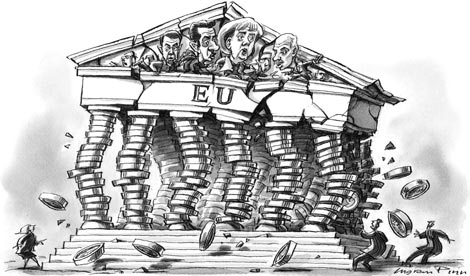
The EU has always proceeded by creating economic “facts on the ground”, which were intended to trigger political effects. Ever since the 1950s this has worked admirably, as a modest coal and steel community turned into a common market and finally into a Union of 27 nations, with its own parliament, supreme court and foreign policy. Jacques Delors, the European Commission president who presided over the creation of a single marketin the 1980s, said frankly: “We’re not here just to make a single market – that doesn’t interest me – but to make a political union.” The creation of the single market involved a huge expansion of European law and therefore deep erosions of national sovereignty. A logical political response to Greek insolvency – and the threat of similar crises in Spain, Portugal and eventually Italy – might be to create common European taxes and a mechanism for big fiscal transfers between EU states. But there is no sign of any such move. Europe is stuck. So what has gone wrong? The problem is that the “economics first, politics later” method is almost Marxist in its assumption that economics will inevitably dictate a particular political response. But democratic politics involves choice. If you want to understand what is happening to the European Union’s constitution, the EU flag is a good place to start. EU, EMU, Marx och Den Enda Vägen The risk premium on Greek government bonds continues to hover around 3 per cent, depriving Greece of much of the benefit of euro membership. If this continues, there is a real danger that Greece may not be able to extricate itself from its predicament whatever it does. Further budget cuts would further depress economic activity, reducing tax revenues and worsening the debt-to-GNP ratio. Given that danger, the risk premium will not revert to its previous level in the absence of outside assistance. The euro was meant to be a monetary union but not a political one. Det som nu händer är precis det som kritikerna, bland annat nobelpristagaren Paul Krugman och andra, varnade för inför bildandet. The late Eddie George /The former governor of the Bank of England/ once remarked to me that the euro project, which was launched in 1999, came 10 years too early. He was wrong. What once could be dismissed as simply a Greek crisis, or simply a Greek and Irish crisis, The standard way to buffer the effects of austerity is to marry domestic cuts to devaluation of the currency. Devaluation renders exports more competitive, thus substituting external demand for the domestic demand that is being compressed. But, since none of these countries has a national currency to devalue, they must substitute internal devaluation for external devaluation. They have to cut wages, pensions, and other costs in order to achieve the same gain in competitiveness needed to substitute external demand for internal demand. Greece, Ireland, Portugal, Spain *
Det är en väldigt liten sannolikhet för att euron kommer att bryta ihop. The Irish “rescue package” finalized over the weekend is a disaster. You can say one thing for the European Commission, the ECB and the German government: they never miss an opportunity to make things worse. It pains me to say this. I’m probably the most pro-euro economist on my side of the Atlantic. The Irish “program” solves exactly nothing – it simply kicks the can down the road. A public debt that will now top out at around 130 per cent of GDP has not been reduced by a single cent. Ireland will be transferring nearly 10 per cent of its national income as reparations to the bondholders, year after painful year.
This is not politically sustainable, as anyone who remembers Germany’s own experience with World War I reparations should know. It must engage in “internal devaluation” because the traditional option of external devaluation is not available to a country that lacks its own national currency. But the more successful it is at reducing wages and costs, the heavier its inherited debt load becomes. One can interpret the intransigence of the German government and its EU allies in two ways. First, they understand neither economics nor politics. As Tallyrand said of the Bourbons, “They have learned nothing, and they have forgotten nothing.” Alternatively, policy makers in Germany – and in France and Britain – are scared to death over what Ireland restructuring its bank debt would do to their own banking systems. If so, the appropriate response is not to lend to Ireland – to pile yet more debt on the country’s existing debt – but to properly capitalize their own banking systems so that the latter can withstand the inevitable Irish restructuring. The two largest creditors to Ireland are /banks in/ the UK and Germany, Was the real mistake creating the euro in the first place? Since I was one of the few Americans to advocate a single European currency, you would be justified in asking: Am I having second thoughts? Euro Currency Union Showing Strains Is this funny, or not? Mr Van Rompuy is a president without a country behind him—a president without money. So when a European Union crisis explodes that only money can fix, he will always be overshadowed by leaders who are putting their own taxpayers’ billions on the table. Such leaders are not just making a financial sacrifice for Europe when they dig deep into their pockets. They are taking a political risk. In one opinion poll, by the Emnid institute, for instance, 71% of Germans opposed financial aid for Greece. Mr Van Rompuy has no voters to fear. So in such disputes, he is a non-combatant: a counsellor but not a player. “What went wrong wasn’t what happened this year. What went wrong was what happened in the first 11 years of the euro’s history. In some ways we were victims of our success. “The euro became a strong currency with very small interest rate spreads [on government bonds]. Årets upplaga av boken Europaperspektiv handlar om hur EU har hanterat den globala krisen - Det bästa för dem hade varit en flytande växelkurs, likt Sveriges. http://www.europaportalen.se/index.php?newsID=48411&page=4001&more=1 http://www.europaperspektiv.se/ Jonas Ljungberg, Professor, Dept. of Economic History, Lund The real story behind the euromess lies not in the profligacy of politicians but in the arrogance of elites — specifically, the policy elites who pushed Europe into adopting a single currency well before the continent was ready for such an experiment. Consider the case of Spain, which on the eve of the crisis appeared to be a model fiscal citizen. If Spain still had its old currency, the peseta, it could remedy that problem quickly through devaluation if Spain were an American state rather than a European country, things wouldn’t be so bad. For one thing, costs and prices wouldn’t have gotten so far out of line: Florida, which among other things was freely able to attract workers from other states and keep labor costs down, never experienced anything like Spain’s relative inflation. For another, Spain would be receiving a lot of automatic support in the crisis: Florida’s housing boom has gone bust, but Washington keeps sending the Social Security and Medicare checks. The fundamental problem was hubris, the arrogant belief that Europe could make a single currency work despite strong reasons to believe that it wasn’t ready. är krisen ett bevis på att eurons införande – som i den antika grekiska tragedin – drevs av hybris och att det är en ödesbestämd nemesis som är under uppsegling? Victims of hubris, the Eurozone's original cheerleaders deserve this current crisis. Victims of hubris, the Eurozone's original cheerleaders deserve this current crisis. When they began to recruit member countries for the single currency, they laid down a set of basic rules about the soundness of national budgets before they could qualify to join. These were sensible enough. But in their eagerness for enlargement (as part of their pursuit of a United Europe in which they would be the main voices), the founder members allowed these rules to be broken. The problems were visible from the outset. For example, neither Greece nor Italy's national finances were in a good enough condition to merit joining. But the greater ideal of a Eurozone prevailed over financial common sense. Economics gave way to politics, as it so often does. Proof, also, that creative accounting is not confined to dodgy public companies. Will the Eurozone still be around in five years' time? With Greece, Italy, Portugal and Spain now suffering a severe financial crisis and with the euro seriously weakening, I think the prospect that it survives in its present form is most unlikely. Full textDie Griechen und der Euro Credit Suisse says Greece must raise €30bn (£26bn) in debt by mid-year, mostly in April and May. Here, in a chart, is why Britain can’t afford to be complacent about the plight of Portugal, Ireland, Italy, Greece and Spain. Tio års test av euron visar att domedagsprofetiorna kommit på skam. Tänk om det inte fungerar The last few days have reminded me of the speculative attacks Investors have concluded that the probability of a contagious default is rising. They are right. The least helpful suggestion in this situation – one that has already contributed to investor panic last week – is to let the International Monetary Fund sort out the mess. The argument is that the European Union is not in a position to provide emergency aid in an effective manner and that the IMF has the experience, personnel and the instruments to do so. That is all true, but advocates of an IMF-led bail-out conveniently ignore the disastrous signal that this would send to the financial markets about where the eurozone is heading in the future. It would demonstrate that the eurozone was incapable of sorting out its own problems. The eurozone might end up losing so much credibility that investors started treating it not as a monetary union but as a fixed exchange rate system with a finite time horizon. At the moment, in the absence of any framework, the threat of a default is transmitted automatically from the first to the next vulnerable country. Last week, the stock market fell even more in Madrid and Lisbon than in Athens. And, lest we forget, other European countries might also be vulnerable. Austria could still be drowned by its banking crisis; Belgium has a much higher level of debt than either Spain or Portugal and a financial sector heavily shaken by the global crisis. As worries spread north, serious investors might be tempted to bet serious money on a eurozone break-up. Such panics are easily triggered and difficult to stop. More seriously for Europe, even a slight surprise – a lost parliamentary vote or illness knocking out a trusted minister – could frighten investors, sparking a spiral of selling. Such panics are easily triggered and difficult to stop. Risk-averse investors will then race to drop exposed bonds, shares and other sovereigns, spreading crisis through the continent. What the eurozone must do if it is to survive Not a bang but a whimper: the threat facing the eurozone Der Spiegel, the German news magazine, has caused a stir in Brussels by reprinting bits of an unusually gloomy internal report from the European Commission on the euro zone (the 16 countries that use the single currency). In particular, people have focussed on the report's finding that differing competitiveness among euro zone countries is "a cause of serious concern for the euro area as a whole." In a widely quoted extract, the report seen by Spiegel frets that: ...differences among euro zone countries "jeopardize confidence in the euro and threatens the cohesiveness of the euro area." British Eurosceptics who have been predicting the collapse of the euro since before it was even created will no doubt be nodding sagely and feeling vindicated. Comment by Rolf Englund; Who is going to buy the multiple trillions in government debt that the G-7 countries want to issue? The dollar may be the worst currency in the world, except for all the others. The Greek government has promised to slash its fiscal deficit 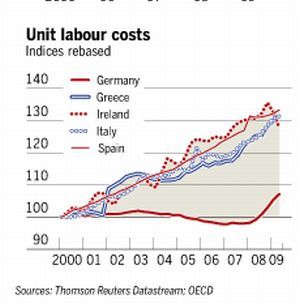
The task it is undertaking is huge. In particular, unlike most countries with massive fiscal deficits – the UK, for example – Greece cannot offset the impact of fiscal tightening by loosening monetary policy or depreciating its currency. A big structural fiscal tightening will generate a deep recession. The government will soon be facing miserable public and private sectors, with no policy levers. In an article in the FT last week, Desmond Lachmanof the American Enterprise Institute concluded that Greece will be forced to leave the eurozone. Suddenly, the unthinkable would be thinkable. The eurozone could then confront a wave of sovereign debt and financial sector crises that would make what happened in 2009 look like a party. A bail-out by the eurozone as a whole would create a monstrous moral hazard for politicians. Given the horrendous difficulty of all alternatives, I am sure the effort will be made to tough it out for as long as possible. The competitive disinflation route to prosperity seems highly likely to fail. Some, knowing of my opposition to UK membership of the eurozone, may suppose that I find some pleasure in these looming difficulties. On the contrary, I fear the dangerous consequences. Most of the time having an independent currency is nothing but a nuisance. But every so often and quite unpredictably, countries desperately need a safety valve. Det handlar om vad jag vill kalla "brandförsäkringsargumentet".
Secession Greek Prime Minister George Papandreou said there was "no chance" that Greece would exit the euro zone, We are about to learn whether the euro can survive a two-speed euro zone. It is unlikely that any of the so-called Piigs (Portugal, Ireland, Italy, Greece and Spain) will be able to get their fiscal houses in order any time soon. Of these, only Ireland seems to have the political will required to cut spending, and even that is not a certainty. The prospect that the euro zone as a whole will grow a bit obscures the wide disparity in the likely performance of its members. Germany and France should begin to recover, Greece and Spain might be another story altogether. It is this disparity that is most worrying to euro zone policy makers as their area-wide currency celebrates its eleventh anniversary, refuting by its continued existence those critics who said the new currency would not survive a serious recession. Angela Merkel will in the end contribute to a bailout fund if necessary. Paul De Grauwe, a Brussels-based economist who advises European Commission President José Manuel Barroso, displayed more than a wry sense of humor when he told reporters, "If there are fears now that a breakup of the euro zone will lead to a weakening of the euro, then that is good news. So we should congratulate Greece for getting us out of … having a euro that is too overvalued." Full textUnemployment in the eurozone 10 per cent for the first time since the introduction of the single currency.
Despite extraordinary measures to protect the labour market during the downturn, 4m have lost jobs across the 16 countries that use the euro, according to the European Commission’s statistical arm. Spanish unemployment, by contrast, is at 19.4 per cent, nearly three times its level before its credit-fuelled economy collapsed. Germany has 7.6 per cent unemployment. The issue is not whether to preserve the eurozone, but how. An excellent new report from the Organisation for Economic Co-operation and Development makes this point very powerfully. As the eurozone integrated, the excess of deposits over loans in surplus countries flowed to deficit countries, where banking sectors were short of deposits. This, one might argue, was meant to happen. Unfortunately, given low eurozone nominal interest rates and their buoyant economies, deficit countries had very low real rates of interest. The consequent asset price bubbles were fuelled by foreign borrowing: by 2007, Ireland’s net liabilities to foreign banks were 204 per cent of gross domestic product. Ireland and Spain had strong fiscal positions throughout: it was private borrowing that ran amok. * Det finns egentligen inte någon Eurokris.Tvärtom tvingar euron fram reformer som sedan länge varit nödvändiga, vilket alltid har varit ett av de starkaste argumenten för en gemensam valuta. Stefan Fölster, Magasinet Neo 2010-06-15 The eurozone’s next decade will be tough What would have happened during the financial crisis if the euro had not existed? That is the outcome the creators of the eurozone wished to avoid. But, if the exchange rate cannot adjust, something else must instead. Where does that leave peripheral countries today? In structural recession, is the answer. This leaves peripheral countries in a trap: they cannot readily generate an external surplus; they cannot easily restart private sector borrowing; and they cannot easily sustain present fiscal deficits. The crisis in the eurozone’s periphery is not an accident: it is inherent in the system. When the eurozone was created, a huge literature emerged on whether it was an optimal currency union. I varje nation måste man också ta ställning till om man vill ha en myntunion som bygger på att det egna landets medborgare måste utvandra för långa perioder eller för alltid för att systemet skall fungera. Eurozone credit contraction accelerates Southern Europe is being ordered to carry out IMF-style austerity, without the IMF-style devaluation required to rectify the massive imbalances that have built up between North and South under the euro. The EMU system has condemned Club Med to structural depression, with no way out. The logical – yet politically absurd – response of German Chancellor Angela Merkel is to talk of overriding national democracies in order to save the euro. "The question arises over what authority Europe has to tell national parliaments what to do, in order to avoid damage to Europe itself? National parliaments don't like to be dictated to about such things, but we need to address the problem," she said. Det var inte inflationen - det var Depressionen Standard & Poor's has put Greece on negative credit watch Trade imbalances will grow from their current low levels in the months ahead, and this is politically dangerous. Dubai and Euroland That Dubai World had financial troubles was known, but many investors had assumed its debts were backed by the government of Dubai, and ultimately by Dubai’s oil-rich neighbour, Abu Dhabi. There are similar ambiguities within the euro bloc. If countries with rickety public finances, such as Greece, Ireland and Spain, ever found themselves unable to refinance their debt, would other euro members with deeper pockets rescue them? If not, would default by one euro-zone country threaten the viability of the euro itself? Some think any problem will be Greece’s alone. After all, the treaty that created the euro contains a “no bail-out” clause that prohibits one country from assuming the debts of another. Discord at the ECB heralds the eurozone’s endgame The euro: How Europe’s grand dream went sour In his definitive history of the euro, MarketWatch columnist David Marsh chronicles the European monetary union’s rise and fall, records the mistakes, intrigues and miscalculations along the way and asks: Where now for the euro? MarketWatch is publishing this excerpt from the book, with new material from Marsh covering the events of the past few weeks. “The Euro – The Battle for the New Global Currency”is published by Yale University Press. Officials have said they will support Greece, but they haven't said how. This has some skeptics of the euro project wondering if the rich, thrift-minded EU states ultimately can be counted on to come to the aid of poorer and heavily indebted ones. "They can choose solidarity or chaos," said David Marsh, author of The Euro: The Politics of the New Global Currency. Any number of things could change in the euro zone in the next few years, Marsh said, depending on the terms offered debtors like Greece. He cites prospects ranging from smaller countries dropping out to a split of the EU into northern and southern regions to Germany pulling out, collapsing the project altogether. David Marsh, author of The Euro: The Politics of The New Global Currency, said the danger for EMU laggards is that the ECB will begin to tighten before they are out of trouble. Eurons växelkurs har nått smärttröskeln för industrin i euroområdet. Förutom Europafacket deltog även ekofinordföranden Anders Borg, eurogruppens ordförande Jean-Claude Juncker, ECB-chefen Jean-Claude Trichet och ekonomikommissionär Joaquin Almunia. "Jag är djupt oroad över utvecklingen i växelkursen på senare tid. Euron har nått smärttröskeln för industrin i euroområdet", sade han. "Det är oförenligt med G20-ländernas åtaganden för en ordnad upplösning av de globala obalanserna", fortsatte han. "The euro at $1.50 is a disaster for the European economy and industry," Beijing has clamped the yuan firmly to the weak dollar for over a year, quietly benefiting from the export advantages. It accumulated $68bn (£41bn) in reserves in September alone as a side-effect of holding down the currency. 15 miljoner arbetslösa i EurolandUnemployment levels across the 16 countries that use the euro rose to 9.7% in September, the highest rate since January 1999. This brought the number of people unemployed across the eurozone region to 15.3 million. Spain has the highest eurozone unemployment rate at 19.3%. Time for the ECB to get serious about the overvalued euro Euron har för länge sedan bevisat sin styrka. I den senaste ekonomiska krisen framstod euron som en säkrare tillflykt än dollarn. När det isländska alltinget för en vecka sedan med knapp marginal beslutade att lämna in en medlemsansökan sade EU-kommissionens ordförande José Manuel Barroso att beslutet var ett tecken på det europeiska projektets vitalitet.
It could be that future generations of German politicians find ingenious ways around the balanced budget law.
The euro should appreciate to $1.53 (as against $1.40 recently). Latvia - IMF experts were overruled by Brussels The ECB estimated bank writedowns total of $649 billion, Euro-zone banks will probably need to write down another $283 billion this year and next on bad loans and securities, the European Central Bank said on Monday. The ECB estimated bank writedowns due to securities -- or toxic assets -- would total around $218 billion from the start of the financial turmoil to the end of 2010, while bad loans would account for another $431 billion -- a total of $649 billion, with an estimated $366 billion already announced. The figures were published in the ECB's latest Financial Stability Review, $375 billion - It seems unfair. This was supposed to be a US crisis. This mess is sizable. Sweden in the early 1990s is rightly held up as the example of how to this; As in the US, the blanket guarantees on deposits and various interbank assets prevented a panic, but also likely removed much of the market pressure on the banks to behave better. jfr Kronan är en dyrbar lyx. Why eurofederalists should be delighted with recent events The most likely structure for a rescue would not require any funding from Germany at all. The rescue would simply consist of a decision, approved by a qualified majority on the European Council to implement Article 122 of the Lisbon treaty. But who would actually pay for such an EU bailout? This brings us to the second reason why eurofederalists should be delighted with recent events. The eurozone faces three threats more serious than any in the US or Britain: If you think Alistair Darling faces trouble in his Budget, spare a thought for Brian Lenihan, the Irish Republic's Finance Minister, who on Tuesday announced his second emergency budget in six months, imposing drastic tax rises, pension and wage cuts, still leaving his country with the by far the biggest budget deficit in the eurozone. Or for Yannis Papathanassiou, his Greek counterpart. His country's credit has been downgraded to one notch above junk status and was justifiably described yesterday as teetering on the verge of bankruptcy in the German magazine Stern. Or for Pedro Solbes, the respected Spanish Finance Minister, who was sacked on Monday in response to the meltdown of an economy and banking system said to be invulnerable only a few months ago.
Or even for Peer Steinbrück, the German Finance Minister, who, despite his swaggering boasts about the triumph of the Rhenish social-market model over Anglo-Saxon capitalism, presides over the weakest leading economy in the world outside Japan. Ex-Bundesbank chief Karl Otto Pohl has just said that Ireland and Greece The U.S. government rescued giant insurer American International Group "Kronan räddar Sverige" Austrian banks have lent a total of $300bn to clients in the region (Eastern Europe),
Will Germany deliver on the Faustian bargain that created monetary union? Eastern crisis that could wreck the eurozone European stocks tumbling to a six-year low Vår slutsats blir att euron är bra för både näringsliv och konsumenter i Sverige, skriver Klas Eklund, Carl Johan Åberg och åtta andra nationalekonomer /däribland således Karolina Ekholm/. Can The Euro Survive? Ever heard of the four PIGS? The euro, or so the argument went, was doomed from the outset because of the wide spread in economic performance and discipline amongst the member countries. When the Stability and Growth Pact behind the euro was established, there was no reference made to unit labour costs which, with the benefit of hindsight, was a major mistake. Even Jean-Claude Trichet, the Head of the European Central Bank, who rarely admits mistakes, has publicly stated that if he could design the currency union all over again, he would push for a unit labour cost stability pact. Table 1: 2007 Unit Labour Cost Index (2000=100)
Another issue, which is potentially even more destabilising for the euro longer term, is the massive liabilities facing Europe as its population ages. A third problem facing Europe is the sheer scale of the banking crisis. Although this is not just a European problem, European countries are probably worse off than the US because a larger part of European debt has to be financed externally. Kenneth Rogoff and Carmen Reinhart published a research paper about a month ago which should be mandatory reading for all investors2. They have studied every single banking crisis of the past 100 years and reach some rather unsettling conclusions.
"There is no risk that the euro will break apart," said Jean-Claude Trichet, EU officials are furious over comments this week by Dominique Strauss-Kahn, head of the International Monetary Fund, who said the euro could prove unworkable unless the member states give up some control over fiscal policy. The yield spreads on Greek 10-year bonds have reached post-EMU highs of 265 basis points over German Bunds. Enligt ledamoten Charles Wyplosz så hade den grekiska valutan gått omkull och troligen också den italienska, spanska, portugisiska och kanske också den irländska valutan Iceland Is Sacrificed to Save EU: The European Union, in order to save itself from the faults of its own legislation, has decided that Iceland and the Icelandic people are expendable. Realising its own failures the EU has decided, through the British and Dutch governments, that the Icelandic authorities have to shoulder the responsibility which is rightfully the EU regulators’. This is what the so-called Icesave dispute is mainly about. The dispute started in October 2008 when almost the entire Icelandic banking system collapsed. One of the three largest Icelandic banks, Landsbanki, had operated internet savings accounts in the United Kingdom and the Netherlands collecting large amounts of deposits by offering high interest rates. These accounts were operated with the approval of the British and Dutch authorities and their operation was made possible by EU laws. According to a cruel joke making the rounds these days, An even crueler epithet calls London "Reykjavik on the Thames." On Monday, S&P downgraded Spain's credit rating to AA+ from triple A, following a similar cut for Greece last week. All this has led to speculation that the euro zone's breakup is imminent. The euro is an anchor of stability, particularly for small members that otherwise would be much more exposed. Denmark may hold a referendum on joining the euro next year and in Iceland, which hitherto has declined to join even the European Union, a clear majority now favors adopting the single currency. Being a member of the eurozone doesn’t immunize countries against crisis. Fördel att stå utanför EMU The eurozone economy will shrink 1.9% in 2009, the European Commission has forecast. The PIIGS "The euro is a flawed mechanism. The euro has no flexibility. The euro marks its 10th birthday on New Year’s day at a perilous moment in global finance. Capital markets have worried about public finances in some countries, leading to a dramatic widening of yield spreads, for example, on Greek and Italian bonds compared with German state debt. Eurozone members trying to pull themselves out of recession will not have the option of currency devaluation, which could make the process more painful. Such trends might make managing the eurozone harder, raising questions about its long-term future Even if the eurozone has avoided a Lehman Brothers-style collapse, there is widespread agreement that the current fragmented system leaves the region dangerously exposed. Still, any moves to centralise bank regulation should be expected to encounter resistance from governments with an eye to the national interest – something James Bond would know all about. Multimedia feature: the euro at 10 We should not try to avoid 1929. We have already failed. Euroskeptics are easy to find in the Nordic capitals, and they won't accept that the financial turmoil has boosted the argument for the common currency. More by Rolf Englund in english Investors Raise Their Bets on Defaults in EU Countries For Ireland, which introduced a €400 billion bank-guarantee program last month that is twice the size of its gross domestic product, investors' cost of insuring against debt default has risen eightfold since the start of the year. The divergence in bond yields points up that even though the euro-zone nations share a currency and a monetary policy administered by the European Central Bank, investors still price the countries' creditworthiness individually. The so-called spread between yield on the 10-year Italian Treasury bond and the corresponding German 10-year bond rose to 1.25 percentage point, after breaching the mark of a full percentage point Tuesday for the first time since the euro's launch in 1999. The interest spread between Italian 10-year bonds and German Bunds has reached 108 basis points, the highest since the launch of the euro. Italy's public debt is the third largest in the world after the US and Japan. At 107pc of GDP, it is the highest of any major economy in the eurozone and almost double the 60pc limit stipulated by the EU's Maastricht treaty. One can sympathise with Berlin. But sharing debts with Italy and Spain was implicit when they agreed to launch the euro. Has the international financial crisis exposed the cracks in the European Union's single market? Germany will guarantee all private savings accounts German Finance Minister Peer Steinbrueck, deputy leader of Social Democrats, The crucial problem on this side of the Atlantic is that the largest European banks have become not only too big to fail, but also too big to be saved. Similarly, the total liabilities of Barclays of around £1,300bn (leverage ratio 60!) are roughly equivalent to the GDP of the UK. Fortis bank has a leverage ratio of “only” 33, but its liabilities are three times the GDP of its home country of Belgium. Given that solutions for the largest institutions can no longer be found at the national level it is apparent that the European Central Bank will need to be put in charge as it is the only institution that can issue unlimited amounts of a global reserve currency. Lender of Last Resort $700 billion rescue plan Could the credit crunch destroy the Eurozone? Mostly Spain What if one of the member states of the eurozone were to default on its debt?
The probability of a default is low but clearly rising. The decision by Standard & Poor’s, the ratings agency, to downgrade Greek sovereign debt and to put Spanish and Irish debt on watch seriously rattled investors last week, for good reason. If the financial crisis has taught us one thing, it is to take perceived tail-risks more seriously. Before I answer the question, it is best to consider what would not happen. For a start, the eurozone would not fall apart. A government about to default would be mad to leave the eurozone. It would mean that, in addition to a debt crisis, the country would also face a currency and banking crisis. Bank customers would simply send their euros to a foreign bank to avoid a forced conversion into a new domestic currency. So we are stuck with the eurozone for better or for worse. If a default happens, the central banks and governments of the eurozone would be forced to co-ordinate their policies whether they liked it or not. Under its statutes, the euro system, which includes the ECB and the national central banks, is not allowed to monetise (that is, buy) new sovereign debt or to grant overdraft facilities. But the ECB is allowed to buy debt in the secondary markets, which is a way of monetising debt. All it would take is a decision by the ECB’s governing council. Putting roughly the same value on Greek and German debt – which is what financial markets did for most of the last 10 years – never made sense. If you assume the worst-case scenario of a default by five or six countries, a full fiscal union would be more probable than a break-up. Meltdown Den stigande räntan drabbar inte svenskarna lika hårt som i många andra länder i Europa. De flesta euroländer har inte en ekonomi som tillåter en mer expansiv finanspolitik. De länder som ändå försöker sig på det riskerar att bryta mot euroländernas ekonomiska regler i den så kallade stabilitetspakten. – Problemet är ju då att situationen ser ganska olika ut i olika länder. Tyskland kanske kan ta det här därför att där har man haft en ganska stark konjunkturutveckling jämförelsevis. Men sedan har vi ju länder som Spanien, Italien och Irland, där lågkonjunkturen är mycket starkare. Så att det kommer helt klart att uppstå stora spänningar inom euroområdet, som är just den typ av spänningar som uppkommer när man ska ha en ränta för ett stort antal länder, där de ekonomiska förhållandena kan se väldigt olika ut, säger Lars Calmfors Spain, Ireland `Thrown to the Wolves' ``They have been thrown to the wolves,'' said Stuart Thomson, who helps manage $46 billion in bonds at Resolution Investment Management Ltd. in Glasgow, Scotland. `It's much easier to bring inflation lower if you're willing to have a recession in economies like Spain, Italy and Ireland.'' The Irish economy contracted for the first time in more than a decade in the first quarter. Growth in Spain was the slowest in 13 years in the period, Has Europe's terminal crisis begun with a triple no vote? The attempt to override the triple "No" votes of the French, Dutch, and Irish peoples has brought the EU to a systemic crisis of legitimacy.Has Europe's terminal crisis begun with a triple no vote? Germany and Spain have clashed in an escalating dispute over the European Central Bank, Why would the euro fall? Because the currency is still an experiment in cooperation.
In the past fifteen years, France government debt to GDP has moved from 35% in French Franc (i.e.: a currency the government could print at will) to 70% in Euros (i.e.: a currency that only the ECB can print). Emu’s second 10 years may be tougher 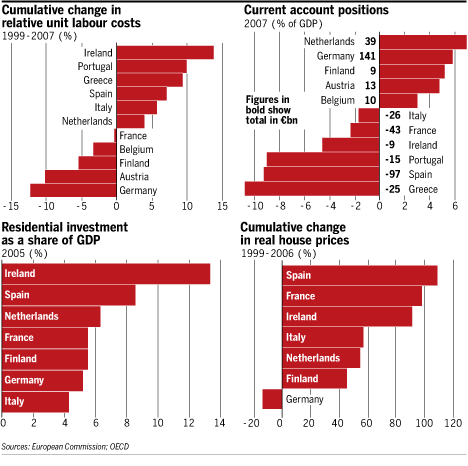 As the euro soars, the pressures of adjustment to internal divergence are likely to grow to enormous levels. The report is honest about these challenges. Between 1999 and 2007, huge divergences in inflation, relative unit labour costs and current account positions emerged (see charts). These tendencies were exacerbated by the divergence in real interest rates, with the lowest rates in the countries with the highest inflation and – perversely, but inevitably – the strongest economies. http://ec.europa.eu/economy_finance/emu10/reports_en.htm The stories here are two: A 10 per cent improvement in relative unit labour costs would demand a 10 per cent decline in relative wages. ECB marking its 10th anniversary June 1, has failed in each of the last eight years to achieve its aim of bringing inflation below 2 percent. There is no excuse for Britain not to join euro From a conventional macroeconomic perspective, there is no reasonable argument for a small, highly open economy such as Britain’s to retain monetary independence To those loudly insisting all this week that Britain should have joined the euro ten years ago, Celebrating 10 years of the euro? About 16 million jobs have been created in the eurozone since the birth of the euro, and unemployment has fallen, from 9% in 1999 to 7% in 2007. Of course, neither of these achievements is necessarily due to the euro, any more than the fall in average inflation and long-term interest rates can be directly attributed to the European Central Bank. Nearly all of the world's advanced economies have seen a steady decline in inflation since the late 1980s (at least until recently), a development that has pushed down interest rates as well. 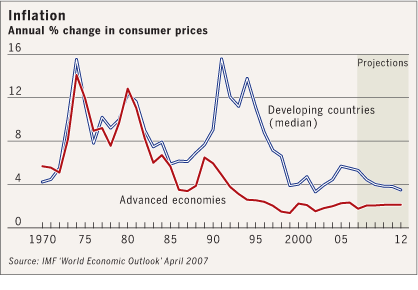 EMU@10 is a very substantial document about the future of the euro area – by far the most comprehensive and thoughtful report we have yet seen. It has three parts. We will ignore the first, which looks back at the first ten years, as well as the second on future challenges, There are three schools of thought about euro area policy co-ordination. What is remarkable is that the European Commission is departing from the previous line that economic reforms should be dealt with purely under the framework of the Lisbon Agenda. *
I am very pleased to welcome you to this website dedicated to the euro and The unemployment rate in Spain jumped the most in 15 years to a three-year high The pain in Spain Europe's monetary union, which launched the euro almost a decade ago, Jean-Claude Juncker, the EU's 'Mr Euro', The euro hit a record high against the dollar after data In truth, as the euro approaches its tenth birthday celebrations, it is facing the biggest test of its short life ECB has been reluctant to cut rates is not because growth is so robust but because inflation has picked up to 3.5%—the highest in the euro's nine-year existence. And two bigger worries have emerged. The first is the strength of the euro. Mr Almunia, economics commissioner, says the euro is “overvalued” and adds that, although the impact has been moderate so far, “we are at the limits, if not beyond them.” The second worry is the housing market. Europe may have avoided the American subprime mess, but in several countries house prices have been even bubblier than in America. They are already falling in Spain and Ireland, and, beyond the euro zone, are starting to do so in Britain. A property bust may not produce an American-style mortgage meltdown, but it will surely topple economies heavily dependent on construction Even critics of the euro would concede that it has had considerable success, establishing itself in less than a decade as a genuine rival to the dollar as a world currency. But... But some countries have adapted a lot better to the discipline of the euro than others. Germany and the Netherlands have cut labour costs and introduced enough reforms to make their economies more competitive. France, Spain and especially Italy have done less—and are suffering more, from both the euro's rise and the global slowdown. Though many observers are rightly concerned about Spain, it may be Ireland that becomes the next serious test of EMU’s one-size-fits-all monetary policy. The European Commission Predicts Weaker Growth, Higher Inflation in 2008 Yet if the storm is peaking in the US, it has hardly begun in Europe. Byggkrasch nära i Spanien Companies in Britain and Europe have failed to place a single high-yield bond http://blogs.telegraph.co.uk/business/ambrosevanspritchard/nov07/euro.htm As the euro brushes $1.50 against the dollar, As Airbus chief Thomas Enders warned in a speech to the Hamburg workers last night, Europe's champion plane-maker - the symbol of European unification, in the words or ex-French president Jacques Chirac -- is now facing a "life-threatening" crisis. The sudden rocketing in sovereign bond spreads this week between core German Bunds and Club Med debt - Italian, French, Spanish, Portuguese, Greek, as well as Irish, Belgian and Slovenian - is a clear sign that markets are starting to price in a break-up risk for the single currency, however remote. The euro soared to another record high against the sagging dollar, "Some thougths about the future of the euro" Why The IMF’s Decision To Agree A Lavian Bailout Programme Without Devaluation Is A Mistake Paul Krugman Edward Hugh Mer om Baltikum och Swedbank SEB m fl The wolf packs are circling. Hedge funds target currency pegs The global M3 money supply is growing at 10.6pc as stimulus from America, Europe – and Japan, through the carry trade – leaks out to the vibrant parts of the world economy... With the usual lag, inflation has at last hit. The easiest prey are in the Baltics and Balkans, where EU newcomers have let rip by importing an ECB monetary policy designed for the slow barges on the Rhine. All are overheating. The dominoes are toppling. The dollar broke above $1.40 per euro for the first time Varför betalade ECB 1.800 miljarder kronor för att rädda euron? The euro slipped to a six-week low against the U.S. dollar on Wednesday and
Hollande Bids Adieu to EU Vacation Culture as Crisis Lingers The ECB made a total of four cash interventions since last Thursday France's largest bank BNP Paribas froze payments on three funds invested in the sector, which involves lending money to those with a poor credit history. The ECB "will continue to monitor the situation while euro-area financial markets in general are going back to normal functioning,'' The European Central Bank on Monday injected another 47.67 billion euros ($65 billion) into the banking system Speculation is mounting that the European Central Bank will seek to arrange a currency swap The European Central Bank made a second move to boost liquidity in the financial market Friday, *
Med nödkrediter på nästan 900 miljarder kronor, Paniken borde egentligen vara obefogad Kommentar av Rolf Englund: *
The European Central Bank scrambled to head off a potential financial crisis on Thursday by pumping an emergency €94.8bn ($131bn) into the region’s banking system The cash injection was the biggest in the ECB’s history, exceeding the €69bn provided the day after the terrorist attacks of September 11 2001. The ECB also made an unprecedented one-day pledge to meet 100 per cent of all funding requests from financial institutions. In “The Coming Collapse of the Dollar,” James Turk and I said this about the effect of a falling dollar on other countries: Professor Paul de Grauwe So what if the euro rises above $1.40? The long-run performance and success of the EMU depends on whether economic convergence or divergence is occurring. Germany needs to formulate a response to Sarkozy or the only proposal on the table will be Sarkozy’s anti-stability, anti-competition, pro-currency-intervention proposals. The euro has continued its dramatic surge to record highs against the dollar, causing serious strains in southern Europe and renewing concerns about the long-term viability of monetary union. The country that most troubles outsiders is Latvia. French and Italian industrial production both unexpectedly fell in April Finns euron kvar om 15 år? I en viktig fråga är EMU-projektets varmaste anhängare och argaste kritiker helt överens: For the first time, respectable voices - i.e., those deemed respectable by the European elite - "tensions" from "persistent divergences in growth and inflation" among its members, the European Commission warned Italy is often mentioned as the country most likely to leave the euro. I disagree. The real reforms needed to secure the euro’s future Joaquín Almunia, EU monetary affairs commissioner 280-page report on the low pace at which countries have adapted to the euro since its launch in 1999. Now, some experts are becoming concerned that Could the eurozone disintegrate? - The answer is yes. John Rubino 7/20/2007: Correctly interpreting this change in buying patterns as a threat to their vital export sectors, European and Japanese leaders will respond with the only weapon they have left: monetary inflation. They’ll cut interest rates and buy dollars with their currencies, flooding the world with euros and yen the way the U.S. now floods the world with dollars. So what if the euro rises above $1.40? My prediction is that they will first have a fight about who is in charge. If the euro continues to appreciate, Germany in particular will suffer from a sustained exchange-rate overshoot, as its economy remains as dependent as ever on a successful export sector. There are non-trivial structural risks that the euro may appreciate further in the short-to-medium term.If it does, Mr Steinbrück (“I’m not worried about a strong euro. I love a strong euro”) will not only have to eat his words. More worryingly, he and his European colleagues will have no idea what to do under these circumstances. Germany’s ability to improve its competitive position through a devaluation of the real exchange rate has run its course. My hunch is that the German government will find it difficult to stick to its current position and that Mr Sarkozy will win this argument. It would be much better if the eurozone adopted a more structured process to deal with exchange rate overshoots. Germany needs to formulate a response to Sarkozy or the only proposal on the table will be Sarkozy’s anti-stability, anti-competition, pro-currency-intervention proposals. The long-run performance and success of the EMU depends on whether economic convergence or divergence is occurring. Now several years after the formation of the monetary union (formally started in 2002 but already effectively in place since 1999) there is enough economic data to make a preliminary assessment of the success of the monetary union. Here is a concise overview of the economic criteria that make a currency or monetary union desirable.... In the RGE paper (co-authored by Christian Menegatti, Elisa Parisi-Capone and myself) that we presented at the EMU conference we conducted a systematic overview of the evidence on economic convergence or divergence within the EMU. The only country where the external adjustment has taken place has been Germany: but even in this case the adjustment was very slow and took more than a decade: the shock of German unification and the ensuing loss of competitiveness of Germany took more of a decade to be unraveled via a painful process of corporate restructuring and significant wage moderation. Iin the process leading to EMU real interest rates sharply fell in countries such as Spain, Portugal, Ireland and the Netherlands. This reduction in real interest rates led to an economic boom and overheating that – in the countries above – took also the form of a housing boom with excessive investment in real estate and sharply rising home prices. The ensuing economic bust in the Netherlands and Portugal was particularly painful. The housing bust that is likely to now occur in Spain - and possibly even Ireland – will be similarly painful. One serious open question if whether the countries – Italy, Portugal, Spain, Greece - that have experienced a significant loss of competitiveness and real exchange rate misalignment will be able implement reforms that will increase productivity growth, reduce relative unit labor costs and allow them to regain their lost competitiveness. There are some reasons to be cautiously pessimistic. Even ECB executive board member Lorenzo Bini-Smaghi - who strongly argued that EMU has been a success – admitted that these countries may have to go through a long and painful adjustment period to regain the lost competitiveness. This article appeared orginally in Nouriel Roubini's Blog at RGE Monitor. The euro has continued its dramatic surge to record highs against the dollar, causing serious strains in southern Europe and renewing concerns about the long-term viability of monetary union. French president Nicolas Sarkozy yesterday instructed his staff to draw up plans on "the means for implementing an exchange rate policy" in co-operation with the 13 finance ministers of the eurozone, showing that he intended to press ahead with his campaign to clip the wings of the European Central Bank. The aim is to twist the arm of the ECB, until it agrees to slow the pace of rate rises. "When the dollar loses 33pc of its value against the euro, how can our industries regain the competitiveness lost unfairly due to political manipulation by the rest of the world?" he told Euro MPs last week. The current account deficits of Spain, Greece, and Portugal have all reached 10pc of GDP. While the slippage in France is less dramatic, it has been enough to cause deep soul-searching in Paris about the value of euro membership on current terms. Bernard Connolly, global strategist for Banque AIG, said investors switching from dollars to euros were mistakenly treating Germany as if it were a "proxy" for all Europe. "What they fail to recognise is that Spain, Italy, and France are in a worse state than the US, and are even more dependent on a global credit bubble to support demand," he said. French and Italian industrial production both unexpectedly fell in April The euro advanced to a record against the dollar in April, making European goods less competitive at a time when the economy of the U.S., the region's biggest export market, has slowed. The European Commission predicts euro-region growth will cool to 2.6 percent this year, from 2.7 percent, still robust enough for the European Central Bank to push interest rates higher. The declines in French and Italian output come after a report showing German industrial production fell in April for the first time in six months. Manufacturing in the euro region expanded at the slowest pace in more than a year in May. The unemployment rate in Spain jumped the most in 15 years to a three-year high The pain in Spain The Spanish economy has been a driving force for economic activity in the euro area for more than a decade, with year-on-year GDP growth exceeding the average rate of expansion in the euro area in every quarter since 1995. The weakness began last year in the housing market — the major driver of the Spanish economy over the last ten years. The danger signs are now spreading to other sectors of the economy. The Economist Intelligence Unit has cut its forecast for Spanish GDP growth to just 1% in both 2008 and in 2009, compared with an annual average rate of expansion of 3.8% in 1998-2007. Rising employment in the construction sector has accounted for a substantial share of overall employment growth in recent years, while house prices are estimated to have increased by 190% between 1997 and 2007—only Ireland and the UK have experienced a similar hike in prices among major industrialised countries. A return to a more normal level of housing investment would take off some 3 percentage points of GDP, and in order to absorb earlier excess construction, a temporary fall to below the normal level would probably be necessary. The experience of Sweden, where housing investment declined by 71% between the peak in 1990 and the first (not final) trough in 1995, suggests that such adjustments can be dramatic. With Spain being a member of the euro area (and a departure from the club out of the question), a devaluation of the currency to improve competitiveness and boost export demand is also not an option (although the high, and rising, current-account deficit would suggest a serious overvaluation). President Nicolas Sarkozy The ECB has doubled rates since December 2005, a key factor driving the euro to record highs. While a resurgent Germany can take the strain, most of the "Club Med" bloc is losing export share - including France. "How can you continue to export if the euro is the only currency in the world that is overvalued compared to the dollar, the yen and the yuan? Sarkozy Sarkozy is no fool. He is a former finance minister, who knows exactly what he is talking about. He has formed a firm view of economic governance both in France and in the euro area. And he has come to a different conclusion that most of us have. From the vantage point of a populist politician who is keen to break with the past, Sarkozy is in fact totally consistent. Treat the ECB, the Commission, and the Germans as your enemy, and play the role of Robin Hood, who takes the money from the evil ECB and hands it to the poor. This, far more than Italy's economic weakness, or a Spanish housing market meltdown, is the stuff which could endanger the long-run viability of the euro. Axel Weber, the hawkish head of the Bundesbank, is alarmed by a 10.9pc surge in the M3 money supply France and Germany have begun to clash openly over control of monetary policy in the eurozone, taking starkly different views about the rising threat of inflation. In an unprecedented rift, the heads of the Bundesbank and the Banque of France have contradicted each other in public, exposing an emerging rift between Europe's north and south. Axel Weber, the hawkish head of the Bundesbank, is alarmed by a 10.9pc surge in the M3 money supply in March, the highest growth rate for the region in almost a quarter of a century. The less-watched M2-M3 gauge rose 19.8pc - anathema to monetary hawks in Frankfurt. The comments were flatly contradicted hours later by Christian Noyer, France's bank chief. "There is no concern that inflation will get out of hand. The risk has not increased," he said, showing his irritation. The north-south clash reflects the yawning gap between a resurgent "Teutonic Tiger" conquering markets in Asia and Eastern Europe, and a sickly France being left behind. The strong euro is slowly asphyxiating French exporters. The rest of the Club Med bloc is lining up behind Paris. Romano Prodi, Italy's premier, said: "I am worried about the relentless rise of the euro. We have reached a point where it has become truly a burden." European finance ministers The eurozone has now split into two incompatible camps. Madness was at full throttle last week as the stateless currency of the world's least dynamic bloc surged to an all-time high near $1.37 against the dollar. It brushed yen163 against the yen, a rise of 80pc since 2001. The euro is even lording it over the Swiss franc. This rise has occurred at a time when a) the EU's "Lisbon" drive to unshackle the economy and close the technology gap with America has flopped, b) France, Italy, Spain, and Poland are openly defying the EU's single market rules, c) the grand plan to create an EU superstate has collapsed, leaving the euro an orphan currency, with no sovereign entity behind it, and no hope of an EU Treasury or debt union to see it through a crisis. The world plainly wants euros. Investors are willing to believe for now that the currency is a sort of big D-Mark reflecting the wonders of the German export machine - forgetting about 180m Latins on the other side of the eurozone's cultural fault line. They'll learn.Sated with dollars, China, Russia, and the petro-powers are shunting their massive reserves into Bunds and Spanish treasuries, pushing the euro ever higher.Since most of Asia hold down their currencies by mercantilist intervention, Europe is taking the brunt of the dollar slide. Deutschland AG has just enforced the harshest wage compression of modern times.Unit labour costs in manufacturing fell 4.4pc in 2005 alone as Volkswagen and Siemens extracted longer hours without extra pay under threat of moving jobs East.Stealthily, Germany has gained 40pc in competitiveness against Italy since the D-mark and lira were fixed in 1995, 30pc against Spain, and about 20pc against France. Berlin gave up the D-Mark under an implicit contract that the euro would never fuel German inflation.This contract will be enforced. If not, German citizens will pull the plug on EMU. The only question is who will file for divorce first: the Latins or Teutonia. They cannot both share the currency. Euro is 'doomed to failure' The French created the European Union, so it would be appropriate if they destroyed it. Do current account deficits matter inside a monetary union? Is Latvia about to devalue? The currency’s peg to the euro has provided the country with much-needed stability – after Russia’s 1998 default, most crucially – but has restricted the central bank’s ability to use monetary policy to reduce demand and inflation. It has also encouraged the credit boom by reducing borrowers’ exposure to foreign exchange risk. Moody’s says Latvia’s $20bn external debt equates to over 100 per cent of GDP, 43 per cent of it short-term and owed by the private sector. After Thailand’s currency peg broke in 1997, its currency lost more than half its value in the following six months. Bör Carl Bildt dömas till böter? Germany’s export strength also makes it export-dependent and vulnerable to a downturn in global demand. The real reforms needed to secure the euro’s future Ségolène Royal, socialist candidate for the presidential elections: The Eurozone economy is strong enough to withstand weaker US growth, higher German taxes and a dip in exports next year, Growth will slow in 2007, though the Commission said it would remain robust as negative effects would be limited. Countering the global problems would be strong domestic consumer demand and improved corporate spending, it added. ``While slower growth in the U.S. will undoubtedly have an impact on the rest of the world, our analysis suggests that its effect on activity in the euro area should be limited,'' Klaus Regling, head of the commission's economics department, said in the report. The recent flurry in foreign exchange markets probably signals the start of a process of unwinding global imbalances. Suppose the market brings about the requisite dollar depreciation. The author is a fellow of Merton College, Oxford Suppose the market brings about the requisite dollar depreciation. Then, if China and Japan were to maintain their dollar exchange rates, as they are currently entitled to, other countries, especially in Asia, would have an incentive to do the same. There would then be a large effective appreciation of the euro with potentially devastating effects on Europe. An exchange rate war could follow, as well as a return to protectionism. French premier Villepin attacks ECB amid call for return to franc Speaking on French radio as the euro surged to fresh records against Asian currencies, he said it was time to "lay everything on the table" and set the proper limits of ECB power. "We must clarify matters in exchange rate policy, which means taking back our sovereignty and our margin for action so the states can play their part," he said. The comments came as Nicolas Dupont-Aignan, a presidential candidate, became the first major Gaulliste to call for a return to the franc, underlining the collapsing popular support for monetary union in parts of French society. Mr Dupont-Aignan said the EMU had become unreformable, leading to a monetary squeeze that was driving the French economy into slump. Mr de Villepin said the eurozone was split into two clearly opposed camps. "There are some states that are happy with the current situation, but for France it is not acceptable. This is a tough fight that we are going to have to carry out at a political level," he said. Mr de Villepin's comments on exchange policy was a clear reference to Article 111-2 of the Maastricht Treaty giving EU finance ministers the power to shape the exchange rate. Known as the "nuclear option", it gives politicians the means to dictate policy to the ECB - since the exchange rate is an indirect lever over interest rates. It would in effect strip the bank of its cherished independence. No EU national leader has ever before threatened openly to invoke the clause. Michael Dicks, chief eurozone economist for Lehman Brothers, said a further rise in the euro above $1.35 would could cause severe strains. The Iraq invasion, disastrous though it has been, may not go down in history as the greatest political blunder of the past decade. What we see today, not only in Italy and Hungary, but also in the other relatively weak economies on the southern and eastern fringes of the EU, is the beginning of the end of the European project. What we see in Eastern and Southern Europe today are the consequences of the EU’s transformation from a union of democratic countries into a sort of supra-national financial empire in which the most important decisions affecting EU citizens are no longer subject to democratic control. There is now almost no chance of Hungary, or any other new European country, being admitted to the euro-zone in the foreseeable future. This was demonstrated over the summer when Lithuania and Estonia was refused permission to join the euro on the flimsiest of grounds. Italy will be tightening its budget at the same time as Germany implements the biggest tax increases in its modern history At some point the people of Europe will realise that there is something rotten in a political system that leaves them forever in the world economy’s slow lane — and which cannot be changed by any democratic process, regardless of how people vote. Eurozone unemployment falls to record low Why break-up of faltering euro could be the way ahead The disintegration of the euro may be drawing closer. Warnings of an EMU bust-up were once confined to a handful of eurosceptic journals: they have since spread to City banks such as Morgan Stanley and HSBC, and are now moving perilously close to the EU core itself. "Will the Eurozone Crack?" is the latest missive from the Centre for European Reform, a pro-euro think-tank with close ties to the European Commission. "The single currency was supposed to bring Europe together, but it risks becoming a source of economic dislocation and political division," begins the report, a 59-page demolition of EMU by the centre's business chief, Simon Tilford. As The Daily Telegraph's Brussels correspondent, I used to meet for furtive lunches with a Commission economist who was so worried about the coming smash-up that he had switched his savings into "hard" currencies, choosing foreign accounts beyond EU reach. I joke not. He knew, from his ringside seat, that the single currency had been thrust on Europe by the Delors crowd for entirely political reasons in the face of vehement warnings from the pros at the Directorate of Economic and Monetary Affairs. How to ensure the eurozone does not unravel What are the circumstances under which the eurozone could disintegrate? A departure by Italy or Spain, or both, would not suffice. However, it is extremely difficult to construct even a purely theoretical scenario under which it would make sense for France or Germany to reintroduce national currencies. A decision to quit would never pay off for the quitter in the short run. The administrative costs would be crippling, financial markets would be in turmoil and the quitter would almost certainly have to pay higher risk premiums on its bonds. Den gemensamma valutan är integrationens mest synliga tecken, och
förmodligen det mest långtgående steget mot en europeisk gemenskap Otmar Issing, Europe's high priest of monetary orthodoxy, has confessed that the euro was launched on flawed foundations and is now threatened by "big tensions" between north and south. Otmar Issing, Europe's high priest of monetary orthodoxy, has confessed that the euro was launched on flawed foundations and is now threatened by "big tensions" between north and south. In a parting shot before stepping down today as the European Central Bank's chief economist, and dominant force, Dr Issing said the stark differences in wage inflation across the eurozone were storing up future trouble. While he did not name the culprits, Dr Issing was clearly fingering the Club Med quartet of Portugal, Greece, Italy, and Spain, all of which failed to kick their inflationary habits after joining EMU. He said the euro project was launched before the building blocks were in place. "The proper functioning of a monetary union requires flexible labour and good markets. These conditions have not been fulfilled from the start." Dr Issing has been Frankfurt's intellectual powerhouse since the early 1990s, infusing the fledgling euro-bank with the ethos and monetary discipline of the revered Bundesbank, where he had also been chief economist. A loyal public servant, he has never questioned the euro's viability, but it is an open secret that he long favoured a core currency limited to France, Germany and Benelux, and doubted whether the euro could survive as an orphan currency without the backing of full political union. Paul de Grauwe, professor of economics at the University of Leuven in Belgium and an adviser to Mr Barroso, fears that a lack of political integration is undermining the single currency project. The Italian election result was a disaster for Italy and is a threat to the future of the euro. The narrow election victory by Romano Prodi’s centre-left alliance was the worst imaginable outcome in terms of Italy’s chances to remain in the eurozone beyond 2015. Spricker EMU? Italy’s seven years within the eurozone seem consistent with Dante’s famous inscription at the entrance of hell: “Abandon all hope, ye that enter”. Italy follows Argentina down road to ruin Try reissuing the 12 national currencies that were replaced with just one. At a seminar in London this month organized by the think tank Open Europe, John Gillingham, professor of history at the University of Missouri-St Louis, said it was time to look at radical options to change the way the euro area's economy is run. "The currencies of the euroland should be reissued and any attempt to regulate the values of the currencies by an overall single monetary and fiscal straight jacket should be dropped," said Gillingham, who wrote the book "Design for a New Europe". It might seem odd to listen to forecasts on monetary matters from a historian rather than an economist. Then again, the euro is primarily a historical achievement - which may help explain why it has gone wrong. Of course, the debate has been here before. (You don't need to be a professor of history to know there are very few genuinely new ideas in the world.) As far back as 1990, then British Chancellor John Major proposed a new European currency that would circulate alongside the existing national ones. It wasn't accepted then because everyone was focused on creating a single currency that would replace the others. Now, perhaps it has more chance. Why? Because in 1990 you could still argue a single currency would deliver stronger growth. It is hard to argue that in 2006. There are only three ways forward. One is to struggle on with a permanently sluggish economy. Another is to wait for a financial crisis, or a bad-tempered exit (probably by Italy). The third is to preserve what is good about the euro, while repairing the parts that don't work. Design for a New Europe at Amazon Will EMU survive 2010? Germany entered EMU with an overvalued exchange rate, but it has regained competitiveness through a process that used to be called ‘competitive deflation’, i.e. extracting continuous concessions from trade unions on labour costs. By contrast, Italy has continuously lost competitiveness, and the French performance has again been ‘middling’. Somewhat surprisingly, the export performance of France is even worse than that of Italy, suggesting a corresponding lack of structural reforms. Unnoticed by many, an even more severe disequilibrium is building up in the case of Spain, which so far has been regarded as a success story. The remainder of this decade is thus likely to see the North and the South of Europe trading places: Germany is likely to emerge with the strongest growth once its real estate market has bottomed out, whereas Italy and Spain are likely to experience a period of weak growth as their labour markets struggle with the problem of how to regain competitiveness through lower wages and extracting concessions on working time. The real test for the EMU framework is thus likely to arise over the remainder of this decade. Once Germany has brought its public finances under control (probably around 2007), the pressure will mount on Italy whose relative position is likely to have deteriorated further. Over time, the global savings glut is likely to end and global interest rates are likely to return to more normal levels. The ‘one size fits all’ policy of the ECB is then likely to become very difficult to bear for countries like Spain and Italy, which will then have to enter a period of very low increases, or even declining, domestic price levels. A combination of slow growth, rising real interest rates and increasing pressures from Brussels to reduce spending will make EMU unpopular in these countries. Spanish banks doubled their share of the ECB’s weekly funding auctions, The European Central Bank has effectively funded new lending in Spain in recent months, replacing banks’ use of wholesale capital markets, which have been strangled by the global credit crunch. The market for securitised debt and for mortgage-backed bonds in particular has been almost entirely shut since the credit crunch hit last summer and investors began shunning complex, structured debt. The Spanish banking system is second only to the UK in Europe in its use of mortgage-backed bond markets and other securitisations to fund lending. Jean-Claude Trichet, president of the ECB, last week insisted the central bank had not been bailing out banks in Spain, but said there had been a marked increase in use of securitised bonds as collateral by Spanish banks and others. Yet if the storm is peaking in the US, it has hardly begun in Europe. "Some thougths about the future of the euro" Professor Paul de Grauwe Since the start of the year, the Spanish economy has felt like a huge party on the Titanic,
cruising heedlessly on to an iceberg of corporate debt. “Spain is different!” the over-borrowed say. There won’t be a property crash – foreigners will always want a place in the sun. “International investors only care about one thing, your exposure to the real estate sector,” laments one Spanish banker. Although house prices are not falling yet, house sales are. According to the association of Spanish property registrars, property sales fell 7 per cent in 2006. This year, building permits have been issued for 800,000 new homes. And while not all will come on to the market this year, it is difficult to escape the conclusion that the Spanish real estate market is over-heated, over-priced and over-supplied. One serious open question if whether the countries – Italy, Portugal, Spain, Greece - that have experienced a significant loss of competitiveness and real exchange rate misalignment will be able implement reforms that will increase productivity growth, reduce relative unit labor costs and allow them to regain their lost competitiveness. Euro helps topple Spanish property Miguel Fernandez Ordonez, the Bank of Spain's governor, blamed the bubble on the wrong interest rates caused by euro membership. Bernard Connolly, global strategist for Banque AIG and former head of economic research for the European Commission, said the country will face a brutal adjustment over the next two years - if it can remain in the euro at all. 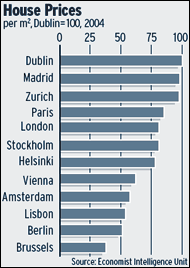 Last year alone, Spain started to build 800,000 new homes Spain has experienced a roaring economic expansion, in part fuelled by low interest rates caused by sluggish growth in other parts of the eurozone. - In any dynamic modern economy the size of the US or the European Union there are bound to be significant regional differences in economic performance.
Economic policy tries to assuage such differences and set up automatic stabilising mechanisms by which they become self-correcting.
Movements in exchange rates can act as such an automatic stabiliser. Disbelief has been suspended. Whenever I mention rising interest rates, higher mortgage payments, creeping unemployment, the possibility of falling house prices, fingers are stuffed in ears, eyes are tightly shut and heads shake wildly. No, no, no. Go away. The pain in Spain Shares in Spanish construction companies have collapsed like haciendas in an earthquake. Years of cheap loans, chronic over-supply of housing (facilitated by corrupt planning officials) and dodgy investment schemes, peddled to gullible foreigners, created an unsustainable boom. The bust is going to Costa lot, especially for thousands of Britons who borrowed heavily to buy a home in the sun, expecting rental income to pay the mortgage. The pain in Spain is a timely reminder that rampant bull markets can make ordinary people mistake themselves for financial wizards. Do current account deficits matter inside a monetary union? In Spain, the construction and housing sector accounts for 18.5 per cent of gross domestic product, The booms in Spanish and Irish real estate make the US real estate boom look timid By importing the credibility of the European Central Bank, they benefit from low nominal interest rates, in spite of their vivid growth and consequent higher than average inflation. Thus in addition to the global savings glut which exercised downward pressure on nominal interest rates, both countries exhibit very low real interest rates. In fact, the total value of mortgage debt in Ireland tripled over the 2000-2005 horizon, and mortgage lending is still growing at a 20% pace. Spanish lending is still growing at a 23.6% pace. Given that in Ireland 83% of total outstanding mortgage debt in 2005 and in Spain, 97% of the debt is at variable rate interest, households are considerably exposed to interest rate hikes. A decade of red-hot growth in the Spanish housing market fueled a jump in such things as jobs and consumer spending, turning Spain into one of the fastest-growing countries in the euro zone. Byggkrasch nära i Spanien Italy is often mentioned as the country most likely to leave the euro. I disagree. Italy is often mentioned as the country most likely to leave the euro. I disagree. Leaving the euro would not solve any of Italy’s problems. Since Italy’s debt is mostly euro-denominated, Italy would be facing an Argentinian-style debt crisis. A wise Italian politician told me recently that Italy was more likely to disintegrate as a nation state than to leave the euro. If any country ever decided to quit, unlikely as this may be, that country would be Spain, not Italy. Over the past seven years, Spain has lost even more competitiveness against the eurozone than Italy. At the same time, Spain is also in a better position to quit. With a debt-to-gross-domestic-product ratio of just over 40 per cent, Spain would have no problem servicing its debts. Unlike Italy, Spain enjoys the reputation of a European success story. But its economic success rests on shaky ground. It was driven by a housing bubble, during which average property prices have increased almost threefold since 1997. The US and UK housing markets have been well behaved by comparison. The house-price bubble has kept the Spanish economy ticking over – and overshadowed Spain’s underlying problem of falling competitiveness. Successive Spanish governments have failed to put in place the one condition essential for a country to prosper in the eurozone in the long run – a sufficient degree of wage and price flexibility. The country’s current account deficit for the first 11 months of 2005 reached 7.3 per cent of GDP. In its latest autumn forecast, the European Commission put the current account deficit at 8.3 per cent this year, and 9.1 per cent in 2007. These are unsustainable levels. More about house prices at internetional.se On Friday I was in Davos in a panel on the "Ups and Downs of EMU" (European Monetary Union) where ECB head Trichet, Italian Economy Minister Tremont, a few other EU officials and myself were supposed to discuss the following questions: Unlike the other panelist that ignored the topic and spoke instead about all the good things allegedly associated with EMU, I took the questions seriously by considering some of the problems and risks faced by EMU and the risks of a break-up, especially for the case of Italy. My remarks caused a stir with Minister Tremonti who interrupted me in the middle of my remarks, went into a temper tantrum and shouted - to the consternation of all participants - to me: "Go Back to Turkey!!". I happen to have been born in Istanbul; but more than offensive to myself his pathetic burst of uncivilized anger was an insult to the decent Turks who are currently trying to negotiate an agreement to enter into the EU. My current concerns are that, while EMU has lead to a process of convergence of nominal variables (inflation, interest rates, etc.). it has also been associated with a process of increased divergence in economic performance, especially regarding economic growth rates. This economic performance divergence is a serious problem for some EMU countries (Italy, Portugal, Greece) and it may eventually lead to a collapse of EMU. I am not supportive of such a collapse but, unless appropriate macro and structural economic policies are undertaken, the risk of a break-up becomes serious. The risks that eventually Italy may exit EMU cannot be underestimated. See also: Frits Bolkestein, the former EU internal market commissioner, has questioned the chances of survival for the euro in the long term.
The ageing of Europe's population will hit the continent "ruthlessly," the outspoken Dutch politician stated, with eurozone states like Italy being unprepared for the expected jump in pension claims. Will all the 12 countries in Europe's single currency remain members in three or four decades? WILL all the 12 countries in Europe's single currency remain members in three or four decades? The question may seem imponderable. But euro-area governments floating 30- or even 50-year bonds are asking investors to ponder it nonetheless. S&P assumes that countries such as Italy and Greece would want to regain their own currency only to debauch it. Both have lost competitiveness since the 1990s. Italy's unit labour costs are projected to be 27% higher by the end of 2006; Greek costs have increased by almost half. In S&P's simulations, the Italian government announces a surprise exit from the euro on the last day of 2006, and promptly devalues the new lira by 27%. The Greeks devalue by 49%. Both countries would thus recoup, at a stroke, the competitiveness they have lost. Unfortunately, their debts would still be payable in euros. Of course, I will be challenged on my views on Europe and my opposition to the British intervention in Iraq. Europe should concentrate on building jobs, enterprise and competitiveness with a real attack on unnecessary regulation. Ken Clarke’s dismissal of the euro as a “failure” is like a cardinal telling us that God doesn’t really exist. The sceptical voice of the former UK Conservative chancellor adds to the chorus of pessimism about the euro that has reached a crescendo after the No votes in the French and Dutch referendums. I agree with him that the cautious approach to entry by Gordon Brown, the current chancellor of the exchequer, is right at the present time. But is the euro really a “failure”? There are two new, contradictory arguments for pessimism. The first is that the European Central Bank’s common monetary policy is a cause of slow growth. The second concern is that Germany, far from languishing under the euro, is showing signs of economic improvement, potentially creating an unsustainable divergence with Italy (and others). Either, it is said, could lead the single currency to collapse. There is a serious issue about whether the “one size fits all” monetary policy is restricting growth, particularly in Germany Let us again suppose that A reforms and B does not. En rad länder i västra Europa plågas av en ihållande ekonomisk kris. Arbetslösheten stiger och tillväxten sjunker. I Tyskland, Italien och Frankrike - liksom Sverige - tilltar svårigheterna trots god konjunktur och låg ränta. Ekonomisk politik kan fokusera på antingen strukturella reformer eller stimulanser av konjunkturen. Det senare kan utgöras av finanspolitik eller penningpolitik. Båda är dock bara olika former av klassisk keynesiansk stimulanspolitik. En gemensam valuta, som i Hayeks anda för bort penningpolitiken från nationella politiker, stänger likt en guldmyntfot möjligheten att fuska sig ur problem och främjar därför reformer.
Kommentar av Rolf Englund: Därigenom måste Munkhammars slutsats bli att det behövs supply-side economics, som i USA. Sedan moderaterna, efter att ha tappat var tredje väljare, övergav den Munkhammarska systemskiftespolitiken, strömmarna väljarna till. It is economic performance – not the European Union budget or any proposed constitution – that will determine the fate of the “European Project”. European Central Bank council member Christian Noyer: Noyer, also governor of France's central bank, told French National Assembly's foreign affairs committee last week, according to minutes of the closed hearing released today. Such a move may put in doubt a nation's continued membership of the European Union, he said. For the first time, respectable voices - i.e., those deemed respectable by the European elite - "Det finns ingen anledning till oro" Weakening economies in Europe have translated into rising pressure for political change. The previously noted loss by Germany’s left-of-center SPD Party of North Rhine–Westphalia in the May 2005 election has been likened to the Republicans carrying New York and California in a presidential election. Clearly, it is not politically viable for even a left-leaning German government to try to rein in social costs while the German economy is so weak. The unemployment rate is above 11 percent, and growth is slipping toward zero. The poor performance of some European economies and the unevenness of performance among them--Spain, Ireland, and even France are still experiencing strong growth and strong real estate markets--is a byproduct of Europe’s bold currency experiment in which full currency union preceded political union. The more serious problem is the moral-hazard issue that arises in a monetary union with one central bank oriented toward low inflation and twelve treasuries with sharply differing economic systems to manage. The expedient move by the Italian government would be to borrow heavily in order to finance a large fiscal stimulus to boost Italy out of its recession. The effective peg between interest rates on Italian government liabilities and German government liabilities means that the Italians will be under increasing pressure to employ Keynesian fiscal stimulus to boost their economy. The Italian Finance Ministry answers to the Italian government, not to the European Central Bank, thus the institutional bias to use deficit finance to boost the economy out of recession. Lord Lamont was UK chancellor of the exchequer 1990-93 and is co-chairman of the Bruges Group Six years ago, 11 European nations made a bold bet that a common currency would unify and fortify the continent from Sicily to Helsinki. Now, as many of the nations in what is known as the euro zone slog through an economic funk, The euro-bashing isn't confined to Italy. A poll for Stern magazine this month found that 56% of Germans want the mark back. "Breakup is back on the radar screen as a theoretically possible option" for the monetary union, says Holger Fahrinkrug, an economist at Swiss bank UBS in Frankfurt. "It would have been better for Italy to stay out [of the euro] for a few years," says Julian Callow, chief European economist at Barclays Capital in London. "There's no easy solution now." Is the euro forever? A rising tide of integrationist ambition swept the single currency on to the European shore in the 1990s. I en viktig fråga är EMU-projektets varmaste anhängare och argaste kritiker helt överens: för att valutaunionen ska hålla, måste den förr eller senare leda till politisk union. The French and Dutch referendums have dashed hopes of political union in Europe. Finns euron kvar om 15 år? Varför överlevde valutaunionerna i USA, Kanada, Tyskland och Italien, till skillnad från de skandinaviska och latinska mynt-unionerna? Jo, de var en del i arbetet med att skapa en nationalstat. För amerikanerna tog det 150 år att uppnå en fungerande monetär union... ännu på 1920- och 1930-talen rådde en oenighet mellan regionerna om penningpolitiken, vilket lade grunden för den paralysering som i sin tur bidrog till att skapa den stora depressionen. Om Tyskland fortfarande haft en egen valuta skulle man kunnat devalvera sig ur de senaste årens kostnadskris. Men i stället har landet pressat ner kostnadsläget den hårda vägen, genom arbetslöshet och sänkta reallöner. Hur länge orkar Europa färdas på det spåret? Nu riktas blickarna mot Italien, som har förlorat sin konkurrenskraft på grund av fallande produktivitet och finansiell oreda. Martin Wolf i Financial Times tecknade i förra veckan en mörk framtidsbild, i vilken italienarna känner sig så pressade att de sliter sig loss från EMU. Så här i backspegeln måste 1990-talet betraktas som ett osedvanligt lyckosamt decennium, i väntan på det stora ovädret. Could the eurozone disintegrate? - The answer is yes. Tyskland har gjort många fel. Ett allvarligt fel var att gå in i EMU med en för högt värderad valuta. Ja, det är ju inget konstruktionsfel, det blir så med en gemensam valuta. In an interview with the daily La Repubblica
Top The under-fire euro fell further on Wednesday, slumping to an eight-month low EU will never become a federation with a unique federal government, federal army and international personality. The writer, a member of the European Commission between 1999 and 2004, is author of The Limits of Europe (Lannoo) and his Brussels diary Grensverkenningen (Prometheus) The Common Agricultural Policy and regional development funds do not respect this rule. They urgently need reform. Why should German citizens pay for the upkeep of the landscape in France? What makes the bureaucrats in Brussels believe they are better judges of French regional policy than their colleagues in Paris? All non-essential bits of these programmes should be repatriated. That would also help to slim the EU budget. The EU is a group of states that have decided to carry out certain tasks in a federal manner, such as trade and competition policy. The federal framework applies to the European parliament, the European Court of Justice and (for 12 of the 25 member states) the European Central Bank. But the EU will never become a federation with a unique federal government, federal army and international personality. The reason is that member states do not want that: not Britain, and not France either. Nor do the Germans want it, even though Joschka Fischer, their foreign minister, spoke some years ago of a "federation of nation states". That concept is a contradiction in terms. In using it, Mr Fischer underestimated his audience. It is an example of the eurobabble that other politicians have unfortunately emulated. The principle of subsidiarity, which means that whatever member states can do equally well (or better) should not be undertaken by the Union. This principle has been obeyed more in theory than in practice. The trouble is that the institutional bias is always to propose more. The European parliament wants the EU to do everything. The European Commission displays the normal bureaucratic instinct: more tasks mean more jobs and more money. And often a member of the Council of Ministers tries to achieve through Brussels what they cannot get at home. Many politicians mistake activity for action. An EU of 40 is inevitable unless stopped by a referendum, The second problem, Bolkestein warned, is that immigration is The Limits of Europe Never Closer Union? Before the vote, Jean-Claude Juncker, Luxembourg's prime minister and current president of the European Council, declared that France and the Netherlands should re-run their referendums, if necessary, in order to obtain the "right answer". Mr Juncker is all too representative of the contemporary European elite, which does not merely deserve, but needs, the kicking the French have given it. When the French look at contemporary Europe, they no longer see themselves in the mirror and when they look at their economy, they no longer see anybody in control. First, the treaty is dead. I presume the Dutch will vote No. If the British cannot be threatened with isolation, they will also reject it. It is impossible to overturn the verdicts of the disgruntled citizens of two of the six founding members and two of the three most powerful countries in Europe. Further movement towards deeper integration among all members of the EU is off the agenda. The Europe we have today is as much as - quite possibly more than - all will share. Enlargement beyond Bulgaria and Romania has become unlikely. There will be referendums on Turkish entry. In current circumstances, these would be lost. France has set its face not just against the European project but against the modern world. That is going to make it far more difficult to pursue liberalisation, domestically, within Europe and globally. For that outcome, the French elite bear heavy responsibility. Their ceaseless indulgence in infantile anti-market rhetoric has had its consequence. Last but not least, there is a chance of some unravelling of the European project, which has relied on a version of the bicycle theory: if it does not go forward, it risks toppling over. The belief that it must go forward is now dead. It is possible that some achievements, including the single market, will go backwards. A currency union requires greater flexibility and so more intense internal competition than independent national monetary areas. The failure to make this clear before starting the union was the great political and economic blunder of the 1990s. Rolf Englund: The Economist also wrote that Not bad for being written in 1997... This is just a foretaste of what could happen once investors start to think through the euro's long-term chances of survival in a "post-federal" Europe that is no longer moving ineluctably towards ever-closer union. Hubristic talk that the euro would soon displace the dollar as the world's reserve currency has been silenced by a flurry of analysts' reports warning that monetary union is becoming unmanageable and could collapse, leaving holders of Italian, Greek and Portuguese state bonds with a wicked haircut. Italy's Confundistria chief, Luca Cordero de Montezemolo, believes his country is now staring into the abyss. Its world share of exports has collapsed by almost one third since the launch of EMU. The economy has contracted for the last two quarters and is now accelerating downwards. "The political class doesn't seem to understand the dramatic condition of our public finances, and above all the real economy. This is the worst crisis since the war. We must face up to the emergency with brave, urgent, and unpopular measures," he says. Portugal, Greece and Italy slipped into monetary union with false figures - or "statistical alchemy" in the words of Eurostat - and debt loads that breach the Maastricht limits. They enjoyed a quick windfall from ECB's far lower rates, but the wealth illusion proved poisonous. It let Italy fend off structural reform, and led to a mighty boom and bust in Greece and Portugal. Paul Krugman about the break-up of EMU
Here's how the story has been told: a year or two or three after the introduction of the euro, a recession develops in part - but only part - of Europe. This creates a conflict of interest between countries with weak economies and populist governments - read Italy, or Spain, or anyway someone from Europe's slovenly south - and those with strong economies and a steely-eyed commitment to disciplined economic policy - read Germany. The weak economies want low interest rates, and wouldn't mind a bit of inflation; but Germany is dead set on maintaining price stability at all cost. Nor can Europe deal with "asymmetric shocks" the way the United States does, by transferring workers from depressed areas to prosperous ones: Europeans are reluctant to move even within their countries, let alone across the many language barriers. The result is a ferocious political argument, and perhaps a financial crisis, as markets start to discount the bonds of weaker European governments. In spite of interest rates at historic lows, strong world demand, low inflation and healthy corporate profitability, the eurozone growth outlook is gloomy. The European Commission 29 June formally asked the Italian government to take measures to get back in line with eurozone rules.
On 5 December 2006, the Commission adopted the Convergence Report 2006, which re-assessed the conditions for adopting the euro in the Czech Republic, Estonia, Cyprus, Latvia, Hungary, Malta, Poland, Slovakia and Sweden. The ECB published its own report on the same day. Sverige bör, liksom England, hålla sig utanför euron så länge som möjligt. Han går därmed på kollisionskurs med det svenska näringsliv som annars hyllar hans tongivande teser för liberal globalisering. "Det är bara länder som inte kan sköta sin penningpolitik själva som behöver den. För länder som kan sköta sin penningpolitik är det mycket bättre att stå utanför euron och på så vis skapa en stabil ekonomisk-politisk miljö istället för att införa euron och därmed riskera en penningpolitik som är ’quite inappropriate for you." 2004 kom hans banbrytande bok ”Why Globalization Works” där han bland annat detaljgranskar globaliseringskritiken och ger den fel på nästan samtliga områden utom att vissa internationella institutioner, såsom WTO, inte fungerat ”så bra som de borde”.
Nu har boken översatts till Svenska (SNS förlag) men den är inte skriven för svenskar, säger Martin Wolf lite skämtsamt: Let us think the unthinkable: Disappearance of the zone as a whole seems hugely unlikely, so long as the commitment to the European project survives. But the exit of one (or more) members, a sovereign default or both is not at all inconceivable. Interest rate spreads within the eurozone are tiny. Investors apparently consider the debt of the eurozone governments as close to perfect substitutes. This is astonishing: after all, ratios of government debt to gross domestic product at the end of last year varied from Luxembourg's 5 per cent and Ireland's 29 per cent to Italy's 105 per cent and Greece's 112 per cent Investors must not only believe that the currency union is impregnable but that each sovereign borrower is as good as the other. The latter belief assumes that all the fiscal authorities will behave in an equally responsible manner or that there is an implicit bail-out. These assumptions are highly implausible. Relative to Germany, Italy's real effective exchange rate has appreciated by almost one-fifth since 1999. In its most recent Economic Outlook, the OECD notes that the cyclically adjusted primary fiscal balance (the balance before interest payments) has collapsed from a surplus of 5 per cent of gross domestic product in 1998 to a forecast surplus of only 1 per cent this year In order to regain lost external competitiveness, Italy must have substantially lower inflation in the costs of tradeable goods and services than elsewhere in the eurozone. Unfortunately, efforts to shift the fiscal position back to balance would weaken the economy still more, since there are no monetary or exchange-rate offsets to such fiscal tightening. (Rolf Englund: That is the main point with EMU. If that is not a good thing -
which I do no think it is,
than the whole EMU project is fundamentally wrong. Bad thinking - as stupid as the Stability Pact. Why do you do stupid things like that? Because you need a flag, a parliament, a president, a defence - and a currency - to build a state.) Martin Wolf continues: If you think you have seen a case a bit like this, you are right: it is called Argentina. Bernard Connolly, a notorious opponent of the monetary union, even argues that the debt ratio will explode upwards, given the low inflation Italy needs and the declining potential rate of growth that Italy also has Mr Connolly's assumptions seem too pessimistic, particularly over the present fiscal position. But the underlying point is strong: managing the fiscal position of a country that suffers from structurally weak productivity growth, a large loss of international competitiveness and an irrevocably fixed exchange rate (or, in Italy's case, no exchange rate at all) is challenging, to say the least. I do not wish to be misunderstood. So let me be clear. I am not saying that the eurozone will disintegrate, or that Italy is doomed to Argentina's fate either. I am saying that tough choices and tougher times do lie ahead. Only with radical structural reforms, the most disciplined wage behaviour and the greatest possible fiscal rigour can a country in Italy's predicament sustain stability and return to healthy growth. If the country fails to rise to the challenge it confronts, a default or even a forced withdrawal from the eurozone is perfectly conceivable.Could we be headed for some sort of crisis within the EU? If the No vote wins in France It is almost impossible to overstate the importance of the French referendum Utan Europas förenta stater kommer EMU att spränga EU – Om EMU inte skulle fungera ekonomiskt, kan man ha hur vackra
argument som helst för – det kommer ändå att haverera. The eurozone is a monetary federation without a federal budget. This unstable situation can evolve in two ways. One is implosion through political tensions between member states An emergency plan for dealing with a European financial crisis was agreed at the weekend The chancellor's proposal may be the first sign of an unravelling of the underlying fundamentals of the euro. The trouble is that immigration looks more and more like the first problem that requires Europeans to choose definitively between European and national sovereignty. Nations can lay down the law on immigration, and so can the EU. But any mixed regime of EU standards and local immigration quotas will collapse of its own illogic
What would happen if one of the 25 member states of the European Union refused to ratify the constitutional treaty? EMU ökar spänningarna i medlemsländerna Tyskland, Italien och Nederländerna har för låg tillväxt. Samtidigt riskerar Irland, Grekland och Spanien överhettning.Den europeiska centralbanken, ECB, har ett omöjligt jobb. Deras ränta blir fel för några länder hur de än gör.Och det kan bli ännu värre i framtiden.
”Jag tror att man ska räkna med att länderna inte går fas. Situationen som man ser i dag tror jag inte ska uppfattas som extrem. Det kommer att uppkomma situationer där konjunkturutvecklingen skiljer sig mycket mer åt mellan länderna än i dag”, säger Lars Calmfors Stark euro tynger Framför allt Tyskland, men även Nederländerna, skulle behöva en lägre styrränta för att få fart på ekonomin. Tillväxten är låg samtidigt som resursutnyttjandet och därmed också inflationstrycket är lågt. Samtidigt slår den starka euron hårt mot konkurrenskraften för exportföretagen. Det är helt klart så att om Tyskland hade haft en egen räntepolitik så skulle man ha haft lägre ränta där i dag än vad man har”, säger Ingemar Hansson, generaldirektör på Konjunkturinstitutet, KI. Eftersom räntepolitiken bestäms på en europeisk nivå kan den inte samordnas med arbetsmarknadsreformer, vilket gör att Tyskland fastnar i hög arbetslöshet.Samtidigt är ECB:s ränta, som i dag är 2 procent, för låg för flera länder. Irland är det tydligaste exemplet, med en hög tillväxt och ett högt resursutnyttjande riskerar konjunkturen att bli överhettad.Inflationen skenar i väg och det finns stor risk för fastighetsbubblor när räntan är när räntan är så pass låg som den är i dag. även Grekland, Luxemburg och Spanien kan få liknande överhettningsproblem. Det är en nödvändig delkostnad för en valutaunion”, säger Ingemar Hansson. An emergency plan for dealing with a European financial crisis was agreed at the weekend Although there are no signs that such a problem is likely to appear in the foreseeable future, European regulators are haunted by the Asian financial crisis in 1997-98, which shook the whole region. The assumption underlying the agreement is that the most likely cause of a economic crisis in Europe would arise from the banking sector, not from a securities crash. Lars Jonung på CNN: Every nation state has a system of supervision and control of its financial sector, including a lender of last resort, to guarantee the soundness and stability of the financial system. RE: Sverige Jonung m fl: Finland Internationella valutafondens roll i krishantering: fallet Asien Rolf Englund, Den Stora bankkraschen, Timbro, 1983 How long will the euro survive? The author shows that the answer depends principally on Germany. Brendan Brown received his PhD from London School of Economics and is Director and Head of Research at Tokyo-Mitsubishi International plc, London. "Euro on Trial" looks back - to the aspirations of the founders - and forward - to the possibility of reform or splitting up. Monetary union is reversible in part or in whole and this book assesses the costs and benefits. How long will the euro survive? The author shows that the answer depends principally on Germany. Germany's membership so far has brought much disappointment. How many more years of disillusion are required before the question of EMU reform or break-up enters the mainstream of German political debate? Euron spricker när dollarn faller The dollar is likely to fall further. Politicians are failing not only to enthuse voters, but they are silent on the biggest challenge There is a new economic challenge in the world that is particularly difficult for Britain and Europe. Pricing power has shifted from the Atlantic to the Pacific; it now belongs to China. China can set the prices for manufacturers below the level at which Europe, or Britain, can compete. European cars, for instance, have many good qualities, but, like Fiat or Jaguar, they are surplus to the world’s requirements. China also sets prices for raw materials and oil. If Chinese demand had not risen so fast in the past five years, oil would be $20 a barrel, not $50. This revolution in pricing power reflects the industrialisation of China, drawing on the huge Chinese workforce. In the past 12 years 200 million people from the west of China have moved to industrial areas within 100 miles of the Pacific. This transfer continues. They have acquired advanced technologies and high skills. It is the equivalent of adding another Germany, France and Britain to the potential workforce of Europe, at less than 10 per cent of European labour costs. This is one of the largest human migrations in history. Britain has not begun to adjust to its impact. This has already turned the terms of trade against Europe; the process is global and the rate is accelerating. In all probability it will destroy the ill-conceived euro before 2020, perhaps before 2010. The eurozone is set up according to this principle - "one money, one central bank". Sir, Allow me to comment on two statements by Wolfgang Munchau in his interesting analysis of the stability of monetary unions ("The flaw that threatens the eurozone", September 6).
First, Mr Munchau writes: "The Scandinavian monetary union (1872-1931), which included Sweden, Denmark and later Norway, was more durable but started to unravel slowly after the political union between Norway and Sweden ended in 1905."
Second, Mr Munchau states that "one common cause underlies the failure of all monetary unions: the lack of political union with the authority to enforce economic and financial policy among its members". Monetary history suggests a more precise interpretation: a successful monetary union requires that there is one central bank with the legal monopoly on supplying the base money of the monetary union, hence having the power to determine the policy interest rate. What does this tell us about the future of the eurozone? The European Central Bank, with its monopoly on issuing euros, should be compared with the US Federal Reserve system rather than with the monetary unions of the past with many central banks. Of course, the economic performance of a monetary union such as the eurozone can be improved on by co-operation among the member states in various fields of policymaking. The optimal extent of such political and economic co-operation is not known to the economics profession for the moment, witness the academic debate concerning the Stability and Growth Pact. Actually, some competition among policymaking authorities within a monetary union such as the eurozone may be desirable - as long as the competition does not concern the monopoly supply of base money. It is safe to conclude that European policymakers are currently involved in a learning process, searching for improvements in the workings of the eurozone. This ongoing process of adaptation is in itself a guarantee for a lasting monetary union. Europe is likely to split The eurozone bases its economic policy on two premises: one is that it needs only a minimal degree of policy co-ordination; the other is that the process of economic and monetary union (Emu) is irreversible. Both assumptions could not be more wrong. Last week, the European Commission outlined the basics of a long-awaited reform of the stability and growth pact, the eurozone's framework for policy co-ordination. The current pact became defunct after France and Germany last year managed to avert the threat of sanctions despite running excessive deficits. The reform proposals address a few long-standing criticisms: lack of flexibility during economic downturns, a too-narrow focus on annual deficits as opposed to the outstanding stock of public debt and too great a reliance on the threat of fines. The trouble is that the reforms do not even come close to creating an effective regime of economic policy co-ordination. Where there used to be sanctions, there will now be peer pressure. Fiscal policy in the eurozone member states will in future be exactly the same as in the past, except that breaching the rules will no longer be deemed illegal but ungentlemanly. With the reformed stability pact, Emu will be more like an eccentric club than an economic union. High inflation is probably the most frequent trigger for the failure of monetary unions. Another mechanism through which a monetary union may fail is a banking crisis that starts off in one country and spills over into the rest of the union. It is far from clear whether the present system for co-ordinating banking supervision in the eurozone will prove effective in such a situation. No matter whether the trigger is high inflation, a banking crisis or some other channel, one common cause underlies the failure of all monetary unions: the lack of a political union with the authority to enforce economic and financial policy among its members. The new European constitution, signed by EU leaders in June this year and awaiting ratification by member states, takes a small step towards such a union, for example in foreign policy and through the extension of majority voting in some areas. The trouble is that it leaves the present, defunct economic policy regime intact. As a framework for a political union capable of supporting a monetary union in the long run, it simply will not do. Valéry Giscard d'Estaing, the former French president who presided over the constitutional convention, predicted that the new constitution would last for 50 years. Let us hope that he is wrong. If he is right, the constitution may well outlive the euro. Nu är det inte bara varningar och
råd som förs fram utan direkta larmsignaler Frågan kom upp när ekonomiprofessor Lars Calmfors, tidigare regeringens EU- och EMU-utredare, i Rosenbad igår presenterade årets rapport från ekonomerna i European Economic Advisory Group, EEAG Tonen har skärpts ordentligt i årets rapport. Nu är det inte bara varningar och råd som förs fram utan direkta larmsignaler om att EMU-projektet riskerar att haverera. Hotbilderna utgörs av växelkurssvängningar mellan euron och andra valutor, främst dollarn, som ECB inte tillräckligt parerar med räntesänkningar. Vidare skapar Frankrikes och Tysklands öppna nonchalans mot stabilitetspakten en osäkerhet om vilka regler som verkligen gäller. Att en rad länder, som Storbritannien och Portugal, står på tröskeln till att överträda underskottsgränsen gör inte situationen lättare. "Ett totalt sammanbrott kan inte längre uteslutas", sade Calmfors. För Sveriges del verkar läget än så länge vara ganska betryggande. Kreditvärderingsinstitutet Standard & Poor's höjde igår landets kreditbetyg till toppnivån AAA. Jacques Delors: Asked if he puts the chances of the effective
collapse of the EU as high as 50%, he replies simply:
“Yes.” Lessons from monetary union Europe's economic and monetary union is five years old this week, and it is too soon to tell what its long-term impact is likely to be. But for those countries, in Asia and elsewhere, discussing whether to set up their own monetary union, the euro's short history has produced a few early lessons. A monetary union is primarily a political, not an economic project. This is the most important lesson from the euro so far. Each member country will at some point be required to make political sacrifices. For example, members might face constraints on their fiscal policy. The economic consequences of the euro, if they exist at all, are far more difficult to prove. If you merely want exchange rate stability, forming a monetary union is definitely overkill. Start off with an internal market before adopting a single currency. The Europeans made the mistake of failing to integrate financial markets first. One negative consequence is that monetary policy decisions are transmitted to various parts of the eurozone at different speeds. Forget about a stability pact and focus instead on the long-term
sustainability of public finances, including pensions. The Brussels elite climb into their BMWs
for the Christmas break, and the near-obligatory trip to the slopes of Verbier,
in a dark mood. The only problem is that things could be even worse when they
get back. And all the time, public support for the European dream has slipped away. The number of people who think the EU is "a good thing" has slipped below 50 per cent, and turnout in next year's European elections is expected to hit a new low. The events of 2003 are a catalogue of bad news, lightened only by the formal signing of the accession treaties in April by 10 new member states - many of whom were still living under communism only 15 years ago. The Iraq crisis was only the start of Europe's problems, the Union shattering along the lines of "Old" and "New" Europe defined by Donald Rumsfeld, US defence secretary. The European economy, dogged by sluggish reform, a resistance to a truly free single market and a looming pensions crisis, remained stuck close to recession while the US roared further ahead. In June Tony Blair shelved any hopes of Britain joining the euro for the forseeable future, and in September Sweden recorded a strong No to membership of the single currency. Then came the year's twin low-points. First France and Germany effectively killed the EU's stability and growth pact because they could not bear to be bound by the deficit rules they themselves had invented. Then a few weeks later there was the appalling Brussels summit, where the EU's prestige project - a new constitution - was unceremoniously booted into the long grass because France and Germany could not agree with Spain and Poland on a new voting system. There is no sign of the constitution being revived in the near future, the stability pact lies abandoned in the gutter, and in June the voters will get their chance to say what they think in the European elections. The verdict is unlikely to be favourable, and maybe that will be the jolt Europe's squabbling and increasingly nationalistic leaders need to start burying their differences. I den grundlagskonferens som EU just lagt på is efter
sammanbrottet vid toppmötet i Bryssel förra helgen har Sverige
hållit en påfallande låg profil. Mr Giscard d'Estaing told the European parliament:
Utmaningen är att finna ett sätt att mobilisera
folkliga känslor för byggandet av Europa. Möjligheten är
att skapa ett mera demokratiskt Europa. Det finns fördelar med euron, men riskerna är
stora. In 1993, Czechoslovakia experienced a
two-fold break-up: We analyze the economic background of the two break-ups, and discuss lessons for stability of monetary unions in general. We argue that while Czechoslovakia could be considered an optimum currency area, it was in fact less integrated than some other existing unions. That, along with low labor mobility and higher concentration of heavy and military industries in Slovakia, made Czechoslovak economy vulnerable to asymmetric economic shocks - such as those induced by the economic transition. Furthermore, the Czech-Slovak monetary union was marred by low credibility, lack of political commitment, low exit costs, and the absence of fiscal transfers. Källa: http://ideas.repec.org/p/dgr/kubcen/199874.html See also: http://www.eh.net/lists/archives/abstracts/sep-2000/0007.php http://www.bradmans.com/scripts/display.cgi?type=hgc&city=293 Deutsche Bank-ekonom orolig för EMU-kollaps
– Om EMU inte skulle fungera ekonomiskt, kan man ha hur
vackra argument som helst för – det kommer ändå att
haverera. Det är det första testet. Jag är glad att jag
började där. För på den punkten känner jag mig trygg
och säker nu. Det är den så kallade stabilitetspakten som
fått Persson att börja sväva på målet Det finns starka ekonomiska skäl för att ha en buffert
i statsfinanserna om man ska gå med i EMU Skapandet av den Europeiska
monetära unionen, EMU, var utan motstycke, något som lovade mer
integrerade och större marknader. Stimulansen av handel och investeringar
är uppenbar. Men kommer euron att bestå? Niklas Ekdal, på Herbert Tingstens stol, - Vi tror inte någon går
ur, då havererar alltihop. Om Sverige går över till euron går det inte att gå ur samarbetet igen, enligt statsminister Göran Persson - Jag tror inte ens det finns någon formell möjlighet att gå ur. Man ger upp en del av sin nationella suveränitet när man går in i samarbetet, men får i stället ett skydd mot de globala marknadskrafterna. Det är det bytet vi gör, sade Persson vid en utfrågning på Värmdö gymnasium. - Det finns en kraft som växer fram som kan vara en global motvikt till USA, och det är europeiska unionen, sade Persson.
- Den gemensamma valutan är ett steg
på vägen mot fördjupad politisk enighet, mot ett slags
Förenta Europa. Myntunion utan fiskal union äventyrar
demokratin EMU är i gungning Evigt liv för EMU? Vem vet, om tio år kanske Tyskland har
temporärt tvingats lämna euroblocket för att devalvera sin
valuta. Att säga ja till euron blir då inte att säga ja till
tillväxt - utan som att knyta fast sin jolle vid "Titanic"! Om tio
år kanske vi är glada över om kronan är den enda valutan
vid östersjön vid sidan av euron - och den ryska rubeln. Lars Calmfors tror inte på nejsidans argument att EMU
kommer att spricka, till följd av att euroländernas ekonomier
växer olika snabbt. Dessa skillnader kan, enligt honom, klaras genom att
lönerna får öka i något olika takt. Vi måste säga nej till EMU. En valutaunion utan
gemensam politisk ledning kommer inte att fungera. Du har tidigare känt en oro för att hela
europrojektet skall spricka och att det finns en sådan risk, vari
består den enligt Dig? "Jag är övertygad om att valutaunionen kommer att
spricka. Det är bara en fråga om när. Säger vi ja nu och
går in då får vi vara med i det lidandet", säger
han. Lönebildningen har varit mitt första och viktigaste
frågetecken. Vi vill ha en flytande krona som ställer in
sig på rätt kurs, varken hård eller mjuk. Jag tror för min del att länder måste klara
sina interna problem själva. Lika svårt som det är att
införa demokrati utifrån i ett land som inte är vant vid den,
lika svårt är det att införa en förnuftig ekonomisk
politik den vägen. State Street Global Advisors, the US fund manager, one of the
world's largest with $760bn of assets under management, said a single monetary
policy was by its "very design pro-cyclical and destabilising" Utan Europas förenta stater kommer EMU att spränga
EU När det gäller EMU-debatten finns det ett argument
som jag har synnerligen svårt för. Inte för att det skulle vara
särskilt besvärligt att bemöta. Heller inte för att det
skulle vara intellektuellt tungt eller värst sannolikt. Argumentet
går ut på att Sverige inte ska gå med i EMU eftersom "EMU
kommer att spricka". EMU kan sluta med katastrof Brandförsäkringsargumentet Det är en dum konstruktion - skulle vi rösta om
huruvida EMU skulle vara kvar eller inte så skulle jag tveklöst
rösta nej. Felet är naturligtvis att Europa är inte ett optimalt
valutaområde. Det finns så stora skillnader internt. Det är
få ekonomer som tror att det här skall hålla, låt oss
säga, 20 år framåt. Två tidigare försök att få till
stånd ett intimare monetärt samarbete mellan Europas stater - med
Werner-planen 1971 och EMS (det europeiska monetära samarbetet) 1979 - har
båda misslyckats. Sannolikheten för ännu ett, större,
misslyckande har inte minskat: inga egentliga säkerhetsventiler har
skapats. Tänk om det inte fungerar Valutaunionen är ett
stort vågspel. om den skulle förverkligas. Det kan visserligen
hända att en gemensam valuta skulle tvinga fram den anpassning som
krävs för att den ska fungera: en samordnad finanspolitik, flexibla
arbetsmarknader, och överföringar av människor och resurser
mellan länderna. Men tänk om det inte fungerar. State Street Global Advisors, the US
fund manager, one of the world's largest with $760bn of assets under
management, said a single monetary policy was by its "very design pro-cyclical
and destabilising" State Street Global Advisors has launched an unusually frank attack on the euro, warning it could lead to a loss of national sovereignty and push European countries into recession. The US fund manager, one of the world's largest with $760bn (£487bn) of assets under management, said a single monetary policy was by its "very design pro-cyclical and destabilising". Alan Brown, chief investment officer, said there was a "real prospect" that such a policy could see Germany slip into a deflationary cycle similar to Japan. In order for the real exchange rate to decline over time, Mr Brown said Germany would have to run an inflation rate "perilously close to zero". At the same time, Germany would experience above average real interest rates as well as tax increases and spending cuts to curtail its deficit. "There is a certain irony to the fact that Germany, the principal architect behind the stability and growth pact, is one of the first countries to be caught by it," Mr Brown said. "Effectively, all important economic sovereignty would have been handed over to an unelected body in Brussels," he added. "If a country in the eurozone were to be slipping into recession, they wouldn't be able to do anything about exchange or interest rates which are determined for the region as a whole." Mr Brown said this would lead to protracted economic downturns. "In the same way booms can go on for years, as Ireland bears out, so can busts," he said.
|