Europe's Ever-Closer Disunion at Projet Syndicate
Göran Persson och federalismen
Rome, Habsburg and the European Union

News Home
|
Rolf Englund IntCom Internetional
|
"ever closer union" - The United States of Europe
Å ena sidan ett EU med alltmer överstatlighet, som präglas av legalism, där det alltid finns ett nytt fördrag eller ny konvention som medlemsstaterna har att underkasta sig.
Ett Europas förenta stater.
Å andra sidan ett EU av relativt självständiga nationer, men där man samarbetar om det man inte kan lösa på egen hand. Där ingen yttre makt tvingar demokratiskt valda regeringar att genomföra politik deras folk avskyr.
Ett europeiskt nationernas förbund.
Detta är vår tids stora politiska konflikt.
Ivar Arpi Expressen 18 maj 2019
The CDU and SPD accept the principle of a fiscal union for macroeconomic stabilisation, and transforming the European Stability Mechanism (ESM), the rescue fund, into an institution of the EU.
Otmar Issing, a former member of the European Central Bank’s executive committee, rightly recognised the importance of the EU section in the agreement.
As an economic conservative he was appalled by the ease with which Germany raised the white flag in the eurozone debate. Banking union, fiscal union, transfer systems — it could all happen very soon.
It is what the conservative, ordo-liberal German establishment always fought against.
Wolfgang Münchau, FT 4 February 2018
The single currency has failed to deliver economic stability or a greater sense of a European identity.
It has become a source of discord.The story of Italy is revealing and, given its size, of crucial importance.
Martin Wolf FT 19 June 2018
published in November 2012, sets out the Commission's vision for future euro area integration.
Click
pushing for an embryonic treasury with powers to fight economic recessions and to cope with shocks in hard-hit regions.
Ambrose Evans-Pritchard, 22 May 2017
If it is to survive, the European Union must become a lot more flexible
The Economist print 25 March 2017
As long as this decision is evaded, the EU will remain dysfunctional.
Dani Rodrik, Project Syndicate 14 March 2017
In 2016, it repelled an attempted conquest by the E.U.’s nomenklatura.
George F. Will, Washington Post 24 June 2016
It comes down to an elemental choice:
whether to restore the full self-government of this nation, or to continue living under a higher supranational regime,
ruled by a European Council that we do not elect in any meaningful sense, and that the British people can never remove,
even when it persists in error.
Ambrose, Telegraph 13 June 2016
Anders Borg, Project Syndicate 14 July 2016
styrt från Bryssel och Frankfurt, eller om det blir Berlin.
Rolf Englund, Nya Wermlands-Tidningen, 11 juni 2001
- "ever closer union" -
som är själva grundbultsfelet med EU.
Kunde vi rulla tillbaka Sovjetunionen skall vi väl kunna rulla tillbaka Europeiska Unionen.
Rolf Englund Barometerns website, 7 juni 2005
The 1990 Tory coup against Margaret Thatcher
Tim Bale via Englund blog 27 Febr 2016
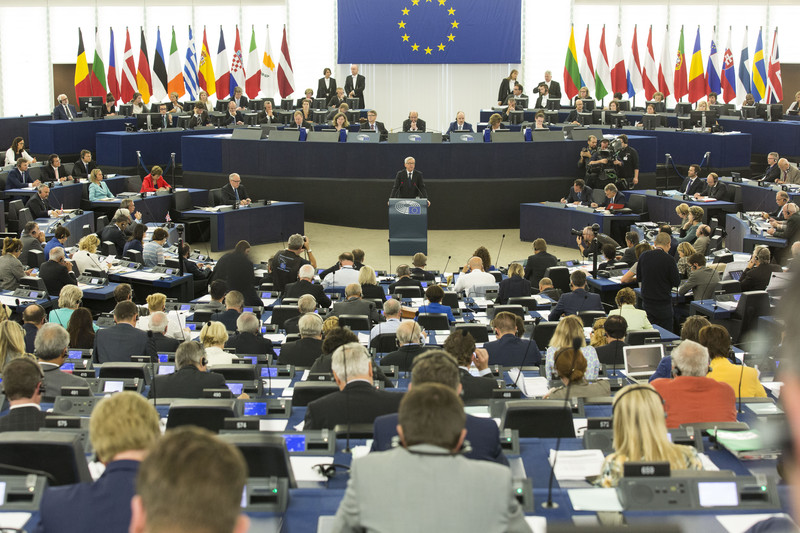
zc
Vi förstod inte att östeuropéer skulle betrakta Bryssel som ett nytt Moskva.
Misstaget är förmodligen ett av det förra seklets största.
Richard Swartz DN 6 oktober 2018
Problemets kärna är att det inte går att ha EMU om man inte vill ha ett Federalt Europa,
styrt från Bryssel och Frankfurt, eller om det blir Berlin.
Rolf Englund, Nya Wermlands-Tidningen, 11 juni 2001
It is legitimate to believe the EU has over-reached. On monetary union, I agree.
It is legitimate to believe the EU has under-reached. On defence, I also agree.
But it is illegitimate for a sane person to despise the EU’s goals or hope that it will collapse into chaos.
Martin Wolf 4 October 2018
The euro has been a failure. It means that the single currency has failed to deliver economic stability or a greater sense of a European identity.
It has become a source of discord.
The story of Italy is revealing and, given its size, of crucial importance.
Martin Wolf FT 19 June 2018
All of this was predicted.
In his excellent EuroTragedy, Princeton University’s Ashoka Mody cites a critique of the 1970 Werner Committee report, the first blueprint for a monetary union, by Nicholas Kaldor, a British economist of Hungarian origin.
Kaldor argued there would need to be fiscal transfers. That would require a political union. But the conflicts created by the currency union would fester, making moves towards such a union more difficult. So it has proved.
Om Maastrichts föregångare, den s k Werner-planen
ur boken "Vår framtid i Europa" (MUF, 1971) av Jan Brännström, Rolf Englund och Claes-Henric Siven
Ashoka Mody, a former IMF bail-out chief in Europe, said the Greeks are right to resist the demands.
“Everything that we have learned over the past five years is that it is stunningly bad economics to enforce austerity on a country in a deflationary cycle.
more here
Ashoka Mody at Project Syndicate
Jan Björklund är noga med att påpeka att han absolut inte vill se ett federalt EU av amerikansk modell,
men att ett viss mått av överstatlighet kan vara bra.
SvD 23 augusti 2018
Mr Macron has made a big bet on persuading Germany to take the next leap towards “ever closer union”,
in particular by agreeing to a eurozone budget and finance minister.
Gideon Rachman FT 30 April 2018
Varoufakis
Does Europe Really Need Fiscal and Political Union?
Dani Rodrik, Project Syndicate 11 December 2017
This is one of the interesting revelations in Varoufakis’s fascinating account of his tenure as finance minister.
“You are probably the one [in the Eurogroup] who understands that the eurozone is unsustainable,” Varoufakis quotes Schäuble as telling him.
“The eurozone is constructed wrongly. We should have a political union, there is no doubt about it.”
But there is also an alternative, much less ambitious view, according to which neither fiscal nor political union is needed. What needs to be done instead is to de-link private finance from public finance, insulating each from the malfeasance of the other.
Martin Sandbu of the Financial Timeshas been a strong proponent of the view that a workable monetary and financial union does not require fiscal integration. He believes the critical reform is to prevent bank bailouts by public authorities. The price of bank failures should be paid by the banks’ owners and creditors;
we should have bail-ins rather than bailouts.
Martin Schulz calls for ‘United States of Europe’
German SPD leader says EU member states must sign up to a federal union or leave the bloc
FT 7 december 2017
Martin Schulz told a party conference in Berlin on Thursday that he wanted EU member states to agree a new “constitutional treaty” to establish a federal union and that countries that did not sign up would have to leave the bloc.
Det tidigare försöket, som väljarna i Frankrike och Nederländerna sade nej till, konventets förslag, som senare ersattes av Lissabonfördraget.
Läs om det här
styrt från Bryssel och Frankfurt, eller om det blir Berlin.
Rolf Englund, Nya Wermlands-Tidningen, 11 juni 2001
Juncker Seeks Greater Commission Control over Eurozone
Turning the ESM into an EU institution should in theory necessitate treaty change,
but the Commission has come up with a way around that requirement.
Article 352 of the EU Treaty, a kind of emergency clause, allows the Commission to grant itself competencies it might need.
Spiegel Online 5 December 2017
By turning the bailout fund into an EU institution, Juncker hopes that the Commission will have access to the ESM's sizeable financial means. The ESM can extend loans worth a total of half a trillion euros. In order to ensure it maintains the highest possible credit rating, member states provide the fund with 700 billion euros in paid-in capital. Juncker, of course, would like to see that capital remain in the ESM, even as his plan calls for the countries that supplied the capital to lose some of their influence over how it is spent.
Jean-Claude Juncker’s Roadmap for European Disaster
Hans-Wernet Sinn, ProjectSyndicate 19 September 2017
This month, the European Commission's president called for an acceleration of the eurozone's eastward expansion. But his plan for doing so could recreate the conditions that fueled the EU-wide crisis stemming from Southern Europe just a few years ago.
I Sverige drömmer knappt någon om euron längre, utom möjligtvis Liberalerna
– och debattören och författaren Per Wirtén.
Göran Greider, Aftonbladet 15 maj 2017
Syftet med den europeiska gemensamma valutan var inte bara att minska transaktionskostnaderna
utan också att framtvinga en europeisk överstat.
2005 kände sig EU mogen för en stats symboliska födelse: en konstitution.
Den förhandlades, skrevs och skickades ut för folkomröstning.
Det blev ett rungande nej
Sedan dess hankar sig EU fram och väcker måttlig entusiasm.
Överstaten, eller federationen, är tills vidare död som idé.
PM Nilsson, ledare Dagens Industri, 1 maj 2017
"The whole idea of an ever-closer Europe has gone, it's buried," said Dutch premier Mark Rutte,
dismissing calls for full political union as a dangerous romantic fantasy.
Ambrose Evans-Pritchard, Telegraph 19 January 2017
"The fastest way to dismantle the EU is to continue talking about a step-by-step move towards some sort of superstate," he said at the World Economic Forum.
Martin Schulz, the European Parliament's president, called it profoundly misguided to give up the dream of political union and retreat to the nation state."If it's Angela Merkel, or Mark Rutte, or whoever else, they must have the courage to say that we need ever-closer union union
more than ever in the 21st century, and without it the EU has no future," he said.
Otmar Issing - a former chief economist at ECB:
Five Presidents Report creating a fiscal union "without democratic legitimacy".
Telegraph 3 March 2016
Speech by President Juncker at the European Parliament Plenary session on the Economic and Monetary Union
"This has nothing to do with institutional power grabs or federal dreams."
via Rolf Englund blog 19 december 2015
EU - en superstat ?
Jag ser inte Romfördragets ord om ”ever closer union” som en vision av en skräckinjagande europeisk superstat
utan bara som ett uttryck av EU-fädernas önskan att undvika att ett tredje världskrig startar i Europa.
Janerik Larsson, SvD 16 oktober 2015
Jag ber att få respectully disagree.
Poängen är det inte behöver bli "en skräckinjagande europeisk superstat" för att man skall säga nej till utvecklingen.
Det räcker med att EU bli en stat.
Då blir Sverige, liksom England, Frankrike, Tyskland, Italien och alla de andra gamla länderna delstater i denna stat.
Det skulle inte komma att sluta lyckligt, därom är jag övertygad.
Rolf Englund blog 16 oktober 2015
Tove Lifvendahl: Thatcher och Babylons expresståg
Det babyloniska expresståget har dessvärre kört på med hög hastighet.
Margaret Thatcher var en vän av det europeiska samarbetet i termer av att säkra fred och handel,
men hon var inte en vän av socialism, oavsett det kom i nationell eller unionsmässig skepnad.
Tove Lifvendahl, SvD ledarblog 14 oktober 2015
By invoking EU law to impose quotas under pain of sanctions, Brussels has unwisely brought home the reality that
states have given up sovereignty over their borders, police and judicial systems, just as they gave up economic sovereignty by joining the euro.
Ambrose Evans-Pritchard, 9 Sep 2015
The escalating treaties of Amsterdam, Nice and Lisbon, each concentrating power further in the hands of a deformed institutional system, sapping at the parliamentary lifeblood of the ancient nation-states that can alone be the fora of authentic democracy in Europe.
Father of the euro fears EU superstate by the back door
Professor Otmar Issing has warned against handing over control of tax and spending before a democratic political union has been established
Ambrose Evans-Pritchard, Cernobbio, Italy, 6 September 2015
Finanskrisen avslöjade obarmhärtigt bristerna i eurons konstruktion. Medlemsländerna var för olika
För federalisten är allt okomplicerat. Lösningen heter finanspolitisk union, en enda budget bestämd av ett departement i Bryssel
En sådan är fullständigt otänkbar för Tyskland
För Sveriges del skulle euron vara för evigt omöjlig.
DN huvudledare 4 september 2015
Finanskrisen avslöjade obarmhärtigt bristerna i eurons konstruktion. Medlemsländerna var för olika, låga räntor bringade en falsk säkerhet, medan några höll i plånboken lät andra lönerna skena iväg. Beska botemedel söndrade än mer, stora räddningspaket möttes av ilska i skuldländerna för att de åtföljdes av krav på åtstramningar.
För federalisten är allt okomplicerat. Lösningen heter finanspolitisk union, en enda budget bestämd av ett departement i Bryssel, harmonisering av skatter och bidrag, gemensam a-kassa, euroobligationer som får alla att svara för varandras skulder. Frankrikes ekonomiminister målade i veckan upp drömmen om en eurozon med kommunal skatteutjämning i kontinental skala.
En sådan är fullständigt otänkbar för Tyskland, som förväntas betala kalaset.
För Sveriges del skulle euron vara för evigt omöjlig.
Problemets kärna är att det inte går att ha EMU om man inte vill ha ett Federalt Europa,
styrt från Bryssel och Frankfurt, eller om det blir Berlin.
Rolf Englund, Nya Wermlands-Tidningen, 11 juni 2001
Det går inte att ha en valuta, en centralmakt och 19 finansdepartement som gör som de vill.
Och det går inte att ha en valuta som används av 340 miljoner medborgare som tillsammans utgör världens största ekonomi
utan en enhetlig politisk och ekonomisk styrning.
Statslösa valutor överlever inte.
Ledare DI PM Nilsson 23 augusti 2015
Jag var en millimeter ifrån att rösta nej till EU i folkomröstningen hösten 1994
Jakampanjen hade varit hemsk. Den låtsades som om frågan gällde ett frihandelsområde
jag höll på att spy när jag på valdagens kväll såg de hånflinande fånarna fira segern på Södra Latin i Stockholm.
PM Nilsson, Expressen 24/8 2003
Fiscal and economic union, at least for the eurozone.
Constanze Stelzenmüller, FT August 10, 2015
Tyskland och Frankrike sida vid sida för Ever Closer Union:
For the EU to survive, eurozone countries need to integrate further and create a joint treasury
The euro was built on a Franco-German understanding but overlooked critical flaws in the architecture of monetary union
Finansministrarna Emmanuel Macron and Sigmar Gabriel, Guardian 3 juni 2015
It needs to be emphasised at the start that the establishment of a single currency in the EC would indeed bring to an end the sovereignty of its component nations and their power to take independent action on major issues…
I sympathise with those (like Margaret Thatcher) who, faced with the loss of sovereignty wish to get off the EMU train altogether.
I also sympathise with those who seek integration under the jurisdiction of some federal constitution with a federal budget very much larger than that of the Community budget.
"What I find totally baffling is the position of those who are aiming for economic and monetary union
without the creation of new political institutions (apart from a new central bank),
and who raise their hands in horror at the words "federal" or "federalism"."
Wynne Godley, London Review of Books 8 October 1992
Sustaining the Unsustainable Eurozone
When the eurozone was established, its creators envisioned gradual progress toward an “optimal currency area,”
characterized by fiscal integration, the free movement of labor, and political union. But this process has not occurred
Yannos Papantoniou, Greece’s Economy and Finance Minister from 1994 to 2001, Project Syndicate 25 March 2015
Who could have foreseen the huge problems the euro would eventually cause?
Actually, lots of people., /but not Jonung/
The point is that it wasn’t at all hard to see, right from the beginning, that currency union without political union was a very dubious project.
Paul Krugman 20 July 2015
Berlin, Paris and the rest simply cannot be confident the euro will be for all time if Greece is either bundled out the exit door or chooses to walk through it.
Because it would demonstrate that the euro had failed in its core underlying purpose,
which was to bind its members ever closer together, economically, financially and - perhaps critically - in a political sense too.
Robert Peston, BBC economics editor, 17 February 2015
Federalism
Berlin has a bottom-line, non-negotiable position on which it will not budge.
This is that the eurozone is not about to become a permanent transfer union – not now, not ever.
Jeremy Warner, Telegraph 14 February 2015
Germans thought they were signing up to a rules-based monetary union. Yet the Greeks demand a quantum leap into fiscal union
From the off, the eurozone has been a collection of nations that decided to share monetary policy, but not fiscal sovereignty. That was the deal, but now it’s being progressively eroded.
I can see no realistic prospect of Berlin significantly changing its position, even though break-up of the eurozone will be extraordinarily costly to German taxpayers and savers.
For Germany, it’s two impossible choices.
Europe’s leaders have led their electorates into the most ghastly mess, and still they can’t admit it.
If they don’t end up guillotined for their stubbornness, metaphorically at least, I for one will be very surprised.
Ms Merkel does not say “no” to eurozone bonds.
She says: “Not without treaty change.”
The European Court of Justice has declared
legal supremacy over the sovereign state of Germany, and therefore of Britain, France, Denmark and Poland as well.
If the Karlsruhe accepts this, the implication is that Germany will no longer be a fully self-governing sovereign state.
"This Union" - meaning the Union to which EU integrationists aspire
- is currently blocked by the German court, the last safeguard of our nation states against encroachment.
Ambrose Evans-Pritchard, 14 Jan 2015
Mr Draghi issued his own cri de coeur in Helsinki six weeks ago, laying out the "minimum requirements for monetary union".
His prescription amounts to an EU superstate, with economic sovereignty to be "exercised jointly".
His plea is Utopian. There is no popular groundswell anywhere for such a vaulting leap forward
The northern creditor states have in any case spent the past four years methodically preventing any durable pooling of risk or any step towards fiscal union.
In airing such thoughts, Mr Draghi is really telling us that he no longer thinks EMU can work.
Ambrose Evans-Pritchard 7 Jan 2015
That does not mean fiscal or political union.
If all the euro’s member states and, more importantly, their peoples,
were freely willing to take such a step, this newspaper would welcome it.
But the tolerance for further integration is at rock bottom.
Financial Times editorial December 29, 2014
Jean Monnet
The European Union is suffering from a democracy problem:
Too many Europeans feel that integration is being forced upon them.
What's worse, they may be right.
Mark Buchanan, former editor of Nature, Bloomberg View, 28 November 2014
Borders and budgets risks provoking political crises
that could plausibly culminate in the break-up of the euro, or even the EU.
Gideon Rachman, FT October 20, 2014
Europe is riven, politically, but at root intellectually, between two incompatible views of what to do.
One is the conviction, spawned by the trauma of the sovereign debt crisis, that at least the 18 eurozone members must pursue much deeper integration.
The other is the belief, reinforced by the elections last May, that integration has already gone further than the public accepts.
Martin Sandbu, the economics leader writer for the Financial Times, August 24, 2014
But there is a Gordian solution to the knotty problem that Europe has tied itself up in.
It is to reassess the claim that monetary union can only work with a fiscal union and political union.
Eurokrisen, fisksoppan och elitens olidliga dumhet och varför en extern devalvering är bättre än en intern
Rolf Englund blog 2012-04-05
German Finance Minister Wolfgang Schaeuble:
European economic and monetary affairs commissioner should have veto powers over national budgets that breach eurozone criteria.
"We need to show that we want to jointly proceed toward a fiscal union,"
France24, 23 November 2014
After 2020, all EU members will have to adopt the euro
But even at only €100 billion, the Eurozone would still need an income stream to fund such transfers.
As a body that raises taxes and debts and distributes hundreds of billions in funds,
the Eurozone treasury will need to be politically accountable to those that pay it taxes.
That will mean pan-Eurozone elections of politicians to oversee Eurozone tax-and-spend decisions.
Andrew Lilico, Telegraph 1 July 2014
If by a fair deal, we can agree that we are not heading, at different speeds, to the same place
– as some have assumed up to now – then there is business we can do.
David Cameron, Telegraph 29 June 2014
Angela Merkel defended the candidate she had been so lukewarm about just a few weeks ago.
She said that "ever-closer union" did not mean a one-speed Europe.
Gavin Hewitt, BBC 27 June 2014
“DETERMINED to lay the foundations of an ever-closer union among the peoples of Europe…” proclaims the Treaty of Rome
that began the European project in 1957. When the history of the European Union is written,
2014 will very probably come to be seen as an equally significant date, for this was
the year that Europe’s voters told its leaders to abandon the noble aspiration that launched the venture more than half a century earlier and has shaped its policies ever since.
The Economist 31 May 2014
Downing Street said Mr Cameron warned that if EU leaders bowed to the European Parliament’s demands for the appointment of Mr Juncker,
it would mark an “irreversible step” with elected European leaders handing powers to MEPs.
Financial Times 23 June 2014
The case for British withdrawal from the EU – if you are so inclined – is
to ensure the Parliamentary self-government of these islands. It is to uphold democracy at its natural and optimal level,
in a nation state forged over the centuries by wars, shared institutions, and the ancestral chords of memory, with a single dominant language.
It is to advance by Burkean steps – or as Confucians would say, by crossing the river through feeling the stones – and to resist vaulting leaps towards Hegelian or Utopian structures that usually end in horror.
Ambrose Evans-Pritchard, June 10th, 2014
Europe desperately needs fresh leaders willing to accept that the Project has overreached and must step back, and
that the goal of ever-closer union must be abandoned, re-establishing the primacy of the sovereign democracies.
Ambrose Evans-Pritchard, June 6th, 2014
När EU-apparaten skapades så beslutade man att EU-kommissionen skulle vara en opolitisk, verkställande gren och
EU-parlamentet en rådgivande församling med begränsad beslutsrätt.
Teresa Küchlers blogg 24 maj 2014
Den demokratiska delen av EU-samarbetet skulle ligga ute i unionens medlemsländer, där invånarna i vanlig ordning i allmänna val skulle välja sina ledare och regeringar, som sedan kunde föra deras talan i Bryssel.
Med tiden har EU-parlamentet fått mer makt och direktvalda ledamöter.
EU-kommissionen däremot har fortsatt att vara en i huvudsak teknokratisk konstruktion som lägger lagförslag,
jämkar och koordinerar mellan EU-länderna och EU-parlamentet i förhandlingarna om dessa lagförslag och sedan, när lagarna är antagna, ser till att de efterföljs.
Frågan vi bör ställa oss är om EU ska bejaka pluralism eller om EU ska utvecklas i centralistisk riktning
SvD 8 maj 2014
Rolf Englund blog 22 mars 2014
At present, the argument for German leadership boils down to a plea that it should put more and more money on the European table.
Yet the principle that there should be no bailouts is fundamental in a union of countries that share a currency but remain sovereign when it comes to public finances.
A democratic European monetary union could not have been built without respecting this principle.
It will be a long time before a fully fledged political union is established.
Fiscal transfers will remain a matter for national parliaments.
Jointly issued eurozone bonds would violate this principle and undermine democracy.
Otmar Issing, Financial Times 25 March 2014
Rolf Englund blog 9 januari 2014
The Netherlands, a founding member of the EU, said the time for closer union was over
as it proposed an extensive list of powers that should not be given to Brussels.
Financial Times, June 21, 2013
How to End the Crisis Now.
Det var den för mig lockande rubriken på en artikel i TIME av en Rana Foroohar
Reaffirm a Commitment to a True Political Union
- European leaders say economic unification was always meant to be the first step in greater political union.
Det är ett stort steg som jag menar man inte bör ta utan att ordentligt fråga de berörda folken.
Rolf Englund blog 22 januari 2014
Nu är vi där! Nu har EU:s härskande klass ställt till det så till den milda grad att de kan hävda att
vi måste göra en fullskalig politisk (och ekonomisk) union av EU – för att det inte skall gå fullständigt åt helvete.
Henrik Alexandersson, 18 maj 2013
Frankrikes president, François Hollande, menar att Europa annars riskerar att falla samman eller till och med bli utraderat från världskartan. Såpass.
På något sätt känns det som en synkad kampanj.
I Sverige sänder Carl Bildt samma signaler.
Och gamla politiska tungviktare som Göran Persson lägger huvudet på sned och säger att jaja,
så småningom har vi inget annat val än att ansluta oss till den gemensamma valutan och byta kronan mot euron.
Det finns dock starkare krafter som talar för att EMU-länderna trots allt lär ge upp makten till Bryssel.
Etablissemanget vill det. Nästan alla etablerade partipolitiker kommer framstå som åsnor om EMU havererar.
Marknaden vill det. Finansiella marknader har nästan alltid ett kortsiktigt fokus och bryr sig inte om vad som är rättvist eller demokratiskt.
Lobbyisterna vill det. Hela banksektorn och tyska exportindustrin kämpar med alla medel för att euron ska överleva.
Peter Benson, SvD Näringsliv 21 juli 2012
Germany is preparing for a national election in which – much like in last year’s French presidential election – the European crisis is to play no part, or at least only a minor one.
Both government and opposition believe that it would be better to tell the people the truth concerning
the most vital question of the day only after the election (and in measured doses).
Such an outcome would make a mockery of democracy.
Joschka Fischer, Project Syndicate, April 30, 2013
In the run-up to D-Day in 1944 the British ran a superb deception campaign called Operation Fortitude
to fool the Germans as to the real location of the invasion. It worked spectacularly.
Today, the Germans are being fooled again, this time by their own government.
Berlin took the decision a long-time ago to give Greece the extra time and money.
Chancellor Merkel wants to mask the truth about the real cost of saving the euro until after the September 2013 German federal elections.
Merkel endorses Juncker after all
EU Observer 30 maj 2014
It was Luxembourg Prime Minister Jean-Claude Juncker who famously remarked,
“We know how to solve the crisis. We just do not know how to get re-elected afterwards”.
http://izquotes.com/author/jean-claude-juncker
Block Juncker to save real democracy in Europe
Gideon Rachman, Financial Times June 2, 2014
Jean-Claude Juncker, som är kandidat till kommissionsordförande för den största partigruppen, konservativa EPP, förklarade en gång hur EU arbetar:
”Vi bestämmer någonting, låter det ligga ett tag och väntar och ser vad som händer.
Om ingen protesterar, av det enkla skälet att de flesta inte vet vad som har blivit beslutat, så fortsätter vi, steg för steg, tills det inte finns någon återvändo.”
Johan Norberg
David Cameron, Britain’s prime minister, is to launch a diplomatic offensive after this week’s European elections to try to stop the veteran federalist Jean-Claude Juncker from taking the top job in Brussels.
Downing Street fears that Mr Juncker, a supporter of European integration, would represent “business as usual” in Brussels.
Mr Juncker, a wily Brussels fixer, has the backing of the centre-right European People’s party.
The British prime minister has told allies that the former Luxembourg prime minister, who is the lead candidate of Europe’s main centre-right parties for the post of European Commission president, would be “totally unacceptable”.
Financial Times, 22 May 2014
Nils Lundgren: Flexibel integration – Måste alla länder vara med i allt EU-samarbete?
Det grundläggande problemet är sannolikt att det finns starka intressen som inte primärt ser frihet, demokrati, materiellt välstånd och kulturell mångfald som huvudmål för den europeiska integrationen utan som framför allt vill etablera en mäktig federal EU-stat, en europeisk supermakt som kan agera på den internationella arenan på jämbördig nivå med USA, Kina och Indien.
Rapport 2 september 2013
Det europeiska politisk etablissemanget tror att en centraliserad europeisk federation är vägen till internationell framgång...
Det grundläggande problemet är sannolikt att det finns starka intressen som inte primärt ser frihet, demokrati, materiellt välstånd och kulturell mångfald som huvudmål för den europeiska integrationen utan som framför allt vill etablera en mäktig federal EU-stat, en europeisk supermakt som kan agera på den internationella arenan på jämbördig nivå med USA, Kina och Indien.
Om målet är att skapa en sådan plattform för en europeisk maktelit, räcker det naturligtvis inte att bara ha en gemensam handelspolitik och kunna uppträda som en stat i globala och bilaterala handelsförhandlingar.
Huruvida en mäktig federal EU-stat också ligger i de europeiska folkens intresse, och inte bara i dess politiska makteliters, är en fundamental fråga som måste komma upp i den europeiska politiska debatten.
Rapporten kan laddas ner från Forum för EU-debatt
State of The Union
Det betyder att det inte bara för Sverige, utan för alla länder, är en dum idé att vara med i euron.
Om det är så dumt, varför har då så många europeiska politiker valt att införa euron?
Svaret är att det har de gjort av andra skäl än ekonomiska.
Vad är det som har en flagga, en nationaldag, en nationalsång, en militärstyrka, ett parlament och en högsta domstol. En stat, naturligtvis.
Vad är det mer en stat har? Jo, en valuta. Det är därför europas ledande politiker har infört euron. För att vara med om att rita om Europas karta, skapa ett nytt imperium, i Habsburgs efterföljd,
som kan utmana USA, som vänstern hatar och högern föraktar.
Rolf Englund Internet 20/1 2003
Alla i Europa vet att krisen antingen kommer att tillintetgöra EU eller leda till en politisk union,
Euron går inte att rädda utan en solidarisk lösning av befintliga skuldproblem och att en del nya lån tas upp gemensamt.
Sådana åtgärder gör långtgående överföringar av suveränitet oundvikliga.
Är Tyskland – eller Frankrike – villigt att göra det?
Joschka Fischer, Kolumn DN 6 maj 2013
Europas nationella politiker kritiserar slentrianmässigt EU för brist på demokratisk legitimitet, men de har bara sig själva att skylla.
Tyskland gör sig redo för ett parlamentsval där krisen inte får spela någon roll.
Både regering och opposition anser att det vore bättre att säga sanningen om den viktigaste frågan först efter valet (och i måttliga doser).
En sådan utgång vore ett hån mot demokratin.
Men allt kan gå en helt annan väg om krisens dynamik trasslar till de tyska politikernas planer.
En obehaglig överraskning kan inte uteslutas. Just nu kan en sådan vara Europas största källa till hopp.
Kommentar av Rolf Englund:
Av barn och dårar skall man höra sanningen.
Tomas Lundin
Klart står också att det tyska förbundsdagsvalet den 22 september lägger en död hand över hela krispolitiken.
Alla vet att Portugal sannolikt kommer att behöva ett nytt stödpaket, precis som Grekland. Men det får man inte ens viska om så länge Angela Merkel är på valturné och möter väljare som ser rött bara ordet Sydeuropa nämns.
Allt detta är naturligtvis makulatur när valet i Tyskland är över, oavsett vem som vinner.
Då finns det ingen anledning längre att blunda för det oundvikliga.
Klicka här
Det är bara en tidsfråga innan ett av de stora krisländerna väljer en politisk ledning som inte längre godtar åtstramningsdiktaten.
Cypernkrisen avslöjade den fulla omfattningen av
den politiska katastrof som eurokrisen har ställt till
en nästan ofattbar inkompetens i ”trojkan”,
alltså EU-kommissionen, ECB och IMF.
Joschka Fischer, Kolumn DN 6 maj 2013
The unhappy truth is that the euro zone is stuck in a halfway position.
European leaders have agreed in principle that, to save the single currency, they must accept deeper economic and political integration,
starting with their fiscal compact and continuing with banking union.
But when it comes to turning principle into practice, obstacles keep emerging.
And not just with banking union: leaders are now less ready to transfer more powers to Brussels or to create new mechanisms to hold countries to account.
The Economist print 13 April 2013
Instead, the hope seems merely to be that the ECB can keep the euro alive until the single currency is rescued by a world economic recovery.
This is dangerously complacent.
Om ett fördjupat EU-bygge blir tillräckligt bra
bör Sverige allvarligt överväga att delta och inte reflexmässigt följa Storbritannien ut i en oviss kyla.
Men först måste partierna inför valet till Europaparlamentet nästa år förklara vad de vill i EU-frågan.
Allt annat är ett svek mot demokratin, skriver "ledande svenska EU-debattörer".
Anders Wijkman, Karl-Erik Olsson, Rolf Gustavsson, Ulf Dahlsten och Kristina Persson, DN Debatt 2 mars 2013
Eurozonländerna har nu i princip kommit överens om en fiskal och monetär integration.
Ett av målen är att rätta till bristerna i eurons konstruktion.
Främst Storbritannien – men också Sverige - har länge kämpat emot och istället framhärdat i att EU i första hand skall vara en utvecklad frihandelsunion
Anders Wijkman, Karl-Erik Olsson, Rolf Gustavsson, Ulf Dahlsten och Kristina Persson
Som jag förstår det vill debattörerna att Sverige överger Storbritannien för att i stället ge sitt stöd till Tyskland. Det tror jag skulle reducera Sveriges inflytande i EU till ingenting. Det inflytande som vi ändå har bygger på vår möjlighet att säga nej till sånt som vi inte vill vara med om.
Det är förstås sant att förmågan att säga nej skulle reduceras kraftigt om Storbritannien lämnade EU. Men detta ser jag mer som ett argument för att även Sverige bör lämna EU om Storbritannien gör det Ekonomism.us
Fredrik Reinfeldt i riksdagens partiledardebatt 13 juni 2012
Ett stort steg som pekar på fördjupning och överföring av suveränitet från nationalstaterna till den europeiska nivån.
Med kort varsel kommer det nu att avkrävas svar av Sverige som nation och av riksdagens partier om hur vi ska förhålla oss till mycket av det här.
Det är den svenska utrikespolitikens eviga fråga.
Skall vi följa Tyskland eller skall vi följa England.
Rolf Englund blog 9 december 2011
As 19th century philosopher Ernest Renan noted a nation is defined by "a willingness to live together"
- and every nation in Europe, for most of the post WW2 period, found a way to uphold its local social contract.
To cut a long story short, it is the constitutional right of every country to be badly managed if the survival of the social contract binding the population is at stake.
Finding a way to live together is much more important than being well managed.
Unfortunately, this common sense formulation was never understood by the European zealots,
who were intent on destroying the old gods to replace them with their new and unique god - a new Roman Empire.
Charles Gave, via zerohedge, 1 March 2013
In this sense, the similarity with the USSR project is striking (see our discussion of a Christian Europe vs the new Roman Empire in
Was The Demise Of The Soviet Union A Negative Event?).
The euro was created as a first step towards a new Roman Empire and the result was that Italians had to effectively transfer deutschmarks to the south.
France was also forced to pay its innumerable civil servants in DM.
Retirement benefits across the eurozone were effectively set in DM, which savaged the younger generations.
The result was that local entrepreneurs lost competitiveness and peripheral eurozone economies started to go bankrupt.
The euro has thus caused the probability of recurrent devaluations to be replaced by the certainty of national bankruptcy.
This fate can only be avoided by a total surrender of national sovereignty to so called creditor nations, which is a remarkable achievement.
Rome, Habsburg and the European Union
Click
Jag tror att vi behöver mer av Europas förenta stater, inte mindre.
Om mer överstatlighet låter helt oacceptabelt i mångas öron, tala i stället om ett mer federalt EU.
Stig Fredriksson, SvD Näringsliv 20 Februari 2013
Jag tror på allvar att EU:s enda möjlighet att bli en seriös faktor på framtidens internationella arena är att nationalstaten ger vika för en federation där inte bara bankreglering och budgetsanering blir gemensamma angelägenheter, utan också utrikes- och försvarspolitik.
Bara Angela Merkel talar om att EU måste utvecklas vidare och att EU behövs som fredsprojekt.
Måste man ha upplevt ofrihet och frånvaro av demokrati, som Merkel i DDR,
för att ha modet att hålla fast vid visionen om det förenade Europa?
Men hur ska Europas ledare få medborgarna med sig på den här utvecklingen?
Det demokratiska underskottet är ett av EU:s allra största problem idag.
Anders Borg:
”I do think that you’re overstretching the democratic legitimacy when you’re pushing more resources and more powers to Brussels.”
The eurozone’s push toward closer fiscal integration could undermine the EU while doing little to resolve the single currency’s debt crisis, according to Sweden’s finance minister.
In an interview with the Financial Times Anders Borg said he was deeply sceptical about the idea of fiscal union whether it involved common euro bonds, joint tax or a eurozone ministry.
Financial Times 19 February 19 2013
Farlig tystnad om framtiden
Vad är egentligen målet med ”den allt fastare sammanslutning mellan de europeiska folken”
som EU alltsedan Romfördraget 1957 har sagt sig vilja arbeta för?
Eurons kris har ställt den stora men obesvarade frågan på sin spets: Vart är unionen på väg?
Det vore verkligen trist om bara David Cameron söker ett svar; Europavänner borde också fundera.
Annika Ström Melin, Signerat DN 7 februari 2013
ett slags spöktåg som vare sig stannar vid några stationer eller har en slutdestination
SvD-ledare 24 januari 2013
David Cameron has one great ally: the people of Europe
The old guard, still struggling to grasp the magnitude of what has just happened, offer no flicker of recognition that the EU itself has over-reached disastrously and must learn to respect the nation-state democracies if it is to survive at all.
For the first time since the Treaty of Rome in 1957 a country has challenged the Monnet doctrine of ever-closer union.
Ambrose Evans-Pritchardm 27 January 2013
- The dogs are barking, but the caravan is moving on, lär Helmut Kohl ha sagt
EU är väl inte direkt någon karavan utan mer som ett framrusande tåg, med Europas Förenta Stater som mål och med medlemsstaterna som blivande underordnade provinser.
Rolf Englund blog 2 juni 2011
Bankunionen
För svensk smak är idéerna alltför långtgående. De skulle leda till minskad nationell makt över budget- och finanspolitiken
och på lång sikt ett slags gemensamt finansdepartement och gemensam budget för euroländerna.
- Det görs utan att vara vare sig färdigdiskuterat eller förankrat, sade statsminister Fredrik Reinfeldt efter ett samråd med riksdagens EU-nämnd.
SvD Näringsliv 12-12-12 via Rolf Englund blog
– De långtgående förslagen i slutsatserna riskerar att leda till nya problem utan att lösa dagens utmaningar, sade Fredrik Reinfeldt (M) under EU-nämndens möte i riksdagen på onsdagseftermiddagen inför toppmötet i Bryssel.
Han menar att planens förslag på en ökad samordning av euroländernas ekonomier och en gemensam eurozonsbudget i så pass olika länder som dem inom valutasamarbetet inte är ”helt länkat i verkligheten”.
– Man gömmer sig bakom krisen för att förverkliga ett federalt Europa, sade Marie Granlund (S), vice ordförande i EU-nämnden
Europaportalen 12 december 2012
A masterplan for “completion of economic and monetary union” has been set out in a confidential document to be discussed by EU leaders at a Brussels summit next week.
In the nine-page paper, seen by The Daily Telegraph, Herman Van Rompuy, the president of the European Council – the monthly summits of EU leaders –
charts a series of steps from ongoing financial reforms to overall political union for the eurozone.
Daily Telegraph 5 December 2012
Johan Norberg i den nyutkomna boken Eurokrasch (Hydra).
Norbergs fokus ligger på den ekonomiska politiken, men hans genomgång av eurons närhistoria ger
en skrämmande bild även av den konstitutionella glidning som följt i krisens spår.
Paulina Neuding, jurist och chefredaktör för det borgerliga samhällsmagasinet Neo, Kolumn SvD 20 oktober 2012
EU får en bankunion. Hur vi hamnade där förklarade EU-kommissionens dåvarande ordförande Romano Prodi redan 2001:
”Jag är säker på att euron kommer att tvinga oss att introducera en helt ny uppsättning ekonomisk-politiska verktyg.
Det är omöjligt att föreslå det nu. Men en dag kommer det att bli kris och då kommer de verktygen att skapas” (Financial Times).
2002 förklarade eurogruppens ordförande Jean-Claude Juncker för The Economist:
”Vi bestämmer någonting, låter det ligga ett tag och väntar och ser vad som händer. Om ingen protesterar, av det enkla skälet att de flesta inte vet vad som har blivit beslutat, så fortsätter vi, steg för steg, tills det inte finns någon återvändo.”
Ronald Reagans ofta citerade "Det är staten som är problemet", har alldeles särskilt kommit att gälla bygget av en europeisk superstat.
Att borgerligheten drev på för ett medlemskap för fredens, demokratins och frihandelns skull är inte skäl att okritiskt älska en politisk koloss som i allt större utsträckning ägnar sig åt annat.
Paulina Neuding chefredaktör för Neo, SvD 19/12 2010
Denna kris erbjuder Europa en enorm chans. Den har lagt fast dagordningen för åratal framåt: bankunion, finanspolitisk union och politisk union.
finanskrisen har inte bara skakat Europa i dess grundvalar utan antagit livshotande proportioner
Just nu står eurozonen på tröskeln till en bankunion, och en finanspolitisk union följer.
Men om så bara med en bankunion kommer trycket i riktning mot en politisk union att tillta.
Joschka Fischer, Kolumn DN, 2 Oktober 2012
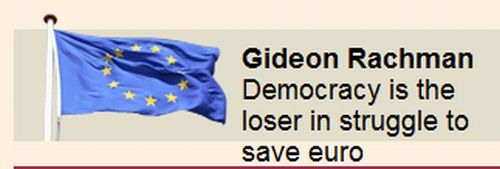
EU är nationsbyggandets svar på Esperanto
Ekonomism,29 September 2012
Should Europe now seek political union?
Forming such a union implies nothing less than the end of the nation state.
There are powerful arguments why “Europe” – whatever this means and how many countries might be included – should have this ambition.
However, to base the argument for integration primarily on saving monetary union is anything but convincing.
And it is more than strange when foreign politicians and experts are pressing eurozone states to give up national sovereignty, out of fear that a collapse of monetary union might have severe consequences for their economies.
Otmar Issing, Financial Times 29 July 2012
Europe’s impossible dream
The dream of the founders was an ever-closer union transforming itself into something like a federal state.
One of these founders, French Foreign Minister Robert Schuman, called up the ideal in a speech in 1948:
We are carrying out a great experiment, the fulfillment of the same recurrent dream that for ten centuries has revisited the peoples of Europe:
creating between them an organization putting an end to war and guaranteeing an eternal peace.
Two years later, in another speech, he filled in the nuts and bolts:
Europe will not be made all at once or according to a single plan. It will be built through concrete achievements which first create a de facto solidarity.
John Lloyd, Reuters, 23 July 2012
Jag var en av nästan 2,5 miljoner väljare som röstade ja i folkomröstningen.
Det krävs mycket mer: en politisk union av något slag. Men ingenstans i Europa finns folkligt stöd för en så omfattande maktöverföring till EU:s gemensamma instanser.
Per T Ohlsson, Sydsvenskan, 12 augusti 2012
Själv röstade jag ”ja” till att Sverige skulle gå med i valutaunionen vid folkomröstningen 2003
Jag har svårt att tro på idén om en långtgående centralisering av finanspolitiken
Alternativet är en partiell eller total upplösning av valutaunionen
jag tvivlar på att befolkningen i länder med statsfinansiella problem kommer att acceptera förmynderi och bestraffning beslutade av politiker i andra länder
Assar Lindbeck, DN Debatt 17 juli 2012
De ledande europeiska politikerna har nu tvingats inse att eurokrisen har sin grund i projektets konstruktion.
Huvudmotivet är mindre omsorg om dessa länders befolkningar än omsorg om de egna bankerna och euron som ett politiskt projekt.
Det kallas för ”en fiskal union” är i praktiken en sorts ekonomisk diktatur
utövad av tjänstemän och experter i Bryssel under i praktiken tyskt överinseende.
Carl Tham, DN Debatt 16 juli 2012
Att nu med valutaunionen som torped söka baxa in de europeiska folken med deras skilda politiska traditioner och språk i en federation,
innebär en enorm demokratiförlust och likaså ofelbart växande konflikter mellan centrum och periferi.
Carl Tham, DN Debatt 16 juli 2012
Barroso: We must complete the unfinished business of economic and monetary union (EMU)
Common and more integrated supervision is the first step towards a banking union.
Moreover, it is the start of something much bigger.
Project Syndicate, 29 augusti 2012
Bankunion är på väg
"a big step towards more European integration – a genuine transfer of sovereignty
and a significant strengthening of European institutions"
Wolfgang Schäuble, Financial Times, August 30, 2012
Så planerar Barosso "rädda euron"
Centralisera makten över euron, skapa en särskild räddningsfond och gör det möjligt för Bryssel att beskatta invånarna i eurozonen.
Så ser planen ut för att rädda euron på lång sikt, enligt ett förslag som EU-kommissionens ordförande José Manuel Barroso presenterade
SvD Näringsliv 29 november 2012
Någon eurogemensam insättningsgaranti – något som många analytiker hävdat är ett måste – nämns dock inte i förslaget. Här nöjde sig Barroso med att uppmana de enskilda länderna att skapa sina egna lösningar.
Det är dock inte uteslutet att en gemensam insättningsgaranti blir verklighet i framtiden, påpekade Barroso.
Men en sådan lösning är kontroversiell särskilt i Tyskland, där såväl invånare som politiker och banker ser det som att en gemensam insättningsgaranti skulle innebära att tyska skattebetalare får stå för notan när bland annat spanska banker inte klarar sina finanser, skriver CNBC.
The eurozone should gradually acquire the powers of a national government
with a single treasury and the right to tax or issue commonly backed bonds under a Brussels blueprint
to ensure the single currency’s longer-term survival.
Financial Times 28 november 2012
”Det handlar alltså inte om en gigantisk överstatlig finanspolitisk union”, det ser bara ut så.
Det sista lade jag till. Det första skrev EBRD:s chefsekonom Erik Berglöf på DN Debatt (25/7), två gånger, i början och i slutet av artikeln.
Allt däremellan handlar om hur vi är på väg att bilda en gigantisk finanspolitisk union.
SvD-ledare, Alen Musaefendic, 28 juli 2012
Kommer Europa låta Bryssel ta över den ekonomiska makten eller läggs EMU-projektet ner?
Endera måste ske och det mesta talar för att Bryssel tar hem spelet.
Det lär vi i så fall få ångra i generationer framåt.
Resonerar man kring vad som är ”långsiktigt hållbart” så landar man lätt i slutsatsen att eurons dagar är räknade.
Det finns dock starkare krafter som talar för att EMU-länderna trots allt lär ge upp makten till Bryssel.
Etablissemanget vill det. Nästan alla etablerade partipolitiker kommer framstå som åsnor om EMU havererar.
Marknaden vill det. Finansiella marknader har nästan alltid ett kortsiktigt fokus och bryr sig inte om vad som är rättvist eller demokratiskt.
Lobbyisterna vill det. Hela banksektorn och tyska exportindustrin kämpar med alla medel för att euron ska överleva.
Peter Benson, SvD Näringsliv 21 juli 2012
Med den breda penseln kan man måla upp två huvudscenarier för framtiden.
Dessa scenarier kallar jag ”Euron havererar” respektive ”Bryssel tar makten”.
Peter Benson, SvD Näringsliv 14 juli 2012
RE: Lyasande och pedagogisk. Highly recommended
"Federalism is the right goal for Europe. But Europe is not yet ready for federalism"
About Larry Siedentop - who teaches at Oxford - (Democracy in Europe, Penguin Books, 2000)
Martin Wolf, Financial Times, 4 July, 2000, yes 2000
Idén om EU som en ständigt mer sammanväxande union håller på att falla ihop.
Krisen ställer i förlängningen krav på en grundlig omdaning av EU.
Kanske – eller förhoppningsvis – kan det leda till ett mindre men bättre EU, än dagens.
SvD-ledare, Benjamin Katzeff Silberstein, 8 juli 2012
It is not news that Europe has become increasingly less religious. But there is a new religion that has risen almost without notice.
The revival-like fervor of those who wish for a united Europe, not only monetarily but as a true fiscal whole
Government leaders and business elites are almost religious in their insistence that there can be no outcome but fiscal union
This would be the triumph of hope over history
John Mauldin, 14 July 2012
The eurosceptics have the best lines again
There was never a purely economic case for the currency.
I did not share that view but I recall admitting back then that
if you do not accept political union, logically you should not accept the euro either.
Wolfgang Munchau, Financial Times, July 15, 2012
Att ta ett jättekliv på väg mot politisk enhet och mer centralstyrning därför att marknaderna kräver det och bankerna behöver det,
mot flertalet medborgares vilja, är att bädda för nya och ännu större problem
Alltför mycket makt och befogenheter kan inte samlas i Bryssel utan att medborgarna får möjlighet att påverka politikens inriktning.
Och eftersom demokratin fortfarande fungerar bäst på nationell nivå måste krisgeneralerna gå försiktigt fram
Annika Ström Melin, Signerat DN 29 juni 2012
Kommentar av Rolf Englund
Bra, Annika, men det är inte klivens storlek, utan deras riktning, som är det viktiga.
Även mindre kliv, som inte är Jättekliv, på väg mot politisk enhet och mer centralstyrning därför att marknaderna kräver det och bankerna behöver det,
mot flertalet medborgares vilja, är att bädda för nya och ännu större problem.
Sanningen är att eurons nuvarande konstruktion inte fungerar.
Är konsekvensen upplösning – eller en politisk union i full skala?
Förhoppningsvis finns det fortfarande ett alternativ någonstans mitt emellan.
Euron måste räddas eftersom följden annars blir ekonomiskt och politiskt kaos. Men demokratin ska också överleva
Annika Ström Melin, Signerat DN 29 juni 2012
Konstruktionen kring euron har inte varit fel
Jan Björklund, Birgitta Ohlsson, Carl B Hamilton och Olle Schmidt, SvD Brännpunkt, 9 september 2011
Ytterst måste valutaunionens medlemmar bestämma sig för om de ska lösa problemen gemensamt,
vilket ofrånkomligen leder EU-samarbetet i federal riktning
eller om de ska ta det dramatiska och mycket riskabla steget att lösa upp euron
Peter Wolodarski, Dagens Nyheter 24 juni 2012
SPECTRE
Germany’s man at the ECB, Jörg Asmussen:
The influential “commentariat” comes predominantly from outside the euro area.
The big English-language newspapers, the news agencies and wire services that shape opinions in the economic and financial sphere on the Continent
But if the profound political commitment of Eurozone countries to the historical project of “ever closer union” is neglected, the assessment remains superficial and partial
P O Neill, fistfulofeuros.net, 6 July 2012
IMF help would set the eurozone on the road to fiscal and political union – let’s not encourage it
Jeremy Warner, Telegraph 21 June 2012
Den union som nu håller på att ta form, med ett stort inslag av överstatlighet, stödfonder och styrning av enskilda länders skatter och utgifter,
är en helt annan union än den ”rena” valutaunion som Sverige folkomröstade om 2003.
Många av dem som röstade ”ja” då har nog anledning att känna sig lurade i dag.
Mats Persson,professor vid institutet för internationell ekonomi, Stockholms universitet, DN Debatt 19 juni 2012
Herman Van Rompuy on Tuesday published a plan for the future of the eurozone
The plan calls for progress towards commonly issued eurozone bonds and the eventual establishment of central EU treasury
The proposal – which urges the eurozone to work simultaneously towards a banking union, fiscal union and political union
– contains measures that move beyond what some member states have indicated they are willing to accept.
Financial Times 26 June 2012
Nu kommer ödesstunden för Fredrik Reinfeldt och Den Store Tigaren P J Anders Linder
Rolf Englund 26 juni 2012
Fredrik Reinfeldt i riksdagens partiledardebatt 13 juni 2012
Ett stort steg som pekar på fördjupning och överföring av suveränitet från nationalstaterna till den europeiska nivån.
Med kort varsel kommer det nu att avkrävas svar av Sverige som nation och av riksdagens partier om hur vi ska förhålla oss till mycket av det här.
Klicka här
Allt fler bedömare pekar på att EMU är felkonstruerad.
Man kan inte ha en statsövergripande centralbank som driver en gemensam penningpolitk och samtidigt 17 olika regeringar som sköter finanspolitiken.
Därför talar man om behovet av en "fiskal union" och i förlängningen en politisk union.
Men redan en fiskal union är ett stort steg till en politisk union.
Danne Nordling 24 juni 2012
Konstruktionen kring euron har inte varit fel
Jan Björklund, Birgitta Ohlsson, Carl B Hamilton och Olle Schmidt, SvD Brännpunkt, 9 september 2011
The dream of a United States of Europe has turned into a nightmare, but confronting reality is too terrifying for them to contemplate.
In the absence of voter approval for irreversible fiscal union and a perpetual conveyor belt of taxpayer funding from Stuttgart to Salonika,
how does the euro survive?
For if Greece goes, what about Spain?
Jeff Randall, Daily Telgraph 25 June 2012<
The most important thing is that we create a fiscal union, one in which the nation states give up their jurisdiction in terms of fiscal policy.
If we had always said we would only take steps toward integration if they would immediately work 100 percent, we would never have advanced by so much as a meter.
That's why we wanted to introduce the euro first and then quickly make the decisions needed for a political union
SPIEGEL Interview with Finance Minister Schäuble, 25 June 2012
The arrogance of European officials who convinced themselves that they could make a single currency work without a single government.
Whhy does the dollar area — also known as the United States of America — more or less work, without the kind of severe regional crises now afflicting Europe?
The answer is that we have a strong central government, and the activities of this government in effect provide automatic bailouts to states that get in trouble.
Paul Krugman, New York Times 17 June 2012
Det har varit märkligt tyst om eurokrisen i den svenska politiska debatten.
Den har hittills mest varit en förevändning för regeringen att skryta om svensk budgetdisciplin.
Därför var det glädjande att statsministern ägnade sitt anförande i gårdagens partiledardebatt i riksdagen åt att ställa de frågor som måste diskuteras.
Ska Sverige följa euroländerna in i den mer överstatliga finanspolitik som kommer att behövas?
Vilka ekonomiska åtaganden är vi beredda att göra?
Expressen 14 juni 2012
Alla insiktsfulla förstår att det nu krävs fördjupad politisk integration.
I stora drag vet alla vad som måste göras för att undvika ett kollektivt europeiskt sönderfall.
Men dagens generation av vacklande politiskt ledarskap verkar mest intresserat av nästa opinionsmätning.
Rolf Gustavsson, Svd 12 juni 2012
Rolf Gustavsson (RG) är ett fenomen i svensk press. Han har drivit politisk EU-propaganda på nyhetsplats i SvD i många år och sedan varit kolumnist där sedan 2010. Ifjol fick han Publicistklubbens stora pris
Han har gått märkligt fri från kritik, trots att han egentligen aldrig utvecklar sina tankar om vad EU är och bör vara utan
nöjer sig med att ösa sitt förakt över länder, politiker och intellektuella som inte säger ja och amen omedelbart till alla förslag att flytta makten från medlemsländerna till Bryssel.
Nils Lundgren juni 2012
På väg mot 1931
Grekland kan bara klara sig undan katastrof om såväl väljare som politiker besinnar sig.
Långsamt växer insikten om att EU måste få en starkare institutionell överbyggnad som medger mer långtgående samordning.
Per T Ohlsson, Sydsvenskan 17 juni 2012
Europas förenta stater?
Nej, att EU går i den riktningen är inget tilltalande scenario.
Europas förenta banker däremot?...
Ledare Sydsvenskan 13 juni 2012
Diskussioner om en europeisk bankunion är i full gång, vilket i grunden är utmärkt. Europa kan inte fortsätta att hanka sig fram med nödlösningar hur länge som helst. Ett nytt finansiellt ramverk måste ta form.
Men vilket?
Tyska Bundesbank anser att en bankunion måste gå hand i hand med överstatliga steg på det statsfinansiella området. Skattebetalarna i de europeiska länderna måste få gränsöverskridande inflytande om de görs ömsesidigt ansvariga för varandras bankskulder, resonerar centralbanken.
Men en sådan lösning är lika lite önskvärd som ökad överstatlighet.
Målet med en bankunion ska inte vara att få Europas folk att bära varandras bankers skulder, utan att få bankerna att bära dem själva.
Jorg Asmussen, the second resignation of a German member of the ECB’s executive board within the last two years.
Angela Merkel will most likely be proposing Bundesbank deputy Sabine Lautenschläger to the ECB’s executive board.
Eurointelligence, 16 December 2013
Barroso pushes EU banking union
All 27 EU countries should submit their big banks to a single cross-border supervisor as part of a banking union to be enacted as soon as next year
Financial Times, 11 June 2012
Mr Barroso’s proposal to put such a supervisor in place would give one EU authority power to wind down a bank and impose losses on bondholders without the approval of national authorities.
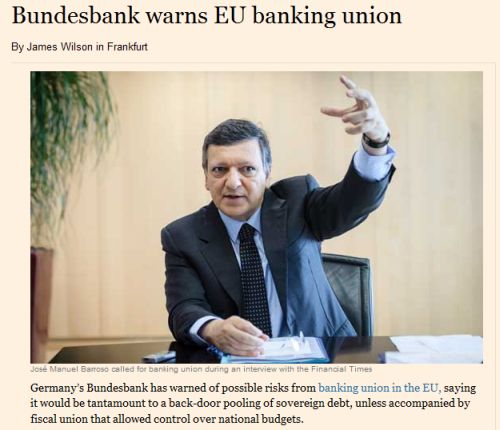
Sabine Lautenschläger, vice-president of the Bundesbank, said banking union could only work in tandem with fiscal union –
meaning some common cross-border binding rules on how countries could set budgets.
Ms Lautenschläger also cast doubt on how quickly any banking union could be implemented,
saying “comprehensive EU treaty changes” would be needed.
Once you take a big step towards the mutualisation of debt across Europe,
you are forced towards much deeper political union.
Gideon Rachman, Financial Times 11 June 2012
Otmar Issing warns against a further mutualisation of debt and risks
“Germany would do the right thing to stick to the treaty and as the others to do the same.
A Germany that would drown in debt because it takes liabilities as a result of an ill-conceived sense of solidarity
will provoke the rage of its citizens and alienate them even further from the European idea as is unfortunately already the case now.”
Frankfurter Allgemeine Zeitung via Eurointelligence 12 June 2012
Zon på gränsen till sammanbrott
Att krisen blivit så djup hänger samman med ett ursprungligt konstruktionsfel i den valutaunion som sjösattes 1999.
Ingen tidigare valutaunion har fungerat långsiktigt utan att kombineras med någon form av politisk union – som i dollarns USA.
En anledning till att eurons arkitekter fullt medvetet bortsåg från kopplingen mellan det monetära och det politiska var ett svagt folkligt stöd för långtgående maktöverföring till Bryssel.
Per T Ohlsson, Sydsvenskan 3 juni 2012
Book
Carlo Bastasin on how national politics nearly destroyed the euro
As a description of how the eurozone contracted its current ills and as a prescription for how it might yet cure them, Saving Europe has many virtues but one irredeemable flaw.
Review by John Thornhill, Financial Times 10 June 2012
While acknowledging the problem of political legitimacy, Bastasin never suggests how it could be resolved beyond saying that “a political dimension at the euro level seems indispensable”. Given the electoral trauma the EU endured to pass the Lisbon Treaty, a relatively innocuous set of institutional rules, one wonders how the eurozone’s governments can ever persuade their voters to move rapidly towards a full fiscal union involving a radical transfer of real powers to Brussels.
Spanish premier Rajoy has become the latest European politician
to call for countries to, in effect, abandon their sovereignty in a last-ditch attempt to save the beleaguered currency
a new central authority would send a clear signal to investors that the single currency is an irreversible project
Telegraph 2 June 2011
ECB President Mario Draghi
The euro is “irreversible” and is not in danger of collapsing
eurozone nations will eventually be bound even closer together
analysts have been too pessimistic and had not recognised the political will behind the eurozone
Telegraph 21 July 2012
Mario Draghi, president of the European Central Bank,
said the EU is at a "crucial moment" in its history.
"We have reached a point in which the process of European integration needs a courageous leap of political imagination in order to survive,"
Ambrose Evans-Pritchard, 24 May 2012
RE: The Ultimate Article about EMU and the Eurocrisis
Time to plan a velvet divorce for the euro
In the coming months, Europe may be forced to decide
Sacrificing national self-rule on the altar of the euro is inherently objectionable
– and would invite a nationalist backlash across Europe.
Gideon Rachman, Financial Times 21 May, 2012
Helmut Schlesinger, was president of the Bundesbank when sterling was forced out of the European Exchange Rate Mechanism in 1992.:
- And I would say that either we get the United States of Europe, that is an actual political union, and then that political union gets its own currency.
But then it is no monetary union any longer, but the currency of that new state.
Robert Peston, BBC Business editor, 17 May 2012
One nation (under Germany)
Historian Niall Ferguson tells Ben Laurance the single currency will survive
and the crisis will leave Berlin heading a federal Europe
"I am not a federalist," he says. "But the costs of the single currency disintegrating are really so high...!
Ben Laurance, via John Mauldin 20 May 2012
Jean-Claude Trichet - president of the European Central Bank during many of the euro's formative years - made a similar point.
"In a single market with a single currency… it seems to me that Europe could go for a federation."
Robert Peston, BBC Business editor, 17 May 2012
Europas ledare klamrar sig just nu fast vid euron i dess nuvarande form och vid åtstramningspolitiken. Allt i det europeiska projektets namn.
Samtidigt är det just det europeiska projekt som de riskerar att förgöra.
Katrine Kielos 27 maj 2012
Den nuvarande ensidiga åtstramningspolitiken är ohållbar. EU kommer att behöva byta politik. Frågan är bara om det sker medvetet eller efter en kollaps.
Den nuvarande ekonomiska krisen kan mycket väl leda till att ett mindre antal euroländer på kontinenten sluter sig samman i något som mer liknar just en federal union. Går det att rädda EMU på något annat sätt?.
Och vad gör Sverige då?
Vill vi vara del av en kontinentaleuropeisk alltmer federal union
So what is going to happen:
creation of the European superstate and survival of the euro,
or a disastrous monetary and political disintegration?
Robert Peston, BBC Business editor, 17 May 2012
David Cameron, Britain’s prime minister, will on Thursday warn that the single European currency could unravel
unless the eurozone’s 17 members move rapidly towards full fiscal and political union.
Financial Times, May 17, 2012 12:01 am
Is the Federal Chancellor in charge of the country’s foreign policy and strategic destiny, answering to the Bundestag?
Or is the Bundesbank answering to what it believes to be a higher master – the German constitution and the Basic Law – invoking the rulings of the Verfassungsgericht
Ambrose Evans-Pritchard, April 19th, 2012
Rolf Englund blog 18 februari 2012
What lessons should we draw? Don’t be like Greece -- that’s the easy one.
The more important lesson of the euro area is that
a successful currency union should also be a fiscal and political union.
Ezra Klein, Bloomberg View columnist, 3 May 2012
Jag lät tidigare mina studenter skriva uppsats på ämnet om Sverige skulle gå med i euron eller inte.
Idag skulle jag omformulera frågan: hur mycket skulle Sverige vara berett att betala för att inte gå med?
Det är en stor tillgång för er att ni står utanför
Kenneth Rogoff, intervjuad i SvD Näringsliv av Andreas Cervenka, 11 januari 2012
Kenneth Rogoff, professor på Harvard i USA och ansedd som en av de främsta experterna på finanskriser, bland annat efter boken This Time is Different.
Han var mellan 2005 och 2011 också rådgivare åt svenska Riksbanken.
Kenneth Rogoff, former chief economist of the International Monetary Fund and now a professor at Harvard University,
Given the low growth, he says, inflation above central banks’ targets could be helpful:
“A bit of inflation is by far the lesser evil compared with even lower growth.
Five per cent inflation for 2 to 3 years is not the end of the world. There are even some benefits.”
Financial Times 13 may 2011
Enda chansen att rädda euron är en fullfjädrad politisk union.
I ett första steg bör Tyskland och Frankrike bli ett land.
Kenneth Rogoff, Harvard, tidigare chefekonom på IMF, i SVT:s Agenda.
via SvD Näringsliv 21 maj 2012
– Euron var en dåligt framtagen idé.
- Det är fel att tro att man kan ha en gemensam valuta innan man har en politisk union
Gör man inte det kommer inga brandväggar eller stödpaket att ge långvariga lättnader, säger Rogoff till SVT.
Rogoff menar att processen måste kantas av mer demokrati och deltagande från medborgarna än hittills.
– Värstascenariot är något värre än Lehman-kraschen. Men jag vill inte säga att det är sannolikt.Det värsta vore om Grekland lämnar, och därefter i snabb följd Portugal, Irland, Spanien och Cypern.
Sedan lämnar Frankrike och hela Europa går mot en massiv depression som varar i många år, säger Kenneth Rogoff.
Se hela intervjun på SVT Play här!
RE: Fransmännen kanske fortfarande har svårt för den tanken, efter Vichy France, From Wikipedia.
Dom kunde väl börja med att ena Belgien.
Jag har tidigare hävdat att det enda genomförbara sättet att förkorta den kommande perioden av smärtsamma nedskärningar och långsam tillväxt är
en bibehållen måttlig inflation på till exempel 4–6 procent i flera år.
Kenneth Rogof, Kolumn DN 16 augusti 2011
Samma dag som Carl Bildt utnämndes till utrikesminister i oktober 2006 frågade jag honom
om EU, om det inte var ett problem att han är mer federalistisk än de moderata väljarna.
Han svarade att det inte var hans uppgift att följa opinionen
SvD-ledare, signerad Claes Arvidsson, 19 maj 2012
Om man har en monetär union, måste man ha en fiskal union och en transfereringsunion och då måste man ha
en politisk union, ett stort steg mot ett Europas Förenta Stater, sade Erik Åsbrink.
Det ville en del ledande politiker i Europa, men problemet var enligt Åsbrink att det ville inte folken gå med på.
Ja, då går det alltså inte, är den slutsats man måste dra.
Erik Åsbrink drog inte själv den slutsatsen explicit, det fick åhörarna förstå själva.
Exkludera Schulz och Juncker
Det finns två personer som är olämpliga i rollen som ordförande för Europeiska kommissionen;
socialdemokraten Martin Schulz och kristdemokraten Jean-Claude Juncker.
Det främsta skälet är att de på ett kuppartat sätt vill ta makten från medlemsländerna genom att föra över den till sig själva och Europaparlamentet.
Smålandsposten, signerad Marcus Svensson, 16 april 2014
Without a truly integrated union and strong institutions to coordinate and enforce policy decisions,
the cries of “Berlin must do something” ring hollow.
Karl-Theodor zu Guttenberg, New York Times, 27 November 2013
Karl-Theodor zu Guttenberg, who served as the defense minister, economics minister and technology minister of Germany, is a nonresident distinguished statesman at the Center for Strategic and International Studies.
Center for Strategic and International Studies
Don't blame Germany for the eurozone's travails, blame the euro itself
Germany didn’t set out to design an economic model that impoverishes much of the rest of Europe
Any attempt to set a single interest rate for 17 politically and fiscally sovereign nations is almost by definition doomed to failure.
Perpetual crisis is more or less guaranteed.
Jeremy Warner, Telegraph, 11 Nov 2013
Många Europavänner ser eurokrisen som en möjlighet att utveckla EU i federal riktning. Men detta kommer förmodligen att misslyckas.
Orsaken är att medborgarna knappast uppfattar någon positiv vision bakom dessa integrationssträvanden. De framstår i stället som priset för stödpaketen.
Lars Calmfors, Kolumn DN 27 juni 2012
I'll protect Britain from European superstate
David Cameron promises to 'protect' Britain from German plans for a eurozone superstate with common banking and political systems.
“I wouldn’t for instance ask British taxpayers to stand behind Greek or Spanish deposits,” he said. “It’s not our currency.”
Telegraph 7 June 2012
Spanish premier Rajoy has become the latest European politician
to call for countries to, in effect, abandon their sovereignty in a last-ditch attempt to save the beleaguered currency
a new central authority would send a clear signal to investors that the single currency is an irreversible project
Telegraph 2 June 2011
Europe’s leaders can’t save their currency union without figuring out a way to salvage the region’s banks. Spain is a perfect place to start.
By accepting joint responsibility for injecting capital into a single country’s banks, the nations of the currency zone
would be taking another step toward financial federalism and collectively backed euro bonds.
Bloomberg, editors, 31 May 2012
Ultimately, a United States of Europe was the goal.
The arc of Europe’s postwar history is turning toward tragedy.
It isn’t even that the whole mess was avoidable.
It’s that the crisis is dividing Europe along the very lines the European project was intended to erase
Clive Crook, Bloomberg, 24 May 2012
Kommentar:
Den ofrånkomliga slutsatsen, som Economist inte drar explicit, är att den av Economist anvisade vägen, inte är framkomlig
Spain’s nightmare is a symptom of what is wrong with the entire euro zone.
Bail out Spain and immediately investors will rightly worry about Italy and whether the rescue funds are big enough.
Ultimately, as we have argued, a solution requires the currency’s members to draw on their combined strength by mutualising some debt and standing behind their big banks.
haggling over the details, holding referendums and amending constitutions could easily take three years.
The trouble is that the 17 members of the euro zone, let alone their 333m citizens, cannot agree on who must sacrifice what to allow this new Europe to emerge.
The Economist print 28 July 2012
Perhaps the politicians will be shocked into action, by a euro-zone bank run, a chaotic Greek exit, or flight from Italian government debt.
But Europe’s leaders will find it increasingly hard to drag their people along with them.
This is the deeper lesson of Spain’s nightmare
Kommentar:
Den ofrånkomliga slutsatsen, som Economist inte drar explicit, är att den av Economist anvisade vägen, inte är framkomlig
A limited version of federalism is a less miserable solution than the break-up of the euro
Fear that the state could not cope makes a banking collapse more likely.
That is why we have reluctantly concluded that the nations in the euro zone must share their burdens.
The Economist print 26 May 26 2012
Hans Magnus Enzensberger ”Det mjuka monstret Bryssel
Under det grekiska dramat finns därför frågor som rör unionens själ
Att ”skapa en allt fastare sammanslutning” har varit utgångspunkten
sedan Romfördraget skrevs och är fortfarande målparagraf 1 i Lissabonfördraget.
Ingen har dock lyckats beskriva slutstationen
Annika Ström Melin, DN 25 maj 2012
Hans Magnus Enzensberger har skrivit en tankeväckande essä med skarp EU-kritik, ”Det mjuka monstret Bryssel” (Karneval förlag).
Den europeiska integrationen har enligt Enzensberger utvecklats till ett växande, oformligt monster.
Bryssels välvilliga men osynliga och teknokratiska maktutövning förstör den europeiska mångfalden, omyndigförklarar medborgarna och urholkar demokratin.
Bristen på demokrati är definitivt en inbyggd och allvarlig svaghet i unionens beslutsapparat, skriver ASM.
- Den som tror att Europas demokratiska länder behöver samarbeta kan inte nöja sig med mellanstatliga Europarådet som mest fungerar som en stor diskussionsklubb.
- Att ta steget fullt ut och bums skapa Europas förenta stater är inte heller en framkomlig väg.
Kommentar av Rolf Englund:
Eftersom det inte går att bums skapa Euromas Förenta stater försöker dom göra det steg för steg,
utan att basunera ut det på gator och torg och utan att i onödan fråga folket.
Det är föga demokratiskt, men vad bryr sig utopister om det.
Har man likt andra fundamentalister funnit den enda vägen är vidare debatt överflödig.
Eller som det hette i Östtyskland: Freiheit ist Einsicht in Die Notwendigkeit.
Italy’s finance minister calls for ‘political union’ to save euro
FT July 26, 2015 3:55 pm
Italy is calling for a wide set of measures — including the swift completion of banking union, the establishment of a common eurozone budget and the launch of a common unemployment insurance scheme — to reinforce the common currency.
He said an elected eurozone parliament alongside the existing European Parliament and a European finance minister should also be considered.
The Italian finance minister is confident this is the right path for the eurozone, but he is not certain it is a winning battle. Many eurozone governments, including Italy, are facing pressure from people who are increasingly sceptical about the merits of existing European economic integration, let alone the possibility of more to come.
"I am sure the euro will oblige us to introduce a new set of economic policy instruments.
It is politically impossible to propose that now. But some day there will be a crisis and new instruments will be created."
Romano Prodi, EU Commission President. Financial Times, 4 December 2001
Men om man ställer till rejäla kriser, så kan varje nationell maktelit skrämma sitt folk till underkastelse. De tvingas acceptera. EU-kommissionens tidigare ordförande, virrpannan Romano Prodi, var så omedveten att han skrev en kolumn i självaste Financial Times (20 maj 2010), där han lugnt konstaterade att han och alla de andra som drev fram europrojektet naturligtvis visste att det skulle leda till en svår kris förr eller senare.
Jag citerar: ”When the euro was born everyone knew that sooner or later a crisis would occur. It was inevitable that, for such a bold and unprecedented project, in some countries (even the most virtuous ones), mistakes would be made and unforeseeable events occur.”
Nils Lundgren 2011
Italy’s finance minister calls for ‘political union’ to save euro
Detta är ett led i den stora konspirationen.
Rolf Englund blog 27 juli 2015
The euro zone must undergo much faster acceleration towards fiscal and financial integration than most European politicians will admit.
The financial re-engineering of Europe is a prerequisite for the euro to survive.
Greece is bringing forward that moment of truth.
And yet politicians, particularly in Germany, have still to accept the logic, let alone explain it to voters.
The Economist print, editorial, 19 May 2012
So what is going to happen:
creation of the European superstate and survival of the euro,
or a disastrous monetary and political disintegration?
Robert Peston, BBC Business editor, 17 May 2012
Eventually, Europe will have to forge some kind of fiscal union if it wants the common currency to survive
In the currency area known as the U.S. federal transfers such as income-tax credits help struggling states catch up,
cushioning as much as 40 percent of the blow of economic downturns.
Bloomberg, editors, 11 May 2012
Europakten kräver tysk grundlagsändring
German Chancellor Angela Merkel faces an unexpected challenge
the new treaty will require a two-thirds majority in both houses of parliament
CNBC 3 mars
Almost unnoticed by the public,
the European Union has already begun transforming itself into an organisation
with far more central power over national economic decision-making.
Ireland’s planned referendum on a new eurozone budget discipline treaty will for the first time
answer a question hovering over the bloc’s crisis response for months:
will Europe’s voters support the fiscal union many political elites believe is necessary to make the single currency function?
Financial Times 28 February 2012
Merkel: I Won't Take Part In Pushing Greece Out Of Euro and
It’s necessary to create a political union
Rolf Englund blog 10 februari 2012
Angela Merkel is often depicted by the Western media as a boring, mousey and indecisive physicist obsessed by rules and the Euro ideal.
In fact, she is none of these things.
Her unusual and at times murky past suggests that she is driven by the ideal of technocratic power, has no firm belief in anything, and is ruthlessly disloyal when it suits her.
Her role in the former East Germany has been cleaned up by those around her.
The Slog, 30 January 2012
Merkels eget svar på vad som behöver göras är
mer samordning mellan Europas länder, mer samordnade skatter och mer samordnad arbetsrätt.
Arbetskraften är ännu inte tillräckligt rörlig mellan Europas länder
– Jag föreställer mig att Europakommissionen blir mer av en regering i framtiden,
sade Tysklands förbundskansler Angela Merkel, Ekot 25 januari kl 20:55
Merkel och Göran Persson om politisk union och skatteunion
Rolf Englund blog 2012-01-10
"Investerare misstar sig om de tror att ECB ska kunna lösa skuldkrisen i euroområdet så länge det saknas en politisk union"
Angela Merkel sade att euron introducerades som ett "visionärt steg, men grunden var inte tillräckligt förberedd".
Denna motsättning ska lösas med ökad ekonomisk integration, vilket blir uppdraget de kommande åren.
DI 10 januari 2012
Investerare misstar sig om de tror att ECB ska kunna lösa skuldkrisen i euroområdet så länge det saknas en politisk union i området. Det sa Tysklands förbundskansler Angela Merkel 9 januari, enligt Bloomberg News.
Låt mig än en gång konstatera att Europa inte har denna ”desire of its people for closer political cohesion” och att valutaunionen därför inte kan fås att fungera ens med en fiskal union.
Valutaunionen leder till att hela det europeiska integrationsprojektet, frihetens Europa, hotas.
De politiker och andra opinionsbildare som drev igenom eurosatsningen i slutet av nittiotalet
och har försvarat den utan hänsyn till verkligheten sedan dess bär på ett fruktansvärt ansvar.
Problemet är att de europeiska folken inte har någon möjlighet att utkräva detta ansvar.
Nils Lundgren, 26 december 2011
Det finns inga andra, politiskt acceptabla, partier att rösta på och inga andra tidningar att läsa.
Nils Lundgren, Calmfors och eurons tigande Ja-sägarna
Som vanligt finns inget intresse i svensk press av att utkräva ansvar av dessa politiker för det de har ställt till med,
skriver Nils Lundgren i anledning av Annika Ström Melins artikel om att "Populisterna avancerar".
Rolf Englund blogg 17 december 2011
Varken Greklands finanser eller ens euron är värda
det vågspel som en finanspolitisk union skulle betyda.
Risken är påtaglig att politiken håller på att skena ifrån sitt folkliga stöd.
Gunnar Wetterberg, Expressen, 23 dec 2011
In reality, Europe is on the path toward becoming a federal country
The European idea as we know it is in the process of dissolving into thin air.
The monumental postwar project of a peacefully unified continent where all member states hold hands in friendship collapsed overnight.
Roland Nelles, seit März 2011 Mitglied der Chefredaktion, Der Spiegel, 9 Dezember 2011
In the long hours of a bitter Brussels night Europe changed.
A major step was taken towards closer integration. It was not as a result of popular demand by Europe's people.
It came about because Europe's leaders believed their project had "never been in such danger".
Gavin Hewitt, BBC Europe editor, 9 December 2011
Last night most of Europe's governments gave up a chunk of their sovereignty.
In the future, tax and spending plans will be shown to European officials before national governments.
France and Germany have bulldozed Britain out of EU for the sake of a treaty that offers absolutely
no solution to the crisis at hand, or indeed any future crisis
Europe's blithering idiots and their flim-flam treaty
Ambrose Evans-Pritchard, December 9th, 2011
10 år med euron – det ska firas
"videon ser ut som en Scientologikyrkereklam"
Teresa Kuchler, SvD Näringsliv, 1 december 2011, med video
Att videon ser ut som en Scientologikyrkereklam med överretuscherade, fettfria och helt asexuella karaktärer under fulanimerade blå himlar, och ackompanjeras av kriminellt usla Beethovenvariationer eller den slags håglöst synth-dunk som vanligtvis hörs på företagsstämmornas power point-presentationer från helvetet, har däremot inget med dålig tajming att göra. Så ser alla EU-producerade propagandafilmer ut.
Sarkozy efterlyser bättre disciplin inom EU
– I dag har rädslan återvänt, rädslan för att Frankrike inte längre styr över sitt öde, sa presidenten,
samtidigt som han underströk behovet av just Europeiskt samarbete för fredens skull och för överlevnad.
Ekot 2 december 2011
Frankrike tycks närma sig Tysklands hållning, men de två mäktiga står ännu inte på samma ruta. Talet i går kväll innehöll kanske därför inte dramatiska lösningar utan beskrev mer problemen.
Sarkozy, has said France and Germany must come together to ensure stability at the heart of Europe.
In a major speech in the port of Toulon, Mr Sarkozy said he and the German Chancellor, Angela Merkel,
would meet on Monday to propose measures to ensure the future of Europe.
BBC, 1 December 2011
Euron: Förändrad europeisk maktbalans
Det europeiska par som styr Europa är inte jämlikt.
Paris har blivit beroende av det starkare Berlin.
Annika Ström Melin, 1 December 2011
What keeps the United States' monetary union strong is not our common language nor the uniformity of economic conditions across member states,
but rather our meaningful fiscal union transfers across states as part of the federal U.S. budget
If the European Monetary Union is to survive, Germany will have to dramatically increase its transfers to the periphery countries.
Ted Temzelides, professor of economics at Rice University, February 17, 2012
The people who bullied Europe into adopting a common currency,
the people who are bullying both Europe and the United States into austerity aren’t technocrats.
They are, instead, deeply impractical romantics.
So why did those “technocrats” push so hard for the euro, disregarding many warnings from economists?
Partly it was the dream of European unification, which the Continent’s elite found so alluring that its members waved away practical objections.
Paul Krugman, New York Times, November 20, 2011
Tighter controls on the “Club Med” countries’ purse strings
But that’s not “fiscal union”.
The only way a single currency can work in the long term is by pooling a large share of total tax revenues and having intra-regional fiscal transfers, as in the US. Yet that will never happen in Western Europe.
Liam Halligan, DT 26 Nov 2011
ECB board member Jose Manuel Gonzalez-Paramo urged euro-area politicians to take bold steps toward fiscal union to end the debt crisis,
“It is now a time for politicians to be bold and courageous” and “complete as soon as possible the great project begun 60 years ago towards ever closer union,” he said.
Bloomberg 25 November 2011
"I am sure the euro will oblige us to introduce a new set of economic policy instruments.
It is politically impossible to propose that now. But some day there will be a crisis and new instruments will be created."
Romano Prodi, EU Commission President. Financial Times, 4 December 2001
Conspiracies, Coups and Currencies
The inhabitants of Italy and Greece, who have just watched democratically elected governments toppled by pressure from
financiers, European Union bureaucrats and foreign heads of state, it evokes the cold reality of 21st-century politics.
Democracy may be nice in theory, but in a time of crisis it’s the technocrats who really get to call the shots.
National sovereignty is a pretty concept, but the survival of the European common currency comes first.
Ross Douthat, New York Times, November 19, 2011
“Fiscal union” advocates will also need, when the time comes, to send out the eurozone riot-police.
Voters get angry, and sometimes violent, when their own politicians let them down.
But when they feel controlled and humiliated by foreigners, they become totally enraged.
That, I’m afraid, is the undeniable lesson of history.
Liam Halligan, DT, 19 Nov 2011
"The challenge of our generation is to finish what we started in Europe, and that is to bring about, step by step, a political union,"
Merkel told the party congress in the east German city of Leipzig, CNBC 14 Nov 2011
Tyskland Den franske presidenten Mitterrand ställde då ett ultimatum:
för att acceptera ett tyskt enande var landet tvunget att ge upp sin D-mark och gå med på ett stärkt EU-samarbete.
The Roman empire divided irretrievably. Yet the dream of reunification never died.
It was apparent in the claims of popes and “holy Roman emperors”. It was carried by Napoleon’s eagles.
It is the aspiration embedded in the European Union.
Martin Wolf, Financial Times, November 15, 2011
Confronted with turbulence in the provinces, the eurozone has sent in new governors.
Europe is putting in place these new governors in members that have descended to the status of clients.
Vem frågar folket när EU krisar?
Det skall vår EU-minister, Birgitta Ohlsson, svara på hos Ekot.
Lördag 3 december 2011 kl 12:55
- En liten krets EU-ledare fattar i rask takt beslut som rör framtiden för hundratals miljoner eu-medborgare.
EU-ländernas ekonomiska politik ska styras hårdare från Bryssel och förslag finns om att åter göra om EU:s grundlagar.
Men hänger medborgarna med? Har någon frågat vad vi tycker?
Och hur går det med demokratin när fler och fler tunga ekonomisk-politiska beslut flyttas upp på EU-nivå?
EU- och demokrati-minister Birgitta Ohlsson intervjuas av Tomas Ramberg.
De första provinsguvernörerna har redan installerats i Grekland och Italien.
Rolf Englund blog 14 november 2011
EU; 25 lydstater under ett fransktyskt protektorat
Nils Lundgren 5 november 2011
Det är ju det man har haft på känn hela tiden
Hur kan dom vara så dumma att dom inför en gemensam valuta. Det kommer ju inte att gå, frågade jag mig för länge sedan. Svaret var inte så svårt att komma fram till.
Den gemensamma valutan kan bara försvaras som en nödvändig byggsten i bygget som skall leda fram till ett nytt romerskt rike
Rolf Englund blog 14 november 2011
Sarkozy is causing a big stir after calling on November 8th for a two-speed Europe:
a “federal” core of the 17 members of the euro zone, with a looser “confederal” outer band of the ten non-euro members.
Charlemagne, The Economist Nov 10th 2011
He made the comments during a debate with students at the University of Strasbourg. The key passage is below
You cannot make a single currency without economic convergence and economic integration. It's impossible.
But on the contrary, one cannot plead for federalism and at the same time for the enlargement of Europe. It's impossible. There's a contradiction.
We are 27. We will obviously have to open up to the Balkans. We will be 32, 33 or 34.
I imagine that nobody thinks that federalism — total integration — is possible at 33, 34, 35 countries.
EU has repeatedly failed to put forward a convincing euro rescue.
Its latest and bravest attempt, at the end of last month, fell short of the mark—just like all the others.
That is because the Europeans are deeply at odds over what the crisis is really about, and riven by disagreement over what each country must contribute towards solving it
So long as the euro zone’s members cannot settle these arguments, or at least agree that their differences matter less than finding a solution,
the collective action needed to defend the euro will remain impossible.
The Economist, Special report, print, Nov 12th 2011
While the world waits for Europe to make up its mind, catastrophe is in the air. It could take many forms. A country might storm out of the euro—which the treaty forbids, but who could stop a determined government? European banks might suffer a fatal loss of confidence. Italy or Spain might become unable to borrow on decent terms. Or a government trying to impose austerity might be replaced by one that rejects it. Any of these could cause contagion and plunge the world economy into depression.
Economic crisis has shown up, once again, the democratic deficit at the heart of the European project as a whole.
The eurozone’s elected political class failed, for more than a decade, to tell voters what a common currency would cost.
No politician dared to explain to the Greeks or the Italians, let alone Germans, the truth.
The truth was that Italy and Greece were not competitive and were paying themselves more than they could afford.
The German people were not told that a currency union transfers political and economic cost from profligate states to prudent ones like their own.
Michael Ignatieff, FT, November 17, 2011
Kommentar av Rolf Englund:
Dom lurade oss, helt enkelt.
Eller så visst dom inte vad dom gjorde.
Om inte den politiska makten i Europa europeiseras och den nuvarande konfederationen
övergår i en federation kommer eurozonen, och EU som helhet, att falla sönder
Eurozonen kommer att få uppträda som EU:s förtrupp,
eftersom EU som helhet varken kan eller vill påskynda en politisk förening.
Joschka Fischer, Kolumn DN 2011-10-31
Att EU går framåt betyder att politisk makt flyttas från medlemsländerna till Bryssel och detta kan inte genomföras på demokratisk väg. Folken (obs pluralen) är nämligen helt emot detta.
Men om man ställer till rejäla kriser, så kan varje nationell maktelit skrämma sitt folk till underkastelse.
De tvingas acceptera. EU-kommissionens tidigare ordförande, virrpannan Romano Prodi, var så omedveten att han skrev en kolumn i självaste Financial Times (20 maj 2010),
där han lugnt konstaterade att han och alla de andra som drev fram europrojektet naturligtvis visste att det skulle leda till en svår kris förr eller senare.
Jag citerar: ”When the euro was born everyone knew that sooner or later a crisis would occur. It was inevitable that, for such a bold and unprecedented project, in some countries (even the most virtuous ones), mistakes would be made and unforeseeable events occur.”
Och då kommer EU att gå framåt, dvs. tillskansa sig mera makt på medlemsstaternas bekostnad.
Detta var så magstarkt att t o m Annika Ström Melin på DN:s ledarsida tyckte det var omdömeslöst att säga det så rent ut.
Nils Lundgren blog 24 oktober 2011
Det kan vara hälsosamt för demokratin i EU att vid avgörande tillfällen fråga väljarna vad de tycker om färdriktningen
I flertalet länder har folket avgjort frågan om medlemskap – vilket borde vara regel.
Någon gång bör folket få säga sitt
Annika Ström Melin, Signerat DN 2 november 2011
The apparent alternative of disorderly default and break-up would almost certainly plunge Europe,
and very possibly the rest of the world too, into prolonged depression.
Whatever satisfaction those such as William Hague derive from being proved right about the folly of monetary union,
it cannot be in our economic interests to see the project end in catastrophe.
Ergo, they must support what in opposition would have been anathema – ever closer union.
Jeremy Warner, Daily Telegraph 25 Oct 2011
Jag är mer militant än Daily Telegraph om Eurokrisen och stegen mot "ever closer union"
Rolf Englund blog 26 oktober 2011
På frågan om det blir så svarade Fredrik Reinfeldt igår: Vet ej.
Ett nytt regelverk måste vara så konstruerat att det utesluter
att EU står som betalningsgarant för enskilda euroländer och att EU i praktiken blir en transfereringsunion.
Claes Arvidsson, ledarskribent SvD 24 oktober 2011
To eliminate the monetary independence of 17 sovereign countries and create a major new world currency is a pretty big undertaking.
It was arrogantly assumed that political will would overcome all problems.
Moreover, although there was political will aplenty, it wasn’t at all clear what was willed.
For no one was ever asked to sign up to the whole caboodle. What was on offer was always monetary union lite.
Roger Bootle, Daily Telegraph 16 October 2011
Yet the people of Europe were not prepared for full union. So the euro elites glossed over the issue – but pressed on regardless, believing that the essential logic of closer union would in the end prevail.
Indeed, a crisis might be the way, perhaps the only way, that the European dream could be realised. It would all be all right on the night.
But it hasn’t worked out this way at all. The euro was supposed to bring convergence. In fact, for many of its member countries, it has brought increased divergence.
På EU-nivån har beslut och beslutsfattare seglat iväg farligt långt från den allmänna opinionen,
och krisbekämpningen kan leda till mer överstatlighet än vad politikerna någonsin har bett om mandat för.
PJ Anders Linder, SvD 9 oktober 2011
Eurokrisen på 30 sekunder
Du skall införa euron om Du, nu, vill skapa ett Europas Förenta Stater.
Du skall inte införa ett Europas Förenta Stater för att rädda euron.
Rolf Englund blog 19 sept 2011
"Det gäller bara Grekland", Mycket fiffigt, Too clever by half,
men allt var fel från början
Rolf Englund blog 2011-07-22
"It may be that nothing short of a politically united euro zone, or Europe, will, in the end,
be seen as the only way to embrace the valued single currency."
Alan Greenspan wrote in Financial Times, CNBC 7/10 2011.
Det var direkt plågsamt att lyssna på EU-kommissionens ordförande José Manuel Barroso i går morse.
Han framträdde i Europaparlamentet och höll sitt stora tal om den pågående krisen.
Har han tydligen helt förlorat kontakten med den politiska verkligheten i medlemsländerna?
Annika Ström Melin, DN, Signerat 29 sept 2011
Kommentar av Rolf Englund:
Observera att Annika Ström Melin inte är emot själva jätteklivet i federalistisk riktning.
Hennes invändning är att det inte är läge för det. Det gäller att navigera rätt och sedan ta det
fedralistiska jätteklivet när det är läge för det.
Charles Gave beskriver situationen i Grekland som ett ”lågintensivt inbördeskrig”.
”Och det kommer att sprida sig till Frankrike, Portugal och Spanien och andra länder”
”Många känner sig lurade. Eurokraterna försökte genomföra en politisk kupp när euron infördes, i syfte att skapa en europeisk stat.
Men befolkningen i Europa vill inte ha en sådan stat. Nu ser vi motreaktionen”
DI 23 sept 2011
Writing in Handelsblatt, Frank Walter Steinmeier, the SPD parliamentary leader, said that the Bundestag’s approval of the EFSF will solve nothing.
The politicians will not get ahead of the crisis, unless they adopted a clear long-term strategy of where they are headed.
He is proposing a 10-year road map towards a political and fiscal union to accompany that current crisis management – similar to the Delors plan of the 1990s.
Eurointelligence 4 October 2011
"ett litet steg mot en finanspolitisk union"
I juli kom EMU-politikerna överens om att öka nödlånsfonden EFSF mer flexibel. Till skillnad från nu ska fonden få stödköpa statsobligationer på andrahandsmarknaden.
I dagsläget har fonden en utlåningskapacitet på ungefär 250 miljarder euro, motsvarande 2.300 miljarder kronor. Fondens storlek ska växa till 440 miljarder euro.
Viktor Munkhammar, DI 2011-09-16
Few people, least of all this newspaper, want either vast intervention in financial markets
or a big shift of national sovereignty to Europe.
It is just that the alternatives are far worse.
The Economist editorial, Sept 17th 2011, print
Barroso has said in an interview that the EU's institutions need to be strengthened to stabilize the euro zone,
arguing that national governments can't be trusted to take determined action.
Meanwhile, former German Finance Minister Peer Steinbrück says it's time to openly admit that Greece is practically bankrupt.
Der Spiegel, 30 Sept 2011
The Economist: This is not what they were promised when the euro was set up.
Completely true, and sadly irrelevant.
Rolf Englund blog 16 sept 2011
"I am sure the euro will oblige us to introduce a new set of economic policy instruments.
It is politically impossible to propose that now. But some day there will be a crisis and new instruments will be created."
Romano Prodi, EU Commission President. Financial Times, 4 December 2001
http://www.liebreich.com/LDC/HTML/Europe/08-Euro.html
"We must now face the difficult task of moving forward towards a single economy, a single political entity...
For the first time since the fall of the Roman Empire we have the opportunity to unite Europe."
Romano Prodi, EU Commission President, speech to European Parliament, 13th October 1999.
http://www.liebreich.com/LDC/HTML/Europe/08-Euro.html
A big step towards fiscal federalism in Europe
When the euro was born everyone knew that sooner or later a crisis would occur.
It was also clear that the stability and growth pact was – as I have said before – “stupid”
Romano Prodi FT May 20 2010
Rome, Habsburg and the European Union
Den fördjupade ekonomiska integrationen har också en politisk dimension
som öppnat ett stort spelrum för allehanda populistiska sockerbagare som lockar med
den gamla världens söta illusion om nationell suveränitet.
Rolf Gustavsson, SvD 10 september 2011
Rolf Gustavsson, demokratin och sockerbagare
Rolf Englund blog 18 sept 2011
Slutmålet är tydligt: Europas förenta stater.
I en intervju nyligen med tyska Der Spiegel slog Gerhard Schröder fast att det är dags att revidera Lissabonfördraget
”Situationen har förändrats. Den här krisen innebär en stor möjlighet att skapa en verklig politisk union i Europa.”
Att driva igenom ökad överstatlighet – utan att det är förankrat hos EU:s medborgare – kan få allvarliga konsekvenser.
Sydsvenskan, huvudledare 10 september 2011
Federalisterna kan hävda att detta är helt i linje med EU:s mål som från början varit att att skapa en allt fastare sammanslutning mellan de europeiska folken.
Gemensam finanspolitik inom eurozonen kräver att hela EU går i riktning mot att bli en federation, vilket inte är någon önskvärd, om ens farbar, väg.
Skillnaderna mellan EU-länderna är för påtagliga för att de skall kunna styras enligt en politisk agenda.
Men en europeisk valutafond borde kunna hålla EU och euron på det rätta ekonomiska spåret.
Sydsvenskan, ledare med rubriken "Eurons sak är vår", 9/3 2010
"Euron och Saab har lite för mycket gemensamt"
I hägnet av krishanteringen träder ett nytt EU fram
Claes Arvidsson, SvDs ledarsida 9 september 2011
Konstruktionen kring euron har inte varit fel
Euron är numera kärnan i det europeiska samarbetet.
Utan den reduceras samarbetet till ett frihandelsområde, mindre långtgående och mindre betydelsefullt än
den politiska union som med en gemensam valuta möter globaliseringens utmaningar.
Jan Björklund, Birgitta Ohlsson, Carl B Hamilton och Olle Schmidt, SvD Brännpunkt, 9 september 2011
Euroland måste nu antingen bli en riktig federation, överstatligt och med Tyskland i spetsen, det land som vann kriget genom att förlora det.
Eller Euroland faller itu vilket vore detsamma som en renationalisering. Inget av alternativen är särskilt trevligt.
Richard Swartz, Kolumn DN 3 september 2011
Det går långsamt upp för allmänheten – också i Tyskland – att finanskrisen kan tillintetgöra hela det europeiska unionsprojektet,
eftersom den skoningslöst blottar svagheterna i eurozonen och dess konstruktion.
Dessa svagheter är politiska snarare än finansiella eller ekonomiska.
Joschka Fischer, Kolumn DN, 2 september 2011
Ja-sägarna sade ingenting i folkomröstningen om en Federation, som Joscha Fischer nu anser nödvändig
Rolf Englund blog 2 september 2011
Just as Germany yearns for the return of the deutschemark, peripheral nations look back longingly on the sometimes violent currency swings of pre-euro days as if it were a golden age.
However unsettling the exchange rate turbulence of those times was, at least national governments were still in control of their own destiny.
Now they’ve lost even the blessing of low and stable interest rates.
Jeremy Warner, DT, 14 Sep 2011<
In a remarkable speech Bundesbank president Jens Weidmann yesterday launched a debate in Germany on the eurozone’s future evolution
Financial Times Deutschland reports. He urged the government to quickly decide on whether it wanted to continue existing arrangements
or “big leap” towards a fiscal union /which/ would require a change of the German constitution and would be the result of a “long and difficult path”
Eurointelligence 14 September 2011
The European Union should appoint a new budget tsar with powers to dictate taxes and spending in euro zone countries
and who could ultimately adjudicate whether countries should be kicked out of the euro, the Dutch prime minister has arguedin the Financial Times
CNBC, 8 September 2011
“Countries that do not want to submit to this regime can choose to leave the euro zone,” Mr Rutte and Mr de Jager write. “In the future, the ultimate sanction can be to force countries to leave the euro.”
- Det blir inga Europas förenta stater, det kan jag lova!utbrast Lena Hjelm-Wallén 2003
Reluctantly, Europe Inches Closer to a Fiscal Union
Europe appears to be inching closer to a more centralized fiscal union that would eventually turn the euro zone
into something resembling a United States of Europe.
New York Times 5 September 2011
Why austerity is only cure for the eurozone
This does not mean that fiscal policy in the eurozone should not gradually become more centralised.
It should, as long as this process is legitimised by a strong democratic mandate.
Wolfgang Schäuble, FT September 5, 2011
Charlemagne
The end of Monnet
The debt crisis is exposing problems in the basic design of the European Union
The Economist print 2 September 2011
The French president and the German chancellor in Paris yesterday
had interrupted their August to announce that, in future, there would be a eurozone government with an elected president.
Fiscal union - the coordination of tax and spending - has not yet arrived but it has moved a giant step closer.
Gavin Hewitt, BBC Europe editor, 17 August 2011
Politikerna inom EU har inte vågat diskutera det fortsatta ekonomiska samarbetet med befolkningen.
Det kan hota eurons framtid
säger Niklas Bremberg, forskare i statsvetenskap vid Stockholms universitet
DN 9 augusti 2011
The eurozone is not a single nation state, yet it has some of the elements and institutions of a nation state.
Inside a nation state, transfers occur between rich and poor regions. In fact, this is one of the key reasons for having a national budget
But such transfers have never seemed remotely possible inside the European Union, because there is insufficient "community spirit" to make them politically feasible.
Gavyn Davies, FT blog July 20, 2011 11:30 am
Americans from all 50 states of the union feel part of a much bigger entity. Europeans from the member countries in general do not, or at least not to the same extent.
In the end, the only way of eliminating moral hazard would be to shift much more of the tax and spending decisions to a central EU budget - a genuine national budget for a genuine nation state.
The eurozone is a very long way from that state of affairs. It is not a nation state.
A modest proposal
The eurozone can in theory still be saved, if two sets of conditions are fulfilled;
if the leaders of Germany, Austria, Finland, and the Netherlands accept fiscal union and a common pooling of debt, and can persuade their parliaments and courts to ratify such a revolution.
Given that these sovereign diets will not efface themselves lightly, the wise course is to prepare for an orderly break-up of monetary union.
Ambrose Evans-Pritchard 17 July 2011
Om unionen ska överleva på sikt krävs en bättre demokratisk förankring än i dag
Alltför länge har EU framför allt varit ett samarbete mellan ländernas regeringar.
Ministrarna och regeringscheferna åker till Bryssel för att förhandla och lösa gemensamma problem.
Men var finns folket, de politiska diskussionerna och den fria press som granskar det som sker?
Annika Ström Melin, Signerat Dagens Nyheters ledarsida, 16 juli 2011
- Den Europatanke som var så självklar för efterkrigstidens stora européer känns tyvärr i dag, i skuldkrisens och migrationsdebattens EU, som alltför avlägsen och svårgripbar.
- Robert Schumann, Jean Monet och Otto von Habsburg var alla djupt märkta av det förra århundradets långa kedja av katastrofer. Det skriver SvD i en välskriven ledare av Gustaf Almkvist i dag den 16 juli 2011.
Rolf Englund blog
Click here
In Europe, politicians are dealing with the legacy of a utopian project
which requires a degree of solidarity that their peoples do not feel.
Martin Wolf, Financial Times, 12 July 2011
EU är ett fantastiskt och unikt experiment med demokrati på en helt ny nivå.
Aldrig tidigare har det funnits en demokratisk union mellan enskilda stater och medborgare på detta vis.
Därför är det också av mycket stor betydelse för det europeiska samarbetet, och alla dess medborgare, att demokratin är en demokrati fullt ut.
Europaparlamentariker Olle Schmidt (FP), 7 juli 2011
Vi i den liberala gruppen föreslår därför att det införs ytterligare en gemensam europeisk valkrets, förutom de 27 medlemsstaterna, där 25 extra ledamöter skulle väljas.
Olle Schmidt och andra folkpartister som är EU-extremister
Det talas mycket om europeiskt samarbete. Men låt oss kalla saker vid deras rätta namn.
Den europeiska valutan och Europaparlamentet handlar om någonting annat. Drömmen är att fusionera.
Historiskt har demokratins institutioner byggts parallellt med nationalstaterna.
Det nya är att demokratin skall byggas vid sidan om, ovanför eller till och med i motsats till nationen.
Carl Hamilton i Aftonbladet 1999-06-10
I dessa globala tidevarv är det naturligtvis helt otidsenligt att påstå att nationalstaten skulle ha någon annan uppgift att fylla än att stilla upplösas och försvinna. Kort sagt, att fusioneras.
Den pågående Europavalrörelsen har varit en orgie i rosenröda fusioneringsdrömmar. Var och en får naturligtvis tro, hoppas och lova vad han eller hon vill. Men här finns en kolossal underskattning av de krafter som sätts i rörelse när de demokratiska styrelseformerna en dag ställs i motsats till nationella intressen.
Portugisiska och grekiska bönder vill helt enkelt inte att nogräknade tyskar och svenskar i demokratisk ordning reformerar, det vill säga lägger ned, deras jordbruk.
Man skulle förstås kunna se hela valet mer som ett slags skämt, ett "practical joke" som de styrande spelar menigheten. Alla vet att de viktiga frågorna avgörs någon annanstans. Men vi kan i alla fall låtsas. Låt oss gå igenom hela ritualen med debatter, leende politiker, tv-utfrågningar, löften och torgmöten, men inte på riktigt, utan - som levande charad.
Problemet är att de demokratiska bristerna inte kan avhjälpas genom att Europaparlamentet ges verklig beslutsmakt över riktiga frågor.
Antingen leker Europaparlamentet parlament, fast det inte är det. Eller leker Europa nation, fast det inte är det. Det senare är en farligare övning.
Läs mer här
---
The approval of the European Union's key economic governance proposal, which is at the center of efforts to strengthen oversight of the 27-member group, is stalling due to disagreement between the Parliament and member states represented on the European Council.
Jean-Claude Trichet said European leaders have failed to grasp the importance of improving economic governance
The Parliament wants to introduce more automatic consequences against countries failing to address their deficits and debt.
Member states say they have negotiated as far as they can go and have submitted a proposal to Parliament for final approval.
Parliament refuses to accept the proposal as final.
WSJ 9 July 2011
European Central Bank President Jean-Claude Trichet on Saturday said European leaders have failed to grasp the importance of improving economic governance, adding that growth remains insufficient and the unemployment rate unacceptable.
Maktkamp mellan Europaparlamentet och Stats- och regerinscheferna
Rolf Englund blog 9 juli 2011
Man undrar vad EU:s grundare, som var fast beslutna att få ett slut på det Europa där stormakterna bekrigade varandra i allt blodigare krig, skulle säga om dagens EU.
Unionen håller på att bli ett slags monster som växer okontrollerat i alla riktningar.
EU håller på att bli ett överhetsprojekt där en liten privilegierad elit berikar sig själv.
Carl Rudbeck, Sydsvenskan 27 juni 2011
De som ursprungligen släppte in Grekland i unionen måste ta på sig en betydande del av skulden.
En annan del av skuldbördan måste axlas av de säkerligen som briljanta ansedda ekonomer - som konstruerade euron enligt principen att en storlek passar alla.
---
Det är förfärligt det som har hänt i många europeiska länder under de senaste åren. Folken sviker sina ledare. Etablissemanget kan inte längre räkna på blind lydnad från den råa hopen.
Svenskarna röstade emot euron och gav så sätt vårt lands politiska och ekonomiska eliter en rejäl örfil. Fransmän och holländare sade nej tack till EU-konstitutionen och försatte därmed hela unionen i en välbehövlig kris.
Carl Rudbeck, Timbros Smedjan 20/9 2005
For Europe's elite, the idea of a country leaving the euro is anathema. And that will push them towards shouldering Greece's debt.
But that will only really be possible if the eurozone takes a giant leap towards economic union, and that can only be underpinned by a major shift towards political union.
Gavin Hewitt, BBC Europe editor, 5 July 2011
Such a step would fundamentally change the EU and presumably would have to be put to the people of the nation states in referenda.
Full textLogiken i det hela rör sig i federativ riktning... Sch! säger Kohl åt mig när jag tar upp det.
Göran Persson
zcbankunion
Financial Times Indepth, European Banking Union
Bankunion och Eurobonds, EBU hos Rolf Englund blog
United States remains closer to an optimum currency area.
Euro Area needs vigorous, coordinated regulation of its banking and financial systems by a single supervisor
— monetary union without banking union will not work.
Barry Eichengreen sciencedirect 19 June 2018
optimum currency area - In the 1990s, the outstanding scholarly skeptic of European Monetary Union (EMU) was Barry Eichengreen
Click
Every great financial crisis over the last century has been linked to a currency cock-up.
It was the perverse workings of the fixed exchange Gold Standard that turned the US slump into a global depression in 1931.
(See 'Fetters of Gold' by Berkeley’s Barry Eichengreen. A brilliant book.)
Bankunion
Man vill skapa förutsättningar för att bryta den så kallade ”doomloop”,
den negativa feedback, som finns mellan ett svagt banksystem och svaga offentliga finanser.
Statssekreterare Karolina Ekholm Intervju: Per Lindvall Realtid 15 juni 2018
In time, more centralised authority and the requirement to bail in creditors
will revolutionise European economic and political relations beyond imagination.
If eurozone leaders had fully realised what they were signing up to, they would probably have lost their nerve.
Martin Sandbu, FT 25 July 2017
Banking union was undertaken in the urgency to short-circuit a “doom loop” between banks and governments that fuelled the sovereign debt crisis. But the reform has far-reaching repercussions.
Europe Needs More Than a Bundle of Bonds
The new “safe asset” proposed by Brussels doesn’t solve the euro zone’s problem.
Bloomberg editorial 5 June 2017
Banks in Europe have preferred to buy bonds issued by their own national governments.
As a result, alarm over government finances can infect national banking systems.
The new security takes aim at this dangerous concentration of risk by bundling sovereign bonds from different euro-zone countries into a single instrument.
The idea is to encourage banks to diversify their bond holdings, so that a fiscal crisis won’t automatically turn into a banking crisis.
Crucially, however, the proposed new securities wouldn’t be jointly guaranteed by the euro-zone governments.
Without the joint guarantee, the new instrument is largely pointless.
The innovation would have symbolic value, always much prized in EU affairs. And it could serve as a prelude to deeper forms of integration.
But the point is, those deeper forms of integration are what’s really needed. Without a fully fledged banking union and at least some elements of a fiscal union -- including jointly guaranteed euro-bonds -- the euro zone is bound to relapse into another crisis.
"I am sure the euro will oblige us to introduce a new set of economic policy instruments.
It is politically impossible to propose that now. But some day there will be a crisis and new instruments will be created."
Romano Prodi, EU Commission President. Financial Times, 4 December 2001
Over time, the eurobonds would replace national sovereign debt.
If a country wants to default on its legacy debt, let it.
The eurobonds would dismantle the toxic nexus between banks and governments.
Wolfgang Münchau, FT 21 May 2017
The no-bailout rule would suddenly make sense.
This is an environment in which states can default.
Yves here. It’s astonishing to see Germany take active steps to wreck the Eurozone.
‘eurozone finance ministry’
Nakedcapitalism 26 Febr 2016
A strong eurozone needs a full banking union
Common deposit insurance will reduce the risk of future crises
Financial Times editorial, December 27, 2015
Schäuble’s Gathering Storm
The “Schäuble plan,” calls for a limited political union to support the euro.
Italian Prime Minister Matteo Renzi, French Economy Minister Emmanuel Macron
Yanis Varoufakis, Project Syndicate 23 October, 2015
A formalized Eurogroup (composed of the eurozone’s finance ministers), presided over by a president who wields veto power
– legitimized by a Euro Chamber comprising parliamentarians from the eurozone member states – over national budgets.
In exchange for forfeiting control over their budgets, Schäuble offers France and Italy – the primary targets of his plan – the promise of a small eurozone-wide common budget that would partly fund unemployment and deposit-insurance schemes.
“The decision to use the single currency to drive the European project forward was a risky one,
and at some stage or probably in several stages, it will be necessary to put the missing fiscal framework into place,”
Stanley Fischer, the vice-chairman of the Fed, FT 21 May 2015
Traumatised by the way Lehman Brothers’ collapse almost brought down the financial system,
the European authorities concluded back then that every bank was systemically significant and none could be allowed to fail.
This led to the egregious /Outrageously bad; shocking/ mistake of making Irish taxpayers bail out German, French and UK investors
in private Irish banks
FT Editorial August 4, 2014
Europe’s banking union is set to face a challenge in Germany’s constitutional court,
a development that threatens to generate renewed uncertainty over one of the main responses to the eurozone’s financial crisis.
EU’s banking union is illegal under German law because it was created without the necessary treaty changes.
FT July 27, 2014
Balance sheet recession
Giving the banks more money for lending is surely not the answer to a demand problem
Call them stability bonds instead of euro bonds, if that makes the idea more palatable in Berlin.
Wolfgang Munchau, FT June 29, 2014
The fall in private sector investment is the inevitable result of the debt build-up that took place last decade. Now, companies and households are spending less because they are paying back their debts. When that happens, the economy is in a so-called balance sheet recession.
The easiest solution, in theory, would be for the EU itself to issue a bond, and simply start investing the money, for example in EU-wide infrastructure or energy networks.
Call them stability bonds instead of euro bonds, if that makes the idea more palatable in Berlin.
And then let the European Central Bank buy those bonds; just do not talk about debt monetisation.
This would solve two problems – insufficient investment and excessively low inflation – with a single instrument.
Europe's half a banking union
- but the half that has been undertaken will be transformative and positive for the European Union
Adam Posen and Nicolas Véron, Bruegel, 20th June 2014
The starting point of Europe's banking union was the euro area summit statement of mid-2012
Until that statement, EU member states had defended their local control over banking policy as an unnegotiable attribute of national sovereignty.
What can be described as "banking nationalism" — a continued reliance on national policy instruments to defend and promote national banking champions in an increasingly integrated European financial market —
can be identified as a key reason why the financial crisis of 2007–08 had such a severe impact on Europe
It also explains why, unlike in the United States, European policymakers were unwilling to resolve it and were unable to rapidly reestablish trust in their banking system.
At present, the argument for German leadership boils down to a plea that it should put more and more money on the European table.
Yet the principle that there should be no bailouts is fundamental in a union of countries that share a currency but remain sovereign when it comes to public finances.
A democratic European monetary union could not have been built without respecting this principle.
It will be a long time before a fully fledged political union is established.
Fiscal transfers will remain a matter for national parliaments.
Jointly issued eurozone bonds would violate this principle and undermine democracy.
Otmar Issing, Financial Times 25 March 2014

EU:s bankunion har ingen backstop.
Backstop? De är en Lender of Last resort, helt enkelt.
Rolf Englund blog 24 mars 2014
European Parliament, Council and Commission agree a “compromise” on banking union, which leaves the ministers’ material red-line untouched: there will be no backstop to the fund;
Wolfgang Schauble applauds the agreements on the grounds that
"the mutualised liability of participating member states remained ruled out";
Eurointelligence 21 March 2014 From an economic perspective, it is the only issue that matters. We would like to highlight why a backstop is critically important.
A backstop is what transforms a fund that can deal with a single bank into one that can backstop multiple banks at the same time.
A backstop is what renders such a fund viable during a financial crisis.
The Federal Deposit Insurance Corporation, the US resolution fund, is in many ways similar to the SRM, including in terms of its overall budget size,
but unlike the SRM it enjoys an implicit backstop of the US federal government.
When it takes over a bank, this implicit backstop is critical to the success of the operation because it is why savers, investors and counterparty banks place their trust in the FDIC. It cannot go bust.
The backstop is the reason the FDIC can do what it does.
One of the agreements reached in the early hours of yesterday morning was the ability by the fund to borrow on markets
– which appears a good compromise at first sight – but it is not.
If you tell the markets, as Schauble did yesterday, that the mutualised liability of member states is ruled out,
the markets will not lend to the fund in a crisis.
The parliament did manage to score a few symbolic points on several subsidiary issues.
This is the list from the parliament’s own press release, which claims that it repaired many of the original proposal’s many shortcomings.
EU banking union
After a marathon negotiation stretching until dawn,
the European parliament and EU member states finally settled terms on the unified system for handling crises.
FT 20 March 2014
Lenders will be policed by the European Central Bank, the EU’s top bank supervisor, and
wound down by a central authority – if necessary against the wishes of its home state – using a €55bn rescue fund.
MEPS hailed the compromise, arguing it showed they had the clout to make Wolfgang Schäuble, German finance minister, make bigger concessions to them than to his fellow finance ministers.
Referring to calls between finance ministers in the early hours, Sven Giegold, a Green MEP in the negotiating team, said:
“The European parliament is powerful. We can wake up Wolfgang Schäuble at 5.30am – and he actually made concessions.”
Wednesday deadline to agree legislation with the European parliament
so that it has time to pass before the European elections.
France and Germany squabble over who pays 55 bn euros (nästan 500 mrd kr) for EU banking union
FT, March 17, 2014
French officials used the bank’s risk-weighted assets as an indicator of potential failure and resolution.
Should other indicators such as leverage or levels of bail-in debt be used, French contributions could increase further.
Madrid is against seeing risk-weighted assets as an indicator of riskiness
and instead supports using internal models and a measure of how much of a bank’s debt can be bailed in. That would significantly reduces the expected bill for Spanish banks.
Var är reservfonden? Var är bankunionsfonden? Vem skall betala 500 miljarder kr?
Det här är frågor som väl bara Klas Eklund kan svara på.
Rolf Englund blog 2014-03-18
A bad banking union is worse than none.
Some advocates miscalculated because they thought of it as a cheap alternative to a fiscal union
The matter is now in the hands of the European parliament.
A deadline for a compromise in the negotiations between finance ministers and parliamentary representatives is approaching fast.
Wolfgang Münchau, FT March 16, 2014
The European parliament has drawn five red lines: the ECB should have the final say about whether a bank fails; resolution decisions should be taken without political interference; there should be no new inter-governmental legislation; the fund should be replenished more quickly; and, most importantly, governments should jointly commit to pay up themselves if the fund’s resources prove inadequate.
“The banking sector is acting as a parasite on the real economy,” he said.
“The profitability of the finance industry has been excessive. For a while 35pc of all corporate profits in the United Kingdom and the United States came from the financial sector. That’s absurd.
George Soros, Telegraph 8 March 2014
“Very little has been done to correct the excess leverage in the European banking system.
The equity in the banks relative to their balance sheets is wafer thin, and that makes them very vulnerable.
“The issue of ‘too big to fail’ has not been solved at all.”
George Soros, Telegraph 8 March 2014
The proposed solution of a European banking union does not address the underlying problems, Mr Soros adds.
“A real danger to the financial system is the incestuous relationship between national authorities and bank managements,” he said.
“France in particular is famous for its inspecteurs de finance, who end up running its major banks.
Germany has its Landesbanken and Spain its caixas, which have unhealthy connections with provincial politicians.”
George Soros, Telegraph 8 March 2014
'Greece Can Never Pay Back Its Debt'
George Soros, Der Spiegel, 7 October 2013
When Europe’s leaders set out in June 2012 to break the “vicious circle” between banks and sovereigns,
they left rules for treating government bonds untouched, an oversight that may subvert their drive to prevent a recurrence of the debt crisis.
Under EU rules, banks can rate all debt issued by the bloc’s 28 national governments as risk-free,
avoiding any increase in their capital requirements.
Bloomberg, 10 February 2012
EMU:s chef för banktillsynsmyndigheten SSM, Danièle Nouy:
"En av de största lärdomarna av den nuvarande krisen är att det inte finns någon riskfri tillgång, så statspapper är inga riskfria tillgångar.
Det har visat sig, så nu måste vi reagera"
Rolf Englund blog med länkar 10 februari 2014
Ms Merkel called for a “real economic union” in Europe through treaty change
saying that the current level of economic co-ordination in the eurozone is unsatisfactory.
The eurozone is currently in a state of “deceptive calm” in which the crisis is “under control, at best,” she said
Financial Times, 14 January 2014
Två forskare menar att EU:s bankfond inte kommer räcka till om storbanker i euroländerna börjar vackla.
Bankerna i euroländerna har ett kapitalunderskott på motsvarande 4,5 till 6,8 biljoner kronor.
Studien pekar ut banker i Cypern, Frankrike och Belgien som extra känsliga för kriser på finansmarknaden.
Europaportalen, 17 januari 2014
The euro zone's financial sector has assets of about $43 trillion.
Yet the bank resolution fund being suggested to support the sector would amount to only $75 billion, and only after 10 years of fundraising via levies on individual banks.
That's not enough to bail out a regional bank in, say, Slovakia, let alone a major Italian or French institution.
Rana Foroohar, Time Magazine, Jan. 15, 2014
Europe’s landmark deal to establish a common €55bn fund to rescue troubled banks
is facing a concerted legal challenge from the European Parliament,
which argues the German designed side-pact breaches fundamental EU law.
Financial Times, January 16, 2014
Martin Hellwig betonar att många problem återfinns i det tyska banksystemet.
"This is the most important book to have come out of the financial crisis", Martin Wolf
Martin Hellwig har skrivit boken ”The Bankers' New Clothes: What's Wrong with Banking and What to Do About It”.
Han anser att en äkta bankunion är en absolut nödvändighet om eurosamarbetet ska överleva.
SvD Näringsliv 26 december 2013
What euro crisis watchers should look for in 2014
The decision not to set up a common backstop for the eurozone’s banks has closed the last window for any form of debt mutualisation as a tool of crisis resolution.
All of the adjustment will take place through austerity and price deflation in the periphery.
Most of the adjustment still lies ahead.
Wolfgang Münchau, Financial Times, January 5, 2014
Highly recommended
Ingen kommer att riktigt kunna lita på den gemensamma bankakuten. Det skapar förstås osäkerhet.
DN-ledare, signerad Carl Johan von Seth, 20 december 2013
Kungstanken i projektet har varit att förebygga finanskrisernas dödsspiral, det tillstånd som riskerar att uppstå när statsfinanser dräneras av krisande banker och ekonomin kollapsar av en dubbel åtstramning.
Ungefär det scenario som drabbade Irland.
German Finance Minister Wolfgang Schäuble has negotiated a European banking union suited perfectly to his country's tastes.
It looks like a victory, but it could prove to be very expensive if Europe or Germany face another financial crisis.
Der Spiegel, 19 december 2013
Negotiators from Berlin have also created an intergovernmental treaty, to be negotiated by the start of 2014,
that they believe will protect Germany from any challenges at its Constitutional Court that might arise out of the banking union.
They also established a very strict "liability cascade" that will require bank shareholders, bond holders and depositors with assets of over €100,000 ($137,000) to cover the costs of a bank's liquidation before any other aid kicks in.
The banks are also required to pay around €55 billion into an emergency fund over the next 10 years.
The EU must arm itself for the "day after tomorrow," the Economist writes.
Banking union as an idea emerged at the peak of the euro crisis,
when Greece’s departure from the eurozone was a real possibility
and the prospect of a large-scale depositor flight from Spain’s fragile banks kept EU policy makers awake at night.
Germany was sceptical, having recognised banking union as fiscal union by the back door, which it was.
Sony Kapoor, Director of Re-Define, a think-tank, Financial Times 19 December 2013
Cross-border flows of finance in the eurozone were, until that fateful day in September 2008, proudly considered to be a metric of the success of the European project. Little attention was paid to how the money was actually invested or the effect this had on the real economy. Almost overnight, this badge of honour became “imbalances”.
European Union finance ministers headed toward a showdown with the bloc’s parliament
over a proposed bank-failure fund as they struggled to put together a blueprint to present to leaders next week.
Blooomberg, 11 December 2013
The EU assembly “has all the tools in its hands to stop such an intergovernmental approach, which would weaken the democratic-control rights of the European Parliament,” Sven Giegold, a German lawmaker who deals with banking-union issues, said by telephone. Ministers should remember that the parliament’s approval is needed on a range of related laws intended to increase financial stability, giving lawmakers leverage, he said.
- Jag tycker nog att vi ska respektera att parlamentet har en roll som anges av fördraget.
Det finns ingen som helst anledning att misstänkliggöra det.
Vad tycker du om Gunnar Hökmarks insats som rapportör?
- Jag tycker det är bra att vi har den här ordningen som anges i fördraget.
Det är ju en del av den europeiska demokratin och vi tycker det i grund och botten är bra.
Anders Borg, SvD 11 december 2013
När Jeroen Dijsselbloem i ministermötets öppna session varnade för komplicerade förhandlingar med EU-parlamentet och tämligen oinlindat antydde att dess ansvarige rapportör i frågan, Borgs partikamrat Gunnar Hökmark (M), går Sveriges ärenden ilsknade finansministern till ordentligt.
- Jag tycker nog att vi ska respektera att parlamentet har en roll som anges av fördraget. Det finns ingen som helst anledning att misstänkliggöra det.
Jag tyckte det var väldigt olämpligt, sade Borg.
Vad tycker du om Gunnar Hökmarks insats som rapportör?
- Jag tycker det är bra att vi har den här ordningen som anges i fördraget.
Det är ju en del av den europeiska demokratin och vi tycker det i grund och botten är bra.
Euroländerna grälar vidare om bankunionen.
Tyskland vill inte betala för någon kollektivisering av andras problem och håller fast vid att räddningsfonden ESM bara ska ge stöd till länder, inte direkt till banker.
Eurokrisen är inte över
DN-ledare signerad Gunnar Jonsson, 16 november 2013
IMF har uppskattat att banker i Spanien, Italien och Portugal hotas av förluster på 250 miljarder euro, 2 200 miljarder kronor, bara på sina lån till företag.
Siffran motsvarar en tredjedel av bankernas totala kapital.
Wolfgang Münchau, kolumnist i Financial Times, har uppskattat de totala förlusterna i euroländernas banker till 2 600 miljarder euro, 23 000 miljarder kronor (!).
Andreas Cervenka, SvD Näringsliv 2 november 2013
The German banking system appears healthy at first sight.
It certainly fulfils its function of providing the private sector with credit at low interest rates.
But I still find it hard to believe that the German banking system as a whole is solvent.
The country has been running large current account surpluses for a decade, currently at about 6 per cent of gross domestic product.
This means German banks must have been building up huge stocks of foreign securities – a large yet unknown proportion of which are likely to default,
especially if the main crisis resolution tool turns out to be a bail-in of investors.
Wolfgang Münchau, FT, June 23, 2013
IMF boss Christine Lagarde calls for speedy EU bank union
How banking union will be achieved is unclear, with some countries maintaining it would require a change to EU treaties.
BBC, 10 September 2013
Unintended consequences
Bail-in fears grow for big depositors in euro periphery
The latest initiative to build a resilient eurozone “banking union” may have the opposite effect and
spark renewed capital movement away from the continent’s troubled southern economies while benefiting banks in the north.
Financial Times, July 1, 2013
European Union reaches deal on failed banks
Another piece of a eurozone banking union that could eventually share the costs of future bank bailouts.
European taxpayers have extended about €1,600bn of support to banks since 2008.
Financial Times, June 27, 2013
After more than a year of complex and fraught talks on how to lift the burden of paying for bank rescues from taxpayers, ministers brokered terms in Brussels preserving some national discretion when dealing with lenders in trouble.
The reform is the bloc’s flagship effort to bolster Europe’s patchy national defences against bank failure, which were badly exposed by the financial crisis.
The political deal between member states will open debate on further stages of financial integration, including on establishing a central authority to shut down eurozone banks. A final agreement on bail-in rules is a further precondition for beginning to inject money into failing banks directly from common eurozone rescue funds.
Men om man ställer till rejäla kriser, så kan varje nationell maktelit skrämma sitt folk till underkastelse. De tvingas acceptera.
EU-kommissionens tidigare ordförande, virrpannan Romano Prodi, var så omedveten att han skrev en kolumn i självaste Financial Times (20 maj 2010),
där han lugnt konstaterade att han och alla de andra som drev fram europrojektet naturligtvis visste att det skulle leda till en svår kris förr eller senare.
Jag citerar: ”When the euro was born everyone knew that sooner or later a crisis would occur.
It was inevitable that, for such a bold and unprecedented project, in some countries (even the most virtuous ones), mistakes would be made and unforeseeable events occur.”
Nils Lundgren
Eurozone bailout fund given power to ‘directly recapitalise’ banks
but only after national governments share the burden by first making their own capital investment
Financial Times, June 21, 2013
Eurozone finance ministers agreed to give their €500bn bailout fund the power to pump cash directly into teetering banks on Thursday night, but only after national governments share the burden by first making their own capital investment.
The power to “directly recapitalise” banks through the fund, the European Stability Mechanism, was hailed by leaders as a key achievement to help eurozone countries avoid the fate of Ireland, Spain and Cyprus, where national governments were put at risk of a cut-off from financial markets when they were unable to deal with massive bank bailouts on their own.
European leaders announced in the summer of 2012 that they were working on a plan
to break the vicious cycle between the need to prevent banks from collapse and the surge in sovereign debt such efforts caused.
In the future, they said, insolvent banks would not be saved by last-second, taxpayer-funded bailouts.
Rather, troubled financial institutions would be propped up by a European banking union or they would be unwound in an orderly fashion.
Since then, leaders have been discussing what, exactly, such a banking union should look like.
Der Spiegel, 15 May 2013
Let’s call this a banking union and hope that nobody notices
What they call a banking union looks increasingly more like a PR stunt, designed to impress fools.
Eurointelligence 14 maj 2013
Wolfgang Schauble said – rightly in our view – that if the authorities move in, and close down a bank,
and inflict losses on all sorts of people, you had better make sure that you have a solid legal basis.
Eurointelligence 14 maj 2013
The consensus is now shifting towards the timber construction. Quite typical is this shifty comment by Pierre Moscovici:
“Mr. Schaeuble says we need to go as far as possible with the existing treaty,
and if there are problems in order to change the treaties, we’ll see.
I do agree with that with maybe a little nuance that I believe that we can go very very far with the existing treaty.”
Wolfgang Schäuble warns
EU bank rescue agency needs treaty changes
"EU democratic legitimacy could be improved upon"
"EU powers defined by its treaties. To take them lightly ...is to tamper with the rule of law"
Financial Times May 12, 2013
The European Commission will soon put forward a proposal for a resolution mechanism. We will assess it with an open mind.
Yet while today’s EU treaties provide adequate foundation for the new supervisor and for a single resolution mechanism,
they do not suffice to anchor beyond doubt a new and strong central resolution authority.
We should not make promises we cannot keep. The overly optimistic predictions about a single supervisor starting work as early as January 2013 cost the EU credibility.
Wolfgang Schäuble, Financial Times May 12, 2013
This would be a timber-framed, not a steel-framed, banking union. But it would serve its purpose and
buy time for the creation of a legal base for our long-term goal:
a truly European and supranational banking union, with strong, central authorities, and potentially covering the entire single market.
The writer is German finance minister
European leaders were at pains to insist at the end of a two-day EU summit that the long-promised
transformation of the eurozone from a simple currency union into something resembling a centralised fiscal and economic bloc was still in the works.
“No door was closed on steps towards deeper [integration] and we will keep moving forward,”
said José Manuel Barroso, the European Commission president.
FT December 14, 2012
Discipline and solidarity
"Commission sets out next steps towards a deep and genuine Economic and Monetary Union"
Brussels, 20 March 2013
Click
"Nya steg på vägen mot en djupgående och verklig ekonomisk och monetär union"
europa.eu/rapid/press-release_IP-13-248_sv.htm 20/03/2013
2012, the EU’s two presidents issued ambitious reports setting out a multiyear timetable for transforming the eurozone from a loosely co-ordinated group of economies
into a far more federal system with centralised fiscal control from Brussels.
Although the blueprints by Barroso and Herman Van Rompuy differed in their details, both shared a common goal:
creating an embryonic eurozone budget that could eventually evolve to a US-style federal treasury
with the power to tax, spend and raise debt.
Financial Times 8 May 2013
But just weeks after the plans were unveiled, at the last EU summit of the year, those same leaders essentially gutted them.
Mr Barroso has vowed to push for a more federal eurozone budget and
in March published an outline for a so-called “convergence and competitiveness instrument”
that would give countries access to a nascent eurozone budget in times of crisis
if they agreed to clear benchmarks for economic reform.
"promising to pay nothing forever"
Balance sheet obstacles to sustained demand growth mean the EU faces two or three more years of recession.
The balance sheet recession is caused by excessive leverage:
zombie banks throughout the EU, excessive sovereign debt and deficits in the periphery,
and excessive household indebtedness in many countries.
Willem Buiter, Finanacial Times 8 May 2013
The Semantics of Banking Union
A “common” fund need not necessarily mean a “single” fund,
Mr. Barnier also believes the current treaty provides sufficient legal cover for such a fund.
The commissioner said his proposal, which is due in June, would be “on the basis of the current treaty.”
Real Time Brussels, The Wall Street Journal and Dow Jones team in Brussels, April 19, 2013
French and German banks reduced their exposures to these markets by some 30-40 percent
ECB has taken extraordinary action to protect monetary union with the LTRO and conditional OMT.
Unfortunately, fragmentation continues and remains debilitating.
A common safety net is another essential element.
This would involve common deposit insurance and common backstop.
The other union Europe needs to contemplate is fiscal union.
David Lipton, First Deputy Managing Director IMF, April 25, 2013
Soros argumenterar för att Tyskland antingen måste acceptera euroobligationer – eller lämna valutaunionen.
Soros tankar om euron får stor uppmärksamhet i hela Europa.
Det säger något om hur desperat jakten på lösningar är och hur få svar på krisen de politiska ledarna verkar ha.
Åtstramningarna har blivit en ond cirkel av sjunkande tillväxt och stigande arbetslöshet
och den bankunion som sades vara räddningen är halvfärdig och skjuts på framtiden.
Annika Ström Melin, signerat, DN 23 april 2013
Euroobligationer innebär att medlemsländerna gemensamt står för varandras skulder. Men om Tyskland mot förmodan går med på att ta över Greklands och andra länders skulder är det väl rimligt att Berlin får ha synpunkter på hur ekonomierna sköts?
En oundviklig följd av euroobligationer är att centralstyrningen av finanspolitiken ökar ännu mer, vilket är en politiskt högst vansklig väg.
Utan euroobligationer överlever inte valutan, hävdar Soros och anser att det i så fall är bäst om Tyskland hoppar av.
Då skulle den kvarvarande euron devalveras, de skuldsatta länderna återfå sin konkurrenskraft och skulderna räknat i euro kosta mindre än i dag.
Simsalabim!
Misstaget var att skapa en gemensam valuta i ett ekonomiskt alltför splittrat område, och sedan strunta i reglerna,
men nu gäller det att lappa och laga så gott det går.
Kommentar av Rolf Englund:
- Bara EU hade hållit på reglerna hade det gått bra...
Det är eurokramarnas sista återstående livslögn.
Irland och Spanien hade utmärkta statsfinanser före fastighetskraschen, framkallad av den låga och gemensamma euroräntan.
Precis som Sverige fortfarande har utmärkta statsfinanser nu så här före bostadsbubblans kollaps.
Lösningen på problemen kan sammanfattas med ett enda ord: Euroobligationer.
Det är skuldförbindelser som alla medlemsländerna tar på sig solidariskt.
I ett slag skulle konkurshotet försvinna, riskpremierna sjunka, bankernas balansräkningar förbättras
liksom de skuldsatta ländernas budgetar genom att räntebördan blev mindre,
anser Soros.
Danne Nordling om George Soros artikel i DN:s kulturdel 21/4 2013
Germany laid down a big barrier on the fast track to European banking union,
insisting a revision of EU treaties is necessary to create a single authority to wind up banks,
even if it took several years to accomplish.
Financial Times, April 14, 2013
Wolfgang Schäuble, the German finance minister, strongly voiced his legal concerns at an informal meeting of EU finance ministers Dublin over the weekend.
His comments point to the high political stakes involved in forging a common institution to shut down troubled financial groups.
At a conference of German bankers in Frankfurt on March 19, she /Lagarde/ zeroed in on one message:
Europe needs a strict, E.U.-wide banking union, and quickly.
Time Magazine, April 8, 2013
The IMF was formed in 1944 to avert another Great Depression by lending money to troubled countries,
but after decades of dealing mainly with the third world, the
IMF now devotes 83% of the money in its general-resources account - extended loans, in plain speak - to three limping European nations: Portugal, Greece and Ireland.
Some economists even seem nostalgic for the days of Lagarde's predecessor, Dominique Strauss-Kahn, who resigned in disgrace after he was hauled into a New York City jail in May 2011 on charges of sexually assaulting a hotel maid. (The charges were eventually dropped.)
It was Strauss-Kahn who negotiated the IMF loans to Greece, Ireland and Portugal, using his credibility as an economist and his skill as a dealmaker to keep dissension in check.
Quite apart from creating the dangerous precedent that savers and lenders to banks will incur serious losses as and when those banks get into difficulties
- which undermines efforts to rebuild confidence in the Spanish and Italian banking systems - it also shows that
one of the presumed "sine qua nons" of the rehabilitation of the eurozone,
a so-called banking union, is a distant dream.
Robert Peston, BBC Business editor, 20 mars 2013
Genom att även konfiskera småsparares pengar upphävs en princip som gällt sedan den amerikanska depressionen på 30-talet:
att den lille mannens pengar är skyddade.
Den så kallade insättningsgararantin är själva fundamentet för det moderna banksystemet och
hjälper till att förhindra förödande så kallade bankrusningar.
Andreas Cervenka, SvD Näringsliv 18 mars 2013
Detta bygger förstås på att den stat som garanterar kontona har råd.
Den som plockar fram miniräknaren och tittar på mängden sparmedel, bankernas finanser och nivån på staternas kassakistor i länder som Grekland, Spanien, Portugal och Italien kommer fram till en ganska obehaglig slutsats. Det saknas pengar.
Det är ingen slump att planerna på en europeisk bankunion har innehållit en gemensam insättningsgaranti.
Och det är ingen slump att länder som Tyskland sagt nej.
Cyprus rescue breaks all the rules
So what is seen by many as profoundly shocking about the terms of the rescue of Cyprus by the rest of the eurozone and the International Monetary Fund is that both of these principles have been broken.
Retail savers are being punished, by a levy of 6.75% on savings up to 100,000 euros.
And bondholders aren't being touched.
Robert Peston, BBC Business editor, 18 March 2013
The eurozone crisis is not finished
The renationalisation of banking means that
the monetary union is still unsustainable
Wolfgang Münchau, FT, February 3, 2013
The European Central Bank will become the common bank supervisor. This has indeed been agreed.
But there will be no common deposit insurance.
The resolution system likely to emerge later this year is also flawed. It will end up protecting only the taxpayer of the creditor countries from bank failures in the debtor countries.
But it will not accelerate the resolution of the eurozone’s undercapitalised banks. My suspicion is that the ultimate intent of the Franco-German legislation is to secure the position of their national champion banks.
The proposed legislation aims to force banks to put their proprietary trading (that is, trades made on their own accounts rather than on behalf of a customer) into separate legal entities.
But this does not affect market making, for example. Erkki Liikanen, the governor of the Finnish central bank, proposed a full separation in his European Commission report, published in October. The commission has been planning an EU-wide directive, but the Franco-German action has now pre-empted the outcome.
"Intellectuals"
Elva av Europas skarpaste hjärnor tycker att en politisk union är nödvändig,
annars kommer valutan att överleva i ett par decennier innan den kollapsar till följd av kriser och krig.
”Socialism eller barbari, brukade vi säga. Idag står valet mellan en politisk union och barbari.
För att vara mer exakt: federalism eller kollaps – följt av social misär, osäker arbetsmarknad och en tsunami av uppsägningar och fattigdom.”
SvD Näringsliv, 28 januari 2013
Bankunionen
En viktig del rör regelverk för hur banker i problem ska tas om hand framöver
De nya reglerna har beskrivits som ett skydd mot framtida krascher
och som ett sätt att få slut på den ordning som innebär att det är skattebetalarna som alltid får bära bördan
I själva verket är det tvärtom, anser artikelförfattarna Hans-Werner Sinn och Harald Hau och
menar att det är just därför som den så kallade marknaden just nu gör vågen
Andreas Cervenka, SvD Näringsliv 30 januari 2013
Largely ignored by public opinion, the European Commission has drafted a new directive on bank resolution
which creates the legal basis for future bank bailouts in the EU.
While paying lip service to the principle of shareholder liability and creditor burden-sharing,
the current draft falls woefully short of protecting European taxpayers and might cost them hundreds of billions of euros.
Hans-Werner Sinn and Harald Hau, Financial Times 28 January 2013
Further lobbying by banks is likely to make things only worse.
Folkpartiet har konsekvent bejakat ett bättre Europasamarbete,
inklusive att Sverige bör eftersträva en europeisk bankunion.
Carl B Hamilton, DN Debatt 23 januari 2013
I juni lovade EU:s politiker att bryta det farliga bandet mellan banker och staters finansiella hälsa.
Men enligt ett förslag kommer euroländer även i fortsättningen tvingas stå för en stor del av kostnaderna om deras banker fallerar
SvD Näringsliv/FT 14 januari 2013
---
Senior EU officials have long argued the link between failing banks and otherwise healthy governments has been the single most destructive dynamic in the eurozone crisis.
It was not until they were forced to bail out collapsing banking sectors that markets began to question whether their sovereign debt levels in Ireland, Spain and Cyprus were sustainable.
Peter Spiegel in Brussels, Financial Times January 14 2013
The European summit (December 13th-14th) that was supposed to decide how to move towards a greater degree of fiscal federalism.
Instead of approving a road-map to create what Eurocrats call “a genuine economic and monetary union” (an implicit admission that the existing currency zone is rather fake)
over the coming decade, they agreed some limited steps for the coming 18 months.
Beyond that, there is silence. Only fragments remain of the “specific and time-bound roadmap”, as it is called, remain.
The destination is unknown.
Charlemagne, The Economist, Dec 14th 2012
Germany and the creditors resist any suggestion that they should be made to pay for the problems of others. When they have agreed to stake their taxpayers’ money it has been only at moments of acute crisis to forestall an imminent collapse.
By June Mr Van Rompuy had produced a report setting out four “building blocks” of reforms, which came to be known as “banking union” (to stabilise the banking sector), “fiscal union” (including fiscal discipline and joint bonds), “economic union” (to co-ordinate structural reforms, eg in labour policy) and “political union” (to enhance democratic legitimacy)
The main economic purpose of a banking union is bank resolution and deposit insurance.
Angela Merkel, as she rejected a fiscal union,
she will also reject a bank resolution mechanism that does what such a policy is supposed to do
– take taxpayers’ money and rescue a bank.
Wolfgang Münchau, Financial Times December 16, 2012
Angela Merkel has made it clear that Berlin is not ready to pay for the resolution of other people’s banks.
At last week’s European summit the German chancellor said she rejected a mutualisation of debt and hidden transfer payments. In other words: just as she rejected a fiscal union, she will also reject a bank resolution mechanism that does what such a policy is supposed to do – take taxpayers’ money and rescue a bank.
The most I would expect is a small resolution fund, financed by the banks themselves – something too small to do the job. Without a real resolution mechanism, there can be no banking union either. So what happened last week was the political process stalled in a very big way.
One can criticise Ms Merkel’s position, but not her lack of clarity.
När SSM (den gemensamma banktillsynen) är på plats kommer det behövas en gemensam rekonstruktionsmyndighet
med de maktmedel som krävs för att garantera att alla banker i medlemsländer som deltar i bankunionen kan bli rekonstruerade
med de verktyg som behövs, säger Herman van Rompuy.
Ekot 14 december 2012
EU summit delays crucial eurozone moves
An EU summit once touted as a gathering to set the future course of the eurozone has instead put off all major decisions on closer fiscal and economic integration
until June, casting a blow to efforts by the presidents of the EU’s major institutions to jump start the effort early next year.
Financial Times December 14, 2012
Coming less than 24 hours after finance ministers took a major step forward towards creating a banking union within the eurozone, EU heads of government appeared to decide that such progress was sufficient for now and that other legs of integration for the single currency could be delayed.
The two most controversial proposals put forward by European Council president Herman Van Rompuy – a future eurozone budget and binding economic reform contracts – were nearly stripped entirely from the summit’s communiqué. The document, which was published early on Friday morning, instead said the contracts would be presented as a “possible measure” in June.
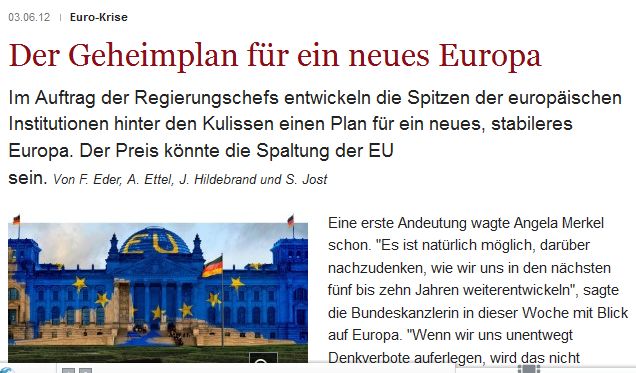
Står vi inför EU:s kollaps?
”Bankunionen” ett redskap i en utpressning
Det har skapats en ”flåsighet” kring frågan om bankunionen och den överstatliga finansmyndigheten som är direkt olycksbådande
Olof G. Hedengren, Realtid.se, 2012-11-14
EU:s förslag att inrätta vad man kallar en bankunion har som ett centralt inslag en övernationell tillsynsmyndighet. Innan denna nya dinosaurus kommit på plats kan inte den så kallade Europeiska räddningsfonden eller ESM (European Stability Mechanism) börja distribuera pengar direkt till finansiellt ansträngda banker.
På så vis blir försöken att hastigt och lustigt sjösätta ”bankunionen” ett slags redskap i en utpressning vilket visar sig i att de Sydeuropeiska EU-länderna är mycket angelägna om en snabb uppgörelse så att deras banker kan få sörpla ur ymnighetshornet.
Därför har det skapats en ”flåsighet” kring frågan om bankunionen och den överstatliga finansmyndigheten som är direkt olycksbådande.
Olof G. Hedengren är aktuell med memoarerna
Den ofrivillige bankiren
där han beskriver sina 30 år i finansbranschen på firmor som Aragon, Fischer Partners och ACH Securities.
Han är återkommande krönikör på Realtid.se.
EU-etablissemangets nyspråkliga innovationer
I sin kolumn i dagens DN säger Lars Calmfors att det finns ”skäl att allvarligt överväga ett svenskt deltagande i en europeisk bankunion”.
Det gör det förvisso, men det finns också skäl att allvarligt överväga att stå utanför.
Jag skall återkomma till denna sakfråga inom den närmaste tiden.
Just nu vill jag bara påminna om hur vårt sätt att tala om EU-frågor har utvecklats för att styra våra tankar.
Nils Lundgren, 30 oktober 2012
Calmfors är vår ledande ekonom på området EU-ekonomi och har visat både vilja och förmåga att stå emot trycket från den politiska makteliten under sina år som utredare och forskare. Just därför är hans uttryckssätt extra avslöjande.
Ta följande stycke i DN-kolumnen: ” Det finns en stor fara i att driva fram en finanspolitisk integration som euroländerna inte är mogna för. De flesta medborgare ser förmodligen fortfarande beslut om budgeten som helt centrala för det nationella demokratiska självbestämmandet.” (Mina kursiveringar.)
Varför skriver han ”inte är mogna för” i stället för det raka beskedet ”är emot”?
Och varför sätter han in ordet ”fortfarande” i den andra meningen?
Det finns goda skäl för en bankunion.
Den bör inkludera en gemensam mekanism för rekonstruktion och avveckling av banker i kris samt en gemensam insättningsgaranti.
Lars Calmfors, kolumn DN 30 oktober 2012
Det finns anledning att ifrågasätta uppfattningen att banktillsynen i Sverige fungerar så mycket bättre än i andra länder.
Till exempel underskattade de svenska myndigheterna grovt riskerna med våra bankers låneexpansion i Baltikum som kunde ha lett till att de gått omkull.
Det är förmätet att tro att Sverige aldrig kan hamna i en bankkris där vi behöver hjälp.
Merkel has cast doubt on one of the main benefits of eurozone banking union only hours after the bloc’s leaders agreed to a slightly clearer time table for the creation of a single bank supervisor.
Ms Merkel said that bad assets held by Spanish and Irish banks will not be cleaned up by the eurozone’s new €500bn rescue fund, adding that it should only be used to shore up teetering financial institutions in the future.
Financial Times 19 October 2012
So-called direct recapitalisation by the eurozone is important to Madrid because it must otherwise must borrow or self-finance about €40bn to prop up its stricken domestic lenders, adding to its sovereign debt load.
Banking union will not end Europe’s crisis
The banking union is a tool so powerful that it could unite the core of the EU.
It is more useful to think of the banking union as a long-term political project than as a tool of crisis resolution.
Depending on your view, it can be monumental or irrelevant.
Wolfgang Münchau, Financial Times, October 21, 2012
The banking union and its various cousins constitute the biggest act of political integration in Europe since the creation of the European Economic Community 55 years ago. I believe that they will be even bigger than the euro itself because they are a significant encroachment on national sovereignty on several levels.
While the combination of banking, fiscal and economic union, if done properly, would create a minimally sufficient institutional set-up for a sustainable monetary union, there is a big snag: the monetary union might blow up well before the new mechanisms kick in.
The banking union, as currently constructed, will not help us in the current crisis.
Även om eurokrisen kräver kraftfulla åtgärder så har EU slagit in på en farlig väg med den snabba rörelsen mot överstatlighet
i en tid när Europaprojektet genomlever sin hittills största förtroendekris.
Priset för att utan folkligt stöd förvandla EU till en regelrätt federation kan inom sinom tid bli högt.
Därför behövs nu ett mått av försiktighet och eftertanke.
Expressen-ledare, 20 oktober 2012
En bankunion behövs möjligen inom eurozonen men detaljerna måste i så fall vara extremt noga genomtänkta så att inte ansvarslöshet belönas.
Sverige har särskilt goda skäl att hålla huvudet kallt. Vi har välkapitaliserade banker, en utmärkt finansinspektion och står utanför eurozonen. Fredrik Reinfeldts skepsis inför det utökade samarbetet är sund. I det här läget bör vi nog alla vara glada att det inte är Folkpartiet som styr landet. Deras ledande företrädare uttryckte på Expressens debattsida i veckan "stor oro" över att Sverige "står utanför" det förstärka samarbete som eurokrisen tvingar fram.
På EU-toppmötets första dag i Bryssel beslöt EU-länderna att vänta med de praktiska detaljerna för en bankunion till 2013, vilket omöjliggör skyndsam krishjälp till spanska banker.
Jag välkomnar att man kommer att behöva jobba en hel del under en stor del av 2013 innan allt är på plats, sade Reinfeldt
Europaportalen, 19 oktober 2012
Inför toppmötet har några av EU:s institutioner lagt fram en delrapport om vägen till ”en genuin ekonomisk och monetär union”.
När det gäller förslagen om en gemensam banktillsyn anser Danmark och Sverige att ... de förslag som kommissionen nyligen lagt fram om en gemensam banktillsyn väcker en rad frågor. Den kanske viktigaste frågan rör vad som händer om den nya gemensamma tillsynen identifierar en bank som behöver rekapitaliseras. Vem ska då betala?
Fredrik Reinfeldt, statsminister i Sverige och Helle Thorning-Schmidt, statsminister i Danmark, DN Debatt 18 oktober 2012
Vi menar att det först och främst är bankerna själva som ska betala. Det är inte rimligt att skattebetalarna ska betala för bankernas misstag – inte heller vad gäller andra länders banker.
Nya initiativ bör diskuteras i en grundlig process som karakteriseras av transparens och med fullständigt deltagande av de nationella parlamenten.
Fredrik Reinfeldt i riksdagens partiledardebatt 13 juni 2012
Ett stort steg som pekar på fördjupning och överföring av suveränitet från nationalstaterna till den europeiska nivån.
Med kort varsel kommer det nu att avkrävas svar av Sverige som nation och av riksdagens partier om hur vi ska förhålla oss till mycket av det här.
The FT reports that the legal service of the European Council said the proposals to create a common bank supervisor in the ECB violated the Treaty.
Eurointelligence, 18 October 2012
The legal argument is the following:
A separate body inside the ECB to deal with banking supervision cannot make any formal decision, as only the ECB’s governing council is in a position to do so.
But this raises two specific problems for the non-eurozone members and for Germany.
The non-members cannot vote. And Germany does not accept the convolution of bank supervision and monetary policy in a single board.
The paper, according to the FT, says it would be possible for an ECB-based banking supervisor to make a recommendation for as long as the governing council takes the final decision.
The article quoted unnamed officials who said that it would be problematic to give voting powers to a committee that cannot take decisions – something that fell well short of a realistic political solution.
For the non-members, such a regime would not be of any interest.
The legal service also challenged a number of other aspects of the proposal, including the right retained by member states to decide how rules on their banks are applied when under the supervision of the ECB.
European leaders will try to bridge deep differences over plans for a banking union at a summit on Thursday
but no substantial decisions are expected, reviving concerns about complacency in tackling the three-year-old debt crisis.
It will be the fourth time EU leaders have met this year and the 22nd summit held since the crisis erupted in Greece in late 2009.
CNBC 17 October 2012
Yet diplomats expect no breakthroughs at the two-day gathering, with the agenda focused instead on longer-term efforts to retool the region's banks and economies.
Fears grow over EU banking union plan
EU leaders have expressed alarm that the eurozone’s push towards a banking union has stalled, setting up a confrontation with a more reluctant Germany at a European summit in Brussels
Financial Times 17 October 2012
The group includes the French, Spanish and British leaders as well as José Manuel Barroso, president of the European Commission, and Herman Van Rompuy, president of the European Council, who chairs the two-day summit beginning on Thursday. They are increasingly concerned that recent market calm has sucked the urgency out of the plan.
It’s clear that the eurozone doesn’t meet the standard economic criteria for an optimal currency area. Wages are not flexible and there’s little labour mobility between member countries.
Even if the economic fit isn’t perfect, currency unions can be held together by fiscal transfers from the richer to the poorer regions.
This is what happens in the United Kingdom, where Wales and Scotland are the recipients of English largesse.
Germany has had its own recent experience with a transfer union. Since the country’s reunification in 1990 large sums have flowed from the other Bundeslander towards east Germany.
Edward Chancellor, Financial Times, 4 November 2012
To date, west Germans have paid upwards of €1tn ($1.29tn) to support their brethren in the former German Democratic Republic.
A eurozone fiscal union could prove even more expensive
Fiscal transfers are not merely expensive, they don’t resolve any competitiveness issues within currency unions.
Reading these commentaries by Edward Chancellor and Wolfgang Munchau,
it occurred to me that a lot of the issue can be captured by one picture.
Paul Krugman July 12, 2010
Schäuble Plan 'Would Fundmentally Change Euro Zone
Considerable skepticism over whether the necessary changes to the European treaties could be made in a timely manner.
Der Spiegel, 17 October 2012
Alexander Graf Lambsdorff, a prominent member of the business-friendly Free Democratic Party, told the Financial Times Deutschland that while it might make sense to give the commissioner greater influence over budgets, it would still take five years for that to happen. Schäuble himself has set an ambitious one and a half years to accomplish that goal. He's proposing that the European Council, the powerful body representing the leaders of the 27 EU member states, convene a treaty-changing convention at its summit in December.
Finance minister Wolfgang Schaeuble
There must be an EU “currency commissioner” with sweeping powers to strike down national budgets;
a “large step towards fiscal union”; and yet another EU treaty
Ambrose Evans-Pritchard, 16 Oct 2012
Finance minister Wolfgang Schaeuble dropped his bombshell in talks with German journalists on a flight from Asia, and apparently had the blessing of Angela Merkel, the chancellor. “When I put forward such proposals, you can take it as a given that the chancellor agrees,” he said.
Officials in Brussels reacted with horror. “If that is the demand, they are not going to get it. Nobody in the Council wants a new treaty right now,” said one EU diplomat.
Michael Link, the country’s Europe minister, said Mr Van Rompuy’s plans are dead on arrival. “When you make proposals that are simply unacceptable for certain members, this will only give the impression of division. You can phrase it any way you like, 'treasury bills’, 'debt-redemption funds’ or 'eurobonds’, this type of debt issuance will not fly with our government. We have always said this very clearly.”
The comment invited a barbed retort from his French counterpart, Bernard Cazeneuve. “Well, for us, it is 'yes’, just as clearly,” he said. Such an open rift between Germany and France on the eve of a summit is rare.
Eurointelligence 17 oktober 2012:
The most extensive coverage this morning in Suddeutsche Zeitung, which says that Schäuble’s plan far exceed what is being discussed in Brussels now. Schäuble said the Group of Four discussions (European Council, Eurogroup, ECB, and Commission) that are currently taking place were too vague and set the wrong emphasis, which is why he decided to push ahead with his own proposals for reform – ahead of this week’s EU summit.
The paper said Schäuble had consulted with Angela Merkel. The proposals would require extensive treaty change. To that effect, Schäuble wants to set a constitutional convention this December. If there is no majority among the EU-27, Schäuble said the changes should be done among the Eurozone-17 (presumably on the legal basis of enhanced cooperation).
EU utan euron skulle säkra framtida fred
Vi behöver mer samarbete i Europa. Men det är fel väg att med eurokrisen som förevändning nu ta stora steg mot ett Europas förenta stater
fd riksbankschef Lars Wohlin och Rolf Englund, en av grundarna av kampanjorganisationen Medborgare mot EMU
Brännpunkt, SvD.se, 9 oktober 2012
Denna kris erbjuder Europa en enorm chans. Den har lagt fast dagordningen för åratal framåt: bankunion, finanspolitisk union och politisk union.
finanskrisen har inte bara skakat Europa i dess grundvalar utan antagit livshotande proportioner
Just nu står eurozonen på tröskeln till en bankunion, och en finanspolitisk union följer.
Men om så bara med en bankunion kommer trycket i riktning mot en politisk union att tillta.
Joschka Fischer, Kolumn DN, 2 Oktober 2012
Fredrik Reinfeldt upprepade de svenska villkoret om att svenska banker och skattebetalare inte ska kunna få betala för förluster i andra länders banksystem.
DN/TT 17 oktober 2012
Fredrik Reinfeldt måste ha en majoritet tillsammans med Socialdemokraterna i riksdagen om Sverige ska överväga att vara med frivilligt i euroländernas bankunion.
– Vi har också haft problem med våra banker, vi bad inga andra om hjälp, sade Reinfeldt.
Han underströk också att det är viktigt att Sverige att försäkras inflytande och att Sverige får ha högre krav på kapitaltäckning för bankerna än övriga EU.
Fredrik R låtsas inte förstå själva idén med en bankunion
Rolf Englund blog 17 oktober 2012
Förslaget om en bankunion, med en överstatlig finanstillsyn som ett första steg
kommer upp för diskussion på toppmötet nästa vecka
Rolf Gustavsson, kolumn SvD 13 oktober 2012
Fredrik Reinfeldt, Sweden’s prime minister, voiced the dismay of many.
Anders Borg, Sweden’s finance minister, warned his counterparts that a mishandled push towards eurozone banking union could “split the EU”, according to people present at a gathering to discuss the issue in Cyprus last month
Financial Times, 1 October 2012
“What is in it for us?” he said, when asked why non-eurozone countries would want to join. “If we are without influence . . . that will never fly. I don’t think any of the outs will accept that.”
At stake is more than sovereign control over banking: it is a test of whether the EU can handle deeper eurozone integration that has a direct bearing on all 27 economies.
EU officials have been taken aback by the vociferous objections of so-called eurozone ‘outs’ to their blueprint for a single bank supervisor – a reform that needs the backing of all 27 EU countries to become law.
The real source of uncertainty about the euro’s future is the failure of Germany and its European partners to commit themselves to the level of integration needed to hold the single currency together.
Systemic reforms will be needed, including some mutualisation of debts and a move towards a banking union, with euro-wide oversight and responsibility for banks
The Ecoonomist print 16 June 2012
“We urgently need to adopt a vision for a fully developed economic and monetary union. The moment of truth has arrived,”
says Michel Barnier, the EU’s top financial regulator.
“In acting on our vision we will no doubt have to make a quantum leap to a banking union.”
Financial Times 18 June 2012
In an apparent reference to the proposed euro bonds,
Merkel said that seemingly simple "collectivization ideas" are actually
"unconstitutional and completely counterproductive."
Der Spiegel 14 June 2012
Ms Merkel does not say “no” to eurozone bonds. She says: “Not without treaty change.”
The German constitutional court in Karlsruhe would never allow Germany’s sovereign guarantee to be given to its eurozone partners
without them submitting to effective and centrally budgeted discipline.
Financial Times 31 May 2012
S svänger om euroobligationer
Ett införande av euroobligationer skulle kräva ett närmare finanspolitiskt samarbete, där de länder som garanterar lånen vill ha ökat inflytande över länderna med svaga statsfinanser.
”Och jag kan inte se att det finns någon efterfrågan i Europa på minskat självbestämmande över finanspolitiken”,
säger Magdalena Andersson i DI 31 maj 2012
Why it is impossible - The Name Is Bond. Eurobond.
German central bank chief Jens Weidmann:
“The pooling of debt is just one side of a coin where federalism is the other.
Governments who are in favour (of eurobonds) fail to point this out,”
Sapa-AFP 26 maj 2012
“In those countries which are calling for eurobonds, France included, there is no public debate or public support for the transfer of sovereignty that that would entail. But it's precisely this debate we should be having,”
Common bonds “can only come at the end of a long process, which, among others, would require several states to change their constitution, modification of treaties and the creation of more of a budgetary union,” German central bank chief Jens Weidmann said
It turns out that they don’t mean a eurobond when they talk about a eurobond
We are back to where we were before. There is no strategy to solve the crisis
Eurointelligence Daily Briefing 22 May 2012
It turns out that they don’t mean a eurobond when they talk about a eurobond. They mean a project bond.
It will start with a “trial” of €230m, and yes that is million, a sum of no macroeconomic significance.
The idea is to allocate those funds to finance cross-border transport, communications and energy infrastructure.
And with this miniature scheme, Germany, the Netherlands, and Finland are still not happy.
Spiegel quotes a senior diplomat as saying that the real division was about whether this pilot scheme could be made permanent. The Germans request guarantees that this would be a one-off measure only.
So much for the eurobond. And so much for that dinner tomorrow night.
It looks like one of those useless and overhyped meetings where everybody will hype the new growth agenda. But when you look behind the headlines, you will quickly discover that we are back to where we were before, that there is no strategy to solve the crisis.
They are really getting worried about a Greek exit.
Francois Hollande and Mario Monti have now joined forced to present the idea of a eurobond
at the informal eurozone summit this Wednesday, El Pais reports
Eurointelligence, måndag 21 maj 2012
Greece’s exit from the euro
As the economist Barry Eichengreen, the leading authority on these matters, has argued, it
would provoke “the mother of all financial crises.” The contemplation of this possibility by EU leaders is making matters even worse.
Greece has no chance of recovery while this danger hangs over its economy.
Clive Crook, Bloomberg, May 16, 2012
Merkel can achieve fiscal union in Europe
We see the compact as a first step on the long road to joint and several liability for eurozone sovereign debt,
and the deeper fiscal union that the monetary union always implied.
The next step should be a Europe-wide banking recapitalisation scheme.
Niall Ferguson and Pierpaolo Barbieri, Financial Times 2 May 2012
Spains banks need more help than European Central Bank liquidity can provide.
So funds should be given directly to the troubled banks, much as the US did in late 2008.
A further step would be to create a proper eurozone-wide deposit insurance scheme. This would end the bleeding of national banking systems in the periphery.
If you want to claim funds of such size, you need joint and several liability
– ie all eurozone countries need to be jointly liable – not individual liability among member states.
Call it a eurobond, call it what you like.
If you do not want that either, then you have to accept that there is simply no backstop for Spain.
Wolfgang Münchau, FT 25 March 2012
Skuldkrisen är i första hand en ekonomisk kris. Därför bör inte EU springa iväg med stora, komplicerade ändringar av regler, institutioner eller av EU-fördraget.
Inte heller är euroobligationer eller utvidgade möjligheter för ECB att ge finansiellt stöd en lösning.
Det sade statsminister Fredrik Reinfeldt vid en presskonferens på tisdagen efter att ha träffat EU-ordföranden Herman Van Rompuy.
SvD nyhetsplats, 22 november 2011
The introduction of a Eurobond will require a broader and deeper economic government that extends well beyond the notion of a fiscal union.
But it might not happen. The crisis is moving too fast. We may well find that the Germans, the Dutch and the Finns are not ready for this.
Their political leaders have certainly not prepared the ground for such a momentous decision.
Wolfgang Münchau, FT 13 November 2011
Eurobonds are the only answer to Europe’s crisis;
Mario Monti, Financial Times, July 20, 2011
Rolf Englund blog 13 november 2011
Eurobonds are out of the question as Germany is against them and
they would require a change in treaties that would take years to approve.
Nouriel Roubini, FT 10 November 2011
För egen del tror jag att ännu starkare europeisk medicin då krävs än den som nu är aktuell:
samordnad budgetpolitik, mer ambitiös strukturpolitik, gemensam finansinspektion, bankakut och euroobligationer
De europeiska politikerna och deras väljare är dock inte beredda att gå så långt – i alla fall inte ännu.
Klas Eklund, kolumn SvD 2 oktober 2011
Föreställningen om euro-obligationer – ett slags XXL-lån där alla (läs: Tyskland) går i borgen för varandra
är kanske ekonomiskt förnuftigt, men riskerar att bli till en politisk härdsmälta som kan väcka alla våra slumrande nationella fiendebilder till liv.
Richard Swartz, DN 17 september 2011
Markets rally on a misunderstanding eurobonds
Eurointelligence 15 sept 2011
It was hilarious (lustigt) to watch a rally in peripheral bonds yesterdays as a consequence of a statement by Jose Manuel Barroso who said the European Commission would soon make proposals for eurobonds.
Barroso said yesterday that the Commission will present options, but that this will not bring an end to the eurozone crisis. This means the Commission is not going to propose an all-encompassing eurobond, but some partial bond, which may be nice to have, but will not bring down borrowing costs for sovereigns.
(The misunderstanding lies in the word eurobond. People have used it from anything from a common infrastructure bond to Treasury securities that would encompass most of Europe’s sovereign debt).
Barroso föreslår euro-obligationer
DI 2011-09-14 09:58
EU-kommissionens ordförande José Manuel Barroso bekräftade på onsdagen att han är i färd med att lägga fram ett förslag om så kallade euro-obligationer
"Vissa av dessa (euro-obligationer) skulle kunna börja användas inom ramarna för gällande EU-regler, andra kräver fördragsförändringar", sade Barroso inför EU-parlamentet i Strasbourg enligt Reuters.
Even a joint bond might not save the euro
Two months ago, it was said the worst things that could happen were that the crisis would extend to Italy and Spain; and the economic recovery would stall.
Now the crisis has extended to Italy and Spain, and growth in the eurozone economy has slowed.
Wolfgang Münchau, FT August 28 2011
Bundesbank questions legality of EU bail-outs
Germany's Bundesbank has issued a blistering critique of EU bail-out policies,
warning that the eurozone is drifting towards a debt union without "democratic legitimacy" or treaty backing.
Ambrose Evans-Pritchard, 22 August 2011
European Council President Herman Van Rompuy stuck his neck out twice
Mr. Van Rompuy’s view rests on an argument more often heard from Anglo-Saxon euroskeptics than from senior eurocrats:
that European leaders were mistaken to launch the single currency without first bringing their diverse economies closer together.
Wall Street Journal 22 August 2011
“We could only have euro bonds the day when there is truly a real budgetary convergence, the day when everyone is running a balanced budget or pratically a balanced budget.
That’s when we could have a euro bond. But not before,” he said.
Mr. Van Rompuy went on to argue that his opposition is not just a political judgment.
“We can’t make…the same mistake that some have made with the launching of the single currency. We launched a common currency but we forgot about having a common economic policy. Now we will launch euro bonds without having a much stricter and much more unified fiscal policy. We can’t make the same mistake,” he said.
For the man set to become the first euro-zone president, that’s a rather striking view.
Monetary union without fiscal union will not work, screamed the economists back then, and they were right.
Indeed, the euro is the main culprit in the current calamity.
It allowed the profligates to live like the Germans and to borrow like Italy, Greece and the others. For suddenly their debt was no longer denominated in melting liras and drachmas, but in cosy and reliable euros.
And down went interest rates for the big spenders.
Josef Joffe, The Times, 22 August 2011
The poisoned fruits of the euro now smell to high heaven. All the PIIGS (Portugal, Ireland, Italy, Greece, Spain) face insolvency, and the rest of euroland is paying with yet another rescue package or a towering credit-cum-guarantee shelter.
These are known by such opaque acronyms as EFSF or ESM, with the E standing for “Europe” and the S for “stability”.
Last year alone, Spain started to build 800,000 new homes
FT editorial 28/4 2007
Irland växte snabbt under 90-talet. Med euron tillkom en låg ränta som blåste upp en jättelik fastighetsbubbla
Irland
German Chancellor Angela Merkel attempted to shut the door on common euro-area bonds, saying that she won’t let financial markets dictate policy.
“At this time -- we’re in a dramatic crisis -- euro bonds are precisely the wrong answer,” “They lead us into a debt union, not a stability union.”
Bloomberg 22 August 2011
Joint euro bonds would require European Union treaty changes that would “take years” and might run afoul of Germany’s constitution, Merkel said.
While common borrowing might arrive at some point in the “distant future,” bringing in euro bonds at this time would further undermine economic stability and so they “are not the answer right now.”
Chancellor Angela Merkel saying that so-called euro bonds would be an option only in the distant future,
while her finance minister said that common debt would make it easier for governments to avoid pursuing responsible fiscal policies.
New York Times 21 August 2011
“It will not be possible to solve the current crisis with euro bonds,” Mrs. Merkel told ZDF television.
The German finance minister, Wolfgang Schäuble, said it would take too long for countries in the euro zone to amend the treaty on monetary union, which would probably be required to allow the bonds.
“We have to solve the crisis within the existing treaty,” he told the newspaper Welt am Sonntag.
The European Commission said it may present draft legislation on euro bonds
when completing a report on the feasibility of common debt sales.
“The report will, if appropriate, be accompanied by legislative proposals,” EU Economic and Monetary Affairs
Commissioner Olli Rehn said in a written response to a European Parliament question. “
Bloomberg 19 August 2011
Problemet med euroobligationer är att de inte innehåller några incitament för problemländerna att sanera sina statsfinanser.
I stället formaliserar de det förhållande som under mer än ett decennium gjort att de kunnat låna pengar till en betydligt lägre ränta än vad deras egentliga kreditvärdighet borde ha tillåtit.
Det var därför viktigt att euroobligationer avfärdades vid det tysk-franska toppmötet.
DN-ledare 18 augusti 2011
Europe's economy slides towards disaster
The EU leaders’ rhetoric in Paris makes it clear that they are not facing up to the existential crisis.
Jeremy Warner, Daily Telegraph 17 Aug 2011
President Sarkozy said:
"Eurobonds can be imagined one day but at the end of the European integration process, not at the beginning."
BBC 17 August 2011
Chancellor Merkel was far more cautious. Key members of her coalition have made it clear their outright opposition to eurobonds.
The coalition could even break up over the issue. Deutsche Bank has called eurobonds "poison pills".
Merkel and Sarkozy rejected an expansion of the 440 billion-euro ($633 billion) rescue fund and
rebuffed calls for joint euro borrowing to end the debt crisis
Bloomberg 17 August 2011
The euro bonds debate reflects what is perhaps the central existential question facing Europeans:
how much more central government and integration are they willing to accept to save the euro?
New York Times, 15 august 2011
Euro bonds are a deeply controversial idea among both economists and ordinary Europeans. Critics said they would not solve the financial crisis and might create unbearable political tension instead. Voters in stronger countries would balk at assuming the obligations of less prudent members. Some critics argued that euro bonds would unfairly raise borrowing costs for countries like Germany, and, rather than protecting the euro, could lead to the breakup of the currency union.
“Euro bonds could trigger very strong anti-European movements,” said Clemens Fuest, a professor at Oxford. “It would be very hard to sell in Germany.”
...
How much more central government and integration are they willing to accept to save the euro?
Det är det frågan om eurobonds handlar om
Rolf Englund blog 16 augusti 2011
George Osborne, George Soros, some eurozone leaders
and many economists (if you think their views are still worth hearing)
argue that the eurozone's salvation requires the adoption of a fiscal policy of "all for one, and one for all".
Robert Peston, BBC Business editor, 15 August 2011
So, although Mr Schaeuble is viewed as an opponent of the euro bond idea, that is not a "no, nay, never" from Germany.
It is a conditional yes.
Britain's Finance Minister George Osborne said some kind of fiscal union may now be needed
CNBC 14 Aug 2011
Asked if the only answer for the euro zone was some form of fiscal union, he told BBC radio: "The short answer is yes."
UK finance minister George Osborne
Germany and France are ruling out common eurozone bonds
to solve the bloc’s current debt crisis, in spite of renewed pressure ahead of a meeting of chancellor Angela Merkel and president Nicholas Sarkozy on Tuesday.
FT 15 August 2011
Wolfgang Schäuble, German finance minister, made clear in an interview with Der Spiegel, that Berlin remains opposed to such a policy.
“I rule out eurobonds for as long as member states conduct their own financial policies and we need different rates of interest in order that there are possible incentives and sanctions to enforce fiscal solidity,” he said.
In a SPIEGEL interview, billionaire investor George Soros criticizes Germany's lack of leadership in the euro zone,
arguing that Berlin must dictate to Europe the solution to the currency crisis.
He also argues in favor of the creation of euro bonds as a way out of the turbulence.
www.spiegel.de
...
Europe needs eurobonds
George Soros, FT August 14, 2011
The introduction of the euro was supposed to reinforce convergence; in fact it created divergences, with widely differing levels of indebtedness and competitiveness. If heavily indebted countries have to pay heavy risk premiums, their debt becomes unsustainable. That is now happening. The solution is obvious: deficit countries must be allowed to refinance their debt on the same terms as surplus countries.
This is best accomplished through eurobonds, which would be jointly guaranteed by all the member states.
While the principle is clear, the details will require a lot of work.
France's President Nicolas Sarkozy and Germany's Chancellor Angela Merkel will meet in Paris on Tuesday and make proposals on how to strengthen the euro zone's economic governance
Mr. Sarkozy and Ms. Merkel won't go as far as European Central Bank president Jean-Claude Trichet, who in the spring said the euro zone should be equipped with a finance minister, people familiar with the matter said. They will also repeat their opposition to creating sovereign Eurobonds because the issuer would have to be a federal political constituency, and the time for that isn't ripe
Wall Street Journal, 12 August 2011
European leaders will face an ever starker choice between a break-up of the euro zone and a closer fiscal union. Saving the euro will require a far bigger rescue fund than the zone has currently been prepared to accept.
A more robust idea from an economic perspective would be the ability to issue Eurobonds collectively backed by all the zone’s members.
That would be a huge political decision, not something European voters should see introduced through the back door: but a commitment to do it would provide a clear end to this saga.
Again, it is politically hard; but Germany’s Angela Merkel and France’s Nicolas Sarkozy are running out of options.
Aug 13th 2011 The Economist print edition
Related: Eurobonds
Slithering to the wrong kind of union
This time the consequence would be to threaten the collapse of the most successful project of economic integration in the history of mankind.
Otmar Issing, Financial Times, August 8, 2011
If you want to know how the EFSF could implode all of a sudden,
Eurointelligence 29 July 2011
Reuters quoted unnamed eurozone officials as saying that Italy may not be able to participate in the next Greek tranche in September, due to the rise in its own borrowing costs, which are now close to the peak last week ahead of the summit. The German-Italian spreads are now at the second highest level we have ever recorded. During a conference call of euro zone finance officials on Thursday, the Italian official said Italy might have to use the "step-out" option, which you can trigger if your own financing costs exceed those of the Greek loans. When a country steps out of the arrangement, other countries will have to make up its share, which in the case of Italy is a whopping 18%.
(The danger of the construction of the EFSF consists of a domino effect: Spain’s and Italy’s guarantees are not worth anything, which leaves the German and French guarantees as the economic core of the EFSF. But with the rise in France’s effective share come doubts about the country’s own triple-A rating. The entire system is as stable as the quality of the next country’s guarantee. This is why we believe that the EFSF/ESM is unsustainable. The only way out of this domino effect will be a joint and several guarantee, in other words a eurozone bond.)
The prospect of a break-up of the eurozone, either “apocalyptic or controlled”.
The author personally very much wants the euro to succeed. But he believes this would require a genuine federalist programme.
In contrast to other French pundits, he is precise about what he means by economic government, namely an institution concerned with eurozone-wide demand management and, unlike the ECB, with growth and not just price stability.
He is also quite precise on which taxes should be transferred to a federal fiscal authority.
Samuel Brittan, FT 28 July 2011
Christian Saint-Etienne, La fin de l'euro (The End of the Euro)
How much closer a union?
Deeper “transfer union” and issuing joint Eurobonds
Charlemagne, The Economist print July 30th 2011
“I am a federalist,” Mr Sarkozy told his colleagues. In joining the euro, countries had to surrender some sovereignty. That such views should be expressed by a former Gaullist, at a time when the EU is unpopular, was perhaps a surprise.
All this leads to talk of a deeper “transfer union” and of issuing joint Eurobonds. Mrs Merkel says this is a matter for future generations: Eurobonds would need both a new EU treaty and a new German constitution. But she may be forced to discuss it quite soon.
Spain and Greece, and most Socialist opposition parties, want Eurobonds.
The commission will propose them in the autumn.
Are citizens ready to give up more sovereignty to save the euro? Nobody has asked them.
The more leaders try to fix the euro’s flaws the more they risk exposing a flaw in the European Union itself: a project of European integration that lacks a strong democratic mandate.
Full textFor Nicolas Sarkozy, the French president, this is all
a big step towards the creation of a "European Monetary Fund" and, indeed, of a European "economic government".
Charlemagne, The Economist, July 21st 2011
He said there would soon be more proposals to integrate economic policies of the 17 euro area states. He relished the idea of creating a two-speed Europe; agreement at 17 was hard enough, he said; striking a deal with 27 leaders would have been nigh impossible
Daniel Hannan about illelgal eurobonds
Such a scheme will be expensive: it´ss hard to see it costing less than a trillion euros.
Most serious of all, it will be illegal.
Article 125 of the European Treaty could hardly be clearer:
"The Union shall not be liable for or assume the commitments of central governments, regional, local or other public authorities, other bodies governed by public law, or public undertakings of any Member State."
Rolf Englund blog 21 juli 2011
Eurobonds are the only answer to Europe´ss crisis
Mario Monti, former European commissioner, Financial Times 20 July 2011
Some are now openly advocating political union as the solution to the crisis.
The former EU Commissioner Emma Bonino was refreshingly candid when I met her in Rome last week.
She believes that a United States of Europe is the answer. She accepted that political union would have to be put to the voters.
Gavin Hewitt, BBC Europe editor, 18 July 2011
Bildt´s Nikolaus Blome asks all European (Eurobond-)Dreamers to wake up
In a lengthy comment Bild´ss deputy Editor-in-chief Nikolaus Blome asks those who dream of great leaps forward in European integration to wake up.
"Each one of these proposals for more Europe that would bring about more EU integration in the old style require a treaty change"
Hier lesen
Eurobonds som garanteras av alla medlemsländer
I förlängningen ligger en gemensam finanspolitik och politisk union.
Ska eurozonen räddas måste samtidigt konkurrenskraften i Sydeuropa höjas.
Tomas Lundin, SvD Näringsliv 18 juli 2011
Förmodligen blir det den europeiska krisfonden, EFSF, som går in och köper grekiska statspapper till marknadsvärde, alltså långt under utgivningskurs. Har man väl tagit det steget är det inte långt till att eurozonen ger ut Eurobonds som garanteras av alla medlemsländer.
Starka länder som Tyskland som har högsta kreditbetyg skulle troligen få betala ett högre pris för sin upplåning i framtiden vilket förklarar en del av Tysklands motstånd.
Ska eurozonen räddas måste samtidigt konkurrenskraften i Sydeuropa höjas.
I annat fall är miljardstödet bara ett plåster på såret. Fallande världsmarknadsandelar, sjunkande produktivitet och arbetskraftskostnader som i åratal har stigit snabbare än snittet i Eurozonen kännetecknar inte bara Grekland utan delvis också Italien och Portugal.
Att detta inte går ihop med en valuta som man delar med Tyskland eller Nederländerna vet alla.
Five years ago, I was among those who argued that the probability of a collapse of the eurozone was close to zero.
Last year, I wrote it was no longer trivial, but small.
I now would put the odds of a break-up of the eurozone at 50:50.
As I argued last week, a eurozone bond is the only solution to the crisis.
Wolfgang Münchau, Financial Times 18 July 2011
The endgame for Europe is approaching "” and much faster than anyone expected
Italy´ss bond market turbulence means the EU faces an immediate decision:
political union or scrap the euro
Anatole Kaletsky, The Times, July 13 2011
Soon the euro zone may well have to expand the EFSF and allow it to issue jointly guaranteed "Eurobonds".
It is not a pleasant option. But the alternative could be the end of the euro.
The Economist print editorial, July 14th 2011
Short-term help may have to come from the ECB buying Italian bonds (difficult politically because the next head of the ECB will be Mario Draghi, the boss of Italy´ss central bank). Soon though the euro zone may well have to expand the EFSF and allow it to issue jointly guaranteed "Eurobonds".
That is a huge political leap"”especially for Mrs Merkel. Germany is firmly opposed to any solution that could imply open-ended transfers to feckless southerners; so are several other northern European countries, not least because guaranteeing others may raise their own borrowing costs.
More about Euronds at this site
For Euro Zone, It's Euro Bonds or Else
Markets in Europe are being hit hard by fears that the debt crisis will spread to Italy,
which is regarded as too big to rescue. German media commentators say the time has come to
stop the piecemeal bailout efforts and to make the member states share liability for their debt
- via euro bonds
Der Spiegel 12 Juli 2011
The left-leaning Die Tageszeitung writes:
"The next approaching crisis -- in Italy this time -- shows that the euro states' rescue strategy isn't working. In fact, it shows that one can't even call it a strategy, strictly speaking. Buying time, whatever the cost -- not much more than that has happened in the one-and-a-half years since the Greek crisis erupted."
The Financial Times Deutschland writes:
"The case of Italy will show whether Europe is truly prepared to defend the euro. It's not enough to call for a few austerity packages or an increase in the rescue fund to €1.5 trillion. If the pressure on the country increases, Europe will have to break what has until now been a taboo: to pool the organization of borrowing and debt -- in a fiscal union with euro bonds. Alternatively, the EU must solve the problem on its periphery so fast, sustainably and decisively that the attacks on its core will cease."
More about Euronds at this site
EBU ett allt större hot - "The only solution is a eurozone bond"
Rolf Englund blog 11 juli 2011 i anledning av Wolfgang Münchau
A step closer to Eurobond-age
Rolf Englund, Financial Times,
Letters to the editor, December 9 2010
More about Euronds at this site
Från EMU till EBU
Rolf Englund blog 10 juli 2011
EU genomför fördragsändring i smyg
- Räddningsfonden (European Stability Mechanism, ESM) kräver en mindre ändring av EU:s fördrag.
Toppmötet i midsommarhelgen noterar att den fördragsändringen nu är färdig. Det skrev Mats Hallgren i SvD Näringsliv
Rolf Englund blog 30 juni 2011
Eurobonds, bondage och Vägen till träldom enligt Hayek
Rolf Englund blog 23 juni 2011
Those who argue that "political union" is the solution to the current crisis seem to believe that Europe´ss problem is institutional.
The real problem is political and cultural.
There is not a strong enough common political identity in Europe to support the single currency.
That is why German, Dutch and Finnish voters are revolting against the idea of bailing out Greece again - while Greeks riot against what they see as a new colonialism imposed from Brussels and Frankfurt.
Gideon Rachman, 20 June 2011
A list of the main creditors to Greece is now topped by the European Central Bank, the European Financial Stability Facility (EFSF), and the IMF. Especially in the case of the ECB, what were initially termed liquidity support operations have rapidly turned into semi-permanent transfers of resources from one economy to another.
Nouriel Roubini has called this "fiscal union by stealth".
Perhaps it is politically more feasible than a more open approach, because it is not sufficiently understood by the public,
Gavyn Davies, FT blog June 19, 2011
Ingredients of a European political union
The European Council will probably step back from the brink at its meeting on June 23-24, agreeing a new loan for Greece.
The alternative is a messy, disorderly Greek default in July.
And then they will have to do it again for Ireland, and for Portugal.
By 2014, the vast majority of Greek, Irish and Portuguese debt will be guaranteed by the other member states. What then?
Wolfgang Münchau, FT, June 5 2011
Genom finanskrisen håller EU på att få den förstärkta ekonomiska samordning som politikerna avvisade vid toppmötet i Maastricht för tjugo år sedan.
Dagens generation politiska ledare kan tvingas ta sådana steg - för att rädda den gemensamma valutan.
Den förstärkta politiska sammanhållningen kan komma bakvägen, trots att ingen verkar vilja ha den.
Rolf Gustavsson, SvD 5 juni 2011
Fy skam, fy skam, för ingen ville ha den
Rolf Englund blog i anledning av Rolf Gustavsson och invasionen i Normandie den 6 juni
Exorcising Lehman Ghost
Hours before Moody´ss raised Greece´ss default risk to 50 percent
the ECB president gazed at the symbol of unity used by the Holy Roman Empire´ss founder and 30 of his successors.
The next day, Trichet called for "historical perspective" when addressing the turmoil afflicting Europe´ss common currency.
Bloomberg 8 July 2011
As German Chancellor Angela Merkel flirts with solutions to the Greek crisis that rating companies say would amount to a default, Trichet says leaders can´st repeat the mistakes made by U.S. officials when they let Lehman Brothers Holdings Inc. fail.
"No credit event, no selective default, no default," he said at a press conference in Frankfurt yesterday.
Gavin Hewitt, Europe editor, BBC, om Trichet:
In his vision, the crisis in the eurozone is an opportunity for a great leap forward towards ever closer union
Rolf Englund blog 3 juni 2011
He also favors giving the European Union powers to veto the budget measures of countries
Trichet said governments should consider setting up a finance ministry for the 17-nation euro region
"Would it be too bold, in the economic field, with a single market, a single currency and a single central bank, to envisage a ministry of finance of the union?"
Trichet said in a speech today in Aachen, Germany.
Bloomberg 2 june 2011
He also favors giving the European Union powers to veto the budget measures of countries that go "harmfully astray," though that would require a change to EU Treaties.
He said today that while any single finance ministry would "not necessarily" administer "a large federal budget," it would "exert direct responsibilities in at least three domains."
These would include "first, the surveillance of both fiscal policies and competitiveness policies" and "direct responsibilities" for countries in fiscal distress, he said.
It would also carry out "all the typical responsibilities of the executive branches as regards the union´ss integrated financial sector, so as to accompany the full integration of financial services, and third, the representation of the union confederation in international financial institutions."
Trichet, Karl den Store och Göran Persson hos SNS
Rolf Englund blog 2 juni 2011
Makten i Europa
Presentation av Demokratirådets rapport SNS 2011
Göran Persson och Birgitta Ohlsson kommenterar
SNS Tisdagen den 31 maj klockan 09.00-12.00. Jakobsbergsgatan 18
Ursprungligen fanns ett fåtal politikområden där EU hade inflytande - idag är nästan alla områden föremål för någon form av lagstiftning eller samordning inom unionen. Penning-, asyl- och försvarspolitik är exempel på kompetens som lagts till listan av EU:s traditionella frågor som som handel och jordbruk.
Logiken i det hela rör sig i federativ riktning... Sch! säger Kohl åt mig när jag tar upp det.
Göran Persson, Fichtelius, sid. 391
Den europeiska byråkrati som Menasse imponeras av och som Enzensberger gisslar i EU-kommissionen har under senare år blivit allt mer förvaltande och allt mindre av den pådrivande motor som hyllas i retoriken.
Detta försvårar lösningen på den problematik som både Menasse och Enzensberger brottas med, nämligen den europeiska demokratiska kontrollen.
Rolf Gustavsson, SvD 21 maj 2011
Den tyske författaren Hans Magnus Enzensberger i en essä om Bryssel som ett mjukt monster som omyndiggör Europa i den postdemokratiska tidsåldern. Enzensberger är inte imponerad. Han är förskräckt över kommissionen som en bastard. Framdelen som ett lejon, bakdelen som en orm och mittpartiet som en get.
I det tysta fortsätter den europeiska integrationen.
Och under det senaste året har det gått fort. För närvarande slutförhandlas ett helt paket av lagar och andra bestämmelser
som sammantaget liknar ett skelett för gemensam ekonomisk politik i EU.
Allt ska vara klappat och klart i juni.
Samtidigt som den europeiska populismen går framåt tas det alltså ett par ordentliga kliv framåt på väg mot en politiskt alltmer sammansvetsad union.
Gapet mellan retoriken och det som sker i verkligheten vidgas - vilket utgör ett växande problem.
DN-ledare 9 maj 2011
Den som vill göra EU till ett nytt romerskt rike bör först fråga folket
Rolf Englund blog 9 maj 2011
Europe´ss political elites are afraid to tell a truth that economic historians have known forever: that a monetary union without a political union is simply not viable. This is not a debt crisis. This is a political crisis.
The eurozone will soon face the choice between an unimaginable step forward to political union or an equally unimaginable step back.
Wolfgang Münchau, Financial Times, May 8 2011
Sources with information about the government's actions have informed SPIEGEL ONLINE that
Athens is considering withdrawing from the euro zone
Der Spiegel Onlina 6/5 2011
Martin Wolf argues that the eurozone faces a choice between permanent pro-cyclical adjustments, a break-up; or closer union
FT 3/5 2011
Why is Spain paying higher interest rates on its government debt than the UK?
The answer to this question is illuminating: membership of a currency union makes a country fiscally fragile. This is inherent in the construction: members are neither sovereign states nor components of a federation.
The big challenge for the eurozone is to resolve this contradiction.
In an important paper, Paul de Grauwe of Leuven university notes this contrast between the current positions of Spain and the UK.
The eurozone is inherently fragile. Moreover, because of the financial connections inside the union, the fragility of one is the fragility of all. What can the eurozone do about this? I see three alternatives: accept fragility; become more homogeneous; or move towards a far closer union.
The eurozone must move forward, or go backwards. I assume it will choose the first option. But that is a political choice.
Either people and politicians believe they share a common destiny, or they do not.
This choice may not be made tomorrow.
But it has to be made.
Martin Wolf sätter EMU och folkstyret på sin spets - Skall vi uppge vår suveränitet och bli likt provinser i det forna romar-riket.
Rolf Englund blog 4/5 2011
Auftritt der Anti-Euro-Krieger
Finnlands Rechtsaußen Timo Soini hat mit seinen "Wahren Finnen" 19 Prozent geholt und drängt in die Regierung.
Der Erfolg ist kein Zufall, überall zwischen Nordkap und Palermo sind Scharfmacher auf dem Vormarsch.
Ihr Feindbild: der Euro, die EU, der Islam.
Der Spiegel, 18/4 2011
In a front page editorial with the title "žWarning shot from the North-East" Frankfurter Allgemeine Zeitung´ss Klaus-Dieter Frankenberger warns against stigmatizing the True Finns as populist rightists.
"Whoever tries to put those parties which capitalize from this disgruntlement in the same corner as demagogues should remember that even the federal government (of Germany) said until recently that
the interdiction to bail out other countries was nonnegotiable."
Eurointelligence 19/4 2011
Peter Ehrlich, in FT Deutschland, sees the rise of a European Tea Party, as the establishment has completely decoupled from ordinary citizens.
There is a sense now that what started as a financial crisis is now turning into a political crisis.
Eurointelligence 19/4 2011
"This scenario posits that sooner or later, the cement that has held European countries together for decades cracks and the progression towards ever-closer union comes to a spectacular halt,"
The risk is roughly one in seven that Europe's ongoing debt crisis will push member nations to abandon the shared currency,
raising the spectre of the "effective end of the euro area,"
The Economist Intelligence Unit has warned
Daily Telegraph 4 Apr 2011
SPIEGEL Interview with Ex-ECB Chief Economist Issing
Issing: Before the euro was introduced, former Chancellor Helmut Kohl said: The monetary union will not function without a political union.
But a political union of Europe doesn't exist, and it won't happen in the foreseeable future.
That's why we need mechanisms that force the member states to pursue solid financial policies. These mechanisms are missing, and even the most recent decisions reached in Brussels can do little to change this.
Otmar Issing, Der Spiegel 23/3 2011
The Fundamental Problem with Efforts to Save the Euro
European politicians are still pursuing a path to integration that citizens have long since abandoned.
For former German Chancellor Helmut Kohl, the idea of "maintaining an economic and monetary union in the long term without a political union" was an "absurd notion."
Michael Sauga, Der Spiegel 03/30/2011
Whenever something goes wrong in the gears of the community, European politicians call for more integration. They see the crisis as an opportunity and, in doing so, are adhering to the traditional Brussels motto that Europe functions like a bicycle: if it doesn't move forward, it falls over.
/Men varje 5-åring vet ju att det är mycket lätt att få stopp på cykeln utan att ramla. Man bromsar och sätter ner foten. Likadant är det med EU. Man skall bromsa och sätta ned foten. Rolf Englund i Nya Wermlands-Tidningen 2002-03-01/
Udo Di Fabio, a judge on Germany's Constitutional Court in Karlsruhe, speaks of "conceptual limits that can in fact only be exceeded by taking a spirited step in the direction of the federal state."
But neither governments nor citizens are prepared to take such a step.
As a result, the center of power in Brussels is distancing itself from the needs and perceptions of its base.
European politicians are still pursuing a path to integration that citizens have long since abandoned.
Last week, the political developments in Germany shifted dramatically in the wrong direction.
The Bundesbank, the parliament, the small business community and influential academics have all come out openly against an extension of the various support mechanisms.
German society as a whole is in open revolt against the eurozone.
The only reason to accept such a loss of sovereignty would be the prize of an ever closer economic union.
Wolfgang Münchau, FT, February 27 2011
Dangers lurk in Franco-German plans for a more tightly integrated euro zone
The Economist print Feb 10th 2011
On the face of it, the pact is about bolstering the economic bit of Europe´ss economic and monetary union (see Charlemagne).
But the pact does little to resolve the euro´ss current sovereign-debt crisis.
First Greece and then Ireland have been bailed out. Portugal may be next. Yet though this may buy time, it fails to recognise that Greece and maybe the other two as well are insolvent (see article).
The pact also includes ideas that are not just unhelpful, but also damaging. One is to impose constitutional amendments to enforce balanced budgets, which are too rigid in a system without a big federal budget.
This should also worry EU countries outside the euro, including Britain, Poland and Sweden.
/Datalagrings/direktivet, som har baxats fram av medlemsländernas regeringar och röstats igenom
i Europaparlamentet (där svenska väljare utser 18 ledamöter av 736), kan formellt inte stoppas av våra folkvalda.
Paulina Neuding,chefredaktör för magasinet Neo, kolumn SvD ledarsida 26/3 2011
Den svenska riksdagen har alltså ingen rätt att avslå EU-direktiv, varken med hänvisning till svensk grundlag, Europakonventionen, eller mänskliga rättigheter i största allmänhet. Att riksdagen röstade nej till datalagringsdirektivet räknas som ett brott mot EU:s fördrag och innebär att vi blir skyldiga att betala en straffavgift.
Ronald Reagans ofta citerade "Det är staten som är problemet", har alldeles särskilt kommit att gälla bygget av en europeisk superstat.
Att borgerligheten drev på för ett medlemskap för fredens, demokratins och frihandelns skull är inte skäl att okritiskt älska en politisk koloss som i allt större utsträckning ägnar sig åt annat.
Paulina Neuding chefredaktör för Neo, SvD 19/12 2010
The tragedy of the Euromess is that the creation of the euro was supposed to be the finest moment in a grand and noble undertaking: the generations-long effort to bring peace, democracy and shared prosperity to a once and frequently war-torn continent.
But the architects of the euro, caught up in their project´ss sweep and romance, chose to ignore the mundane difficulties a shared currency would predictably encounter
Instead, they engaged in magical thinking, acting as if the nobility of their mission transcended such concerns.
Paul Krugman, New York Times, January 12, 2011
When the single European currency was first proposed, an obvious question was whether it would work as well as the dollar does here in America. And the answer, clearly, was no "” for exactly the reasons the Ireland-Nevada comparison illustrates. Europe isn´st fiscally integrated: German taxpayers don´st automatically pick up part of the tab for Greek pensions or Irish bank bailouts. And while Europeans have the legal right to move freely in search of jobs, in practice imperfect cultural integration "” above all, the lack of a common language "” makes workers less geographically mobile than their American counterparts.
America, we know, has a currency union that works, and we know why it works: because it coincides with a nation "” a nation with a big central government, a common language and a shared culture. Europe has none of these things, which from the beginning made the prospects of a single currency dubious.
These observations aren´st new: everything I´sve just said was well known by 1992, when the Maastricht Treaty set the euro project in motion. So why did the project proceed? Because the idea of the euro had gripped the imagination of European elites. Except in Britain, where Gordon Brown persuaded Tony Blair not to join, political leaders throughout Europe were caught up in the romance of the project, to such an extent that anyone who expressed skepticism was considered outside the mainstream.
A failed euro wouldn´st send Europe back to the days of minefields and barbed wire "” but it would represent a possibly irreversible blow to hopes of true European federation.
Move forward decisively on the path toward "federalization" of economic and fiscal policies.
In my view, this is the right course
The European Council should lead this effort toward federalization and a single global voice,
including proposing the requisite changes in the European treaties,
even when it may be expected that some countries of the Union may not wish to join this development.
Felipe González New York Times 7/1 2011
The financial crisis has exposed the crisis of governance at the heart of the European project.
Logically, this federalization should be completed with a common foreign and security policy, for which the current treaty provides sufficient authority.
I am convinced that sharing sovereignty through a federal structure is not objectionable to most Europeans.
Felipe González is a former prime minister of Spain and a founding member of the 21st Century Council sponsored by the Nicolas Berggruen Institute.
Mr Issing said proposals that Emu should be expanded into a "transfer union" - the transfer of funds from Germany and other financially strong states to weaker, highly indebted states - were wrong.
"This would wholly change Emu´ss character," he said.
FT 11/1 2011
He observed that some European politicians were advocating a bold leap towards political union as a solution to the crisis, but said: "I can only warn against the objective of trying to create political union through the back door of the common currency.
It´ss simply stunning that this revolution in the European political system is about to take place under the guise of a "limited treaty change"
that European officials say will not require the votes of member states. It´ss hard to believe that anyone truly thinks this is minor;
more likely the EU officials are just frightened that the peoples of Europe will not accept the new regime. Better to impose it before the people can oppose it.
John Carney, Senior Editor, CNBC.com, 20 Dec 2010
Folkomrösta om EU:s fördragsändring för räddningsfonden
Rolf Englund blog 18/12 2010
How can Germany or France agree lightly to plans that amount to
an EU debt union, with a common treasury, tax system, and budget policy,
the stuff of civil wars and revolutions over the ages?
To do so is to dismantle the ancient nation states of Europe in all but name.
Ambrose Evans-Pritchard, 12 Dec 2010
The flaw was this: productive activity always tends to migrate to centres of economic success and prosperity.
Martin Jacomb, FT December 19 2010
A step closer to Eurobond-age
Rolf Englund, Financial Times, Letters to the editor, December 9 2010
From Mr Rolf Englund.
Sir, European sovereign bonds, called E-bonds, would end the crisis, according to Jean-Claude Juncker and Giulio Tremonti (Comment, December 6). In fact it would be a step, hard to reverse, on the road to something that many would call a fiscal union federal superstate. There we would end up in a state of European bondage.
Google translates bondage to a Swedish word that in English is "serfdom" (livegenskap).
So maybe we are on The Road to Serfdom, after all.
Director, IntCom,
Stockholm, Sweden
More by Rolf Englund in english
Eurokrisen farligare än en terrorist från Tranås
Rolf Englund blog 13/12 2010
The political foundations for union were never laid. Governments kept building higher and higher regardless.
History and ordinary prudence dictated that the union might be broad and shallow (a free-trade area)
or else narrow and deep (an evolving political union, confined to countries willing to be led there.
But the architects did not even have the brains to choose the second. They recognized no limits to their ambitions.
They set about creating a union that was both broad and deep. A federal constitution, a parliament, a powerful central executive, one central bank, one currency - all with no binding sense of European identity.
As for scale, well, the bigger the better. Today Greece, tomorrow Turkey. And why stop there? Madness.
Clive Crook is a senior editor of The Atlantic, a columnist for National Journal, and a commentator for the Financial Times. He worked at The Economist for nearly 20 years, including 11 years as deputy editor.
The Atlantic Journal May 13, 2010
Den ekonomiska politiken i EU måste utvecklas och det kan bara ske gradvis.
Den nationella budgeten är ett slags kärna i alla medlemsstaters självbestämmande och demokrati.
DN-ledare 26/9 2010
Sven-Otto Littorin oroade sig för tecken
på ökad federalism inom EU
SvD-ledare 12/3 2003
Av idén om ett politiskt och ekonomiskt alltmer sammansvetsat Europa har blivit
idén om ett alltmer utvidgat Europa, vilket inte nödvändigtvis är samma idé
även om båda idéerna för närvarande samsas under namnet EU
Göran Rosenberg, kolumn DN 24 augusti 2010
Det gigantiska krispaketet och EU-kommissionär Olli Rehns kommande förslag om skärpt budgetkontroll innebär att det tas ytterligare några ordentliga kliv på väg mot den "allt fastare sammanslutning mellan de europeiska folken", som det så vackert heter i EU:s fördrag ända från Rom (1957) till Lissabon (2009).
Annika Ström Melin DN Signerat 2010-05-11
Federalisterna, Jugoslavien, Annika Ström Melin och Göran Persson
Rolf Englund blog 2010-05-14
Taking on the 'wolf pack'
President Van Rompuy said:
"We can't have a monetary union at the end without some form of economic and political union,
and that is our big task for the coming weeks and the coming months."
BBC 10 maj 2010
Full text
Charlemagnes notebook, The Econmist Dec 28th 2009
There can be no more pretence that monetary union respects the premise
on which it was sold to European citizens, Germans in particular.
Financial Times editorial May 10 2010 20:41
There is a real chance that a euro member´ss failure to pay its debts will land neighbours or the ECB with losses that can only amount to fiscal transfers or money-printing. Strict surveillance and ECB independence was meant to make it impossible to end up in this situation; both have been undermined.
I överenskommelsen som snickrats ihop av Frankrike och Tyskland ingår också att euroländerna vill stärka koordineringen av den ekonomiska politiken
I den franska översättningen står också att stats- och regeringscheferna i sitt Europeiska råd ska vara en ekonomisk regering för EU.
Ljuva ord för en fransman, men väl magstarkt för många medlemsstater och texten har därför mildrats i den engelska versionen.
SvD/Utrikes 26 mars 2010
Inte heller Fredrik Reinfeldt tycker om den franska formuleringen, men han kan köpa bättre kontroll och koordinering, så länge det inte innebär att EU:s fördrag måste skrivas om.
- Det är bara bra om vi använder de ordningsvakter som finns i det europeiska systemet, säger han
.Om alla 27 EU-länderna ställer sig bakom, kommer Herman Van Rompuy att få i uppdrag att leda en grupp som till slutet av året ska föreslå åtgärder för att budgetdisciplinen ska förbättras.
The accord masks a bitter struggle between Germany and a French-led bloc over the future shape of Europe.
For all the rhetoric, Berlin has refused to cross the Rubicon towards an EU fiscal union, shattering long-held assumptions about the inevitable march of the EU project.
By bringing in the IMF, it ensures that each sovereign state remains responsible for its own debts.
Ambrose Evans-Pritchard 25 March 2010
Krisen i euroländerna driver fram förslag om gemensam finanspolitik i EU.
Nu diskuteras nya skatter på EU-nivå. Sverige måste stå emot ökad centralism
Riksdagsledamoten Karl Sigfrid (M) och Mats Persson, chef för tankesmedjan Open Europe, SvD Brännpunkt 31 maj 2010
Diskussionen om Grekland handlar inte bara om pengar, utan ytterst om fördjupat samarbete.
Euroländerna har i dag gemensam valuta, gemensam penningpolitik och gemensam centralbank. Men varje land sköter själv sina statsfinanser och sin ekonomiska politik. Greklands kris visar på riskerna med det
Men om euroländerna ska ge stöd åt den medlem som råkat i knipa kommer det oundvikligen att följas av krav på inflytande över medlemsländernas ekonomiska politik och budgetar.
Henrik Brors, DN 25/3 2010
Kommer krisen i Grekland att leda till slutet för valutasamarbetet i EU?
Nej, det mesta pekar för närvarande åt rakt motsatt håll.
Annika Ström Melin, Signerat DN 2010-05-04
Många euromoståndare i Sverige varnade för den politiska union som Issing förespråkade.
Statsminister Göran Perssons utdragna eurovånda handlade också om valutunionens konstruktion.
Går det att ha gemensam valuta utan att också ha gemensam ekonomisk politik?
Den frågan vände och vred Persson på under flera års tid.
Det borde vid det här laget vara klart att svaret är nej.
Annika Ström Melin, Signerat DN 2010-02-17
Europe stumbles upon closer union
The giant currency union has bound 16 European Union states into a monetary bloc. The member countries, however, remain sovereign states with control over their own taxes and spending.
If it organises a rescue of Greece, the EU will cross a political Rubicon, heading towards a more complete union.
Financial Times editorial, February 12 2010
But even for advocates of closer integration in Europe, this is a mistake. The EU suffers from a lack of popular legitimacy. The manner in which the Lisbon treaty was passed was unedifying, giving the impression that the EU is a stitch-up by a small elite.
If Europe, or just the Eurozone, is to become more deeply joined, it should be a deliberate and honest process, not an accidental and covert one.
Rubicon - Caesar: Tärningen är kastad
Wikipedia
Fervent federalists (and a few Eurosceptics) have rushed to claim that the euro´ss long-term survival requires a United States of Europe, with a big central budget.
A United States of Europe is not going to happen, because neither EU governments nor voters want it.
The bigger failing is that several (mostly Mediterranean) members have suffered a huge loss of competitiveness against Germany and other northern countries.
The Economist Sept 23rd 2010
Might the markets be the answer to keeping discipline in the euro zone?
Retain the possibility of sovereign default, and work out an orderly procedure for restructuring a euro member´ss debts if they become insupportable
"”as may still happen for Greece or even Ireland.
If a euro-zone member can default, the chances are good that investors will impose tougher discipline on any country with excessive debts.
Too many governments believed that, once in the euro, they could worry less about competitiveness. Actually, they should have worried more, because they have lost for ever the let-out of devaluation.
Top og pageSceptical commentators in places such as America and Britain have long underestimated the political will within the euro zone to defend the single currency, which was always as much a political as an economic project.
Both Mr Sarkozy and Mrs Merkel said at the Brussels summit that the current economic crisis had generated support across the EU for much closer co-ordination of economic policies within the union. Both talked about moving towards an "economic government" for Europe.
Charlemagne, The Economist Feb 11th 2010
Krugman, Nils Lundgren och Europas Förenta Stater
Rolf Englund blog 2010-02-10
Professor Paul de Grauwe
"Without further steps towards political union, the eurozone has little chance of survival"
Ambrose Evans-Pritchard, Daily Telegraph 16/7 2007
Frankrike har länge stött en sådan idé och presenterade den mitt under brinnande finanskris i slutet av 2008. Storbritannien och Tyskland fortsätter att vara emot förslaget som de ser som en attack på deras ekonomiska själständighet. Stefan de Vylder tror inte heller att den strategi som Van Rompuy föreslår kommer att kunna lösa något.
- Jag tror det skulle vara svårt att få medlemsländerna att acceptera en sådan överstatlig kontroll över deras budgetar, säger Stefan de Vylder.
I dag väntas Sverige fällas i EU:s domstol för att regeringen ännu inte infört EU:s så kallade datalagringsdirektiv i svensk lag.
Ekot 4 februari 2010
EU-direktivet ålägger teleoperatörerna att lagra uppgifter om e-posttrafik och telefonsamtal, alltså vem vi ringer och vem vi e-postar till.
Full textIt is worth being specific about what much deeper political union would mean.
Those proposing a political federation of 27 EU member countries basically mean a union with much more majority voting, ie a union in which countries can be outnumbered and voted down even on issues that touch on the core political and social contracts between authorities and citizens: issues from taxation to foreign policy.
That is the meaning of all those commentaries from supporters of deeper European integration blaming Copenhagen on the catastrophe of inter-governmental negotiations, in which all countries have a veto.
Charlemagnes notebook, The Econmist Dec 28th 2009
I think there are big problems of democratic legitimacy to be thought through here. Ask pro-integrationists about Europe's lack of connection with voters, and their response is more Europe: pan-European political parties, pan-European publicly funded media, pan-European referendums on new treaties (ideally that are binding if a majority of all EU voters say yes) and candidates standing for pan-European constituencies in the European Parliament. This is a long argument for another day, but I just do not believe you can legislate a European demos into existence.
Logiken i det hela rör sig i federativ riktning... Sch! säger Kohl åt mig när jag tar upp det.
Göran Persson
Det är målsättningen om ett ständigt fastare förbund
- "ever closer union" -
som är själva grundbultsfelet med EU.
Kunde vi rulla tillbaka Sovjetunionen skall vi väl kunna rulla tillbaka Europeiska Unionen.
Rolf Englund Barometerns website 7/6 2005
Rösta inte på partierna som lägger sig platt
Vi måste förhindra att EU-författningen kuppas igenom
Rolf Englund, Barometern 31/3 2004
I can think of only two reasons, why the loss of Lisbon should excite such anger and determination.
First, it doesn´st matter what the treaty does. It is just unacceptable for one small country to thwart the will of the political leaderships of the big countries.
The second reason could be that the treaty is crucial because it is the next stage in the drive for political union, which began with the Single European Act and continued with Maastricht and the creation of the Euro. Lisbon, in itself, is a disappointingly small step towards political union.
But - if it is stopped - the whole process is stopped. And that is unacceptable.
Gideon Rachman, Financial Times June 24, 2008
British/American Special Relationship and European Union
Britain cannot have two best friends
John Bolton, Financial Times 1/8 2007
At Tuesday's press conference in Strasbourg, the Commission President Jose Manuel Barroso was asked what the European Union would be after the new reform treaty has been negotiated and agreed.
His answer: Europe is an empire, a non-imperial one, must be said.
But still, an empire.
EUX.TV 10/7 2007
If you want to understand what is happening to the European Union´ss constitution, the EU flag is a good place to start.
European leaders will agree to delete references to the flag in the constitution.
Everybody knows the flags will keep flying.
The words in the constitution will change.
But the substance will remain the same.
Gideon Rachman, Financial Times June 12 2007
The European Project has been about building a European super-state - Ruth Lea
Europe's ``ever closer union'' is turning into an ever more divided one - Bloomberg
Det är målsättningen om "ever closer union" som är själva grundbultsfelet med EU - Rolf Englund
From the Treaty of Paris (1951), which set up the European Coal and Steel Community, and the Treaty of Rome (March 1957), which set up the European Economic Community, to the Constitutional Treaty (signed in 2004), the EU has been working towards the "ever closer union of the peoples of Europe".
The European Project, from the very start, has been about building a European super-state - though cleverly masked as an economic exercise.
A looser and more open Europe is surely the way forward for the 21st century.
Ruth Lea, Daily Telegraph 20/11 2006
Ruth Lea is the director of the Centre for Policy Studies and a non-executive of Arbuthnot Banking Group
There are real public concerns about the scope and pace of enlargement. Moreover, these concerns are likely to be intensified with the accession of Romania and Bulgaria, both very poor countries, in January 2007.
Under the current Treaty of Nice, the EU cannot have more than 27 members. The maximum figure will be reached /have been reached/ with the accession of Romania and Bulgaria.
In February 2005, French President Chirac inserted a clause into the French Constitution, subjecting every new candidate for EU membership to a referendum of the French electorate. The implication is that any enlargement beyond the current EU plus Bulgaria, Romania and Croatia (whose entry negotiations were in the pipeline before the amendment was pushed through) can be rejected by the French electorate.
Apart from Croatia, the other candidate countries comprise the Republic of Macedonia and, most controversially of all, Turkey. Potential candidate countries are the West Balkan countries of Albania, Bosnia and Herzegovina, Montenegro and Serbia.
The solution to both these challenges is to replace the monolithic 20th century EU model with a new 21st century "Ã la carte Europe", where individual states can negotiate different relationships with the EU, deciding which is the most appropriate.
There are many possible catalysts for this desirable, arguably necessary, change. I suggest two.
The first is if the UK were to open negotiations for a changed relationship with the EU to one basically of free trade, opting out of political union and thus ceasing to be a member of the EU as currently structured.
The second would be the formal recognition that some candidate countries, notably Turkey, cannot be full members of the present monolithic EU.
What was meant to be Europe's ``ever closer union'' is turning into an ever more divided one.
As the European Union marks its 50th birthday this week, it faces a growing backlash against the federal visions of its post-World War II founders, who gave Europe a common market, a currency, a flag and an anthem.
March 19, 2007 (Bloomberg)
``Europe faces one of its gravest political crises since World War II,'' says Charles Kupchan, a professor of international relations at Georgetown University in Washington and senior fellow at the Council on Foreign Relations.
``It's completely conceivable that the EU has reached its high-water mark.''
For years, the six original members sought a more closely knit economy with the goal of bringing political unity in through the back door. That was the two-track strategy mapped out by Jean Monnet, the French cognac salesman turned founding father of a united Europe.
The high point of European unity was in 1991, when European leaders met in Maastricht, the Netherlands, to sketch the road map to a single currency.
The federalists, though, haven't given up. They are pinning their hopes on German Chancellor Angela Merkel, in her first stint in the bloc's six-month rotating presidency, to salvage at least part of the constitution, which 18 countries have ratified. A few want to go even further: Belgium's prime minister, Guy Verhofstadt, is calling for a United States of Europe with its own taxes and army.
Merkel's first step, at the March 25 festivities, is to win a consensus for a declaration on the EU's future.
The Germans have already made one concession, jettisoning the word ``constitution.''
The new, less provocative term: ``institutional settlement.''
Grundlagen - The Constitution/institutional settlement
Det är målsättningen om ett ständigt fastare förbund
- "ever closer union" -
som är själva grundbultsfelet med EU.
Kunde vi rulla tillbaka Sovjetunionen skall vi väl kunna rulla tillbaka Europeiska Unionen.
Rolf Englund Barometerns website 7/6 2005
Det folken har sagt nej till är, efter vad jag förstår, att EU skall utvecklas till en stat.
Det är målsättningen om ett ständigt fastare förbund - "ever closer union" som är själva grundbultsfelet med EU.
Ãterför makt från EU till de nationella parlamenten.
Avskaffa EMU.
Man måste vara blind om man inte ser att EU skaffar sig statens alla institutioner och symboler, flagga, mynt, president, parlament, domstol, försvar - och - som man nu försökte - en grundlag.
Kunde vi rulla tillbaka Sovjetunionen skall vi väl kunna rulla tillbaka Europeiska Unionen.
I själva verket verkar det som om om tillbakarullningen redan har börjat.
Angela Merkel:
“The new treaty will not include state-like nomenclature or symbols,”
“Many of our partners feel these stand for the European superstate.
References to the EU’s blue flag with gold stars, its anthem – Beethoven’s Ode to Joy – and its motto, “United in diversity”, would be axed from the text, although all those symbols would remain in practice.
A provision stipulating the “primacy of EU law” is also expected to be excluded on the basis that it is already a fact that European law takes precedence over national law.
But the biggest innovations contained in the constitution will be retained – including a new EU president, foreign minister, slimmed-down Commission and an extension of qualified majority voting.
Barometern-OT må ha varit mycket skeptisk till tanken att med politiska beslut skapa en gemensam europeisk valuta - euron.
Men på det rent politiska planet ser tidningen en europeisk federalism som den framtid som ger störst frihet och möjligheter för Europas medborgare.
Replik på Rolf Englund
Barometern 8/6 2005
EU spenderar varje år åtskilliga miljarder kronor på tevekanaler, radiostationer, tankesmedjor, trycksaker, kampanjer och resor för journalister.
Kommunikationsinsatsen propagerar för en stark och enhetlig europeisk union. En utveckling som flera folkomröstningar har sagt nej till.
Det visar en ny rapport från Timbro
Tankesmedjans vd Maria Rankka, samt utredarna Philip Thomasson-Lerulf och Hannes Kataja
DN Debatt 2009-07-26