
EMU Start
|
Spanien - Spain
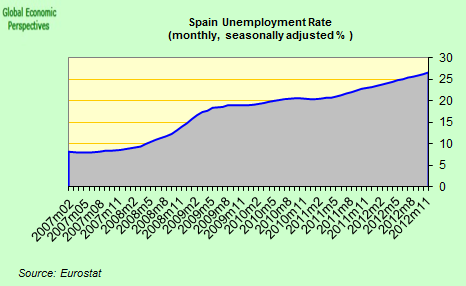
The people will not tolerate 25% unemployment forever - with no hope in sight.
CalculatedRisk, 25 January 2015
Spain will be stuck with an unemployment rate above 25 per cent for at least five more years,
according to a forecast by the International Monetary Fund
Financial Times, August 2, 2013
Kommentar av Rolf Englund
Detta är - eller borde i alla fall vara - fullständigt oacceptabelt.
Att Spaniens och EMUs ledare låter detta fortgå kan bara förklaras av ett fanatiskt fasthållande vid EMU-projektet
och/eller en ovilja att erkänna sina misstag. Hellre får folket lida.
Det kan inte vara bra för freden.
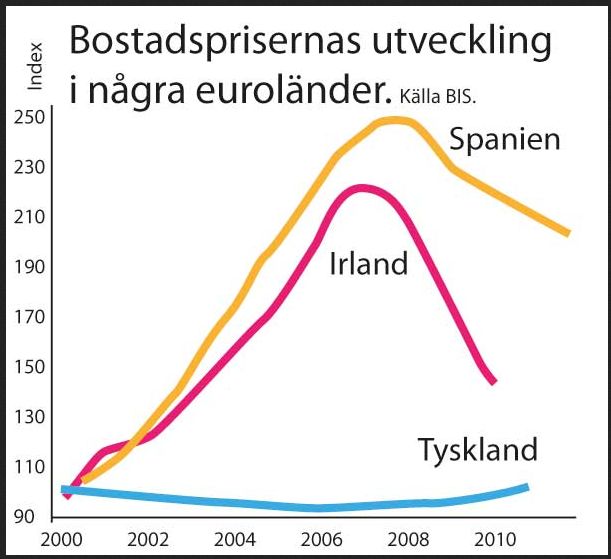
Stigande huspriser och skulder är Sveriges största bekymmer just nu
lösningen stavas hårdare tyglar för bankerna.
Det signalerar finansminister Anders Borg, DI 21 november 2012
The Spanish Housing Market Is About To Bottom
Tyler Durden, zerohedge, 28 January 2013
The tightrope PM Rajoy is trying to walk between austerity and human costs is the fault line dividing the whole of Europe.
Louise Armitstead, Telegraph 29 March 2012
Like Greece's Syriza party, they make empty protests, catering to ignorance,
unwilling to accept that the euro itself has now become their real enemy.
As yet, I can see no clear proposal on the table in any EMU country
– from any major movement, party, or political leader – that offers a way out of the current impasse.
Somebody will fill the vacuum.
Ambrose, October 19th, 2012
"To talk about a bail-out for Spain at the moment makes no sense," he told reporters.
"Spain is not going to be rescued; it's not possible to rescue Spain, there's no intention to, it's not necessary
and therefore it's not going to be rescued."
Louise Armitstead, Telegraph 12 Apr 2012
Q&A: What went wrong in Spain?
Spain's story illustrates the fact that the eurozone's problems run far deeper than the issue of excessive borrowing by ill-disciplined governments.
BBC 28 September 2012
I’ve always viewed Spain, not Greece, as the quintessential euro crisis country
Paul Krugman, 7 March 2012
Tyskarna gick in i EMU med en övervärderad kurs
Efter återföreningsbubblan som lämnade dem med en svag ekonomi i ett halvt decennium.
De arbetade långsamt tillbaka konkurrenskraften den hårda vägen, genom att pressa löner och driver upp produktiviteten.
Det är helt förståeligt att de nu tror att Club Med kan och bör göra samma sak.
De är helt fel, naturligtvis, eftersom Tyskland kunde sänka relativlöner under
a) en global boom, b) mot andra EMU-stater som inflaterade C) och med räntor som var låga även under de svåra åren.
Ingen av dessa faktorer gäller Italien eller Spanien nu.
Ambrose Evans-Pritchard, 2 December 2011
The Germans entered EMU at an overvalued rate
after the Reunification bubble, leaving them in semi-slump for half a decade.
They slowly clawed back competitiveness the hard way, by squeezing wages and driving up productivity.
It is entirely understandable that they now think Club Med can and should do the same.
They are profoundly wrong, of course, because Germany was able to lower relative wages during
a) a global boom, b) against other EMU states that were inflating c) and with benchmark borrowing cost that stayed low even during the dog days.
None of these factors apply to Italy or Spain now.
Ambrose Evans-Pritchard, December 2nd, 2011
Expression from Aubie Balton
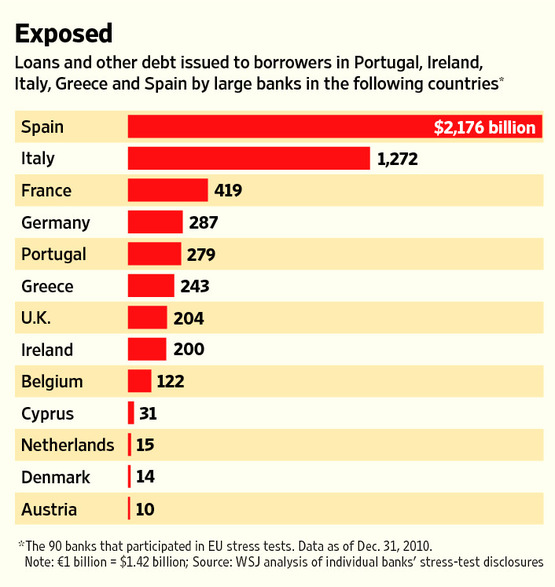
Wall Street Journal 18 July 2011
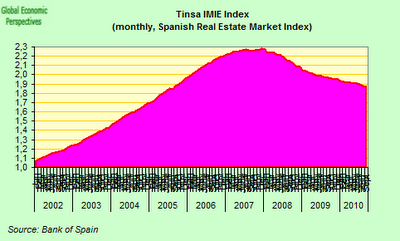
Wolfgang Münchau, April 10, 2011
Paul Krugman, New York Times, 22 May 2011
a comparison of the recent history of the Spanish and German economies can prove illuminating
As Wolfgang Munchau pointed out in the FT yesterday, Germany entered the eurozone at an uncompetitive exchange rate and embarked on a long period of (quite painful) wage moderation and deep structural reform.
A Fistful Of Euros, 31 August 2010 with many nice charts
Unfortunately, the number of new houses was not just more than
France, Germany and Italy combined built last year.
It was also more than anybody wanted to buy.
FT editorial 28/4 2007
DN huvudledare 7/5 2010
Population: 45.8 million, Budget deficit in 2009: 11.1%,
Unemployment in Sept: 20.8%
Like the Irish Republic, a collapse in the housing market has also been a key factor in Spain's economic woes. Yet the country's economic problems run a lot deeper, as Spain's 20.8% unemployment rate reveals.
The country is now continuing to liberalise its labour laws to make it easier for firms to make people redundant.
This may sound as if it will worsen the problem, but Madrid hopes the increased flexibility will persuade more companies to take on extra staff.
BBC 17/11 2010
Spain’s Bankia, the country’s fourth-largest bank
It’s been a headache for Spanish leaders since it required a rescue in 2012 to avert a collapse
that could have brought down the nation’s entire financial system.
Bloomberg 6 July 2018
...
Bankia had a 4.47bn-euro loan by the Spanish bailout fund converted into shares.
BBC 11 May 2012
Political uprising in Spain shatters illusion of eurozone recovery
"Our message to Europe is clear. Spain will never again be the periphery of Germany.
We will restore the meaning of sovereignty," said Podemos
Ambrose Evans-Pritchard, 21 Decenber 2015
There has been an export miracle of sorts, led by a surge in car output as multinational companies switch plant from France to Spain to take advantage of wage cuts, reaching 27pc for new workers at plants in Valladolid.
But what has really eliminated the current account deficit is a 12pc collapse in internal demand. Imports have been choked. The country can barely balance its external books with unemployment at 22pc.
A full recovery would quickly expose Spain's chronic lack of competitiveness within the euro structure.
Spain
Greece's creditor powers have delayed talks over reducing the country's debt mountain
for fear of emboldening anti-austerity forces in the southern Mediterranean, its finance minister has claimed.
Telegraph 10 November 2015
Euclid Tsakalotos said EU lenders would not discuss the question of Greece's debt burden, which stands at 200pc of GDP, until after the Spanish elections are held in the new year.
GreeceSpain’s recovery has been helped hugely by external factors outside Mr Rajoy’s control.
A weaker euro has helped to boost the growth in Spanish exports.
The decline in oil prices has been particularly beneficial for a country which imports all its energy needs from abroad.
The European Central Bank’s adoption of quantitative easing has been a further boost.
Financial Times editorial, 25 August 2015
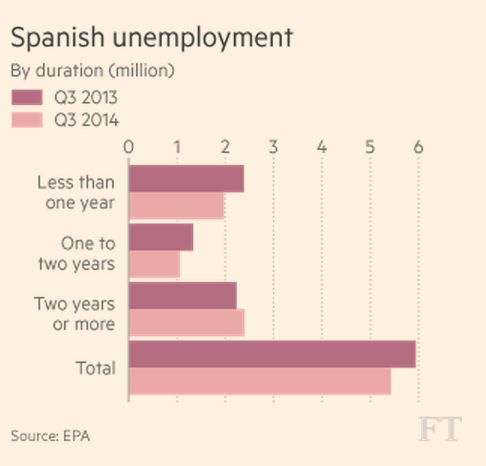
Jobless numbers are falling but the unemployment rate — at 22 per cent — remains the highest in the EU after Greece.
Many without work have been out of the labour market for more than two years.
Spaniens ekonomi skördar nu frukterna av ekonomiska reformer men det kvarstår ihållande strukturella problem, som "mycket hög" arbetslöshet, låg produktivitet och höga skuldnivåer.
Det skriver IMF i en Spanienrapport
SvD Näringsliv 14 augusti 2015
IMF Executive Board Concludes 2015 Article IV Consultation with Spain
Press Release August 14, 2015
"However, deep structural problems limit Spain’s growth potential going forward and vulnerabilities remain.
The high structural unemployment and pervasive labor market duality, and the lack of economies of scale of Spain’s many small firms hold back medium-term growth. Public and private debt levels are still high and are likely to keep weighing on consumption and investment.
Spain has a large negative net international investment position, which adds to its external vulnerabilities.
Despite doing (basically) everything right, Spain’s membership in the euro has left it at the mercy of
forces far stronger than anything even the most competent and responsible national institutions can handle.
Matthew C Klein. FT Alphaville June 11, 2015
The normal response would be to let the currency float while defaulting on some foreign debt and maybe imposing some capital controls. Let’s call that the Iceland model, which seems to have worked out pretty well, all things considered.
And yet output is still about 6 per cent below peak while 23 per cent of the labour force remains unemployed. Even if GDP and job growth maintain their current rapid rates, neither output nor employment will return to pre-crisis levels until sometime in 2019
— and again, this is the result of following the designs of elite Euro area policymakers as well as any other country in Europe.
Is The Crisis Now History In Spain?
Unemployment falling back, to 23.2%
Edward Hugh, 14 april 2015
The real debate is about the following decade, whether or not that one will be lost too,
as deflation and secular stagnation steadily take hold in the context of an ageing and declining population
A similar picture emerges when it comes to unemployment which is now steadily falling back, with the seasonally adjusted rate falling to 23.2% in February.
Top of pageDenna genomklappning av Spaniens två stora partier har givetvis med landets långa och svåra ekonomiska kris att göra,
men det är korruptionen som är den riktiga boven i dramat.
Mauricio Rojas, SvD 21 mars 2015
Skandalerna har varit så många och så pinsamma att det krävs stor partilojalitet för att fortsätta stödja det gamla partietablissemanget. Men korruptionens tentakler når mycket längre än till politiken: kungahuset, stora företag och fotbollsklubbar, fackföreningarna – ja, praktiskt taget varje viktig samhällsinstitution har drabbats av förödande skandaler. Men samhället i övrigt är givetvis inte immunt mot denna farsot, tvärtom.
Top of page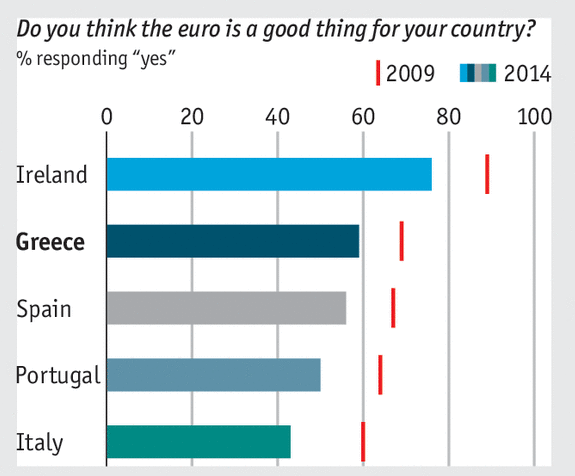
The Economist 16 February 215
Top of pageAusterity – the policy of saving your way out of a demand shortfall – simply does not work.
The question now is not whether the German government will accept it, but when.
Will it take a similar debacle for Spain’s conservatives in that country’s coming election
to force Merkel to come to terms with reality?
Joschka Fischer, Project Syndicate JAN 30, 2015
In the next act of the eurozone’s economic drama, keep a close eye on Spain
2015 could be when we find out, one way or another, whether the current strategy for fixing the eurozone is workable
— not just economically but politically
Stephanie Flanders, FT December 21, 2014
At the start of 2014, the radical leftwing party, Podemos, did not exist.
Today it is the most popular political movement in Spain.
Policy makers want to believe this muddle-through combination will be enough.
Even in an environment of near zero inflation, they hope the eurozone and its battered governments are on a path
that is both financially and politically sustainable. There will be no better test than the next 12 months in Spain.
The writer is chief market strategist for UK and Europe at JPMorgan Asset Management
There is the argument in government ministries and the smoke-free conference rooms of Brussels,
as politicians and bureaucrats attempt to define new continent-wide rules to ensure Europe does not slip back into a new and debilitating debt crisis.
But the future of the European economy and its single currency is more likely to be decided on the streets.
Gideon Rachman, FT October 18 2010
Radical left is right about Europe’s debt
The tragedy of today’s eurozone is the sense of resignation with which the establishment parties of the centre-left and the centre-right
are allowing Europe to drift into the economic equivalent of a nuclear winter.
You may not consider yourself a supporter of the radical left.
But if you lived in the eurozone and supported those policies, that would be your only choice.
Wolfgang Münchau, FT November 23, 2014
Both Ms Le Pen and Mr Grillo want their countries to leave the eurozone.
In Greece, Alexis Tsipras and his Syriza party lead the polls.
So does Podemos in Spain, with its formidable young leader Pablo Iglesias
The euro is in greater peril today than at the height of the crisis
Insurrectional electorates more likely to vote for a new generation of leaders
Wolfgang Münchau, FT November 9, 2014
Spain
“On the macroeconomic level you see that things are going better. But our people see no change,”
“There are more and more people whose unemployment benefits have run out, and who have used up all their financial reserves.”
FT 30 October 2014
 Top of page
America’s experience in the 1960s should have warned the eurozone’s creators that tying national monetary authorities’ hands might not be such a good idea.
Europe’s leaders must recognize that the eurozone, as it is currently constituted, is larger than Europe’s optimal currency area.
Some of its member countries – certainly Greece, and probably Italy and Spain – need an independent monetary policy.
Koichi Hamada, Special Economic Adviser to Japanese Prime Minister Shinzo Abe and Professor of Economics at Yale University, Projet Syndicate 28 October 2014
Independence referendum in November
Mr Pujol, who was Catalan president for 23 years until 2003,
stunned supporters last month by revealing he had kept undisclosed bank accounts outside Spain for the past 34 years.
FT 12 August 2014
Spain
IFRS imposed a strict “incurred-loss” method, in which debt was valued at par until a borrower actually stopped paying.
One of the biggest changes between the new rules and many of the national guidelines that preceded them was
a ban on banks writing down the value of their loans in anticipation of future losses,
a practice some had abused to disguise volatility in their earnings.
The Economist print 26 July 2014
Investor appetite for yield has reached such voracious levels that valuations have started to look "strange", bond investors have said,
with 10-year Apple bonds and 10-year Spanish government bonds now trading at similar levels
CNBC 14 May

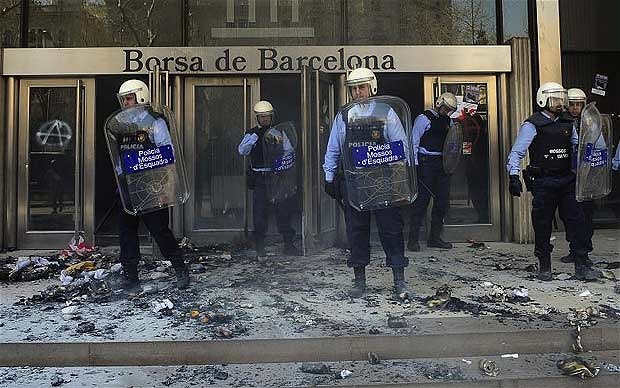
Violence has broken out at the end of an anti-austerity protest
attended by tens of thousands of people in the Spanish capital Madrid.
Dozens of youths threw projectiles at police, who responded by charging at them.
Demonstrators were protesting over issues including unemployment, poverty and official corruption.
BBC 23 March 2014
Nice video and pics
Telegraph 14 March 2014
Flera katalanska partier är nu överens om hur folket i regionen nästa år ska tillfrågas om självständighet.
En författningsvidrig folkomröstning som ska stoppas, hälsar regeringen i Madrid.
DI, 12 december 2013
Catalan leaders set date for vote on independence
“This consultation will not take place because it is not allowed by the constitution,” said the minister for justice.
FT, December 12, 2013
“This consultation will not take place because it is not allowed by the constitution,” said Alberto Ruiz-Gallardón, the minister for justice.
He went on to describe the Catalan move as an “attempt to violate the constitution and the fundamental rights of all Spaniards”.
Spanien får beröm för att ha lyckats sina kostnader och för att ha vänt ett underskott i bytesbalansen på 10 procent till ett litet överskott.
Men en arbetslöshet på över 25 procent imponerar inte.
Betyget blir ”godkänt”.
Dagens Industris Henrik Mitelman, 2013-08-27
Man häpnar.
Hur kan man undvika att inse att 25 procents arbetslöshet är en katastrof för land och folk?
Att det är fullständigt oacceptabelt.
Det är till och med ett orimligt pris även om man inbillar sig tillhöra dem som håller på att skapa ett nytt Romerskt rike.
Rolf Englund blog 2013-08-27
Rome, Habsburg and the European Union
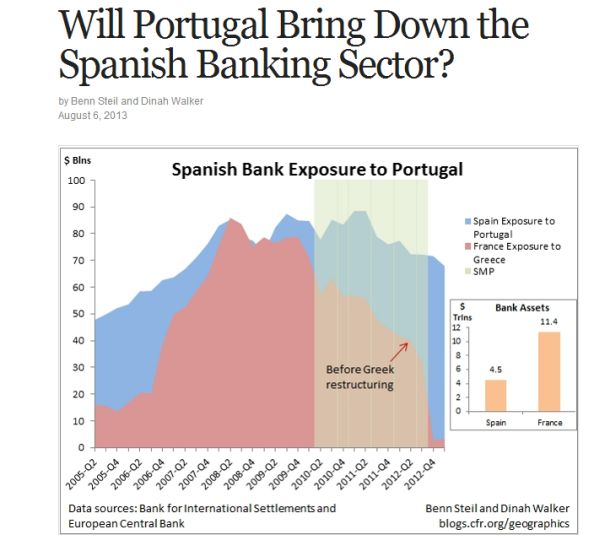
Will Portugal Bring Down the Spanish Banking Sector?
Spanish bank exposure to Portugal today is higher than French bank exposure to Greece in early 2010.
France’s exposure to Greece totaled $86 billion.
Geo-Graphics, Council on Foreign Relations, 6 August 2013
Spanish bank stress tests in 2012 suggested that the capital hole was more manageable than widely feared,
but those tests looked only at the domestic lending books; foreign assets were excluded.
In its recent evaluation of the Greek bailout program, the IMF revealed that the euro area leadership sought to delay a Greek sovereign debt restructuring back in 2010
because of contagion fears; that is, Greece’s creditors might get sucked into the bailout vortex.
Among eurozone national banking systems, France had the largest exposure. At its peak in the second quarter of 2008, France’s exposure to Greece totaled $86 billion.
That exposure has since plummeted, partly because French banks took advantage of the ECB’s Securities Market Programme (SMP) during 2010-11 to fob off Greek bonds, effectively forcing a eurozone mutualization of the debt.
SMP was terminated in September 2012.
Thanks to Eurointelligence for the link.
- Den stora risken var att Grekland skulle utlösa en kris i italienska, franska och tyska banker.
Nu finns i praktiken en EU-garanti för de utestående grekiska statsobligationerna.
Anders Borg, TT, 22 februari 2012
Considering issuing at least €6bn in hybrid equity capital such as convertible bonds
Deutsche Bank set to shrink to achieve leverage target
Deutsche Bank has one of the lowest leverage ratios of large banks globally
Financial Times, July 21, 2013
Spain will be stuck with an unemployment rate above 25 per cent for at least five more years,
according to a forecast by the International Monetary Fund
Financial Times, August 2, 2013
Kommentar av Rolf Englund
Detta är - eller borde i alla fall vara - fullständigt oacceptabelt.
Att Spaniens och EMUs ledare låter detta fortgå kan bara förklaras av ett fanatiskt fasthållande vid EMU-projektet
och/eller en ovilja att erkänna sina misstag. Hellre får folket lida.
Det kan inte vara bra för freden.
IMF Spain:
2013 Article IV Consultation, August 02, 2013
Spain's slow-motion implosion into an insolvent singularity has been one of the most amusing sideshows for over a year.
The chief reason for this is the sheer schizophrenic and absurdist polarity between the sad reality, visible to everyone, and the unprecedented propaganda by the government desperate to paint a rosy picture.
Zerohedge, July 22, 2013
Tack till Professor Pelotard som påminde om Frank Hellers funderingar om Minorca:
- Vid sextonhundratalets utgång var storhertigdömet så nära ruinen en stat gärna kan bli (och ogärna bör vara): och i sin nöd finner vi dess härskare tillgripa de mest olika metoder för att lätta en förtvivlad ställning - metoder som onekligen stöter oss något.
Spanish Prime Minister Mariano Rajoy
El Mundo newspaper reported on Tuesday that it had presented the Spanish High Court with documents that
showed payments were made from an illicit "slush fund" to leading members of the ruling People's Party,
including Rajoy.
CNBC, July 9, 2013
Rajoy on slush fund:
“It is all untrue, except for some things”
EL PAÍS, Madrid 4 FEB 2013
France, Spain and Slovenia are set to be criticised in a major commission report on Wednesday
as countries that have failed to cut public debt and to implement structural reforms
European Union studies on “macroeconomic imbalances” have been given new teeth this year
under eurozone “governance” legislation
Telegraph, 25 May 2013
Braulio Rodriguez, the Archbishop of Toledo:
"We have to change direction, otherwise this is going to bring down whole political systems,"
"The Vatican has always been an enthusiast for Europe, but a Europe of solidarity where we help each other,
not a Europe of coal and steel. Whether this is possible depends on Germany and Chancellor Angela Merkel,"
Ambrose 12 May 2013
The decline in yields on Spanish debt, shown so clearly in the chart, dates almost precisely to 26th July 2012, the date on which Mario Draghi, president of the ECB, told an audience in London that “Within our mandate, the ECB is ready to do whatever it takes to preserve the euro. And believe me, it will be enough.”
This statement, in turn, led to the announcement by the ECB on August 2nd 2012 of “outright monetary transactions” which would be aimed “at safeguarding an appropriate monetary policy transmission and the singleness of the monetary policy”.
Rightly or wrongly, markets concluded that the risk of an outright default on Spanish bonds had largely disappeared.
Martin Wolf, Financial Times, 10 May 2013
5.136 miljarder SEK
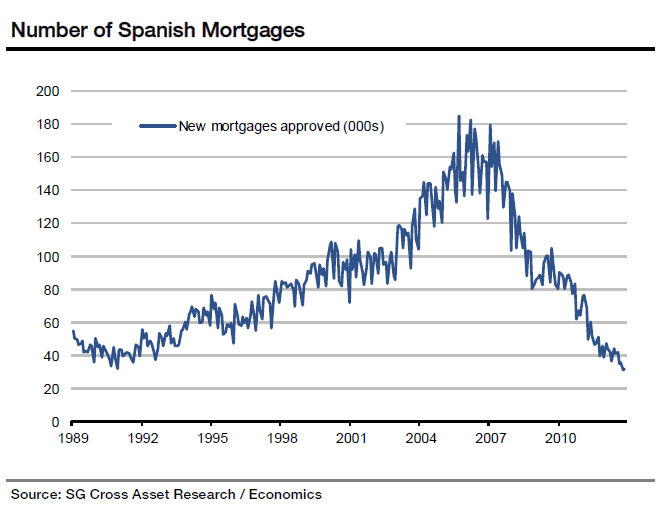
The pre-crash bubble saw Spaniards borrow merrily, owing almost twice as much in mortgages as Italians by 2010.
The total debt is falling gradually, but is still around €600 billion ($780 billion).
Some 8% of mortgage-holders are now jobless.
Last year 80 families a day had mortgages foreclosed, with their properties usually valued far below the purchase price.
Many owe money on homes they no longer own or live in
The Economist print Apr 27th 2013
The total number of unemployed people in Spain has now passed the six million figure,
A big demonstration in Madrid is being planned against the austerity measures.
BBC etc, 25 April 2013
I am surprised that a great historic nation should put up with 27pc unemployment, or accept vassal status to an incompetent and dysfunctional EMU regime.
Does anybody in Madrid think that EU officials in Brussels actually know what they are doing?
Ambrose
More than 6 million without jobs in Mariano Rajoy's Spain while figure in François Hollande's France is 3.2 million, Guardian
Family's struggles as Spain unemployment hits new high, BBC
money.cnn.com/video/news/2013/04/25
money.cnn.com/2013/04/25/news/economy/spain-greece-unemployment
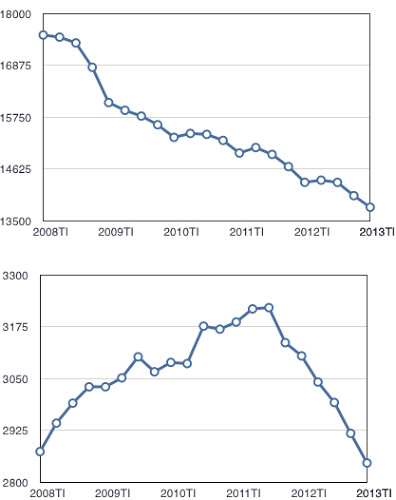
Det övre diagrammet visar antalet anställda (i tusental) i den privata sektorn och det undre diagrammet visar antalet anställda i den offentliga sektorn.
Man noterar att antalet anställda i den offentliga sektorn inte har sjunkit alls sedan krisen började även om antalet har minskat sedan Zapatero-regeringens kollaps.
Det innebär att Spanien inte har "dragit åt svångremmen" på samma sätt som Portugal, Grekland eller Italien.
Det återstår fortfarande - med en arbetslöshet på över 27% (eller över 32% om man skulle använt sig av det gamla sättet att räkna).
Fortsätter man på den här vägen går Spanien rakt in i ett socialt sammanbrott.
Via tips från Professor Pelotard 26 april 2013
Euron kollapsar i Spanien Rolf Englund 28 maj 2012 - Rolf Englund blog Maj 31, 2010
The turmoil produced by the Italian elections has directed attention back to where it should have been all along – to the politics of the eurozone crisis.
It is possible that southern Europe will give the Germans until the autumn to come around to a new approach.
But toleration for austerity is unlikely to last much beyond then.
Europe may be approaching a stark choice: giving up the euro; or keeping it and seeing the political crisis spin out of control.
Mark Mazower, professor of history at Columbia university, Financial Times 28 February 2013
Socialism eller barbari, brukade vi säga
Europa befinner sig i sönderfall på grund av den ändlösa eurokrisen, en kris som ingen kan se något slut på.
Denna abstrakta, flytande gemensamma valuta, är den inte bara ett fantasifoster
med sin brist på förankring i en gemensam ekonomi, resurser och ekonomisk politik?
Europa är inte i kris. Europa är döende. Inte i geografisk bemärkelse, naturligtvis, men Europa som idé. Europa som dröm, som projekt.
"Elva europeiska intellektuella" i ett flertal europeiska tidningar,
bland annat Le Monde, Frankfurter Allgemeine och El País i januari 2013.
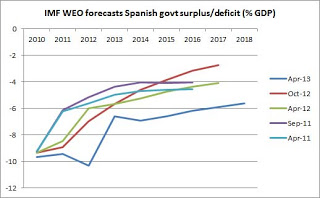
The IMF seems to have turned significantly more pessimistic on the prospect of a Spanish recovery.
The charts below provide a comparison with the previous WEO forecasts (highlighting how these forecasts tend to be overly optimistic)
- which very much confirms what we have noted before about the real risks in Spain
Open Europe 18 April 2013
"In two Member States, Spain and Slovenia, imbalances can be considered excessive.
In Spain, the very high domestic and external debt levels continue to pose
serious risks for growth and financial stability.
The adequacy of their policy responses will be assessed in time for the conclusion of this year’s European Semester of economic policy coordination,
in the context of which country-specific recommendations will be adopted on 29 May."
EU-Kommissionen, 10 april 2013
Spaniens statliga pensionsfond nu har 97 procent av sina tillgångar i spanska statspapper.
Moody’s rapport om de spanska bankerna. Andelen dåliga lån är uppe i 10,8 procent eller motsvarande 160 miljarder euro.
Många av bankerna är beroende av nödlån från ECB för att klara sig.
En annan stor risk enligt Moody’s: bankernas stora exponering mot spanska statspapper.
Bankerna har, vid sidan om pensionsfonder, nämligen stödköpt det egna landets skuldebrev i enorm omfattning.
Andreas Cervenka, SvD 5 april 2013
Cyprus, Spain, Greece, Italy
At what point does it become economically rational for a country to leave the eurozone
Wolfgang Münchau, Financial Times, March 31, 2013
There are two things to consider.
The first is whether the country’s banking system is viable in the presence of an imperfect banking union – one that will not share any risks in the foreseeable future.
The second is whether public and private sector debts are sustainable, given the country’s present and expected future growth rates.
If the Federal Deposit Insurance Corporation raids a bank in San Francisco, and bails in uninsured depositors,
there is no bank run on neighbouring banks as California is not liable for the banking system.
Instead the US has a federal resolution authority and deposit insurance system.
But as each eurozone country remains responsible for their banking systems, Cyprus had no choice but to impose capital controls after the bail-in.
The authorities have in effect launched a new parallel currency convertible to the standard euro at an exchange rate of one to one, but only up to €5,000, the monthly transfer limit.
Jeroen Dijsselbloem, Dutch finance minister and president of the eurogroup of eurozone finance ministers – in an interview with the Financial Times – shocked the world by telling the truth.
It is now the stated policy of the creditor countries to solve the problem of a debt overhang in the banking sector in the peripheral countries through the bail-in of bondholders and depositors.
The logical consequence of Mr Dijsselbloem’s dictum and the reality of austerity and a deficient banking union is a future bail-in of Spanish bank bondholders and depositors.
The problem is that even insured deposits will then not be protected.
Look at what happens in Cyprus, where capital controls affect small and large deposits alike.
I would expect that to happen in Spain as well.
Given the stated policy, it is logically irrational for any Spanish saver to keep even small amounts of savings in the Spanish banking system.
There is no way that the Spanish state can guarantee the system without defaulting itself.
Cypriot Financial Sector Faces Collapse
Data from the BIS in Basel shows that, at the end of September 2012, the Cypriot banks had a total of
$441 million in debt with foreign banks - a dimension that could be coped with easily.
Spain, by comparison, has a whopping €132 billion in liabilities to foreign banks.
Der Spiegel, 21 March 2013
Spanish economist advocates controlled demolition of Eurozone
Juan Francisco Martin-Seco wonders whether the high cost of austerity wouldn't justify
"admitting that the Monetary Union has been a failure and should not have been done"
Eurointelligence 11 March 2013
Martin-Seco, who is promoting his new book "Against the Euro: the story of a mousetrap" argues that:
the successive failures of the European Monetary System to sustain fixed exchange rates foretold the failure of the Euro.
the alternative to "rolling back" the Euro is to "press forward" which requires "a true fiscal union" including a common Public Finance and sizable resource transfers from richer to poorer countries, but "this scenario is virtually impossible because Germany will never accept it".
if the Eurozone consisted only of France and Germany, France would eventually end up like Greece because of the structural differences between the countries.
Eurozone membership has already had high costs for Spain: an erosion of democracy, the loss of the "Social State"; and staying in the Euro would roll back 80 years of building a welfare state.
Boken är på spanska och heter Contra el euro : historia de una ratonera
Spanish Economy minister Luis de Guindos: “Spain doesn’t need any sort of bailout,”
Perhaps the key point here hangs on your interpretation of the word “need”.
Edward Hugh, 18 February 2013
Spanish Economy minister Luis de Guindos can point to occasions where he has carried the argument. Back in October last year, when he told an audience at the London School of Economics that Spain didn’t need a bailout they simply laughed.
Four months later it is looking increasingly unlikely that the country will seek additional EU aid in the short term. “Spain doesn’t need any sort of bailout,” he told Bloomberg TV recently, and this time no one laughed.
Perhaps the key point here hangs on your interpretation of the word “need”.
If paying around 5% on your 10 year bonds is considered to be an acceptable cost for financing your country’s debt – Germany, for example is paying around 1.7% – then there is no need to apply to the EU and trigger ECB bond buying via the Outright Monetary Transactions program.
If, on the other hand, you think the country could well benefit from lower funding costs, and the kind of pressure for reform which would be exerted from the outside though a Memorandum of Understanding, then clearly a bailout is needed.
Rajoy on slush fund:
“It is all untrue, except for some things”
EL PAÍS, Madrid 4 FEB 2013
SPAIN'S PM FACES HUGE CORRUPTION SCANDAL
Internet Explodes With Mockery
Business Insider Feb. 3, 2013
Suddenly, the Spanish government is swirling in a massive corruption scandal.
Late last week, the Spanish newspaper El Pais published documents, which purport to show that the party of ruling PM Mariano Rajoy has been taking illegal donations for years.
Opposition politicians are calling on Rajoy to resign, a move that would bring unwanted political instability to one of the Euro's most vulnerable nations.
Rajoy is remaining defiant, and yesterday he held an emergency televised address to rebuke the claims. However, this image of reporters covering Rajoy via monitor is being used to make him look like a coward.
Protests broke out in Spanish cities after Prime Minister Mariano Rajoy denied claims that
he and other party members had accepted secret payments.
"I have never received nor distributed undeclared money," Mr Rajoy said earlier, vowing not to resign.
BBC, 3 February 2013
An online petition demanding the leader's resignation has gathered more than 740,000 signatures.
The Spanish Housing Market Is About To Bottom
Tyler Durden, zerohedge, 28 January 2013 with nice chart
Spain
Since 2009 the deficit has fallen by €16bn
while public investment has contracted by €17bn
Juan Rubio-Ramirez, Financial Times 8 January 2013
The writer is professor of economics at Duke University and a researcher at FEDEA in Madrid
The EMU disaster is not at root a public debt crisis, and never was.
As EMU leaders themselves say – correctly – Euroland's aggregate public debt is lower than in the UK, US, and Japan as a share of GDP.
What Europe faces is a north-south incompatibility crisis,
the result of ramming together misaligned economies and countries into a single currency.
Ambrose Evans-Pritchard, January 8th, 2013
Whether you think this matters depends on whether you think the democracies of southern Europe will tolerate slow grinding depression – with no light at the end of the tunnel – for year after year.
The denouement is hard to predict in such situations. Political upheavals are famously non-linear. But the situation in Spain is remarkable, with the added nitroglycerine of a ruling party determined to exploit the crisis to take power back from the regions, and Catalonia determined to resist with all means at its disposal.
Data from Tinsa released today shows that Spanish house prices fell 11.3pc last year, and are now down 33.3pc from the peak in 2007.

"Spain requests €39.5bn bank bail-out, but no state rescue"
Spain's economy ministry said it had requested the disbursement of €39.5bn for its banking sector,
for its four nationalised banks - Bankia, Catalunya Banc, NCG Banco and Banco de Valencia - and for a so-called “bad bank”.
It should be paid to the state’s banking fund by mid-December, the ministry said.
Telegraph 3 December 2012
“It is very complicated to reduce the deficit by 2.6 percentage points in the context of a recession, with so many revenue problems and with such high financing costs,” Mr Rajoy said. “Our objective is to do things well and see what happens at the end of the year.”
As well as refusing tor rule out a rescue for Spain, he also said he could not rule out further austerity measures.
Mr Rajoy’s government has introduced more than €60bn of spending cuts since it came to power at the end of last year.
A general strike has been called for November 14 /in Spain/. Yet they have nothing coherent to offer.
Like Greece's Syriza party, they make empty protests, catering to ignorance,
unwilling to accept that the euro itself has now become their real enemy.
As yet, I can see no clear proposal on the table in any EMU country
– from any major movement, party, or political leader – that offers a way out of the current impasse.
Somebody will fill the vacuum.
Ambrose, October 19th, 2012
Merkel has cast doubt on one of the main benefits of eurozone banking union only hours after the bloc’s leaders agreed to a slightly clearer time table for the creation of a single bank supervisor.
Ms Merkel said that bad assets held by Spanish and Irish banks will not be cleaned up by the eurozone’s new €500bn rescue fund, adding that it should only be used to shore up teetering financial institutions in the future.
Financial Times 19 October 2012
Katalonien start
Katalonien vill sluta betala för Spanien
I dag är det 300-årsjubileum för Kataloniens nationaldag, och snart röstar katalanerna om självständighet.
Att bryta sig loss från Spanien ses som ett medel för att skydda regionens ekonomiska välstånd.
Jakob Lewander, understreckare SvD 11 september 2014
Under det spanska tronföljdskriget 1701–14 stred Europas stormakter på spansk mark om resterna av det stapplande spanska imperiet som styrdes av den svagsinte, sjuklige och troligtvis inavelsstörde habsburgaren Karl II.
Det franska kungahuset Borbón hade starkast stöd i Kastilien medan Aragonien stödde habsburgarnas mer federalistiskt inriktade kungahus som lät imperiets områden existera på lokala villkor.
As Scotland prepares to vote on independence, Catalans and Spaniards are watching with a mixture of excitement and unease.
Despite cries of "illegal" from Madrid, Catalonia's top politician is committed to holding a similar vote in this Spanish region
BBC 11 September 2014
In a matter of weeks, Spain's Constitutional Court is expected to rule that a referendum in Catalonia would be "illegal".
Mr Mas seems unperturbed, claiming that a "non-legally binding vote" would still be possible under Catalan law.
When asked what a "yes" vote in such a case would actually mean, his answer was unclear.
But that perhaps reflects the fact that no one really knows, because it would be uncharted territory, with the territorial integrity of Spain at stake.
Independence referendum in November
Mr Pujol, who was Catalan president for 23 years until 2003,
stunned supporters last month by revealing he had kept undisclosed bank accounts outside Spain for the past 34 years.
FT 12 August 2014
His party has dominated regional politics for decades and, under Mr Mas, has moved from a moderate nationalist stance to outright support for an independent state. Mr Mas says he will hold an independence referendum in November, a plan adamantly opposed by the Spanish political establishment.
Split from Spain would be an error but autonomy is needed
a shadow over the nation’s political future shows no sign of resolution:
the demand by millions of Catalans for independence.
Scots are set to vote this September in an independence referendum
Financial Times editorial, May 5, 2014
One of the leading arguments for secession, in addition to the region’s history and separate language, has been economic. It is home to a seventh of Spain’s population and is among the wealthiest and most productive parts of the country. For years a healthy chunk of its tax revenues has in effect been given away to help fund the rest of the country’s public services.
Artur Mas, the Catalan president, has called an independence referendum for November 9. But last month the Spanish parliament declared it would not tolerate such a move, striking down the formal request. Mariano Rajoy, Spain’s prime minister, insists such a referendum would violate the 1978 constitution.
While the Scots are set to vote this September in an independence referendum that has been formally approved by the UK parliament, no such compromise has been achieved in Spain.
Mr Mas has admitted he will not press ahead with the referendum if it lacks legality.
Spain's Prime Minister maintained that a referendum on independence for Catalonia would be "illegal"
on Tuesday (25 February) as he delivered his annual state of the nation speech.
Mariano Rajoy vowed to block the vote, which the Catalan authorities intend to hold on 9 November.
EU Observer, 26 February 2014
"This referendum can't take place, it is not legal," he said, adding that "it is the entire Spanish people who have the capacity to decide what Spain is."
Spain promises non-interference on Scotland
Men varnar Katalonien och drar paralleler med South Ossetia, Abkhazia and Somaliland
Financial Times, 2 February 2014
Madrid has long been among the most vocal opponents of separatist movements in Europe, reflecting its struggle to contain secessionist pressures in its own region of Catalonia.
José-Manuel García-Margallo, foreign minister, told the Financial Times: “If Scotland becomes independent in accordance with the legal and institutional procedures, it will ask for admission [to the EU]. If that process has indeed been legal, that request can be considered. If not, then not,” he said
He warned Catalan leaders in particualr not to go down the route of a unilateral declaration of independence: “A state born through a unilateral declaration of independence would have no international recognition whatsoever. It would be absolutely isolated in the concert of nations. Such a state would not have access to the United Nations system or to the World Bank or the IMF,” he said.
He drew a parallel with unrecognised break-away regions such as South Ossetia, Abkhazia and Somaliland
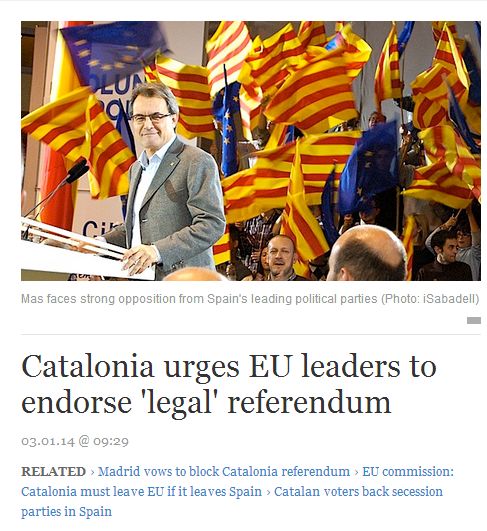
Catalonia's President, Artur Mas, has written to EU leaders and world powers seeking
their support for a vote on independence from Spain.
The appeal comes amid strong resistance to his plan to hold a referendum in November.
EU Observer, 3 January 2014
Spain's governing centre-right Partido Popular and the opposition PSOE have both said it would breach the Spanish constitution.
Catalonia’s parliament Wednesday overwhelmingly passed a bill unilaterally claiming the region’s right to decide
whether it seeks an independent state within the European Union, setting a 2014 timeframe to carry out a referendum
Christian Science Monitor 23 January 2013
The vote “to start a process” that would eventually culminate with a referendum was approved with 85 votes in the 135-member chamber, and 41 votes against. The bill defines the region of Catalonia, Spain’s economic motor, as a “political and legal sovereign entity” with the right to secede, if a majority of its 7.5 million citizens decide to do so through democratic means.
Anledningen till att den katalanska nationalismen nu har flammat upp med sådan intensitet är en europeisk skuldkris som slår skoningslöst mot Spanien, eurozonens fjärde största ekonomi.
Dessa påfrestningar underblåser separatistiska strömningar i ett Spanien som egentligen inte är en nationalstat i vanlig bemärkelse, utan en ganska löst sammanfogad enhet med 17 autonoma regioner med stora språkliga och kulturella skillnader.
Per T Ohlsson, Sydsvenskan 14 Oktober 2012
Boken”Eurokrisen”
Förslaget från Tyskland att inrätta något slags superkommissionär kommer att möta kraftigt motstånd.
Det är ett gigantiskt steg mot en centralisering av finanspolitiken och ökat demokratiskt underskott,
säger Stefan de Vylder i SvD Näringsliv 18 oktober 2012
Han har i veckan släppt boken ”Eurokrisen” (Den europeiska valutaunionen EMU har utvecklats till ett dyrbart experiment, och historiens dom kommer att bli hård.) som beskriver bakgrunden till dagens svåra situation och vad han tror väntar framöver.
– Vi ser just nu en gigantisk och accelererande kapitalflykt från spanska banker. Krisen kommer att fortsätta fördjupas tills några länder lämnar EMU.
Det finns inga räddningsfonder stora nog att stötta det spanska banksystemet, menar han.
– Det skulle krävas en gemensam europeisk insättargaranti och där är motståndet stenhårt hos flera länder. Spanien kommer tvingas införa valutakontroller och det betyder att man inte kan vara kvar i EMU, säger de Vylder.
Spaniens kreditbetyg sänks till BBB-
strax över skräpstatus
SvD Näringsliv 11 oktober 2012
”De negativa utsikterna för det långsiktiga kreditbetyget återspeglar vår uppfattning om de betydande riskerna mot Spaniens ekonomiska tillväxt och budgetutfall, och bristen på klar riktning i euroområdets policy. Den fördjupade ekonomiska recessionen begränsar den spanska regeringens policyalternativ”, skrev S&P.
Kreditvärderingsinstitutet tog också in i beräkningen den höga arbetslösheten, vilken i sin tur skapar spänningar mellan statsmakten och regionerna.
S&P downgrades Spain
FT Alphaville 10 October 2012
What happens if a large, high-income economy, burdened with high levels of debt and an overvalued, fixed exchange rate, attempts to lower the debt and regain competitiveness?
This question is of current relevance, since this is the challenge confronting Italy and Spain.
Yet, as a chapter in the International Monetary Fund’s latest World Economic Outlook demonstrates,
a relevant historical experience exists: that of the UK between the two world wars.
Martin Wolf, Financial Times, 9 October 2012
I dag vet vi att den spanska krisen kommer att bli mycket allvarligare än den grekiska
ty ingen har ifrågasatt Greklands existens som nation och det är precis det som nu händer i Spanien
Mauricio Rojas, Kolumn SvD, 7 oktober 2012
Welcome back to the eurozone crisis
Germany will not after all allow Spain to dump the risk of its banks on to the ESM
Wolfgang Münchau, Financial Times 30 September 2012
Spain has pushed through €40bn of fresh austerity measures in the teeth of recession,
It comes on top of a €62bn squeeze already in the pipeline.
despite violent protests across the country and separatist crises in Catalonia and the Basque region
that threaten to break the country apart.
Ambrose Evans-Pritchard, 27 September 2012
Premier Mariano Rajoy has frozen public pay in 2013 for the third year in a row. The agriculture ministry and culture expenses will be cut by 30pc and the defence bureacracy by 15pc.
Den som vill se fredsvalutan in action kan med fördel titta på livestreamningen från demonstrationerna i Madrid.
Spanien måste spara mycket mer om landet ska ha en chans att kvarstå i euron.
På kort sikt lär detta höja arbetslösheten ytterligare.
Det är därmed högst osäkert om Spanien kan överleva detta som nation om landet kvarstår i eurosamarbetet.
Mattias Lundbäck, 25 September 2012
What began as an economic storm has blown into a full-scale political crisis.
Amid popular discontent and separatist protests, Spain has stumbled towards a crossroads:
without decisive action by the government, the post-Franco democratic settlement is at risk.
Financial Times, editorial 27 September 2012
Nu är det kris igen, och nu är det kris igen;
euron och Spanien
Rolf Englund blog 2012-09-27
The political turmoil in Spain triggered a sell-off of European shares,
as investor concerns mounted about the eurozone’s fourth-largest economy.
Financial Times, September 26, 2012 9:35 pm
Spain’s Ibex share index, which had rallied over the summer, ended down 3.9 per cent and the FTSE Eurofirst 300 index dropped 1.7 per cent. The euro gave up its gains over the past two weeks, falling to $1.28.
The financial pressures on Mr Rajoy’s government have been intensified by a constitutional crisis brewing over the Catalonia region, which called snap elections this week that could hasten a move toward independence.
Den europeiska skuldkrisen, Mats Persson, SNS Förlag
Det här är både ekonomiskt och politiskt vansinne och leder bara till recession, anser Mats Persson.
Vad som nu händer är att tyska och franska banker får betalt, medan grekerna får svälta.
Kaianders Sempler, Ny Teknik 29 augusti 2012, via Rolf Englund blog
I boken Den europeiska skuldkrisen (SNS förlag) menar nationalekonomiprofessor Mats Persson att
det vore bättre om de krisande bankerna tillfälligt togs över av de krisande staterna,
återkapitaliserades med ESM som finansiär och sedan bjöds ut på marknaden.
SvD-ledare, Benjamin Katzeff Silberstein, 12 september 2012
The debate over whether the U.S.’s largest banks are too big is heating up.
Since the 2008 financial crisis, the perception has taken hold among some analysts and economists that certain U.S. institutions are too big to fail, meaning they would have to be bailed out to protect the financial system in the event of another calamity.
The continued downward spiral in Europe raises a similar question: Are some banks too big to save, meaning their collapse could dramatically worsen the euro crisis
(as happened in Ireland in the fall of 2008 and is happening now in Spain and Greece)?
Simon Johnson, who served as chief economist at the IMF in 2007 and 2008, Bloomberg 3 September 2012
ECB pytsade i december och mars ut ut hela 1 000 miljarder euro i treåriga lån.
Spaniens banker har stått längst fram i lånekön. De hande i juli lånat hela 376 miljarder euro av ECB.
En del av dessa pengar har bankerna använt för att köpa spanska statsobligationer. Det var också precis avsikten,
och ett sätt för ECB att självt slippa stödköpa direkt.
Andreas Cervenka, SvD Näringsliv 3 september 2012
Totalt köpte spanska banker på sig statsväxlar för 87 miljarder euro mellan december och mars.
Fotnot RE: 87 miljarder euro är cirka 733 miljarder kronor
Början på sidanThe central bank of Spain just released the net capital outflow numbers and they are disastrous.
During the month of June alone $70.90 billion left the Spanish banks and in July it was worse at $92.88 billion which is 4.7% of total bank deposits in Spain. For the first seven months of the year the outflow adds up to $368.80 billion or 17.7% of the total bank deposits of Spain and the trajectory of the outflow is increasing dramatically.
Reality is reality and Spain is experiencing a full-fledged run on its banks whether anyone in Europe wants to admit it or not.
ZeroHedge, 2 September 2012
Investerare flyttade ut den rekordstora summan 219,8 miljarder euro,
motsvarande runt 1,8 biljoner kronor, från Spanien under det första halvåret 2012.
DN/TT 31 augusti 2012
Andalucia, Spain’s most populous region, need a €1bn advance from the country’s central government,
making it the fourth regional administration to request financial aid.
Financial Times, 3 September 2012
The request comes after Catalonia, Valencia, and Murcia have all requested aid from Spain’s central government, which is in the process of establishing the €18bn pot, partly using money from the country’s state lottery
Manifestationen på Diada, Kataloniens nationaldag, brukar samla en tapper men begränsad skara självständighetsivrare.
Dagens möte i Barcelona väntas locka flera hundra tusen deltagare, inklusive moderata nationalistpolitiker som normalt håller sig hemma.
DN, Signerat Gunnar Jonsson, 11 september 2012
Enligt en färsk opinionsmätning skulle 51 procent av katalanerna i dag rösta för självständighet från Spanien.
Före eurokrisen var de flesta fullt nöjda med sin autonomi. Nu växer ilskan och motsättningarna.
The centre-right PP, which won power last November, wants not only to shrink the state but also to recentralise it.
If mishandled, it could undermine the constitutional settlement that brought Spain out of the dictatorship of Francisco Franco into a vibrant democracy and stoke demands for Basque and Catalan independence that devolved government was supposed to prevent.
David Gardner, Financial Times, August 22, 2012
Autonomous communities of Spain, Wikipedia
Economists have uncovered a hole in Spain’s budget that threatens to allow the country’s regional governments to overspend this year, calling into question the credibility of Madrid’s deficit reduction plan agreed with Brussels.
CNBC/FT August 27, 2012
The discrepancy in this year’s spending plans for Spain’s 17 autonomous regions—which have become one of the main battle grounds for prime minister Mariano Rajoy’s austerity program—could allow the regions to exceed their agreed budget deficit for 2012 by almost 10 percent.
Spanska huspriser rasar
I juli föll huspriserna i Spanien med 11,2 procent, den kraftigaste nedgången sedan mars 2011.
Sedan 2008 har därmed de spanska huspriserna i snitt rasat med 31 procent samtidigt som landet beräknas ha 2 miljoner osålda bostäder.
Snittpriset per kvadratmeter i juli låg på 1 606 euro (cirka 13 200 kronor). Det innebär att priset för en normal bostad med två sovrum i Spanien ligger på omkring 105 000 euro (cirka 870 000 kronor).
I storstadsområden kostar samma typ av bostad i snitt 275 000 euro.
Källa: SvD Näringsliv 15 augusti 2012
Att låta Europeiska centralbanken stå för stödet till krisländerna trollar inte bort kostnaderna. De döljs bara för väljarna.
ECB kan alltid trycka hur mycket pengar som helst.
Lars Calmfors, kolumn DN 9 augusti 2012
Att låta ECB och de nationella centralbankerna ta kostnaderna för krisstöden uppfattas ibland som ett sätt att inte belasta skattebetalarna i Tyskland och andra välskötta euroländer. Men någon sådan gratismetod för att ge stöd finns inte.
Omedelbara budgetkostnader skulle uppkomma om euroländerna väljer att med statliga budgetmedel direkt återställa det egna kapital som gått förlorat.
Om det inte sker – vilket är mer sannolikt – fördelas i stället kostnaderna över ett antal år därför att de vinster som de nationella centralbankerna (ECB:s ägare) brukar leverera in till statskassorna uteblir.
Det finns ingen snabb lösning på krisen. Men den kan förkortas av kraftiga nedskrivningar av krisländernas statsskulder.
Sådana bör göras snabbt så att det finns tillräckligt med privata långivare kvar som då får vara med och bära kostnaderna. Annars riskerar skattebetalarna i Tyskland och andra länder att få betala alltför mycket.
Väljarnas reaktioner på det utgör det största hotet mot både euro- och hela EU-projektet.
Men på vilket sätt drabbas skattebetalarna av centralbankernas kapitalförluster?
Det måste vara väldigt kännbart eftersom det enligt Calmfors riskerar att leda till en politisk reaktion som avskaffar euron. Så vitt jag kan förstå innebär en kapitalförlust endast indirekta effekter på centralbankerna och mycket utspädda effekter på skattebetalarna.
Danne Nordling, 5 augusti 2012
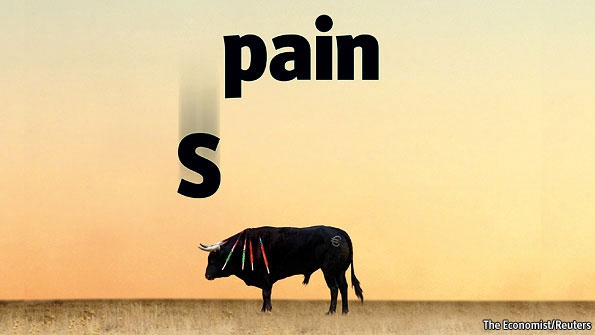
Spain’s nightmare is a symptom of what is wrong with the entire euro zone.
Bail out Spain and immediately investors will rightly worry about Italy and whether the rescue funds are big enough.
Ultimately, as we have argued, a solution requires the currency’s members to draw on their combined strength by mutualising some debt and standing behind their big banks.
haggling over the details, holding referendums and amending constitutions could easily take three years.
The trouble is that the 17 members of the euro zone, let alone their 333m citizens, cannot agree on who must sacrifice what to allow this new Europe to emerge.
The Economist print 28 July 2012
Europe is “sleepwalking towards disaster”
The lack of any light at the end of the tunnel is leading to a populist backlash in both the debtor and creditor states.
The only question is whether the North or the South succumb to revulsion first.
“The sense of a neverending crisis, with one domino falling after another, must be reversed.
The last domino, Spain, is days away from a liquidity crisis,” said the economists.
They include two members of Germany’s Council of Economic Experts and leading euro specialists at the London of School of Economics, all euro supporters.
Ambrose, 24 July 2012
As the price of Spanish government debt plummets, that generates losses for Spain's banks,
which hold around 250bn euros of the country's government bonds, equivalent to a third of central government debt.
Spanish banks are becoming more and more dependent, for their very survival, on exceptional funding from the ECB
Robert Peston, BBC Business editor, 23 July 2012
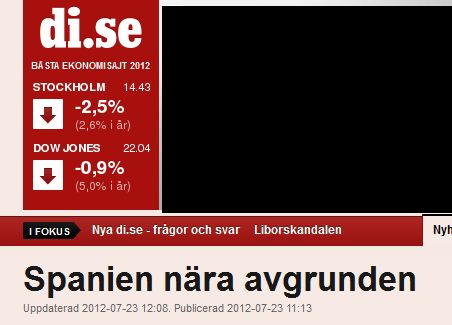
Spain on the verge of a nervous bailout
Since Friday, the situation has deteriorated dramatically.
Spain’s 10-year yields are approaching 10.4%
The market is now expected a fully fledge EFSF/ESM programme for Spain
Eurointelligence Daily Briefing 23.07.2012
Spanish House prices
This sounds bad, but is actually good news.
If you know that house prices have to adjust 50-60% in total, but have only come down 20% so far,
then the news of an acceleration in house price declines means that the adjustment is finally under way in earnest.
Eurointelligence 19 July 2012
It is time for Spain and the victim states to seize the initiative.
What they can to do is use their majority votes on the ECB's Governing Council to force a change in monetary policy.
Germany has two votes out of 23, with a hardcore of seven or eight at most.
If Germany storms out of monetary union in protest, that would be an excellent solution.
Ambrose Evans-Pritchard, 22 July 2012
Spanien på väg mot akuten
Bankernas nuvarand aktieägare, preferensaktieägare och ägare av så kallade efterställda lån, ska ta smällarna för det att EFSF ska skjuta till pengar.
Spanska småsparare har lockats att skjuta till upp emot 67,5 miljarder euro i preferensaktier och liknande riskbärande värdepapper i krisbankerna, vilka riskerar att bli värdelösa.
SvD Näringsliv 22 juli 2012
/Kommentar RE; Det är sådant som kan framkalla en revolutionär situaton./
Allt fler sparare har börjat tömma sina konton hos de spanska bankerna. Utflödet i juni, omräknat i årstakt, motsvarade hela 50 procent av Spaniens BNP.
Allt fler har också börjat ifrågasätta om 100 miljarder euro verkligen är tillräckligt för att stabilisera de spanska bankerna.
These subordinated debt holders largely are the public. They are not some imagined capitalist fat cat, strolling back to the office in Mayfair after a good lunch, but the banks’ own retail customers, mis-sold the debt as a savings product at a time when the banks were desperate for new capital.
Many of these investors would seem to have a cast iron case for compensation.
If they are bailed-in, a fair old chunk of Spanish savings will either disappear up the Swanee, or the Spanish government will be faced with the ludicrous prospect of in turn having to bail them out again with money it hasn’t got.
Jeremy Warner, Telegraph 11 July 2012
The draft agreement for Spain’s EU bailout paves the way to impose burden sharing on banks’ hybrid capital and subordinated debt holders.
They have to take remaining losses after ordinary equity holders have been wiped out before a bank can receive state aid.
Spanish lenders have €67bn of subordinated and hybrid debt, on central bank data.
Lex, Financial Times 11 July 2012
Tänk i stället på de stackars aktieägarna i de spanska bankerna som får se sina tillgångar sjunka i värde i den mån de inte redan har gjort det. Men, å andra sidan, that is what shareholders are for. Rof Englund, 10 juni 2012
Spanish police have fired rubber bullets to clear demonstrators in Madrid
as a day of nationwide protests against spending cuts ended in unrest.
Protesters set alight rubbish bins as riot police charged them in the city centre, near the parliament building
BBC text and video 20 July 2012
Leaders will take the embattled eurozone to the edge of the political and economic abyss before deciding to resolve the crisis.
How to create a fiscal union from countries as different as Greece and Germany?
Spain and Italy will reassure markets with their tough austerity plans but on the streets they will face dangerous civil unrest.
It will be the revolts, a sort of Mediterranean Spring, rather than the continued financial traumas, that will eventually goad leaders into action
Louise Armitstead, Daily Telegraph, 28 Dec 2011
Eurons farliga dödsdans fortsätter
Hur denna politik ska lösa krisen eller långsiktigt stärka Spaniens statsfinanser är en gåta
DN, huvudledare, 17 juli 2012
Spain is where the doom of the euro will be determined
(Also in Spanish)
Daniel Hannan, Telegraph, July 8th, 2012 and Parliament speech
Ireland, Greece, Portugal and Cyprus, combined, account for less than 5 per cent of the EU's economy.
Spain was always likely to be where the issue would be settled for good or ill.
Samlingspartiet står fast vid kravet på säkerheter
Jan Vapaavuori, ordförande för Samlingspartiets riksdagsgrupp, fick på fredagen inget offentligt stöd av toppolitiker inom sitt eget parti
för sitt utspel om att Finland inte borde kräva säkerheter av Spanien.
Hufvudstadsbladet 13 Juli 2012
Vapaavuoris utspel kom som en överraskning för finansminister Jutta Urpilainen (SDP). Urpilainen sade att hon inte kan föra diskussioner om säkerheterna med ett halvt mandat, det vill säga utan Samlingspartiets stöd. Enligt henne kan kommentarerna få negativa följder, om omvärlden tror att Finland inte är enat angående säkerheterna.
Many places in Spain are suffering as a result of the euro crisis,
but few have been hit as hard as La Línea, a Spanish town which neighbors the prosperous British overseas territory of Gibraltar.
Walter Mayr in La Línea, Spiegel Online, 6/27/2012
The picture of the crisis also includes the deep-seated rivalry between the "two Spains," the political camps of the left and the right. Their largely irreconcilable attitudes to each another makes it difficult to achieve the kinds of compromises that are needed to combat a crisis. If the left is in power in the city (La Línea) and the region (Andalusia), but not in the province (Cadiz) and not in Madrid, politics comes to resemble a funnel that is clogged twice, with nothing coming out of the bottom at all anymore.
Goldman Sachs’ analysts said the large size of Spain’s external debt, coupled with “structural rigidities impeding the adjustment process”
mean Spain will be unable to solve its debt crisis without support measures in addition to those announced this week.
Spain’s external debt, accumulated by international over-borrowing, is a “more fundamental problem” then the public debt on which market attention has focused
CNBC 13 July 2012
The analysts highlighted that Spain’s net external debt is at similar levels to Greece, Portugal and Ireland, all of which have required EU assistance during the crisis.
Spain currently has net external liabilities (both debt and equity) of around 90 percent of gross domestic product (GDP), gross external liabilities of 200 percent of GDP and gross external debts of 160 percent of GDP.
Support for Spain will need to be more flexible than that provided for other peripheral countries, due to its larger size, said the report.
Bundestag votes for Spanish bank rescue program
Wolfgang Schäuble had to insist heavily that it was the Spanish government that remained liable for the rescue program of potentially up to €100bn.
Eurointelligence 20 July 2012
“Spain has made the request, Spain gets the money for the bank recapitalization and Spain as a state is liable for the EFSF’s credits”, the finance minister said.
Michael Fuchs, deputy parliamentary leader of Merkel’s Christian Democratic Union party, said in an interview with Bloomberg
“Schaeuble reassured us today that there will be no possibility to sidestep the liability issue in the process of transferring Spanish bank rescue aid. We want to make sure there are no tricks,” that there is no “circumventing state liability,” he said.
“The German parliament will be involved all the way.”
German deputy finance minister Steffen Kampeter on Thursday reiterated that the Spanish state is liable.
“There is no direct infusion into the Spanish banking system. The European partners have a memorandum of understanding with the state of Spain and money is delivered to the state of Spain and guaranteed by the state,”
CNBC 19 July 2012
Grekland, Portugal och Spanien hör inte hemma i eurosamarbetet.
Men mycket prestige har investerats i projektet och man kommer säkert att försöka hålla dem under armarna så länge det går.
Magnus Henrekson, professor nationalekonomi SvD Näringsliv 27 juli 2011
Man kan anta att spansk kravallpolis gjorde sig beredd på en hård arbetsdag samma stund som
premiärminister Rajoy under onsdagseftermiddagen meddelade sig vara nödd och tvungen till ytterligare nedskärningar,
i utbyte mot nödvändig EU-hjälp till landets banker.
Skatterna ska höjas trots tidigare utlovade sänkningar.
Obligationsmarknaden svarade försiktigt positivt. Men många experter är kritiska och menar att skattehöjningarna missar målet i en ekonomi som redan krymper.
SvD-ledare Benjamin Katzeff Silberstein, 13 juli 2012
Fierce clashes in Madrid:
Spanish police fire rubber bullets, Youtube
What Spain is embarked on is a strategy of despair, a form of madness
in the hope it will support the higher purpose – a currency union which is manifestly harming Spanish interests and is already effectively busted beyond repair
Jeremy Warner, Telegraph 11 July 2012
And the pain doesn’t end there. One of the conditions attached to European money for Spanish bank bailouts is that subordinated and hybrid debt holders are wiped out first. This might appear the equitable way of proceeding, for it seems manifestly unfair that taxpayers be expected to pick up the costs of banking insolvencies, leaving creditors largely untouched. To bail creditors in seems partially to answer public anger over the way bankers have been allowed to privatise the profits but socialise the losses.
Only in Spain, these subordinated debt holders largely are the public. They are not some imagined capitalist fat cat, strolling back to the office in Mayfair after a good lunch, but the banks’ own retail customers, mis-sold the debt as a savings product at a time when the banks were desperate for new capital.
Many of these investors would seem to have a cast iron case for compensation. If they are bailed-in, a fair old chunk of Spanish savings will either disappear up the Swanee, or the Spanish government will be faced with the ludicrous prospect of in turn having to bail them out again with money it hasn’t got.
Spain’s conservative prime minister yesterday took Austerianism to its logical conclusion
with a programme of €65bn in savings and higher taxes until 2014.
As El Pais points out in its front page lead story, this is the most Draconian economic package during Democracy,
in fact since General Franco’s stabilisation plan of 1959.
Eurointelligence 12 July 2012
Paul Krugman calls the austerity programme pointless
In his NYT blog, Paul Krugman says Spain faces a three-tier problem:
a highly indebted banking sector,
an increasingly indebted public sector, and a loss of competitiveness.
To end the depression, the country needs an export-led recovery, which absorbs some of the employment lost in the housing crash.
But it now confronts a multi-annual depression. The programme will cut Spain’s debt by a cumulated 4% of GDP – which is not much. He has constructed a flat-tailed Phillips-curve to show that even the competitiveness effect is likely to be small.
He says it is not clear why anybody would want to impose such harshness for so little benefit?
Spanish Prime Minister Mariano Rajoy has said Spain cannot afford to finance itself for long at current rates.
Spanish 10-year government bonds have been trading at yields above 6.8%, coming close to the 7% considered unaffordable.
Mr Rajoy told the Spanish parliament: "There are institutions and also financial entities that cannot access the markets.
"It is happening in Spain, it is happening in Italy and it is happening in other countries," he said.
BBC 27 June 2012
– Flera av de länder vi ser har varit 4-5 år i kris, de har flera år av reformer framför sig.
Men uthålligheten brister, befolkningarna orkar inte, deras företrädare orkar inte,
så då vill man ha en lösning där andra ska ta över deras skulder eller täcka deras underskott.
man har problem med korruption och är inte konkurrenskraftig. Det hjälper man sig inte runt genom att fördela skulderna.
Fredrik Reinfelt, Ekot 27 juni 2012
Latvia, Internal devalutation
Oh, wow — another bank bailout, this time in Spain. Who could have predicted that?
The answer, of course, is everybody.
Paul Krugman, New York Times June 10, 2012
For years Spain and other troubled European nations have been told that they can only recover through a combination of fiscal austerity and “internal devaluation,” which basically means cutting wages.
It’s now completely clear that this strategy can’t work unless there is strong growth and, yes, a moderate amount of inflation in the European “core,” mainly Germany.
Consider, for example, what Jörg Asmussen, the German representative on the European Central Bank’s executive board, just said in Latvia, which has become the poster child for supposedly successful austerity.
Latvian success consists of one year of pretty good growth following a Depression-level economic decline over the previous three years.
True, 5.5 percent growth is a lot better than nothing. But it’s worth noting that America’s economy grew almost twice that fast — 10.9 percent! — in 1934, as it rebounded from the worst of the Great Depression.
What explains this trans-Atlantic paralysis in the face of an ongoing human and economic disaster?
Whatever the deep roots of this paralysis, it’s becoming increasingly clear that it will take utter catastrophe to get any real policy action that goes beyond bank bailouts.
But don’t despair: at the rate things are going, especially in Europe, utter catastrophe may be just around the corner.
Europe needs a fiscal and banking union if it is to survive
“the worst crisis” since the European Union’s creation,
Spanish Prime Minister Mariano Rajoy said in an open letter to leaders on Wednesday.
CNBC 13 Jun 2012
“We must create a European fiscal authority that can direct fiscal policies in the euro zone, that can harmonize member states’ fiscal policies, and that can control central finances, as well as manage European debt,” Rajoy wrote.
Rajoy added that the European Council’s next meeting on June 28-29 provides an “urgent” opportunity to outline these plans, and that leaders must sent a “clear and determined” message about the irrevocability of the euro and the common market.
Spain's rating was cut three notches, from A3 to Baa3
- one notch above junk
Cyprus' rating fell two notches, from Ba1 to Ba3, pushing it deeper into junk status
BBC, June 13, 2012
Att EU går framåt betyder att politisk makt flyttas från medlemsländerna till Bryssel och detta kan inte genomföras på demokratisk väg. Folken (obs pluralen) är nämligen helt emot detta.
Men om man ställer till rejäla kriser, så kan varje nationell maktelit skrämma sitt folk till underkastelse.
De tvingas acceptera. EU-kommissionens tidigare ordförande, virrpannan Romano Prodi, var så omedveten att han skrev en kolumn i självaste Financial Times (20 maj 2010),
där han lugnt konstaterade att han och alla de andra som drev fram europrojektet naturligtvis visste att det skulle leda till en svår kris förr eller senare.
Jag citerar: ”When the euro was born everyone knew that sooner or later a crisis would occur. It was inevitable that, for such a bold and unprecedented project, in some countries (even the most virtuous ones), mistakes would be made and unforeseeable events occur.”
Och då kommer EU att gå framåt, dvs. tillskansa sig mera makt på medlemsstaternas bekostnad.
Detta var så magstarkt att t o m Annika Ström Melin på DN:s ledarsida tyckte det var omdömeslöst att säga det så rent ut.
Nils Lundgren
Europe’s latest initiative to subdue its financial crisis fell apart in less than a day.
The instant response to the plan for supporting Spanish banks had been euphoric.
Even as bond markets pushed the cost of Spanish public borrowing even higher, in effect declaring the country insolvent,
politicians were still applauding themselves.
Clive Crook, Bloomberg June 13, 2012
Mistakes in the deal’s design made the plan self-defeating. These errors are worth noting, because they lie at the core of the EU’s larger strategy.
The overarching fact in this crisis is that German taxpayers feel cheated. They didn’t want the euro in the first place, suspecting it would become a transfer system that would put them on the hook for other countries’ profligacy.
That, of course, is exactly what happened.
To blunt this resistance, Germany’s leaders promised at the outset there would be no bailouts, and they insisted on lots of rules and mechanisms to back this up.
The crisis has blown that structure to pieces, but Merkel is still trying to keep the promise -- even if the EU, and the German economy along with it, collapses as a result.
National governments need to surrender sovereignty to the European center, Merkel says, so that democratic accountability is restored and proper standards of governance can be maintained.
Meaning what? Perhaps she imagines that this new political union would put Germany in command.
Assuming non-Germans would be allowed to vote, Germany would be less in command than now. It’s the profligate whose political clout would increase.
Deeper union would overwhelm the German anomaly of prudent public finance.
The Spanish 10-year bond yield hit 6.81 %, as optimism about the weekend's Spanish bank bailout continued to evaporate.
Italy's 10-year bond yield rose to 6.28 %, a rate not seen since January, as concerns about its finances rose.
BBC 13 June 2012
The interest rates are seen as unsustainable in the long run for two countries weighed down by huge debts.
The fact that all of it is going to be used to prop up the banking sector is no more than cosmetic for an underlying truth - that it is Spanish taxpayers who are left with the liability.
Spain is being forced to borrow from Europe to bailout its banks because markets won't provide the money directly to Spain.
Jeremy Warner, Telegraph 11 Jun 2012
In so doing, the Spanish rescue may well suffer from the same fate as the three previous sovereign rescues.
Because the bailout money takes on the position of preferred creditor, it subordinates other bondholders, thereby making it even harder to raise money from the capital markets.
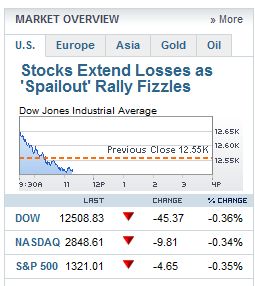
CNBC, 11 juni 2012
El Pais led this morning’s edition with the story that
Contrary to the way the government is portraying the deal, there is de facto fiscal conditionality after all.
If Spain does not stick to its agreed deficit reduction programme
– which seeks to reduce the deficit from 8.9% last year to 3% in 2014 (which is virtually impossible given the likely trajectory of the depression),
the European money flow would stop.
Eurointelligence 11 June 2012
The funds will be channeled through the state-run FROB bank-rescue fund and
Spain will “retain the full responsibility of the financial assistance and will sign” the agreement with the other partners
Bloomberg 11 June 2012
“Spain needs a systematic restructuring of its banking system, which could entail haircuts to subordinated bank debt.
Official lenders on the other hand are likely to demand seniority.” (RE: Jfr Företrädesrät vid konkurs.)
A spokesman said the /German Finance/ minister believed it would be “more efficient” for the loans to be made by the European Stability Mechanism, the eurozone’s permanent rescue facility.
ESM loans are senior to other creditors, ensuring that Spain’s debts to other eurozone members would take precedence over private lenders in the event of a default.
Financial Times 11 June 2012
Worries about the effects of preferred-creditor status led the eurozone to leave out such a stipulation in the EFSF when it was established in 2010. But Germany insisted on the rule, inspired by the IMF, for its permanent successor.
However, a spokesman for Ms Merkel conceded that it is not for Germany to decide whether the ESM or the EFSF is used. The timing and formulation of Spain’s eventual request for assistance would determine which of the two rescue funds was tapped, he said.
“There will be a troika [the team of outside inspectors from the European Union, European Central Bank and International Monetary Fund] and it will make sure the programme is being implemented,” Wolfgang Schäuble said on Monday.
Experts said the European Stability Mechanism (ESM), which replaces the EFSF in July, could be used instead.
However, since ESM debt would rank above private bondholders, loans from this fund could make Spain even less attractive to private investors on the capital markets.
Louise Armitstead, Chief Business Correspondent, Telegraph 10 Jun 2012
The world is uncomfortably close to a 1931 moment
Italy must guarantee 22pc of the bail-out funds, even though it cannot raise money itself at a sustainable rate.
You could hardly design a surer way to pull Italy into the fire.
Ambrose Evans-Pritchard, 10 Jun 2012
It reshuffles debt from one end of the Spanish economy to another.
Spain’s total debt was 363 per cent of gross domestic product in mid-2011, and with the prospect of a severe economic depression ahead,
its crisis cannot be solved through a combination of austerity and liquidity support.
The eurozone must recognise that some form of debt relief, or default, will be inevitable.
Wolfgang Münchau, Financial Times, June 10, 2012
Men på vilket sätt drabbas skattebetalarna av centralbankernas kapitalförluster?
Det måste vara väldigt kännbart eftersom det enligt Calmfors riskerar att leda till en politisk reaktion som avskaffar euron.
Så vitt jag kan förstå innebär en kapitalförlust endast indirekta effekter på centralbankerna och mycket utspädda effekter på skattebetalarna.
Danne Nordling, 5 augusti 2012
Till detta kommer att Europas politiker måste klargöra vilket alternativet är. Om ECB inte köper obligationer för att hålla räntorna nere kommer en betalningsinställelse ännu säkrare att inträffa. Då kommer pensionsfonder och andra placerare som till stor del representerar småsparare att förlora en stor del av kapitalet. Det kanske Calmfors anser är bättre? Men en skuldnedskrivning i krisländerna kommer också att drabba eurozonens banksystem och i viss mån även banker utanför.
Kommentar av Rolf Englund
Folk är vana vid att man måste arbeta för att få pengar.
Dom, och tydligen många som anses lärda, har inte tagit till sig att man, om man är en riksbank, kan skapa pengar genom att skriva en summa på datorn och sedan trycka enter.
Konsten är, som vi monetarister brukar säga, att skapa lagom mycket pengar.
Inte för mycket, då blir det inflation,
Inte för lite, då blir det massarbetslöshet.
För mer om monetarismen, se
www.internetional.se/freshstart.htm
Vem betalar Spaniens bankstöd?
Är det Europas skattebetalare istället för spanjorerna som måste betala det nya bankstödet?
Eller är det egentligen enbart fråga om att garantera låga räntor för lån som som
på ett eller annat sätt ändå måste kanaliseras till Spanien?
Danne Nordling 10 juni 2012
Stödet till Spanien är gratis, väl?
Rof Englund, 10 juni 2012 21.45
Det är inte lätt, men nödvändigt, att skilja på realt och finansiellt.
Om vi tänker oss att Spanien hade drabbat av en verklig, real, tsunami som hade spolat bort några badorter på Solkusten och euroländerna i norr ville hjälpa till hade de behövt skicka lastbilar och byggnadsmaterial osv.
Det hade varit reala resurser som åtgått och kostnaden härför hade behövt belasta statsbudgeten och kanske skattebetalarna.
Nu har Spanien drabbats av en finansiell tsunami som sopat bort låt oss säga 1.000 miljoner euro i form av fallande fastighetspriser (som i USA).
Det har gjort att bankernas fordringar på fastighetsbolagen måste skrivas ner med 1.000 miljoner, säger de petiga revisorerna.
Då sjunker tillgångssidan i balansräkningarna med 1.000 miiljoner.
De petiga revisorerna säger att då måste 1.000 miljoner euro bort också från kreditsidan i balansräkningen. Det måste väga jämnt, säger dom.
Då minskar det egna kapitalet med 1.000 miljoner, vilket leder till konkurs eller i varje fall till att bankens utlåning måste minska med kanske det 20-dubbla (Basel-reglerna).
Nu får den spanska Bankstödsmyndigheten ett lån, inte en gåva, ett lån från någon EU-räddningsfond, oklart vilken.
För dessa 1.000 miljoner euron köper myndigheten nyemmitterade aktier i bankerna.
Frågan är givetvis till vilken kurs. Det borde bli billigt eftersom bankerna förmodligen är konkursmässiga och likt Carnegie skulle kunna mista sin bankoktroj. Men bankerna har mäktiga vänner och anlitar väl kanske Kreabs spanska syster för att få bra betalt för sina nya aktier.
Nåväl, hur drabbar då detta skattebetalarna i bland annat Tyskland?
Räddningsfonden skänker inte bort sina pengar, utan lämnar lån.
Kostnad 0 kr.
Om fonden skulle behöva fyllas på är det inte heller en kostnat, utan en investering.
Konstnad 0 kr.
Det är precis som jag tror det är med Sveriges bidrag till IMF nyligen.
Riksbanken bokförde det som en fordran på IMF och krediterade något av sina konton.
Kostnad i budgeten 0 kr.
Vadan all denna hysteri?
Tänk i stället på de stackars aktieägarna i de spanska bankerna som får se sina tillgångar sjunka i värde i den mån de inte redan har gjort det.
Men, å andra sidan, that is what shareholders are for.
Arikeln kan laddas ner som pdf här
Where will the money come from? Italy?
De Guindos, Schauble and the Eurogroup, all announced that the sole source of cash would be the ESM and/or the EFSF.
The problem with this is that the ESM has yet to be ratified by Germany, whose parliament said previously it is sternly against allowing the ESM to fund a direct bank bailout
Thus, the successful German ESM ratification vote, whenever it comes, and which previously was taken for granted, now appears to be far more questionable.
Which leaves the EFSF. The problem with the EFSF is that there is about €200 billion in dry powder.
And this includes the Spanish quota of €93 billion, which we can only assume is now officially scrapped.
ZeroHedge 9 June 2012
Which brings us to a bigger question: now that Spain is officially to be bailed out, what happens next. And by that we mean of course the big one: Italy. Recall that as we posted in Brussels... We Have A Problem,
once the contagion spreads again to Italy, and that country also needs a bailout, it is game over.
Spain’s Fund for Orderly Bank Restructuring (Ha, ha, ha)
Spain was keen to ensure that any assistance went direct to its banks, rather than to the central government.
As a result, the loans will go to its bank restructuring agency, called FROB.
But this would still considered state debt
BBC 9 June 2012
100 miljarder euro, 892 miljarder kronor, 125 miljarder USD
(JPMorgan Chase hade ett börsvärde på 130 miljarder dollar år 2011)
När och hur är det tänkt att den spanska myndigheten
Spain’s Fund for Orderly Bank Restructuring
skall återbetala pengarna med ränta?
Rolf Englund 9 juni 2012
Tanken är väl att Fonden skall få aktier i de bankerna i utbyte mot 100 miljarder euro.
Det borde bli mycket aktier, i all synnerhet som bankerna står inför konkurshot, likt Carnegie sägs ha gjort
Sedan skall fonden kränga aktierna för åtminstone 100 miljarder euro, helst.
Som jämförelse kan nämnas att JPMorgan Chase & Co. hade ett börsvärde på 130 miljarder dollar år 2011.
The president of the European Commission, Jose Manuel Barroso, said he was confident that through bank restructuring and other reforms, Spain could gradually regain the confidence of investors and create the conditions needed for sustainable growth and job creation.
BBC 10 June 2012
What the IMF report confirms is that the finances of the Spanish government and of the Spanish banks live and die together
- in that the banks hold around two-fifths of Spanish central government debt, which is equivalent to 8% of all the banks' loans and investments.
Or to put it another way, the Spanish government would have struggled to finance itself without loans from the banks
and the banks would be bust if the government were to go bust.
Robert Peston, BBC Business editor, 9 June 2012
All of which reinforces the likelihood of the Spanish government receiving a substantial bailout package from the eurozone's European Financial Stability Facility - because it cannot borrow the sums required by its banks from its banks (doh!) and right now other investors are increasingly reluctant to lend to it.
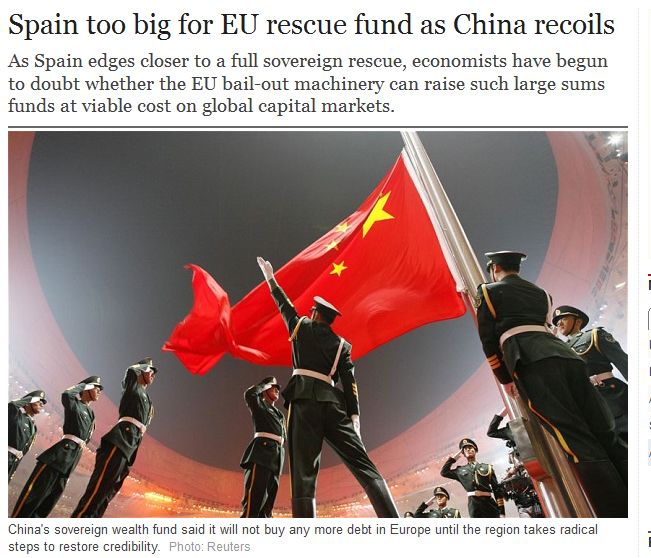
The Chinese issued their own verdict on Thursday.
The country's sovereign wealth fund said it will not buy any more debt in Europe until the region takes radical steps to restore credibility.
"The risk is too big, and the return too low," said Lou Jiwei, the chairman of the China Investment Corporation.
Ambrose Evans-Pritchard, 7 Jun 2012
Spain, the fourth-biggest euro economy,
owes bondholders 731 billion euros,
more than the three countries (Greece, Ireland and Portugal)
that have already been bailed out combined.
John Mauldin, 2 June 2012
The euro’s 'guilty men’ are now steering Europe to catastrophe
Remaining in the single currency is no longer a rational choice for many countries
– but will its creators listen?
Peter Oborne, Telegraph, 6 Jun 2012
More than six months have passed since Frances Weaver and I published our pamphlet, Guilty Men, identifying those financiers, politicians and propagandists who advocated the creation of the European single currency 15 years ago, and exposing the dishonest or even brutal methods they used.
Our pamphlet was not an exercise in academic point-scoring. As Winston Churchill told the House of Commons, in the context of appeasement in 1936: “The use of recriminating about the past is to enforce effective action at the present.” Our task was no less ambitious.
We wanted to silence and, if possible, to shame those voices in British and European public life who have been responsible for the tragedy of the euro, and therefore enable the resurrection of sensible and humane economic policies.
Guilty Men was a book published in Great Britain in 1940 that attacked British public figures for their appeasement of Nazi Germany in the 1930s. It is regarded as the classic denunciation of appeasement and is said to have shaped popular thinking for twenty years.... Wikipedia
Can we envisage a set of reforms that are not only politically feasible and economically workable, but would let it prosper, as it is.
If so, what might they be?
Martin Wolf Financial Times 12 June 2012
What is needed: a swift and effective move towards an insurance and adjustment union.
That is neither a federal union nor a transfer union.
It is a way of making it possible for countries that remain largely sovereign to share a single currency.
I do not know whether even this is economically and politically feasible. But if not that, what?
Before now, I had never really understood how the 1930s could happen.
Now I do.
Martin Wolf, Financial Times, June 5, 2012 10:39 pm
All one needs are fragile economies, a rigid monetary regime, intense debate over what must be done, widespread belief that suffering is good, myopic politicians, an inability to co-operate and failure to stay ahead of events. Perhaps the panic will vanish. But investors who are buying bonds at current rates are indicating a deep aversion to the downside risks. Policy makers must eliminate this panic.
In the eurozone, they are failing to do so.
If those with good credit refuse to support those under pressure, when the latter cannot save themselves, the system will surely perish.
The comment startled analysts given that the Spanish treasury
plans to auction up to €2bn of bonds on Thursday.
Financial Times June 6, 2012 1:46 am
Spanish premier Rajoy has become the latest European politician
to call for countries to, in effect, abandon their sovereignty in a last-ditch attempt to save the beleaguered currency
a new central authority would send a clear signal to investors that the single currency is an irreversible project
Telegraph 2 June 2011
He said: “The European Union needs to reinforce its architecture. This entails moving towards more integration, transferring more sovereignty, especially in the fiscal field.
“And this means a compromise to create a new European fiscal authority which would guide the fiscal policy in the eurozone, harmonise the fiscal policy of member states and enable a centralised control of [public] finances.”
Kommentar av Rolf Englund:
Rajoy och andra euro-peiska ledare har missförstått sin upppgift.
Uppgiften är inte att "rädda euron" - uppgiften är att göra det bra för sina folk
EMU är inget experiment. EMU är ett vågspel. Ett experiment kan avbrytas.
EMU är som att göra fisksoppa av ett akvarium. Om man ångrar sig är det svårt att göra ogjort
Rolf Englund om DNs ledarsida 13/7 2003
Måste Spanien upprepa Irlands misstag?
I Irland fick oron till följd att regeringen införde en bankgaranti.
När Irlands banker fick problem med hotande bankrusning fanns ingen "lender of last resort".
Hur kunde eurons konstruktörer glömma att förse valutaunionen med en fungerande centralbank
Danne Nordling 2 juni 2012
Irland - Lender of last resort
The future of the euro will be determined over the next few dramatic weeks, the Spanish finance minister Luis de Guindos has warned.
"I don't know if we are on the edge of a cliff, but we are in a very, very difficult position," de Guindos said.
"The future of the euro is going to play out in the next few weeks in Spain and Italy."
Guardian, 1 June 2012
As new data showed Spain's unemployment rate at a record 24.3%,
budget minister Cristóbal Montoro reported that the country's regional governments, which kept the national budget deficit at 8.9% last year, had balanced their budgets in the first quarter of this year.
But he admitted this was only because central government had brought forward € 5 bn in payments to the most cash-strapped regions
Montoro also warned other European countries that if Spain was allowed to collapse without paying its debts then that would inflict damage on them too.
"Who holds our external debt?" he asked. "You will understand that those who are most interested in things going well for Spain are the creditors.
ECB, Lender of last resort, current account
As Paul Krugman said to me earlier this week on his trip to London,
if the eurozone is going to end, it's a fair bet that the process will start with a Spanish bank run
Stephanie Flanders, BBC Economics editor, 1 June 2012
If Spain, Ireland, Greece, Portugal and maybe Italy, broke free (with a combined GDP to rival Germany).
They would enjoy an immediate 30pc cost advantage thanks to devaluation, which would jump start growth
Germany would probably be forced to adopt its own stimulus measures to boost consumer spending at home
A smaller German surplus and more inflation would result, but that's no disaster, even for Germans.
Damian Reece, Telegraph 31 May 2012
Spexit
6 reasons Spain will leave the euro first
Matthew Lynn, Market Watch May 30, 2012
We’ve already had Merkozy, now relegated to the footnotes
Grexiy has been trending for the last few weeks.
And coming up next: the Spexit
What’s that?
It’s shorthand for Spain quitting the euro — and we’re going to hear a lot of it over what promises to be a turbulent summer.
How to save Spain
Spain’s problem is one of misdiagnosis
The Economist print Jun 2nd 2012
Its government and European officials reckon the main challenge is fiscal.
Spanish politicians have dithered about cleaning up the country’s banks, for fear that doing so would demand an injection of public funds which, in turn, would worsen the government’s finances.
This fiscal focus gets things exactly backwards.
Spain’s poor public finances, unlike those of Greece, are a symptom rather than the cause of the country’s economic woes.
Before the crisis Spain was well within the euro zone’s fiscal rules. Even now its government debt, at around 70% of GDP, is lower than Germany’s.
As in Ireland, the origins of Spain’s debt problems are private, not public.
The inadequate, piecemeal nature of Europe’s approach to the crisis stems from a wanton refusal to face up to its causes.
Europe can’t bring itself to accept that the economics of the single currency doom it to failure.
Felet är att eurozonens ledare inte vill inse att allt var fel från början.
De vill inte inse att tanken, att ha en gemensam valuta för Tyskland och Grekland, Finland och Cypern, var och är en felaktig tanke.
Allt var fel från början, precis som kommunismen. Englund blog 21 oktober 2011
Konstruktionen kring euron har inte varit fel
Jan Björklund, Birgitta Ohlsson, Carl B Hamilton och Olle Schmidt, SvD Brännpunkt, 9 september 2011
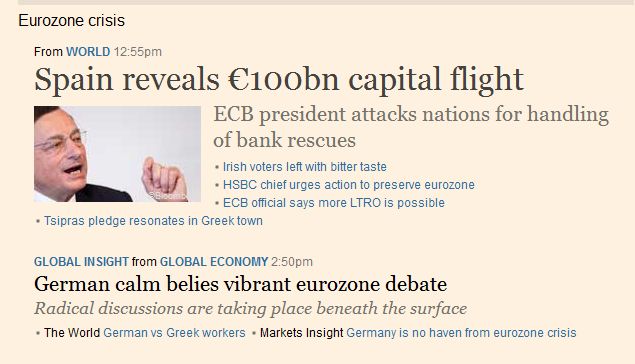
Data published by Spain’s central bank showed
€ 97 bn had been pulled out in the first quarter – around a 10th of the country’s GDP
Financial Times 31 May 2012
Bank run, The beginning of the end
Bank of Spain data showed a net 66.2 billion euros was sent abroad last month,
the most since records began in 1990.
CNBC 31 May 2012
Europe’s leaders can’t save their currency union without figuring out a way to salvage the region’s banks. Spain is a perfect place to start.
By accepting joint responsibility for injecting capital into a single country’s banks, the nations of the currency zone
would be taking another step toward financial federalism and collectively backed euro bonds.
Bloomberg, editors, 31 May 2012
Central-bank data suggest that, in the first four months of this year, more than 100 billion euros in private money has fled Spain for other euro-area countries, an amount roughly equal to a 10th of the country’s annual economic output.
A European Central Bank measure of deposits in Spain’s banks declined by 31.5 billion euros in April.
It’s imperative that Europe step in to break Spain’s fall, lest the country’s problems topple the euro area’s banking system. Europe’s banks have about 672 billion euros in claims on Spain’s banks, government and companies, according to the Bank for International Settlements.
Germany’s claims alone add up to about 186 billion euros, or nearly half of German banks’ aggregate capital.
An opportunity to create a model for bank recapitalizations throughout the euro area.
One crucial element, as indicated Wednesday in a European Commission proposal, would be to allow the euro area’s bailout funds to provide capital directly to individual banks, a route now closed to the rescue funds.
The quid pro quo should be a measure of European control over how the money is used, burden-sharing among the banks’ creditors, the ejection of entrenched management and steps toward a unified banking authority with the power to take over failing banks anywhere in the euro area.
Let’s say Spain’s banks need 120 billion euros in new equity -- or capital -- to cover losses and restore confidence. The first place to look for the money would be the banks’ own subordinated creditors, whose claims aren’t secured against any of the institutions’ assets.
These investors, who received a higher return to compensate for their low position in the pecking order of creditors, have often been made whole in bank bailouts.
Instead, their claims should be converted into equity -- a “bail-in” that could cut 30 billion euros or so off the price tag of recapitalization.
Of the remaining 90 billion, the first 25 billion could come from the Spanish government in the form of equity that would protect other contributors from losses.
The rest -- about 65 billion -- could come from the euro-area’s bailout funds.
In return, the funds would gain a presence on the boards of the recipient banks.
Voting power would allow them to make sure that the managers responsible were replaced and that the compensation of executives and shareholders stayed in check until Europe’s money had been paid back.
Such a recapitalization plan would be a radical move for the euro area.
By accepting joint responsibility for injecting capital into a single country’s banks, the nations of the currency zone would be taking another step toward financial federalism and collectively backed euro bonds.
The sooner they realize that this is the only viable direction to go, the greater the currency union’s chances of survival.
Despite the enormity of Spain’s problem, this crisis is a refreshing change
It doesn’t involve wholesale deposits, collateralised debt obligations, or structured investment vehicles – or even an investment bank
It is the kind of fiasco that always brings down banks
Over-leverage, a commercial property bubble, poor supervision and hubris
John Gapper, Financial Times 30 May 2012
Bankia and the troubles of Spain’s other cajas are a repeat of the US savings and loans crisis a quarter of a century ago, which cost $100bn.
“Real estate lending became the fashion, the ‘new’ banking idea of the times,” William Seidman,
who as head of the Federal Deposit Insurance Corporation tackled the S&L crisis, later recalled.
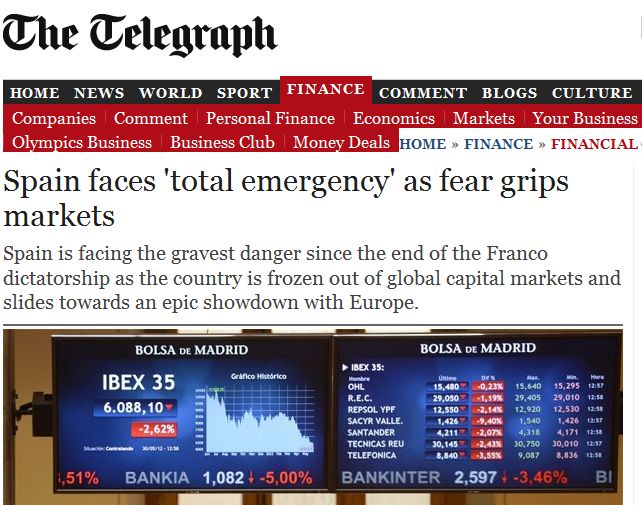
“We’re in a situation of total emergency, the worst crisis we have ever lived through”
said ex-premier Felipe Gonzalez, the country’s elder statesman.
Ambrose Evans-Pritchard, 30 May 2012
The warning came as the yields on Spanish 10-year bonds spiked to 6.7pc, pushing the “risk premium” over German Bunds to a post-euro high of 540 basis points.
The IBEX index of stocks in Madrid fell 2.6pc, the lowest since the dotcom bust in 2003.
EU:s finanspakt: Irland röstar men har inget val
Paralleller finns med Spanien.
Gunnar Jonsson, signerat, DN 31 maj 2012
RE: En lysande artikel
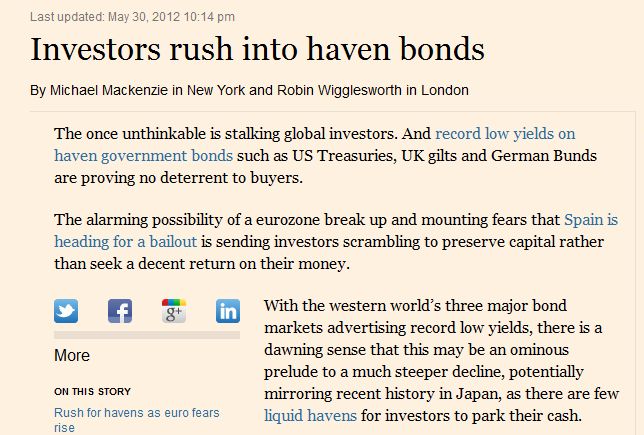
The once unthinkable is stalking global investors
The alarming possibility of a eurozone break up and mounting fears that Spain is heading for a bailout
is sending investors scrambling to preserve capital rather than seek a decent return on their money
Financial Times 30 May 2012

A Spanish plan to recapitalise Bankia, the troubled lender,
by indirectly tapping the European Central Bank for cash,
was bluntly rejected as unacceptable by the ECB, European officials said.
Financial Times 29 May 2012
News of the rejection came as Spain faces elevated borrowing costs in the bond markets,
tries to persuade investors it can contain problems in a banking sector weighed down by €180bn of bad property loans
and, on Tuesday, saw its central bank governor stand down early.
Top of page, highly recommended
– Vi låter varken någon region eller bank falla,
för det kan inte hända... om det skulle hända faller landet,
sa Spaniens premiärminister Mariano Rajoy vid en presskonferens.
Både Spaniens regioner och banker har stora problem med underskott
SvD Näringsliv 29 maj 2012
Bland regionerna är det framför allt storstadsområden som visar problem: Madrid, Valencia och Barcelona.
Enbart Katalonien, som Barcelona ligger i, har mer än 13 miljarder euro i lån som förfaller i år - det motsvarar nästan 120 miljarder kronor.
The fiscal treaty will not solve Europe’s crisis
The Spanish and Irish crises stem from too much cross-border private sector borrowing and lending
Today’s large fiscal deficits are a result of, not the cause of, Ireland’s and Spain’s crises.
David McWilliams, Financial Times 28 May 2012
Capital flight has cut foreign holdings of Spanish debt from 50pc to 37pc since January.
Spain's banks -- including Bankia -- have been propping up the state with €316bn borrowed from the ECB
Now the state is propping up banks.
Barclays Capital says Spain's housing crash is only half way through.
Ambrose Evans-Pritchard, 28 May 2012
Euron kollapsar i Spanien
Rolf Englund 28 maj 2012
Spain is spiralling into the vortex of debt-deflation
Ambrose Evans-Pritchard, 27 May 2012
"The moment they start saying, 'Don't worry, your money will be safe,'
is the moment you should withdraw your money from the bank,"
In Spain, investors watch for run on banks
As depositors worry about their money, observers warn of panic.
Banks and the government issue statements aiming to calm the public
Los Angeles Times, 27 May 2012
Finance alone
S&P slashed its ratings on the creditworthiness of five Spanish banks on Friday,
just as one of them — Bankia, the nation’s largest real estate lender —
requested an additional 19 billion euros in rescue funds from the country, far beyond initial government estimates.
New York Times 25 May 2012
It is only a trickle so far, and not nearly enough to constitute a classic bank run. But
these growing transfers of deposits out of troubled Spanish banks reflect a broader fear that the country’s problems
could make it hard for Spaniards to get to their money if banks fail and cannot be supported by the government.
Herald Tribune 24 May 2012
Despite efforts at official reassurance, no one really knows the consequences of a Greek exit from the euro zone,
or how rapidly big countries like Spain and Italy, and their banks, will feel the effects.
The point of no return may be approaching faster than anyone anticipated
Steven Erlanger, The New York Times 20 May 2012
Once again, markets are becoming nervous about lending to a eurozone government.
This time it's Spain's turn.
BBC 18 May 2012
The interest rate demanded by markets from the Spanish government to lend it money for 10 years has risen well above 6% - not far short of the 7%-8% level that prompted Greece, the Irish Republic and Portugal to go cap in hand to Brussels for a bailout.
In comparison, the German government only has to pay an interest rate of 1.42% - which, by the way, is the cheapest cost of borrowing that Berlin has ever faced.
What the markets are saying is that they are afraid Spain may ultimately go the same way as Greece,
and prove unable to repay its debts, so they are moving their money to the safety of German bonds
It’s Spain
Greece no longer holds the dubious honour of being centre stage in the eurozone crisis.
Long-held worries about the health of Spanish banks have given rise to concern about the chance of bank runs,
the worst nightmare of policy makers and investors alike.
Financial Times 18 May 2012
148 miljarder euro
The Bank of Spain disclosed that the value of bad loans held by the teetering Spanish banking sector
increased a third over the last year to €148bn, amid mounting concern that the country is now the front line
in preventing Greece’s political crisis from pulling down the rest of the eurozone.
Financial Times 18 May 2012
Euroland's €1 trillion question
Everyone knows Greece is leaving the euro,
the real challenge is preventing the fall-out extending to Spain
Alistair Osborne, Telegraph 16 May 2012
Bank deposits, /in Greece/ are now being withdrawn at the rate of around 3 bn euros a wee
Madrid continues to look the biggest nasty for the eurozone. Ten-year bond yields spiked to 6.5pc yesterday,
their highest level since the ECB put some financial morphine into the system late last year with the first of its cheap loans to banks.
Totalling €1 trillion, it was dubbed a long-term refinancing operation but has proved anything but.
Spain’s banks took the cheap money and bought Spanish sovereign debt, the latest lot on yields averaging 5pc.
Now the banks are sitting on losses they may have to crystallise, making a bad situation worse.
In fact, LTRO merely disguised the main problem – the state Spain’s in – while blurring the lines between whether it’s facing a banking or a sovereign crisis
Top of page - News - Start page
Cajas are currently saddled with 180 billion euros in troubled mortgage loans
Just like in the United States, a real estate bubble had also grown in Spain.
The only difference between the two was that Spain's wasn't hidden in the form of complicated financial products.
Spain's cajas, or savings banks, speculated badly with normal loans.
Der Spiegel 11 May 2012
In contrast to their German counterparts, the Sparkassen, which are only allowed to do business in the areas where they are located, the Spanish eliminated such a "regional principle" in 1988. This allowed all the country's cajas to participate in the construction boom that saw large parts of the country's coast dotted with new concrete apartment buildings. It is estimated that the cajas are currently saddled with €180 billion ($233 billion) in troubled mortgage loans.
Madrid höll ordning på sin budget, men landet gick länge med ett stort underskott i betalningsbalansen
medan europeiska banker glatt lånade till fastighetsboomen.
Efter kraschen hamnade det privata skuldberget i statens knä.
DN-ledare, Signerad Gunnar Jonsson, 12 maj 2012
Kan verkligen krisen för de spanska bankerna bero på de dåliga statsfinanserna i Grekland?
Naturligtvis inte. Det förstår väl vem som helst, är det naturliga svaret.
Men sanningen är ju den att den svenska regeringen och S-ledaren Löfven och Dagens Nyheter och
Svenska Dagbladet och alla andra eurokramare, fortfarande håller fast vid den analysen.
Rolf Englund 11 maj 2012
The Spanish government is to force its banks to take on an extra 30bn euros of capital
The banks will have to raise the money or borrow from the government at an annual interest rate of about 10 %
BBC 11 May 2012
Earlier in the week, the Spanish government took a 45% stake in Bankia.
Bankia had a 4.47bn-euro loan by the Spanish bailout fund converted into shares.
Desperately seeking a bailout for Spain and its banks;
Roubini, FT 9 May 2012
Banks may have to disclose profits from carry trades derived from 1 trillion euros in ECB loans
and exclude the money from bonus pools
Bloomberg May 4, 2012
Spain is the crucial front in Europe’s battle to contain its economic crisis, and the fight is going badly
Bloomberg Editors May 1, 2012
Spain’s economy is in a tailspin. Some forecasters say the unemployment rate, already a punishingly high 24.4 percent, could reach 30 percent. The government’s credit rating has just been downgraded, and its cost of borrowing -- close to 6 percent -- is putting its solvency in question. Investors are watching the country’s banks with mounting concern.
The ECB’s trillion-euro liquidity operation brought temporary relief, but only at the cost of increasing Spain’s financial fragility as its banks used the ECB’s loans to buy more of their government’s subsequently downgraded debt.
The more investors understand this frailty, the greater the risk of financial meltdown becomes.
Considering that Spain’s economy is far larger than those of Greece, Ireland and Portugal combined, the repercussions would put all of Europe at risk.
ECB’s trillion-euro liquidity operation
Spanien väntas inom kort få ett stödlån på cirka 150 miljarder euro
(1.335 miljarder kronor)
för att reformera/rekapitalisera de spanska bankerna”, skriver SEB
DI 8 maj 2012
1.335 miljarder kr till Spanien visar att det inte bara handlar om Grekland
Rolf Englund 8 maj 2012
Spain is working on a rescue plan for Bankia which is likely to involve injecting billions of euros of public money
In a rapid reversal of policy by Spain’s government, which had until now insisted that no additional state money would be used to clean up the country’s banking sector,
the ministry of economy confirmed that a plan to intervene in Bankia, the country’s third largest bank by assets, was under way.
Financial Times 7 May 2012
"Its functioning fell short of both expectations and needs"
EFSF, the rescue fund for cash-strapped euro-zone countries, has not been very successful, admitted ECB President Mario Draghi
Spanish banks are particularly unsteady. They are sitting on roughly €1 trillion in shaky loans
Der Spiegel 7 May 2012
The frenzy drove Spanish home prices to a peak in 2007, they have fallen by at least one-fourth, and the bottom seems nowhere in sight.
As Spain endures its second recession and unemployment nears 25 percent,
an increasing number of debt-heavy Spaniards can no longer meet monthly payments on the mortgages that their banks were all too eager to give.
With a rising portion of Spain’s 663 billion euros, or $876 billion, in home mortgages at risk of default,
many economists say it is only a matter of time before some of Spain’s biggest banks will need a bailout.
And the Spanish government, staggering under its own debt and budget deficit burdens, may not have the money to come to the rescue.
New York Times, 24 Apr 2012
Last year alone, Spain started to build 800,000 new homes
Unfortunately, the number of new houses was not just more than France, Germany and Italy combined built last year.
It was also more than anybody wanted to buy.
FT editorial 28/4 2007
Lars Calmfors i Hässleholm:
Ännu återstår att se om EU har de verktydg som behövs för att ta sig ur krisen.
– Än så länge ger Frankrike stödlån även om de har högre statsskuld än Spanien.
Anders Selnes, europaportalen, 19 april 2012
The biggest Catch 22 for the Spanish government is also the most obvious.
Its cost of borrowing (the bond yield) goes up when financial markets worry that it will not get a handle on its budget deficit.
But it also goes up when ministers talk about the tough measures they are going to take to get that deficit down,
because of fears that spending cuts and tax rises will tank the economy and therefore be self-defeating.
Stephanie Flanders Economics editor 16 April 2012
It's a good example of the market's "schizophrenia" on the subject of fiscal austerity, highlighted by the IMF's chief economist at the end of last year and often debated.
But, as Goldman Sachs economists make clear in a recent, very thorough four-part analysis of the fiscal and competitiveness problems facing the European periphery, the Catch 22s for Spain go deeper than that, and they are even worse for Portugal and Greece.
The crisis economies have not just a fiscal problem, but a competitiveness problem, built up over their first decade in the euro.
To fix that latter problem, the Goldman Sachs team reckon that Portugal needs a real devaluation of around 35%. In other words, the nominal cost of Portuguese labour and other inputs has to fall by 35%, relative to their trading partners.
The equivalent figure for Greece is around 30%, while Spain needs a real depreciation of just over 20%, and Italy about 10-15%.
Interestingly, they think this part of Ireland's adjustment is more or less complete.
To put these figures into perspective, the fall in the value of the pound in 2008 was one of the largest depreciations to have occurred in a major industrial country since the war - and produced an increase in UK competitiveness of around 20%.
So, Spain now has to pull off the same thing, but without changing its nominal exchange rate by one peseta - because, to state the obvious, it doesn't have pesetas any more. It has euros.
Krugman, IMF och sedelpressar
Rolf Engund blog 12 april 2012
Spain’s fiscal problems are a consequence of its depression, not its cause.
Nonetheless, the prescription coming from Berlin and Frankfurt is, you guessed it, even more fiscal austerity.
This is, not to mince words, just insane.
Paul Krugman, New York Times 15 April 2012
The survival of the eurozone now depends on Italy and Spain.
They are the countries that are too big to fail – or to rescue.
Structural steps are painful for any government. They are devilishly difficult without growth.
Robert Zoellick, president of the World Bank, Financial Times 16 April 2012
Spain must repay a € 11.9 bn bond on April 30, and another € 12.8 bn loan at the end of July
If investors refuse to finance this repayment at an "affordable" rate, what happens next?
The answer is that nobody knows
Liam Halligan, Telegraph 14 Apr 2012
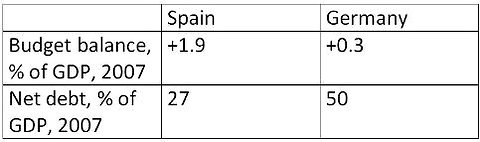
What happened to Spain was a housing bubble
— fueled, to an important degree, by lending from German banks — that burst, taking the economy down with it.
I’m really starting to think that we’re heading for a crackup of the whole system.
Paul Krugman 15 April 2012
Spain could be the next European economy brought down by German-led mismanagement of the euro-zone crisis.
It need not turn out that way. But it surely will unless Chancellor Angela Merkel and her political allies
acknowledge that no country can pay off its debts by suffocating economic growth.
New York Times, editorial, 12 April 2012
Austerity, the one-size-fits-all cure prescribed by Ms. Merkel, is not working anywhere.
Mr. Rajoy’s budget is supposed to slash last year’s deficit of 8.5 percent of gross domestic product, to 5.3 percent this year and then 3.0 percent in 2013.
The targets are likely unreachable, even if he rigorously keeps to his punishing budget.
The most optimistic official estimates forecast the economy to shrink by nearly 2 percent this year.
And the more Spain’s G.D.P. contracts, the more tax receipts drop, requiring even steeper budget cuts. It is a destructive, ever downward cycle.
Each of Europe’s struggling economies has different problems, calling for different remedies. Spain, for example, has one of Europe’s lowest public-sector debt levels.
But it does need to work off the private debt that went bad when its housing bubble burst and its weakened banks turned to the government for support.
Spain's prime minister Mariano Rajoy:
"To talk about a bail-out for Spain at the moment makes no sense," he told reporters.
"Spain is not going to be rescued; it's not possible to rescue Spain, there's no intention to, it's not necessary
and therefore it's not going to be rescued."
Louise Armitstead, Telegraph 12 Apr 2012
Spanish, Italian and Portuguese banks are loading up on bonds issued by their own governments,
a move that shifts more of the risk of sovereign default to European taxpayers from private creditors.
Holdings of Spanish government debt by lenders based in the country jumped 26 percent in two months, to 220 billion euros,
Bloomberg 18 April 2012
Italian banks increased ownership of their nation’s sovereign bonds by 31 percent to 267 billion euros
The jump in sovereign-debt holdings by Spanish and Italian banks has been fueled by the ECB’s 1 trillion-euro long-term refinancing operation, or LTRO,
For lenders in so-called peripheral countries -- Spain, Portugal, Ireland, Greece and Italy -- profit also was an inducement: They could borrow at 1 percent to buy government bonds yielding between 6 percent and 13 percent.
Lenders in those five countries have taken about 715 billion euros from the ECB through emergency programs, including the LTRO,
Spanish banks' borrowing from the ECB almost doubled in March from February to 316 billion euros
as the question whether Spanish banks need to be recapitalized hangs over the sector like the sword of Damocles
In January the Spanish government introduced reforms under which
Spanish banks must increase their provisions for property assets by 52 billion euros.
CNBC 13 April 2012
As Citigroup's Willem Buiter wrote in his famed note in March, “New property and real estate-related losses are likely to come their way as a result of further property price declines. The Spanish banks are unlikely to be able to absorb these losses."
But who is ready to help the beleaguered Spanish banks?
Spanish and Italian banks are trapped with large losses on sovereign bonds bought with ECB funds (LTRO).
Spanish banks used ECB funds to purchase five-year Spanish bonds at yields near 3.5pc in February and 4.5pc in December.
The same bonds were trading at 4.77pc on Wednesday, implying a large loss on the capital value of the bonds.
It is much the same story for Italian banks pressured into buying Italian debt by their own government.
Any further dent to confidence in Italy and Spain over coming weeks could push losses to levels that trigger margin calls on collateral.
Ambrose Evans-Pritchard 11 April 2012
Spain's banks are fast joining the ranks of the most unloved in Europe just as many need to raise capital urgently,
deserted by investors who believe the country is on the brink of a recession that many lenders will not survive.
CNBC 11 April 2012
European Union officials joined Madrid on Wednesday in insisting Spain’s banks would not need a cash injection from the eurozone’s rescue fund,
despite concerns they will fail to raise more than €50bn in new government-mandated capital by the end of the year
Financial Times 28 March 2012
So much for the miracle cure.
The magnitude of Spain’s debt crisis has now exposed the limits of the European Central Bank’s longer term refinancing operations.
John Plender, FT, April 10, 2012
That underlines a fundamental problem with the ECB’s great liquidity injection. It reinforced the incestuous relationship whereby undercapitalised eurozone banks propped up overstretched sovereign borrowers who stood behind those same fragile banks.
Spain now finds itself at the centre of a great eurozone laboratory experiment designed to show that a pro-cyclical increase in fiscal austerity in a deep recession can lead on to growth and debt sustainability.
Markets, which are wrongly assumed always to favour the fiscal hair shirt, are torn on the issue.
There is also market concern that a deeper recession would adversely affect the credit quality of private sector debt, which at nearly 300 per cent of GDP has always been a much bigger problem for Spain than public sector debt.
Against the background of sagging house prices that are expected to fall further, non-performing loans, currently eight per cent of the total, can only go in one direction.
Spain’s Death Spiral and the Hypocrisy of the Euro
TIME, April 5, 2012
From November to February, during which the central bank lent more than 1 trillion euros to 800 European banks,
Spanish banks increased their holdings of government securities by 68 billion euros and
Italian banks by 54 billion euros
New York Times 9 April 2012
Spain
"The problem lies in the fact that the tailing off of GDP is now going faster than the deficit reduction.
The 5.3% of GDP deficit target set for this year, and next year's 3.0% is not just a stretch of the financial imagination... it is impossible
Stephen Pope, of Spotlight, BBC 5 April 2012
The vulnerability of Spain lies not in its sovereign debt but in its bank debt, built up on a massive property bubble, which is still in the process of bursting.
The small local banks and caixa (unlisted savings and loan institutions) are hugely exposed to property and have so far been very slow in marking their assets down to realistic prices.
"It's different from Greece, because the crisis is in banking, but by cutting back spending, the government is not giving the property market and the banks any chance to recover."
With unemployment rising and the property collapse, bad debts and mortgage arrears worsening by the month, the caixa are being squeezed beyond endurance.
Yes, Mussolini pulled off a 20pc cut in wages in the late 1920s.
How can a democracy bring about such cuts in private sector wages without use of police coercion?
Portugal, Italy, and Spain need an "internal devaluation" of around 20pc
to claw back competitiveness within EMU. This means draconian wage cuts for year after year.
Ambrose Evans-Pritchard, 5 April 2012
"a threat not just to Spain but to the whole EU"
The decisive test of the euro area’s plans for economic recovery was never Greece but Spain,
and the European Union shows every sign of failing it.
Bloomberg, editorial 5 April 2012
Given its size, the fate of the Spanish economy will also largely decide the fate of the euro.
€80bn of €396bn (1/5) in loans that Spanish banks have made to the bust construction and real estate sectors are considered ‘doubtful’
and potentially toxic, meaning at serious risk of default, with the banks only holding €50bn in reserves to cover potential losses.
Open Europe, 3 April 2012
Already dropping, house prices could potentially fall another 35%, meaning that Spanish banks will almost certainly face hefty losses as more households default on their mortgages.
In such a scenario, the Spanish state is unlikely to be able to afford to recapitalise its banks, meaning that the eurozone’s permanent bailout fund (the ESM) would have to step in, shifting the cost to eurozone taxpayers.
As domestic banks are currently the main buyers of Spanish government debt, this could also lead to major funding problems for Spain. The chances of a self-fulfilling bond run on Spanish debt would increase massively in this scenario, threatening to push the whole country into a full bailout.
If the eurozone’s austerity strategy, based mainly on the imposition of fiscal contraction in the peripheral economies, works in Spain, then it will probably work elsewhere.
But if it fails in Spain, the long term outlook for the eurozone would seem ominous.
Gavyn Davies, Financial Times 1 April 2012
OMINOUS Synonyms: baleful, dire, direful, doomy, foreboding, ill, ill-boding, inauspicious, menacing, minatory, portentous, sinister, threatening
Nouriel Roubini: markets are “schizophrenic” they cannot decide whether to reward or punish countries such as
Spain and Italy for their austerity plans. “Without growth, the socio-political backlash will become overwhelming for some governments.”
The euro needs to sink to parity with the US dollar in order to restore Europe’s peripheral economies to growth
CNBC 30 March 2012
The tightrope PM Rajoy is trying to walk between austerity and human costs is the fault line dividing the whole of Europe.
Louise Armitstead, Telegraph 29 March 2012
Spain is the big worry: it's raced to the head of market fears - as well as the political agenda - with alarming speed.
International leaders and traders are now watching in horror.
On one side there's the German-led plan to forcibly reduce debt by axing public spending, raising taxes and executing structural reforms;
on the other is a demand for more support of the sinner states to avoid depression and anarchy.
Before we dig down any deeper, just to let us all see where we are, why don’t we make a small detour to
Chapter 11 of the Bank of Spain’s Statistical Bulletin, on General government liabilities. Excessive Deficit Procedure (EDP) debt.
Now if we examine section 11.3 Liabilities outstanding and debt according to the excessive deficit procedure. Absolute values,
we will find this most illuminating table.
Edward Hugh March 6th, 2012

European Union officials joined Madrid on Wednesday in insisting Spain’s banks would not need a cash injection from the eurozone’s rescue fund,
despite concerns they will fail to raise more than €50bn in new government-mandated capital by the end of the year
The Spanish government last month passed laws requiring banks to present recapitalisation plans by the end of March
Financial Times 28 March 2012
The Spanish economist Luis Garicano said the Spanish government and the European Commission made unrealistic assumptions about the deficit reduction efforts.
For Spain to cut the deficit from 8.5% to 5.3%, as demanded by the latest agreement with the Commission, the budgetary impact will not be €32bn,
but between €53bn and €64bn – something that is impossible, he said at a meeting with financial journalists in Madrid, as reported by El Pais.
Eurointelligence 28 March 2012
Garicano proposes that the priority should be expenditure control of the autonomous regions. Garicano also estimated that each €10bn fall in public spending would imply a fall in GDP of between 0.6 to 0.8%. (That implies a multiplier of 60 to 80%, which is relatively optimistic. But Garicano is right in principle. The scale of the adjustment Spain is asked to do is physically impossible.)
Luis Garicano
at Chicago Booth School of Business: Six of our faculty members have won Nobel Prizes
Two rounds of European Central Bank lending have banks across the Atlantic awash in a “sea of liquidity,”
according to a note from Citigroup economist Willem Buiter, but
the risk of a Spanish sovereign debt restructuring is still “higher now than it has been since the crisis started.”
Forbes 28 March 2012
What chiefly concerns Buiter is the fact that while the ECB’s two long-term refinancing operations (LTRO) have staved off a liquidity crisis, the underlying structural debt issues of the Spanish sovereign, banks and the country’s private sector remain far from solved.
If you want to claim funds of such size, you need joint and several liability
– ie all eurozone countries need to be jointly liable – not individual liability among member states.
Call it a eurobond, call it what you like.
If you do not want that either, then you have to accept that there is simply no backstop for Spain.
Wolfgang Münchau, FT 25 March 2012
Spain was always on the “one to watch” list.
It now finds itself in that most awkward of positions: the financial equivalent of a vicious circle.
The interest rate on its sovereign debt is rising, the economy is stalling and the government is fast losing the enthusiasm to deliver the austerity demanded by Brussels.
The process then repeats itself.
Stephen King, FT March 26, 2012
Germany current account surplus of 5.7 per cent, even bigger than China’s, 5.2
The eurozone deal will fail
because it offers no explanation of how, precisely, the German current account surplus will be recycled
if the southern European nations head down the path of fiscal righteousness.
Stephen King, Financial Times, 12 december 2011
Spanish economy: Gathering gloom
Willem Buiter, Citigroup chief economist, told Bloomberg Radio this week that Spain was “at a greater risk than ever before” of being forced to accept a debt restructuring.
This would shake the European banks that helped fund its rapid growth in the past three decades,
further undermining confidence in the euro.
Victor Mallet, FT March 22, 2012
A sovereign debt restructuring would be crippling for the German and French banks that financed much of Spain’s property lending in the boom years and would overwhelm the EU’s available rescue funds.
Spain has never been so close to default
and Greece, Ireland and Portugal may need further bailouts,
Citigroup Inc. chief economist Willem Buiter said
Bloomberg March 21, 2012
“Spain is the key country about which I’m most worried,” Buiter, a former Bank of England policy maker, said in a radio interview today on “Bloomberg Surveillance” with Tom Keene and Ken Prewitt.
“It’s really moved to the wrong side of the spectrum and is now at greater risk of sovereign restructuring than ever before.”
On my estimates, Spain’s house price adjustment is still less than halfway complete.
In real terms, the US housing boom has been almost completely cancelled out.
The graphs of historic bubbles, if expressed in real prices, have nice bell-shaped curves.
This makes sense, since domestic property is an unproductive real asset.
In Spain, as elsewhere, it would be reasonable to assume real prices will eventually fall
to where they were in the mid-to-late 1990s.
Wolfgang Munchau, Financial Times 18 March 2012
Danne Nordling 12 mars om EEAG, SNS och Spanien
via Rolf Englund blog 18 mars 2012
Just nu är Italien och Spanien viktigast.
Det är ingen som vet hur de ska klaras, men i slutändan måste det bli ECB som kommer att göra något spektakulärt.
Det kan bli så att ECB stödjer all spansk och italiensk upplåning, det vet vi inte. Men där är vi inte i dag.
Bengt Dennis, SvD Näringsliv 13 mars 2012
EU hotar nu Spanien med sanktioner, i första hand böter på cirka två miljarder euro.
Rajoy har goda inrikespolitiska skäl att inta en omutlig attityd.
De spanska arbetsmarknadslagarna har reviderats på ett sätt som kommer att leda till över en halv miljon nya arbetslösa,
och de mörkaste prognoserna pekar på en arbetslöshetssiffra i höst på nära 27 procent, världsrekord i en modern marknadsekonomi
Nathan Shachar, DN Ekonomi 12 mars 2012
Under the current framework, Spain would have been required to reduce its budget deficit to 4.4% in 2012
From a European point of view, Spain's apparent defiance of the rules of the Stability and Growth pact is worrying
Spain will be seen as a test case for the value of the new fiscal compact
Guntram Wolff, Eurointelligence 8 March 2012
Spain replaces Italy as bad boy in euro class
Its unemployment rate is 23.3 percent, versus Italy’s 9.2 percent.
Italy may have suffered years of low growth but it has a stronger industrial base.
Hugo Dixon, a Reuters Breakingviews columnist, March 7, 2012
Rajoy undertecknar finanspakten och håller därefter presskonferens där han meddelar att Spanien har satt upp ett eget mål
Spanien är ett lärorikt exempel på hur budgetreglerna krockar med verkligheten
Låga räntor och stort kapitalinflöde hade skapat en väldig bygg- och fastighetsbubbla som plötsligt sprack
Spanien hade haft överskott i de offentliga finanserna och statsskulden låg på en behaglig nivå
DN-ledare, signerad Gunnar Jonsson, 9 mars 2012
Med svindlande fart uppstod i stället ett budgethål på över 10 procent av BNP.
När borgerliga Partido Popular vann valet i november 2011 fanns redan en uppgörelse med EU-kommissionen om ett offentligt underskott på 6 procent för 2011, 4,4 procent 2012 och 3 procent 2013. - Siffran för 2011 blev 8,5 procent.
När Spanien och EU spikade budgetmålet var prognosen en tillväxt i år på 2 procent – nu spås ett minus på nästan lika mycket.
Dessutom bär Spaniens autonoma regioner, som står för över hälften av de offentliga utgifterna, en hel del av ansvaret. Madrid gör inte som man vill med katalaner och andalusier, oavsett vad Bryssel tycke
Så vad gör Rajoy? Undertecknar finanspakten tillsammans med övriga EU-ledare. Och håller därefter presskonferens där han meddelar att Spanien har satt upp ett eget mål för underskottet 2012
I sak har Rajoy goda argument. Att strypa de offentliga utgifterna så kraftigt när ekonomin krymper raskt, är som att sluta andas.
Men det europeiska samarbetsklimatet mår också tjyvtjockt om länder tolkar avtal hur som helst.
Som Martin Wolf påpekat i Financial Times är det ofta hopplöst att beräkna det strukturella underskottet. De bedömningar självaste Internationella valutafonden gjorde för 2007 visade sig fyra år senare ha varit helt uppåt väggarna. Ingen hade med de siffrorna framför sig gissat att Spanien låg illa till, ens jämfört med Tyskland.
Så vem ska räkna ut Spaniens strukturella underskott? Tysklands finansminister? Någon tjänsteman i Bryssel?
De kanske också ska bestämma vilka länder som har vilken sorts och hur stora bubblor.
Regler är bra, fyrkantighet dåligt, men tillväxt är fortfarande den felande länken i Europa.
De spanska statsfinanserna var i god ordning och uppfyllde de krav som ställdes inom valutaunionen.
I stället kom den privata sektorn allt mer i obalans.
Låga räntor och stora kreditmöjligheter gav upphov till en fastighetsbubbla,
där det byggdes på spekulation samtidigt som bostadspriserna sköt i höjden.
Johan Schück, DN Ekonomi 18 november 2011
Finally, Spain
I’ve always viewed Spain, not Greece, as the quintessential euro crisis country
Paul Krugman, 7 March 2012
With Spain now front and center, the essential wrongness of the whole European policy focus becomes totally apparent.
Spain did not get into this crisis by being fiscally irresponsible; here’s a little comparison:
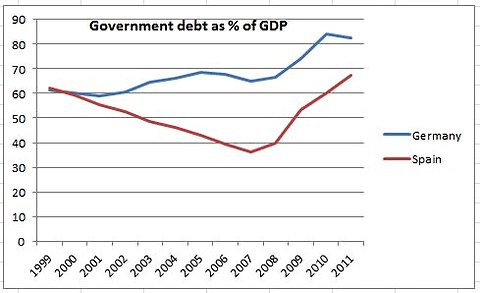
Spain needs to become more competitive; maybe the labor market reforms it’s trying will do the trick, though I tend to be skeptical; otherwise it’s about gradual relative deflation — or euro exit and devaluation.
What’s clear is that even more austerity does nothing to help; all it does it reinforce the downward spiral, and bring the possibility of real catastrophe nearer.
Spain’s fiscal difficulties are a consequence of the crisis, not a cause.
The country experienced huge rises in private debt after 1990, particularly among non-financial corporations
A sharp reduction in government borrowing is most unlikely to be offset by more private borrowing and spending.
The result is more likely to be a far deeper recession, along with little progress in reducing actual fiscal deficits.
Martin Wolf, FT 6 March 2012
The Spanish Prime Minister, Mariano Rajoy, said the target for cutting the budget in 2012 would be missed.
Then today the European Commission said there were "grave" and "serious" gaps in the figures for 2011.
It is worth recalling that it was the Greek admission in 2009 that their accounts could not be trusted that sparked the eurozone debt crisis.
The gap in last year's figures amounts to tens of billions of euros. Possibly as much as 90bn euros (£75bn).
And to put that in perspective - it's the size of the entire bailout for Portugal.
Gavin Hewitt, BBC Europe editor, 6 March 2012
The fiscal treaty /Europakten/ is already collapsing in Spain
El Pais quotes Frederik Reinfeldt as saying that the first to do after agreeing new budget rules cannot be to soften them.
Eurointelligence 2 March 2012
European Commission inkl. Cecila Malmström) resists Spanish demand for a relaxation in the deficit
Spain has to hit a completely unrealistic deficit target of 4.4% of GDP this year, after 8.5% in 2011,
which would produce a massive depression.
Eurointelligence 1 March 2012
Mariano Rajoy’s attempts to get the EU to raise the target is not bearing fruit, El Pais reports. The Spanish government has now concluded that Brussels will not allow a higher target, as a result of which Rajoy wants to run a two-pronged policy.
He will not sanction the required fiscal adjustment of €44bn the target would now involve, as such a massive fiscal contraction in a recession would be extremely dangerous.
He will steer a middle way, which would involve a breach of the target this year, to be followed by a greater effort in 2013
– when Rajoy thinks the recession will be over.
In his FT Deutschland column, Wolfgang Munchau takes a closer look at Spain and
concludes that the pursuit of the 4.4% deficit would be pure madness,
pull the country into a depression, and would result in an inescapable debt trap for the private sector.
12229
Munchau says the problem for Spain is the relative lack of deleveraging in the private sector so far, a process that is only now beginning in earnest, and which will take several years to complete. During that time, the Spanish government can ill-afford to consolidate as well. The degree of consolidation required under the EU adjustment programmes is so extreme that it is bound to destabilise the Spanish economy.
Munchau concludes that Spain, not Greece, was the biggest threat to the eurozone’s cohesion.
Source: Eurointelligence
Kommentar av Rolf Englund
Hoppet är ute för EMU - Euron kollapsar i Spanien
Rolf Englund blog 2010-05-31
Fiscal irresponsibility; Greece, but nobody else.
Italy ran deficits in the years before the crisis, but they were only slightly larger than Germany’s
(Italy’s large debt is a legacy from irresponsible policies many years ago).
Portugal’s deficits were significantly smaller, while Spain and Ireland actually ran surpluses
Paul Krugman, New York Times, February 26, 2012
Spanien
Though he swept into office as an apostle of orthodoxy,
Mariano Rajoy has since delved into Madrid’s ghastly accounts and concluded that
it would be "suicidal" to try to slash the budget deficit from 8pc of GDP to 4.4pc of GDP this year
Ambrose Evans-Pritchard, 26 Feb 2012
Such a policy would require a further €40bn or €50bn of cuts and accelerate the downward spiral already underway, beyond the 1.7pc contraction expected this year by the International Monetary Fund.
The unemployment rate would rise to well over 25pc with six million out of work by the end of the year, equivalent to 30pc under the old definition used in the last jobless crisis in the early 1990s.
Josep Borrell, ex-president of the European Parliament and the voice of Spain's pro-European establishment,
said such debt-deflation risks pushing the banking system over the edge.
"To cut the deficit almost four points in one year would be a true depressionary shock for an anaemic economy,
made worse by the requirement for banks to mark their real estate losses to market prices."
The Spanish have good reason to feel maligned by North Europe's self-serving narrative of the EMU crisis.
They never violated the Maastricht debt rules. They ran a budget surplus of 2pc of GDP during the boom.
Private credit spiralled out of control in part because the European Central Bank missed its inflation target every month for almost nine years and gunned the eurozone M3 money supply at double the bank's own target rate to help Germany, then in trouble.
Den europeiska mardrömmen
Tyskland är inte Sverige i kvadrat. Tysklands problem är långt värre än så.
Arbetslösheten överstiger 10 procent, tillväxten är närmast obefintlig, budgeten går med underskott,
banksystemet skakar, risken för deflation är överhängande och landets industri befinner sig i en svår kostnadskris.
Den tyska utvecklingen är en europeisk mardröm, vars slut vi ännu inte sett skymten av.
Peter Wolodarski DN 27/4 2003
De spanska bankernas osäkra fordringar,
som i huvudsak består av lån till den kollapsade fastighets- och byggnadssektorn,
uppgår till 7,6 % av bankernas tillgångar. En fördubbling sedan år 2008
Ekot 17 februari 2012
Igår antog parlamentet en lag som tvingar de spanska bankerna att höja sin kapitaltäckning.
Spanska banker har ingen stor utlåning till Grekland, men däremot till Portugal
Full text
Men det kanske blir så att de spanska bankerna,
med stora lån till Portugal, går under när Portugal gör det
Rolf Englund blog 26 januari 2012
The Spanish economy shrank by 0.3%
Spain's unemployment figure passed the five million mark in the last quarter of 2011
The country has the highest jobless rate in the EU, with almost one in four people out of work
BBC 16 February 2012
Quantifying Eurozone Imbalances and
the Internal Devaluation of Greece and Spain
Claus Vistesen, 23
Det grekiska budgetunderskottet på runt tio procent av BNP behöver omgående minskas.
Annars går det inte att få kontroll över statsskulden
Utan tillväxt i den grekiska ekonomin blir detta svårt att klara av.
Nu är man tvärtom inne på femte året med fallande BNP,
vilket visar på behovet av tillväxtfrämjande reformer.
Johan Schück, DN Ekonomi 10 februari 2012
DN om Greklands exportfrämjande åtgärder
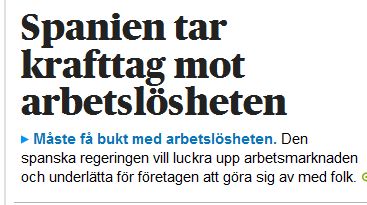
Spanska regeringen lägger fram en ny arbetsmarknadsreform.
Flera av åtgärderna ska underlätta för företagen att göra sig av med anställda
i ett försök att åtgärda den skyhöga arbetslösheten
DN Ekonomi 10/2 2012
Per T Ohlssons tillväxtfrämjande åtgärder för att rädda euron
via Rolf Englund blog
Interndevalvering enligt Ådalsmetoden är inte en olycklig biprodukt
utan själva syftet med den nu förda europolitiken
Nils Lundgren via Rolf Englund blog
Spain's unemployment figure passed the five million mark
5.3 million people were out of work at the end of December
Almost half of all 16-24 year-olds in the country are jobless
The rate rose from 21.5% in the third quarter to 22.8%
BBC 27 January 2012
Spain already has the highest jobless rate in the 17-nation eurozone and is expected to slide back into recession.
“They are going to sign a treaty that makes Keynesianism illegal,”
Charlemagne, The Economist print, Jan 28th 2012
Italy and Spain need to borrow a combined € 590 bn in 2012
their yields remain above sustainable levels,
ECB’s efforts at buying debt in the secondary markets have so far been ineffective in holding yields down
John Paulson, Financial Times, December 14, 2011
With ECB backing and subsequent debt spreads about 1 per cent above the German Bund, Italy and Spain would have time for new austerity measures and growth initiatives to take hold.
If there is not one common illness it is hard to apply one common cure
Edward Hugh, November 20th, 2011
it is important to understand that the so called core economies are not identical, while those on the periphery do not all suffer from the same ailment.
In Greece the problem has been excessive (and indeed almost fraudulent) deficit spending.
In Italy the problem is accumulated government debt – debt which has been amassed during two decades now.
In Spain and Ireland the problem is the bursting of a housing bubble, a bubble which was made possible by the application of an excessively loose monetary policy by the ECB.
In many ways it is unfortunate that the Greek crisis was the first one to break out, since this has reinforced earlier stereotypes that the problem with the Euro is the lack of sufficiently strong fiscal controls from the centre. This is surely the case, but it is only part of the problem, and far too much of Europe’s leaders time and energy has been devoted to this issue, to the neglect of many others which in many ways have equal or even greater importance.
What is true is that lying at the heart of the present crisis (across developed countries, that is including Japan, the UK, the US etc) is the issue of debt, whether this be public sector debt or private debt. That is why what we have is called a sovereign debt crisis.
Sist i Edward Hughs artikel kan man läsa:
"I recently attended an experts meeting on the legal background to state creation. It was really fascinating stuff, but what I was most surprised to learn was that in the event of a Catalan declaration of independence, and absent an amical agreement between Spain and the new state, the liability for servicing existing debt issued by the Spanish state would fall on Spain and Spain alone. This would mean that the country without the Catalan financial contribution would be virtually immediately bankrupt. This is a daunting thought, and should serve to concentrate everyone’s minds in the months and years to come."
– Det är inte euron som är under attack
Fredrik Reinfeldt menar att det inte är euron som är problemet,
utan de stora statsskulderna i flera länder och bristande konkurrenskraft.
DN 22 november 2011
With the replacement of Zapatero's Socialist party by Rajoy's conservative Popular Party,
all the governments in office in the PIGS — Portugal, Ireland, Greece and Spain — have been turned out.
Irwin Stelzer, WSJ, 21 Nov 2011
If Germany genuinely wishes to save Spain and Italy, it must allow EMU-wide reflation and
mobilize the ECB as a lender of last resort to halt the bond crisis, since the EFSF rescue fund does not exist.
To create a currency without such a backstop is criminally irresponsible.
Ambrose Evans-Pritchard, DT, 20 Nov 2011
Spanish Bad Loans Surge to Highest in 17 Years
Bloomberg, December 19, 2011
Spanska huspriser fortsätter falla
Sedan toppnivåerna 2007 har de spanska huspriserna fallit med 24 procent
e24, TT, Reuter 2011-12-15
Spanska huspriser föll 7,4 procent under årets tredje kvartal jämfört med samma kvartal 2010. Det är en kraftigare nedgång än prisfallet på 2,8 procent kvartalet före.
Med tredje kvartalets prisfall har landets huspriser fallit 14 kvartal i rad, vilket har lett till stora problem för landets banker.
Sedan toppnivåerna 2007 har de spanska huspriserna fallit med 24 procent och bedömare räknar med att det ska fortsätta nedåt en lång tid framöver.
Snittprognosen ligger på att prisnedgången på tio år blir 35-40 procent, då hög arbetslöshet och svag befolkningstillväxt dämpar efterfrågan.
- Kanske är vi i Sverige blinda för att vi befinner oss i
en irländsk/spansk situation med lånefest och, än så länge, stigande bostadspriser
Rolf Englund, 4 december 2010
Spain Awaits Austerity Steps
Against a backdrop of mounting financial tension, Spain's prime minister-elect this week will assume his office and
take his first steps toward reducing one of the euro zone's largest budget deficits.
the need for collective sacrifices to overhaul an ailing economy grappling with a towering debt load and a 21% unemployment rate.
Analysts say the occasion calls for a rousing speech. "I hope he calls for blood, sweat and tears, because that's what's required,"
said Emilio Lamo de Espinosa, sociology professor at Madrid's Complutense university.
Wall Street Journal, 19 December 2011
Spain becomes eurozone's weaker link
If you add together all debts - government, corporate, financial, household
- Spain is a much more indebted or leveraged country than Italy.
Robert Peston, BBC Business editor, 18 Nov 2011
New fundamental research by the consultancy McKinsey sheds some light on why that should be.
In 1989, Spain's ratio of government debt to GDP - the value of what the country produces - was just 39%. Its ratio of corporate debt to GDP was 49%, the ratio of household debt to GDP was just 31% and financial sector debt was just 14% of GDP. The aggregate ratio of debt to GDP was 133%.
By the middle of this year, the picture was utterly different. The aggregate ratio of debt to GDP had soared to 363% of GDP.
Kommentar av Rolf Englund
Hoppet är ute för EMU - Euron kollapsar i Spanien
Rolf Englund blog 2010-05-31
Kapitalets nästa offer blir Spanien
Katastrof väntar politiska vänstern
Aftonbladsledare, signerad Olle Svenning, 2011-11-12
UGT, en av de spanska landsorganisationerna, tickar på sin hemsida fram antalet arbetslösa. Snudd på fem miljoner.
Siffrornas innebörd konkretiseras på Puerta del Sol, Madrids klassiska demonstrationstorg, numera förvandlat till upprorsläger för ”los indignados.
Spaniens ekonomiska tillväxt skapades genom hyperexploatering av mark, turism och uselt avlönade arbetare, med tiden allt oftare afrikaner. Under González första decennium räknades sju miljoner nya jobb in, tillväxten var år efter år hög. Utländskt kapital köpte in sig och kunde håva in svindlande miljardvinster. Kuster och naturområden skövlades. Industrin förblev torftig.
Den spanska medelklassen mådde väl; den kunde bygga sig sina egna hem och låna från de frikostiga sparkassorna. Husen belånades och konsumtionskraft frigjordes.
Forget About Italy and Greece
Spain Next on Agenda
"In a lot of ways it's more worrisome than Italy," Megan Greene, senior research analyst at Roubini Global Economics
CNBC 16 Nov 2011
Reducing the deficit will be a long, grim task for Spain and the Spanish people, already suffering from declining property prices and youth unemployment at close to 50 percent.
Economists at Credit Suisse believe Spanish workers need to have an 11 percent cut in wages over the next 5 years to restore competitiveness.
Many argue that its property market, where the average house price is down around 26 percent from its peak compared to 43 percent in Ireland, has still further to fall.
The banking system has yet to recover from financing the property boom, and the fallout from the ensuing bust, and there are murmurs that its biggest banks may have to be recapitalized.
Nov. 16 (Bloomberg) -- Spanish banks face deeper losses on 176 billion euros ($243 billion)
Spanien har potential att bli ett stort finansiellt monster. Bara under 2012 har staten ett refinansieringsbehov på 200 miljarder euro
Efter det att Italiens kris snabbt fördjupades förra veckan har fokus på marknaden nu flyttats vidare till Spanien
SvD Näringsliv 15 november 2011
- Det går inte att lösa de spanska problemen utan att hela eurozonens problem har lösts, särskilt de italienska problemen.
Kommentar av Rolf Englund
Hoppet är ute för EMU - Euron kollapsar i Spanien
Rolf Englund blog 2010-05-31
Nu sprider sig paniken
SvD Näringsliv 15 november 2011 kl 20:31
Mauricio José Rojas Mullor, född 28 juni 1950 i Santiago i Chile, är en svensk politiker (folkpartist) och docent i ekonomisk historia vid Lunds universitet.
Han var ordinarie riksdagsledamot 2002 – 2006 och statsrådsersättare 6 oktober 2006 – 10 november 2008.
Han var ledamot av Riksdagens konstitutionsutskott.
Vice vd och vd för Timbro 2000–2004
Wikipedia
I dag vet vi att den spanska krisen kommer att bli mycket allvarligare än den grekiska
ty ingen har ifrågasatt Greklands existens som nation och det är precis det som nu händer i Spanien
Mauricio Rojas, Kolumn SvD, 7 oktober 2012
Kataloniens president, Artur Mas, med landets statsminister, Mariano Rajoy. Mas krävde att Katalonien skulle få en ”fiskalpakt”, det vill säga rätt till separata statsfinanser. Utifrån sina egna inkomster skulle sedan Katalonien förhandla om hur mycket man skulle ge i bidrag till övriga Spanien. Det skulle sätta stopp för vad katalanerna betraktar som en utsugning av deras resurser motsvarande 5-6 procent av regionens BNP.
Statsministern sade nej och några timmar senare utropade Artur Mas att det enda alternativet som återstod för Katalonien var att bilda en egen stat. Han utlyste regionala nyval (till den 25/11), och regionparlamentet beslutade att en folkomröstning om självständighet skulle hållas trots att den saknar befogenhet att göra det.
Snart blir Spanien ett andra Grekland
Likt en grekisk tragedi fortsätter Spanien sin obevekliga gång mot ett sorgligt slut
Mauricio Rojas, Kolumn SvD 22 juli 2012
Spanien är uppbyggt som en mångfald små furstendömen: 17 autonoma regioner och två dito städer, 50 provinser och över 8000 kommuner, som har tävlat om att göra allt efter eget huvud och spendera så mycket som möjligt.
Det beskrivs som ett illasinnat tysk-franskt försök att tvinga fram en allmän bankkapitalisering,
baserad på en beräkningsmetod som de facto innebär en nedskrivning av värdet på Spaniens och andra perifera problemländers statsskuld.
Spaniens redan idag svåra läge skulle bli helt ohållbart.
Det finns mycket som tyvärr tyder på att så är fallet.
Mauricio Rojas SvD 23 oktober 2011
Drömmen om EU på väg att spricka
Mauricio Rojas, ledarsidan SvD 14 augusti 2011
Ja-trion Carl Bildt (m), Mauricio Rojas (fp) och Anna Ibrisagic (m) har begett sig till de invandrartäta norra förorterna utanför Stockholm för att vinna invandrare för euron
Vem tror ni bestämmer över kronan? -Det är kungen, ropar pojken.
-Nej, det är finansmarknaderna, förklarar Rojas. Euron blir som ett starkt paraply för oss om det regnar eller blåser för mycket.
DNs ledarsida, signerat Magdalena Nordensson 21/8 2003
In a surprisingly frank presentation to investors in London on Tuesday, José María Roldán, the Bank of Spain’s director general of banking regulation, said that
It’s not just sovereign debt
Spanish land prices had fallen about 30 percent from the 2007 peak, adjusted for inflation, and that
home prices were off about 22 percent. “In both cases, we expect further corrections in the years to come,”
New York Times, 23 Sept 2011
For land prices, he said, the bank’s “baseline scenario” was that prices would fall to little more than half of the peak level. The “adverse scenario” indicated that the decline could be significantly worse.
But if lending to home buyers was conducted in a far more prudent manner than it was in the United States, lending to real estate developers and construction companies was, if anything, more irresponsible.
Why is Spain — along with Italy in so much trouble?
The answer is that these countries are facing something very much like a bank run
Paul Krugman, New York Times, 11 September 2011
Hans Werner Sinn, chef för det ansedda IFO-institutet
Euro bonds would destroy the euro zone.
In 1995, shortly before the exchange rates for the euro were fixed,
the interest rates on Italian and Spanish debt were on average about 5 percentage points above Germany's.
Der Spiegel 23 Augusti 2011
The European Central Bank spent €22bn on government bonds last week
Some analysts have worried that because of the size of Italy’s and Spain’s bond markets
– totalling €2,100bn - the ECB could have difficulties in sterilising all its purchases
if it has to carry on buying on such a large scale
FT 16 august 2011
The European Union’s Maastricht treaty was designed to deal only with imbalances in the public sector; but excesses in the banking sector have been far worse.
George Soros, FT August 14, 2011
The euro’s introduction led to housing booms in countries such as Spain and Ireland.
Eurozone banks became among the world’s most over-leveraged, and they remain in need of protection from counterparty risks.
The good ship Eurotitanic might maneuver around the tiny ice cubes that are Greece and Portugal,
but it is headed straight toward two huge icebergs: Italy and Spain, the third and fourth largest euro-zone economies.
Irwin Stelzer,director of economic policy studies at the Hudson Institute, WSJ 11 July 2011
Spain has a budget deficit equal to 9.2% of GDP, and Italy's debt:GDP ratio of around 120% is second only to Greece. Spain, which has caused greater investor nervousness than Italy, might actually be in better shape, despite its 20.7% unemployment rate
The first thing Silvia Huelves was told when she started studying architecture was that she should take up Chinese or Japanese - she was never going to build anything in Spain any time soon.
It wasn't criticism of her skills but a reflection on the state of the country, where the jobless rate among 16-24-year-olds is a staggering 45 percent and a construction sector slump caused nearly two years of recession.
CNBC 27 May 2011
Last year alone, Spain started to build 800,000 new homes
Unfortunately, the number of new houses was not just more than
France, Germany and Italy combined built last year.
It was also more than anybody wanted to buy.
FT editorial 28/4 2007
The Spanish people have finally found their voice. For over a week they have been occupying squares across the country to protest at unemployment. For 16- to 24-year-olds, 43% are without work.
What unites the protesters is a desire for a change, a sense that the "establishment has failed an entire generation". Having taken to the streets they might not accept further austerity if it was needed.
So Spain is once again troubling markets and officials. A weak government is caught between needing to enforce spending cuts and protesters demanding work.
Gavin Hewitt, Europe editor, BBC, 23 May 2011
Spanish protests in pictures
BBC 21 May 2011
Spanish protests on Youtube
Click here
Photo Gallery: Protests in Madrid's Puerta del Sol, Der Spiegel
Tiotusentals spanjorer trotsade natten till lördagen demonstrationsförbudet och fortsatte att protestera mot åtstramningar, arbetslöshet och korruption.
Runt om på torg i de stora städerna har människor slagit läger för att kräva förändring.
SvD 21 maj 2011
I bland annat centrala Barcelona, Málaga och Valencia har mängder av demonstranter intagit olika torg,
På den stora platsen Puerta del Sol mitt i Madrid samlades tiotusentals människor. Poliser var utplacerade,
men socialistregeringen kommer troligen att akta sig för att stävja protesterna, som hittills varit helt fredliga
Ekot 21 maj 2011
Hoppet är ute för EMU - Euron kollapsar i Spanien
Rolf Englund blog Maj 31, 2010
A day after Portugal formally requested aid from the European Union to help ease ongoing debt problems, Madrid on Friday insisted that it was "out of the question" that Spain would be next.
German commentators aren't so sure, and say that it's time for European leaders to reveal the true extent of the problems.
Der Spiegel 8/4 2011
Frankfurter Allgemeine Zeitung’s Werner Mussler
the next in line is the first really big Euro economy: Spain
Eurointelligence 8/4 2011
Economically the country is in better shape than Portugal, he concedes. But unemployment is rising, growth perspectives are bad and the Spanish banks are heavily engaged in neighbouring Portugal.
The total exposure of foreign banks to the struggling quartet of
Greece, Ireland, Portugal and Spain tops $2.5 trillion
once all forms or risk are included, according to the latest data from BIS
Ambrose Evans-Pritchard 14 Mar 2011
Moody's sänker kreditbetyget för 30 spanska banker
DI 2011-03-24
Islands nej kan också få Grekland och Portugal att inse att IMF- och euroländernas krav för att stå för sina lånelöften är en plågsam vandring till ett utblottat Ebberöd.
(Skuldavskrivning är med all sannolikhet den enda rimliga vägen om de ska kunna komma på fötter.)
Men framför allt kan det få den ekonomiskt lerfotade kolossen Spanien att inse att landet vare sig kan eller bör hålla sitt banksystem under armarna om eller snarare när det börjar rämna.
Per Lindvall, e24, 13/4 2011
Oavsett hur mycket det iberiska landet försöker distansera sig från sina europeiska olyckskamrater så står man näst i kön. ”Självbelåtna Europa måste inse att det är Spanien nästa”, som Financial Times tyske krönikörWolfgang Münchau skrev i måndags.
Det räcker med att lyfta fram en siffra för att förstå Spaniens mycket utsatta läge. Det är Spaniens externa finansiella nettoskuld på knappt 1000 miljarder euro, vilket i princip motsvarar landets BNP och där den absoluta merparten finns i banksystemet.
Det är naturligtvis inte så svårt att förstå EU-etablissemangets och den europeiska finansiella sektorns oro. Det isländska nejet till att utan rättslig prövning godta att landets medborgare ska ikläda sig en konkursad privat banks åtaganden gäller inte bara tvisten med Storbritannien och Holland, utan sätter mycket större krafter än så i rörelse.
en återgång till ett ”fördemokratiskt” feodalt Europa, där vissa länder och dess medborgare ska tvingas leva i finansiell träldom, medan de som har lånat ut pengarna och skapat förutsättningarna för krisen ska få gå omärkta ur de problem de har varit med att bygga upp. Eller vad säger Greve Carl B Hamilton?
Skuldkrisen i EMU är av allt att döma på väg in i ännu en kritisk fas.
Det stora orosmolnet är inte Portugal utan Spanien.
Viktor Munkhammar, DI 24/3 2011
Moody's Cuts Spain's Debt Rating to Aa2
The cut in the rating drove the euro to session lows against the dollar and
the premium investors charge for Spanish 10-year debt instead of German Bunds widened 9 basis points on the day to 232 bps.
CNBC, 10 Mar 2011
Moody’s estimates necessary volume of caja recapitalisation at €50bn
The Spanish government imposed core tier one ratios of 8-10% for the entire savings banking industry, and estimated the recapitalisation volume of under €20bn.
Eurointelligene 1/3 2011
Det är sant att Anders Borg har prioriterat ordning och reda i den offentliga ekonomin. Men det har han inte varit ensam om.
Samma sak kan även sägas om finansministrarna i Irland och Spanien, länder som till alldeles nyligen fick ett gott betyg för sin ekonomiska skötsel och hade föga gemensamt med exempelvis Grekland.
Peter Wolodarski, DN 20/2 2011
Spain’s success is of acute relevance to the rest of the eurozone
Spain is where Ireland was a couple of years ago
Mohamed El-Erian, FT February 3 2011
If Spain is not successful, Europe’s existing rescue mechanisms and approach would be overwhelmed, raising doubt on the sustainability of the eurozone’s weaker countries (such as Greece, Ireland and Portugal). It would also lead to renewed pressures on the value of the euro, on German interest rates, and on the credibility and integrity of the European Central Bank.
First, the good news. Unlike Greece, Spain does not have a direct public finance crisis.
In the next few weeks, it has to choose whether to use the government’s balance sheet to recapitalise the cajas’ struggling balance sheets and whether to assumes their losses.
Spanish banks have €323 billion (the equivalent of 31% of GDP) in loans to property developers.
Add in construction, and the exposure rises to 42% of GDP.
The Economist print 13/1 2011
By the end of 2010 Spanish banks had already made €87 billion in provisions for bad loans.
Liksom för Irland så är inte Spaniens största bekymmer att statsfinanserna spårade ur, som för Grekland och i viss mån Portugal,
utan att landets privata sektor och banker har bygg upp och finansierat en gigantisk fastighetsbubbla.
(Såväl de irländska som de spanska bankerna har i sin tur finansierat sig hos andra europeiska insititut.)
Per Lindvall e24, 1/4 2011
Det är den kollapsande irländska bank- och fastighetssektorn som ligger bakom Irlands gigantiska ekonomiska bekymmer. Inklusive det nu framräknade kapitalbehovet så har den irländska staten pumpat in motsvarande 625 miljarder kronor, eller 45 procent av landets BNP, i sina havererade banker.
I Sverige har bostadspriserna rusat i höjden med hela 116 procent på tio år.
Det är lika mycket som i Spanien och betydligt mer än på krisdrabbade Irland
där priserna stigit med 34 procent sedan år 2000, enligt SEB.
Expressen 24/11 2010
Spain credit rating review by Moody's hits euro
BBC 15 December 2010
So if nothing bad were to happen to force Spain to raise even more money,
it will need to borrow €290bn next year, equivalent to a non-trivial 27% of the country's GDP.
Robert Peston, 15 December 2010
To put it another way, 2011 will be the year when the financial credibility of Spain - and by extension the eurozone as a whole - is likely to receive its severest test.
Full textMoody’s yesterday put the losses of the Spanish banking sector at €177bn
A recession would drive up losses to €300bn, with new capital requirements of €100bn.
Eurointelligence 14/12 2010
El Pais reported that Elena Salgado and Miguel Ferdinand Ordonez were both out yesterday trying to reassure investors about the soundness of the Spanish financial system.
Back in 2007, Ireland’s net public debt was just 12 per cent of gross domestic product.
This compares with 50 per cent in Germany and 80 per cent in Greece.
Martin Wolf, FT November 23 2010
De som köpte bostad i Spanien under 2007, innan finanskrisen slog till,
har i vissa fall fått se sitt hus halveras i värde.
Mäklare i Spanien talar om prisfall på allt från 25 till 50 procent.
e24 2/12
– Du kan fortfarande fynda på Teneriffa, det är många engelsmän där som vill flytta hem, konstaterar Lilian Lindgren.
Spain's Prime Minister Jose Luis Rodriguez Zapatero:
"[Our banking system] is definitely healthy"
Rolf Englund blog 2/12 2010
We've heard it before: Spain is too big to fail—and too big to be saved.
The Blame in Spain Falls Mainly on—Chancellor Merkel?
8 Dec 2010 Ash Bennington, NetNet Writer, Special to CNBC.com
Here is the takeaway fact, which can get lost in the noise: Spain has an economy twice the size of Greece, Portugal, and Ireland—combined.
Also Spain has approximately €1 trillion in private foreign liabilities.
(That number is on top of Spain's €1 trillion in public debt.)
And about how the nightmare scenario could begin to unfold, with the Spanish domino smashing down, followed by a concussion wave of panic spreading through the financial markets.
Spanish savings banks, which have been ordered to raise more capital by the government,
are facing an uphill struggle to persuade investors to help them improve their balance sheets.
The New York Times, 18 Feb 2011
For years, until the start of the financial crisis and the ensuing collapse of Spain’s real-estate sector, the cajas had flown under investors’ radar screens, focusing on running a vast branch network that accounts for half of Spain’s retail banking sector and providing much of the financing for Spain’s decadelong construction boom.
The crisis brought to the surface a harmful blend of mismanagement, reckless real estate lending and exaggerated influence from politicians — and, in one instance, the Catholic Church.
Some smaller cajas had to be rescued by a state-run fund.
Last year the cajas, already under pressure from the government, engaged in a round of mergers that cut their number from 45 to 17.
The others are tapas; Spain is the main course.
Why is Spain in so much trouble? In a word, it’s the euro.
Paul Krugman, New York Times November 28, 2010
What’s striking about Spain, from an American perspective, is how much its economic story resembles our own. Like America, Spain experienced a huge property bubble, accompanied by a huge rise in private-sector debt.
But unlike America, Spain is on the edge of a debt crisis.
Why is Spain in so much trouble? In a word, it’s the euro.
Through the good years, by the way, the Spanish government appeared to be a model of both fiscal and financial responsibility: unlike Greece, it ran budget surpluses.
Spain’s public debt, as a share of the economy, was only about half as high as Germany’s
If Spain still had its own currency, like the United States — or like Britain, which shares some of the same characteristics — it could have let that currency fall, making its industry competitive again. But with Spain on the euro, that option isn’t available. Instead, Spain must achieve “internal devaluation”: it must cut wages and prices until its costs are back in line with its neighbors.
And internal devaluation is an ugly affair. For one thing, it’s slow: it normally take years of high unemployment to push wages down. Beyond that, falling wages mean falling incomes, while debt stays the same. So internal devaluation worsens the private sector’s debt problems.
Should Spain try to break out of this trap by leaving the euro, and re-establishing its own currency? Will it? The answer to both questions is, probably not. Spain would be better off now if it had never adopted the euro — but trying to leave would create a huge banking crisis, as depositors raced to move their money elsewhere.
So Spain is in effect a prisoner of the euro, leaving it with no good options.
Dr. Robert Shapiro (served as Under Secretary of Commerce for Economic Affairs in President Clinton's administration):
The big fear is that a default in Spain could significantly hurt German and French banks since
they hold more than $600 billion in Spanish debt, a large chunk.
And that could create a scenario similar to the Wall Street meltdown of 2008
CNN 30/11 2010
"But then you get to Spain. It's the ninth largest economy in the world."
The euro crisis
Spreading from Ireland to Iberia
To stop the euro’s meltdown, Zapatero must revive Spanish reform
The Economist print Nov 25th 2010
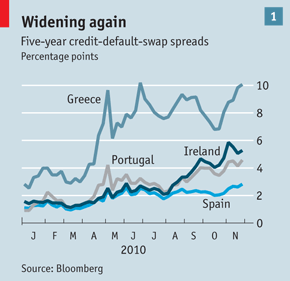
Europe’s rescue plan is based on the idea that Ireland and the rest just need to borrow a bit of cash to tide them over while they sort out their difficulties.
But investors increasingly worry that such places cannot, in fact, afford to service their debts
Den verkliga faran är Spanien och kanske även i Italien,
EMU:s tredje respektive fjärde största ekonomier.
Viktor Munkhammar, DI 22/11 2010
Skulle länder av Spaniens och Italiens kaliber ställas inför marknadsräntor som i praktiken gör det omöjligt att låna på kapitalmarknaden, som Grekland och Irland, är sannolikheten stor att det skulle sluta med betalningsinställe i någon form.
Det i sin tur vore ett allvarligt hot mot hela eurosamarbetet.
Det stora testet kommer när Spanien ber om hjälp.
”Det vill man helst inte tänka på, men det är en tidsfråga”, säger Pär Magnusson,
chefsanalytiker på Royal Bank of Scotland.
Annelie Östlund e24 2010-11-17
Den privata och den offentliga nettoskulden mot omvärlden uppgår till cirka 100 procent av BNP.
Det kan jämföras med motsvarande procentsiffra för Sverige i början på 1990-talet som låg på cirka 50 procent.
– För att lösa vårt bytesbalansproblem och börja amortera på utlandsskulden behövde vi en rejäl försvagning av kronan – som vi också släppte 1992, säger SEB:s chefsekonom Robert Bergqvist.
Men Spanien kan inte gå den traditionella devalveringsvägen eftersom landet deltar i eurosamarbetet.
– Istället måste man in i en plågsam process av löne- och kostnadssänkningar för att försöka höja konkurrenskraften gentemot andra länder, säger Robert Bergqvist.
Noch stehen Irland und Portugal im Mittelpunkt der Euro-Krise.
Doch die wirkliche Gefahr für die Stabilität der Währungsunion geht von Spanien aus.
Würden die Investoren das Vertrauen in das große EU-Land verlieren,
könnte die Schuldenkrise eine völlig neue Qualität bekommen.
Handelsblatt 15/11 2010
Daniel McCormack von der Investmentbank Macquarie.
"Spanien macht zwölf Prozent der Wirtschaftsleistung der Euro-Zone aus,
mehr als dreimal so viel wie Irland und Portugal zusammengenommen", rechnet der Volkswirt vor.
We received a report submitted from a Spanish blogger who wishes to remain anonymous, in which the author, in 7 brief pages, describes why
in his view Spain's GDP is massively overrepresented.
The report (attached below) provides extensive validation for this hypothesis
by Tyler Durden at zerohedge 30/9 2010
Moody’s downgraded Spain’s government bonds, citing weak economic growth, a deterioration of financial strength and higher borrowing needs.
The downgrade by Moody’s by one notch from its top rating of AAA to Aa1 makes it the last of the three big rating agencies to downgrade Spain
The downgrade, which was also applied to Spain’s Fund for Orderly Bank Restructuring, known as Frob from its Spanish initials
Victor Mallet, FT September 30 2010
En form av ohelig allians, där problemtyngda stater garanterar problemtyngda banker,
som i sin tur köper statsskuld med finansiering från den europeiska centralbanken
minskar risken för misslyckade emissioner,
men frågan är hur långt det går att driva detta reptrick innan bubblan spricker.
Martin Enlund, senioranalytiker på Handelsbanken, DI 2010-09-09 14:57
I början av sommaren riktades starkt fokus mot ett omfattande lånebehov i Spanien, och finansmarknaderna reagerade då positivt på varje fulltecknad emission, oavsett hur hög räntan blev.
Senare har det dock kommit uppgifter om att det i första hand var lokala banker som köpte obligationerna och finansierade detta med lån hos ECB.
Det är troligt att detta också kommer att vara lösningen på det ökade lånebehovet i september.
Spanish banks asked for a record 130 billion euros ($166 billion) in July
Bloomberg 16 August 2010 with nice chart
Alla kan inte exportera sig ur krisen, för då är det ingen som köper.
Grekland och Spanien måste skära ned drastiskt, inget annat kan återställa finansmarknadernas förtroende.
Tyskland ska ha ordning på statsfinanserna, men ....
DN-ledare 29 juni 2010
Spain’s Unemployment Continues To Rise
Spain’s EU harmonised seasonally-adjusted unemployment rate (which is the interesting number) went up again in July, according to the latest data from Eurostat. It rose to 20.3% from 20.2% in June.
Edward Hugh, A fistful och euros 7 august 2010
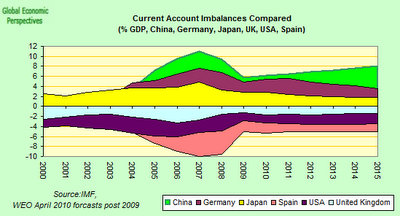
IMF report
It isn’t only Spain where the current account deficits are going to persist.
Edward Hugh, A fistful och euros 7 august 2010
They are also expected to continue in the US, and the UK. The structural surplus countries China, Japan and Germany - will also continue on their path, as if nothing important had happened.
Which means the global imbalances will remain just the way they were, untouched and unmolested by the crisis
I can’t help asking myself, wasn’t that how we got here in the first place?
Edward Hugh counts Nobel Prize winner and American economist Paul Krugman among his avid followers. CNN June 10, 2010
Financial Financial Crisis - Rebalancing - SpainGermany’s Hypo Real Estate Holding AG, Agricultural Bank of Greece SA and five Spanish savings banks didn’t have adequate reserves to maintain a Tier 1 capital ratio of at least 6 percent in the event of a recession and sovereign-debt crisis
Had the Tier 1 threshold been 7 percent, 24 of the banks would have failed,
said Andrew Sheets, Morgan Stanley’s head of European credit strategy in London
Bloomberg July 25, 2010
The entire point of stress tests is to identify problem banks so they can be closed or recapitalized, and the resulting transparency is supposed to reduce the chances of panic.
'
But since Europe's regulators still won't test for the effects of a sovereign default on banks, this year's results—like last year's—won't stop the crisis of confidence in the continent's financial system.
Wall Street Journal 19 July 2011
When Europe's bank regulators excluded sovereign default from their bank stress tests last year, they could at least argue with a straight face that the possibility of a default by a euro-zone member looked remote. One year later, a default in Greece looks all but inevitable, and others may not be far behind.
The opponents of default and debt restructuring argue that if Greece forces haircuts on its creditors, the resulting bank losses could cascade through Europe's financial system and produce a panic like the one in 2008.
Certainly, the stress tests should be based on what one might call a plausible worst-case scenario, not one that represents the absolute worst. Nobody is asking the bank supervisors to stress-test the impact of an alien attack.
But sovereign default in the case of Greece is not such a far-fetched scenario – even if you believe it to be unlikely. It is irresponsible for the stress testers to ignore that sort of event.
That is like a car crash tester failing to consider the possibility of an oncoming vehicle.
Wolfgang Münchau FT July 25 2010
A notable exception is Spain, where the situation is the most severe, and where a serious attempt is under way to address it.
Full textOnly seven of 91 banks failed the tests
Five of the seven were cajas, Spanish savings banks
The Bank of Spain on Friday indicated that it had sufficient contingent liquidity measures in place to reassure caja customers and counter any threat of a run on these banks.
FT July 23 2010 17:46
Ingen fara säger Bank of Spain
Rolf Englund blog 2010-07-24
One Size Fits One
"a lot of the issue can be captured by one picture"
Paul Krugman July 12, 2010
Reading these commentaries by Edward Chancellor and Wolfgang Munchau, it occurred to me that a lot of the issue can be captured by one picture.
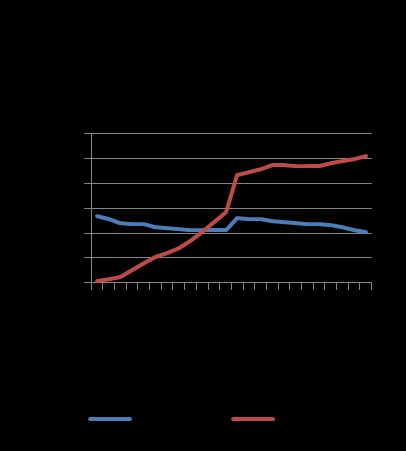
Here’s the total number of unemployed, in thousands, in Germany and Spain:
The gap between Spain and Germany
These two countries share a single currency and inhabit the same monetary union.
Spain would benefit from a looser monetary and fiscal policy.
Germany would not.
Gavin Hewitt, the BBC's Europe editor, 9 July 2010
Germany is "big surplus" country, currently running at 5.5%. Even if the shine comes off some of these trends in the coming months the German motor is purring.
In Spain unemployment continues to edge up. It is close to 20% and is more than 40% for those aged between 16 and 24. The International Monetary Fund forecasts that Spain's economy will shrink this year by 0.4%. It is struggling to emerge from recession. Spain has a budget deficit of 10%.
In the private sector there is still huge debt, some of which may have to be written off. The Spanish good years were built on a housing boom. It was, for a time, the biggest creator of jobs in the EU. The burst bubble has left behind an injured coastline, 800,000 unsold homes, and companies burdened with debt.
These two countries share a single currency and inhabit the same monetary union. Spain would benefit from a looser monetary and fiscal policy. Germany would not.
For Spain there are two big questions: How will it grow again, and how will it become competitive again?
Spanish banks have been lobbying the European Central Bank to act to ease the systemic fallout from the expiry of a €442bn ($542bn) funding programme this week
FT, June 28, 2010
Banks across the eurozone, but in Spain in particular, have found it hard in recent weeks to secure liquid funding in the commercial markets, with inter-bank funding virtually non-existent.
The €442bn ECB facility, which charges interest at a rate of 1 per cent, is not set to be renewed, something that banks in Spain and elsewhere in Europe say ignores current commercial realities
Fotnot: 442 bn euros = cirka 4 199 miljarder svenska kronor.
Inga problem?
See also Zero Hedge
...
International capital markets are “closed” to most Spanish companies and banks
chairman of Banco Bilbao Vizcaya Argentaria SA, Spain’s second-largest bank, said on June 14.
the risk premium on Spanish government debt to a euro-era record
Bloomberg 29 June 2010
Spanish Finance Minister Elena Salgado said she hopes the European Central Bank is aware of lenders’ cash needs as the ECB’s first 12-month loan expires.
Stress test scenarios are not forecasts.
They are only scenarios, of the kind that market participants have already factored into the pricing of bonds.
What else is the implication of a 10 per cent yield on 10-year Greek sovereign bonds?
Wolfgang Münchau, FT July 4 2010
Highly recommeded
The decision to publish such tests for 26 banks was the one piece of good news to come out of the European Union summit two weeks ago. This was followed by negotiations to extend the tests to 100 banks, including some of the German Landesbanken and Spanish cajas considered to be most at risk.
There are two reasons why one might want to conduct, and publish, stress tests. The first is to reduce market uncertainty about the banking system as a whole through a credible and transparent process; the second is to recapitalise the most vulnerable banks.
But for this to work, the stress tests themselves must pass three tests: they must include realistic scenarios; they must be credible; and they must be backed up by a plausible re-capitalisation strategy.
First, by realistic stress I mean the inclusion of extreme, not probable, worst-case scenarios. Given the recent discussions about Greece, this must include the worst estimates of a “haircut” – a deduction suffered by bondholders – of about 50 per cent of the face value of Greek bonds. The stress tests will, according to reports last week, include a uniform haircut on sovereign bonds of 3 per cent . This number is a joke. Some institutions will have a stronger exposure to Greece, Portugal, Ireland or Spain than others, and it is important that those banks are stressed on the assumption of significant haircuts of their sovereign risk portfolios.
Tyska banker har lånat ut motsvarande ungefär 800 miljarder kronor till spanska banker.
Spanska banker har i sin tur lånat ut ungefär 900 miljarder i Portugal.
Noterbart är också att franska banker ensamt står för halva utlåningen till Grekland.
Ekot 14 juni 2010
Av utlåningen till Grekland, Irland, Portugal och Spanien handlar inte enbart om statspapper, utan även om lån till företag. Det visar BIS-statistik som Wall Street Journal refererar till.
De fyra staternas skulder är bara ungefär 15 procent av beloppet.
Resten är alltså utlåning till framför allt företag, vilket också kan förklara varför många bedömare oroar sig så mycket för vad nedskärningarna kan betyda för tillväxten.
The BIS noted in a separate report that, while large depreciations in currencies tend to be associated with substantial permanent losses of output, since the losses usually take place before the fall in the currency, it is likely the factors that spur the drop in the currency's value rather than the depreciation itself that is the trigger.
Taken alone, the currency depreciation can actually be good for output.
Wall Street Journal 14 June 2010
"We're not afraid of transparency," said the Spanish Banking Association (AEB), saying the full truth would put an end to rumours battering Spain's instutitions. El Pais reported that the government backs the initiative, putting it on a collision course with Germany which insists on secrecy.
Ambrose Evans-Pritchard, 15 Jun 2010
Josef Ackermann, head of Deutsche Bank, warned last week that it would be "very dangerous" to publish the results of each bank, fearing that it would trigger flight from weak lenders and set off a chain reaction.
Spain's risk premium, as measured by the yield spread on Spanish bonds over German bunds,
hit its highest level since the creation of the euro
after El Economista reported the International Monetary Fund, the European Union and the U.S. Treasury are preparing a €250 billion ($308.68 billion) liquidity facility for Spain.
Wall Street Journal 16 June 2010
Spain's government, banks and companies have faced increasing difficulties financing themselves in recent weeks as investors fret over the country's double-digit budget deficit, 20% unemployment rate and lengthy economic downturn
The Greek 10-year yield premium, or spread, over bunds stood at 6.84 percentage points,
off the day's highs but still 0.29 percentage points above Tuesday's close at 6.55 percentage points.
The yield premium for Portugal's bonds stood at three percentage points, up from 2.85 percentage points at Tuesday's close.
The yield spread on 10-year Spanish bonds over benchmark German bunds rose 0.13 percentage points to 2.235 percentage points, with the bonds yielding 4.881%,
In the US, stress tests carried out in the spring of last year revealed how healthy certain balance sheets were, forced weaker institutions to raise capital and turned round sentiment to stave off a crisis that now threatens to engulf Europe.
But politicians in Europe are balking at making public the results of stress tests, which are being carried out by banking regulators, in spite of pressure from the European Central Bank to do so.
David Oakley, FT June 14 2010
This is because of worries that releasing details of what lies on balance sheets may be counter-productive and create the very crisis that everyone is trying to avoid.
This is a rare one newspaper-only scoop.
Frankfurter Allgemeine reports this morning that EU officials will start talks about a bail out for Spain, citing unnamed sourced in Berlin. The paper said the situation had deteriorated so much that they did not want wait until the EU summit on Thursday.
The trigger is the freeze in the inter-banking market last week as the markets have lost confidence in the Spanish banking sector.
Eurointelligence 14 June 2010
In a separate news report, Frankfurter Allgemeine writes that Barroso and Trichet were worried about the state of Spanish banks, and pleaded for aid. The paper also cites the latest statistics from the BIS, according to which German banks had given credits to Spain of $202bn, more than half of which to Spanish banks.
The exposure of French banks is $248bn – mostly to companies and households.
In a short comment, the paper makes the point that the €750bn rescue umbrella is just another bank bailout package.
El Pais spoke of a "perverse spiral" in its editorial.
Fitch has not downgraded Spain for lack of austerity
Spain's unemployment was already 20.5pc even before this latest dose of shock therapy.
There are 4.6m people without work.
Dole payments alone account for half the budget deficit
Ambrose Evans-Pritchard, 30 May 2010
EMU caused Spanish interest rates to halve overnight,
with dire results as the Bank of Spain's governor confessed in April 2007. "The single monetary policy has meant that excessively loose conditions for our economy have been almost continuous," he said.
Real rates were -2pc as the bubble reached its crescendo.
Nearly 800,000 homes were built in 2007, more than in Britain, Germany, and Italy combined.
The boom was a debt illusion, just as it was in Britain.
Britain still has the instruments to extricate itself. The Bank of England has engineered a devaluation of 20pc, restoring competitiveness at a stroke.
Spain can try to claw back an even greater loss by cutting wages, but that risks a slow death by debt-deflation as compound interest tightens its vice.
Debunking The "Spain Is Safe" Myth
We’re concerned about austerity in a country that already has 20% unemployment; where home prices are down only 11% with half the newly constructed ones sitting unoccupied; and with $3.4 trillion of household and corporate debt (220% of GDP, one of the highest ratios in the world).
Tyler Durden on 06/08/2010
The closer that economists and strategists are to a region, the harder it has been for them to see a negative paradigm shift.
Examples include Citicorp in Mexico 1994 (the only U.S. firm that had a Mexican branch banking license); Asian economists in 1997; Renaissance Capital, Deutsche Bank and CSFB in Russia in 1998; U.S. technology analysts in 2001; Argentina’s “Chicago Boys” economists defending its currency board; etc.
Grekland, Spanien och grunderna i macro
Rolf Englund blog 2010-05-29
The eurozone’s crisis has blown sky-high the idea that developed countries are 100 per cent safe.
A bank can buy all the Spanish debt (current rating: AA) it likes without having to back it up with a cent of capital
Lex, FT May 27 2010
Spain lost its AAA credit grade at Fitch Ratings
Standard & Poor’s lowered Spain’s ratings to AA on April 28
Bloomberg 28 May 2010
The Bank of Spain has ordered the country's lenders to face up to bad debts and set aside reserves of up to 30pc on property holdings in a bid to restore global confidence
. Deutsche Bank said Spanish lenders need to refinance €125bn by late 2011.
Ambrose Evans-Pritchard, 27 May 2010
Even the strongest banks – Santander and BBVA – are paying a stiff premium over Libor. The Wall Street Journal reports that BBVA has been unable to roll over €1bn in commercial paper. This has raised fears of a chain reaction through Europe's banks due to the nexus of loans. Data from the Bank for International Settlements show that European banks – led by German lenders, in some trouble themselves – have $851bn (£584bn) in exposure to Spain, as well as $240bn to Portugal and $189bn to Greece.
Spansk strejk mot sparpaket
Mer än 2,5 miljoner spanjorer arbetar inom den offentliga sektorn, lönesänkningar med fem procent
Dessutom försämras villkoren för pensionärer och nyblivna föräldrar
Spaniens budgetunderskott är det tredje största i Europa, näst Grekland och Irland.
DN/TT 8 juni 2010
Fixing Spain's Savings Banks Means Paying Workers to Play Golf
The central bank has coaxed ailing savings banks to merge, financing the process with more than 10 billion euros. Consolidating the lenders, known as “cajas,” may eventually cost as many as 50,000 jobs, with many workers taking early retirement
Bloomberg July 15, 2010
Välvilliga spanska sparbanker i kombinaton med spanjorernas önskan att själva äga sina bostäder har eldat på den prisbubbla som ledde fram till landets krasch på bomarknaden.
Bokrisen slår direkt mot ett fyrtiotal småbanker, som kämpar för sin överlevnad och sprider skräck bland ekonomer i hela eurozonen.
DI 8 juni 2010
Sedan toppen i mitten av 2007 har bopriserna fallit med 15-30 procent. I vissa kustområden är siffran 40 procent. Antalet bostadsaffärer minskade dessutom drastiskt när krisen kom, och Spaniens expertbedömare utesluter inte fortsatta prisnedgångar.
Trots att Spanien inte har så stor statsskuld har medborgarnas höga belåning satt skräck i bedömare utomlands.
”Spanien är allvarligt. Det är ett stort land”, berättade ekonomen och Financial Times-krönikören Wolfgang Münchau när han i dagarna gästade svenska Avesta för att ge sin bild av förutsättningarna för eurozonen under Engelsbergsseminariet, som arrangeras av Axel och Margaret Ax:son Johnsons stiftelse och som samlat en rad tunga forskare och ekonomer i en herrgård i Dalarna.
Spaniens centralbank meddelade på lördagen att den tagit kontroll över sparbanken Cajasu
Spanska banker har i stort ridit ut den globala finanskrisen väl, tack vare ett strikt banktillsyn.
Men en sprucken fastighetsbubbla har lämnat de spanska bankerna med 300 miljarder euro i osäkra fordringar.
DN/TT 22 maj 2010
Spansk svångrem kan kväsa tillväxt
Sänkta löner för offentliganställda och inga uppjusteringar
av pensioner eller barnbidrag före 2012
Anders Bolling, DN 12 maj 2010
Den spanska statens finanser har rasat från ett behagligt överskott på 2 procent så sent som 2007.
Fallet började efter en fastighetskollaps sommaren 2008.
Some countries that have big deficits today, notably Spain, easily met the fiscal criteria, so long as their bubble economy was inflating: Spain ran a fiscal surplus in 2005, 2006 and 2007.
Martin Wolf May 11 2010
How can a loan guarantee solve a problem of excessive indebtedness?
We should remember that, unlike in Greece, the issue in Spain and Portugal is not primarily fiscal, but an excessively indebted private sector. Private debts constitute large contingent liabilities for the state due to the bank guarantees – the result of another expensive European summit two years ago.
So unless José Luis Zapatero, Spain’s prime minister, is going to present the mother of all economic reform packages, it is hard to see how the mother of all bail-outs is going to work.
Wolfgang Münchau May 10 2010
---
The eurozone came extremely close to a breakdown 10 days ago.
What is completely missing in Brussels – and even more so in Berlin – is an understanding of the urgency of the situation.
Wolfgang Münchau, FT May 16 2010
Spaniens problem handlar varken om fusk eller om bristande budgetkontroll. Sedan Spanien blev euromedlem har budgetpolitiken varit ”anmärkningsvärt disciplinerad”, skriver Sapir och Pisani-Ferry
Budgetunderskotten uppstod först i samband med den ekonomiska krisen 2008.
Bakom Spaniens nuvarande kris ligger i stället en långvarig och successsiv urholkning av konkurrenskraften och växande underskott i bytesbalansen.
DN 7/5 2010
"Ländernas konkurrenskraft har också betydelse för valutans stabilitet."
DN huvudledare 7/5 2010
"Slutsatsen är att det behövs grundligare kontroller och analyser av både euroländernas statsbudgetar och ekonomier. Det var förödande att de politiska ledarna vid 2000-talets mitt luckrade upp stabilitetspaktens regler, men ländernas konkurrenskraft har också betydelse för valutans stabilitet."
DN har skådat ljuset: "Ländernas konkurrenskraft har också betydelse för valutans stabilitet."
Rolf Englund blog 2010-05-07
Take the example of Spain. It has enjoyed strong growth after its accession to the Eurozone, but this growth was not sustainable.
It was mainly driven by a construction boom, itself the outcome of a housing bubble.
As construction is not a traded good, the result has been a massive trade deficit, which reached 9% of GDP.
As the boom heated the economy (relative to its equilibrium level which involves a rather high level of unemployment), Spain has experienced consistently greater inflation than the average of the Eurozone. This inflation has in turn deteriorated its competitiveness, which has further added to its trade deficit, while making it quite painful to reallocate resources to the export sector now that the construction industry is gone. Greece has experienced similar inflation differentials and its competitiveness is even more crippled than Spain's.
Gilles Saint-Paul, VoxEU.org, 5 May 2010
Risken är stor att Spanien hamnar i samma situation som Grekland.
Det säger banken SEB:s chefsekonom Robert Bergqvist.
DI 6/5 2010
I en räddningsplan för Spanien ser Robert Bergström ett scenario där Kina och Japan hjälper Europa genom att de ställer upp med kapital för Spanien genom internationella valutafonden.
Ett räddningspaket för Spanien skulle sluta på 500 miljarder euro istället för de 110 miljarder euro som gäller för Grekland och det mäktar eurozonen inte med.
"Man bör ha en räddningsplan i beredskap för Spanien. Den kommer att inbegripa ett större ansvar från internationella valutafonden eftersom det beloppet kommer att bli större", säger Robert Bergqvist.
---
”Jag röstar nej. Jag tror att Sverige kan stå på egna ben.Det är kanske lite fegt men jag röstar nej nu så får vi se sedan”
Robert Bergqvist, chefsanalytiker på SEB Merchant Banking
Intervjuad i SvD Näringsliv 2/1 2003
Help Portugal Help Greece
The real fun begins if Spain’s cost of borrowing rises above the pooled loan rate.
It has to lend €9.8 billion to Greece.
Charles Forelle, Real Time Brussels, WSJ 5/5 2010
Anyone who doubts that German Chancellor Angela Merkel will do all she can to prevent any of her voters' money from being used to bail out what she sees as spendthrift countries, that didn't swallow the tough medicine Germans took to gain global competitiveness, doesn't understand German politics and sensibilities.
Which bodes ill for Spain: even though its economy is five times as large as Greece's
WSJ APRIL 6, 2010
Spain has $1 trillion in sovereign debt outstanding, and, according to Desmond Lachman, a scholar at the American Enterprise Institute, a gross external debt burden of "a staggering 135% of GDP…".
Worse still for Spain's prospects, "the Spanish economy has lost even more price and wage competitiveness than the Greek economy…."
Which raises the key question: Is the Zapatero government willing to impose the pain on Spain that will allow it to cut its fiscal deficit from 11.4% of GDP to 3% in 2013?
Apparently not.
Southern Europe's problem is essentially a competitiveness problem, and not a fiscal one,
and if many states have been having growing difficulty with their negative fiscal balances, this is a symptom of the problem, and not its cause.
Even in the worst of cases - countries like Greece and Portugal - the rising recourse to fiscal outlays has been a response to lack of "healthy" growth, and the root cause of this continuing difficulty in generating real growth has been the underlying lack of competitiveness, and the inability to export your way out of trouble once the burden of debt starts to rise,
so simply pruning the fiscal side isn't going to cure the problem, and by now that simple point should be obvious, I would have thought.
Edward Hugh, Spain Economy Watch March 24, 2010
Det riktigt stora potentiella bekymret är Spanien.
Spaniens externa nettoskuld är fem gånger så stor som Greklands.
Det skriver Per Lindvall på e24.se i en utmärkt artikel.
Rolf Englund blog 24/3 2010
Victor Mallet, FT, February 1 2010
Greece, Ireland, Portugal and Spain will cut the demand
So, unless as-yet-unspotted foreign cavalry ride to Europe’s rescue by buying up the continent’s products, aggregate demand will fall.
Less competitive Eurozone countries will be forced to deflate and shrink their economies to match Europe’s diminished and diminishing circumstances.
FT Editorial March 15 2010
Former Federal Reserve Chairman Paul Volcker is confident the /Euro/currency will survive
“I’m still a believer in the euro,” Volcker said in an interview in Berlin March 6.
The lack of a unified government to back up the European Central Bank is a “structural crack” and “maybe fortunately it’s tested with a country as small as Greece, which doesn’t present an insuperable financing problem.”
Bloomberg March 8 2010
Finansanalytikern Peter Malmqvist konstaterade nyligen i Dagens industri:
Den svenska kronan är industrivärldens svagaste valuta.
i Spanien har valutavärdet mer än fördubblats
Olle Wästbergs nyhetsbrev 22 Februari 2010
Samtidigt som fokus ligger på ett krisande Grekland har oron för en rad grannländer - de så kallade PIIGS-länderna - ökat.
Spanien, Irland, Italien, Grekland och Spanien som åtminstone har ett gemensamt – de kommer att få svårt att exportera sig ur den kris de hamnat i.
Spanien och Irland har haft en kredittillväxt och en byggbom som gick alldeles för långt, säger professor Lars Calmfors.
SvD/e24, 2010-03-09, reporter Annelie östlund
I EMU-länder som Spanien och Irland, där överhettningen varit särskilt uttalad, har man inte kunnat höja räntan för att kyla av ekonomin. Därför har inflationen stigit vilket inneburit att realräntan fallit.
– Generellt sett har de här länderna haft för stora pris- och kostnadsökningar. Spanien och Irland har haft en kredittillväxt och en byggbom som gick alldeles för långt, säger professor Lars Calmfors.
De länder som just nu är i blickfånget – Grekland, Italien, Irland, Spanien och Portugal – skulle enligt detta synsätt ha klarat sig bättre om de inte avhänt sig makten över styrräntan till Europeiska centralbanken. ECB:s räntemedicin har passat dem illa. Deras överhettade ekonomier hade behövts kylas ned med en högre ränta.
Peter Wolodarski, DN Krönika 2010-03-07
Spanien är ett skolexempel på att Margaret Thatchers ekonomiska rådgivare, Alan Walters, hade rätt i sin kritik mot EMU
”Spanien hade inte hamnat i det här läget om landet inte hade varit med i EMU.”
menar professor Lars Calmfors SvD/E24 2010-03-03
reporter Annelie östlund
Spanien har inte, som Grekland, misskött sina offentliga finanser. Spaniens problem är istället en tidigare mycket kraftig överhettning i ekonomin som slog över i lågkonjunktur. Att överhettningen blev så kraftig hängde ihop med att EMU-medlemmen Spanien inte kunde föra en egen räntepolitik.
– Med en egen valuta hade det naturliga sättet att hantera en sådan här kris varit att devalvera och därmed återställa kostnadsläget och få igång ekonomin igen, säger Lars Calmfors.
– Nu måste man ”devalvera” genom att hålla tillbaka lönerna istället. Och man får räkna med att det kommer att ta mycket lång tid för Spanien att rätta till sitt kostnadsläge. Sverige befann sig i en liknande situation på 1990-talet. Det som drog oss ur krisen var att kronan sjönk i värde och exporten drog igång. Något sådant kan inte ske mellan euroländerna.
Ett land utanför EMU kan i en överhettning höja räntan mer än inflationen så att realräntan går upp och efterfrågan dämpas.
Men ett enskilt land som är med i EMU kan inte höja räntan i en överhettning. När inflationen då stiger betyder det att realräntan istället går ned vilket förstärker överhettningen. Det blir en självförstärkande mekanism.
Margaret Thatchers ekonomiska rådgivare, Alan Walters, pekade på det här problemet som därför brukar kallas Walterkritiken.
– Spanien är ett skolexempel på att den kritiken var berättigad. Vad som hänt visar hur fel de hade som viftade bort argumentet att de så kallade asymmetriska störningarna kunde bli ett allvarligt problem i EMU.
Lars Calmfors, professor, DN Debatt 15/1 2010
Man kan försöka beräkna hur mycket den gemensamma ränta som ECB sätter för hela euroområdet skiljer sig från den ränta som skulle vara önskvärd för det enskilda eurolandet utifrån dess konjunktursituation.
European Economic Advisory Group har gjort sådana kalkyler /som/ tyder på att skillnaderna i konjunkturläge mellan länderna i dag är större än någon gång tidigare sedan EMU-starten.
Några euroländer har drabbats mycket mer av den pågående krisen än andra. Det gäller främst Irland, Spanien och Grekland.
De djupa nedgångarna i dessa länder beror dessutom i hög grad på att den gemensamma penningpolitiken inte tillräckligt motverkade de tidigare överhettningarna där med snabb kredittillväxt, fastighetsbubblor och kraftigare prisökningar än i omvärlden.
De mest aktiva EMU-förespråkarna har närmast velat förlöjliga argumentet om asymmetriska störningar. Men argumentet måste uppenbarligen även fortsättningsvis tas på största allvar.
Läs mer här
Varför ska Sverige gå med i EMU?
Framför allt Grekland, Irland och Spanien har under senare år haft kraftiga överhettningar som inte har dämpats tillräckligt av den gemensamma penningpolitiken.
Dessa överhettningar har bidragit till att de pågående konjunkturnedgångarna i dessa länder har blivit särskilt djupa.
Lars Calmfors Sieps JULI Nr 6-2009
Miguel Angel Fernández Ordóñez, governor of the Bank of Spain:
“Unfortunately,” he told a conference last week, “we find ourselves at a historic moment.”
Victor Mallet, FT February 28 2010
The crucial issue for Spain and its European neighbours is the credibility of its “stability plan”, which outlines sharp cuts in government spending, including a near-freeze on hiring civil servants, and aims to reduce the deficit from 11.4 per cent of gross domestic product last year to 3 per cent of GDP in 2013.
Mr Zapatero and his ministers, like their foreign peers, deserve some sympathy for their post-Keynesian hangover. At a meeting in London this month Mr Zapatero recalled that the same organisations and markets that had demanded massive fiscal stimulus to avert an economic depression were now complaining about the resulting fiscal deficits. “What a paradox. What a contradiction,” he said.
The bad news for Mr Zapatero and other deficit-burdened European prime ministers is that the markets, impersonal yet fickle, do not give a damn about paradoxes or who was to blame yesterday for a problem today.
Victor Mallet
Born on May 14, 1960, he went to school in England and earned a degree in English language and literature from Oxford University. He is married, with two children.
Victor Mallet also writes a regular column on sailing and yachting in the Weekend FT.
Read more here
As one of the “big four” eurozone economies – with Germany, France and Italy – Spain is four times as large as Greece, five times the size of Ireland and six times that of Portugal.
Victor Mallet, FT, February 1 2010
Millions of migrants have arrived in Greece, Italy and Spain over the past decade.
To avoid serious social problems, those countries need to do a better job of making them feel welcome
Time Magazine March 1st 2010
EMU skapar social och demokratisk kris
Krisen är djup i Spanien, bruttonationalprodukten sjunker med 3,5 procent. Arbetslösheten är tvåsiffrig
Olle Svenning, Aftonbladet, 21/3 2010
Det krävs givetvis en annan penningpolitik i Holland med 3,6 procent arbetslösa än i Spanien, där arbetslösheten i år rusar upp mot 20 procent.
Men EMU-samarbetet tillåter inte det, när räntevapnet har vridits ur händerna på de enskilda länderna.
Värmlands Folkblad 2010-02-17
Sveriges ränta bestäms av Riksbanken och ingen annan. Det är en styrka i dag. Ett snart medlemskap i EMU, efterlängtat av Jan Björklund och en rad nyliberaler, skulle inte förbättra situationen. Euron kan gott vänta.
German exposure to the region amounts to €43bn in Greece, €47bn in Portugal, €193bn in Ireland, and €240bn in Spain,
according to the Bank for International Settlements.
German lenders are already vulnerable, with the world's lowest risk-adjusted capital ratios bar Japan.
Ambrose Evans-Pritchard, 10/2 2010
Det är intressant att läsa att en svensk nationalekonomisk auktoritet som Lars Calmfors påtalar det uppenbara
att det är de nu blottlagda bristerna i EMU- och europrojektet som är orsaken till de gigantiska bekymmer som den absolut största av de sydeuropeiska problemhärdarna, Spanien, har att hantera.
Per Lindvall, SvD/E24 2010-03-03
En mycket kraftig kredit- och fastighetsbubbla byggdes således upp, där lamporna hos en självständig centralbank i Spanien eller Irland skulle ha blinkat illrött.
Men den europeiska centralbanken ECB hade fullt upp med att hantera den tyngre tyska deflationen och höll sin styrränta alldeles för låg för dessa länder.
Det fanns nästan ingen som varnade för att dessa länder hade slagit in på en mycket farlig väg som hade alla historiska ingredienser att sluta i en stor krasch.
Det är bara att hålla med Lars Calmfors att euron är ett politiskt projekt som skapats för att för att öka den politiska integrationen av Europa.
För en av få lösningar på dessa stora bekymmer är att införa mera överstatlighet och någon form av europeisk beskattning för att kunna stötta de länder som håller på att gå ner sig.
Frågan är bara hur de politiker vi och de andra EU-länderna har och inte minst de vi kommer att få klarar att hantera detta?
As I’ve tried to point out in a number of posts, Spain’s troubles are not, despite what you may have read, the result of fiscal irresponsibility.
Instead, they reflect “asymmetric shocks” within the eurozone, which were always known to be a problem, but have turned out to be an even worse problem than the euroskeptics feared.
There’s a kind of classic simplicity about the story — it’s almost like a textbook example. Unfortunately, millions of people are suffering the consequences.
Paul Krugman, New York Times, 9/2 2010
Am I calling, then, for breakup of the euro. No: the costs of undoing the thing would be immense and hugely disruptive. I think Europe is now stuck with this creation, and needs to move as quickly as possible toward the kind of fiscal and labor market integration that would make it more workable.
Logiken i det hela rör sig i federativ riktning... Sch! säger Kohl åt mig när jag tar upp det.
Göran Persson
Jag tror ingen egentligen har tänkt igenom det här ordentligt. Ja, de som är federalister har gjort det, och de har gjort det lätt för sig, naturligtvis. De vill ha ett Europas förenta stater med direktvalt organ och alltihop, det är enkelt.
Men vi är inte federalister i Sverige, vi är för en europeisk union som vi vill skall bli större, men vi vill inte ha en federation.
Göran Persson
State of The Union
Rolf Englund, Internet 20/1 2003
Det är målsättningen om ett ständigt fastare förbund
- "ever closer union" -
som är själva grundbultsfelet med EU.
Kunde vi rulla tillbaka Sovjetunionen skall vi väl kunna rulla tillbaka Europeiska Unionen.
Rolf Englund Barometerns website 7/6 2005
Spain is an object lesson in the problems of having
monetary union without fiscal and labor market integration.
Paul Krugman, New York Times, February 5, 2010
Spain was running a budget surplus; its debts, were low relative to GDP.
So what happened?
Spain is an object lesson in the problems of having monetary union without fiscal and labor market integration.
First, there was a huge boom in Spain, largely driven by a housing bubble — and financed by capital outflows from Germany. This boom pulled up Spanish wages.
Then the bubble burst, leaving Spanish labor overpriced relative to Germany and France, and precipitating a surge in unemployment.
It also led to large Spanish budget deficits, mainly because of collapsing revenue but also due to efforts to limit the rise in unemployment.
If Spain had its own currency, this would be a good time to devalue; but it doesn’t.
On the other hand, if Spain were like Florida, its problems wouldn’t be as severe. The budget deficit wouldn’t be as large, because social insurance payments would be coming from Brussels, just as Social Security and Medicare come from Washington. And there would be a safety valve for unemployment, as many workers would migrate to regions with better prospects.
The point is that this has nothing to do with a spendthrift government; what’s happening to Spain reflects the inherent problems with the euro, which now more than ever looks like a monetary union too far.
Det som nu händer är precis det som kritikerna, bland annat nobelpristagaren Paul Krugman och andra, varnade för inför bildandet.
Systemet har mycket svårt att hantera så kallade ”assymetriska chocker” där ett lands konkurrenskraft och betalningsförmåga plötsligt urholkas av någon exogen händelse.
Per Lindvall, SvD/E24, 2010-02-11
Greece, Ireland, Portugal and Spain will cut the demand
So, unless as-yet-unspotted foreign cavalry ride to Europe’s rescue by buying up the continent’s products, aggregate demand will fall.
Less competitive Eurozone countries will be forced to deflate and shrink their economies to match Europe’s diminished and diminishing circumstances.
FT Editorial March 15 2010
Fears of 'Lehman-style' tsunami as crisis hits Spain and Portugal
The Greek debt crisis has spread to Spain and Portugal in a dangerous escalation as global markets test whether Europe is willing to shore up monetary union with muscle rather than mere words.
Ambrose Evans-Pritchard 4 Feb 2010
Julian Callow from Barclays Capital said the EU may to need to invoke emergency treaty powers under Article 122 to halt the contagion, issuing an EU guarantee for Greek debt. “If not contained, this could result in a `Lehman-style’ tsunami spreading across much of the EU.”
Credit default swaps (CDS) measuring bankruptcy risk on Portuguese debt surged 28 basis points on Thursday to a record 222 on reports that Jose Socrates was about to resign as prime minister after failing to secure enough votes in parliament to carry out austerity measures.
Daniel Gross from the Centre for European Policy Studies said Portgual and Greece need to cut consumption by 10pc to clean house, but such draconian measures risk street protests. “This is what is making the markets so nervous,” he said.
Darling Fears Article 122 Of The Lisbon Treaty
January 31, 2010
EU possesses the legal power to rescue Greece if necessary
January 26, 2010
----
Is the euro forever?
The problem for the eurozone is that Italy is not alone. The CEPS report says: “Portugal and Greece are in a similar situation. These two countries are also running the highest government budget deficits in the eurozone. Even a strong performer like Spain masks under the strong growth a deteriorating competitive position that, were its housing market to slow down, would put its economic performance at risk. Thus, the list of countries at risk is increasing, and could easily become a majority soon.”
Wolfgang Munchau Financial Times 8/6 2005
Spain's troubles are less immediate, but it lost as much competitiveness during the early EMU boom, that debt trap of negative real interest rates. External corporate debt is dangerously high. The budget deficit was 11.3pc of GDP last year. Madrid has drawn up €50bn of cuts to sweeten the markets, even though unemployment is already 19pc. The jobless typically receive 50pc to 60pc of former earnings for around 18 months, then the axe falls. The social distress hits with a lag. How much more tightening can Spain endure before Catalan, Basque, and Galician seperatism rocks the Spanish state?
Ambrose Evans-Pritchard, 31 Jan 2010
What the eurozone must do if it is to survive
The clear and present danger to the eurozone is Spain.
Wolfgang Münchau January 31 2010
Spain, like Greece, has suffered from an extreme loss of competitiveness during a period in which it relied on a housing bubble to generate prosperity. While the Greek government is at least beginning to recognise the need for reform, perhaps too late, Spain’s political establishment remains in denial.
The first of the essential conditions is a robust and transparent system of crisis management. Maybe the Greek bail-out will provide a blueprint for such a system. But in any case, it would need to be worked out formally and approved by national parliaments to achieve a maximum degree of legitimacy. This should not be imposed by diktat.
The reason I have become more sceptical about the eurozone’s long-term prospects is not the inherent economics of monetary union. It is that I doubt the political will exists to do what is necessary
Joblessness among young people has surged beyond 40 percent
Spain’s unemployment rate, the highest in the euro region,
rose more than expected, threatening to delay recovery from the worst recession in six decades.
Bloomberg Jan. 29, 2010
The jobless rate rose to 18.8 percent from 17.9 percent in the previous quarter, the National Statistics Institute said today in an e-mailed statement. The active population fell as immigrants left the labor market.
Reeling from the collapse of a debt-fueled construction boom as well as the global crisis, Spain’s unemployment rate has more than doubled in two years and joblessness among young people has surged beyond 40 percent.
The greatest job losses in the euro region are eroding support for the Socialist government of Prime Minister Jose Luis Rodriguez Zapatero, re-elected in 2008 on pledges of full employment
The deeper concern is Spain, where youth unemployment has reached 44pc
and the housing bust has a long way to run.
Nouriel Roubini said Spain is too big to contain.
"If Greece goes under that's a problem for the eurozone. If Spain goes under it's a disaster," he said
Ambrose Evans-Pritchard 28 Jan 2010
Roubini said he’s never been more pessimistic about the future of European monetary union,
saying Spain poses a looming threat to the euro region holding together.
“Down the line, not this year or two years from now, we could have a breakup of the monetary union,”
Roubini said in a Bloomberg Radio interview from the World Economic Forum’s annual meeting in Davos
Bloomberg Jan. 27 2010
Spanish bankshave some astronomical €325 billion ($456 billion) in non-performing loans by real-estate companies.
That's about a third of Spain's GDP
American Thinker 26/1 2010
So far, banks have been able to keep a brave face because the law allows them to buy back the property at face value when the loans become delinquent, thus avoiding the lender's bankruptcy
USA:s huspriser övervärderade med 14,0 procent
Spanska huspriser övervärderde med 55,1 procent
Svenska huspriser övervärderade med 34,7 procent
Engelska huspriser övervärderade med 28,8 procent
The Economist print Decembet 30th 2009
We — that is, the United States — have a floating exchange rate. Spain, however, being part of the euro zone, does not. Its wages are too high compared with those of other eurozone members, now that the housing boom and massive capital inflows are over. If Spain still had a peseta, I’d say devalue it; since it doesn’t, wages have to give.
Paul Krugman, December 17, 2009
Moody's downgraded a third of the entire stock of Spanish mortgage bonds or "cedulas" – covered bonds deemed safer than US sub-prime securities – but also made from debt that is sliced into packages.
Most were cut from AAA (Aaa) to Aa1. They are largely owned by German or French banks and pension funds.
Ambrose Evans-Pritchard, 18 Dec 2009
The agency said the Spanish savings banks that issued the bonds are heavily exposed to Spain's property crash. Moody's said it had based its stress test on assumptions of a 45pc fall in house prices.
The scale of yesterday's action is huge, roughly equal to a trillion-dollar downgrade in US terms. Spanish banks avoided damage from the global credit crunch because they eschewed US toxic debt, but their own internal sub-prime crisis is slowly catching up with them.
Professor Luis Garciano from the London School of Economics said Spain's property bubble left an over-supply of 1.5m homes, the most concentrated glut in the world.
Standard & Poor's revised its outlook for Spain to "negative" from "stable".
Mr Zapatero, the Spanish prime minister, boasted that his Socialist government's generous emergency spending plans had helped stave off economic depression and had saved hundreds of thousands of jobs, even though, according to one measure of unemployment,
about 18 per cent of the workforce in Spain, or more than 4m people, are without jobs.
FT December 11 2009
However, Mr Zapatero also promised that Spain would cut its budget deficit to the European Union's target of 3 per cent of gross domestic product by 2013 from a predicted 10 per cent this year.
At 70 percent of GDP Spain’s mortgage and consumer credit burden
is the largest of the euro region’s major economies
June 3 2009 (Bloomberg)
Annual growth of almost 4 percent over a decade turned Spain into an engine of Europe’s economy, boosting pay and prices as a building boom encouraged households to rack up 800 billion euros in debt. More than a year into a housing slump that helped spark the worst recession in six decades, the challenge is to trim labor costs and pay back loans without hobbling the country’s route to recovery.
One of Spain’s most pressing problems is that it has become less competitive since the euro was created in 1999, with Commerzbank AG estimating based on labor costs that it has become 10 percent more expensive relative to the rest of the currency bloc.
“The only way for Spain to recover the lost competitiveness of the last 10 years will be for a sustained drop in prices and wages,” said Luis Garicano, a professor at the London School of Economics.
More than 1 million households in Spain now have no one in work to support them,
and a third of working age Spaniards under 25 are unemployed.
Financial Times May 14 2009
Spain, which grew rapidly in the past decade on the back of a surge of home construction, has suffered the highest rise in unemployment following the collapse of the housing bubble, a severe setback for José Luis Rodríguez Zapatero, the Socialist prime minister, ahead of next month’s European elections.
Hundreds of thousands of building workers have lost their jobs, and the unemployment rate reached 17.4 per cent of the workforce, the highest in the European Union, in the first quarter of this year.
Spaniens centralbank meddelade på lördagen att den tagit kontroll över sparbanken Cajasu
Spanska banker har i stort ridit ut den globala finanskrisen väl, tack vare ett strikt banktillsyn.
Men en sprucken fastighetsbubbla har lämnat de spanska bankerna med 300 miljarder euro i osäkra fordringar.
DN/TT 22 maj 2010
Landets oftast olistade sparbanker svarar för runt halva det finansiella systemet. De är mest exponerade mot krisdrabbade fastighetsbolag
The Bank of Spain is to take over Caja Castilla la Mancha in
the first bank bail-out in Spain since the global financial crisis began.
The government will also back the bank with 9bn euros (£8.4bn) in guarantees.
BBC 30/3 2009
Shares in banking giants Santander and BBVA declined on concern over the health of the banks in Spain, where the housing market has been badly hit.
In September, Santander agreed to take over the savings accounts of the Bradford & Bingley as part of the UK government's attempts to stop that bank collapsing.
The Bank of England may have averted a catastrophe.
If ever there was a time when this country needed its own monetary authorities this is the moment.
Those nations with fossilised or timid central banks clinging to outdated ideologies are not so lucky.
Even less lucky are those such as Spain and Ireland that have surrendered policy to a body that is deaf to their pleas and constitutionally obliged to ignore the welfare of their particular societies.
They face crucifixion.
Ambrose Evans-Pritchard, Daily Telegraph, 08 Mar 2009
Can The Euro Survive?
Ever heard of the four PIGS?
John Mauldin Feb 02 2009
"There is no risk that the euro will break apart," said Jean-Claude Trichet,
the European Central Bank's president, speaking at the World Economic Forum.
Ambrose Evans-Pritchard in Davos 30 Jan 2009
S&P downgraded Spain's credit rating to AA+ from triple A, following a similar cut for Greece last week.
Ireland and Portugal were put on credit watch, and Italy may be next in line.
Wall Street Journal 23/1 2009
Being a member of the eurozone doesn’t immunize countries against crisis.
In Spain’s case (and Italy’s, and Ireland’s, and Greece’s) the euro may well be making things worse.
Paul Krugman, New York Times January 19, 2009
The pain in Spain isn’t hard to explain.
Spain was basically Florida, with a housing bubble inflated by both resident and holiday purchases,
and now the bubble has burst.
But Spain is in worse shape than Florida, for two reasons — reasons familiar to anyone who was involved in the great debate about whether the euro was a good idea.
First, Europe doesn’t have a central government;
Spain, unlike Florida, can’t draw on Social Security and Medicare checks from Washington. So the burden of recession falls entirely on the local budget — hence the country’s declining credit rating.
Second, the United States has a more or less geographically integrated labor market:
workers move from distressed regions to those with better prospects.
Italy, and Ireland, and Greece
The PIIGS
The euro zone faces tough times as the PIIGS — Portugal, Ireland, Italy, Greece and Spain —
will need a flexible exchange rate to compensate for the economic slowdown
so some of them may decide to break free from the single currency's straightjacket
Hugh Hendry, Chief Investment Officer and Partner at Eclectica, CNBC 12/1 2009
Santander, the euro zone's largest bank by market value,
said its clients had an exposure of €2.33 billion ($3.1 billion) to Mr. Madoff's investment funds
Wall Street Journal DECEMBER 15, 2008
Spanish unemployment hit a four-year high in the third quarter as tens of thousands of jobs were lost at the end of a decade-long housing boom
Until last year Spain was one of Europe's engines of economic growth and job creation.
Largely thanks to a massive home-building boom, the economy created over a third of all new jobs in euro zone in the past decade.
Wall Street Journal, October 27, 2008
Since the credit squeeze began a year ago,
Spanish institutions raised their monthly borrowing from the ECB by 31 billion euros to a record 49.4 billion euro
(=3 times Zapatero's fiscal stimulus package).
RGE Monitor 29/8 2008
Mostly Spain
Banks becoming addicted to the liquidity window in Frankfurt
Ambrose Evans-Pritchard, Daily Telegraph, 21/8 2008
Meltdown
Two aspects of the eurozone economy are often mixed up. One is its overall performance.
The other is the divergences that at any time exist within the single currency area.
If you look at the eurozone from a great height, a meltdown of the Spanish economy looks like a minor regional wildfire.
Wolfgang Münchau, Financial Times, July 20 2008
Spain, Ireland `Thrown to the Wolves'
July 4 2008 (Bloomberg)
Germany and Spain have clashed in an escalating dispute over the European Central Bank,
exposing the deep rift that has emerged between Europe's North and South.
Ambrose Evans-Pritchard, Daily Telegraph 10/6 2008
Some 98pc of Spanish mortgages are on floating rates and the country is now in the grip of a fully-fledged housing slump.
"I would advise Mr Trichet to be more careful in his comments: we expect the European Central Bank to be more responsible," said Spain's premier, Jose Luis Zapatero.
In a rare breach of diplomatic etiquette, Germany shot back yesterday with a public rebuke of Spain's elected leader. "We have no criticism to make of the ECB or Mr Trichet. If Mr Zapatero sees this differently, he must explain that," said Thomas Steg, spokesman for Chancellor Angela Merkel.
The emergence of a Paris-Rome-Madrid axis changes the balance of power in the euro-zone and poses a serious threat to ECB hegemony. Together they make up three of the "Big Four" euro powers.
Under Maastricht Article 109, politicians have the ultimate power to set exchange rate policy. If they choose to invoke this clause - by qualified majority vote - they could overrule Germany.