Italy to face disciplinary action stability pact
Martin Wolf:
Italy withdrawal from the eurozone is perfectly conceivable.
Prodi: stability pact "stupid"

News Home
|
Italien - Italy
The people will not tolerate 25% unemployment forever - with no hope in sight.
CalculatedRisk, 25 January 2015
zc
The End of the Euro Is Closer Than You Think
The most plausible solution to the latest impasse appears to be “Italexit”— Italy’s secession from the euro zone.
Avi Tiomkin Barron's Nov. 16, 2018
...
Italy’s Threat to the Euro
Desmond Lachman, America Enterprise Institute, November 18, 2018
Italy, the Eurozone’s third largest economy, is coming under increased market pressure fueled by doubts about the country’s economic outlook and the sustainability of its public finances.
This has to once again raise questions as to whether the Euro can survive in its present form.
Europe Is Too Exposed to Italy to Let It Go
French and German banks have more than $400 billion at stake and would lose big
if the country left the currency union.
When Greece’s fiscal mismanagement triggered a crisis in 2010, French and German banks were holding about $115 billion in various Greek investments
Bloomberg 29 October 2018
At the end of the day, those with the power to set and enforce EU fiscal and monetary rules know full well that the eurozone could not survive a Greek-style crisis in Italy.
It is their responsibility in the months ahead to make sure it doesn’t come to that.
Jim O'Neill Project Syndicate 17 October 2018
Italy
The short history of the eurozone has taught us that resistance is futile.
Wolfgang Münchau FT 28 October 2018
The main instrument of coercion in the eurozone is not its fiscal rules, but the power of the European Central Bank to withdraw funding from national banks.
This is not a discretionary power, but one that is automatically triggered once a country‘s sovereign debt loses investment grade status.
The rise in Italian spreads is evidence that the eurozone crisis never ended. It just fell dormant for a while.
ECBThe Italian crisis was the Left’s final warning
The 2008 financial crisis was our generation’s 1929
It’s time to explain how the bloc, and the euro, could be run differently, democratically and sustainably
Yanis Varoufakis New Statesman op-ed, 6 June 2018
The euro has been a failure. It means that the single currency has failed to deliver economic stability or a greater sense of a European identity.
It has become a source of discord.
The story of Italy is revealing and, given its size, of crucial importance.
Martin Wolf FT 19 June 2018
Very Important Article
Italy’s debts to European Central Bank near €500bn
Germany’s Target 2 surplus is on track to reach €1tn.
FT 9 July 2018
“As long as the eurozone stays together, all of this is an accounting issue”
Italian banks have pulled assets out of the central bank
and deposited them across the Eurosystem's banking institutions.
Target2 liabilities now stand at €465bn
Jamie Powell ftalphaville 12 June 2018
The euro may be approaching another crisis.
Italy, the eurozone’s third largest economy, has chosen what can at best be described as a Euroskeptic government.
This should surprise no one.
Joseph E. Stiglitz, Project Syndicate 13 June 2018
Italy turmoil shows banking ‘doom loop’ still a powerful force
FT 5 June 2018
The reason the Italian political crisis caused so much angst was the ill health of Europe’s banks
which remain bloated and over-levered.
John Authers FT 2 June 2018
I wanted to keep Greece in the eurozone sustainably and was clashing with Germany’s leaders in favor of the debt restructuring that would make this possible.
By crushing our Europeanist government in the summer of 2015, Germany sowed the seeds of today’s bitter harvest:
a majority in Italy’s parliament that dreams of exiting the euro.
Yanis Varoufakis Project Syndicate 29 May 2018
It was the unconditional pro-Europeanism of Italy’s past leaders that gave rise to the current nationalist backlash.
Wolfgang Münchau FT 3 June 2018
It is not Italian politics that kills the euro, but a lack of reforms in the eurozone and Germany’s massive current account surplus.
If you are really pro-euro, my advice is to stop treating the euro as an article of faith but fight for its sustainability.
The Italian Trigger
Germans and French are better off than the Italians compared to 17 years earlier.
John Mauldin 1 June 2018
Since the eurozone crisis began receding in 2012, too little has been done to fix the underlying problems of the single currency
— a fragmented banking system, inadequate crisis rescue capacity and a lack of fiscal flexibility to offset asymmetric shocks.
FT Editorial 1 June 2018
"helicopter money"
Italy’s new finance minister Professor Giovanni Tria is an advocate of full-blown fiscal reflation and
printed money to rescue Europe’s high-debt states, putting him on an inevitable collision course with Brussels and Germany’s policy elites.
Ambrose Evans-Pritchard Telegraph 1 June 2018
Italy no longer has a lender of last resort standing behind its sovereign debt,
and therefore has no backstop defence for its commercial banking system.
Ambrose Evans-Pritchard 30 May 2018
The European Central Bank is progressively removing its shield as quantitative easing is wound down and purchases of Italian bonds fall to zero. There will be no protection by the end of the year. The Draghi pledge to do “whatever it takes” no longer holds.
No future rescue by the ECB is possible unless the Italian government of the day – endorsed by parliament – formally invokes the bail-out mechanisms (OMT-ESM) and accepts austerity imposed by Brussels.
Italy - the eurozone’s third-largest economy - is weak and
shackled to a monetary union whose impact is substantially malign.
The rise of the populist politics represented by the anti-establishment Five Star Movement and the far-right League
is an all-too-comprehensible consequence of gross economic mismanagement both within Italy and in a very imperfect monetary union.
John Plender, FT 30 May 2018
Within the monetary union, Italy cannot address this competitiveness issue through devaluation.
The only remedy is internal devaluation via wage deflation.
Yet despite unemployment of 11 per cent and youth unemployment at a devastating 35 per cent,
unit labour costs have not come anywhere near to delivering that internal devaluation.
In reality, the level of unemployment that would be required to restore competitiveness might well be unthinkable.
It looks like the debt crisis days of 2012 all over again
Bloomberg 29 May 2018
Mario Draghi, head of the Bank of Italy before his ECB appointment
QE, since the programme began in March 2015, the ECB has bought €341bn in Italian bonds
FT 31 May 2018
OMT, Italy and ELA
Bloomberg 29 May 2018
Italy’s pro-euro elites have overreached disastrously.
President Sergio Mattarella has asserted the extraordinary precedent that no political movement or constellation of parties
can ever take power if they challenge the orthodoxy of monetary union.
Ambrose Evans-Pritchard 28 May 2018
In one sense, this veto should have been expected. The Berlusconi government was toppled in 2011 by Brussels and the European Central Bank.
Whistleblowers have since revealed that they manipulated bond spreads to exert maximum pressure. The EU even tried to recruit Washington.
The US refused to help. “We can’t have blood on our hands,” said the US Treasury Secretary, Tim Geithner.
What is new is that euro sanctity should be formalized as an Italian constitutional imperative.
Italy - snap parliamentary elections, perhaps in October
On one side would be popular sovereignty and national self-determination
On the other side would be Brussels, Berlin, Frankfurt and their supposed lackeys in an Italian establishment
that stands accused of presiding over a quarter-century of political incompetence and economic decline.
Tony Barber FT 28 May 2018
Tony Barber is Europe Editor of the Financial Times.
He is a former foreign correspondent in Austria, Belgium, Germany, Italy, Poland, the former Soviet Union, the US and the former Yugoslavia.
It would be fitting if the European Union were to come to a sticky end because of Italy.
After all, the agreement that established the entity that we now call the European Union was signed in Rome.
Roger Bootle Telegraph 27 May 2018
For several decades after that 1957 treaty, Italy was one of the strongest supporters of the European project.
Having endured first fascism and then, after the war, unstable and ineffectual government, it suffered none of the angst about the loss of sovereignty that plagued British debates about joining the European Community.
Otmar Issing vänder sig mot hur ECB-chefen Mario Draghi har drivit igenom obligationsköp
som ska stötta euroländer med stora interna problem som Italien och Grekland
Johan Schück DN 26 maj 2018
European Commission warns Italy it must act to cut national debt
FT 23 May 2018
EU’s stability and growth pact requires governments to work to bring their debt levels below 60 per cent of GDP.
Pierre Moscovici, the EU’s economy commissioner, said that Italy’s debt is “set to decline slightly to 130.7 per cent in 2018 and 129.7 per cent in 2019” based on a “no policy change” scenario.
Italy’s new rulers could shake the euro
Between 1997, when the eurozone was launched, and 2017, Italy’s real gross domestic product per head rose 3 per cent
— a worse performance than that of Greece.
Martin Wolf chief economics commentator Financial Times 22 May 2018
March 2018, the Italian central bank owed partners — the Bundesbank, above all — a further €443bn in the “Target 2” system.
Today, debtor and creditor positions inside the European System of Central Banks surpass their scale during the crisis of 2012.
In 1991, I argued of monetary union: “The effort to bind states together may lead, instead, to a huge increase in frictions among them. If so, the event would meet the classical definition of tragedy: hubris (arrogance), ate (folly); nemesis (destruction).”
Italy
The bond markets have woken up to the enormity of what is happening a country
that cannot be easily crushed into submission “à la Grecque”,
and that is big enough to destroy monetary union.
Ambrose Evans-Pritchard 21 May 2018
The European Central Bank is still mopping up much of Italy’s debt issuance through quantitative easing.
The problem arises at the end of the year when the ECB turns off the QE spigot.
At that moment, Italy will no longer have a lender of last resort standing behind it.
A rescue will be available only if the country activates a formal bail-out (ESM-OMT) under draconian conditions,
requiring a vote in the German Bundestag and Dutch Tweede Kamer.
There is zero possibility that the Lega and ‘Grillini’ would accept the terms.
The Bundesbank’s Target2 credits to the ECB system - mostly to Italy and Spain - are €927bn and rising.
Italy's insurgents enrage Germany and risk ECB payment freeze
Ambrose Evans-Pritchard 17 May 2018
The ECB has soaked up €300bn of Italian debt
buying time for the country to claw its way out of a debt-deflation trap.
Italy has pulled off an “internal devaluation” within the eurozone, albeit at the cost of a deeper depression than the 1930s.
Ambrose Evans-Pritchard Telegraph 13 May 2018
Matteo Salvini, the Lega strongman and soon to be Italy’s co-leader
“The euro is and remains a failure. It is clear in our minds that the system of monetary union is destined to end, and therefore we wish to prepare for that moment,” he said.
His goal is to set off a chain of events that leads to German withdrawal as the “cleanest” way to end what he calls the “infernal instrument of the euro”.
Populists of Left and Right are poised to take power in Italy,
forming the first "anti-system" government in a major West European state since the Second World War.
Ambrose Evans-Pritchard Telegraph 10 May 2018
Leaders of the radical Five Star Movement and the anti-euro Lega party have been meeting to put the finishing touches on a coalition of outsiders, the "nightmare scenario" feared by foreign investors and EU officials in equal measure.
The ECB is to wind down its debt purchase programme by the end of the year, depriving the Italian treasury of a backstop buyer for its debt.
The country has to refinance debt equal to 17pc of GDP this year, one of the highest ratios in the world.
A study by HSBC concluded that the ECB has mopped up half the gross supply of Italian debt during the QE phase
We know for certain that Germany will not agree to a central eurozone budget to weather macroeconomic shocks.
There will be no single safe asset. There will be no common deposit insurance.
The big project of a European banking union will remain forever uncompleted.
Wolfgang Münchau FT 22 April 2018
Understanding the differences between German and Italian investment spending
Marcello Minenna, head of Quantitative Analysis and Financial Innovation at the Italian securities regulator.
FT Alphaville 27 March 2018
The disappointing performance of investment spending in Italy since 2009 is one of the many faces of that collapse of domestic demand that has also affected imports and consumption.
If the global economy turns down, it will take Italy with it.
What we see in Italy now is the predictable response to two decades of economic policy
that failed to produce jobs for young people.
Wolfgang Münchau FT 25 March 2018
Europe's crisis deepens as intellectual opinion turns, and Italy is where it all ends
Ambrose Evans-Pritchard Telegraph 14 March 2018
Once-silent intellectuals are starting to challenge the core assumption of EU ideology, indicting the project for moral vandalism and a reckless attack on the democratic nation state.
Theorists and professors are proclaiming the virtues of the nation – the precious liberal nation, inspired by the universal and redemptive values of the French and American revolutions – in a way we have hardly heard in recent times.
They defend it as the only real vehicle of democracy known to man.
No empire in history has ever been democratic. And the problem with soft empires is that they remain soft only until they meet resistance.
At that point they must persist with a despotic logic – and we saw flashes of that in the eurozone crisis
Rome, Habsburg and the European Union
Italians were once among the most enthusiastic supporters of the European project. This is true no longer.
This does not mean Italy will leave; the costs would be too great.
Martin Wolf FT 13 March 2018
The election results are quite as shocking as the Brexit referendum and the election of Donald Trump in the US: 55 per cent of the voters chose Eurosceptic and anti-establishment parties.
The biggest frustration may be that the people Italians vote for have next to no room for manoeuvre. The question has rather been whom to elect (or sometimes not even elect) to carry out the policies decided in Brussels and Berlin.
Why not vote for a clown or a party created by a clown? It might not make much difference to what happens in Italy, but it might at least be more amusing.
My conclusion is that Italy will remain the principal source of risk for the eurozone for the foreseeable future.
Wolfgang Münchau FT 11 March 2018
The euro is run in the interest of whichever country faces the biggest problems and
poses the biggest threat to the survival of monetary union at any particular time.
Right now that is Italy,”
Bernard Connolly, a hedge fund advisor and former currency chief for the European Commission, Ambrose Telegraph 22 February 2018
By spending taxpayer money on preventing investors in senior bonds from taking any losses,
Rome has repeated the mistakes made by Ireland and others in the crisis.
Martin Sandbu 28 June 2017
This episode shows that Europe still has not shaken off its bad habit of making taxpayers pay for the mistakes of investors and bank managers.
And while the Italian government is the most to blame, a whole constellation of decision making entities had to conspire to pull this off.
Italy’s €17bn bank rescue deal
Critics say use of state funds to deal with failing Veneto banks undermines EU rules
FT 26 June 2017
The Bank Recovery and Resolution Directive (BRRD), aims to protect taxpayers from having to bail out banks by making creditors, including senior bondholders, liable for losses.
In the case of the Italian banks, the Single Resolution Board — the eurozone agency responsible for dealing with bank crises — decided resolution was “not warranted in the public interest” because their failure was not expected to have “significant adverse impact on financial stability”.
This opened the door for the banks to be dealt with under national insolvency procedures instead.
Italy will commit as much as 17 billion euros ($19 billion) to clean up two failed banks
Banca Popolare di Vicenza SpA and Veneto Banca SpA
The lenders will be split into good and bad banks.
Bloomberg 25 June 2017
Friday when the European Central Bank said the two banks are failing or were likely to fail and turned the matter over to the Single Resolution Board in Brussels for disposal.
The SRB, in turn, passed the issue back to Italian authorities to allow the banks to be wound down under local law.
Intesa agreed to purchase the assets of the two banks for 1 euro
The senior bonds in Veneto Banca and Banca Popolare di Vicenza had been trading at steep discounts to face value, reflecting investors’ fears that they could be “bailed-in” — a process whereby losses are imposed on private creditors to lessen the cost to the taxpayer.
Instead, the two banks’ senior bonds will become liabilities of Intesa Sanpaolo, which was given €4.8bn by the Italian government to take over the healthy assets of the two failing banks.
For all the finance ministry’s ebullience over the MPS agreement,
it will find it much harder to win approval from Brussels for a state bailout of Banca Popolare di Vicenza and Veneto Banca.
FT 1 June 2017
ECB faces impossible choice between German overheating or Italian debt storm
When ECB runs out of plausible justifications for why it is still covering Italy's entire budget deficit
and rolling over its existing €2.2 trillion of public debt.
Ambrose, 25 May 2017
Beleaguered pessimists of the eurozone, searching for the next threat on the horizon,
have settled on Italy as the likeliest source of doom, or at least disorder.
Weaker banks struggle with consequences of a long recession and loose lending
FT 11 May 2017
Leaving the euro to devalue the currency would help exporters,
but at the cost of blowing up banks and insurers with liabilities in euros and large holdings of sovereign debt.
The Italian government wants to rescue three banks which are struggling under the weight of non-performing loans.
The trade-offs, as always, are complicated: financial stability now against financial stability later;
shielding taxpayers from the costs of a rescue against protecting small investors from heavy losses.
Yet the right balance can't mean saving every struggling bank every time.
Bloomberg 5 April 2017
Italy
Joblessness in the eurozone’s third largest economy crept up to 12 per cent
underscoring Italy’s long struggle with low growth and double-digit unemployment
Youth unemployment rose to 40.1 per cent.
FT 31 January 2017
Full text with nice, sort of, chart
Can Italy maintain the €?
Yes, if it grows, unlike in the last 17 years.
Francesco Papadia January 17, 2017
Many inconsistent trios go around the world. Possibly the most famous is the one popularized, among others, by Tommaso Padoa-Schioppa, whereby only any two of the three following components are mutually consistent:
free capital movements, fixed exchange rates and autonomous national monetary policy.
Another inconsistent trio that acquired great relevance in assessing the current wave of populism is the one put forward by Dani Rodrik
the world can only choose two out of the trio composed of hyper-globalization, democratic politics, national sovereignty.
Basically my argument is that 130 per cent for the debt to GDP ratio,
the € and continued stagnation in economic growth (as recorded on average over the last 17 years)
form a not compatible trio in the long run.
ECB needs to be more clear about its calculation that ailing bank Monte dei Paschi di Siena
needs more than €8 billion pumped into it, Italy's economy minister Pier Carlo Padoan says.
EUobserver, 30 december 2016
The bank had initially estimated it would need €5 billion.
"It would have been useful, if not kind, to have a bit more information from the ECB about the criteria that led to this assessment,"
Deutsche Bank AG, UniCredit SpA and eight other European Union banks
would fall short of the European Central Bank’s capital demands on Banca Monte dei Paschi di Siena SpA
Bloomberg 30 December 2016
Italy to bail out Monte dei Paschi di Siena bank
Last-gasp private rescue plan for the world’s oldest bank looks set to fail
FT 21 December 2016
Shares in MPS were suspended on Wednesday morning after the bank, Italy’s third-largest lender by assets,
warned that its liquidity levels were deteriorating rapidly.
People close to the bank said small and midsized companies had been pulling deposits.
Italy is to nationalise Banca Monte dei Paschi di Siena
Ambrose, Telegraph 9 December 2016
wiping out investors in a dramatic escalation of the country’s banking woes and political crisis.
The Italian treasury has been left with no other option after the European Central Bank refused
to give the crippled lender more time to clinch a deal with private funds.
Charles Gave, paterfamilias of Gavekal, can sound like the Voice of God Himself, declaring from on high.
When Italy adopted the euro in 1999, he had argued that Italy would change
from being an economy with a high probability of many currency devaluations
to one with the certain probability of eventual bankruptcy.
John Mauldin 7 December 2016
Basel - Italy MPS
EU reform was supposed to make investors shoulder bank rescue costs.
But it has struggled to overcome one big hurdle: politicians seem unwilling to implement it.
FT 6 December 2016
Britain’s decision to leave is the most striking but, in the long run,
the unfolding crisis in Italy could pose a more severe threat to the survival of the EU.
The reasons for this are political, economic and even geographic.
Gideon Rachman, FT 5 December 2016
It was, said a hoarse, red-eyed Matteo Renzi, an “extraordinarily clear” result.
Official figures showed the rejectionist front winning by 60% to 40% in metropolitan Italy
(and by 59% to 41% counting ballots cast by Italians abroad).
The Economist, 5 December 2016
Extend & Pretend, Italian-Style
I love Italy. I love the culture, the people, the food,
the beautiful art and architecture, and the heritage the country has bestowed on all of Western civilization.
Some of the best moments of my life happened in Italy. I wish nothing but joy to the country and all its people.
But politically and economically, Italy is an ungovernable mess heading straight for a Greek-style banking and debt crisis – but with an Italian flare.
John Mauldin, 2 December 2016
Därför blir nästa finanskris /Italien/ värre
Andreas Cervenka, SvD 3 december 2016
En av få personer på Wall Street som förutspådde den amerikanska bostadskraschen var förvaltaren Steve Eisman, lysande porträtterad i filmen ”The Big Short”.
Italiens banker sitter på svindlande 3 500 miljarder kronor i dåliga lån.
Steve Eisman räknar med att de får tillbaka futtiga 20 procent av dessa pengar, enligt tidningen The Guardian.
Problemet är att om bankerna skulle erkänna denna jätteförlust skulle de i samma andetag gå under och riskera att dra med sig euron i fallet.
Renzi’s reforms leave Italy’s real problems untouched
Outside Italy, many have swallowed Mr Renzi’s line that this referendum is decisive.
The truth, however, is that the reforms he is proposing are confused,
likely to be ineffective and are potentially dangerous because they enforce submission to EU laws.
The Italian people understand this and I expect them to deliver a decisive No vote.
Matteo Salvini, leader of the Northern League, FT 2 December 2016
How December 4th Could Trigger The "Most Violent Economic Shock In History"
Italy has had no productive growth since 1999. Real GDP per person is smaller than it was at the turn of the century.
That’s almost two decades of economic stagnation. By any measure, the Italian economy is in a deep depression.
It’s no surprise Italians are in a revolutionary mood...
zerohedge 2 December 2016
The moment of real danger for Italy will come as soon as the European Central Bank starts to taper bond purchases
This is imminent.
The only outcome that would make much difference is if a technocrat government were to take over and request a €40bn bail-out package
for the Italian banks from the European Stability Mechanism, effectively putting Italy under economic occupation.
Ambrose, Telegraph 30 November 2016
Eric Dor shows that, contrary to hopes that this was mainly foreign investors repatriating their cash after selling their Italian bond holdings,
the Target2 movements reflect the actions of Italian investors.
Martin Sandbu FT 25 November 2016
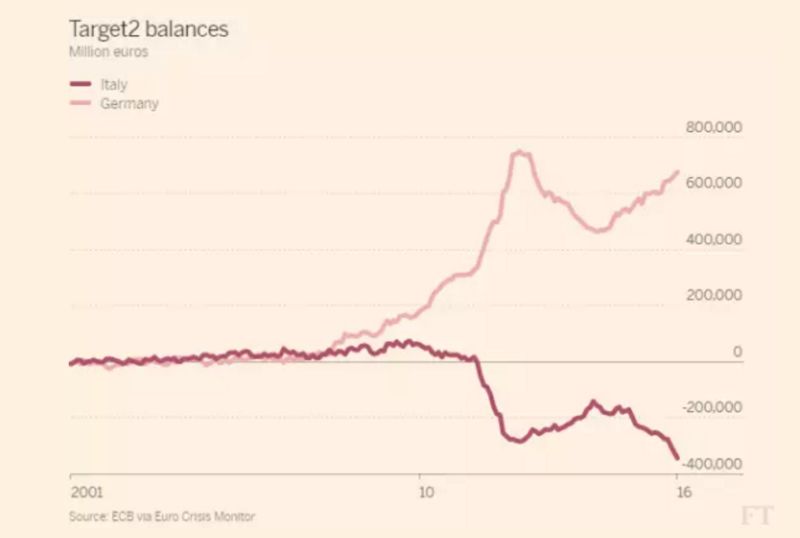
Spreads on Italian bonds have widened to about 200 basis points over German bunds.
The balance-of-payments crisis underway since the first half of 2016 is the main factor
Carmen Reinhart, Project Syndicate 23 November 2016
As of September (the most recent data available), Italy’s Target2 deficit is above 20% of GDP
According to IMF estimates, real per capita income in Italy is about 12% below what it was in 2007,
with only Greece faring worse.
The European flag /EU-flag really/ has disappeared from the office of the Italian prime minister.
This has the unmistakable touch of Jim Messina, the Obama strategist brought over to Rome
for a fee of €400,000 to help Mr Renzi survive next month’s make-or-break referendum.
The last 32 polls all point to defeat.
Ambrose, 16 November 2016
Italian banks – already grappling with non-performing loans equal to 18pc of balance sheets –
are up to their necks in the sovereign “carry trade”. They hold €400bn of Italian government bonds.
These assets have suffered a paper haircut. Losses must be “marked-to-market”, eroding core capital ratios.
Lately, Italy's central bank has been building up a lot of liabilities to the Eurosystem.
As of the end of September, they stood at about 354 billion euros, up 118 billion from a year earlier
Bloomberg 17 October 2016
given the chance that they might eventually be converted into lira.
The end game may have finally arrived for Banca Monte dei Paschi di Siena SpA.
An institution that’s seen its stock fall by 99 percent since 2009, recorded 15 billion euros in losses
Has until year-end to raise 5 billion euros of capital - seven times its current market value
Bloomberg 23 November 2016
- and offload almost 28 billion euros in soured loans to save the world’s oldest lender.
European Union rules require bondholders and stockholders to absorb losses in the event of a bailout,
an outcome that could cause a political firestorm.
The world's oldest surviving bank, Monte dei Paschi di Siena (MPS), which has been in business since 1472,
BBC 7 August 2014
Concern is mounting that the world’s oldest bank will have to be bailed-in under new EU rules
FT 21 September 2016
Shares in Monte dei Paschi di Siena, Italy’s third-largest bank by assets,
have fallen to under two cents amid growing investor concern that the world’s oldest bank will be
unable to pull off a €5bn recapitalisation and €30bn bad loan disposal demanded by regulators.
About Monte dei Paschi di Siena at IntCom
About Monte dei Paschi di Siena at Google
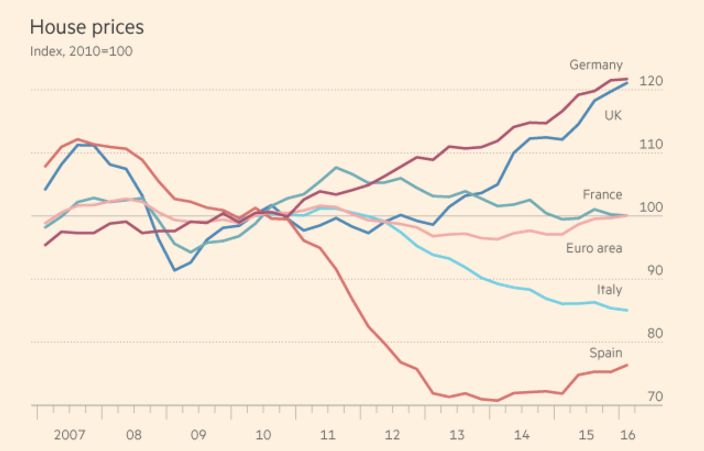
Why Italy’s housing crisis matters
FT 21 July 2016
“Burden-sharing by shareholders and subordinated creditors as a prerequisite for the authorization, by the commission,
of state aid to a bank with a shortfall is not contrary to EU law,”
according to the EU Court of Justice.
The Luxembourg-based court’s decision is binding and can’t be appealed.
Bloomberg 19 July 2016
Italy’s banking woes have the potential to wipe out investors and
undo over 60 years of supranational state-building in Europe.
zerohedge 12 July 2016
The fact that in Italy, thanks in part to a quirk of the tax code,
some €200 billion of bank bonds are held by retail investors adds an extra political dimension to the mix,
as The Economist points out.
Italy's economy will not return to the levels seen before the 2008 financial crisis
until the mid-2020s, the IMF has said
BBC 12 July 2016
Lack of NGDP growth is the real reason for Italy’s banking crisis
The Market Monetarist, 7 July 2016
The Italian banking sectors’ trouble has little to do with the Brexit vote. Rather the main reason the Italian banking sector is under water is the same reason why Italian public finances are a mess – lack of economic growth.
Hence, there essentially hasn’t been any recovery in the Italian economy since 2008. In fact, real GDP is today nearly 10% lower than it was at the start of 2008 and even worse – real GDP today is at the same level as 15 years ago! 15 years of no growth – that is the reality of the Italy economy.
I agree with those who reacted to Mr Renzi’s proposal by saying
there is no case to suspend the bail-in rules that are encapsulated in the Bank Recovery and Resolution Directive,
which came into force at the start of the year,
and that doing so would fatally damage the credibility of the brand-new bailout framework.
Philipp Hildebrand, FT 5 July 2016
Italy is preparing a €40bn rescue of its financial system as bank shares collapse on the Milan bourse
An Italian government task force is watching events hour by hour, pledging all steps necessary to ensure the stability of the banks.
“This is the moment of truth we have all been waiting for a long time. We just didn’t know it would be Brexit that set the elephant loose,”
said a top Italian banker.
Ambrose Evans-Pritchard, Telegraph 27 June 2016
The new bail-in reform this year has brought matters to a head, catching EU authorities off guard.
It was intended to protect taxpayers by ensuring that creditors suffer major losses first if a bank gets into trouble,
but was badly designed and has led to a flight from bank shares.
The Bank of Italy has called for a complete overhaul of the bail-in rules.
Italy Concocts €5 Billion “Atlas” Rescue Fund
to Cure €360 Billion in Non-Performing Loans
Mish's Global Economic Trend Analysis, 12 April 2016
Italy is big enough to matter
Greece, Portugal and Ireland were mere test subjects for what will come.
Spain would have been a challenge, but were narrowly avoided.
Italy will drag the whole structure down if it continues on its current trajectory,
and there is nothing to suggest it will change course.
EUGEN VON BÖHM-BAWERKON, FEBRUARY 23, 2016
Italian households put their money in the bank or in public pension funds,
which is used to fund current retirees, but expected to provide a cash flow for their own retirement.
If capital per worker is falling, as it would in a situation where, through depreciation, capital is consumed, one should expect lower output per worker.
This is exactly what has been going on for the last 15 years.
Mr Draghi issued his own cri de coeur in Helsinki six weeks ago, laying out the "minimum requirements for monetary union".
His prescription amounts to an EU superstate, with economic sovereignty to be "exercised jointly".
His plea is Utopian. There is no popular groundswell anywhere for such a vaulting leap forward
The northern creditor states have in any case spent the past four years methodically preventing any durable pooling of risk or any step towards fiscal union.
In airing such thoughts, Mr Draghi is really telling us that he no longer thinks EMU can work.
Ambrose Evans-Pritchard 7 Jan 2015
The euro is in greater peril today than at the height of the crisis
Insurrectional electorates more likely to vote for a new generation of leaders
Wolfgang Münchau, FT November 9, 2014
America’s experience in the 1960s should have warned the eurozone’s creators that tying national monetary authorities’ hands might not be such a good idea.
Europe’s leaders must recognize that the eurozone, as it is currently constituted, is larger than Europe’s optimal currency area.
Some of its member countries – certainly Greece, and probably Italy and Spain – need an independent monetary policy.
Koichi Hamada, Special Economic Adviser to Japanese Prime Minister Shinzo Abe and Professor of Economics at Yale University, Projet Syndicate 28 October 2014
In an act of studied contempt, Mr Renzi’s government published online
the Commission’s “strictly confidential” letter demanding an explanation for Italy’s draft 2015 budget.
Mr Renzi said he wanted greater transparency and would, in future, be publishing not just the Commission’s letters,
“but all the financial data on how much is spent in these buildings. It’ll be a lot of fun.”
It is the sort of remark you might expect from a eurosceptic like Nigel Farage rather than the leader of
the country that currently occupies the EU’s rotating presidency.
Charlemagne, The Economist 26 October 2014
ECB should abolish its OMT program – which, according to Germany’s Constitutional Court, does not comply with EU treaty law anyway.
Furthermore, the ECB should reintroduce the requirement that TARGET2 debts be repaid with gold, as occurred in the US before 1975
The fiscal compact – formally the Treaty on Stability, Coordination, and Governance in the Economic and Monetary Union
French Prime Minister Manuel Valls and his Italian counterpart, Matteo Renzi, have declared – or at least insinuated –
that they will not comply with the fiscal compact to which all of the eurozone’s member countries agreed in 2012
Their stance highlights a fundamental flaw in the structure of the European Monetary Union
– one that Europe’s leaders must recognize and address before it is too late.
Hans-Werner Sinn, Project Syndicate 22 October 2014
Italy’s Downward Spiral
Italy’s new prime minister, Matteo Renzi, wants to stimulate growth. But what he really intends to do is accumulate even more debt.
True, debt spurs demand; but this type of demand is artificial and short-lived.
Sustainable growth can be achieved only if Italy’s economy regains its competitiveness,
and within the eurozone there is only one way to accomplish this: by reducing the prices of its goods relative to those of its eurozone competitors.
What Italy managed in the past by devaluing the lira must now be emulated through so-called real depreciation.
Hans-Werner Sinn, Project Syndicate 21 August 2014
Renzi is not alone in this. On the contrary, virtually the entire European political elite, from Brussels to Paris to Berlin,
still believes that Europe is suffering from a mere financial and confidence crisis.
The underlying loss of competitiveness is not discussed, because that is a problem that discussion alone cannot resolve.
Hans-Werner Sinn, Professor of Economics and Public Finance at the University of Munich,
is President of the Ifo Institute for Economic Research and serves on the German economy ministry’s Advisory Council.
He is the author of Can Germany be Saved?
Crucially
Italy’s PM Matteo Renzi wants the EU’s budgetary rules to be interpreted more loosely – so that money spent for ‘growth-enhancing’ purposes does not count as part of the budget deficit.
At a summit at the end of June, EU leaders agreed that they should make “best use” of the flexibility in the Stability and Growth Pact.
Crucially, however, the rules were to remain the same.
Nevertheless Italian officials have been holding this up as a significant blow-to-austerity victory.
EU Observer 7 August 2014
Italy's Renzi must bring back the lira to end depression
Output has collapsed by 9.1pc from the peak, back to levels last seen 14 years ago. Industrial production is down to 1980 levels.
It takes spectacular policy errors to bring about such an outcome in a modern economy.
Ambrose Evans-Pritchard, 13 Aug 2014
I do not wish to revisit the stale debate over why Italy kept losing labour competitiveness against Germany for a decade and a half, except to say that it proves just how hard it is to bend Europe's deeply-rooted cultures to the demands of a currency experiment.
Economists said EMU nations would converge.
Anthropologists and historians said they would do no such thing.
However we got there, the situation is now untenable.
Italy is 30pc overvalued against Germany. It cannot claw this back by deflating since Germany itself is near deflation.
Italy must look after itself. It can recover only if it breaks free from the EMU trap, retakes control of its sovereign policy instruments and redominates its debts into lira, with capital controls until the dust settles.
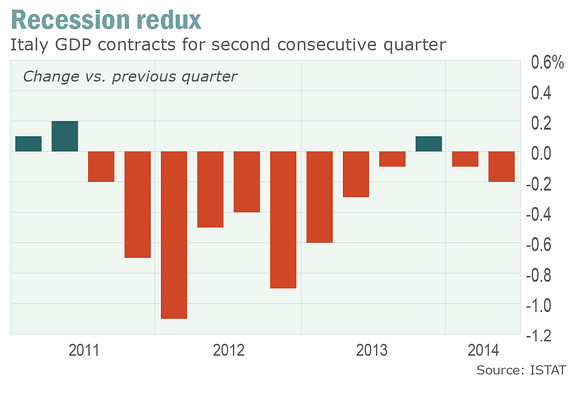
Italy shows euro zone may never have left recession
MarketWatch Aug. 6, 2014
Nice chart
Italian economy has managed to eke out only one paltry quarter of growth in the past three years.
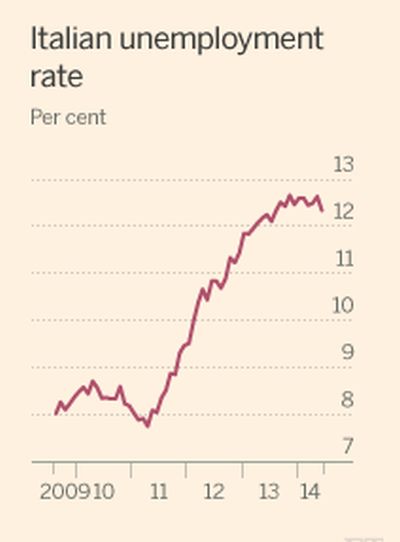
Italy is the third largest economy in the eurozone,
one that has underperformed since the single currency was established 15 years ago,
and for a decade before that.
BBC 25 February 2014
If we go back to the turn of the century and look at the total growth achieved up to last year,
we find that both Germany and France have managed 15 %.
That yields an average of about 1% per year, which is not impressive.
Spain, even after the financial crisis in which it was one of the eurozone's casualties, is 18% ahead of where it was in 2000,
and Ireland is more than 30% up.
Italy's total growth in the same period is approximately nothing.
EU behöver inte en till tysk seger
Matteo Renzi, Italiens populäre socialdemokratiske premiärminister, har tagit över ordförandeklubban i EU
och utmanar Tyskland gällande åtstramningspolitiken.
Lycka till, säger kommentariatet, britterna förlorade nyss med 7-1.
Eller 26-2 för att använda de faktiska röstsiffrorna i rådet.
Men man ska nog inte räkna ut Matteo Renzi.
Katrine Kielos, Aftobladet 13 juli 2014
The argument between Italy and Germany asks a question at the heart of the currency’s future
Can an arrangement that will always fall well short of a textbook monetary union
be at once economically robust and politically sustainable?
Philip Stephens, FT 10 July 2014
Matteo Renzi is rubbing shoulders with the likes of Barack Obama at G7 summits, and is
emerging as the biggest counterweight to German Chancellor Angela Merkel on the EU political landscape.
John Mauldin 23 June 2014
His Democratic Party (PD) took 40.8 percent of votes – the best-ever result for the Italian left, and the highest score ever recorded by a single party since the Christian Democrats in 1958 – has given him a strong hand to challenge Berlin-backed austerity policies, as Italy takes on the EU’s six-month presidency on 1 July.
Italy that is unable to grow, incapable of reforming, and burdened with what increasingly looks like an unsustainable debt.
Barry Eichengreen, 15 October 2013
I underhuset får det parti eller koalition som har fått flest röster en bonus som ger egen majoritet.
Därför får vänstern, som i valet fick 31 procent, hela 54 procent av rösterna i underhuset.
Aftonbladet 27 februari 2013
Tim Geithner recounts in his book Stress Test: Reflections on Financial Crises just how far the EU elites are willing to go to save the euro, even if it means toppling elected leaders and eviscerating Europe’s sovereign parliaments.
The former US Treasury Secretary says that EU officials approached him in the white heat of the EMU crisis in November 2011 with a plan to overthrow Silvio Berlusconi, Italy’s elected leader.
"They wanted us to refuse to back IMF loans to Italy as long as he refused to go," he writes.
Ambrose Evans-Pritchard, May 15th, 2014
Wolfgang Münchau
Supporters of currency union have failed to explain how Italy can prosper inside a monetary union with Germany.
The lazy argument is that Italy’s problems have nothing to do with the exchange rate regime. It is all about structural rigidities. As long as Italy reforms, all is well.
This is nonsense. Globalisation was an asymmetric shock.
It brought new customers for German luxury cars, but for Italy it mainly brought new competitors.
It would not be unreasonable for a country to respond to an asymmetric shock through an exchange rate devaluation.
Italians have been suffering for much longer than other southern Europeans.
Electorates can be relied upon to reject systems that fail to produce economic growth for long periods.
Wolfgang Münchau, FT May 11, 2014
Total bank assets in Italy stand at a relatively modest 2.6 times GDP, compared with 3.2 times in the whole of the euro area. Italian banks generally shunned the sorts of toxic financial instruments that brought down banks in America and Germany. And the country has not experienced a housing bust on a par with that in Ireland or Spain.
Yet for all their sobriety, Italian banks are struggling amid a mountain of bad debts from Italian businesses, big and small.
As the European Central Bank prepares to conduct stress tests and asset quality reviews of hundreds of banks across the eurozone, there is particular worry among some European regulators about Italy’s banks.
These concerns have led the Bank of Italy to conduct its own intensive examinations across the nation, such as the one at Banca Alberobello, ahead of the ECB tests. From Banca di Sicilia in the deep south to Banco di Trento e Bolzano, in the German-speaking northeast, the Bank of Italy is staging its toughest examination of the nation’s banks in history.
Financial Times, 4 March 2014
Italy’s new prime minister will have the most difficult job in Europe.
Once confirmed, he will preside over a country with three fundamental economic problems:
it has very large debt; it has no growth; and it is a member of a poorly functioning monetary union.
Wolfgang Münchau, FT, February 16, 2014
The plot is thickening fast in Italy.
Romano Prodi – Mr Euro himself – is calling for a Latin Front to rise up against Germany
and force through a reflation policy before the whole experiment of monetary union spins out of control.
Ambrose Evans-Pritchard, November 4th, 2013
When the euro was born everyone knew that sooner or later a crisis would occur.
It was also clear that the stability and growth pact was – as I have said before – “stupid”
Romano Prodi, FT May 20 2010
Men om man ställer till rejäla kriser, så kan varje nationell maktelit skrämma sitt folk till underkastelse.
De tvingas acceptera.
EU-kommissionens tidigare ordförande, virrpannan Romano Prodi, var så omedveten att han skrev en kolumn i självaste Financial Times (20 maj 2010),
där han lugnt konstaterade att han och alla de andra som drev fram europrojektet naturligtvis visste att det skulle leda till en svår kris förr eller senare.
Nila Lundgren
The so-called "Frenkel Cycle", the brutal denouement of every fixed-exchange rate system and every monetary union that fails to meet the four basic conditions
"The debt-to-GDP ratio has risen by 15 percentage points [to 133pc] over the past 15 months because there is no growth.
It is all because of the effects of austerity and the fiscal multiiplier. We are making the same mistake they made in Greece."
Ambrose Evans-Pritchard, 30 Oct 2013
The report cited the so-called "Frenkel Cycle", the brutal denouement of every fixed-exchange rate system and every monetary union that fails to meet the four basic conditions of an optimal currency area.
These are labour mobility across borders, wage and price flexibility, fiscal transfers and aligned business cycles.
The euro area meets none of them.
Jeffrey A. Frankel Home page at Harvard
Italy, saddled with the euro region’s second-largest debt, is the “biggest threat” to the economy of the 16-member bloc,
according to Nobel Prize-winning economist Robert Mundell.
Bloomberg Feb. 17 2010
EMU och teorin för optimala valutaområden
Nils Lundgren, den 21 september 1994
Brussels is demanding that Monte dei Paschi di Siena, the world's oldest bank, be subjected to tougher penalties
before it approves the €3.9bn state bailout of Italy’s third-biggest bank by assets.
Financial Times, July 28, 2013
The European fiscal compact, an inter-governmental treaty that came into effect in January,
provides far less flexibility to countries as they try to meet their deficit-cutting targets than they had under previous agreements.
Under the fiscal compact, Italy will be required to pay back debt worth more than 2 per cent of GDP each year.
To achieve that goal, Italy will need to run very large structural surpluses for almost a generation.
Wolfgang Münchau, Financial Times, May 5, 2013
Italy’s new premier Enrico Letta is on a collision course with Germany after vowing to end death by austerity,
and warned that Europe itself faces a “crisis of legitimacy”
“Italy is dying from fiscal consolidation. Growth policies cannot wait any longer,” he told Italy’s parliament.
He said the country is in “very serious” crisis after a decade of stagnation and
warned of violent protest if the social malaise deepens.
Ambrose Evans-Pritchard 29 Apr 203
The grand coalition of Left and Right - the first since the late 1940s - will abolish the hated IMU tax on primary residences, a wealth levy imposed by ex-premier Mario Monti, and push for tax cuts for business and young people to pull the country out of perma-slump.
A rise in VAT to 22pc in July may be delayed.
Vice-premier Angelo Alfano - the appointee of ex-premier Silvio Berlusconi - said he agreed with every word from “beginning to end”, as the Berlusconi camp claimed “total victory” over the policy agenda.
But while Mr Letta promised that Italy would abide by fiscal commitments made to Europe
he did not explain where the government would find the lost revenues of up to €6bn.
Mr Berlusconi took his party to the brink of victory in those elections with a fiercely anti-austerity message aimed against Germany’s “hegemony” in Europe. Italy’s recession and anger at the political elite also led to the populist Five Star Movement winning a quarter of votes in parliament where it is now the largest opposition force.
However Mr Letta stressed the pro-Europe orientation of the new government, saying it would push for
greater economic and political unity in a “United States of Europe”.
Efter två års usel konjunktur behöver åtstramningstakten slås av.
Men vad Italien ska göra för att få hjulen att rulla är lika oklart som förr
Gunnar Jonsson, signerat DN 26 april 2013
The euro zone crisis could be largely over by the end of the year
A year ago going into the Greek elections, the risk was more severe.
Now, [the euro zone crisis] looks fairly contained
unless Italy throws a very funny surprise,"
Holgar Schmieding, chief economist at Berenberg Bank, told CNBC 12 March 2013
Om arbetsmarknaden liberaliseras måste de som förlorar jobbet erbjudas grundläggande trygghet i väntan på att reformerna vitaliserar ekonomin och fler arbetstillfällen skapas.
Det perspektivet har varit sorgligt frånvarande i den tyskdikterade politik som har delar av Europa i sitt grepp.
Den har förvisso modifierats något; Portugal, Grekland och Spanien har beviljats uppskov med budgetsaneringen.
Men det kan vara för lite för sent. Den nedåtgående spiralen fortsätter
Per T Ohlsson, Sydsvenskan 3 mars 2013
Too big to fail or to bail
This is dangerous. It is hard to see Italy remaining in the single currency in such dire straits
— and equally hard to imagine the euro surviving if it falls out.
Italy is the euro zone’s third-biggest economy and, although its budget deficit is quite small,
it has the biggest stock of public debt (at almost 130% of GDP). This makes it too big to bail out.
The Economist print 2 March 2013
Mr Grillo was right about Italy’s overpaid and corrupt politicians.
Mr Berlusconi was right that austerity alone will not solve Europe’s crisis.
TOO BIG TO BAIL
Aubie Balton 31 July 2011
The turmoil produced by the Italian elections has directed attention back to where it should have been all along – to the politics of the eurozone crisis.
It is possible that southern Europe will give the Germans until the autumn to come around to a new approach.
But toleration for austerity is unlikely to last much beyond then.
Europe may be approaching a stark choice: giving up the euro; or keeping it and seeing the political crisis spin out of control.
Mark Mazower, professor of history at Columbia university, Financial Times 28 February 2013
Anders Borg är förvånad över att marknaden inte reagerat mer på det italienska valresultatet.
– De finansiella marknaderna har närmast tittat åt annat håll under de senaste dagarna
Men jag tror man ska vara väldigt försiktig med den optimistiska tolkningen som marknaden gör.
Anders Borg, Ekot 28 februari 2013
Det kan tillkomma politisk osäkerhet från Spanien, Grekland och Cypern och då kan det i sin tur utgöra ett allvarligt hinder för en återhämtning, säger Anders Borg.
Vad tror du det ger för signaler till andra politiker och regeringar runt om i Europa?
– De varierar, de länder som har genomfört en framgångsrik saneringspolitik, där man också återställt tillväxten, har regeringarna blivit återvalda. Den här regeringen har gjort en del återgärder men det är också tydligt att man inte lyckats återställa Italiens konkurrenskraft tvärtom har Italiens konkurrenskraft fortsatt att försämrats, säger finansminister Anders Borg.
The great fear is that ECB will find it impossible to prop up the Italian bond market under its Outright Monetary Transactions (OMT) scheme
if there is no coalition in Rome willing or able to comply with the tough conditions imposed by the EU at Berlin’s behest.
Europe’s rescue strategy could start to unravel
Ambrose Evans-Pritchard 26 February 2013
Andrew Roberts, credit chief at RBS, said: “What has happened in these elections is of seismic importance.
“The ECB rescue depends on countries doing what they are told. That has now been torn asunder by domestic politics in Italy.
“The big risk is that markets will start to doubt the credibility of the ECB’s pledge.”
Mr Roberts said: “The big unknown is how much Germany is going to buckle over the next six months.
German leaders want to keep up the appearance that the eurozone crisis has been solved, at least until their elections in September.”
Italy Votes for Chaos and the Euro Crisis Is Back
Bloomberg, Megan Greene 26 February 2013
Italy’s parliamentary election could not have gone worse for the country or the euro area.
It is now possible that in the coming months the currency zone’s third-largest economy will need a bailout from international creditors,
at a time when Italy will have no government in place to ask for, or negotiate, a rescue.
In case you had any doubts, the euro-area crisis is back.
Eurointelligence 27 February 2013:
The German established is shocked beyond belief - Not in the Casablanca way, but for real.
(Some people were apparently shocked to learn that gambling was occurring at Rick's Cabaret)
The German crisis-exit narrative has been so unbelievably complacent
– everyone pursuing austerity, then happiness forever – that these elections came as a total shock.
Angela Merkel did not say anything (quite wisely, we think).
Frankfurter Allgemeine quotes leading German economists and business representatives to devastating effect.
Lars Feld, a member of the German Council of Economic Advisers, predicted that investors will withdraw money from Italy, which will result in a rise in risk spreads. The Italian economy will then not be able to get out of recession. And that raises, once again, question about Italy’s debt sustainability.
The eurozone crisis will have returned with full force.
The head of Germany’s export association is quoted as saying that Germany should now contemplate the possibility of what he euphemistically called “a modified eurozone”.
(German exporters calling for a break-up of the eurozone is one degree more stupid than turkeys voting for Christmas. But we completely agree with Lars Feld on his description of the dynamics.)
Mario Monti, som inte bara haft insikt i Italiens problem utan även viljan att genomföra nödvändiga strukturreformer,
är nu nästan uträknad i italiensk politik.
Hur kommer det sig?
Tendensen att vilja leva över sina tillgångar drivs på av populistisk valfläskpolitik.
SvD-ledare signerad Ivar Arpi 27 februari 2013
Om Italien ska komma på fötter krävs inte bara politisk tillnyktring på hemmaplan.
Det behövs också en bättre och mer sammanhållen politik inriktad på tillväxt och sysselsättning i euroområdet – och i hela EU.
Valet i Italien är ännu ett tecken på att eurons utdragna svårigheter har lett till att
den ekonomiska krisen har blivit både social och politisk.
DN-ledare 27 februari 2013
Väljarna röstade kraftfullt mot Italiens politiska klass och
lika kraftfullt mot EU:s brutala åtstramningspolitik.
Delvis kan resultatet skyllas på valsystemet.
I underhuset får det parti eller koalition som har fått flest röster en bonus som ger egen majoritet.
Därför får vänstern, som i valet fick 31 procent, hela 54 procent av rösterna i underhuset.
Aftonbladet ledarekrönika Anders Lindberg 27 februari 2013
Högerns idéer och hela åtstramningspolitiken verkar ha passerat sitt bäst-före-datum. I val efter val röstar väljarna på andra partier och en annan politik.
Problemet, vilket illustreras tydligt av valresultatet i Italien, är att om inte Europas socialdemokrater klarar att presentera ett trovärdigt och tydligt alternativ så går väljarna till rena missnöjespartier.
Det verkar som om det egentligen är Mario Monti som bäddat för de ansvarstagande krafternas valnederlag
genom en okänslig svångremspolitik som släppte fram fantaster som Berlusconi och Grillo.
Tråkigt nog kommer detta att återverka på resten av Europa genom den oförmåga att vidta motverkande stabiliseringspolitiska åtgärder som finns hos EU:s toppolitiker.
Danne Nordlilng 26 februari 2013
Själv röstade jag ”ja” till att Sverige skulle gå med i valutaunionen vid folkomröstningen 2003
Jag tvivlar på att befolkningen i länder med statsfinansiella problem
kommer att acceptera förmynderi och bestraffning beslutade av politiker i andra länder.
Assar Lindbeck, DN Debatt 17 juli 2012
If it can happen in Italy then why not in Greece, Spain, Portugal or France?
The writing is emblazoned now clearly on the wall which declares
opposition to living under the dictums handed down from other countries
This is clearly defined by the total rejection of Monti and the Brussels/Berlin austerity measures that he put in place.
The vote for Monti at just under ten percent is a ringing condemnation of the European Union by the people of Italy.
Tyler Durden/Mark J. Grant, Zerohedge 26 February 2013
This vote was not just a massive rejection of politics as it is played in Italy.
It was also a rejection of the policies championed by Mario Monti, the unelected prime minister who replaced Silvio Berlusconi.
He was widely praised in Brussels for bringing stability to Italy but his austerity measures are blamed for deepening the recession.
He was a major loser in this campaign. Europe's leaders feted Mr Monti but the people did not.
This vote was a rejection of the austerity being pursued by Brussels to save the single currency.
Gavin Hewitt, BBC Europe editor, 26 February 2013
The extraordinary success of the protest movement of Beppe Grillo.
One in four voters backed a movement that has promised to shake up and kick out Italy's political establishment.
Mr Grillo has tapped into a mood of anger and resentment. He never gave a single interview to Italian TV and yet has nearly 170 seats.
The country is in deep recession. Unemployment is rising and industrial production is at its lowest level since the 1990s.
Mr Grillo raged against corruption, against budget cuts, against austerity and promised to hold a referendum on continued membership of the euro.
Messy Italian Election Shakes World Markets
Voters delivered political gridlock that could once again rattle Europe's financial stability.
The Dow Jones Industrial Average swung nearly 300 points, ending with its worst day in almost four months,
Wall Street Journal 25 February 2013
Italy
a general election in which voters delivered a resounding rebuff to austerity policies .
The upstart anti-establishment Five Star Movement, founded only three years ago by the comedian-blogger Beppe Grillo,
was on course to stage the biggest shock by garnering the largest number of votes of any single party.
the grassroots movement was leading on 25.5 per cent
But the nation was torn three ways between Mr Grillo and his band of political novices, Pier Luigi Bersani’s centre-left coalition and Silvio Berlusconi’s centre-right alliance,
raising the prospect of a second election within months.
Financial Times 26 February 2013
It will be the revolts, a sort of Mediterranean Spring,
rather than the continued financial traumas, that will eventually goad leaders into action
Louise Armitstead, Daily Telegraph, 28 Dec 2011
Perhaps the most important point to have emerged is that the crisis is subject to growing political risks.
The fall of the Dutch government and the victory of François Hollande in the first round of the French presidential election demonstrate this point.
The street might overwhelm the establishment.
Martin Wolf, Financial Times, April 24, 2012
Bernard Connolly är en av vår tids hjältar.
I dag intervjuas Connolly i Wall Street Journal om hur han ser på eurons framtid.
Den akuta kris som utlöstes för några månader sedan berodde på att Europeiska centralbanken vägrade stödköpa italienska statsobligationer.
Skulle banken åter köpvägra är krisen här igen - innan Herman von Rumpoy hinner säga flasklock.
ekonomism.us 24 februari 2013
Paul Krugman has got in early to comment on the political demise of Mario Monti
– who now seems certain to trail in fourth in the Italian elections.
According to Krugman, Monti’s reputation for wisdom is wildly overblown.
On the contrary, he more or less deserves his fate because he was “in effect, the proconsul installed by Germany.”
Worse, according to Krugman, Monti’s policies did not even work.
Gideon Rachman, Financial Times February 25 2013
As in the rest of southern Europe, the economy has shrunk and so debt-to-GDP ratios have risen. There was only one “piece of good news” in the Monti era – that “bond markets have calmed down.” However, Monti cannot claim the credit even for this, because it is “largely thanks to the stated willingness of the ECB to step in and buy government debt when necessary.”
As ever, with Krugman, the argument is forcefully made. But it misses out a crucial stage in the argument and therefore unfairly denigrates the role of Monti in stabilising the Italian economy.
Austerity, Italian Style
What good, exactly, has what currently passes for mature realism done in Italy or for that matter Europe as a whole?
For Mr. Monti was, in effect, the proconsul installed by Germany to enforce fiscal austerity on an already ailing economy;
willingness to pursue austerity without limit is what defines respectability in European policy circles.
This would be fine if austerity policies actually worked — but they don’t.
Paul Krugman, New York Times 24 February 2013
The Austerians, Olli Rehn, Olivier Blanchard and fiscal multipliers
No debate please, we're Europeans
Paul Krugman, New York Times blog, 16 February 2013
For anyone with a sense of history,
the sight of the German representative on the ECB being isolated and outvoted should be chilling.
Since 1945, the central idea of the European project was
never again to leave a powerful and aggrieved Germany isolated at the centre of Europe.
Gideon Rachman, Financial Times, September 10, 2012
ECB has revealed that Italian government bonds make up nearly half of its holdings under a bond-buying plan
Italian bonds with a book value of 99bn euros account for the biggest holding under the now ended Securities Market Programme.
BBC 21 February 2013
Silvio Berlusconi said Merkel’s East German roots had made her too rigid and too austerity-minded.
Berlusconi says Merkel is an "intelligent bureaucrat" tied to the notion of a centralized economy.
He disagrees with the notion that the fiscal compact was designed to shore up the common currency.
He said the Fiscal Compact imposes a shoe size 42 for men and 40 for women.
This is why he says he wants to renegotiate the entire Compact if elected.
Eurointelligence 19 February 2013
Italien
Vem litar ni mer på? En framgångsrik företagare, en ”krigare” som inte står med mössan i hand i Bryssel?
Eller en marionett som Mario Monti i händerna på Angela Merkel och de tyska bankerna?
SvD Näringsliv 29 januari 2013
Utomlands är Mario Monti populär, en marknadernas och EU-politikernas stora favorit. Men på hemmaplan får han skulden för recessionen som håller Italien i ett järngrepp sedan mitten av 2011 med minustillväxt fem kvartal i rad, fallande investeringar och en arbetslöshet på över 11 procent.
The ECB's Mario Draghi has taken the risk of a sovereign default in Spain and Italy off the table,
but he has not restored these countries to economic viability within a D-Mark currency bloc, and nor can he.
Take a moment to read Eurozone crisis: it ain't over yet by Professor Paulo Manasse from Bologna University, posted on VOX EU.
Ambrose Evans-Pritchard, January 23rd, 2013
Mario Monti's exit is only way to save Italy
The nation is richer than Germany in per capita terms, with some €9 trillion of private wealth.
It has the biggest primary budget surplus in the G7 bloc.
Its combined public and private debt is 265pc of GDP, lower than in France, Holland, the UK, the US or Japan.
Italy has only one serious economic problem. It is in the wrong currency
Ambrose Evans-Pritchard, 10 Dec 2012
The one great obstacle is premier Mario Monti, installed at the head of a technocrat team in the November Putsch of 2011 by German Chancellor Angela Merkel and the European Central Bank – to the applause of Europe’s media and political class.
Mr Monti may be one of Europe’s great gentlemen but he is also a high priest of the EU Project and a key author of Italy’s euro membership. The sooner he goes, the sooner Italy can halt the slide into chronic depression.
Normal service is resuming.
After a year of relative stability and regained market confidence,
Italy is plunging back into political turmoil with the familiar sight of Silvio Berlusconi gearing up for yet another electoral campaign – his sixth in 19 years –
against a centre-left still seeking to shed its proto-communist image.
Financial Times 9 December 2012
After all, it's not Spain that is responsible for 57% of the sovereign debt of the troubled eurozone economies - it's Italy.
And come the spring, Italy will be looking for a new prime minister.
Stephanie Flanders, BBC Economics editor, 16 November 2012
In their punchy new book, Democrisis, David Roche and Bob McKee say Italy is the "circuit-breaker" that could make a lot of the crisis go away: "Italy represents more than half of every form of measurable economic contagion of the eurozone sovereign debt crisis... If the markets believe Italy is 'saveable', a virtuous outcome is possible and contagion will go into reverse."
That makes Italy sound very much like the pivot state: the country whose future could dictate everyone else's.
"Lägger man ihop statsskulden med hushållens skulder är Italien mindre skuldsatt än Sverige.
Detta riskerar att flyttas in i fastighetspriserna", sa Göran Persson
Han varnade för att svenskarna med fallande bopriser riskerar hamna i ond spiral där säkerheterna inte täcker lånen.
DI/GP 2012-11-13
What happens if a large, high-income economy, burdened with high levels of debt and an overvalued, fixed exchange rate, attempts to lower the debt and regain competitiveness?
This question is of current relevance, since this is the challenge confronting Italy and Spain.
Yet, as a chapter in the International Monetary Fund’s latest World Economic Outlook demonstrates,
a relevant historical experience exists: that of the UK between the two world wars.
Martin Wolf, Financial Times, 9 October 2012
Banca Monte dei Paschi di Siena at Google
Monte dei Paschi rescue deal now close
MPS, the oldest bank in the world, was shown to be one of the sickest, too.
FT 22 May 2017
In 2014, Mr Mussari and two colleagues were sentenced to three and a half years in jail for trying to hide MPS’s problems with a convoluted, undisclosed derivatives contract.
Since the start of 2017, MPS, the Italian government, the European Commission and the European Central Bank’s regulatory arm,
the Single Supervisory Mechanism, have been locked in talks about the design of a rescue.
The world's oldest surviving bank, Monte dei Paschi di Siena (MPS)
Shares in Banca Monte dei Paschi di Siena were suspended on Monday,
after the Italian lender and eight of its domestic peers emerged as the standout losers in health checks
aimed at restoring confidence in the euro area’s financial sector.
Financial Times 27 October 2014
Officials at the country’s central bank complained that the parameters in regulatory stress tests were unrealistically harsh on Italian banks.
They disputed the exact number of failures, after nine Italian lenders fell short in a comprehensive review unveiled by the European Central Bank.
The announcement represents the culmination of more than a year of intensive work costing hundreds of millions of euros and involving thousands of officials and accountants – all aimed at restoring investor faith in European banks ahead of the launch of a unified banking supervisor in Frankfurt.
The world's oldest surviving bank, Monte dei Paschi di Siena (MPS), has reported a bigger-than-expected loss.
The Italian bank, which has been in business since 1472, reported a second quarter loss of 179m euros (£142m),
three times the loss analysts had been expecting. It was the bank's ninth consecutive quarterly loss
BBC 7 August 2014
n June, MPS raised 5bn euros on the stock market which it used to pay back state aid and boost its financial situation
Monte dei Paschi di Siena, Italy’s third-largest bank by assets, is set to launch a €3bn capital raising
in the second half of May after the banking foundation that is its controlling shareholder cleared a crucial obstacle to the deal.
FT 19 March 2014
Monte dei Paschi di Siena, the world's oldest bank, took five centuries to accumulate its wealth -- and three years to gamble it away.
Its fall from grace is a disaster for its home city of Siena, which relied on distributed profits from the bank.
Der Spiegel, 7 August 2012
Brussels is demanding that Monte dei Paschi di Siena, the world's oldest bank, be subjected to tougher penalties
before it approves the €3.9bn state bailout of Italy’s third-biggest bank by assets.
Financial Times, July 28, 2013
The EU’s competition enforcer told Italy that the proposed restructuring plan for the 500-year-old lender is too soft on executive pay, cost-cutting and treatment of creditors, according to private correspondence seen by the Financial Times.
In a SPIEGEL interview published on Monday, Monti warned that European leaders could not allow themselves to be bound entirely to parliamentary resolutions in their efforts to save the euro.
"If governments let themselves be fully bound by the decisions of their parliaments without protecting their own freedom to act, a break up of Europe would be a more probable outcome than deeper integration," he warned in the SPIEGEL interview.
Moody's downgraded Italy's government bond rating two notches from A3 to Baa2. This is just above junk status.
Moreover, the outlook is negative with further downgrades possible in the near future.
So what happened in the Italian government bond auction this morning? Did buyers demand higher interest rates?
No they didn't. How is this possible?
Apparently Italian banks couldn't resist an urge to grossly overpay for their government's newly issued debt.
The ECB was most certainly backing them up behind the scenes.
Seeking Alpha 13 July 2012
If this is how Italian banks do business, can we assume that they're solvent?
There is little need to pose that question for Spanish banks. Recent data indicate that they borrowed €365 billion in June from the ECB - a record amount.
Mario Monti and the Limits of Technocracy
When Mario Monti was appointed - not elected - prime minister in November,with the economy headed for collapse, technocratic leadership and a break from politics as usual were exactly what they wanted.
So they thought.
Now, opinion polls put Monti’s approval rating at slightly more than 30 percent, down from more than 70 percent at the start of his tenure.
Editors, Bloomberg 27 June 2012
There’s only so much a technocratic leadership can achieve. In a democracy, a sustained effort at institutional and economic reform -- changes that make powerful interests worse off even as they advance overall living standards -- must be underwritten by voters. Politicians must put forward the case for painful measures and win a mandate to make them happen.
In a broken political system, which Italy’s is, the rule of technocrats can serve a vital temporary purpose. We applaud what Monti has done. But as Italy’s economic crisis escalates once again, its leaders can no longer put politics aside. That’s both understandable and inevitable, if not all that encouraging.
Full textYet even continued gifts under some sort of fiscal union would not bring prosperity, as we see clearly in Italy.
Italian unification in 1861 married the Germanic north with the Latin south. The consequent misalignment continues to this day.
If the euro holds together, this would leave the southern peripheral countries as a giant version of the Mezzogiorno.
Roger Bootle, Telegraph 24 June 2012
Desperate Monti needs Merkel summit deal to stop revolt at home
Italy's technocrat government risks a parliamentary mutiny unless premier Mario Monti can secure major concessions from Germany
at a crucial summit of the eurozone's Big Four powers in Rome on Friday.
Ambrose, 21 June 2012
The main Left and Right parties have until now backed Mr Monti's fiscal squeeze – a net tightening of 3.2pc of GDP this year – and radical reform of pension and labour markets.
The implicit trade-off was that Brussels and the European Central Bank would in return intervene to keep the bond vigilantes at bay, if necessary. Germany has so far blocked such action. Yield spreads of 10-year Italian bonds over German Bunds neared a record 500 basis points last week.
The soft-spoken Professor Monti – flanked by French president Francois Hollande and Spanish premier Mariano Rajoy – is unlikely to be so blunt. Yet he has lured German Chancellor Angela Merkel into a Latin ambush, symbolically staged in the seat of Roman power.
The unspoken message is that Germany does not command a majority vote at Europe's high table and can no longer rely on the Franco-German axis to impose its will. The deal agreed by the quartet in Rome – if there is one – will largely dictate the final EU response to the crisis next week in Brussels.
Berlusconi says Italy should quit eurozone unless Merkel changes course
Ok, he is no longer Italy’s prime minister, but he is still the leader of one of Italy’s most important political parties.
Eurointelligence Daily Briefing 21.06.2012
He said the eurozone crisis can have one of three outcomes.
Either Germany allows the ECB to backstop everything.
Second, Germany leaves.
Third Italy leaves.
Number is two is not going to happen, so we are left with the bifurcation we have forecasting for a long time.
Either they agree a full backstop – which can logically only come from the ECB, and which in turn requires a political union – or the eurozone collapses.
Corriere also has a reference to an interview of Berlusconi in the Wall Street Journal in which he clarified his position further. He said the departure of the a country from the eurozone, or even the collapse of the eurozone, were not subject to polite conversation in Europe until recently, but they are now possible. Here is a section from the excerpt of the interview:
“I see three possible outcomes. The first is that Germany is persuaded and therefore the ECB becomes a backstop for the euro. The second possibility is that Germany leaves the euro…The third solution is that Italy leaves the euro and we reintroduce our own currency, which would bring many advantages.”
And then he went on the attack against Angela Merkel:
“If we continue on with the policies of Signora [Angela] Merkel [the German chancellor], who before had the backing of Sarkozy, demanding that countries reduce their public debt, we'll end up in a worsening recessionary spiral. This is really the wrong policy.”
(Discussing a euro exit is still considered blasphemy by centrist European parties, especially in Italy. So this is an important statement, as he is still an influential political leader. It is also a sign that the anti-euro campaign by Beppe Grillo is having an effect.)
The vicious euro circle keeps turning
Why are investors still so gloomy about Spain?
Stephanie Flanders, BBc 12 June 2012
The core of the problem for Spain - reflected very clearly in the market movements of the past few days - is economic growth. In Italy, too - worries about the state of the economy helped push up the Italian government's cost of borrowing at the start of the week.
An extended period of economic depression and fiscal austerity can trash the balance sheet of the healthiest bank. As the IMF pointed out so helpfully in their recent assessment of Spain's financial sector
Different countries have been hit by the close, mutually destructive relationship between banks and their sovereign governments.
In Spain, as in Ireland, it is the debts of the banks that have fundamentally weakened the government's balance sheet.
In Greece, Portugal and to some extent Italy, the debt problems have largely spread in the other direction - from the government to the banks.
Either way, it's been a toxic mix.
Om man har en sedelpress går man inte i konkurs
Rolf Englund 4 november 2011
Euro Crisis Deepens
Italy Struggles to Break Out of Downward Spiral
Der Spiegel 13 June 2012
After Spain, the focus of the euro crisis has now shifted to Italy, which is struggling with a shrinking economy and rising bond yields.
Prime Minister Mario Monti has denied that his country will ask for an EU bailout, but optimism about Italy's future is in short supply.
The world is uncomfortably close to a 1931 moment
Italy must guarantee 22pc of the bail-out funds, even though it cannot raise money itself at a sustainable rate.
You could hardly design a surer way to pull Italy into the fire.
Ambrose Evans-Pritchard, 10 Jun 2012
The survival of the eurozone now depends on Italy and Spain.
They are the countries that are too big to fail – or to rescue.
Structural steps are painful for any government. They are devilishly difficult without growth.
Robert Zoellick, president of the World Bank, Financial Times 16 April 2012
The Spanish 10-year bond yield hit 6.81 %, as optimism about the weekend's Spanish bank bailout continued to evaporate.
Italy's 10-year bond yield rose to 6.28 %, a rate not seen since January, as concerns about its finances rose.
BBC 13 June 2012
The interest rates are seen as unsustainable in the long run for two countries weighed down by huge debts.
Idag gäller riskerna banker i Grekland, Spanien, Cypern. Portugal och Irland och
imorgon Italien, Frankrike, Belgien, tyska delstater, och delar av Östeuropa.
Carl B Hamilton, 6 juni 2012
Also stressed to virtual breaking point,
Italy, becomes liable for some 17.9pc of the cross guarantees,
raising the absurd spectacle of Italy borrowing at 5pc to lend to the Spanish banking system at 3pc.
European solidarity may be a noble cause, but there must be limits.
Jeremy Warner, Telegraph 11 Jun 2012
European Central Bank head Mario Draghi provided what was perhaps the most urgent appeal to euro-zone political leaders on Thursday in comments delivered to the European Parliament in Brussels.
He said the structure of the euro as it stands now is "unsustainable unless further steps are taken"
Italian Prime Minister Mario Monti also got into the act on Thursday by
demanding that the euro backstop fund, the European Stability Mechanism (ESM),
be allowed to provide fresh capital directly to struggling European banks,
a move that Germany has strictly opposed thus far.
Der Spiegel 1 June 2012
In a video-taped presentation for a conference in Brussels, Monti challenged Berlin to "think deeply yet quickly" about further instruments to combat the crisis facing Europe's currency. The focus of such cogitation, he said, should be the Continent's banks.
The most immediate cause of concern this week is Spain.
As Greece erupts, Italy is moving into the eye of the storm.
Its economy is contracting at speeds not seen since the depths of the slump in 2009
as draconian austerity bites, greatly increasing the risk of social revolt and a banking crisis
Ambrose Evans-Pritchard, 15 May 2012
With the world's third largest debt after the US and Japan at €1.9 trillion (£1.18 trillion), it is big enough to bring the global financial system to its knees.
It is also in the front line of contagion as the Greek crisis metastasizes.
Top of page - News - Start page
Spanish and Italian banks are trapped with large losses on sovereign bonds bought with ECB funds (LTRO).
Spanish banks used ECB funds to purchase five-year Spanish bonds at yields near 3.5pc in February and 4.5pc in December.
The same bonds were trading at 4.77pc on Wednesday, implying a large loss on the capital value of the bonds.
It is much the same story for Italian banks pressured into buying Italian debt by their own government.
Any further dent to confidence in Italy and Spain over coming weeks could push losses to levels that trigger margin calls on collateral.
Ambrose Evans-Pritchard 11 April 2012
From November to February, during which the central bank lent more than 1 trillion euros to 800 European banks,
Spanish banks increased their holdings of government securities by 68 billion euros and
Italian banks by 54 billion euros
New York Times 9 April 2012
Utan genomgripande reformer driver Italien närmare ett grekiskt tillstånd
Det vore en katastrof för Italien och för Europa
Rolf Gustavsson, SvD 8 april 2012
Det är mycket att ta itu med, "den organiserade kriminaliteten, korruptionen och ett skattefusk som motsvarar minst åtta procent av BNP."
Det är, och har varit, en stor uppgift för varje regeringschef i Italien.
Det mest akuta problemet, skriver Rolf Gustavsson, är reformerna på en arbetsmarknad "som utestänger ungdomar och kvinnor". Därmed avser han försöken att mot fackets motstånd göra det lättare att avskeda arbetskraft.
Allt detta skall, men det skriver inte Rolf Gustavsson, skall leda till att Italien återvinner sin konkurrenskraft. Och detta skall göras i ett läge med stor arbetslöshet.
Det är inte lätt att förstå hur detta försök till interndevalvering skall lyckas.
Rolf Englund blog 8 april 2012
Yes, Mussolini pulled off a 20pc cut in wages in the late 1920s.
How can a democracy bring about such cuts in private sector wages without use of police coercion?
Portugal, Italy, and Spain need an "internal devaluation" of around 20pc
to claw back competitiveness within EMU. This means draconian wage cuts for year after year.
Ambrose Evans-Pritchard, 5 April 2012
Tyskarna gick in i EMU med en övervärderad kurs
Efter återföreningsbubblan som lämnade dem med en svag ekonomi i ett halvt decennium.
De arbetade långsamt tillbaka konkurrenskraften den hårda vägen, genom att pressa löner och driver upp produktiviteten.
Det är helt förståeligt att de nu tror att Club Med kan och bör göra samma sak.
De är helt fel, naturligtvis, eftersom Tyskland kunde sänka relativlöner under
a) en global boom, b) mot andra EMU-stater som inflaterade C) och med räntor som var låga även under de svåra åren.
Ingen av dessa faktorer gäller Italien eller Spanien nu.
Ambrose Evans-Pritchard, 2 December 2011
The Germans entered EMU at an overvalued rate
after the Reunification bubble, leaving them in semi-slump for half a decade.
They slowly clawed back competitiveness the hard way, by squeezing wages and driving up productivity.
It is entirely understandable that they now think Club Med can and should do the same.
They are profoundly wrong, of course, because Germany was able to lower relative wages during
a) a global boom, b) against other EMU states that were inflating c) and with benchmark borrowing cost that stayed low even during the dog days.
None of these factors apply to Italy or Spain now.
Ambrose Evans-Pritchard, December 2nd, 2011
Nouriel Roubini: markets are “schizophrenic” they cannot decide whether to reward or punish countries such as
Spain and Italy for their austerity plans. “Without growth, the socio-political backlash will become overwhelming for some governments.”
The euro needs to sink to parity with the US dollar in order to restore Europe’s peripheral economies to growth
CNBC 30 March 2012
Just nu är Italien och Spanien viktigast.
Det är ingen som vet hur de ska klaras, men i slutändan måste det bli ECB som kommer att göra något spektakulärt.
Det kan bli så att ECB stödjer all spansk och italiensk upplåning, det vet vi inte. Men där är vi inte i dag.
Bengt Dennis, SvD Näringsliv 13 mars 2012
- Den stora risken var att Grekland skulle utlösa en kris i italienska, franska och tyska banker.
Nu finns i praktiken en EU-garanti för de utestående grekiska statsobligationerna.
Anders Borg, TT, SvD papper 22 februari 2012
Fiscal irresponsibility; Greece, but nobody else.
Italy ran deficits in the years before the crisis, but they were only slightly larger than Germany’s
(Italy’s large debt is a legacy from irresponsible policies many years ago).
Portugal’s deficits were significantly smaller, while Spain and Ireland actually ran surpluses
Paul Krugman, New York Times, February 26, 2012
S&P downgrades ratings of 34 Italian banks
Financial Times, 10 February 2012
The European Union must recognize Italy's efforts in fighting the sovereign debt crisis
or risk the third-largest euro zone economy falling into the hands of anti-EU populists
Italian Prime Minister Mario Monti, CNBC 11 Jan 2012
Monti called the breaches of the Maastricht Treaty limits on deficit ceilings by France and Germany,
soon after the launch of the single currency, the "worst mistake in the EU in the past ten years".
CNBC 11 Jan 2012
Germany has long insisted that austerity be the primary strategy used in confronting the ongoing euro-zone debt crisis.
Italy has now joined France in demanding a more nuanced approach.
Italian prime minister seems to have lost his enthusiasm for austerity.
He has begun pursuing a different direction - one diametrically opposed to that which German Chancellor Angela Merkel would like to see.
Der Spiegel, 11 January 2012
Italy
UniCredit shares fell nearly 15pc today on the size of the larger-than-expected discount, 43 procent
which is designed to help the bank meet a new minimum core capital requirement imposed by the European Banking Authority.
Harry Wilson, Banking Correspondent, Daily Telegraph, 4 Jan 2012
Italy and Spain need to borrow a combined € 590 bn in 2012
their yields remain above sustainable levels,
ECB’s efforts at buying debt in the secondary markets have so far been ineffective in holding yields down
John Paulson, Financial Times, December 14, 2011
Italy paid a euro era record yield of 6.47 percent
to sell five-year paper at its first auction of longer-term debt
after the EU moved towards greater fiscal integration at last week's summit
CNBC 14 Dec 2011
In Italy, Chancellor Merkel is seen as having helped engineer, along with the European Central Bank, Silvio Berlusconi's departure.
Mario Monti's weakness is that he is seen as "sponsored" by Berlin and Brussels.
All the time spent discussing his plans with European officials undermines his standing at home.
As an unelected leader he will have to implement deeply unpopular cuts without a mandate.
Rightly or wrongly some of the anger will attach itself to Germany.
Gavin Hewitt, BB Europe editor, 30 November 2011
It did not help that almost as soon as he was elected in Spain, Mariano Rajoy was on the phone to Berlin.
Everything depends on Italy,
because financial markets now fear that it may be insolvent.
Italy can save both its own economic sovereignty and the euro if it acts decisively and quickly to convince the financial markets
that it will balance its budget and increase its rate of economic growth so that the ratio of its public debt to its gross domestic product will decline in a steady and predictable way.
Martin Feldstein, Financial Times, 30 November 2011
If the Italian government has to continue paying a seven or even eight per cent interest rate to finance its debt, the country’s total debt will grow faster than its annual output and therefore faster than its ability to service that debt.
If investors expect that to persist, they will stop lending to Italy. At that point, it will be forced to leave the euro. And if it does, the value of the “new lira” will reduce the price of Italian goods in general and Italian exports in particular.
The resulting competitive pressure could then force France to leave the euro as well, bringing the monetary union to an end.
But this need not happen. Italy can save both its own economic sovereignty and the euro if it acts decisively and quickly to convince the financial markets that it will balance its budget and increase its rate of economic growth so that the ratio of its public debt to its gross domestic product will decline in a steady and predictable way.
Kommentar av Rolf Englund
Det var väl ett elegant sätt att skriva att euron spricker. If, if, if.
Då förstår alla att det inte kommer att gå.
7.89 % for three years, and 7.56 % for 10 years
The make-or-break question - for Italy and for the eurozone - is whether there is the faintest chance those rates will fall,
without the supply of emergency finance to a highly indebted government that's presiding over a very slow-growing economy.
Robert Peston, BBC Business editor, 29 November 2011
The precedent of Greece, Portugal and Ireland suggests there is little prospect of Italy's borrowing costs returning to non-penal levels without outside help, even if its government of technocrats produces a credible programme both to reduce the mountain of debt and put some fuel in the economy.
IMF för inga samtal med Italien om ett eventuellt låneprogram för landet.
Det uppgav en talesperson för IMF i ett e-postat meddelande på måndagsmorgonen, enligt Bloomberg News.
Tidningen La Stampa rapporterade på söndagen om att IMF förebereder ett låneprogram för Italien på upp till 600 miljarder euro.
DI 2011-11-28, 07:21
Monti Says Merkel, Sarkozy Agree
Italy Default Would Lead to End of Euro
Bloomberg Nov 25, 2011
Italian bond yields rise above 8%
So-called “real money” managers – including pension funds and insurers – as well as banks have already begun
offloading their holdings of “peripheral” European debt.
Financial Times, November 25, 2011
Bond yields on short-term Italian debt rose above 8 per cent on Friday as Rome was forced to pay euro-era high interest rates in what analysts called an “awful” auction.
That means both Rome and Madrid have paid more than Athens for short-term debt this week.
If Germany genuinely wishes to save Spain and Italy, it must allow EMU-wide reflation and
mobilize the ECB as a lender of last resort to halt the bond crisis, since the EFSF rescue fund does not exist.
To create a currency without such a backstop is criminally irresponsible.
Ambrose Evans-Pritchard, DT, 20 Nov 2011
10.53 Italian yield passing 7pc
Allt skulle ju bli så bra bara dom blev av med Göran Persson och Berlusconi.
Rolf Englund blog 2011-11-15
Italy’s labour cost competitiveness against Germany has deteriorated by around 50 per cent since the mid-1990s.
How can this conceivably be reversed in a low inflation environment within EMU?
Gavyn Davies, FT November 13, 2011
Many of the most essential labour market reforms will certainly add to unemployment and
deepen the recession in the short run, making the budget problem even more difficult.
With interest rates on its sovereign debt surging well above seven per cent, there is a rising risk that Italy may soon lose market access.
Given that it is too-big-to-fail but also too-big-to-save, this could lead to a forced restructuring of its public debt of €1,900bn.
That would partially address its “stock” problem of large and unsustainable debt but it would not resolve its “flow” problem,
a large current account deficit, lack of external competitiveness and a worsening plunge in gross domestic product and economic activity.
Nouriel Roubini, FT 10 November 2011
To resolve the latter, Italy may, like other periphery countries, need to exit the monetary union and go back to a national currency, thus triggering an effective break-up of the eurozone.
Eurobonds are out of the question as Germany is against them and they would require a change in treaties that would take years to approve.
Eurobonds are the only answer to Europe’s crisis;
Mario Monti, Financial Times, July 20, 2011
Rolf Englund blog 13 november 2011
Last week, everyone was insisting that the departure of Prime Minister Silvio Berlusconi would calm markets.
On Wednesday, it became apparent that the opposite was true.
After all, what comes next might be worse.
Der Spiegel 9 november 2011
People are worried about Italy's future because they suddenly remember its past. Between the end of World War II and 1994, when Berlusconi was first elected as prime minister, Italy had almost five dozen governments, few of which survived much longer than a year and many much shorter than that. Political chaos was long an Italian trademark before Il Cavaliere was able to impose some order.
Top of pageMilton Friedman om EMU, Italien och politiska problem
Rolf Englund blog 10 november 2011
The currency bloc is not so much suffering a sovereign-debt or banking crisis as a crisis of governance. How one views this governance crisis will depend partly on where one lives.
To a Northern European, the problem lies in the failure of some member states to control their borrowing or reform their economies to enable them to compete and grow under a single currency.
To anyone in the periphery or living outside the euro zone, the problem lies in the design of the euro,
which has left one of the richest region's in the world unable to prevent a debt crisis in one of its smallest economies
spiraling out of control and threatening to devastate the global economy.
Simon Nixon, WSJ, 8 Nov 2011
What the ECB is being asked to do is provide an open-ended commitment to subsidize Italy's debts by agreeing to underwrite the risk of default.
That is a major transfer of fiscal sovereignty that will de facto make all euro-zone countries henceforth responsible for each other's debts.
Even if the ECB had the legal power to assume this responsibility under the European treaties, which it says it doesn't,
it has no means to ensure countries stick to reform programs and thus minimize the risk of losses for taxpayers.
Ialy's debt crisis spiraling out of control.
Italian government 10-year bond yields have reached a euro-era record of 6.7% — a level from which no other peripheral euro-zone country's bond market has recovered.
Increased European Central Bank bond-buying — last week's purchases were double those of the week before — have failed to halt the slide in prices.
European banks are dumping Italian bonds at a loss and being rewarded by the market.
Given the lack of adequate bailout facilities, many now argue that only an unequivocal commitment from the
ECB to act as a lender of last resort by signaling its willingness to buy unlimited quantities of debt
Simon Nixon, WSJ, 8 Nov 2011
What's more, the ECB's exposure to Italy isn't limited to bonds. It also is providing substantial lender-of-last-resort funding to its banks. When the ECB's total exposure to Greece, Ireland and Portugal grew to a significant proportion of their GDP, it rightly forced them to seek an alternative source of external financing.
"alternative source of external financing" = Räddningspaket från EU och IMF
Whatever Silvio Berlusconi's faults, which are undoubtedly many,
since when was it thought acceptable for the central bank to effectively decide on what the government in Italy should be?
The now repeated imposition of supra-national policy by an unelected elite on the citizens of the eurozone has got to be ultimately unusustainable.
The dangers of extremist popularism followed in short order by Balkanisation are all too obvious.
Jeremy Warner, DT, November 8th, 2011
Far from promoting growth and political solidarity, which is what the single currency was supposed to do, the euro is in fact achieving the opposite effect, by condemning the eurozone to long term recession and now extreme political infighting
Top of pageUnless the European Central Bank step in very soon and on a massive scale to shore up Italy, the game is up.
We will have a spectacular smash-up.
Italy is not fundamentally insolvent. It is only in these straits because it does not have a lender of last resort, a sovereign central bank, or a sovereign currency.
The euro structure itself has turned a solvent state into an insolvent state. It is reverse alchemy.
Ambrose Evans-Pritchard, 1 November 2011
If handled badly, the disorderly insolvency of the world’s third largest debtor with €1.9 trillion in public debt and nearer €3.5 trillion in total debt would be a much greater event than the fall of Credit Anstalt in 1931.
The Anstalt debacle triggered the European banking collapse, set off tremors in London and New York, and turned recession into depression. Within four months the global financial order had essentially disintegrated.
The referendum is a healthy reminder that Europe is a collection of sovereign democracies, tied by treaty law for certain arrangements. It is a union only in name.
Certain architects of EMU calculated that the single currency would itself become the catalyst for a quantum leap in integration that could not be achieved otherwise.
This was the Monnet Method of fait accompli and facts on the ground. These great manipulators of Europe’s destiny may yet succeed, but so far the crisis is not been remotely beneficial.
The sovereign nation of Germany has blocked every move to fiscal union, whether Eurobonds, debt-pooling, fiscal transfers, or shared budgets. It has blocked use of the ECB as a genuine central bank. The great Verfassungsgericht has more or less declared the outcome desired by those early EMU conspirators to be illegal and off limits.
And as my old friend Gideon Rachman at the FT writes this morning: the Greek vote is “a hammer blow aimed at the most sensitive spot of the whole European construction – its lacks of popular support and legitimacy.”
In many ways, the euro-zone debt crisis is now all about Italy.
The Economist, Charlemagne 24 Oct 2011 with nice pic
In discussions all weekend, including at two European summits, leaders worked on drawing up a package deal to save the euro that should be concluded in another round of summits on Wednesday.
All three of the main issues – the fate of Greece, the “firewall" to prevent contagion and the recapitalisation of Europe' banks - revolved in some ways around Italy: if Greece's debt is restructured, will the markets then turn on Italy, the next most-indebted state in the euro zone? If so, is the new firewall big enough to protect Italy? And does the plan to strengthen banks with fresh capital, so that they can withstand the loss of value of their bond holdings, not place an unfair burden on Italy, whose banks hold vast amounts of depreciated Italian debt?
Angela Merkel of Germany and Nicolas Sarkozy of France thought differently. When asked whether Italy's prime minister had reassured them about doing his homework to draw up a plan to bring down Italy's vast debt and implement structural reforms, Mrs Merkel and Mr Sarkozy first hesitated, then looked at each other and, finally, smirked knowingly. (video clip here, in French)
According to Germany's chancellor, Angela Merkel,
"Italy has great economic strength, but Italy does also have a very high level of debt
and that has to be reduced in a credible way in the years ahead."
However, some economists might disagree with her assessment.
BBC 24 October 2011
The big fear is "contagion" - that a Greek default could trigger a financial catastrophe for other, much bigger economies. And Italy seems to have ousted Spain as the lead candidate for that contagion. Why is that?
As with Greece, she and other eurozone leaders believe the solution is more government austerity - spending cuts and tax rises - by Rome.
The Italian government's debt, at 118% of GDP (annual economic output) is certainly high, even by European standards.
But dig a little deeper, and the picture changes.
Unlike their counterparts in Spain or the Irish Republic, ordinary Italians have not run up huge mortgages, and generally have very little debt.
That means that according to the Bank of International Settlements Italy as a country - not just a government - is not actually terribly indebted compared with other big economies such as France, Canada or the UK.
Moreover, the large debts of the Italian government are nothing new. It has got by just fine with a debt ratio over 100% of its GDP ever since 1991.
The main reason is because - unlike Greece - Italy is actually quite financially prudent.
The government spends less on providing public services and benefits to its people than it earns in taxes, and has been doing so every year since 1992, except for the recession year of 2009.
Europe’s crisis is all about the north-south split
Anticipating the euro, drachma-denominated 10-year sovereign bonds fell more than 450 basis points
relative to German Bund rates in the three years leading up to Greece’s adoption of the euro in 2001.
Likewise, Portugal and Italy
Alan Greenspan, FT October 6, 2011
The Italian government yesterday raised €7,86bn at an interest rate of 5.86 %,
up from 5.22 % in August, according to Reuters.
That level is inconsistent with Italy’s continued membership in the eurozone.
Eurointelligence 30 Sept 2011
Once the crisis hit Italy, followed by an absolutely inadequate policy response of the Italian government, the crisis has reached a point of No return.
Italy is too big to save with the current set of instruments, including ECB bond purchases, and in the absence of a credible programme of eurobonds,
he concludes that a breakup of the eurozone must now be considered as a probable scenario.
The question is now whether and how the EU can survive such a cataclysmic event.
Wolfgang Münchau in his column in FT Deutschland, ref. by Eurointelligence 21 September 2011
Why is Spain — along with Italy in so much trouble?
The answer is that these countries are facing something very much like a bank run
Paul Krugman, New York Times, 11 September 2011
Italian bond spreads surpass 400bp for the first time in this crisis
The bond spreads rose after investors concluded that China is, after all, not going to bail out Italy
Eourointelligence 14 September 2011
There is nothing magical about apparent threshold numbers, but a spreads of 400bp is awe-inspiring because it clearly signals a lack of sustainability.
Den italienska obligationsmarknaden är världens tredje i storlek.
Med dessa väldiga volymer kan ECB inte i längden uppträda som yttersta garant, när de privata aktörerna drar sig undan.
Mer varaktiga stödköp skulle dessutom knappast vara förenliga med reglerna i EU-fördraget.
Johan Schück, DN Ekonomi 9 september 2011
Sedan länge har Italien stora problem med sin konkurrenskraft, vilket bottnar i att arbetskraftskostnaderna har stigit snabbt medan produktiviteten sjunkit. På så sätt går man i otakt med Tyskland och andra länder i norra Europa, medan liknande problem finns i exempelvis Grekland. Den gemensamma valutan har hittills inte medfört något närmande mellan nord och syd när det gäller ekonomisk utveckling.
Full textDiagram i Financial Times
Medan de tyska lönerna har ökat med 5 procent, har de italienska stigit med nästan 40 procent.
Gunnar Jonsson,DN ledarsidan 7 september
Att tillväxten på 2000-talet varit sämst i EU har inte hjälpt.
Debatterade igår euron med Olle Schmidt i Studio ett.
Jag har jag fortfarande inte från Schmidt hört någon trovärdig lösning på problemet om hur Grekland ska kunna uppnå konkurrenskraft inom euron.
Adam Cwejman, förbundsordförande Liberala ungdomsförbundet, 6 september 2011
Inte heller något svar på de problem som uppstår om situationen för Grekland kvarstår som den är idag.
Man kan i dagarna läsa att var fjärde grek vill lämna samarbetet, det är alltså fler greker som vill lämna euron än svenskar som vill införa den.
Låt Grekland lämna euron
Italiens tillväxt är bland världens lägsta.
Under det senaste decenniet är det av samtliga världens länder bara Zimbabwe och Haiti som har haft lägre tillväxt.
Adam Cwejman, förbundsordförande Liberala ungdomsförbundet, SvD Brännpunkt 3 september 2011
Att köpa upp statsobligationer och utfärda nödlån kan vara till hjälp när stater lider av dålig likviditet – men inte när det är den låga produktiviteten som är problemet.
En del uträkningar som gjorts uppskattar att Grekland skulle behöva en devalvering motsvarande 40 procent för att bli konkurrenskraftigt. Detta skulle kunna vara möjligt om man återgick till att ha en egen valuta.
I Greklands fall handlar det om pris- och lönesänkningar som vissa uppskattar skulle vara i storleksordningen 30 procent.
Att genomföra detta är politiskt omöjligt.
Frågan är hur dessa länder ska nå högre ekonomisk tillväxt när de inte kan konkurrera med just lägre priser och löner.
Nu brådskar det att avveckla euron under ordnade former.
Alternativet kan bli att valutaunionen upplöses i ekonomiskt, socialt och politiskt kaos.
Jonas Sjöstedt, SvD Brännpunkt 2 september 2011
"it is an open secret that numerous European banks" would run into trouble were they forced to write down their sovereign bond holdings to reflect current market value. Deutsche Bank CEO Josef Ackermann, Der Spiegel 5 September 2011
*
The greatest fear is that one of the Continent’s major banks may fail, setting off a financial panic like the one sparked by Lehman’s bankruptcy in September 2008.
European policy makers, determined to avoid such a catastrophe,
are prepared to use hundreds of billions of euros of bailout money to prevent any major bank from failing.
New York Times, 7 september 2011
Det finns ett känt citat av President Nixon som jag minns som "I don´t give a damn about the Lira".
Rolf Englund blog 2011-06-21
Hans Werner Sinn, chef för det ansedda IFO-institutet
Euro bonds would destroy the euro zone.
In 1995, shortly before the exchange rates for the euro were fixed,
the interest rates on Italian and Spanish debt were on average about 5 percentage points above Germany's.
Der Spiegel 23 Augusti 2011
Italy alone has to raise or roll-over €68bn by the end of September.
You can be sure that a great number of investors will take advantage of ECB intervention between now and then to lighten their holdings, and switch the risk to eurozone taxpayers.
The ECB may have to buy at least €100bn of Italian bonds alone by late September to cap the 10-year yield at 5pc.
Ambrose Evans-Pritchard, August 17th, 2011
The European Central Bank spent €22bn on government bonds last week
Some analysts have worried that because of the size of Italy’s and Spain’s bond markets
– totalling €2,100bn - the ECB could have difficulties in sterilising all its purchases
if it has to carry on buying on such a large scale
FT 16 august 2011
Italien planerar budgetnedskärningar om 45 miljarder euro under perioden 2012-2013
e24 110812
Ekonomer välkomnade åtgärderna, men uttryckte oro över hur de ska påverka landets tillväxt.
Italian Finance Minister compared Germany and its small-minded Chancellor to a first-class passenger on the Titanic.
When the ship hits the iceberg, everybody goes down together
Rolf Englund blog 20 juli 2011
Italian public debt has been an accident waiting to happen
This is not because recent budgetary policy has been irresponsible.
Instead, it is because Italy has become trapped by two intractable problems
– a high public debt ratio of around 120 per cent of GDP; and a chronically weak rate of GDP growth,
due to its increasingly uncompetitive production sector.
Gavyn Davies, FT blog 17 July 2011
Italian real GDP growth since the nation joined the euro has averaged only 0.6 per cent per annum, and it shows no signs of improving.
A very high debt ratio, together with low real GDP growth and a low inflation rate set by the ECB, is potentially a toxic mix.
A question (to which I don’t have the full answer):
Why are the interest rates on Italian and Japanese debt so different?
As of right now, 10-year Japanese bonds are yielding 1.09 %; 10-year Italian bonds 5.76 %
Paul Krugman, July 16, 2011
Analysföretaget Gavekal skriver i ett marknadsbrev att ”den italienska stormen” hotar euroområdets grundvalar.
Med tanke påd en italienska obligationsmarknaden storlek (1.600 miljarder euro,
motsvarande 14.700 miljarder kronor) är det ett test EMU måste klara”, skriver Gavekal.
Viktor Munkhammar DI 13 juli 2011
Europas ledare möts och pratar, men någon ordning på eurokrisen får de inte.
Röran på finansmarknaderna fortsätter och gäller inte bara Grekland.
Räntetrycket hårdnar även på Italien och Spanien.
DN-ledare signerad Gunnar Jonsson, 13 juli 2011
Not so tender trap
In extreme circumstances, a country can get into a “debt trap”,
in which the interest rate on its borrowings exceeds the growth rate of the economy.
Britain has the benefit, unlike Italy, of being outside the euro and
therefore is not locked into an inflexible monetary policy.
The Times editorial 12 July 2011
A spokesman for Herman Van Rompuy, president of the European Council, denied that senior officials would discuss the state of Italy’s finances
But another official, who requested anonymity because he was not authorized to speak publicly, said Italy would probably be on the agenda
New York Times 11 July 2011
For Italy, the cost of financing its debt rose at the end of the week, though nowhere near the levels faced by Greece. The spread between the yield on the Italian 10-year bond and the German equivalent widened on Friday to 2.36 percentage points, the most since the introduction of the euro.
The cost of insuring Italian debt rose sharply after the country’s trusted Finance Minister became linked to a corruption scandal
There would be huge repercussions if Italy was badly affected because its economy makes up 16.7 per cent of eurozone GDP,
compared with 2.4 per cent by Greece and 1.8 per cent by Portugal.
The Times 9 July 2011
UniCredit plunged suddenly and investor concerns regarding Italy's sovereign debt and contagion risk escalated.
UniCredit shares were briefly suspended after dropping over 6%
WSJ 8 July 2011
Rome is expected on Thursday to approve an austerity drive worth up to 68 bn dollar in savings by 2014,
in a move aimed at reassuring the markets and its European partners on its fiscal discipline.
Financial Times 29 juni 2011
2 triljoner euros
Yields on 10-year Italian bonds jumped 21 points to 4.61pc, threatening to shift the crisis to a new level.
Italy's public debt is over €2 trillion, the world's third-largest after the US and Japan.
Ambrose Evans-Pritchard, 29 Nov 2010
"The EU rescue fund cannot handle Spain, let alone Italy," said Charles Dumas, from Lombard Street Research. "We we may be nearing the point where Germany has to decide whether it is willing take on a burden six times the size of East Germany, or let some countries go."
Top of page Bank Austria, Austria's largest bank, is in fact, owned by Unicredit, Italy's largest bank.
How and why the pride and jewel of Austria is owned by the pride of Italy,
and why it will be Italy that has to deal with a trainload of Balkan debt
Italy could fall into a so-called 'debt trap.'
We think that it might take a decade or more of stagnant or falling wages to restore full competitiveness
Roger Bootle and his team over at Capital Economics
CNBC 6 Jul 2010
The only chance of Italy getting its debt-to-GDP ratio below 100 percent would be for it to run a budget surplus of 5 percent over 15 years.
“If doubts grow over whether the Government is willing or able to do this, Italy could fall into a so-called 'debt trap.'
Under this scenario, rising borrowing costs lead the debt-to-GDP ratio to increase at an accelerating rate, leaving the Government with no choice but to default.”
“If the Government were to default on its debts and investors were forced to take a large haircut of say 50 percent, this would wipe out around 80 percent of Italian banks’ tier one capital at a stroke, causing domestic financial market meltdown,"
I saw a bubble blowing up in housing a few years ago but I seriously underestimated how much longer it would inflate. I therefore gave my warnings of the market's demise too early.Roger Bootle 18 July 2008
Italy's outstanding public debt is €1.7 trillion, seven times the size of Greece's.
Italy "is a big systemic piece," said François Chauchat, an economist with GaveKal, a Stockholm-based economic advisory firm.
"If Italy cannot refinance its debt than it's the end of the euro."
WSJ 14 May 2010
So far, markets have deemed Italy less risky than other Southern European nations despite a public debt equivalent to 115% of gross domestic product—about the same as Greece
"If the interest you're paying on debt is higher than the rate of growth, you end up in a death trap, where you're adding to the debt all the time," says Gabriel Stein, an economist with Lombard Street Research, a London-based economic advisory firm. "I don't know if Italy is in a death trap right now."
Italy, saddled with the euro region’s second-largest debt, is the “biggest threat” to the economy of the 16-member bloc, according to Nobel Prize-winning economist Robert Mundell.
Bloomberg Feb. 17 2010
Being a member of the eurozone doesn’t immunize countries against crisis.
In Spain’s case (and Italy’s, and Ireland’s, and Greece’s) the euro may well be making things worse.
Paul Krugman, New York Times January 19, 2009
The PIIGS
The euro zone faces tough times as the PIIGS — Portugal, Ireland, Italy, Greece and Spain —
will need a flexible exchange rate to compensate for the economic slowdown
so some of them may decide to break free from the single currency's straightjacket
Hugh Hendry, Chief Investment Officer and Partner at Eclectica, CNBC 12/1 2009
Millions of migrants have arrived in Greece, Italy and Spain over the past decade.
To avoid serious social problems, those countries need to do a better job of making them feel welcome
Time Magazine March 1st 2010
Grekland skyller krisen på nazismen
"Man lägger helt enkelt vissa penningbelopp på nästa år. Så gjorde alla och Grekland gjorde det i mindre omfattning än exempelvis Italien", sade Pangalos.
DI/TT 2010-02-24
The crushing defeat of the centre-left government and the complete ousting from parliament of its Communist wing, for the first time in 60 years,
was matched by a dramatic revival in the fortunes of the Northern League and Umberto Bossi, its leader.
Financial Times 18/4 2008
Silvio Berlusconi, the billionaire businessman, back in power at the age of 71, becomes prime minister for a third time but his newly named People of Freedom party maintains its majority only as long as Mr Bossi, 66, remains loyal to their coalition.
"Some thougths about the future of the euro"
The real threat to the cohesion of the monetary union is not Italy, or even a post-property-crash Spain.
The real issue is the political gulf between France and Germany.
Susanne Mundschenk and Wolfgang Münchau, Eurointelligence 18/10 2007
One serious open question if whether the countries – Italy, Portugal, Spain, Greece - that have experienced a significant loss of competitiveness and real exchange rate misalignment will be able implement reforms that will increase productivity growth, reduce relative unit labor costs and allow them to regain their lost competitiveness.
Nouriel Roubini, New York University and RGE Monitor, 28/6 2007
Faktum är att de flesta av EU:s stora projekt ligger i ruiner.
Stabilitetspakten som skulle garantera budgetdisciplin hos EMU-medlemmarna har ingen legitimitet sedan både Tyskland och Frankrike bryter mot den, för att inte tala om Italien.
PM Nilsson, Expressen 25/3 2007
Do current account deficits matter inside a monetary union?
Inside a monetary union, currency risk turns into credit risk
Martin Wolf, FT 28/3 2007
Italy’s debt was downgraded on Thursday by two of the world’s leading credit ratings agencies
in a damaging blow to the centre-left coalition government of Romano Prodi, prime minister.
Financial Times 19/10 2006 ..... full text here
The agreements that established the euro contain no provisions to allow exit. However, if some government – let us suppose the Italian one – decided to leave, there is nothing Europe could or would do to stop it.
But what exactly would a government set on such a course – or forced into it – do?
John Kay, FT, 12/9 2006
Some people will conclude that these problems make a break-up of the euro impossible. This would be a profound error. History – not least the establishment of European monetary union itself – shows that, given political determination, practical problems will be overcome. Civil servants, lawyers and bankers are there to ensure that a client’s wishes are met even if misconceived and if the Bank of Italy does not have a plan in its safe, its officers have been failing in their plain duty.
The Italian election result was a disaster for Italy and is a threat to the future of the euro.
Italy is now in the economic condition that normally preceded devaluation of the lira in the years before the single currency. So long as Italy remains in the euro system it will be impossible to devalue, yet it would be equally impossible for a weak left-of-centre coalition, with no real majority, to take the tough economic decisions that might, or might not, restabilise the economy.
William Rees-Mogg, The Times, 17/4 2006
When the euro was first planned many critics argued that a single currency could survive only if it was backed by a single European government. Inside the euro system different national economies would develop separately and would diverge over time. Each economy would have to adjust to unforeseen external shocks, such as the increase in the oil price or in Asian export competition, but the shocks would have different impacts on different countries.
With no recourse to devaluation, countries would have to take painful economic decisions that might prove to be politically impossible; we have recently seen that in France
The structural weakness of the euro is that it is a single currency that has 12 different economies, 12 different electorates, 12 different governments, 12 different budgets and 12 different systems of sovereign debt. In the debt market itself there are 12 different values for the euro.
If Italy had to leave the euro the consequences would be quite sensational.
The euro itself would be expected to survive, but confidence would have been damaged. If Italy had to leave, who else might go in the future? One can expect every effort to prevent Italy leaving, both in Italy and in the rest of Europe. Even the US Federal Reserve would be worried. All uncertainty is bad for financial markets. If Italy leaves, it will be only after a lot more pain.
Lord William Rees-Mogg, The Times, October 5, 1998
The free-fall in markets across the world is inevitable after years of profligate credit
När och hur spricker EMU
EMU Break-up
The narrow election victory by Romano Prodi’s centre-left alliance was the worst imaginable outcome in terms of Italy’s chances to remain in the eurozone beyond 2015.
Wolfgang Munchau, Financial Times 17/4 2006
These are not bets on Mr Prodi’s political commitment to the euro. It would be difficult to find a more pro-European politician than the former president of the European Commission.
These are bets on economic circumstances that might force a government to take decisions that are unthinkable until the moment they become inevitable.
If Italy continues to lose macroeconomic competitiveness, a populist political movement could well emerge with an agenda for euro withdrawal. Let us think the unthinkable and assume some future Italian government brings back the lira. What would then happen to the country’s mostly euro-denominated debt, which now stands at 106.5 per cent of gross domestic product? Italy would almost certainly be unable to service its obligations to investors in full. It would either convert those debts back into lira at an exchange rate unfavourable to investors or it would default outright.
Three factors may explain the markets’ optimism. First is the view that Italy may be effectively trapped inside the eurozone; leaving it would not solve any economic problems. This argument ignores the fact that default is usually not a consequence of rational choice but of panic. Second is the belief that the European Central Bank would ultimately bail out a defaulting member state. This view may underestimate the ECB’s resolve to observe its no-bail-out rule.
Third, even if one accepts the worst-case scenario, it is still highly unlikely that default would occur within the lifetime of a 10-year bond. This argument offers the most plausible explanation for why the markets have not placed a higher risk premium on Italian bonds. It is also explains why bond markets are notoriously poor early indicators of default risk. Bond investors are complacent until they start to panic.
Financial markets cannot force a country out of a monetary union through currency speculation – as they forced Britain out of Europe’s exchange rate mechanism in 1992. But there are other ways for investors to exploit a country’s difficulties in a monetary union. This is why there are parallels between Italy today and the UK in 1992.
Britain’s political commitment to the ERM appeared as unshakable then as Mr Prodi’s support for the euro looks now. But Britain was neither politically nor economically ready to live under a regime of semi-fixed exchange rates. Italy’s membership of the euro is based on similarly shaky foundations. Fourteen years ago, it took investors a few days to expose a political lie.
Ten years on and sterling's ejection from the European exchange rate mechanism on Black Wednesday still has a surreal quality about it.
Financial Times 2002-09-13
När och hur spricker EMU
EMU Break-up
Spricker EMU?
Det mardrömsscenario ekonomerna varnade för tycks nu inträffa i Italien
Expressen-ledare 24/3 2006
Italy’s seven years within the eurozone seem consistent with Dante’s famous inscription at the entrance of hell: “Abandon all hope, ye that enter”.
The economic consequences of monetary union have been so serious for the country that they require urgent political action by the next Italian government. Without it there will be no escape from the inferno.
Wolfgang Munchau,Financial Times 20/3 2006
A 16 per cent appreciation of the real exchange rate over the last seven years has led to a loss of competitiveness and falling economic growth. If the trend of the last seven years were to persist for the next seven, the consequences for Italian industry and the solvency of the state would be near-catastrophic.
A constellation that might deliver some of these reforms would be a German-style grand coalition. By this, I mean not the present grand coalition in Berlin but the one that governed between 1966 and 1969. The sole rationale of that coalition was to implement economic reforms that were inconceivable under any other political constellation. Italy faces a similar political situation today.
Italy follows Argentina down road to ruin
Desmond Lachman, American Enterprise Institute (Timbros storebror)
Financial Times 17/3 2006
Desmond Lachman joined AEI after serving as a managing director and chief emerging market economic strategist at Salomon Smith Barney. He previously served as deputy director in the IMF's Policy and Review Department and was active in staff formulation of IMF policies toward emerging markets.
An irony of Italy’s unfolding political and economic drama is that many of the current holders of the country’s bloated and ever-increasing government debt were once proud holders of Argentina’s now-defaulted sovereign bonds. As Mario Draghi, Italy’s new central bank governor, warns that the Italian economy has “run aground”, and as prime minister Silvio Berlusconi vents about “the euro having been a disaster for Italy” in the run-up to next month’s election, one has to wonder at what stage Italy’s bondholders will get the feeling that they have been to this sad movie before.
For quite aside from Italy’s disturbing political and institutional weaknesses ... the country’s economic predicament is remarkably similar to that of Argentina in the late 1990s.
The most striking similarity between the two countries is the rigid currency arrangements in which they locked themselves. As a reaction to its mid-1980s experience with hyperinflation, Argentina in 1991 nailed its currency to the convertibility plan cross. It did so in the hope of forcing on the country the low inflation and fiscal policy discipline that it had never before enjoyed.
In a similar effort to impose macro-economic discipline, Italy abandoned the lira for the euro in 1999. It was hoped that high inflation and periodic lira devaluations would give way to fiscal discipline and structural reform. By abandoning its currency, Italy, like Argentina before it, gave up macroeconomic policy flexibility to stabilise its economy. Italy can no longer engage in periodic exchange rate devaluations to rectify losses in international competitiveness. And no longer having its own monetary policy, it has to accept the interest rates set by the European Central Bank even though these might not necessarily conform to Italy’s circumstances. When Jean-Claude Trichet, the ECB president, recently tightened European monetary policy because of high oil prices, did he give much weight to Italy’s cyclical weakness?
If this is not bad enough, under Europe’s fiscal stability pact, Italy is committed to strengthening its public finances at a time of cyclical weakness.
Italy is often mentioned as the country most likely to leave the euro. I disagree.
If any country ever decided to quit that country would be Spain.
Wolfgang Munchau, Financial Times
February 20 2006
On Friday I was in Davos in a panel on the "Ups and Downs of EMU" (European Monetary Union) where ECB head Trichet, Italian Economy Minister Tremont, a few other EU officials and myself were supposed to discuss the following questions:
Will EMU collapse in the future? Which country will exit first? What will be the consequences of a break-up of EMU? How to avoid that? And what are the prospects for the Growth and Stability Pact?
Nouriel Roubini, 28/1 2006
Will EMU survive 2010?
Global interest rates are likely to return to more normal levels. The ‘one size fits all’ policy of the ECB is then likely to become very difficult to bear for countries like Spain and Italy
Daniel Gros, Director CEPS, 17 January 2006
A most impressive list of Board of Directors....
Roberto Castelli, justice minister, said the league planned to present concrete proposals for restoring Italy's former currency at a party meeting on June 19.
"Are Swedes poor because they are the outside the euro?” Mr Castelli asked at a conference in Milan.
Financial Times 8/6 2005
“Does sterling have no economic foundation because it is outside the euro? Is Denmark living in absolute poverty because it is outside the euro?
The anger and embarrassment of other politicians at the league's campaign are tempered by the recognition that the party's purpose is to attract maximum attention as Italy prepares for a general election next year.
In particular, the league wants to discredit Romano Prodi, the centre-left opposition leader who, as Italy's premier from 1996 to 1998 and later as European Commission president, was responsible for taking Italy into the eurozone.
Silvio Berlusconi says Mr Prodi's government fixed the lira against the euro at too high an exchange rate, a problem compounded in Mr Berlusconi's view by the euro's subsequent strength against the dollar and by the European Central Bank's monetary policy.
Kommentar av Rolf Englund:
Dom i Schweiz verkar överleva dom också, ehuru dom inte är med i EMU.