|
Den nu föreslagna grundlagsändringen, innebärande att beslutanderätt skall kunna överföras, inte bara till EG, utan även till EU, måste beslutas genom den ordning som i dag gäller för stiftande av grundlag, dvs med mellanliggande val.
Läs detta först
Syftet med den europeiska gemensamma valutan var inte bara att minska transaktionskostnaderna
utan också att framtvinga en europeisk överstat.
2005 kände sig EU mogen för en stats symboliska födelse: en konstitution.
Den förhandlades, skrevs och skickades ut för folkomröstning.
Det blev ett rungande nej
Sedan dess hankar sig EU fram och väcker måttlig entusiasm.
Överstaten, eller federationen, är tills vidare död som idé.
PM Nilsson, ledare Dagens Industri, 1 maj 2017
Questions are being raised in Germany about the new treaty,
following Germany’s failure to ratify the constitution.
An appeal lodged with the federal constitutional court obtaining an injunction from the court
preventing the federal president from signing the instrument of ratification
Frankfurter Allgemeine Zeitung/Freeeurope.info
Germany's parliamentary democracy is under threat from the European Union
which is slowly taking away all the national parliament's powers
Roman Herzog, the country's ex-president, has said in Welt am Sonntag.
EU Observer 15/1 2007
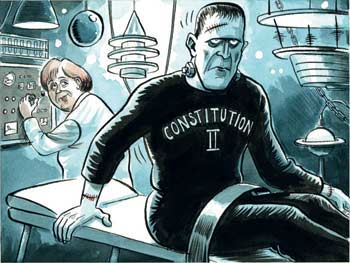
A monster lives again
European leaders are about to squander their second chance to get the constitution right
The Economist print edition 4/1 2007
Angela Merkel, the chancellor, told her parliament that it would be “an historical failure if we do not succeed in working out the substance of the constitutional treaty” by the next European elections in 2009. That means getting a new text ready by the end of 2007.
Everyone knows that the text rejected by France and the Netherlands is dead. Everyone also knows that whatever replaces it will have to await the French presidential election in the spring and Tony Blair's handover of power in Britain (presumably in early summer).
The Laeken declaration of 2001, which began the drafting process, laid down three aims for the drafters: to distribute power to the lowest level (in EU jargon, it should embody the principle of “subsidiarity”); to bring the union closer to its citizens; and to make the institutions work more efficiently. So far, constitution-builders have paid mainly lip service to the first two and focused instead on the third.
Evil Empire or Medieval Empire
- Jag brukar föreslå min federalistiska tyske kollega att Tyskland och Frankrike kan väl
börja med att bilda en federation så kommer vi efter om det går bra.
Men jag skrev inte det i boken, för jag ville inte låta populistisk.
Professor Jan Zielonka, Oxford University, 14/12 2006 ABF-huset, Stockholm
- Enligt många bedömmare liknar EU mer och mer en stat, men Jan Zielonka hävdar att detta är ett missförstånd. Det vi ser växa fram i Europa idag är liknar snarare ett ny-medeltida imperium, skrev den EU-vänliga Arengagruppen i sin inbjudan.
Kommentar av Rolf Englund:
Jan Zielonka, uppvuxen i det kommunistiska Polen, som sade sig kunna "smell empire"
sade dock att federalism luktar för mycket stat.
Han hävdade att det vore bättre om det framtida Europa mer liknade ett medeltida imperium - Medieval Empire
Professor Jan Zielonka, från Oxford universitet gav nyligen ut boken Europe as Empire: The Nature of the Enlarged European Union.
Sceptics and enthusiasts for the European Union are united in one thing: they do not like muddle.
The Europhobes want to boil the union down to a free-trade zone.
The Europhiles want it to turn into a federal state.
But Jan Zielonka, an Oxford-based political scientist, thinks this is a false choice. His new book suggests that Europe should adopt a "neo-medieval" way of looking at itself.
The Economist 8/6 2006
Germany yesterday unveiled a master plan for resurrecting the European Union constitution
Home Secretary, John Reid, said the constitution was a "dead, deceased parrot"
David Rennie, Daily Telegraph 7/12 2006
Germany takes over the rotating presidency of the EU on Jan 1 and the chancellor, Angela Merkel, has pledged to use it to resurrect the constitution, which has been in the deep freeze since last year's No votes in France and Holland. However, Mrs Merkel has conceded that the treaty will have to lose the name "constitution", to avoid frightening voters.
Margaret Beckett, the Foreign Secretary, recently referred to the constitution as a "grandiose" project that "failed to come off," while only this week the Home Secretary, John Reid, said the constitution was a "dead, deceased parrot" that was "no more".
Added by webmaster Rolf Englund:
The Dead Parrot sketch, alternatively and originally known as Pet Shop sketch or Parrot Sketch, is a popular sketch from Monty Python's Flying Circus, one of the most famous in the history of television comedy.
Wikipedia
Germany's envoy to the European Union, Wilhelm Schoenfelder, said the EU has until December 2007, to resolve the issue if the charter is to take effect by mid-2009 as planned.
"If we do not succeed this time, this thing will be dead. We'll be in a very deep crisis"
Herald Tribune 6/12 2006
n June 2005, the EU leaders declared a one-year "period of reflection." They have since added another year, but there is little visible sign of any reflection.
EU diplomats see no chance of a breakthrough until after the two-round French presidential elections, due to conclude next May.
If a new charter is to take effect in 2009, Schoenfelder said, EU governments must know by the end of 2007 the outline of a new charter as ratification is bound to take at least a year.
Germany's plans to put the EU constitution back on track early next year have been dealt a blow by the country's constitutional court in Karlsruhe.
The court on Tuesday (31 October) said it would not rule on whether the EU charter was compatible with the German constitution until after a final decision had been taken on the overall fate of the document
EU Observer/Die Welt 2/11 2006
Mr Sarkozy's "mini treaty" would include key provisions of Part I of the constitution such as member states' voting weights provisions
and plans to create an EU foreign minister, on which there is a "large consensus."
EU Observer 14/9 2006
But simply skipping Part III of the constitution is seen by experts as problematic, as this chapter also includes a list of policies where the constitution proposes to improve decision-making in the EU by lifting the national veto.
Den gemensamma valutan är integrationens mest synliga tecken, och
förmodligen det mest långtgående steget mot en europeisk gemenskap
En del experter menar att en gemensam valuta aldrig kommer att fungera
utan en gemensam ekonomisk politik och en verklig solidaritet mellan länderna
Jakub Swiecicki, Utrikespolitiska Institutet 2006/8
Europe has still to emerge from the political shock of last year’s rejection of the EU’s constitutional treaty in France and the Netherlands.
Governments almost everywhere have lost their nerve over future enlargement of the Union. The western Balkans can go hang; Turkey likewise.
Philip Stephens, Financial Times 20/10 2006
Sett från Bryssel är det obegripligt hur Europa-politiken blivit så undanskymd i valrörelsen.
I det tysta tickar en tidsinställd politisk bomb under vänsterblocket, men ingen verkar bry sig. Inte ens den borgerliga alliansen, som tycks frukta samma spöke som den socialdemokratiska ledningen: en ny folkomröstning om EU.
Rolf Gustavsson, SvD 10/9 2006
Vid toppmötet i juni i år skisserades en tidtabell. Avstampen tas den 25 mars nästa år, då 50 årsdagen av Rom-fördragen högtidighålles under Angela Merkels ledning. Efter förberedande sonderingar börjar förhandlingar mellan EU:s regeringar och ett nytt, reviderat förslag läggs fram under Frankrikes ordförandeskap hösten 2008. Om inte EU skall gå i baklås bör det nya fördraget vara i kraft hösten 2009, när en ny EU-kommission tillträder.
Under nästa mandatperiod inbjuds Sveriges regering att delta i förhandlingarna om ett nytt EU-fördrag och när förhandlingarna avslutas förväntas den godkänna resultatet. Göran Perssons regering har ju godkänt förslaget till konstitutionellt fördrag och statsministern har ju högtidligen undertecknat det (29 oktober 2004 i Rom).
Ju mer de etablerade partierna gömmer undan Europa-politiken av rädsla för en ny folkomröstning desto mer frodas konspirationsteorierna i folkdjupet.
One Country - One President
In Mr Sarkozy's vision, the commission president would himself be elected by the European Parliament - which would provide him with a democratic mandate.
EU Observer 9/9 2006
Mr Sarkozy stated that the principle of national capitals appointing commissioners "does not guarantee neither the efficiency nor the legitimacy" of the EU executive.
"Why aren't we bold...and leave the composition of the commission to its president?...after all, it's on the basis of this logic that national governments are formed."
Once elected, the commission chief could then pick his or her own commissioners, which would enable the body to "function like a real team around its president."
Megalomanin skenar i den växande skaran stats- och regeringschefer, där den minsta potentat uppträder som solkungen själv, inbäddad i ett följe av rådgivare, diplomater, PR-maskinister, livvakter och betjänter.
Rolf Gustavsson kolumn SvD 22/6 2003
Fotnot: Megalomani: storhetsvansinne
In a landmark speech mapping out his vision for Europe, Mr Sarkozy called on European leaders
to agree a "mini-treaty" that would salvage the urgently required institutional reforms laid out in the original draft constitution.
Such a mini-treaty, the French interior minister stressed, would require only parliamentary ratification, but no referendum.
Financial Times 9/9 2006
Mr Sarkozy’s approach is likely to incur charges that it ignores French public opinion, which remains deeply divided on the constitution. However, by avoiding a second referendum, Mr Sarkozy would significantly raise the chances of a new deal succeeding.
Beyond the adoption of a mini-treaty, Mr Sarkozy urged a more flexible approach to decision-making in the EU, warning that the current regime requiring unanimity on many policies, including efforts to harmonise corporate taxation, was unworkable.
Migrantöverenskommelsen var inget EU-beslut
Nu åker ett antal regeringschefer hem och säger dels att de är stolta över vad de kommit överens om,
dels att det är EUs fel.
Men fattades beslutet verkligen av EU?
Att ett antal regeringschefer kommer överens om något gör det inte till ett EU-beslut ä
ven om det har fattats i en lokal smyckad med EU-flaggor.
- Anser Du fortfarande att Sverige skall gå med i EMU?
Jag har haft och har den uppfattningen. Dock har jag sagt att vi kommer inte att aktualisera frågan förrän det finns ett starkt folkligt krav på att så sker, därför att det här skall underställas en folkomröstning och nästa gång en regering lägger fram det här, och då talar vi om perioden efter 2010, så skall vi i så fall vara i ett läge där vi vet vet att vi har folket med oss.
Göran Persson, Ekots partiledarutfrågning, 21/8 2006
Vi kommer "inte att förhandla bort vår uppfattning om EU-fördraget och att det skall tas av riksdagen"
Bosse Ringholm till Svenska Dagbladet 1/9 2006 (s22, ej online)
Fördragsfrågan har knappast diskuterats i valrörelsen, trots att frågan kommer upp under mandatperioden.
Mats Hallgren, SvD Nyhetsplats 2/9 2006
EU-grundlagen är vår grundlag
med info om Lars Leijonborg om EU och EMU
Rolf Englund på internet 6/9 2006
Fördraget innehåller bland annat bestämmelser om ett djupare samarbete inom tredje pelaren,
det vill säga polisiärt och straffrättsligt samarbete.
Detta, och andra delar av fördraget, kan genomföras redan nu utan att fördraget godkänns.
Vad hände(r) med den konstitutionella krisen i EU?
Sieps 2006:6 September 2006
Det allvarligaste misslyckandet med det konstitutionella fördraget ligger inte i innehållet utan i processen i den storstilade inviten till medborgarna i kombination med det försuttna – eller till och med missbrukade – tillfället att tydliggöra för dem vad som idag verkar vara något oklart: varför EU- samarbetet behövs och förtjänar deras förtroende.
Det är ofrånkomligt att medlemsstaternas regeringar, på allvar innan något ytterligare försök görs att vinna stöd för ett nytt (eller nygammalt) fördrag, försöker förklara för medborgarna varför EU behövs och förtjänar deras förtroende.
Daniel Hannan - den nya internetstjärnan!
Hånad, för radikal, bråkstake - ja det finns många beskrivningar för den brittiske europaparlamentarikern Daniel Hannan, men likt en sann saga har han nu fått sin revansch på sina avundsjuka partikamrater och blivit världskändis - allt tack vare internet.
Det hela handlar givetvis om Daniel Hannans brandtal mot premiärminister Gordon Brown
inför några hundra sömniga parlamentariker som orkat pallra sig hela vägen till Strasbourg.
joinsimon blog 27/3 2009
If Gordon Brown was embarrassed by his recent rhetorical skewering at the hands of Daniel Hannan,
a Conservative member of the European Parliament (MEP), Britain’s established media can sympathise.
Indifference from those accustomed to managing the flow of information from politicians to voters
failed to stop the speech from attracting more than a million internet viewings within a week
The Economist print April 2nd 2009
Daniel Hannan MEP: The devalued Prime Minister of a devalued Government
youtube
EU in reality only has one policy and that is political integration.
And, in seeking to achieve this, it has become past master at exploiting situations of concern,
in this particular case concern about terrorism.
EU Referendum 29/8 2006
The fact is that what Hannan has written cannot be said too often – especially for our American friends,
some of whom still labour under the impression that the EU has some purpose other than integration for the sake of it.
Brussels is using terrorism to further its federal ambitions
Daniel Hannan, Daily Telegraph 29/8 2006
The European Union is a solution in search of a problem. Whatever the question, the answer is invariably "more Europe".
War in Lebanon? We need to be able to deploy an EU army.
A breakdown in the World Trade Organisation talks? Let's have a more integrated European economy.
People voted against the constitution? They obviously thought it didn't go far enough.
It would be unfair to demand that the federalists simply abandon their ideal of political union in Europe.
We are all entitled to our dreams.
But they should recognise that in the current political situation they lack both the power and the legitimacy to press on with "the project".
Gideon Rachman, Financial Times, August 29 2006
Gideon Rachman became chief foreign affairs columnist for the Financial Times in July 2006. He joined the FT after a 15-year career at The Economist
If there is one thing that the French and Dutch referendums demonstrated, it is that local politicians are spectacularly bad judges of what sways their voters.
It is already clear that when the Germans take over the EU presidency in January they will use their position to relaunch the constitutional debate. As a result, constitutional wrangling may dominate the next couple of years of the EU’s political life.
The constitution’s most ardent advocates are not embarrassed by this prospect. They do not regard the rejection of the document by voters as in any way definitive – merely grossly inconvenient.
It is true that 15 countries have ratified the constitution.
But only two, Spain and Luxembourg, have done so after a popular vote – and Luxembourg, with less than 0.1 per cent of the EU’s total population, barely counts. The eight EU members that have so far failed to pronounce on the constitution are not simply being absent-minded. Countries such as Britain, Poland and the Czech Republic know that under current political circumstances they cannot win the domestic political argument for the EU constitution.
EU leaders have set 2008 as a target for making changes to the EU rule book, which are needed for further expansion.
BBC 19/6 2006
The President of the European Commission, Jose Manuel Barroso, told the BBC on Thursday that all democracies had to take account of public opinion.
He added that it was possible for Turkey to join the EU, but it would be very difficult.
"First of all (it will be) very demanding for them but also demanding for us here to be ready to accommodate such an important big country that is seen by so many of us as culturally different from, let's say, mainstream Europe," he said.
The Treaty Establishing a Constitution for Europe, to call it by its proper official name, is not just another EU treaty.
This Treaty (Art.IV-437) repeals all the existing EC/EU treaties from the Treaty of Rome to the Treaty of Nice and then founds or establishes quite a new EU, based on its own Constitution.
Legally, constitutionally and politically this new European Union would be quite different from the existing EU.
The new EU, founded on its own State Constitution, in fact becomes a new European State in the world community of States. A young State and a new one, a weak State perhaps, but a State nonetheless, with virtually all the essential features of a State, in which the existing Member States are reduced to the constitutional status of regions or provinces. Simultaneously the EU Constitution becomes the fundamental source of legal authority within Europe, supplanting the Constitutions of the Member States as the ultimate source of legal power.
The EU Constitution becomes part of our Constitution and will not be amendable except with the consent of other countries. This is therefore the most decisive step ever in the near-60-year-old project of European integration, aimed at turning the EEC/EC/EU into a fully-fledged State, a superpower in the world.
Radio Free Europe/Radio Liberty:
It appears the EU is fulfilling its mission as it expands eastward and accepts new countries devastated in the past century by war, genocide, and authoritarian regimes.
But recent events have caused many to claim the EU is in a state of emergency. At the end of May and beginning of June 2005, voters in France and the Netherlands rejected the European Constitutional Treaty.
Read more here
Socialdemokraterna och de fyra borgerliga partierna i EU-parlamentet, som tydligen inte har några moraliska betänkligheter att köra över folkviljan.
I januari i år röstade de glatt för “att alla tänkbara åtgärder vidtas för att se till att konstitutionen träder i kraft under 2009?"
Vilka är dessa “tänkbara åtgärder”?
Nils Lundgren m fl i Värmlands Folkblad 15/8 2006
Eureka - vägar ut ur krisen (för EU-grundlagen)
I antologin medverkar Ursula Berge, Henrik Dahlsson, Fredrik Erixon, Lotta Fogde, Hillevi Larsson, Håkan Larsson, Jonas Morian, Jonas Sjöstedt och Maria Weimer.
Boken ges ut av Kommittén för EU-debatt och nätverket Nytt Europa.
Omröstningen i EU-parlamentet om Duff/Voggenhuber betänkandet i januari 2006
"EU:s maktelit talar skamlöst om svåra bakslag som drabbade under fjolåret.
Jag vill påpeka att demokratiska utslag är bara bakslag för dem som har förlorat det för att de saknar folkligt stöd."
Nils Lundgren i Europaparlamentet
För tidigare nyheter - 2003 och tidigare - om EU-grundlagen och konventet klicka här
Politicians will not take Non for an answer
George Parker, FT’s Brussels bureau chief, FT July 10 2006
About the book "The Constitution for Europe, Legal Analysis,
By Jean-Claude Piris, Cambridge University Press
What to do with the failed Constitutional Treaty?
That the old Constitutional Treaty is dead is obvious to everyone although officially acknowledged by few.
Carl Bildt, blog 17/6 2006
First there will be some sort of political declaration at a special summit in Berlin on March 25 in connection with the 50th anniversary of the Treaty of Rome.
Then it will be for the meeting of the European Council in June to start to take decisions on how to proceed. This will be under the German presidency, and after the French elections.
In the second half of 2008, that happens to be under a French presidency one can forsee a mini-convention starting in the later part of 2007 and winding up by the summer of 2008. This will then produce a rather slimmed down document that might be called something like Treaty of Institutional Reform.
The C-word will be gone. And it will be given a more proper designation. Institutional reform is what it is really all about. In substance, I would expect it to differ little from these parts of the much larger Constitutional Treaty.
This treaty will then go for ratification during 2009. A smart idea would be to treat the elections to the European Parliament in June of that year as a de facto referendum on it. Voters could vote for candidates supporting the treaty or for candidates opposing it.
EU:s regeringar får drygt två år på sig att försöka enas om hur EU:s kris ska lösas.
Ekot 16/5 2006
FT briefing: The EU Constitution
By George Parker, June 15 2006
Q. Is the EU’s constitution dead?
A. Yes
The clearest conclusion from the two noes: that the constitutional treaty was dead.
The Economist 25/5 2006
Nobody agrees about the reasons the French and Dutch said no.
- a rejection of the drive towards ever-closer union
- the voters wanted more Europe
- voters were merely taking the chance to bash unpopular national governments
What seems certain is that the naysayers were not rejecting the EU constitution as such ... Rather they were showing dissatisfaction with the European project in a wider sense.
Yet a moment's consideration shows that dreams of proceeding with the constitution are utterly unrealistic.
No French or Dutch leaders, now or in prospect, have floated the idea of putting the constitution to a fresh vote (though France's Valéry Giscard d'Estaing, who presided over the constitutional convention, has suggested it). Besides, six countries—Britain, Ireland, Sweden, Denmark, Poland and the Czech Republic—have made clear that, after the French and Dutch votes, they have no plans to ratify the constitution. Most of these had promised referendums.
One year after the French non and the Dutch nee, it is time to bury the EU constitution
Underlying those objections was a belief that the European project has been carried forward by an elite that has paid little heed to the views of ordinary people. It would be a travesty of democracy for the elite now to order the people to keep voting until they give the “right” answer.
The Economist, editorial, 25/5 2006
There is no reason to believe that voters' objections have disappeared—if anything, the EU is less popular today than it was a year ago.
A better course would be for Europe's leaders to forget the constitution and concentrate on their much bigger worries. Top of the list must be improving their sclerotic economies, best done through a serious programme of liberalisation and deregulation. Linked to this should be the preservation of the single European market and its competition rules, which are under attack from economic nationalists.
När ett barn inte vill äta fisken som serveras vid middagsbordet kan det fungera att skära maten i småbitar och säga att det är pannkaka.
En liknande metod funderar nu EU:s ledare på att tillämpa för att få medborgarna i medlemsländerna att acceptera förslaget till ny konstitution.
Marianne Björklund, DN 29/5 2006
EU-ledarna famlar efter en lösning på hur fördragsfrågan ska lösas sedan folket i Nederländerna och Frankrike ratade förslaget för ett år sedan.
Meningen med ett nytt fördrag är att underlätta beslutsfattandet i ett EU som har blivit allt större och snart väntas utökas med ytterligare två länder, Rumänien och Bulgarien. Här finns också förslag om att EU ska ha en egen utrikesminister och att man slutar med att ha roterande ordförandeskap.
EU har velat förbättra kommunikationen med medborgarna. Frågan är om ett möte i ett kloster några kilometer utanför Wien och långt bort från allmänheten och journalister är rätt väg att gå.
98 procent av dem som röstade nej i franska folkomröstningen ångrar sig inte - medan tio procent av dem som röstade ja gör det.
Det är kanske dags för EU-ledarna att välja sig ett nytt folk
Nytt Europa 20/5 2006
EU-parlamentets konstitutionella utskott uppmanar EU-ledarna att få Frankrike och Nederländerna att återuppta ratificeringsprocessen och godkänna EU-grundlagen
Samtidigt visar en opinionsmätning i tidningen Libération att 98 procent av dem som röstade nej i franska folkomröstningen inte ångrar sig - medan tio procent av dem som röstade ja gör det.
Det är kanske dags för EU-ledarna att välja sig ett nytt folk?
"Oron för ett ”Europas förenta stater” är obefogad"
Trots att Sverige är medlem sedan mer än tio år anser inte de politiska partierna att detta är viktiga frågor.
SOM-institutet vid Göteborgs universitet: lika många svenskar är för ett medlemskap som emot. En fjärdedel kan inte ta ställning.
Sydsvenskan ledare 27/5 2006
När Sverige blev ordförande i EU våren 2001 var statsminister Göran Persson en hängiven europé. Inför EMU-omröstningen 2003 stod en stor del av Sveriges politiska etablissemang enat på ja-sidan. Persson kallade EMU för ”vår tids viktigaste fråga”. Idag har både EU-vännerna och -kritikerna tystnat. EU är helt enkelt ingen röstvinnare.
Den som läser det liggande förslaget om en EU-konstitution i detalj ser också att oron för ett ”Europas förenta stater” är obefogad.
När marginalerna inför valet i höst är små är det begripligt att partierna tänker taktiskt. Men oviljan att diskutera EU är inte desto mindre att frånträda en del av det politiska ansvaret. Och att negligera en väsentlig del av väljarnas verklighet.
Den period för reflektions som utlystes för ett år sedan när Holland och Frankrike röstade nej till EU:s författning kommer att förlängas ytterligare.
Ekot 28/5 2006
Det har funnits förhoppningar om att EU skulle hitta en väg ur det nuvarande dödläget som man kunde enas om på EU:s toppmöte i juni, men så blir det inte. EU:s utrikesministrar enades istället om att EU behöver ett år till på sig för att fundera på hur EU:s kris ska lösas.
Frågan om hur EU ska kunna väcka liv i den nya författningen verkar nu nästan omöjlig att lösa. Fransmännen och holländarna som röstade nej till författningen förra året har blivit ännu mer kritiska, visar opinionsundersökningar.
Riksdagen debatterar lagen i morgon 10/5
A majority of Finns would like to have a say on the country's adoption of the EU constitution.
57 per cent those asked want a referendum, while only 23 per cent agree that the Finnish parliament should adopt the constitution without consulting the people directly.
EU Observer 24/4 2006
Enligt en opinionsmätning som offentliggjordes i april vill tre av fem finländare ha en folkomröstning om EU-grundlagen.
Riksdagen debatterar lagen i morgon.
YLE 9/5 2006
Till krisen för konstitutionen för Europa kan vi nu lägga en högst självförvållad konstitutionell kris i Sverige.
Vi vet inte längre om det krävs två riksdagsbeslut med mellanliggande val – eller om det räcker med ett enkelt beslut med kvalificerad majoritet av de röstande – för att ändra våra grundlagar.
Lagom till valet har riksdagspartierna dessutom abdikerat från Europadebatten.
Ulf Öberg, Europaportalen 8/5 2006
Sedan lagrådet yttrade sig över Fördraget om upprättande av en konstitution för Europa den 28 juni förra året, vet vi inte längre vad som gäller i förhållandet mellan reglerna om godkännande av internationella fördrag (RF 10:2), reglerna om överlåtande av beslutanderätt till EU (RF 10:5) och förfarandet för grundlagsändring (RF 8:15).
Kan våra riksdagsledamöter under nästa mandatperiod godkänna EU:s konstitution – eller dess efterföljare – och överlåta makt till EU med ett enkelt beslut? Kan detta ske även om det i praktiken innebär omfattande grundlagsändringar för svenskt vidkommande, vilket annars kräver två beslut med mellanliggande val?
Vad gäller riksdagens desinformation kan den illustreras med nedanstående utdrag: dels ur Riksdagens hemsida som påstår att grundlagens ursprungliga innebörd fortfarande gäller: ”För att ändra en grundlag krävs att riksdagen fattar två beslut med likadant innehåll och att det hålls ett allmänt val mellan de två besluten. Riksdagen ska inte kunna fatta förhastade beslut som inskränker människors fri- och rättigheter.” dels ur Lagrådets yttrande 2005-06-28 som visar varför grundlagens nuvarande innebörd i stället är följande: ”Den (bestämmelsen RF 10kap 5par, min anm.) innebär således i praktiken att grundlagen kan ändras genom ett enda beslut och detta utan att ändringen kommer till uttryck i själva grundlagstexten.” Björn von der Esch, Europaportalen 7/4 2006
Det var med en knappt dold suck av lättnad som de svenska riksdagspartierna i juni förra året godtog statsminister Göran Perssons beslut att lägga "Fördrag om upprättande av en konstitution för Europa" på is och stoppa riksdagens behandling av förslaget.
Sedan har det varit tyst om EU i svensk politisk debatt. Inför höstens val verkar Europafrågan stendöd.
- Det finns en liten öppning för det tyska ordförandeskapet att starta en ny offensiv när valen i Frankrike och Nederländerna är över, konstaterar det tyska EU-utskottets ordförande Matthias Wissmann
Ingrid Hedström, DN 8/5 2006
En idé som prövats är att bryta ut de två första delarna av den tredelade konstitutionen och ställa dem till ny omröstning i Frankrike och Nederländerna, kompletterade med en politisk deklaration om "Europas sociala dimension". Men diskussionen förs i tysthet.
- Det pågår en intensiv diskussion om de olika alternativen för att lösa EU:s kris, men det är inte läge nu att föra in dessa förslag i den offentliga diskussionen, säger Matthias Wissmann.
Over the next few weeks, everyone and his dog will be offering advice about the EU constitution.
Next week, the European Commission will present its proposals; Angela Merkel, chancellor of Germany and thus leader of the traditional guardian of EU integration, will deliver hers. Two weeks later, EU foreign ministers will debate the matter.
All this will culminate in a summit in mid-June, which will mark the end of the “pause for reflection” begun last year, after French and Dutch voters so rudely interrupted the drive to a constitution.
The Economist 4/5 2006
This flurry of activity is extraordinary for many reasons, but perhaps most of all because those involved know nothing will come of it. No constitution will be passed into law any time soon. There will not even be an agreed plan. The “period of reflection” will be extended into 2007, and maybe into 2008.
It would be nice to think that this is because the EU is a normal democracy in which leaders have taken note of the French and Dutch votes. But the EU is not that.
The problem is that governments cannot agree on how the constitution should be resurrected. France—or at least its president—wants to salvage what it can by cherry-picking bits that can be passed into law without another referendum.
Other countries, including Italy, want to revive half the treaty and junk the rest.
Still others insist on the whole constitution and nothing but the constitution, and propose that the French and Dutch voters should try again.
It is tempting to conclude that the constitutional debate is therefore much ado about nothing. But that would be wrong. The real lesson of the re-emergence of debate is that the drive to create an EU constitution is as strong as ever.
This impetus will not fade. For those who do not share it, or who want the EU to grow organically rather than by design (a group that includes not only the British government but much European public opinion), the latest debates may be something to endure, rather than to take part in. It might be better to wait until 2008, when the EU is supposed to undertake a root-and-branch review of how and where it spends its money, and only then try to hammer out new institutional arrangements—quite possibly without using the C-word at all.
Det finns en EU-fråga som den kommande svenska riksdagen ska bestämma helt på egen hand. Den ska avgöra om Sverige trots allt ska ratificera EU:s konstitutionella fördrag
Att vänta med ett andra beslut till 2010 verkar däremot inte realistiskt, vilket innebär att riksdagen som väljs i höst eventuellt kommer att få ta slutlig ställning till fördraget.
Annika Ström Melin, skribent och kanslichef vid Svenska institutet för europapolitiska studier, Sieps, SvD 25/4 2006
Gamla välkända EU-sluggers vill gärna debattera Europafrågor igen men flera stora partier låter helst bli och åhörarna drabbas lätt av en stark känsla av att ha hört alltihop förut. Det finns förstås en rad politiskt rationella skäl för flera partier att försöka hålla EU borta från årets riksdagsval. Det är till exempel inte svårt att förstå att socialdemokraterna helst vill undvika att blottlägga den klyfta som skiljer fotfolkets Brysselförakt från partitoppens ofta pliktskyldigt framförda EU-engagemang.
Att unionens utdragna och komplicerade lagstiftningsförfarande kan avskräcka vilket parti som helst från att gå till val på EU-löften inser var och en. Samtidigt är det uppenbart att EU tränger sig in lite överallt i svensk politik. Till och med vården, skolan och omsorgen påverkas av gemensamma regler rörande rätten att söka vård i andra EU-länder, Bolognaprocessen och
tjänstedirektivets effekter för europeiska vårdföretag.
EU griper till och med in i det svenska försvaret. Den nordiska snabbinsatsstyrkan, en del av de militära muskler som EU nu bygger upp, ska stå i ständig beredskap under 2008. Borde inte partierna förklara varför de anser att det är viktigt att svenska soldater ska göra sig beredda att gå i döden under ett EU-uppdrag?
Som en del i Regeringskansliets EU-dagar i samband med Europadagen den 9 maj, inbjuder Sieps till seminarium den 10 maj 2006, kl. 9.00 - 11.00, Rosenbads konferenscenter, Drottninggatan 5,
I en ny rapport från Sieps beskrivs hur den konstitutionella utvecklingen i EU under året har fortsatt parallellt med och oberoende av det nya fördraget. Rapporten innehåller också en redogörelse för vilka förändringar som kan genomföras utan att nuvarande fördrag ändras samt en beskrivning av de nya styrelseformer som utvecklas av kommissionen.
http://www.sieps.se/sem/2006/sem_0510/sem_0510.html
Remember Winston Churchill’s phrase about "fighting them on the beaches". Well our beaches are entirely subject to the European Commission’s directives.
Article by John Blundell in the Business 12/3 2006
One of the great clichés of politics is that Britain has no written Constitution. Britain’s constitution is called the Treaty of Accession. It has been supplemented by the Treaties of Maastricht and Nice.
Läs mer hos Timbros storasyster IEA
You think I am exaggerating? We have the Department of Trade and Industry (DTI), which determines Britain’s policies on all the commercial horizons. No, it does not. The DTI has few residual functions that matter. It is largely the messenger boy for the instructions from the Commission.
These complex and detailed commands can be found, though I agree few of us look, in the “acquis communautaire”, the bulky handbook that is the 86,000 pages-long body of European law. These are not amiable abstractions or expressions of goodwill. They are the body of laws under which every British business operates.
The centre-right European People's Party (EPP) will at its congress next week call for the "implementation" of the EU constitution
EU Observer 22/3 2006
The EPP, the pan-European political party behind the EPP group in the European Parliament, will meet in Rome on 30-31 March for a congress which could expose differences between its national member parties on the fate of the EU constitution.
A draft "Rome manifesto" agreed by officials of the Christian democrat and conservative member parties of the EPP states that "the reforms foreseen in the constitutional treaty - which were the result of a broad consensus between the representatives of member states, national parliaments, the European Parliament and the European Commission...need to be implemented."
So, you thought the European constitution was dead, did you?
Two years from now, the European constitution will be in force - certainly de facto and probably de jure, too.
Daniel Hannan, Daily Telegraph 20/3 2006
The Eurocrats have worked out a deft way of getting around them. Here's how they'll do it.
First, they will shove through as many of the constitution's contents as they can under the existing legal framework - a process they had already begun even before the referendums. Around 85 per cent of the text can, with some creative interpretation, be implemented this way.
These outstanding items will be formalised at a miniature inter-governmental conference, probably in 2007. There will be no need to debate them again: all 25 governments accepted them in principle when they signed the constitution 17 months ago. We shall then be told that these are detailed and technical changes, far too abstruse to be worth pestering the voters with.
EU-medlemskapet har inneburit att Regeringsformen ger en falsk bild av hur Sverige styrs idag.
All offentlig makt i Sverige kommer inte längre från folket, som det står i Regeringsformens portalparagraf,
Riksdagen är idag inte längre ensam lagstiftare utan delar lagstiftningsmakten med EU:s ministerråd och EU-parlamentet.
Högsta domstolen och Regeringsrätten är inte längre våra högsta domstolar.
Agne Gustafsson på Grundlagsutredningens website 2006
Sarkozy wants freeze on enlargement and slimmer EU charter
But negotiations with Romania and Bulgaria had progressed so far that it would be inappropriate to stop them.
EU Observer 13/1 2006
French interior minister, Nicolas Sarkozy, has launched his campaign to become the next president of France by calling for a freeze on further EU enlargement, while proposing a short version of the EU constitution. He said the first part of the proposed EU constitution should be revived. This part, setting out European decision-making procedures, could be adopted by members of the French parliament, without a new consultation of French voters in a referendum.
"Departing from the initial text of the European constitution, we should establish a shorter text, based on the first part of the treaty and with the only aim to organise the functioning of the EU 25," he said.
EU enlargement should be put on hold until the bloc has agreed a watered down version of the constitution, he added. But negotiations with Romania and Bulgaria had progressed so far that it would be inappropriate to stop them.
Austrian chancellor Wolfgang Schussel has kicked off his country's presidency of the EU with criticism on the European Court of Justice (ECJ) for systematically expanding EU powers through its rulings.
EU Observer 3/1 2006
Medan Göran Persson står på partikongressen och talar om att EU ska bli en motvikt till det internationella kapitalet, undrar hans väljare varför regeringen gått med på att den fria rörligheten inom EU hittills skett på sådana villkor att den möjliggör lönedumpning och undergräver statliga monopol.
I folkflertalets ögon är EU ännu så länge en del av problemet snarare än lösningen.
Lotta Fogde, kolumn DN 14/12 2005
Aftonbladet ledare 1/12 2005:
I dag lovar EU:s justitieministrar att införa nya lagar mot terrorism, utan att allmänheten fått debattera förslagen.
I flera fall kan EU-förslagen hamna i konflikt med svensk grundlag... Men konstitutionsutskottet, som är ansvarigt för grundlagsfrågor, har inte kunnat gå igenom de löften som regeringen tänker ställa ut. Dokumenten har förhandlats i flera månader. Först klockan 10 i fredags fanns handlingsplanen på EU-nämndens bord. Riksdagsledamöterna hade en knapp timme på sig att ta del av texten samtidigt som de skulle debattera andra ämnen.
Klicka här
|
Belgian prime minister Guy Verhofstadt has pleaded for the creation of a federal "United States of Europe." EU:s förslag till ett nytt konstitutionsfördrag är lagt på is och frågan är när det kan tinas upp. Befinner sig EU i en olöslig kris? Hur ska folkets förtroende återupprättas? Dessa frågor stod i centrum på ett seminarium som Palmecentret anordnade i Göteborg. - Slutsatsen kanske måste vara att vi har nått gränsen för hur mycket vi tål. Med undantag för vissa områden verkar det inte finnas stöd för att flytta beslutskraften från nationell till europeisk nivå. Själv anser han inte att det bortröstade förslaget skulle leda till en "europeisk superstat" utan snarare till en tydligare uppdelning mellan beslutsfattandet på nationell och EU-nivå. Dessutom är han rädd för att utvidgningen, som han själv tycker är den viktigaste drivkraften, hotas. It is time to set aside the tired debate pitting Europe against the nation state. Forced to choose between the two, voters in France, the Netherlands and elsewhere will not hesitate to opt for the national alternative. The big political questions behind Europe’s identity crisis go largely unanswered. Tumultuous shifts in comparative advantage between developed and emerging economies, above all China and India, mean that Europe’s welfare systems must be pro-active. The unemployed will get jobs only if they are helped and, sometimes, prodded. Demography demands that we will have to work longer and contribute more to our pensions. Too many young people are leaving education unskilled and unqualified We saw the polarising effect in the French and Dutch rejections of the European constitutional treaty. In France, leftwing protectionism made an ally of rightwing nationalism. In the Netherlands, fears about the impact of immigration on national identity and cultural cohesion saw the voters repudiate the long-standing liberal consensus. The same drift to the extremes can be seen elsewhere. We have seen deepening Euroscepticism in Britain, a more self-interested Germany and the revival of Gaullism in France. Hardly surprising then that European voters have come to regard the EU as part of the problem rather than the solution to the new insecurities. Poland will "definitely" hold a referendum on the adoption of the euro, the country’s newly elected president Lech Kaczynski has said. He added that the poll would probably take place in the second half of his five-year term, stating "Our friends in Europe are not encouraging us to act hastily". Som Jakub Swiecicki betonat i EU - avgrund eller avstamp? (Världspolitikens dagsfrågor 2005:7-8) finns det grundfrågor att tala om. Det starkaste
argumentet för folkomröstning är emellertid att medborgarnas
möjligheter att påverka beslutet har varit bristfälliga och att
man därför skulle kunna ifrågasätta om ett ratificeringsbeslut
av nuvarande riksdag vore representativt för folkviljan.
Centre-right group Civic Platform (PO) and the eurosceptic Law and Justice party (PiS) both came out in favour of a referendum on the single currency in the Polish press on Monday (19 September), with Law and Justice proposing a date toward the end of the parliament's next four year-long session. After the No votes in the referendums on the constitutional treaty Cecilia Malmström och Lars Leijonborg Top Nu kan det hända, det som man försäkrade aldrig skulle kunna hända. Lagrådet som regeringen tillfrågat om vissa lagändringar, har konstaterat att EU-grundlagen kan antas utan folkomröstning. Det sensationella är Lagrådets motivering. Tryckfrihetsförordningen och Yttrandefrihetsgrundlagen - som trots att de utgör vårt statsskicks grunder - berörs bl.a. genom att media kommer att kunna åtalas för ekonomiskt förtal av företag. Ej möjligt idag. Ingen vare sig i riksdag eller media har sannolikt varit medveten om dessa konsekvenser av riksdagsbeslutet, Lag (202:903), som nu vållat konstitutionellt kaos i riksdagen. Riksdagen den 15 september 2005 Förre talmannen Björn von Sydow utses i morgon till ny ordförande i
Vetenskapsrådet av regeringen/utbildningsminister Lars Leijonborg Brev till Talmannen Björn von Sydow dnr RD 011-4583-04/05 Talmannen Björn von Sydow Riksdagskollega, Primus inter pares. Lagrådet konstaterar att riksdagens ställning numera "urholkas i väsentlig grad" och att överlåtelse av riksdagens grundlagsfästa makt "kan ske utan att vare sig vanlig lag eller grundlag ändras". Folket har fråntagits rätten att uttala sin mening i val eller folkomröstning, eftersom "...grundlagen kan åsidosättas utan att folket som annars är föreskrivet, får tillfälle att yttra sig i val". När Lagrådets slutsatser blev kända konstaterade en av konstitutionsutskottets mest erfarna ledamöter att "Antingen har jag och även övriga i konstitutionsutskottet - och därmed hela riksdagen - blivit grundlurade…våren 2002, eller så har lagrådet ... begått det här årtiondets fadäs"(Sydsvenskan aktuella frågor 22/7). Plötsligt visar det sig att den mest fundamentala principen i en demokrati - folkets suveräna makt - blev grovt åsidosatt genom ett närmast obemärkt riksdagsbeslut 2002. Med beslutet att i tysthet beröva medborgarna deras i grundlagen inskrivna rätt att uttrycka sin mening i val eller folkomröstning, rubbades grunden för vår demokrati. Eftersom Du är den ytterst ansvarige för att riksdagen i sin maktutövning respekterar de grundlagar svenska folket beslutat skall gälla, vädjar jag om Din uppmärksamhet på det inträffade. De beslut som stundar om att till övriga EU avhända oss 98 procent av vårt nuvarande självbestämmande över våra naturtillgångar, avgör nu riksdagen på egen hand, sedan folket ställts utanför. En ödesfråga för kommande generationer! Inte ens konstitutionsutskottet - än mindre övriga riksdagsledamöter - visar det sig nu, har insett konsekvenserna av detta fatala beslut. Riksdagen måste ges möjlighet att på lämpligt sätt ta upp frågan på nytt, för att ge medborgarna tillbaka deras rättmätiga inflytande i en demokrati. Inte minst för våra efterkommandes skull. Riksdagen den 10 augusti 2005 Med djupaste oro Björn von der Esch Carl Bildt, Maria Borelius och Bunkergänget Minnesord över Anne Wibble, av Lars Leijonborg, "Gud lever och mår bra. Han arbetar dock på ett mindre ambitiöst projekt". Så lär det stå som graffiti på en vägg i Oxford. Det påstod åtminstone professor Larry Siedentop när han redan för några år sedan förutsåg den framväxande europeiska förtroendekrisen. Sömngångaraktigt har Europas politiska ledare sedan 15 år traskat patrull in i den allt djupare misstron, sade han. Européerna själva framstår som vanligt som Europas värsta fiende, slår det mig när jag bläddrar i en hög ambitiösa akademiska studier. Under året har det i USA kommit ut böcker med anspråksfulla titlar som "Den europeiska drömmen", "Europas förenta stater", eller "Den europeiska superstaten". I London har dessutom den briljante provokatören Mark Leonard kommit ut med en pamflett som förklarar varför Europa skulle styra världen i detta nya århundrade. (I svensk översättning: "Utmaning Europa".) Allt detta verkar i dag vara förspilld tankemöda. De skrevs innan EU-samarbetet i somras tvingades ta en "tankepaus" som för övrigt innehåller mer paus än nya tankar. Sorgen och saknaden drabbar även hela den vägrarfront som byggt sin politiska framgång på att säga nej till EU. När den så hotfulla europeiska superstaten mer liknar ett fallfärdigt korthus måste den väl hitta något nytt hjärnspöke att skrämmas med, en ny nej-fråga. Jag förstår att Nils Lundgren och kompani sliter hårt med frågan inför riksdagsvalet nästa år. Joschka Fischer, som nu träder tillbaka, var kanske den siste betydelsefulle representanten för den gamla ambitiösa europeiska visionen. Kommentar av Rolf Englund: Även om man kan disputera om exakt vilka aspekter av det europeiska projektet som väljarna har sagt nej till är detta nej otvetydigt. The French and Dutch referendum votes against the European constitutional treaty Large parts of the EU populations in the "old" countries of the union— France, Germany, and the Netherlands among them—are uncomfortable with expansion to twenty-five countries. They are apprehensive about bringing into the EU Romania and Bulgaria, not to speak of the remaining and still unreconciled former Yugoslav states of Croatia, Serbia, Montenegro, and (whatever its eventual form) Kosovo, and very doubtful indeed about Ukraine and Georgia. The constitution asks a larger sacrifice of national sovereignty than the French, Dutch, and others are willing to accept. Europa står vid ett vägskäl Det var inte ett rop på fred och enhet från en bred folklig rörelse som drev fram första steget mot europeisk integration. De franska och holländska nejen har rimligen en gång för alla gjort rent hus med en speciell variant av folkomröstning: den där en regering erbjuder medborgarna att rösta ja eller nej men kräver ett ja. Det är givetvis bra om EU:s ledare i god tid kan lägga fast de ekonomiska ramarna från och med 2007, men det sätt på vilket detta sker har också betydelse. En hård konfrontation mellan nationella särintressen ger ännu en gång medborgarna bilden av EU som toppmännens arena och som ett nollsummespel, där somliga vinner på andras bekostnad. Det är ett säkert sätt att bygga under den misstro och oförståelse som många medborgare hyser gentemot EU. Deras perspektiv är "dom-där-uppe" och "vi-här-nere". Men också om EU-ledarna vore mer medvetna om detta, vad kan de göra? Projekt "demokrati ovanifrån" har misslyckats, och kommissionens plan D som i demokrati är inte heller svaret. Tid och reflektion är ett par enkla medel som inte prövats. EU-maskinen går inte att stanna, då ramlar den sönder. Den föreställningen har många av EU:s vänner, men är den verkligen sann? Men varje 5-åring vet ju att det är mycket lätt att få stopp på cykeln utan att ramla. Alla EU-hatare går med rosiga kinder, självbelåtna leeenden och säger: Jonas Sjöstedt är den i "Nej till EU"-gänget som behärskar blicken bäst. Han behöver inga argument längre. För att vinna folkomröstningar och tv-debatter behöver han bara blicken och sin förmåga att väsa "EU är på väg att utvecklas till en suuuperstat". Persson sade att den svenska ratifikationsprocessen kan skjutas upp om inte nästa veckas EU-toppmöte ger klarhet om hur de andra länderna tänker fortsätta processen.
Alla riksdagspartier, förutom moderaterna, välkomnar statsminister Göran
Perssons besked i dag om att den svenska ratifikationsprocessen om EU-
konstitutionen sannolikt skjuts upp. Vi är stolta över den representativa demokratin. Vi tycker att den kan fatta beslut.
Problemet är att beslutsfattarna har försökt gena och springa förbi den politiska debatten, de nationella partierna, medierna, t o m folket. Fp-ledaren Lars Leijonborg anser att processen med en svensk ratificering av fördraget bör läggas på is. The Dutch vote on the Constitutional Treaty is much more clear than the French one - 63 % No with a 62 % turnout of the electorate. De mer hårdföra skeptikerna frukar att EU kommer att försöka genomföra delar av konstitutionen i smyg, ett slags "lättkonstitution". Är nationen svaret på framtidens utmaningar? Embrace diversity and decentralisation. That is the conclusion Plus ca change, plus c'est la meme chose: In 1992, after the French held what turned out to be an extraordinarily close, nail-biting vote on the treaty that set up the common European currency, the then-president, Francois Mitterand, declared the 51.4% "oui" majority a great victory, and he, too, went on as if nothing had happened. The French are not unique in this respect. Indeed, one of the most remarkable characteristics of the European Union is the ability of its leaders to keep building their institutions and expanding their power, self-righteously ignoring whatever obstacles European voters throw in their path. In a certain sense, of course, the democratic deficit was built into the very heart of the European project from the beginning. For Europe is not, in fact, a nation. Nevertheless, the EU every year writes more European law and influences a wider range of policies, on everything from labor to the environment to arts subsidies. Europe's national parliaments and national debates matter less. Why argue about things you can't influence? So far the popular response to this erosion of democracy - which has coincided with an economic slowdown in much of Europe, as well as a wave of North African and Eastern European immigration - has been an anguished and inchoate series of "anti-establishment" protest votes. Although all of these politicians had very different agendas, they shared a common euroskepticism, as well a common nationalism - or, rather, patriotism. But for better or worse, all were responding to their countrymen's understandable feelings that in the rush to unify Europe, their own national identities, traditions and legal systems had been obscured or forgotten. A few Europeans, at least, understand that Europe is not a nation, and that attempts to make it become one without popular consent will fail. British Prime Minister Tony Blair, for example, has called for Europe to stop and "reflect" before the ratification process is continued. Plus ca change, plus c'est le meme chose: And if European leaders, and the French above all, do not recognize that Europe needs to be run more democratically, expect the backlash to be broader more powerful, and possibly nastier the next time around. http://www.anneapplebaum.com/2005/06/01/just-say-non/ Författaren och journalisten Anne Applebaum, som är aktuell med boken ”Järnridån” (Albert Bonniers förlag), ser skrämmande likheter med hur Sovjetunionen steg för steg lade delar av Öst- och Centraleuropa under sig efter andra världskriget. Many explanations have been proffered. Yes, the French and the British were protesting their ineffective establishment parties.
“We have sown a seed… Instead of a half-formed Europe,
we have a Europe with a legal entity, with a single currency, common justice,
a Europe which is about to have its own defence.” “Massively and frighteningly, in confusing complexity, with pretentious
rhetoric and language of depressing triviality, he [Giscard d’Estaing] provides
an Integrationist Manifesto. Some enthusiasts for a Union which never stops adding
to its competences may rejoice; but realists - whether they are enthusiasts for Community or Union or opponents who believe that the Treaty of Rome
adopted what was, and has developed into, a tragically mistaken system of
law-making and government - will want to put this imprecise, foolish and
dangerous document into the dustbin of history.” Source: Andrew Bosomworth, Pimco När giljotinen fallit blir det bokstavligen huvudlöst att låtsas som om ingenting hänt. Nu skall vi lyssna bättre, lovar Margot Wallström. Jaha. På vem då? På de politiker som jublar och ser sig som vinnare? De utgör en intressant församling. Jag skulle med spänning lyssna på diskussionerna i nej-sidans konvent. Men förmodligen får jag vänta förgäves på att nej-sägarna skall ta sitt ansvar. Här blottas samtidigt ja-sidans huvudlösa fiasko. Den har inte bara misslyckats med att vinna förståelse hos vanligt folk för sitt projekt. Den har inte ens lyckats få vanligt folk att inse att nej- sidan säljer tomt prat, chimärer och humbug. Hur kan man förklara att bluffmakare får högre trovärdighet än de styrande politiska ledarna? Europe’s well-oiled bureaucracy still cannot believe that a systemic failure has occurred, one that could jeopardise the very basis of its existence. Mikhail Gorbachev was the president of the Soviet Union. Alexander Lebedev is a member of the State Duma and head of the Russian Academy of Sciences’ Integration Research Centre. It is clear that Europe’s political elites have only themselves to blame for what has happened. The referendums revealed a chasm that divides EU elites and the people of EU countries. It now appears that the framers of the constitution had not envisaged any mechanism in case the ratification process went off course. In other words, they had decided everything beforehand, dismissing any thought that the people they claim to represent could disagree with them. Why are the people of Europe so angry? The standard answer, as the Germans, French and Dutch all turn against their governments, is that The relative economic decline of "old" Europe since the early 1990s - especially of Germany and Italy, but also of France - has been a disaster almost unparalleled in modern History. The people of France, Germany, Italy and Holland may be angry about globalization or ultra-liberalism or immigration, but this anger reflects a deeper malaise. Their living standards are falling, their pensions are in danger; their children are jobless and their national pride is turning into embarrassment and even shame. - Okej, men bortsett från avlopp, medicin, utbildning, vin, säkerhet, jordbruk, vägar, dricksvatten och folkhälsa, vad har romarna någonsin gjort för oss? Bortsett från fred, låga räntor, tyglad inflation, stabil valuta, en jättelik inre marknad, skydd för mänskliga rättigheter, fri rörlighet, bättre miljö och samarbete mot brottsligheten - vad har EU någonsin gett oss? Fråga inte vad Rom har gjort för dig, utan vad du kan göra för Rom. Holy Roman Empire and The Habsburgs Det heter väl inte Rom-fördraget för inte "ett förenat Europa med en regering,
ett parlament, en beskattning, ett försvar och medlemsländerna som
delstater med delstatsregeringar och -parlament. No would be the right answer in next week's French and Dutch referendums The arguments are contradictory. That clash is easily solvable, for the second one is nonsense. That is no mere technical matter and fully deserves the term “constitution”, however much some worried Europhiles may now regret the word. Jag tycker det är olyckligt att de kallar det för en konstitution Moreover the text is not, contrary to the claims of many French antis, “ultra-liberal”. The Economist, which is proud to be liberal with or without the adjective, wishes it were so. But the treaty makes no stipulations about economic arrangements more radical than those that France did so much to craft in the Treaty of Rome in 1957, which provided for the abolition of obstacles to the free movement between member states of goods, persons, services and capital. If the new system would be ultra-liberal, then the European Union must always have been so. What is needed instead is a treaty that acknowledges the central popular concern: that an EU that is increasingly remote is also a threat to the diversity of Europe's nations and thus to national identity. Whether or not the French and Dutch electorates kill this current constitution, the EU's future will depend on both permitting and exploiting the continent's very diversity. A Europe that allows different approaches to be tried, whether in single countries or in groups of countries, whether “core” or “non-core”, is likely to be one that survives.
When a reality TV show attracts more votes than an election,
democracy is in trouble. Austrian Chancellor Wolfgang Schuessel has called for a form of European Union tax The debate on the new European constitution is not an easy one. Is it a beast or a beacon?
It of course depends on your starting point and basic attitude towards the European Union. Margot Wallström blog 6/4 2005 Insofar as the European constitution mentions the free market, it is simply banal and unoriginal. Insofar as it extends majority voting, it is damaging and undemocratic. Boris Johnson, MP for Henley and editor of The Spectator Daily Telegraph 19/5 2005 När Högsta domstolen den 26 juli skulle avgöra vad som skall gälla vid införsel av alkohol framstod de annars så mäktiga justitieråden lika maktlösa som en nyutexaminerad tingsnotarie.
I stället för att lösa problemet valde man att avvakta tills EU:s domstol sagt sit Tidigare ändring av grundlagen Den till synes förbryllande innebörden av lagrådets yttrande är att båda förutsättningarna gäller,
När riksdagen år 2002 genomförde en grundlagsändring slog man fast att för maktöverföring till just EU krävs bara ett riksdagsbeslut med majoritet och med endast den begränsningen, att principerna för statsskicket får inte beröras. Vad det senare innebär finns emellertid inte definierat, men lagrådet antar att förutom riksdagens ställning som främsta statsorgan omfattar statsskicket också den fria åsiktsbildningen, offentlighetsprincipen, tryckfrihet och dylikt. Men i övrigt kan alltså allt överlåtas med ett enda riksdagsbeslut även om grundlagarna berörs. Folket har således inte längre kvar rätten, att kräva delaktighet i sådana beslut genom allmänna val eller folkomröstning. Björn von der Esch fortsätter att skapa intrycket att riksdagen i hemlighet fattat beslut om överlåtelser. Detta är förstås nonsens eftersom riksdagens beslutsfattande är offentligt. Beslutet år 2002 innebar enbart att riksdagen gavs möjlighet att överlåta makt till EU i stället för till EG. Ingen förbindelse att anta kommande fördragsändringar gjordes. Under beredningsarbetet i KU av förslaget försökte von der Esch få frågan överlämnad till jurister som skulle avgöra riksdagens beslut. Han fick inget stöd för detta. Som en sista bromsande utväg försökte han sedan få till stånd en folkomröstning om ändringen av EG till EU, vilket han inte fick tillräckligt stöd för. Lagrådet granskar förslaget till ny konstitution
Den nya EU-konstitutionen är förenlig med den svenska grundlagen. Det skriver regeringen i det förslag till riksdagsbeslut som man den 2 juni överlämnade till lagrådet för granskning. Enligt regeringen kan riksdagen därmed fatta beslut om det nya fördraget före årsskiftet. EU-konstitutionen förenlig med svensk grundlag "No Reason to Sacrifice Sovereignty" On Sunday in France, and Wednesday in Holland, Europe's elites -- political, commercial and media -- may learn the limits of their ability to impose their political fetishes on restive and rarely consulted publics. The European project is the transformation of "Europe" from a geographic into a political denotation. This requires the steady drainage of sovereignty from national parliaments, and the "harmonization" of most economic and social policies. France and Holland - Why are these two nations being balky? Partly because, unusually, they can be. The European project has come this far largely by bypassing democracy. Many Dutch regard the proposed constitution as a device for sweeping their little nation into a large, meddlesome entity of 450 million people, with consequent dilution of self-determination. The constitution says member states can "exercise their competence" only where the EU does not exercise its. But the constitution gives EU institutions jurisdiction over foreign affairs, defense, immigration, trade, energy, agriculture, fishing, and much more. If the French and Dutch reject the constitution, they will do so for myriad reasons, some of them foolish. But, the result will be salutary because the constitution would accelerate the leeching away of each nation's sovereignty. Top Vi har fått vår makt av folket i allmänna val för att utöva
den i överensstämmelse med grundlagarna - inte för att överlåta den till
annan makt, i strid med grundlagarna.
Tidigare tvivelaktiga ändringar i den svenska grundlagen Could we be headed for some sort of crisis within the EU? Could we be headed for some sort of crisis within the EU? I’m generally of the view that most ‘crises’ are the creation of overexcited journalists and ambitious politicians and that, in reality, they can generally be dealt with by that most conservative of approaches – muddling through. That said, I think that we may be heading towards the real thing in Europe at the moment. Lets take a look. If the French vote ‘no’ (which I hope they do) they will be taking the right decision for, very largely, the wrong reasons. It will be a rejection as much of economic liberalism and les Anglo-Saxons as of European integration. The crowning irresponsibility of the EU’s elite is the way that they have allowed necessary free market reforms to be contaminated by the creation of their unnecessary and unwanted superstate. A Dutch no, meanwhile, will primarily be a rejection of the way that the country has been run into the ground - and their currency trashed - for no good reason other (again) than the mad belief that a superstate is necessary if Europe is to avoid a return to 1940. Former French President Valery Giscard d'Estaing has strongly defended the EU constitution Mats Svegfors om Lena Hjelm-Wallén 98-08-07 Persson attackerar EMU-ja De tre ledarna betonade också att det inte finns någon "Plan B" om fransmännen säger nej. I Frankrike är grundlagen ett hot mot höga löner och pensioner. I Nederländerna är debatten sval, intellektuell och skeptisk. Den handlar om hur ett litet land som Nederländerna ska klara att behålla sitt nationella självstyre i ett EU där medlemsländerna ständigt utökar sitt samarbete. Regeringen är impopulär och enligt opinionsmätningarna åtnjuter man förtroende hos bara 19 procent av väljarna. För holländarna är det första gången som man direkt får rösta i en EU-fråga. Och det verkar finnas ett uppdämt behov att säga ifrån, att protestera mot den styrande elitens entusiasm inför ett integrerat Europa. En paradox är att 75 procent av holländarna säger sig vara varma EU-anhängare men vill inte säga ja till grundlagen som var tänkt att göra samma EU mer demokratiskt och effektivt. "Vi gillar idén med EU men det går för fort" tycks budskapet vara. Very Important article His book, ‘The Accidental Constitution’, was published in December 2003 by EuroComment of Brussels and has been acclaimed as the only authoritative account of the European Convention and the controversial draft Constitution that it produced. Peter Norman has now taken the story of the EU’s ‘Accidental Constitution’ further. He has thoroughly updated ‘the Accidental Constitution’ in a second edition that explains the creation and content of the complex text that must now be ratified by all the Union’s 25 member states. Subtitled ‘the making of Europe’s constitutional treaty’, it will be published by EuroComment of Brussels on May 19 British eurosceptics argue that it is a stepping stone to a European “superstate” in which national identities and traditions will eventually be submerged. The British government position is that it changes very little. At one stage, the UK minister in charge of negotiations in the Convention even claimed it was no more than a tidying up exercise. In France, parties of the left claim it gives insufficient support to European social policy and instead sets out a too liberal “Anglo Saxon” free market economic agenda. Jacques Chirac, the French president, on the other hand has claimed that the constitution will enable France to spread values first expounded in its revolution of 1789. In fact, the full document is finely balanced and difficult to categorise. The EU’s constitutional treaty can stir passions to a remarkable degree. Its capacity to generate heat largely reflects the failure of political elites across the EU to explain what the Convention and the member states’ governments have negotiated. Accidental Constitution: The Making of Europe's Constitutional Treaty In two weeks the Dutch will hold a referendum on the EU constitutional treaty and there is a very real chance they will vote No. "People are fed up with the way politicians have built Europe without including them," says Lousewies van der Laan, who heads the Better Europe Foundation campaigning for a Yes vote. Kallsvetten börjar på nytt lacka i EU-huvudstädernas regeringskanslier Free elections sure can be a drag. Margot Wallström avvisar kritik The No campaign has regained the lead, as voters ignore warnings about the damage that would be caused by rejection of Europe's constitutional treaty. If the French do indeed shoot down the constitution even some leading /US/ administration officials are likely to cheer.
It would seriously undermine prospects for EU enlargement to include key American friends such as Turkey and Ukraine. The - possibly fatal - conceit was to dress up necessary reforms of EU institutions in the guise of a constitution, A future document would then have to resolve the nature of the EU, rather than attempt to accommodate every possible view of it. The death of the notion that support for the European project requires support for every European initiative is a mark not of that project's failure but of its maturity. F A Hayek var en av förra århundradets stora liberala individualister. Han varnade tidigt för politisk maktkoncentration och kollektivism. För EU är det livsviktigt att få medborgarna i de olika länderna att "känna samhörighet" med EU och då krävs det propaganda. Vice ordföranden i EU-kommissionen, Margot Wallström, har utsetts till ”propagandakommissionär”. Måste svensk grundlag ändras för att Sverige ska kunna anta den nya EU-konstitutionen? Vid ett seminarium anordnat av Sieps, Svenska institutet för Europapolitiska studier, Regeringen anser att det inte krävs en grundlagsändring. Thomas Bull, docent vid Uppsala universitet, invände att beslutsformen visst har stor betydelse om den innebär att Sverige förlorar möjligheten att inlägga veto: Den franska folkomröstningdebatten förs numera på nätet. Särskilt nejsidan, som kanske med rätta anser sig styvmoderligt behandlad av etablerade medier, för fram sitt budskap i cyberrymde
The European Union's three biggest countries, Britain, Germany and France, go to the polls this month in a coincidence of votes that in different ways will manifest the kind of Europe Europeans want. "In France and Germany, a new phenomenon has emerged where people who are intrinsically pro-European are uncomfortable about the direction the EU is heading," said Mark Leonard, director of foreign policy of the Center for European Reform in London. En opinionsundersökning som publicerades i Paris Matchs nätupplaga visar en exakt jämvikt. 50-50, mellan lägren. Man undrar lite var anständighetens gräns går mellan halvsanningar och rena osanningar. Ur Riksdagens EU-debatt Three weeks ago, the political leadership of the European Union had no Plan B if the French vote No in their referendum on the EU constitutional treaty on May 29. This is no longer the case. Jean-Claude Juncker, the prime minister of Luxembourg, which currently holds the EU presidency, simply proposed to let the treaty ratification process continue The British position is that ratification should stop after a French No. It would let Tony Blair, the UK prime minister, off the hook because there would then be no need for a British referendum, which opinion polls suggest Mr Blair would lose. There exists an alternative Plan B that has generated some excitement in political circles in Paris and Berlin - the "core-Europe scenario". Under this plan, the constitution would be dropped, while France and Germany would agree bilaterally to enhance their co-operation in economic and fiscal policy. This could include the imposition of minimum tax rates or tax bands for some categories of taxation, and perhaps an attempt to preserve or strengthen their social model. But, whatever the long-term political and economic merits of closer policy co-ordination in the eurozone, there exists a seemingly insurmountable problem. The political leadership in Europe is so weak that such a bold plan is extremely unlikely to move beyond the drafting stage. A French No would turn Jacques Chirac, France's president, into a lame duck. In Germany, opinion polls suggest that the SPD, Chancellor Schröder's party, risks losing next month's state elections in North-Rhine Westphalia, Germany's most populous state, which it has governed since 1966. On May 30, Mr Chirac and Mr Schröder are far more likely to be preoccupied with their own political survival than with the next phase of European integration. The Group of Seven said in its communiqué that "we emphasise that more flexibility in exchange rates is desirable for major countries and areas that lack such flexibility to promote smooth and widespread adjustments in the international financial system, based on market mechanisms". More by Rolf Englund in The Financial Times In part, this new nationalism is a kind of geopolitical fundamentalism -- in which people cleave to old identities as a way of coping with the new stresses of globalization itself. A funny thing is happening on the way to a globalized economy: Even as national boundaries are getting fuzzier because of free trade and instant flows of capital, the world is becoming more nationalistic. Contrary to the assumptions of a decade ago, globalization isn't sweeping away national identities. In part, this new nationalism is a kind of geopolitical fundamentalism -- in which people cleave to old identities as a way of coping with the new stresses of globalization itself. After prodding other European nations for a generation toward its view of a unified Europe -- and after former President Valery Giscard d'Estaing took the lead in writing a new European constitution -- the French public is now leaning against ratifying that constitution. The old vision of a quasi-federal Europe must accommodate the new nationalism that is stirring across the continent. The French (and most other Europeans) want to guard their national sovereignty, their national culture, their national prerogatives, their protected national labor markets. These national traits may be inefficient, in a free-market sense, but a European constitution that tries to sweep them away will fail. Top The Economist: I debatten om ”Fördraget om upprättande av en konstitution för Europa” är en inte oväsentlig fråga hur riksdagen kommer att behandla frågan med avseende på grundlagens bestämmelser. The Dutch government will bombard voters with reasons to support the treaty Carl Bildt: Financial Times editorial: There is poetic justice in the fact that Mr Chirac came face to face with the problematic nature of referendums in his TV appearance. He could have known in advance that extraneous issues such as high unemployment, the prospect of Turkey's EU membership and the sheer unpopularity of France's centre-right administration would be caught up in the campaign. In an ideal world, the constitutional debate should involve none of these issues. But the confusion of the constitutional treaty in a melee of issues and emotions highlights a wider divide between rulers and ruled in Europe. Put bluntly, the policies, practices and ideas that constitute the EU are failing to deliver what people want. When the organisation was conceived, it was possible to accept its top-down, elitist nature as one of several trade-offs to assist the noble goals of banishing war and shoring up the western side of a continent divided by the Iron Curtain. Fifty years on, today's European citizens feel none of the geopolitical imperatives of the founding fathers. Nor can many see advantages from the policies of greater integration - or "deepening" the EU - and enlargement, or "widening", that inspired the intermediate generation of leaders such as Germany's Helmut Kohl and France's François Mitterrand. Instead, today's enlarged 25-member EU is a cause of concern for many in France, Germany, the Netherlands and Italy. There are the spectres of Anglo-Saxon free-market liberalism and "social dumping", represented by low-cost labour from the new member states, which threaten hard-won and jealously guarded privileges. This undertow of discontent, reflecting unemployment rates of 10 per cent or more, helps explain the absence of a natural constituency for the constitutional treaty and the uphill struggle its supporters face in the 10 countries that have signalled that ratification will be by referendum.
In the short term, not much might change. The EU could continue using the clumsy instruments of the Treaty of Nice. But the psychological shock of a No vote in France would be huge. John Mauldin: Expressen ledare: It is almost impossible to overstate the importance of the French referendum on the European constitution for the future of the European Union. Czech President Vaclav Klaus has called for a referendum in his country on the EU constitution, which he opposes. Mr Klaus described the constitution as "a revolutionary document which will change everyone's lives". BBC 6/4 2005 Bit för bit läggs på plats i pusslet och bilden som träder fram är den av ett EU som en stormakt att räkna med. Full text Top The proposal for a new European Union services directive, issued when Frits Bolkestein was single market commissioner, is under attack from all sides. The new constitution, with its nonsense about a "social union", makes the wrong choices. Konstitutionaliseringen av de
grundläggande fördragen bekräftas, dvs. att fördragen snarare har karaktär av
överstatlig konstitution än mellanstatligt fördrag. Konstitutionaliseringen av de grundläggande fördragen bekräftas, dvs. att fördragen snarare har karaktär av överstatlig konstitution än mellanstatligt fördrag. Detta sker bland annat genom att principen om unionsrättens företräde kodifieras (artikel I-6). Det finns skäl att erinra om att grunden för upprättandet av en europeisk konstitution i princip lades redan i och med Nice-fördraget. Fru talman! I torsdags godkände Sveriges riksdag detta olyckliga avtal.
Parollerna från utrikesministern och från konstitutionsutskottets ordförande Per Unckel var att avtalet ökade effektiviteten och underlättade utvidgningen till nya länder. Inte är väl långbänk och beslutsförlamning tecken på ökad effektivitet?
Det är möjligt att Per Unckel och utrikesministern trodde på vad de sa. Aningslöshet är dock värre än ohederlighet, när de ska försvara våra intressen i Bryssel. Justitiekanslern JK: Högt över våra huvuden har ett grundlagsdokument för EU beslutats. Högt över våra huvuden har ett grundlagsdokument för EU beslutats. EU-konstitutionen öppnar i praktiken för en europeisk överstat med breda och mångfaldiga befogenheter att intervenera i ekonomi och samhällsliv. Tidningen The Economist har redan föreslagit en lämplig slutförvaringsplats för konstitutionen - i papperskorgen. Den som vill se ett Europa präglat av öppenhet mot omvärlden, begränsade statsmakter och fria marknader har all anledning att instämma. Istället för att vara begravda i protokollstext och glömda till och med av politikerna själva finns detaljer och regleringar nu katalogiserade i en överskådlig text. Med andra ord är konstitutionstexten i sig ett veritabelt smörgåsbord för de makthungriga skaror som vill ha fler politiska ingrepp i vår vardag. Det är ingen önskvärd förenkling. Att medlemsstaterna är underordnade unionen slås också fast. De ska ”underlätta att unionens uppgifter fullgörs och de ska avstå från varje åtgärd som kan äventyra att konstitutionens mål uppnås”. Varje åtgärd som ”kan äventyra” att något av ovanstående mål inte uppnås är alltså förbjuden. Tolkningen görs av EU-domstolen, känd för sin legala ”aktivism” i syfte att maximera makten för gemenskapens institutioner. Det innebär alltså att ett land som liberaliserar på egen hand kan få rejäla problem. Om vi inte själva röstar nej i Sverige kommer vi alltså att sitta med en grundlag som rättfärdigar i stort sett varenda politiskt ingrepp och som stadfäster EU:s rätt att centralisera ekonomisk politik, bygga upp ett militärt försvar och underkasta varje medlemsstat genom sitt tolkningsföreträde vid konflikt. Det är illa nog. Än värre är att de borgerliga partierna ihop med regeringen beslutat att denna EU-konstitution vare sig ska prövas i allmänna val eller i en folkomröstning. Istället kuppas den igenom av en riksdagsmajoritet som valdes innan det ens var aktuellt med ett förslag om EU-konstitution. Låt folket rösta om EU-konstitutionen! Förmodligen är det bara en tidsfråga innan statsminister Göran Persson basunerar ut att en folkomröstning
om EU:s nya konstitution ska hållas. Ändringar i
regeringsformen och riksbankslagen trädde i kraft 1 januari 1999. Både
kommissionen och Europeiska centralbanken anser dock att dessa ändringar
är otillräckliga 58 procent av svenskarna vill ha en folkomröstning om EU:s nya grundlag. - Tjaa, jag vill ju inte sticka under stol med att siffrorna är lite bättre än vi vågade hoppas. Vi gjorde en liknande undersökning redan i januari - och de nu aktuella siffrorna visar att EU-kritiken tilltagit i styrka. Säger Nils Lundgren, klädd i elegant blå kostym och orange slips - som sig bör: Junilistan har officiellt deklarerat att orange är "deras" politiska färg. Observera att Lilla Helgonet Margot Wallström
står bakom kommissionens förslag till tjänstedirektiv Two recent opinion polls in France indicated that opponents of the constitution now outnumber its supporters. The British, French and Dutch all have difficult referendums on the constitution. Germany has a general election in autumn next year. All are too scared of their voters to reach agreement on a more generous deal. Indeed, both Mr Chirac and Mr Blair have been notable for their reluctance to argue loudly in favour of "their" constitution. Instead they allow their acolytes to present the case in favour as "keeping Brussels at bay". No wonder the No voters are picking up support. Svenska socialdemokrater har i allians med allsköns protektionister motarbetat förslaget om en fri marknad för tjänster, det så kallade tjänstedirektivet. Nej, regeringen vill inte kännas vid att den är mot konkurrens, men i praktiken innebär invändningarna mot förslaget att inskränkningar görs i rätten att sälja tjänster över gränserna. Inget som kan tänkas utmana facket eller kollektivavtalen tillåts slinka igenom. Lägg till detta kraven från Frankrike och andra om att offentliga tjänstemonopol måste skyddas så återstår inte mycket av den fria
marknaden för tjänster. Direktivet går nu en osäker framtid till mötes.
Kommentar av Rolf Englund:De som SvD kallar "allsköns protektionister" är EU:s högsta beslutande organ, som SvD annars brukar anse som ofelbara. När Frankrike haft sin folkomröstning om konstitutionen kan Barroso och hans medarbetare återkomma med ett omarbetat förslag som fortfarande ställer till stora problem för löntagare och konsumenter. Mr Chirac said he had chosen to have a referendum on the Constitution out of respect for French citizens and traditions. Europe's centralising dynamic must be checked
Sir, The signatories to this letter - more than 100 from universities and think-tanks in Europe - unite in rejecting the agreement reached by heads of state or government on the proposed constitution for the European Union. We call on the peoples of the Union to withhold ratification through their parliamentary representatives or through referendums. First, the proposed constitution paves the way for ever-more matters to be decided at an ever-increasing distance from the citizen. Instead of trying to provide a clear focus on what the Union can do best and leave the rest to member states and their regions, the constitution opens doors for the Union to pre-empt the role of other jurisdictions in an increasing number of fields. Second, the proposed constitution opens up numerous new avenues for increased regulation in Europe. It would undermine Europe's competitiveness in the world economy. Europe needs less regulation, not more. Third, by centralising policymaking the proposed constitution gives the state more power over the citizens and suppresses international differences in preferences and needs. The centralising dynamic has to be checked by institutions that do not have a vested interest in centralisation. Fourth, the fundamental purpose of a constitution to base the rules of political association on popular assent cannot be achieved with such a complicated and ambiguous document. Crucially important matters such as whether or not the Union has the power to tax or how the charter of rights is to be applied have been left deliberately obscure or have become hopelessly over-complicated. We do not deny that the proposed constitution contains some positive elements. But on balance it clearly makes things worse. It pushes people still further away from those who exercise power in their name. It must be rejected. For the complete list of signatories and their affiliations see the website Europhiles in France and Germany, the European Union's largest countries, face a worrying development: their governments appear to be becoming eurosceptic. So what could have turned the two nations that led European integration in the 1950s into hotbeds of anti-Brussels agitation? Robert Badinter, one of France's leading constitutional scholars and a former justice minister, says the French elite has belatedly recognised it has lost control of its creation. "The French saw a perspective that answered their historical desires to play an important role, if not a dominant role, in the European Union. Now they no longer recognise themselves in the project. It no longer exalts them." While France has a twin tradition of euroscepticism - nationalist on the right and social on the left - it is more recent in Germany. Berlin politicians blame the economic crisis that followed unification. It robbed the country of its status as the EU's economic role model and restricted its fiscal leeway, making it harder for Germany to act as the EU's financier of last resort, as it had under Helmut Kohl, Mr Schröder's predecessor. Risken för bakslag i den franska folkomröstningen överskuggar allt mer arbetet i EU. Det finns "i dagsläget" inte någon
anledning att ompröva regeringens inställning till en folkomröstning,
men "inget är hugget i sten".
Så sade statsrådet Jens Orback då nät-
verket Folkomröstning.nu i dag över-
lämnade en namnlista med krav på folk-
omröstning om EU:s grundlag. Men enligt Orbacks pressekreterare Olle Eriksson var det mer avsett som ett "allmänfilosofiskt" konstaterande. Regeringens hållning är att det inte ska hållas någon folkomröstning. Konstitutionen är en missad chans. Men jag är inte beredd att döma ut EU:s sätt att framskrida via trial-and-error för det. Tio tunga demokratiska skäl för att folkomrösta om EU-grundlagen. Tisdag 22 mars klockan 10.00 Vad som är fullständigt oacceptabelt är att den nu sittande
riksdagen, vald utan att frågan om EU-grundlagen behandlades i
valdebatten, skall fatta beslutet. Om folkomröstning i LOs yttrande över förslaget till ny EU-grundlag, mars 2005 Riksdagen kan utan grundlagsändring överlåta beslutanderätt till EU med tre fjärdedels majoritet alternativt med samma tillvägagångsätt som vid grundlagsändring. Mot bakgrund av detta och debatten i Sverige diskuterade LO-kongressen i juni 2004 frågan om det behövs en folkomröstning. LO-kongressens svar blev nej. Grundfrågan var om det finns någon principiell förändring i förslaget till nytt fördrag jämfört med de nuvarande fördragen som det svenska folket inte tog ställning till i folkomröstningen 1994. Förändringarna vad avser nya frågor på EUs dagordning ansågs inte vara av principiell karaktär, förändringarna speciellt vad avser arbetsrätten går dessutom i rätt riktning. Det ansågs till sist också omöjligt att säga ett enkelt ja eller nej till två så komplicerade regelverk utan att gå in på en mängd detaljer varför det inte är lämpligt med en folkomröstning. Det franska politiska etablissemanget vill, trots riskerna och trots erfarenheterna av den ytterst knappa ja-segern om Maastrichtavtalet 1992, förankra EU:s traktat i folkomröstning. Frankrike håller folkomröstning om EU-traktaten den 29 maj, något tidigare än väntat. Ja-sidan har stöd av president Chirac, hans borgerliga regering och av majoriteten inom såväl socialistpartiet som de gröna. Ändå finns det betydande oro för utgången av omröstningen. Nej-sidan har ökat med tio procent bara på några månader och når 40 procent Carl Bildt: Vi har inte tillräckligt
mandat Margot Wallström sätta upp en grupp "informerade journalister" som skall ge EU-konstitutionen sitt stöd. Tio skäl emot folkomröstning om EU-grundlagen Carl B Hamilton, folkpartiet, 3/3 2005 Margot Wallström är inte "Sveriges representant i Bryssel" Personligen vill jag förorda att beslutet i Riksdagen kommer efter valet år 2006. Det allra första som måste ske är att långt bättre förankra EU-samarbetet bland Sveriges befolkning. Det urusla valdeltagandet i EU-valet var en tankeställare för oss alla. Förslaget till ny författning innebär ett utmärkt tillfälle att engagera i en bred debatt om EU:s framtid. Förslag har väckts om en folkomröstning. Jag menar att denna fråga lämpar sig mindre väl för just en folkomröstning. Vi folkomröstar inte om vår egen författning. Varför då göra det om EU:s, särskilt som förslaget mest är en fråga om att tydliggöra EU:s uppgifter och att stärka beslutskraften. Däremot måste debatten få ta den tid som krävs för att möjliggöra en ordentlig genomlysning av alla centrala frågor. Personligen vill jag förorda att beslutet i Riksdagen kommer efter valet år 2006. Då säkerställer vi att vi får en ordentlig koppling mellan inrikespolitiken och de många frågor som avgörs på EU-nivå. Därtill får väljarna en möjlighet att välja både parti och person efter sina preferenser i EU-politiken. Slutligen får ett riksdagsbeslut om konstitutionen starkt ökad legitimitet genom att avgörandet tas först efter ett val. Det finns inga bärande argument för att också svenskarna ska folkomrösta om det nya EU-fördraget, eftersom det inte kräver några grundlagsändringar. Moderaterna är inkonsekventa om EU-grundlagen Vi minns debatten inför EU-parlamentsvalet i juni förra året då de etablerade partierna började tävla om att vara "EU-kritiska" - allt för att stoppa Junilistans valframgång. Moderaternas toppkandidat Gunnar Hökmark deklarerade stolt att kritiker till EU-centralism och detaljreglering minsann borde rösta på honom i stället för på Junilistan. Gunnar Hökmark var inte närvarande vid omröstningen, men moderaternas övriga EU-parlamentariker lämnade in en intressant röstförklaring. I den avvisar man flera av EU-konstitutionens grundbultar, exempelvis EU-presidenten och den så kallade passarellen som gör det möjligt för rådet att ta beslut med kvalificerad majoritet i stället för med enhällighet. Man anser det vara "grundläggande" att förändringar av konstitutionen måste godkännas av Sveriges riksdag och andra nationella parlament. Junilistan delar helt den analysen. Därför frågar vi oss hur moderaterna till sist kunde rösta för EU-konstitutionen i sin helhet! Moderaterna vågar tydligen inte stå för sin analys vid omröstningen, utan hukar för den konservativa gruppen de tillhör och accepterar förslag som de säger sig vara emot! Trots sin röstförklaring säger moderaterna ja till EU-presidenten och till att grundlagen ska kunna ändras utan godkännande i nationella parlament eller genom folkomröstningar. Demokrati betyder folkvälde. Alltså måste vi först finna ett folk. Folket ju fick rösta om en svensk anslutning till euron. Mot den bakgrunden kan man undra varför folket inte ska få rösta om EU-konstitutionen. DET FINNS TVÅ VIKTIGA anledningar till att debatten om folkomröstning har blivit infekterad i Sverige. Den ena är att folket ju fick rösta om en svensk anslutning till euron. Mot den bakgrunden kan man undra varför folket inte ska få rösta om EU-konstitutionen. Men euron borde inte ha varit föremål för någon folkomröstning heller. För den gemensamma valutan fanns med i det EUpaket som en majoritet av svenska folket godkände 1994. Carl Bildt: "Jag redovisade allt och dolde inget" Mer av Dagens Industri om EU och EMU Låt väljarna på valdagen nästa år
få säga ja eller nej till EU-konstitutionen. Danmark ska hålla en folkomröstning om EU:s nya grundlag den 27 september. Det sa statsminister Anders Fogh Rasmussen på måndagen. Dansk grundlag kräver folkomröstning om EU-traktaten. Dagen valdes efter samråd mellan Anders Fogh Rasmussens två regeringspartier Venstre och Konservative och Radikale Venstre, Socialdemokraterna och Socialistisk Folkeparti i opposition. Alla ingår i den så kallade nationella kompromiss som slutits om EU-grundlagen och alla står för ett ja till grundlagen. På nej-sidan och utanför den nationella kompromissen, står Dansk Folkeparti, regeringen stödparti och längs ut på vänsterkanten Enhedslistan. Top Om det inte ska hållas en folkomröstning borde konstitutionsfrågan ställas till medborgarna i ett ordinarie riksdagsval. Vi måste en gång för alla visa att tanken på en fungerande utvecklad europeisk union inte bara är en politikeridé utan något svenska folket önskar sig. Det sker enklast genom att folkomrösta om konstitutionsförslaget. Det är självdestruktivt när så många svenska politiker envetet hävdar att inget har hänt. Och att EU fortfarande bara handlar om marknader, och att konstitutionen är en betydelselös papperslapp (förlåt, papperslunta). Alltför många ser att så inte är fallet, och misstron sprider sig. Det var den misstron som förde junilistan in i EU-parlamentet. Ska nu dagens politikers tendens att ducka i debatten föda en septemberlista, som sätter käppar i hjulet för ett regeringsskifte efter valet 2006? Det rimliga är och förblir att alla de som tror på EU:s möjligheter och vill se en union med bred förankring också tar tjuren vid hornen? Vi måste en gång för alla visa att tanken på en fungerande utvecklad europeisk union inte bara är en politikeridé utan något svenska folket önskar sig. Det sker enklast genom att folkomrösta om konstitutionsförslaget. Riksdagens beslut om EU:s nya konstitutionella fördrag bör tas först efter nästa val, inte redan i höst som regeringen och de borgerliga oppositionspartierna gjort upp om. - Ansvariga politiker säger sig vilja ha en ordentlig debatt, men jag ser inga tecken på att man verkligen aktivt vill få igång debatten, snarare tvärt om, säger han. - EU byter inte karaktär på något fundamentalt sätt. Men det nya fördraget vidgar tveklöst EU:s kompetens på en rad områden. Vi får en större överlappning och därmed oklarheter mellan EU-rätten och den nationella rätten, säger han. Som exempel på detta nämner han att EU-rättens företräde framför nationell rätt blir fördragsfäst. Unionens domstol i Luxemburg får ökad kompetens. EU:s utökade rätt att lagstifta med kvalificerad majoritet (ingen vetorätt) inom straffrätten är en tydlig överföring av kompetens. Han är starkt kritisk till hur EU-medlemskapet har framställts i Sverige av ledande politiker. EU-medlemskapet har "sålts till folket" som en god ekonomisk affär för Sverige och man har förtigit EU:s karaktär av förpliktigande politisk gemenskap. Top Det är faktiskt inte odemokratiskt att medborgarna delegerar komplicerade frågor till riksdagen. Moderata ungdomsförbundet i Stockholm beslutade på sin stämma i dag med stor majoritet att uttala att de det nuvarande förslaget till EU-konstitution inte bör antas Sverige uppfyller alla inträdeskrav till EMU – inklusive kravet på två års stabil växelkurs för kronan. Det visar en analys som Dagens Industri gjort. ”Sverige är egentligen skyldigt att gå med när vi uppfyller alla inträdeskrav”, säger Ulf Bernitz, professor i Europarätt. Till skillnad mot Danmark och Storbritannien har Sverige ingen undantagsklausul som ger oss rätt att stå utanför EMU. ”Sverige är därmed skyldigt enligt fördraget att införa euron, vilket innebär att landet måste sträva efter att uppfylla samtliga konvergenskriterier, inbegripet växelkurskriteriet”, heter det i Europeiska centralbankens senaste konvergensrapport. Vi väljer riksdagsledamöter som vi har förtroende för, för att de ska fatta besluten åt oss i komplexa frågor som grundlagsfrågor. Inte ens svenska grundlagar har varit föremål för folkomröstning och ska inte vara det. EU:S NYA GRUNDLAG ändrar inte Sveriges förhållande till EU på så avgörande sätt att det skulle kräva en folkomröstning. Grundlagen är ingen ”massiv överflyttning” av makt från Sverige till EU, som miljöpartisterna hävdar. Inga nya beslutsområden flyttas till unionsnivå. Att vetorätten tas bort i 31 fall gör det något lättare att fatta beslut i en union med 25 länder, men betyder inte att Sverige riskerar att bli dramatiskt överkört i någon nationellt viktig fråga. EU är ett samarbete mellan stats- och regeringschefer som har stor förståelse för varandras behov av att kunna försvara beslut inför väljare. Det finns en väg mellan elitismens Skylla och populismens Charybdis. Om man är i grunden positiv till EU-projektet kan man peka på att den nya författningen sammanfattar mycket som redan är på plats: ett samarbete mellan suveräna stater där makten delegeras uppåt. De förändringar som sker handlar mest om att klara av utvidgningen. Den som är emot EU kan peka på just de områden där överstatligheten ökar. Framför allt handlar det om att EU får företräde i rättsliga frågor samt förstärkningen av den gemensamma utrikes- och säkerhetspolitiken. Även om man kan ifrågasätta graden av förändring från dagens mellanstatliga samarbete innebär kodifieringen i sig ett fall framåt för överstatligheten på just dessa områden. Vilken slutsats ska man då dra? Som kritikerna framhåller har EU valt att betrakta konstitutionen som ett nödvändigt led i unionens utveckling. Om dokumentet är komplicerat beror det på att EU är komplicerat. Och om EU ska förankras demokratiskt måste medborgarna ha rätt att ta ställning just till denna komplexitet. Sverige har valt att förlägga beslutet till riksdagen. Det är i linje med den svenska representativa demokratin. Men beslutet undermineras av att de politiska partierna av taktiska skäl tidigare har använt folkomröstningsinstrumentet på ett oansvarigt sätt. Bosse Ringholms plädering för den representativa demokratin efter turerna kring kärnkraften och EMU är ingen vacker syn. Det finns en väg mellan elitismens Skylla och populismens Charybdis. Som Olof Ruin och även DN:s ledarsida tidigare har föreslagit: skjut upp den parlamentariska ratificeringen till efter valet 2006. Då skulle konstitutionen föras in i den ordinarie valrörelsen och den osunda gränsen mellan svensk inrikespolitik och EU-frågor äntligen raderas. Syftningen var på DN:s ledarsida den 5 december 2004 Tre fjärdedels majoritet är ett strikt krav och en minst lika god garant för demokratisk förankring som beslut av två riksdagar med val emellan
Både vänsterpartiet och Junilistan har en poäng. Uppskjut riksdagsbehandlingen av EU:s grundlag till efter de allmänna valen i september 2006. Spaniards voted overwhelmingly in favour of a constitution for the European Union yesterday but the low turnout was likely to send worrying signals to nine other member states that will be submitting the EU charter to referendums over the next 18 months. Three out of four voters - nearly 11m Spaniards - backed the new EU charter. Official results showed 77 per cent voted Yes, against 17 per cent of voters who rejected the treaty.
Top Vi är övertygade att om riksdagen på initiativ av s-regeringen ratificerar EU-konstitutionen före valet 2006 så gör det ett framtida närmare samarbete mellan socialdemokraterna och miljöpartiet i det närmaste omöjligt. Kravet på folkomröstning är inte något nej-krav. Enbart kännedom om vad för sorts regeringar som utlyst folkomröstningar i tio EU-länder borde räcka för att bevisa detta. Men inte heller i Sverige är folkomröstning ett nej-krav. En ja-vinst är inte omöjlig och vore ett allvarligt bakslag för EU-motståndet. Ändå kräver vi, som är övertygade motståndare till EU-konstitutionen, en folkomröstning, på samma sätt som övertygade ja-sägare har utlyst folkomröstning också i länder där det inte är absolut nödvändigt av konstitutionella skäl och där ja-seger inte alls är säker, till exempel Frankrike och Storbritannien. Hur skall detta förklaras? Svaret är förstås enkelt, ett litet ord vars tillämpning tycks ha fallit i glömska bland svenska EU-älskare: demokrati. Det är uppenbart att en fullföljning av den planerade bortmyglingen av EU-konstitutionen från varje form av väljarinflytande, av de allra flesta miljöpartister skulle uppfattas som ett slag i ansiktet. Hur ett förtroendefullt samarbete efter valet 2006 skulle kunna baseras på en flagrant och utmanande kränkning av den gröna grundläggande övertygelsen och demokratisynen är för oss obegripligt. Förslaget till EU-konstitution innebär en massiv överflyttning av makt från nationell nivå till EU-nivå där möjligheten till nationellt veto avskaffas i inte mindre än 31 fall. Makten överflyttas till EU-parlament och EU-kommission och en sådan maktöverföring ska inte riksdagen själv kunna göra. Makt kan i en fungerande demokrati bara ges av folket, inte tas från det. Den sittande riksdagen har tydligt bevisat att man saknar representativitet i EU-frågor, medan en stor majoritet av riksdagsledamöterna var för EMU röstade en stor majoritet svenskar nej. I syfte att förhindra en folkomröstning i Sverige om EU:s nya grundlag har de fyra borgerliga partierna ingått en ohelig allians med självaste socialdemokraterna.
The French parliament on Thursday amended the country's constitution, clearing the way for President Jacques Chirac to accelerate the timetable for a divisive national referendum on Europe's constitutional treaty. While opinion polls show that about 60 per cent of French voters support the treaty, the government has been exhibiting increasing signs of concern about the outcome of the vote. French officials have hinted they could accelerate the timetable for the ballot from June to May to prevent the No campaign from gaining too much momentum. Riksbanken ger ut ett minnesmynt för att uppmärksamma att det är 100 år sedan unionen mellan Sverige och Norge upplöstes. The outcome of Sunday's vote is not in doubt: the Spanish remain among the EU's biggest supporters. But a low turnout would be an inauspicious start to a campaign of national referendums that could plunge the EU into crisis. The constitution can come into force only with the approval of all 25 member states. Most will push the treaty through national parliaments with little public debate - the old way of doing things. But up to 10 countries are to expose the treaty to a referendum - a strategy forcing Europe's politicians to explain their project to a public often ignorant about the EU, bored by it or outright hostile. If one or more countries reject the treaty, legally it would be dead. Five years of political effort could be lost - and the European Union's attempts to equip itself for the 21st century and make it more relevant in the world would be in danger. The Czech Republic, whose President Vaclav Klaus is the most elevated eurosceptic in the EU, is another potential trouble-spot. "I am not critical, I am 100 per cent against," Mr Klaus said of the treaty on a recent visit to Germany. Opinion polls show that about 60 per cent of French voters are in favour of the treaty. However, officials are concerned that the referendum could be influenced by issues not on the ballot paper: dislike of Mr Chirac's government, antipathy towards Turkey's entry talks and trades union opposition to the reform of France's 35-hour working week. Patrick Devedjian, industry minister, warned last week that this "coagulation of discontents" could jeopardise the vote. Other French officials are talking about bringing forward the date from June to May to cut short the No campaign. The Netherlands, planning a referendum this spring, has a volatile political climate, with the enlargements of the EU feeding growing popular concern over immigration. Almost half of Dutch voters are undecided, according to opinion polls, although the government is confident it can secure a Yes vote. Svenska institutet för europapolitiska studier Tillsammans med EU2004-kommittén och Svenska institutet för europapolitiska studier (Sieps) ordnar SNS ett seminarium med anledning av att "Fördrag om upprättande av en konstitution för Europa" kommer ut i bokform med kommentarer av statsvetarna Hans Hegeland (Sveriges riksdag) och Olof Petersson (SNS). Top Aldrig har riksdagen varit så i otakt med väljarna som när det gäller EU:s konstitution. I nuvarande riksdag finns en betryggande majoritet för att säga ja till EU-konstitutionen. Vad få vet är emellertid att det enligt regeringsformen endast krävs 25 procent av ledamöterna för att förkasta det hela. Efter ett riksdagsval, med nya kandidater, och kanske nya partier, kan detta antal lätt uppnås. Och detta är förmodligen ett skäl till att man redan före nästa val vill lotsa konstitutionen genom den nuvarande riksdagen. Att svenska folket tycks vara av en annan mening förefaller vara en måhända besvärande, men inte hindrande, omständighet. Konstitutionen framställs som ett betydelselöst dokument av den socialdemokratiska regeringen och de borgerliga allianspartierna. Den inställningen är ohållbar. Om konstitutionen vore harmlös, varför har man då beslutat om eller planerar folkomröstningar i fler än tio andra EU-länder? Tidigare ändringar av den svenska grundlagen för EU-anpassning Most opinion polls suggest that Tony Blair is likely to win the general election pencilled in for May 5 2005. "Should the UK approve the treaty establishing a constitution for the EU" is hardly a formulation to set electoral pulses racing. Deliberately so. Mr Blair's best - probably his only - chance of securing a Yes vote is to make the case that endorsement of the treaty represents affirmation of the status quo rather than an integrationist leap. But, Yes or No, the outcome will shape British politics for a generation. In the other big European nations the votes are about the direction of the EU. Were France to vote No in its referendum later this year, the treaty would fall. It is taken as a given, and probably rightly so, that rejection by the British electorate would also spell the end of Mr Blair's premiership. Even if he sought to stay in 10 Downing Street, Mr Blair would have lost all authority. A Yes vote would be equally momentous, and not simply because it would settle the argument of the past two decades about Britain's place in Europe. Many, perhaps most, in the Conservative party would accept the verdict of the electorate and move on. But Michael Howard's party includes a sizeable minority who will never be reconciled to sharing national sovereignty in Europe. They would choose to fight on, alongside the UK Independence party and other assorted remnants on the distant right. The result could be a Tory split and a realignment of British politics as profound as anything since Labour displaced the Liberals in the early decades of the last century Hitherto, the talk has been of a vote in the late spring or summer of next year. Nothing is fixed, but the murmurs in Whitehall now suggest that Mr Blair might well delay until September 2006. That should ensure that Britain is the last of the 25 nations to vote and thus cast the choice as one between continued membership of the European club and self-exclusion. That is probably the only way to win If the other 24 nations, among them fiercely independent Poland and sceptical Denmark as well as federalist Belgium, say Yes, should Britain cut itself loose? The treaty may pretend to create a constitution, but that description is a case of rhetoric substituting for reality. Instead, it mixes modest improvements in the Union's institutions with consolidation of what has gone before. What would happen if one of the 25 member states of the European Union refused to ratify the constitutional treaty? An intriguing possibility would be to split the EU in two - an outer part, in which all members take part, and the eurozone. The outer part would consist of a customs union, a common external trade policy, an internal market, a single competition policy and free movement of goods, services, labour and capital. This is essentially today's EU minus the eurozone and perhaps also minus the common agricultural policy, structural funds, and the common foreign and security policy. The politically strengthened eurozone would act as a hub for future economic and political integration. It would be the logical choice of a hard core because it would constitute the greatest degree of integration the EU had achieved so far. All EU countries should in principle have the right, but not the obligation, to join it. But membership would come with the implicit obligation to pursue further political integration. The eurozone would require a proper constitution. The outer part could exist on the basis of existing treaties, albeit revised. It would have no further integrationist agenda. The first of the referendums on the treaty is due to be held in Spain on February 20. The Spanish will almost certainly vote "Yes". But there will be at least nine further referendums, including in the UK, where opinion polls show a strong and increasing majority for a "No" vote. I know of few EU officials who expect all 25 countries to ratify the constitution. If some choose not to ratify, EU leaders will meet at a summit in 2006 to decide whether those countries should be asked to leave - a decision for which there is no legal basis - or whether they accept the politically unrealistic alternative of living without the constitution. It is not good politics perpetually to confront national electorates with the stark choice between accepting a deeply integrated Europe Union and leaving it altogether. There must be an another way. The ratification of the EU constitution, which has to be approved unanimously by all 25 member states, is supposed to be completed by the autumn of 2006. Mr Juncker, the Luxembourg prime minister, said there could be pressure to put off sensitive decisions because of their possible impact on national referendums. "I do see a danger of the possibility of getting bogged down due to a succession of long, difficult, ratification referendums in a number of member states," he said. With a national election expected this spring in Britain and in Germany in autumn 2006, Mr Juncker said he feared there would be pressure to "suspend" difficult EU decisions for domestic political reasons. Mr Juncker's most immediate priority is preparing a crucial EU economic summit in March, which will attempt to reinvigorate Europe's creaking economic reform programme. The summit will also hope to agree reforms to the EU's stability and growth pact, the five-year-old fiscal rulebook, which has fallen into disrepair after repeated breaches of its deficit rules by France and Germany. Mr Juncker wants the pact to put more pressure on countries to run surpluses in upturns, but says it needs to be more flexible "during times of the economic cycle when we have periods of stagnation or even recession". Such a loosening of the rules is being resisted by fiscal hardliners such as Austria and the Netherlands. Meanwhile, Italy is opposing plans to make the pact focus more on levels of national debt; its debt-to-gross domestic product ratio is the second highest in the EU at 106 per cent. Jacques Chirac faces a testing vote on the EU constitution in the early summer
Både vänsterpartiet och Junilistan har en poäng. DN har tidigare pläderat för denna lösning och nu har även statsvetaren Olof Ruin anslutit sig till denna ståndpunkt (DN Debatt 18/12). Fördelen är att väljarna då skulle kunna göra en samlad bedömning av vilket parti de föredrar och väga inrikespolitiken och EU-frågorna gemensamt. Det sätter press på partierna, som får sina omsorgsfullt lagda strategier för nästa valrörelse kullkastade. Men också på väljarna, som blir tvungna att ta ett helhetsansvar för svensk politik. Effekten i båda fallen vore att stärka demokratin. Sverige är i dag underställt unionen utan annat lagstöd än vad som följer av att riksdagen genom enkel lag har beslutat, att unionslagstiftningen "gäller här i landet". Regeringsformen förblev oförändrad. Om EG-rättens principiella företräde hade gjorts till en grundlagsfråga, hade saken behövt diskuteras från den utgångspunkten i en vanlig valrörelse. Den formella aspekten hade då lätt kunnat ta överhanden. Därför ansågs det säkrast att inte ställa problemet konstitutionellt. Regeringen är rädd för folket. Statsminister Persson fruktar mer överstatlighet genom EU-parlamentets maktyttring vid kommissionärskrisen nyligen, men om Göran Persson vill ha ett mellanstatligt EU, varför har han då skrivit under fördraget om EU:s grundlag. Denna stärker EU-parlamentet, EG-domstolen och överstatligheten, särskilt på bekostnad av de små medlemsstaternas reger-ingar och parlament. En svensk underskrift godkänner också Sveriges presumtiva inträde i EMU trots svenska folkets klara nej i folkomröstningen. Diskussionen om EU:s grundlag aktualiserar de grundläggande principerna bakom konstitutionella reformer, vilket Sverker Gustavsson nyligen utvecklat i UNT (5/11). Skall reformerna ske genom ändringar av grundlagens texter eller genom författningsomvandling, varigenom praxis blir gällande rätt under överinseende av domstolar? Grundlagsutredningen inför EG föreslog på sin tid, att EG-rättens företrädesrätt framför svensk lag och grundlag öppet skulle redovisas i en enda heltäckande "plattläggningsparagraf" i regeringsformen (SOU 1993:14). Dåvarande statsministern Carl Bildt vågade dock inte föreslå svenska folket en sådan naken kapitulation inför EU, av rädsla för att förlora folkomröstningen om anslutning till EU. Carl Bildt får nu som ledamot av författningskommittén ta ställning till plattläggningsparagrafen ännu en gång. Den återkommer nämligen i EU:s grundlag: "Konstitutionen och den rätt som antas av unionens institutioner genom utövande av de befogenheter som den har tilldelats, skall ha företräde framför medlemsstaternas rätt" (Art. 1: 5a). There are two reasons why the constitution is important: Uppskjut riksdagsbehandlingen av EU:s grundlag till efter de allmänna valen i september 2006. Naturligtvis kan ett uppskjutande av riksdagens beslut i fråga om EU:s grundlag till efter valrörelsen 2006 ge Junilistan extra anledning att engagera sig i denna valrörelse och ställa upp kandidater till riksdagen. De fem partier som bestämt sig för en annan beslutsordning ser säkerligen denna lista som en icke önskvärd konkurrent om medborgarnas röster. Ändå kan jag inte tycka att denna oro skall få utgöra skäl mot en ordning som ur demokratisk synpunkt ter sig betydligt mer tilltalande än den som de fem partierna kommit överens om. Ett uppskjutande av den svenska riksdagens ställningstagande i frågan om EU:s grundlag med ett år utgör knappast heller något problem för beslutsprocessen inom unionen i dess helhet. Över huvud är tidtabellen när det gäller hela detta projekt tämligen osäker. Många folkomröstningar kommer att äga rum nästa år, och blir det ett nej i någon av dem - särskilt om det sker i ett stort EU-land - återstår många nya förhandlingar. Kanske man över huvud misslyckas med att samla sig kring en grundlag. Mer av Olof Ruin - plattläggningsparagarafens fader Carl Bildt: Vi har inte tillräckligt mandat ÖPPET BREV TILL F D MODERATA PARTILEDAREN CARL BILDT
Om nu de borgerliga och socialdemokraterna i förening ska börja driva kampanj om EU-grundlagsfördraget kommer detta att resultera i ett surfläge för Junilistans inomsvenska avläggare. Regeringen "slår fast" = "påstår" Regeringen slår fast att förändringarna inte innebär någon svensk grundlagsändring, alltså att det inte handlar om att mer makt förs över till EU. Att vissa beslutsformer förändras, från att alla måste vara överens om ett förslag till att majoriteten är för ett förslag, innebär enligt regeringen inte att Sverige lämnar ifrån sig mer makt till EU. På onsdagsmorgonen 8/12 har de borgerliga partiledarna överläggningar med statsminister Göran Persson om hur folkupplysningen kring EU:s nya grundlag ska bli så bra som möjligt. Men regeringen är redan färdig med argumenten som ska bli offentliga strax före jul. På onsdag möts Göran Persson och de borgerliga partiledarna Elva av EU:s medlemsländer väntas ordna folkomröstning om unionens nya konstitution, och de svenska nejpartierna vänsterpartiet, miljöpartiet och Junilistan tycker att också de svenska väljarna borde få ta ställning vid valurnorna. Men socialdemokraterna och de borgerliga tycker att riksdagen ska ta beslutet om EU-konstitutionen. Samtidigt har de svårt att förneka behovet av bättre folklig förankring för den nya EU-författningen. EUs grundlag: "en ny sorts politisk entitet som är något mer än vanligt internationellt samarbete men något betydligt mindre än en ny statsbildning"
Ändå måste väljarna få möjlighet att delta i en bred, offentlig debatt kring den nya konstitutionen. Ett alternativ är att riksdagsbeslutet förläggs till hösten 2006, efter nästa val. Då skulle konstitutionen föras in i den ordinarie valrörelsen, och den osunda avskiljningen av svensk inrikespolitik från Europafrågor brytas. Men eftersom det sannolikt skulle gynna de EU-kritiska partierna håller både socialdemokrater och borgerliga emot. Vissa är mot konstitutionen därför att den är för överstatlig, som stora delar av den svenska vänstern eller den brittiska högern. Andra för att den är för lite överstatlig, som till exempel den minoritet inom det franska socialistpartiet som förespråkade ett nej eller vissa mer principiellt hängivna federalister. På en rad principiella punkter är författningsförslaget ett steg framåt. Alla medborgare i EU-länder blir också unionsmedborgare, deras grundläggande rättigheter definieras och vikten av deras demokratiska deltagande i EU:s beslutsprocesser understryks. Att EU genom författningen dessutom får ställning som en juridisk person stärker också Europas möjlighet att spela en internationell roll. Den som är positiv eller har blandade känslor måste ta ställning till om dessa förbättringar när det gäller demokrati, medborgarskap och internationellt engagemang uppväger riskerna med att anta en författning som inte ger några garantier för att den framtida utvecklingen för EU:s institutioner blir precis som man själv önskar. Rolf Englund: Pikant nog är Barbro Hedvall på DNs ledarsida en av dem som räknar sig till den federalistiska förtruppen. Med ett rungande "ja" gav de franska socialisterna, PS, sitt stöd till EU:s nya grundlag, vid sin interna omröstning på onsdagskvällen. Another unlikely group is lining up to take sides with European eurosceptics: Centerpartiets Maud Olofsson diskuterar direkt med statsminister Göran Persson om hur EU:s nya fördrag ska behandlas i Sverige. Trots att inte ett enda kommatecken kan ändras i fördraget kan det på så sätt komma fram synpunkter som kan få betydelse för riksdagens behandling av frågan, tror hon. Britter och svenskar har ett viktigt gemensamt Europaintresse, På 1960-talet fruktade de Gaulle att ett brittiskt EG-inträde skulle hota den gemensamma jordbrukspolitiken. I dag hotar Storbritannien, tillsammans med de nya medlemsstaterna, den franska föreställningen om ett inåtvänt Europa, avskilt från eller rent av fientligt mot USA. I dag sätter sig Frankrike mot Storbritannien inte för att det inte skulle vara tillräckligt "europeiskt", utan för att Frankrike fruktar att Storbritannien kan ha blivit europeiskt på ett sätt som hotar Frankrikes egna syften. Storbritannien, tillsammans med de nya medlemsstaterna, är mer positivt inställt till USA:s utrikespolitik än vad de sex grundarstaterna - och också Sverige - är. Britter och svenskar har ändå ett viktigt gemensamt Europaintresse, och det är att bevara ett mer löst organiserat, utåtriktat Europa än det mer integrerade Europa Tysklands utrikesminister Joschka Fischer förespråkar. Alla den franska femte republikens presidenter, från de Gaulle till Chirac, har haft en Europaidé. Det är en idé grundad på fransk hegemoni och med ett Tyskland - oförmöget att hävda sig på grund av minnet av nazismen - som underordnad och medgörlig partner. Tidigare artiklar av Bogdanor: Utmaningen är att finna ett sätt att mobilisera folkliga känslor för byggandet av Europa. Möjligheten är att skapa ett mera demokratiskt Europa.
Europa håller på att framkalla den farligaste av
politiska klyftor - den mellan den politiska klassen och folket. On Wednesday, the Socialist party, which forms the chief opposition to the government, will vote on whether the party should campaign for or against the constitutional treaty in the national referendum that Jacques Chirac, the president of France, has called for next year. The result could have momentous consequences for the Socialist party, for France, and for Europe. Dominique Strauss-Kahn, one of the French Socialist Party's most senior figures, has warned of the possible "breakdown of Europe" if his party's members reject the European Union's constitutional treaty in an internal vote next week. Det europeiska samarbetet: Ska det växa åt det federala hållet eller sträva efter att hålla så mycket som möjligt på det mellanstatliga planet? Själv tvekar jag inte: det federala spåret för åt rätt håll. Barbro Hedvall DN 21/11 2004 Jag skulle jag betrakta en ratificering av EU-konstitutionen före riksdagsvalet 2006 som en krigsförklaring som dödar varje tanke på en mp-s-regering för överskådlig tid. Med tanke på förekomsten av gröna strömningar inom s-partiet och Göran Perssons nystart för det gröna folkhemmet finns det ändå anledning att tro att för de traditionella miljöfrågorna vore en mp-s-regering bättre än varje annat möjligt alternativ. Problemet finns på annat håll. Enligt miljöpartiets övertygelse betyder nuvarande inriktning att EU obevekligt stegvis utvecklas till en federal stat där Sverige får ställning av ett sorts utkantslän, något som svenska folket aldrig accepterat. För mp är det en huvudfråga att stoppa denna utveckling och styra om det europeiska samarbetet så att vi får ett i huvudsak mellanstatligt all-europeiskt samarbete med endast begränsade överstatliga inslag. Ibland låter det som om Göran Persson har samma syn. En folkomröstning om EU-konstitutionen är inte bara det enda sättet att ge framtidens EU-politik demokratisk legitimitet. Det är också det enda sättet att skapa grundval för en mp-s-regerings EU-linje, eftersom båda parter givetvis måste acceptera folkomröstningens utfall som bestämmande för regeringens handlande (vilket inte betyder att de måste ändra övertygelse och åsikt!). Om däremot Göran Persson skulle göra allvar av sitt hot att tvinga igenom en ratificering av konstitutionsfördraget redan nästa år, vilket skulle göra väljarna helt överspelade, betraktar jag frågan om en rödgrön regering som avförd från dagordningen. För egen del, och jag är inte ensam inom miljöpartiet, skulle jag betrakta en ratificering av EU-konstitutionen före riksdagsvalet 2006 som en krigsförklaring som dödar varje tanke på en mp-s-regering för överskådlig tid. Vi måste få folkomrösta om EU-konstitutionen! Circle of Barbed Wire The EU "constitution" has been put forward by a body known, in a deliberate and rather disgusting parody of the Philadelphia Constitutional Convention, as the European Convention. Its chairman was Valéry Giscard d'Estaing, a former French president so ineffectual that he was easily defeated in 1981 by Francois Mitterrand. Blair has signed us up to the sharia of Euro-enthusiasts My first reaction, on hearing that Rocco Buttiglione was considered unfit to be the EU Justice and Home Affairs Commissioner because he follows Roman Catholic teaching on sexual matters, was anger. The Treaty of Rome, largely conceived by three Catholics – De Gasperi, Schuman and Adenauer – was signed at the heart of Western Christian civilisation in 1957. It was intended to mend and advance that civilisation. Yesterday, the leaders of EU member states met, again in Rome, to sign the new European Constitution, from which all mention of God has been excluded. Is active religious belief a disqualification from taking part in the government of modern Europe? My anger rose further at the astonishing virulence of an article by Matthew Parris in The Times last week. Parris is a brilliant writer and usually a thoughtful, humane man, but here he was beside himself. "Kick him out," he yelled, in reference to Mr Buttiglione, and, "I say: enough of tolerance." He said that Mr Buttiglione had "indeed been the victim of anti-Christian discrimination, and that such discrimination is now in order". Parris wanted people with "anti-modern beliefs" excluded from public positions unless they agreed not to act on such beliefs. We have been here before. The men who first used the guillotine after the French Revolution believed that organised religion was anti-modern. So did Hitler. So did the Communists who ran half of Europe from the end of the war until 1989. There are many million people alive today who experienced "modern" government and would not care to return to it. They are also, unfortunately, many million people who experienced it and, as a result, are dead. I notice that two of the commissioners presented to the European Parliament at the same time as Mr Buttiglione were once active in Communist government in their countries. The parliament approved them. The main reason, though, for refusing to get angry is the job itself, the one that Mr Buttiglione didn't get. He was going to be Justice and Home Affairs Commissioner, in charge of civil liberties. Why do we think that the European Commission should be in charge of our justice and our home affairs? Why does the job exist? Like most things in the EU, it has crept up on us. For years, the EU was only an "economic community". Justice and home affairs first feature in EU treaties with Maastricht in 1991, and have been moving forward ever since. Now we have ideas such as the common European arrest warrant and a common asylum policy. We are also moving towards a pan-European prosecuting magistracy and the granting of executive powers to Europol, which is supposed to be no more than a body for police co-operation, rather than a European police force. Most of these powers, in fact, are not in the treaties – they are simply pushed forward on the basis of summit communiqués and suchlike. But they will be cemented by the European Constitution, and the Charter of Fundamental Rights contained within it. When the European Parliament recently interviewed all 25 potential commissioners, it asked each whether he or she would feel free to implement their bits of the European Constitution now, without waiting for the national referendums and ratifications on the subject. Only six out of the 25 said they should wait. One of the 19 who wanted to go ahead without democratic approval was Mr Buttiglione. The Charter of Fundamental Rights is an amazing document. It veers between the high generality – "spiritual and moral heritage", "dignity, freedom, equality and solidarity" – and the weirdly specific: "Everyone has the right of access to a free placement service." It says that trade unions must be consulted by employers. Everyone has a right to a "high level" of this and that – healthcare, environmental protection, ciabatta, whatever. The key point about the Charter is not so much what it says, as how it will be implemented. It will give the European Court a much wider basis for making decisions. Until recently, most European decisions have been economic. Now they will be cultural. This is about what sort of lives we should lead, and it gives legal authority to European judges and bureaucrats to tell us how to lead them. Since the European Court is staffed only by judges who believe in ever-closer European integration, it will make its decisions in that light. The constitution is the sharia of the Euro-enthusiasts. To be sure, the judges' world-view is politically correct. They are part of the enormous international industry of "human rights", which obsesses about wheelchair access but not about abortion, about asbestos but not pornography. They like positive discrimination (the charter explicitly says so), dislike national independence. With the vast new scope granted them under the charter and the constitution, they will surely act like the Warren Supreme Court in the United States in the 1960s and 1970s, pushing through an essentially political agenda under a legal guise. But the real objection to all this is not that what the court wants is wrong. It is that it shouldn't possess such powers. The US Supreme Court is a body set up by a single nation and appointed by the elected president of the nation, with the approval of Congress. It has properly granted authority – the right, as it were, to be wrong. The European Court should have no such right because it arises out of no such nation, with no such consent. So we should resist it, whether its judges adhere to the Sermon on the Mount, the Koran or the gospel according to Matrix Chambers. But yesterday in Rome, Mr Blair signed up to its vast new power. Tony Blair is to use Britain's presidency of the European Union next year to launch a referendum on its constitution in the spring of 2006. The prime minister, who has staked his political future on the referendum, believes the period of EU leadership will turn public opinion in favour of the treaty. Ministers are set to publish a bill within weeks of next month's Queen's Speech that, if approved by parliament, would ratify the treaty. The bill is expected to contain the wording of the question that would be put to voters. By introducing the bill quickly, Labour hopes to shelve a contentious political issue before next year's probable general election and lay the ground for a referendum. Den svenska regeringen anser att beslutet skall fattas av riksdagen. Inte utan anledning.
Sverker Gustavsson: det borde krävas ett beslut om grundlagsändring i Sverige, Sverker Gustavsson, som på 1980-talet var statssekreterare i utbildningsdepartementet, pekade på tre områden där han anser att förslaget till ny grundlag för EU innebär en förändring även i sak. Han hävdar att det gör stora stater starkare, strukturen mindre tydlig genom att systemet med pelare tas bort samt att den så kallade plattläggningsparagrafen som säger att EU-bestämmelser tar över nationella bestämmelser nu slås fast även för Sveriges del. Teija Tiilikainen, som förutom forskarrollen också var sin regerings representant i det konvent som tog fram det första förslaget till nytt fördrag, förstod inte den sista frågan, eftersom inte heller den formuleringen i förslaget innebär någon förändring jämfört med tidigare. - Nej, det kan stämma, men i Sverige har vi inte låtsats om den tidigare. Nu blir formuleringen sådan att vi inte kan göra så längre, sade Sverker Gustavsson med ett leende Daniel Tarschys konstaterade att det är acceptabelt att EU-rätten ska gälla framför svensk rätt på de områden där Sverige lämnat över beslutsrätt till EU. Men däremot ansåg han det viktigt att Sverige ehåller rätten att tolka ifall beslutskompetensen för ett visst sakområde verkligen lämnats över till EU. – Dessutom är det viktigt att riksdagen tar tillbaka den makt man förlorat till regeringen under de senaste tio åren på grund av EU. Om man accepterar den så kallade ”passerellen” (spången), en bestämmelse i förslaget till grundlag som säger att EU kan få beslutsrätt över fler politikområden om medlemsländerna är eniga om det, måste riksdagen markera att detta inte är något som regeringen kan besluta om för Sveriges del. Det måste krävas riksdagsbeslut, sade Daniel Tarschys. De tidigare riksdagsmännen och EU-parlamentarikerna Hans Lindkvist (c) och Maj Britt Theorin (s), båda ledande EU- och EMU-motståndare, talade från publiken för en folkomröstning, men varken Daniel Tarschys eller Teija Tiilikainen ansåg att någon sådan behövdes. Aningen överraskande, åtminstone för diskussionsledare Färm, var även den normalt relativt EU-kritiske Sverker Gustavsson emot svensk folkomröstning. Han ansåg däremot att förändringen var så stor att det borde krävas ett beslut om grundlagsändring i Sverige, vilket innebär krav på två likalydande riksdagsbeslut med val emellan. Daniel Tarschys var mer tveksam. Han hade ännu inte bestämt sig för om han ansåg att det kunde räcka med ett enskilt riksdagsbeslut utifrån den grundlagsändring som gjordes 2002 eller om det krävdes två beslut med val emellan. För Sverker Gustavsson är det stora problemet med EU att det är lättare att enas om övernationella beslut om avregleringar av marknader och fri konkurrens än om att bygga en välfärdsstat. Det verkliga testet på om EU kan bli en fungerande demokratisk stat är om solidariteten mellan befolkningarna räcker till för att ge EU en rejäl gemensam pengapåse att omfördela välfärd mellan invånare, oavsett nationalitet. Han konstaterade att först när det finns en offentlig arena för allmän debatt över gränserna inom EU är det möjligt att gå vidare och åstadkomma detta. A group of eurosceptic MEPs have launched an alliance A group of eurosceptic MEPs have launched an alliance against the European Constitution – just three days before the document is due to be signed by EU leaders. Called 'The Referendum Group', it crosses the political spectrum in the European Parliament and is expected to comprise up to 100 MEPs. Göran Persson: – Ska vi ändå inte ha ett riksdagsval emellan? Nej, det ska vi inte Det var i en riksdagsdebatt tidigare i veckan som statsminister Göran Persson efter att först ha avfärdat tanken på folkomröstning, slog fast att frågan om den nya grundlagen inte heller ska bli föremål för diskussion i nästa val. – Ska vi ändå inte ha ett riksdagsval emellan? Nej, det ska vi inte, för då är det lika bra att gå till en folkomröstning för då blir ju riksdagsvalet folkomröstningen. Det är ju det de vill ha som vill ha det under rikdagsvalet naturligtvis, sa Göran Persson. Anf. 63 Statsminister GÖRAN PERSSON (s) replik: Fru talman! Det är ingen sensation som jag kommer att säga till Peter Eriksson, utan det är en debatt vi har haft här i kammaren många gånger. Vi har uppfattningen att riksdagen ska hantera ratificeringen. Det ser vi som ett uttryck för den här kammarens status och kompetens. Vi ser det också som ett uttryck för att det fördrag som nu ligger i grunden inte ändrar relationen mellan Sverige och EU. Därför bör riksdagen kunna godkänna det nya fördraget, efter en diskussion naturligtvis. Sedan aspekten att andra folkomröstar, alltså borde vi göra det också. Andra ska inte besluta åt oss hur vi ska hantera vår demokratiska process. Jag är en bestämd motståndare till överstatlighet, Peter Eriksson, i alla sammanhang. Den yttersta formen av överstatlighet vore ju att låta andra bestämma hur vi ska hantera vår egen ratifikationsprocess. Nej till folkomröstning, ja till beslut i riksdagen. Anf. 65 Statsminister GÖRAN PERSSON (s) replik: Fru talman! Det är tråkigt om Peter Eriksson inte har noterat min principiella hållning till EU-samarbetet. Jag är för mellanstatlighet, har i alla sammanhang argumenterat för detta. Några gånger gäller överstatlighet, men det är vid de tillfällen då vi inte klarar själva att hantera svåra samhällsproblem. Vi klarar definitivt själva att hantera en ratifikation av ett fördrag. Alltså ska vi själva ta ställning till den saken. Det beslutar inte tyskar och fransmän åt oss, utan det beslutar Sveriges riksdag, valda ombud för Sveriges folk. Sedan kommer den andra kroken: Ska vi ändå inte ha ett riksdagsval emellan? Nej, det ska vi inte. Då är det lika bra att man håller en folkomröstning, för då blir riksdagsvalet folkomröstningen. Det är naturligtvis det de vill ha som vill ha det under riksdagsvalet. Då är det bättre att säga att man ska ha en folkomröstning. Jag har avvisat folkomröstningen med de argument som jag nyss anfört och har heller ingen anledning att fördjupa mig i en diskussion om detta ska avgöras under ett riksdagsval. I dagens partiledardebatt har Göran Persson möjlighet att ge ett viktigt besked om att det är dags att involvera svenska folket i diskussionen om EU och EU:s framtid. Redan om två år kan Ungern och Rumänien vara medlemmar. I somras fick Kroatien status som kandidatland och i förra veckan gavs grönt ljus för att inleda förhandlingar om medlemskap med Turkiet Det EU vi nu ser växa fram är verkligen det alleuropeiska samarbete många av oss talade om inför folkomröstningen 1994. Likväl är skepsisen till samarbetet stor i vårt land. Den ojämförligt viktigaste måste vara det sätt på vilket främst regeringen, men också hela det politiska systemet, har hanterat vårt medlemskap. godkännande av fördraget bör föregås av en bred process där många kan göra sin röster hörda och där vi kan sätta in fördraget i en vidare diskussion om hur EU bör utvecklas i framtiden. En sådan process bör bestå åtminstone av fyra steg: Partiöverläggningar - En mycket bred diskussion bör genomföras, helst i form av ett demokratikonvent - Riksdagens behandling bör ske i ett sammansatt utskott för konstitutionella och utrikes frågor. Som avslutning på processen bör en frågestund genomföras - regionala "frågestunder" Tre utvägar: 1. Den konventsmodell jag skisserat ovan. The dangers of a contradictory constitution On the face of it, the proposed European Union constitution imitates the American federalist form. But its specific provisions move in an entirely different direction. It voices a deeply felt commitment to open borders and free movement of capital and labour within the Union. But it also embraces "the sustainable development of the earth, solidarity and mutual respect among peoples, free and fair trade, eradication of poverty and protection of human rights". It then extols "growth, price stability, social progress, full employment, balanced economic growth and price stability, a highly competitive social market economy, aiming at full employment and social progress". This infinitude of ends means no nation can know what it signs up to. Unfortunately, ducking hard choices today invites larger conflict tomorrow. Britain and other EU member states should steer clear of a constitution that promises little benefit and much hardship. The alternative is to push hard for a comprehensive free-trade agreement that avoids the risk of oppressive centralised regulation and exerts pressure for the EU to liberalise its own internal markets. But do not make the foolish bet that the EU's byzantine political processes will cleanse its cluttered and flawed constitution. The Netherlands' economic problems may have had a negative impact on Dutch attitudes to Europe. Riksdagen kan tvinga fram folkomröstning om EU-lag Eftersom konstitutionen för Europa i praktiken innebär en grundlagsändring, bör den godkännas i samma ordning som gäller för stiftande av grundlag.
Regeringens förslag att trumfa igenom den nya EU-grundlagen före valet 2006
- utan debatt och utan att väljarna få säga sitt, innebär att man
åsidosätter demokratins grundläggande principer. Europe is likely to split According to a poll by French newspaper Le Monde, the French Socialist party - traditionally one of the most pro-European parties in the European Union - is evenly split over whether to accept the proposed constitution. There is still a pro-constitution majority across all mainstream political parties in France but its margin has become uncomfortably small. There are also doubts about the vote in the Netherlands, which, like France, is committed to holding a referendum. The chances that the constitutional treaty will be ratified in all 25 EU countries are not high. Legally, the treaty comes into effect only after it is ratified by all. In reality, it also matters who rejects the treaty. A No vote in the UK, for example, would raise more questions about UK membership than about the treaty itself. But what if a founding member of the EU were to reject the treaty? If the French were to vote Non, the agreement would be dead, and the same might happen if the Dutch voted against. Given the realistic prospect of a No vote in France and the Netherlands, it is worth asking whether there is such a thing as a Plan B. The answer is no, at least not officially. In fact, the European Commission never had a coherent Plan A. The political leaders of France, Germany and Italy are not known for their keen interest in or competence with European affairs but it is likely that if faced with a crisis Gerhard Schröder, Germany's chancellor, and Jacques Chirac, France's president, would formulate a joint strategic response. What would such a plan look like? Would it be a lesser treaty, a version that strengthened the national capitals, one that supported the national veto? Of course not. If France votes No, the reason will be that the constitution has not gone far enough to establish a common European social and economic policy. As a result, a French No is more likely to be seen as a vote in favour of integration than against. This raises the prospect that it could lead to a far more integrationist treaty than the present one. The trouble is that this is by no means assured - and pro-European No campaigners should not take comfort from the hope that they will automatically get a better treaty by voting No. But even if such a treaty were to emerge it would stand no chance of being adopted, let alone ratified, by all 25 EU members. Instead, it would precipitate a split of the EU into an integrationist camp and a free-trading fringe. The alternative is the continued lack of a Plan B. In that case, the Treaty of Nice would remain in force, complete with a defunct voting regime that has already brought decision-making in the EU to a halt. That could also eventually trigger a split, as pro-integration countries are becoming increasingly frustrated. Taking a long-term strategic look at the present EU, it is difficult to see how it can fail to split. The real issue is that the introduction of the euro, by far the biggest project o f European integration so far, has fuelled a need for further European integration among the members of the eurozone, while non-members have different priorities. Just witness the debate about tax harmonisation. Most participants of the eurozone are in favour, while many of those who oppose it, such as the UK and several eastern European countries, happen to be outside the eurozone. Membership of the EU and the eurozone are not likely to coincide for a long time, if ever. The UK, Sweden and Denmark may never join the euro, while several of the recent entrants will be dragging their feet. This is the underlying reason why an à la carte EU that continues to enlarge is inherently unstable. Fransk revolution mot EU-fördraget – En konstitution ska vara koncis, överblickbar och befriad från ideologiserande. Här har vi en stor, osorterad textmassa. Dessutom kodifierar den den kapitalistiska ideologin genom att skriva in marknadsekonomin som en del av konstitutionen. Hans ”nya socialistiska parti” är anhängare av federalism och Europademokrati: Ett nej tvingar fram en bättre, mer demokratisk konstitution och binder oss inte för årtionden vid den ostrukturerade kompromiss som maldes fram av EU-konventet, menar Montebourg. En replik riktad till dem i partiledningen som ser ett nej som returbiljett till Nice och den gamla ännu eländigare beslutsordningen. De 120 000 medlemmarna ska om en månad rösta ja eller nej till EU-traktaten. Ett nej innebär med stor säkerhet att författningen dör. Socialisterna är landets största parti, dessutom den största partigruppen bland EU:s vänsterpartier. – Vi håller samråd med de flesta av EU:s socialdemokratiska partier och menar att de borde göra som vi: låta medlemmarna rösta. Demokratin måste byggas från basen. Och författningen är i högsta grad medborgarnas angelägenhet. Det är ett budskap riktat också till Sverige, säger Montebourg. Propagandaminister Wallström Av oklara skäl fick Margot Wallström i våras rykte om sig att vara en av de få s-politiker som vågar utmana president Persson. I själva verket slogs hon för sitt jobb inom EU-byråkratin. Nu har hon en viktig post i EU-kommissionen, ska bli dess ansikte utåt och bland annat slåss för EUs nya grundlag. Och visst, med sitt sympatiska sätt kan hon säkert ge EU-byråkratin ett mer mänskligt ansikte. Igår frågades hon ut inför EU-parlamentet och lovade att försöka förankra EU genom en djupare dialog med medborgarna. Men på en direkt fråga ville hon inte ens rekommendera medlemsstaterna att hålla folkomröstningar i grundlagsfrågan. Monologen uppifrån fortsätter. Den här tidtabellen är inte nödvändig. EU-frågorna har hänförts till folkomröstningar och EU-parlamentsval men hållits utanför riksdagsvalrörelserna. Det har konserverat ja- och nejinställningarna hos människor och konstruerat en motsättning mellan elit och folk, som gröper ur den representativa demokratin. Olyckligtvis ämnar regeringen fortsätta på den här vägen. Enligt dess nyligen offentliggjorda arbetsprogram för EU-politiken 2004-2005 ska en proposition läggas till riksdagen i september 2005 om EU:s nya författning. Regeringen vill uppenbart ha frågan ur vägen före valåret 2006. Den här tidtabellen är inte nödvändig, Sverige skulle inte försena processen om den nyvalda riksdagen hösten 2006 fick ta ställning. Författningsförslaget i sig är knappast revolutionerande, men det har fått en symbolisk tyngd. Dess godkännande uppfattas alltmer som ett ja till Europa-arbetet över huvud taget. Kraven på folkomröstning är ett uttryck för det. Men det bästa tillfället att diskutera och ta ställning till en så övergripande fråga som vad vårt EU-medlemskap innebär och hur Sverige ska medverka i Europaprojektet är en riksdagsvalrörelse. Regeringen vill att riksdagen klubbar EU:s nya grundlag före jul nästa år I sitt färska arbetsprogram för EU-politiken 2004-2005 lägger regeringen för första gången fram en tidsplan för behandlingen av EU:s nya grundlag i Sverige. En proposition läggs på riksdagens bord i september. Med normal riksdagsbehandling kan det nya EU-fördraget klubbas i december nästa år. - Vår linje är att det är totalt oacceptabelt, säger det gröna språkröret Maria Wetterstrand. Nils Lundgren: Redan att låta den nu sittande riksdagen avgöra frågan är ett brott mot demokratins spelregler. Dokumentet som visar regeringens strategi är Arbetsprogram för EU-politiken 2004-2005 (http://www.regeringen.se/sb/d/1488/a/18577;jsessionid=aN0uME1an7_b) där regeringen angående det konstitutionella fördraget skriver att "Det interna svenska arbetet förväntas mynna ut i en proposition i september 2005 inför riksdagsbeslut i december samma år." Hela pressmeddelandet från JunilistanOm det inte skall hållas folkomröstning, Jan Peter Balkenende I början av 1950-talet skrev Jean Monnet att "vi inte formar en koalition av stater. Vi enar folk". Men tyvärr har det inte blivit så. I takt med att unionen rört sig framåt verkar det som om den har förlorat Europas medborgare på vägen. Många människor vänder projektet ryggen. De har svårt att se vad som förenar Europa. De känner sig inte som en del av helheten. Även i de nya medlemsstaterna minskar entusiasmen för den europeiska familjen av demokratier. Vi har uppnått ett enat Europa utan att ena européerna. Ingressen till EU-konstitutionen slår fast att Europa är "förenat i sin mångfald". Kanske är detta det mest precisa uttrycket för vad som gör Europa till Europa. Men orden "förenade i mångfald" väcker frågan om vari enheten består. Svaret står att finna i de värden på vilka unionen vilar. De är inneslutna i tre koncept: frihet, solidaritet och ömsesidig respekt. Ingmar Karlsson,EN EUROPEISK NATION ELLER NATIONERNAS EUROPA? A divided Union In the short term, a failure to ratify the constitution may actually disrupt the emergence of the multi-tiered European Union described above. In the long run, however, a constitutional crisis would confirm that the emerging European Union is simply too diverse to contain within a single uniform structure. The federalist dream of a “United States of Europe” will slide into irrelevance. A more diverse EU would allow countries and their citizens to adopt different levels of European integration to suit their national preferences. Second, diversity would allow some useful competition between different economic and social models within Europe. With peace and prosperity established, the European Union can safely abandon its old aim of an “ever closer union”. Det nya EU-fördraget bekräftar ordningen med ett i huvudsak mellanstatligt samarbete. Former Prime Minister Laurent Fabius is drifting towards a firm rejection of the Constitution Valéry Giscard d'Estaing, the father of Europe's new constitution, said that in principle he was in favor of referendums in all member states. En ny översyn av den svenska regeringsformen skall göras av parlamentariker. Men det är inte en självklar arbetsform att partierna själva skall avgöra reglerna för det politiska spelet, samtidigt som de också är aktiva spelare i matchen. Blir det ingen folkomröstning om EU:s nya grundlag kan vi få se enfrågepartiet Septemberlistan - syskon till Junilistan - konkurrera med de etablerade partierna i riksdagsvalet 2006 Can the world trust Germany, and can Germans trust themselves? Only now has it sunk in that it was not referendums that paved the way for Hitler—there were only two during the Weimar Republic. Today, politicians are more fearful of being seen to mistrust the people: 81% of Germans say they want a referendum on the EU constitution. S i Malmö kräver folkomröstning
Socialdemokraterna i Malmö gick vid ett representantskapsmöte på måndagskvällen mot sin egen styrelse och ställde sig bakom kravet på en folkomröstning om EU:s nya grundlag. Riksdagsledamoten Leif Jacobsson som är kassör i Malmö Arbetarkommun är besviken och säger att en folkomröstning är fel och odemokratisk. - En folkomröstning måste vara lättolkad och lätt att klara ut vad resultatet egentligen innebär, säger han.
Kommentar av Rolf Englund: Beslutet innebär att EU får lägga fram ett nytt förslag, om det aktuella förslaget har avvisats av folket. Europa klarar sig utan
"konstitutionen" Det märkliga dokument som kommit ut från de långa mötena i EU:s regeringskonferens är tekniskt sett inte en konstitution. Ingenstans går det till exempel att läsa "Vi, Europas folk..." I stället kallas dokumentet ett "fördrag om upprättande av en konstitution för Europa", beslutat av "höga fördragsslutande parter", alltså de nationella regeringarna. Det ska ratificeras av medlemsländernas parlament - i vissa fall genom folkomröstningar - och kan endast ändras av framtida regeringskonferenser, inte av Europaparlamentet eller det (icke-existerande) "europeiska folket". Ju äldre och mer förankrad demokratin är i respektive medlemsland, desto mer skeptiska är medborgarna mot det konstitutionella fördraget. Gapet mellan vision och verklighet växer således i Europa. Hur kan man stödja ett samarbete
mellan Europas folk utan att fråga sitt eget? Författningsförslaget förser unionen med klassiska symboler som en flagga, en nationalsång och en nationaldag - vilket inte är så olikt en egentlig statsbildning, men ännu viktigare är att förslaget slår fast att "konstitutionen och den rätt som antas av unionens institutioner genom utövande av de befogenheter som den har tilldelats skall ha företräde framför medlemsstaternas rätt" (artikel 5-1). När folket får bestämma Europa håller på att
framkalla den farligaste av politiska klyftor - den mellan den politiska
klassen och folket. I nästan varenda medlemsstat är det regerande partiet starkt engagerat för EU. Väljarna däremot blir allt mer skeptiska, och många av dem vill lämna unionen. De känner sig inte representerade, utan allt mer alienerade från de traditionella partierna. Reaktionerna på Maastrichtavtalet visade att folket var mindre positivt till Europa än de ledare som sade sig representera dem. Det är följaktligen föga förvånande att nya EU-skeptiska partier har bildats inför det kommande EU-valet, i Danmark och det hittills EU-positiva Belgien, liksom i nya medlemsländer - i Tjeckien, där de leds av förre premiärministern Vaclav Klaus, och i Polen, där den EU-skeptiske partiledaren Andrzej Lepper jämför EU med den tyska invasionen 1939. Men det är ändå i Sverige och Storbritannien, två länder i unionens geografiska periferi, som den EU-skeptiska opinionens tillväxt har varit mest tydlig. Europas ledare har bara sig själva att skylla problemen på. Väljarna har skickat dem signaler, men de har valt att inte lyssna. De har fullständigt misslyckats med att förklara vilket syfte EU tjänar i världen efter kalla kriget, och hur unionen kan göras mer ansvarig. Förslaget till en EU-grundlag är ett förlorat tillfälle, för det ger inga svar på de frågorna - och det är hur som helst obegripligt för den vanlige väljaren. Var går Europas gräns?
Var går Europas gräns? Frågan tränger sig på, sedan Europeiska unionen gått från sex medlemmar till 25 och fler vill in. Bulgarien, Rumänien och Turkiet har redan medlemskap i utsikt. Kroatien, Serbien och Bosnien kan kvalificera sig genom att stabilisera sina demokratier. Schweiz, Norge och Island har tagit intryck av EU:s utvidgning till en alleuropeisk organisation. Men hur ser vi på Ukraina? Ryssland? Armenien? Israel? Marocko? EU:s östra gräns har i ett slag flyttats fram till Ukraina, Vitryssland och Ryssland. Kan och bör expansionen fortsätta, österut och kanske rent av söderut? I förslaget till konstitution för EU sägs det: "Unionen skall vara öppen för alla europeiska stater som respekterar dess värderingar och förbinder sig att gemensamt främja dem." Men frågan vilka stater som är "europeiska" lämnas i sig öppen. Förslaget till konstitution för EU saknar något av det mest fundamentala i varje författning: fungerande regler för framtida tillägg och förändringar. "Ändringar träder i kraft när de har ratificerats av samtliga medlemsstater i överensstämmelse med deras konstitutionella bestämmelser", står där. I valet mellan en författning som aldrig går att ändra och ingen författning kan även en EU-vän undra om det inte är att föredra att vara utan författning. Var anser du att EU:s framtida geografiska
östgräns ska gå? - Jag anser att man inte idag kan eller ska besluta om slutgiltiga gränser, men alla europeiska länder som uppfyller de politiska och ekonomiska kriterierna har rätt till ett framtida medlemskap. Det gäller givetvis såväl länderna på Balkan som Rumänien och Bulgarien men i ett längre perspektiv även Turkiet. Ukraina, Moldavien och Vitryssland är också tänkbara kandidater. If there is ground for criticism it is
that Tony Blair held out so long in a delaying battle to prevent the
inevitable Some over-enthusiastic supporters of the European Union are gnashing their teeth in dismay now that the UK has joined several other countries that have already declared that they are to hold referendums on the proposed European constitutional treaty. They are mistaken. If there is ground for criticism it is that Tony Blair held out so long in a delaying battle to prevent the inevitable. Other countries may save the British government embarrassment if they vote "No" beforehand. But it cannot rely on this kind of bail-out. What makes the treaty so elusive is the "Community-speak" in which it is written. The best concise analysis I have seen comes from a paper from the National Bureau of Economic Research*. The authors argue that, far from clarifying the division of responsibility between EU institutions and national governments, the draft document lists 10 areas of so-called "shared competence", including loosely defined ones such as "economic, social and territorial cohesion" and "freedom, security and justice". Member states exercise their competence there "to the extent that the Union has not exercised its competence". There are also unspecified "supporting, co-ordinating or complementary actions" in other areas including industry, culture, education and vocational training. Moreover, "the Union shall have the competence to promote and co-ordinate economic and employment policies". As the authors remark: a legitimate interpretation of the verbiage is that it "intends to leave the door open for future more or less veiled extensions of competence on virtually all possible areas one can think of". The treaty makes sense only on the assumption that there is already a will to create a superstate but that in some areas there is still a lingering need for unanimous decisions. Historically, confederations have had a sad history. The confederation formed by the original American colonies was soon found to be ineffective and gave way to the present US constitution in 1789. There was in the 19th century a German Confederation, whose only achievement was to hound Richard Wagner out of Germany and into neighbouring German-speaking Switzerland. It was swept aside by the unsentimental "blood and iron" of Bismarck's Reich. A No vote will not destroy the EU but be a signal that over-centralisation has increased, is increasing and ought to be diminished. The best concise analysis I have seen comes from a paper from the National Bureau of Economic Research*. The European Union: A Politically Incorrect View, A. Alesina and R. Perotti, Working Paper 10342 Why Tony Blair is right to propose a national
referendum on the draft EU constitution Europhiles have often argued against a referendum on the EU constitution because—like the European project in general—it seems so unloved. In brute terms, they fear that it will be rejected. But this is in fact the second reason why a referendum is a good idea. For a big factor contributing to popular disillusion with the EU, which is felt well beyond Britain, is that a huge gulf has opened between what is seen as an elite project run from Brussels and the day-to-day concerns of ordinary voters. And the best way to try to bridge that gulf is to stage a full-blown campaign that gets voters to focus on European issues—and then decide whether they want the constitution that the Brussels elite is proposing. What happens if they say no? Nobody knows for sure. In legal terms, the new constitution, like all EU treaties, must be ratified by all member countries (including ten new ones joining next month) before it can come into force; a rejection in one country, whether Britain or somewhere else, is enough to stop it in its tracks. But the experience of Denmark and Ireland, both of which voted to reject previous treaties, suggests that a more likely outcome is that, after minor titivations, a single naysayer would be asked to vote again. If, however, the naysayer is big or recalcitrant, or if several countries say no, it is more likely that the entire constitutional treaty will fall. Eurosceptics who have been baying for a referendum would doubtless welcome that. But voters may also learn during the campaign that this is unlikely to be the end of the matter. The countries that want more European federalism might go ahead without those that prefer to entrench the European project as solely inter-governmental—especially if the main or only foot-dragger is Britain. It is thus possible that the endgame will be one in which the foot-draggers have to choose whether they want to be in or out of the EU. And it is precisely because the stakes could be this high that it is right to put the constitution to a referendum. Why referendums on a new constitution would be good for the
European Union Låt oss folkomrösta Kristdemokraternas partiledare Göran Hägglund tycker
inte att Blairs beslut påverkar partiets tidigare nej till en
folkomröstning. Frågan var vad jag skulle göra, sade Blair.
Det är nej till folkomröstning som
gäller Folkpartiets Carl B Hamilton säger att partiet kommer att
stå fast vid sitt nej till folkomröstning. Ett skäl är att vi får slå vakt om riksdagsvalen som den överordnade kanalen för folkligt inflytande. Om vi mot förmodan får en omröstning i Sverige får man nog sätta hela medlemskapet på spel. Och har man en fråga som EU-medlemskapet är det väl bättre att ha ett extra riksdagsval på den frågan än att ha en folkomröstning Tårarna rinner redan över ett
förlorat slag om Europa. Men blir det någon katastrof?
Sällan har premiärminister Tony Blair varit så lik en förlorare, som när han helomvände från nej till ja i fråga om en brittisk EU-folkomröstning. Britterna är inte ensamma. Det räcker med att en medlemsstat säger nej till konstitutionen för att den ska falla. Braket lär bli betydligt. Folkomröstningsköret mot Göran Persson har redan börjat. EU-motståndarna larmar och står i. Men vill Persson bättra på sitt skamfilade europarykte är blankt nej det enda alternativet. Tårarna rinner redan över ett förlorat slag om Europa. Men blir det någon katastrof? Förslaget till konstitution skulle må bra av en grundlig bearbetning som gör det mer principiellt och mindre storsvulet. Det finns tid. Trots allt ska EU:s medborgare leva med sin nya grundlag i decennier framöver. Kanske skulle det också öka möjligheterna att vinna gehör. Blair visar vägen ut ur ja-bunkern
Efter etablissemangets snöpliga nederlag i EMU-valet vill varken regering eller opposition ha någon folkomröstning om saken. Men nu har Tony Blair till slut sagt ja till en brittisk omröstning - och därmed borde pressen öka på svenska politiker att lämna sin Ja-till-allt-i-EU- bunker och möta folket. Grundlagen är en symbolfråga som bör krympas till
sina rätta proportioner Risken för ett nej i den brittiska folkomröstningen
är stor. Britterna ska få folkomrösta om
EU:s nya grundlag. Det lovade Tony Blair på tisdagen, i sin största,
mest överraskande helomvändning på sju år som
premiärminister. Med gårdagens besked sätter Blair både sin och EU-konstitutionens framtid på spel. I Bryssel väcker det oro. Ett enda nationellt veto räcker för att stjälpa det mödosamt framförhandlade fördraget, som stats- och regeringscheferna väntas underteckna i juni. Även i Paris kommer president Jacques Chirac under förnyad press att utlysa folkomröstning. - Förklara er beredda att genomföra en
folkomröstning före ett riksdagsbeslut om ratificering av EUs nya
grundlag. Persson anser att det svenska folket
får uttrycka sin mening även utan en folkomröstning, genom de
folkvalda i riksdagen. - Vi har valt representanter som skall ta svåra beslut, säger Persson på tisdagen. Och jag tror att vi går en farlig väg om vi tar ifrån riksdagen den typen av beslut och lägger i folkomröstningar, därför att det kommer att försvaga riksdagen. Persson hänvisar till att "vi har en riksdag som är
vald för att ta svåra beslut". Det är bara det att denna
riksdag inte är representativ för folket. Folkets majoritet vill inte
ha mer maktcentralisering till EU. Folkomrösta om EU:s
grundlag Sverige och Göran Persson måste nu följa efter
och utlysa en folkomröstning om den nya EU-konstitutionen också i
Sverige, precis som Storbritannien och Tony Blair. We must have a referendum - and we must vote
'Yes' My party has consistently argued that measures that involve the transfer of significant powers away from Westminster must be approved by the British people. We called for a referendum on the Maastricht Treaty - which actually established the EU and set out its current shape. We were also the first party to argue for a referendum on the euro. I don't accept the Government's argument that this is simply a ''tidying-up exercise''. Enshrining the Charter of Fundamental Rights at the heart of the treaty, together with the proposed changes to the presidency of the council and the new areas of majority voting for aspects of justice and home affairs, do, I believe, involve a significant transfer of powers. Blairs abrupt conversion to holding a
referendum over the new European Union constitution is a bid to defuse the
campaign for a vote led by the Conservatives It is an opportunistic and high-risk move that could weaken the chances of winning the ratification by all 25 EU member states that the constitution needs to become law. Later today, Mr Blair is expected to announce his abrupt volte-face in the Commons. He will have to explain why he has changed his mind on the need for a plebiscite on a constitution that he said - repeatedly and rightly - does not change fundamentally the relationship between Britain and the EU. He will also have to tell parliament why he no longer believes it is the proper place to debate the new treaty. His claim that the Conservative pledge to renegotiate the treaty changes everything is tripe. Treaties once ratified cannot be renegotiated without the consent of the other signatories. The real reason Mr Blair has agreed to this expedient populism is to weaken Tory attacks on the issue ahead of this summer's European election and next year's general election. In practice, he may be bailed out by rejection of the new constitution in other EU member states. Seven countries are already committed to such votes, and ratification must be unanimous for the treaty to become law. The Netherlands is seen as one that could vote No, and Mr Blair's U-turn will not make winning the vote any easier. It will also add pressure on the French to call a vote that would be even more unpredictable. The 1992 referendum on the Maastricht treaty in France was won by a whisker - despite the support of the political establishment. Today there is no such consensus, with the EU unpopular for vetoing state aid to businesses and for demanding tax rises or spending cuts to comply with the stability and growth pact. Jack Straw, Britain's foreign secretary,
will make a statement to parliament on Tuesday on the European Union
constitution but Downing Street refused to confirm whether he would announce
plans for a referendum. Tony Blair's widely expected decision to allow a referendum will cast a shadow over the treaty, which has been under preparation for more than two years. Britain is the most eurosceptic country in Europe: only 28 per cent of its people believe the EU is “a good thing” compared with a European average of 48 per cent. The constitution can only be ratified if all 25 EU member states agree, and a British referendum will almost certainly be the most difficult to win of the seven or eight expected. Mr Blair’s decision will also increase pressure on Jacques Chirac, French president, to hold a similar vote; France only narrowly approved the EU’s Maastricht Treaty when it held a referendum in the early 1990s. However if Britain is the only country to say No to the constitution, that could raise questions for the country’s future membership of the EU. The draft treaty says that if 23 or 24 members say Yes, then the European Council would decide what to do next. One option might be to reconstitute the EU under the new constitution - a so-called “institutional rupture” - leaving the refuseniks excluded from the EU Mark II. Mr Blair will not go into details about
when the referendum will be held when he makes his announcement this
week. Mr Blair's announcement - which will risk a damaging showdown with pro-European cabinet ministers - was described by pro-European Labour MPs last night as a dangerous gamble. "A No result would be a disaster for Labour, it would be the end of Blair," one senior MP said. The prime minister will resist Tory demands for an early
referendum, saying that three hurdles must first be cleared. They are to:
Mr Blair will attempt to put a brave face on his decision by blaming the Tories for his change of heart. He will say that Michael Howard's pledge to renegotiate the constitution if it is merely ratified by parliament - and not by the people in a referendum - would threaten Britain's position as a "flourishing" member of the EU. His attack on the Tories is designed to allow him to turn the referendum into a wider poll on whether Britain should stay in or leave the EU. To comply with strict rules that are likely to be imposed by the Electoral Commission, voters will be asked simply to say Yes or No to the constitution. Mr Blair hopes people will regard the votes as a Yes or No to continued British membership of the EU. A referendum: brave, right and risky
If, as now seems likely, Tony Blair commits himself to a referendum on the EU constitution, he will be doing something brave and right. This newspaper has spent much of the past two years demanding that the matter be put directly to voters. Now that we finally appear to have got our way, it would be petty to cavil about whether the poll will be manipulated, or gloat at Mr Blair's U-turn. The plain fact is that the Prime Minister is putting his future on the line for the sake of his principles, and that is something every democrat should applaud. Logically, the poll should be held as soon as possible: having decided to consult the people, there is no point in leaving them hanging around. Yet Mr Blair may well be tempted to play it long. Brussels often tries to produce a domino effect in referendums, starting in the countries likeliest to vote "yes" and thus putting pressure on the more recalcitrant states. It used this device in Austria and Scandinavia in 1994, and again in the enlargement referendums last year. If several other states had voted "yes", europhiles would be able to trot out their old bus-missing metaphors. If, on the other hand, another nation voted "no", Mr Blair would be off the hook. He would then enjoy all the kudos of promising a referendum without actually having to hold one. This is one of the most serious political risks Mr Blair will ever take. If he lost on an issue of such magnitude, he would almost certainly have to resign. Even if he clung on, his authority would be destroyed. But the question of Britain's relationship with the EU is bigger than any prime minister. At stake is whether we want to be an independent country, living under our own laws, or part of a bigger country called Europe. Valet till EU-parlamentet den 13 juni blir
framför allt ett tillfälle att säga sin mening om EU:s
förändring i ännu mer centralistisk riktning. I helgen hade vänsterpartiets kandidater valupptakt. Jonas Sjöstedt, partiets förstanamn, framhöll att grundlagen – som innebär ett stort steg i centralistisk riktning – är den viktigaste frågan i valet. Formellt är det inte EU-parlamentet som beslutar i denna fråga. Alla de partier som säger ja till förslaget till grundlag kommer också att försöka glida undan genom att hänvisa till att beslutet tas av varje enskilt medlemsland. Men EU-parlamentsvalet får inte desto mindre stor symbolisk betydelse. Det hålls helgen innan EU-ledarna träffas för att underteckna unionens nya grundlag. En framgång för de partier – socialdemokraterna, moderaterna, folkpartiet, kristdemokraterna och centern – som säger ja till grundlagen och nej till att svenska folket får säga sin mening om den kommer av dessa också att tas till intäkt för att väljarna i Sverige godkänner marschen i fortsatt överstatlig riktning. En framgång för vänstern, miljöpartiet och Junilistan (som blir ett alternativ för borgerliga och socialdemokrater som är kritiska till överstatligheten) kommer i gengäld att tolkas som en ny manifestation av den opinion som kom till uttryck i folkomröstningen om EMU. Framför allt är det viktigt att få partietablissemanget att ändra uppfattning i synen på folkomröstning om grundlagen. British voters are likely to be given the
opportunity to vote in a referendum on the planned European Union
constitution, Several Sunday newspapers said Blair may decide for a vote this week and that an interview on Saturday when he refused to rule out a referendum was the strongest signal yet. "Our policy has not changed and if there is any question of it changing, I can assure you we will tell you. You will have to wait and see," Blair told BBC radio. Djup klyfta mellan det partipolitiska
etablissemanget och folket Större delen av partieliten är överens om att ge mer makt till EU. Större delen av folket sade nej till detta i folkomröstningen om EMU. Det föranledde inget omtänkande på det partipolitiska planet. Närmast demonstrativt svarade i stället majoriteten i riksdagen med att efter euroomröstningen godkänna huvuddragen i förslaget till grundlag för EU som kraftigt ökar den överstatliga makten. När partierna satte ihop sina kandidatlistor inför valet till EU-parlamentet märktes heller ingenting av att Sverige precis hade haft en folkomröstning med ett glasklart budskap om mindre makt till överstaten. Nästan sextio procent av de socialdemokratiska väljarna röstade nej till EMU. Men partiets lista befolkas på valbara platser bara av anhängare av mer överstatlighet. En EU-kritiker förekommer på trettioförsta plats, en placering som är att betrakta som ett hån mot den stora majoriteten socialdemokratiska väljare. Nästan trettio procent av de moderata väljarna röstade nej till EMU. Andelen moderater som i dag säger nej till euron uppgår till över fyrtio procent. Av detta märks inget på partiets lista eller i dess politik. Moderaterna vill ge mer makt till EU, till exempel på det utrikes- och försvarspolitiska området. Det vill också centern som efter folkomröstningen svängt och numera spricker av iver över att ge mer makt till Bryssel. Partiet säger ja till EU-grundlagen och har särskilt profilerat sig som en anhängare av dess försvarspolitiska ambitioner. Maud Olofsson vill underordna Sverige i ett EU som hon vill se förvandlat till en militärunion där besluten i utrikes- och försvarsfrågor fattas med majoritetsbeslut. Svenska soldater skall alltså skickas i strid, även om Sveriges riksdag och regering inte vill det. Centerledningens omsvängning är ännu ett exempel på hur det partipolitiska etablissemanget struntar i och utmanar folkopinionen i synen på överstatligheten. Ett svar på att partierna vägrar att ta till sig det folkliga budskapet, på att politiken fortsätter i samma hjulspår och med samma uppsättning jasägare till mer EU-makt, är den nya formationen Junilistan med Nils Lundgren i spetsen. Junilistan lanserar sig som ett alternativ för de socialdemokratiska och borgerliga väljare som önskar sätta gränser för överstatligheten. Att det inte är fråga om ett parti i vanlig bemärkelse framgår av att man valt att kalla sig för en "lista". Kandidaterna på listan förenas i synen att EU skall ha mindre makt, men representerar olika ideologier inrikespolitiskt. Det motsvarar hur det ser ut bland väljarna. Tanken är att socialdemokratiska, moderata, kristdemokratiska, liberala och allmänt borgerliga väljare som motsätter sig sina partiers hållning i EU-frågorna och som vill markera mot överstatligheten skall kunna göra det utan att känna sig som "svikare" inrikespolitiskt; socialdemokratiska väljare skulle till exempel kunna sätta ett kryss på socialdemokraten Nils Lundgren. Men nu har socialdemokraterna beslutat att utesluta Nils Lundgren ur det parti där han varit medlem i trettio år. Principen att man inte kan vara med i två partier är givetvis riktig, men den nu uppkomna situationen är speciell, och inte minst ett resultat av partietablissemangets maktfullkomliga agerande. Uteslutningen av Lundgren kan bara ytterligare befästa intrycket av maktfullkomlighet. Socialdemokraterna, moderaterna och kristdemokraterna har också tagit strid för att hindra kandidaterna på Junilistan från att beteckna sig som socialdemokrat, moderat och kristdemokrat. Det är förstås ett uttryck för den oro som dessa partier känner. Men det måste faktiskt vara tillåtet för människor att behålla sin politiska identitet, även när deras partier inte ger rum för deras syn på EU-makten och därför tvingar dem att skapa ett kompletterande alternativ i denna fråga. Partidiktaturen i EU-frågorna måste brytas ner. Rösta inte på partierna som lägger sig platt
Mr Blair's refusal to put the constitutional
treaty to a referendum means he will probably rush it through parliament later
this year, ahead of a likely general election next spring. Jacques Chirac, French president, is also under pressure to put the constitution to a referendum. Like Mr Blair, he fears he could lose such a poll. Britain is proposing that national
parliaments should have the power to veto new European Union legislation that
they believe encroaches on national sovereignty. Denis MacShane, Britain's minister for Europe, believes the "red card" initiative would help to make the treaty more palatable to the national parliaments that have to ratify it. Mr MacShane told the Financial Times the initiative had support from some other EU countries, including the Netherlands, and from Giuliano Amato, the vice-president of the European Convention that drafted the treaty. He said: "I know that all British MPs were disappointed that the convention watered down the proposal to allow national parliaments the right to reject a European Commission proposal if a majority or two-thirds of national parliaments raised objections." Vi håller på att få en
mängd nya dimensioner i politiken, vilka snarare hvuvudsakligen rör
sig längs skalan federalism-mellanstatlighet än längs det ganska
platta spektrum av höger-vänster som vi hittills känt. Det blir allt tydligare att europapolitiken i Bryssel håller på att dra upp helt nya riktlinjer på Sveriges politiska karta. Den är inte bara en potentiell konflikthärd i höger-vänsterskalan: den vänder helt upp och ned på vår hittills kända politiska verklighet, även inom det borgerliga lägret. Vi håller på att få en mängd nya dimensioner i politiken, vilka snarare hvuvudsakligen rör sig längs skalan federalism-mellanstatlighet än längs det ganska platta spektrum av höger-vänster som vi hittills känt. Detta kommer utan tvekan bidra till politiska konvulsioner, i den mån det inte redan gör det, i Europas länder. Gårdagens debattartikel i Dagens Nyheter är ett tydligt tecken i tiden. ”Vänster för Europa” drog till stor del upp riktlinjer som de med federala sympatier, även högerut, kan ställa upp på. Om man låtsas som om Europanivån inte finns så kommer dessa nya dimensioner förefalla helt obegripliga. För demokratins och delaktighetens skull borde vi därför för länge sedan haft en vettig Europadebatt i Sverige. Idag är det istället ett par månader kvar till Europaparlamentsvalet den 13 juni, och få medborgare har blivit uppmärksamma på att de faktiskt kan säga sitt till Bryssel. Några dagar efter valet är det meningen att den nya grundlagen ska klubbas. How many readers think that the big weakness
of the European Union is its inability to enact a large enough number of
regulations? If you do, you should welcome the draft constitutional
treaty. Remember that one of the objectives of those engaged in the constitutional convention, under the chairmanship of Valéry Giscard d'Estaing, was to increase the EU's "efficiency". One measure of this, it appears, is the ease of passing regulations or laws. Yet the notion that the EU is failing to pass sufficient numbers of regulations is quite extraordinary. The body of EU laws and regulations - referred to, with reverence, as the acquis communautaire - consists of 97,000 pages. Apparently, the legislative process that generated this mountain of paper is insufficiently effective. A thrust of the new treaty is to allow the EU to pass more laws, in more areas and more easily than ever before The new constitutional treaty would tend to increase EU legislative activity in at least three ways: by expanding EU sole and shared competences; by lowering the threshold for so called qualified majority voting (QMV) and by increasing the number of areas subject to QMV. To this should be added the inclusion of the EU Charter of Fundamental Rights, which seems certain to increase the powers of European institutions, including the European Court of Justice. Competences have been added in energy, intellectual property, space, foreign direct investment and sport. Despite talk of "subsidiarity", no competences are to be returned to member states. Geoffrey Fitchew, a former Commission director-general for financial institutions, alleges that "the Union is given a power to legislate to impose binding principles of an unspecified character on 'services of general economic interest', a term which covers universal post and public transport systems, but also includes education and health". The political case against the euro "Vänster för Europa" gillar det liggande
grundlagsförslaget och vill inte ha folkomröstning om det "If he is going to hold a referendum, he
should hold it on the EU constitution and not hold a fraudulent debate on being
in or out of Europe." Downing Street said that also applied to a wider poll on Britain's place in the EU. No referendum A source reportedly told The Sun: "The Tories will go into the next election saying they are ready to offer people a say while we won't. "If we hold a referendum, it will call their bluff because they have no alternative policy except to pull out." A Downing Street spokeswoman insisted Mr Blair's position had remained "consistent" and there would be no referendum. But the BBC's political editor Andrew Marr said that despite Number 10's denials, "there are people around Tony Blair thinking about this kind of thing". It would be a "big risk" politically, Mr Marr said, but if Labour performs badly at the European elections in June, Mr Blair may lack the "moral authority" to ratify the EU constitution in Parliament. Michael Howard has launched a nationwide
petition, piling pressure on the Blair government to promise a UK referendum on
the proposed EU constitution. The Opposition Leader made the move just hours after the
Conservative Party placed a poster on the streets of London urging people to
phone the Labour Party - on 08705 900200 - and demand a Yes or No vote on the
critical issue. Warning that the proposed constitution would give the EU the "attributes of statehood" with its own president, foreign minister and legal system, Mr Howard added: "That is a profound and radical change. It is dishonourable to pretend that this is merely a tidying up exercise. It will involve a large-scale transfer of power to Brussels. It is more honest to call this the capstone of a federal state." - Jag vill inte ha en federativ utveckling. Svenska folket har
inte gått med i en federation. EMU kan mycket väl komma att
kräva en europeisk finanspolitik. En sådan är inte möjlig
att utveckla, om den ska vara kraftfull, utan att man också bygger upp
europeiska, gemensamma politiska organ. "Vår vision i ett femton-tjugoårsperspektiv ser ut
så här: Europa, från Atlanten till Ural" Vi var ett antal liberaler som också skrev i Arena och
bedyrade vår federalism; Barbro Hedvall på DN, Göran
Rosenberg, Ann-Charlotte Marteus och jag själv här på
Expressen. Replikskifte Så här svarar Moderaterna
på frågan: "Ska EU ha en egen konstitution?" Utskriftsvänlig version (pdf) med motiveringar Michael Howard is to step up pressure on Tony Blair by turning
June's European elections into a "referendum on a referendum" on the EU
constitution Philippe de Villiers is a French rebel with a cause. He breaks
a general taboo among respectable politicians in France. He says boldly that
"the Europe of Brussels is an anti-democratic dictatorship". Tories can kill off the European
Constitution Tony Blairs view is that this is an arcane document of no fundamental importance, which consolidates older EU treaties but otherwise adds little to the long-established ascendancy of European over British law. In the Commons, Mr Blair ridiculed the Conservative critique as alarmist exaggeration, implying that not much would change. In reality, the draft constitution would have incalculable consequences. Superimposed on our own unwritten set of conventions, it would inaugurate an organic and inexorable process of centralisation, leading to the atrophy of the nation state and the hypertrophy of the superstate. The constitution would not merely circumscribe, but abdicate parliamentary sovereignty - and in perpetuity. It is the Trojan horse whereby the last citadel of independence could be subverted from within. Because the new constitution is established by a treaty, it still requires ratification. Once the constitution creates Europe as a legal entity, treaties and ratification - the badges of sovereignty - would be consigned to the dustbin of history. The best form of ratification would be a referendum. There is a strong and popular case for it, but so far Mr Blair has remained unmoved. Yesterday Downing Street dismissed the notion with a "No!" emphatic enough for a Thatcher or a de Gaulle. Given such authoritarian intransigence, it is imperative for the democratic Opposition (Liberal as well as Tory) to have a plan B, a way of testing public opinion, just in case Labour refuses to hold a referendum that it would probably lose. The next best opportunity is the European elections in June, which might, with an energetic campaign, be turned into a de facto referendum. But an election in which most people normally abstain and in which other issues are bound to figure will not be easy to focus on so abstract a proposition as the constitution. A promise to "renegotiate" the constitution is not enough. Mr Howard needs to spell out precisely how he would reverse this inglorious revolution. Förhoppningsvis klarar Persson att stå emot
påtryckningarna inifrån och utanför sitt eget parti. Det
handlar inte om det politiska etablissemangets "överhetsattityd", som
Sören Wibe och Junilistans Nils Lundgren påstår. Det handlar
om respekt för den svenska grundlagen. Det väckte en hel del uppmärksamhet när
oberoende liberala Sydsvenskan inför valet 2002 förordade Göran
Persson och socialdemokraterna. Give us a referendum Mr Blair is trying to have it both ways by sounding suddenly so keen. Notwithstanding his officials' insistence that Downing Street's "red lines" remain firmly drawn, it is clear that much in the EU constitution is not in Britain's interests, and contrary to Mr Blair's Atlanticist instincts. Eventually, Britain will be forced to go along with the spirit of the new constitution, because that is how the EU historically has developed. European economic policy under the new constitution would be designed to "ensure co-ordination of the economic policies of the member states". Meanwhile, defence and foreign policy are moving towards a "common union defence policy" built on the spirit of "loyalty and mutual solidarity". We believe the EU constitution sets Europe on the wrong course and is not in Britain's national interests. It will further undermine our parliamentary sovereignty. We do not think supporters of the constitution are bad or evil, but simply wrong, and that a good open debate would make that clear. There is only one way to resolve this issue properly, and that is with a referendum. If the citizens of one or other part of
Europe send the constitution back to the bin, the EU might be forced to come
back with a simpler, more sensible version a few years from now, when its new
members have had time to settle in and any problems of an enlarged Union will
have had time to emerge. European Union leaders have relaunched their plan to give the EU a written constitution, which had looked doomed after the collapse of talks last December. The leaders now seem ready to compromise but what about their voters and parliaments? “Twelve weeks to stop Euro superstate”, screamed Britain’s Europhobic tabloid Sun this week To the horror of those opposed to “Ever closer union”, the constitution would among other things extend the Union’s powers and remove national governments’ vetoes in many areas. It would also give the EU a full-time president and foreign minister and introduce a charter of fundamental rights. Mr Chirac has raised the possibility of France holding a referendum to ratify the EU constitution but is now backing off, realising his compatriots might also say Non. And Britain’s prime minister, Tony Blair, is under strong pressure from the opposition Conservatives and the Eurosceptic British press to call a referendum. If he continues to resist this, he will only boost the fortunes of the Eurosceptic opposition leader, Michael Howard, ahead of an election expected next year. Since the constitution only takes effect if it is ratified by all 25 countries, there is a strong chance that, despite the EU leaders’ willingness to compromise, it will fail to get through. The draft constitution that EU leaders have been discussing, drawn up by a 105-member European Convention, is a terrible mess. It is so hard to understand that even the convention’s members struggle to explain it. Whereas it ought to have strengthened the principle of “subsidiarity” (devolving decision-making so it is as close to the people as possible), it does the opposite—making everything subordinate to the Union’s objectives, which include various types of “cohesion” (read: Brussels-led harmonisation). If the citizens of one or other part of Europe send the constitution back to the bin, the EU might be forced to come back with a simpler, more sensible version a few years from now, when its new members have had time to settle in and any problems of an enlarged Union will have had time to emerge. This would be no bad thing. --- Why referendums on a new constitution would be good for the
European Union Europe's constitution turns into
nightmare Europe's constitution was born in the royal Belgian parkland of Laeken in 2001, at a summit European Union leaders proclaimed to be "a defining moment". In future the EU would be "more democratic, more transparent and more efficient". A simple, honest, constitution would explain the European project to an increasingly sceptical public. It may have seemed a good idea at the time, but Europe's constitution is about to become a political nightmare for many of the EU leaders who launched it more than two years ago. If all goes to plan, the constitution will be signed by the 25 leaders of an enlarged EU at a summit in June. But that is when the trouble could really start. The constitution does not come into force until each of the 25 member states has ratified it, through potentially stormy parliamentary votes or unpredictable referendums. The European debate will suddenly shift from antiseptic conference rooms in Brussels to the floors of national parliaments and out on to the streets. For many EU leaders, it is not an appealing thought. Since the Laeken summit the EU's popularity has sunk to new lows. The distance between the Brussels elite and the people is expected to be reflected in dismal voter turnout figures in the European parliament elections in June. The number of Europeans who thought the EU was "a good thing", in a Eurobarometer poll in December, fell below 50 per cent for the first time to 48 per cent. Britain managed 28 per cent. It is a document that creates a new EU president and foreign minister; the European parliament will have more power; national vetoes will be removed in several areas; EU action in defence and foreign policy will be enhanced. Winning parliamentary support for the constitution, let alone winning a referendum, will be a considerable political challenge in many countries. Mr Blair called the draft treaty "good news for Britain", but he will have trouble persuading a hostile press, including the tabloid The Sun which warned this week: "12 weeks to stop euro super state." But perhaps the biggest risk to the constitution will come in countries where its merits are put directly to the electors in a referendum, including - so far - Denmark, Ireland, Luxembourg, The Netherlands, Portugal and Spain. Michael Howard has promised that an
in-coming Conservative government would seek to re-negotiate a new EU
constitution adopted by Britain under Tony Blair Warning that accepting a constitution would dramatically increase the powers of the Brussels-based EU Commission and rob Britain of the right to control its borders, the Opposition Leader protested: "This would amount to the biggest constitutional change since the 17th century, and a Conservative government would re-open negotiations on it. I would start negotiating about it to change those arrangements." Mr Howard was commenting on the eve of the latest summit of EU leaders, when talks on reviving a new European constitution are likely to be back on the agenda. Vid en middag sent på
torsdagkvällen enades EU-ledarna om att på nytt dra i gång de
grundlagsförhandlingar som så snöpligt strandade i december.
Ahern överväger också att samla EU-ledarna till en arbetsmiddag i Dublin i samband med festligheterna kring EU:s utvidgning 1 maj. Göran Persson fortsätter att
blankt avvisa de krav som samarbetspartierna vänster- och
miljöpartiet, bland andra, driver om att en folkomröstning bör
hållas i Sverige om förslaget till grundlag. - Mycket kan gå snett, men ett andra misslyckande i anslutning till valen till EU-parlamentet är ett mycket högt pris att betala, sade statsminister Göran Persson efter middagen med kollegorna från de 24 övriga nuvarande och blivande EU-länderna vid toppmötet i Bryssel, sent på torsdagskvällen. EU-ledarna har flera gånger sagt att en överenskommelse om en ny konstitution skulle finnas klar i god tid före EU-parlamentsvalen den 12 och 13 juni i år. Väljarna skulle få möjlighet att ta ställning till resultatet före valen, även om de parlamentariker som ska väljas då har just inget inflytande över vad som händer med konstitutionen. Nu kan en uppgörelse bli klar bara några dagar efter valen. Bland diplomater i Bryssel spekuleras det i att den franske presidenten Jacques Chirac inte vill ha någon överenskommelse klar före valen. Han tros vara oroad över att motståndarpartier ska vinna röster i valrörelsen på att kräva en folkomröstning om grundlagen. If we really want to convince our citizens
that the EU is actually working for them, we should abandon this grandiose
state-building project As EU president, Mr Ahern is limited in what he can say. In truth, he is desperately trying not to say what we all know: that the proposed European constitution is like the emperor with no clothes. The peoples of Europe are not gripped by enthusiasm for a European constitution. The convention on the future of Europe was not established in response to a popular desire for deeper integration. People on the street are not calling for a document that the Belgian prime minister has called the "capstone" of a "federal state". The text the convention produced, the constitution, has not excited Europeans - and no wonder. As Gisela Stuart MP, the Labour representative who helped draw up the constitution, noted in a lucidly argued pamphlet, "the process in the convention was itself riddled with imperfections and moulded by a largely unaccountable political elite, set on a particular outcome from the very start". Why, then, are we forced to continue down a road few want to travel? It seems that too few European politicians want to answer hard questions about the EU's development. Mr Ahern rightly draws attention to the need for progress on the Lisbon process. Indeed, it is all the stranger that rather than concentrating on a programme to invigorate Europe's troubled economies, Europe's political class should have invested so much time and effort in a constitutional project. Mr Ahern talks about "momentum" and "credibility" just as the French foreign minister talks of the constitution being needed for the EU to "advance". Momentum to what end? Advance whither? Credibility as what? If they mean that the constitution is needed to move the EU closer to a federal European state, they should understand that not all EU countries want that. It would be more productive to turn away from the rigid, uniform structure the constitution would impose. Rather, the aim should be to create a flexible Europe, which allows those countries that want deeper integration to proceed, while accepting that others may not follow them. If we really want to convince our citizens that the EU is actually working for them, we should abandon this grandiose state-building project and concentrate on practical measures to make a positive difference to the way people live and go about their business every day. We should let this wretched constitution slip quietly away. It would not be mourned. Nytt fördrag för EU behövs
nu Det nya fördraget är tydligare och mer lättläst än dagens fördrag. Det visar klart och tydligt vad unionen har ansvar för och vad medlemsstaterna har ansvar för. Det i sin tur gör demokratiskt ansvarsutkrävande enklare. Det nya fördraget ger oss en grund för en starkare europeisk utrikespolitik, nu när den behövs mer än någonsin. Tillsammans kan vi påverka utvecklingen såväl i vårt grannskap som i andra delar av världen. EU är världens största biståndsgivare. Vi vill stärka EU:s möjligheter att förebygga konflikter och skicka fredstrupper när FN så begär. EU-samarbetet är Sveriges kanske viktigaste medel att påverka utvecklingen i Europa och världen. Därför vill jag gärna se och delta i en livligare debatt om EU:s framtid. Ett tillfälle att göra detta blir inför valet till Europaparlamentet 13 juni. Just three months after failing
spectacularly to agree on a new constitutional treaty, leaders of the
soon-to-be-25 member states seem set to decide that it is now or
never At dinner tonight in Brussels, Bertie Ahern, the Irish prime minister who is currently in the chair, will challenge them to have another go at agreeing on a new set of rules for the enlarged EU. If Jacques Chirac, France's president, and Leszek Miller, Poland's prime minister - hitherto the two most doubtful - say yes, a deal by the end of June looks more than likely. The EU leaders would not try again if they did not expect to succeed this time. To fail twice would be seen as a political disaster for them all. There are also ominous plans afoot to curb the powers of the European parliament, the one body that ensures a degree of democratic control over the European Commission and the Council of Ministers' bureaucracies (Council decisions are largely taken by national civil servants, rubber-stamped by government ministers). EU finance ministers are trying to ensure they have the last say on the budget, instead of being forced to reach agreement with the elected parliament. If they come up with a lousy compromise, however, voters could yet have their revenge. At least seven countries, including the Netherlands, have promised to put the treaty to referendums. Mr Chirac has suggested the same in France. Yet both the Dutch and the French are capable of voting "no": the former because they resent paying so much money to Brussels; the latter because they do not like enlargement, especially if Turkey is in line as well. Voters need to be persuaded that the future constitution is going to make the EU not just more effective but also more democratic. It must balance the interest of small states against those of the big ones. If it fails, it only takes one country to refuse to ratify and Europe will be back to the drawing board. EU-tåget rullar igen Regeringsskiftet i Madrid har löst upp knutar mellan EU:s medlemmar. Centervänsterblocket har stärkts - vad det nu kan betyda för den framtida ekonomiska politiken. Den spanska högerregeringen förde en tillväxtvänlig politik men med sociala avigsidor i form av extremt korta anställningar och av en uppblåst fastighetsmarknad. Det har fått den redan hårt trängda polska regeringen att ändra tonläge och från Tyskland signaleras kompromissvilja. Det mesta talar nu för att arbetet med författningen kommer att gå snabbt. Målsnöret kan till och med komma att sprängas före det junitoppmöte med vilket Irland avslutar sitt ordförandeskap. Borta är också talet om ett Europa i flera hastigheter, ett Kärneuropa och ett Europa i periferin. Må vara att det verkar litet tillkämpat men flera ledande politiker talar nu för att alla måste vara med, att bara ett Europa som håller samman kan tala med tyngd i världen. Rösta om EU:s framtid!
Det finns en bild av att en gemensam konstitution är den enda vägen EU kan gå. Men det finns givetvis alternativ till konstitutionen. Vi som är kritiska till EU:s utveckling framstår gärna som uppgivna, men det är vi inte. Den verkliga uppgivenhet finns på andra sidan, bland dem som vägrar se att det finns alternativ till EU. Det finns en uppgivenhet, en tro bland EU:s politiker att EU är den enda vägen. Den brittiska liberala historikern Timothy Garton Ash uttryckte det som om man tror att ett Europa som inte går "framåt mot enandet" är dömt att "gå bakåt". Men, som Garton Ash så självklart uttrycker det, "denna åsikt tar sig uttryck i den så kallade ‘trampcykelteorin’ för europeisk integration: om man slutar trampa ramlar cykeln omkull. I själva verket är det ju så, som alla som kan cykla vet, att man bara behöver sätta ner en fot i marken. Och hur som helst är Europa ingen cykel." ---- - Det är som att cykla, skrev Percy Barnevik om EU i
Financial Times i juni förra året. Det går inte att stå
stilla, antingen rör man sig framåt eller så faller man, hette
det i artikeln, förmodligen skriven av någon av
Wallenbergssfärens välbetalda PR-konsulter. Men varje 5-åring
vet ju att det är mycket lätt att få stopp på cykeln utan
att ramla. Man bromsar och sätter ner foten. Likadant är det med EU.
Man skall bromsa och sätta ned foten June target set for European
constitution Europe's increasingly divisive debate on a new constitution could be wrapped up by mid-June, Bertie Ahern, Irish holder of the rotating EU presidency, said on Monday. Mr Ahern announced his intention to restart treaty negotiations - which collapsed in acrimony last December - after a meeting in Paris with Jacques Chirac, French president. The Irish prime minister was on the final leg of talks with EU leaders ahead of the two-day European Council summit in Brussels starting on Thursday. The bombings of the commuter trains in
Madrid and the ensuing debate about the alleged triumph of terrorism may have
overshadowed the real political significance of this event. But let there be no
mistake: the politics of the European Union is fundamentally different today
from what it was eight days ago. The Socialist victory in Spain has given the process of European integration the biggest boost in many years.Mr Zapatero's announcement that he wants to align Spain more closely with France and Germany, its traditional allies, could have a series of political implications: for Europe's future constitution, for its foreign policy and also for Tony Blair, the British prime minister, who had forged a strategic alliance with José Mara Aznar, Spain's outgoing prime minister. Let us take those issues in turn. Apart from supporting US policy over Iraq, Mr Aznar played a crucial role in the failure of the intergovernmental conference to agree a new European constitution last year. Together with Poland, Spain rejected the draft constitution, insisting that the proposed voting weights in the enlarged EU would cement the relative power of the most populous countries at their expense. All this has left senior EU diplomats optimistic about the prospects of a deal over the constitution in June. There are still more than a dozen disputed points to be sorted out, and the process may yet be derailed. But if the Irish presidency of the EU manages to secure an agreement, Mr Zapatero's election may prove to have been a turning point. The draft constitution has a number of shortcomings, especially the parts dealing with democratic processes and with economic policy. These shortcomings are serious enough for the constitution probably to need revision at some point in the future. At the same time, it is a far more coherent and readable document than the present convoluted treaties. It also lays the ground for a common European foreign and security policy, not least through the creation of the position of a European foreign minister. Where does this leave Mr Blair? In an uncomfortable position. He will not veto the constitution and risk isolation in the EU as long as the final draft takes account of the UK's main concerns, such as maintaining the national veto over tax harmonisation. But if the constitution is agreed at the EU's June summit, it could become an uncomfortable domestic issue at a bad time - a year before the election, which may take place next summer. For European integrationists, however, this is a moment of hope and opportunity. They have much to thank Spain's voters for. Frågan om övergångsregler för den fria
rörligheten kan kokas ner till problemet med arbetstagares
självförsörjning. Pudelns kärna ligger i EU-lagen med det
spännande namnet 1612/68 Poland has given its clearest signal yet
that it will compromise on the Constitution - removing a major obstacle to
eventual agreement on the treaty blueprint Polish president Aleksander Kwasniewski yesterday (18 March) spoke in positive terms about the new voting system in the draft Constitution - something which until now Warsaw had been strongly against. Mr Kwasniewski told FT Deutschland that a compromise on the voting method - known as the double majority system - currently being considered by the Irish EU Presidency is "an important and interesting idea". " We now have a situation that is very positive". The compromise says that in the future decisions would be taken when 55% of member states representing 55% of the EU population agree to it. Leszek Miller, the prime minister, said he
did not want his country to be isolated Leszek Miller, the prime minister, said he did not want his country to be isolated after the new Socialist government in Spain signalled it would no longer fight alongside Poland in a battle over EU voting weights. "For an individual loneliness is a very unpleasant mental state," he told Brussels-based journalists. "For a country it would be very dangerous." Mr Miller said he would recommend to Bertie Ahern, the Irish holder of the rotating EU presidency, that talks on the constitution should be relaunched at next week's summit in Brussels. Why referendums on a new constitution
would be good for the European Union In any event, regardless of the result, referendums on European issues serve a vital democratic purpose. Politicians and civil servants in Brussels spend a lot of time searching for ways to “bring Europe closer to the people”. The Irish and Swedish experiences show that referendums are the best way—possibly the only way—to achieve this. For a jaded observer from Brussels it was oddly heartening to get into a taxi in Dublin at the height of the referendum campaign and be treated not to the usual moans about traffic and football but to an expletive-filled tirade against article 133 of the Nice treaty. In a politer, more Nordic way the Swedes also had an intense debate about the euro. The constraints of Europe's stability-and-growth pact, which limits government borrowing, are normally debated only by economists and Brussels nerds. Yet in Sweden, you heard ordinary people discussing the impact of the pact on the Portuguese welfare state. In normal circumstances, public indifference to EU issues is entirely understandable. People believe, rightly, that such issues are usually decided far away, and above their heads. But give ordinary people a chance to have a say, and the Swedish and Irish experiences show that the great unwashed are perfectly capable of a proper debate about Europe. Recent experience also shows that a standard argument against referendums—that elected politicians can represent the views of their voters—is questionable when it comes to European issues, where the professional political class is often totally out of tune with public opinion. Some of the more candid and thoughtful advocates of a federal Europe have begun to admit this and to argue for referendums. Pascal Lamy, a European commissioner from France and a self-declared “militant” believer in European unity, argues that holding a referendum on the EU constitution in France is the only way to counteract a growing French Euroscepticism and to “renew the marriage contract between the French and the construction of Europe.” Many Liberal Democrats, from Britain's most “pro-European” party, have joined Eurosceptic Tories in calling for a referendum. Even Valéry Giscard d'Estaing, the chairman of the convention that produced the draft, has made favourable noises about referendums, despite the risk that they might destroy his work. Such advocates of European unity have appreciated a simple truth. If a European government is to be created, it can only be with the consent of the governed. Nätverk med krav på
folkomröstning om EU:s nya grundlag Miljöpartiet och vänstern har tillsammans med EU-kritiska socialdemokrater, centerpartister och kristdemokrater bildat ett nätverk med krav på folkomröstning om EU:s nya grundlag. I nätverket ingår också den nybildade EU-kritiska Junilistan och fackförbundet Transport. - Vår enda arbetsuppgift är att samla in namn för att få till stånd en folkomröstning. Vi hoppas få in omkring 50.000 namn före sommaren på vår hemsida folkomröstning.nu och genom att samla in namn manuellt, förklarade Sören Wibe, socialdemokratisk riksdagsman. När nätverket presenterades i Riksdagshuset på torsdagen tryckte man framför allt på att EU redan har eller är på väg att bli helt annorlunda än det var vid folkomröstningen om svenskt inträde i unionen 1994. Mr Chirac said that France and Germany
favoured finishing negotiations on the new Constitution "as soon as possible
and certainly by the end of 2004" France and Germany have given positive signs about the Constitution just ten days before a crucial meeting of EU leaders to decide whether there is enough political will to revive negotiations. A meeting between German Chancellor Gerhard Schröder and French President Jacques Chirac in Paris on Tuesday (16 March) saw the two leaders agree that the Constitution must be wrapped up quickly. Mr Schröder was more optimistic about the timing. Jacques Chirac, France's
president, was under mounting pressure to hold a referendum on the future
European constitution yesterday after Jean-Pierre Raffarin, his prime minister,
came out in unexpected support for the idea of a nationwide vote on the treaty.
"It will be necessary to have a referendum. A true European cannot not want a referendum," Mr Raffarin told reporters When the European Council meets next week,
our citizens will look to it to see progress on issues that are of fundamental
importance to them and to the European Union. I strongly believe that if we do
not make early progress on the constitution, we risk a further loss of momentum
and of credibility. Confidence in the Union will erode The institutional questions are the most sensitive and will be the trickiest to resolve. I urge partners to approach them in the round. If the Union is to meet its citizens' expectations and to fulfil its international potential, its institutions must have a capacity for efficient, legitimate decision-making. We need a parliament with an enhanced role that guarantees a level of representation with which citizens are comfortable and that enables MEPs to make a meaningful contribution. We need to balance the equally valid demands for representativeness and efficiency in the Commission. A strong and effective Commission better protects the rights and interests of all member states, especially the smaller ones. A weak Commission will simply be bypassed. Hopes are rising in European
capitals that the change of government in Madrid could break the deadlock over
a new constitution for the European Union José Luis Rodríguez Zapatero, Spain's prime
minister-elect: "I believe that we will rapidly reach an agreement which will
maintain a reasonable balance of power that will define the new, enlarged
Europe." Poland, which fought alongside Spain to oppose the constitution's
proposed voting system in the Council of Ministers, admitted Mr Zapatero's
election could leave Warsaw isolated. The improved mood may persuade Bertie Ahern, the Irish holder of the rotating EU presidency, to announce at next week's EU summit that he will push for a final deal. That could come either at a special summit next month, or after the European elections in June. Berlin is considering a compromise on the
key issue of vote weighting in a future EU Currently, the draft Constitution suggests that 50% of member states representing 60% of EU citizens is needed for a decision to be taken. Small- and medium-sized member states - particularly Poland and Spain - have been strongly opposed to the new system fearing it means large member states can run roughshod over them in important decisions. The idea being bandied about is lowering the population criterion (from 60%) and raising the number of countries threshold (from 50%). If the reports turn out to be the official position of the German government it would substantially alter the tone and nature of the discussion on the Constitution. It may also give the general push towards an overall compromise that the Irish EU Presidency is hoping to secure before a crucial meeting of EU leaders later this month. Jean-Claude Juncker, tipped by many to
become the next president of the European Commission, urged other European
leaders to accept a "two-speed" Europe only as a last resort The prime minister of Luxembourg, who is seeking re-election, says a large European Union comprised of 25 states "must be given the chance to work", even though many diplomats insist a bigger EU will be too unwieldy to work effectively. But, as one of the staunchest defenders of a more politically integrated Europe, Mr Juncker told the Financial Times he would not rule out "a united, hard grouping if that were the way to move European integration forward". He said the EU's future direction depended on whether Ireland, holder of the presidency, could push through a new constitutional treaty for Europe before June's European parliamentary elections. Mr Juncker was speaking after Joschka Fischer, German foreign minister, did an about-turn last weekend when he said he no longer supported the idea of a "two-speed" or core Europe. Once a firm supporter of a few countries taking the lead in more EU integration, Mr Fischer said his priority now was for a bigger, stronger and more integrated Europe - with Turkey as a member - that could deal with new threats. Dublin will draw up a progress report for EU
leaders later this month (25-26 March). The next three weeks are set to be the deciding phase for whether a European Constitution can be achieved within the first half of this year and so under the current Irish EU Presidency. While Irish prime minister Bertie Ahern has publicly met his counterparts from all of the key players in the treaty negotiations - France, Germany, the UK, Spain and Poland - background negotiations will continue over the next few weeks to see where a compromise can be found. Chirac yesterday increased the tempo in the
Constitution debate by saying that all of Europe's energy should be devoted to
breaking the deadlock and securing a deal by the end of the year that "pioneer groups" need to be set up that could move faster than others on some issues. This would allow "more flexibility", according to the French President. "Certain countries will have the desire and the ability to move at a quicker pace: let's open the door for them", said Mr Chirac. On the other hand, "for others who are more hesitant, let's allow them as much time as they need". Will not France and Germany seek to
exploit Mr Blair's delight at being at the heart of Europe for their own ends,
the first to build a defence capability to rival Nato's, the second to advance
a federal agenda? Do we want to get into bed with two countries whose recent record has been so retrograde, initially over reform of the Common Agricultural Policy, then in breaching the guidelines of the stability and growth pact? What of our relationships with other European allies, notably Italy, Poland and Spain, which fear that the Berlin triumvirate is an embryonic directory designed to present European summits with faits accomplis, thus excluding them from decision-making? And can a country which remains outside the euro zone really claim to belong to the core? The seismic shifts which are taking place offer Britain an opportunity to reassert Europe's vocation as a union of nation states rather than a would-be federation. France and Germany, the old motors of integration, have alienated many of their partners by their behaviour over Iraq and the stability pact. The Commission has rarely been weaker. Differences over voting rights have prevented adoption of a European constitution. The new entrants are looking for liberal economic policies which will allow them to make the most of membership. As a champion of transatlantic unity and free trade, Britain has the potential to be the continent's pace-maker. The problem is Mr Blair's ambivalence. He is a close ally of Washington, yet has accepted the union's acquiring an autonomous defence capability outside Nato. Despite domestic opposition, he still dreams of taking Britain into the euro zone. His attitude towards the new European constitution remains confusing: he talks of red lines that cannot be crossed, yet appears ready to accept a document which would radically alter the union's status. Michael Howard, the Conservative leader, drew two ineradicable
lines in the sand on Thursday Den mest brännande utrikespolitiska
frågan just nu: För något håller på att hända. Sverige är på väg att lämna EU. Inte med en skräll utan med ett gnäll, för att tala med TS Eliot; inte genom ett formellt utträde, utan genom att steg för steg tassa ut ur gemenskapen. Att säga nej till euron var ett tydligt steg mot periferin. Sverige signalerade sin misstro mot det europeiska projektet, och vårt inflytande över den ekonomiska agendan har smultit ihop till ett intet. Den nya grundlagen har också hanterats som om svenska politiker själsligen stått utanför i EU. Under framtidskonventet, där grundlagen arbetades fram, tog Sveriges förhandlare, dåvarande utrikesminister Lena Hjelm-Wallén och statssekreterare Lars Danielsson, processen med en uttråkad klackspark. Först i elfte timmen insåg man att Europas framtid stod på spel. Men då var Sverige redan på efterkälken. " Den fråga som förmodligen kommer att definiera och konsolidera EU i framtiden är den gemensamma säkerhets- och utrikespolitiken. Här finns en fungerande europeisk motor, bestående av Storbritannien, Frankrike och Tyskland. Syftet är att stärka EU som aktör på den internationella scenen. Inte att bli en konkurrent till USA, men en partner som måste tas på allvar. Målet är att verka för fred, rättvisa och demokrati. Den svenska regeringen blev emellertid så svårt chockad av den utvecklingen att både Göran Persson och Laila Freivalds förnekade att någon överenskommelse existerade. Ingen gemensam ekonomisk politik för Sverige, alltså. Ingen gemensam säkerhets- och utrikespolitik, heller. Och nu drar vi åt tumskruvarna för den fria rörligheten för EU-medborgare, och talar övergångsregler. Det sistnämnda är vi förvisso inte ensamma om. Alla medlemsländer utom Storbritannien och Irland ger nykomlingarna kalla handen. Men sammantaget skapas bilden av ett Sverige som vänder EU ryggen. Saknaden efter Anna Lindh är som sagt stor. I Almedalen förra sommaren höll hon ett fantastiskt tal, där hon drog en linje mellan den gemensamma utrikespolitiken, det gemensamma myntet och den gemensamma kampen för fred, social rättvisa och mänskliga rättigheter. Hon hymlade inte om att EU handlar om politisk makt, utan påminde i stället om att socialdemokratin alltid sökt sig till makten för att driva de frågor man trott på. Om Anna Lindhs efterträdare Laila Freivalds, tillsammans med Göran Persson - och ostörd av oppositionen - förslösar det arvet, och fortsätter att fega och passa, då ger man de verkliga EU-skeptikerna tolkningsföreträde och ut-ur-EU-partier kan få luft under vingarna. Om /Turkiet/ kommer med så har vi ju
plötsligt gränser mot både Irak och Iran. Barometern-OT: Är det inte alltid så att intressena kring vad som ska försvaras blir alltmer olika alltmedan Europa växer? Är det inte risk för splittring inom EU i detta hänseende? Elmar Brok: Jo, det är det – om vi växer för snabbt. Detta är en klassisk fråga. Alla vet ju att allianser och imperier alltid faller när de är som starkast. Till detta kommer också den turkiska frågan, vilken måste vävas in i resonemanget. Om de kommer med så har vi ju plötsligt gränser mot både Irak och Iran. Det gäller att EU måste visa sin styrka att kunna begränsa sig. Bar-OT: Europa måste alltså snart fokusera på vad man egentligen vill? EB: Ja, absolut. Detta berör också frågan om den nya konstitutionen. Frankrike kommer aldrig att gå med på att ratificera den om de anar att Turkiet kan komma med i EU. Elmar Brok är ett namn som inger respekt bland dem som är aktiva inom politiken på Europanivå. Han är tysk kristdemokrat och har en gedigen bana bakom sig inom tysk och europeisk politik. I grunden är han utbildad journalist. Han är för tillfället ordförande i EU-parlamentets utskott för utrikes- och säkerhetspolitik samt mänskliga rättigheter. Barometern-OT får en pratstund med honom över en öl efter hans anförande om europeisk framtida säkerhet på konferensen för Folk och försvar. Europe can trust in France's support Tidigare nyheter om EU-grundlagen och konventet
|
|||||||