Mrs. Thatcher
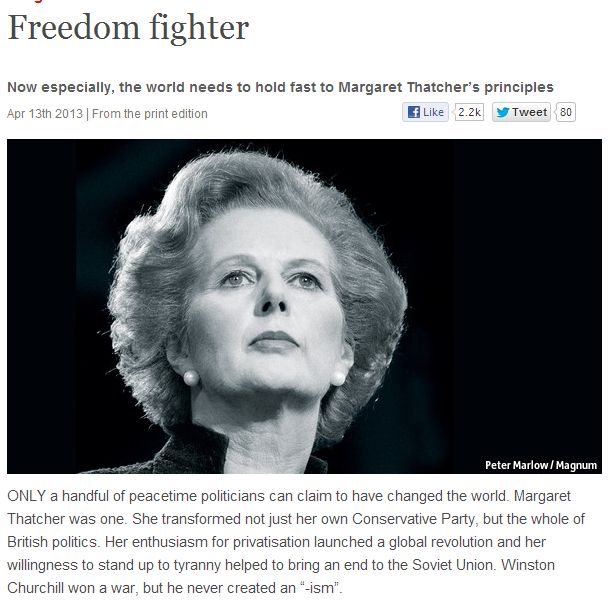
A great biography of an extraordinary life
Margaret Thatcher—The Authorised Biography,
Volume I: From Grantham to the Falklands. By Charles Moore.
her “No, No, No” to the single currency stirred a Tory rebellion
Statecraft
: Strategies for a Changing World
"I wanted to write one more book and I wanted it to be about the future. In this age of spin-doctors and soundbites, the ever present danger is that leaders will follow fashion and not their instincts and beliefs. That was not how the West won the Cold War, not how we created the basis for today's freedom and prosperity."
Margaret Thatcher was Great Britain's first woman
Prime Minister.
She came to office in May 1979 and remained until her
resignation in November 1990,
making her the longest serving British Prime
Minister in over 100 years.
|
Jfr Mrs. Thatcher |
- They are not more European than we are. They
are just more federal.
Mrs. Thatcher, June 27, 1991
Thatcher’s Bruges speech
Thatcher said: “And let me be quite clear. Britain does not dream of some cosy, isolated existence on the fringes of the European Community.
Our destiny is in Europe, as part of the community.”
FT 25 September 2018
Den lindrigt begåvade Ingvar Carlsson sökte medlemskap i EG,
därefter kom Maastricht och Ingvar Carlsson kämpade sedan sida vid sida med Carl Bildt
för ett svenskt medlemskap i EU, den Europeiska Unionen.
Englund 10 februari 2010
The bloody history of civil war in the Tory party and
The 1990 Tory coup against Margaret Thatcher
Tim Bale via Englund blog 27 Febr 2016
Tove Lifvendahl: Thatcher och Babylons expresståg
Det babyloniska expresståget har dessvärre kört på med hög hastighet.
Margaret Thatcher var en vän av det europeiska samarbetet i termer av att säkra fred och handel,
men hon var inte en vän av socialism, oavsett det kom i nationell eller unionsmässig skepnad.
Tove Lifvendahl, SvD ledarblog 14 oktober 2015
Margaret Thatcher hoppade inte. Det gjorde däremot ledarna för Sveriges riksdagspartier,
plus Feministiskt initiativ och minus Sverigedemokraterna, när de i helgen debatterade i RFSL:s regi.
Johan Ingerö SvD 7 augusti 2018
Upplägget var pinsamt för alla inblandade. RFSL lät de ej inbjudna Sverigedemokraterna företrädas på scenen av en uppblåsbar elefant.
Under debatten fick partiledarna ta ställning till ja- och nej-frågor genom att stå på led och vifta med varsin regnbågsflagga.
Att flera av dem såg djupt plågade ut förbättrade inte intrycket.
De ville framstå som toleranta, men framstod mest som dresserade.
De borde ha sagt "de här frågorna är viktiga och jag debatterar dem gärna, men på ett värdigt sätt och utan att håna någon som inte är inbjuden". Det hade ingett respekt.
Mer än något annat handlar 2010-talets politik om att vara äkta, även när det inte är populärt.
Väljarna vet mycket väl vilka som hoppar och vilka som låter bli. Så hoppa inte.
...
Elefanten i rummet är ett bildligt uttryck för något som är påtagligt för alla människor i en grupp,
men som man undviker att prata om.[1] Orsaken till att man håller tyst om "elefanten" kan vara att det skulle vara genant, förorsaka besvärliga diskussioner eller att ämnet är tabu.
Wikipedia
Det är sant att Arthur Scargill, ledare för gruvarbetarnas fackförbund National Union of Mineworkers (NUM), besegrades i en hård kamp under gruvstrejken 1984.
Scargill var kommunist fram till början av 60-talet då han gick med i labourpartiet.
Geoffrey Howe, vice premiärminister, var rasande över att Margaret Thatcher vägrade att sätta upp en tidtabell för att föra in Storbritannien i /eurons vänthall/ ERM
Nils Lundgren blog 15 april 2013
Han begärde personligen pengar från Moskva att smugglas ut via Polen för att finansiera sina verksamheter.
Scargill lät sig utnämnas till ordförande på livstid och lät NUM betala hyran för sin lägenhet i London, bortåt en halv miljon kr per år. Denna förmån skulle han ha till sin död och förmånen skulle sedan vara kvar för hans änka till hennes död. Han hade också stora ersättningar från NUM för sina lyxbilar. I rättegångar ifjol fråntogs han dessa förmåner.
Scargill lämnade labourpartiet och bildade år 1996 ett nytt parti, Socialist Labour Party.
Han har för detta parti ställt upp i val till underhuset, Wales nya parliament, Londons kommunalval och val till EU-parlamentet.
Han har normalt fått 1-2 procent utom en gång i Newport East, då han fick 5,2 procent i underhusvalet.
Margaret Thatcher vann däremot alla val till underhuset som hon ställde upp i som partiledare, 1979, 1983 och 1987.
När hon föll, var det inte det brittiska folket i val som fällde henne utan hennes egna regeringskolleger.
Framför allt Geoffrey Howe, vice premiärminister, var rasande över att Margaret Thatcher vägrade att sätta upp en tidtabell för att föra in Storbritannien i The Exchange Rate Mechanism,
dvs. det växelkurssamarbete som var ett krav för att kunna komma med i den planerade valutaunionen.
Before Lady Thatcher won her first election, she was asked at a meeting at Conservative Central Office whether it might be easier to pursue a “middle way”, a consensus driven approach more akin to the 1950s and 1960s (and which led ultimately to the failure of the 1970s).
She produced Mr Hayek’s The Constitution of Liberty from her handbag and, holding it up for all to see, said sternly: “This is what we believe,” before banging the book down on the table.
Kamal Ahmed, Daily Telegraph, 13 April 2013
Turning-points in history
Christian Caryl, a timely new book,
“Strange Rebels: 1979 and the Birth of the 21st Century”.
In it he argues that 1979 belongs to the select club of real turning-points: years in which one era ended and another was born.
The Economist, April 13th 2013, print
Her colleagues thought she was too anti-Europe.
After a series of fervid meetings and maneuvers while she was away, the members of her own party brought her down.
They were toppling a person who was their political and moral superior.
David Brooks, New York Times, April 8, 2013
Highly Recommended
They knew she had earned the right to face the country in an election one last time, rather than be deposed by the supposed lieutenants in her own party.
They sensed there would be some Shakespearean retribution for the act of disloyalty they were engaged in.
They went around rubbing their hands like Lady Macbeth trying to expunge the sin even as they were committing it.
She came back from Paris betrayed and red around the eyes. But she still had to lead a Question Time in the House of Commons, speaking for a government she no longer headed.
It was a triumph. She dominated the hall, crushed the hecklers and rose magnificently above her own misery.
The men who destroyed her leapt to their feet and roared.
Thatcher went down in full cry: “When good has to be upheld, when evil has to be overcome, Britain will take up arms!”
In effect, the Paris Summit was the peace conference of the Cold War
The Charter of Paris for a New Europe (also known as the Paris Charter) was adopted by a summit meeting of most European governments in addition to those of Canada, the United States and the Soviet Union, in Paris on 21 November 1990.
wikipedia
Family Photo from the conference
The Cold War was over.
As the Heads of State of the Conference on Security and Co-operation in Europe gathered in Paris for their second Summit,
they knew that the profound changes had swept across the continent
OSCE
By 1200 GMT, Chancellor John Major and Foreign Secretary Douglas Hurd had announced they would now stand against Mr Heseltine in the next stage of the leadership contest.
BBC 22 November 1990
Margaret Thatcher var en svart svan.
Genom att hennes gärning visade sig vara möjlig upphävdes en föreställning om samhällsutvecklingens nödvändighet som hade kommit att uppfattas som en politisk naturlag.
Det är detta som delar av vänstern än i dag inte kan förlåta henne. Hon rubbade deras cirklar. Hon tog deras självsäkerhet ifrån dem.
P J Anders Linder 14 april 2013
Black swan events were introduced by Nassim Nicholas Taleb in his 2004 book Fooled By Randomness,
which concerned financial events. His 2007 book (revised and completed in 2010) The Black Swan extended the metaphor to events outside of financial markets. Taleb regards almost all major scientific discoveries, historical events, and artistic accomplishments as "black swans"—undirected and unpredicted. He gives the rise of the Internet, the personal computer, World War I, Dissolution of the Soviet Union, and the September 11 attacks as examples of black swan events.
Wikipedia
Evaluating Thatcher's legacy
Twenty five
years to the day since she entered Downing Street, Margaret Thatcher remains a
controversial figure. To her supporters, she was a revolutionary figure who
transformed Britain's stagnant economy, tamed the unions and re-established the
country as a world power. Together with US presidents Reagan and Bush, she
helped bring about the end of the Cold War.
BBC 2/5
2004
UK was right not to join flawed euro, admits
Jacques Delors
M Delors, 78, also spoke with unexpected admiration of
Baroness Thatcher, his old nemesis. He said that she was a “figure who
counts” in British and European history, and the way her Conservative
colleagues dumped her was an example of the “atrocious” manner in
which male politicians treat female colleagues.
The Times 17/1 2004
One of the dominant voices of the 20th Century has
been silenced:
Baroness Thatcher has decided to follow doctors’ advice
and will never make a speech in public again.
The surprise announcement
yesterday marks the effective retirement from public life of the 76-year-old
former Prime Minister, who has suffered a series of slight strokes and whose
failing health has been a source of deep concern to family and friends.
Her
last speech was at a tribute evening for her old ally Ronald Reagan, who is
suffering from Alzheimer’s, in Washington, where she was given a rapturous
standing ovation by a 700-strong audience of leading Republicans.
The Times, March
23, 2002
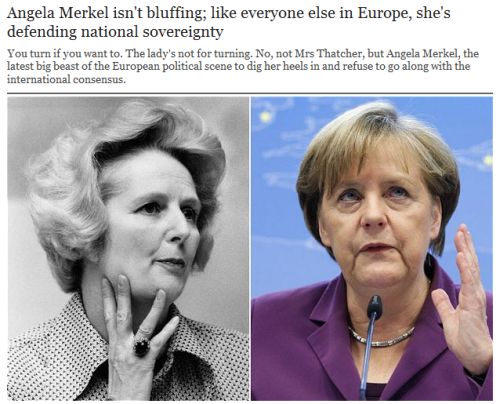
The parallels with /Mrs Merkel and/ Britain's own iron lady are striking, though obviously not exact.
Mrs Thatcher pledged to use the British veto to block monetary union.
I'm going to stand on the track and stop that train, she said. So she stood on the track and was duly run over by the EMU locomotive.
Jeremy Warner,Telegraph 27 June 2012
How far needs the resurgent capitalism that emerged in the 1980s,
under the leadership of Ronald Reagan in the US and Margaret Thatcher in the UK, to be reformed.
Financial Times, editorial, December 27, 2011
The answer is that it must be, for it has proved not just unstable, but, in important respects, unjust.
The result has not only been a devastating crisis, but also a sense that the achievement of extraordinary wealth may not reflect exceptional merit.
In societies that rely on consent, this is politically corrosive.
Den brittiska regeringschefen vann, bör man minnas, stöd för sin auktoritära kapitalism i demokratiska val,
EU fattar beslut utan att ens söka folklig och demokratisk legitimitet.
Unionens yttersta hierarki vill främst rädda euron – myntet som symboliserar ekonomiskt oförnuft, politisk hybris och som
slitit sönder Europa i rika och permanent fattiga delar.
Olle Svenning, Aftonbladet 11 mars 2012
The bloody history of civil war in the Tory party and
The 1990 Tory coup against Margaret Thatcher
Tim Bale via Englund blog 27 Febr 2016
This provided the occasion, incidentally, for the toppling of Margaret Thatcher:
her “No, No, No” to the single currency stirred a Tory rebellion.
Strange as it seems, British Conservatives were once mostly pro-Europeans.
Philip Stephens Financial Times 26 January 2012
"The Iron Lady" is the name of the new film in which Meryl Streep stars as Margaret Thatcher.
You have only to consider the title itself to understand the impact of the person portrayed.
Charles Moore, Wall Street Journal, 17 December 2011
Mr. Moore is the former editor of the Daily Telegraph, where he is now a columnist.
His authorized biography of Margaret Thatcher will not appear in her lifetime.
It helps explain why, in these hard times, she and her legacy arouse even more interest than they did in the boom era at the end of the 20th century.
And this Lady was first called "Iron" not by her admirers but by her enemies.
the Soviet Red Army newspaper Red Star christened her "The Iron Lady.
She was quite sophisticated enough to understand that nations can and sometimes must borrow and spend on a huge scale. She respected the teachings of John Maynard Keynes, while being highly suspicious of the subsequent generations of left-wing "Keynesians."
In 1988, her famous Bruges Speech, excoriated by all European leaders, warned of Europe's becoming "a narrow-minded, inward-looking club…ossified by endless regulation."
To her, Europe was much wider than the EU. It included all the countries of the east, then struggling to throw off communism. Her pro-Americanism came to the fore.
She spoke of "that Atlantic community—that Europe on both sides of the Atlantic—which is our noblest inheritance and our greatest strength."
Rolf Englund blog 26/11 2011
Is Margaret Thatcher winning in
Europe?
May 30th 2002 From The Economist print edition
Lady Thatcher is not heartless -
her critics are
By Tom Utley, Daily Telegraph 30/03/2002
Like love to hatred turned
The Economist, March 28th 2002
The lady turns
Financial
Times, editorial 2002-03-19
Thatcher insists Britain must
never join the 'doomed' euro
The Times March 19, 2002
“It can
never be right for Britain to abolish its currency. And it can never be right
for the Conservative Party to pretend otherwise.”
I would never give up the pound,
declares Thatcher
Daily Telegraph 2001-05-23
Is Margaret Thatcher
winning in Europe?
May 30th 2002 From The Economist print edition
A SPECTRE is haunting Europe, the spectre of Margaret Thatcher. These days Lady Thatcher, warned off public speaking by her doctors since she fell ill last autumn, is as silent as a ghost. But while her voice is no longer heard, her ideas continue to resonate through European politics.
Warnings about the dangerous spread of “Thatcherism” have again become a staple of left-wing politics across the European Union. In Spain, as trade unions gear up for a general strike this month just before a grand EU summit in Seville, they have attacked Jose Maria Aznar, the prime minister, for pursuing “the most reactionary policies of Margaret Thatcher”. In France, the Socialists have accused President Jacques Chirac of wanting to emulate “the iron lady” by “destroying public services”.
Of course, any political figure as vivid as Lady Thatcher is unlikely ever to disappear from the political lexicon. But Thatcherism remains so live an issue inside the EU because many of the battles she won in Britain, particularly over trade-union reform and privatisation, are still being fought out on the continent. Messrs Berlusconi and Aznar, among several other leaders, would love to “do a Thatcher” on their unions, but have provoked general strikes by broaching reforms of the labour market.
Left-wingers, meanwhile, fear the spread of what they see as an “ultra-liberal virus” from Britain. Much as British mothers once frightened their children with threats of “Boney” (Napoleon), so French Socialists now send chills down each other's spine with talk of Thatcher. When she came out in support of Chile's General Augusto Pinochet in his fight to avoid extradition from Britain a few years ago, it confirmed their feeling that it is but a short step from trade-union reform to torture.
There is, of course, a rich irony in all of this. When Mrs Thatcher was drummed out of office in 1990, it was largely because her attitude to Europe appalled many leading figures in her party. The iron lady had concluded that the Union posed an increasing threat to much of what she had achieved in Britain.
Over the past decade she has repeatedly made it clear that she feels that she was betrayed and deceived by those who convinced her to sign the Single European Act of 1986, which, in the name of creating a single market, ushered in a huge extension of majority voting within the EU and thus a big erosion of British (and every other EU country's) sovereignty.
So did the lady actually win—and just not notice her victory? Inevitably, it is more complicated than that. It is pretty clear that as prime minister she may have failed to understand that the ramifications of the Single European Act would go well beyond mere economic liberalisation. In Brussels, eager enthusiasts for more European integration on all fronts still cackle with amusement over how Mrs Thatcher was persuaded unwittingly to sign away so much sovereignty. It is also true that to achieve the single-market programme, the British had to concede the idea of a “social Europe” in the shape of a set of norms on everything from safety at work to the length of the working day.
Lady Thatcher is not
heartless - her critics are
By Tom Utley, Daily Telegraph 30/03/2002
Wrting in the Mirror, Tony Parsons greeted the news of Lady Thatcher's illness and her consequent retirement from speech-making with an article so vitriolic and spiteful, so fizzing with venom, that I feared for his sanity.
He described the former prime minister as a "heartless cow", a "shrill bully" who shed tears for nobody except for her "useless- bastard son" when he went missing in the desert. "This plastic patriot sent men to die and burn and be crippled in the Falklands. 'Rejoice, rejoice,' she shrieked, dry-eyed," he wrote. He concluded with the words: "Rot in hell, Maggie Thatcher."
The article was illustrated by a grotesque drawing, every line of it etched in hatred, showing Lady Thatcher with a large cork in her mouth. The cork was inscribed with the words: "And now stay shut up you mad old bat!"
Many of us columnists go over the top occasionally, in our efforts to hold our readers' attention, and my usual instinct is to forgive the odd burst of hyperbole. But when we consider that what prompted this vicious and idiotic tirade from Mr Parsons was the news that a 76-year-old woman had suffered several minor strokes, which had affected her once sharp mind, I do not see why we should forgive him.
Like love to hatred turned
The Economist, March 28th 2002
Since her dramatic ejection from the leadership of her party and the country in 1990, Margaret Thatcher has been indefatigable—never happier than when picking up an award or delivering a lecture on how she and Ronald Reagan (to whom this work is rather touchingly dedicated) fought and won the battle to save the world from Communism.
If “Statecraft” were just collected anecdotes, it would, even allowing for Lady Thatcher's characteristic spikiness, be the book that retired statesmen are supposed to write. But Lady Thatcher has more to say. Proud as she is of her record as a cold warrior, she is riven with guilt about her part in drawing Britain into an ever-closer relationship with the European Union.
Lady Thatcher has not hidden her mounting revulsion for Europe during the last decade, but the extent of her current apostasy is breathtaking. This is, after all, someone who was happy to serve in Ted Heath's cabinet when the arch-Europhile negotiated the terms of Britain's entry into the then EEC, who, as prime minister, appointed a succession of Euro-enthusiastic foreign secretaries, signed up to the Single European Act in 1986 and who, during her last weeks in power, took sterling into the exchange-rate mechanism.
The former premier feels so terrible about all this that she devotes about 100 pages to explaining how she could have got it so horribly wrong and why there is no hope for Britain unless a future Conservative government has the courage to pull out of a project that is not only doomed but fundamentally hostile to Britain's national interest.
The lady turns
Financial
Times, editorial 2002-03-19
Baroness Thatcher is certainly not one to shirk a good fight. Her former adversaries in the EU, such as Germany's Helmut Kohl, know that all too well. This time she has come out in her true colours to declare that Britain should start the process of withdrawing from the EU.
The next Conservative government should state at the outset its intention of fundamentally renegotiating the terms of UK membership of the Union, she says. The aim should be to quit the common agricultural policy, the fisheries policy and the common foreign and security policy and reassert national control of trade policy. That would play havoc with the single market and competition policy.
Her real aim is scarcely in question. Europe is "a monument to the vanity of intellectuals, a programme whose inevitable destiny is failure: only the scale of the final damage is in doubt", she says in her new book. It is time to think the unthinkable about quitting the EU. Lady Thatcher wants out.
It would be wrong to dismiss her outburst merely as the fury of a woman scorn'd. It reflects the frustration of a formidable prime minister who believes she was misled. For she must take much credit for a giant stride towards closer EU integration, in the shape of the single market.
Much in Lady Thatcher's analysis is correct. She knows a political project when she sees one.
Jfr Dagens Industri:
Frågan för
Sverige är inte om om en gemensam valuta är bra eller dålig
utan
om Sverige skall vara med i det europeiska samarbetet.
She is perfectly right when she describes Europe's single currency, its security and defence initiative and plans for a common judicial area and a constitution as adding up to "one of the most ambitious political projects of modern times". But she is wrong in concluding that it will inevitably become a fully fledged United States of Europe. A federation of nation states is a much more accurate description.
By arguing for what amounts to withdrawal, Lady Thatcher will not only undermine the Conservative party's commitment to constructive engagement, to the delight of Tony Blair. She would also renounce Britain's role in shaping the EU. That would do nothing to preserve British sovereignty in any more than token fashion. The EU will combine aspects of federalism and nation states and the UK must play a full part in defining it.
Thatcher insists
Britain must never join the 'doomed' euro
The Times March 19, 2002
“It can never be right for Britain to abolish its currency. And it
can never be right for the Conservative Party to pretend otherwise.”
BARONESS Thatcher insists that the European single currency will fail “economically, politically and socially” and says that Britain must never enter.
The former Prime Minister storms back on the attack with a warning that the euro is “nothing more or less than an instrument for forging a European superstate” and is not necessary for Britain to prosper and the City to thrive.
British News March 19, 2002 Thatcher insists Britain must never join the 'doomed' euro By Philip Webster, Political Editor BARONESS Thatcher insists that the European single currency will fail “economically, politically and socially” and says that Britain must never enter. The former Prime Minister storms back on the attack with a warning that the euro is “nothing more or less than an instrument for forging a European superstate” and is not necessary for Britain to prosper and the City to thrive. Story continues below advertisement ADVERTISEMENT Her latest onslaught, in her new book Statecraft being serialised in The Times, comes after she reignited passions over Europe with a call for Britain to begin negotiating its way out of the European Union.
In today’s extract she criticises the Tory party’s past “timidity” over the euro and urges it to rule it out for good — a policy that Iain Duncan Smith has adopted.
She turns her fire on previous leaders by attacking the “wait and see” policy on the euro adopted by John Major at the 1997 election and its successor at the 2001 election under William Hague of ruling out the euro for a parliament.
“This was not very logical. The principal arguments against Britain’s joining the single currency are not dependent on circumstances: they depend, rather, on matters of fundamental belief which cannot be glossed over if Conservatives wish to be taken seriously.”
I
would never give up the pound, declares Thatcher
Daily Telegraph
2001-05-23
LADY THATCHER thrust Europe to the centre of the election
campaign last night with
a
dramatic declaration that she would "never" give up the pound.
Although
giving strong backing to William Hague, she went well beyond official Tory
policy of only ruling out membership of the euro for the lifetime of the next
Parliament. The former prime minister, appearing alongside Mr Hague for the
first time in the campaign, said the key issue was whether Britain would remain
a free independent nation or would be absorbed into a federal Europe.
She received a rapturous reception from a rally of party workers in Plymouth.
Thatcher rouses Tories with mauling of Labour and Brussels Financial Times; May 23, 2001
Baroness Thatcher put Europe at the heart of the election last night, igniting what looks set to be a crucial campaign issue. Lady Thatcher, dressed in her trademark blue coat and pearl necklace, went further than the official Conservative policy of ruling out membership of the euro for the lifetime of the next parliament, launching an outspoken attack on Brussels "bureaucracy".
"The greatest issue in the election - indeed the greatest issue before our country - is whether Britain is to remain a free independent nation state or whether we are to be dissolved in a federal Europe," she said.
"To surrender the pound, to surrender our power of self-government would betray all the past generations down the ages that lived and died to defend it.
"It would also be to turn our back on America, leader of the English-speaking peoples to whom Europe, let's remember, owes its freedom."
She would "never be prepared" to lead Britain into the euro.
